Yerba Mate
Yerba mate is a caffeinated South American infusion of holly leaves. What IARC found about very hot drinks, what reviews of maté show, and the cautions that matter.
Content last updated . This page has not been medically reviewed.
Safety first. Natural products can cause side effects and interact with medicines. Read herbal tea and extract safety before you use anything on this page.
Yerba mate contains caffeine, so it is not a caffeine-free herbal tea. A 1995 poisoning report says the leaves of Ilex paraguariensis contain caffeine and theophylline, but a 2008 laboratory analysis of Brazilian leaf samples measured caffeine and theobromine and did not detect theophylline. [1][2] Measured caffeine in leaf extracts varied with the leaf and the growing system. [2] Very hot drinks of any kind are a separate concern: the International Agency for Research on Cancer (IARC, part of the WHO) concluded in 2016 that very hot beverages probably cause esophageal cancer. [3]
What yerba mate is
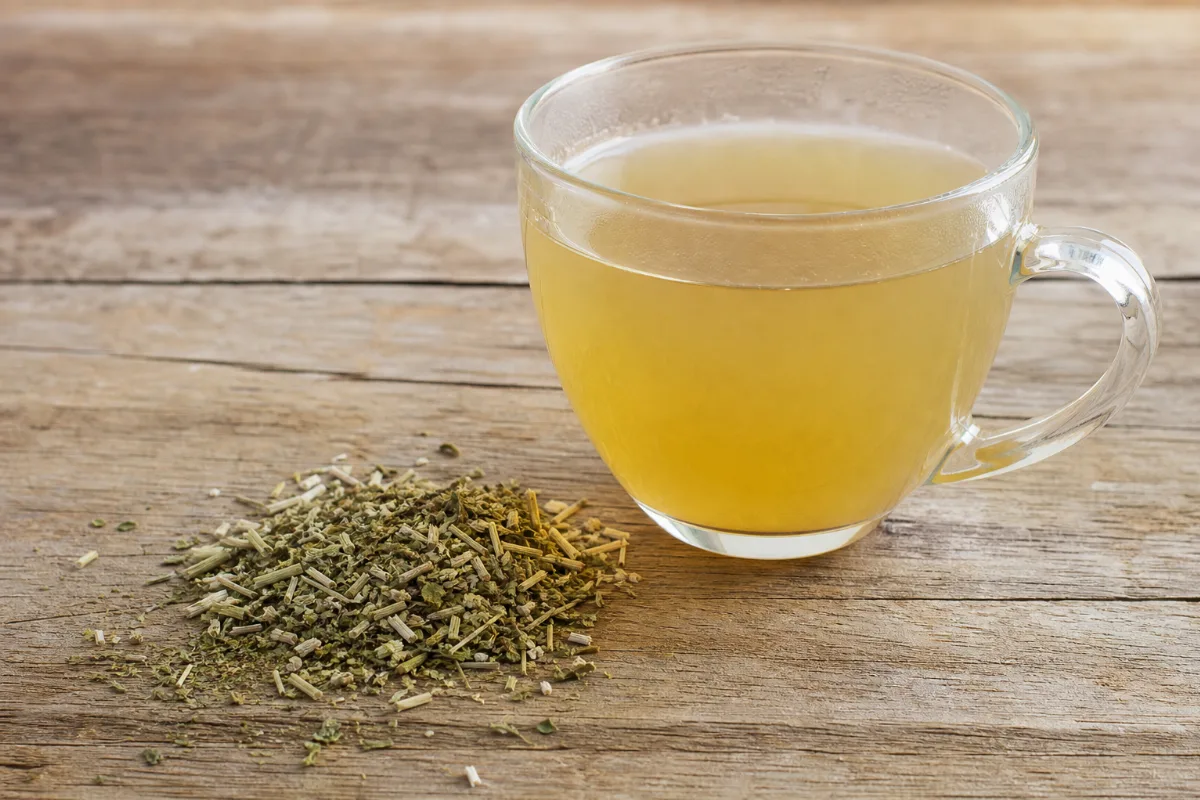
Yerba mate (maté) is an infusion made from dried leaves of Ilex paraguariensis A.St.-Hil., a holly in the family Aquifoliaceae. [4][3][1] It is drunk mostly in South America and to a lesser extent in the Middle East, Europe and North America. [3] Two South American ways of serving it are chimarrão, a partial infusion with hot water, and tereré, a total infusion with cold water. [5] IARC describes maté as traditionally drunk very hot through a metal straw, though it may also be drunk warm or cold. [6]For how a holly leaf drink differs from true tea, see Tisane vs Tea. For caffeine in other herbal teas, see Caffeine in Herbal Teas.
What the research shows
Traditional use here means everyday drinking in the regions above, not a medical claim. The studies below are about people and a drink, so each row says what form was studied.| Question | What the source found | Strength of evidence | Form and population |
|---|---|---|---|
| Very hot drinks and esophageal cancer | IARC classified very hot beverages as probably carcinogenic to humans (Group 2A), based on limited human and limited animal evidence. [3] | Limited evidence of harm | Hot drinks in general, including tea and maté, from studies in several countries |
| Maté at warm or cold temperatures | Not classifiable (Group 3), with inadequate evidence in humans. [3] | Insufficient evidence | Maté drunk warm or cold |
| Maté and esophageal cancer in South America | Ever-drinkers had higher odds than never-drinkers (1.60, range 1.2 to 2.2), rising with total amount drunk; the link was stronger at higher drinking temperatures. [7] | Observational association, not proof | 1,400 cases and 3,229 controls in South America |
| Metabolic health | A 2025 review of 13 randomized trials found no significant effect on cholesterol, fasting glucose, waist size or BMI; two trials in people with prediabetes suggested lower after-meal glucose and HbA1c, which the authors said needs confirming. [8] | Mixed, low certainty | Different maté preparations, not only tea |
| Wide range of benefits | A 2023 systematic review of 32 studies reported effects on metabolism, weight, mood and more, but most studies had a high risk of bias and certainty ranged from moderate to very low. [9] | Promising but limited | Mixed designs and preparations |
IARC explained that the temperature, not the drink itself, appears responsible. [3] It defined "very hot" as 65 °C or above, a figure drawn from animal studies and supported by real-world drinking temperatures. [6] The same Q&A says the typical drinking temperature for tea and coffee in most parts of the world is below 65 °C. [6] IARC noted that the proportion of esophageal cancers linked to very hot drinks is not known. [3] Letting any hot drink cool is consistent with that finding.
Smoke-drying of the leaves adds a second question. A review found that maté leaves are often smoke-dried, so commercial samples may contain high levels of polycyclic aromatic hydrocarbons (PAHs), though only some of these pass into the infusion (1 to 50 percent in the studies reviewed). [10] Whether PAHs or heat explain the cancer link is not settled in the sources we read.
What research found and what to check: Yerba Mate
Findings about drinking the tea itself, kept apart from capsules, extracts and concentrated supplements. Each card says what was studied, in whom, and how strong the evidence is.
Mate tea, blood pressure and blood fats (tea trials)
Preliminary or mixedIn an 8-week crossover trial of three servings a day of mate tea, blood pressure and some inflammation markers fell in all participants, but the hypercholesterolemic group's cholesterol change was similar to the control drink. An acute single-dose trial found no change in blood vessel function.
Supplements: Tea trials only; not the same as capsules or extracts.
Mate and blood sugar
Preliminary or mixedA 2025 review of 13 randomized trials of mate preparations found no significant effect on fasting glucose, cholesterol, waist size or BMI; two trials in people with prediabetes found lower after-meal glucose and HbA1c, which the authors say needs confirming.
Supplements: Mixed; results for extracts or other preparations do not carry over to a cup of tea.
Traditional use for tiredness (EU regulatory category)
Preliminary or mixedThe EU herbal committee accepts mate leaf tea as a traditional herbal medicine for symptoms of tiredness and a feeling of weakness, and to increase urine flow in minor urinary complaints, based on long-standing use only.
Supplements: Traditional-use status is not trial evidence.
Connected topics
Open a group to see how each topic connects and how strong the evidence is.
Health goals (3)
- Blood Sugar BalancePreliminary or mixed
Two trials in people with prediabetes found lower after-meal glucose and HbA1c; the authors say this needs confirming, and no effect was found on fasting glucose across all trials.
- Metabolic HealthPreliminary or mixed
Small tea trials and a 2025 review of 13 trials gave mixed results for metabolic markers; the evidence is not strong.
- Reduce FatiguePreliminary or mixed
The EU accepts mate leaf tea for tiredness only as a traditional use based on long-standing use, not trial proof.
Body systems (6)
- Digestive SystemDocumented risk
Very hot drinks, including mate, probably cause esophageal cancer (IARC); the EU monograph also lists stomach and duodenal ulcers as a caution.
- Cardiovascular SystemDocumented risk
Same caffeine-related cautions for blood pressure and heart rhythm as in the EU monograph.
- Heart & CirculationDocumented risk
The EU monograph lists high blood pressure and arrhythmia as reasons not to use mate; trial adverse events included fast heartbeat.
- Sleep & RecoveryDocumented risk
Caffeine can disturb sleep; the EU monograph says mate is not recommended before bedtime.
- Blood Sugar SupportPreliminary or mixed
Two prediabetes trials suggested lower after-meal glucose and HbA1c; needs confirming.
- Energy & FatiguePreliminary or mixed
Traditional-use category for tiredness only, per the EU monograph.
Body parts (3)
Functional actions (1)
- Blood Sugar RegulationPreliminary or mixed
Two small prediabetes trials suggested lower after-meal glucose; overall results were mixed.
Root causes (1)
- Medication Side EffectsDocumented risk
The EU monograph advises caution with MAO-inhibitor medicines and says caffeine adds to side effects of stimulant-type medicines.
Biomarkers (2)
- Blood GlucosePreliminary or mixed
After-meal glucose fell in two prediabetes trials, but fasting glucose did not change significantly across trials.
- HbA1cPreliminary or mixed
Two prediabetes trials in a 2025 review found lower HbA1c; needs confirming.
Conditions & symptoms (2)
- Esophageal NeoplasmsDocumented risk
IARC found that very hot drinks (65 °C or above) probably cause esophageal cancer, and mate is traditionally drunk very hot. Mate that is not very hot could not be classified.
- Prediabetes SyndromePreliminary or mixed
Two trials in people with prediabetes found lower after-meal glucose and HbA1c; the authors say this needs confirming and the preparations were not all tea.
Documented risks and interactions (8)
- Very hot mate and esophageal cancer. IARC found that drinking very hot beverages (65 °C or above, about 149 °F) probably causes esophageal cancer. Mate has traditionally been drunk very hot through a metal straw. Mate drunk warm or cold could not be classified.
- Caffeine in yerba mate tea. Yerba mate contains caffeine. In one trial the tea (3 g of leaf in 150 mL of boiling water, 5 minutes) gave about 22 mg of caffeine per serving. Traditional gourd drinking uses much more leaf, so intake can be far higher.
- Pregnancy and breastfeeding with mate. The EU monograph says mate should be avoided in pregnancy and breastfeeding because data are limited and caffeine crosses the placenta and enters breast milk. A case report linked heavy homemade mate to a jittery premature newborn. A cross-sectional study of 279 breastfeeding women found no change in the milk markers measured but did not test infant outcomes.
- Medicines, heart, ulcers and thyroid conditions. The EU monograph lists stomach or duodenal ulcers, high blood pressure, heart rhythm problems and an overactive thyroid as reasons not to use mate as a herbal medicine, advises caution with MAO-inhibitor medicines, and says caffeine-containing products reduce the calming effect of sedatives and add to side effects of stimulant-type medicines.
- Children and teenagers. The EU monograph does not recommend mate leaf tea under 18 years because of a lack of adequate data. The FDA, quoting the Dietary Guidelines, says caffeinated drinks should be avoided for children under 2.
- Smoke-dried leaf and PAH contamination. Mate leaves are often smoke-dried, so commercial dry samples can contain polycyclic aromatic hydrocarbons (PAHs); only 1 to 50 percent passed into the drink in the studies reviewed. A risk assessment found the margin of exposure for PAH was very low risk, while the temperature effect was not.
- Rare liver injury. NIH LiverTox calls yerba mate generally regarded as safe but linked to rare instances of clinically apparent liver injury.
- Mislabeled product poisoning (one old outbreak). In 1995, seven people in New York became ill after a tea labeled Paraguay Tea that tests showed contained belladonna alkaloids, not caffeine.
Frequently asked questions
Is yerba mate caffeine-free?
No. A report on Paraguay tea describes the leaves as containing caffeine, and lab work found caffeine in the leaf extracts. [1][2] The amount varies, so check the label and ask a clinician if caffeine is a concern.
Is hot yerba mate dangerous for the esophagus?
IARC found that very hot drinks (65 °C or above) probably cause esophageal cancer and that the temperature appears to be the cause; maté drunk warm or cold was not classifiable. [3][6]
Does yerba mate help with weight or blood sugar?
Evidence is mixed. A 2025 review found no significant effect on BMI or fasting glucose, with a possible effect on after-meal glucose in prediabetes that needs confirming. [8] A 2023 review reported wider effects but rated the certainty low. [9]
Is yerba mate safe while pregnant or breastfeeding?
We found no clear answer. One case report linked heavy maté intake to a jittery newborn, and a cross-sectional study did not test infant outcomes. [11][12] Ask a clinician.
Can I trust that a "yerba mate" product is what it says?
A 1995 outbreak involved a tea labeled "Paraguay Tea" that contained belladonna alkaloids instead. [1] See Herbal Tea Adulteration, Mold and Mislabeling.
More details: evidence, limits and cautions
The details behind this page: cautions, limits of the evidence and where sources disagree. Open any note to read it.
Safety
- Caffeine and heart rate. Trials in the 2025 review listed insomnia, tachycardia (fast heartbeat), angina, headache, mucosal irritation and stomach discomfort among adverse events. [8] People who are sensitive to caffeine, have heart rhythm problems or have trouble sleeping can ask a clinician about it. For caffeine and pregnancy see Coffee: Research Reviews, Caffeine and Pregnancy.
- Pregnancy and breastfeeding. A case report described a premature newborn with jitteriness and irritability whose mother drank homemade maté; high caffeine and theobromine levels were found in the baby and in breast milk. [11] A cross-sectional study of 279 breastfeeding women in Argentina found no changes in milk nutrients and biomarkers it measured, but it did not test infant outcomes. [12] Ask a clinician about maté in pregnancy and breastfeeding.
- Medicines. We did not find a source we could read on maté and specific medicines, so we make no claim. Ask a pharmacist, and see How Interactions Work.
- Mislabeled product. In 1995, seven people in New York City became ill with dry skin, high temperature, fast heartbeat, dilated pupils, agitation and hallucinations after drinking a tea labeled "Paraguay Tea". Lab tests found belladonna alkaloids and no caffeine, and unsold stock was quarantined. [1] This is one old outbreak, not a typical risk, and it is why labels and sources matter; see Quality Testing and Certifications. In the US, call Poison Help (1-800-222-1222) for poisoning questions, or 911 in an emergency.
- Children, older adults, liver and kidney conditions, surgery, allergy: not described in the sources we read.
What we could not find
References
- Hsu CK, Leo P, Shastry D, et al. Anticholinergic poisoning associated with herbal tea. Arch Intern Med. 1995;155(20):2245-8 Read 2026-10-23.
- Strassmann BB, Vieira AR, Pedrotti EL, et al. Quantitation of methylxanthinic alkaloids and phenolic compounds in mate (Ilex paraguariensis) and their effects on blood vessel formation in chick embryos. J Agric Food Chem. 2008;56(18):8348-53 Read 2026-10-23.
- International Agency for Research on Cancer (IARC, WHO). IARC Monographs evaluate drinking coffee, maté, and very hot beverages, press release, 15 June 2016 Read 2026-10-23.
- GBIF Secretariat. Ilex paraguariensis A.St.-Hil., GBIF Backbone Taxonomy Read 2026-10-23.
- Meinhart AD, Bizzotto CS, Ballus CA, et al. Methylxanthines and phenolics content extracted during the consumption of mate (Ilex paraguariensis St. Hil) beverages. J Agric Food Chem. 2010;58(4):2188-93 Read 2026-10-23.
- International Agency for Research on Cancer (IARC, WHO). Q&A on Monographs Volume 116: Coffee, maté, and very hot beverages, 2016 Read 2026-10-23.
- Lubin JH, De Stefani E, Abnet CC, et al. Maté drinking and esophageal squamous cell carcinoma in South America: pooled results from two large multicenter case-control studies. Cancer Epidemiol Biomarkers Prev. 2014;23(1):107-16 Read 2026-10-23.
- Li D, Yue L, Peng X, et al. Yerba Maté and its impact on glycemic control and metabolic health: a systematic review and meta-analysis. Front Endocrinol. 2025;16:1641592 Read 2026-10-23.
- José MFB, Machado RP, Araujo PAB, Speretta GF. Physiological effects of yerba maté (Ilex paraguariensis): a systematic review. Nutr Rev. 2023;81(9):1163-79 Read 2026-10-23.
- Oranuba E, Deng H, Peng J, et al. Polycyclic aromatic hydrocarbons as a potential source of carcinogenicity of mate. J Environ Sci Health C. 2019;37(1):26-41 Read 2026-10-23.
- Martín I, López-Vílchez MA, Mur A, et al. Neonatal withdrawal syndrome after chronic maternal drinking of mate. Ther Drug Monit. 2007;29(1):127-9 Read 2026-10-23.
- Scotta AV, Cortez MV, Orosz L, et al. Yerba mate as a safe polyphenolic source during human lactation (in Spanish). Rev Med Inst Mex Seguro Soc. 2022;60(5):524-32 Read 2026-10-23.