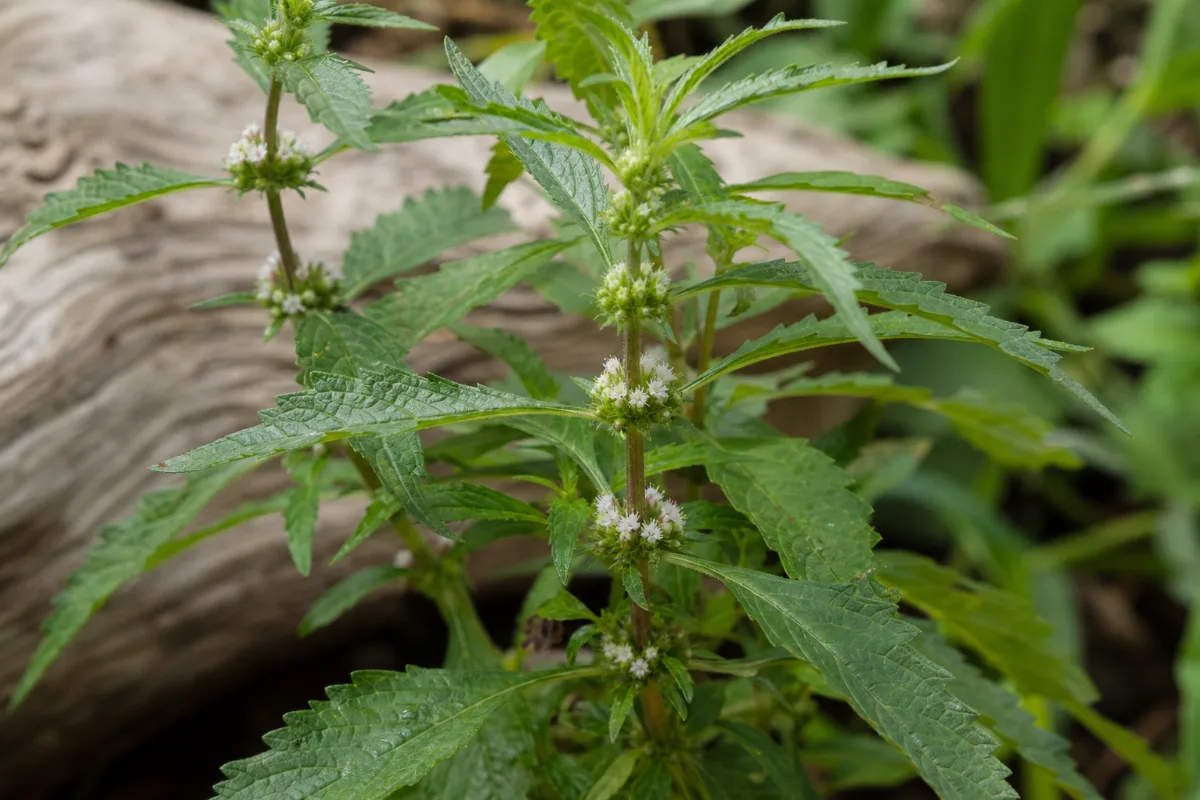
Herbs & Botanicals · Traditional thyroid herb
Bugleweed
Lycopus virginicus · also called Virginia water horehound, gypsywort (L. europaeus), gypsyweed, water horehound
Bugleweed is a mint-family plant whose leaves and flowers are used in herbal medicine for a mildly overactive thyroid and a racing heart. The human research is small and weak: a few open studies, mostly of the European cousin gypsywort, and two case reports. Bugleweed can lower thyroid activity, so it can clash with thyroid medicines and tests and should be avoided with an underactive thyroid and in pregnancy.
General information, not medical advice. Last substantive update · Not medically reviewed. A named clinician has not signed off on this page. How this page is made
About Bugleweed
Bugleweed is used for mild overactive thyroid symptoms. The evidence is very low in certainty, and it can lower thyroid activity. The main cautions are thyroid medicines, thyroid tests and scans, underactive thyroid, and pregnancy and breastfeeding.
Safety first
Thyroid medicines: consumer references say bugleweed, and lemon balm, may interfere with thyroid hormone medicines such as levothyroxine. No interaction study was found. Do not combine them unless your prescriber agrees. Do not swap a prescribed anti-thyroid drug for an herb.
Thyroid tests and scans: one reference says bugleweed may interfere with diagnostic procedures that use radioactive isotopes, such as radioiodine scans. Tell the testing team if you take it.
Underactive or enlarged thyroid: avoid. Both references say people with hypothyroidism should not use it, and one adds that long-term or high-dose use may enlarge the thyroid. Safety is described as not established.
Pregnancy and breastfeeding: avoid. No safety data were found, and an effect on milk supply is raised. No LactMed record was found.
Diabetes medicines: no interaction study was found. Changes in thyroid function can shift blood sugar, so ask your doctor or pharmacist about amounts and your medicines.
What it is
Bugleweed is Lycopus virginicus, a North American plant of the mint family. The aerial parts (leaf, stem and flower) are used. The European species Lycopus europaeus (gypsywort) is a separate accepted name and is often used in its place, and almost all human studies used that species.
It is often combined with lemon balm in thyroid products. Lemon balm blocked TSH binding in the same test-tube work.
What the research shows
Human studies: a 2008 open study and a 2013 survey of 403 people used a Lycopus europaeus extract in mild overactive thyroid. Symptoms improved more than in untreated people, but neither study had a placebo group or blinding. The 2013 product was branded, and the sponsor was not stated.
Case reports: a 2021 conference abstract describes two women with Graves' disease who stayed in normal range on bugleweed and lemon balm products. Graves' disease can ease by itself.
Lab and animal work: extracts blocked TSH and Graves' antibodies in test tubes and slowed T4-to-T3 conversion in rat liver. Results in rats differ by dose. This does not show what happens in people.
Regulatory status
We found no EMA/HMPC monograph, and no LiverTox, LactMed or NCCIH record. Our EMA check was blocked. This is not proof none exists. FDA, Commission E and WHO were not checked.
At a glance
Traditional uses history, not proof
- Mild overactive thyroid and a fast heartbeat
- Mild sedative and nervous restlessness
- Coughs, fever and mucus in colds
- Cyclic breast pain and premenstrual symptoms (proposed)
Studied for research
- Symptoms of mild overactive thyroid: very low
- Graves' disease (two case reports): insufficient
- Heart signs of excess thyroid hormone (rats): insufficient
- Thyroid hormone levels (lab and animal): very low
Main compounds
- Rosmarinic acid
- Caffeic acid
- Luteolin-7-glucoside
- Ellagic acid
Common forms
- Dried leaf and flower (tea)
- Tincture
- Standardised Lycopus europaeus extract (branded)
- Combination with lemon balm
Research links: Beer 2008: Lycopus europaeus, thyroid and symptoms (PubMed) · Eiling 2013: mild hyperthyroidism, 403 people (PubMed) · Vonhoff 2006: heart signs in rats (PubMed) · Kaplan 2021: two Graves' disease cases (Europe PMC) · Research Library · Genes & Biomarkers Library
The plant and its history
- Accepted scientific name
- Lycopus virginicus
- Naming authority
- L.
- Common names
- Bugleweed (en); Virginia water horehound (en); Gypsywort (L. europaeus) (en); Gypsyweed (L. europaeus) (en)
- Botanical family
- Lamiaceae (mint family)
- Classification
- Plantae > Tracheophyta > Magnoliopsida > Lamiales > Lamiaceae > Lycopus > Lycopus virginicus
- Native range
- North America (per EBSCO) for L. virginicus; L. europaeus is the European species. GBIF native range not read.
- Habitat
- Not found in the sources read.
- What the plant looks like
- Roots: Not found.; Stems: Not found.; Leaves: Long, thin leaves growing in pairs (EBSCO).; Flowers: Small whitish flowers around the stem at the base of each leaf pair (EBSCO).; Fruit: Not found.
- Cultivation
- Not found.
- Harvest and processing
- Aerial parts (leaf, stem, flower) are used (Drugs.com summary, via our earlier summary).
- Look-alikes and adulterants
- Name: Lycopus europaeus (gypsywort); Note: The European species; separate accepted name. Most human data are for it.; Name: Lemon balm (Melissa officinalis); Note: A different mint-family herb often combined with bugleweed.
- Sustainability and conservation
- Not found.
Traditional use and history history, not clinical proof
| Tradition or era | Documented use | Source |
|---|---|---|
| Herbalism in North America and Europe | Sedative, mild heart conditions, fever and mucus in colds, and mild overactive thyroid | s-ebsco-bugleweed |
| Roma use of European gypsywort | Juice reportedly used as a skin darkener; may be the origin of the name gypsywort (EBSCO says 'reportedly'). | s-ebsco-bugleweed |
| Late 20th century European phytotherapy | Extracts used for mild overactive thyroid symptoms | p23247973 |
Traditional use shows how a plant was used. It does not show that a supplement works or is safe today.
What is inside, and how it may work
What the plant contains and how those compounds act in cells and animals. Laboratory and animal mechanisms are not proven effects in people.
Main compounds
| Compound | Family | Where it is concentrated | Activity studied | Level of evidence |
|---|---|---|---|---|
| Rosmarinic acid PubChem 5281792 | phenolic acid | aerial parts (named in the 1995 abstract as a main component of L. europaeus extract) | Blocked the T4-to-T3 enzyme in rat liver preparations; oxidised forms blocked TSH binding in test tubes. 18 14 11 10 | Laboratory research |
| Caffeic acid PubChem 689043 | phenolic acid | aerial parts | After oxidation, blocked TSH binding to thyroid membranes in test tubes. 18 14 10 | Laboratory research |
| Luteolin-7-glucoside (luteolin is the related PubChem entry) PubChem 5280445 | flavonoid | aerial parts | Blocked the T4-to-T3 enzyme in rat liver preparations. CID given is for luteolin, the related aglycone, not the glucoside. 18 14 11 | Laboratory research |
| Lithospermic acid PubChem 6441498 | phenolic acid | not confirmed | Often named as a key Lycopus compound; its presence and activity were NOT confirmed in any abstract we read. 18 | Not verified |
| Ellagic acid | phenolic compound | aerial parts (named as present in the 1985 abstract) | Active in the rat enzyme work; oxidised ellagic acid blocked TSH binding in test tubes. 11 10 | Laboratory research |
Mechanisms, receptors and pathways
| Target or pathway | Gene or receptor | What was found | Level |
|---|---|---|---|
| TSH binding to the thyroid receptor | TSH receptor (TSHR) | Freeze-dried extracts of L. virginicus and L. europaeus blocked TSH from binding to human thyroid membranes by forming complexes with TSH; oxidised phenolic acids did the same. 12 10 | Laboratory research |
| Graves' antibodies | TSHR | Extracts and oxidised parts reduced the binding and thyroid-stimulating action of Graves' antibodies in test systems. 1 | Laboratory research |
| T4 to T3 conversion | Iodothyronine deiodinase | Extracts and rosmarinic acid, ellagic acid and luteolin-7-glucoside blocked the enzyme in rat liver preparations; by mouth in rats T3 fell for over 24 hours. 11 13 | Animal research |
| Heart beta-receptors | Beta-adrenoceptors | A low-dose extract lowered heart beta-receptor density in thyroxine-treated rats, close to atenolol; hormone levels did not change. 9 | Animal research |
| Kidney handling of T4 | Not known | More T4 was lost in urine in treated people; the authors suggest changes in the kidney filters or in re-absorption. 2 | Human open study |
Absorption, metabolism and elimination
- Absorption
- No human data were found. In rats an oral dose changed hormone levels, so some active parts are taken up.
- Distribution
- Not found.
- Metabolism
- A 1995 method paper studied rosmarinic acid, caffeic acid and luteolin-7-glucoside in isolated perfused rat liver; the abstract gives no metabolism results.
- Elimination
- One human study found extra T4 in urine; this is a hormone effect, not elimination of the herb.
- Bioavailability
- Not found.
Isolated compounds versus whole extracts
Test-tube work points to oxidised phenolic acids (caffeic and rosmarinic acid) as active parts, but whole extracts were what was studied in animals and people. Which part matters in a person is not known.
Nutritional composition
Bugleweed is a medicinal herb, not a source of any nutrient. It has no nutrient role we found.
2 very low certainty5 not enough evidence
What is Bugleweed good for?
The studied uses and how strong the evidence is. Nearly all human data are for the European species Lycopus europaeus, in small open studies without a placebo group.
Benefits, one by one
Each card is a research question, not a promise. Tap a goal to filter. Open a card to see the studies, doses and limits.
Symptoms of mild overactive thyroid
Very low certaintySmall open studies of a Lycopus europaeus extract in people with mild overactive thyroid report fewer symptoms, such as a lower heart rate in the morning. None had a placebo group, so the result is uncertain. Almost all the work is on the European plant (L. europaeus), not bugleweed (L. virginicus).
2 studiesDried herb (aerial parts) extracts of Lycopus europaeus, one branded …
Studies, doses and limits
What the trials found
Two open studies of L. europaeus extracts (one with 403 people) and two case reports of combination products. No placebo-controlled trial was found.
Results
In the 2008 open study, thyroid-linked symptoms eased and urine T4 loss rose. In the 2013 survey of 403 people, 72.6% (followed forward) and 96.5% (looked at after the fact) responded, against 41.2% of untreated people. No side effects were reported in the 2013 survey.
Effect sizes as reported
Responder rates 72.6% and 96.5% vs 41.2% untreated; urine T4 p=0.032
Why this rating
Very low: open, non-randomised, unblinded designs, product-specific extracts, a loose 'response' definition and no placebo group. The 41.2% response in untreated people shows how much improvement can happen without treatment.
Form and dose studied
Dried herb (aerial parts) extracts of Lycopus europaeus, one branded product. Amounts are for a doctor or pharmacist to decide, and thyroid levels need to be measured.
Who was studied
Adults with mild symptomatic overactive thyroid (low TSH).
Limits
Mostly L. europaeus, not L. virginicus. Short follow-up (4 weeks to 3 months). Possible manufacturer links in the branded-product survey. Serum thyroid hormone results were not seen in the abstracts.
Why researchers looked
The herb has long been used in Europe and North America for jumpy, fast-heart symptoms linked to a mildly overactive thyroid.
Traditional use
Traditionally used by herbalists for mild overactive thyroid, fast heartbeat and nervousness.
Proposed mechanism Preliminary mechanism
Test-tube and animal work suggests the extract may stop TSH from binding to thyroid cells and may slow the change of T4 into T3. In one human study more T4 was lost in the urine. How it works in people is not settled.
A proposed mechanism does not show that the effect happens in people.
Self-treating an overactive thyroid can be dangerous. A doctor needs to find out why the thyroid is overactive. See the safety tab.
Graves' disease (two case reports)
Not enough evidenceA 2021 conference abstract described two women with Graves' disease whose thyroid tests became normal while taking bugleweed and lemon balm products. Two cases cannot show that the herb caused the change.
2 studiesCombination bugleweed and lemon balm products (Thyrosoothe, a tinctur…
Studies, doses and limits
What the trials found
Two uncontrolled case reports (one woman with no symptoms, one who stopped methimazole because of raised liver enzymes).
Results
Case 1: TSH 0.02 to 1.89 mIU/L in three months and normal TSI. Case 2: TSI fell from 0.84 to 0.36 IU/L over 15 months. Both stayed in normal range on the products.
Effect sizes as reported
Not applicable (case reports)
Why this rating
Insufficient: two cases, no control, a conference abstract. Graves' disease can ease on its own, and one woman had no symptoms at the start.
Form and dose studied
Combination bugleweed and lemon balm products (Thyrosoothe, a tincture); strengths unknown. Amounts are for a doctor or pharmacist to decide, and thyroid levels need to be measured.
Who was studied
Two adult women with Graves' disease.
Limits
No control, no replication, products of unknown strength. The authors themselves call for more study.
Why researchers looked
Test-tube work found that Lycopus extracts reduced the action of the antibodies in Graves' disease.
Traditional use
Bugleweed and lemon balm are folk remedies for overactive thyroid.
Proposed mechanism Laboratory research
In test tubes, extracts and their oxidised parts reduced how well Graves' antibodies bound and switched on thyroid membranes.
A proposed mechanism does not show that the effect happens in people.
Graves' disease needs medical care. Do not replace prescribed treatment with an herb.
Fast heart rate and other body signs of excess thyroid hormone
Not enough evidenceIn rats given extra thyroxine, a low dose of Lycopus europaeus extract lowered heart rate, blood pressure and heart enlargement, close to the beta-blocker atenolol. This is animal work only.
2 studiesHydro-ethanolic extract of L. europaeus in rats. Not applicable to pe…
Studies, doses and limits
What the trials found
Rat study only. No human trial measured this on its own.
Results
Heart rate, blood pressure, heart size and body temperature were lowered in thyroxine-treated rats. Thyroid hormones and TSH did not change significantly.
Effect sizes as reported
Not applicable (animal)
Why this rating
Insufficient for people: animal data only. The human open study reported lower morning heart rate, but without a placebo group.
Form and dose studied
Hydro-ethanolic extract of L. europaeus in rats. Not applicable to people.
Who was studied
Rats
Limits
Animal study; unclear mechanism; low dose only.
Why researchers looked
People with mild overactive thyroid often notice a fast heartbeat. A rat study tested whether the extract helps with that.
Traditional use
Used by herbalists for palpitations and 'nervous heart'.
Proposed mechanism Animal research
The extract reduced the number of beta-receptors in heart tissue about as much as a beta-blocker, without changing thyroid hormone levels (rats).
A proposed mechanism does not show that the effect happens in people.
Do not use an herb to treat a fast heartbeat without finding the cause.
Effect on thyroid hormone levels
Very low certaintyAnimal and test-tube work shows Lycopus extracts can lower T3, T4 and TSH in some set-ups, and not in others. Human blood-level results were not available in the abstracts we read.
6 studiesL. europaeus and L. virginicus extracts in the lab. No dosing is give…
Studies, doses and limits
What the trials found
No usable human blood-level data in the abstracts. Rat results differ between studies.
Results
By mouth in rats the extract lowered T3 for over 24 hours and later lowered T4 and TSH (Winterhoff 1994). At a low dose in thyroxine-treated rats hormones did not change significantly (Vonhoff 2006). In test tubes extracts blocked TSH binding and the T4-to-T3 enzyme.
Effect sizes as reported
Not applicable
Why this rating
Very low: results come from rats and test tubes, and they conflict. The one human study measured urine T4 loss, not blood levels, in the abstract.
Form and dose studied
L. europaeus and L. virginicus extracts in the lab. No dosing is given here.
Who was studied
Rats and lab preparations
Limits
Large single doses in some rat work; test-tube concentrations not directly comparable to a person taking the herb.
Why researchers looked
The herb is said to lower thyroid activity, so researchers measured hormone levels.
Traditional use
Folk use for 'calming' an overactive thyroid.
Proposed mechanism In vitro and animal
Possible routes: blocking TSH binding, blocking T4-to-T3 conversion, or an effect on the pituitary. All shown in lab or animal work only.
A proposed mechanism does not show that the effect happens in people.
The effect could lower thyroid function in a person who does not need that. See the safety tab.
Cyclic breast pain and premenstrual symptoms
Not enough evidenceSome references say bugleweed may lower the hormone prolactin and has been suggested for cyclic breast pain and premenstrual symptoms. No trial was found. The same reference does not recommend it for this because of its thyroid effects.
2 studiesNot applicable
Studies, doses and limits
What the trials found
No human trial found. A consumer reference (EBSCO 2024) lists it as a proposed use.
Results
None to report.
Effect sizes as reported
Not applicable
Why this rating
Insufficient: no human data for this use.
Form and dose studied
Not applicable
Who was studied
Women (proposed use)
Limits
No trial; prolactin effect is only stated by a consumer reference.
Why researchers looked
Prolactin can contribute to breast pain, and lab work suggests Lycopus extracts affect some pituitary hormones.
Traditional use
Listed by herbalists for breast tenderness and premenstrual syndrome.
Proposed mechanism Animal research
The 1994 rat study reported lower LH after a Lycopus extract, which points to the pituitary; nothing on prolactin was in the abstract.
A proposed mechanism does not show that the effect happens in people.
Because the herb acts on the thyroid, it is not recommended for this use. See the safety tab.
Calming, sleep, anxiety, cough and nosebleed (traditional uses)
Not enough evidenceBugleweed was historically used as a mild sedative and for coughs, anxiety, poor sleep and nosebleeds. No good trials support these uses.
1 studiesNot applicable
Studies, doses and limits
What the trials found
No human trials found for these uses.
Results
EBSCO states these uses need more research.
Effect sizes as reported
Not applicable
Why this rating
Insufficient: traditional use only.
Form and dose studied
Not applicable
Who was studied
General adult users
Limits
No trial data.
Why researchers looked
Herbalists in Europe and North America used the plant for 'nerves', colds and mild heart troubles.
Traditional use
Traditionally a sedative, a cough herb, and a remedy for fever and mucus in colds.
Proposed mechanism None
Not established.
A proposed mechanism does not show that the effect happens in people.
Because of its thyroid effects, these uses are not a reason to try it.
Blood sugar (other Lycopus species, lab only)
Not enough evidenceA 2020 review names a different species, Lycopus lucidus, among natural products worth studying for diabetes. It gives no data on bugleweed itself.
1 studiesNot applicable
Studies, doses and limits
What the trials found
None for bugleweed.
Results
None for bugleweed.
Effect sizes as reported
Not applicable
Why this rating
Insufficient: a different species, narrative review, no clinical data.
Form and dose studied
Not applicable
Who was studied
None
Limits
Not bugleweed; no human data.
Why researchers looked
Related Lycopus species are being tested in the lab for sugar-handling pathways.
Traditional use
Not a recorded traditional use of bugleweed.
Proposed mechanism In vitro and animal review
Review suggests Lycopus lucidus extracts may act on TGF-beta signalling.
A proposed mechanism does not show that the effect happens in people.
Nothing is known about bugleweed with diabetes medicines. See the safety tab.
Connections to the rest of health
How Bugleweed connects to the rest of our health knowledge graph. Every link says what kind of connection it is. A safety link (for example to the liver) is a warning, not a benefit. A study that merely mentions a topic never creates a benefit link.
Explore every connection: goals, body systems, organs, symptoms, genes
A. Wellness goals
| Connected to | Kind of connection | Evidence status | Context | Studies |
|---|---|---|---|---|
| Thyroid Support | Very low certainty | Symptoms of mild overactive thyroid: Small open studies of a Lycopus europaeus extract in people with mild overactive thyroid report fewer symptoms, such as a lower heart rate in the morning. None had a placebo group, so the result is uncertain. Almost all the work is on the European plant (L. europaeus), not bugleweed (L. virginicus). | 2 6 | |
| Thyroid Support | Not enough evidence | Graves' disease (two case reports): A 2021 conference abstract described two women with Graves' disease whose thyroid tests became normal while taking bugleweed and lemon balm products. Two cases cannot show that the herb caused the change. | 8 1 | |
| Heart Health | Not enough evidence | Fast heart rate and other body signs of excess thyroid hormone: In rats given extra thyroxine, a low dose of Lycopus europaeus extract lowered heart rate, blood pressure and heart enlargement, close to the beta-blocker atenolol. This is animal work only. | 9 2 | |
| Thyroid Support | Not enough evidence | Fast heart rate and other body signs of excess thyroid hormone: In rats given extra thyroxine, a low dose of Lycopus europaeus extract lowered heart rate, blood pressure and heart enlargement, close to the beta-blocker atenolol. This is animal work only. Effect on thyroid hormone levels: Animal and test-tube work shows Lycopus extracts can lower T3, T4 and TSH in some set-ups, and not in others. Human blood-level results were not available in the abstracts we read. | 9 2 13 12 10 11 | |
| Womens Wellness | Traditional use | Not enough evidence | Cyclic breast pain and premenstrual symptoms: Some references say bugleweed may lower the hormone prolactin and has been suggested for cyclic breast pain and premenstrual symptoms. No trial was found. The same reference does not recommend it for this because of its thyroid effects. | 4 13 |
| Hormone Balance | Traditional use | Not enough evidence | Cyclic breast pain and premenstrual symptoms: Some references say bugleweed may lower the hormone prolactin and has been suggested for cyclic breast pain and premenstrual symptoms. No trial was found. The same reference does not recommend it for this because of its thyroid effects. | 4 13 |
| Calm Relaxation | Traditional use | Not enough evidence | Calming, sleep, anxiety, cough and nosebleed (traditional uses): Bugleweed was historically used as a mild sedative and for coughs, anxiety, poor sleep and nosebleeds. No good trials support these uses. | 4 |
| Anxiety Support | Traditional use | Not enough evidence | Calming, sleep, anxiety, cough and nosebleed (traditional uses): Bugleweed was historically used as a mild sedative and for coughs, anxiety, poor sleep and nosebleeds. No good trials support these uses. | 4 |
| Better Sleep | Traditional use | Not enough evidence | Calming, sleep, anxiety, cough and nosebleed (traditional uses): Bugleweed was historically used as a mild sedative and for coughs, anxiety, poor sleep and nosebleeds. No good trials support these uses. | 4 |
| Blood Sugar Balance | Not enough evidence | Blood sugar (other Lycopus species, lab only): A 2020 review names a different species, Lycopus lucidus, among natural products worth studying for diabetes. It gives no data on bugleweed itself. | 7 |
B. Body systems
| Connected to | Kind of connection | Evidence status | Context | Studies |
|---|---|---|---|---|
| Endocrine system | Adverse effect or risk | Consumer reference | Risk of lowering thyroid function; interferes with thyroid medicines and tests. Preparation or compound: Lycopus extracts |
4 3 |
| Hormone Health | Biological association | Very low certainty | Studied for: Symptoms of mild overactive thyroid Studied for: Graves' disease (two case reports) | 2 6 8 1 13 9 12 10 11 4 |
| Endocrine System | Biological association | Very low certainty | Studied for: Symptoms of mild overactive thyroid Studied for: Graves' disease (two case reports) | 2 6 8 1 9 13 12 10 11 |
| Heart Circulation | Biological association | Not enough evidence | Studied for: Fast heart rate and other body signs of excess thyroid hormone | 9 2 |
| Reproductive Health | Biological association | Not enough evidence | Studied for: Cyclic breast pain and premenstrual symptoms | 4 13 |
| Nervous System | Biological association | Not enough evidence | Studied for: Calming, sleep, anxiety, cough and nosebleed (traditional uses) | 4 |
| Respiratory System | Biological association | Not enough evidence | Studied for: Calming, sleep, anxiety, cough and nosebleed (traditional uses) | 4 |
| Blood Sugar Support | Biological association | Not enough evidence | Studied for: Blood sugar (other Lycopus species, lab only) | 7 |
I. Biomarkers
| Connected to | Kind of connection | Evidence status | Context | Studies |
|---|---|---|---|---|
| Resting heart rate in the morning | Biological association | Very low certainty | Measured in trials: decreased. A lab change is not the same as a health benefit. | 2 9 |
| Symptom response rate (mild overactive thyroid) | Biological association | Very low certainty | Measured in trials: increased. A lab change is not the same as a health benefit. | 6 |
| T4 lost in 24-hour urine | Biological association | Very low certainty | Measured in trials: increased. A lab change is not the same as a health benefit. | 2 |
| TSH (thyroid-stimulating hormone) | Biological association | Not enough evidence | Measured in trials: mixed. A lab change is not the same as a health benefit. | 8 13 9 |
| Thyroid-stimulating antibody (TSI) | Biological association | Not enough evidence | Measured in trials: decreased. A lab change is not the same as a health benefit. | 8 |
| Prolactin | Biological association | Not enough evidence | Measured in trials: unclear. A lab change is not the same as a health benefit. | 4 |
J. Genes, receptors and enzymes
| Connected to | Kind of connection | Evidence status | Context | Studies |
|---|---|---|---|---|
| TSH receptor | Preliminary mechanism | In vitro | Test-tube blocking of TSH and Graves' antibody binding. | 12 1 |
| Iodothyronine deiodinase | Preliminary mechanism | Animal | Slowed T4-to-T3 conversion in rat liver preparations. | 11 13 |
| Beta-adrenoceptor | Preliminary mechanism | Animal | Reduced receptor density in rat heart. | 9 |
L. Active compounds
| Connected to | Kind of connection | Evidence status | Context | Studies |
|---|---|---|---|---|
| Rosmarinic acid | Biological association | In vitro | Blocked the T4-to-T3 enzyme in rat liver preparations; oxidised forms blocked TSH binding in test tubes. Preparation or compound: aerial parts (named in the 1995 abstract as a main component of L. europaeus extract) |
18 14 11 10 |
| Caffeic acid | Biological association | In vitro | After oxidation, blocked TSH binding to thyroid membranes in test tubes. Preparation or compound: aerial parts |
18 14 10 |
| Luteolin-7-glucoside (luteolin is the related PubChem entry) | Biological association | In vitro | Blocked the T4-to-T3 enzyme in rat liver preparations. CID given is for luteolin, the related aglycone, not the glucoside. Preparation or compound: aerial parts |
18 14 11 |
| Lithospermic acid | Biological association | Not verified | Often named as a key Lycopus compound; its presence and activity were NOT confirmed in any abstract we read. Preparation or compound: not confirmed |
18 |
| Ellagic acid | Biological association | In vitro | Active in the rat enzyme work; oxidised ellagic acid blocked TSH binding in test tubes. Preparation or compound: aerial parts (named as present in the 1985 abstract) |
11 10 |
Each connection is stored with the ingredient, the connected record, the kind of connection, the evidence status, the supporting studies, the preparation or compound involved, and a review date (last reviewed October 25, 2026).
Evidence at a glance: what changed in 1 lab markers
Tap a number to show only those markers. Counts are markers, not people.
The evidence
The research centre for Bugleweed. Every record here was checked against PubMed or the publisher's page; we never list a study we have not verified.
Evidence by outcome
Bars show how many studies we found for each outcome, not how well it works. People are added up across trials only (reviews are not added, to avoid double counting).
How we rate evidence
High certainty
Several well-run trials or reviews agree; further research is unlikely to change the picture much.
Moderate certainty
Good trials point the same way, but some doubt remains.
Low certainty
Small, short or inconsistent trials. The finding could change with better research.
Very low certainty
Very little or very weak human data. Treat as a possibility only.
Mixed findings
Trials or reviews disagree with each other.
Not enough evidence
Not enough human research to say either way.
Evidence against
Good research found no benefit, or found harm.
We take the reviewers' own risk-of-bias and GRADE statements where they exist, and otherwise judge from study size, design, consistency, directness and whether a product matches what is sold. Many publications do not make evidence high. Method note: We read our existing herb summary, searched PubMed, read the abstract of each PubMed record cited, and checked names in GBIF and NCBI Taxonomy and compounds in PubChem. Regulator pages that could not be opened are marked not found or not verified.
Study library: every study we checked 18
| Study | Design | People | Product, dose, length | Result |
|---|---|---|---|---|
| Auf'mkolk 1985 Extracts and auto-oxidized constituents of certain plants inhibit the receptor-binding and the biological activity of Graves' immunoglobulins. Endocrinology · PMID 2985357 · DOI |
Laboratory research in vitro |
Human thyroid membranes with immunoglobulin from people with Graves' disease | Freeze-dried extracts of Lycopus virginicus, L. europaeus, Melissa officinalis and Lithospermum officinale aerial parts (extracts) not given here laboratory · vs extracts without antithyrotropic activity |
Extracts and their oxidised parts reduced the binding and thyroid-stimulating action of Graves' antibodies in test systems. Not applicable (None) Methods, limits and fundingOutcomes: Binding and action of Graves' antibodies Limitations: Test-tube and mouse-assay work only; no patients were treated. Funding and conflicts: Not stated in abstract Read: abstract |
| Beer 2008 Lycopus europaeus (Gypsywort): effects on the thyroidal parameters and symptoms associated with thyroid function. Phytomedicine · PMID 18083505 · DOI |
Open prospective two arm |
People with low TSH (under 1.0 mU/l) and symptoms linked to an overactive thyroid; group size not stated in the abstract | Lycopi europaei herba (Lycopus europaeus herb) preparation aerial parts (herb) not stated in abstract (not given here) 3-month follow-up · vs comparison arm in an open design (details not in abstract) |
Urine T4 loss rose significantly in treated patients (p=0.032). Thyroid-linked symptoms eased, for example the fast heart rate in the morning. Tolerability was described as good. The authors suggest the kidneys may be involved, either through the filters or through poorer re-absorption. Urine T4 excretion p=0.032; no effect sizes or hormone levels in abstract (None) Methods, limits and fundingOutcomes: Urine T3/T4 loss over 24 hours (primary); other hormones, general condition and thyroid-linked symptoms (secondary) Limitations: Open, not blinded, no placebo. Sample size, extract and serum TSH/T3/T4 results are not in the abstract (we read the abstract only). The study was of Lycopus europaeus, not L. virginicus. Funding and conflicts: Not stated in abstract Read: abstract |
| Drugs.com 2015 Bugleweed (Drugs.com Natural Products) Drugs.com consumer reference · Source |
Consumer reference |
unspecified |
NOT re-opened on 2026-10-25 (page returned HTTP 403 to our request). Summary-only, from our existing herb summary: Drugs.com says bugleweed (and lemon balm) may interfere with thyroid hormone medicines such as levothyroxine; warns that use by healthy people or heavy use in people with thyroid disease may harmfully lower thyroid function; advises against use in pregnancy, breastfeeding and underactive thyroid. It also says long-term use in overactive thyroid is considered safe (citing a 1988 text), which disagrees with the other sources. Methods, limits and fundingLimitations: Summary-only (not re-read). Consumer reference last reviewed 2015 in our summary. Its sources disagree with EBSCO on long-term safety. Read: summary-only | |
| EBSCO CAM Review Board 2024 Bugleweed's therapeutic uses EBSCO Research Starters · Source |
Consumer reference |
unspecified |
Read 2026-10-25. Says several small, older, preliminary studies suggest bugleweed may help mild overactive thyroid and that older small double-blind trials suggested lower TSH (these trials are not named, so we could not check them). Safety is 'not established'; long-term or high use may enlarge the thyroid. Advises against use with underactive or enlarged thyroid, in pregnancy and while breastfeeding, and against combining with thyroid medicines. Says it may interfere with diagnostic procedures that use radioactive isotopes to look at the thyroid. Says bugleweed may lower prolactin but is not recommended for breast pain because of the thyroid effect. Lists sedative, heart, fever, cough, anxiety, insomnia and nosebleed as traditional or other suggested uses. Methods, limits and fundingLimitations: Secondary consumer reference, cites older sources (for example a 1990 naturopathic journal) and does not name the trials. Not a primary source. Read: full-text | |
| EMA 2026 Regulators and safety databases: EMA/HMPC, LiverTox, LactMed, NCCIH Regulator search record · Source |
Not found |
unspecified |
On 2026-10-25 an EMA search page returned HTTP 401 (blocked), and an NCBI Bookshelf search for bugleweed or Lycopus found no LiverTox or LactMed entry (only unrelated books). Our earlier herb summary also noted that no EU HMPC monograph, NCCIH, MSK or MedlinePlus page was found or readable. No guess is made of what these bodies would say. Methods, limits and fundingLimitations: Not found is not proof none exists. No regulator position on bugleweed is confirmed. Read: not-found | |
| Eiling 2013 [Improvement of symptoms in mild hyperthyroidism with an extract of Lycopus europaeus (Thyreogutt® mono)]. Wien Med Wochenschr · PMID 23247973 · DOI |
Open post marketing surveillance 3 cohorts |
403 Adults with mild symptomatic overactive thyroid; 146 followed forward, 171 looked at after the fact, 86 untreated controls |
Lycopus europaeus extract (Thyreogutt mono, tablets or drops) aerial parts (extract) not stated in abstract (not given here) 4 weeks · vs no-treatment control cohort (86 people) |
Responder rate was 72.6% (followed forward), 96.5% (looked at after the fact) and 41.2% in the untreated group. No side effects were reported. Responders 72.6% / 96.5% vs 41.2% untreated (None) Methods, limits and fundingOutcomes: Response = normal thyroid hormone values at the end, or at least 20% fewer symptoms Limitations: Not randomised, not blinded, no placebo. Two of the three groups were assessed after the fact. A broad 'response' definition (hormones normal OR 20% fewer symptoms) can be met by chance changes. A branded product was studied. Read in abstract only. Original paper is in German. Funding and conflicts: Sponsor not stated in the abstract; the study is a post-marketing survey of a branded product, so manufacturer involvement is possible and was not checked. Read: abstract |
| Heydarpour 2020 Involvement of TGF-β and Autophagy Pathways in Pathogenesis of Diabetes: A Comprehensive Review on Biological and Pharmacological Insights. Front Pharmacol · PMID 33041786 · DOI |
Narrative review review of lab work |
Review of signalling pathways in diabetes | Mentions Lycopus lucidus extracts, a different species, among natural products to study other species (extract) not applicable not applicable |
The review lists Lycopus lucidus extract as a possible future candidate that acts on TGF-beta signalling in diabetes. It does not report any bugleweed (L. virginicus or L. europaeus) data. Not applicable (None) Methods, limits and fundingOutcomes: Pathways in diabetes (TGF-beta and autophagy) Limitations: Different species, narrative review, no human or clinical data on bugleweed. Funding and conflicts: Not stated in abstract Read: abstract |
| Kaplan 2021 Two Cases of Graves' Hyperthyroidism Treated With Homeopathic Remedies Containing Herbal Extracts from Lycopus spp. and Melissa officinalis Journal of the Endocrine Society (conference abstract) · Source |
Case report |
Bugleweed (Lycopus) and lemon balm combination products (Thyrosoothe; a tincture) herb extracts |
Read the abstract (Europe PMC record of PMC8090196). Case 1: a 64-year-old woman with Graves' disease who had no symptoms. Her TSH rose from 0.02 to 1.89 mIU/L over three months while on a bugleweed plus lemon balm product (Thyrosoothe), and her thyroid stimulating antibody (TSI) returned to normal; she took it for 9 months. Case 2: a 46-year-old woman stopped methimazole because of raised liver enzymes (transaminitis) and took a bugleweed plus lemon balm tincture; she stayed in normal range and TSI fell from 0.84 to 0.36 IU/L after 15 months. The authors say further study is needed. Methods, limits and fundingLimitations: Two cases, no control, a conference abstract, products of unknown strength described as 'homeopathic'. Graves' disease can ease on its own. Not peer-reviewed as a full paper. Read: abstract (via Europe PMC) | |
| Vonhoff 2006 Extract of Lycopus europaeus L. reduces cardiac signs of hyperthyroidism in rats. Life Sci · PMID 16150466 · DOI |
Animal experiment rat |
Rats given thyroxine to mimic overactive thyroid | Hydro-ethanolic Lycopus europaeus extract (low dose); atenolol as reference drug aerial parts (extract) not given here 5.5 weeks of co-treatment · vs thyroxine-treated rats; atenolol |
The extract lowered raised body temperature, heart rate and blood pressure and eased heart enlargement. Heart beta-receptor numbers fell, almost as much as with the beta-blocker. Thyroid hormone and TSH levels did not change significantly. The authors say the way it works is unclear. Not applicable (animal) (None) Methods, limits and fundingOutcomes: Body temperature, heart rate, blood pressure, heart size, beta-receptor density, thyroid hormones, TSH Limitations: Animal study only; cannot be applied to people. Low-dose extract of L. europaeus. Funding and conflicts: Not stated in abstract Read: abstract |
| p3987612 The active principles of plant extracts with antithyrotropic activity: oxidation products of derivatives of 3,4-dihydroxycinnamic acid. · Source |
Laboratory research in vitro |
Methods, limits and fundingRead: abstract (truncated at 400 words) | ||
| p6724503 Antihormonal effects of plant extracts: iodothyronine deiodinase of rat liver is inhibited by extracts and secondary metabolites of plants. · Source |
Laboratory research rat / in vitro |
Methods, limits and fundingRead: abstract | ||
| p6745167 Inhibition by certain plant extracts of the binding and adenylate cyclase stimulatory effect of bovine thyrotropin in human thyroid membranes. · Source |
Laboratory research in vitro |
Methods, limits and fundingRead: abstract (truncated at 400 words) | ||
| p8135877 Endocrine effects of Lycopus europaeus L. following oral application. · Source |
Animal experiment rat |
Methods, limits and fundingRead: abstract | ||
| p8520679 Analysis of the components of Lycopus europaeus L. in body fluids during metabolism studies. Comparison of capillary electrophoresis and high-performance liquid chromatography. · Source |
Method paper animal rat |
Methods, limits and fundingRead: abstract | ||
| s-gbif-le GBIF species record: Lycopus europaeus L. · Source |
Authoritative guidance |
Methods, limits and fundingRead: full-text | ||
| s-gbif-lv GBIF species record: Lycopus virginicus L. · Source |
Authoritative guidance |
Methods, limits and fundingRead: full-text | ||
| s-ncbi-tax-lycopus NCBI Taxonomy: Lycopus virginicus (taxid 1620142) and Lycopus europaeus (taxid 260603) · Source |
Authoritative guidance |
Methods, limits and fundingRead: full-text | ||
| s-pubchem-bugleweed PubChem compound records: rosmarinic acid, caffeic acid, luteolin, lithospermic acid · Source |
Authoritative guidance |
Methods, limits and fundingRead: full-text |
What we do not know yet
- No placebo-controlled trial of bugleweed (Lycopus virginicus).
- Human studies used one branded extract of the European species and open designs.
- No interaction study with thyroid medicines or radioiodine.
- No pregnancy, breastfeeding, liver or long-term safety data.
- No regulator monograph found.
How new research is added
New studies are found by a saved PubMed search and placed in a review queue. A person reads each one before it changes any rating or safety wording.
Lab markers
What changed in blood or saliva tests during trials. A changed number is not the same as feeling or being healthier, and we give no "normal ranges".
Hormonal 2
TSH (thyroid-stimulating hormone)
Mixed results in trials
The pituitary signal that tells the thyroid to make hormone. A low TSH usually means an overactive thyroid.
Not enough evidenceResults and what it means
Why it was measured
The main blood test for thyroid function.
Statistical vs. clinical meaning
Results differ between animals and one human case; no controlled human data in the abstracts we read.
Safety implication
Thyroid blood tests are needed to know the effect in any person. The herb can also make test results harder to read.
| Study | Result | People | Product |
|---|---|---|---|
| 8 | TSH moved from 0.02 to 1.89 mIU/L in one woman over three months | Case 1, Graves' disease | Bugleweed plus lemon balm product |
| 13 | TSH fell 24 hours after a tube dose in rats; number not in abstract | Rats | Ethanolic L. europaeus extract |
| 9 | No significant TSH change in thyroxine-treated rats | Rats | Low-dose L. europaeus extract |
Prolactin
Unclear in trials
A pituitary hormone that drives milk production and can be linked to breast tenderness.
Not enough evidenceResults and what it means
Why it was measured
Proposed mechanism for breast pain and effects on milk supply.
Statistical vs. clinical meaning
A consumer reference says bugleweed may lower prolactin; no study was found that measured it.
Safety implication
A possible effect on milk supply is one reason to avoid it while breastfeeding.
Other 4
Resting heart rate in the morning
Decreased in trials
How fast the heart beats on waking. Fast beats are a common sign of too much thyroid hormone.
Very low certaintyResults and what it means
Why it was measured
Used to track one of the main symptoms of an overactive thyroid.
Statistical vs. clinical meaning
Reported as an eased symptom in an open study. No placebo group, so it cannot be credited to the herb.
Safety implication
A fast heart rate can have causes other than the thyroid and needs a proper check.
| Study | Result | People | Product |
|---|---|---|---|
| 2 | Morning heart rate was lower in treated people; number not in abstract | People with low TSH and thyroid-linked symptoms | Lycopus europaeus herb preparation, open study |
| 9 | Heart rate lowered in thyroxine-treated rats; number not in abstract | Rats | Low-dose L. europaeus extract, atenolol as reference |
Symptom response rate (mild overactive thyroid)
Increased in trials
The share of people whose thyroid values went to normal or whose symptom count fell by at least 20%.
Very low certaintyResults and what it means
Why it was measured
A simple way to count who improved in a practice-based survey.
Statistical vs. clinical meaning
Higher than untreated, but not randomised or blinded, and the untreated group also improved a lot.
Safety implication
No adverse events were reported in the abstract.
| Study | Result | People | Product |
|---|---|---|---|
| 6 | Responder rate 72.6% (followed forward), 96.5% (looked at after the fact), 41.2% untreated | 403 people with mild symptomatic overactive thyroid | Lycopus europaeus extract (Thyreogutt mono) for 4 weeks vs no treatment |
T4 lost in 24-hour urine
Increased in trials
How much thyroxine (T4) leaves the body in urine over a day.
Very low certaintyResults and what it means
Why it was measured
The 2008 study used it as a direct measure of what the herb does.
Statistical vs. clinical meaning
Statistically significant in a small open study; the meaning for health is unclear.
Safety implication
Losing more T4 could in theory lower thyroid function.
| Study | Result | People | Product |
|---|---|---|---|
| 2 | Urinary T4 excretion significantly higher in treated people (p=0.032); amount not in abstract | People with low TSH and thyroid-linked symptoms | Lycopus europaeus herb preparation, 3 months |
Thyroid-stimulating antibody (TSI)
Decreased in trials
An antibody that switches the thyroid on in Graves' disease.
Not enough evidenceResults and what it means
Why it was measured
Tracks the immune cause of Graves' disease.
Statistical vs. clinical meaning
Two uncontrolled cases only.
Safety implication
Graves' disease needs monitoring by a doctor.
| Study | Result | People | Product |
|---|---|---|---|
| 8 | TSI normal after treatment in case 1; fell from 0.84 to 0.36 IU/L in case 2 | Two women with Graves' disease | Bugleweed plus lemon balm products |
Safety
What studies and official sources say about side effects, medicines and who should check first. Each point shows what kind of evidence it comes from.
Main points to know 5
- Thyroid medicines: do not combine without your prescriber. Consumer references (EBSCO 2024; Drugs.com, via our earlier summary) say bugleweed, and lemon balm, may interfere with thyroid hormone medicines such as levothyroxine, and advise against combining. No clinical interaction study was found. The concern is that the herb is described as lowering thyroid activity, which could clash with any thyroid drug. Consumer reference 4 3
- Thyroid tests and radioiodine scans. EBSCO says bugleweed may interfere with diagnostic procedures that use radioactive isotopes, such as radioiodine uptake scans, and that thyroid function tests should only go ahead with a physician's advice if you take it. Only one consumer source says this. Tell the testing team about any bugleweed before a thyroid test or scan. Consumer reference 4
- Underactive thyroid and enlarged thyroid: avoid. Both consumer references say people with an underactive thyroid (hypothyroidism) should not use bugleweed, and EBSCO adds people with an already enlarged thyroid. EBSCO also says long-term or high-dose use may enlarge the thyroid. In animals and test tubes the extract lowers thyroid hormone or TSH action in some set-ups, which fits this warning. Consumer reference 4 3 13
- Pregnancy and breastfeeding: avoid. Both consumer references say to avoid bugleweed in pregnancy and while breastfeeding. EBSCO points to possible effects on the baby and on milk supply. No pregnancy, breastfeeding or LactMed data were found. Consumer reference 4 3 5
- Safety is not established. EBSCO says the safety of bugleweed has not been established. The Drugs.com summary says long-term use in overactive thyroid is considered safe (citing a 1988 text) while also warning of harmful thyroid suppression. These sources disagree, so the cautions above are the careful reading. Consumer reference 4 3
Side effects 5
| Effect | How often | Severity and recovery | Evidence |
|---|---|---|---|
| No side effects reported in the 2013 survey Open survey of one L. europaeus extract; short time; weak at finding rare harms. | 0 reported among 403 people (4 weeks) | not applicable not applicable | Observational 6 |
| Good tolerance described in the 2008 open study Abstract only says the preparation was well tolerated. | not stated in abstract | not stated not stated | Observational 2 |
| Too little thyroid hormone (low thyroid function) A concern for healthy people, for people on thyroid drugs, and for heavy use; no case series was found. | unknown | potentially harmful (consumer reference) unknown | Consumer reference 4 3 |
| Enlarged thyroid with long-term or high use Stated by EBSCO; primary evidence not named. | unknown | unknown unknown | Consumer reference 4 |
| Raised liver enzymes In case 2 the raised liver enzymes were attributed to methimazole, which she stopped; they were not attributed to the herb. | not applicable | not applicable resolved in the case | Case report 8 |
Liver
No liver injury linked to bugleweed was found in the sources we read, and no LiverTox record was found. The Graves' case report mentions raised liver enzymes on methimazole, not on the herb. Absence of reports is not proof of safety. 5 8
How often. Unknown.
Monitoring. No specific advice from a source we read. Tell your doctor if you develop yellow skin or eyes, dark urine or pale stools.
This is a safety connection. It is not evidence that Bugleweed supports liver health.
Medicines and supplements 7
| With | Why it matters | Importance | Evidence | What to do |
|---|---|---|---|---|
| Thyroid hormone medicines (levothyroxine, liothyronine) drug | The herb is described as lowering thyroid activity; test-tube and rat work shows blocked TSH binding and slower T4-to-T3 conversion. | Could work against thyroid replacement and upset dose balance. No clinical interaction study found. | Consumer reference Low certainty 4 3 11 | Do not combine without your prescriber. Thyroid blood tests may be needed. |
| Anti-thyroid drugs (methimazole, carbimazole, propylthiouracil) drug | Both are meant to lower thyroid hormone, so effects could add up in theory. | Could push thyroid function too low. Not studied. One case report describes a person who stopped methimazole and took a bugleweed and lemon balm tincture. | Case report Not enough evidence 8 4 | Do not stop or swap a prescribed anti-thyroid drug for an herb. Talk to your doctor first. |
| Radioiodine uptake tests and scans test | EBSCO says it may interfere with diagnostic procedures that use radioactive isotopes to look at the thyroid. A mechanism is not given. | Could make a test or treatment plan less reliable. Single consumer source. | Consumer reference Low certainty 4 | Tell the testing team about bugleweed, and ask whether it should be stopped before a scan. |
| Thyroid blood tests (TSH, T3, T4, antibodies) test | The herb may change the hormones being measured, and in the human open study more T4 was lost in the urine. | May alter results and hide the true cause of an overactive thyroid. | Observational Very low certainty 2 4 | Tell the person ordering the tests you take it. |
| Lemon balm and other herbs affecting the thyroid herb | Lemon balm blocked TSH binding in the same test-tube work and is often combined with bugleweed. | Effects may add up. | Laboratory research Very low certainty 12 3 8 | Avoid stacking thyroid-active herbs without a clinician. |
| Diabetes medicines (insulin, metformin and others) drug | None known for bugleweed. A review mentions a different species (Lycopus lucidus) in diabetes pathway work. | No bugleweed and diabetes drug interaction has been studied. Changes in thyroid function can themselves shift blood sugar and insulin needs. | None Not enough evidence 7 | If you take diabetes medicines and are thinking about using it, ask your doctor or pharmacist and keep an eye on blood sugar. |
| Beta-blockers (propranolol, atenolol) drug | In rats the extract lowered heart rate and heart beta-receptor density similarly to atenolol. | Theoretical extra lowering of heart rate. Not tested in people. | Animal research Very low certainty 9 | Ask your doctor or pharmacist if you take a beta-blocker. |
Who should check first 7
| Situation | Advice | Evidence |
|---|---|---|
| Underactive thyroid (hypothyroidism) or enlarged thyroid | Avoid. | Consumer reference 4 3 |
| Taking thyroid medicines (replacement or anti-thyroid) | Do not combine unless your prescriber agrees. | Consumer reference 4 3 |
| Before a thyroid test or radioiodine scan | Tell the testing team; do not start it without medical advice. | Consumer reference 4 |
| Pregnancy | Avoid. No safety data. | Consumer reference 4 3 |
| Breastfeeding | Avoid. A possible effect on milk supply is raised and no LactMed record was found. | Consumer reference 4 5 |
| Children | No data were found. Not recommended without medical advice. | None 5 |
| Self-treating an overactive thyroid or Graves' disease | Do not. The cause of an overactive thyroid needs a doctor's work-up. | Consumer reference 4 8 |
Overdose, product quality and regulators
Summary. No formal toxicity data for bugleweed were found. Animal and lab work concerns hormone effects rather than organ poisoning.
Animal. A single large tube dose of an ethanolic L. europaeus extract lowered T3, T4, TSH and LH in rats; a low dose in thyroxine-treated rats did not change hormone levels.
Human doses studied. Not stated in the abstracts we read.
High dose or long term signals. EBSCO says long-term or high-dose use may enlarge the thyroid and that safety is not established. Drugs.com (summary-only) warns of harmful lowering of thyroid function.
Overdose response. Not described in any source read.
Genotoxicity. Not found.
Toxic plant parts. Aerial parts are the part used. No toxic plant part was named in the sources read.
No contamination or adulteration data for bugleweed products were found.
Product consistency. The human work used different products: a branded L. europaeus extract, an unnamed herb preparation, and combination products with lemon balm, so their strength is not comparable. 6 2 8
Species. Bugleweed (L. virginicus) and gypsywort (L. europaeus) are used interchangeably in some references, but nearly all human data are for L. europaeus. 4 16 15
| Body | Action | Date |
|---|
When to get medical help
- Symptoms of a very low thyroid after starting it: marked tiredness, feeling very cold, slow heartbeat, swelling in the neck or face, confusion.
- A new lump or swelling in the neck.
- Chest pain, a racing or irregular heartbeat, or fainting (these need a doctor whatever the cause).
- In pregnancy or while breastfeeding: stop the herb and call your doctor or midwife.
Stop the supplement and contact a clinician or emergency service. In the US, Poison Control is 1-800-222-1222.
General information only, not medical advice. Ask a clinician or pharmacist before use, especially with medicines, in pregnancy or with a health condition. See the Natural Remedy Safety guide.
Frequently asked questions
What is bugleweed?
Does bugleweed work for an overactive thyroid?
Can I take bugleweed with levothyroxine?
Can it replace methimazole or other anti-thyroid drugs?
No evidence supports this. One case report describes a woman who stopped methimazole because of raised liver enzymes and used a herbal tincture, but one case proves nothing. Never stop a prescribed drug without your doctor.
Does bugleweed affect thyroid tests or scans?
Is it safe if my thyroid is underactive?
Can I take it in pregnancy or while breastfeeding?
Does bugleweed interact with diabetes medicines?
No study has looked at this. Thyroid changes can affect blood sugar, so ask your doctor or pharmacist and monitor blood sugar if you take diabetes medicines.
Is bugleweed the same as gypsywort?
Does it help with anxiety, sleep or a racing heart?
Explore by health goal
Thyroid SupportHeart HealthWomens WellnessHormone BalanceCalm RelaxationAnxiety SupportBetter SleepBlood Sugar Balance
Editorial transparency
- Written by
- AlternativeMed editorial team. Research compiled with AI assistance, then checked against PubMed records.
- Medical review
- None. This page has not been reviewed by a physician or pharmacist.
- First published
- 2026-10-25
- Last substantive update
- 2026-10-25
- How we research
- We read our existing herb summary, searched PubMed, read the abstract of each PubMed record cited, and checked names in GBIF and NCBI Taxonomy and compounds in PubChem. Regulator pages that could not be opened are marked not found or not verified.
- How we rate evidence
- See "How we rate evidence" in the Evidence tab.
- Independence
- No product is promoted on this page. No affiliate links are shown.
Sources 18
Each source was opened and checked. Where we read only the abstract, it says so. The small numbers in the text point here.
- Auf'mkolk M, Ingbar JC, Kubota K, Amir SM, Ingbar SH. Extracts and auto-oxidized constituents of certain plants inhibit the receptor-binding and the biological activity of Graves' immunoglobulins.. Endocrinology. 1985. PMID 2985357. DOI 10.1210/endo-116-5-1687. (abstract)
- Beer AM, Wiebelitz KR, Schmidt-Gayk H. Lycopus europaeus (Gypsywort): effects on the thyroidal parameters and symptoms associated with thyroid function.. Phytomedicine. 2008. PMID 18083505. DOI 10.1016/j.phymed.2007.11.001. (abstract)
- Drugs.com. Bugleweed (Drugs.com Natural Products). Drugs.com consumer reference. 2015. (summary-only)
- EBSCO CAM Review Board. Bugleweed's therapeutic uses. EBSCO Research Starters. 2024. (full-text)
- EMA, NCBI Bookshelf, NCCIH. Regulators and safety databases: EMA/HMPC, LiverTox, LactMed, NCCIH. Regulator search record. 2026. (not-found)
- Eiling R, Wieland V, Niestroj M. [Improvement of symptoms in mild hyperthyroidism with an extract of Lycopus europaeus (Thyreogutt® mono)].. Wien Med Wochenschr. 2013. PMID 23247973. DOI 10.1007/s10354-012-0167-z. (abstract)
- Heydarpour F, Sajadimajd S, Mirzarazi E, Haratipour P, Joshi T, Farzaei MH et al. Involvement of TGF-β and Autophagy Pathways in Pathogenesis of Diabetes: A Comprehensive Review on Biological and Pharmacological Insights.. Front Pharmacol. 2020. PMID 33041786. DOI 10.3389/fphar.2020.498758. (abstract)
- Kaplan D, Dosiou C. Two Cases of Graves' Hyperthyroidism Treated With Homeopathic Remedies Containing Herbal Extracts from Lycopus spp. and Melissa officinalis. Journal of the Endocrine Society (conference abstract). 2021. (abstract (via Europe PMC))
- Vonhoff C, Baumgartner A, Hegger M, Korte B, Biller A, Winterhoff H. Extract of Lycopus europaeus L. reduces cardiac signs of hyperthyroidism in rats.. Life Sci. 2006. PMID 16150466. DOI 10.1016/j.lfs.2005.06.014. (abstract)
- . The active principles of plant extracts with antithyrotropic activity: oxidation products of derivatives of 3,4-dihydroxycinnamic acid.. . . (abstract (truncated at 400 words))
- . Antihormonal effects of plant extracts: iodothyronine deiodinase of rat liver is inhibited by extracts and secondary metabolites of plants.. . . (abstract)
- . Inhibition by certain plant extracts of the binding and adenylate cyclase stimulatory effect of bovine thyrotropin in human thyroid membranes.. . . (abstract (truncated at 400 words))
- . Endocrine effects of Lycopus europaeus L. following oral application.. . . (abstract)
- . Analysis of the components of Lycopus europaeus L. in body fluids during metabolism studies. Comparison of capillary electrophoresis and high-performance liquid chromatography.. . . (abstract)
- . GBIF species record: Lycopus europaeus L.. . . (full-text)
- . GBIF species record: Lycopus virginicus L.. . . (full-text)
- . NCBI Taxonomy: Lycopus virginicus (taxid 1620142) and Lycopus europaeus (taxid 260603). . . (full-text)
- . PubChem compound records: rosmarinic acid, caffeic acid, luteolin, lithospermic acid. . . (full-text)