Herbs & Botanicals · Herbs · A traditional laxative root with almost no human trials
Yellow Dock (Rumex crispus)
Rumex crispus L. (root and rhizome) · also called Yellow dock, curly dock, curled dock
Yellow dock here means the dried root of Rumex crispus, a weedy plant of the knotweed family. The root holds anthraquinones (emodin, chrysophanol) that act as a stimulant laxative, plus tannins and oxalate. It has long been used as a laxative, skin remedy and 'blood cleanser'. We found no human trial testing it, and the plant's oxalate has caused kidney harm and poisoning.
General information, not medical advice. Last substantive update · Not medically reviewed. A named clinician has not signed off on this page. How this page is made
About Yellow Dock (Rumex crispus)
Yellow dock (Rumex crispus) is a weedy plant whose root is a traditional laxative, skin remedy and 'blood cleanser'. We found no human trial for any of these uses. The plant is high in oxalate and can poison when eaten in quantity, and the root carries the cautions of other stimulant laxatives.
What it is
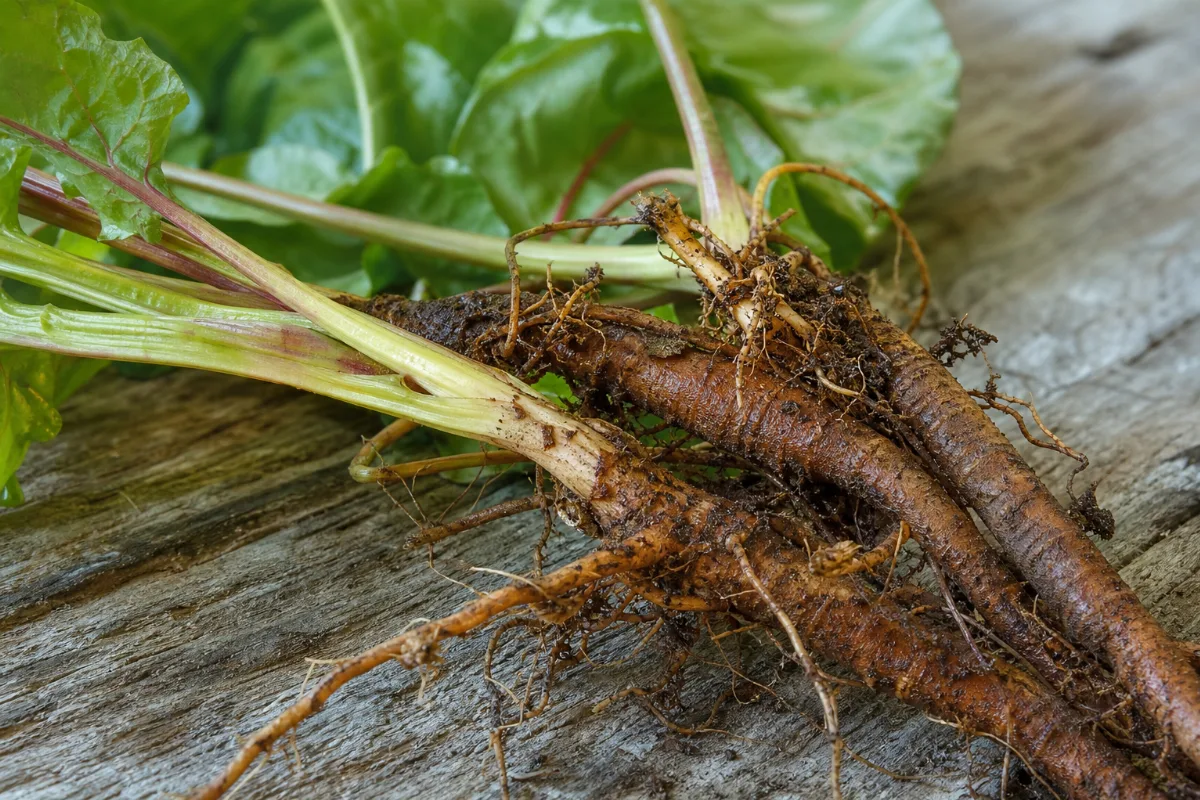
Yellow dock is Rumex crispus, also called curly dock, a plant of the knotweed family found around the world. The yellow-brown root and rhizome are the medicinal part.
The root contains anthraquinones such as emodin, along with tannins and oxalate. PROSEA gives about 0.1 percent emodin in the root.
Traditional uses
Old herbal books use it as a laxative, a skin remedy, a diuretic and a mild tonic, and as a 'blood cleanser'. Some herbal shops sell it as an iron tonic; we found no source that checks this.
These are long-standing uses, not proven ones.
What the research shows
There is almost no human research. A 2024 review of the plant lists traditional uses and many lab findings, and calls for more work. The human trials in a 2025 review of the whole Rumex genus used other species.
Lab and animal work shows antibacterial, antioxidant and cell-growth effects, but none has been shown in people.
At a glance
Traditional uses history, not proof
- Mild laxative (rhizome and root, South-East Asia and India).
- Skin complaints and swellings, applied on the skin or taken as a 'depurative'.
- 'Blood cleanser' and mild tonic.
- Sold as an 'iron tonic' in herbal shops; this claim is not backed by any source we read.
Studied for research
- Constipation (traditional laxative), insufficient
- Skin complaints and 'blood cleansing', insufficient
- 'Iron tonic' use, insufficient
- Germ-fighting in the lab, very-low
- Antioxidant activity (fruit extract, rats), very-low
- Cancer cells in a dish, very-low
Main compounds
- Emodin
- Chrysophanol
- Physcion
- Oxalic acid (oxalate)
- Tannins
Common forms
- Dried root tea or decoction
- Tincture
- Capsule or powder
- Blends with other herbs such as burdock
Research links: Review of Rumex crispus (2024) · Rumex genus review (2025) · Yellow dock and burdock tea, low platelets: case report (2022) · Fatal curly dock poisoning: case report (1990) · Anthraquinone laxatives and colorectal cancer: meta-analysis (2022) · Research Library · Genes & Biomarkers Library
The plant and its history
- Accepted scientific name
- Rumex crispus L.
- Naming authority
- L.
- Common names
- Yellow dock, curly dock, curled dock (English)
- Botanical family
- Polygonaceae (knotweed family).
- Classification
- Plantae > Tracheophyta > Magnoliopsida > Caryophyllales > Polygonaceae > Rumex > Rumex crispus
- Native range
- Not verified in our sources. PROSEA says wild plants in South-East Asia are mostly escapes from cultivation and the plant is distributed worldwide, sometimes cultivated.
- Habitat
- Not verified beyond PROSEA's note on worldwide distribution.
- What the plant looks like
- Roots: Yellow-brown rhizome and root, the medicinal part. Fresh rhizome can irritate mucous membranes (PROSEA).; Stems: Not verified.; Leaves: Curly-edged leaves (the common name); the strongest oxalate poisoning reports are from the leaves (PROSEA). Not otherwise verified.; Flowers: Not verified.; Fruit: Not verified in detail; ripe fruits were used in one antioxidant study. PROSEA says one plant may produce 60,000 seeds a year.
- Cultivation
- Mostly a wild and weedy plant; local use (PROSEA).
- Harvest and processing
- Roots and rhizomes are dried for tea, tincture, capsule or powder; our summary notes anthraquinone content varies. Details not verified.
- Look-alikes and adulterants
- Name: Other docks and sorrels (Rumex obtusifolius, R. patientia, R. acetosa and others); Note: Share oxalate and often anthraquinones. Results from another Rumex species cannot be credited to yellow dock; this file marks each such study.
- Sustainability and conservation
- Not verified.
Traditional use and history history, not clinical proof
| Tradition or era | Documented use | Source |
|---|---|---|
| Traditional medicine in several countries | Astringent, laxative, diuretic, mild tonic, blood cleanser, spasmolytic and cholagogue (bile-moving) agent (2024 review). | p39520965 |
| South-East Asia and India | Rhizomes and roots of Rumex species taken as a laxative, and applied to swellings and ringworm. Roots also used for tanning (PROSEA). | s-prosea-rumex |
| Western herbal tradition (iron or blood tonic claim) | Widely repeated in herbal writing; NOT verified in any source we read. | p39520965 |
Traditional use shows how a plant was used. It does not show that a supplement works or is safe today.
What is inside, and how it may work
What the plant contains and how those compounds act in cells and animals. Laboratory and animal mechanisms are not proven effects in people.
Main compounds
| Compound | Family | Where it is concentrated | Activity studied | Level of evidence |
|---|---|---|---|---|
| Emodin PubChem 3220 | anthraquinone | Root about 0.1 percent (PROSEA, as printed) | Stimulant-laxative family; antibacterial in the lab (MRSA study); liver effects at high exposure in lab work. 13 15 16 | Laboratory research |
| Chrysophanol PubChem 10208 | anthraquinone | Root (genus) | Named as an active ingredient of Rumex in the seed toxicity study; enzyme blocking reported in the lab. 5 3 16 | Animal research |
| Physcion PubChem 10639 | anthraquinone | Rumex roots (genus) | Listed among Rumex anthraquinones; sugar-enzyme blocking in the lab. 3 16 | Laboratory research |
| Oxalic acid (oxalate) PubChem 971 | dicarboxylic acid | Leaves highest in poisoning reports; whole plant 6.6 to 11.1 percent dry weight in Rumex samples from a sheep poisoning (our earlier summary: 7 to 11 percent, not re-read) | Binds calcium; forms kidney crystals; poisoning route. 14 18 3 16 | Human data |
| Tannins (group; tannic acid used as the PubChem stand-in) PubChem 16129778 | polyphenol | Plant (the 2025 review lists tannins among Rumex constituents) | Astringent; can bind minerals and proteins in the gut. 3 16 | Laboratory research |
Mechanisms, receptors and pathways
| Target or pathway | Gene or receptor | What was found | Level |
|---|---|---|---|
| Large-bowel stimulation by anthraquinone aglycones | none identified | Gut bacteria release active anthraquinones from glycosides; shown for class, not yellow dock. 11 20 | Pharmacological theory |
| Oxalate binding calcium; crystal deposition | none identified | In sheep and in the fatal human case, low blood calcium and oxalate crystals in kidney and liver. 18 14 | Human data |
| Antibacterial action on MRSA | none identified | Emodin and other constituents contribute to activity in the lab. 15 | Laboratory research |
| Cell death in colon cancer cells | caspases | A water-soluble fraction triggered caspase and inflammatory pathways in DLD-1 cells. 10 | Laboratory research |
Absorption, metabolism and elimination
- Absorption
- Not studied in people for yellow dock. The 2025 review says key Rumex compounds are poorly absorbed and quickly metabolised.
- Distribution
- Oxalate crystals appeared in liver and kidney in the fatal poisoning.
- Metabolism
- Anthraquinone glycosides are changed by gut bacteria in the usual laxative route (class level; not shown for yellow dock).
- Elimination
- Not studied.
- Bioavailability
- Poor for many Rumex compounds, per the 2025 review; no yellow dock figure found.
Isolated compounds versus whole extracts
Most lab findings come from isolated compounds (emodin) or extracts of fruit, seed or other Rumex species. A whole-root tea also brings oxalate and tannins, so lab results on emodin cannot be assumed to describe a tea.
Nutritional composition
Yellow dock is not a meaningful source of nutrients. Oxalate and tannins can lower absorption of calcium and other minerals (2025 review). Leaves are sometimes eaten as greens in Rumex species (PROSEA), which is where the poisoning reports arise.
4 very low certainty3 not enough evidence
What was looked at
The 7 benefits and uses checked for Yellow Dock (Rumex crispus), each with how strong the evidence is. Tap one to open it.
- Constipation (traditional laxative)Not enough evidence
- Skin complaints and 'blood cleansing' (traditional)Not enough evidence
- 'Iron tonic' and tiredness (traditional)Not enough evidence
- Germ-fighting activity (lab only)Very low certainty
- Antioxidant activity (lab and rats)Very low certainty
- Cancer cell studies (lab only)Very low certainty
- Inflammation and blood sugar (animal and lab, other Rumex species included)Very low certainty
What is Yellow Dock (Rumex crispus) good for?
The traditional uses of yellow dock and how strong the human evidence is for each. There is no human trial for any of them. Lab and animal findings are listed last and do not show a benefit in people.
Benefits, one by one
Each card is a research question, not a promise. Tap a goal to filter. Open a card to see the studies, doses and limits.
Constipation (traditional laxative)
Not enough evidenceYellow dock root has long been used as a mild laxative. Its chemistry makes this believable, but we found no trial in people that tested yellow dock for constipation.
3 studiesNo amounts are given here. Ask a doctor or pharmacist about amounts.
Studies, doses and limits
What the trials found
No human trial of yellow dock for constipation was found. The only human evidence nearby is for other anthraquinone laxatives: a Cochrane review in pregnancy (2 studies with data, 180 women) found stimulant laxatives improved constipation better than bulk-forming ones in one study, with more belly discomfort. That says nothing certain about yellow dock.
Results
None for yellow dock. Root anthraquinone content is given as about 0.2 percent oxymethyl-anthraquinone and 0.1 percent emodin (PROSEA), so strength varies and has not been standardised in any trial we found.
Effect sizes as reported
No effect size for yellow dock. For stimulant laxatives in pregnancy versus bulk-forming ones (one study, 140 women): improvement RR 1.59 (95% CI 1.21-2.09); belly discomfort RR 2.33 (1.15-4.73).
Why this rating
No human study of the herb. The class effect of anthraquinone laxatives is plausible, but the amount of active compounds in a yellow dock product is unknown.
Form and dose studied
No amounts are given here. Ask a doctor or pharmacist about amounts.
Who was studied
Not tested in any group.
Limits
Traditional use and class chemistry only. Short-term use is the norm for anthraquinone laxatives; see the safety tab for electrolyte, kidney and other cautions.
Why researchers looked
The root holds anthraquinones such as emodin and chrysophanol, the same family of compounds that makes senna and cascara work as stimulant laxatives.
Traditional use
PROSEA records the rhizome and root of Rumex species, including R. crispus, as an internal laxative in South-East Asia and India. A 2024 review lists laxative, astringent, diuretic, mild tonic and blood cleanser among its traditional uses.
Proposed mechanism Pharmacological theory
Gut bacteria turn anthraquinone glycosides into active forms that stimulate the large bowel. This is the usual route for anthraquinone laxatives. It has not been shown for yellow dock in people.
A proposed mechanism does not show that the effect happens in people.
Stimulant laxatives can cause cramps, loose stools and potassium loss. Yellow dock root also carries oxalate. See Safety.
Skin complaints and 'blood cleansing' (traditional)
Not enough evidenceOld herbal books use yellow dock as a 'blood cleanser' and a remedy for skin problems. This is long use, not proof. No human trial supports it.
4 studiesNo amounts are given here. Ask a doctor or pharmacist about amounts.
Studies, doses and limits
What the trials found
No human trial of yellow dock for any skin condition or for 'blood cleansing' was found. The few human trials of Rumex in the 2025 review used other species (R. occidentalis cream for melasma; R. acetosa in a sinus formula and a mouth rinse) and cannot be credited to yellow dock.
Results
None in people. 'Blood cleanser' is a traditional phrase with no measurable human meaning in the studies we read.
Effect sizes as reported
None.
Why this rating
Only traditional use and lab work. No human data on yellow dock.
Form and dose studied
No amounts are given here. Ask a doctor or pharmacist about amounts.
Who was studied
Not tested.
Limits
Skin and blood claims cannot be separated from the herb's strong laxative and oxalate effects. Do not use any root product on broken skin without advice.
Why researchers looked
Traditional herbalists linked the root to skin conditions and to 'purifying the blood'. Lab work has looked at antibacterial and anti-inflammatory activity of root extracts.
Traditional use
PROSEA lists external use on swellings and ringworm and internal use as a tonic and depurative for Rumex roots. The 2025 genus review says root anthraquinones fit the use of R. crispus 'to purify the blood in skin complaints' and for constipation.
Proposed mechanism Laboratory research
In the lab, a root extract held back MRSA bacteria and emodin was one contributor. Anti-inflammatory activity is reported in animal work. Neither has been shown on human skin.
A proposed mechanism does not show that the effect happens in people.
A tea of yellow dock with burdock was linked to one case of very low platelets. See Safety.
'Iron tonic' and tiredness (traditional)
Not enough evidenceYellow dock is often sold as an iron tonic for tiredness or low blood iron. We found nothing in the sources we read that tests this in people or measures iron.
2 studiesNo amounts are given here. Ask a doctor or pharmacist about amounts.
Studies, doses and limits
What the trials found
No human study of yellow dock and iron, ferritin, haemoglobin or anaemia was found.
Results
None. The iron-tonic claim is NOT verified in the sources we read.
Effect sizes as reported
None.
Why this rating
No measurement of iron status after yellow dock in any study we found.
Form and dose studied
No amounts are given here. Ask a doctor or pharmacist about amounts.
Who was studied
Not tested.
Limits
Tiredness and low iron need a blood test and a doctor. A tonic that causes diarrhoea can make things worse.
Why researchers looked
Herbal tradition calls the root a 'tonic' and a 'blood builder'. The idea that it supplies or frees up iron is repeated in herbal writing but is not backed by any source we read.
Traditional use
The 2024 review lists 'mild tonic' and 'blood cleanser' among traditional uses. It does not claim an iron or anaemia effect in its abstract.
Proposed mechanism Pharmacological theory
No mechanism for iron benefit was found. Oxalate and tannins in the plant can bind minerals in the gut and lower absorption of calcium and other minerals (2025 review), which points the other way.
A proposed mechanism does not show that the effect happens in people.
Do not use it to treat suspected anaemia on your own.
Germ-fighting activity (lab only)
Very low certaintyExtracts of yellow dock root slowed MRSA bacteria in the lab. This is a test-tube result.
2 studiesNo amounts are given here. Ask a doctor or pharmacist about amounts.
Studies, doses and limits
What the trials found
None.
Results
Lab antibacterial activity against MRSA.
Effect sizes as reported
None reported in people.
Why this rating
Test-tube result only.
Form and dose studied
No amounts are given here. Ask a doctor or pharmacist about amounts.
Who was studied
Not tested in people.
Limits
Lab activity often does not carry over to people. It does not mean a tea or capsule treats an infection.
Why researchers looked
Yellow dock is a traditional remedy for infections and sores, and emodin is a known antimicrobial compound.
Traditional use
Used on skin sores and swellings in folk practice.
Proposed mechanism Laboratory research
A 2022 metabolomics study measured emodin in a root extract and tied emodin and other constituents to activity against MRSA.
A proposed mechanism does not show that the effect happens in people.
Do not treat infected wounds with root products.
Antioxidant activity (lab and rats)
Very low certaintyA fruit extract was a strong antioxidant in test-tube assays and protected rat livers from a chemical stress. It was the fruit, not the root, and it was not tested in people.
2 studiesNo amounts are given here. Ask a doctor or pharmacist about amounts.
Studies, doses and limits
What the trials found
None.
Results
Rat liver antioxidant markers moved toward normal after a chemical injury.
Effect sizes as reported
Test-tube values only (for example DPPH IC50 3.7 ug/mL); none in people.
Why this rating
Lab and rat work on the fruit.
Form and dose studied
No amounts are given here. Ask a doctor or pharmacist about amounts.
Who was studied
Rats.
Limits
Not the root. No human data. Liver safety of the herb is a separate question; see Safety.
Why researchers looked
Plants rich in phenols often show antioxidant effects in the lab.
Traditional use
Seeds and fruits are not the main traditional part; the root is.
Proposed mechanism Animal research
Methanol extract of ripe fruits was comparable to the preservative BHT in antioxidant tests and reduced carbon-tetrachloride liver stress in rats.
A proposed mechanism does not show that the effect happens in people.
Do not take a herb for liver protection on this evidence.
Cancer cell studies (lab only)
Very low certaintyA water-soluble fraction from yellow dock slowed human bowel-cancer cells in a dish. That is a starting point for chemists, not a treatment.
3 studiesNo amounts are given here. Ask a doctor or pharmacist about amounts.
Studies, doses and limits
What the trials found
None. Separately, past use of anthraquinone laxatives as a class is NOT proven to cause or prevent bowel cancer: a 2022 meta-analysis gave OR 1.41 (95% CI 0.94-2.11), not statistically significant.
Results
Slower growth of cancer cells in a dish.
Effect sizes as reported
None in people.
Why this rating
Cells in a dish only.
Form and dose studied
No amounts are given here. Ask a doctor or pharmacist about amounts.
Who was studied
Cell line.
Limits
No animal or human follow-up was found.
Why researchers looked
Emodin and other plant compounds are screened for activity against cancer cells.
Traditional use
None directly.
Proposed mechanism Laboratory research
The most active fraction (L19) triggered cell-death pathways in DLD-1 cells.
A proposed mechanism does not show that the effect happens in people.
Do not use yellow dock for cancer.
Inflammation and blood sugar (animal and lab, other Rumex species included)
Very low certaintyReviews report anti-inflammatory and blood-sugar-lowering effects of Rumex extracts in cells and rodents. Much of this is from other Rumex species, and none of it is from people taking yellow dock.
2 studiesNo amounts are given here. Ask a doctor or pharmacist about amounts.
Studies, doses and limits
What the trials found
None for yellow dock. The review says there is a notable lack of well-designed clinical trials.
Results
Lab and rodent findings only.
Effect sizes as reported
None in people.
Why this rating
Mechanism and animal work, often on other species.
Form and dose studied
No amounts are given here. Ask a doctor or pharmacist about amounts.
Who was studied
Cells and rodents.
Limits
Genus-wide review; it cannot be assumed that yellow dock behaves the same.
Why researchers looked
Anthraquinones and flavonoids from the genus block inflammation and sugar-digesting enzymes in the lab.
Traditional use
Tonic and depurative uses in folk medicine.
Proposed mechanism Animal research
The 2025 genus review describes COX-1 and COX-2 inhibition by root anthraquinones and naphthalene derivatives, and blocking of the enzymes alpha-glucosidase and alpha-amylase, mostly from other Rumex species.
A proposed mechanism does not show that the effect happens in people.
If you take diabetes medicines, do not add a laxative herb without advice.
Connections to the rest of health
How Yellow Dock (Rumex crispus) connects to the rest of our health knowledge graph. Every link says what kind of connection it is. A safety link (for example to the liver) is a warning, not a benefit. A study that merely mentions a topic never creates a benefit link.
Explore every connection: goals, body systems, organs, symptoms, genes
A. Wellness goals
| Connected to | Kind of connection | Evidence status | Context | Studies |
|---|---|---|---|---|
| Digestive Support | Traditional use | Not enough evidence | Constipation (traditional laxative): Yellow dock root has long been used as a mild laxative. Its chemistry makes this believable, but we found no trial in people that tested yellow dock for constipation. | 13 17 19 |
| Gut Health | Traditional use | Not enough evidence | Constipation (traditional laxative): Yellow dock root has long been used as a mild laxative. Its chemistry makes this believable, but we found no trial in people that tested yellow dock for constipation. | 13 17 19 |
| Healthy Skin | Traditional use | Not enough evidence | Skin complaints and 'blood cleansing' (traditional): Old herbal books use yellow dock as a 'blood cleanser' and a remedy for skin problems. This is long use, not proof. No human trial supports it. | 13 17 3 15 |
| Detoxification Support | Traditional use | Not enough evidence | Skin complaints and 'blood cleansing' (traditional): Old herbal books use yellow dock as a 'blood cleanser' and a remedy for skin problems. This is long use, not proof. No human trial supports it. | 13 17 3 15 |
| Energy Boost | Traditional use | Not enough evidence | 'Iron tonic' and tiredness (traditional): Yellow dock is often sold as an iron tonic for tiredness or low blood iron. We found nothing in the sources we read that tests this in people or measures iron. | 17 3 |
| Reduce Fatigue | Traditional use | Not enough evidence | 'Iron tonic' and tiredness (traditional): Yellow dock is often sold as an iron tonic for tiredness or low blood iron. We found nothing in the sources we read that tests this in people or measures iron. | 17 3 |
| Immune Support | Preliminary mechanism | Very low certainty | Germ-fighting activity (lab only): Extracts of yellow dock root slowed MRSA bacteria in the lab. This is a test-tube result. | 15 17 |
| Inflammation Balance | Preliminary mechanism | Very low certainty | Antioxidant activity (lab and rats): A fruit extract was a strong antioxidant in test-tube assays and protected rat livers from a chemical stress. It was the fruit, not the root, and it was not tested in people. Inflammation and blood sugar (animal and lab, other Rumex species included): Reviews report anti-inflammatory and blood-sugar-lowering effects of Rumex extracts in cells and rodents. Much of this is from other Rumex species, and none of it is from people taking yellow dock. | 9 17 3 |
| Liver Support | Preliminary mechanism | Very low certainty | Antioxidant activity (lab and rats): A fruit extract was a strong antioxidant in test-tube assays and protected rat livers from a chemical stress. It was the fruit, not the root, and it was not tested in people. | 9 17 |
| Healthy Aging | Preliminary mechanism | Very low certainty | Cancer cell studies (lab only): A water-soluble fraction from yellow dock slowed human bowel-cancer cells in a dish. That is a starting point for chemists, not a treatment. | 10 8 17 |
| Blood Sugar Balance | Preliminary mechanism | Very low certainty | Inflammation and blood sugar (animal and lab, other Rumex species included): Reviews report anti-inflammatory and blood-sugar-lowering effects of Rumex extracts in cells and rodents. Much of this is from other Rumex species, and none of it is from people taking yellow dock. | 3 17 |
B. Body systems
| Connected to | Kind of connection | Evidence status | Context | Studies |
|---|---|---|---|---|
| Digestive system | Traditional use | Not enough evidence | Traditional laxative with no human trial; stimulant laxative cautions apply. Preparation or compound: Root anthraquinones |
13 17 |
| Digestive System | Biological association | Not enough evidence | Studied for: Constipation (traditional laxative) Studied for: 'Iron tonic' and tiredness (traditional) | 13 17 19 3 10 8 |
| Integumentary System | Biological association | Not enough evidence | Studied for: Skin complaints and 'blood cleansing' (traditional) | 13 17 3 15 |
| Immune System | Biological association | Very low certainty | Studied for: Germ-fighting activity (lab only) | 15 17 |
| Hepatic System | Biological association | Very low certainty | Studied for: Antioxidant activity (lab and rats) | 9 17 |
| Metabolism Weight | Biological association | Very low certainty | Studied for: Inflammation and blood sugar (animal and lab, other Rumex species included) | 3 17 |
C. Body parts and organs
| Connected to | Kind of connection | Evidence status | Context | Studies |
|---|---|---|---|---|
| Kidneys | Adverse effect or risk | Documented risk | High intake linked to extra urine oxalate and calcium oxalate stones; plant poisoning damaged kidneys. Oxalate in the plant is linked to kidney stones and, in poisoning, kidney damage. Preparation or compound: Oxalate in plant |
3 14 18 |
| Platelets (blood) | Adverse effect or risk | Case report | One case of platelets 5 K/ul. Preparation or compound: Yellow dock and burdock tea |
7 |
D. Symptoms
J. Genes, receptors and enzymes
| Connected to | Kind of connection | Evidence status | Context | Studies |
|---|---|---|---|---|
| Caspases (cell-death enzymes) | Preliminary mechanism | In vitro | Activated by a water-soluble fraction in colon cancer cells; lab only. | 10 |
| COX-1 and COX-2 | Preliminary mechanism | In vitro | Inhibited by Rumex root anthraquinones in lab work, mostly other species. | 3 |
L. Active compounds
| Connected to | Kind of connection | Evidence status | Context | Studies |
|---|---|---|---|---|
| Emodin | Biological association | In vitro | Stimulant-laxative family; antibacterial in the lab (MRSA study); liver effects at high exposure in lab work. Preparation or compound: Root |
13 15 16 |
| Chrysophanol | Biological association | Animal | Named as an active ingredient of Rumex in the seed toxicity study; enzyme blocking reported in the lab. Preparation or compound: Root (genus) |
5 3 16 |
| Physcion | Biological association | In vitro | Listed among Rumex anthraquinones; sugar-enzyme blocking in the lab. Preparation or compound: Rumex roots (genus) |
3 16 |
| Oxalic acid (oxalate) | Biological association | Human | Binds calcium; forms kidney crystals; poisoning route. Preparation or compound: Leaves highest in poisoning reports; whole plant |
14 18 3 16 |
| Tannins (group; tannic acid used as the PubChem stand-in) | Biological association | In vitro | Astringent; can bind minerals and proteins in the gut. Preparation or compound: Plant (the 2025 review lists tannins among Rumex constituents) |
3 16 |
Each connection is stored with the ingredient, the connected record, the kind of connection, the evidence status, the supporting studies, the preparation or compound involved, and a review date (last reviewed October 25, 2026).
The evidence
The research centre for Yellow Dock (Rumex crispus). Every record here was checked against PubMed or the publisher's page; we never list a study we have not verified.
Evidence by outcome
Bars show how many studies we found for each outcome, not how well it works. People are added up across trials only (reviews are not added, to avoid double counting).
How we rate evidence
High certainty
Several well-run trials or reviews agree; further research is unlikely to change the picture much.
Moderate certainty
Good trials point the same way, but some doubt remains.
Low certainty
Small, short or inconsistent trials. The finding could change with better research.
Very low certainty
Very little or very weak human data. Treat as a possibility only.
Mixed findings
Trials or reviews disagree with each other.
Not enough evidence
Not enough human research to say either way.
Evidence against
Good research found no benefit, or found harm.
We take the reviewers' own risk-of-bias and GRADE statements where they exist, and otherwise judge from study size, design, consistency, directness and whether a product matches what is sold. Many publications do not make evidence high. Method note: We started from our existing summary, then searched PubMed, read abstracts of the 2024 review, the case reports, the Cochrane and meta-analyses, read parts of the 2025 genus review and the PROSEA text, and checked the plant name in GBIF and NCBI and compounds in PubChem. Not found or not read: EMA monograph for yellow dock (404), NCCIH page (404), LiverTox and LactMed (blocked), FDA, WHO, Commission E. Certainty ratings are the compiler's reading. No study is cited that we could not verify.
Study library: every study we checked 20
| Study | Design | People | Product, dose, length | Result |
|---|---|---|---|---|
| Beltra-Pico 2024 Cassia angustifolia and tacrolimus interaction in a liver transplant patient, a case report Br J Clin Pharmacol · PMID 38657592 · DOI |
Case report |
1 Liver transplant patient, Spain |
Herbal product based on Cassia angustifolia (SENNA, a different anthraquinone herb) with tacrolimus senna product amounts not reproduced here not stated · vs not applicable |
The tacrolimus level rose 2.8-fold (area under the curve 2.1-fold). In its background the abstract says senna may add to other laxatives or potassium-losing diuretics, may reduce drug absorption by speeding the gut, and that combination with digoxin has been linked to digoxin toxicity through higher digoxin levels and low potassium. tacrolimus level 2.8-fold Methods, limits and fundingOutcomes: Tacrolimus blood level Limitations: SENNA, not yellow dock. One case. The digoxin and diuretic statements are background claims in the abstract. Abstract only was read. Funding and conflicts: Not stated Read: abstract |
| European Medicines Agency 2020 Sennae folium - herbal medicinal product (public summary; a different herb) European Medicines Agency · Source |
Authoritative guidance n/a |
not applicable | Rumex crispus (yellow dock) unless stated root unless stated not applicable not applicable · vs not applicable |
EU summary for SENNA leaf, used only as a comparison for anthraquinone laxatives. Short-term use for occasional constipation in adults and adolescents over 12; not longer than one week; not in pregnancy, while breastfeeding, or for children under 12; not with bowel blockage, appendicitis, inflammatory bowel disease, unexplained belly pain or severe dehydration; long-term use may lead to bowels not working properly and dependence. none (narrative or record) Methods, limits and fundingOutcomes: see results Limitations: Different herb. It is not a statement about yellow dock. Page text read on 2026-10-25. Funding and conflicts: not read Read: full-text |
| Food Science & Nutrition (Mohamed Gohar et al.) 2025 Rumex Species: Phytochemistry, Pharmacology and Nutritional Potential for Food and Health Applications Food Science & Nutrition (Mohamed Gohar et al.) · Source |
Narrative review animal+in-vitro (review) |
not applicable | Rumex crispus (yellow dock) unless stated root unless stated not applicable not applicable · vs not applicable |
Review of the whole Rumex genus. Says high dietary oxalate is linked to secondary hyperoxaluria and calcium oxalate kidney stones, and that people with kidney stones, gout, arthritis, rheumatism or hyperacidity should avoid Rumex plants. Quotes an estimated lethal oxalic acid amount in adults of 15 to 30 g. Its table of human toxicity lists, for R. crispus, fatal oxalate poisoning after a large amount of plant, nausea, vomiting, diarrhoea, electrolyte imbalance (low potassium) and rare immune thrombocytopenia from tea, citing Reig 1990. It reports roots of R. crispus contain anthraquinones used for skin complaints and constipation. The human trials it describes are of other Rumex species (R. occidentalis cream for melasma; R. acetosa in a sinus formula and a mouth rinse), not yellow dock. none (narrative or record) Methods, limits and fundingOutcomes: see results Limitations: Genus-wide review. Most data are lab or animal. Full text read in parts (about 150,000 characters of page text scanned for oxalate, toxicity and R. crispus passages). Its toxicity table is second-hand. Funding and conflicts: not read Read: full-text (read in parts) |
| GBIF 2026 GBIF backbone match: Rumex crispus L. GBIF · Source |
Database record n/a |
not applicable | Rumex crispus (yellow dock) unless stated root unless stated not applicable not applicable · vs not applicable |
Accepted species Rumex crispus L., usage key 8195144, family Polygonaceae, order Caryophyllales, match type exact, confidence 97. none (narrative or record) Methods, limits and fundingOutcomes: see results Limitations: Synonym list not read. Funding and conflicts: not read Read: full-text |
| Islam 2015 Toxicity of anthraquinones: differential effects of rumex seed extracts on rat organ weights and biochemical and haematological parameters Phytother Res · PMID 25753342 · DOI |
Animal research animal |
Male and female rats | Water and ethanol extracts of Rumex patientia SEED (a different species and plant part from yellow dock root) seed amounts not reproduced here 14 weeks, then 15 days off treatment · vs untreated animals |
Long-term anthraquinone doses caused changes focused on liver, lung and kidney. Most returned to normal in 15 days. The ethanol extract at a very high dose (4000 mg per kg) caused lasting changes; the water extract caused none that lasted. Males looked more sensitive. The authors advise against long-term high-dose anthraquinone extracts and, because of other reports of reproductive toxicity, against use in pregnancy. organ changes mostly reversible at lower doses Methods, limits and fundingOutcomes: Organ weights, over 30 blood, chemistry and tissue measures Limitations: A different Rumex species and the seed, in rats. Relevant to the anthraquinone class only. Abstract only was read. Funding and conflicts: Not stated Read: abstract |
| Izzo 2005 Cardiovascular pharmacotherapy and herbal medicines: the risk of drug interaction Int J Cardiol · PMID 15676159 · DOI |
Systematic review |
43 case reports and 8 clinical trials of herbs with heart medicines | Herbal medicines with cardiovascular drugs; yellow dock is not among the herbs named in the abstract various amounts not reproduced here not applicable · vs not applicable |
Warfarin was the most common drug involved. The abstract names a case of low potassium after liquorice with blood-pressure drugs. Yellow dock is not named in the abstract, so the paper is used only to show that herb and heart-drug interactions are real and that potassium loss is one route. none for yellow dock Methods, limits and fundingOutcomes: Herb and heart-drug interactions Limitations: Does not mention yellow dock or digoxin with laxatives in its abstract. Abstract only was read. Funding and conflicts: Not stated Read: abstract |
| Latif 2022 Herbal Teas and Thrombocytopenia: A Curious Case of Yellow Dock and Burdock-Induced Thrombocytopenia Eur J Case Rep Intern Med · PMID 35402325 · DOI |
Case report |
1 38-year-old woman, New Jersey, USA |
Herbal tea containing yellow dock (Rumex crispus) and burdock (Arctium lappa) not stated in the abstract amounts not reproduced here tea drunk about 1 week before presenting · vs not applicable |
Symptomatic thrombocytopenia with a platelet count of 5 K/ul one week after drinking the tea. The authors say cause and effect has not been studied and treat it like immune thrombocytopenia (steroids, platelets if bleeding). single case; platelet count 5 K/ul Methods, limits and fundingOutcomes: Platelet count and symptoms Limitations: One patient, two herbs together, cause not proven. Abstract only was read. Funding and conflicts: No competing interests declared Read: abstract |
| Lombardi 2022 Anthraquinone laxatives use and colorectal cancer: A systematic review and meta-analysis of observational studies Phytother Res · PMID 35040201 · DOI |
Meta-analysis |
People in 5 observational studies (8 studies in the systematic review) | Anthraquinone laxatives as a class (not yellow dock) various amounts not reproduced here various · vs other or no laxatives |
Past use of anthraquinone laxatives was linked to colorectal cancer, but not at a statistically significant level. The authors conclude no link can be established, but the trend is a strong reason for better studies. Quality of evidence was moderate to low. OR 1.41; after removing outliers OR 1.51 (95% CI 0.94-2.11; outlier-removed 0.97-2.34) Methods, limits and fundingOutcomes: Colorectal cancer Limitations: Observational studies; the laxatives were not yellow dock. Abstract only was read. Funding and conflicts: No conflict declared Read: abstract |
| Maksimovic 2011 Antioxidant activity of yellow dock (Rumex crispus L., Polygonaceae) fruit extract Phytother Res · PMID 20623623 · DOI |
Animal research animal+in-vitro |
Test tube and rats | Methanol extract of ripe Rumex crispus FRUIT (not the root) fruit amounts not reproduced here not stated in the abstract · vs positive control substances |
Strong activity in antioxidant tests, comparable to the preservative BHT but lower than vitamin C, rutin and quercetin. In rats it reduced liver oxidative stress caused by carbon tetrachloride. none for people Methods, limits and fundingOutcomes: Antioxidant assays and liver antioxidant enzymes in a poisoned-liver model Limitations: Fruit extract, lab and rats. Abstract only was read. Funding and conflicts: Not stated Read: abstract |
| Mohammadhosseinpour 2023 Anti-Proliferative and Apoptotic Activities of Rumex crispus Life (Basel) · PMID 38276257 · DOI |
Laboratory research in-vitro |
Human colorectal cancer cells (DLD-1) in a dish | Water-soluble fractions from Rumex crispus plants plant (part not given in the abstract) amounts not reproduced here not applicable · vs not applicable |
The most active fraction (L19) slowed cell growth in a dose-dependent way and triggered cell-death pathways. none (lab) Methods, limits and fundingOutcomes: Cell growth and cell-death signals Limitations: Cells in a dish. No animal or human test. Abstract only was read. Funding and conflicts: Declared none; funders had no role Read: abstract |
| Mohammed 2021 Pseudomelanosis coli, its relation to laxative use and association with colorectal neoplasms: A comprehensive review JGH Open · PMID 34124379 · DOI |
Narrative review human+animal (review) |
Review of laxative use and bowel pigmentation | Anthraquinone laxatives as a class (not yellow dock) various amounts not reproduced here not applicable · vs not applicable |
Pseudomelanosis coli (dark bowel lining) is historically linked to anthraquinone laxatives. They caused tumours in animal studies. Human studies showed no significant link between anthraquinone laxatives, this pigmentation and colorectal cancer, though adenoma risk may be slightly higher, possibly because polyps are easier to see against a dark background. none (narrative) Methods, limits and fundingOutcomes: Pseudomelanosis coli and colorectal tumours Limitations: Narrative review. Abstract only was read. Funding and conflicts: Not stated Read: abstract |
| Nakasone 2015 A Serendipitous Find: A Case of Cholangiocarcinoma Identified Incidentally After Acute Liver Injury Due to Cascara sagrada Ingestion Hawaii J Med Public Health · PMID 26114074 |
Case report |
1 Adult patient, Hawaii |
Large quantities of CASCARA SAGRADA (a different anthraquinone herb) bark amounts not reproduced here not stated · vs not applicable |
Acute hepatitis after large amounts of cascara. The authors say anthranoid laxatives can, in rare instances, cause hepatitis that clears when the product is stopped. The work-up found a bile duct cancer. single case Methods, limits and fundingOutcomes: Liver injury Limitations: CASCARA, not yellow dock. A bile duct cancer was found alongside, so the cause of the liver injury is not clean. Abstract only was read. Funding and conflicts: Not stated Read: abstract |
| PROSEA (Plant Resources of South-East Asia) n/d Rumex (PROSEA Medicinal plants) PROSEA (Plant Resources of South-East Asia) · Source |
Reference text n/a |
not applicable | Rumex crispus (yellow dock) unless stated root unless stated not applicable not applicable · vs not applicable |
Says rhizomes and roots of Rumex species including R. crispus are used as a laxative internally and on swellings and ringworm externally. R. crispus roots hold anthraquinones (about 0.2 percent oxymethyl-anthraquinone and 0.1 percent emodin, as printed). Fatal acute oxalate poisoning after eating large amounts of R. crispus leaves is reported in humans and sheep. Fresh rhizome can irritate mucous membranes with vomiting because of its anthrone content. none (narrative or record) Methods, limits and fundingOutcomes: see results Limitations: Reference text without a date. Percentages are as printed there; method and plant age not stated. Funding and conflicts: not read Read: full-text (read in parts) |
| Panciera 1990 Acute oxalate poisoning attributable to ingestion of curly dock (Rumex crispus) in sheep J Am Vet Med Assoc · PMID 2365622 |
Animal research animal |
100 100 mature ewes, Oklahoma, USA |
Growing curly dock plants grazed in a pen growing plant amounts not reproduced here within 40 hours · vs not applicable |
Ten of 100 ewes were poisoned within 40 hours: drooling, tremor, loss of balance, collapse, low blood calcium and raised blood waste products. Kidney tubules were damaged. Rumex samples held 6.6 to 11.1 percent oxalic acid by dry weight. 10 of 100 ewes affected; oxalic acid 6.6 to 11.1 percent dry weight Methods, limits and fundingOutcomes: Clinical signs, blood chemistry, kidney findings, oxalic acid content Limitations: Sheep eating the growing plant, not people taking a root product. Abstract only was read. Funding and conflicts: Not stated Read: abstract |
| Pelzer 2022 More Than Just a Weed: An Exploration of the Antimicrobial Activity of Rumex crispus using a Multivariate Data Analysis Approach Planta Med · PMID 34695862 · DOI |
Laboratory research in-vitro |
Lab study against MRSA bacteria | Rumex crispus root extract and fractions root amounts not reproduced here not applicable · vs not applicable |
Emodin was identified and measured in the extract, and the authors conclude constituents including emodin contribute to the antibacterial activity against MRSA in the lab. none (lab) Methods, limits and fundingOutcomes: Antibacterial activity against methicillin-resistant Staphylococcus aureus Limitations: Test-tube study only. It does not show that a tea or capsule treats infection. Abstract only was read. Funding and conflicts: No conflict declared Read: abstract |
| PubChem 2026 PubChem compound records: emodin, chrysophanol, physcion, oxalic acid, tannic acid PubChem · Source |
Database record n/a |
not applicable | Rumex crispus (yellow dock) unless stated root unless stated not applicable not applicable · vs not applicable |
Name lookups returned emodin CID 3220 (C15H10O5), chrysophanol CID 10208 (C15H10O4), physcion CID 10639 (C16H12O5), oxalic acid CID 971 (C2H2O4) and tannic acid CID 16129778 (C76H52O46). none (narrative or record) Methods, limits and fundingOutcomes: see results Limitations: Identifiers only. Tannic acid stands in for the tannin group; the exact tannins in yellow dock were not listed in our sources. Funding and conflicts: not read Read: full-text |
| Qian 2024 Rumex crispus L.: A comprehensive review on botany, traditional uses, phytochemistry, pharmacology, and safety Int Immunopharmacol · PMID 39520965 · DOI |
Narrative review animal+in-vitro (review) |
Review of lab, animal and traditional-use reports on Rumex crispus | Rumex crispus extracts and isolated compounds root, aerial parts, seeds (as reported) amounts not reproduced here not applicable · vs not applicable |
Lists traditional uses as astringent, laxative, diuretic, mild tonic, blood cleanser, spasmolytic and cholagogue. Reports about 224 constituents including anthraquinones, and lab/animal antitumour, antimicrobial, antioxidant, anti-inflammatory, anti-osteoporotic, antidiabetic and anti-allergic activity. States that the plant is toxic and has adverse effects including allergy and symptomatic thrombocytopenia. Calls for more work on active compounds. none (narrative) Methods, limits and fundingOutcomes: Traditional uses, about 224 constituents, pharmacology, safety Limitations: Narrative review, not a systematic one. Abstract only was read. It reports no human trials of yellow dock in its abstract. Funding and conflicts: No competing interests declared Read: abstract |
| Reig 1990 Fatal poisoning by Rumex crispus (curled dock): pathological findings and application of scanning electron microscopy Vet Hum Toxicol · PMID 2238449 |
Case report |
1 53-year-old man, Barcelona, Spain |
Ingested Rumex crispus plant material (amount and part not stated in the abstract) plant material amounts not reproduced here single ingestion; death after 72 hours · vs not applicable |
Stomach and gut symptoms, severe low calcium, metabolic acidosis and acute liver failure. He died 72 hours after eating the plant. Autopsy showed liver cell death in the centre of liver lobules and birefringent crystals in the liver and kidneys, identified as oxalate. death; crystals in liver and kidney Methods, limits and fundingOutcomes: Clinical course and autopsy findings Limitations: One case. It is poisoning from eating the plant, not a report of a tea or capsule taken as labelled. Abstract only was read. Funding and conflicts: Not stated Read: abstract |
| Rungsiprakarn 2015 Interventions for treating constipation in pregnancy Cochrane Database Syst Rev · PMID 26342714 · DOI |
Systematic review |
180 Pregnant women; 4 studies, 2 with usable data |
Stimulant laxatives vs bulk-forming laxatives; fibre vs nothing (no herb studied) not applicable amounts not reproduced here various · vs bulk-forming laxatives or no treatment |
Stimulant laxatives improved constipation more than bulk-forming laxatives (one study, 140 women, moderate quality) but caused more belly discomfort (low quality) and a borderline increase in diarrhoea. No usable data were found on dehydration or electrolyte imbalance. Improvement RR 1.59; discomfort RR 2.33; diarrhoea RR 4.50 (95% CI 1.21-2.09; 1.15-4.73; 1.01-20.09) Methods, limits and fundingOutcomes: Constipation improvement, comfort, diarrhoea Limitations: Tiny evidence base. It tells us nothing about yellow dock itself. Abstract only was read. Funding and conflicts: Not stated in the abstract Read: abstract |
| Wald 2003 Is chronic use of stimulant laxatives harmful to the colon? J Clin Gastroenterol · PMID 12702977 · DOI |
Narrative review human (review) |
Review | Stimulant laxatives as a class various amounts not reproduced here not applicable · vs not applicable |
Stimulant laxatives cause surface cell changes of unknown meaning. There was no convincing evidence that chronic use damages gut nerves or muscle, and no reliable data linking chronic use to colorectal cancer. The author thinks the risks of laxative abuse have been over-emphasised. none (narrative) Methods, limits and fundingOutcomes: Harm to colon structure and function Limitations: Expert opinion review from 2003. Not about yellow dock. Abstract only was read. Funding and conflicts: Not stated Read: abstract |
What we do not know yet
- What the evidence supports: plausible laxative chemistry and a clear oxalate risk.
- What is uncertain: whether yellow dock does anything for constipation, skin or iron, because no human trial was found.
- No LiverTox, LactMed, NCCIH or EMA record for yellow dock was read.
- Pregnancy, breastfeeding, children and drug interactions rest on related herbs and class-level science.
How new research is added
New studies are found by a saved PubMed search and placed in a review queue. A person reads each one before it changes any evidence rating or safety wording. New publications never change ratings automatically.
Lab markers
What changed in blood or saliva tests during trials. A changed number is not the same as feeling or being healthier, and we give no "normal ranges".
Safety
What studies and official sources say about side effects, medicines and who should check first. Each point shows what kind of evidence it comes from.
Main points to know 4
- Yellow dock carries oxalate: avoid with kidney stones or kidney disease. Rumex plants from a sheep-poisoning report held 6.6 to 11.1 percent oxalic acid by dry weight (our earlier summary gave 7 to 11 percent for the plant). A 2025 review links high Rumex intake to extra oxalate in the urine and calcium oxalate kidney stones and says people with kidney stones, gout, arthritis, rheumatism or acidity problems should avoid it. We found no yellow dock study in people with kidney disease, so avoiding it is the cautious reading. Other 3 14
- Eating the leaves or large amounts of plant can poison and has killed. A 53-year-old man died 72 hours after eating curly dock: low calcium, acid blood, liver failure, oxalate crystals in liver and kidneys. PROSEA reports fatal oxalate poisoning in humans and sheep after large amounts of leaves. In a sheep flock, 10 of 100 ewes were poisoned within 40 hours of grazing the plant. These are plant-eating events, not reports of normal teas. Case report 18 13 14
- It is a stimulant laxative: short use only, with potassium and dependence cautions. Yellow dock root holds emodin and related anthraquinones. For the related herb senna, the EU says short-term use only (not more than one week), and that long use may lead to bowels not working properly and dependence. No agency statement for yellow dock itself was found, so this is borrowed from a related herb and labelled as such. Authoritative guidance 2 13
- Almost no human safety data on yellow dock itself. We found one case report (very low platelets after a yellow dock and burdock tea) and one fatal poisoning. We found no trial, no liver reference entry and no regulator monograph for the root. Absence of reports is not proof of safety. Case report 7 18 17
Side effects 5
| Effect | How often | Severity and recovery | Evidence |
|---|---|---|---|
| Nausea, vomiting, diarrhoea and low potassium (electrolyte imbalance) Listed for R. crispus in the 2025 review's toxicity table, which cites the 1990 fatal case. The abstract of that case reports stomach and gut symptoms, not low potassium, so the potassium point is the review's wording and also what is expected from any laxative. | Not established | moderate Not stated. | Other 3 18 |
| Throat, mouth and stomach irritation with vomiting from fresh rhizome PROSEA attributes it to anthrone content in the fresh rhizome. | Not established | mild Not stated. | Other 13 |
| Very low platelet count (immune thrombocytopenia) One woman, platelets 5 K/ul one week after a tea with yellow dock and burdock. Cause not proven; burdock was also in the tea. | Not established | severe Treated like immune thrombocytopenia in the report; outcome not given in the abstract. | Case report 7 17 |
| Allergy The 2024 review says the plant is allergenic. The abstract gives no detail. | Not established | mild-to-moderate Not stated. | Other 17 |
| Cramps and loose stools Known for stimulant laxatives as a class: in pregnancy more belly discomfort (RR 2.33) and borderline more diarrhoea than bulk-forming laxatives. Not measured for yellow dock. | Not established | mild Expected to stop when the laxative is stopped. | Pharmacological theory 19 |
Liver
We found no LiverTox entry for yellow dock (the NCBI Bookshelf pages could not be opened; a robot check blocked them), so no likelihood score is given. The only liver event tied to the plant is the fatal 1990 poisoning: acute liver failure with liver cell death and oxalate crystals after eating the plant. For the same anthraquinone class, a cascara case report describes acute hepatitis after large amounts, and in rats a long-term high-dose anthraquinone seed extract (R. patientia) changed liver, lung and kidney measures, mostly reversing in 15 days. Neither is yellow dock root at normal use. 18 12 5
How often. No frequency of liver injury from yellow dock was found.
Monitoring. No agency monitoring advice found. Stop and get care for yellow skin or eyes, dark urine, pale stools or severe itching.
- .
- .
This is a safety connection. It is not evidence that Yellow Dock (Rumex crispus) supports liver health.
Medicines and supplements 5
| With | Why it matters | Importance | Evidence | What to do |
|---|---|---|---|---|
| Digoxin (heart medicine) prescription | Stimulant laxatives can lower potassium; low potassium makes digoxin more toxic. A 2024 senna case report states this link in its background (SENNA, not yellow dock). | Expected but not shown for yellow dock. No yellow dock case was found. | Pharmacological theory Very low certainty 1 | If you take digoxin, ask your doctor or pharmacist before using any laxative herb. |
| Water pills (potassium-losing diuretics) prescription | Laxative potassium loss adds to the potassium loss from these diuretics (stated for senna in the same case report). The 2005 review shows herb and heart-drug interactions with potassium loss are real for other herbs. | Expected, not shown for yellow dock. | Pharmacological theory Very low certainty 1 6 | Ask your doctor or pharmacist; blood potassium may need checking. |
| Other laxatives other | Additive effects, as stated for senna. | Expected extra diarrhoea and fluid loss. | Pharmacological theory Very low certainty 1 2 | Do not combine laxatives without advice. |
| Tacrolimus (transplant medicine) and other tightly dosed medicines prescription | A senna product was linked in one case to a 2.8-fold rise in tacrolimus level, proposed to act through P-glycoprotein; faster gut movement can also cut absorption of medicines taken by mouth. | Single case with SENNA; unknown for yellow dock. | Case report Very low certainty 1 | Tell the transplant team before using a laxative herb. |
| Medicines that affect platelets or clotting prescription | One case of very low platelets after a yellow dock and burdock tea. No pharmacology is known. | Unknown. | Case report Very low certainty 7 | If you have a bleeding or platelet condition, avoid it or ask your clinician. |
Who should check first 6
| Situation | Advice | Evidence |
|---|---|---|
| Kidney stones, kidney disease, high urine oxalate, gout | Avoid. The plant is high in oxalate. | Other 3 |
| Pregnancy and breastfeeding | Avoid. Anthraquinone laxatives are not advised in pregnancy or breastfeeding by the EU for senna, and a rat study of a Rumex seed extract advised against use in pregnancy because of other reports of reproductive toxicity. No yellow dock study in pregnancy or lactation was found. | Authoritative guidance 2 5 19 |
| Children under 12 | Avoid. Not studied; the EU senna summary excludes under-12s. | Authoritative guidance 2 |
| Bowel blockage, appendicitis, inflammatory bowel disease, unexplained belly pain, dehydration | Avoid stimulant laxatives. Taken from the EU senna summary; not a yellow dock statement. | Authoritative guidance 2 |
| Low platelets or immune thrombocytopenia history | Avoid, given the one case report. | Case report 7 |
| Taking digoxin or potassium-losing diuretics | Ask a doctor first. | Pharmacological theory 1 |
Overdose, product quality and regulators
Summary. Two toxic stories: oxalate (acute poisoning from eating plant, mainly leaves; kidney stones with high intake) and anthraquinone laxative effects (potassium and fluid loss, dependence with long use). The cooking-water point is useful: the 2025 review says avoiding the cooking water lowers poisoning risk because oxalate leaches into it.
Animal. Sheep: 10 of 100 ewes poisoned within 40 hours of grazing curly dock with 6.6 to 11.1 percent oxalic acid; low blood calcium and kidney tubule damage. Rats: 14 weeks of R. patientia seed extracts changed liver, lung and kidney measures at high doses, mostly reversing in 15 days; the water extract caused no lasting change (different species and part).
Human doses studied. No trial dose exists for yellow dock. The 2025 review quotes an estimated lethal oxalic acid amount for adults of 15 to 30 g, with fatal outcomes sometimes under 5 g.
High dose or long term signals. Long-term anthraquinone use is a question for the bowel and kidney. A 2022 meta-analysis of observational studies found a non-significant trend toward colorectal cancer with anthraquinone laxatives (OR 1.41, 95% CI 0.94-2.11); a 2021 review found no significant link; a 2003 expert review found no reliable link. None is about yellow dock.
Overdose response. Fatal oxalate poisoning is described after eating large amounts of leaves or plant. Seek emergency care for vomiting, tremor, weakness, or little urine after eating the plant.
Genotoxicity. Anthraquinone laxatives caused tumours in animal studies (2021 review). Genotoxicity of yellow dock itself was not found.
Toxic plant parts. Leaves (strongest oxalate poisoning reports, PROSEA) and the whole plant when eaten in quantity. Fresh rhizome can irritate the mouth and gut.
No survey of heavy metals, pesticides or adulteration in yellow dock products was found. Species mix-ups are possible because many docks (Rumex) share the name and look.
Product quality. No retail product survey was found. Anthraquinone and oxalate content depends on the species, part, plant age and harvest time (2025 review), so strength varies. 3
| Body | Action | Date |
|---|---|---|
| European Medicines Agency (HMPC) (European Union) | No herbal monograph for Rumex crispus root was found; the page for a 'rumicis radix' address returned not found (404). For SENNA leaf the EU public summary allows short-term use only (not over one week), not in pregnancy, breastfeeding or under 12. source | 2026-10-25 |
When to get medical help
- After eating yellow dock leaves or a large amount of plant: vomiting, tremor, weakness, confusion, little urine or muscle spasms. Call emergency services or poison control.
- Nosebleeds, easy bruising, tiny red dots on the skin, or bleeding gums after using yellow dock tea: get medical care and a blood count.
- Palpitations, muscle weakness or an irregular heartbeat while using a laxative herb, especially if you take digoxin or water pills.
- Severe belly pain, blood in stool or very watery diarrhoea that does not settle.
Stop the supplement and contact a clinician or emergency service. In the US, Poison Control is 1-800-222-1222.
General information only, not medical advice. Ask a clinician or pharmacist before use, especially with medicines, in pregnancy or with a health condition. See the Natural Remedy Safety guide.
Frequently asked questions
What is yellow dock?
Does yellow dock work as a laxative?
Is yellow dock an iron tonic?
Does it purify the blood or help skin problems?
Can yellow dock cause kidney stones?
Can yellow dock poison you?
Is it safe in pregnancy or while breastfeeding?
Does it interact with medicines?
Does it affect the liver or blood?
Do laxatives like this cause bowel cancer?
Has any agency approved yellow dock?
We found no EMA monograph or NCCIH page for it. For senna the EU allows short-term use only. Ask a doctor or pharmacist about amounts.
Explore by health goal
Inflammation BalanceDigestive SupportGut HealthHealthy SkinDetoxification SupportEnergy BoostReduce FatigueImmune SupportLiver SupportHealthy AgingBlood Sugar Balance
Editorial transparency
- Written by
- AlternativeMed editorial team. Research compiled with AI assistance, then checked against PubMed records.
- Medical review
- None. This page has not been reviewed by a physician or pharmacist.
- First published
- 2026-10-25
- Last substantive update
- 2026-10-25
- How we research
- We started from our existing summary, then searched PubMed, read abstracts of the 2024 review, the case reports, the Cochrane and meta-analyses, read parts of the 2025 genus review and the PROSEA text, and checked the plant name in GBIF and NCBI and compounds in PubChem. Not found or not read: EMA monograph for yellow dock (404), NCCIH page (404), LiverTox and LactMed (blocked), FDA, WHO, Commission E. Certainty ratings are the compiler's reading. No study is cited that we could not verify.
- How we rate evidence
- See "How we rate evidence" in the Evidence tab.
- Independence
- No product is promoted on this page. No affiliate links are shown. If one is added later it will be labelled and kept apart from the evidence.
Sources 20
Each source was opened and checked. Where we read only the abstract, it says so. The small numbers in the text point here.
- Beltra-Pico I, Diaz-Gonzalez M, Nalda-Molina R et al.. Cassia angustifolia and tacrolimus interaction in a liver transplant patient, a case report. Br J Clin Pharmacol. 2024. PMID 38657592. DOI 10.1111/bcp.16079. (abstract)
- European Medicines Agency. Sennae folium - herbal medicinal product (public summary; a different herb). European Medicines Agency. 2020. (full-text)
- Food Science & Nutrition (Mohamed Gohar et al.). Rumex Species: Phytochemistry, Pharmacology and Nutritional Potential for Food and Health Applications. Food Science & Nutrition (Mohamed Gohar et al.). 2025. (full-text (read in parts))
- GBIF. GBIF backbone match: Rumex crispus L.. GBIF. 2026. (full-text)
- Islam R, Mamat Y, Ismayil I et al.. Toxicity of anthraquinones: differential effects of rumex seed extracts on rat organ weights and biochemical and haematological parameters. Phytother Res. 2015. PMID 25753342. DOI 10.1002/ptr.5317. (abstract)
- Izzo AA, Di Carlo G, Borrelli F et al.. Cardiovascular pharmacotherapy and herbal medicines: the risk of drug interaction. Int J Cardiol. 2005. PMID 15676159. DOI 10.1016/j.ijcard.2003.06.039. (abstract)
- Latif A, Fichadiya H, Abid F et al.. Herbal Teas and Thrombocytopenia: A Curious Case of Yellow Dock and Burdock-Induced Thrombocytopenia. Eur J Case Rep Intern Med. 2022. PMID 35402325. DOI 10.12890/2022_003247. (abstract)
- Lombardi N, Crescioli G, Maggini V et al.. Anthraquinone laxatives use and colorectal cancer: A systematic review and meta-analysis of observational studies. Phytother Res. 2022. PMID 35040201. DOI 10.1002/ptr.7373. (abstract)
- Maksimovic Z, Kovacevic N, Lakusic B et al.. Antioxidant activity of yellow dock (Rumex crispus L., Polygonaceae) fruit extract. Phytother Res. 2011. PMID 20623623. DOI 10.1002/ptr.3234. (abstract)
- Mohammadhosseinpour S, Bhandari M, Lee DA et al.. Anti-Proliferative and Apoptotic Activities of Rumex crispus. Life (Basel). 2023. PMID 38276257. DOI 10.3390/life14010008. (abstract)
- Mohammed A, Paranji N, Singh A et al.. Pseudomelanosis coli, its relation to laxative use and association with colorectal neoplasms: A comprehensive review. JGH Open. 2021. PMID 34124379. DOI 10.1002/jgh3.12546. (abstract)
- Nakasone ES, Tokeshi J. A Serendipitous Find: A Case of Cholangiocarcinoma Identified Incidentally After Acute Liver Injury Due to Cascara sagrada Ingestion. Hawaii J Med Public Health. 2015. PMID 26114074. (abstract)
- PROSEA (Plant Resources of South-East Asia). Rumex (PROSEA Medicinal plants). PROSEA (Plant Resources of South-East Asia). n/d. (full-text (read in parts))
- Panciera RJ, Martin T, Burrows GE et al.. Acute oxalate poisoning attributable to ingestion of curly dock (Rumex crispus) in sheep. J Am Vet Med Assoc. 1990. PMID 2365622. (abstract)
- Pelzer CV, Houriet J, Crandall WJ et al.. More Than Just a Weed: An Exploration of the Antimicrobial Activity of Rumex crispus using a Multivariate Data Analysis Approach. Planta Med. 2022. PMID 34695862. DOI 10.1055/a-1652-1547. (abstract)
- PubChem. PubChem compound records: emodin, chrysophanol, physcion, oxalic acid, tannic acid. PubChem. 2026. (full-text)
- Qian H, Jia Y, Zheng K et al.. Rumex crispus L.: A comprehensive review on botany, traditional uses, phytochemistry, pharmacology, and safety. Int Immunopharmacol. 2024. PMID 39520965. DOI 10.1016/j.intimp.2024.113569. (abstract)
- Reig R, Sanz P, Blanche C et al.. Fatal poisoning by Rumex crispus (curled dock): pathological findings and application of scanning electron microscopy. Vet Hum Toxicol. 1990. PMID 2238449. (abstract)
- Rungsiprakarn P, Laopaiboon M, Sangkomkamhang US et al.. Interventions for treating constipation in pregnancy. Cochrane Database Syst Rev. 2015. PMID 26342714. DOI 10.1002/14651858.CD011448.pub2. (abstract)
- Wald A. Is chronic use of stimulant laxatives harmful to the colon?. J Clin Gastroenterol. 2003. PMID 12702977. DOI 10.1097/00004836-200305000-00004. (abstract)