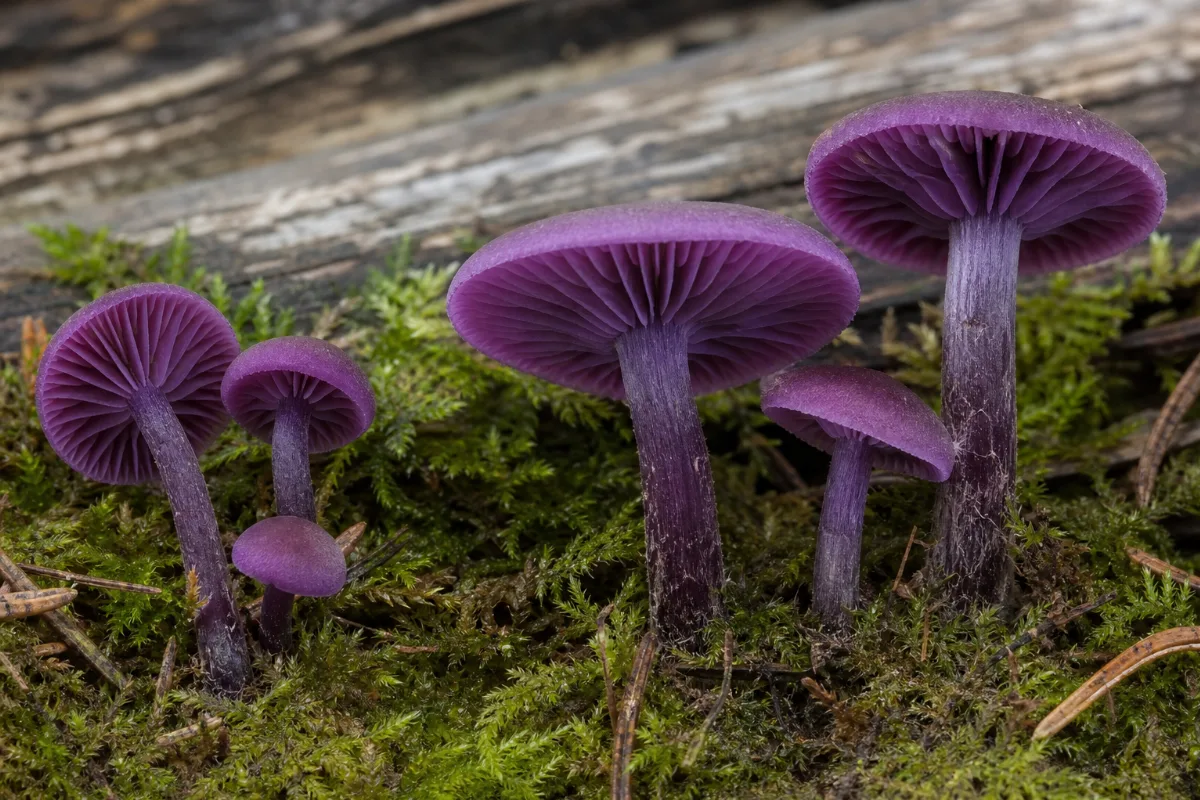
Mushrooms · Wild culinary mushroom
Amethyst deceiver
Laccaria amethystina (the close relative Laccaria laccata is often studied with it) · also called Amethyst deceiver
The amethyst deceiver is a small wild woodland mushroom that people eat in parts of Europe and Asia. It is a food, not a supplement, and we found no human study of any health benefit. What research does show is a food-safety problem: it takes up a lot of arsenic from the soil, it took up radioactive caesium after Chernobyl, and it can be mistaken for look-alikes that can be deadly. Never pick or eat a wild mushroom because of a photo, an app or a web page.
General information, not medical advice. Last substantive update · Not medically reviewed. A named clinician has not signed off on this page. How this page is made
About Amethyst deceiver
The amethyst deceiver is a small wild woodland mushroom eaten in some places. No health trial exists. The research is about safety: very high arsenic in many samples (and highest on polluted ground), radioactive caesium after Chernobyl, and a risk of confusion with deadly look-alikes. No poisoning case from this mushroom itself was found in the sources we read.
What it is
Laccaria amethystina is a woodland mushroom that lives in partnership with tree roots (GBIF lists it as an accepted species in the family Hydnangiaceae). A French study found it with several tree species. Only the fruiting body is eaten. The close relative Laccaria laccata is often covered by the same food and metal studies, but a 2025 paper says the name L. laccata was long ambiguous, so older papers may mix the two.
Traditional and current uses
We found no traditional medicinal use and no recipe source for this species. A Chinese study notes that Laccaria mushrooms are eaten in southwest China and bought samples from local markets. No nutrient table (calories, protein, vitamins) was found, so none is given here.
What the research shows
No trial, animal study or case series on a health effect of the amethyst deceiver was found. The papers are measurements of what is in the mushroom, plus laboratory work on a sugar-binding protein (this species) and on antioxidant chemistry and chitosan (the related L. laccata). In a 2026 Turkish study the related L. laccata held 10.059 mg per kg cadmium, 2.182 lead and 2.0 arsenic, and the authors ranked it the riskiest of six wild mushrooms in their model.
Forms and cooking
Only the wild fruiting body is eaten. No supplement, powder or extract was found. Soaking then boiling lowered arsenic by about 79% and 93% in two other wild mushrooms, but Laccaria was not tested and digestion tests still showed high arsenic bioaccessibility, so we cannot say cooking makes this mushroom safe.
Rules and regulators
We found no health authority statement about this mushroom. The 1987 German study applied a 600 Bq per kg caesium limit of the time. The Chinese paper compares its arsenic estimate with an FAO/WHO expert committee limit for inorganic arsenic; we did not read that committee's document.
At a glance
Traditional uses history, not proof
- No traditional medicinal use was found in the sources we read, so none is claimed.
- Eaten as a wild food. Laccaria mushrooms were sold in four local markets in Yunnan, China, in a 2015 study (Zhang).
Studied for research
- Any health effect in people: none studied, insufficient
- Food and nutrition: no nutrient data found, insufficient
- Antioxidant test (related species, lab): insufficient
- Sugar-binding protein (lab only): insufficient
- Fungal chitosan on cells in a dish (related species): insufficient
Main compounds
- Arsenic compounds taken up from soil (mostly dimethylarsinic acid in Danish samples)
- Radioactive caesium taken up after the Chernobyl accident
- A sugar-binding protein (galectin) studied in the laboratory
Common forms
- Eaten as a wild fruiting body. No powder, extract or supplement product was found.
Research links: Arsenic in Laccaria mushrooms from Yunnan (abstract) · Mineral and radionuclide review (abstract) · Caesium in mushrooms after Chernobyl, 1987 (abstract) · Caesium monitoring 1987 to 1988 (abstract) · Orellanine (Cortinarius) toxicology review · AI mushroom identification apps test, 2026 · Research Library · Genes & Biomarkers Library
What it is and its history
- Accepted scientific name
- Laccaria amethystina
- Naming authority
- Cooke (GBIF)
- Common names
- Amethyst deceiver (English)
- Family or group
- Hydnangiaceae (a fungus family), not a plant
- Classification
- Fungi > Basidiomycota > Agaricomycetes > Agaricales > Hydnangiaceae > Laccaria > Laccaria amethystina
- Native range
- Collected in Europe (France, Denmark, Germany, Hungary), and Asia (China); full range not checked.
- Habitat
- A mushroom that lives in partnership with tree roots (ectomycorrhizal). A French study found it with fir, sweet chestnut, beech, oak and hornbeam.
- What it looks like
- Fruiting body: Not described here, on purpose: identification must never be done from text.
- Cultivation
- No cultivation or product was found.
- Harvest and processing
- Wild harvest only. Not checked further.
- Look-alikes and adulterants
- Name: Purple Cortinarius species; Note: A foraging guide says it could be confused with them; a mushroom reference site says it looks a little like a small Cortinarius. Some Cortinarius species make orellanine, which damages the kidneys; the sources do not say which purple ones. No identification tips are given.; Name: Lilac fibrecap (Inocybe lilacina); Note: The same foraging guide calls it deadly poisonous and a possible mix-up.; Name: Laccaria laccata (the deceiver); Note: A close relative that is often studied together; a 2025 paper says its name had long been ambiguous. Papers on one may be mixed with the other.
- Sustainability and conservation
- Not checked.
What is inside, and how it may work
What it contains and how those compounds act in cells and animals. Laboratory and animal mechanisms are not proven effects in people.
Main compounds
| Compound | Family | Where it is concentrated | Activity studied | Level of evidence |
|---|---|---|---|---|
| Arsenic compounds (dimethylarsinic acid, methylarsonic acid, trimethylarsine oxide, arsenic acid, arsenobetaine) | organic and inorganic arsenic | Fruiting body Up to 250 mg/kg dry matter quoted in a review; 135 mg/kg mean in Chinese caps; about 1,400 mg/kg at one polluted site. | A contaminant taken up from the soil, not a nutrient or active ingredient. 5 18 | Chemical analysis |
| Radioactive caesium-137 and caesium-134 | radionuclides | Whole fruiting body 1,710 and 766 Bq/kg in one 1986 sample. | A contaminant after the Chernobyl accident. 15 | Chemical analysis |
| Galectin (LAG), a sugar-binding protein | lectin | Fruiting body | Binds beta-galactosides in test-tube assays; no known effect in people. 12 | Laboratory research |
Mechanisms, receptors and pathways
| Target or pathway | Gene or receptor | What was found | Level |
|---|---|---|---|
| Arsenic uptake from soil | not studied here | Total arsenic in the fruiting body varies with the soil: much higher at a polluted Danish site. For a related species the Chinese authors report a bioconcentration factor of 29.1 and call it an accumulator. 18 5 | Chemical analysis |
| Sugar binding by galectin | not applicable | Binds beta-galactosides, most specifically O-glycoproteins, in test-tube assays. 12 | Laboratory research |
Absorption, metabolism and elimination
- Absorption
- Not found in the sources read for this mushroom. An in-vitro study on two other fungi found high arsenic bioaccessibility.
- Distribution
- Not found.
- Metabolism
- Not found.
- Elimination
- Not found.
- Bioavailability
- Not established for this species.
Isolated compounds versus whole extracts
Only the wild fruiting body is eaten. No powder, extract or mycelium product was found.
Nutritional composition
No measured table of calories, protein, fibre or vitamins was found for this species, so no nutrition claim is made.
5 not enough evidence
What was looked at
The 5 benefits and uses checked for Amethyst deceiver, each with how strong the evidence is. Tap one to open it.
What is Amethyst deceiver good for?
The uses people ask about and how strong the human evidence is for each. For this mushroom the honest answer is that nothing has been studied in people. Read this together with the Safety tab.
Benefits, one by one
Each card is a research question, not a promise. Tap a goal to filter. Open a card to see the studies, doses and limits.
Health effects in people
Not enough evidenceNo trial, case series or other human study of any health effect of the amethyst deceiver was found. There is no evidence it helps any condition.
2 studiesOnly the wild fruiting body is eaten. No supplement, powder or extrac…
Studies, doses and limits
Results
No results to report.
Why this rating
There is no human research.
Form and dose studied
Only the wild fruiting body is eaten. No supplement, powder or extract product was found.
Limits
Absence of research is not proof of safety or of no effect.
Why researchers looked
It has not been studied for health. The research on this mushroom is about food safety.
Traditional use
No traditional medicinal use was found in the sources we read, so none is claimed.
Proposed mechanism None
Not applicable. No human or animal study of an effect was found.
A proposed mechanism does not show that the effect happens in people.
The documented issue is a food-safety one: very high arsenic in some places and radioactive caesium after Chernobyl. See the Safety tab.
Food use and nutrition
Not enough evidenceThe amethyst deceiver is a small woodland mushroom that is eaten in some places, including southwest China, where Laccaria mushrooms are sold in local markets. We found no table of calories, protein or vitamins for it, so we give no nutrition figures.
2 studiesWild fruiting body only.
Studies, doses and limits
Results
No nutrient values found for this species.
Why this rating
No measured nutrient data for this species were found.
Form and dose studied
Wild fruiting body only.
Limits
General statements about wild edible mushrooms do not tell us what this species contains.
Why researchers looked
Wild edible mushrooms are studied mostly for what they contain, including minerals and metals, because wild mushrooms can take up elements from the soil.
Traditional use
Eaten as a wild food. We found no recipe or market source for L. amethystina itself apart from the Chinese market samples.
Proposed mechanism None
Not applicable.
A proposed mechanism does not show that the effect happens in people.
Arsenic and caesium findings mean it should not be treated as a harmless wild food. See the Safety tab.
Antioxidant activity (laboratory)
Not enough evidenceIn one Turkish laboratory study, an alcohol extract of the close relative Laccaria laccata had weak antioxidant activity compared with five other wild mushrooms. This is a test-tube measure, not a health benefit.
1 studiesEthanol extract of dried wild fruiting body (L. laccata).
Studies, doses and limits
Results
The Canbolat 2026 abstract says L. laccata had low antioxidant activity and high elemental contamination among the six mushrooms tested. No test of L. amethystina was found.
Why this rating
Laboratory measure on a related species. No human or animal study.
Form and dose studied
Ethanol extract of dried wild fruiting body (L. laccata).
Limits
Different species from the one this page is about. A high antioxidant score would also not be a health benefit.
Why researchers looked
Mushroom extracts are often screened in the laboratory for antioxidant chemistry.
Proposed mechanism Laboratory research
Antioxidant tests measure how well an extract reacts with a chemical dye in a dish. A high or low score does not show what happens in the body.
A proposed mechanism does not show that the effect happens in people.
The same paper found the most worrying metal levels in L. laccata among its six mushrooms. See the Safety tab.
A sugar-binding protein (galectin), laboratory only
Not enough evidenceResearchers in Japan purified a sugar-binding protein, called a galectin, from the amethyst deceiver and described its structure. It is test-tube biochemistry and says nothing about health effects of eating the mushroom.
1 studiesPurified protein.
Studies, doses and limits
Results
The abstract reports its amino-acid sequence and that it is about 75.6% identical to the galectin of Laccaria bicolor.
Why this rating
Protein chemistry in a dish only.
Form and dose studied
Purified protein.
Limits
Not tested in cells, animals or people.
Why researchers looked
Mushroom proteins of this kind are studied in biochemistry for how they bind sugars.
Proposed mechanism Laboratory research
The protein binds beta-galactosides and was most specific for O-glycoproteins in test-tube assays.
A proposed mechanism does not show that the effect happens in people.
No safety information.
Chitosan from a relative (cell dishes only)
Not enough evidenceChitosan, a fibre-like material from the cell wall of Laccaria laccata, harmed both tumour and normal cells in a dish. That is not a treatment finding, and it is for a related species.
1 studiesIsolated chitosan films and solutions, not the mushroom.
Studies, doses and limits
Results
Toxic to both a liver tumour cell line and a normal ovary cell line in the dish.
Why this rating
Cell lines only, related species, not selective for tumour cells.
Form and dose studied
Isolated chitosan films and solutions, not the mushroom.
Limits
Says nothing about eating the mushroom.
Why researchers looked
Researchers looked for new natural sources of chitosan, which is also made from shellfish shells.
Proposed mechanism Laboratory research
Low-molecular-weight chitosan with a high degree of deacetylation was toxic to tumour and normal cell lines in vitro.
A proposed mechanism does not show that the effect happens in people.
Shows only that the isolated material was toxic to cells in a dish.
Connections to the rest of health
How Amethyst deceiver connects to the rest of our health knowledge graph. Every link says what kind of connection it is. A safety link (for example to the liver) is a warning, not a benefit. A study that merely mentions a topic never creates a benefit link.
Explore every connection: goals, body systems, organs, symptoms, genes
B. Body systems
| Connected to | Kind of connection | Evidence status | Context | Studies |
|---|---|---|---|---|
| Digestive System | Biological association | Not enough evidence | Studied for: Food use and nutrition | 18 10 |
C. Body parts and organs
E. Health conditions
| Connected to | Kind of connection | Evidence status | Context | Studies |
|---|---|---|---|---|
| Arsenic poisoning | Low certainty | Very high arsenic measured; exposure estimate above a limit in one paper; no poisoning case found. Very high arsenic measured; no poisoning case found. Preparation or compound: Wild fruiting body |
18 5 9 17 | |
| Heavy metal exposure | Low certainty | Takes up metals from soil. Preparation or compound: Wild fruiting body (arsenic; cadmium in L. laccata) |
18 1 |
L. Active compounds
| Connected to | Kind of connection | Evidence status | Context | Studies |
|---|---|---|---|---|
| Arsenic compounds (dimethylarsinic acid, methylarsonic acid, trimethylarsine oxide, arsenic acid, arsenobetaine) | Biological association | Chemical analysis | A contaminant taken up from the soil, not a nutrient or active ingredient. Preparation or compound: Fruiting body |
5 18 |
| Radioactive caesium-137 and caesium-134 | Biological association | Chemical analysis | A contaminant after the Chernobyl accident. Preparation or compound: Whole fruiting body |
15 |
| Galectin (LAG), a sugar-binding protein | Biological association | In vitro | Binds beta-galactosides in test-tube assays; no known effect in people. Preparation or compound: Fruiting body |
12 |
Each connection is stored with the ingredient, the connected record, the kind of connection, the evidence status, the supporting studies, the preparation or compound involved, and a review date (last reviewed October 25, 2026).
Evidence at a glance: what the research found for 5 outcomes
Each outcome below is one thing researchers measured. Certainty is how far the evidence can be trusted, not how well it works. The full studies are on the next tab.
The evidence
The research centre for Amethyst deceiver. Every record here was checked against PubMed or the publisher's page; we never list a study we have not verified.
Evidence by outcome
Bars show how many studies we found for each outcome, not how well it works. People are added up across trials only (reviews are not added, to avoid double counting).
How we rate evidence
High certainty
Several well-run trials or reviews agree; further research is unlikely to change the picture much.
Moderate certainty
Good trials point the same way, but some doubt remains.
Low certainty
Small, short or inconsistent trials. The finding could change with better research.
Very low certainty
Very little or very weak human data. Treat as a possibility only.
Mixed findings
Trials or reviews disagree with each other.
Not enough evidence
Not enough human research to say either way.
Evidence against
Good research found no benefit, or found harm.
We take the reviewers' own risk-of-bias and GRADE statements where they exist, and otherwise judge from study size, design, consistency, directness and whether a product matches what is sold. Many publications do not make evidence high. Method note: We read PubMed records and abstracts for 15 papers (arsenic and metal measurements, two caesium monitoring papers, reviews on mushroom minerals and on Cortinarius kidney poisoning, a cooking study, an AI identification test, a taxonomy paper and three lab-chemistry or ecology papers). We also read a mushroom reference site and a commercial foraging guide (neither is peer reviewed), and checked the names in GBIF. One older arsenic paper (Larsen 1998) could not be re-opened and rests on an earlier summary; the Yunnan arsenic paper has a correction notice we could not read. Certainty ratings are the compiler's own reading.
Study library: every study we checked 18
| Study | Design | People | Product, dose, length | Result |
|---|---|---|---|---|
| Canbolat 2026 Carcinogenic and non-carcinogenic risk assessment of elemental impurities and bioactive compounds in six wild mushrooms using Monte Carlo simulation. Scientific Reports · PMID 41807450 · DOI |
Lab measurement Laccaria laccata |
Six wild mushrooms (including Laccaria laccata) collected 2018 to 2020 in Bingol and Van provinces, Turkiye | Dried wild fruiting bodies; ethanol extracts for antioxidant tests fruiting body Not shown here |
Abstract: L. laccata stood out as the riskiest of the six for public health, with low antioxidant activity and high elemental contamination. All six mushrooms posed a potential carcinogenic concern in the model. From the paper's tables (read in full text): L. laccata cadmium 10.059 (SD 3.24), lead 2.182 (SD 1.16) and arsenic 2.000 (SD 1.43) mg/kg, mercury not detected. Methods, limits and fundingOutcomes: Cadmium, lead, arsenic and mercury by ICP-MS; antioxidant tests; modelled health risks Limitations: Risk figures are model estimates, not illness seen in people. This paper studied L. laccata, not L. amethystina. Units/basis (dry weight) taken from the paper's methods as read; sample size not stated in the parts read. Funding and conflicts: Authors declare no competing interests Read: abstract and tables |
| Diaz 2021 Nephrotoxic Mushroom Poisoning: Global Epidemiology, Clinical Manifestations, and Management. Wilderness & Environmental Medicine · PMID 34629291 · DOI |
Narrative review review |
Review of mushrooms that damage the kidneys | n/a Not shown here |
Says nephrotoxic mushrooms, most commonly Cortinarius species, can cause acute kidney failure and that dialysis is often needed. Methods, limits and fundingOutcomes: Which mushrooms cause kidney failure and how it is managed Limitations: Review; says nothing about Laccaria. Funding and conflicts: Not stated in the abstract Read: abstract |
| Dinis-Oliveira 2016 Human and experimental toxicology of orellanine. Human and Experimental Toxicology · PMID 26553321 · DOI |
Narrative review review |
Review of orellanine poisoning from Cortinarius mushrooms | n/a Not shown here |
Orellanine is a kidney toxin made by some Cortinarius species. Symptoms typically begin 1 to 2 weeks after eating, after a quiet period with mild gut upset in some people, and can progress to severe kidney damage. There is no specific antidote; treatment is supportive care and dialysis, with chronic kidney problems if recovery is incomplete. Methods, limits and fundingOutcomes: Epidemiology, toxicity, diagnosis and treatment of orellanine poisoning Limitations: Review about Cortinarius poisoning in general. It does not mention Laccaria. Funding and conflicts: Not stated in the abstract Read: abstract |
| Dovana 2025 Solving the Enigma of the Identity of Laccaria laccata. Journal of Fungi · PMID 40863527 · DOI |
Taxonomy study taxonomy |
Historic and new collections of Laccaria laccata | n/a fruiting body collections Not shown here |
The authors say the taxonomy of L. laccata, the type species of the genus, has long been ambiguous and that their work stabilises its name. The name is relevant here because older studies may mix up species. Methods, limits and fundingOutcomes: Fixing a reference specimen (epitype) and DNA identity for L. laccata Limitations: Taxonomy paper about L. laccata, not L. amethystina. Funding and conflicts: Authors declare no conflicts of interest Read: abstract |
| Falandysz 2013 Macro and trace mineral constituents and radionuclides in mushrooms: health benefits and risks. Applied Microbiology and Biotechnology · PMID 23179616 · DOI |
Narrative review review |
Review of mineral and radionuclide data in wild and cultivated mushrooms | n/a Not shown here |
Passage read in full text: Laccaria amethystina is named among mushrooms specifically rich in arsenic, with up to 250 mg/kg dry matter (quoting Stijve et al. 1990). In the flesh the arsenic was mainly dimethylarsinic acid, with methylarsonic acid, trimethylarsine oxide, arsenic acid and arsenobetaine; insoluble and unidentified arsenicals made up 15 to 32% of the total (quoting Larsen et al. 1998). At an arsenic-contaminated Danish site the content was up to about 1,400 mg/kg dry matter, with dimethylarsinic acid dominant. Methods, limits and fundingOutcomes: Arsenic and other hazardous elements in mushrooms Limitations: Narrative review; the figures are quoted from older papers we did not open (Stijve 1990). Funding and conflicts: Not stated in the abstract Read: abstract and one passage of full text |
| GBIF 2026 GBIF Backbone Taxonomy: Laccaria amethystina Cooke and Laccaria laccata (Scop.) Cooke GBIF API (checked 2026-10-25) · Source |
Taxonomy record n/a |
n/a | n/a Not shown here |
Both names are ACCEPTED: Laccaria amethystina Cooke (key 2530983) and Laccaria laccata (Scop.) Cooke (key 2530926). Kingdom Fungi, phylum Basidiomycota, class Agaricomycetes, order Agaricales, family Hydnangiaceae, genus Laccaria. Methods, limits and fundingOutcomes: Accepted names and classification Limitations: Index Fungorum was not checked. Funding and conflicts: n/a Read: record read |
| Kuo 2010 MushroomExpert.Com: Laccaria amethystina (Michael Kuo, suggested citation December 2010) MushroomExpert.Com · Source |
Reference guide n/a |
n/a | n/a Not shown here |
Says the species looks a little like a small Cortinarius in the subgenus Seriocybe. Says the site carries no information about edibility or toxicity. Methods, limits and fundingOutcomes: Description and look-alikes Limitations: A hobbyist reference site by a single author, not peer reviewed. Page read in full text through a text-extraction tool. Funding and conflicts: n/a Read: summary of page |
| Kuznetsov 2026 AI-mediated risks and real-life challenges in mushroom foraging. npj Science of Food · PMID 41735347 · DOI |
Technology test n/a |
Popular AI mushroom identification tools tested on 100+ real-world photos of nearly 60 species | n/a Not shown here |
Even the best tool failed in almost 15% of cases, others did worse, and none consistently gave a single correct answer. The authors say they cannot be trusted for life-or-death identification. Methods, limits and fundingOutcomes: How often AI identification apps were wrong Limitations: Short abstract read; not about this species specifically. Funding and conflicts: Authors declare no competing interests Read: abstract |
| Larsen 1998 Speciation and health risk considerations of arsenic in the edible mushroom Laccaria amethystina collected from contaminated and uncontaminated locations. Applied Organometallic Chemistry · Source · DOI |
Lab measurement Laccaria amethystina |
Laccaria amethystina fruiting bodies from Danish sites | Dried fruiting body fruiting body Not shown here |
Summary carried from an earlier reading (summary-only, abstract not re-opened for this build): two uncontaminated beech-forest sites held 23 and 77 micrograms per gram dry weight and a contaminated site held 1,420; dimethylarsinic acid was about 68 to 74% of the total; traces of arsenobetaine; the authors advised against eating it from highly contaminated soil. The 1,400 mg/kg and dimethylarsinic acid points are confirmed by the 2013 review above. Methods, limits and fundingOutcomes: Total arsenic and its chemical forms Limitations: We could not re-open the abstract (publisher and university pages blocked). The numbers 23, 77 and 1,420 and the authors' advice rest on the earlier summary-level reading. Funding and conflicts: Not stated Read: summary-only |
| Liu 2022 Research Progress on Elements of Wild Edible Mushrooms. Journal of Fungi · PMID 36135689 · DOI |
Narrative review review |
Review of trace elements and heavy metals in nearly 400 species of wild edible mushrooms from 10 countries | n/a Not shown here |
Abstract: wild edible mushrooms are highly enriched in heavy metals compared with green plants and cultivated mushrooms; species ability to take up elements and environmental pollution are the main factors. An earlier reading of the full text quoted a top Hungarian value of 146.9 mg/kg arsenic for L. amethystina (summary-only, basis not stated). Methods, limits and fundingOutcomes: Iron, manganese, zinc, copper, cadmium, lead, mercury and arsenic in wild edible mushrooms Limitations: Review; abstract re-read for this build, the Hungarian figure is from the earlier reading. Funding and conflicts: Authors declare no conflict of interest Read: abstract |
| Liu 2023 Changes in Arsenic Speciation in Wild Edible Fungi after Different Cooking Processes and Gastrointestinal Digestion. Molecules · PMID 36677657 · DOI |
Lab measurement Pleurotus citrinopileatus, Agaricus blazei |
Two other wild edible fungi: Pleurotus citrinopileatus and Agaricus blazei (not Laccaria) | Cooked dried fungi fruiting body Not shown here |
Arsenic fell by 55.4% and 72.9% with soaking plus stir-frying, and by 79.4% and 93.4% with soaking plus boiling (the two species respectively). In-vitro bioaccessibility of arsenic was relatively high (gastrointestinal 63.5 to 98.1%) in uncooked, boiled or stir-fried fungi; the authors say further risk evaluation is needed. Methods, limits and fundingOutcomes: Arsenic content and forms after soaking, stir-frying and boiling, and in-vitro digestion Limitations: Two other species, lab digestion model. Nothing was tested on Laccaria, so we cannot say the same happens. Funding and conflicts: Authors declare no conflict of interest Read: abstract |
| Lyimo 2011 Primary structure and specificity of a new member of galectin family from the Amethyst deceiver mushroom Laccaria amethystina. Bioscience, Biotechnology, and Biochemistry · PMID 21228493 · DOI |
Lab biochemistry Laccaria amethystina |
Purified protein from L. amethystina | Galectin (a sugar-binding protein, lectin) fruiting body Not shown here |
A new galectin, LAG, was characterised. It binds beta-galactosides and shows high specificity towards O-glycoproteins in test-tube assays. Methods, limits and fundingOutcomes: Amino-acid sequence and sugar-binding specificity Limitations: Test-tube protein chemistry only. No cells, animals or people. Funding and conflicts: Not stated in the abstract Read: abstract |
| Oberemko 2019 Physicochemical and in vitro cytotoxic properties of chitosan from mushroom species (Boletus bovinus and Laccaria laccata). Carbohydrate Polymers · PMID 31227147 · DOI |
Lab biochemistry Laccaria laccata |
Chitosan extracted from two mushrooms, tested on tumour (hepatoma) and normal (ovary) cell lines in a dish | Chitosan (a fibre-like polymer from the cell wall) fruiting body Not shown here |
Low-molecular-weight chitosan with a high degree of deacetylation was toxic to both tumour cells and normal cells in vitro. Methods, limits and fundingOutcomes: Cytotoxicity of fungal chitosan films and solutions Limitations: Cell lines only; toxicity to normal cells too, so it is not selective. L. laccata, not L. amethystina. Funding and conflicts: Not stated in the abstract Read: abstract |
| Roy 2008 Evidence from population genetics that the ectomycorrhizal basidiomycete Laccaria amethystina is an actual multihost symbiont. Molecular Ecology · PMID 18489549 · DOI |
Ecology genetics Laccaria amethystina |
510 fruiting bodies from three French sites | n/a fruiting body Not shown here |
The authors say L. amethystina grows with several tree species (fir, sweet chestnut, beech, oak, hornbeam in their sites), with little genetic structure and no sign of hidden separate species at that scale. Methods, limits and fundingOutcomes: Genetic structure of L. amethystina populations Limitations: Ecology paper; no health content. Funding and conflicts: Not stated in the abstract Read: abstract |
| Ruckert 1987 [Increased levels of cesium-137 and cesium-134 in 34 mushroom species following the reactor accident at Chernobyl]. Zeitschrift fur Lebensmittel-Untersuchung und -Forschung · PMID 3660949 · DOI |
Lab measurement Laccaria amethystina and others |
85 samples of 34 wild mushroom species, mostly from northern Baden (Germany), collected September to December 1986 | Wild mushrooms whole fruiting body Not shown here |
Radiocaesium was below the Common Market limit of 600 Bq/kg in all samples but one. The exception was a sample of Laccaria amethystina with 1,710 Bq/kg caesium-137 and 766 Bq/kg caesium-134. Higher levels were also seen in Xerocomus badius, X. chrysenteron and Cantharellus tubaeformis. Methods, limits and fundingOutcomes: Caesium-137 and caesium-134 by gamma spectrometry Limitations: German-language paper; English abstract read. Single post-accident season; basis (fresh or dry) not stated in the abstract. One sample. Funding and conflicts: Not stated Read: abstract |
| Ruckert 1990 [Radioactivity levels in mushrooms collected in the area of Karlsruhe during 1987 and 1988]. Zeitschrift fur Lebensmittel-Untersuchung und -Forschung · PMID 2382512 · DOI |
Lab measurement Laccaria amethystina and others |
Wild mushrooms from the northern Black Forest and Rhine Valley, monitored after the Chernobyl accident | Wild mushrooms whole fruiting body Not shown here |
Radiocaesium fell from 1986 to 1988. Caesium accumulation was observed particularly in Laccaria amethystina, Xerocomus badius, X. chrysenteron, Cantharellus tubaeformis, Laccaria laccata and Russula ochroleuca, with maximum values (across all species) of 3,600 (1986), 2,000 (1987) and 1,200 (1988) Bq/kg. Samples of the same species at the same place differed a lot. Methods, limits and fundingOutcomes: Caesium-134, caesium-137, silver-110m and potassium-40 Limitations: German-language paper; English abstract read. The maximum values are for all species together, not for L. amethystina alone. Funding and conflicts: Not stated Read: abstract |
| The Foraging Course Company Ltd 2025 The Foraging Course Company: Foraging guide to the amethyst deceiver (first published 4 Nov 2024, updated 26 Apr 2025) foragingcoursecompany.co.uk · Source |
Reference guide n/a |
n/a | n/a Not shown here |
Says the species could also be confused with purple Cortinarius species and with the lilac fibrecap, Inocybe lilacina, which the page calls deadly poisonous. Says the amethyst deceiver bioaccumulates arsenic particularly well and that it should not be harvested from contaminated soil. Methods, limits and fundingOutcomes: Look-alikes and arsenic warning Limitations: A commercial foraging-course website, not peer reviewed; no named author. Page read through a text-extraction tool. We do not repeat its identification tips. Funding and conflicts: Commercial foraging-course company Read: summary of page |
| Zhang 2015 Arsenic concentrations and associated health risks in Laccaria mushrooms from Yunnan (SW China). Biological Trace Element Research · PMID 25534292 · DOI |
Lab measurement Laccaria amethystina, L. laccata and other Laccaria |
Laccaria mushrooms and topsoil from natural habitats in Yunnan (SW China), plus samples bought in four local markets | Wild fruiting bodies (caps) caps Not shown here |
Mean arsenic in caps was 135 mg/kg dry weight for Laccaria amethystina, 14.1 to 143 for L. laccata, 5.5 for L. proxima and 130 to 163 for L. vinaceoavellanea. For caps of L. amethystina, L. laccata and L. vinaceoavellanea, 300 g fresh weight in a single weekly meal gives an arsenic exposure of 4.1, 0.42 to 4.3 and 3.9 to 4.9 mg, which the authors say is higher than the limit dose for inorganic arsenic recommended by the Joint FAO/WHO Expert Committee on Food Additives. The authors call L. vinaceoavellanea an arsenic accumulator (bioconcentration factor 29.1). Methods, limits and fundingOutcomes: Arsenic in caps (dry weight) and an exposure estimate for a 300 g fresh meal once a week Limitations: Abstract read only. The paper has a published erratum (Biol Trace Elem Res 2015;165:233-4); its record shows no text, so we cannot say which figures it changed. Total arsenic was compared with a limit for inorganic arsenic, so the exposure estimate may overstate the inorganic part. No people were studied. Funding and conflicts: Not stated in the abstract Read: abstract |
What we do not know yet
- No human or animal study of a health effect of the amethyst deceiver was found.
- No poisoning report naming this mushroom was found, and no nutrient table.
- Radiocaesium data are from 1986 to 1988 in one region; arsenic data vary hugely by place.
- Whether cooking lowers arsenic in this species is unknown.
How new research is added
New studies are found by a saved PubMed search and placed in a review queue. A person reads each one before it changes any evidence rating or safety wording.
Lab markers
What changed in blood or saliva tests during trials. A changed number is not the same as feeling or being healthier, and we give no "normal ranges".
Safety
What studies and official sources say about side effects, medicines and who should check first. Each point shows what kind of evidence it comes from.
Main points to know 4
- Look-alikes can be deadly, and AI apps get identification wrong. Never eat a wild mushroom because of a photo, an app or this page. One foraging company guide says this mushroom can be mistaken for purple Cortinarius species and for the lilac fibrecap (Inocybe lilacina), which that guide calls deadly poisonous. A mushroom reference site says it looks a little like a small Cortinarius. Medical reviews describe Cortinarius poisoning of the orellanine type: symptoms start 1 to 2 weeks after eating, kidneys can fail, there is no antidote and dialysis is often needed. Those reviews do not say which purple Cortinarius species are meant. A 2026 test found that even the best AI mushroom app was wrong in almost 15% of cases. This page gives no identification help. Authoritative guidance 17 7 3 2 8
- Very high arsenic in many samples. The amethyst deceiver is among the mushrooms richest in arsenic. A 2013 review quotes up to 250 mg per kg dry matter, and up to about 1,400 mg per kg at an arsenic-polluted site in Denmark. Chinese caps averaged 135 mg per kg dry weight. The Chinese authors estimated that one 300 g fresh meal a week would give about 4.1 mg of arsenic, above the limit dose for inorganic arsenic set by an FAO/WHO expert committee. Most of the arsenic in the Danish work was a less toxic organic form (dimethylarsinic acid), so the two papers do not measure the same thing. No person has been reported poisoned by this mushroom in the sources we read. Lab measurement 18 5 9 17
- Radioactive caesium after Chernobyl. In German samples from autumn 1986, one amethyst deceiver held 1,710 Bq per kg of caesium-137 and 766 of caesium-134, the only sample above the 600 Bq per kg limit then used. Later monitoring found this species among those that took up caesium most. These are 1986 to 1988 measurements from one region; current levels depend on where the mushroom grew. Lab measurement 15 16
- The close relative L. laccata also carries metals. In a 2026 Turkish study, dried Laccaria laccata held 10.059 mg per kg cadmium, 2.182 lead and 2.000 arsenic, with no mercury detected. The authors' model called it the riskiest of six wild mushrooms. That is a model of long-term exposure, not illness seen in people. Lab measurement 1
Side effects 5
| Effect | How often | Severity and recovery | Evidence |
|---|---|---|---|
| Arsenic exposure from eating it Risk comes from measured arsenic and calculated exposure, not from reported illness. | No rate; no poisoning case from this mushroom was found | unknown Not described | Lab measurement 18 5 9 17 |
| Cadmium exposure (L. laccata) Cadmium builds up in the kidneys and liver (as the paper explains in general); the figure is for the related species. | No rate | unknown Not described | Lab measurement 1 |
| Radioactive caesium intake Measured in mushrooms; no health outcome was studied in these abstracts. | No rate | unknown Not described | Lab measurement 15 16 |
| Kidney failure after mistaking a look-alike for it The link between the two is a foraging guide's warning; the reviews describe Cortinarius poisoning in general. | Not known for this mushroom | severe Can be permanent when recovery is incomplete (orellanine reviews) | Authoritative guidance 17 3 2 |
| Allergy, stomach upset or other reactions to the mushroom itself None of the sources we read describes them. Not being described is not proof of safety. | Not described | unknown Unknown | None |
Liver
No liver injury linked to the amethyst deceiver was found in the sources read. Cadmium, found at high levels in L. laccata, can harm the liver and kidneys in general (Canbolat 2026). Mushroom poisonings from other species can damage the liver; that is not described for this species. LiverTox was not searched. 1
How often. Not known.
This is a safety connection. It is not evidence that Amethyst deceiver supports liver health.
Medicines and supplements 2
| With | Why it matters | Importance | Evidence | What to do |
|---|---|---|---|---|
| Any prescription or over-the-counter medicine prescription | No interaction reports found. | Unknown. No source we read discusses medicines and this mushroom. | None Not enough evidence | If you take medicines and eat wild mushrooms, ask a doctor or pharmacist. |
| Kidney or liver disease condition | Arsenic and cadmium are cleared and can build up in these organs (general toxicology, not tested in this mushroom). | Not studied. Mentioned so people with these diseases ask before eating wild mushrooms with high metal levels. | Mechanistic Not enough evidence 1 | Ask a doctor first. |
Who should check first 3
| Situation | Advice | Evidence |
|---|---|---|
| Anyone who cannot be sure of the identification | Do not eat it. Wild mushroom look-alikes include deadly species. | Authoritative guidance 17 8 |
| Mushrooms from polluted, mine, smelter or arsenic-treated ground, or from areas that received Chernobyl fallout | The Danish authors advised against eating this species from highly contaminated soil, and a foraging guide gives the same warning. Radiocaesium varies by place. | Lab measurement 9 17 15 |
| Pregnancy, breastfeeding, young children, kidney or liver disease | No source describes this mushroom for these groups. Arsenic and cadmium are a particular concern in small bodies, so ask a doctor before eating it. (Our caution; not from a study of this mushroom.) | None |
Overdose, product quality and regulators
Summary. The mushroom itself is not described as poisonous in the sources we read. The documented concerns are arsenic, radiocaesium, and mistaking it for toxic look-alikes.
Animal. Not reviewed. The Danish group noted that dimethylarsinic acid was damaging to DNA in animals at high doses (carried from an earlier reading; summary-only).
Human doses studied. No human study. This page gives no amounts to eat.
High dose or long term signals. The exposure estimate in the Chinese paper is for a weekly meal over time. No long-term study of eaters was found.
Overdose response. If anyone has eaten a wild mushroom and you are worried, call your local poison centre or emergency number right away and do not wait for symptoms. Kidney poisoning from Cortinarius-type mushrooms can show up only 1 to 2 weeks later.
Genotoxicity. Not studied for this mushroom.
Toxic or hazardous parts. Only the fruiting body is eaten.
The chief quality issue is where the mushroom grew. Wild mushrooms are not tested or regulated like medicines, and the sources show very wide differences between places.
Arsenic. Reported values run from about 23 micrograms per gram dry weight at clean Danish sites to about 1,400 at a polluted one (the 23 and 77 come from the Larsen summary, summary-only). Chinese caps averaged 135 mg per kg. The Hungarian maximum of 146.9 mg per kg in an earlier reading of a review is summary-only. 18 5 9 10
Radiocaesium. 1,710 Bq per kg caesium-137 in one 1986 sample; this species was one of those that took up the most caesium in 1986 to 1988 monitoring. 15 16
Cadmium, lead, mercury (L. laccata). 10.059, 2.182 and not detected in a Turkish sample; 2.000 for arsenic. 1
Can cooking remove arsenic?. Soaking then boiling cut arsenic by about 79% and 93% in two other wild mushrooms, but bioaccessibility stayed high in digestion tests. Laccaria was not tested, so we do not know. 11
Species names. A 2025 paper says the name Laccaria laccata was long ambiguous, so older papers may mix up the two close relatives. 4
| Body | Action | Date |
|---|---|---|
| European Common Market (limit cited in a 1987 paper) (European Community) | A limit of 600 Bq per kg for radiocaesium was applied in the German study; one amethyst deceiver sample exceeded it. source | 1987 |
When to get medical help
- Anyone who ate a wild mushroom and feels unwell, or you fear it was a look-alike: call your local poison centre or emergency number now. Do not wait for symptoms.
- Passing much less urine, back or flank pain, thirst, or vomiting 1 to 2 weeks after a wild mushroom meal: get medical help at once (signs of kidney injury from some Cortinarius-type mushrooms).
- Vomiting, severe diarrhoea, confusion or drooling within hours of a wild mushroom meal: get emergency help.
If someone may be poisoned or in a crisis, contact a clinician or emergency service straight away. In the US, Poison Control is 1-800-222-1222.
General information only, not medical advice. Ask a clinician or pharmacist before use, especially with medicines, in pregnancy or with a health condition. See the Natural Remedy Safety guide.
Frequently asked questions
What is the amethyst deceiver?
Is it safe to eat?
We found no study that proves it safe. The documented concerns are arsenic, which was very high in many samples, radioactive caesium after Chernobyl, and confusion with look-alikes. No poisoning case from this mushroom was found. Do not eat wild mushrooms unless an expert has identified them in person.
How much arsenic does it contain?
Is it radioactive?
What can it be confused with?
A foraging guide says purple Cortinarius species and the lilac fibrecap, which it calls deadly poisonous. A mushroom reference site says it looks a little like a small Cortinarius. Some Cortinarius mushrooms cause kidney failure that shows up 1 to 2 weeks later. We give no identification tips.
Can an app or photo identify it for me?
No. A 2026 test of popular AI identification apps found the best one failed in almost 15% of cases and none could be trusted for life-or-death decisions.
Does it have health benefits?
Is it the same as Laccaria laccata?
Does cooking remove the arsenic?
We do not know for this mushroom. Soaking then boiling lowered arsenic in two other wild mushrooms by about 79% and 93%, but Laccaria was not tested and digestion tests still showed high bioaccessibility.
Is there a supplement version?
We found none. Everything in the research is about the wild fruiting body.
Is it safe in pregnancy, for children or with medicines?
No source describes this. Arsenic is a particular concern in small bodies, so ask a doctor or pharmacist first. Not being described is not proof of safety.
What if someone has eaten a wild mushroom and I am worried?
Call your local poison centre or emergency number right away and do not wait for symptoms. Some mushroom poisonings show up only 1 to 2 weeks later.
Explore by health goal
Editorial transparency
- Written by
- AlternativeMed editorial team. Research compiled with AI assistance, then checked against PubMed records.
- Medical review
- None. This page has not been reviewed by a physician or pharmacist.
- First published
- 2026-10-25
- Last substantive update
- 2026-10-25
- How we research
- We read PubMed records and abstracts for 15 papers (arsenic and metal measurements, two caesium monitoring papers, reviews on mushroom minerals and on Cortinarius kidney poisoning, a cooking study, an AI identification test, a taxonomy paper and three lab-chemistry or ecology papers). We also read a mushroom reference site and a commercial foraging guide (neither is peer reviewed), and checked the names in GBIF. One older arsenic paper (Larsen 1998) could not be re-opened and rests on an earlier summary; the Yunnan arsenic paper has a correction notice we could not read. Certainty ratings are the compiler's own reading.
- How we rate evidence
- See "How we rate evidence" in the Evidence tab.
- Independence
- No product is promoted on this page. No affiliate links are shown. This page is information, not a recommendation to eat any wild mushroom.
Sources 18
Each source was opened and checked. Where we read only the abstract, it says so. The small numbers in the text point here.
- Canbolat F, Acar I, Okumus E, Ayata F. Carcinogenic and non-carcinogenic risk assessment of elemental impurities and bioactive compounds in six wild mushrooms using Monte Carlo simulation.. Scientific Reports. 2026. PMID 41807450. DOI 10.1038/s41598-026-38659-5. (abstract and tables)
- Diaz JH. Nephrotoxic Mushroom Poisoning: Global Epidemiology, Clinical Manifestations, and Management.. Wilderness & Environmental Medicine. 2021. PMID 34629291. DOI 10.1016/j.wem.2021.09.002. (abstract)
- Dinis-Oliveira RJ, Soares M, Rocha-Pereira C, Carvalho F. Human and experimental toxicology of orellanine.. Human and Experimental Toxicology. 2016. PMID 26553321. DOI 10.1177/0960327115613845. (abstract)
- Dovana F, Scali E, Lopez Del Visco C, et al. Solving the Enigma of the Identity of Laccaria laccata.. Journal of Fungi. 2025. PMID 40863527. DOI 10.3390/jof11080575. (abstract)
- Falandysz J, Borovicka J. Macro and trace mineral constituents and radionuclides in mushrooms: health benefits and risks.. Applied Microbiology and Biotechnology. 2013. PMID 23179616. DOI 10.1007/s00253-012-4552-8. (abstract and one passage of full text)
- GBIF. GBIF Backbone Taxonomy: Laccaria amethystina Cooke and Laccaria laccata (Scop.) Cooke. GBIF API (checked 2026-10-25). 2026. (record read)
- Kuo M. MushroomExpert.Com: Laccaria amethystina (Michael Kuo, suggested citation December 2010). MushroomExpert.Com. 2010. (summary of page)
- Kuznetsov NV, Xia Y, Kuznetsov S, et al. AI-mediated risks and real-life challenges in mushroom foraging.. npj Science of Food. 2026. PMID 41735347. DOI 10.1038/s41538-026-00752-4. (abstract)
- Larsen EH, Hansen M, Gossler W. Speciation and health risk considerations of arsenic in the edible mushroom Laccaria amethystina collected from contaminated and uncontaminated locations.. Applied Organometallic Chemistry. 1998. DOI 10.1002/(SICI)1099-0739(199804)12:4<285::AID-AOC706>3.0.CO;2-#. (summary-only)
- Liu S, Liu H, Li J, Wang Y. Research Progress on Elements of Wild Edible Mushrooms.. Journal of Fungi. 2022. PMID 36135689. DOI 10.3390/jof8090964. (abstract)
- Liu Y, Chen S, Li Q, Liu L. Changes in Arsenic Speciation in Wild Edible Fungi after Different Cooking Processes and Gastrointestinal Digestion.. Molecules. 2023. PMID 36677657. DOI 10.3390/molecules28020603. (abstract)
- Lyimo B, Yagi F, Minami Y. Primary structure and specificity of a new member of galectin family from the Amethyst deceiver mushroom Laccaria amethystina.. Bioscience, Biotechnology, and Biochemistry. 2011. PMID 21228493. DOI 10.1271/bbb.100542. (abstract)
- Oberemko A, Salaberria AM, Saule R, et al. Physicochemical and in vitro cytotoxic properties of chitosan from mushroom species (Boletus bovinus and Laccaria laccata).. Carbohydrate Polymers. 2019. PMID 31227147. DOI 10.1016/j.carbpol.2019.05.073. (abstract)
- Roy M, Dubois MP, Proffit M, et al. Evidence from population genetics that the ectomycorrhizal basidiomycete Laccaria amethystina is an actual multihost symbiont.. Molecular Ecology. 2008. PMID 18489549. DOI 10.1111/j.1365-294X.2008.03790.x. (abstract)
- Ruckert G, Diehl JF. [Increased levels of cesium-137 and cesium-134 in 34 mushroom species following the reactor accident at Chernobyl].. Zeitschrift fur Lebensmittel-Untersuchung und -Forschung. 1987. PMID 3660949. DOI 10.1007/BF01850085. (abstract)
- Ruckert G, Diehl JF, Heilgeist M. [Radioactivity levels in mushrooms collected in the area of Karlsruhe during 1987 and 1988].. Zeitschrift fur Lebensmittel-Untersuchung und -Forschung. 1990. PMID 2382512. DOI 10.1007/BF01214069. (abstract)
- The Foraging Course Company Ltd. The Foraging Course Company: Foraging guide to the amethyst deceiver (first published 4 Nov 2024, updated 26 Apr 2025). foragingcoursecompany.co.uk. 2025. (summary of page)
- Zhang J, Li T, Yang YL, et al. Arsenic concentrations and associated health risks in Laccaria mushrooms from Yunnan (SW China).. Biological Trace Element Research. 2015. PMID 25534292. DOI 10.1007/s12011-014-0213-3. (abstract)


