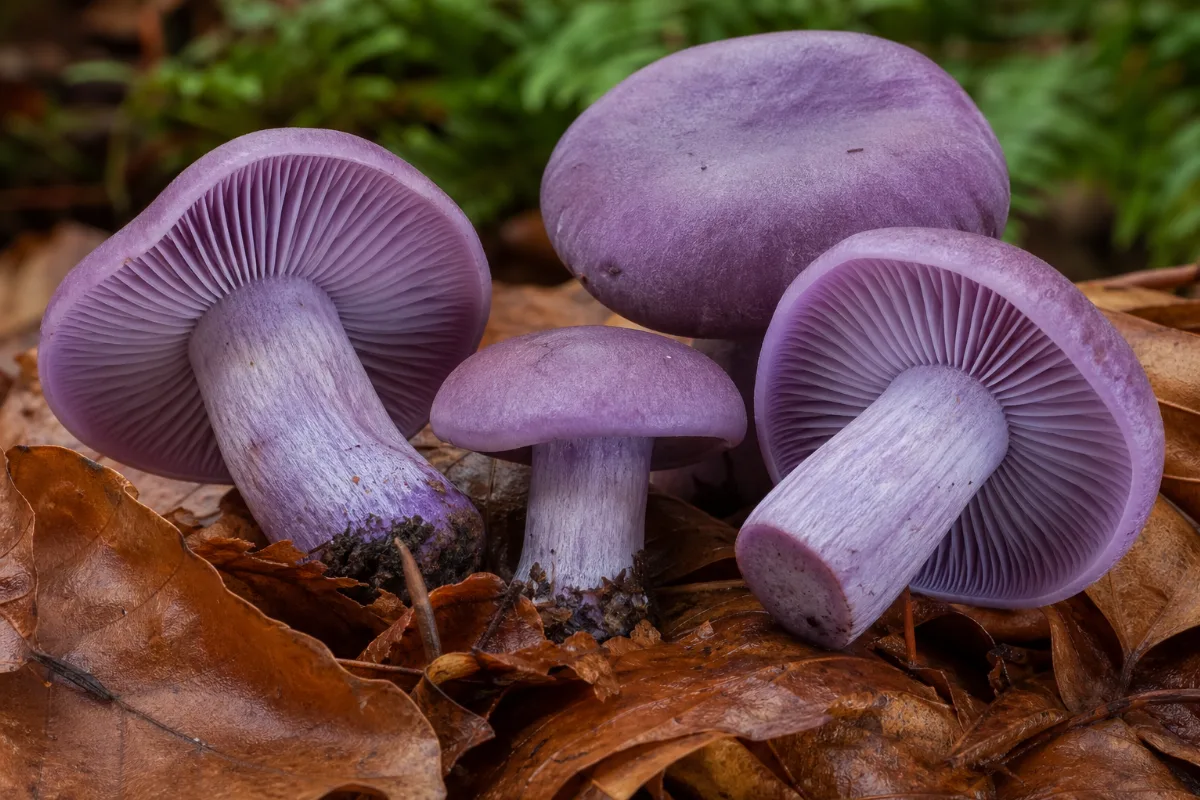
Mushrooms · Wild culinary mushroom
Blewit
Lepista nuda · also called Wood blewit (also written Clitocybe nuda or Collybia nuda in some sources)
Blewit is a purple-tinged wild mushroom that is cooked and eaten for its floral scent. It is a food, not a proven remedy: we found no human trial of it for any health outcome, and the lab findings are early ideas only. Sources say it must be cooked and that some people react badly, so a forager's guide advises trying only a little at first. The most serious caution is mistaken identity, because poisonous webcaps that damage the kidneys can be mistaken for it.
General information, not medical advice. Last substantive update · Not medically reviewed. A named clinician has not signed off on this page. How this page is made
About Blewit
Blewit is a wild mushroom eaten for its flavour. There is no human research on health benefits. The real concerns are the cooking caution, poisonous look-alikes, contamination from soil, and possible allergy. Safety information for medicines and pregnancy is missing, not reassuring.
What it is
Blewit usually means Lepista nuda, accepted in the GBIF database (family Tricholomataceae). It is a fungus that lives on dead leaves rather than with trees. Some sources now call it Clitocybe nuda or Collybia nuda, because researchers are still revising the genus.
A 2026 study grew it on outdoor fungal beds in forests in Fukushima, so it can be cultivated in that way.
What research has tested
We found no trial in which people ate blewit and a health outcome was measured. The research is laboratory work. Extracts were tested in test tubes for antioxidant activity, for blocking an enzyme linked to gout (xanthine oxidase) and another linked to memory (acetylcholinesterase), and against microbes. Purified polysaccharides were tested on cell lines, and a water extract was tested in zebrafish embryos.
These results are ideas for future research. They are not evidence that blewit prevents or treats any condition.
Metals and radioactivity
Mushrooms take up metals and caesium from soil. In bed-grown blewit at 14 forest sites in Fukushima, caesium-137 ranged from 0.2 to 42 Bq per kg (mean 8.0), below Japan's 100 Bq per kg limit. The authors say uptake was an order of magnitude lower than reported for wild mushrooms.
In a study of 15 wild mushrooms from a busy Ankara campus, blewit was within reference limits for the metals measured, by the authors' calculation, while some other species were not. One site does not describe blewit from elsewhere.
Forms and what is known about them
Fresh and cooked is the food form. A forager says it dries reasonably well and that small firm ones suit pickling, but we read no data on either. Extracts and purified fractions appear only in laboratory studies. This page gives no amounts and does not recommend any product.
Rules and official statements
Searches of the USDA food database for blewit and Lepista nuda returned no record. We did not find or read a blewit-specific statement from the European Food Safety Authority, the US Food and Drug Administration, the European Medicines Agency, NCCIH, LiverTox or LactMed. Absence of a statement is not a safety guarantee.
At a glance
Traditional uses history, not proof
- A forager's guide ranks it among the finest edible fungi and notes a floral scent that survives cooking (Galloway Wild Foods 2011).
Studied for research
- Nutrition as a food: protein 30.3 g per 100 g dry weight in wild Patagonian samples (no health effect shown), insufficient
- Antioxidant chemistry in test tubes, insufficient
- Gout-related enzyme (xanthine oxidase) in a test tube, insufficient
- Memory-related enzyme (acetylcholinesterase) in a test tube, insufficient
- Immune messengers and cancer cell lines (purified sugars, cells only), insufficient
- Blood-vessel formation in zebrafish embryos and cells, insufficient
Main compounds
- Phenolic acids such as gallic acid and p-hydroxybenzoic acid
- Ergothioneine, eritadenine and adenosine (named in an abstract, no amounts given)
- Polysaccharides (two purified fractions studied in cells)
Common forms
- Fresh blewit, cooked (the food form)
- Dried blewit (a forager says it dries reasonably well; no data read)
- Pickled blewit (a forager mentions small firm ones for pickling)
- Solvent and water extracts and purified fractions used only in laboratory studies
Research links: Orellanine: kidney poison in some webcaps (abstract) · Nephrotoxic mushroom poisoning review (abstract) · Caesium-137 in bed-grown blewit, Fukushima (abstract) · Metals in 15 wild mushrooms, Ankara (abstract) · Gout enzyme and composition of four mushrooms (abstract) · Antioxidant properties of two wild mushrooms, Morocco (abstract) · Blood-vessel formation in zebrafish and cells (abstract) · Research Library · Genes & Biomarkers Library
What it is and its history
- Accepted scientific name
- Lepista nuda
- Naming authority
- (Bull.) Cooke (GBIF)
- Synonyms
- Clitocybe nuda (Bull.) H.E.Bigelow & A.H.Sm.; Agaricus nudus Bull.; Collybia nuda (Bull.) Z.M. He & Zhu L. Yang (2023)
- Common names
- Blewit (English); Wood blewit (English)
- Family or group
- Tricholomataceae in GBIF (a fungus family), not a plant. A 2026 paper places related fungi in Clitocybaceae.
- Classification
- Fungi > Basidiomycota > Agaricomycetes > Agaricales > Tricholomataceae > Lepista > Lepista nuda
- Native range
- Not checked beyond the papers: specimens come from Argentina, Turkey, Morocco, Serbia and Japan.
- Habitat
- A forager's guide describes it as a saprophyte that lives on dead leaf litter and compost, not a tree partner (Galloway 2011).
- What it looks like
- Fruiting body: No identification description is given here by design.
- Cultivation
- A 2026 study grew it on outdoor fungal beds in forests in Fukushima (Sakai 2026).
- Harvest and processing
- A forager's guide says it dries reasonably well and that smaller firm specimens are good for pickling.
- Look-alikes and adulterants
- Name: Webcaps (Cortinarius); Note: Named by a forager's guide as possible mix-ups; some Cortinarius contain the kidney poison orellanine (Lyons 2023). The guide says purple webcaps are not the most worryingly toxic, but warns to avoid eating any webcap without careful research.; Name: Clouded agaric (Clitocybe nebularis); Note: Named in the same guide as similar. No poisoning detail was read. No identification help is given here.
- Sustainability and conservation
- Not checked.
Traditional use and history history, not clinical proof
| Tradition or era | Documented use | Source |
|---|---|---|
| Autumn foraging | A forager's guide ranks it among the finest edible fungi, with a floral scent kept through cooking, and notes it appears around the first frost. | s-galloway-2011 |
Traditional use shows how it was used. It does not show that it works or is safe today.
What is inside, and how it may work
What it contains and how those compounds act in cells and animals. Laboratory and animal mechanisms are not proven effects in people.
Main compounds
| Compound | Family | Where it is concentrated | Activity studied | Level of evidence |
|---|---|---|---|---|
| Phenolic compounds (gallic acid, p-hydroxybenzoic acid) | phenolic acid | Fruiting body Gallic acid 408.64 micrograms per g dry weight (Ekin 2025); p-hydroxybenzoic acid 587.90 micrograms per g dry weight (Erbiai 2023). Values differ between papers. | Antioxidant activity in test tubes. 4 6 | Laboratory research |
| Ergothioneine, eritadenine, adenosine | mushroom bioactives | Fruiting body (water extract) Identified and quantified by HPLC in the abstract; amounts not given in the abstract. | Named in a zebrafish and cell study. 1 | Animal research |
| Heteropolysaccharides LNP-1 and LNP-2 | polysaccharide | Fruiting body Molecular weights 16,263 and 17,730 Da. | Slowed a melanoma cell line; raised immune messengers in macrophages. 9 | Laboratory research |
| Polyamines and protein | polyamine | Fruiting body Not extracted from the abstract. | Linked by authors to enzyme inhibition and antioxidant activity in a test tube. 11 | Laboratory research |
Mechanisms, receptors and pathways
| Target or pathway | Gene or receptor | What was found | Level |
|---|---|---|---|
| Xanthine oxidase (uric acid enzyme) | Xanthine oxidase | A methanol extract blocked the enzyme in a test tube (IC50 11.71 micrograms per mL). 4 | Laboratory research |
| Blood-vessel growth signalling | MAPK/p38, VEGF-related genes | A water extract reduced vessel formation and signalling in zebrafish embryos and cells. 1 | Animal research |
| Acetylcholinesterase | AChE | Extract inhibited the enzyme in the Ellman assay. 11 | Laboratory research |
Absorption, metabolism and elimination
- Absorption
- Not found in the sources read.
- Distribution
- Not found.
- Metabolism
- Not found.
- Elimination
- Not found.
- Bioavailability
- Not established in people.
Isolated compounds versus whole extracts
The cell, zebrafish and enzyme findings used solvent or water extracts or purified polysaccharides, not cooked mushroom. Extracts and the food are different and results do not transfer.
Nutritional composition
Wild Patagonian Lepista nuda held 30.30 g crude protein per 100 g dry weight (Rugolo 2022). Fresh mushrooms are mostly water, so a cooked portion supplies far less. No USDA FoodData Central record was found in a search on 2026-10-25.
7 not enough evidence
What was looked at
The 7 benefits and uses checked for Blewit, each with how strong the evidence is. Tap one to open it.
- Blewit as a food (nutrients)Not enough evidence
- Antioxidant chemistry (laboratory)Not enough evidence
- Gout-related enzyme (test tube)Not enough evidence
- Memory-related enzyme (test tube)Not enough evidence
- Immune messengers and cancer cell lines (cells only)Not enough evidence
- Blood-vessel formation (zebrafish embryos and cells)Not enough evidence
- Antimicrobial activity (test tube)Not enough evidence
What is Blewit good for?
What blewit has been studied for and how strong the evidence is. None of it is proven in people. Read this together with the Safety tab.
Benefits, one by one
Each card is a research question, not a promise. Tap a goal to filter. Open a card to see the studies, doses and limits.
Blewit as a food (nutrients)
Not enough evidenceBlewit is eaten cooked as a wild or bed-grown mushroom. One laboratory study measured protein at 30.3 g per 100 g of dried wild mushroom, but fresh mushrooms are mostly water, so a cooked portion gives far less. No official food table exists for it.
4 studiesFresh, cooked fruiting body is the usual food. Dried blewit is mentio…
Studies, doses and limits
Results
Patagonian wild Lepista nuda: crude protein 30.30 g per 100 g dry weight (Rugolo 2022). Turkish wild Lepista nuda, dry weight: iron 0.449 mmol per kg, alpha-tocopherol 0.3581 micromol per kg, linoleic acid 30.38 percent of fatty acids (Ekin 2025). USDA FoodData Central searches returned no blewit record.
Effect sizes as reported
Nutrient values only; no health effect measured
Why this rating
Composition was measured in two small sets of wild specimens, but nothing shows a health benefit from eating blewit.
Form and dose studied
Fresh, cooked fruiting body is the usual food. Dried blewit is mentioned by a forager, but we read no data on drying.
Limits
Dry-weight values overstate what a fresh cooked portion contains. Values come from wild samples in two countries. No USDA record.
Why researchers looked
Because blewit is a prized autumn food, most research asks what is in it.
Traditional use
A forager's guide calls it among the finest edible fungi, with a floral scent kept through cooking (Galloway 2011).
Proposed mechanism Other
Not a mechanism claim. These are laboratory measurements of the food.
A proposed mechanism does not show that the effect happens in people.
Wild or bed-grown blewit: only eat wild mushrooms confirmed by a qualified local expert, and cook blewit as sources state.
Antioxidant chemistry (laboratory)
Not enough evidenceSolvent extracts of blewit scavenged free radicals in test-tube assays, and the mushroom contains phenolic acids and flavonoids. This is chemistry in a test tube. It has not been shown to protect anyone's body.
3 studiesMethanol or water extracts of fruiting bodies, not cooked mushroom.
Studies, doses and limits
Results
Moroccan Lepista nuda methanol extract: total flavonoid content 19.02 mg catechin equivalents per g extract; p-hydroxybenzoic acid 587.90 micrograms per g dry weight; scavenging in DPPH, beta-carotene and reducing-power assays (Erbiai 2023). Turkish specimens: gallic acid 408.64 micrograms per g dry weight (Ekin 2025). In cultured human lymphocytes, the highest dose of the aqueous extract raised total antioxidant capacity (Emsen 2020).
Effect sizes as reported
Test-tube activity; no human outcome
Why this rating
Lab-only results from solvent extracts; the two papers measured different compounds, so values cannot be compared directly.
Form and dose studied
Methanol or water extracts of fruiting bodies, not cooked mushroom.
Limits
Test-tube antioxidant power does not show a benefit in people. Extracts differ from the food.
Why researchers looked
Many wild mushrooms hold phenolic compounds, so researchers test their antioxidant activity.
Proposed mechanism In vitro
Free-radical scavenging in solution (DPPH, beta-carotene bleaching, reducing power); in cultured human blood cells a water extract raised total antioxidant capacity.
A proposed mechanism does not show that the effect happens in people.
No safety signal in the cell study (see Safety tab); this is not a safety guarantee.
Gout-related enzyme (test tube)
Not enough evidenceA methanol extract of blewit blocked xanthine oxidase, an enzyme that helps make uric acid, in a test tube, and was the strongest of four mushrooms tested. This does not show that eating blewit lowers uric acid or helps gout.
1 studiesMethanol extract.
Studies, doses and limits
Results
Ekin 2025: Lepista nuda methanol extract XO IC50 11.71 micrograms per mL. The authors suggest it may be useful for hyperuricemia and gout.
Effect sizes as reported
IC50 11.71 micrograms per mL in a test tube
Why this rating
Test-tube result from one study; not tested in animals or people.
Form and dose studied
Methanol extract.
Limits
One study. No uric acid measurement in any living animal or person.
Why researchers looked
The enzyme makes uric acid, so extracts that block it are screened as an idea for gout.
Proposed mechanism In vitro
Inhibition of xanthine oxidase in solution; IC50 11.71 micrograms per mL for Lepista nuda against 20.71 to 39.97 for the three other species.
A proposed mechanism does not show that the effect happens in people.
Do not use blewit in place of gout medicine. Ask a doctor.
Memory-related enzyme (test tube)
Not enough evidenceIn a Serbian laboratory study, an extract of Lepista nuda blocked acetylcholinesterase, an enzyme linked to memory research. This is a test-tube result only and does not show any effect on memory.
1 studiesExtract.
Studies, doses and limits
Results
Rasheta 2023: Lepista nuda extract inhibited the enzyme by 99.94 percent in the test tube, among the highest of eight fungi.
Effect sizes as reported
99.94 percent enzyme inhibition in a test tube
Why this rating
Test-tube result; the authors say the active substances are unknown.
Form and dose studied
Extract.
Limits
Test-tube only, in one study.
Why researchers looked
Fungal extracts are screened for neuroprotective ideas.
Proposed mechanism In vitro
Acetylcholinesterase inhibition in the Ellman assay; the authors link it to protein, phenolic and polyamine levels.
A proposed mechanism does not show that the effect happens in people.
None identified.
Immune messengers and cancer cell lines (cells only)
Not enough evidenceTwo purified sugar chains (polysaccharides) from blewit slowed the growth of a human melanoma cell line and made mouse-type immune cells release immune messengers in a dish. They did not slow a liver cancer cell line. This is cell work on purified fractions, not the mushroom as food.
1 studiesPurified polysaccharides in cell culture.
Studies, doses and limits
Results
Li 2023: both fractions slowed A375 cells but not HepG2 cells; LNP-2 had better cellular antioxidant activity.
Effect sizes as reported
Qualitative cell findings
Why this rating
One cell-culture paper on purified fractions.
Form and dose studied
Purified polysaccharides in cell culture.
Limits
No animal or human data. Raising immune messengers is not shown to be a benefit.
Why researchers looked
Mushroom polysaccharides are commonly tested for immune effects.
Proposed mechanism In vitro
Purified polysaccharides raised gene activity for NO, IL-6 and TNF-alpha in macrophages and slowed A375 cells.
A proposed mechanism does not show that the effect happens in people.
None identified.
Blood-vessel formation (zebrafish embryos and cells)
Not enough evidenceA water extract of blewit reduced new blood-vessel formation in zebrafish embryos and in cells in a dish. The authors suggest it could limit cancer progression, but this was not tested in any adult animal or person.
1 studiesWater extract.
Studies, doses and limits
Results
Deshmukh 2023: the extract inhibited vessel development in zebrafish embryos, HUVEC tube formation, migration and invasion, and sprouting in embryos injected with HuCCT1 cancer cells.
Effect sizes as reported
Reduced vessel formation in embryos and cells
Why this rating
Embryo and cell work only; no adult animal or human data.
Form and dose studied
Water extract.
Limits
Blocking new vessels could also be a risk in pregnancy or wound healing; this was not studied for the mushroom as eaten.
Why researchers looked
Researchers study blood-vessel growth because tumours need it.
Proposed mechanism Animal research
Reduced angiogenesis-related gene activity and MAPK/p38 signalling in cells; extract contained ergothioneine, eritadenine and adenosine on HPLC.
A proposed mechanism does not show that the effect happens in people.
This is a laboratory finding. It says nothing about the cooked mushroom, so do not read it as pregnancy advice.
Antimicrobial activity (test tube)
Not enough evidenceIn a Turkish laboratory study, Lepista nuda extracts had some of the strongest antimicrobial activity of seven mushrooms tested against microbes in a dish. This does not mean eating blewit fights infections.
1 studiesExtract.
Studies, doses and limits
Results
Dincer 2023: Lepista nuda and Craterellus cornucopioides had the highest antimicrobial activity of seven species in the laboratory.
Effect sizes as reported
Qualitative ranking in a test tube
Why this rating
One test-tube study; the abstract gives no numbers for blewit.
Form and dose studied
Extract.
Limits
No animal or human data.
Why researchers looked
Wild mushrooms are screened for natural antimicrobial compounds.
Proposed mechanism In vitro
Not described in the abstract.
A proposed mechanism does not show that the effect happens in people.
None identified.
Connections to the rest of health
How Blewit connects to the rest of our health knowledge graph. Every link says what kind of connection it is. A safety link (for example to the liver) is a warning, not a benefit. A study that merely mentions a topic never creates a benefit link.
Explore every connection: goals, body systems, organs, symptoms, genes
B. Body systems
| Connected to | Kind of connection | Evidence status | Context | Studies |
|---|---|---|---|---|
| Digestive System | Biological association | Not enough evidence | Studied for: Blewit as a food (nutrients) | 12 4 15 8 |
| Musculoskeletal System | Biological association | Not enough evidence | Studied for: Gout-related enzyme (test tube) | 4 |
| Nervous System | Biological association | Not enough evidence | Studied for: Memory-related enzyme (test tube) | 11 |
| Immune System | Biological association | Not enough evidence | Studied for: Immune messengers and cancer cell lines (cells only) Studied for: Antimicrobial activity (test tube) | 9 3 |
| Cardiovascular System | Biological association | Not enough evidence | Studied for: Blood-vessel formation (zebrafish embryos and cells) | 1 |
C. Body parts and organs
| Connected to | Kind of connection | Evidence status | Context | Studies |
|---|---|---|---|---|
| Kidneys | Adverse effect or risk | Not enough evidence | Delayed kidney failure after mistaking a poisonous mushroom for an edible one. Preparation or compound: Webcap (Cortinarius), a mushroom that could be mistaken for blewit; not the blewit |
10 2 8 |
| Gut | Adverse effect or risk | Not enough evidence | A forager's website says some people react adversely; no medical report was found. Preparation or compound: Uncooked or poorly cooked blewit (forager's report only) |
8 |
K. Biological pathways
| Connected to | Kind of connection | Evidence status | Context | Studies |
|---|---|---|---|---|
| Angiogenesis (MAPK/p38 signalling) | Preliminary mechanism | Animal | Reduced by a water extract in embryos and cells. | 1 |
L. Active compounds
| Connected to | Kind of connection | Evidence status | Context | Studies |
|---|---|---|---|---|
| Phenolic compounds (gallic acid, p-hydroxybenzoic acid) | Biological association | In vitro | Antioxidant activity in test tubes. Preparation or compound: Fruiting body |
4 6 |
| Ergothioneine, eritadenine, adenosine | Biological association | Animal | Named in a zebrafish and cell study. Preparation or compound: Fruiting body (water extract) |
1 |
| Heteropolysaccharides LNP-1 and LNP-2 | Biological association | In vitro | Slowed a melanoma cell line; raised immune messengers in macrophages. Preparation or compound: Fruiting body |
9 |
| Polyamines and protein | Biological association | In vitro | Linked by authors to enzyme inhibition and antioxidant activity in a test tube. Preparation or compound: Fruiting body |
11 |
Each connection is stored with the ingredient, the connected record, the kind of connection, the evidence status, the supporting studies, the preparation or compound involved, and a review date (last reviewed October 25, 2026).
Evidence at a glance: what the research found for 7 outcomes
Each outcome below is one thing researchers measured. Certainty is how far the evidence can be trusted, not how well it works. The full studies are on the next tab.
The evidence
The research centre for Blewit. Every record here was checked against PubMed or the publisher's page; we never list a study we have not verified.
Evidence by outcome
Bars show how many studies we found for each outcome, not how well it works. People are added up across trials only (reviews are not added, to avoid double counting).
How we rate evidence
High certainty
Several well-run trials or reviews agree; further research is unlikely to change the picture much.
Moderate certainty
Good trials point the same way, but some doubt remains.
Low certainty
Small, short or inconsistent trials. The finding could change with better research.
Very low certainty
Very little or very weak human data. Treat as a possibility only.
Mixed findings
Trials or reviews disagree with each other.
Not enough evidence
Not enough human research to say either way.
Evidence against
Good research found no benefit, or found harm.
We take the reviewers' own risk-of-bias and GRADE statements where they exist, and otherwise judge from study size, design, consistency, directness and whether a product matches what is sold. Many publications do not make evidence high. Method note: We read PubMed records and abstracts for 13 papers (seven laboratory studies of blewit extracts or composition, one cell-culture safety test, two reviews of kidney-damaging mushrooms, one classification paper on poisonous relatives, one caesium study and one metals study), plus the full text of one forager's website, the GBIF taxonomy record and a USDA FoodData Central search. Index Fungorum, EFSA, FDA, EMA, NCCIH, LiverTox and LactMed were not read. Certainty ratings are the compiler's own reading.
Study library: every study we checked 16
| Study | Design | People | Product, dose, length | Result |
|---|---|---|---|---|
| Deshmukh 2023 Antiangiogenic potential of Lepista nuda extract suppressing MAPK/p38 signaling-mediated developmental angiogenesis in zebrafish and HUVECs. Biomedicine & Pharmacotherapy · PMID 36621144 · DOI |
Animal and in vitro Lepista nuda |
Zebrafish embryos and human umbilical vein endothelial cells (HUVECs) | Water extract of Lepista nuda fruiting body |
The water extract, which contained ergothioneine, eritadenine and adenosine on HPLC, reduced blood-vessel development in zebrafish embryos and tube formation, migration and invasion in HUVECs. It also reduced sprouting in embryos injected with a human bile-duct cancer cell line (HuCCT1). The authors suggest it could be an angiogenesis inhibitor that limits cancer progression. Blocked new blood-vessel formation in embryos and cells Methods, limits and fundingOutcomes: Blood-vessel formation in zebrafish embryos and in cultured cells Limitations: Zebrafish embryos and cells only. Blocking blood-vessel growth in an embryo is also a possible harm, which is why this is not a pregnancy-safe signal and says nothing about eating the mushroom. Only the abstract was re-read for this page. Funding and conflicts: No conflicts declared by the authors. Read: abstract (PubMed) |
| Diaz 2021 Nephrotoxic Mushroom Poisoning: Global Epidemiology, Clinical Manifestations, and Management. Wilderness & Environmental Medicine · PMID 34629291 · DOI |
Narrative review Nephrotoxic mushrooms (not blewit) |
Review of kidney-damaging mushroom poisonings worldwide | Nephrotoxic mushrooms (mainly Cortinarius) fruiting body |
The abstract says that most mushroom poisonings and deaths come from amatoxin mushrooms, but that nephrotoxic mushrooms, most commonly Cortinarius species, can cause acute kidney insufficiency and failure. It says poisonings are rising, include formerly edible species, and that dialysis is often needed, with transplant reserved for treatment failures. Kidney failure after some mushroom poisonings (review) Methods, limits and fundingOutcomes: Epidemiology, clinical features and management of kidney poisoning from mushrooms Limitations: Narrative review from internet searches (1957 onward). Not about blewit specifically. Funding and conflicts: None declared in the PubMed record. Read: abstract (PubMed) |
| Dinçer 2023 Cytotoxic, Antioxidant, Antibiofilm, and Antimicrobial Activities of Mushroom Species from Turkey. International Journal of Medicinal Mushrooms · PMID 37522534 · DOI |
Laboratory research Lepista nuda (and 6 other species) |
Seven wild mushroom species from Turkey, tested on microbes and cell lines in the laboratory | Mushroom extracts fruiting body |
The abstract reports that Craterellus cornucopioides and Lepista nuda had the highest antimicrobial activity of the seven species. Antibiofilm effects across species ranged from 20.7 to 96.3 percent. The selective effects on breast cancer cell lines named in the abstract were for other species (Hymenopellis radicata, C. cornucopioides), not Lepista nuda. Test-tube antimicrobial activity only Methods, limits and fundingOutcomes: Cytotoxic, antioxidant, antibiofilm and antimicrobial activity in the laboratory Limitations: Laboratory work on extracts of seven species; no animal or human data. Only the abstract was re-read for this page. Funding and conflicts: None declared in the PubMed record. Read: abstract (PubMed) |
| Ekin 2025 Comparison of Xanthine Oxidase Inhibitory Activities and Phenolic, Fatty Acid, Element, and Vitamin Levels of Four Mushroom Species. Food Science & Nutrition · PMID 40264684 · DOI |
Laboratory analysis Lepista nuda (and 3 other species) |
Four wild edible mushrooms (Helvella leucopus, Tricholoma terreum, Lepista nuda, Marasmius oreades) from Turkey | Extracts and dried fruiting body, laboratory assays fruiting body |
For Lepista nuda the abstract gives gallic acid 408.64 micrograms per g dry weight as the main phenolic compound, alpha-tocopherol 0.3581 micromol per kg dry weight, linoleic acid 30.38 percent of fatty acids and iron 0.449 mmol per kg dry weight. In the test-tube xanthine oxidase assay the IC50 values were 39.97, 20.71, 11.71 and 23.85 micrograms per mL for the four mushrooms in the order listed, so Lepista nuda was strongest (11.71). The authors suggest it and T. terreum may be useful for hyperuricemia and gout. Test-tube enzyme inhibition and composition only; no human outcome Methods, limits and fundingOutcomes: Phenolics, vitamins, trace elements, fatty acids, xanthine oxidase (XO) inhibition in a test tube Limitations: Laboratory assay on extracts; the gout suggestion is the authors' idea and was not tested in animals or people. Single sampling date in Turkey. Only the abstract was re-read for this page. Funding and conflicts: No conflicts declared by the authors. Read: abstract (PubMed) |
| Emsen 2020 Antioxidant and Genotoxic Effects of Aqueous and Methanol Extracts from Two Edible Mushrooms from Turkey in Human Peripheral Lymphocytes. International Journal of Medicinal Mushrooms · PMID 32479004 · DOI |
Laboratory research Lepista nuda (and Pleurotus ostreatus) |
Cultured human blood lymphocytes exposed to extracts of Lepista nuda and Pleurotus ostreatus | Aqueous and methanol extracts of the fruiting body fruiting body |
At all concentrations tested the extracts did not show significant differences in chromosome aberration or micronucleus tests (p above 0.05). The highest concentration of the aqueous Lepista nuda extract raised total antioxidant capacity and lowered total oxidative stress in the cells compared with the control. The authors call the extracts non-mutagenic and antioxidant. No DNA damage signal in cultured cells; antioxidant readings in cells Methods, limits and fundingOutcomes: Chromosome aberrations, micronuclei, total antioxidant capacity and oxidative stress in cultured cells Limitations: Cell culture, extracts rather than a cooked mushroom, no human volunteers. Not a safety guarantee for eating the mushroom. Only the abstract was re-read for this page. Funding and conflicts: None declared in the PubMed record. Read: abstract (PubMed) |
| Erbiai 2023 Antioxidant Properties, Bioactive Compounds Contents, and Chemical Characterization of Two Wild Edible Mushroom Species from Morocco: Paralepista flaccida (Sowerby) Vizzini and Lepista nuda (Bull.) Cooke. Molecules · PMID 36770790 · DOI |
Laboratory analysis Lepista nuda (and Paralepista flaccida) |
Two wild edible mushrooms from northern Morocco | Methanolic extracts of dried fruiting body fruiting body |
In Lepista nuda total flavonoid content was 19.02 mg catechin equivalents per g of dry methanolic extract, and p-hydroxybenzoic acid was the main phenolic compound (587.90 micrograms per g dry weight). Methanol extracts scavenged free radicals in DPPH, beta-carotene bleaching and reducing-power tests (EC50 about 1 mg per mL in DPPH). The authors call both species potential sources of biomolecules for the food and pharmaceutical industry. Test-tube antioxidant activity; no human outcome Methods, limits and fundingOutcomes: Phenolic and flavonoid content, individual compounds, antioxidant test-tube assays Limitations: Test-tube assays on a solvent extract. They show chemistry, not a benefit to people. Only the abstract was re-read for this page. Funding and conflicts: No conflicts declared by the authors. Read: abstract (PubMed) |
| GBIF Secretariat 2026 GBIF: Lepista nuda (Bull.) Cooke GBIF Backbone Taxonomy (API) · Source |
Database record n/a |
n/a | n/a Not shown here |
GBIF Backbone: Lepista nuda (Bull.) Cooke is the accepted species, key 5242048, family Tricholomataceae, order Agaricales. Its synonym list includes Clitocybe nuda (Bull.) H.E.Bigelow & A.H.Sm., Agaricus nudus Bull. and Collybia nuda (Bull.) Z.M. He & Zhu L. Yang (2023). A separate GBIF dataset record lists Collybia nuda as an accepted name. Accepted name confirmed; newer genus placement exists Methods, limits and fundingOutcomes: Accepted name and synonyms Limitations: Taxonomy database only; the genus name is being revised by researchers, so labels and papers may use Lepista, Clitocybe or Collybia. Index Fungorum was not read. Funding and conflicts: n/a Read: database record, API checked 2026-10-25 |
| Galloway Wild Foods 2011 Wood blewits - Identification, Distribution, Edibility, Ecology, Sustainable Harvesting (forager's website) gallowaywildfoods.com (non-medical website) · Source |
Forager guide Lepista nuda (called Clitocybe nuda on that page) |
General readers; a Scottish forager's guide | Text on edibility and look-alikes fruiting body |
The page says the mushroom must be cooked, that some people react adversely, and to try just a little, well cooked, the first time. It names purple webcaps (Cortinarius) and the clouded agaric as similar species and says to avoid eating any webcap without careful research. It also says the purple webcaps are not the most worryingly toxic members of the genus but contain some potentially troublesome compounds. Practical advice from one forager; not a medical source Methods, limits and fundingOutcomes: Edibility advice and named look-alikes Limitations: A single non-medical website, dated 3 December 2011. It gives no reference for the adverse reactions. It is quoted only for the cooking caution and the names of look-alikes. This page does not give identification help. Funding and conflicts: Website; the author sells foraging courses and a book. Read: full page text read 2026-10-25 |
| Li 2023 Structure characterization and biological activities evaluation of two hetero-polysaccharides from Lepista nuda: Cell antioxidant, anticancer and immune-modulatory activities. International Journal of Biological Macromolecules · PMID 37271268 · DOI |
Laboratory research Lepista nuda |
Two purified polysaccharides (LNP-1, LNP-2) from Lepista nuda tested on cell lines | Purified polysaccharide fractions fruiting body |
Molecular weights were 16,263 Da (LNP-1) and 17,730 Da (LNP-2). Both slowed growth of A375 (human melanoma) cells but not HepG2 (human liver cancer) cells. LNP-2 had better cellular antioxidant activity. In macrophages both raised the activity of genes for NO, IL-6 and TNF-alpha, immune messengers. Cell-line findings only Methods, limits and fundingOutcomes: Structure, cell antioxidant activity, effect on cancer cell lines, immune messengers from macrophages Limitations: Purified fractions in cell culture, not whole mushroom; no animal or human work. Raising immune messengers is not shown to be a benefit. Only the abstract was re-read for this page. Funding and conflicts: No conflicts declared by the authors. Read: abstract (PubMed) |
| Lyons 2023 Orellanine: From Fungal Origin to a Potential Future Cancer Treatment. Journal of Natural Products · PMID 37308446 · DOI |
Narrative review Cortinarius orellanus (not blewit) |
Review of orellanine, a kidney poison found in some webcap mushrooms (Cortinarius), including the fools webcap | Orellanine from Cortinarius species fruiting body |
The abstract calls orellanine a fungal nephrotoxin found in mushrooms including Cortinarius orellanus (fools webcap), with exceptional selectivity for kidney proximal tubule cells and a characteristically prolonged latency period between eating and symptoms. It also notes early-2022 announcement of phase I/II human trials of orellanine as a possible cancer drug. Kidney toxin with delayed onset (review) Methods, limits and fundingOutcomes: History, toxicity, symptoms and latency Limitations: A chemistry and toxicology review of the poison, not about blewit. Which webcaps contain it, and how likely a blewit mix-up is, is not covered by the abstract. Only the abstract was re-read for this page. Funding and conflicts: No conflicts declared by the authors. Read: abstract (PubMed) |
| Rašeta 2023 Polyamines in Edible and Medicinal Fungi from Serbia: A Novel Perspective on Neuroprotective Properties. Journal of Fungi · PMID 38248931 · DOI |
Laboratory research Lepista nuda (and 7 other fungi) |
Eight edible and medicinal fungi from Serbia, including Lepista nuda | Extracts of fruiting bodies fruiting body |
The abstract says Ganoderma applanatum and Lepista nuda showed the strongest anti-AChE activity (98.05 and 99.94 percent inhibition) and antioxidant activity, which the authors attribute to protein, phenolic and polyamine levels working together. They call for more research to find the responsible substances. Test-tube enzyme inhibition only Methods, limits and fundingOutcomes: Acetylcholinesterase (AChE) inhibition and antioxidant tests in a test tube; polyamine levels Limitations: Test-tube assay (Ellman). AChE is a memory-related enzyme, but nothing here shows an effect on memory in any living animal. Only the abstract was re-read for this page. Funding and conflicts: No conflicts declared by the authors. Read: abstract (PubMed) |
| Rugolo 2022 Nutritional Composition and Bioactive Properties of Wild Edible Mushrooms from Native Nothofagus Patagonian Forests. Foods · PMID 36360128 · DOI |
Laboratory analysis Lepista nuda (and 16 other species) |
17 wild edible mushroom species from Andean Patagonian forests (Argentina), including Lepista nuda | Dried wild fruiting bodies, laboratory analysis fruiting body |
The abstract says crude protein was highest in Lepista perlatum (36.60 g per 100 g dry weight) followed by Lepista nuda (30.30 g per 100 g dry weight). Carbohydrates were the most abundant macronutrient across the 17 species. The paper links this kind of data to using wild mushrooms in food and tourism. Composition measurement only; no health effect measured Methods, limits and fundingOutcomes: Proximate composition, fatty and organic acids, sugars, phenolics, ergosterol, antioxidant and antimicrobial activity Limitations: Dry-weight values are not what is on a plate, because fresh mushrooms are mostly water. Wild specimens from one region; one set of samples. Only the abstract was re-read for this page. Funding and conflicts: No conflicts declared by the authors. Read: abstract (PubMed) |
| Sakai 2026 Radiocesium uptake in two fungal bed-cultivated edible mushroom species in forests in Fukushima, Japan. PLoS One · PMID 42546016 · DOI |
Field measurement Lepista nuda (and Lyophyllum decastes) |
Lyophyllum decastes and Lepista nuda grown on outdoor fungal beds at 14 forest sites in Fukushima Prefecture | Fruiting bodies from outdoor fungal beds, measured for caesium-137 fruiting body |
Caesium-137 in Lepista nuda fruiting bodies (at 90 percent water content) ranged from 0.2 to 42 Bq per kg (mean 8.0), below Japan's 100 Bq per kg threshold. Concentrations correlated with contamination in upper soil and leaf mold. Transfer factors were one order of magnitude lower than reported for wild mushrooms. Below the Japanese limit in this cultivation study Methods, limits and fundingOutcomes: Caesium-137 in fruiting bodies compared with Japan's 100 Bq per kg food limit Limitations: Bed-grown mushrooms at 14 sites, not wild ones. It says nothing about wild blewit from contaminated areas. Only the abstract was re-read for this page. Funding and conflicts: No conflicts declared by the authors. Read: abstract (PubMed) |
| Sarikurkcu 2020 Metal concentration and health risk assessment of fifteen wild mushrooms collected from the Ankara University Campus (Turkey). Environmental Science and Pollution Research · PMID 32506407 · DOI |
Laboratory analysis Lepista nuda (and 14 other species) |
Fifteen wild mushroom species, including Lepista nuda, from a busy urban campus in Ankara | Wild fruiting bodies, metal analysis and exposure estimate fruiting body |
The abstract says that Cyclocybe cylindracea, Lepista nuda and Cerioporus squamosus were within the reference dose limits set by authorities for all the metals studied. Other species in the same study (for example Armillaria mellea and Pleurotus ostreatus) were judged toxic for some metals. The authors say that, because the site is traffic-heavy, some mushrooms there should not be eaten until emissions are controlled. Risk index within reference limits for this species at this site Methods, limits and fundingOutcomes: Iron, manganese, copper, zinc, cobalt, cadmium, lead and nickel; daily intake and health risk index Limitations: One site and one collection; the exposure assumptions are the authors'. A result for one place does not apply to blewit from elsewhere. Only the abstract was re-read for this page. Funding and conflicts: None declared in the PubMed record. Read: abstract (PubMed) |
| USDA Agricultural Research Service 2026 USDA FoodData Central search for blewit and Lepista nuda USDA FoodData Central (API search) · Source |
Database record n/a |
n/a | n/a Not shown here |
Searches for 'blewit' and 'lepista nuda' through the FoodData Central search API returned zero foods on 2026-10-25. No USDA nutrient record found Methods, limits and fundingOutcomes: Whether the food has a nutrient record Limitations: Absence from one database search only; the search tool could miss alternative names. Funding and conflicts: n/a Read: API search, 2026-10-25 |
| Xu 2026 Phylogenetic and Phylogenomic Analyses Reveal New Taxa in Clitocybaceae, with Notes on Poisonous Species and Spore Evolution. Journal of Fungi · PMID 42646075 · DOI |
Taxonomy and case notes Clitocybaceae (Lepista s.str. group) |
24 Chinese specimens in the fungus family Clitocybaceae, most collected at poisoning sites | DNA and spore study of fungi, with poisoning symptoms noted fruiting body |
The abstract says the edibility and toxicity of many species in this family are unknown, which poses a poisoning risk. It describes a new genus, Allolepista, split from Lepista s.str. (the group containing the blewit), and says some relatives caused gastroenteritis or muscarinic syndrome. The abstract does not say that blewit itself was involved in any poisoning. Family-level warning; blewit not named as poisonous Methods, limits and fundingOutcomes: Classification; symptoms seen in poisoning cases Limitations: A classification paper from China. The poisonous species it names are not the blewit; it is used here only to show that this family contains species with unknown or poisonous effects. Only the abstract was re-read for this page. Funding and conflicts: No conflicts declared by the authors. Read: abstract (PubMed) |
What we do not know yet
- No trial of eating blewit for any health outcome was found.
- No medical description of the adverse reaction that foragers report was found.
- No blewit-specific regulator statement (EFSA, FDA, EMA, NCCIH, LiverTox, LactMed) was read.
- No allergy, interaction, pregnancy, breastfeeding or children data were found.
- Metal and radioactivity data for wild blewit are limited to two small studies.
How new research is added
New studies are found by a saved PubMed search and placed in a review queue. A person reads each one before it changes any evidence rating or safety wording. New publications never change ratings automatically.
Lab markers
What changed in blood or saliva tests during trials. A changed number is not the same as feeling or being healthier, and we give no "normal ranges".
Safety
What studies and official sources say about side effects, medicines and who should check first. Each point shows what kind of evidence it comes from.
Main points to know 3
- Mistaken identity with poisonous mushrooms is the main danger. A forager's guide names webcaps (Cortinarius) and the clouded agaric as mushrooms that could be mistaken for blewit. Some webcaps contain orellanine, a kidney poison. A 2023 review says orellanine has a prolonged delay between eating and symptoms, and a 2021 review says the mushrooms that damage kidneys are most commonly Cortinarius species, and that dialysis is often needed. The guide itself says purple webcaps are not the most worryingly toxic of the genus, so we cannot say how dangerous a blewit mix-up is. This page does not teach identification, and pictures or apps are not enough. Never eat a wild mushroom unless a qualified local expert has confirmed it. Review 8 10 2
- Cook it, and start small: some people react badly. The only source we found on this is a forager's website, not a medical source. It says blewit must be cooked, that some people react adversely, and that the first time you should try just a little, well cooked. It gives no details of the reaction, and we found no medical paper describing it. Treat this as a caution from experience, not a measured risk. Expert opinion 8
- Allergy to mushrooms exists; nothing blewit-specific was found. We found no report of allergy to blewit. Mushroom allergy exists in general, so stop and get help for hives, swelling or breathing trouble after eating any mushroom. Gap
Side effects 2
| Effect | How often | Severity and recovery | Evidence |
|---|---|---|---|
| Adverse reaction when not well cooked or in sensitive people (not described) Stated by one forager's website without detail or reference. No medical report was found, so the symptoms, frequency and cause are unknown. | Not established | unknown Not described | Expert opinion 8 |
| No documented poisoning by blewit itself in the sources read This is the absence of a report in what we read, not proof of safety. A 2026 taxonomy paper warns that edibility and toxicity are unknown for many species in the same fungus family, but it does not name blewit as poisonous. | Not established | unknown Not applicable | Gap |
Liver
No report of liver injury from eating blewit was found in the sources read. We did not find a LiverTox entry for it.
How often. No rate can be given.
This is a safety connection. It is not evidence that Blewit supports liver health.
Medicines and supplements 2
| With | Why it matters | Importance | Evidence | What to do |
|---|---|---|---|---|
| Prescription medicines in general prescription | Unknown. No report, trial or label statement was found. | Gap Not enough evidence | Ask a pharmacist or doctor if you take regular medicines and plan to eat blewit often. | |
| Gout medicines or uric acid tests prescription | A test-tube extract blocked xanthine oxidase, the enzyme gout drugs such as allopurinol also target. No study tested eating it. | Unknown. A test-tube result does not show an effect in people. | Laboratory research Not enough evidence 4 | Do not use blewit instead of gout medicine. Ask a doctor. |
Who should check first 3
| Situation | Advice | Evidence |
|---|---|---|
| Any wild mushroom that has not been confirmed by a qualified local expert | Do not eat it. Some mushrooms that could be confused with blewit contain kidney poison with a delayed onset, and this page does not teach how to tell them apart. | Review 8 10 2 |
| Eating blewit raw | Sources say it must be cooked. Do not eat it raw. | Expert opinion 8 |
| Past reaction to mushrooms, or mushroom allergy | Avoid it and ask a doctor, because no safety data exist for blewit. | Gap |
Overdose, product quality and regulators
Summary. Blewit is a long-used food in the sources read, but its safety rests on cooking and on correct identification, and no safety study of it was found.
Animal. No animal toxicity study was found. A zebrafish-embryo study found that a water extract reduced blood-vessel development; that is a laboratory finding about an extract, not a safety statement about the cooked mushroom.
Human doses studied. No human trials. This page gives no amounts and none are advised.
High dose or long term signals. No long-term study of eating blewit was found.
Overdose response. Not described.
Genotoxicity. In cultured human blood cells, aqueous and methanol extracts did not increase chromosome aberrations or micronuclei at the concentrations tested (Emsen 2020). Cell test only; not proof for people.
Toxic or hazardous parts. Fungus: fruiting body (eaten). Described as needing cooking by a forager's guide. Raw eating was not covered by any medical source we read.
Mushrooms take up metals and radioactive caesium from soil. Blewit data are limited to two small studies.
Radioactive caesium in bed-grown blewit (Fukushima, Japan). In Lepista nuda fruiting bodies grown on outdoor fungal beds at 14 forest sites, caesium-137 ranged from 0.2 to 42 Bq per kg (mean 8.0), below Japan's 100 Bq per kg limit. The authors say transfer factors were an order of magnitude lower than reported for wild mushrooms. 13
Metals in wild blewit (Ankara, Turkey). In a study of 15 wild mushrooms from a busy urban campus, Lepista nuda was within reference dose limits for all metals measured (iron, manganese, copper, zinc, cobalt, cadmium, lead, nickel) by the authors' calculation (they assumed their own intake levels). Other species there were judged toxic for some metals. 14
| Body | Action | Date |
|---|---|---|
| USDA FoodData Central (United States) | Searches for blewit and Lepista nuda returned no food record (zero hits). source | 2026-10-25 |
When to get medical help
- Call a poison centre or emergency service straight away if you may have eaten a wild mushroom you could not identify for sure. In the US, Poison Help is 1-800-222-1222. Keep a sample or a photo of what was eaten.
- Vomiting, belly cramps or diarrhoea within hours of eating a wild mushroom: get medical advice the same day, and tell the clinicians exactly what was eaten.
- Some mushroom poisons act late. Thirst, passing much less urine, back or flank pain or tiredness days after a mushroom meal need urgent medical help even if you felt well at first.
- Hives, swelling of the face or throat, or difficulty breathing after eating mushrooms need emergency care.
If someone may be poisoned or in a crisis, contact a clinician or emergency service straight away. In the US, Poison Control is 1-800-222-1222.
General information only, not medical advice. Ask a clinician or pharmacist before use, especially with medicines, in pregnancy or with a health condition. See the Natural Remedy Safety guide.
Frequently asked questions
What is a blewit?
Is blewit safe to eat?
Can I eat blewit raw?
No. The source we found says it must be cooked, and no medical source we read supports eating it raw.
What are the poisonous look-alikes?
Can I identify it from a description or an app?
Does blewit have any health benefits?
Can blewit help with gout?
No evidence shows this. A methanol extract blocked an enzyme that makes uric acid in a test tube, but nothing was tested in animals or people. Do not use it in place of gout medicine. Ask a doctor.
Does blewit contain heavy metals or radioactivity?
Can blewit cause an allergy?
We found no blewit-specific allergy report, but mushroom allergy exists in general. Tell a doctor about hives, swelling or breathing trouble after eating mushrooms.
Does blewit interact with medicines?
We found no report, trial or label statement about blewit and medicines. That means unknown, not safe. Ask a pharmacist or doctor if you take regular medicines.
Is blewit safe in pregnancy, breastfeeding or for children?
Is blewit the same as a medicinal mushroom supplement?
No. Blewit is a wild food. We found no supplement, extract or mycelium product with data. Medicinal mushrooms such as reishi have their own research.
Explore by health goal
Editorial transparency
- Written by
- AlternativeMed editorial team. Research compiled with AI assistance, then checked against PubMed records.
- Medical review
- None. This page has not been reviewed by a physician or pharmacist.
- First published
- 2026-10-25
- Last substantive update
- 2026-10-25
- How we research
- We read PubMed records and abstracts for 13 papers (seven laboratory studies of blewit extracts or composition, one cell-culture safety test, two reviews of kidney-damaging mushrooms, one classification paper on poisonous relatives, one caesium study and one metals study), plus the full text of one forager's website, the GBIF taxonomy record and a USDA FoodData Central search. Index Fungorum, EFSA, FDA, EMA, NCCIH, LiverTox and LactMed were not read. Certainty ratings are the compiler's own reading.
- How we rate evidence
- See "How we rate evidence" in the Evidence tab.
- Independence
- No product is promoted on this page. No affiliate links are shown. This page is information, not a recommendation to eat or pick blewit.
Sources 16
Each source was opened and checked. Where we read only the abstract, it says so. The small numbers in the text point here.
- Deshmukh D, Hsu YF, Chiu CC, et al. Antiangiogenic potential of Lepista nuda extract suppressing MAPK/p38 signaling-mediated developmental angiogenesis in zebrafish and HUVECs.. Biomedicine & Pharmacotherapy. 2023. PMID 36621144. DOI 10.1016/j.biopha.2023.114219. (abstract (PubMed))
- Diaz JH. Nephrotoxic Mushroom Poisoning: Global Epidemiology, Clinical Manifestations, and Management.. Wilderness & Environmental Medicine. 2021. PMID 34629291. DOI 10.1016/j.wem.2021.09.002. (abstract (PubMed))
- Dinçer E, Işık H, Hepokur C, et al. Cytotoxic, Antioxidant, Antibiofilm, and Antimicrobial Activities of Mushroom Species from Turkey.. International Journal of Medicinal Mushrooms. 2023. PMID 37522534. DOI 10.1615/IntJMedMushrooms.2023047802. (abstract (PubMed))
- Ekin S, Bayramoglu Akkoyun M, Bakir A, et al. Comparison of Xanthine Oxidase Inhibitory Activities and Phenolic, Fatty Acid, Element, and Vitamin Levels of Four Mushroom Species.. Food Science & Nutrition. 2025. PMID 40264684. DOI 10.1002/fsn3.70203. (abstract (PubMed))
- Emsen B, Guven B, Uzun Y, et al. Antioxidant and Genotoxic Effects of Aqueous and Methanol Extracts from Two Edible Mushrooms from Turkey in Human Peripheral Lymphocytes.. International Journal of Medicinal Mushrooms. 2020. PMID 32479004. DOI 10.1615/IntJMedMushrooms.2020033845. (abstract (PubMed))
- Erbiai EH, Maouni A, Pinto da Silva L, et al. Antioxidant Properties, Bioactive Compounds Contents, and Chemical Characterization of Two Wild Edible Mushroom Species from Morocco: Paralepista flaccida (Sowerby) Vizzini and Lepista nuda (Bull.) Cooke.. Molecules. 2023. PMID 36770790. DOI 10.3390/molecules28031123. (abstract (PubMed))
- GBIF Secretariat. GBIF: Lepista nuda (Bull.) Cooke. GBIF Backbone Taxonomy (API). 2026. (database record, API checked 2026-10-25)
- Galloway Wild Foods. Wood blewits - Identification, Distribution, Edibility, Ecology, Sustainable Harvesting (forager's website). gallowaywildfoods.com (non-medical website). 2011. (full page text read 2026-10-25)
- Li Y, Guo X, Zhong R, et al. Structure characterization and biological activities evaluation of two hetero-polysaccharides from Lepista nuda: Cell antioxidant, anticancer and immune-modulatory activities.. International Journal of Biological Macromolecules. 2023. PMID 37271268. DOI 10.1016/j.ijbiomac.2023.125204. (abstract (PubMed))
- Lyons MJ, Ehrhardt C, Walsh JJ. Orellanine: From Fungal Origin to a Potential Future Cancer Treatment.. Journal of Natural Products. 2023. PMID 37308446. DOI 10.1021/acs.jnatprod.2c01068. (abstract (PubMed))
- Rašeta M, Kebert M, Mišković J, et al. Polyamines in Edible and Medicinal Fungi from Serbia: A Novel Perspective on Neuroprotective Properties.. Journal of Fungi. 2023. PMID 38248931. DOI 10.3390/jof10010021. (abstract (PubMed))
- Rugolo M, Mascoloti Spréa R, Dias MI, et al. Nutritional Composition and Bioactive Properties of Wild Edible Mushrooms from Native Nothofagus Patagonian Forests.. Foods. 2022. PMID 36360128. DOI 10.3390/foods11213516. (abstract (PubMed))
- Sakai M, Watanabe M, Kanao Koshikawa M, et al. Radiocesium uptake in two fungal bed-cultivated edible mushroom species in forests in Fukushima, Japan.. PLoS One. 2026. PMID 42546016. DOI 10.1371/journal.pone.0342639. (abstract (PubMed))
- Sarikurkcu C, Sarikurkcu RT, Akata I, et al. Metal concentration and health risk assessment of fifteen wild mushrooms collected from the Ankara University Campus (Turkey).. Environmental Science and Pollution Research. 2020. PMID 32506407. DOI 10.1007/s11356-020-09530-5. (abstract (PubMed))
- USDA Agricultural Research Service. USDA FoodData Central search for blewit and Lepista nuda. USDA FoodData Central (API search). 2026. (API search, 2026-10-25)
- Xu YD, Li HJ, Sheng CG, et al. Phylogenetic and Phylogenomic Analyses Reveal New Taxa in Clitocybaceae, with Notes on Poisonous Species and Spore Evolution.. Journal of Fungi. 2026. PMID 42646075. DOI 10.3390/jof12080548. (abstract (PubMed))


