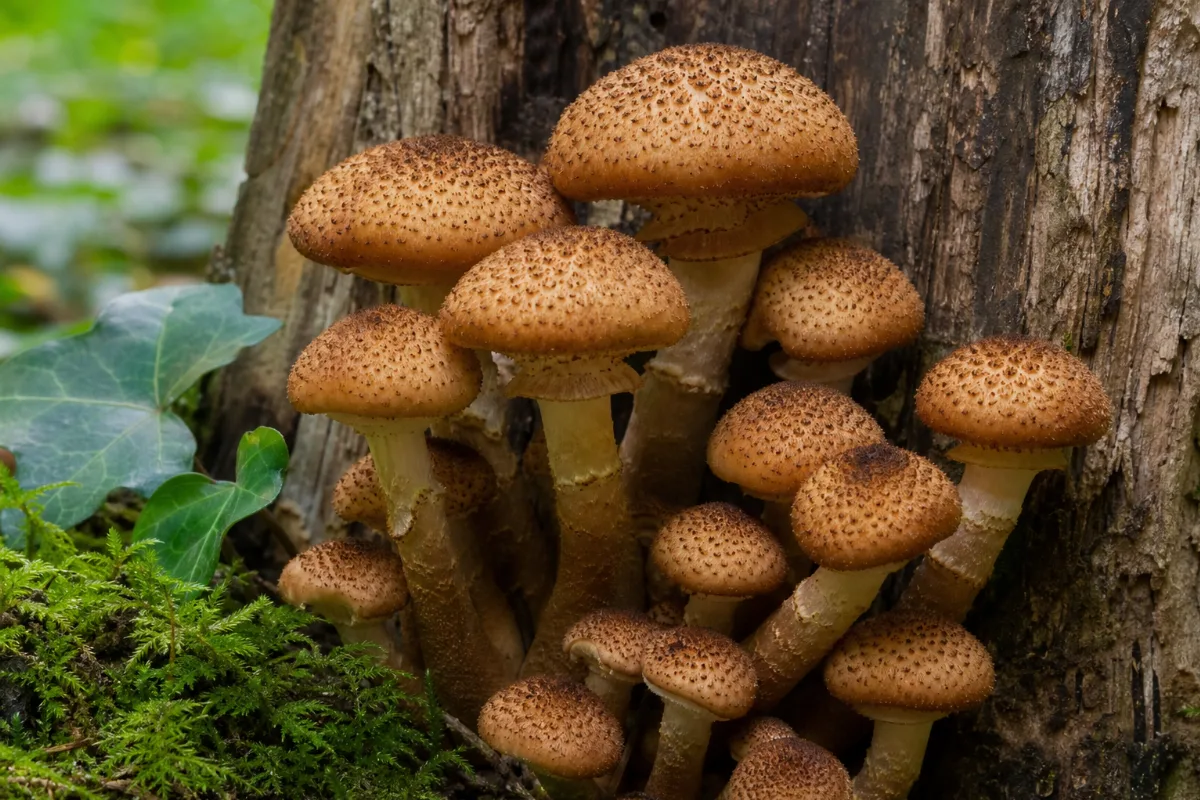
Mushrooms · Wild culinary mushroom
Honey mushroom
Armillaria mellea and related Armillaria species (A. ostoyae, A. gallica and others) · also called Honey fungus; hazel mushroom (name used in China)
Honey mushroom is a wild mushroom that grows in clusters on trees and is eaten cooked in parts of Europe and Asia. Safety comes first: it must be cooked well, some people get a stomach illness even then, and it has been mistaken for the deadly Galerina mushroom, which damages the liver. It is a food, not a proven remedy: all the health findings are from cells, mice and rats, and no human trial was found.
General information, not medical advice. Last substantive update · Not medically reviewed. A named clinician has not signed off on this page. How this page is made
About Honey mushroom
Honey mushroom is a wild mushroom group eaten cooked in parts of Europe and Asia. Cook it well: a poison-centre series found stomach illness in most reported cases, and some people were ill even after cooking. A deadly look-alike, Galerina marginata, has been eaten by mistake for it, and its liver damage can appear days later. Health claims are unproven: findings come from cells, mice and rats, with no human trial. The tian ma orchid link is to the orchid, not to eating the mushroom.
What it is
Honey mushrooms are fungi of the genus Armillaria. They live on and kill trees, forming black cords (rhizomorphs) in soil and under bark. A 2026 review says more than 40 species are recognised and that shape or one DNA region cannot reliably tell them apart, and another 2026 review says older papers often labelled isolates simply 'A. mellea'. So 'honey mushroom' in a book, market or paper may mean A. mellea or a relative.
On edibility the sources we read agree on the genus but not on rankings. The Missouri guide lists A. mellea as edible; a 2026 review names A. gallica, A. ostoyae, A. mellea, A. borealis and A. luteo-virens as notable edible species; a Romanian paper labels A. mellea 'Moderately Edible'. The Wisconsin cases were recorded at genus level, and only half were confirmed by a mycologist, so we cannot say which species cause the most upset.
The genus includes the so-called humongous fungus. MDC says it is an Armillaria mycelium over 2.5 square miles, one specimen estimated at more than 450 years old. That is a tree-disease story and says nothing about eating or health.
What the research shows
No human trial of honey mushroom was found, as a food, extract or supplement. A second 2026 review says medicinal and food claims are supported mainly by chemical, cell or cultivation data, not clinical validation.
The studies we read are in animals or cells. A water extract reduced low-mood-like behaviour in rats; a lab fermentation liquor shortened time to sleep in rats given a sedative; a sugar-chain extract lowered an inflammation signal in tired mice; ethanol and hot-water extracts lowered uric acid in mice; and sugar chains showed antioxidant and anti-inflammatory activity in test tubes and cultured cells. A 2026 review adds that one extract slowed lung cancer cells in a dish. These results cannot show a health effect in people.
There is a real traditional-medicine link, but it is to an orchid. Gastrodia elata (tian ma) has no roots or leaves and must partner with Armillaria mellea to grow. The orchid tuber, not the mushroom, is the medicine. Eating honey mushroom should not be expected to do what tian ma is used for.
How strong is the evidence?
Insufficient for every use. All the benefit work is animal or lab work, often with purified compounds, fermentation liquors or lab-grown mycelium, which differ from a cooked fruiting body. Most abstracts do not give group sizes or the species strain, and older papers may have used other Armillaria species.
The safety evidence is stronger than the benefit evidence: a poison-centre series, a published Galerina case, a toxin study of Galerina species and a review of amatoxin poisoning. Even these are small groups of cases and cannot give rates.
Forms and quality
The only food form with any safety track record in the sources is the fresh or dried fruiting body, cooked. Cultured mycelium is used as a feeder for tian ma and as a lab material. We found no honey mushroom supplement with trial or safety data, and nothing in the sources compares extracts with the cooked food.
Wild mushrooms carry the metals of their soil and wood, so one Romanian result is not a rule. A 2026 review says wild A. ostoyae mineral data 'confirm' safety, but that list leaves out lead and cadmium and does not address stomach illness or look-alikes.
Legal and regulatory status
We found no drug-regulator statement on honey mushroom. The Missouri Department of Conservation is a state agency field guide, not a medicines regulator. A Romanian paper says EU Regulation 2023/915 sets limits for cadmium (0.5 mg/kg) and lead (0.8 mg/kg) in mushrooms; we did not open the regulation itself. FDA, EFSA and LactMed were not searched. Rules differ by country and change.
At a glance
Traditional uses history, not proof
- Eaten cooked in Europe and Asia 'when appropriately prepared' (2011 review).
- Used in Chinese cooking, for example braised with chicken (2026 review).
- Study authors say it has been used as a folk medicine for insomnia in China for several hundred years, and for dizziness and epilepsy in Asia. We did not find a primary source.
- Its real medicinal link is to an orchid: the tian ma orchid (Gastrodia elata) cannot grow without Armillaria mellea, and the orchid tuber is the traditional medicine.
Studied for research
- Low-mood-like behaviour in rats, insufficient
- Sleep in rats (fermentation liquor), insufficient
- Tiredness in mice (polysaccharide), insufficient
- Immune and anti-cancer lab findings, insufficient
- Uric acid in mice, insufficient
Main compounds
- Melleolides, cell-killing chemicals made mostly by lab-grown mycelium
- Polysaccharides (sugar chains)
- Mannitol, the main free sugar
Common forms
- Fresh, thoroughly cooked fruiting body (the food)
- Dried fruiting body (cooking)
- Lab-grown mycelium or fermentation liquor (research and orchid farming only)
Research links: Missouri Department of Conservation: Honey mushroom · Wisconsin Poison Center series (abstract) · Galerina amatoxin study (abstract) · Armillaria review, Biology 2026 (abstract) · Metals in wild mushrooms, Romania 2025 (abstract) · Amatoxin poisoning review (abstract) · Research Library · Genes & Biomarkers Library
What it is and its history
- Accepted scientific name
- Armillaria mellea (Vahl) P.Kumm., the best-known of a genus of more than 40 honey mushroom species
- Naming authority
- (Vahl) P.Kumm. (GBIF)
- Synonyms
- Armillaria tabescens (Scop.) Emel is a synonym of Desarmillaria tabescens (Scop.) R.A.Koch & Aime in GBIF (checked 2026-10-25)
- Common names
- Honey mushroom (English); Honey fungus (English); Hazel mushroom (English (name used for the species in China, per a 2026 review)); Ghebe (Romanian (listed with the species in a 2025 paper))
- Family or group
- Physalacriaceae (a fungus family), not a plant
- Classification
- Fungi > Basidiomycota > Agaricomycetes > Agaricales > Physalacriaceae > Armillaria > Armillaria mellea
- Native range
- Not checked in the sources read. MDC says it occurs statewide in Missouri; a 2026 review describes the genus as having worldwide distribution.
- Habitat
- MDC says the species is parasitic on trees, sometimes killing the host and causing root rot, and forms long black cords (rhizomorphs) that spread through soil and under bark.
- What it looks like
- Fruiting body: Not described on this page. We give no identification help because wild mushrooms cannot be safely identified from text.
- Cultivation
- A 2026 review says A. gallica, A. ostoyae and A. mellea can be grown artificially. Commercial growers farm Armillaria as a feeder for the orchid Gastrodia elata (tian ma), per reviews.
- Harvest and processing
- Not checked in the sources read.
- Look-alikes and adulterants
- Name: Galerina marginata group (deadly galerina); Note: Contains amatoxins; has been eaten by mistake for honey mushroom (see Safety). GBIF: Galerina marginata (Batsch) Kuhner, family Hymenogastraceae, key 8118872.; Name: Ringless honey mushroom (Desarmillaria caespitosa); Note: Named by MDC as a look-alike; a relative whose edibility we did not research.; Name: Jack-o'-lantern (Omphalotus illudens) and big laughing gym (Gymnopilus junonius); Note: Named by MDC as look-alikes. In the Wisconsin series some reported honey mushroom cases were a psilocybin-containing Gymnopilus.; Name: Inocybe fastigiata; Note: A muscarine-containing mushroom that a case report says is easily confused with Armillaria. GBIF lists the name as a synonym.
- Sustainability and conservation
- Not checked.
Traditional use and history history, not clinical proof
| Tradition or era | Documented use | Source |
|---|---|---|
| Europe and Asia | Considered edible and medicinal 'when appropriately prepared' (2011 review abstract). | p22135893 |
| China, cooking | The fruiting body is used in cooking, for example braised with chicken, and valued for its fleshy texture (2026 review). | p42345810 |
| China, folk medicine | The authors of a 2022 rat study say A. mellea has been used as a folk medicine for insomnia in China for several hundred years. We did not find a primary historical source. | p34984694 |
| Asia, folk medicine | The authors of a 2021 rat study say A. mellea has been reported as a treatment for dizziness and epilepsy in Asia. No primary source was read. | p32956757 |
| China, orchid medicine | The orchid Gastrodia elata (tian ma) has no roots or leaves and must form a partnership with Armillaria mellea to grow. The orchid tuber, not the mushroom, is the traditional medicine, used for dizziness, limb numbness, convulsions and high blood pressure, and was added to China's list of foods that are also medicines in 2023 (2026 review). | p42646141 |
| Romania, food | Listed as 'Ghebe' and labelled 'Moderately Edible' in a table of wild edible mushrooms in a 2025 paper. | p41154076 |
| The 'humongous fungus' | MDC says the honey mushroom's genus includes the 'humongous fungus', an Armillaria mycelium over 2.5 square miles, with one specimen estimated at more than 450 years old. This is a tree-disease story and says nothing about eating or health. | s-mdc-honey |
Traditional use shows how it was used. It does not show that it works or is safe today.
What is inside, and how it may work
What it contains and how those compounds act in cells and animals. Laboratory and animal mechanisms are not proven effects in people.
Main compounds
| Compound | Family | Where it is concentrated | Activity studied | Level of evidence |
|---|---|---|---|---|
| Melleolides and other protoilludane sesquiterpene aryl esters (for example armillaricin, melleolide) | sesquiterpene | Mostly mycelium | Cytotoxic or antimicrobial in lab tests; 'cytotoxic' means toxic to cells. 4 | Laboratory research |
| Polysaccharides (sugar chains): AMP (about 460 kDa, glucose), AMPA, AMPS-III (about 13 kDa xylosyl galactofucan) | polysaccharide | AMP and AMPA from fruiting body; AMPS-III from mycelium fermentation | Slowed A549 cancer cells (AMP), raised immune signals in immunosuppressed mice (AMPA), lowered TNF-alpha and MCP-1 in cultured cells (AMPS-III). 4 | Laboratory research |
| Mannitol | sugar alcohol | Fruiting body Named as the main free sugar (2026 review, from an earlier paper) | Composition fact; no health effect shown. 4 | Composition |
| Tocopherol, phenolic acids and minerals | vitamin E form, phenolics, minerals | Fruiting body Tocopherol 42.41 micrograms per 100 g (basis as quoted by the review); Moroccan A. mellea phenolic acids such as vanillic acid 198.4 micrograms per g dry weight; wild A. ostoyae quoted at iron 190 and magnesium 1100 mg/kg. | Composition facts quoted from earlier papers via one review; not verified at source. 4 | Composition |
Mechanisms, receptors and pathways
| Target or pathway | Gene or receptor | What was found | Level |
|---|---|---|---|
| Cancer-cell growth (A549 lung cancer cell line) | The AMP polysaccharide inhibited growth, stopped the cell cycle at G0/G1 and raised the share of dying cells in the lab (per the 2026 review). 4 | Laboratory research | |
| Immune signals in immunosuppressed mice | IL-2, IL-6, IgM, IgA, TNF-alpha, IFN-gamma | The acidic polysaccharide AMPA raised these in cyclophosphamide-treated mice (per the 2026 review). 4 | Animal research |
| Serotonin system and gut bacteria | 5-HT1A and 5-HT2A receptors | A fermentation liquor raised hippocampal serotonin and receptor expression and shifted gut bacteria in insomnia rats. 14 | Animal research |
| Uric acid handling | OAT1, GLUT9, CNT2, xanthine oxidase | Extracts changed these proteins and partly blocked xanthine oxidase in hyperuricemic mice. 15 | Animal research |
| Fungal translation | Elongation factor 2 | Melleolides interfere with fungal protein-making through elongation factor 2 (per the 2026 review); this explains lab toxicity to microbes, not a food effect. 4 | Laboratory research |
Absorption, metabolism and elimination
- Absorption
- Not found in the sources read.
- Distribution
- Not found in the sources read.
- Metabolism
- Not found in the sources read.
- Elimination
- Not found in the sources read.
- Bioavailability
- Not established.
Isolated compounds versus whole extracts
Nearly all of the chemistry and lab work uses purified polysaccharides, extracts, fermentation liquors or lab-grown mycelium, not the cooked fruiting body. A 2015 chemistry paper found that wild fruiting-body and cultured-mycelium polysaccharides differ in make-up and antioxidant strength. So results from one form cannot be carried over to another or to a meal.
Nutritional composition
As a food honey mushroom is mostly carbohydrate. A 2026 review quotes, per 100 g dry weight of A. mellea, carbohydrate 81.25 g, crude protein 1.81 g, fat 1.97 g and ash 8.84 g from an earlier paper, yet elsewhere calls the mushroom high in protein; treat the table as unverified. No nutrient claim is made here.
7 not enough evidence
What was looked at
The 7 benefits and uses checked for Honey mushroom, each with how strong the evidence is. Tap one to open it.
- Low mood (animal model only)Not enough evidence
- Sleep (animal model only)Not enough evidence
- Tiredness (mouse model only)Not enough evidence
- Immune and anti-cancer findings (lab and mice only)Not enough evidence
- Antioxidant and anti-inflammatory tests (lab only)Not enough evidence
- Uric acid in miceNot enough evidence
- Food value (composition only)Not enough evidence
Lab markers tracked in the studies
Immobility time in the forced-swim test (rats)Sleep latency and sleep duration (rats given a sedative)Interleukin-6 (IL-6), a blood inflammation signalSuperoxide dismutase (SOD) activitySerum uric acid (mice)TNF-alpha and MCP-1 release from cultured cells
What is Honey mushroom good for?
The uses people ask about and how strong the evidence is for each. None has been tested in people. Read this together with the Safety tab.
Benefits, one by one
Each card is a research question, not a promise. Tap a goal to filter. Open a card to see the studies, doses and limits.
Low mood (animal model only)
Not enough evidenceIn rats, a water extract of Armillaria mellea reduced behaviours that scientists use as a stand-in for low mood. This was done in animals only. No person has been studied.
1 studiesA water extract of Armillaria mellea was used. This page does not giv…
Studies, doses and limits
Results
Rats given the water extract (three levels) had shorter immobility in the forced-swim test and kept normal sugar-water preference and activity under chronic mild stress; two upper levels lowered IL-1 beta and TNF-alpha.
Why this rating
Rat study only. Animal behaviour tests do not show an effect on mood in people, and nothing was tested in people.
Form and dose studied
A water extract of Armillaria mellea was used. This page does not give amounts and none are advised.
Who was studied
Rats (acute and chronic mild stress models)
Limits
One research group's rat study. The abstract does not say how many animals, which part of the mushroom, or where the mushroom came from. Strains of Armillaria are hard to tell apart (see the identity notes).
Why researchers looked
A. mellea lives in partnership with the orchid Gastrodia elata (tian ma), which is a traditional Chinese medicine. The authors say they expected the mushroom might share some of its properties. They also note it has been used in Asia for dizziness and epilepsy.
Traditional use
The study authors say A. mellea has been reported as a treatment for dizziness and epilepsy in Asia. We did not find a primary traditional source.
Proposed mechanism Animal research
The authors point to less inflammation: raised IL-1 beta and TNF-alpha were lower in blood and brain in stressed rats, and a brain-inflammation protein (Iba1) was lower at the top extract level.
A proposed mechanism does not show that the effect happens in people.
Honey mushroom has real safety points that matter more than any lab finding: it must be well cooked, some people get a stomach illness even then, and a deadly look-alike exists. See the Safety tab.
Sleep (animal model only)
Not enough evidenceA liquid made by growing Armillaria mellea in a fermenter shortened the time to fall asleep and lengthened sleep in rats given a sleep-disrupting drug. It is a lab-made fermentation liquid in rats, not a food, and no person was studied.
1 studiesA fermentation liquor (broth made in a fermenter), not the fruiting b…
Studies, doses and limits
Results
Fermentation liquor reduced restless movement and weight loss in drug-induced insomnia rats and, in rats given a sedative drug, shortened time to fall asleep and lengthened sleep.
Why this rating
Rat study of a lab fermentation product. No human data.
Form and dose studied
A fermentation liquor (broth made in a fermenter), not the fruiting body. No amounts are given here.
Who was studied
Rats with p-chlorophenylalanine-induced insomnia; sedative-treated rats
Limits
The abstract does not give group sizes. Fermentation broth differs from the mushroom you would cook, and results cannot be carried over to a meal of honey mushroom. The authors' claim of 'significant efficacy' in people in Asia is not backed by any trial we found.
Why researchers looked
The authors say A. mellea has been used as a folk medicine for insomnia in China for several hundred years, but how it might work was unknown.
Traditional use
Folk use for insomnia in China for several hundred years (statement by the study authors; no primary source read).
Proposed mechanism Animal research
In the rats, the liquid raised serotonin (5-HT) and two serotonin receptors in the hippocampus, changed gut bacteria, raised two antioxidant enzymes in blood and lowered three inflammation signals (IL-6, TNF-alpha, IL-1 beta).
A proposed mechanism does not show that the effect happens in people.
Honey mushroom has real safety points that matter more than any lab finding: it must be well cooked, some people get a stomach illness even then, and a deadly look-alike exists. See the Safety tab.
Tiredness (mouse model only)
Not enough evidenceA sugar-chain extract (polysaccharide) from Armillaria mellea lowered one inflammation signal and raised an antioxidant enzyme in mice made chronically tired. It also changed gut bacteria. This was done in mice only.
1 studiesA purified polysaccharide (AMP) from A. mellea, not the whole mushroo…
Studies, doses and limits
Results
In mice with a chronic-fatigue model, the polysaccharide group had significantly lower IL-6 (p < 0.05), significantly higher superoxide dismutase (SOD) activity and more lactic acid bacteria than the model group.
Effect sizes as reported
Statistically significant differences on blood markers; no tiredness result for people
Why this rating
Mouse model only, blood and gut markers, no human data.
Form and dose studied
A purified polysaccharide (AMP) from A. mellea, not the whole mushroom. No amounts are given here.
Who was studied
Mice with a chronic-fatigue model (running wheel plus noise)
Limits
The abstract says the polysaccharide has 'no adverse effects' as a general statement about edible fungal polysaccharides. That is a claim in the abstract, not a finding we can confirm, and it does not apply to eating the mushroom itself.
Why researchers looked
Edible fungus sugar chains are being tested for tiredness and for effects on gut bacteria. The authors call them natural functional foods.
Traditional use
No traditional use for tiredness was described in the abstract.
Proposed mechanism Animal research
The authors link the changes to antioxidant capacity and to more lactic acid bacteria in the gut.
A proposed mechanism does not show that the effect happens in people.
Honey mushroom has real safety points that matter more than any lab finding: it must be well cooked, some people get a stomach illness even then, and a deadly look-alike exists. See the Safety tab.
Immune and anti-cancer findings (lab and mice only)
Not enough evidenceSugar chains (polysaccharides) and chemicals made by Armillaria slowed cancer cells in a dish and raised immune signals in mice. That is lab work. No person has been given honey mushroom for cancer or immunity in a published trial that we found.
2 studiesPurified polysaccharides and compounds, mostly from fruiting bodies o…
Studies, doses and limits
Results
Cell-line and mouse findings as summarised in review articles; the original papers were not opened.
Why this rating
Cells and mice only, read through review articles. Purified compounds and extracts are not the same as eating the mushroom.
Form and dose studied
Purified polysaccharides and compounds, mostly from fruiting bodies or lab-grown mycelium. No amounts are given.
Who was studied
Human cancer cell lines; mice given an immune-suppressing drug
Limits
We read the reviews, not the primary papers. Many historical papers labelled isolates 'A. mellea' before DNA tests could separate species. A lab compound that kills cells can also be harmful.
Why researchers looked
Armillaria makes unusual chemicals (melleolides) and sugar chains, and many fungi are screened for immune and cancer-cell effects.
Traditional use
No traditional anti-cancer or immune use of the mushroom itself was found in the sources read.
Proposed mechanism Laboratory research
A 2026 review says an A. mellea sugar-chain extract (AMP) slowed A549 lung cancer cells and stopped their cycle at an early phase, and that another (AMPA) raised several immune signals in mice given an immune-suppressing drug. It also says melleolide-type chemicals from mycelium were toxic to cells and microbes in the lab.
A proposed mechanism does not show that the effect happens in people.
Honey mushroom has real safety points that matter more than any lab finding: it must be well cooked, some people get a stomach illness even then, and a deadly look-alike exists. See the Safety tab.
Antioxidant and anti-inflammatory tests (lab only)
Not enough evidenceA sugar chain from Armillaria mellea lowered two inflammation signals in cultured cells, and sugar chains from wild mushrooms and cultured products scavenged free radicals in test-tube tests. These are lab results only.
2 studiesPurified polysaccharides from wild fruiting bodies (sporophores) and …
Studies, doses and limits
Results
AMPS-III significantly suppressed TNF-alpha and MCP-1 release in the two cell types. SP and CMP polysaccharides scored higher than the other two in DPPH and ABTS radical-scavenging tests and reducing power.
Why this rating
Cell and test-tube results only.
Form and dose studied
Purified polysaccharides from wild fruiting bodies (sporophores) and from cultured mycelium, fermentation broth and mixtures.
Who was studied
Cell lines; chemical tests
Limits
Antioxidant test-tube scores often do not carry over to the body. The authors suggest uses as food supplements, which goes beyond the data.
Why researchers looked
Researchers test mushroom polysaccharides for antioxidant and anti-inflammatory activity as a first screen.
Traditional use
Not described.
Proposed mechanism Laboratory research
AMPS-III, a xylosyl galactofucan of about 13 kDa, suppressed release of TNF-alpha and MCP-1 from mouse macrophage cells (RAW264.7) and a human blood-vessel cell line (EAhy926) after LPS or TNF-alpha stimulation. Four polysaccharides showed different radical-scavenging power, best for those from wild mushrooms and mycelium.
A proposed mechanism does not show that the effect happens in people.
Honey mushroom has real safety points that matter more than any lab finding: it must be well cooked, some people get a stomach illness even then, and a deadly look-alike exists. See the Safety tab.
Uric acid in mice
Not enough evidenceEthanol and hot-water extracts of Armillaria mellea lowered blood uric acid in mice that had been made to have high uric acid. This is a mouse study; nobody with gout or high uric acid has been studied.
1 studiesAn ethanol extract and a hot-water extract of A. mellea. No amounts a…
Studies, doses and limits
Results
Serum uric acid fell from 351 micromol/L in untreated high-uric-acid mice to between 115 and 250 micromol/L across the six extract groups. The abstract says allopurinol showed evident kidney toxicity while the extracts had little impact.
Effect sizes as reported
Large drops in a mouse model; not comparable to people
Why this rating
One mouse study; no human data.
Form and dose studied
An ethanol extract and a hot-water extract of A. mellea. No amounts are given here.
Who was studied
Mice with induced high uric acid
Limits
The abstract does not give group sizes or which part of the mushroom was used. A mouse model does not show that eating honey mushroom lowers uric acid. Anyone with gout needs medical care.
Why researchers looked
High uric acid causes gout. The authors compared the extracts with allopurinol, a gout medicine, in mice.
Traditional use
Not described.
Proposed mechanism Animal research
In the mice, the extracts raised a kidney transporter protein (OAT1), lowered another (GLUT9, hot-water extract only), lowered an intestinal purine transporter (CNT2) and partly blocked xanthine oxidase, the enzyme that makes uric acid. Computer docking picked four candidate compounds.
A proposed mechanism does not show that the effect happens in people.
Honey mushroom has real safety points that matter more than any lab finding: it must be well cooked, some people get a stomach illness even then, and a deadly look-alike exists. See the Safety tab.
Food value (composition only)
Not enough evidenceAs a food, honey mushroom is mostly carbohydrate with a little protein and fat, and its main free sugar is mannitol. This describes what is in it; it does not show a health benefit.
2 studiesFruiting body, dry weight basis.
Studies, doses and limits
Results
A 2026 review quotes, per 100 g dry weight of A. mellea fruiting body: carbohydrate 81.25 g, crude protein 1.81 g, crude fat 1.97 g, ash 8.84 g, from an earlier paper; strain and origin are not stated. The protein figure looks low next to the same review's call for the mushroom as protein-rich, so treat the table as unverified.
Why this rating
Composition numbers quoted second-hand from one table; nothing about health effects.
Form and dose studied
Fruiting body, dry weight basis.
Limits
Values differ by species, wild versus cultivated origin and method. USDA FoodData Central had no honey mushroom entry in the file the earlier page used; we did not re-check it.
Why researchers looked
A 2026 review summarises the fruiting body's make-up because the mushroom is eaten in parts of Europe and Asia.
Traditional use
Eaten in Europe and Asia 'when appropriately prepared' according to a 2011 review abstract.
Proposed mechanism Composition
Not applicable (composition).
A proposed mechanism does not show that the effect happens in people.
Honey mushroom has real safety points that matter more than any lab finding: it must be well cooked, some people get a stomach illness even then, and a deadly look-alike exists. See the Safety tab.
Connections to the rest of health
How Honey mushroom connects to the rest of our health knowledge graph. Every link says what kind of connection it is. A safety link (for example to the liver) is a warning, not a benefit. A study that merely mentions a topic never creates a benefit link.
Explore every connection: goals, body systems, organs, symptoms, genes
A. Wellness goals
| Connected to | Kind of connection | Evidence status | Context | Studies |
|---|---|---|---|---|
| Stress Relief | Not enough evidence | Low mood (animal model only): In rats, a water extract of Armillaria mellea reduced behaviours that scientists use as a stand-in for low mood. This was done in animals only. No person has been studied. | 8 | |
| Better Sleep | Not enough evidence | Sleep (animal model only): A liquid made by growing Armillaria mellea in a fermenter shortened the time to fall asleep and lengthened sleep in rats given a sleep-disrupting drug. It is a lab-made fermentation liquid in rats, not a food, and no person was studied. | 14 | |
| Reduce Fatigue | Not enough evidence | Tiredness (mouse model only): A sugar-chain extract (polysaccharide) from Armillaria mellea lowered one inflammation signal and raised an antioxidant enzyme in mice made chronically tired. It also changed gut bacteria. This was done in mice only. | 12 | |
| Immune Support | Not enough evidence | Immune and anti-cancer findings (lab and mice only): Sugar chains (polysaccharides) and chemicals made by Armillaria slowed cancer cells in a dish and raised immune signals in mice. That is lab work. No person has been given honey mushroom for cancer or immunity in a published trial that we found. | 4 17 | |
| Healthy Aging | Not enough evidence | Antioxidant and anti-inflammatory tests (lab only): A sugar chain from Armillaria mellea lowered two inflammation signals in cultured cells, and sugar chains from wild mushrooms and cultured products scavenged free radicals in test-tube tests. These are lab results only. | 1 16 | |
| Healthy Joints | Not enough evidence | Uric acid in mice: Ethanol and hot-water extracts of Armillaria mellea lowered blood uric acid in mice that had been made to have high uric acid. This is a mouse study; nobody with gout or high uric acid has been studied. | 15 |
B. Body systems
| Connected to | Kind of connection | Evidence status | Context | Studies |
|---|---|---|---|---|
| Digestive system | Adverse effect or risk | Low certainty | Vomiting or diarrhoea in 15 of 18 reported cases in a poison-centre series; resolved within about two days. Preparation or compound: Cooked fruiting body |
5 |
| Nervous System | Biological association | Not enough evidence | Studied for: Low mood (animal model only) Studied for: Sleep (animal model only) | 8 14 12 |
| Immune System | Biological association | Not enough evidence | Studied for: Immune and anti-cancer findings (lab and mice only) Studied for: Antioxidant and anti-inflammatory tests (lab only) | 4 17 1 16 |
| Urinary System | Biological association | Not enough evidence | Studied for: Uric acid in mice | 15 |
| Digestive System | Biological association | Not enough evidence | Studied for: Food value (composition only) | 4 10 |
C. Body parts and organs
| Connected to | Kind of connection | Evidence status | Context | Studies |
|---|---|---|---|---|
| Liver | Low certainty | Delayed, potentially fatal liver damage after eating the look-alike; honey mushroom itself is not linked to liver injury in the sources read. Preparation or compound: Galerina marginata look-alike (amatoxins), not honey mushroom |
7 3 |
E. Health conditions
| Connected to | Kind of connection | Evidence status | Context | Studies |
|---|---|---|---|---|
| Food poisoning | Adverse effect or risk | Low certainty | Short stomach illness reported even after cooking. Preparation or compound: Honey mushroom eaten undercooked or by sensitive people |
5 9 |
G. Root causes and contributing factors
| Connected to | Kind of connection | Evidence status | Context | Studies |
|---|---|---|---|---|
| Heavy metal exposure | Low certainty | Cadmium and lead under EU limits, but a child hazard index above 1 in the paper. Preparation or compound: Wild fruiting body, one Romanian sample |
11 |
I. Biomarkers
| Connected to | Kind of connection | Evidence status | Context | Studies |
|---|---|---|---|---|
| Immobility time in the forced-swim test (rats) | Biological association | Not enough evidence | Measured in trials: lowered. A lab change is not the same as a health benefit. | 8 |
| Sleep latency and sleep duration (rats given a sedative) | Biological association | Not enough evidence | Measured in trials: improved (shorter latency, longer sleep). A lab change is not the same as a health benefit. | 14 |
| Interleukin-6 (IL-6), a blood inflammation signal | Biological association | Not enough evidence | Measured in trials: lowered. A lab change is not the same as a health benefit. | 12 14 |
| Superoxide dismutase (SOD) activity | Biological association | Not enough evidence | Measured in trials: raised. A lab change is not the same as a health benefit. | 12 |
| Serum uric acid (mice) | Biological association | Not enough evidence | Measured in trials: lowered. A lab change is not the same as a health benefit. | 15 |
| TNF-alpha and MCP-1 release from cultured cells | Biological association | Not enough evidence | Measured in trials: lowered. A lab change is not the same as a health benefit. | 1 |
J. Genes, receptors and enzymes
| Connected to | Kind of connection | Evidence status | Context | Studies |
|---|---|---|---|---|
| Xanthine oxidase | Preliminary mechanism | Animal | Partly inhibited by extracts in mice and by docking prediction. | 15 |
| Serotonin receptors 5-HT1A and 5-HT2A | Preliminary mechanism | Animal | Expression raised in rat hippocampus by a fermentation liquor. | 14 |
K. Biological pathways
L. Active compounds
| Connected to | Kind of connection | Evidence status | Context | Studies |
|---|---|---|---|---|
| Melleolides and other protoilludane sesquiterpene aryl esters (for example armillaricin, melleolide) | Biological association | In vitro | Cytotoxic or antimicrobial in lab tests; 'cytotoxic' means toxic to cells. Preparation or compound: Mostly mycelium |
4 |
| Polysaccharides (sugar chains): AMP (about 460 kDa, glucose), AMPA, AMPS-III (about 13 kDa xylosyl galactofucan) | Biological association | In vitro | Slowed A549 cancer cells (AMP), raised immune signals in immunosuppressed mice (AMPA), lowered TNF-alpha and MCP-1 in cultured cells (AMPS-III). Preparation or compound: AMP and AMPA from fruiting body; AMPS-III from mycelium fermentation |
4 |
| Mannitol | Biological association | Composition | Composition fact; no health effect shown. Preparation or compound: Fruiting body |
4 |
| Tocopherol, phenolic acids and minerals | Biological association | Composition | Composition facts quoted from earlier papers via one review; not verified at source. Preparation or compound: Fruiting body |
4 |
Each connection is stored with the ingredient, the connected record, the kind of connection, the evidence status, the supporting studies, the preparation or compound involved, and a review date (last reviewed October 25, 2026).
Evidence at a glance: what changed in 5 lab markers
Tap a number to show only those markers. Counts are markers, not people.
The evidence
The research centre for Honey mushroom. Every record here was checked against PubMed or the publisher's page; we never list a study we have not verified.
Evidence by outcome
Bars show how many studies we found for each outcome, not how well it works. People are added up across trials only (reviews are not added, to avoid double counting).
How we rate evidence
High certainty
Several well-run trials or reviews agree; further research is unlikely to change the picture much.
Moderate certainty
Good trials point the same way, but some doubt remains.
Low certainty
Small, short or inconsistent trials. The finding could change with better research.
Very low certainty
Very little or very weak human data. Treat as a possibility only.
Mixed findings
Trials or reviews disagree with each other.
Not enough evidence
Not enough human research to say either way.
Evidence against
Good research found no benefit, or found harm.
We take the reviewers' own risk-of-bias and GRADE statements where they exist, and otherwise judge from study size, design, consistency, directness and whether a product matches what is sold. Many publications do not make evidence high. Method note: We read PubMed records and abstracts for 16 papers (a poison-centre case series, a Galerina toxin study, a case report, an amatoxin review, a metals analysis, four reviews of Armillaria, a Gastrodia review, and six animal or lab studies), the Missouri Department of Conservation guide in full, and checked the species names in GBIF. Several papers were also read in open-access full text. The original papers behind the lab findings quoted in reviews were not opened, and the Swedish Galerina case is as retold in the 2021 Galerina paper.
Study library: every study we checked 17
| Study | Design | People | Product, dose, length | Result |
|---|---|---|---|---|
| Chang 2018 Purification, structural elucidation, and anti-inflammatory activity of xylosyl galactofucan from Armillaria mellea. International Journal of Biological Macromolecules · PMID 29452183 · DOI |
Laboratory research cell-line |
Cultured RAW264.7 macrophages and EAhy926 cells | AMPS-III, a xylosyl 1,3-galactofucan (about 13 kDa) from Armillaria mellea Not shown here · vs Unstimulated or untreated cells |
AMPS-III significantly suppressed release of TNF-alpha and MCP-1 after LPS and TNF-alpha induction. Lower inflammation signals in cultured cells Methods, limits and fundingOutcomes: TNF-alpha and MCP-1 release Limitations: Cell study of one purified compound; no animals or people. Funding and conflicts: Funding not stated in the abstract Read: abstract |
| Comelli 2014 Accidental mushroom poisoning mimicking stroke. A case report and literature review. Acta Biomedica · PMID 24458168 · DOI |
Case report |
1 One 64-year-old man |
Mixed mushroom meal including Armillaria mellea and Inocybe fastigiata fruiting bodies Not shown here |
Diaphoresis, low blood pressure, slow heart rate, bilateral severe miosis, confusion and right-sided weakness (prior stroke); complete remission after 2 mg atropine, fluids and potassium. A mycologist identified Armillaria mellea and the muscarine-containing Inocybe fastigiata in the mixture. Cholinergic (muscarine) poisoning with a look-alike in the meal Methods, limits and fundingOutcomes: Clinical presentation and response to atropine Limitations: One case; the poisoning is attributed to the Inocybe, not to Armillaria. Funding and conflicts: Funding not stated in the abstract Read: abstract |
| Diaz 2018 Amatoxin-Containing Mushroom Poisonings: Species, Toxidromes, Treatments, and Outcomes. Wilderness and Environmental Medicine · PMID 29325729 · DOI |
Narrative review |
Amatoxin poisonings | Amanita, Lepiota and Galerina species fruiting bodies Not shown here |
Most fatal Galerina ingestions are due to Galerina marginata. Apart from liver transplantation, treatments are supportive and untested in randomised trials; patients with late-appearing gastrointestinal toxicity, with or without a false recovery, should be referred to centres providing liver transplantation; about half of those in acute liver failure require transplant. Galerina marginata is the main fatal Galerina Methods, limits and fundingOutcomes: Species, toxidromes, treatments, outcomes Limitations: Review based on internet searches; no trial data. Funding and conflicts: Funding not stated in the abstract Read: abstract |
| Duan 2026 Armillaria Species: Biological Complexity, Bioactive Metabolites and Molecular Foundations for Medicinal and Agricultural Applications. Biology (Basel) · PMID 42345810 · DOI |
Narrative review fungus |
Armillaria genus; fruiting bodies, mycelia and rhizomorphs | Armillaria species (A. mellea, A. ostoyae, A. gallica and others) fruiting body, mycelium Not shown here |
Armillaria is a genus of edible and medicinal value with more than 40 species; protoilludane sesquiterpenes (melleolides) and polysaccharides are the main bioactive groups, with cytotoxic, antioxidant, immune and anti-cancer lab findings. No human trial is described in the text we read. Lab and nutrition review Methods, limits and fundingOutcomes: Biology, nutrition, bioactive metabolites, species identification, genomes Limitations: Narrative review quoting earlier papers; some claims (high protein, safe minerals) do not match its own tables or the poison-centre data. Funding and conflicts: Funding not stated in the abstract Read: abstract and open-access full text |
| Feldman 2026 A 25-year analysis of Armillaria (honey mushroom) poisoning in Wisconsin. American Journal of Emergency Medicine · PMID 42066652 · DOI |
Case series |
18 Suspected or confirmed Armillaria ingestions reported to the Wisconsin Poison Center, 2000-2025 |
Armillaria (honey mushroom) ingestion, coded at genus level fruiting body eaten Not shown here |
18 cases; 9 mycologist-confirmed. 15 (83%) had gastrointestinal symptoms; 3 (17%) none. Onset 0.25 to 7.5 h (median 3.5), resolution 2 to 41 h (median 8.75). 5 went to an emergency department, 4 were discharged, 1 briefly admitted. No organ failure or deaths. Illness occurred despite reported cooking. Some cases reporting Armillaria were later identified as psilocybin-containing Gymnopilus. Self-limited stomach illness Methods, limits and fundingOutcomes: Symptoms, onset, resolution, emergency visits, organ failure, deaths Limitations: Small retrospective series; half unconfirmed; real rate unknown. Funding and conflicts: Funding not stated in the abstract Read: abstract |
| GBIF Secretariat 2026 GBIF Backbone Taxonomy: Armillaria mellea, A. ostoyae, A. gallica, Desarmillaria tabescens and D. caespitosa, Galerina marginata, Gastrodia elata GBIF API · Source |
Taxonomy record n/a |
n/a | n/a |
A. mellea key 2536891 ACCEPTED (Physalacriaceae); A. ostoyae 2536899; A. gallica 2536847; Desarmillaria tabescens 9713443 (Armillaria tabescens is a synonym); D. caespitosa 12258431; Galerina marginata 8118872 (Hymenogastraceae); Gastrodia elata 2813351 (Orchidaceae). Methods, limits and fundingOutcomes: Accepted names, families and keys Limitations: Index Fungorum not checked. Funding and conflicts: Public database Read: API response read 2026-10-25 |
| Landry 2021 Phylogenetic analysis of the distribution of deadly amatoxins among the little brown mushrooms of the genus Galerina. PLoS One · PMID 33566818 · DOI |
Taxonomy and toxin study fungus |
70 70 Galerina and relative samples from western British Columbia |
Mass-spectrometry toxin analysis with DNA barcoding fruiting bodies Not shown here |
Amatoxins found only in the 24 samples of the G. marginata s.l. complex, in significant quantities; none in 46 samples from other clades. The introduction retells a Swedish woman who ate Galerina marginata mistaking it for honey mushroom (hospital 9 days) and states there is no known antidote. Amatoxins confined to the G. marginata complex in this sample set Methods, limits and fundingOutcomes: Presence of amatoxins by Galerina group Limitations: Samples from one region; case reports retold from earlier papers. Funding and conflicts: Funding not checked Read: abstract and open-access full text |
| Lin 2021 Water extract of Armillaria mellea (Vahl) P. Kumm. Alleviates the depression-like behaviors in acute- and chronic mild stress-induced rodent models via anti-inflammatory action. Journal of Ethnopharmacology · PMID 32956757 · DOI |
Animal study rat |
Rats in forced-swim and unpredictable chronic mild stress models | Water extract of Armillaria mellea Not shown here 28 and 35 days · vs Untreated stress controls (as implied) |
All doses reduced immobility time in the forced-swim test without disturbing movement and prevented stress-induced abnormal behaviour in the chronic stress model. The two higher levels attenuated stress-induced rises in IL-1 beta and TNF-alpha in serum and cerebrum; the highest level lowered Iba1 protein. Antidepressant-like behaviour in rats Methods, limits and fundingOutcomes: Immobility time, sucrose preference, activity, serotonin and its metabolites, inflammatory proteins Limitations: Animal model; group sizes and mushroom part not stated in the abstract; authors suggest dietary therapy for depression should be considered, which goes beyond the data. Funding and conflicts: Funding not stated in the abstract Read: abstract |
| Missouri Department of Conservation 2026 Missouri Department of Conservation: Honey Mushroom (field guide) mdc.mo.gov · Source |
Authoritative guidance n/a |
n/a | n/a |
Lists Armillaria mellea as edible, good when young and fresh, causing stomach upset in some people; try a small amount the first time and cook thoroughly; names ringless honey mushroom, jack-o'-lantern, big laughing gym and deadly galerina as look-alikes. Methods, limits and fundingOutcomes: Edibility status, cooking advice and look-alikes Limitations: State field guide, not a medicine regulator; page not dated. Funding and conflicts: Independent public agency Read: full text |
| Muszynska 2011 Chemical, pharmacological, and biological characterization of the culinary-medicinal honey mushroom, Armillaria mellea (Vahl) P. Kumm. (Agaricomycetideae): a review. International Journal of Medicinal Mushrooms · PMID 22135893 · DOI |
Narrative review fungus |
Armillaria mellea fruiting bodies | Armillaria mellea fruiting body Not shown here |
Considered edible and medicinal in Europe and Asia 'when appropriately prepared'. Quantitative analyses of indole compounds and heavy metals 'signal potential health hazards for humans'. Describes the symbiosis with the orchid Gastrodia elata. Chemistry review; no human study Methods, limits and fundingOutcomes: Chemical groups and hazards Limitations: Abstract only; the data behind the hazard statement were not read. Funding and conflicts: Funding not stated in the abstract Read: abstract |
| Stihi 2025 Assessment of the Impact of Metals in Wild Edible Mushrooms from Dambovita County, Romania, on Human Health. Foods · PMID 41154076 · DOI |
Lab analysis fungus |
18 wild edible mushroom species from forests in Dambovita County, Romania (3 to 5 samples per species) | Wild fruiting bodies analysed by EDXRF fruiting body Not shown here |
Metals varied widely by species. Armillaria mellea (WM15): Cd 0.038, Pb 0.247 mg/kg fresh weight; child non-carcinogenic hazard index 1.69 (above 1), listed among species exceeding 1. Authors recommend discouraging wild mushroom eating, especially by children. Child hazard index above 1 for honey mushroom in this study Methods, limits and fundingOutcomes: Metal concentrations and risk indices Limitations: One area; one honey mushroom sample row; the authors' cancer-risk figures were not independently re-checked here. Funding and conflicts: Funding not stated in the abstract Read: abstract and open-access full text |
| Wang 2026 Armillaria mellea polysaccharide improves chronic fatigue through intestinal flora. International Journal of Biological Macromolecules · PMID 41619881 · DOI |
Animal study mouse |
Mice with a chronic-fatigue model (restrained running wheel plus night noise) | Armillaria mellea polysaccharide (AMP): mannose 3.415%, glucose 83.673%, galactose 9.221% Not shown here · vs Model group |
AMP-treated mice had significantly lower IL-6 (p < 0.05), significantly greater SOD activity and more lactic acid bacteria than the model group. Lower inflammation signal and higher antioxidant enzyme in mice Methods, limits and fundingOutcomes: IL-6, superoxide dismutase activity, gut lactic acid bacteria Limitations: Mouse model; no tiredness test result is given in the abstract; the abstract's claim of 'no adverse effects' is general. Funding and conflicts: Funding not stated in the abstract Read: abstract |
| Xie 2026 Research Advances in Gastrodia elata Endophytes: Diversity, Secondary Metabolites and Pharmacological Activities. Journal of Fungi (Basel) · PMID 42646141 · DOI |
Narrative review fungus |
Fungi living in the orchid Gastrodia elata | Gastrodia elata endophytes; Armillaria mellea as the symbiotic partner Not shown here |
More than 296 secondary metabolites reported from the orchid's endophytic fungi. The full text states that G. elata must partner with Armillaria mellea after germination, that its tubers are medicinal, and that it was added to China's medicinal-edible list in 2023. Orchid-fungus relationship review Methods, limits and fundingOutcomes: Endophyte sources, functions, compounds and activities Limitations: About the orchid's fungi, not about eating honey mushroom. Funding and conflicts: Chinese provincial research funds per the record Read: abstract and open-access full text |
| Yao 2022 Armillaria mellea fermentation liquor ameliorates p-chlorophenylalanine-induced insomnia associated with the modulation of serotonergic system and gut microbiota in rats. Journal of Food Biochemistry · PMID 34984694 · DOI |
Animal study rat |
Rats with p-chlorophenylalanine-induced insomnia; pentobarbital-treated rats | Armillaria mellea fermentation liquor Not shown here · vs Insomnia model controls |
All doses reduced locomotor activity and weight loss in insomnia rats, shortened sleep latency and lengthened sleep duration in pentobarbital-treated rats, raised serum glutathione peroxidase and superoxide dismutase, lowered IL-6, TNF-alpha and IL-1 beta, raised hippocampal 5-HT and 5-HT1A and 5-HT2A receptor expression, and normalised gut microbial composition. Sedative-like and sleep-supporting effects in rats Methods, limits and fundingOutcomes: Locomotor activity, body weight, sleep latency and duration, antioxidant enzymes, inflammatory cytokines, serotonin system, gut microbiota Limitations: A fermentation liquor in rats; group sizes not in the abstract. The abstract's statement that A. mellea has been clinically used in Asia 'with significant efficacy' is not supported by any trial we found. Funding and conflicts: Funding not stated in the abstract Read: abstract |
| Yong 2018 Hypouricemic Effects of Armillaria mellea on Hyperuricemic Mice Regulated through OAT1 and CNT2. American Journal of Chinese Medicine · PMID 29595077 · DOI |
Animal study mouse |
Mice with induced hyperuricemia | Ethanol extract (65 C) and hot-water extract (85 C) of Armillaria mellea Not shown here · vs Untreated hyperuricemic mice; allopurinol |
Serum uric acid fell from 351 micromol/L to 136, 130 and 115 and to 250, 188 and 152 micromol/L (two extracts, three levels each). Extracts had little kidney impact versus evident allopurinol toxicity, partly inhibited xanthine oxidase, raised OAT1, and lowered CNT2 (both extracts) and GLUT9 (hot-water extract only). Lower uric acid in mice Methods, limits and fundingOutcomes: Serum uric acid, xanthine oxidase activity, OAT1, GLUT9 and CNT2 proteins, kidney effects Limitations: Mouse model; sample sizes not in the abstract; docking is a computer prediction. Funding and conflicts: Funding not stated in the abstract Read: abstract |
| Zhang 2015 Chemical compositions and antioxidant activities of polysaccharides from the sporophores and cultured products of Armillaria mellea. Molecules · PMID 25838171 · DOI |
Laboratory research chemical assay |
Four polysaccharide preparations tested in chemical assays | Polysaccharides from wild sporophores (SP) and cultured mycelium (CMP), fermentation broth (CFBP) and fermentation mixture (CFMP) of Armillaria mellea sporophore (fruiting body) and cultured products Not shown here · vs Comparison among the four preparations |
All were made of xylose, glucose and galactose without protein. SP and CMP showed higher radical-scavenging activity and reducing power than the other two. Test-tube antioxidant activity Methods, limits and fundingOutcomes: Yield, composition, DPPH and ABTS radical scavenging, reducing power Limitations: Chemical assays only; the authors' suggestion of dietary supplement use goes beyond the data. Funding and conflicts: Funding not stated in the abstract Read: abstract |
| Zhang 2026 Armillaria mellea sensu lato and related Armillaria species at the crossroads of taxonomy, ecology, and biotechnology: a multi-dimensional review. Archives of Microbiology · PMID 42554878 · DOI |
Critical review fungus |
Armillaria mellea sensu lato complex | Armillaria mellea and related species Not shown here |
Species delimitation cannot rely on shape or ITS alone; medicinal, food and enzyme claims are supported mainly by chemical, in-vitro or cultivation data rather than mechanistic or clinical validation; accurate taxonomy is needed for safe commercial development. Claims lack clinical validation Methods, limits and fundingOutcomes: Taxonomy, Gastrodia symbiosis, stress adaptation, selenium enrichment, applications Limitations: Review; funded by Chinese national and provincial research programmes per the record. Funding and conflicts: Chinese public research funds (National Key R&D Plan and provincial programmes) per the record Read: abstract |
What we do not know yet
- No human trial or supplement safety data for honey mushroom.
- Which Armillaria species cause stomach upset, and whether cooking method changes the risk, is not established.
- No pregnancy, breastfeeding, allergy or medicine-interaction information was found.
- Lab findings use purified compounds, fermentation liquors or lab-grown mycelium, not the cooked mushroom.
- Folk-medicine claims rest on statements in study introductions; no primary historical source was read.
How new research is added
New studies are found by a saved PubMed search and placed in a review queue. A person reads each one before it changes any evidence rating or safety wording. New publications never change ratings automatically.
Lab markers
What changed in blood or saliva tests during trials. A changed number is not the same as feeling or being healthier, and we give no "normal ranges".
Inflammatory 1
Interleukin-6 (IL-6), a blood inflammation signal
Lowered in trials
A protein released by immune cells that rises with inflammation.
Not enough evidenceResults and what it means
Why it was measured
Used as a general marker of inflammation in animal and human studies.
Statistical vs. clinical meaning
Statistically significant in animals; not tested in people.
Safety implication
None established.
Other 5
Immobility time in the forced-swim test (rats)
Lowered in trials
How long a rat stays still in a tank of water. Scientists use it as a rough stand-in for low-mood-like behaviour in animals.
Not enough evidenceResults and what it means
Why it was measured
A quick animal screening test for possible antidepressant-like activity.
Statistical vs. clinical meaning
Animal result only; does not show an effect on mood in people.
Safety implication
None established; see the Safety tab for food safety points.
| Study | Result | People | Product |
|---|---|---|---|
| 8 | All three extract levels reduced immobility time without disturbing movement. | Rats | Water extract of Armillaria mellea, 28 days before testing |
Sleep latency and sleep duration (rats given a sedative)
Improved (shorter latency, longer sleep) in trials
How long it takes a rat to fall asleep after a sedative drug, and how long it sleeps.
Not enough evidenceResults and what it means
Why it was measured
A standard way to see whether something adds to sedation in animals.
Statistical vs. clinical meaning
Animal result with a lab-made liquid; no human sleep data.
Safety implication
Extra sedation with sleep medicines is a theoretical concern; no human data exist.
| Study | Result | People | Product |
|---|---|---|---|
| 14 | The fermentation liquor reduced sleep latency and increased sleep duration in pentobarbital-treated rats. | Rats | Armillaria mellea fermentation liquor |
Superoxide dismutase (SOD) activity
Raised in trials
An enzyme that helps the body neutralise damaging oxygen molecules.
Not enough evidenceResults and what it means
Why it was measured
A common marker of antioxidant capacity in animal studies.
Statistical vs. clinical meaning
Animal marker only; not a health outcome.
Safety implication
None established.
| Study | Result | People | Product |
|---|---|---|---|
| 12 | Significantly greater SOD activity than the model group. | Mice with a chronic-fatigue model | Armillaria mellea polysaccharide (AMP) |
Serum uric acid (mice)
Lowered in trials
The amount of uric acid in blood. Too much can form crystals in joints and cause gout.
Not enough evidenceResults and what it means
Why it was measured
The main measure in gout and high-uric-acid research.
Statistical vs. clinical meaning
Large drops in mice; not tested in people.
Safety implication
The abstract says the extracts had little effect on kidney toxicity in mice, unlike allopurinol; no human safety data exist.
| Study | Result | People | Product |
|---|---|---|---|
| 15 | Fell from 351 micromol/L in untreated high-uric-acid mice to between 115 and 250 micromol/L in the six extract groups. | Mice with induced high uric acid | Ethanol and hot-water extracts of Armillaria mellea |
TNF-alpha and MCP-1 release from cultured cells
Lowered in trials
Two inflammation signals released by immune and blood-vessel cells.
Not enough evidenceResults and what it means
Why it was measured
A first-screen test of anti-inflammatory activity in the lab.
Statistical vs. clinical meaning
Cell result only.
Safety implication
None established.
| Study | Result | People | Product |
|---|---|---|---|
| 1 | AMPS-III significantly suppressed the release of TNF-alpha and MCP-1 in RAW264.7 macrophages and EAhy926 cells after LPS and TNF-alpha induction. | Cultured cell lines | AMPS-III polysaccharide from Armillaria mellea |
Safety
What studies and official sources say about side effects, medicines and who should check first. Each point shows what kind of evidence it comes from.
Main points to know 5
- A deadly look-alike exists (Galerina marginata group). Some small brown mushrooms of the Galerina marginata group contain amatoxins, the same family of poisons as the death cap, in amounts a 2021 study says equal those of the death cap. A published case describes a 32-year-old Swedish woman who sauteed Galerina marginata thinking it was honey mushroom: she was admitted 17 hours later with vomiting, diarrhoea and blood tests showing liver damage, and recovered after nine days in hospital. Serious symptoms can come 2 to 4 days after the meal, when the liver is already harmed, and there is no known antidote, only hospital care that in some cases includes a liver transplant. No one should identify wild mushrooms from words or an app; this page does not help with identification. Case report 7 3 9
- It must be cooked well, and some people still get ill. The Missouri Department of Conservation calls honey mushroom a good edible when young and fresh, says it causes stomach upset in some people, and says to cook it thoroughly. A 25-year Wisconsin Poison Center series of 18 cases found vomiting or diarrhoea in 15 of 18 (83%), with onset from 15 minutes to 7.5 hours and recovery within 2 to 41 hours. Illness occurred even when the mushroom was reported as cooked. No organ failure or deaths. This is a small series of reported cases and cannot give a true rate. Case series 5 9
- Other look-alikes can cause different poisonings. The Missouri guide names four look-alikes: the ringless honey mushroom (Desarmillaria caespitosa), the jack-o'-lantern (Omphalotus illudens), the big laughing gym (Gymnopilus junonius) and the deadly galerina. In the Wisconsin series some cases reported as honey mushroom were later identified as a Gymnopilus that contains psilocybin, and the authors say toxic look-alikes including Gymnopilus, Galerina, Cortinarius and muscarine-containing genera should stay in mind. A case report describes a 64-year-old man with sweating, a slow heartbeat, tiny pupils and confusion after a mixed mushroom meal that included Armillaria mellea and a muscarine-containing Inocybe; he recovered after atropine. Case series 5 9 2
- Metals, and caution for children. In one Romanian study of 18 wild mushroom species, the honey mushroom sample had cadmium 0.038 and lead 0.247 mg/kg fresh weight, under the EU limits the authors cite (0.5 and 0.8). Even so, the paper's child hazard index for that sample was 1.69, above its threshold of 1, and the authors advise discouraging wild mushroom eating, especially by children. A 2011 review abstract says analyses of indole compounds and heavy metals in A. mellea 'signal potential health hazards'. Lab analysis 11 10
- No safety data for supplements, pregnancy, breastfeeding or children. We found no human trial, no supplement product with safety data, no allergy report and no pregnancy or breastfeeding information for honey mushroom. Absence of data is not proof of safety. Insufficient 17
Side effects 3
| Effect | How often | Severity and recovery | Evidence |
|---|---|---|---|
| Vomiting or diarrhoea All symptomatic patients had vomiting or diarrhoea. Illness occurred despite reported cooking. | 15 of 18 reported cases (83%) in a Wisconsin Poison Center series; not a rate in all eaters | mild to moderate; 5 of 18 went to an emergency department, 1 briefly admitted Resolved in 2 to 41 hours (median 8.75) | Case series 5 |
| Abdominal pain and nausea Onset was early (median 3.5 hours) but occasionally more than 6 hours, which can look like amatoxin poisoning. | Listed among the symptoms in the Wisconsin series; counts not given in the abstract | mild to moderate Self-limited in the series | Case series 5 |
| Stomach upset in some people even when properly cooked Stated by the Missouri Department of Conservation. | Not quantified | mild Not described | Authoritative guidance 9 |
Liver
Honey mushroom itself has not been linked to liver injury in the sources we read: the Wisconsin series reported no organ failure or deaths. The liver danger comes from the look-alike Galerina marginata group, whose amatoxins cause delayed liver damage that can be fatal. 5 7 3
How often. No rate can be given. Amatoxin poisonings are described as increasing in a 2018 review.
Monitoring. No monitoring advice applies to honey mushroom. After any wild mushroom meal followed by delayed or returning symptoms, urgent medical assessment is needed.
- p33566818.
This is a safety connection. It is not evidence that Honey mushroom supports liver health.
Medicines and supplements 3
| With | Why it matters | Importance | Evidence | What to do |
|---|---|---|---|---|
| No interaction studies exist for honey mushroom and any medicine prescription | Not studied. | We found no source describing an interaction with a medicine, supplement or alcohol. | Insufficient Not enough evidence 5 | Ask a pharmacist if you take regular medicines and plan to eat wild mushrooms. |
| Sedatives and sleep medicines prescription | In rats, a lab fermentation liquor of A. mellea shortened the time to fall asleep and lengthened sleep after a sedative drug. | No human data. The liquor is not the same as the cooked mushroom, so this is a theoretical flag only. | Animal research Very low certainty 14 | No action based on this alone; mention any mushroom supplement to your pharmacist. |
| Immune-suppressing medicines or autoimmune disease prescription | A sugar-chain extract of A. mellea raised several immune signals in immunosuppressed mice (as summarised in a 2026 review). | No human data. Theoretical only, and the finding concerns a purified extract, not food. | Pharmacological theory Very low certainty 4 | Ask the prescribing team before using any concentrated honey mushroom product; we found no such product with safety data. |
Who should check first 8
| Situation | Advice | Evidence |
|---|---|---|
| Eating it raw or undercooked | Sources say cook thoroughly (Missouri Department of Conservation). Even cooked mushrooms made some people ill in the Wisconsin series. | Authoritative guidance 9 5 |
| Any wild mushroom that has not been identified in person by an expert | Do not eat it. Wild mushrooms cannot be safely identified from a description, photo or app, and the deadly Galerina has been eaten by mistake for honey mushroom. | Case report 7 9 |
| Pregnancy | No safety data were found. Ask a clinician; avoid wild mushrooms unless a clinician says otherwise. | Insufficient 17 |
| Breastfeeding | No data were found in the sources read, and the LactMed database was not searched. Ask a clinician. | Insufficient 17 |
| Children | A Romanian metal study found a child hazard index above its threshold for honey mushroom and advises discouraging wild mushroom eating, especially by children. Children have been seriously poisoned by Galerina eaten as another mushroom. Ask a doctor. | Lab analysis 11 7 |
| Past stomach illness after honey mushroom | Stomach upset after honey mushroom is common in the case series. Do not eat it again without medical advice if you reacted strongly. | Case series 5 |
| Allergy to mushrooms | No honey mushroom allergy report was found in the sources we read. As a general precaution, anyone who has reacted to a mushroom should ask a doctor first. | Insufficient 5 |
| Concentrated extracts, powders or capsules | No human trial or safety data exist for them. Do not assume they are safer than the cooked food. | Insufficient 17 4 |
Overdose, product quality and regulators
Summary. Eaten cooked, honey mushroom causes a short, self-limited stomach illness in some people. Lab work reports cell-killing chemicals (melleolides) made mostly by mycelium. The serious poison danger is a look-alike, not honey mushroom itself.
Animal. Not reviewed in depth. A 2026 review says melleolide-type chemicals from Armillaria mycelium were toxic to tumour cells and microbes in the lab; this is not a food finding.
Human doses studied. No human dosing study exists. This page does not give amounts, and none are advised.
High dose or long term signals. Not studied. Long-term eating of honey mushroom has not been assessed in any source we read.
Overdose response. No overdose description was found. For any suspected mushroom poisoning, call a poison centre or emergency number early.
Genotoxicity. Not read.
Toxic or hazardous parts. Fungus: the cooked fruiting body is the food form. The sources do not say which part of a honey mushroom causes stomach upset; a 2011 review notes indole compounds and heavy metals as possible hazards.
Wild mushrooms carry the metals of their soil and wood, so results differ by place. Identity is a second quality problem: 'honey mushroom' can mean several species, and look-alikes have been eaten by mistake. No test of supplement products was found.
Metals in wild honey mushroom. In Armillaria mellea (sample WM15, Dambovita County, Romania, 2025 paper) cadmium was 0.038 and lead 0.247 mg/kg fresh weight, iron 54.573, zinc 11.442. The paper says EU limits are 0.5 mg/kg (cadmium) and 0.8 mg/kg (lead) in mushrooms and the honey mushroom sample was under both. Its child hazard index was 1.69 (above 1) and honey mushroom is named among samples whose child index exceeded 1. This is one sample location; 3 to 5 samples per species. 11
A conflicting reassurance. A 2026 review quotes a wild A. ostoyae analysis (silver 5.6, calcium 150, copper 28, iron 190, magnesium 1100, manganese 30, zinc 40 mg/kg, basis not stated) and says the data 'confirm' wild Armillaria is safe to eat without excessive heavy-metal contamination. That statement rests on a short mineral list, does not include lead or cadmium, and does not cover the stomach illness or look-alike risks above. 4
Which species is it?. A 2026 review says more than 40 Armillaria species exist and that shape or one DNA region cannot reliably tell them apart; older papers often labelled isolates simply 'A. mellea'. A label or market name of 'honey mushroom' does not say which species was eaten. 17 4
Mistaken identity. In the Wisconsin series some cases reported as honey mushroom were later identified as a psilocybin-containing Gymnopilus. Half of the 18 cases had mycologist confirmation. 5
| Body | Action | Date |
|---|---|---|
| Missouri Department of Conservation (state agency field guide) (United States) | Lists Armillaria mellea as edible, 'a good edible when young and fresh', says it causes stomach upset in some people, to cook it thoroughly, and names four look-alikes including the deadly galerina. Not a medicines regulator. source | undated page (read 2026-10-25) |
When to get medical help
- Vomiting or diarrhoea after a wild mushroom meal that is severe, gets worse, lasts more than a day or two, or comes back after you felt better: call a poison centre or emergency number now (US: Poison Help 1-800-222-1222). Delayed liver damage can follow an early recovery.
- Yellow skin or eyes, dark urine, pale stools or severe belly pain in the days after a wild mushroom meal: go to an emergency department now.
- Heavy sweating, very slow heartbeat, tiny pupils, confusion or weakness after a wild mushroom meal: call emergency services.
- Swelling of the face or throat, wheeze or trouble breathing after eating a mushroom: call emergency services.
- Early poison-centre or toxicology advice helps, according to the Wisconsin authors; do not wait for symptoms to settle if you are unsure what was eaten.
If someone may be poisoned or in a crisis, contact a clinician or emergency service straight away. In the US, Poison Control is 1-800-222-1222.
General information only, not medical advice. Ask a clinician or pharmacist before use, especially with medicines, in pregnancy or with a health condition. See the Natural Remedy Safety guide.
Frequently asked questions
What is honey mushroom?
Is honey mushroom safe to eat?
Sources describe it as edible when thoroughly cooked, but it causes stomach upset in some people. In a Wisconsin poison-centre series, 15 of 18 reported cases had vomiting or diarrhoea, which settled within 2 to 41 hours, and no one had organ failure or died. Never eat a wild mushroom unless an expert has identified it in person.
Does honey mushroom have to be cooked?
Can honey mushroom be confused with a deadly mushroom?
Yes. The deadly galerina (Galerina marginata group) has been eaten by mistake for honey mushroom. It contains amatoxins, which damage the liver after a delay of days. Other look-alikes cause different poisonings. This page gives no identification help, because wild mushrooms cannot be safely identified from text.
What should I do if I feel ill after eating a wild mushroom?
Are all honey mushroom species edible?
The sources we read do not rank them. Missouri lists A. mellea as edible; a 2026 review names A. gallica, A. ostoyae, A. mellea, A. borealis and A. luteo-virens as notable edible species; a Romanian paper labels A. mellea 'moderately edible'. The ringless honey mushroom is named by Missouri as a look-alike. Species are hard to tell apart, so assume nothing.
What is the link between honey mushroom and tian ma?
Does honey mushroom have health benefits?
Not proven. We found no human trial. Studies in rats, mice and cells report effects on mood-like behaviour, sleep, tiredness, uric acid and inflammation, but they use extracts, purified sugar chains or lab fermentation liquors, not the cooked mushroom. Certainty is insufficient for every use.
Is there a honey mushroom supplement?
Is the 'humongous fungus' a honey mushroom?
It is a close relative in the same genus, an Armillaria colony the Missouri guide says is over 2.5 square miles. It is a tree disease, and says nothing about eating or health.
Does honey mushroom contain heavy metals?
Is it safe in pregnancy, breastfeeding, for children, or with medicines?
Explore by health goal
Stress ReliefBetter SleepReduce FatigueImmune SupportHealthy AgingHealthy Joints
Editorial transparency
- Written by
- AlternativeMed editorial team. Research compiled with AI assistance, then checked against PubMed records.
- Medical review
- None. This page has not been reviewed by a physician or pharmacist.
- First published
- 2026-10-25
- Last substantive update
- 2026-10-25
- How we research
- We read PubMed records and abstracts for 16 papers (a poison-centre case series, a Galerina toxin study, a case report, an amatoxin review, a metals analysis, four reviews of Armillaria, a Gastrodia review, and six animal or lab studies), the Missouri Department of Conservation guide in full, and checked the species names in GBIF. Several papers were also read in open-access full text. The original papers behind the lab findings quoted in reviews were not opened, and the Swedish Galerina case is as retold in the 2021 Galerina paper.
- How we rate evidence
- See "How we rate evidence" in the Evidence tab.
- Independence
- No product is promoted on this page. No affiliate links are shown. This page is information, not a recommendation to eat any wild mushroom.
Sources 17
Each source was opened and checked. Where we read only the abstract, it says so. The small numbers in the text point here.
- Chang CC, Cheng JJ, Lee IJ, et al. Purification, structural elucidation, and anti-inflammatory activity of xylosyl galactofucan from Armillaria mellea.. International Journal of Biological Macromolecules. 2018. PMID 29452183. DOI 10.1016/j.ijbiomac.2018.02.033. (abstract)
- Comelli I, Lippi G, De Blasio A. Accidental mushroom poisoning mimicking stroke. A case report and literature review.. Acta Biomedica. 2014. PMID 24458168. DOI not given in PubMed record. (abstract)
- Diaz JH. Amatoxin-Containing Mushroom Poisonings: Species, Toxidromes, Treatments, and Outcomes.. Wilderness and Environmental Medicine. 2018. PMID 29325729. DOI 10.1016/j.wem.2017.10.002. (abstract)
- Duan Y, Huang Z, Yang X, et al. Armillaria Species: Biological Complexity, Bioactive Metabolites and Molecular Foundations for Medicinal and Agricultural Applications.. Biology (Basel). 2026. PMID 42345810. DOI 10.3390/biology15120954. (abstract and open-access full text)
- Feldman R, Audette M, Leacock PR, et al. A 25-year analysis of Armillaria (honey mushroom) poisoning in Wisconsin.. American Journal of Emergency Medicine. 2026. PMID 42066652. DOI 10.1016/j.ajem.2026.04.033. (abstract)
- GBIF Secretariat. GBIF Backbone Taxonomy: Armillaria mellea, A. ostoyae, A. gallica, Desarmillaria tabescens and D. caespitosa, Galerina marginata, Gastrodia elata. GBIF API. 2026. (API response read 2026-10-25)
- Landry B, Whitton J, Bazzicalupo AL, et al. Phylogenetic analysis of the distribution of deadly amatoxins among the little brown mushrooms of the genus Galerina.. PLoS One. 2021. PMID 33566818. DOI 10.1371/journal.pone.0246575. (abstract and open-access full text)
- Lin YE, Wang HL, Lu KH, et al. Water extract of Armillaria mellea (Vahl) P. Kumm. Alleviates the depression-like behaviors in acute- and chronic mild stress-induced rodent models via anti-inflammatory action.. Journal of Ethnopharmacology. 2021. PMID 32956757. DOI 10.1016/j.jep.2020.113395. (abstract)
- Missouri Department of Conservation. Missouri Department of Conservation: Honey Mushroom (field guide). mdc.mo.gov. 2026. (full text)
- Muszynska B, Sulkowska-Ziaja K, Wolkowska M, et al. Chemical, pharmacological, and biological characterization of the culinary-medicinal honey mushroom, Armillaria mellea (Vahl) P. Kumm. (Agaricomycetideae): a review.. International Journal of Medicinal Mushrooms. 2011. PMID 22135893. DOI 10.1615/intjmedmushr.v13.i2.90. (abstract)
- Stihi C, Dumitrescu C. Assessment of the Impact of Metals in Wild Edible Mushrooms from Dambovita County, Romania, on Human Health.. Foods. 2025. PMID 41154076. DOI 10.3390/foods14203540. (abstract and open-access full text)
- Wang X, Zhu H, Wang J, et al. Armillaria mellea polysaccharide improves chronic fatigue through intestinal flora.. International Journal of Biological Macromolecules. 2026. PMID 41619881. DOI 10.1016/j.ijbiomac.2026.150534. (abstract)
- Xie T, Shen K, Xia W, et al. Research Advances in Gastrodia elata Endophytes: Diversity, Secondary Metabolites and Pharmacological Activities.. Journal of Fungi (Basel). 2026. PMID 42646141. DOI 10.3390/jof12080614. (abstract and open-access full text)
- Yao L, Lv J, Duan C, et al. Armillaria mellea fermentation liquor ameliorates p-chlorophenylalanine-induced insomnia associated with the modulation of serotonergic system and gut microbiota in rats.. Journal of Food Biochemistry. 2022. PMID 34984694. DOI 10.1111/jfbc.14075. (abstract)
- Yong T, Chen S, Xie Y, et al. Hypouricemic Effects of Armillaria mellea on Hyperuricemic Mice Regulated through OAT1 and CNT2.. American Journal of Chinese Medicine. 2018. PMID 29595077. DOI 10.1142/S0192415X18500301. (abstract)
- Zhang S, Liu X, Yan L, et al. Chemical compositions and antioxidant activities of polysaccharides from the sporophores and cultured products of Armillaria mellea.. Molecules. 2015. PMID 25838171. DOI 10.3390/molecules20045680. (abstract)
- Zhang X, Luo M, Liu D, et al. Armillaria mellea sensu lato and related Armillaria species at the crossroads of taxonomy, ecology, and biotechnology: a multi-dimensional review.. Archives of Microbiology. 2026. PMID 42554878. DOI 10.1007/s00203-026-05112-0. (abstract)


