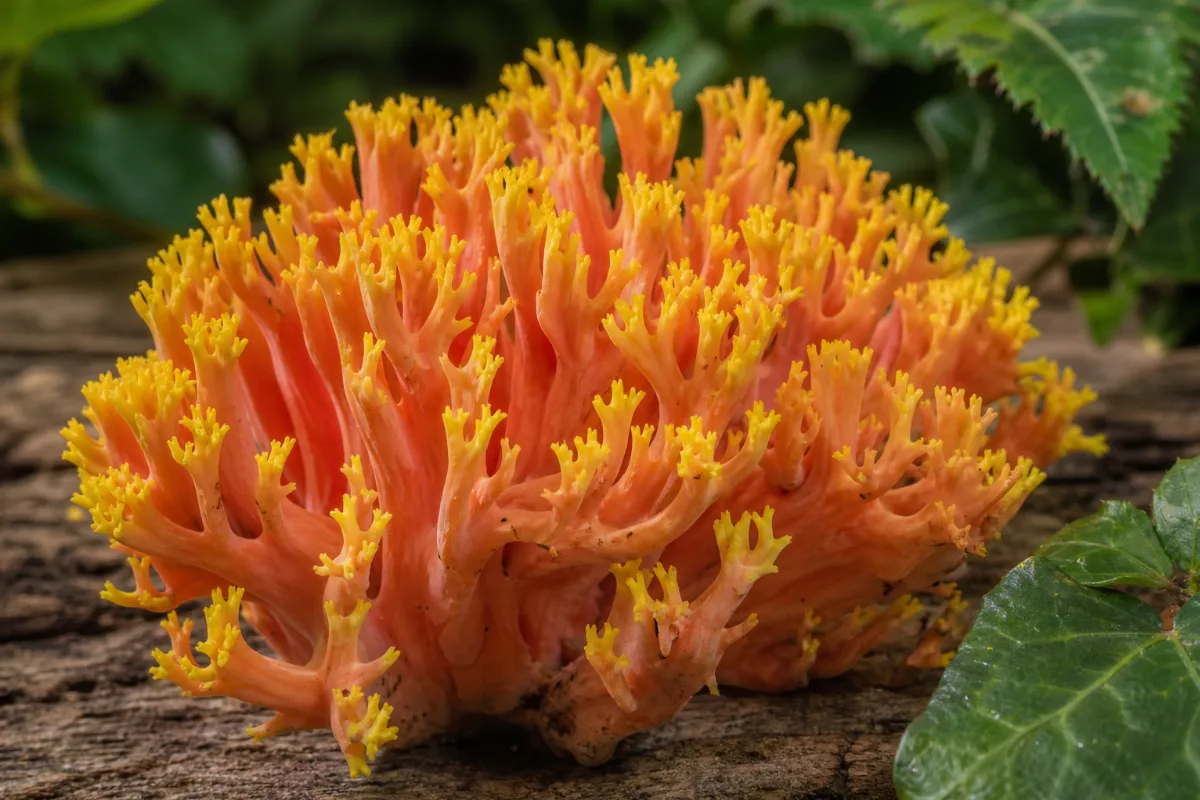
Mushrooms · Poisonous mushroom
Beautiful Clavaria
Ramaria formosa (Pers.) Quél. · also called Yellow-tipped coral fungus, salmon coral (a fungus, not a plant)
Beautiful clavaria (Ramaria formosa) is a wild coral mushroom that sources list as poisonous. A 2026 paper says eating it causes stomach and bowel upset. No trial shows it helps any condition. If someone has eaten a wild mushroom, call a poison centre right away.
General information, not medical advice. Last substantive update · Not medically reviewed. A named clinician has not signed off on this page. How this page is made
About Beautiful Clavaria
Beautiful clavaria (Ramaria formosa) is a wild coral mushroom that sources list as poisonous. A 2026 paper says it causes gastrointestinal issues when eaten, from a toxin nobody has identified. No source we read gives how soon symptoms start, how long they last or how severe they are. A stomach upset after a wild mushroom can also be the first sign of a far more dangerous poison, so call a poison centre. No human study shows any benefit.
Danger first: what it does
A 2026 paper in the journal Toxins says that Ramaria formosa, eaten in the fall, causes gastrointestinal issues because of an uncharacterised toxicological agent. That is one sentence in a paper that is mainly about a different coral mushroom, and it cites a book chapter we could not open. An Italian list of mushroom poisonings in Tuscany from 2007 to 2017 includes one case of R. formosa and files it as toxic. A 1995 review of poisonings in Mexico reports a gut-upset poisoning from Ramaria but does not name the species.
No source we read describes the symptoms, the time they start, how long they last or how severe they are for this mushroom. The North American Mycological Association (NAMA) describes gut-irritant mushrooms in general: nausea, vomiting, cramps and diarrhoea, usually within 20 minutes to 4 hours, with hospital care needed in severe cases. That is a general description, not a finding about this mushroom.
If someone has eaten a wild mushroom, call a poison centre right away. In the US call Poison Help at 1-800-222-1222 (free, confidential), and 911 if the person collapses, has a seizure, has trouble breathing or cannot be awakened. In the UK call NHS 111 if unsure and 999 in an emergency. In Australia call 13 11 26.
When a stomach upset is not the whole story
NAMA warns that gut symptoms starting 6 to 24 hours after eating mushrooms could mean amatoxin poisoning, a very serious toxicity, and that other poisons cause gut symptoms first and kidney damage days later. A gut upset does not prove the mushroom was a mild one.
Tell the poison centre exactly what was eaten, when it was eaten and when symptoms began. Keep any leftover mushroom or meal, or a photo, to show staff. Do not wait to see whether symptoms pass.
Who is at higher risk
No source we read says who is at higher risk from this mushroom. Pregnancy, breastfeeding, children, older people, medicines, alcohol and pets are not covered. Call a poison centre for any child who may have eaten a wild mushroom.
Cooking, drying and old advice
Penn State Extension says no matter how much you cook or dry mushrooms, you will not destroy their toxins. The 2026 toxin paper says a different coral mushroom, Ramaria flavobrunnescens, which poisons cattle in South America, loses its toxicity after cooking or drying. That is about another species and is not shown for R. formosa. This page gives no preparation method.
Same genus does not mean same safety
Some coral mushrooms of the genus Ramaria are eaten, and others are poisonous. A Tsotsil study in Chiapas, Mexico, found that 133 interviewees named R. formosa as a toxic mushroom 5 times, under a local name that marks it as the harmful counterpart of an edible Ramaria. The author says toxic species that resemble widely eaten mushrooms may be the most dangerous for collectors. An Italian list files R. flavescens as edible but R. formosa and R. pallida as toxic.
Another Ramaria, R. flavo-brunnescens, poisons cattle and sheep in South America and causes ulcerative and gangrenous lesions in the skin, tongue and oesophagus. That is a different mushroom and a different harm, and it is not evidence about R. formosa.
No identification help here
This page does not tell you how to recognise this mushroom or tell it from edible coral mushrooms. A photo, an app or a name is never proof that a wild mushroom is safe, and Penn State Extension says only an expert can tell poisonous from edible mushrooms.
What research exists
No clinical trial and no animal study of Ramaria formosa was found. Two 2015 test-tube studies purified chemicals from the fruiting bodies: ramarins A and B and three known compounds slowed a human white-blood-cell enzyme (neutrophil elastase) by roughly 30 to 35% at the highest level tested, while two labdane diterpenes did so moderately, less strongly than the comparison compound EGCG. These are test-tube results on pure chemicals. They say nothing about eating the mushroom, and no study links these chemicals to the poisoning.
At a glance
Traditional uses history, not proof
- No traditional medicinal use is described in the sources we read.
- In Tsotsil communities in Chiapas, Mexico, a local name marks it as the harmful counterpart of an edible coral mushroom (Ruan-Soto 2018).
- Other coral mushrooms (Ramaria) are eaten, but this species is listed as toxic in the sources we read.
Studied for research
- Enzyme tests in test tubes: pure chemicals only, not enough evidence
- Food use: against; sources list it as toxic
- No human trial of any benefit
Main compounds
- Ramarins A and B (sesquiterpenes; test-tube work only)
- Labdane diterpenes (test-tube work only)
- The toxin is not identified
Common forms
- Wild mushroom (poisonous; not a food or supplement)
Research links: Poison Control (US): call 1-800-222-1222 · NAMA: mushroom poisoning syndromes · Coral mushroom toxin paper, 2026 (abstract) · Tuscany poisoning list and DNA dataset, 2021 (abstract) · Ramarin sesquiterpenes, test-tube study, 2015 (abstract) · Research Library · Genes & Biomarkers Library
What it is and its history
- Accepted scientific name
- Ramaria formosa
- Naming authority
- (Pers.) Quél.
- Synonyms
- Clavaria formosa Pers.; Clavaria formosa Fr.; Clavariella formosa (Pers.) P.Karst.; Merisma formosa (Pers.) Sprengel; Ramaria neoformosa R.H.Petersen
- Common names
- Beautiful clavaria (en); Yellow-tipped coral fungus (en); Salmon coral (en); Schöne Koralle (de); Clavaire élégante (fr); Ramaria hermosa (es); Fraaie koraalzwam (nl)
- Family or group
- Gomphaceae, the coral and club fungus family (a fungus, not a plant). The part people meet is the fruiting body.
- Classification
- Fungi > Basidiomycota > Agaricomycetes > Gomphales > Gomphaceae > Ramaria > Ramaria formosa
- Native range
- GBIF holds about 3,600 occurrence records. This page does not map where it grows.
- Habitat
- Not described here.
- What it looks like
- Part used: The fruiting body (the mushroom). This page does not describe how to recognise it, on purpose.
- Look-alikes and adulterants
- Name: Edible coral mushrooms of the same genus; Note: The genus Ramaria holds both edible and poisonous members, and a Tsotsil study names R. formosa as the harmful counterpart of an edible Ramaria. An Italian list files R. flavescens as edible but R. formosa and R. pallida as toxic. No features are given here: do not identify wild mushrooms from text, photos or apps.
- Sustainability and conservation
- Not checked.
Traditional use and history history, not clinical proof
| Tradition or era | Documented use | Source |
|---|---|---|
| Taxonomy | GBIF gives the accepted name Ramaria formosa (Pers.) Quél. The species was first published as Clavaria formosa Pers. and has since been moved between genera (Merisma, Clavariella, Corallium, Ramaria). | GBIF |
| Local knowledge, Tsotsil communities, Chiapas, Mexico | Among 133 people interviewed, Ramaria formosa was named as a toxic mushroom 5 times, under a name marking it as the harmful counterpart of an edible Ramaria. | Ruan-Soto 2018 |
Traditional use shows how it was used. It does not show that it works or is safe today.
What is inside, and how it may work
What it contains and how those compounds act in cells and animals. Laboratory and animal mechanisms are not proven effects in people.
Main compounds
| Compound | Family | Where it is concentrated | Activity studied | Level of evidence |
|---|---|---|---|---|
| Ramarin A and ramarin B (sesquiterpenes) | Terpene-type fungal chemicals | Fruiting body | Isolated and tested against a human enzyme (neutrophil elastase) in a test tube; slowed it by roughly 30 to 35% at 100 micromolar. No link to the poisoning has been shown. 3 | Laboratory research |
| Two labdane diterpenes | Terpene-type fungal chemicals | Fruiting body | Slowed the same enzyme moderately in a test tube (IC50 36.4 and 40.8 micromolar). No link to the poisoning has been shown. 4 | Laboratory research |
Mechanisms, receptors and pathways
| Target or pathway | Gene or receptor | What was found | Level |
|---|---|---|---|
| Cause of the gut upset | Not established | A 2026 paper calls it an uncharacterized toxicological agent. NAMA groups this kind of poisoning with the gastrointestinal irritants in general. 2 12 | Not established |
| Human neutrophil elastase (enzyme) | Neutrophil elastase | Several isolated compounds slowed this enzyme in test tubes. 3 4 | Laboratory research |
Absorption, metabolism and elimination
- Absorption
- Not studied.
- Distribution
- Not studied.
- Metabolism
- Not studied.
- Elimination
- Not studied.
- Bioavailability
- Not studied.
Isolated compounds versus whole extracts
The test-tube work used purified compounds, not the whole mushroom, and the poisoning is a property of the whole mushroom eaten as food. The two are not linked by any study.
Nutritional composition
Ramaria formosa is not a food or nutrient source. We found no nutrient entry for it.
1 not enough evidence1 evidence against
What was looked at
The 2 benefits and uses checked for Beautiful Clavaria, each with how strong the evidence is. Tap one to open it.
What is Beautiful Clavaria good for?
The uses people ask about and how strong the human evidence is for each. None is proven, and there is no human evidence at all. Read every row together with the Safety tab: this is a poisonous mushroom.
Benefits, one by one
Each card is a research question, not a promise. Tap a goal to filter. Open a card to see the studies, doses and limits.
Use as a food
Evidence againstSources we read treat Ramaria formosa as poisonous, not as food. A 2026 paper says it causes stomach and bowel trouble when eaten in the fall. No study tells us how often, how badly or for how long.
5 studiesNot covered. This page gives no amounts, preparation or ways of using…
Studies, doses and limits
What the trials found
No clinical study. A 2026 toxin paper gives one sentence that it causes gastrointestinal issues if eaten in the fall (citing a book chapter we could not open). An Italian poisoning list for Tuscany, 2007 to 2017, includes 1 case and files the species as toxic. A 1995 Mexican review reports a gut-upset poisoning from Ramaria without naming the species.
Results
Gastrointestinal upset when eaten. No onset time, length of illness or severity was found for R. formosa.
Why this rating
Several independent sources list it as toxic or as causing gut upset; the evidence is thin and indirect, and no source describes the poisoning in detail, but nothing supports eating it.
Form and dose studied
Not covered. This page gives no amounts, preparation or ways of using the mushroom.
Who was studied
People who ate it by accident; no details given.
Limits
The only direct statement about R. formosa is one sentence that cites a book chapter. The cooking or drying result in the same paper is about a different Ramaria species and is not carried over. Penn State Extension says cooking and drying do not destroy mushroom toxins in general.
Why researchers looked
People ask because other coral mushrooms (Ramaria) are eaten, and the genus holds both edible and poisonous species.
Traditional use
In Tsotsil communities in Chiapas, Mexico, a local name for R. formosa marks it as the harmful counterpart of an edible Ramaria (Ruan-Soto 2018). No traditional medicinal use is described in the sources we read.
Proposed mechanism Authoritative guidance
The cause is not identified. A 2026 paper calls it an uncharacterized toxicological agent. No toxin has been measured.
A proposed mechanism does not show that the effect happens in people.
This is a poisonous mushroom. Eating it can cause stomach and bowel upset. If someone has eaten it, call a poison centre.
Blocking a human enzyme in a test tube
Not enough evidenceChemicals purified from the mushroom slowed an enzyme made by human white blood cells (neutrophil elastase) in test tubes. Nobody has tested the mushroom itself in animals or people. This is not a health use.
2 studiesNot covered. This page gives no amounts, preparation or ways of using…
Studies, doses and limits
Results
Five compounds (ramarin A, ramarin B and three known ones) reduced enzyme activity by roughly 30 to 35% at the highest concentration, 100 micromolar, versus 60% for the comparison compound EGCG. Two labdane diterpenes had IC50 values of 36.4 and 40.8 micromolar versus 12.5 for EGCG.
Effect sizes as reported
About 30 to 35% inhibition at 100 micromolar (ramarins and known compounds); IC50 36.4 and 40.8 micromolar (labdanes). All weaker than EGCG.
Why this rating
Two test-tube papers on pure compounds from one research group, weaker than the comparison compound, no animal or human data.
Form and dose studied
Not covered. This page gives no amounts, preparation or ways of using the mushroom.
Limits
Test-tube enzyme results say nothing about eating the mushroom, and do not explain the stomach poisoning. The mushroom is poisonous, so these findings are no reason to eat it.
Why researchers looked
Scientists screen fungal chemicals for effects on enzymes linked to inflammation.
Traditional use
No traditional use for this is described in the sources we read.
Proposed mechanism Laboratory research
Two papers isolated sesquiterpenes (ramarins A and B) and labdane diterpenes from the fruiting bodies and measured how much they slowed the enzyme. One labdane acted in a mixed, non-competitive way. Neither paper tested a living animal or person.
A proposed mechanism does not show that the effect happens in people.
This is a poisonous mushroom. Eating it can cause stomach and bowel upset. If someone has eaten it, call a poison centre.
Connections to the rest of health
How Beautiful Clavaria connects to the rest of our health knowledge graph. Every link says what kind of connection it is. A safety link (for example to the liver) is a warning, not a benefit. A study that merely mentions a topic never creates a benefit link.
Explore every connection: goals, body systems, organs, symptoms, genes
B. Body systems
| Connected to | Kind of connection | Evidence status | Context | Studies |
|---|---|---|---|---|
| Digestive system | Adverse effect or risk | Low certainty | Gastrointestinal upset reported when eaten; toxin unknown. Preparation or compound: Mushroom (fruiting body) |
2 |
| Digestive System | Biological association | Evidence against | Studied for: Use as a food | 2 1 6 5 8 |
| Immune System | Biological association | Not enough evidence | Studied for: Blocking a human enzyme in a test tube | 3 4 |
J. Genes, receptors and enzymes
L. Active compounds
| Connected to | Kind of connection | Evidence status | Context | Studies |
|---|---|---|---|---|
| Ramarin A and ramarin B (sesquiterpenes) | Biological association | In vitro | Isolated and tested against a human enzyme (neutrophil elastase) in a test tube; slowed it by roughly 30 to 35% at 100 micromolar. No link to the poisoning has been shown. Preparation or compound: Fruiting body |
3 |
| Two labdane diterpenes | Biological association | In vitro | Slowed the same enzyme moderately in a test tube (IC50 36.4 and 40.8 micromolar). No link to the poisoning has been shown. Preparation or compound: Fruiting body |
4 |
Each connection is stored with the ingredient, the connected record, the kind of connection, the evidence status, the supporting studies, the preparation or compound involved, and a review date (last reviewed October 25, 2026).
Evidence at a glance: what the research found for 2 outcomes
Each outcome below is one thing researchers measured. Certainty is how far the evidence can be trusted, not how well it works. The full studies are on the next tab.
The evidence
The research centre for Beautiful Clavaria. Every record here was checked against PubMed or the publisher's page; we never list a study we have not verified.
Evidence by outcome
Bars show how many studies we found for each outcome, not how well it works. People are added up across trials only (reviews are not added, to avoid double counting).
How we rate evidence
High certainty
Several well-run trials or reviews agree; further research is unlikely to change the picture much.
Moderate certainty
Good trials point the same way, but some doubt remains.
Low certainty
Small, short or inconsistent trials. The finding could change with better research.
Very low certainty
Very little or very weak human data. Treat as a possibility only.
Mixed findings
Trials or reviews disagree with each other.
Not enough evidence
Not enough human research to say either way.
Evidence against
Good research found no benefit, or found harm.
We take the reviewers' own risk-of-bias and GRADE statements where they exist, and otherwise judge from study size, design, consistency, directness and whether a product matches what is sold. Many publications do not make evidence high. Method note: We read the abstracts of seven papers in PubMed and the full text of three (the 2026 toxin paper, the Tsotsil study and the Italian DNA paper), the NAMA poisoning-syndromes page, a Penn State Extension page and poison-help pages from the US, UK and Australia, and checked the scientific name in GBIF. Index Fungorum could not be opened. Where a statement could not be checked it is marked as such.
Study library: every study we checked 13
| Study | Design | People | Product, dose, length | Result |
|---|---|---|---|---|
| Giusti 2021 Building of an Internal Transcribed Spacer (ITS) Gene Dataset to Support the Italian Health Service in Mushroom Identification. Foods · PMID 34070525 · DOI |
Other observational Ramaria formosa |
448 Mushroom poisoning cases in Tuscany, Italy, 2007 to 2017 (448 cases in the paper's list) |
DNA reference dataset for mushroom species involved in poisonings |
The paper's list of Tuscan poisoning cases between 2007 and 2017 includes Ramaria formosa with 1 case and the category 'T' (toxic). It also lists Ramaria pallida as toxic and Ramaria flavescens as edible. Methods, limits and fundingOutcomes: Which species were involved in regional poisonings and their edibility category Limitations: One case only, so it says nothing about how severe the poisoning is. The edibility categories come from the authors' lists and mycological inspectorates. The paper is about DNA identification, not about symptoms. Funding and conflicts: Authors report no conflict of interest Read: full-text |
| Kelman 2026 High-Resolution LC-MS Characterization of Ramaria flavobrunnescens, a Coral Mushroom Toxic to Livestock, Reveals Fungal, Bacterial, and Eucalyptus Tree Metabolites. Toxins (Basel) · PMID 41591199 · DOI |
Laboratory study Ramaria flavobrunnescens (about R. formosa: one sentence) |
Fruiting bodies of Ramaria flavobrunnescens (a different coral mushroom) from cattle poisonings in Uruguay | LC-MS analysis of mushroom extracts Fruiting body |
The paper is about another species. It says other Ramaria species are classed as mildly poisonous and have been involved in accidental poisonings, and that R. formosa eaten in the fall causes gastrointestinal issues due to an uncharacterized toxicological agent (it cites a 2023 book chapter). It also mentions that the ramarin chemicals from R. formosa were reported by Kim et al. 2015. Methods, limits and fundingOutcomes: What chemicals the livestock-poisoning coral mushroom contains; one sentence about R. formosa Limitations: The R. formosa statement is one sentence that cites a book chapter we could not open. The paper's own work is on R. flavobrunnescens, so its other findings (including that species being non-toxic after cooking or drying) are not carried over to R. formosa. Read: full-text |
| Kim 2015 Sesquiterpenes from the fruiting bodies of Ramaria formosa and their human neutrophil elastase inhibitory activity. Chem Pharm Bull (Tokyo) · PMID 26133070 · DOI |
Laboratory study Ramaria formosa |
Test-tube enzyme assay (human neutrophil elastase) | Purified compounds from the mushroom: ramarin A, ramarin B and three known compounds Fruiting body |
Two new sesquiterpenes (ramarin A and B) and three known compounds were isolated. All five reduced the activity of the enzyme by roughly 30 to 35% at the highest concentration (100 micromolar). The comparison compound EGCG reduced it by 60% at that concentration. Methods, limits and fundingOutcomes: Whether isolated compounds slow a human enzyme in a test tube Limitations: Test tube only. The abstract reports the percentage as '35-30%'. Pure compounds, not the whole mushroom. Does not explain the stomach poisoning or show any health use. Funding and conflicts: Not stated in the abstract Read: abstract |
| Lee 2015 Inhibition of human neutrophil elastase by labdane diterpenes from the fruiting bodies of Ramaria formosa. Biosci Biotechnol Biochem · PMID 26181334 · DOI |
Laboratory study Ramaria formosa |
Test-tube enzyme assay (human neutrophil elastase) | Two new labdane diterpenes isolated from the mushroom Fruiting body |
The two compounds slowed the enzyme moderately: IC50 36.4 and 40.8 micromolar, against 12.5 for the comparison compound EGCG. One acted in a mixed, non-competitive way (Ki 41.5 micromolar). Methods, limits and fundingOutcomes: Whether isolated compounds slow a human enzyme in a test tube Limitations: Test tube only. Pure compounds, not the whole mushroom. Weaker than the comparison compound. No animal or human data. Funding and conflicts: Not stated in the abstract Read: abstract |
| Pérez-Moreno 1995 A review of mushroom poisoning in Mexico. Food Addit Contam · PMID 7664928 · DOI |
Other observational Ramaria (species not named in abstract) |
Mushroom poisonings reviewed in Mexico, with two described cases | Review of reports and two case descriptions |
The abstract says symptoms and field data confirm a deadly liver-damaging poisoning from Amanita and a gastrointestinal poisoning from Ramaria. It does not name the Ramaria species or give numbers. Methods, limits and fundingOutcomes: Which mushrooms caused poisonings Limitations: The abstract does not say which Ramaria species it was, so it cannot be tied to R. formosa. Old paper; full text not read. Read: abstract |
| Ruan-Soto 2018 Sociodemographic differences in the cultural significance of edible and toxic mushrooms among Tsotsil towns in the Highlands of Chiapas, Mexico. J Ethnobiol Ethnomed · PMID 29724247 · DOI |
Survey Ramaria formosa |
133 133 Tsotsil people from seven communities in Chiapas, Mexico (interviews) |
Interviews and free lists of edible and toxic mushrooms |
Ramaria formosa appears in the toxic list with 5 mentions and a local name that marks it as the harmful counterpart of an edible Ramaria. The author says toxic species resembling widely eaten mushrooms may be the most dangerous for collectors, and lists R. formosa among species future prevention work could focus on. Methods, limits and fundingOutcomes: Which mushrooms people name as edible or toxic Limitations: An interview study of local knowledge. It does not describe poisonings in people or what the poisoning looks like. Funding and conflicts: Author reports no competing interests Read: full-text |
| Scheid 2022 Ramaria flavo-brunnescens mushroom poisoning in South America: A comprehensive review. Toxicon · PMID 34883101 · DOI |
Systematic review Ramaria flavo-brunnescens (not R. formosa) |
Cattle and sheep poisoned by Ramaria flavo-brunnescens in South America (a different species) | Review of poisoning reports Fruiting body |
Review of a different coral mushroom. It causes ulcerative and gangrenous lesions in the skin, tongue and oesophagus and loss of hair at the tail tip in cattle and sheep, and, rarely, in horses and pigs. Methods, limits and fundingOutcomes: Signs and pathology of livestock poisoning by one coral mushroom Limitations: About another species and another kind of poisoning, in animals. Not evidence about R. formosa or people. It is cited only to show the genus Ramaria is not uniform. Read: abstract |
| n/a 2026 Penn State Extension: Preparing and Preserving Mushrooms (page read 25 October 2026) n/a · Source |
Authoritative guidance n/a |
n/a | n/a |
The page says only an expert can tell poisonous from edible mushrooms, that non-experts should not forage, and that no matter how much you cook or dry mushrooms, you will not destroy their toxins. Methods, limits and fundingOutcomes: Whether cooking or drying removes mushroom toxins Limitations: General extension page, not about any one species. It does not name R. formosa. Read: full-text |
| n/a 2026 Poison Control (US): Need immediate assistance? (page read 25 October 2026) n/a · Source |
Authoritative guidance n/a |
n/a | n/a |
The page says to call 1-800-222-1222 or use the online tool; both are free and confidential. If the person collapses, has a seizure, has trouble breathing or cannot be awakened, call 911 immediately. Methods, limits and fundingOutcomes: What to do in a suspected poisoning in the US Limitations: A public help page. Read: full-text |
| n/a 2026 NHS (UK): Poisoning (page read 25 October 2026) n/a · Source |
Authoritative guidance n/a |
n/a | n/a |
The page says to call 999 or go to A&E if someone may have swallowed something harmful, has lost consciousness, has stopped breathing, has severe difficulty breathing or has a seizure, and to call NHS 111 if unsure. It says not to drive yourself to A&E and to bring any medicines taken. Methods, limits and fundingOutcomes: What to do in suspected poisoning in the UK Limitations: A public help page. Read: full-text |
| n/a 2026 NSW Poisons Information Centre (Australia): home page (read 25 October 2026) n/a · Source |
Authoritative guidance n/a |
n/a | n/a |
The page says the centre can be called 24/7 on 13 11 26, says not to wait for symptoms, and says to call Triple Zero (000) for an ambulance if someone is unconscious or not breathing. Methods, limits and fundingOutcomes: Poison advice line in Australia Limitations: A public help page for one Australian state service. Read: full-text |
| n/a 2026 North American Mycological Association: Mushroom Poisoning Syndromes (page read 25 October 2026) n/a · Source |
Authoritative guidance n/a |
n/a | n/a |
NAMA says the most frequent form of mushroom poisoning is caused by gastrointestinal irritants. Symptoms usually appear within 20 minutes to 4 hours and include nausea, vomiting, cramps and diarrhoea, which normally pass once the irritant is expelled. Severe cases may require hospitalization, and treatment is supportive (replacing lost fluids and electrolytes). It warns that gut symptoms starting 6 to 24 hours after eating could mean amatoxin poisoning, a very serious toxicity, and that other poisons cause gut symptoms first and kidney damage later. Methods, limits and fundingOutcomes: What gastrointestinal-irritant mushroom poisoning looks like and why late gut symptoms matter Limitations: General syndrome page, not specific to this species; it does not name Ramaria formosa. Undated. Read: full-text |
| n/a 2026 GBIF Backbone Taxonomy: Ramaria formosa (Pers.) Quél. (species key 5238663; read through the GBIF API 25 October 2026) n/a · Source |
Registry or database n/a |
n/a | n/a |
Accepted species in GBIF: Ramaria formosa (Pers.) Quél., family Gomphaceae, order Gomphales, phylum Basidiomycota, kingdom Fungi. GBIF lists 14 synonyms (for example Clavaria formosa Pers., Ramaria neoformosa R.H.Petersen) and about 3,600 occurrence records. Methods, limits and fundingOutcomes: Accepted name, authority, family, synonyms, vernacular names, records Limitations: A database record. Occurrence records are observations, not a map of where the species is safe or common. Index Fungorum was not opened. Read: full-text |
What we do not know yet
- No clinical series of poisoning by Ramaria formosa; the statements come from one sentence in a 2026 paper, one Tuscan case and a general 1995 review.
- No onset time, symptom list, duration or severity for this mushroom.
- No study identifies the toxin or measures its amount.
- No study of any cooking or drying method for this species.
- No animal or human study of any extract.
- No information on pregnancy, breastfeeding, children, medicines, alcohol or pets; no regulator statement specific to this species.
How new research is added
New studies are found by a saved PubMed search and placed in a review queue. A person reads each one before it changes this page. Poison-help pages are rechecked on a schedule.
Lab markers
What changed in blood or saliva tests during trials. A changed number is not the same as feeling or being healthier, and we give no "normal ranges".
Safety
What studies and official sources say about side effects, medicines and who should check first. Each point shows what kind of evidence it comes from.
Main points to know 4
- If someone has eaten it, call a poison centre now. Do not wait to see whether symptoms appear or pass. In the US call Poison Help at 1-800-222-1222 (free and confidential), or 911 if the person collapses, has a seizure, has trouble breathing or cannot be awakened. In the UK call NHS 111 if you are unsure and 999 in an emergency. In Australia the Poisons Information Centre line is 13 11 26. Keep the mushroom, a photo or the leftovers to show staff. Authoritative guidance 9 10 11
- It is listed as poisonous and is said to upset the stomach and bowel. A 2026 toxin paper says Ramaria formosa eaten in the fall causes gastrointestinal issues due to an uncharacterized toxicological agent. An Italian poisoning list files it as toxic. These are brief statements, not a clinical series. Expert guide 2 1
- A stomach upset is not always a mild poisoning. NAMA warns that gut symptoms starting 6 to 24 hours after eating a wild mushroom could mean amatoxin poisoning, a very serious toxicity, and that other poisons cause gut symptoms first and kidney damage days later. A gut upset does not tell you which mushroom was eaten. Authoritative guidance 12
- Cooking and drying are no safety step. Penn State Extension says no matter how much you cook or dry mushrooms, you will not destroy their toxins. A statement that one other Ramaria species loses its toxicity after cooking is about that species only. This page gives no preparation method. Authoritative guidance 8 2
Side effects 2
| Effect | How often | Severity and recovery | Evidence |
|---|---|---|---|
| Gastrointestinal upset (stomach and bowel) The only effect reported. No onset time, length of illness, symptom list or severity figure was found for R. formosa. NAMA describes the general picture for gut-irritant mushrooms: nausea, vomiting, cramps and diarrhoea, usually within 20 minutes to 4 hours, with hospital care needed in severe cases. That is a general description, not a finding about this mushroom. A 1995 review reports a gut-upset poisoning from Ramaria without naming the species. | Not established | moderate Not stated for this species | Expert guide 2 5 |
| Dehydration risk from vomiting and diarrhoea NAMA says replacing lost fluids and electrolytes matters in all cases with vomiting and diarrhoea. Not specific to this species. | Not established | unknown Not stated | Authoritative guidance 12 |
Liver
No liver injury is described for Ramaria formosa in the sources we read. That is not a promise it is safe: a gut upset can also be the first stage of a liver-damaging mushroom poisoning, which is why a poison centre should be called. 12
How often. No data for this species.
This is a safety connection. It is not evidence that Beautiful Clavaria supports liver health.
Medicines and supplements 1
| With | Why it matters | Importance | Evidence | What to do |
|---|---|---|---|---|
| Medicines, alcohol and supplements all | No interaction has been studied for this mushroom. | Unknown. Tell the poison centre or emergency team about every medicine and supplement the person takes. | None Not enough evidence 9 | Do not self-treat. A poison centre decides what to do. |
Who should check first 1
| Situation | Advice | Evidence |
|---|---|---|
| Anyone | It is a poisonous mushroom with no proven benefit. This page does not describe how to find, pick, prepare or eat it. Pregnancy, breastfeeding, children, older people, people with liver, kidney or gut disease, and people taking medicines are not covered by any source we read for this species: call a poison centre for any of them after a wild mushroom. | Authoritative guidance 9 10 |
Overdose, product quality and regulators
Summary. Described as poisonous: eaten, it causes gastrointestinal issues. The toxic agent has not been identified.
Amounts. No toxin level and no safe or harmful amount has been established in any source we read.
Onset and course. Not found for this species. Only a general NAMA description for gut-irritant mushrooms (20 minutes to 4 hours).
Repeated use. No data.
Animal data. No animal study of Ramaria formosa. A different species, Ramaria flavo-brunnescens, poisons cattle and sheep in South America and causes ulcerative and gangrenous lesions in the skin, tongue and oesophagus. That is another mushroom and another kind of harm, and it is not carried over.
Not read. The 2023 book chapter on the genus Ramaria that the 2026 paper cites for the poisoning statement, the original Italian poison-centre records, and the full text of the 1995 Mexican review.
No product testing, heavy-metal or radioactivity data for Ramaria formosa were found. It is a wild mushroom, not a supplement.
Metals and radioactivity. No measurement for this species in the sources we read.
| Body | Action | Date |
|---|---|---|
| Poison Control (US, National Capital Poison Center) (United States) | Call 1-800-222-1222 for free, confidential help; call 911 immediately if the person collapses, has a seizure, has trouble breathing or cannot be awakened. source | |
| NHS (UK) (United Kingdom) | Call 999 or go to A&E if someone may have swallowed something harmful, is unconscious, has stopped breathing, has severe breathing difficulty or has a seizure; call NHS 111 if unsure. source | |
| NSW Poisons Information Centre (Australia) | Call 13 11 26 (24/7) and do not wait for symptoms; call 000 if the person is unconscious or not breathing. source |
When to get medical help
- If someone may have eaten this mushroom, or a wild mushroom that might be it, call a poison centre right away, even if they feel fine.
- Call 911 (US), 999 (UK) or your local emergency number for collapse, a seizure, trouble breathing or if the person cannot be awakened.
- Vomiting or diarrhoea that starts 6 to 24 hours after eating a wild mushroom needs urgent medical help (NAMA warns of a far more dangerous poison).
- Signs of dehydration (very little urine, dizziness, a dry mouth) need medical help.
If someone may be poisoned or in a crisis, contact a clinician or emergency service straight away. In the US, Poison Control is 1-800-222-1222.
General information only, not medical advice. Ask a clinician or pharmacist before use, especially with medicines, in pregnancy or with a health condition. See the Natural Remedy Safety guide.
Frequently asked questions
Is beautiful clavaria (Ramaria formosa) poisonous?
What should I do if someone has eaten it, or a wild mushroom that might be it?
Call a poison centre right away, even if the person seems fine. In the US call Poison Help at 1-800-222-1222 (free, confidential), and 911 if the person collapses, has a seizure, has trouble breathing or cannot be awakened. In the UK call NHS 111 if unsure and 999 in an emergency. In Australia call 13 11 26. Keep any leftover mushroom or meal, or a photo, to show staff. Do not wait to see whether symptoms pass.
What are the symptoms?
Can a stomach upset hide something worse?
Yes. NAMA warns that gut symptoms starting 6 to 24 hours after eating a wild mushroom could mean amatoxin poisoning, a very serious toxicity, and that other poisons cause gut symptoms first and kidney damage days later. That is why a poison centre should be called.
Does cooking or drying make it safe?
Are all coral mushrooms (Ramaria) safe or all unsafe?
Can I tell it from edible coral mushrooms?
Does it have any health benefit?
What causes the poisoning?
The toxin has not been identified. The 2026 paper calls it an uncharacterised toxicological agent. No study we read tested which compound is responsible.
Is it deadly?
Can children or pets be poisoned?
Explore by health goal
Editorial transparency
- Written by
- AlternativeMed editorial team. Research compiled with AI assistance, then checked against PubMed records, poison-help pages and GBIF.
- Medical review
- None. This page has not been reviewed by a physician or pharmacist.
- First published
- 2026-10-25
- Last substantive update
- 2026-10-25
- How we research
- We read the abstracts of seven papers in PubMed and the full text of three (the 2026 toxin paper, the Tsotsil study and the Italian DNA paper), the NAMA poisoning-syndromes page, a Penn State Extension page and poison-help pages from the US, UK and Australia, and checked the scientific name in GBIF. Index Fungorum could not be opened. Where a statement could not be checked it is marked as such.
- How we rate evidence
- See "How we rate evidence" in the Evidence tab.
- Independence
- No product is promoted on this page. No affiliate links are shown. This page gives no dose, preparation, identification, picking or sourcing advice.
Sources 13
Each source was opened and checked. Where we read only the abstract, it says so. The small numbers in the text point here.
- Giusti A, Ricci E, Gasperetti L, Galgani M, Polidori L, Verdigi F, Narducci R, Armani A. Building of an Internal Transcribed Spacer (ITS) Gene Dataset to Support the Italian Health Service in Mushroom Identification.. Foods. 2021. PMID 34070525. DOI 10.3390/foods10061193. (full-text)
- Kelman MJ, Renaud JB, Tanney JB, Machado M, Sumarah MW. High-Resolution LC-MS Characterization of Ramaria flavobrunnescens, a Coral Mushroom Toxic to Livestock, Reveals Fungal, Bacterial, and Eucalyptus Tree Metabolites.. Toxins (Basel). 2026. PMID 41591199. DOI 10.3390/toxins18010053. (full-text)
- Kim KC, Lee IS, Yoo ID, Ha BJ. Sesquiterpenes from the fruiting bodies of Ramaria formosa and their human neutrophil elastase inhibitory activity.. Chem Pharm Bull (Tokyo). 2015. PMID 26133070. DOI 10.1248/cpb.c15-00051. (abstract)
- Lee IS, Kim KC, Yoo ID, Ha BJ. Inhibition of human neutrophil elastase by labdane diterpenes from the fruiting bodies of Ramaria formosa.. Biosci Biotechnol Biochem. 2015. PMID 26181334. DOI 10.1080/09168451.2015.1065168. (abstract)
- Pérez-Moreno J, Ferrera-Cerrato R. A review of mushroom poisoning in Mexico.. Food Addit Contam. 1995. PMID 7664928. DOI 10.1080/02652039509374315. (abstract)
- Ruan-Soto F. Sociodemographic differences in the cultural significance of edible and toxic mushrooms among Tsotsil towns in the Highlands of Chiapas, Mexico.. J Ethnobiol Ethnomed. 2018. PMID 29724247. DOI 10.1186/s13002-018-0232-9. (full-text)
- Scheid HV, Viégas Sallis ES, Riet-Correa F, Schild AL. Ramaria flavo-brunnescens mushroom poisoning in South America: A comprehensive review.. Toxicon. 2022. PMID 34883101. DOI 10.1016/j.toxicon.2021.12.001. (abstract)
- n/a. Penn State Extension: Preparing and Preserving Mushrooms (page read 25 October 2026). n/a. 2026. (full-text)
- n/a. Poison Control (US): Need immediate assistance? (page read 25 October 2026). n/a. 2026. (full-text)
- n/a. NHS (UK): Poisoning (page read 25 October 2026). n/a. 2026. (full-text)
- n/a. NSW Poisons Information Centre (Australia): home page (read 25 October 2026). n/a. 2026. (full-text)
- n/a. North American Mycological Association: Mushroom Poisoning Syndromes (page read 25 October 2026). n/a. 2026. (full-text)
- n/a. GBIF Backbone Taxonomy: Ramaria formosa (Pers.) Quél. (species key 5238663; read through the GBIF API 25 October 2026). n/a. 2026. (full-text)


