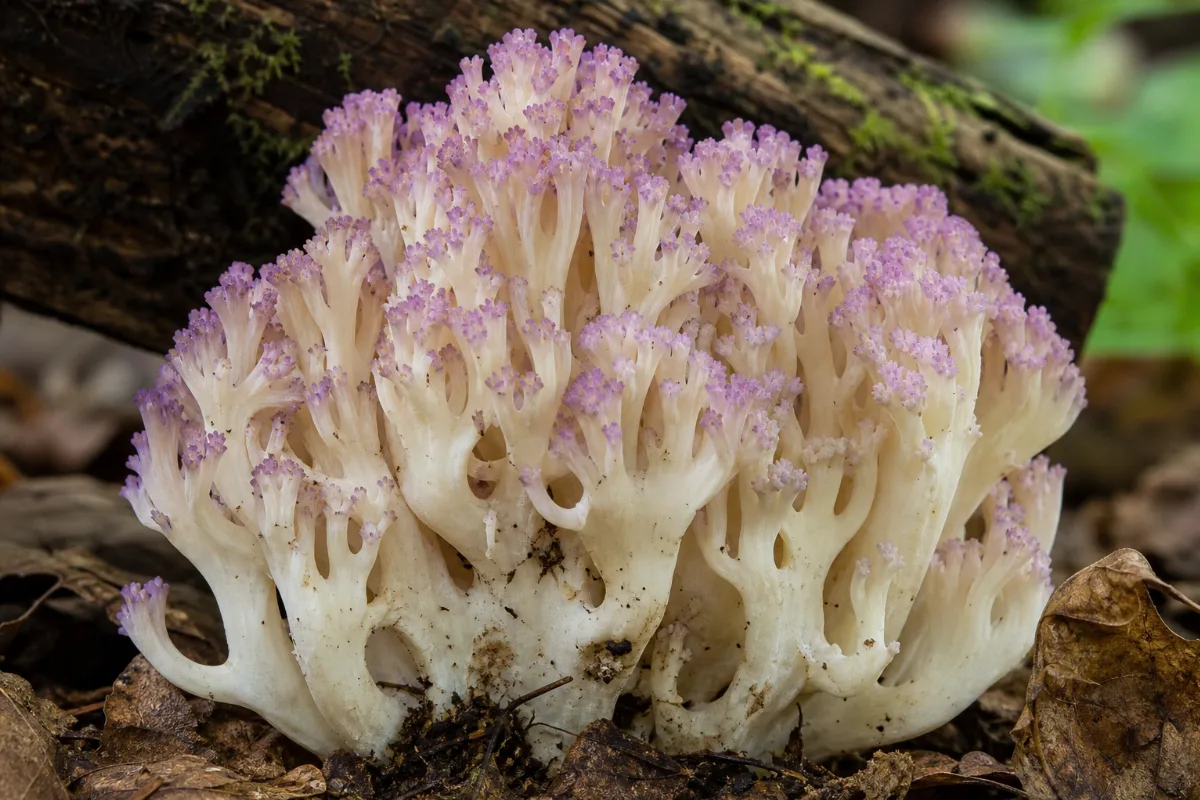
Mushrooms · Wild culinary mushroom
Cauliflower Coral
Ramaria botrytis · also called Clustered coral, pink-tipped coral, rosso coral, Nedzumi-take (Japan)
Cauliflower coral is a wild coral-shaped fungus eaten cooked in some countries. No trial in people has tested it for any health use, so the research is thin: one food analysis and some test-tube work. The main caution is that look-alike coral mushrooms are reported to cause stomach and bowel illness. Never eat a wild mushroom unless a trained expert has identified it in person.
General information, not medical advice. Last substantive update · Not medically reviewed. A named clinician has not signed off on this page. How this page is made
About Cauliflower Coral
Cauliflower coral is a wild coral fungus eaten cooked in some countries. Nobody has tested it in people, and nothing shows a health benefit. The research is one food analysis and some test-tube work. The key caution is the risk of mistaking it for a toxic look-alike.
What it is
Cauliflower coral, Ramaria botrytis, is a fungus in the family Gomphaceae. GBIF lists it as an accepted species. It lives with trees on the forest floor and fruits wild; we found no verified commercial farming.
It is not the same as the cauliflower mushroom (Sparassis), a different frilly fungus with its own page. Names and authorities differ between records; see the science notes.
Traditional and current uses
The 2017 Himalayan paper says native people of northwestern India use it for food. Wikipedia says it is sold in Japan as Nedzumi-take. We found no traditional medicinal use in a source we could read; one polysaccharide paper says it is widely prescribed for anti-aging and immunity but gives no source, so we treat that as not verified.
What the research shows
No human trial and no animal study of the whole mushroom was found. One laboratory analysis of a single wild collection reported 21.65 % protein, very little fat (0.22 %) and 15.7 mg magnesium per 100 g, with the basis of the figures not stated.
Laboratory papers show antioxidant activity of a pigment and of sugar-chain fractions in test tubes, growth inhibition of some bacteria in a dish, activation of mouse immune cells by a glucan, and killing of lung cancer cells in a dish by an isolated protein. These are test-tube or cell-dish results with purified compounds, and none shows an effect from eating the mushroom.
Wild picking and contamination
Wild mushrooms take up substances from the ground. A simple screening test in the Himalayan study did not detect toxic metals, but it was not a precise measurement. Arsenic compounds have been found in other Ramaria species, and Wikipedia says this species accumulates arsenic. Avoid picking near polluted ground.
At a glance
Traditional uses history, not proof
- Eaten cooked as food by native people in northwestern India (Sharma and Gautam 2017).
- Sold in food markets in Japan as Nedzumi-take, according to Wikipedia (secondary source).
- No traditional medicinal use was found in a source we could read.
Studied for research
- Food value (protein, fibre, minerals) in one wild collection, low
- Antioxidant activity in test tubes, insufficient
- Antibacterial activity in dishes, insufficient
- Immune-cell activation in mouse cells, insufficient
- Cancer-cell tests with an isolated protein, insufficient
Main compounds
- Pistillarin, a pigment with antioxidant activity in a test tube
- Polysaccharides (sugar chains) from the fruiting body
- A ubiquitin-like protein tested on cancer cells in a dish
Common forms
- Fresh or cooked fruiting body (the wild food)
- Dried fruiting body (used in the nutrient analysis)
- Salted fruiting body (named in a pigment paper)
Research links: Food and bioactive profiling of coral fungi (full paper) · Toxicology of Ramaria flavobrunnescens, with notes on other Ramaria (full paper) · Fatal mushroom poisoning cluster with Ramaria rufescens (abstract) · Pistillarin from Ramaria botrytis (abstract) · GBIF name record · Research Library · Genes & Biomarkers Library
What it is and its history
- Accepted scientific name
- Ramaria botrytis
- Naming authority
- (Pers.) Bourdot (GBIF); some records give Ricken as the author of the combination
- Synonyms
- Clavaria botrytis Pers. (the original 1797 name per Wikipedia)
- Common names
- Cauliflower coral (en); Clustered coral (en); Pink-tipped coral (en); Rosso coral (en); Nedzumi-take (Japan) (ja)
- Family or group
- Gomphaceae (a fungus family), not a plant
- Classification
- Fungi > Basidiomycota > Agaricomycetes > Gomphales > Gomphaceae > Ramaria > Ramaria botrytis
- Native range
- Wikipedia lists records across Europe, Asia, North America and Australia (secondary source, not checked further).
- Habitat
- Wikipedia says it lives with trees on the forest floor (ectomycorrhizal). Not checked in a primary source.
- What it looks like
- Fruiting body: Not described here. Wild coral mushrooms cannot be told apart safely from a text description.
- Cultivation
- No commercial cultivation was verified. A 2005 paper on mycelial growth conditions exists but was not opened.
- Harvest and processing
- Not checked in the sources read.
- Look-alikes and adulterants
- Name: Ramaria formosa (yellow-tipped coral); Note: A 2026 toxicology paper says it causes gastrointestinal problems if eaten in the fall months; see the Safety tab.; Name: Other Ramaria species; Note: Wikipedia lists several species that may be confused with R. botrytis, some separable only under a microscope. Do not rely on text.
- Sustainability and conservation
- Not checked.
Traditional use and history history, not clinical proof
| Tradition or era | Documented use | Source |
|---|---|---|
| Scientific naming | First described as Clavaria botrytis by Persoon in 1797, and moved to Ramaria by Ricken in 1918, per Wikipedia. Other records give different authorities for the current name. | s-wikipedia-ramaria-botrytis |
| Culinary | Eaten cooked; the 2017 Himalayan paper says native people of northwestern India use it for food. Wikipedia says it is sold in Japan as Nedzumi-take. | p28422148 |
| Traditional medicine | No traditional medicinal use was found in a source we read. A 2017 paper states without a source that it is widely prescribed for anti-aging and immunity. NOT verified. | p28360933 |
Traditional use shows how it was used. It does not show that it works or is safe today.
What is inside, and how it may work
What it contains and how those compounds act in cells and animals. Laboratory and animal mechanisms are not proven effects in people.
Main compounds
| Compound | Family | Where it is concentrated | Activity studied | Level of evidence |
|---|---|---|---|---|
| Pistillarin and pistillarin B | pigment | fruiting body (pistillarin B in salted fruiting body) | Lipid peroxidation inhibition in a test tube (IC50 0.66 uM and 6.88 uM). 9 | Laboratory research |
| Polysaccharides (glucose-rich fractions and a mannose-rich fraction) | polysaccharide | fruiting body | Antioxidant in test tubes; a separate glucan stimulated mouse immune cells in a dish. 8 2 | Laboratory research |
| Ubiquitin-like protein RBUP (18.5 kDa) | protein | fruiting body | Killed A549 lung cancer cells and cut DNA in a dish. 13 | Laboratory research |
| Tocopherols, carotenoids, phenolics | antioxidant vitamins and pigments | fruiting body | Reported in the Himalayan analysis. Amounts not shown here because the units were inconsistent in the paper. 7 | Laboratory analysis |
Mechanisms, receptors and pathways
| Target or pathway | Gene or receptor | What was found | Level |
|---|---|---|---|
| Lipid peroxidation | not applicable | Pistillarin inhibited lipid peroxidation in a test tube. 9 | Laboratory research |
| Macrophage activation | not stated | A glucan raised nitric oxide in a mouse macrophage line and made spleen and thymus cells multiply. 2 | Laboratory research |
| Apoptosis of A549 cells | not stated | A purified protein induced apoptosis in a lung cancer cell line. 13 | Laboratory research |
Absorption, metabolism and elimination
- Absorption
- Not found in the sources read.
- Distribution
- Not found.
- Metabolism
- Not found.
- Elimination
- Not found.
- Bioavailability
- Not established.
Isolated compounds versus whole extracts
Every finding in this profile except the food analysis comes from an isolated compound or solvent extract in a test tube or dish. None of it describes cooking and eating the whole mushroom.
Nutritional composition
One analysis of one dried wild collection found 21.65 % protein, 0.22 % fat and 1.33 % crude fibre, with 15.7 mg magnesium per 100 g. The basis is not stated and other specimens will differ.
1 low certainty4 not enough evidence
What was looked at
The 5 benefits and uses checked for Cauliflower Coral, each with how strong the evidence is. Tap one to open it.
What is Cauliflower Coral good for?
The uses people ask about and how strong the human evidence is for each. There is no human evidence for any of them. Read this together with the Safety tab.
Benefits, one by one
Each card is a research question, not a promise. Tap a goal to filter. Open a card to see the studies, doses and limits.
As a food: protein, fibre and minerals
Low certaintyCauliflower coral is eaten cooked as a wild food. One analysis of a single wild collection in India found a protein share of 21.65 % and very little fat. That is a description of the food, not a health effect, and amounts in other specimens will differ.
2 studiesNot applicable. No supplement form was found.
Studies, doses and limits
What the trials found
No human study. One laboratory analysis of one wild collection.
Results
Protein 21.65 +/- 0.2 %, fat 0.22 %, crude fibre 1.33 %, magnesium 15.7 +/- 3.12 mg per 100 g. The basis (fresh or dry) is not stated; vacuum drying suggests dry weight.
Effect sizes as reported
Composition values only; no outcome in people
Why this rating
The numbers come from one paper, one site and one collection, with the basis not stated. They are not typical values for the species.
Who was studied
No people studied
Limits
Wild fungi vary by site, season and age. A single measurement may not repeat. The same paper used a simple colour test, not exact measurement, for toxic metals.
Why researchers looked
It is a wild edible fungus, so researchers have measured what it contains.
Traditional use
Described as eaten by native people in northwestern India (Sharma and Gautam 2017, Table 1). Wikipedia says it is sold in Japan as Nedzumi-take and is collected in Korea and Nepal; this is a secondary source.
Proposed mechanism Composition analysis
Not a mechanism claim. The values are measured composition of one dried wild collection.
A proposed mechanism does not show that the effect happens in people.
Eating wild mushrooms carries a look-alike risk. See the Safety tab.
Antioxidant activity (test tube only)
Not enough evidenceIn test tubes, extracts, a pigment called pistillarin and sugar-chain fractions from cauliflower coral blocked certain reactive molecules. Nobody has tested whether this does anything in the body.
3 studiesIsolated pigment, extracted sugar fractions and solvent extracts, non…
Studies, doses and limits
What the trials found
No human trial and no animal trial found.
Results
Pistillarin: lipid peroxidation IC50 0.66 uM; pistillarin B 6.88 uM. Himalayan extracts: R. botrytis, together with Clavaria fragilis, showed the lowest EC50 values (strongest activity) among 12 coral species in the DPPH and ABTS tests, according to the full text.
Effect sizes as reported
Test-tube activity only
Why this rating
All findings are from chemical assays. Antioxidant activity in a test tube is not known to translate into any benefit in people.
Form and dose studied
Isolated pigment, extracted sugar fractions and solvent extracts, none of which is a food or product.
Limits
No human or animal data. Assay results depend on the method and concentration.
Why researchers looked
Mushrooms contain pigments and sugar chains that often show antioxidant activity in chemical tests.
Traditional use
No traditional antioxidant use was found in the sources read. The 2017 polysaccharide paper says the species is widely prescribed for anti-aging and immunity but does not name a source.
Proposed mechanism Laboratory research
Pistillarin inhibited lipid peroxidation in a test tube (IC50 0.66 uM) and quenched superoxide (IC50 10.2 uM), but not singlet oxygen or hydroxyl radicals. Polysaccharide fractions scavenged DPPH and hydroxyl radicals in test-tube assays.
A proposed mechanism does not show that the effect happens in people.
No safety data on these preparations.
Antibacterial activity (in a dish only)
Not enough evidenceIn lab dishes, extracts of cauliflower coral slowed or stopped the growth of some bacteria, but only at high concentrations. This is not evidence that eating the mushroom treats or prevents an infection.
2 studiesSolvent extracts of wild fruiting bodies.
Studies, doses and limits
What the trials found
No human or animal study.
Results
Portuguese wild R. botrytis extract: inhibited Enterococcus faecalis and Listeria monocytogenes; MBC 20 mg/mL for Pasteurella multocida and Streptococcus agalactiae, 10 mg/mL for Streptococcus pyogenes. Himalayan extract: all 12 coral species had MICs of 40 to 100 mg/mL; the largest R. botrytis zone against E. coli was 11.1 +/- 1.9 mm.
Effect sizes as reported
Bacterial growth reduced in a dish
Why this rating
Dish tests only, at concentrations far from anything eaten, with methanol or other solvent extracts.
Form and dose studied
Solvent extracts of wild fruiting bodies.
Limits
No animal or human data; results depend on method and concentration.
Why researchers looked
Researchers screen wild mushrooms for antibacterial compounds because some bacteria resist common antibiotics.
Traditional use
No traditional antibacterial use was found in the sources read.
Proposed mechanism Laboratory research
Not determined. Extracts were tested on bacteria in a dish.
A proposed mechanism does not show that the effect happens in people.
No safety information on the extracts.
Immune-cell activation (mouse cells in a dish)
Not enough evidenceA sugar-chain (glucan) from cauliflower coral made mouse immune cells produce nitric oxide and multiply in a dish. No study has tested this in a living animal or a person.
1 studiesAlkaline-extracted purified glucan.
Studies, doses and limits
What the trials found
No human trial and no whole-animal trial found.
Results
The abstract reports immunostimulating activity (nitric oxide from RAW 264.7 cells; spleen and thymus cell proliferation) with no numbers.
Effect sizes as reported
Cell activation in culture
Why this rating
Cultured mouse cells and an isolated, purified glucan, with no numbers in the abstract.
Form and dose studied
Alkaline-extracted purified glucan.
Limits
A cell result does not show better protection from infection.
Why researchers looked
Many mushroom glucans are tested for effects on immune cells.
Traditional use
The 2017 polysaccharide paper says the species is widely prescribed for improving immunity but gives no source we could read.
Proposed mechanism Laboratory research
Laboratory finding: a purified glucan stimulated macrophages and spleen and thymus cells from normal mice in culture.
A proposed mechanism does not show that the effect happens in people.
More immune activity is not always desirable; people on immune-suppressing medicines should ask their doctor before eating wild mushrooms in unusual amounts.
Cancer-cell tests (isolated protein, in a dish)
Not enough evidenceA purified protein from cauliflower coral killed lung cancer cells in a dish. This tells us nothing about eating the mushroom, and it is not a treatment.
1 studiesPurified protein, not a food.
Studies, doses and limits
What the trials found
No human or animal study.
Results
The protein was strongly toxic to A549 cells in a dish; the abstract gives no numbers.
Effect sizes as reported
Cell killing in culture
Why this rating
One purified protein, one cell line, abstract without numbers.
Form and dose studied
Purified protein, not a food.
Limits
Nothing shows the protein survives digestion or reaches any tumour. It also cut DNA, which shows why test-tube activity is not a safety signal either.
Why researchers looked
Researchers look for cell-killing proteins in edible mushrooms.
Traditional use
No traditional use for cancer was found in the sources read.
Proposed mechanism Laboratory research
Laboratory finding: an 18.5 kDa protein induced apoptosis in A549 lung cancer cells and had DNA-cutting activity.
A proposed mechanism does not show that the effect happens in people.
No safety data.
Connections to the rest of health
How Cauliflower Coral connects to the rest of our health knowledge graph. Every link says what kind of connection it is. A safety link (for example to the liver) is a warning, not a benefit. A study that merely mentions a topic never creates a benefit link.
Explore every connection: goals, body systems, organs, symptoms, genes
A. Wellness goals
| Connected to | Kind of connection | Evidence status | Context | Studies |
|---|---|---|---|---|
| Nutrition | Low certainty | As a food: protein, fibre and minerals: Cauliflower coral is eaten cooked as a wild food. One analysis of a single wild collection in India found a protein share of 21.65 % and very little fat. That is a description of the food, not a health effect, and amounts in other specimens will differ. | 7 12 | |
| Antioxidant Support | Not enough evidence | Antioxidant activity (test tube only): In test tubes, extracts, a pigment called pistillarin and sugar-chain fractions from cauliflower coral blocked certain reactive molecules. Nobody has tested whether this does anything in the body. | 9 8 7 | |
| Infection Support | Not enough evidence | Antibacterial activity (in a dish only): In lab dishes, extracts of cauliflower coral slowed or stopped the growth of some bacteria, but only at high concentrations. This is not evidence that eating the mushroom treats or prevents an infection. | 1 7 | |
| Immune Support | Not enough evidence | Immune-cell activation (mouse cells in a dish): A sugar-chain (glucan) from cauliflower coral made mouse immune cells produce nitric oxide and multiply in a dish. No study has tested this in a living animal or a person. | 2 | |
| Cancer Research | Not enough evidence | Cancer-cell tests (isolated protein, in a dish): A purified protein from cauliflower coral killed lung cancer cells in a dish. This tells us nothing about eating the mushroom, and it is not a treatment. | 13 |
B. Body systems
| Connected to | Kind of connection | Evidence status | Context | Studies |
|---|---|---|---|---|
| Digestive system | Adverse effect or risk | Low certainty | Gastrointestinal upset is reported for other Ramaria species; the effect of cauliflower coral itself is not shown. Preparation or compound: Look-alike Ramaria species; possible laxative effect reported for cauliflower coral (unverified) |
6 5 12 |
| Digestive System | Biological association | Low certainty | Studied for: As a food: protein, fibre and minerals | 7 12 |
| Cells | Biological association | Not enough evidence | Studied for: Antioxidant activity (test tube only) Studied for: Cancer-cell tests (isolated protein, in a dish) | 9 8 7 13 |
| Immune System | Biological association | Not enough evidence | Studied for: Antibacterial activity (in a dish only) Studied for: Immune-cell activation (mouse cells in a dish) | 1 7 2 |
L. Active compounds
| Connected to | Kind of connection | Evidence status | Context | Studies |
|---|---|---|---|---|
| Pistillarin and pistillarin B | Biological association | In vitro | Lipid peroxidation inhibition in a test tube (IC50 0.66 uM and 6.88 uM). Preparation or compound: fruiting body (pistillarin B in salted fruiting body) |
9 |
| Polysaccharides (glucose-rich fractions and a mannose-rich fraction) | Biological association | In vitro | Antioxidant in test tubes; a separate glucan stimulated mouse immune cells in a dish. Preparation or compound: fruiting body |
8 2 |
| Ubiquitin-like protein RBUP (18.5 kDa) | Biological association | In vitro | Killed A549 lung cancer cells and cut DNA in a dish. Preparation or compound: fruiting body |
13 |
| Tocopherols, carotenoids, phenolics | Biological association | Laboratory analysis | Reported in the Himalayan analysis. Amounts not shown here because the units were inconsistent in the paper. Preparation or compound: fruiting body |
7 |
Each connection is stored with the ingredient, the connected record, the kind of connection, the evidence status, the supporting studies, the preparation or compound involved, and a review date (last reviewed October 25, 2026).
Evidence at a glance: what the research found for 5 outcomes
Each outcome below is one thing researchers measured. Certainty is how far the evidence can be trusted, not how well it works. The full studies are on the next tab.
The evidence
The research centre for Cauliflower Coral. Every record here was checked against PubMed or the publisher's page; we never list a study we have not verified.
Evidence by outcome
Bars show how many studies we found for each outcome, not how well it works. People are added up across trials only (reviews are not added, to avoid double counting).
How we rate evidence
High certainty
Several well-run trials or reviews agree; further research is unlikely to change the picture much.
Moderate certainty
Good trials point the same way, but some doubt remains.
Low certainty
Small, short or inconsistent trials. The finding could change with better research.
Very low certainty
Very little or very weak human data. Treat as a possibility only.
Mixed findings
Trials or reviews disagree with each other.
Not enough evidence
Not enough human research to say either way.
Evidence against
Good research found no benefit, or found harm.
We take the reviewers' own risk-of-bias and GRADE statements where they exist, and otherwise judge from study size, design, consistency, directness and whether a product matches what is sold. Many publications do not make evidence high. Method note: We read PubMed records for 11 papers (esummary), read the abstracts for nine and the full text of two (a Himalayan coral-fungus analysis and a 2026 toxicology paper), checked the species name in GBIF and read the Wikipedia entry (marked as a secondary source). Only abstracts were read for most papers, so numbers come from abstracts or the full text named. Certainty ratings are the compiler's own reading. EMA, FDA, EFSA, LiverTox and LactMed were not searched in depth.
Study library: every study we checked 13
| Study | Design | People | Product, dose, length | Result |
|---|---|---|---|---|
| Alves 2012 Antimicrobial activity of wild mushroom extracts against clinical isolates resistant to different antibiotics. Journal of Applied Microbiology · PMID 22621239 · DOI |
Laboratory study laboratory (extract) |
13 wild mushroom species from Braganca, Portugal, tested on bacteria from a hospital | Aqueous methanolic extract of wild fruiting body (R. botrytis among 13 species) fruiting body Not shown here |
The R. botrytis extract inhibited Enterococcus faecalis and Listeria monocytogenes and killed Pasteurella multocida and Streptococcus agalactiae (MBC 20 mg/mL) and Streptococcus pyogenes (MBC 10 mg/mL). The authors name it among the most promising species. Growth inhibition of some bacteria in a dish Methods, limits and fundingOutcomes: Minimum inhibitory and bactericidal concentrations against clinical bacteria Limitations: Bacteria in a dish. Concentrations are high, the extract was made with methanol, and nothing shows an effect in a person. Funding and conflicts: Not stated in the abstract. Read: abstract |
| Bhanja 2013 Structural studies of an immunoenhancing glucan of an ectomycorrhizal fungus Ramaria botrytis. Carbohydrate Research · PMID 23624346 · DOI |
Laboratory study laboratory (mouse cells) |
Mouse macrophage cell line (RAW 264.7) and cells from the spleen and thymus of normal mice | Water-soluble glucan from an alkaline extract of R. botrytis fruiting body Not shown here |
The glucan showed immunostimulating activity: nitric oxide production by the macrophage line, and proliferation of spleen and thymus cells in the dish. The abstract gives no numbers. Immune-cell activation in cultured mouse cells Methods, limits and fundingOutcomes: Nitric oxide production by macrophages; spleen and thymus cell proliferation Limitations: Cells in a dish. The abstract gives no numbers, no animal outcome and no human outcome. Funding and conflicts: Not stated in the abstract. Read: abstract |
| Braeuer 2018 Homoarsenocholine - A novel arsenic compound detected for the first time in nature. Talanta · PMID 30029352 · DOI |
Laboratory analysis laboratory (Ramaria genus) |
Macrofungi of the Ramaria genus (species not named in the abstract) | Fungal fruiting bodies analysed for arsenic forms fruiting body Not shown here |
The authors measured arsenic species in Ramaria macrofungi and found several forms, including a new one (homoarsenocholine). The abstract gives no species names, amounts or health findings. Arsenic compounds are present in some Ramaria Methods, limits and fundingOutcomes: Arsenic species in Ramaria Limitations: The abstract does not say whether R. botrytis was tested or how much arsenic was present, or whether the forms found are harmful. Funding and conflicts: Conflict of interest: none. Read: abstract |
| GBIF Secretariat 2026 GBIF Backbone Taxonomy: Ramaria botrytis GBIF species match API (checked 2026-10-25) · Source |
Taxonomy record not applicable |
Name record | Name record Not shown here |
GBIF matches the name exactly (confidence 99): accepted species Ramaria botrytis (Pers.) Bourdot, order Gomphales, family Gomphaceae, class Agaricomycetes, species key 7486196. Methods, limits and fundingOutcomes: Accepted name and classification Limitations: A name database, not a health source. The authority differs from other records (see notes). Funding and conflicts: Not applicable Read: API response read |
| Huang 2009 Outbreak of fatal mushroom poisoning with Amanita franchetii and Ramaria rufescens. BMJ Case Reports · PMID 21686856 · DOI |
Case report human (different Ramaria species, mixed with Amanita) |
10 10 patients in two villages in Jiangxi Province, China, September 2005 |
Wild mushrooms identified as Amanita franchetii and Ramaria rufescens (not R. botrytis) wild mushrooms eaten Not shown here |
Each of the 10 patients ate wild mushrooms identified as Amanita franchetii and Ramaria rufescens and had gastrointestinal symptoms before sudden death. Gastrointestinal symptoms then sudden death after a mixed wild-mushroom meal Methods, limits and fundingOutcomes: Clinical presentation of a cluster of sudden deaths Limitations: Two species were eaten together, so the abstract cannot say which one caused the deaths. Ramaria rufescens is not R. botrytis. The abstract gives no number of deaths. Funding and conflicts: Not stated in the abstract. Read: abstract |
| Kelman 2026 High-Resolution LC-MS Characterization of Ramaria flavobrunnescens, a Coral Mushroom Toxic to Livestock, Reveals Fungal, Bacterial, and Eucalyptus Tree Metabolites. Toxins (Basel) · PMID 41591199 · DOI |
Laboratory study laboratory (fungus, a different species) |
Fruiting bodies of Ramaria flavobrunnescens (a different species), analysed by mass spectrometry | Mushroom extracts of R. flavobrunnescens, not R. botrytis fruiting body Not shown here |
The full text says other Ramaria species have been classed as mildly poisonous, and that if eaten in the fall months R. formosa causes gastrointestinal problems from an uncharacterized agent. It says the best-studied Ramaria species by mass spectrometry are the edible ones, including R. botrytis, and that most work on them covers nutrition, trace elements and bioactive compounds. Pistillarin has been described from R. botrytis. Background statements on toxic Ramaria species Methods, limits and fundingOutcomes: Chemical profile of a coral mushroom linked to livestock poisoning Limitations: The mushroom analysed is not R. botrytis. The R. formosa statement is itself cited by the authors to another source that we did not read. Funding and conflicts: Authors declare no conflicts of interest. Read: full text (PMC, PMC12845983) |
| Kumar Sharma 2017 Chemical and Bioactive Profiling, and Biological Activities of Coral Fungi from Northwestern Himalayas. Scientific Reports · PMID 28422148 · DOI |
Laboratory analysis laboratory (fungus) |
Twelve wild coral mushroom species collected in northwestern India; Ramaria botrytis was one collection from Kalatope, Himachal Pradesh, 2,300 m | Dried wild fruiting body, analysed in the laboratory fruiting body Not shown here |
For R. botrytis the paper reports protein 21.65 +/- 0.2 %, the lowest fat of all twelve species (0.22 %), the highest crude fibre (1.33 %) and magnesium 15.7 +/- 3.12 mg per 100 g (full text, Table 2 and text). The authors report a preliminary toxic-metal screen as negative for all species and antibacterial effects at high extract strengths (100 mg/mL; largest zone for R. botrytis against E. coli 11.1 +/- 1.9 mm). Food-composition and test-tube findings only Methods, limits and fundingOutcomes: Nutrient content, minerals, antioxidant and antibacterial tests, a screening test for toxic metals Limitations: One collection at one site; the basis of the percentages (fresh or dry) is not stated; the toxic-metal test was a simple colour test on copper foil, not a measurement of arsenic, lead or cadmium; no human outcome measured. Funding and conflicts: Authors declare no competing financial interests. Read: full text (PMC) |
| Li 2017 Extraction, purification, characterization and antioxidant activities of polysaccharides from Ramaria botrytis (Pers.) Ricken. Chemistry Central Journal · PMID 28360933 · DOI |
Laboratory study laboratory (extract fractions) |
Test-tube antioxidant assays | Water-extracted polysaccharide fractions (RBP-1 to RBP-4) from R. botrytis fruiting body fruiting body Not shown here |
Four fractions were purified (weights 6.48 to 96.72 kDa). RBP-4 showed strong reducing power and DPPH radical scavenging; RBP-3 (41.36 % mannose) showed the stronger hydroxyl radical scavenging. The author concludes that the polysaccharides are an efficient natural antioxidant. Antioxidant activity in a test tube Methods, limits and fundingOutcomes: Extraction yield method; reducing power and radical scavenging in vitro Limitations: Test-tube assays only; the abstract says the species has been widely prescribed for anti-aging and immunity but gives no source for that statement. Funding and conflicts: Not stated in the abstract. Read: abstract |
| Sakemi 2022 Antioxidant Activities of Pistillarin in the Clustered Coral Mushroom, Ramaria botrytis (Agaricomycetes), and Discovery of Pistillarin B. International Journal of Medicinal Mushrooms · PMID 35993962 · DOI |
Laboratory study laboratory (isolated compound) |
Chemical test systems (no cells, animals or people) | Pistillarin, a pigment isolated from R. botrytis; and pistillarin B from salted R. botrytis fruiting body Not shown here |
Pistillarin had no singlet-oxygen or hydroxyl-radical quenching (IC50 above 100 uM), moderate superoxide quenching (IC50 10.2 uM) and strong lipid peroxidation inhibition (IC50 0.66 uM). Pistillarin B inhibited lipid peroxidation (IC50 6.88 uM). Antioxidant activity of an isolated pigment in a test tube Methods, limits and fundingOutcomes: Quenching of reactive oxygen species and inhibition of lipid peroxidation in test tubes Limitations: Test-tube chemistry only. It does not show any effect when the mushroom is eaten. Funding and conflicts: Not stated in the abstract. Read: abstract |
| Scheid 2022 Ramaria flavo-brunnescens mushroom poisoning in South America: A comprehensive review. Toxicon · PMID 34883101 · DOI |
Narrative review cattle and sheep (different Ramaria species) |
Poisoning of cattle, sheep and, less often, horses and pigs in South America | Ramaria flavo-brunnescens, a different species, growing in eucalyptus forests fruiting body Not shown here |
The review says R. flavo-brunnescens causes poisoning in cattle and sheep, with ulcerative and gangrenous lesions of the skin, tongue and esophagus and hair loss at the tail tip. It says nothing about R. botrytis. Some coral mushrooms are toxic to animals Methods, limits and fundingOutcomes: Epidemiology, signs and pathology of livestock poisoning Limitations: Livestock, a different species. It shows that some Ramaria species can be toxic. It does not show that R. botrytis is. Funding and conflicts: Not stated in the abstract. Read: abstract |
| Walenta 2024 Arsenobetaine amide: a novel arsenic species detected in several mushroom species. Analytical and Bioanalytical Chemistry · PMID 38227015 · DOI |
Laboratory analysis laboratory (Ramaria sanguinea, a different species) |
Four mushroom species, including Ramaria sanguinea | Fruiting bodies analysed for arsenic fruiting body Not shown here |
Across the four species arsenic ranged from 0.3 to 22 mg per kg dry mass. Homoarsenocholine was found in Amanita muscaria and Ramaria sanguinea, and a new arsenic compound was found in Ramaria sanguinea. Arsenic compounds in a Ramaria species Methods, limits and fundingOutcomes: Total arsenic and arsenic species Limitations: R. botrytis was not among the species named in the abstract. The abstract does not say which forms of arsenic are harmful. Funding and conflicts: Competing interests: none. Read: abstract |
| Wikipedia contributors 2026 Wikipedia: Ramaria botrytis Wikipedia (read 2026-10-25) · Source |
Encyclopaedia entry not applicable |
Secondary summary | Not applicable Not shown here |
Says the species was first described in 1797 by Persoon and given its current name in 1918 by Ricken, is edible and is sold in Japan as Nedzumi-take; that one field guide rates its edibility as questionable because of confusion with poisonous Ramaria formosa; that some authors warn of laxative effects in susceptible people; and that it is known to bioaccumulate arsenic. Methods, limits and fundingOutcomes: Naming history, edibility remarks Limitations: A secondary source. The laxative and arsenic statements are not backed by a primary paper that we opened, so they are shown as not verified. Funding and conflicts: Not applicable Read: page text read |
| Zhou 2017 Purification and characterization of a novel ubiquitin-like antitumour protein with hemagglutinating and deoxyribonuclease activities from the edible mushroom Ramaria botrytis. AMB Express · PMID 28229436 · DOI |
Laboratory study laboratory (isolated protein) |
A549 human lung cancer cell line in a dish | Purified 18.5 kDa protein (RBUP) from R. botrytis fruiting body fruiting body Not shown here |
The isolated protein was strongly toxic to A549 cells and induced apoptosis in the dish. It also agglutinated blood cells and had DNA-cutting activity. Cell-culture activity of an isolated protein Methods, limits and fundingOutcomes: Cancer-cell killing, apoptosis markers, enzyme activity Limitations: A purified protein tested on cancer cells in a dish. It says nothing about eating the mushroom or about treating cancer. The abstract gives no numbers. Funding and conflicts: Not stated in the abstract. Read: abstract |
What we do not know yet
- No human trial or animal study of cauliflower coral exists.
- The food values come from one collection at one site, with the basis not stated.
- No safety, interaction, pregnancy or regulator information was found for this species.
- The laxative and arsenic reports are not confirmed from a primary source.
- Test-tube findings have not been linked to anything measured in a body.
How new research is added
New studies are found by a saved PubMed search and placed in a review queue. A person reads each one before it changes any evidence rating or safety wording. New publications never change ratings automatically.
Lab markers
What changed in blood or saliva tests during trials. A changed number is not the same as feeling or being healthier, and we give no "normal ranges".
Safety
What studies and official sources say about side effects, medicines and who should check first. Each point shows what kind of evidence it comes from.
Main points to know 5
- Look-alike coral mushrooms can cause stomach and bowel illness. Coral mushrooms are hard to tell apart. A 2026 toxicology paper says other Ramaria species have been classed as mildly poisonous, and that Ramaria formosa causes gastrointestinal problems if eaten in the fall months, from an agent not yet identified. Wikipedia says one field guide rates cauliflower coral as questionable because of mix-ups with R. formosa. This page cannot teach you to identify a wild mushroom, and no one should eat one on the strength of text or a photo. Authoritative guidance 6 12
- A Ramaria species was among the mushrooms eaten before a cluster of deaths. A case report from China describes 10 people who ate wild mushrooms identified as Amanita franchetii and Ramaria rufescens, had gastrointestinal symptoms and then died suddenly. Two species were eaten together, so the report does not show which caused the deaths, and R. rufescens is a different species from cauliflower coral. It still shows why wild mushroom identification must be done by an expert. Case report 5
- Some Ramaria species are poisonous to livestock. Ramaria flavo-brunnescens, a coral mushroom of eucalyptus forests in South America, poisons cattle and sheep, causing sores on the skin, tongue and esophagus. This is a different species, not cauliflower coral. Animal research 10 6
- Possible laxative effect in some people (not verified). Wikipedia says some authors warn of laxative effects in susceptible people. We could not confirm this from a primary source we opened, so treat it as an unconfirmed report. Secondary source 12
- Almost no safety research on the species itself. We found no human safety study, no case report and no regulator statement specific to Ramaria botrytis. The absence of reports is not proof that it is safe. Gap
Side effects 3
| Effect | How often | Severity and recovery | Evidence |
|---|---|---|---|
| Gastrointestinal upset (from mistaken look-alikes) Reported for other Ramaria species (R. formosa, R. rufescens), not shown for R. botrytis itself. | No rate found | mild to severe depending on the mushroom eaten Not described in the sources read | Authoritative guidance 6 5 |
| Loose stools or laxative effect Not verified from a primary source. | Not known; "susceptible individuals" per Wikipedia | mild (as described) Not described | Secondary source 12 |
| Allergic reaction Any food, including mushrooms, can cause an allergy; no case was found for this species. | No report found for this species | unknown Unknown | Gap |
Liver
No liver injury report for cauliflower coral was found in the sources read.
How often. Not known. No LiverTox entry or case report was found.
Monitoring. No monitoring advice exists. People with liver disease should ask a doctor about any new food or supplement.
This is a safety connection. It is not evidence that Cauliflower Coral supports liver health.
Medicines and supplements 2
| With | Why it matters | Importance | Evidence | What to do |
|---|---|---|---|---|
| Prescription medicines (general) prescription | No interaction study exists for cauliflower coral. | Unknown. A cooked food portion is unlikely to be studied, but nothing has been tested. | Gap Not enough evidence | Tell your pharmacist or doctor if you plan to eat large or frequent amounts of any wild mushroom while on medicines. |
| Immune-suppressing medicines prescription | A glucan from the species activated mouse immune cells in a dish. | Unknown. A dish result does not show any effect in people. | Laboratory research Not enough evidence 2 | Ask your doctor or pharmacist if you take immune-suppressing medicines. |
Who should check first 3
| Situation | Advice | Evidence |
|---|---|---|
| Anyone who cannot be sure of the identity of a wild coral mushroom | Do not eat it. Look-alike corals are reported to cause gastrointestinal illness. Only an expert who has examined the mushroom can identify it. | Authoritative guidance 6 5 |
| Pregnancy, breastfeeding and young children | No safety data exist for this species. A doctor or midwife can advise; skipping wild mushrooms is the cautious choice. | Gap |
| People with sensitive digestion | A laxative effect is reported by some authors (not verified). Ask a doctor if unsure. | Secondary source 12 |
Overdose, product quality and regulators
Summary. No toxicity data for Ramaria botrytis itself were found. Other Ramaria species are reported as mildly poisonous or toxic to livestock.
Animal. Not studied for R. botrytis. R. flavo-brunnescens poisons cattle and sheep (different species).
High dose or long term signals. Unknown. No long-term data.
Overdose response. No description found. If someone has eaten a wild mushroom and feels unwell, call poison control or emergency services at once (United States: Poison Help line 1-800-222-1222).
Genotoxicity. Not studied. A purified protein from the species cut DNA in a test tube, which is a lab finding, not a safety conclusion.
Toxic or hazardous parts. Fungus: the fruiting body is eaten. No other part is used.
Wild mushrooms take up metals and arsenic from the ground, and no product or farm quality rules apply to wild picking.
Toxic metals (one screening test). A 2017 Himalayan study reported a preliminary toxic-metal screen as negative for all 12 coral species. It was a simple colour test on copper foil, not a measurement of arsenic, lead or cadmium, on one collection. 7
Arsenic in coral mushrooms. Arsenic compounds have been found in some Ramaria species: a 2018 study measured arsenic species in Ramaria macrofungi, and a 2024 study found arsenic compounds in Ramaria sanguinea. Neither abstract names R. botrytis or says the forms found are harmful. Wikipedia says R. botrytis accumulates arsenic and advises caution near polluted areas (not verified from a primary source). 3 11 12
Where it grew. Wild mushrooms can carry pollutants from soil near roads, mines or industry. We found no testing for this species in different places.
| Body | Action | Date |
|---|---|---|
| GBIF (name database, not a regulator) (International) | Lists Ramaria botrytis (Pers.) Bourdot as an accepted species in family Gomphaceae. source | 2026-10-25 |
When to get medical help
- Vomiting, severe diarrhoea or stomach pain after eating any wild mushroom, especially if it lasts or you also feel faint: seek medical care and tell them what you ate.
- Symptoms that get worse, or that start later after a mushroom meal, such as confusion, yellow skin or eyes or very little urine: call emergency services.
- Anyone else who ate the same mushroom, even if well: keep a sample, call poison control (United States: 1-800-222-1222) or emergency services.
- Swelling of the lips, face or throat, wheeze or trouble breathing after eating a mushroom: call emergency services.
If someone may be poisoned or in a crisis, contact a clinician or emergency service straight away. In the US, Poison Control is 1-800-222-1222.
General information only, not medical advice. Ask a clinician or pharmacist before use, especially with medicines, in pregnancy or with a health condition. See the Natural Remedy Safety guide.
Frequently asked questions
What is cauliflower coral?
Is cauliflower coral safe to eat?
Can I identify it from photos or a description?
What are the poisonous look-alikes?
A 2026 toxicology paper says the yellow-tipped coral Ramaria formosa causes gastrointestinal problems if eaten in the fall months, and that other Ramaria species have been called mildly poisonous. A case report from China linked a different species, Ramaria rufescens, eaten with Amanita franchetii, to a cluster of deaths, though the report cannot say which mushroom was responsible.
Does it have a laxative effect?
Wikipedia says some authors warn of laxative effects in susceptible people. We could not confirm this from a primary source, so treat it as unconfirmed.
Does cauliflower coral have health benefits?
Is it a good source of protein?
One analysis of a single dried wild collection in India found 21.65 % protein and very little fat. The basis of the figures was not stated, and other specimens will differ.
Does it fight infections or cancer?
Does it contain arsenic or heavy metals?
A simple screening test in one Himalayan study was negative for toxic metals in coral mushrooms, but it was not a precise measurement. Arsenic compounds have been found in other Ramaria species, and Wikipedia says R. botrytis accumulates arsenic (not verified). Avoid picking near polluted ground.
Does it interact with medicines?
No interaction study exists. A glucan from the species activated mouse immune cells in a dish, so people on immune-suppressing medicines should ask a doctor or pharmacist before eating wild mushrooms in unusual amounts.
Is it safe in pregnancy, breastfeeding or for children?
No data exist for this species. A doctor or midwife can advise; skipping wild mushrooms is the cautious choice.
What should I do if I ate a wild mushroom and feel ill?
Seek medical care, tell them what you ate, keep a sample and call poison control (United States: 1-800-222-1222). Do not wait to see whether symptoms settle.
Explore by health goal
NutritionAntioxidant SupportInfection SupportImmune SupportCancer Research
Editorial transparency
- Written by
- AlternativeMed editorial team. Research compiled with AI assistance, then checked against PubMed records.
- Medical review
- None. This page has not been reviewed by a physician or pharmacist.
- First published
- 2026-10-25
- Last substantive update
- 2026-10-25
- How we research
- We read PubMed records for 11 papers (esummary), read the abstracts for nine and the full text of two (a Himalayan coral-fungus analysis and a 2026 toxicology paper), checked the species name in GBIF and read the Wikipedia entry (marked as a secondary source). Only abstracts were read for most papers, so numbers come from abstracts or the full text named. Certainty ratings are the compiler's own reading. EMA, FDA, EFSA, LiverTox and LactMed were not searched in depth.
- How we rate evidence
- See "How we rate evidence" in the Evidence tab.
- Independence
- No product is promoted on this page. No affiliate links are shown. This page is information, not a recommendation to eat any wild mushroom.
Sources 13
Each source was opened and checked. Where we read only the abstract, it says so. The small numbers in the text point here.
- Alves MJ, Ferreira IC, Martins A, Pintado M. Antimicrobial activity of wild mushroom extracts against clinical isolates resistant to different antibiotics.. Journal of Applied Microbiology. 2012. PMID 22621239. DOI 10.1111/j.1365-2672.2012.05347.x. (abstract)
- Bhanja SK, Rout D, Patra P, Nandan CK, Behera B, Maiti TK, Islam SS. Structural studies of an immunoenhancing glucan of an ectomycorrhizal fungus Ramaria botrytis.. Carbohydrate Research. 2013. PMID 23624346. DOI 10.1016/j.carres.2013.03.023. (abstract)
- Braeuer S, Borovicka J, Glasnov T, Guedes de la Cruz G, Jensen KB, Goessler W. Homoarsenocholine - A novel arsenic compound detected for the first time in nature.. Talanta. 2018. PMID 30029352. DOI 10.1016/j.talanta.2018.05.065. (abstract)
- GBIF Secretariat. GBIF Backbone Taxonomy: Ramaria botrytis. GBIF species match API (checked 2026-10-25). 2026. (API response read)
- Huang L, Liu XL, Cao CS, Ying Q. Outbreak of fatal mushroom poisoning with Amanita franchetii and Ramaria rufescens.. BMJ Case Reports. 2009. PMID 21686856. DOI 10.1136/bcr.06.2008.0327. (abstract)
- Kelman MJ, Renaud JB, Tanney JB, Machado M, Sumarah MW. High-Resolution LC-MS Characterization of Ramaria flavobrunnescens, a Coral Mushroom Toxic to Livestock, Reveals Fungal, Bacterial, and Eucalyptus Tree Metabolites.. Toxins (Basel). 2026. PMID 41591199. DOI 10.3390/toxins18010053. (full text (PMC, PMC12845983))
- Kumar Sharma S, Gautam N. Chemical and Bioactive Profiling, and Biological Activities of Coral Fungi from Northwestern Himalayas.. Scientific Reports. 2017. PMID 28422148. DOI 10.1038/srep46570. (full text (PMC))
- Li H. Extraction, purification, characterization and antioxidant activities of polysaccharides from Ramaria botrytis (Pers.) Ricken.. Chemistry Central Journal. 2017. PMID 28360933. DOI 10.1186/s13065-017-0252-x. (abstract)
- Sakemi Y, Nakanishi H, Araki Y, Shindo K. Antioxidant Activities of Pistillarin in the Clustered Coral Mushroom, Ramaria botrytis (Agaricomycetes), and Discovery of Pistillarin B.. International Journal of Medicinal Mushrooms. 2022. PMID 35993962. DOI 10.1615/IntJMedMushrooms.2022044322. (abstract)
- Scheid HV, Viegas Sallis ES, Riet-Correa F, Schild AL. Ramaria flavo-brunnescens mushroom poisoning in South America: A comprehensive review.. Toxicon. 2022. PMID 34883101. DOI 10.1016/j.toxicon.2021.12.001. (abstract)
- Walenta M, Raab A, Braeuer S, Steiner L, Borovicka J, Goessler W. Arsenobetaine amide: a novel arsenic species detected in several mushroom species.. Analytical and Bioanalytical Chemistry. 2024. PMID 38227015. DOI 10.1007/s00216-024-05132-z. (abstract)
- Wikipedia contributors. Wikipedia: Ramaria botrytis. Wikipedia (read 2026-10-25). 2026. (page text read)
- Zhou R, Han YJ, Zhang MH, Zhang KR, Ng TB, Liu F. Purification and characterization of a novel ubiquitin-like antitumour protein with hemagglutinating and deoxyribonuclease activities from the edible mushroom Ramaria botrytis.. AMB Express. 2017. PMID 28229436. DOI 10.1186/s13568-017-0346-9. (abstract)


