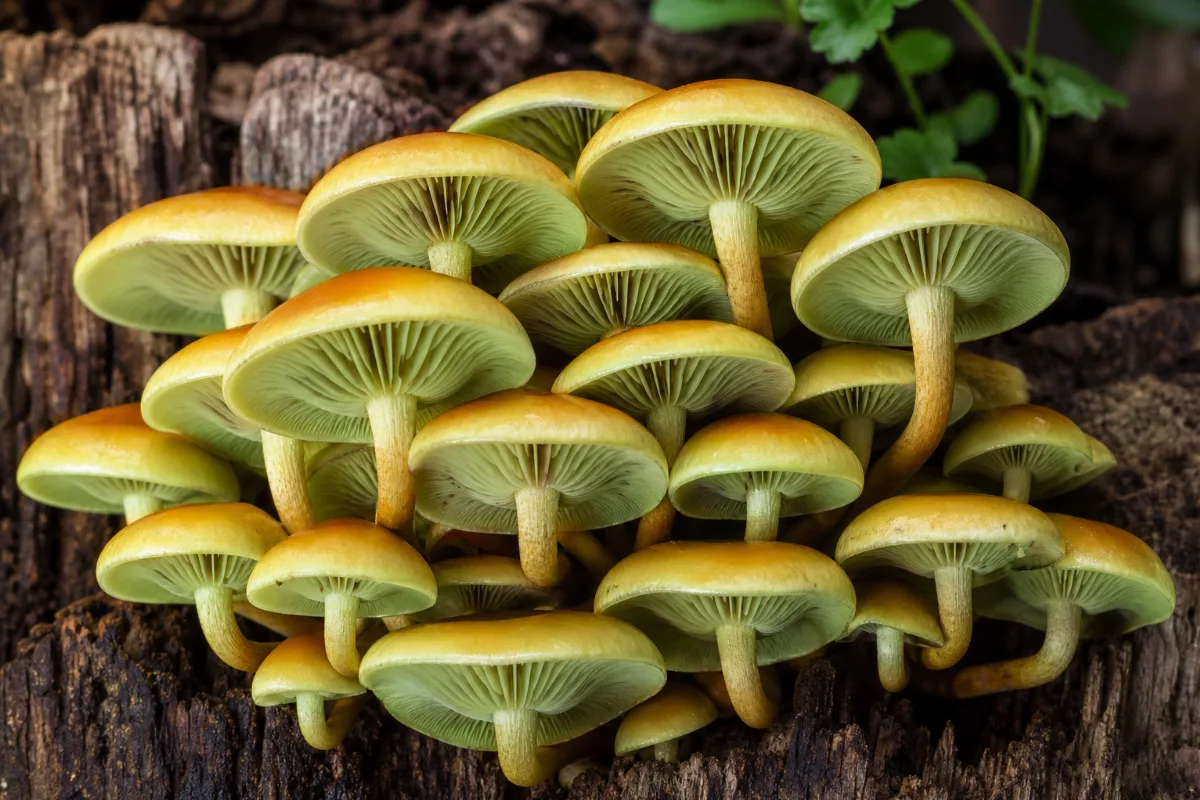
Mushrooms · Poisonous mushroom
Sulphur tuft
Hypholoma fasciculare (Naematoloma fasciculare) · also called Sulfur tuft, clustered woodlover, bitter mushroom (Japan: Nigakuritake)
Sulphur tuft is a poisonous wild mushroom that grows on dead wood. A toxicology review lists vomiting, diarrhoea and nerve paralysis as the symptoms of mushrooms with its toxins, and its main toxins killed mice in the lab. It is not a food and not a remedy. If anyone may have eaten it, call a poison centre now. Nothing studied shows a health benefit.
General information, not medical advice. Last substantive update · Not medically reviewed. A named clinician has not signed off on this page. How this page is made
About Sulphur tuft
Sulphur tuft (Hypholoma fasciculare, also written Naematoloma fasciculare) is a wood-rotting wild mushroom that is poisonous. A toxicology review reports that mushrooms with its toxins cause vomiting, diarrhoea and nerve paralysis. It is not a food or a supplement, and this page gives no identification help and no preparation or amount, because none is safe.
What it is
Sulphur tuft is a fungus in the family Strophariaceae. GBIF accepts the name Hypholoma fasciculare and lists Naematoloma fasciculare as a synonym, which is why you may see both names in older toxicology papers. It is not a plant. It is not sold as a supplement in the sources we read, and we found no traditional medicinal use. This page does not help anyone identify or gather mushrooms; wild mushrooms should not be identified from words, photos or apps.
What the research shows
Research on this mushroom is mostly chemistry and lab screening. Chemists have isolated many steroid-like compounds, including the fasciculols and fasciculic acids. A cell-disrupting protein, fascicularelysin, burst rat cells in a dish. Cultures and tissue slowed some bacteria in dishes. Extracts blocked an enzyme in test tubes. None of this was tested in animals or people for a health use, and none shows a benefit from the mushroom.
At a glance
Traditional uses history, not proof
- No traditional medicinal use was found in the sources read. Its Japanese name means 'bitter mushroom', and it is listed among toxic mushrooms involved in food-poisoning incidents in Japan.
Studied for research
- Bacteria and microbes in dishes, insufficient (lab only)
- Cancer-cell and inflammation screens, insufficient (lab only; results not stated in the abstracts read)
- Enzyme and calmodulin test-tube tests, insufficient (lab only)
Main compounds
- Fasciculol E and F, steroid-like toxins
- Other fasciculols and fasciculic acids
- Fascicularelysin, a cell-disrupting protein
Common forms
- Not a food or supplement; none recommended. Cooking does not make poisonous mushrooms safe.
Research links: Poison Help (US) · Toxicological profiles of mushrooms (2014 review) · Poison-centre guidance on poisonous mushrooms · Toxic principles of Naematoloma fasciculare (1983) · Research Library · Genes & Biomarkers Library
What it is and its history
- Accepted scientific name
- Hypholoma fasciculare
- Naming authority
- (Huds.) P.Kumm. (GBIF)
- Synonyms
- Naematoloma fasciculare (Huds.) P.Karst. (a synonym in GBIF; still used in toxicology and chemistry papers)
- Common names
- Sulphur tuft (English); Sulfur tuft (English); Clustered woodlover (English); Nigakuritake (bitter mushroom) (Japanese)
- Family or group
- Strophariaceae (a fungus family), not a plant
- Classification
- Fungi > Basidiomycota > Agaricomycetes > Agaricales > Strophariaceae > Hypholoma > Hypholoma fasciculare
- Native range
- Not checked beyond the papers read, which come from Europe, East Asia and North America.
- Habitat
- The papers read describe it as a wood-rotting fungus (a white-rot fungus that colonises dead wood).
- What it looks like
- Fruiting body: Not described here on purpose: this page gives no identification help.
- Look-alikes and adulterants
- Name: Other wild mushrooms that grow in clusters on wood; Note: Poison centres and the toxicology review say wild-mushroom poisonings follow wrong identification. We did not find a published case of this mushroom eaten in error for a specific edible species, so none is named. No identification detail is given.
- Sustainability and conservation
- Not checked.
Traditional use and history history, not clinical proof
| Tradition or era | Documented use | Source |
|---|---|---|
| Poisoning reports (modern) | Not a food or a remedy. It is listed among toxic mushrooms involved in food-poisoning incidents in Japan, and its Japanese name means 'bitter mushroom'. No traditional medicinal use was found in the sources read. | p28690303 |
Traditional use shows how it was used. It does not show that it works or is safe today.
What is inside, and how it may work
What it contains and how those compounds act in cells and animals. Laboratory and animal mechanisms are not proven effects in people.
Main compounds
| Compound | Family | Where it is concentrated | Activity studied | Level of evidence |
|---|---|---|---|---|
| Fasciculol E and F | lanostane triterpenoid (steroid-like) toxins | Fruiting body | Identified as the toxic principles; caused paralysis and death in mice by injection (LD50 50 and 168 mg/kg). 10 | Animal research |
| Other fasciculols and related triterpenoids (including fasciculols G, H, I) | lanostane triterpenoids | Fruiting body | Isolated and tested against cancer cell lines; results not given in the abstracts read. 4 9 13 | Laboratory research |
| Fasciculic acids A, B, C | fasciculol esters | Fruiting body | Potent calmodulin blockers in the lab. 11 | Laboratory research |
| Fascicularelysin | protein (cytolysin) | Fruiting body | Disrupted rat mast cells in a dish; strength roughly matched its ability to burst red blood cells. 8 | Laboratory research |
| 3,5-dichloromethoxy benzoic acid | chlorinated aromatic acid | Mycelium culture | Proposed as a possible antibacterial compound from cultures; not tested in people. 1 | Laboratory research |
Mechanisms, receptors and pathways
| Target or pathway | Gene or receptor | What was found | Level |
|---|---|---|---|
| Nerve and muscle function (paralysis) | Not identified | Fasciculol E and F injected into mice caused paralysis and death. How they act was not described in the abstract read. 10 | Animal research |
| Calmodulin | Calmodulin | Fasciculic acids blocked calmodulin in the lab. Whether this explains the poisoning is not shown in anything read. 11 5 | Laboratory research |
| Cell membranes | Not identified | Fascicularelysin disrupted rat mast cells and artificial lecithin and sphingomyelin membranes in the lab. 8 | Laboratory research |
Absorption, metabolism and elimination
- Absorption
- Not found.
- Distribution
- Not found.
- Metabolism
- Not found.
- Elimination
- Not found.
- Bioavailability
- Not established.
Isolated compounds versus whole extracts
All the lab and animal findings use isolated compounds, proteins or extracts. None used the whole mushroom as a person might meet it, and none can be turned into an amount for people.
Nutritional composition
Not a food. No nutrition table is relevant to a poisonous mushroom.
3 not enough evidence
What was looked at
The 3 benefits and uses checked for Sulphur tuft, each with how strong the evidence is. Tap one to open it.
- Bacteria and microbes in the lab (dishes only)Not enough evidence
- Cancer cells, immune and inflammation screens in the lab (cell dishes only)Not enough evidence
- Enzyme and calmodulin tests (test tubes only)Not enough evidence
Lab markers tracked in the studies
Bacterial growth inhibition (lab test)Xanthine oxidase inhibition (IC50)
What is Sulphur tuft good for?
The uses researchers have looked at, and how strong the evidence is. All of it is lab work; none is a reason to eat this poisonous mushroom.
Benefits, one by one
Each card is a research question, not a promise. Tap a goal to filter. Open a card to see the studies, doses and limits.
Bacteria and microbes in the lab (dishes only)
Not enough evidenceIn the lab, substances from sulphur tuft slowed some bacteria, a yeast and one plant-disease bacterium. This was done on dishes and cultures. No animal or human study was found, and none of it is a reason to eat this poisonous mushroom.
3 studiesLaboratory cultures, freeze-dried tissue and isolated compounds; not …
Studies, doses and limits
What the trials found
No human or animal study was found.
Results
Mushroom cultures: activity against Bacillus subtilis, Escherichia coli and a yeast (Saccharomyces cerevisiae). Freeze-dried mushroom tissue: among the three strongest of 23 woodland fungi against Mycobacterium abscessus isolates in dishes. Isolated compounds: slowed one of three plant-disease bacteria.
Effect sizes as reported
Lab findings only; no effect sizes in people.
Why this rating
Dish and culture work only. Lab results of this kind very often fail to carry over to people.
Form and dose studied
Laboratory cultures, freeze-dried tissue and isolated compounds; not a product. No amounts are given or advised.
Who was studied
Bacterial and yeast cultures in dishes
Limits
Not tested in animals or people. Something that slows germs in a dish can also harm human cells. This mushroom is poisonous.
Why researchers looked
Researchers screen wild mushrooms for new antibiotic-like substances because many germs now resist current medicines.
Traditional use
No traditional medicinal use was found in the sources read.
Proposed mechanism Laboratory research
A lab study of the mushroom's cultures found more than 15 gene clusters for making natural products and proposed one compound, 3,5-dichloromethoxy benzoic acid, as a possible antibacterial. A separate study of its fruiting bodies found that three isolated compounds slowed one of three plant-disease bacteria. These are lab findings.
A proposed mechanism does not show that the effect happens in people.
Sulphur tuft is a poisonous mushroom reported to cause vomiting, diarrhoea and nerve paralysis. See the Safety tab.
Cancer cells, immune and inflammation screens in the lab (cell dishes only)
Not enough evidenceChemists have isolated many steroid-like compounds from sulphur tuft and screened some against cancer cell lines and inflammation tests in dishes. The abstracts mostly do not report what was found. Nothing was tested in animals or people.
3 studiesIsolated compounds and solvent extracts in the lab; not a product. No…
Studies, doses and limits
What the trials found
No human or animal study was found.
Results
The abstracts say what was tested but give no results for this mushroom's compounds. The screening paper does not say which activity was found, or how strong.
Effect sizes as reported
No effect sizes available.
Why this rating
Cell-line screening with results not stated in the abstracts read.
Form and dose studied
Isolated compounds and solvent extracts in the lab; not a product. No amounts are given or advised.
Who was studied
Human and mouse cell lines in dishes
Limits
Not tested in animals or people. The fasciculols are the same family as the toxins that paralysed and killed mice. This mushroom is poisonous.
Why researchers looked
Wild mushrooms are screened in the lab for substances that harm cancer cells or calm inflammation.
Traditional use
No traditional medicinal use was found in the sources read.
Proposed mechanism Laboratory research
Two chemistry papers isolated fasciculol-type and other lanostane compounds (steroid-like molecules) and tested them on human cancer cell lines, a brain-tumour cell line, a mouse immune cell line and NF-kappaB, a cell-signalling switch. A third screening paper lists the mushroom among nine species with antiproliferative, immunostimulatory and/or anti-inflammatory activity in lab extracts.
A proposed mechanism does not show that the effect happens in people.
Sulphur tuft is poisonous. See the Safety tab.
Enzyme and calmodulin tests (test tubes only)
Not enough evidenceIn test tubes, extracts blocked the enzyme xanthine oxidase, and compounds from the mushroom blocked calmodulin, a calcium-binding protein in cells. These tests say nothing about eating the mushroom.
3 studiesSolvent extracts and isolated compounds; not a product.
Studies, doses and limits
What the trials found
No human or animal study was found.
Results
Xanthine oxidase: IC50 67.76 +/- 11.05 micrograms per ml for the sulphur tuft extract; other species were stronger. Calmodulin: potent blocking by fasciculic acids A to C, with no numbers in the abstract.
Effect sizes as reported
Test-tube values only.
Why this rating
Test-tube work only.
Form and dose studied
Solvent extracts and isolated compounds; not a product.
Limits
A test-tube enzyme result does not mean a medicine or food would work in a person. Mushroom is poisonous.
Why researchers looked
Xanthine oxidase is the enzyme that gout medicines target. Calmodulin is a cell protein used as a test target for natural compounds.
Traditional use
No traditional medicinal use was found in the sources read.
Proposed mechanism Laboratory research
Extracts of 188 mushroom samples were screened against xanthine oxidase in test tubes. Separately, fasciculic acids from the toxic mushroom were reported to be strong calmodulin blockers. Calmodulin blocking may be connected to why the mushroom is toxic, but no source read says so.
A proposed mechanism does not show that the effect happens in people.
Sulphur tuft is poisonous. See the Safety tab.
Connections to the rest of health
How Sulphur tuft connects to the rest of our health knowledge graph. Every link says what kind of connection it is. A safety link (for example to the liver) is a warning, not a benefit. A study that merely mentions a topic never creates a benefit link.
Explore every connection: goals, body systems, organs, symptoms, genes
B. Body systems
| Connected to | Kind of connection | Evidence status | Context | Studies |
|---|---|---|---|---|
| Digestive System | Adverse effect or risk | Low certainty | Vomiting and diarrhoea listed for fasciculol-containing mushrooms; frequency unknown. Preparation or compound: Wild fruiting body |
3 |
| Nervous System | Adverse effect or risk | Very low certainty | Nerve paralysis listed in one review; paralysis seen in mice given injected fasciculol. Preparation or compound: Wild fruiting body; isolated fasciculol (mice) |
3 10 |
E. Health conditions
| Connected to | Kind of connection | Evidence status | Context | Studies |
|---|---|---|---|---|
| Food Poisoning | Adverse effect or risk | Low certainty | Listed among toxic mushrooms involved in food-poisoning incidents in Japan; case numbers not available. Preparation or compound: Wild fruiting body |
7 |
I. Biomarkers
| Connected to | Kind of connection | Evidence status | Context | Studies |
|---|---|---|---|---|
| Bacterial growth inhibition (lab test) | Biological association | Not enough evidence | Measured in trials: raised. A lab change is not the same as a health benefit. | 6 |
| Xanthine oxidase inhibition (IC50) | Biological association | Not enough evidence | Measured in trials: lowered. A lab change is not the same as a health benefit. | 12 |
K. Biological pathways
| Connected to | Kind of connection | Evidence status | Context | Studies |
|---|---|---|---|---|
| Calmodulin | Preliminary mechanism | In vitro | Blocked in the lab by fasciculic acids from the mushroom. | 11 |
L. Active compounds
| Connected to | Kind of connection | Evidence status | Context | Studies |
|---|---|---|---|---|
| Fasciculol E and F | Biological association | Animal | Identified as the toxic principles; caused paralysis and death in mice by injection (LD50 50 and 168 mg/kg). Preparation or compound: Fruiting body |
10 |
| Other fasciculols and related triterpenoids (including fasciculols G, H, I) | Biological association | In vitro | Isolated and tested against cancer cell lines; results not given in the abstracts read. Preparation or compound: Fruiting body |
4 9 13 |
| Fasciculic acids A, B, C | Biological association | In vitro | Potent calmodulin blockers in the lab. Preparation or compound: Fruiting body |
11 |
| Fascicularelysin | Biological association | In vitro | Disrupted rat mast cells in a dish; strength roughly matched its ability to burst red blood cells. Preparation or compound: Fruiting body |
8 |
| 3,5-dichloromethoxy benzoic acid | Biological association | In vitro | Proposed as a possible antibacterial compound from cultures; not tested in people. Preparation or compound: Mycelium culture |
1 |
Each connection is stored with the ingredient, the connected record, the kind of connection, the evidence status, the supporting studies, the preparation or compound involved, and a review date (last reviewed October 25, 2026).
Evidence at a glance: what changed in 2 lab markers
Tap a number to show only those markers. Counts are markers, not people.
The evidence
The research centre for Sulphur tuft. Every record here was checked against PubMed or the publisher's page; we never list a study we have not verified.
Evidence by outcome
Bars show how many studies we found for each outcome, not how well it works. People are added up across trials only (reviews are not added, to avoid double counting).
How we rate evidence
High certainty
Several well-run trials or reviews agree; further research is unlikely to change the picture much.
Moderate certainty
Good trials point the same way, but some doubt remains.
Low certainty
Small, short or inconsistent trials. The finding could change with better research.
Very low certainty
Very little or very weak human data. Treat as a possibility only.
Mixed findings
Trials or reviews disagree with each other.
Not enough evidence
Not enough human research to say either way.
Evidence against
Good research found no benefit, or found harm.
We take the reviewers' own risk-of-bias and GRADE statements where they exist, and otherwise judge from study size, design, consistency, directness and whether a product matches what is sold. Many publications do not make evidence high. Method note: We read PubMed records and abstracts for 13 papers (1 review, 1 animal study, 1 laboratory method paper and 10 laboratory studies; one is read by title only), the 2014 toxicology review in full, two poison-centre pages, and checked the names in GBIF. Index Fungorum, regulators and poison-centre case databases were not searched in depth. Certainty ratings are the compiler's own reading.
Study library: every study we checked 16
| Study | Design | People | Product, dose, length | Result |
|---|---|---|---|---|
| Al-Salihi 2021 Further Biochemical Profiling of Hypholoma fasciculare Metabolome Reveals Its Chemogenetic Diversity. Frontiers in Bioengineering and Biotechnology · PMID 34109161 · DOI |
Laboratory research in-vitro |
Nine mushroom-forming fungi grown in the lab; genome and chemical analysis | Laboratory cultures (mycelium) of Hypholoma fasciculare mycelium culture Not shown here |
Hypholoma fasciculare was a highly active antagonistic species, with activity against Bacillus subtilis, Escherichia coli and Saccharomyces cerevisiae. The team found more than 15 gene clusters for making natural products and proposed 3,5-dichloromethoxy benzoic acid as a possible antibacterial compound. Activity against 3 microbes in the lab Methods, limits and fundingOutcomes: Antimicrobial screening; gene clusters; candidate compound Limitations: Lab cultures and genome work. A possible antibacterial compound was proposed, not tested in animals or people. Funding and conflicts: The authors declared no commercial or financial conflicts Read: abstract |
| Deo 2019 Antiproliferative, Immunostimulatory, and Anti-Inflammatory Activities of Extracts Derived from Mushrooms Collected in Haida Gwaii, British Columbia (Canada). International Journal of Medicinal Mushrooms · PMID 31679298 · DOI |
Laboratory research in-vitro |
Four crude extracts (ethanol, methanol, water, sodium hydroxide) from 17 wild mushroom species collected in British Columbia | Crude extracts of wild-collected Hypholoma fasciculare fruiting body Not shown here |
Hypholoma fasciculare is one of nine species for which the authors describe antiproliferative, immunostimulatory and/or anti-inflammatory activities not reported before. The abstract does not say which of the three activities, or how strong, for this species. Screening only; no figures for this species in the abstract Methods, limits and fundingOutcomes: Cell growth, immune and inflammation screens Limitations: A screening of 17 species in the lab. The abstract does not separate this species out, so no detail is given. Funding and conflicts: Not stated in the abstract Read: abstract |
| Jo 2014 Toxicological profiles of poisonous, edible, and medicinal mushrooms. Mycobiology · PMID 25346597 · DOI |
Narrative review review |
Review of mushroom poisoning, grouped by toxin | Sulphur tuft (Hypholoma fasciculare) material as described fruiting body Not shown here |
The review states that the symptoms of poisoning with fasciculol-containing mushrooms are vomiting, diarrhea and nerve paralysis, and that the mushrooms containing fasciculol are Naematoloma fasciculare and Hypholoma fasciculare. It gives no timing, no numbers and no individual cases for this mushroom. It also says serious poisonings generally come from wrong identification. One sentence on this mushroom Methods, limits and fundingOutcomes: Symptoms by toxin group Limitations: Short narrative review; the sentence about this mushroom has no case data or reference we could check from the text read. The abstract does not name the mushroom; the sentence is in the full text (PMC4206786). Funding and conflicts: Not stated in the text read Read: full text |
| Kim 2013 Lanostane triterpenoids from the mushroom Naematoloma fasciculare. Journal of Natural Products · PMID 23634786 · DOI |
Laboratory research in-vitro |
Compounds isolated from a methanol extract of the fruiting bodies; four human cancer cell lines (A549, SK-OV-3, SK-MEL-2, HCT-15) and a mouse microglial cell line | Isolated lanostane triterpenoids from Naematoloma fasciculare fruiting body (isolated compounds) Not shown here |
The team isolated four new and 11 known lanostane triterpenoids (a family of steroid-like compounds), including fasciculol G, and tested all 15 against four human cancer cell lines and for effects on nitric oxide production in mouse microglial cells. The abstract does not give the test results. No results in the abstract Methods, limits and fundingOutcomes: Structures; cancer-cell growth; nitric oxide production Limitations: Cell work only. The abstract states what was tested but not what was found, so no benefit is claimed. Funding and conflicts: Not stated in the abstract (authors from a Korean university pharmacy school; research support non-US government) Read: abstract |
| Kubo 1985 Calmodulin inhibitors from the bitter mushroom Naematoloma fasciculare (Fr.) Karst. (Strophariaceae) and absolute configuration of fasciculols. Chemical & Pharmaceutical Bulletin (Tokyo) · PMID 4092281 · DOI |
Laboratory research in-vitro |
Isolated compounds in laboratory assays | Fasciculols from Naematoloma fasciculare fruiting body (isolated compounds) Not shown here |
Title and journal record read only: PubMed carries no abstract. The title says the fasciculols from the bitter mushroom are calmodulin inhibitors. Title only Methods, limits and fundingOutcomes: Calmodulin inhibition; chemistry Limitations: NOT verified beyond the title: no abstract or full text was read, so no result is stated. Funding and conflicts: Not stated Read: title only |
| Millar 2019 Antimicrobial properties of basidiomycota macrofungi to Mycobacterium abscessus isolated from patients with cystic fibrosis. International Journal of Mycobacteriology · PMID 30860186 · DOI |
Laboratory research in-vitro |
Freeze-dried tissue of 23 woodland fungi from Northern Ireland tested against six bacterial isolates from people with cystic fibrosis plus a reference strain | Freeze-dried reconstituted Hypholoma fasciculare tissue fruiting body Not shown here |
All fungi tested except Russula nigricans inhibited the bacteria to some degree. Hypholoma fasciculare was among the three with the strongest activity; the abstract lists a value of 25.3 mg/ml for it. Among the top three of 23 fungi (25.3 mg/ml as listed) Methods, limits and fundingOutcomes: Growth inhibition of Mycobacterium abscessus Limitations: Bacteria in a dish, with freeze-dried fungus tissue. Unit and meaning of the figure are as printed in the abstract. Not tested in animals or people. Funding and conflicts: Not stated in the abstract Read: abstract |
| Nomura 2017 [PCR-Based Method for the Detection of Toxic Mushrooms Causing Food-Poisoning Incidents]. Shokuhin Eiseigaku Zasshi · PMID 28690303 · DOI |
Laboratory method lab |
Osaka public-health laboratory study (article in Japanese) | Sulphur tuft (Hypholoma fasciculare) material as described fruiting body Not shown here |
The authors designed DNA tests for five toxic mushrooms, including Hypholoma fasciculare, that have been involved in food-poisoning incidents in Japan. The tests worked on fresh, cooked and stomach-fluid-treated samples and gave no signal for look-alike mushrooms. Detection method in 2.5 hours Methods, limits and fundingOutcomes: DNA tests for five toxic mushrooms Limitations: A laboratory method, not a clinical study. It shows only that this mushroom has been involved in food-poisoning incidents in Japan; no counts or symptoms are in the abstract. Funding and conflicts: Not stated in the abstract Read: abstract |
| Seeger 1980 Degranulation of rat mast cells in vitro by the fungal cytolysins phallolysin, rubescenslysin and fascicularelysin. Naunyn-Schmiedeberg's Archives of Pharmacology · PMID 7207644 · DOI |
Laboratory research in-vitro |
Rat mast cells in tissue and artificial fat membranes (liposomes) | Fascicularelysin (purified protein) from Hypholoma fasciculare fruiting body (isolated protein) Not shown here |
Fascicularelysin, a protein from Hypholoma fasciculare, disrupted rat mast cells in tissue; 90% of the cells were disrupted within 5 minutes at 37 degrees C. It also released marker molecules from artificial membranes. Its cell-disrupting strength roughly matched its ability to burst red blood cells. 90% of cells disrupted in 5 min Methods, limits and fundingOutcomes: Cell disruption Limitations: Rat cells in a dish. Whether this protein matters in a person who eats the mushroom is not shown. Funding and conflicts: Not stated in the abstract Read: abstract |
| Shi 2011 Fasciculols H and I, two lanostane derivatives from Chinese mushroom Naematoloma fasciculare. Chemistry & Biodiversity · PMID 22006714 · DOI |
Laboratory research in-vitro |
Compounds isolated from the fruiting bodies of the Chinese toxic mushroom; a human glioma cell line (U87) | Isolated fasciculol compounds from Naematoloma fasciculare fruiting body (isolated compounds) Not shown here |
Two new fasciculol-type compounds (fasciculols H and I) and five known compounds were isolated; four were tested against a human brain-tumour cell line (U87) and for NF-kappaB inhibition. The abstract does not give the test results. No results in the abstract Methods, limits and fundingOutcomes: Structures; U87 cell growth; NF-kappaB Limitations: Cell work only. The abstract states what was tested but not what was found. Funding and conflicts: Not stated in the abstract (research support non-US government) Read: abstract |
| Suzuki 1983 The toxic principles of Naematoloma fasciculare. Chemical & Pharmaceutical Bulletin (Tokyo) · PMID 6685576 · DOI |
Animal study animal |
Mice given purified toxins by injection into the abdomen | Purified fasciculol E and F from Naematoloma fasciculare (Hypholoma fasciculare) fruiting body (isolated compounds) Not shown here |
Fasciculol E and F were identified as the toxic principles of Naematoloma fasciculare (Nigakuritake), a poisonous mushroom. These compounds caused paralysis and death in mice. The LD50 values of fasciculol E and F to mice were 50 mg/kg and 168 mg/kg (injection into the abdomen). LD50 50 and 168 mg/kg in mice (i.p.) Methods, limits and fundingOutcomes: Paralysis, death, LD50 Limitations: Mouse injection figures, not an eating dose, and not a human dose. PubMed carries no abstract; the short abstract was read on the J-STAGE record. The full paper was not opened. Funding and conflicts: Not stated Read: abstract (J-STAGE) |
| Takahashi 1989 Fasciculic acids A, B and C as calmodulin antagonists from the mushroom Naematoloma fasciculare. Chemical & Pharmaceutical Bulletin (Tokyo) · PMID 2632070 · DOI |
Laboratory research in-vitro |
Isolated compounds in laboratory assays | Fasciculic acids A, B, C (isolated) from Naematoloma fasciculare fruiting body (isolated compounds) Not shown here |
Three new fasciculol esters, fasciculic acids A, B and C, with potent calmodulin-blocking activity were isolated from the toxic mushroom Naematoloma fasciculare. Their structures were worked out. Chemistry and a lab activity only Methods, limits and fundingOutcomes: Calmodulin antagonism Limitations: Abstract gives structures and the activity in general terms, no numbers. Not tested in animals or people. Funding and conflicts: Not stated in the abstract Read: abstract |
| Ványolós 2014 Xanthine oxidase inhibitory activity of Hungarian wild-growing mushrooms. Phytotherapy Research · PMID 25098272 · DOI |
Laboratory research in-vitro |
Extracts of 47 wild Hungarian mushrooms tested against an enzyme in test tubes | Solvent extracts of Hypholoma fasciculare (chloroform or 50% methanol fractions were the most active overall) fruiting body Not shown here |
Among 188 extracts, Hypholoma fasciculare was one of the species with high enzyme-blocking activity, with an IC50 of 67.76 +/- 11.05 micrograms per ml. Other species were stronger (for example Suillus grevillei, 13.28 micrograms per ml). IC50 67.76 +/- 11.05 micrograms/ml (test tube) Methods, limits and fundingOutcomes: Xanthine oxidase inhibition (IC50) Limitations: Test-tube enzyme work with solvent extracts. Xanthine oxidase is the enzyme targeted by gout medicines, but this says nothing about eating the mushroom. Funding and conflicts: Not stated in the abstract Read: abstract |
| Wang 2022 A new lanostane triterpenoid from the mushroom Hypholoma fasciculare. Bioscience, Biotechnology, and Biochemistry · PMID 35388876 · DOI |
Laboratory research in-vitro |
Compounds from fruiting bodies tested against three plant-disease bacteria | Isolated compounds from Hypholoma fasciculare fruiting body (isolated compounds) Not shown here |
One new and three known compounds were isolated from the fruiting bodies. In growth tests on three plant-disease bacteria, compounds 1, 2 and 4 slowed Clavibacter michiganensis only. 1 of 3 bacteria affected Methods, limits and fundingOutcomes: Structure; bacterial growth inhibition Limitations: Plant-disease bacteria in a dish; says nothing about people. Funding and conflicts: Not stated in the abstract Read: abstract |
| n/a 2026 Poisonous Mushrooms (Poison Control Center) University of Kansas Health System Poison Control Center · Source |
Guide n/a |
n/a | Sulphur tuft (Hypholoma fasciculare) material as described fruiting body Not shown here |
The poison centre says even very experienced gatherers can find it hard to tell whether a mushroom is safe, that symptoms may not appear for a couple of days, and that cooking, canning, pickling, freezing and drying do not remove toxins from poisonous mushrooms. If someone eats a wild mushroom, call immediately, do not wait for symptoms, and save a piece of the mushroom if you can. It lists vomiting and diarrhoea among the possible effects of poisonous mushrooms. Methods, limits and fundingOutcomes: n/a Limitations: A general poison-centre page about poisonous mushrooms. It does not name this species. The delay of days refers to poisonous mushrooms in general, not to this one. Funding and conflicts: Not a funded study; hospital poison centre Read: full text |
| n/a 2026 Poison Help (America's Poison Centers) poisonhelp.org · Source |
Guide n/a |
n/a | Sulphur tuft (Hypholoma fasciculare) material as described fruiting body Not shown here |
The official site of America's Poison Centers gives the free line 1-800-222-1222 for poison help. It says: if a person has collapsed, had a seizure, has trouble breathing or cannot be woken, call 911 immediately. For swallowed poison it says do not try home remedies or try to make someone throw up, and to call Poison Help. Methods, limits and fundingOutcomes: n/a Limitations: A general poison page, not specific to this mushroom. US numbers; use the local poison centre or emergency number elsewhere. Funding and conflicts: Not a funded study; non-profit poison-centre network Read: full text |
| n/a 2026 GBIF Backbone Taxonomy: Hypholoma fasciculare GBIF · Source |
Taxonomy record n/a |
n/a | Sulphur tuft (Hypholoma fasciculare) material as described fruiting body Not shown here |
GBIF accepts Hypholoma fasciculare (Huds.) P.Kumm. (key 3293632), family Strophariaceae, order Agaricales, class Agaricomycetes, phylum Basidiomycota. Naematoloma fasciculare (Huds.) P.Karst. is listed there as a synonym, so both names appear in the older toxicology papers. Methods, limits and fundingOutcomes: n/a Limitations: Index Fungorum was not checked (the site blocked the request); GBIF is a database, not a mycology authority. Checked 2026-10-25 through the GBIF API. Funding and conflicts: Not a funded study; GBIF Read: full text |
What we do not know yet
- No case series with timing, severity, treatment or outcome for sulphur tuft that we could open (a 1955 paper, Mortara and Mortinetti, Arch Toxikol, has no abstract and was not read).
- No measured toxin content of the mushroom.
- No source on alcohol, medicines, pregnancy or children.
- No specific treatment described in the sources read.
- No human or animal study of sulphur tuft for any health use was found.
How new research is added
New studies are found by a saved PubMed search and placed in a review queue. A person reads each one before it changes any evidence rating or safety wording.
Lab markers
What changed in blood or saliva tests during trials. A changed number is not the same as feeling or being healthier, and we give no "normal ranges".
Other 2
Bacterial growth inhibition (lab test)
Raised in trials
A lab measure of how much a substance slows the growth of bacteria in a dish.
Not enough evidenceResults and what it means
Why it was measured
A first screen for substances that might become antibiotics.
Statistical vs. clinical meaning
A dish measurement.
Safety implication
Does not show an antibacterial effect in a person. The mushroom is poisonous.
| Study | Result | People | Product |
|---|---|---|---|
| 6 | Freeze-dried Hypholoma fasciculare was among the three of 23 fungi with the strongest effect on Mycobacterium abscessus isolates; the abstract lists 25.3 mg/ml. | Bacterial isolates from people with cystic fibrosis, grown in dishes | Freeze-dried, reconstituted mushroom tissue |
Xanthine oxidase inhibition (IC50)
Lowered in trials
The amount of extract (micrograms per ml) needed to block half of an enzyme's activity in a test tube. A lower number means a stronger block.
Not enough evidenceResults and what it means
Why it was measured
A quick lab screen for substances that might lower uric acid production.
Statistical vs. clinical meaning
A test-tube number.
Safety implication
Does not show an effect on uric acid or gout in a person. The mushroom is poisonous.
| Study | Result | People | Product |
|---|---|---|---|
| 12 | IC50 67.76 +/- 11.05 micrograms per ml for Hypholoma fasciculare; Suillus grevillei was 13.28 micrograms per ml. | Enzyme in test tubes | Solvent extracts of the mushroom |
Safety
What studies and official sources say about side effects, medicines and who should check first. Each point shows what kind of evidence it comes from.
Main points to know 3
- Sulphur tuft is a poisonous mushroom. A toxicology review says the symptoms of poisoning with fasciculol-containing mushrooms are vomiting, diarrhoea and nerve paralysis, and names Hypholoma fasciculare (also written Naematoloma fasciculare) among them. A Japanese public-health laboratory paper lists it among toxic mushrooms that have been involved in food-poisoning incidents in Japan. Beyond that, little is published that we could read: no case series with timing, severity or outcomes, so we cannot say how often it is serious. Rare severe cases are described in popular sources, but we could not verify them and do not repeat them. Narrative review 3 7
- The identified toxins killed mice. A 1983 study named fasciculol E and F as the toxic principles of this mushroom. Injected into the abdomen of mice, they caused paralysis and death (LD50 values 50 and 168 mg per kg). That is an animal figure by a route nobody eats by. It cannot be turned into a human amount, and no safe amount can be given. Animal study 10
- If it may have been eaten, call a poison centre now. Poison centres advise calling right away for any wild mushroom that may have been eaten, before symptoms start, and keeping a piece of the mushroom if possible. Symptoms of poisonous mushrooms in general can take days to appear. Cooking, drying, canning, pickling and freezing do not remove the toxins of poisonous mushrooms. This page gives no help to identify wild mushrooms; even very experienced gatherers can find it hard to tell safe from poisonous ones. Poison centre guidance 14 15
Side effects 3
| Effect | How often | Severity and recovery | Evidence |
|---|---|---|---|
| Vomiting Listed for fasciculol-containing mushrooms. | Listed as a symptom; how often it happens is not known. | moderate Not described in the sources read. | Narrative review 3 |
| Diarrhoea Listed for fasciculol-containing mushrooms. Heavy vomiting and diarrhoea can cause dehydration. | Listed as a symptom; how often it happens is not known. | moderate Not described in the sources read. | Narrative review 3 |
| Nerve paralysis Treat as a reason to call at once; the human detail is lacking. | Listed in one review; no case details were found. Paralysis was seen in mice given injected fasciculol. | severe Not described. | Narrative review 3 10 |
Liver
No liver injury report for sulphur tuft was found in the sources read. Some popular sources mention liver, kidney and heart findings in a fatal case; we could not verify that, so it is not stated as fact. LiverTox was not searched for this species. 3
How often. No data.
Monitoring. No monitoring advice was read. A poison centre or doctor decides what tests are needed.
This is a safety connection. It is not evidence that Sulphur tuft supports liver health.
Medicines and supplements 3
| With | Why it matters | Importance | Evidence | What to do |
|---|---|---|---|---|
| Alcohol substance | Not known | No source on sulphur tuft and alcohol was found. | Gap Not enough evidence | Silence in the research is not a sign of safety. Do not eat wild mushrooms you cannot account for. |
| Prescription medicines (any) prescription | Not studied | No interaction study was found. Vomiting and diarrhoea can stop oral medicines from being absorbed and can cause dehydration, which matters for people on blood pressure, heart, kidney or diabetes medicines. | Theoretical Not enough evidence 3 | Tell the poison centre and doctor every medicine the person takes. |
| Herbal and mushroom supplements supplement | Not studied | No interaction data were found. This mushroom is not sold as a supplement in the sources read. | Gap Not enough evidence | Do not combine wild mushrooms with supplements; ask a doctor or pharmacist. |
Who should check first 3
| Situation | Advice | Evidence |
|---|---|---|
| Everyone | This is a poisonous mushroom and is not a food or a remedy. No safe amount is known. | Narrative review 3 10 |
| Anyone not sure what wild mushroom they have | Do not eat wild mushrooms you cannot have identified in person by an expert. Do not trust photos, apps or text. | Poison centre guidance 14 3 |
| Pregnancy, breastfeeding, children, pets, older people, and people with kidney, liver or heart disease | No data on these groups were found. Children and pets are at particular risk from small amounts of poisonous wild mushrooms, so remove or fence off wild mushrooms in places where they play, and call a poison centre or vet if one may have been eaten. | Gap 14 |
Overdose, product quality and regulators
Summary. The toxins identified in the mushroom are the fasciculols (steroid-like compounds), mainly fasciculol E and F. They caused paralysis and death in mice by injection. The mushroom also contains fascicularelysin, a protein that disrupted rat cells in a dish. Whether these explain the poisoning in people has not been shown in anything we read.
Animal. Fasciculol E and F, injected into the abdomen of mice: paralysis and death; LD50 50 and 168 mg/kg (a 1983 study, read as a short abstract). Fascicularelysin disrupted rat mast cells in a dish (a 1980 study).
Human doses studied. No dose studies in people. No amounts are given or advised, and no amount can be called safe.
High dose or long term signals. Not studied. No source read says how a larger or smaller meal changes the illness.
Overdose response. Not described in the sources read. If a person may have eaten a wild mushroom, call a poison centre or emergency number now; treatment is decided by them and clinicians.
Genotoxicity. Not read.
Toxic or hazardous parts. Fungus: fruiting body. Cooking, drying, canning, pickling and freezing do not remove toxins from poisonous mushrooms (poison-centre guidance).
The main hazard is a mix-up of wild mushrooms; the identity of a wild mushroom cannot be confirmed from words, photos or apps. No product or supplement was found, so product-quality issues do not arise.
Mix-ups. The toxicology review says serious poisonings generally follow wrong identification. This page gives no identification help on purpose. 3
Cooking. Poison-centre guidance says cooking, canning, pickling, freezing and drying do not remove the toxins of poisonous mushrooms. 14
| Body | Action | Date |
|---|---|---|
| America's Poison Centers (Poison Help) (United States) | Gives the free emergency line 1-800-222-1222 for poisonings. It is a general page, not a statement about sulphur tuft. source | 2026-10-25 |
| University of Kansas Health System Poison Control Center (United States) | Advises calling immediately after any wild mushroom is eaten, saving a piece if you can, and not waiting for symptoms. It does not name sulphur tuft. source | 2026-10-25 |
When to get medical help
- Any wild mushroom that may have been eaten: call a poison centre now (US 1-800-222-1222) or your local poison centre or emergency number, even if the person feels fine
- Collapse, a seizure, trouble breathing, or cannot be woken: call 911 or your emergency number
- Weakness or paralysis, or numbness
- Vomiting or diarrhoea that does not stop, or signs of dehydration (dizziness, very little urine, dry mouth)
- Severe stomach pain or confusion
- Children and pets: treat any possible taste of a wild mushroom as an emergency call
If someone may be poisoned or in a crisis, contact a clinician or emergency service straight away. In the US, Poison Control is 1-800-222-1222.
General information only, not medical advice. Ask a clinician or pharmacist before use, especially with medicines, in pregnancy or with a health condition. See the Natural Remedy Safety guide.
Frequently asked questions
What is sulphur tuft?
Is sulphur tuft poisonous?
What symptoms does it cause?
The review lists vomiting, diarrhoea and nerve paralysis. It gives no timing and no individual cases, and we found no case series, so how long it lasts and how severe it gets are not known to us.
What should I do if someone may have eaten it?
Call a poison centre now (1-800-222-1222 in the US) or your local poison centre or emergency number, even if the person feels fine, and keep a piece of the mushroom if you can. Call 911 or your emergency number for collapse, a seizure, trouble breathing, weakness or paralysis. Do not try home remedies or make someone vomit unless a poison centre says so.
Does cooking make it safe?
No. Poison-centre guidance says cooking, canning, pickling, freezing and drying do not remove the toxins of poisonous mushrooms.
What is the toxin?
Fasciculol E and F were identified as the toxic principles in a 1983 study. Injected into mice, they caused paralysis and death. That is a lab figure and cannot be turned into a human amount.
Is there an antidote?
Can I tell it from safe mushrooms?
Does sulphur tuft have any health benefits?
Does it fight cancer?
Is it dangerous for children and pets?
No data on children or pets were found. Poison centres warn that wild mushrooms may be poisonous, and advise calling at once if one may have been eaten. Remove wild mushrooms where children and pets play.
Why is it also called Naematoloma fasciculare?
Mycologists have moved it between genera. GBIF accepts Hypholoma fasciculare and treats Naematoloma fasciculare as a synonym. Index Fungorum was not checked.
Explore by health goal
Editorial transparency
- Written by
- AlternativeMed editorial team. Research compiled with AI assistance, then checked against PubMed records.
- Medical review
- None. This page has not been reviewed by a physician or pharmacist.
- First published
- 2026-10-25
- Last substantive update
- 2026-10-25
- How we research
- We read PubMed records and abstracts for 13 papers (1 review, 1 animal study, 1 laboratory method paper and 10 laboratory studies; one is read by title only), the 2014 toxicology review in full, two poison-centre pages, and checked the names in GBIF. Index Fungorum, regulators and poison-centre case databases were not searched in depth. Certainty ratings are the compiler's own reading.
- How we rate evidence
- See "How we rate evidence" in the Evidence tab.
- Independence
- No product is promoted on this page. No affiliate links are shown. This page is a warning, not a recommendation to eat this mushroom.
Sources 16
Each source was opened and checked. Where we read only the abstract, it says so. The small numbers in the text point here.
- Al-Salihi SAA, Bull ID, Al-Salhi R, Gates PJ, Salih KSM, Bailey AM, Foster GD. Further Biochemical Profiling of Hypholoma fasciculare Metabolome Reveals Its Chemogenetic Diversity.. Frontiers in Bioengineering and Biotechnology. 2021. PMID 34109161. DOI 10.3389/fbioe.2021.567384. (abstract)
- Deo GS, Khatra J, Buttar S, Li WM, Tackaberry LE, Massicotte HB, Egger KN, Reimer K, Lee CH. Antiproliferative, Immunostimulatory, and Anti-Inflammatory Activities of Extracts Derived from Mushrooms Collected in Haida Gwaii, British Columbia (Canada).. International Journal of Medicinal Mushrooms. 2019. PMID 31679298. DOI 10.1615/IntJMedMushrooms.2019031193. (abstract)
- Jo WS, Hossain MA, Park SC. Toxicological profiles of poisonous, edible, and medicinal mushrooms.. Mycobiology. 2014. PMID 25346597. DOI 10.5941/MYCO.2014.42.3.215. (full text)
- Kim KH, Moon E, Choi SU, Kim SY, Lee KR. Lanostane triterpenoids from the mushroom Naematoloma fasciculare.. Journal of Natural Products. 2013. PMID 23634786. DOI 10.1021/np300801x. (abstract)
- Kubo I, Matsumoto A, Kozuka M, Wood WF. Calmodulin inhibitors from the bitter mushroom Naematoloma fasciculare (Fr.) Karst. (Strophariaceae) and absolute configuration of fasciculols.. Chemical & Pharmaceutical Bulletin (Tokyo). 1985. PMID 4092281. DOI 10.1248/cpb.33.3821. (title only)
- Millar BC, Nelson D, Moore RE, Rao JR, Moore JE. Antimicrobial properties of basidiomycota macrofungi to Mycobacterium abscessus isolated from patients with cystic fibrosis.. International Journal of Mycobacteriology. 2019. PMID 30860186. DOI 10.4103/ijmy.ijmy_167_18. (abstract)
- Nomura C, Masayama A, Yamaguchi M, Sakuma D, Kajimura K. [PCR-Based Method for the Detection of Toxic Mushrooms Causing Food-Poisoning Incidents].. Shokuhin Eiseigaku Zasshi. 2017. PMID 28690303. DOI 10.3358/shokueishi.58.132. (abstract)
- Seeger R, Bunsen E. Degranulation of rat mast cells in vitro by the fungal cytolysins phallolysin, rubescenslysin and fascicularelysin.. Naunyn-Schmiedeberg's Archives of Pharmacology. 1980. PMID 7207644. DOI 10.1007/BF00499259. (abstract)
- Shi XW, Li XJ, Gao JM, Zhang XC. Fasciculols H and I, two lanostane derivatives from Chinese mushroom Naematoloma fasciculare.. Chemistry & Biodiversity. 2011. PMID 22006714. DOI 10.1002/cbdv.201000203. (abstract)
- Suzuki K, Fujimoto H, Yamazaki M. The toxic principles of Naematoloma fasciculare.. Chemical & Pharmaceutical Bulletin (Tokyo). 1983. PMID 6685576. DOI 10.1248/cpb.31.2176. (abstract (J-STAGE))
- Takahashi A, Kusano G, Ohta T, Ohizumi Y, Nozoe S. Fasciculic acids A, B and C as calmodulin antagonists from the mushroom Naematoloma fasciculare.. Chemical & Pharmaceutical Bulletin (Tokyo). 1989. PMID 2632070. DOI 10.1248/cpb.37.3247. (abstract)
- Ványolós A, Orbán-Gyapai O, Hohmann J. Xanthine oxidase inhibitory activity of Hungarian wild-growing mushrooms.. Phytotherapy Research. 2014. PMID 25098272. DOI 10.1002/ptr.5115. (abstract)
- Wang J, Wu J, Tsutsumi K, Choi JH, Hirai H, Kobori H, Takikawa Y, Kawagishi H. A new lanostane triterpenoid from the mushroom Hypholoma fasciculare.. Bioscience, Biotechnology, and Biochemistry. 2022. PMID 35388876. DOI 10.1093/bbb/zbac050. (abstract)
- n/a. Poisonous Mushrooms (Poison Control Center). University of Kansas Health System Poison Control Center. 2026. (full text)
- n/a. Poison Help (America's Poison Centers). poisonhelp.org. 2026. (full text)
- n/a. GBIF Backbone Taxonomy: Hypholoma fasciculare. GBIF. 2026. (full text)


