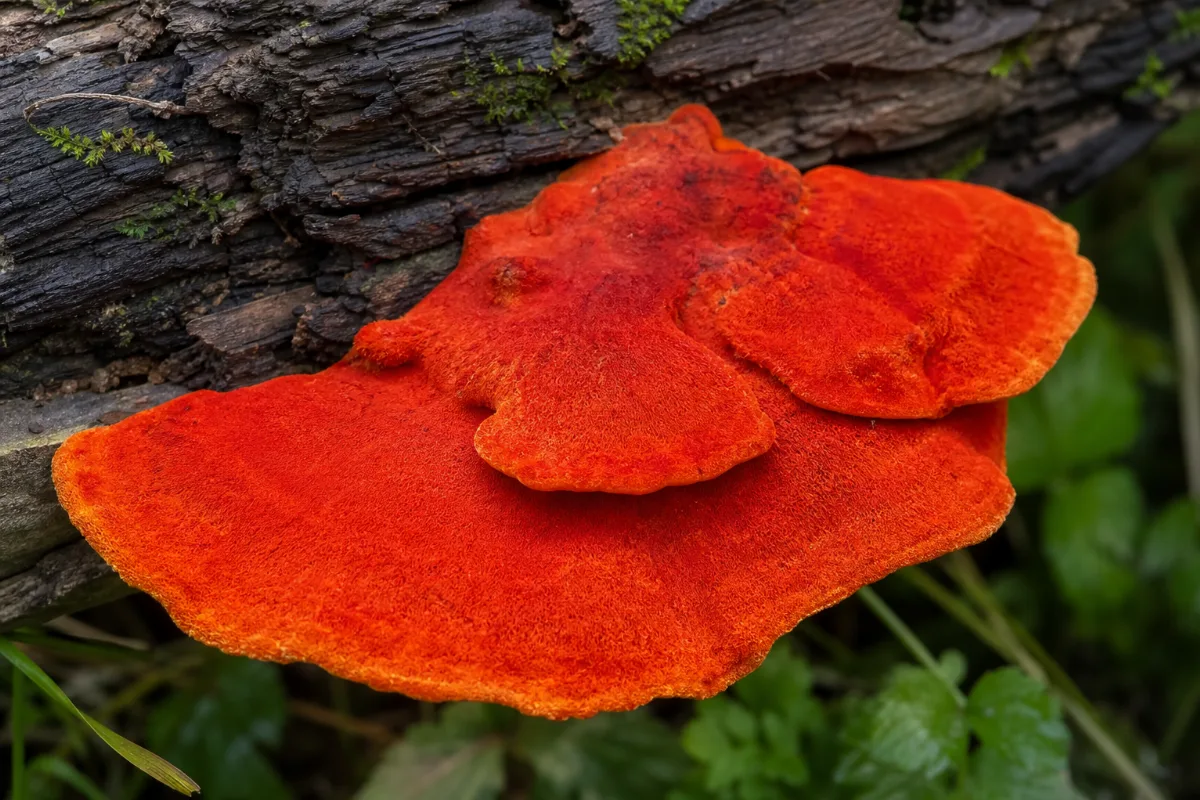
Mushrooms · Wild polypore fungus
Cinnabar polypore
Pycnoporus cinnabarinus (listed in GBIF as Trametes cinnabarina) · also called Cinnabar bracket
The cinnabar polypore is a bright orange-red bracket fungus that rots dead wood. It is better known in laboratories for its wood-digesting enzyme (laccase) and its red pigment than as a remedy. No study in people was found, only test-tube work that includes toxicity to human cells. Do not eat wild brackets because of their colour.
General information, not medical advice. Last substantive update · Not medically reviewed. A named clinician has not signed off on this page. How this page is made
About Cinnabar polypore
The cinnabar polypore is a wood-rotting fungus known for its orange-red colour. Laboratory interest centres on its laccase enzyme and its red pigments. We found no human study, and the few health-type lab studies include toxicity to human cells, so this is not a remedy to look for.
What it is
A bracket fungus is a hard shelf-shaped mushroom that grows on wood. This one is bright orange-red. It breaks down dead wood, which is why scientists study its enzymes.
The name is confusing. Most papers call it Pycnoporus cinnabarinus. The GBIF database lists that as a synonym of Trametes cinnabarina. A close relative, Pycnoporus sanguineus, is often mixed up with it.
What the research is about
Most papers are about enzymes and clean-up work, not health. The genome of one strain was sequenced as a model wood-decaying fungus. The red pigment forms when the enzyme laccase acts on a small molecule, and the amount of pigment changes with the colour of light in lab cultures.
A handful of test-tube studies looked for germ-killing, parasite-killing and cell-killing effects. They show activity in dishes. They do not show a safe or useful effect in people.
How good is the evidence?
Very weak. There are no human trials, no animal trials of a benefit, and the lab studies used different extracts that cannot be compared. A review says the fungus has antibacterial, antioxidant and anti-cancer properties, but those statements rest on other papers that we did not open.
At a glance
Traditional uses history, not proof
- A review reports folk uses (skin sores, ulcers, bleeding, painful periods) for the related red bracket Pycnoporus sanguineus. No traditional use of the cinnabar polypore itself was found in the sources we read.
Studied for research
- Germ-killing activity in lab tests, insufficient evidence (test tubes only)
- Activity against parasite cultures, insufficient evidence (also toxic to human lung cells)
- Killing of human cells in dishes, insufficient evidence (a toxicity signal, not a treatment)
- Immune effects and antioxidant activity, insufficient evidence (genus statements only)
Main compounds
- Cinnabarinic acid and cinnabarin, red pigments
- Phlebiarubrone, a pigment linked to antibacterial activity in one lab screen
- Laccase and other wood-digesting enzymes
Common forms
- Wild bracket on dead hardwood (not a food, cannot be safely identified from a description)
- Laboratory cultures and extracts (research use; not products)
Research links: PubMed: antibacterial lab screen (abstract) · PubMed: parasite and cell toxicity lab study (abstract) · PubMed: fruit fly toxicity study (abstract) · PubMed: review mentioning Pycnoporus (abstract) · Research Library · Genes & Biomarkers Library
What it is and its history
- Accepted scientific name
- Trametes cinnabarina (Jacq.) Fr. in GBIF; most papers still use Pycnoporus cinnabarinus (Jacq.) P.Karst.
- Naming authority
- (Jacq.) Fr. (GBIF accepted name); (Jacq.) P.Karst. for the Pycnoporus name
- Synonyms
- Pycnoporus cinnabarinus (a synonym in GBIF, key 5246466)
- Common names
- Cinnabar polypore (English); Cinnabar bracket (English)
- Family or group
- Polyporaceae
- Classification
- Fungi > Basidiomycota > Agaricomycetes > Polyporales > Polyporaceae > Trametes (GBIF) / Pycnoporus (papers) > Trametes cinnabarina
- Native range
- Not checked in the sources read (the review says it is found in many places in the world).
- Habitat
- Described in the review as a saprophytic white-rot fungus (wood decayer). Papers describe it as a wood-decaying fungus.
- What it looks like
- Fruiting body: A bright orange-red bracket, according to the common name and the pigments cinnabarin and cinnabarinic acid. A detailed description was not read.
- Cultivation
- Grown in pure culture in laboratories for enzyme and pigment work (Schinagl 2023; Levasseur 2014). Not described as a crop.
- Harvest and processing
- Not checked.
- Look-alikes and adulterants
- Name: Pycnoporus sanguineus (blood-red bracket); Note: A close relative that the review treats as a separate species; GBIF places it under a different accepted name. Wild identification of red-orange brackets should be left to experts.
- Sustainability and conservation
- Not checked.
Traditional use and history history, not clinical proof
| Tradition or era | Documented use | Source |
|---|---|---|
| Parts of Africa and South America (related species Pycnoporus sanguineus) | Skin sores, ulcers, bleeding, arthritis, sore throat, fever, gout and tooth trouble; in northern Gabon for painful periods. Reported for P. sanguineus, not shown for the cinnabar polypore. | p41157106 |
Traditional use shows how it was used. It does not show that it works or is safe today.
What is inside, and how it may work
What it contains and how those compounds act in cells and animals. Laboratory and animal mechanisms are not proven effects in people.
Main compounds
| Compound | Family | Where it is concentrated | Activity studied | Level of evidence |
|---|---|---|---|---|
| Cinnabarinic acid | phenoxazine pigment | Culture | Red pigment made when laccase oxidises 3-hydroxyanthranilic acid on glucose medium. 8 | Laboratory research |
| Cinnabarin | phenoxazine pigment | Culture | Orange-red pigment whose amount changes with the colour of light the culture receives (three strains tested). Health activity is not shown in the abstracts. 7 | Laboratory research |
| Phlebiarubrone | fungal pigment | Culture filtrate | Compound linked to antibacterial activity against E. coli in one lab screen. 3 | Laboratory research |
Mechanisms, receptors and pathways
| Target or pathway | Gene or receptor | What was found | Level |
|---|---|---|---|
| Laccase-driven pigment formation | Laccase (enzyme); cellobiose dehydrogenases | Laccase oxidises 3-hydroxyanthranilic acid to cinnabarinic acid; cellobiose dehydrogenases can block this in test tubes. 8 | Laboratory research |
| Wood breakdown (lignin and cellulose) | Ligninolytic peroxidases and other enzymes | The genome carries the usual white-rot toolkit including three types of ligninolytic peroxidase. 4 | Laboratory research |
Absorption, metabolism and elimination
- Absorption
- Nothing found in the sources read.
- Distribution
- Nothing found in the sources read.
- Metabolism
- Nothing found in the sources read.
- Elimination
- Nothing found in the sources read.
- Bioavailability
- Not established; never studied in people.
Isolated compounds versus whole extracts
Not studied. The lab tests used different extracts (ethanol extract, culture-filtrate extract, an extract of unstated type), so results cannot be pooled or compared.
Nutritional composition
No nutrient table was found. A review says the fungus is high in vitamins, minerals and protein and used in food, but cites nothing for it. We do not treat this as established, and none of the sources read describes it as an edible mushroom.
1 very low certainty6 not enough evidence
What was looked at
The 7 benefits and uses checked for Cinnabar polypore, each with how strong the evidence is. Tap one to open it.
- Germ-killing activity in lab tests (bacteria)Not enough evidence
- Activity against parasite cultures (lab)Not enough evidence
- Killing of cells in dishes (cancer-style testing)Not enough evidence
- Immune system effectsNot enough evidence
- Antioxidant activityNot enough evidence
- Traditional wound, bleeding and pain use (related species)Not enough evidence
- Toxicity to insects (not a health use)Very low certainty
What is Cinnabar polypore good for?
None of these uses has been tested in people. Every row is test-tube or animal work, so the honest rating is not enough evidence, and several results are signs of toxicity.
Benefits, one by one
Each card is a research question, not a promise. Tap a goal to filter. Open a card to see the studies, doses and limits.
Germ-killing activity in lab tests (bacteria)
Not enough evidenceIn test tubes, an extract made from a liquid culture of this fungus slowed the growth of one lab strain of E. coli. A review also lists antibacterial findings for the species, taken from papers it cites. Nobody has tested it in animals or people, so it is not known to treat any infection.
2 studiesLiquid-culture extracts, not mushrooms and not products.
Studies, doses and limits
What the trials found
No study in people was found for this fungus.
Results
Ethyl-acetate extract of a culture filtrate: IC50 0.10 mg/mL against bioluminescent E. coli K-12. A review lists antibacterial activity against several bacteria, citing other papers.
Effect sizes as reported
Lab result only
Why this rating
Only test-tube work; no animal or human data; the review claims were not traced to the original papers.
Form and dose studied
Liquid-culture extracts, not mushrooms and not products.
Who was studied
No people. One lab strain of E. coli.
Limits
One screening-method paper, one bacterial test strain, no check against normal cells for this extract.
Why researchers looked
Fungi that fight other microbes in the wild are often screened for new antibiotic leads.
Traditional use
The sources we read give no traditional use of this species for infection. A review reports wound and bleeding use only for the related red bracket Pycnoporus sanguineus.
Proposed mechanism Laboratory research
A red pigment, phlebiarubrone, was linked to the activity in one lab screen. Other pigments (cinnabarin, cinnabarinic acid) are named in a review but their activity was not shown in the papers we read.
A proposed mechanism does not show that the effect happens in people.
Unknown. The same species was toxic to normal human cells in other lab tests (see the Safety tab).
Activity against parasite cultures (lab)
Not enough evidenceIn one test-tube study an extract of this fungus acted on the parasites behind sleeping sickness, Chagas disease, leishmaniasis and malaria at small concentrations. The same extract was also toxic to normal human lung cells, so this is not a treatment lead on its own.
1 studiesAn extract (type not stated in the abstract) from wild-collected fung…
Studies, doses and limits
What the trials found
No study in people was found for this fungus.
Results
Concentrations in ug/mL: 1.32 against Trypanosoma brucei, 1.46 against Plasmodium falciparum, 3.93 against Trypanosoma cruzi, 21.53 against Leishmania infantum. Toxic to human lung fibroblast cells (MRC-5) at 13.05 ug/mL.
Effect sizes as reported
Active in dishes, not selective for the parasite in every case
Why this rating
One lab study; the abstract says this fungus was a comparison species, not the main subject.
Form and dose studied
An extract (type not stated in the abstract) from wild-collected fungi.
Who was studied
Cultured parasites and human lung cells.
Limits
One sample set, no animals, no people. Against L. infantum the concentration toxic to the human cells was lower than the concentration needed against the parasite.
Why researchers looked
Researchers screen many fungi for compounds that kill parasites.
Proposed mechanism Laboratory research
Not shown. The paper does not say which compound is responsible.
A proposed mechanism does not show that the effect happens in people.
Toxic to normal human lung cells in this test.
Killing of cells in dishes (cancer-style testing)
Not enough evidenceExtracts of this fungus killed human cells in laboratory tests, including colon cell lines and lung cells. This is a measure of toxicity in a dish. It does not show that the fungus fights cancer in people, and one of the tests used normal lung cells.
2 studiesEthanol extract; another extract of unstated type.
Studies, doses and limits
What the trials found
No study in people was found for this fungus.
Results
Ethanol extract: IC50 81 ug/mL (Caco-2) and 31 ug/mL (HT-29) colon cell lines. Another extract: toxic to normal human lung cells (MRC-5) at 13.05 ug/mL.
Effect sizes as reported
Toxic to several human cell lines in dishes
Why this rating
Two lab studies; killing normal cells as well as other cells is not a selective anti-cancer effect.
Form and dose studied
Ethanol extract; another extract of unstated type.
Who was studied
Human colon cell lines and a normal lung cell line.
Limits
Test tube only. A review lists anticancer properties for the genus Pycnoporus without a study on this species that we could read.
Why researchers looked
Cell-killing tests are a common first step when looking for anti-cancer compounds.
Proposed mechanism Laboratory research
Not shown in the papers we read.
A proposed mechanism does not show that the effect happens in people.
Toxicity to human cells in dishes is a warning sign, not a benefit.
Immune system effects
Not enough evidenceA review lists immune-modulating properties for the Pycnoporus group, but we found no test that showed this for the cinnabar polypore. In one test-tube study of 27 polypores, the five strongest immune-cell boosters were other species.
2 studiesEthanol extract in the lab study.
Studies, doses and limits
What the trials found
No study in people was found for this fungus.
Results
No result for this species. In the 27-species study, the abstract names P. cinnabarinus only for toxicity to colon cell lines.
Effect sizes as reported
No effect shown
Why this rating
Only a genus-level statement in a review and a screening study that did not report a gain for this species.
Form and dose studied
Ethanol extract in the lab study.
Who was studied
Human neutrophils in dishes (lab study).
Limits
Review claim is not tied to a study we could read.
Why researchers looked
Many bracket fungi are screened for effects on immune cells.
Proposed mechanism Laboratory research
Not shown for this species.
A proposed mechanism does not show that the effect happens in people.
Not applicable.
Antioxidant activity
Not enough evidenceA review lists antioxidant activity for Pycnoporus pigments. We found no measured value for the cinnabar polypore itself.
1 studiesNone.
Studies, doses and limits
What the trials found
No study in people was found for this fungus.
Results
No measured result for this species in the abstracts or sections read.
Effect sizes as reported
Not measured
Why this rating
Genus-level statement only.
Limits
Lab antioxidant tests do not show a health benefit in people even when they work.
Why researchers looked
Antioxidant tests are cheap and common in fungus research.
Proposed mechanism Laboratory research
Not shown for this species.
A proposed mechanism does not show that the effect happens in people.
Not applicable.
Traditional wound, bleeding and pain use (related species)
Not enough evidenceA review says the related red bracket Pycnoporus sanguineus is used in parts of Africa and South America for skin sores, ulcers and bleeding, and in Gabon for painful periods. The sources do not say the cinnabar polypore is used this way. No trial supports any of these uses.
1 studiesNone described.
Studies, doses and limits
What the trials found
No study in people was found for this fungus.
Results
No trial. Folk use only, and for a different species.
Why this rating
Traditional use of a related species is not evidence for this one.
Limits
The review gives the folk uses without testing them.
Why researchers looked
Folk use is the usual reason red brackets are mentioned in natural-health writing.
Traditional use
Reported for P. sanguineus, a related species that is often confused with this one. Not shown for P. cinnabarinus.
Proposed mechanism Traditional use
None.
A proposed mechanism does not show that the effect happens in people.
Unknown.
Toxicity to insects (not a health use)
Very low certaintyIn fruit flies, a diet with this fungus added shortened life and lowered fertility. The authors suggest it could become a natural fly-killer. This is not a benefit for people. It is listed here because it is the only animal-type study we found, and it points to toxicity.
1 studiesFungus added to fly food (form not stated).
Studies, doses and limits
What the trials found
No study in people was found for this fungus.
Results
All five fungi tested, including this one, were lethal to the flies; females were more sensitive than males.
Effect sizes as reported
Shortened life and lower fertility in flies
Why this rating
Reported in one animal-type study; the abstract does not give how much was fed or the form.
Form and dose studied
Fungus added to fly food (form not stated).
Who was studied
Fruit flies.
Limits
Insects are not people. Whether any effect happens in mammals is not known.
Why researchers looked
Researchers looked for natural pesticides.
Proposed mechanism Animal research
Lower antioxidant enzyme activity and more peroxidation products in the flies.
A proposed mechanism does not show that the effect happens in people.
Counts as a toxicity signal, see the Safety tab.
Connections to the rest of health
How Cinnabar polypore connects to the rest of our health knowledge graph. Every link says what kind of connection it is. A safety link (for example to the liver) is a warning, not a benefit. A study that merely mentions a topic never creates a benefit link.
Explore every connection: goals, body systems, organs, symptoms, genes
B. Body systems
| Connected to | Kind of connection | Evidence status | Context | Studies |
|---|---|---|---|---|
| Immune system | Biological association | Not enough evidence | A review lists immune-modulating properties for Pycnoporus; none shown for this species. Immune-modulating properties are listed for Pycnoporus in a review; none shown for this species. Preparation or compound: Review statement about the genus |
6 1 |
J. Genes, receptors and enzymes
L. Active compounds
| Connected to | Kind of connection | Evidence status | Context | Studies |
|---|---|---|---|---|
| Cinnabarinic acid | Biological association | In vitro | Red pigment made when laccase oxidises 3-hydroxyanthranilic acid on glucose medium. Preparation or compound: Culture |
8 |
| Cinnabarin | Biological association | In vitro | Orange-red pigment whose amount changes with the colour of light the culture receives (three strains tested). Health activity is not shown in the abstracts. Preparation or compound: Culture |
7 |
| Phlebiarubrone | Biological association | In vitro | Compound linked to antibacterial activity against E. coli in one lab screen. Preparation or compound: Culture filtrate |
3 |
Each connection is stored with the ingredient, the connected record, the kind of connection, the evidence status, the supporting studies, the preparation or compound involved, and a review date (last reviewed October 25, 2026).
Evidence at a glance: what the research found for 7 outcomes
Each outcome below is one thing researchers measured. Certainty is how far the evidence can be trusted, not how well it works. The full studies are on the next tab.
The evidence
The research centre for Cinnabar polypore. Every record here was checked against PubMed or the publisher's page; we never list a study we have not verified.
Evidence by outcome
Bars show how many studies we found for each outcome, not how well it works. People are added up across trials only (reviews are not added, to avoid double counting).
How we rate evidence
High certainty
Several well-run trials or reviews agree; further research is unlikely to change the picture much.
Moderate certainty
Good trials point the same way, but some doubt remains.
Low certainty
Small, short or inconsistent trials. The finding could change with better research.
Very low certainty
Very little or very weak human data. Treat as a possibility only.
Mixed findings
Trials or reviews disagree with each other.
Not enough evidence
Not enough human research to say either way.
Evidence against
Good research found no benefit, or found harm.
We take the reviewers' own risk-of-bias and GRADE statements where they exist, and otherwise judge from study size, design, consistency, directness and whether a product matches what is sold. Many publications do not make evidence high. Method note: We read PubMed records and abstracts for eight papers (one review, five laboratory studies, one fruit fly study and one genome paper), read the Pycnoporus section of the review in full, and checked the species name in the GBIF database. No regulator pages were searched in depth. Only abstracts were read for most papers, so numbers come from abstracts. Certainty ratings are the compiler's own reading.
Study library: every study we checked 9
| Study | Design | People | Product, dose, length | Result |
|---|---|---|---|---|
| Doskocil 2016 In vitro immunomodulatory activity, cytotoxicity and chemistry of some central European polypores. Pharmaceutical Biology · PMID 26984176 · DOI |
Laboratory research in-vitro |
Isolated human neutrophils and two colon cell lines (Caco-2, HT-29); ethanol extracts of 27 polypore species. | Pycnoporus cinnabarinus ethanol extract Not given in the abstract Not given in the abstract |
Seventeen of the 27 extracts raised phagocytosis or respiratory burst; the five strongest were other species (Aurantiporus fissilis, Trametes gibbosa, Piptoporus betulinus, Neolentinus lepideus, Polyporus squamosus). The abstract names P. cinnabarinus only for toxicity: its extract was cytotoxic to both cell lines, with IC50 values of 81 ug/mL (Caco-2) and 31 ug/mL (HT-29). Toxic to both colon cell lines in a dish; no immune-boosting result is reported for this species in the abstract Methods, limits and fundingOutcomes: Effect on neutrophil phagocytosis (27 species) and cytotoxicity on colon cell lines Limitations: Test tube study. Whether P. cinnabarinus changed phagocytosis is not stated in the abstract. Funding and conflicts: Funding not stated in the abstract Read: abstract |
| Judžentienė 2025 Comparative Research of Antioxidant, Antimicrobial, Antiprotozoal and Cytotoxic Activities of Edible Suillus sp. Fruiting Body Extracts. Foods · PMID 40238251 · DOI |
Laboratory research in-vitro |
Laboratory tests on parasite cultures and human lung fibroblast cells (MRC-5 SV2). Pycnoporus cinnabarinus was a comparison fungus. | Pycnoporus cinnabarinus extract (type of extract not stated in the abstract) Fungus collected in Lithuania (per the abstract: common Lithuanian fungi) Not given in the abstract Not given in the abstract |
The P. cinnabarinus extract had the highest and broadest effect of the comparison fungi: 1.32 ug/mL against T. brucei, 1.46 against P. falciparum, 3.93 against T. cruzi and 21.53 against L. infantum. It also showed strong cytotoxicity on MRC-5 cells at 13.05 ug/mL, which is a lower concentration than the one needed against L. infantum. Active against parasite cultures and toxic to normal human lung cells in a dish Methods, limits and fundingOutcomes: Concentration needed to act on Trypanosoma brucei, Plasmodium falciparum, Trypanosoma cruzi and Leishmania infantum, and concentration toxic to MRC-5 cells Limitations: Test tube study. One sample set of one extract, compared against the Suillus species the paper is mainly about. Not tested in animals or people. Funding and conflicts: Funding not stated in the abstract Read: abstract |
| Järvinen 2016 Cell-based bioreporter assay coupled to HPLC micro-fractionation in the evaluation of antimicrobial properties of the basidiomycete fungus Pycnoporus cinnabarinus. Pharmaceutical Biology · PMID 26808592 · DOI |
Laboratory research in-vitro |
Bioluminescent Escherichia coli K-12 test strain; 116 fungal culture-filtrate extracts screened. | Ethyl-acetate extract of a Pycnoporus cinnabarinus culture filtrate (liquid culture, not a mushroom) Culture filtrate Not given in the abstract Not given in the abstract |
Six of the 116 extracts showed possible antimicrobial activity. The P. cinnabarinus extract had an IC50 of 0.10 mg/mL in the bioreporter assay. The activity was linked to one compound, isolated and identified as the fungal pigment phlebiarubrone. Growth-reducing effect on one lab strain of E. coli Methods, limits and fundingOutcomes: Antimicrobial activity against E. coli Limitations: The main aim was to test a screening method. One bacterial test strain. Test tube only. Funding and conflicts: Funding not stated in the abstract Read: abstract |
| Levasseur 2014 The genome of the white-rot fungus Pycnoporus cinnabarinus: a basidiomycete model with a versatile arsenal for lignocellulosic biomass breakdown. BMC Genomics · PMID 24942338 · DOI |
Laboratory research in-vitro |
Genome sequencing and growth tests of one strain. | Pycnoporus cinnabarinus (fungus genome) Culture Not given in the abstract Not given in the abstract |
The genome is 33.6 megabases with 10,442 predicted genes. The fungus has the usual set of enzymes of white-rot wood decayers, including three types of ligninolytic peroxidases, and is described as a model fungus for studying how plant cell walls are broken down. Describes a wood-rotting fungus; no health outcome Methods, limits and fundingOutcomes: Genome and wood-breakdown enzymes Limitations: Biotechnology paper. Nothing here is about human health. Funding and conflicts: Non-US government research support per the record Read: abstract |
| Li 2023 Comparison of toxic effects of 5 macrofungi against Drosophila melanogaster. Journal of Insect Science · PMID 37352434 · DOI |
Animal research animal |
Fruit flies (Drosophila melanogaster) fed diets supplemented with five macrofungi. | Pycnoporus cinnabarinus added to the fly diet (form not stated in the abstract) Not given in the abstract Not given in the abstract |
All five fungi, including P. cinnabarinus, had lethal effects on the flies. The fungus-supplemented diets lowered antioxidant enzyme activity, raised peroxidation products, reduced lifespan and fertility, and females were more sensitive than males. Amanita pantherina was the most toxic. The authors suggest P. cinnabarinus could be developed into a biopesticide for fly killing. Shortened life and lower fertility in flies on a fungus-supplemented diet Methods, limits and fundingOutcomes: Lifespan, fecundity, offspring growth, antioxidant enzymes, gene activity Limitations: Insects, not mammals. The abstract does not say how much fungus or in what form. It cannot be translated to people. Funding and conflicts: Funding not stated in the abstract Read: abstract |
| Pigoń-Zając 2025 Modern Pro-Health Applications of Medicinal Mushrooms: Insights into the Polyporaceae Family, with a Focus on Cerrena unicolor. Molecules · PMID 41157106 · DOI |
Review review |
No people studied. Narrative review of the Polyporaceae family. | Pycnoporus cinnabarinus (mentioned in a short section) Not given in the abstract Not given in the abstract |
The abstract is about Cerrena unicolor. Its section on the genus Pycnoporus says pigments of Pycnoporus (cinnabarin, cinnabarinic acid, tramesanguin) have reported antioxidant, antifungal, immune-modulating, anticancer, larvicidal, antiviral, antibacterial and anti-inflammatory properties. For P. cinnabarinus it cites antibacterial and larvicidal findings from other papers. The same section says P. cinnabarinus is "used in food and medicine" and "high in vitamins, minerals and protein", with no supporting source. No measured numbers for this species. Methods, limits and fundingOutcomes: Reported properties of Pycnoporus species Limitations: Narrative review; the Pycnoporus claims are summaries of other work that we did not open. The food and nutrient statements have no cited source. Funding and conflicts: Review article; funding not read Read: abstract and the Pycnoporus section of the full text |
| Schinagl 2023 Growth, morphology, and formation of cinnabarin in Pycnoporus cinnabarinus in relation to different irradiation spectra. Photochemical and Photobiological Sciences · PMID 37897564 · DOI |
Laboratory research in-vitro |
Three Pycnoporus cinnabarinus strains grown in pure culture under red, green, blue and UV-A light. | Pycnoporus cinnabarinus mycelium cultures Culture Not given in the abstract Not given in the abstract |
Light of different colours changed growth and colony appearance in all three strains. The amount of cinnabarin depended on the wavelength, with each strain having its own threshold; light below that threshold gave less pigment. The pigment sat as plaques on the outside of the hyphal walls. Pigment amount changes with light colour in lab cultures Methods, limits and fundingOutcomes: Growth, colony shape and cinnabarin pigment content Limitations: About making natural pigments, not health. The abstract does not give the size of the change. Funding and conflicts: Funding not stated in the abstract Read: abstract |
| Temp 1999 Novel interaction between laccase and cellobiose dehydrogenase during pigment synthesis in the white rot fungus Pycnoporus cinnabarinus. Applied and Environmental Microbiology · PMID 9925558 · DOI |
Laboratory research in-vitro |
Fungal cultures and purified enzymes. | Pycnoporus cinnabarinus cultures Culture Not given in the abstract Not given in the abstract |
On glucose the fungus makes the red pigment cinnabarinic acid, formed when the enzyme laccase oxidises 3-hydroxyanthranilic acid. On cellobiose or cellulose less or none was made, because cellobiose dehydrogenases stopped the reaction in test-tube experiments. Explains how the red colour is made Methods, limits and fundingOutcomes: Formation of the red pigment cinnabarinic acid Limitations: Basic enzyme chemistry; no health outcome. Funding and conflicts: Funding not stated in the abstract Read: abstract |
| n/a 2026 GBIF Backbone Taxonomy: name match for Pycnoporus cinnabarinus GBIF species API (read 2026-10-25) · Source |
Registry or database Independent public database |
n/a | n/a |
Accepted name of the species GBIF lists Pycnoporus cinnabarinus (Jacq.) P.Karst. as a synonym of Trametes cinnabarina (Jacq.) Fr. (accepted, key 9227816). It lists Pycnoporus sanguineus (L.) Murrill as a synonym of a different accepted name (key 2546050). Methods, limits and fundingOutcomes: n/a Funding and conflicts: One database; other databases (for example Index Fungorum) were not checked. Read: n/a |
What we do not know yet
- No human study of this fungus was found.
- No animal study of any benefit was found.
- No safety, allergy, liver or interaction data exist.
- Review statements on antibacterial, antioxidant and anti-cancer properties were not traced to original papers.
- The current accepted name differs between databases; only GBIF was checked.
How new research is added
New studies are found by a saved PubMed search and placed in a review queue. A person reads each one before it changes any evidence rating or safety wording. New publications never change ratings automatically.
Lab markers
What changed in blood or saliva tests during trials. A changed number is not the same as feeling or being healthier, and we give no "normal ranges".
Safety
What studies and official sources say about side effects, medicines and who should check first. Each point shows what kind of evidence it comes from.
Main points to know 3
- Wild bracket fungi cannot be safely identified from a description or an app. The cinnabar polypore is bright orange-red, but that colour alone does not identify it, and a closely related red bracket (Pycnoporus sanguineus) is often confused with it. None of the sources we read describe this fungus as a food. Do not eat a wild bracket because of its colour. If someone has eaten an unknown fungus, treat it as an emergency and call poison control or emergency services. Authoritative guidance 6 9
- No safety data for people exist. We found no toxicity study, interaction study, allergy report or case report of poisoning for this fungus. Not knowing is not the same as safe. Gap 6
- Lab extracts were toxic to human cells and to flies. An extract was toxic to normal human lung cells in a dish (13.05 ug/mL), and extracts were toxic to two human colon cell lines (IC50 81 and 31 ug/mL). A diet with the fungus shortened the life of fruit flies. These are not tests in people, but they are warning signs, not reassurance. Laboratory research 2 1 5
Side effects 3
| Effect | How often | Severity and recovery | Evidence |
|---|---|---|---|
| Cell toxicity in laboratory tests Normal human lung fibroblast cells and two colon cell lines were killed by extracts. | Not established | unknown Not applicable (dishes of cells) | Laboratory research 2 1 |
| Shortened life and lower fertility in fruit flies Insects; the abstract gives no amounts. | Not established | unknown Not described | Animal research 5 |
| Side effects in people No human use or study was found, so no side effects have been recorded. | Not established | unknown Unknown | Gap |
Liver
We found no report of liver injury for this fungus, and no one has looked. This is a gap in knowledge, not a sign of safety.
This is a safety connection. It is not evidence that Cinnabar polypore supports liver health.
Medicines and supplements 2
| With | Why it matters | Importance | Evidence | What to do |
|---|---|---|---|---|
| Prescription medicines, blood thinners, immune medicines, supplements prescription | Unknown. No interaction study of this fungus was found. | Unknown | Gap Not enough evidence | Because nothing is known, do not take it with medicines. Ask a doctor or pharmacist. |
| Alcohol and food other | Not studied. | Unknown | Gap Not enough evidence | No information. |
Who should check first 2
| Situation | Advice | Evidence |
|---|---|---|
| Pregnancy, breastfeeding and children | No information was found for any of these groups. Ask a doctor or pharmacist; avoiding it is the sensible choice when nothing is known. | Gap |
| Allergy or asthma, especially to moulds and fungi | No allergy report for this fungus was found. Mushroom spores and moulds can set off allergy in some people, but we found no source for this species, so it is not claimed here. | Gap |
Overdose, product quality and regulators
Summary. No toxicity assessment for people. The only toxicity findings are from cell tests and a fruit fly diet study.
Animal. Fruit flies fed a diet with this fungus died earlier and had fewer offspring; females were more sensitive than males (Li 2023, abstract). No mammal study was found.
High dose or long term signals. Not studied.
Overdose response. Not described. For any suspected poisoning, call poison control or emergency services.
Genotoxicity. Not found.
Wood-growing fungi can take up what is in the wood and soil around them, and wild fungi are not tested. No contamination data for this species were found.
Heavy metals and pesticides. No measurement for this species was found in the sources read.
Mistaken identity. This red bracket is often confused with its relative Pycnoporus sanguineus (per the review) and its accepted name differs between databases. A product sold under either name may not be what the label says. 6 9
| Body | Action | Date |
|---|
When to get medical help
- If anyone has eaten a wild mushroom they cannot name for certain, call poison control or emergency services at once, even if they feel well. Keep a sample or a clear photo for the doctors.
- Vomiting, stomach pain, diarrhoea, confusion, yellow skin or dark urine after eating a fungus need urgent medical care.
- Swelling of the lips or face, trouble breathing or wheeze after contact with a fungus need emergency care.
If someone may be poisoned or in a crisis, contact a clinician or emergency service straight away. In the US, Poison Control is 1-800-222-1222.
General information only, not medical advice. Ask a clinician or pharmacist before use, especially with medicines, in pregnancy or with a health condition. See the Natural Remedy Safety guide.
Frequently asked questions
What is the cinnabar polypore?
What is its scientific name?
Most papers call it Pycnoporus cinnabarinus. GBIF lists that as a synonym of Trametes cinnabarina. We did not check other databases.
Is the cinnabar polypore a medicinal mushroom?
Not in any proven sense. We found no human study. A review lists medicinal properties for the genus, mostly from lab work on other papers.
Is the cinnabar polypore edible?
None of the sources we read describe it as a food. One review says it is used in food and medicine but gives no source for it. Do not eat a wild bracket because of its colour.
Is the cinnabar polypore safe?
Does it fight infections?
In test tubes an extract slowed one lab strain of E. coli. Nobody has tested it against an infection in animals or people, so it should not be used for that.
Does it fight cancer?
What gives it its red colour?
How can I tell it from its look-alikes?
Is it safe in pregnancy, breastfeeding or for children?
No information was found for any of these groups. Ask a doctor or pharmacist.
Does it interact with medicines?
No interaction study was found, so nothing is known either way. Ask a doctor or pharmacist before taking any fungus product with medicines.
What should I do if someone eats a wild mushroom?
Call poison control or emergency services right away, even if they feel fine. Keep a sample or a clear photo.
Explore by health goal
Editorial transparency
- Written by
- AlternativeMed editorial team. Research compiled with AI assistance, then checked against PubMed records.
- Medical review
- None. This page has not been reviewed by a physician or pharmacist.
- First published
- 2026-10-25
- Last substantive update
- 2026-10-25
- How we research
- We read PubMed records and abstracts for eight papers (one review, five laboratory studies, one fruit fly study and one genome paper), read the Pycnoporus section of the review in full, and checked the species name in the GBIF database. No regulator pages were searched in depth. Only abstracts were read for most papers, so numbers come from abstracts. Certainty ratings are the compiler's own reading.
- How we rate evidence
- See "How we rate evidence" in the Evidence tab.
- Independence
- No product is promoted on this page. No affiliate links are shown. This page is information, not a recommendation to use or eat this fungus.
Sources 9
Each source was opened and checked. Where we read only the abstract, it says so. The small numbers in the text point here.
- Doskocil I, Havlik J, Verlotta R, et al. In vitro immunomodulatory activity, cytotoxicity and chemistry of some central European polypores.. Pharmaceutical Biology. 2016. PMID 26984176. DOI 10.3109/13880209.2016.1156708. (abstract)
- Judžentienė A, Šarlauskas J. Comparative Research of Antioxidant, Antimicrobial, Antiprotozoal and Cytotoxic Activities of Edible Suillus sp. Fruiting Body Extracts.. Foods. 2025. PMID 40238251. DOI 10.3390/foods14071130. (abstract)
- Järvinen P, Nybond S, Marcourt L, et al. Cell-based bioreporter assay coupled to HPLC micro-fractionation in the evaluation of antimicrobial properties of the basidiomycete fungus Pycnoporus cinnabarinus.. Pharmaceutical Biology. 2016. PMID 26808592. DOI 10.3109/13880209.2015.1103754. (abstract)
- Levasseur A, Lomascolo A, Chabrol O, et al. The genome of the white-rot fungus Pycnoporus cinnabarinus: a basidiomycete model with a versatile arsenal for lignocellulosic biomass breakdown.. BMC Genomics. 2014. PMID 24942338. DOI 10.1186/1471-2164-15-486. (abstract)
- Li J, Huang Y, Wang D, et al. Comparison of toxic effects of 5 macrofungi against Drosophila melanogaster.. Journal of Insect Science. 2023. PMID 37352434. DOI 10.1093/jisesa/iead042. (abstract)
- Pigoń-Zając D, Małecka-Massalska T, Łapiński J. Modern Pro-Health Applications of Medicinal Mushrooms: Insights into the Polyporaceae Family, with a Focus on Cerrena unicolor.. Molecules. 2025. PMID 41157106. DOI 10.3390/molecules30204089. (abstract and the Pycnoporus section of the full text)
- Schinagl CW, Siewert B, Hammerle F, et al. Growth, morphology, and formation of cinnabarin in Pycnoporus cinnabarinus in relation to different irradiation spectra.. Photochemical and Photobiological Sciences. 2023. PMID 37897564. DOI 10.1007/s43630-023-00493-3. (abstract)
- Temp U, Eggert C. Novel interaction between laccase and cellobiose dehydrogenase during pigment synthesis in the white rot fungus Pycnoporus cinnabarinus.. Applied and Environmental Microbiology. 1999. PMID 9925558. DOI 10.1128/aem.65.2.389-395.1999. (abstract)
- n/a. GBIF Backbone Taxonomy: name match for Pycnoporus cinnabarinus. GBIF species API (read 2026-10-25). 2026. (n/a)


