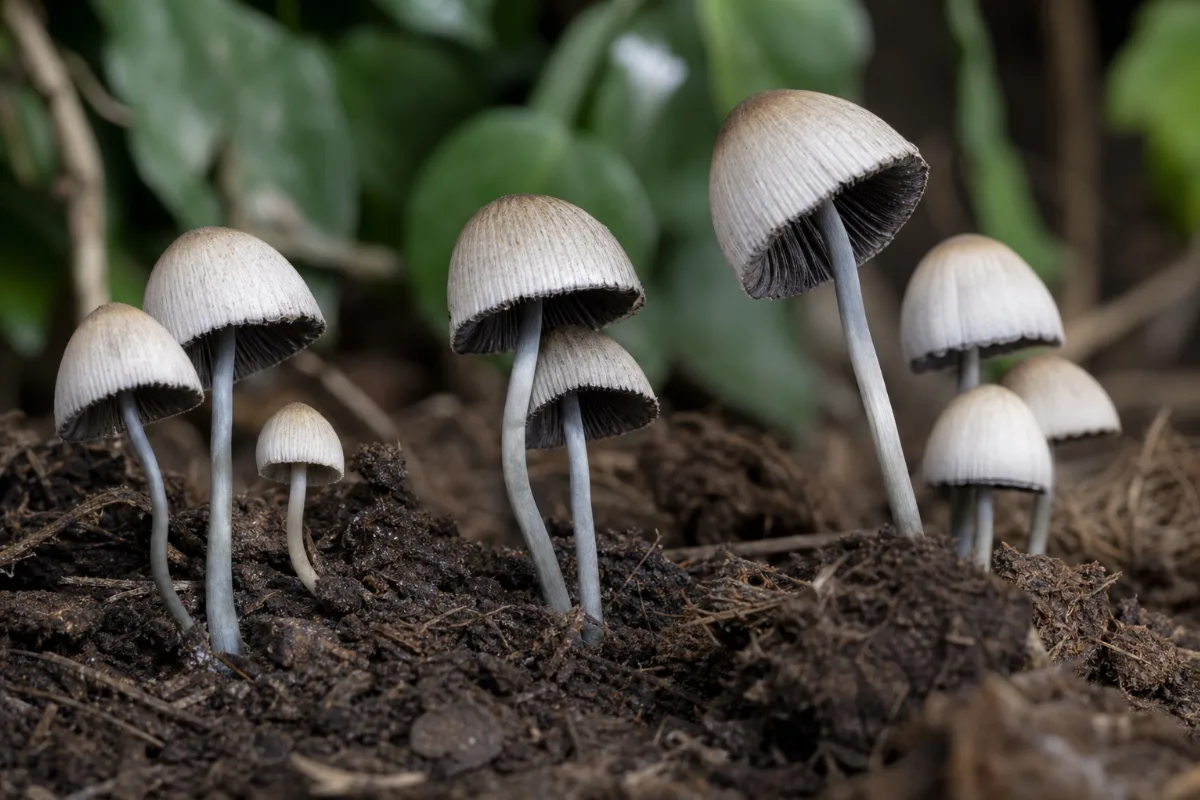
Psychedelic Therapy · Fungus
Panaeolus cyanescens
Panaeolus cyanescens Sacc. · also called Copelandia cyanescens (older genus name); "blue meanies" (a nickname that is not a reliable name)
Panaeolus cyanescens is a dung-living mushroom that contains psilocybin and psilocin, drugs that change perception and mood. It has been tested only in laboratories, never in people, and some lab papers report high psilocin content. It is illegal in many places, and wild mushrooms can look like deadly ones. A name, a nickname or a photo never makes a mushroom safe.
General information, not medical advice. Last substantive update · Not medically reviewed. A named clinician has not signed off on this page. How this page is made
About Panaeolus cyanescens
Panaeolus cyanescens is a dung-living mushroom whose main compounds are psilocybin and psilocin. Depression, cancer distress, alcohol and smoking research uses purified psilocybin, not this fungus. Lab papers report high psilocin in some samples, but content varies widely. Poisoning reports, look-alikes and legal status are the practical concerns.
What it is and its names
Panaeolus cyanescens Sacc. is the accepted species name in the GBIF database. Copelandia cyanescens is an older name for the same fungus, so papers using either name describe one species. Other synonyms include Agaricus cyanescens and Panaeolus bubalorum.
Classification keeps moving. GBIF files the species under the family Bolbitiaceae. A 2026 genome-based study argues Panaeolus belongs in its own family, Galeropsidaceae, and that the old Copelandia group is roughly the same as Panaeolus subgenus Bresadolomyces.
Panaeolus is a mixed genus. In a 2026 test of 14 Chinese species, only two were confirmed to make psilocybin, and a 1993 study found one Panaeolus species with tryptamines but no psilocybin or psilocin.
The nickname "blue meanies"
"Blue meanies" is a slang or trade name, not a scientific name. It is sometimes linked to this species. In a 2025 DNA study of 42 cultivated strains, a strain sold as "Blue Meanies" matched Psilocybe cubensis, while strains sold under another Panaeolus name matched P. cyanescens.
Treat nicknames as marketing. They do not tell you the species, the strength or the risk.
A dung-living fungus
Panaeolus in the wide sense is commonly found on dung, in pasture and grassland, and its dung-living habit has evolved within the group. A 1992 paper reports Copelandia dung fungi in decomposed buffalo and cattle manure in Thailand, and a 1993 paper lists this species among psychoactive fungi in the Hawaiian Islands, some eaten there for recreation.
GBIF has about 1,700 records, mostly from the Americas, Australia and Asia. Records show where it was seen, not where it is native. This page does not tell anyone how to find, grow or identify any mushroom.
What the lab papers measured
Several forensic and chemistry papers measured psilocin and psilocybin in samples of this species. A 2000 German study of confiscated mushrooms found P. cyanescens had the highest levels of the types it sampled. A 2010 German method paper found up to about 3% psilocin by dry weight in dried products. A 2003 Japanese study found Copelandia richer in psilocin than psilocybin, the reverse of Psilocybe cubensis. A 2025 strain study found the highest psilocin in a P. cyanescens strain among the three it compared.
These are single studies of specific samples with different methods. They cannot be turned into a ranking or a rule about any mushroom, and the safety point is that composition cannot be known.
Poisoning reports
No case series confirmed as P. cyanescens poisoning was found in PubMed with an abstract. A 1966 paper title describes a group poisoning in France caused by a Copelandia (details not available). A 1988 inquiry into a 1972 Hawaii death concludes a heroin overdose was the likely cause, not the mushrooms.
For a related species, P. subbalteatus, two Chinese poisonings after eating a large amount of wild mushroom caused nausea, vomiting, numbness, dizziness or an abnormal sense of direction within about half an hour. US poison-centre data on psilocybin mushrooms in general show mostly mild to moderate effects, with rare serious ones such as seizures, coma and cardiac arrest.
What the clinical trials show
Trials used purified psilocybin with therapy in clinics. Several were positive for depression, but a large 2026 German trial missed its main target and a trial against an antidepressant showed no significant difference on its main measure. One small cancer-distress trial and one trial each for alcohol and smoking were positive, with blinding concerns.
A 2026 review found blinding failure above 90% in many psilocybin trials, so expectation may inflate the results.
Cell-dish work on this species
Extracts of P. cyanescens and Psilocybe cubensis did not worsen, and partly protected against, injury in rat heart cells in a dish. A second study found that extracts of four psilocybin mushrooms lowered some inflammation signals in human cells. A 2026 review calls these findings promising but preclinical and notes that toxicity concerns remain at higher concentrations.
Cells in a dish are not people, and this is not evidence of benefit or of heart safety.
Legal status
Laws differ by country and change. In the United States, the federal Schedule I list names psilocybin and psilocyn and covers material containing any quantity of them, unless excepted. A Japanese paper says this species was among those prohibited there from 2002, and a Dutch review says possession and use became illegal there in December 2008. We only verified the US rule with the regulator. This is not legal advice.
At a glance
Traditional uses history, not proof
- No source we read describes traditional use of this species. A 1981 paper title mentions its use in Samoa, but we could not read the paper. This is not clinical evidence.
Studied for research
- Depression, purified psilocybin in trials, low (mixed results; this fungus was not tested)
- Distress in serious illness, one small trial of purified psilocybin, low
- Alcohol use disorder, one trial of purified psilocybin, low
- Quitting smoking, one pilot trial of purified psilocybin, low (not blinded)
- Heart cells and inflammation in a dish, extracts of this species, very-low to insufficient (lab only)
Main compounds
- Psilocybin (becomes psilocin in the body)
- Psilocin, the active form
- Minor tryptamines (for example baeocystin and norbaeocystin)
Common forms
- Dried fruiting bodies (the material analysed in forensic lab studies)
- Laboratory extracts (cell-dish studies only)
- Purified synthetic psilocybin (what clinical trials used)
Research links: NIDA: Psilocybin (Magic Mushrooms) · Genus Panaeolus: global species review, 2023 (abstract) · Forensic analysis of hallucinogenic mushrooms, 2010 (abstract) · Adverse events in classic psychedelic studies, 2024 (abstract) · Research Library · Genes & Biomarkers Library
What it is and its history
- Accepted scientific name
- Panaeolus cyanescens
- Naming authority
- Sacc.
- Synonyms
- Copelandia cyanescens (Sacc.) Singer; Copelandia cyanascens (Berk. & Broome) Singer; Agaricus cyanescens Berk. & Broome; Panaeolus bubalorum Pat.
- Common names
- Blue meanies (English)
- Family or group
- Bolbitiaceae in GBIF. A 2026 study using genome and gene comparisons concluded that Panaeolus belongs to a separate family, Galeropsidaceae, and that the old group name Copelandia is roughly the same as Panaeolus subgenus Bresadolomyces.
- Classification
- Fungi > Basidiomycota > Agaricomycetes > Agaricales > Bolbitiaceae (GBIF) > Panaeolus > Panaeolus cyanescens
- Native range
- Not verified. GBIF holds about 1,738 records: North America 776, Oceania 314, South America 185, Asia 179, Africa 26, Europe 19 (most from the US, Mexico and Australia). GBIF records show where it was recorded, not where it is native. A 1993 study lists it among psychoactive fungi in the Hawaiian Islands, and a 1992 paper reports Copelandia dung fungi in Thailand.
- Habitat
- Dung-living (coprophilous). A 2026 taxonomy paper says Panaeolus in the wide sense is commonly found on dung, in pasture, grassland and forest, and discusses the evolution of the dung-living lifestyle. A 1992 paper reports Copelandia dung fungi in decomposed manure of water buffalo and cattle in Thailand (species not named in the abstract).
- What it looks like
- Roots: Not checked.; Stems: Not checked.; Fruit: The fruiting body (cap and stalk) is the part analysed in laboratories. Appearance is deliberately not described here: this page does not teach identification.
- Cultivation
- Not covered on purpose.
- Harvest and processing
- Not covered on purpose.
- Look-alikes and adulterants
- Name: Deadly amatoxin mushrooms (Galerina, Amanita, Lepiota) and other toxic species; Note: A review says most fatal mushroom poisonings involve amatoxins, and Galerina marginata is the most frequent fatal Galerina. NIDA lists mistaking a toxic mushroom for a psilocybin one as a risk. No name, photo or app makes a wild mushroom safe.; Name: Other Panaeolus species, some psychoactive and some not; Note: A 2026 study tested 14 Chinese Panaeolus species and confirmed psilocybin production in only two. A 1993 study found tryptamines but no psilocybin or psilocin in P. goossensiae. A 2023 review says more study is needed to confirm which species are psychedelic.; Name: Small brown lawn mushrooms such as Panaeolina foenisecii; Note: In 19 children who accidentally ate this lawn mushroom, almost all had no symptoms and none had hallucinations. That series does not cover P. cyanescens and does not make any unknown mushroom safe.
- Sustainability and conservation
- Not checked.
Traditional use and history history, not clinical proof
| Tradition or era | Documented use | Source |
|---|---|---|
| Reports of use in Samoa (1981) | A 1981 paper title reports use of Copelandia cyanescens as a hallucinogenic mushroom in Samoa. No abstract exists, so the details are NOT verified. It is mentioned only as an item in the record. | p7195964 |
| France, 1966 | A 1966 paper title describes a group poisoning with a psilocybin-type syndrome caused by a Copelandia in France. No abstract exists, so the details are NOT verified. | p4955812 |
| Hawaiian Islands, late 20th century | A 1993 study lists Copelandia cyanescens among psychoactive fungi in the Hawaiian Islands and says some of them are eaten there for non-traditional, recreational purposes. | p8246528 |
| Modern law | A 2009 Japanese toxicology paper says Copelandia (Panaeolus) cyanescens was among thirteen species prohibited by law from 2002 in Japan. Not verified with the regulator. | p19344063 |
| Traditional or Indigenous use | No source read describes traditional ceremonial use of this species, and none is claimed. Other historical claims (first descriptions, collectors) were not read in a source and are NOT verified. | s-gbif-pcya |
Traditional use shows how it was used. It does not show that it works or is safe today.
What is inside, and how it may work
What it contains and how those compounds act in cells and animals. Laboratory and animal mechanisms are not proven effects in people.
Main compounds
| Compound | Family | Where it is concentrated | Activity studied | Level of evidence |
|---|---|---|---|---|
| Psilocybin PubChem 10624 | tryptamine (prodrug) | Fruiting body A 2000 German analysis of confiscated mushrooms (all types) found psilocybin from below 0.003% to 1.15%, with P. cyanescens among the highest. A 2003 Japanese analysis of Copelandia found about 0.08 to 0.22% psilocybin in the whole mushroom. Single studies; not comparable. | Becomes psilocin in the body (human data). 37 24 33 4 | Human data |
| Psilocin PubChem 4980 | tryptamine | Fruiting body A 2003 Japanese analysis found Copelandia richer in psilocin (about 0.43 to 0.76% of the whole mushroom) than psilocybin. A 2010 German method study found up to about 3% psilocin by dry weight in dried P. cyanescens products. A 2025 strain comparison found the highest psilocin in a P. cyanescens strain of the three it compared. Content varies by sample, strain and method. | The active form; activates serotonin 2A receptors. 37 33 17 6 19 | Human data |
| Other indolamines (baeocystin, norbaeocystin, aeruginascin, norpsilocin and unidentified peaks) | tryptamines | Fruiting body A 2025 study measured these in 42 strains and reported that the Panaeolus extract had more minor metabolites and unidentified peaks than the two Psilocybe species compared. Effects are not established. | Not established from the sources read. 6 | Lab |
Mechanisms, receptors and pathways
| Target or pathway | Gene or receptor | What was found | Level |
|---|---|---|---|
| Serotonin 2A receptor | 5-HT2A receptor (HTR2A) | In eight volunteers, psilocybin gave receptor occupancy up to 72%, and effect intensity tracked occupancy and psilocin blood levels. This is purified psilocybin in a lab, not this fungus. 19 | Human data |
| Cell injury and inflammation signals | TNF-alpha, IL-1beta, IL-6, COX-2 (cell lines) | Laboratory extracts lowered some inflammation signals in a human macrophage cell line and protected rat heart cells from injury in a dish. Cell-dish findings only; the mechanism was not shown. 26 27 32 | Lab |
Absorption, metabolism and elimination
- Absorption
- For purified psilocybin taken by mouth, no psilocybin was found in blood or urine in 12 adults; psilocin was the circulating form. No data on this fungus.
- Distribution
- Not read.
- Metabolism
- Not read for this fungus.
- Elimination
- Psilocin half-life about 3 hours (SD 1.1) in one human study of purified psilocybin.
- Bioavailability
- Not established for whole mushrooms.
Isolated compounds versus whole extracts
Almost all human research used purified synthetic psilocybin. This fungus has never been tested in people. Lab studies show it contains psilocin, psilocybin and other minor compounds in amounts that differ a lot between samples, so its effects may differ from the purified drug.
Nutritional composition
Not a nutrient and has no nutritional claim.
4 low certainty1 very low certainty1 not enough evidence
What was looked at
The 6 benefits and uses checked for Panaeolus cyanescens, each with how strong the evidence is. Tap one to open it.
- Depression (major and treatment-resistant)Low certainty
- Depression and anxiety linked to serious illnessLow certainty
- Alcohol use disorderLow certainty
- Quitting smokingLow certainty
- Heart muscle cells in a dish (lab only)Very low certainty
- Inflammation signals in human cells (lab only)Not enough evidence
Lab markers tracked in the studies
Depression rating scores (MADRS, GRID-HAMD, QIDS-SR)Depressed mood and anxiety ratings in serious illnessPercentage of heavy drinking daysBiochemically verified smoking abstinenceTNF-alpha and IL-1beta in cultured macrophages
What is Panaeolus cyanescens good for?
The uses people ask about and how strong the human evidence is. All of the human evidence comes from purified psilocybin in supervised clinics, not from this mushroom. Work on P. cyanescens itself is lab-only.
Benefits, one by one
Each card is a research question, not a promise. Tap a goal to filter. Open a card to see the studies, doses and limits.
Depression (major and treatment-resistant)
Low certaintyTrials of purified psilocybin with therapy show mixed results for depression. This species has never been tested in people.
6 studiesThe trials used a purified synthetic drug in fixed clinic protocols w…
Studies, doses and limits
What the trials found
Everything below is about synthetic psilocybin, a purified drug given in supervised clinical trials. No human trial has tested Panaeolus cyanescens. Mushrooms of this species vary in content and are not a medicine. Trials compared one or two supervised sessions with a niacin placebo, a waiting list, a low amount or an antidepressant.
Results
A waiting-list trial (27 adults) found large drops in depression scores. A 104-person trial found a clear edge over niacin at 6 weeks. Against the antidepressant escitalopram (59 adults) the main measure was not significantly different. The 2026 EPISODE trial (144 adults with treatment-resistant depression) missed its main target: response was 17.0% with the higher amount versus 10.6% on placebo. A 2024 meta-analysis of seven trials (436 people) found a pooled effect of 0.66.
Effect sizes as reported
Pooled effect size about 0.66 (95% CI 0.46 to 0.86) in one meta-analysis; individual trials range from clearly positive to not significant.
Why this rating
Small trials, short follow-up, widespread functional unblinding (people can tell which arm they are in), and a large 2026 trial that missed its main test. None used this fungus.
Form and dose studied
The trials used a purified synthetic drug in fixed clinic protocols with trained therapists. Dose information is not given here.
Who was studied
Adults who were screened and monitored in clinics; people with psychosis or mania history were generally excluded.
Limits
Participants were selected. A review found blinding failure above 90% in many psilocybin trials, so expectation can inflate effects.
Why researchers looked
Psilocybin is the main research focus for depression. P. cyanescens is one of several fungi that contain it, and published lab work shows its psilocin content can be high, but no one has tested it as a treatment.
Traditional use
No source read describes traditional use of this species. A 1981 paper title reports its use in Samoa, but its contents were not read.
Proposed mechanism Human pet imaging
Psilocin, the active form that the body makes from psilocybin, switches on serotonin 2A receptors in the brain. This is thought to drive the psychedelic experience. The human imaging study used purified psilocybin, not this fungus. How receptor activity relates to any lasting benefit is not settled.
A proposed mechanism does not show that the effect happens in people.
Even in clinics, adverse events are common and include headache, nausea, anxiety, raised blood pressure and, in some, suicidal thoughts. See the Safety tab.
Depression and anxiety linked to serious illness
Low certaintyOne small trial of purified psilocybin in people with life-threatening cancer found large, lasting drops in distress. It is one trial, and it did not use this fungus.
2 studiesThe trials used a purified synthetic drug in fixed clinic protocols w…
Studies, doses and limits
What the trials found
Everything below is about synthetic psilocybin, a purified drug given in supervised clinical trials. No human trial has tested Panaeolus cyanescens. Mushrooms of this species vary in content and are not a medicine.
Results
In a 51-person crossover trial, a high psilocybin amount produced large decreases in depressed mood and anxiety versus a very low, placebo-like amount. At 6 months about 80% still showed clinically significant decreases. The authors say the mystical-type experience mediated the effect.
Effect sizes as reported
Described as large by the authors; no single pooled number is given in the abstract.
Why this rating
One small trial; a very low amount is not a true placebo, so people could tell; crossover design; selected participants.
Form and dose studied
The trials used a purified synthetic drug in fixed clinic protocols with trained therapists. Dose information is not given here.
Who was studied
Adults with life-threatening cancer and depression or anxiety, screened and monitored.
Limits
Small, expectation effects likely, no follow-up beyond 6 months in this report.
Why researchers looked
Serious illness often brings depression and anxiety, and treatments are limited.
Traditional use
No source read describes traditional use of this species. A 1981 paper title reports its use in Samoa, but its contents were not read.
Proposed mechanism Human pet imaging
Psilocin, the active form that the body makes from psilocybin, switches on serotonin 2A receptors in the brain. This is thought to drive the psychedelic experience. The human imaging study used purified psilocybin, not this fungus. How receptor activity relates to any lasting benefit is not settled.
A proposed mechanism does not show that the effect happens in people.
Even in clinics, adverse events are common and include headache, nausea, anxiety, raised blood pressure and, in some, suicidal thoughts. See the Safety tab.
Alcohol use disorder
Low certaintyOne 95-person trial of purified psilocybin with therapy found fewer heavy drinking days. It was a single trial and did not use this fungus.
1 studiesThe trials used a purified synthetic drug in fixed clinic protocols w…
Studies, doses and limits
What the trials found
Everything below is about synthetic psilocybin, a purified drug given in supervised clinical trials. No human trial has tested Panaeolus cyanescens. Mushrooms of this species vary in content and are not a medicine.
Results
Heavy drinking days over 32 weeks were 9.7% with psilocybin and 23.6% with diphenhydramine (difference 13.9 points, 95% CI 3.0 to 24.7). No serious adverse events in the psilocybin group.
Effect sizes as reported
About 14 percentage points fewer heavy drinking days.
Why this rating
One moderate-sized trial; likely unblinding; people with major psychiatric disorders were excluded.
Form and dose studied
The trials used a purified synthetic drug in fixed clinic protocols with trained therapists. Dose information is not given here.
Who was studied
Adults who were screened and monitored in clinics; people with psychosis or mania history were generally excluded.
Limits
Only one trial; replication is needed.
Why researchers looked
Alcohol use disorder is common and treatments only partly work.
Traditional use
No source read describes traditional use of this species. A 1981 paper title reports its use in Samoa, but its contents were not read.
Proposed mechanism Human pet imaging
Psilocin, the active form that the body makes from psilocybin, switches on serotonin 2A receptors in the brain. This is thought to drive the psychedelic experience. The human imaging study used purified psilocybin, not this fungus. How receptor activity relates to any lasting benefit is not settled.
A proposed mechanism does not show that the effect happens in people.
Even in clinics, adverse events are common and include headache, nausea, anxiety, raised blood pressure and, in some, suicidal thoughts. See the Safety tab.
Quitting smoking
Low certaintyA small, open-label 2026 trial found higher quit rates with purified psilocybin than with a nicotine patch. People knew which treatment they got.
1 studiesThe trials used a purified synthetic drug in fixed clinic protocols w…
Studies, doses and limits
What the trials found
Everything below is about synthetic psilocybin, a purified drug given in supervised clinical trials. No human trial has tested Panaeolus cyanescens. Mushrooms of this species vary in content and are not a medicine.
Results
At 6 months, 40.5% of 82 smokers given psilocybin plus a behavioural programme had biochemically verified prolonged abstinence versus 10.0% with the nicotine patch (OR 6.12, 95% CI 1.99 to 23.26). The trial was a pilot and was not blinded.
Effect sizes as reported
Odds ratio 6.12 (95% CI 1.99 to 23.26) in a pilot.
Why this rating
Pilot size, open label, volunteers without psychiatric disorders, one research group.
Form and dose studied
The trials used a purified synthetic drug in fixed clinic protocols with trained therapists. Dose information is not given here.
Who was studied
Psychiatrically healthy adult smokers.
Limits
Not blinded; pilot; needs larger trials.
Why researchers looked
Most quit-smoking treatments have modest long-term success.
Traditional use
No source read describes traditional use of this species. A 1981 paper title reports its use in Samoa, but its contents were not read.
Proposed mechanism Human pet imaging
Psilocin, the active form that the body makes from psilocybin, switches on serotonin 2A receptors in the brain. This is thought to drive the psychedelic experience. The human imaging study used purified psilocybin, not this fungus. How receptor activity relates to any lasting benefit is not settled.
A proposed mechanism does not show that the effect happens in people.
Even in clinics, adverse events are common and include headache, nausea, anxiety, raised blood pressure and, in some, suicidal thoughts. See the Safety tab.
Heart muscle cells in a dish (lab only)
Very low certaintyExtracts of this species did not harm, and partly protected, rat heart cells in a dish. This says nothing yet about people, and it does not show heart safety.
2 studiesLaboratory extracts only. Nothing here applies to eating or using the…
Studies, doses and limits
What the trials found
No human data. The work used a rat heart-muscle cell line and laboratory extracts of Panaeolus cyanescens and Psilocybe cubensis.
Results
The extracts did not worsen endothelin-1-induced cell enlargement and protected against TNF-alpha-induced cell injury and death at the concentrations used. The authors cautioned about higher concentrations. A 2026 narrative review calls the cardioprotective findings promising but preclinical.
Effect sizes as reported
Not given in the abstract.
Why this rating
Cells in a dish only; one lab group; concentrations not comparable to eating a mushroom; no animal or human follow-up.
Form and dose studied
Laboratory extracts only. Nothing here applies to eating or using the mushroom.
Limits
Cells are not people. NIDA says psilocybin raises blood pressure and heart rate, so people with heart conditions should be careful.
Why researchers looked
Researchers wanted to know whether psilocybin mushrooms might affect the heart, since many people with heart failure also have depression.
Traditional use
No source read describes traditional use of this species. A 1981 paper title reports its use in Samoa, but its contents were not read.
Proposed mechanism Laboratory research
In the cell dish, extracts calmed some injury and inflammation signals. The authors do not show how, and the effect has not been seen in animals or people.
A proposed mechanism does not show that the effect happens in people.
Do not read this as proof of heart safety. See the Safety tab.
Inflammation signals in human cells (lab only)
Not enough evidenceExtracts of four psilocybin mushrooms, including this one, lowered some inflammation signals in a human cell line. It is a cell-dish result only.
2 studiesLaboratory extracts only.
Studies, doses and limits
What the trials found
No human data. The work used a human macrophage cell line and laboratory extracts of four psilocybin mushrooms pooled together.
Results
The extracts inhibited LPS-induced TNF-alpha and IL-1beta and lowered IL-6 and COX-2 in treated cells. They were poor inhibitors of the 15-lipoxygenase enzyme. A P. cyanescens-only result is not given in the abstract.
Effect sizes as reported
Not given in the abstract.
Why this rating
Cell dish only; four mushrooms pooled; no replication read; no animal or human data.
Form and dose studied
Laboratory extracts only.
Limits
Cell results rarely carry over to people.
Why researchers looked
Ongoing inflammation underlies many diseases, so researchers screen natural extracts in cells.
Traditional use
No source read describes traditional use of this species. A 1981 paper title reports its use in Samoa, but its contents were not read.
Proposed mechanism Laboratory research
In the cell dish, extracts calmed some injury and inflammation signals. The authors do not show how, and the effect has not been seen in animals or people.
A proposed mechanism does not show that the effect happens in people.
Not assessed in people.
Connections to the rest of health
How Panaeolus cyanescens connects to the rest of our health knowledge graph. Every link says what kind of connection it is. A safety link (for example to the liver) is a warning, not a benefit. A study that merely mentions a topic never creates a benefit link.
Explore every connection: goals, body systems, organs, symptoms, genes
B. Body systems
| Connected to | Kind of connection | Evidence status | Context | Studies |
|---|---|---|---|---|
| Nervous System | Biological association | Low certainty | Studied for: Depression (major and treatment-resistant) Studied for: Depression and anxiety linked to serious illness | 7 29 5 21 22 28 11 3 15 |
| Cardiovascular System | Biological association | Very low certainty | Studied for: Heart muscle cells in a dish (lab only) | 26 32 |
| Immune System | Biological association | Not enough evidence | Studied for: Inflammation signals in human cells (lab only) | 27 32 |
I. Biomarkers
| Connected to | Kind of connection | Evidence status | Context | Studies |
|---|---|---|---|---|
| Depression rating scores (MADRS, GRID-HAMD, QIDS-SR) | Biological association | Low certainty | Measured in trials: lowered. A lab change is not the same as a health benefit. | 29 21 |
| Depressed mood and anxiety ratings in serious illness | Biological association | Low certainty | Measured in trials: lowered. A lab change is not the same as a health benefit. | 11 |
| Percentage of heavy drinking days | Biological association | Low certainty | Measured in trials: lowered. A lab change is not the same as a health benefit. | 3 |
| Biochemically verified smoking abstinence | Biological association | Low certainty | Measured in trials: raised. A lab change is not the same as a health benefit. | 15 |
| TNF-alpha and IL-1beta in cultured macrophages | Biological association | Not enough evidence | Measured in trials: lowered. A lab change is not the same as a health benefit. | 27 |
J. Genes, receptors and enzymes
| Connected to | Kind of connection | Evidence status | Context | Studies |
|---|---|---|---|---|
| HTR2A (serotonin 2A receptor) | Preliminary mechanism | Human | Main receptor target of psilocin. | 19 |
L. Active compounds
| Connected to | Kind of connection | Evidence status | Context | Studies |
|---|---|---|---|---|
| Psilocybin | Biological association | Human | Becomes psilocin in the body (human data). Preparation or compound: Fruiting body |
37 24 33 4 |
| Psilocin | Biological association | Human | The active form; activates serotonin 2A receptors. Preparation or compound: Fruiting body |
37 33 17 6 19 |
| Other indolamines (baeocystin, norbaeocystin, aeruginascin, norpsilocin and unidentified peaks) | Biological association | Lab | Not established from the sources read. Preparation or compound: Fruiting body |
6 |
Each connection is stored with the ingredient, the connected record, the kind of connection, the evidence status, the supporting studies, the preparation or compound involved, and a review date (last reviewed October 25, 2026).
Evidence at a glance: what changed in 5 lab markers
Tap a number to show only those markers. Counts are markers, not people.
The evidence
The research centre for Panaeolus cyanescens. Every record here was checked against PubMed or the publisher's page; we never list a study we have not verified.
Evidence by outcome
Bars show how many studies we found for each outcome, not how well it works. People are added up across trials only (reviews are not added, to avoid double counting).
How we rate evidence
High certainty
Several well-run trials or reviews agree; further research is unlikely to change the picture much.
Moderate certainty
Good trials point the same way, but some doubt remains.
Low certainty
Small, short or inconsistent trials. The finding could change with better research.
Very low certainty
Very little or very weak human data. Treat as a possibility only.
Mixed findings
Trials or reviews disagree with each other.
Not enough evidence
Not enough human research to say either way.
Evidence against
Good research found no benefit, or found harm.
We take the reviewers' own risk-of-bias and GRADE statements where they exist, and otherwise judge from study size, design, consistency, directness and whether a product matches what is sold. Many publications do not make evidence high. Method note: We read the abstracts of 34 PubMed papers (two more had no abstract and are listed as title-only), read one species comparison in full text, read NIDA and the US federal drug schedule, checked the name in GBIF and the compounds in PubChem. Certainty ratings are the compiler's own reading. Strength figures are quoted as the lab papers state them. Japan, Netherlands and UN entries were not verified with the regulators.
Study library: every study we checked 39
| Study | Design | People | Product, dose, length | Result |
|---|---|---|---|---|
| Allen 1988 A private inquiry into the circumstances surrounding the 1972 death of John Gomilla, Jr., who died after allegedly consuming ten hallucinogenic mushrooms while residing in Hawaii. J Psychoactive Drugs · PMID 3244067 · DOI |
Case report |
1 One 1972 death in Hawaii, reviewed by an ethnomycologist |
Alleged Copelandia cyanescens |
The author concludes the 18-year-old most likely took an accidental heroin overdose and that his story of eating only mushrooms was probably untrue. Doctors had considered muscarine poisoning. The abstract is truncated. Death is not established as caused by the mushroom Methods, limits and fundingOutcomes: Cause of death inquiry Limitations: Author's private inquiry; abstract truncated; secondary reading only. Funding and conflicts: Not stated in the abstract Read: abstract (truncated) |
| Allen 1992 Psychoactive mushroom use in Koh Samui and Koh Pha-Ngan, Thailand. J Ethnopharmacol · PMID 1548895 · DOI |
Review lab |
Ethnomycological fieldwork in southern Thailand | Psilocybe and Copelandia dung fungi (Copelandia species not named in the abstract) |
Reports the first records of Psilocybe subcubensis and Copelandia dung fungi in Thailand, appearing in decomposed manure of water buffalo and cattle. Only the dung habitat is used on this page. Copelandia dung fungi recorded in Thailand Methods, limits and fundingOutcomes: Occurrence of psychoactive fungi Limitations: Species of Copelandia not named in the abstract; other content of the paper is not used here. Funding and conflicts: Not stated in the abstract Read: abstract |
| Bogenschutz 2022 Percentage of Heavy Drinking Days Following Psilocybin-Assisted Psychotherapy vs Placebo in the Treatment of Adult Patients With Alcohol Use Disorder: A Randomized Clinical Trial. JAMA Psychiatry · PMID 36001306 · DOI |
Controlled trial |
95 Adults with alcohol dependence |
Synthetic psilocybin (purified drug), not mushrooms, two sessions with therapy Fixed protocol doses; not reproduced here 32 weeks · vs Diphenhydramine (active placebo) plus therapy |
Heavy drinking days over 32 weeks were 9.7% with psilocybin versus 23.6% with diphenhydramine (difference 13.9 points, 95% CI 3.0 to 24.7; P=.01). No serious adverse events in the psilocybin group. About 14 percentage points fewer heavy drinking days (3.0 to 24.7) Methods, limits and fundingOutcomes: Percentage of heavy drinking days Limitations: One moderate-sized trial; likely unblinding; excluded people with major psychiatric disorders. Funding and conflicts: NIH-funded (research support listed) Registration: NCT02061293 Read: abstract |
| Brown 2017 Pharmacokinetics of Escalating Doses of Oral Psilocybin in Healthy Adults. Clin Pharmacokinet · PMID 28353056 · DOI |
Controlled clinical trial |
12 12 healthy adults |
Oral synthetic psilocybin, escalating Fixed protocol doses; not reproduced here 24 hours per session |
No psilocybin was found in plasma or urine; psilocin was the circulating form and its elimination half-life was about 3 hours (SD 1.1). Psilocin is the active form Methods, limits and fundingOutcomes: Blood and urine psilocybin and psilocin Limitations: Small, open label. Funding and conflicts: Non-US government research support listed Registration: NCT02163707 Read: abstract |
| Carhart-Harris 2021 Trial of Psilocybin versus Escitalopram for Depression. N Engl J Med · PMID 33852780 · DOI |
Controlled trial |
59 Adults with long-standing moderate-to-severe major depression |
Synthetic psilocybin (purified drug), not mushrooms, two sessions, versus the antidepressant escitalopram Fixed protocol doses; not reproduced here 6 weeks · vs Escitalopram (with a very low psilocybin amount) |
Main result not significant: -8.0 points with psilocybin versus -6.0 with escitalopram (difference 2.0, 95% CI -5.0 to 0.9; P=0.17). Remission 57% versus 28%, but secondary outcomes were not corrected for multiple comparisons. Adverse event rates were similar. No significant difference on the main measure (-5.0 to 0.9) Methods, limits and fundingOutcomes: Change in QIDS-SR-16 at week 6 Limitations: Small; secondary results not corrected for multiple comparisons. Funding and conflicts: Alexander Mosley Charitable Trust and Imperial College London centre Registration: NCT03429075 Read: abstract |
| Cohen 2025 Comprehensive analysis of 42 psilocybin-producing fungal strains reveals metabolite diversity and species-specific clusters. Sci Rep · PMID 40263354 · DOI |
Lab analysis lab |
42 42 cultivated strains of 9 species (supplier-labelled, checked by DNA) |
Fruiting bodies of Psilocybe and Panaeolus strains · vs Psilocybe cubensis and P. tampanensis strains |
The abstract reports large metabolite differences within and between 9 species. In the full text, a P. cyanescens strain had the highest psilocin among three compared species, a P. cubensis strain the highest psilocybin, and the Panaeolus extract had more minor metabolites. Strains sold under the name 'Blue Meanies' matched Psilocybe cubensis by DNA, while strains labelled Panaeolus cambodginiensis matched P. cyanescens. Strains differ widely; nicknames do not identify species Methods, limits and fundingOutcomes: Indole alkaloid profiles and DNA identity Limitations: Cultivated strains; small numbers per strain; full text read via Europe PMC for the species comparison. Funding and conflicts: Not stated in the abstract Read: full-text (PMC12015540) |
| Davis 2021 Effects of Psilocybin-Assisted Therapy on Major Depressive Disorder: A Randomized Clinical Trial. JAMA Psychiatry · PMID 33146667 · DOI |
Controlled trial |
27 Adults with major depressive disorder, not on antidepressants |
Synthetic psilocybin (purified drug), not mushrooms, two supervised sessions with therapy Fixed protocol doses; not reproduced here Primary outcome at week 4 after sessions · vs Waiting-list control (delayed treatment) |
Mean GRID-HAMD scores at weeks 1 and 4 after treatment were 8.0 and 8.5 in the immediate group versus 23.8 and 23.5 in the waiting-list group at matched times (Cohen d 2.5 and 2.6, both P<.001). 71% had a clinically significant response and 54 to 58% were in remission. Large drops in depression scores versus waiting list Methods, limits and fundingOutcomes: Depression severity (GRID-HAMD), QIDS-SR Limitations: Small, waiting-list control (not blinded), selected participants, no psychosis or serious suicide attempt history. Funding and conflicts: NIH-funded (research support listed) Registration: NCT03181529 Read: abstract |
| Diaz 2018 Amatoxin-Containing Mushroom Poisonings: Species, Toxidromes, Treatments, and Outcomes. Wilderness Environ Med · PMID 29325729 · DOI |
Review |
Review of amatoxin mushroom poisonings | Amanita, Lepiota and Galerina mushrooms (not psilocybin mushrooms) |
Most mushroom poisonings are caused by unknown mushrooms, and most fatal ones by amatoxin-containing mushrooms. Galerina marginata is the most frequent fatal Galerina. Treatment is supportive and some patients need a liver transplant; symptoms can seem to ease before liver failure. Deadly poisonings come mostly from unidentified wild mushrooms Methods, limits and fundingOutcomes: Epidemiology and outcomes Limitations: Narrative review. Funding and conflicts: Not stated in the abstract Read: abstract |
| Freitas 2025 The safety of psilocybin-assisted psychotherapy: A systematic review. Aust N Z J Psychiatry · PMID 39670342 · DOI |
Systematic review |
24 clinical-trial articles | Psilocybin-assisted psychotherapy (clinical trials) |
Most common events: raised blood pressure, headache, nausea, vomiting, fatigue and anxiety. Suicidal thoughts and behaviour were infrequent and mainly in people with a past history. No deaths were attributed to psilocybin. The authors urge cautious optimism because data are preliminary and varied. Common mild to moderate events; rare serious events Methods, limits and fundingOutcomes: Adverse events Limitations: Heterogeneous definitions and reporting. Funding and conflicts: Non-US government research support listed Read: abstract |
| Gonmori 2009 [Acute encephalopathy caused by cyanogenic fungi in 2004, and magic mushroom regulation in Japan]. Chudoku Kenkyu · PMID 19344063 |
Review n/a |
Japanese toxicology report (abstract in English) | n/a |
The abstract states that thirteen species of magic mushrooms were prohibited by law from 2002 in Japan, including Copelandia (Panaeolus) cyanescens. Named in Japan's 2002 prohibition (per this abstract) Methods, limits and fundingOutcomes: Japanese magic mushroom regulation Limitations: Secondary source; the Japanese law itself was not read. Funding and conflicts: Not stated in the abstract Read: abstract |
| Griffiths 2016 Psilocybin produces substantial and sustained decreases in depression and anxiety in patients with life-threatening cancer: A randomized double-blind trial. J Psychopharmacol · PMID 27909165 · DOI |
Controlled trial |
51 Adults with life-threatening cancer and depression or anxiety |
Synthetic psilocybin (purified drug), not mushrooms, crossover, with support Fixed protocol doses; not reproduced here 5 weeks between sessions, 6-month follow-up · vs Very low (placebo-like) amount |
High-dose sessions produced large decreases in depressed mood and anxiety. At 6 months about 80% still showed clinically significant decreases. The mystical-type experience on session day mediated the effect. Large, sustained decreases in distress Methods, limits and fundingOutcomes: Clinician and self-rated depressed mood and anxiety, quality of life Limitations: Small; a very low amount is not a true placebo so people could tell; crossover design. Funding and conflicts: NIH-funded (research support listed) Registration: NCT00465595 Read: abstract |
| He 2026 Systematic study of Panaeolus (Agaricales, Galeropsidaceae) sensu lato and psilocybin-producing traits of species from China. IMA Fungus · PMID 41607716 · DOI |
Taxonomy review |
14 Panaeolus sensu lato; 14 Chinese species tested for psilocybin |
Panaeolus fruiting bodies |
The group is shown to be a distinct family, Galeropsidaceae, separate from Bolbitiaceae. Subgenus Bresadolomyces is roughly equivalent to the traditional Copelandia group. These fungi are commonly found on dung and in pasture. Of 14 Chinese species tested, only two (P. cinctulus and a new species) were confirmed psilocybin producers. Panaeolus is a mixed genus: only some species make psilocybin Methods, limits and fundingOutcomes: Family, subgenus and psilocybin-producing traits Limitations: The Chinese species tested did not include P. cyanescens in the abstract. Funding and conflicts: Not stated in the abstract Read: abstract |
| Heim 1966 [On a group poisoning with psilocybian syndrome caused in France by a Copelandia]. C R Acad Hebd Seances Acad Sci D · PMID 4955812 |
Case report |
Group poisoning in France (title only) | Copelandia |
No abstract is available in PubMed. Only the title was read: it describes a group poisoning with a psilocybin-type syndrome caused by a Copelandia in France. Details, numbers and outcomes are NOT verified. Historical group poisoning Methods, limits and fundingOutcomes: Not read Limitations: Title only; contents not verified. Funding and conflicts: Not stated Read: title-only |
| Hinkle 2024 Adverse Events in Studies of Classic Psychedelics: A Systematic Review and Meta-Analysis. JAMA Psychiatry · PMID 39230883 · DOI |
Meta-analysis |
3504 214 studies; 3504 participants with analysable adverse-event data |
Serious adverse events: none reported in healthy participants and about 4% in people with existing neuropsychiatric disorders (worsening depression, suicidal behaviour, psychosis, convulsions). No reports of deaths by suicide, persistent psychotic disorders or hallucinogen persisting perception disorder in contemporary research settings. Quality of adverse-event monitoring varied widely. Generally well tolerated in research settings Methods, limits and fundingOutcomes: Serious and non-serious adverse events Limitations: Heterogeneous monitoring and reporting; screened participants in supervised settings. Funding and conflicts: Not stated in the abstract Read: abstract | |
| Johnson 2026 Psilocybin or Nicotine Patch for Smoking Cessation: A Pilot Randomized Clinical Trial. JAMA Netw Open · PMID 41805956 · DOI |
Controlled trial |
82 Adult cigarette smokers |
Synthetic psilocybin (purified drug), not mushrooms, one session plus a cognitive behavioural programme Fixed protocol doses; not reproduced here 6-month follow-up · vs Nicotine patch plus the same programme |
40.5% with psilocybin versus 10.0% with the nicotine patch (OR 6.12, 95% CI 1.99 to 23.26; P=.003). Participants and investigators knew which treatment was given. Higher abstinence than patch in a pilot (1.99 to 23.26) Methods, limits and fundingOutcomes: Biochemically verified prolonged abstinence at 6 months Limitations: Pilot; open label (unblinded); psychiatrically healthy volunteers. Funding and conflicts: Non-US government research support listed Registration: NCT01943994 Read: abstract |
| Jorgenson 2026 Psychoactive mushroom edibles: trends and toxicities reported to the United States National Poison Data System, 2023-2024. Clin Toxicol (Phila) · PMID 41493095 · DOI |
Observational |
362 362 psychoactive mushroom edible exposures |
Unregulated mushroom edibles (Amanita muscaria, psilocybin or unspecified) 2023 to 2024 · vs Stratified by mushroom type |
Polysubstance exposure, confusion and central nervous system depression were linked to admission and to moderate or worse toxicity. No deaths were reported. The authors call effects unpredictable and the products unregulated with unlisted ingredients. Unpredictable effects from unregulated products Methods, limits and fundingOutcomes: Admission and severity Limitations: Voluntary reports; mixed products. Funding and conflicts: Not stated in the abstract Read: abstract |
| Laussmann 2010 Forensic analysis of hallucinogenic mushrooms and khat (Catha edulis Forsk) using cation-exchange liquid chromatography. Forensic Sci Int · PMID 20047807 · DOI |
Lab analysis lab |
Internet-distributed hallucinogenic mushroom products analysed by German customs-linked lab | Dried Panaeolus cyanescens and Psilocybe cubensis products · vs Psilocybe cubensis samples |
Highest total amounts of psilocin were detected in dried P. cyanescens, reaching up to 3.00 +/- 0.24 mg per 100 mg. Handling of fresh material changed the amounts found. One lab method study found its highest psilocin in dried P. cyanescens Methods, limits and fundingOutcomes: Psilocin and psilocybin content by HPLC Limitations: Seized/internet samples of unknown origin; method paper; few samples; cannot give a general strength. Funding and conflicts: Not stated in the abstract Read: abstract |
| Leonard 2018 Does getting high hurt? J Psychopharmacol · PMID 30182795 · DOI |
Observational |
5883 5883 single-substance exposures to psilocybin-containing mushrooms reported to US poison centres |
Psilocybin-containing mushrooms (species not identified) 2000 to 2016 |
Most patients were 13 to 29 years old and male. Common effects were hallucinations (45.8%), agitation (24.1%) and fast heart rate (18.0%). Serious effects were infrequent but included hyperthermia, seizures, coma, raised creatinine and cardiac arrest. Most were treated and released from the emergency department. Mostly mild to moderate; serious effects rare but possible Methods, limits and fundingOutcomes: Clinical effects and outcomes Limitations: Voluntary reporting; species rarely confirmed; other substances may be involved. Funding and conflicts: Not stated in the abstract Read: abstract |
| Madsen 2019 Psychedelic effects of psilocybin correlate with serotonin 2A receptor occupancy and plasma psilocin levels. Neuropsychopharmacology · PMID 30685771 · DOI |
Pet imaging |
8 8 healthy volunteers |
Oral psilocybin in a research setting Fixed protocol doses; not reproduced here Single day · vs Baseline scan |
Dose-related receptor occupancy up to 72%; occupancy and psilocin levels both tracked the intensity of the experience, supporting 5-HT2A activation as a key driver. Psilocin acts through serotonin 2A receptors Methods, limits and fundingOutcomes: 5-HT2A receptor occupancy, psilocin blood levels, subjective intensity Limitations: Only 8 people; healthy volunteers. Funding and conflicts: Non-US government research support listed Read: abstract |
| Merlin 1993 Species identification and chemical analysis of psychoactive fungi in the Hawaiian islands. J Ethnopharmacol · PMID 8246528 · DOI |
Review lab |
Fungi collected in the Hawaiian Islands | Copelandia cyanescens and other dung fungi (and Amanita muscaria) |
Lists five dung-living (coprophilous) and one non-dung species known to contain psychoactive alkaloids in the islands, including Copelandia cyanescens, some of which are eaten for recreation. Panaeolus goossensiae contains tryptamine compounds but no psilocybin or psilocin. C. cyanescens listed among psychoactive fungi in Hawaii Methods, limits and fundingOutcomes: Species identification and alkaloid presence Limitations: Review of collections from the 1980s and 90s; no strength data in the abstract. Funding and conflicts: Not stated in the abstract Read: abstract |
| Mertens 2026 Efficacy and Safety of Psilocybin in Treatment-Resistant Major Depression: The EPISODE Randomized Clinical Trial. JAMA Psychiatry · PMID 41848690 · DOI |
Controlled trial |
144 Adults with treatment-resistant depression, antidepressants withdrawn |
Synthetic psilocybin (purified drug), not mushrooms, with psychotherapy Fixed protocol doses; not reproduced here Main end point at week 6 · vs Nicotinamide (active placebo) and a low psilocybin amount |
Response was 17.0% with the higher psilocybin amount, 12.5% with the lower and 10.6% with placebo (adjusted OR 1.73, 95% CI 0.53 to 6.23; P=.19). The authors call it an inconclusive trial. Suicidal ideation on dosing days was reported more often with the higher amount (4% vs 1 to 2%). Two serious adverse reactions followed the higher amount, including one case of hallucinogen persisting perception disorder. Main test not significant (0.53 to 6.23) Methods, limits and fundingOutcomes: Response (50% or more drop in HAMD17) at week 6 Limitations: Inconclusive trial; safety signals reported. Funding and conflicts: Funding not stated in the abstract Registration: NCT04670081 Read: abstract |
| Metaxa 2024 Efficacy of psilocybin for treating symptoms of depression: systematic review and meta-analysis. BMJ · PMID 38692686 · DOI |
Meta-analysis |
436 Adults with depression symptoms in seven trials |
Synthetic psilocybin (purified drug), not mushrooms Fixed protocol doses; not reproduced here Varied · vs Placebo or non-psychoactive drugs |
Pooled benefit favoured psilocybin (Hedges g 0.66, 95% CI 0.46 to 0.86). All studies had moderate risk of bias; the authors rated certainty moderate and say expectancy effects need further study. Moderate pooled effect (0.46 to 0.86) Methods, limits and fundingOutcomes: Change in depression scores Limitations: Few small trials; expectancy effects; moderate risk of bias in all. Funding and conflicts: Non-US government research support listed Registration: CRD42023388065 Read: abstract |
| Montoy 2025 US Poison Center Encounters for Psilocybin-Related Exposures: 2013-2022. J Am Coll Emerg Physicians Open · PMID 40927687 · DOI |
Observational |
6933 6933 US poison-centre encounters for psilocybin-containing substances |
Psilocybin-containing substances (species not identified) 2013 to 2022 · vs Other psychedelics and toxic plants and mushrooms |
Encounters rose from 477 in 2013 to 1441 in 2022, a 3-fold increase, nearly all since 2019. Rising poison-centre calls Methods, limits and fundingOutcomes: Trend in encounters Limitations: Reports are voluntary; species not identified. Funding and conflicts: Not stated in the abstract Read: abstract |
| Musshoff 2000 Hallucinogenic mushrooms on the German market - simple instructions for examination and identification. Forensic Sci Int · PMID 10978653 · DOI |
Lab analysis lab |
Mushroom material confiscated in Germany | Confiscated mushrooms incl. Panaeolus cyanescens · vs Other species in the sample set |
Across the sample set, psilocybin ranged from below 0.003% to 1.15% and psilocin from 0.01% to 0.90%. Panaeolus cyanescens was the mushroom with the highest levels of psilocybin and psilocin among those found. Highest levels among the types sampled in that study Methods, limits and fundingOutcomes: Psilocybin and psilocin content Limitations: Confiscated material of unknown origin; unequal sample numbers; 2000 methods. Funding and conflicts: Not stated in the abstract Read: abstract |
| Nayak 2021 Classic Psychedelic Coadministration with Lithium, but Not Lamotrigine, is Associated with Seizures: An Analysis of Online Psychedelic Experience Reports. Pharmacopsychiatry · PMID 34348413 · DOI |
Case report series |
Online reports of psychedelics with mood stabilisers | Classic psychedelics with lithium or lamotrigine (self-reports) · vs Lamotrigine reports |
47% of 62 lithium reports involved seizures and 39% involved medical attention; none of 34 lamotrigine reports did. The authors provisionally conclude a significant seizure risk with lithium. Possible seizure risk with lithium Methods, limits and fundingOutcomes: Seizures and medical attention Limitations: Self-selected anonymous online reports; unverified; species and amounts unknown. Funding and conflicts: Not stated in the abstract Read: abstract |
| Nkadimeng 2020 Effects and safety of Psilocybe cubensis and Panaeolus cyanescens magic mushroom extracts on endothelin-1-induced hypertrophy and cell injury in cardiomyocytes. Sci Rep · PMID 33339902 · DOI |
Laboratory research cells |
H9C2 rat heart muscle cell line | Laboratory extracts of dried Panaeolus cyanescens and Psilocybe cubensis Concentrations in cell culture 48 hours · vs Untreated and endothelin-1/TNF-alpha injured cells |
Extracts did not worsen endothelin-1-induced heart-cell enlargement and protected against TNF-alpha-induced injury and cell death at the concentrations used. The authors caution about higher concentrations and say safety in cardiovascular disease is not fully known. Cell-dish findings only Methods, limits and fundingOutcomes: Cell enlargement (hypertrophy) and TNF-alpha cell injury Limitations: Rat cells in a dish; not people; extract concentrations are not comparable to eating a mushroom. Funding and conflicts: Non-US government research support listed Read: abstract |
| Nkadimeng 2021 Anti-Inflammatory Effects of Four Psilocybin-Containing Magic Mushroom Water Extracts in vitro on 15-Lipoxygenase Activity and on Lipopolysaccharide-Induced Cyclooxygenase-2 and Inflammatory Cytokines in Human U937 Macrophage Cells. J Inflamm Res · PMID 34385833 · DOI |
Laboratory research cells |
Human U937 macrophage cell line | Laboratory extracts of four psilocybin mushrooms incl. Panaeolus cyanescens 25 and 50 ug/mL in cell culture 24 hours · vs Untreated and quercetin control |
The extracts were poor inhibitors of the 15-lipoxygenase enzyme. They inhibited LPS-induced TNF-alpha and IL-1beta significantly and lowered IL-6 and COX-2 in cells. The four extracts were pooled in the abstract, so a P. cyanescens-only result is not given. Cell-dish anti-inflammatory signals Methods, limits and fundingOutcomes: Inflammatory markers (TNF-alpha, IL-1beta, IL-6, COX-2, IL-10) Limitations: Human cells in a dish; four species pooled in the abstract. Funding and conflicts: Not stated in the abstract Read: abstract |
| Orsini 2026 Blinding Integrity in Psychedelic Randomized Clinical Trials: A Systematic Review. JAMA Psychiatry · PMID 41984443 · DOI |
Systematic review |
112 112 randomised trials of psychedelics (11 psilocybin) |
Psychedelic drugs in trials (not mushrooms) |
Only 29.5% of the 112 trials tested blinding. The authors say this raises concerns about the validity of efficacy findings. Functional unblinding is widespread Methods, limits and fundingOutcomes: Whether trials tested blinding and how well it held Limitations: Review of other trials; does not re-test outcomes. Funding and conflicts: Not stated in the abstract Read: abstract |
| Raison 2023 Single-Dose Psilocybin Treatment for Major Depressive Disorder: A Randomized Clinical Trial. JAMA · PMID 37651119 · DOI |
Controlled trial |
104 Adults with major depressive disorder |
Synthetic psilocybin (purified drug), not mushrooms, single dose with psychological support Fixed protocol doses; not reproduced here Primary outcome day 43 · vs Niacin placebo |
Psilocybin lowered MADRS scores more than niacin (mean difference -12.3, 95% CI -17.5 to -7.2; P<.001 at day 43). More people had sustained response but not remission. No serious treatment-emergent adverse events, but psilocybin had higher rates of overall and severe adverse events. Clinically meaningful reduction versus placebo (-17.5 to -7.2) Methods, limits and fundingOutcomes: Change in MADRS depression score at day 43 Limitations: Niacin placebo is easy to tell apart from a psychedelic; medication taper required; selected participants. Funding and conflicts: Funding not stated in the abstract Registration: NCT03866174 Read: abstract |
| Schenk-Jaeger 2017 No clinically relevant effects in children after accidental ingestion of Panaeolina foenisecii (lawn mower's mushroom). Clin Toxicol (Phila) · PMID 28073319 · DOI |
Observational |
19 19 young children (mean age 3) who accidentally ate 1 to 5 mushrooms |
Panaeolina foenisecii (a different small lawn mushroom) 1 to 5 mushrooms (accidental) Follow-up at least 4 hours |
16 of 19 children had no symptoms, 2 had minor belly discomfort, 1 was mildly hyperactive and was watched in hospital for 12 hours. None had hallucinations. The authors conclude small amounts probably do not cause significant symptoms. No clinically significant effects Methods, limits and fundingOutcomes: Symptoms after accidental ingestion Limitations: Small series; one species; not P. cyanescens. Funding and conflicts: Not stated in the abstract Read: abstract |
| Strauss 2023 Global species diversity and distribution of the psychedelic fungal genus Panaeolus. Heliyon · PMID 37274634 · DOI |
Review review |
Review of the genus Panaeolus | Panaeolus species |
Summarises species diversity, distribution, DNA sequence coverage and psychedelic potential from published results. The authors say much more study is needed to confirm which species are truly psychedelic and which compounds they produce. Psychedelic status unconfirmed for many Panaeolus species Methods, limits and fundingOutcomes: Which Panaeolus species are psychedelic, where they occur Limitations: Only the abstract was read for this entry. Funding and conflicts: Not stated in the abstract Read: abstract |
| Tominc 2026 Biological Effects of Magic Mushroom Extracts: A Narrative Review Over the Past 15 Years. Int J Med Mushrooms · PMID 42868530 · DOI |
Review review |
Narrative review of extract studies 2010 to 2025 (no clinical trials) | Extracts of Gymnopilus, Panaeolus and Psilocybe |
The review says Panaeolus cyanescens stands out for promising cardioprotective and anti-inflammatory effects in lab studies, while concerns about toxicity persist at higher concentrations. It excludes clinical trials. Promising in lab models only Methods, limits and fundingOutcomes: Biological effects in lab models Limitations: Narrative review of preclinical work; no human data. Funding and conflicts: Not stated in the abstract Read: abstract |
| Tsujikawa 2003 Morphological and chemical analysis of magic mushrooms in Japan. Forensic Sci Int · PMID 14642723 · DOI |
Lab analysis lab |
Magic mushrooms circulating in Japan | Psilocybe cubensis and Copelandia (species not named in the abstract) · vs Psilocybe cubensis |
In Psilocybe cubensis psilocin/psilocybin were 0.14-0.42%/0.37-1.30% in the whole mushroom. In Copelandia they were 0.43-0.76%/0.08-0.22%. The authors conclude P. cubensis is psilocybin-rich whereas Copelandia is psilocin-rich. Copelandia samples were richer in psilocin than psilocybin Methods, limits and fundingOutcomes: Psilocin and psilocybin by HPLC Limitations: Species within Copelandia not named in the abstract; seized material. Funding and conflicts: Not stated in the abstract Read: abstract |
| Yao 2024 Mushroom poisoning of Panaeolus subbalteatus from Ningxia, northwest China, with species identification and tryptamine detection. Toxicon · PMID 38971474 · DOI |
Case report series |
Patients in two poisoning incidents in China | Wild Panaeolus subbalteatus (a different species in the same genus) Symptoms about 0.5 hour after eating |
After eating a large amount of wild mushroom, some patients had nausea, vomiting, numbness of throat and limbs, dizziness or an abnormal sense of direction about half an hour later. Psilocybin and psilocin were found in the mushroom and only psilocin in blood and urine. Gastrointestinal and neurological symptoms in a poisoning of a related species Methods, limits and fundingOutcomes: Symptoms, mushroom and blood/urine tryptamines Limitations: Different species from P. cyanescens; few patients. Funding and conflicts: Not stated in the abstract Read: abstract |
| n/a 2026 NIDA: Psilocybin (Magic Mushrooms) (page read 2026-10-25) n/a · Source |
Authoritative guidance n/a |
n/a | n/a |
NIDA says psilocybin has a low level of toxicity, meaning a low potential for fatal events like breathing problems or a heart attack, but that health risks exist, particularly when unsupervised and outside clinical settings. It says there is the risk of mistaking a mushroom and taking a toxic one, that there is no data on safety in pregnancy, that exposures reported to poison control have increased, that CDC reports found toxic chemicals in some psilocybin-labelled candies, and that the FDA granted Breakthrough Therapy designation to a few psilocybin formulations being studied for depression. It notes Central American Indigenous use of psilocybin mushrooms for healing and ritual going back to about 3000 B.C. Methods, limits and fundingOutcomes: NIDA says psilocybin has a low level of toxicity, meaning a low potential for fatal events like breathing problems or a heart attack, but that health risks exist, particularly when unsupervised and outside clinical settings. It says there is the risk of mistaking a mushroom and taking a toxic one, that there is no data on safety in pregnancy, that exposures reported to poison control have increased, that CDC reports found toxic chemicals in some psilocybin-labelled candies, and that the FDA granted Breakthrough Therapy designation to a few psilocybin formulations being studied for depression. It notes Central American Indigenous use of psilocybin mushrooms for healing and ritual going back to about 3000 B.C. Limitations: General psilocybin page; not about this species. Read: full-text |
| n/a 2026 US eCFR: 21 CFR 1308.11 Schedule I (version dated 2026-10-20, read 2026-10-25) n/a · Source |
Regulation n/a |
n/a | n/a |
The Schedule I list of hallucinogenic substances names Psilocybin (code 7437) and Psilocyn (code 7438), and covers any material, compound, mixture or preparation containing any quantity of the listed substances unless excepted or listed in another schedule. Methods, limits and fundingOutcomes: The Schedule I list of hallucinogenic substances names Psilocybin (code 7437) and Psilocyn (code 7438), and covers any material, compound, mixture or preparation containing any quantity of the listed substances unless excepted or listed in another schedule. Limitations: Lists the chemicals; it does not name this mushroom or describe state-level changes. Read: full-text |
| n/a 2026 PubChem: Psilocybin (CID 10624, C12H17N2O4P, 284.25) and psilocin (CID 4980, C12H16N2O, 204.27), checked via PubChem REST 2026-10-25 n/a · Source |
Database n/a |
n/a | n/a |
Psilocybin is [3-[2-(dimethylamino)ethyl]-1H-indol-4-yl] dihydrogen phosphate, C12H17N2O4P, molecular weight 284.25. Psilocin is 3-[2-(dimethylamino)ethyl]-1H-indol-4-ol, C12H16N2O, molecular weight 204.27. Methods, limits and fundingOutcomes: Psilocybin is [3-[2-(dimethylamino)ethyl]-1H-indol-4-yl] dihydrogen phosphate, C12H17N2O4P, molecular weight 284.25. Psilocin is 3-[2-(dimethylamino)ethyl]-1H-indol-4-ol, C12H16N2O, molecular weight 204.27. Limitations: Chemical database, not a safety source. Read: api |
| n/a 2026 GBIF Backbone Taxonomy: Panaeolus cyanescens Sacc. (key 2526769) and synonym Copelandia cyanescens (key 5240425), retrieved 2026-10-25 n/a · Source |
Database n/a |
n/a | n/a |
Panaeolus cyanescens Sacc. is the accepted species (order Agaricales, family Bolbitiaceae in GBIF). Synonyms: Agaricus cyanescens Berk. & Broome, Copelandia cyanascens (Berk. & Broome) Singer, Copelandia cyanescens (Sacc.) Singer, Panaeolus bubalorum Pat. About 1,738 occurrence records: North America 776, Oceania 314, South America 185, Asia 179, Africa 26, Europe 19; most from the US (446), Mexico (336) and Australia (269). Methods, limits and fundingOutcomes: Panaeolus cyanescens Sacc. is the accepted species (order Agaricales, family Bolbitiaceae in GBIF). Synonyms: Agaricus cyanescens Berk. & Broome, Copelandia cyanascens (Berk. & Broome) Singer, Copelandia cyanescens (Sacc.) Singer, Panaeolus bubalorum Pat. About 1,738 occurrence records: North America 776, Oceania 314, South America 185, Asia 179, Africa 26, Europe 19; most from the US (446), Mexico (336) and Australia (269). Limitations: GBIF records show where it was recorded, not where it is native, and include cultivated or reported material. Read: api |
| van Amsterdam 2011 Harm potential of magic mushroom use: a review. Regul Toxicol Pharmacol · PMID 21256914 · DOI |
Review |
Dutch expert review of the literature on magic mushrooms | Magic mushrooms (species not specified in abstract) |
The Dutch expert group (CAM) concluded dependence potential was low, acute toxicity moderate, chronic toxicity low, and public health and criminal aspects negligible. The authors say combined use with alcohol and the setting deserve attention, and that panic attacks and flashbacks are low in frequency but unpredictable. Use became illegal in the Netherlands in December 2008. Relatively few and mild reported adverse effects (2011 view) Methods, limits and fundingOutcomes: Dependence, toxicity, public health Limitations: 2011 review; much newer data exist; written for a Dutch policy request. Funding and conflicts: Non-US government research support listed Read: abstract |
What we do not know yet
- No human trial of Panaeolus cyanescens for any condition.
- No poisoning case series confirmed as this species with an abstract in PubMed.
- Strength figures come from a few seized or cultivated samples and cannot be generalised.
- No animal toxicity or interaction study of the fungus.
- Native range, conservation status and law outside the US are not verified.
How new research is added
New studies go to a review queue and a person reads each before any rating changes.
Lab markers
What changed in blood or saliva tests during trials. A changed number is not the same as feeling or being healthier, and we give no "normal ranges".
Other 5
Depression rating scores (MADRS, GRID-HAMD, QIDS-SR)
Lowered in trials
Standard questionnaires or interviews that turn depression symptoms into a score. Lower means fewer symptoms.
Low certaintyResults and what it means
Why it was measured
They are the main way trials judge whether a depression treatment works.
Statistical vs. clinical meaning
Score changes can be real yet inflated by expectation when people know they received a psychedelic.
Safety implication
Suicidal thoughts on dosing days were reported more often with the higher amount in one trial.
| Study | Result | People | Product |
|---|---|---|---|
| 29 | Lower MADRS scores than niacin placebo at day 43 (mean difference -12.3, 95% CI -17.5 to -7.2). | 104 adults with major depression | Synthetic psilocybin single dose versus niacin |
| 21 | Response (50% drop) was 17.0% vs 10.6% on placebo; not significant (P=.19). | 144 adults with treatment-resistant depression | Synthetic psilocybin versus nicotinamide |
Depressed mood and anxiety ratings in serious illness
Lowered in trials
Clinician and self-rated scales of low mood and anxiety, used to follow distress in people with cancer.
Low certaintyResults and what it means
Why it was measured
Distress affects quality of life and is a main goal of supportive care.
Statistical vs. clinical meaning
Self-rated outcomes in a trial where participants could tell the sessions apart.
Safety implication
Sessions were supervised; outcomes outside clinics are unknown.
| Study | Result | People | Product |
|---|---|---|---|
| 11 | High-dose sessions produced large decreases; about 80% still showed clinically significant decreases at 6 months. | 51 adults with life-threatening cancer | Synthetic psilocybin versus a very low amount, crossover |
Percentage of heavy drinking days
Lowered in trials
The share of days a person drank heavily, recorded by an interview that goes back day by day.
Low certaintyResults and what it means
Why it was measured
It is the standard main outcome in alcohol treatment trials.
Statistical vs. clinical meaning
A self-reported outcome in a trial where blinding probably failed.
Safety implication
No serious adverse events in the psilocybin group.
| Study | Result | People | Product |
|---|---|---|---|
| 3 | 9.7% with psilocybin vs 23.6% with diphenhydramine over 32 weeks (P=.01). | 95 adults with alcohol dependence | Synthetic psilocybin plus therapy vs active placebo plus therapy |
Biochemically verified smoking abstinence
Raised in trials
Not smoking for a long period, confirmed by a breath or urine test rather than by self-report alone.
Low certaintyResults and what it means
Why it was measured
It is the standard main outcome in quit-smoking trials.
Statistical vs. clinical meaning
Verified by testing, but the trial was a pilot and open label.
Safety implication
No serious adverse events were attributed to either treatment.
| Study | Result | People | Product |
|---|---|---|---|
| 15 | 40.5% with psilocybin vs 10.0% with nicotine patch at 6 months (OR 6.12, 95% CI 1.99 to 23.26). | 82 adult smokers | Synthetic psilocybin plus therapy vs nicotine patch plus therapy |
TNF-alpha and IL-1beta in cultured macrophages
Lowered in trials
Signalling proteins that cells release when inflamed; measured here in a dish, not in a person.
Not enough evidenceResults and what it means
Why it was measured
Researchers use them to screen extracts for anti-inflammatory signals.
Statistical vs. clinical meaning
A lab screen; it does not show a benefit in any person.
Safety implication
Not assessed.
| Study | Result | People | Product |
|---|---|---|---|
| 27 | Extracts of four psilocybin mushrooms (P. cyanescens among them, pooled) lowered LPS-induced TNF-alpha and IL-1beta in human U937 cells. | Human macrophage cell line | Laboratory extracts, not people |
Safety
What studies and official sources say about side effects, medicines and who should check first. Each point shows what kind of evidence it comes from.
Main points to know 7
- A mushroom's name, nickname or look does not make it safe: deadly mushrooms exist, and even the name 'blue meanies' is unreliable. Most mushroom poisonings come from unidentified wild mushrooms, and most deaths come from amatoxin mushrooms (Amanita, Lepiota and Galerina), which can cause liver failure after a delay. NIDA lists mistaking a toxic mushroom for a psilocybin one as a real risk. 'Blue meanies' is a trade nickname, not a scientific name: in one DNA study, strains sold under that name matched Psilocybe cubensis, and strains sold under another Panaeolus name matched P. cyanescens. Within the Panaeolus genus itself, only some species have been shown to make psilocybin, and at least one (P. goossensiae) had tryptamines but no psilocybin or psilocin. This page does not teach identification. Review 8 35 6 20 12
- Strength is unpredictable, and some lab samples of this species had high psilocin. Laboratory papers report that P. cyanescens samples had the highest psilocin or psilocybin levels among the types they compared: a 2000 German analysis of confiscated mushrooms, a 2010 German method study (up to about 3% psilocin by dry weight in dried product) and a 2025 strain comparison. The same papers show that content differs a lot between samples, strains and methods, so no general ranking can be drawn. The practical point is that nobody can know how strong a given mushroom is. Poison-centre data and NIDA describe agitation, fast heart rate, panic and, rarely, seizures, very high temperature, coma and cardiac arrest after psilocybin mushrooms in general. Lab analysis 24 17 6 18 35
- Psychosis, mania, bipolar disorder and serious mental illness. Clinical trials excluded people with a history of psychosis or mania. Serious events in research settings (about 4% of people with existing neuropsychiatric conditions) included worsening depression, suicidal behaviour, psychosis and convulsions. NIDA says mental-health problems are more likely with use outside clinical settings. One 2026 trial reported more suicidal ideation on dosing days with the higher psilocybin amount and one case of hallucinogen persisting perception disorder. Systematic review 14 21 35
- Heart conditions and high blood pressure. Raised blood pressure and heart rate are among the most common events in psilocybin trials, and NIDA says psilocybin raises both. Poison-centre data list cardiac arrest as a rare serious effect. The only heart-related work on this species used rat heart cells in a dish; its authors say safety in cardiovascular disease is not fully known and caution about higher concentrations. Systematic review 9 35 18 26
- Lithium and other medicines. In a 2021 analysis of anonymous online reports, 47% of 62 reports of a classic psychedelic taken with lithium involved seizures. Interactions with antidepressants and other medicines were not studied in the sources read. Never stop or change a medicine on your own. Case report 25
- Pregnancy, breastfeeding, driving and risky behaviour. NIDA says there is no data on psilocybin safety in pregnancy, and warns of dangerous behaviour including unsafe driving while intoxicated. Nothing specific to this species was found. Authoritative guidance 35
- Products and mixtures: edibles are unregulated. Poison-centre reports on psychoactive mushroom edibles (362 cases in 2023 to 2024) describe unregulated products, often with unlisted ingredients and unpredictable effects. Using several substances at once was linked to hospital admission and more severe toxicity. NIDA cites CDC reports of toxic chemicals in some psilocybin-labelled candies. The Dutch expert review also singled out alcohol combined with mushrooms. Observational 16 35 39
Side effects 6
| Effect | How often | Severity and recovery | Evidence |
|---|---|---|---|
| Headache, nausea, vomiting, fatigue, dizziness These data are for purified psilocybin, not this fungus. | Among the most common events in trials of purified psilocybin; no single rate used | mild to moderate Usually short-lived | Systematic review 9 14 |
| Raised blood pressure and heart rate NIDA warns about heart conditions. | Common in trials | mild to moderate; risky with heart disease Usually while effects last | Systematic review 9 35 |
| Anxiety, panic, agitation, hallucinations Species were not identified in these reports. Voluntary reporting. | In US poison-centre reports for psilocybin mushrooms: hallucinations 45.8%, agitation 24.1%, fast heart rate 18.0% of 5,883 single-substance cases | mild to severe Usually resolves; most were treated and released | Observational 18 |
| Rare serious effects: very high temperature, seizures, coma, raised creatinine, cardiac arrest Other substances may have been involved. | Infrequent in poison-centre data | severe Not described in the abstract | Observational 18 |
| Stomach and nervous-system symptoms after eating a wild Panaeolus species A related species, not P. cyanescens. After a large amount of wild mushroom, some patients had nausea, vomiting, numbness, dizziness or an abnormal sense of direction about half an hour later. | Case series: a few patients, species P. subbalteatus | mild to moderate Not described in the abstract | Case report 34 |
| Suicidal thoughts and rare lasting perception changes A large meta-analysis found no reports of persistent psychosis or lasting perception disorder in contemporary research settings; monitoring quality varied. | 4% vs 1 to 2% reported suicidal ideation on dosing days with the higher psilocybin amount in one 2026 trial; one case of hallucinogen persisting perception disorder | severe Unclear | Controlled trial 21 14 |
Liver
No liver injury from psilocybin was found in the sources read. Liver failure is the hallmark of poisoning by deadly amatoxin mushrooms, which are not psilocybin mushrooms but are a main reason mistakes with wild mushrooms can kill. 8
Monitoring. Not assessed.
This is a safety connection. It is not evidence that Panaeolus cyanescens supports liver health.
Medicines and supplements 3
| With | Why it matters | Importance | Evidence | What to do |
|---|---|---|---|---|
| Lithium prescription | Unknown. | 47% of 62 online reports of a psychedelic taken with lithium involved seizures; none of 34 lamotrigine reports did. | Case report Very low certainty 25 | Do not combine without a doctor; reports suggest a real seizure risk. |
| Antidepressants such as SSRIs, and MAOIs prescription | Overlap with the serotonin system is expected, but no interaction study was read for this page. | Not verified. | Not read Not enough evidence 29 21 | Ask a doctor or pharmacist; do not stop any medicine on your own. Some trials had people taper antidepressants first. |
| Alcohol and other drugs taken together recreational | Not established. | A Dutch expert review said combined use with alcohol deserves attention. In US edible reports, using several substances at once was linked to more admissions and more severe toxicity. | Review Very low certainty 39 16 | Mixing substances raises unpredictability. |
Who should check first 6
| Situation | Advice | Evidence |
|---|---|---|
| History of psychosis, mania or bipolar disorder (or a close family history) | Excluded from major trials. Talk to a doctor. Serious events including psychosis occurred in research settings in people with existing disorders. | Systematic review 14 |
| Heart disease or high blood pressure | Psilocybin raises blood pressure and heart rate (NIDA). Cell-dish results on this species are not evidence of heart safety. | Authoritative guidance 35 26 |
| Pregnancy and breastfeeding | No safety data (NIDA). | Authoritative guidance 35 |
| Taking lithium | Reports of seizures. See Interactions. | Case report 25 |
| Driving or operating machinery | NIDA warns of dangerous behaviour including unsafe driving. | Authoritative guidance 35 |
| Young children | Children sometimes eat small brown lawn mushrooms by accident. In one series of 19 children who ate a related lawn mushroom (Panaeolina foenisecii), 16 had no symptoms and none had hallucinations. That series does not cover P. cyanescens. Call poison control after any unknown mushroom is eaten. | Observational 30 |
Overdose, product quality and regulators
Summary. NIDA describes psilocybin itself as having low toxicity, meaning fatal breathing failure or heart attack are unlikely, but it says real health risks exist. A Dutch expert group rated acute toxicity of magic mushrooms as moderate and chronic toxicity as low (2011 review). The largest danger to someone who picks, buys or is handed an unknown mushroom is that it is the wrong species. No toxicity study of P. cyanescens in animals or people was found.
Human doses studied. Not given here.
High dose or long term signals. Not reviewed for this species.
Overdose response. Not reviewed; seek emergency care for severe effects.
Genotoxicity. Not read.
Edible products are unregulated and may contain unlisted ingredients; mushrooms of unknown origin may not be what they are sold as, and strength varies.
Names do not identify species. In a DNA check of 42 cultivated strains, a strain sold as 'Blue Meanies' was Psilocybe cubensis, while strains sold under another Panaeolus name matched P. cyanescens. 6
Edibles. 362 US poison-centre reports in 2023 to 2024; ingredients often unlisted. NIDA cites CDC reports of toxic chemicals in some psilocybin-labelled candies. 16 35
Content variability. Psilocin and psilocybin content differed widely between types and samples in forensic analyses. 24 17 33
| Body | Action | Date |
|---|---|---|
| US Drug Enforcement Administration (via 21 CFR 1308.11) (United States) | Psilocybin (code 7437) and psilocyn (code 7438) are listed in Schedule I, covering any material, compound, mixture or preparation containing any quantity of them unless excepted. The rule names the chemicals; it does not name this mushroom. State laws differ and are not covered. source | 2026-10-25 |
| US Food and Drug Administration (United States) | NIDA says the FDA granted Breakthrough Therapy designation to a few psilocybin formulations studied for depression. That is a development status, not an approval, and it concerns purified psilocybin, not mushrooms. source | 2026-10-25 |
When to get medical help
- Anyone who has eaten an unknown or wild mushroom and develops vomiting, diarrhea or belly pain, even if they feel better later: call poison control or emergency services at once and keep a sample if safe. Amatoxin poisoning can seem to improve before the liver fails.
- Chest pain, seizure, very high temperature, confusion that does not clear, or loss of consciousness: call your local emergency number now.
- Thoughts of suicide or self-harm after use: call your local emergency number or crisis line.
- Children who have eaten any unknown mushroom: call poison control immediately.
- In the US, Poison Help is 1-800-222-1222 (poison.org). Numbers elsewhere were not verified here; use your local emergency number.
If someone may be poisoned or in a crisis, contact a clinician or emergency service straight away. In the US, Poison Control is 1-800-222-1222.
General information only, not medical advice. Ask a clinician or pharmacist before use, especially with medicines, in pregnancy or with a health condition. See the Natural Remedy Safety guide.
Frequently asked questions
What is Panaeolus cyanescens?
Is Copelandia cyanescens a different mushroom?
Are "blue meanies" this species?
Not reliably. The nickname is marketing. In one DNA study, a strain sold as "Blue Meanies" was Psilocybe cubensis.
Is it stronger than other psilocybin mushrooms?
Has it been tested as a medicine in people?
What did cell studies show?
Can eating the wrong mushroom be deadly?
What do poisoning reports say?
Is it safe for people with heart conditions or mental illness?
Does it interact with medicines?
Reports link lithium with seizures. Interactions with antidepressants and other medicines were not studied in the sources we read, so no safe combination can be named. Talk to a doctor or pharmacist and do not stop a medicine on your own.
Is it legal?
Laws differ by country and change. In the United States psilocybin and psilocyn are Schedule I. A Japanese paper says this species was named in Japan's 2002 prohibition, and a Dutch review says use became illegal there in 2008. We did not verify the other countries with their regulators. This is not legal advice.
Explore by health goal
Editorial transparency
- Written by
- AlternativeMed editorial team. Research compiled with AI assistance, then checked against PubMed records.
- Medical review
- None. This page has not been reviewed by a physician or pharmacist.
- First published
- 2026-10-25
- Last substantive update
- 2026-10-25
- How we research
- We read the abstracts of 34 PubMed papers (two more had no abstract and are listed as title-only), read one species comparison in full text, read NIDA and the US federal drug schedule, checked the name in GBIF and the compounds in PubChem. Certainty ratings are the compiler's own reading. Strength figures are quoted as the lab papers state them. Japan, Netherlands and UN entries were not verified with the regulators.
- How we rate evidence
- See "How we rate evidence" in the Evidence tab.
- Independence
- No product is promoted. No affiliate links are shown. This page is information, not encouragement to use anything, and does not teach identification, growing or foraging.
Sources 39
Each source was opened and checked. Where we read only the abstract, it says so. The small numbers in the text point here.
- Allen JW. A private inquiry into the circumstances surrounding the 1972 death of John Gomilla, Jr., who died after allegedly consuming ten hallucinogenic mushrooms while residing in Hawaii.. J Psychoactive Drugs. 1988. PMID 3244067. DOI 10.1080/02791072.1988.10472518. (abstract (truncated))
- Allen JW, Merlin MD. Psychoactive mushroom use in Koh Samui and Koh Pha-Ngan, Thailand.. J Ethnopharmacol. 1992. PMID 1548895. DOI 10.1016/0378-8741(92)90020-r. (abstract)
- Bogenschutz MP, Ross S, Bhatt S, Baron T et al. Percentage of Heavy Drinking Days Following Psilocybin-Assisted Psychotherapy vs Placebo in the Treatment of Adult Patients With Alcohol Use Disorder: A Randomized Clinical Trial.. JAMA Psychiatry. 2022. PMID 36001306. DOI 10.1001/jamapsychiatry.2022.2096. (abstract)
- Brown RT, Nicholas CR, Cozzi NV, Gassman MC et al. Pharmacokinetics of Escalating Doses of Oral Psilocybin in Healthy Adults.. Clin Pharmacokinet. 2017. PMID 28353056. DOI 10.1007/s40262-017-0540-6. (abstract)
- Carhart-Harris R, Giribaldi B, Watts R, Baker-Jones M et al. Trial of Psilocybin versus Escitalopram for Depression.. N Engl J Med. 2021. PMID 33852780. DOI 10.1056/NEJMoa2032994. (abstract)
- Cohen J, Sulimani L, Procaccia S, Lerenthal Y et al. Comprehensive analysis of 42 psilocybin-producing fungal strains reveals metabolite diversity and species-specific clusters.. Sci Rep. 2025. PMID 40263354. DOI 10.1038/s41598-025-97710-z. (full-text (PMC12015540))
- Davis AK, Barrett FS, May DG, Cosimano MP et al. Effects of Psilocybin-Assisted Therapy on Major Depressive Disorder: A Randomized Clinical Trial.. JAMA Psychiatry. 2021. PMID 33146667. DOI 10.1001/jamapsychiatry.2020.3285. (abstract)
- Diaz JH. Amatoxin-Containing Mushroom Poisonings: Species, Toxidromes, Treatments, and Outcomes.. Wilderness Environ Med. 2018. PMID 29325729. DOI 10.1016/j.wem.2017.10.002. (abstract)
- Freitas RR, Gotsis ES, Gallo AT, Fitzgibbon BM et al. The safety of psilocybin-assisted psychotherapy: A systematic review.. Aust N Z J Psychiatry. 2025. PMID 39670342. DOI 10.1177/00048674241289024. (abstract)
- Gonmori K, Yokoyama K. [Acute encephalopathy caused by cyanogenic fungi in 2004, and magic mushroom regulation in Japan].. Chudoku Kenkyu. 2009. PMID 19344063. (abstract)
- Griffiths RR, Johnson MW, Carducci MA, Umbricht A et al. Psilocybin produces substantial and sustained decreases in depression and anxiety in patients with life-threatening cancer: A randomized double-blind trial.. J Psychopharmacol. 2016. PMID 27909165. DOI 10.1177/0269881116675513. (abstract)
- He MQ, Yang WQ, Phurbu D, Liu F et al. Systematic study of Panaeolus (Agaricales, Galeropsidaceae) sensu lato and psilocybin-producing traits of species from China.. IMA Fungus. 2026. PMID 41607716. DOI 10.3897/imafungus.17.167329. (abstract)
- Heim R, Hofmann A, Scherter H. [On a group poisoning with psilocybian syndrome caused in France by a Copelandia].. C R Acad Hebd Seances Acad Sci D. 1966. PMID 4955812. (title-only)
- Hinkle JT, Graziosi M, Nayak SM, Yaden DB. Adverse Events in Studies of Classic Psychedelics: A Systematic Review and Meta-Analysis.. JAMA Psychiatry. 2024. PMID 39230883. DOI 10.1001/jamapsychiatry.2024.2546. (abstract)
- Johnson MW, Naude GP, Hendricks PS, Garcia-Romeu A. Psilocybin or Nicotine Patch for Smoking Cessation: A Pilot Randomized Clinical Trial.. JAMA Netw Open. 2026. PMID 41805956. DOI 10.1001/jamanetworkopen.2026.0972. (abstract)
- Jorgenson DM, Santos Leon E, Vakkalanka JP, Krispin S et al. Psychoactive mushroom edibles: trends and toxicities reported to the United States National Poison Data System, 2023-2024.. Clin Toxicol (Phila). 2026. PMID 41493095. DOI 10.1080/15563650.2025.2599402. (abstract)
- Laussmann T, Meier-Giebing S. Forensic analysis of hallucinogenic mushrooms and khat (Catha edulis Forsk) using cation-exchange liquid chromatography.. Forensic Sci Int. 2010. PMID 20047807. DOI 10.1016/j.forsciint.2009.12.013. (abstract)
- Leonard JB, Anderson B, Klein-Schwartz W. Does getting high hurt?. J Psychopharmacol. 2018. PMID 30182795. DOI 10.1177/0269881118793086. (abstract)
- Madsen MK, Fisher PM, Burmester D, Dyssegaard A et al. Psychedelic effects of psilocybin correlate with serotonin 2A receptor occupancy and plasma psilocin levels.. Neuropsychopharmacology. 2019. PMID 30685771. DOI 10.1038/s41386-019-0324-9. (abstract)
- Merlin MD, Allen JW. Species identification and chemical analysis of psychoactive fungi in the Hawaiian islands.. J Ethnopharmacol. 1993. PMID 8246528. DOI 10.1016/0378-8741(93)90086-k. (abstract)
- Mertens LJ, Koslowski M, Betzler F, Brand M et al. Efficacy and Safety of Psilocybin in Treatment-Resistant Major Depression: The EPISODE Randomized Clinical Trial.. JAMA Psychiatry. 2026. PMID 41848690. DOI 10.1001/jamapsychiatry.2026.0132. (abstract)
- Metaxa AM, Clarke M. Efficacy of psilocybin for treating symptoms of depression: systematic review and meta-analysis.. BMJ. 2024. PMID 38692686. DOI 10.1136/bmj-2023-078084. (abstract)
- Montoy JCC, Wang RC, Coker AR, Smollin CG et al. US Poison Center Encounters for Psilocybin-Related Exposures: 2013-2022.. J Am Coll Emerg Physicians Open. 2025. PMID 40927687. DOI 10.1016/j.acepjo.2025.100231. (abstract)
- Musshoff F, Madea B, Beike J. Hallucinogenic mushrooms on the German market - simple instructions for examination and identification.. Forensic Sci Int. 2000. PMID 10978653. DOI 10.1016/s0379-0738(00)00211-5. (abstract)
- Nayak SM, Gukasyan N, Barrett FS, Erowid E et al. Classic Psychedelic Coadministration with Lithium, but Not Lamotrigine, is Associated with Seizures: An Analysis of Online Psychedelic Experience Reports.. Pharmacopsychiatry. 2021. PMID 34348413. DOI 10.1055/a-1524-2794. (abstract)
- Nkadimeng SM, Steinmann CML, Eloff JN. Effects and safety of Psilocybe cubensis and Panaeolus cyanescens magic mushroom extracts on endothelin-1-induced hypertrophy and cell injury in cardiomyocytes.. Sci Rep. 2020. PMID 33339902. DOI 10.1038/s41598-020-79328-5. (abstract)
- Nkadimeng SM, Steinmann CML, Eloff JN. Anti-Inflammatory Effects of Four Psilocybin-Containing Magic Mushroom Water Extracts in vitro on 15-Lipoxygenase Activity and on Lipopolysaccharide-Induced Cyclooxygenase-2 and Inflammatory Cytokines in Human U937 Macrophage Cells.. J Inflamm Res. 2021. PMID 34385833. DOI 10.2147/JIR.S317182. (abstract)
- Orsini DK, Wong S, Di Luch S, Chan B et al. Blinding Integrity in Psychedelic Randomized Clinical Trials: A Systematic Review.. JAMA Psychiatry. 2026. PMID 41984443. DOI 10.1001/jamapsychiatry.2026.0255. (abstract)
- Raison CL, Sanacora G, Woolley J, Heinzerling K et al. Single-Dose Psilocybin Treatment for Major Depressive Disorder: A Randomized Clinical Trial.. JAMA. 2023. PMID 37651119. DOI 10.1001/jama.2023.14530. (abstract)
- Schenk-Jaeger KM, Hofer-Lentner KE, Plenert B, Eckart D et al. No clinically relevant effects in children after accidental ingestion of Panaeolina foenisecii (lawn mower's mushroom).. Clin Toxicol (Phila). 2017. PMID 28073319. DOI 10.1080/15563650.2016.1271129. (abstract)
- Strauss D, Ghosh S, Murray Z, Gryzenhout M. Global species diversity and distribution of the psychedelic fungal genus Panaeolus.. Heliyon. 2023. PMID 37274634. DOI 10.1016/j.heliyon.2023.e16338. (abstract)
- Tominc GC, Hoscheid J. Biological Effects of Magic Mushroom Extracts: A Narrative Review Over the Past 15 Years.. Int J Med Mushrooms. 2026. PMID 42868530. DOI 10.1615/IntJMedMushrooms.2026065325. (abstract)
- Tsujikawa K, Kanamori T, Iwata Y, Ohmae Y et al. Morphological and chemical analysis of magic mushrooms in Japan.. Forensic Sci Int. 2003. PMID 14642723. DOI 10.1016/j.forsciint.2003.08.009. (abstract)
- Yao Y, Zhang YZ, Liang JQ, Liu F et al. Mushroom poisoning of Panaeolus subbalteatus from Ningxia, northwest China, with species identification and tryptamine detection.. Toxicon. 2024. PMID 38971474. DOI 10.1016/j.toxicon.2024.107849. (abstract)
- n/a. NIDA: Psilocybin (Magic Mushrooms) (page read 2026-10-25). n/a. 2026. (full-text)
- n/a. US eCFR: 21 CFR 1308.11 Schedule I (version dated 2026-10-20, read 2026-10-25). n/a. 2026. (full-text)
- n/a. PubChem: Psilocybin (CID 10624, C12H17N2O4P, 284.25) and psilocin (CID 4980, C12H16N2O, 204.27), checked via PubChem REST 2026-10-25. n/a. 2026. (api)
- n/a. GBIF Backbone Taxonomy: Panaeolus cyanescens Sacc. (key 2526769) and synonym Copelandia cyanescens (key 5240425), retrieved 2026-10-25. n/a. 2026. (api)
- van Amsterdam J, Opperhuizen A, van den Brink W. Harm potential of magic mushroom use: a review.. Regul Toxicol Pharmacol. 2011. PMID 21256914. DOI 10.1016/j.yrtph.2011.01.006. (abstract)


