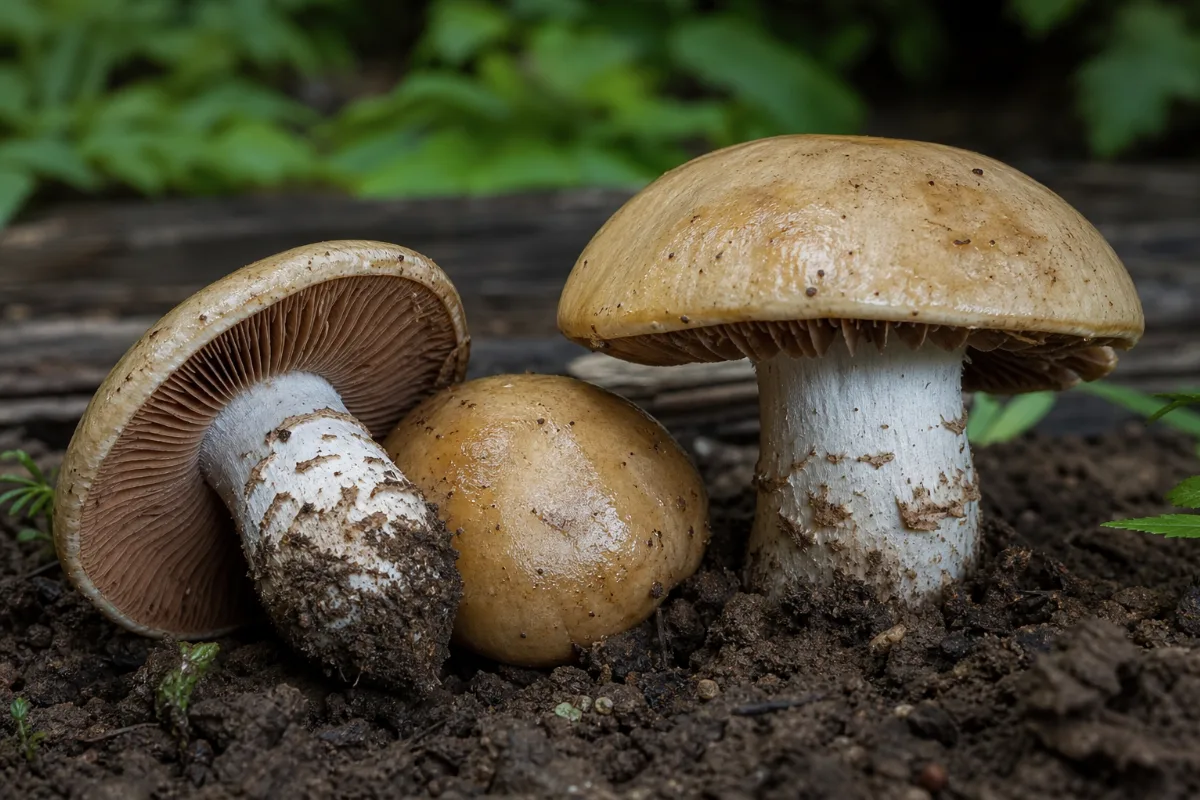
Mushrooms · Poisonous mushroom
Poison Pie
Hebeloma crustuliniforme (Bull.) Quél. · also called Poison pie, poisonpie, fairy-cakes (a fungus, not a plant)
The poison pie (Hebeloma crustuliniforme) is a wild mushroom regarded as poisonous. Reports describe stomach pain, nausea, vomiting and diarrhoea within hours, usually over in a day or two. The toxins are not firmly identified and few cases are on record. No study shows it helps any condition. If someone has eaten a wild mushroom, call a poison centre right away.
General information, not medical advice. Last substantive update · Not medically reviewed. A named clinician has not signed off on this page. How this page is made
About Poison Pie
The poison pie (Hebeloma crustuliniforme) is a wild mushroom regarded as poisonous. A museum guide on the genus says symptoms are stomach pain, nausea, vomiting and diarrhoea, presumably starting 15 minutes to 4 hours after eating and usually finishing after one to two days. Few cases are on record and the toxins are not firmly identified. A stomach upset after a wild mushroom can also be the first sign of a far more dangerous poison, so call a poison centre. No human study shows any benefit.
Danger first: what it does
The poison pie belongs to the genus Hebeloma, whose English name 'poison pie' reflects a belief, certainly in Europe, that all members are poisonous. A museum guide describes stomach pain, nausea, vomiting and diarrhoea, presumably starting 15 minutes to 4 hours after eating and usually finishing after one to two days. A 2022 paper says Hebeloma poisonings typically cause stomach symptoms that pass after several days.
The North American Mycological Association (NAMA) puts stomach-and-bowel mushroom poisoning in its gastrointestinal irritant group. It says it is the most frequent form of mushroom poisoning, that symptoms usually appear within 20 minutes to 4 hours, that recovery is complete, and that severe cases may need hospital care. Supportive treatment replaces lost fluids and salts. These are general descriptions, not a trial of the poison pie. If someone has eaten a wild mushroom, call a poison centre right away. In the US call Poison Help at 1-800-222-1222 (free, confidential), and 911 if the person collapses, has a seizure, has trouble breathing or cannot be awakened. In the UK call NHS 111 if unsure and 999 in an emergency. In Australia call 13 11 26.
When a stomach upset is not the whole story
NAMA warns that gut symptoms starting 6 to 24 hours after eating mushrooms could mean amatoxin poisoning, a very serious toxicity, and that other poisons cause gut symptoms first and kidney damage days later. A stomach upset does not prove the mushroom was a mild one.
Tell the poison centre exactly what was eaten, when it was eaten and when symptoms began. Keep any leftover mushroom or meal, or a photo, to show staff. Do not wait to see whether symptoms pass.
What the few reported cases say
The museum guide, which is about a related Hebeloma, describes three reports. Two dogs in Washington reportedly ate Hebeloma and became sick. In Colorado in 2013, two men ate mushrooms tentatively identified as Hebeloma from a photograph, and about three quarters of an hour later had nausea, vomiting and sleepiness. In Baltimore in 1926, a family of four ate a stew of mixed mushrooms, one later identified as partly decomposed H. crustuliniforme, and had drowsiness, nausea and vomiting. The Baltimore family recovered after a couple of days; the guide does not state the Colorado outcome, and gives no outcome for the dogs.
The guide says poisoning by Hebeloma is rarely reported in western North America. Few and old cases cannot show how common or how severe poisoning can be, and the lack of death reports is no promise of mildness.
Who is at higher risk
No source we read measures risk in children, older people, pregnancy, breastfeeding, medicines or alcohol for this mushroom. Vomiting and diarrhoea can cause fluid and salt loss, so ask a poison centre or doctor right away, and call a poison centre for any child who may have eaten a wild mushroom. If a pet may have eaten one, call a vet or an animal poison service.
Cooking, drying and food use elsewhere
We found no study showing that cooking, drying or any other preparation makes the poison pie safe, and this page gives no preparation method.
A 2022 paper says some Hebeloma species are sold as food in Mexico, and that in Laos one species is sold as food with a bitter taste that apparently remains after cooking. These are other species. The paper says it is not known which Hebeloma species are poisonous, so another species being eaten tells you nothing safe about this one.
No identification help here
This page does not tell you how to recognise the poison pie. A museum guide says all Hebeloma in this group are difficult to identify to species, and a 2022 paper says that, because of this, nobody can be certain which toxic compound belongs to which species. The Colorado case was named from a photograph only. A photo, an app or a name is never proof that a wild mushroom is safe.
What research exists
No clinical trial of the poison pie was found. Laboratory work is about toxins. A 1992 paper isolated three compounds from a related species, Hebeloma spoliatum, that were fatal to mice when injected and relaxed mouse intestine in a dish. One of them had earlier been isolated from H. crustuliniforme and H. sinapizans as a cell-damaging (cytotoxic) principle. A 2022 paper lists triterpenes, cucurbitane glycosides and related chemicals as possible causes of toxicity in the genus.
These results are animal and test-tube work on isolated compounds and a different species. They say nothing certain about eating the poison pie, and no study shows which compound makes people ill.
Arsenic in wild Hebeloma
A 2026 laboratory study measured arsenic in three wild Hebeloma species. Hebeloma sinapizans, a close relative often grouped with the poison pie, held up to 41.2 mg of total arsenic per kg dry mass, H. bulbiferum up to 563 mg per kg, and H. mesophaeum up to 4.2 mg per kg. A companion study found that H. sinapizans carries a gene that exports arsenic. Neither study tested the poison pie itself or looked at harm to people who eat these mushrooms.
At a glance
Traditional uses history, not proof
- No traditional medicinal use is described in the sources we read.
- A 2022 paper says the name 'poison pie' reflects the European belief that members of this genus are poisonous, and that collecting them for eating is generally discouraged (Eberhardt 2022).
- Some other Hebeloma species are sold as food in Mexico and Laos. Those are different species and not a guide to this one (Eberhardt 2022).
Studied for research
- Food use: against; sources regard the genus as poisonous
- Medicinal or health use: no study found, not enough evidence
- Laboratory work is about toxic, cell-damaging chemicals, not benefits
Main compounds
- Toxins not firmly identified; cell-damaging triterpene esters (glutaryl crustulinol type) were isolated from this species and a relative in old laboratory work
- Arsenic compounds have been measured in wild relatives of this mushroom
Common forms
- Wild mushroom (regarded as poisonous; not a food or supplement)
Research links: Poison Control (US): call 1-800-222-1222 · NAMA: mushroom poisoning syndromes · Hebeloma in Mexico, 2022 (abstract) · Toxic metabolites from Hebeloma spoliatum, 1992 (abstract) · Arsenic in three Hebeloma species, 2026 (abstract) · Research Library · Genes & Biomarkers Library
What it is and its history
- Accepted scientific name
- Hebeloma crustuliniforme
- Naming authority
- (Bull.) Quél.
- Synonyms
- Agaricus crustuliniformis Bull.; Agaricus diffractus Fr.; Agaricus longicaudus Pers.; Agaricus nudipes Fr.; Derminus crustuliniformis (Bull.) J.Schröt.
- Common names
- Poison pie (English); Poisonpie (English); Fairy-cakes (English); Tonblasser Fälbling (German); Hébélome croûte de pain (French); Radijsvaalhoed (Dutch); オオワカフサタケ (Japanese)
- Family or group
- Hymenogastraceae (a fungus, not a plant). The part concerned is the fruiting body, the mushroom.
- Classification
- Fungi > Basidiomycota > Agaricomycetes > Agaricales > Hymenogastraceae > Hebeloma > Hebeloma crustuliniforme
- Native range
- GBIF holds about 18,300 occurrence records, about 16,300 in Europe, 1,300 in North America, 140 in Oceania and 84 in Asia. Records are observations, not a map of native range.
- Habitat
- Not described, deliberately.
- What it looks like
- Part used: The fruiting body (the mushroom). This page does not describe how to recognise it.
- Look-alikes and adulterants
- Name: Other Hebeloma species; Note: A museum guide and a 2022 paper say the genus is hard to identify to species, even for specialists, so reports of poisoning cannot always be tied to one species. This page gives no way to tell them apart.
- Sustainability and conservation
- Not checked.
Traditional use and history history, not clinical proof
| Tradition or era | Documented use | Source |
|---|---|---|
| Taxonomy | GBIF gives the accepted name Hebeloma crustuliniforme (Bull.) Quél. The species was first named Agaricus crustuliniformis by Bulliard and moved to Hebeloma by Quélet in 1872 (GBIF publication record: Mém. Soc. Émul. Montbéliard, Sér. 2 5: 128). | GBIF |
| Name in Europe | A 2022 paper says the name 'poison pie' suggests what is believed in Europe to be true of all members of the genus: that they are poisonous, or too easily mixed up with poisonous ones. Collecting Hebeloma for eating is generally discouraged. | MycoKeys 2022 |
| Food use of other Hebeloma | The same paper says some Hebeloma species are sold as food in Mexico, in Laos and elsewhere. These are different species and not a guide to the poison pie. | MycoKeys 2022 |
Traditional use shows how it was used. It does not show that it works or is safe today.
What is inside, and how it may work
What it contains and how those compounds act in cells and animals. Laboratory and animal mechanisms are not proven effects in people.
Main compounds
| Compound | Family | Where it is concentrated | Activity studied | Level of evidence |
|---|---|---|---|---|
| Glutaryl crustulinol (triterpene ester) | Triterpene-type fungal chemicals | Fruiting body | A 1992 abstract says a compound of this type, 3-acetyl-2-(3'-hydroxy-3'-methyl)glutarylcrustulinol, had been isolated from H. crustuliniforme and H. sinapizans as a cell-damaging (cytotoxic) principle. Related compounds from H. spoliatum were fatal to mice when injected. Whether this compound causes illness in people who eat the mushroom is not known. 2 3 | Laboratory research |
| Possible other toxin groups in the genus | Triterpene esters, cucurbitane glycosides, sesquiterpenoids | Not stated | A 2022 paper reports that a literature review lists cytotoxic triterpenes, lanostane-type triterpene esters, neurotoxic cucurbitane-type glycosides and 6,7-seco-caryophyllenes and related sesquiterpenoids as possible causes of Hebeloma toxicity. It is not stated which belong to the poison pie. 1 | Review |
| Arsenic compounds (in relatives) | Metalloid | Fruiting body | In wild H. sinapizans, total arsenic up to 41.2 mg per kg dry mass, mainly arsenobetaine and dimethylarsenate (2026 abstract). Not measured in H. crustuliniforme in the sources we read. 10 | Lab |
Mechanisms, receptors and pathways
| Target or pathway | Gene or receptor | What was found | Level |
|---|---|---|---|
| Gut irritation | Not established | NAMA groups stomach-and-bowel mushroom poisoning with the gastrointestinal irritants, whose symptoms end once the irritant is expelled. No study read shows how the poison pie's toxin acts. 4 3 | Not established |
| Smooth muscle (mouse intestine in a dish) | Papaverine-like relaxation; no receptor identified | Related compounds from H. spoliatum relaxed mouse small intestine contracted by acetylcholine or barium chloride, and appeared to act like papaverine. This is an animal-tissue finding on a different species. 2 | Animal research |
| Arsenic export (ACR3 transporter) | HsACR3 (arsenite transporter in H. sinapizans) | A 2026 laboratory study found that H. sinapizans carries an arsenite-export gene (HsACR3) that lowered arsenic in yeast cells and turned on when the fungus was exposed to arsenate. This is about how the fungus survives arsenic, not about human harm. 11 | Laboratory research |
Absorption, metabolism and elimination
- Absorption
- Not studied.
- Distribution
- Not studied.
- Metabolism
- Not studied.
- Elimination
- Not studied. Recovery is described within one to two days.
- Bioavailability
- Not studied.
Isolated compounds versus whole extracts
The wild mushroom and an isolated cell-damaging compound are different things. Human illness is described for the whole mushroom or for mixed meals. The laboratory work is on isolated compounds from a related species and on the fungus's arsenic handling. No supplement or product was found.
Nutritional composition
The poison pie is not a food or nutrient source. We found no measured nutrient values for it.
1 not enough evidence1 evidence against
What was looked at
The 2 benefits and uses checked for Poison Pie, each with how strong the evidence is. Tap one to open it.
What is Poison Pie good for?
The uses people ask about and how strong the human evidence is for each. None is proven, and there is no human benefit research at all. Read every row together with the Safety tab: this is a mushroom regarded as poisonous.
Benefits, one by one
Each card is a research question, not a promise. Tap a goal to filter. Open a card to see the studies, doses and limits.
Use as a food
Evidence againstSources we read treat the poison pie as a poisonous mushroom, not a food. Reports describe stomach pain, nausea, vomiting and diarrhoea. Some other Hebeloma species are sold as food in Mexico and Laos, but that tells us nothing safe about this one.
3 studiesNot covered. This page gives no amounts, preparation or ways of using…
Studies, doses and limits
What the trials found
No study of people eating the poison pie. Only a few old case descriptions in a museum guide, covered on the Safety tab.
Results
Described outcome: stomach pain, nausea, vomiting and diarrhoea, usually over in one to two days. Two case descriptions also mention drowsiness or sleepiness.
Why this rating
A taxonomy paper says collecting the genus for food is generally discouraged and that nobody knows which species are poisonous. Food use elsewhere refers to other species. No trial or clinical series exists.
Form and dose studied
Not covered. This page gives no amounts, preparation or ways of using the mushroom.
Who was studied
People who ate Hebeloma mushrooms in case descriptions.
Limits
The case descriptions are few, old or based on a photograph, and some cover other Hebeloma species or a mixed stew. They cannot show how common or how severe poisoning is.
Why researchers looked
People ask because the genus is eaten in a few countries and because poisonings are described as passing.
Traditional use
No traditional medicinal use is described in the sources we read. A taxonomy paper says some Hebeloma species are sold as food in Mexico and Laos, and that the species involved are uncertain.
Proposed mechanism Narrative review
The toxins are not firmly identified. A review cited by a 2022 paper lists cytotoxic triterpenes, neurotoxic cucurbitane glycosides and related sesquiterpenoids as possible causes in the genus.
A proposed mechanism does not show that the effect happens in people.
This is a poisonous mushroom. Eating it can cause stomach pain, vomiting and diarrhoea. If someone has eaten it, call a poison centre.
Medicinal or health use
Not enough evidenceWe found no study of the poison pie as a medicine or supplement, in people, animals or test tubes. The only laboratory work on this species is about toxic, cell-damaging chemicals, which is a safety finding and not a benefit.
2 studiesNot covered. This page gives no amounts, preparation or ways of using…
Studies, doses and limits
Results
No health benefit has been tested.
Why this rating
No study of any benefit exists. The only laboratory finding concerns toxicity.
Form and dose studied
Not covered. This page gives no amounts, preparation or ways of using the mushroom.
Limits
A cell-damaging chemical is not a drug. Nothing here shows the mushroom helps any condition, and it is poisonous.
Why researchers looked
People search for it as a remedy because many wild mushrooms are sold as supplements. It is not one.
Traditional use
No traditional medicinal use is described in the sources we read.
Proposed mechanism Laboratory research
None for a benefit. A glutaryl crustulinol compound isolated from this species and a close relative was described as cell-damaging (cytotoxic) in a 1992 abstract; the same abstract shows related compounds from another Hebeloma were fatal to mice when injected.
A proposed mechanism does not show that the effect happens in people.
This is a poisonous mushroom. Eating it can cause stomach pain, vomiting and diarrhoea. If someone has eaten it, call a poison centre.
Connections to the rest of health
How Poison Pie connects to the rest of our health knowledge graph. Every link says what kind of connection it is. A safety link (for example to the liver) is a warning, not a benefit. A study that merely mentions a topic never creates a benefit link.
Explore every connection: goals, body systems, organs, symptoms, genes
B. Body systems
| Connected to | Kind of connection | Evidence status | Context | Studies |
|---|---|---|---|---|
| Digestive system | Adverse effect or risk | Low certainty | Stomach pain, nausea, vomiting and diarrhoea described by guides and NAMA. Preparation or compound: Mushroom (fruiting body) |
3 4 1 |
| Digestive System | Biological association | Evidence against | Studied for: Use as a food | 1 3 4 |
C. Body parts and organs
| Connected to | Kind of connection | Evidence status | Context | Studies |
|---|---|---|---|---|
| Stomach | Adverse effect or risk | Low certainty | Stomach pain and nausea after eating Hebeloma. Preparation or compound: Mushroom (fruiting body) |
3 |
| Gut | Adverse effect or risk | Low certainty | Diarrhoea described; symptoms pass once the irritant has left the body. Preparation or compound: Mushroom (fruiting body) |
4 3 |
E. Health conditions
| Connected to | Kind of connection | Evidence status | Context | Studies |
|---|---|---|---|---|
| Nausea and vomiting | Adverse effect or risk | Low certainty | The main symptom described after eating Hebeloma. Preparation or compound: Mushroom (fruiting body) |
3 4 |
K. Biological pathways
| Connected to | Kind of connection | Evidence status | Context | Studies |
|---|---|---|---|---|
| ACR3 arsenite transporter (in H. sinapizans) | Preliminary mechanism | In vitro | A fungal gene that exports arsenic; relevant to arsenic in wild Hebeloma, not to human illness. | 11 |
L. Active compounds
| Connected to | Kind of connection | Evidence status | Context | Studies |
|---|---|---|---|---|
| Glutaryl crustulinol (triterpene ester) | Biological association | In vitro | A 1992 abstract says a compound of this type, 3-acetyl-2-(3'-hydroxy-3'-methyl)glutarylcrustulinol, had been isolated from H. crustuliniforme and H. sinapizans as a cell-damaging (cytotoxic) principle. Related compounds from H. spoliatum were fatal to mice when injected. Whether this compound causes illness in people who eat the mushroom is not known. Preparation or compound: Fruiting body |
2 3 |
| Possible other toxin groups in the genus | Biological association | Review | A 2022 paper reports that a literature review lists cytotoxic triterpenes, lanostane-type triterpene esters, neurotoxic cucurbitane-type glycosides and 6,7-seco-caryophyllenes and related sesquiterpenoids as possible causes of Hebeloma toxicity. It is not stated which belong to the poison pie. | 1 |
| Arsenic compounds (in relatives) | Biological association | Lab | In wild H. sinapizans, total arsenic up to 41.2 mg per kg dry mass, mainly arsenobetaine and dimethylarsenate (2026 abstract). Not measured in H. crustuliniforme in the sources we read. Preparation or compound: Fruiting body |
10 |
Each connection is stored with the ingredient, the connected record, the kind of connection, the evidence status, the supporting studies, the preparation or compound involved, and a review date (last reviewed October 25, 2026).
Evidence at a glance: what the research found for 2 outcomes
Each outcome below is one thing researchers measured. Certainty is how far the evidence can be trusted, not how well it works. The full studies are on the next tab.
The evidence
The research centre for Poison Pie. Every record here was checked against PubMed or the publisher's page; we never list a study we have not verified.
Evidence by outcome
Bars show how many studies we found for each outcome, not how well it works. People are added up across trials only (reviews are not added, to avoid double counting).
How we rate evidence
High certainty
Several well-run trials or reviews agree; further research is unlikely to change the picture much.
Moderate certainty
Good trials point the same way, but some doubt remains.
Low certainty
Small, short or inconsistent trials. The finding could change with better research.
Very low certainty
Very little or very weak human data. Treat as a possibility only.
Mixed findings
Trials or reviews disagree with each other.
Not enough evidence
Not enough human research to say either way.
Evidence against
Good research found no benefit, or found harm.
We take the reviewers' own risk-of-bias and GRADE statements where they exist, and otherwise judge from study size, design, consistency, directness and whether a product matches what is sold. Many publications do not make evidence high. Method note: We read the abstracts of four papers in PubMed (full text for the 2022 Hebeloma paper), the NAMA poisoning-syndromes page, a university museum guide on a related Hebeloma, and poison-help pages from the US, UK and Australia, and checked the scientific name in GBIF. Index Fungorum could not be opened. Where a statement could not be checked it is marked as such.
Study library: every study we checked 11
| Study | Design | People | Product, dose, length | Result |
|---|---|---|---|---|
| Eberhardt 2022 Not (only) poison pies - Hebeloma (Agaricales, Hymenogastraceae) in Mexico. MycoKeys · Source · DOI |
Review and taxonomy review |
Hebeloma species in Mexico, with background on the genus | n/a |
The full text (open access) says the name poison pie is best known for the genus and is often reserved for H. crustuliniforme. In Europe all members of the genus are believed poisonous, or too easily mixed up with poisonous ones, and collecting Hebeloma for eating is generally discouraged. Poisonings are reported to cause stomach symptoms that pass after several days, but it is not known which species are poisonous. Some Hebeloma species are sold as food in Mexico (for example H. ambustiterranum, a species found only in Mexico so far), and in Laos H. parvisporum is sold as food, with a bitter taste that apparently remains after cooking. A review of the literature that the paper cites lists cytotoxic triterpenes, lanostane-type triterpene esters, neurotoxic cucurbitane-type glycosides and related sesquiterpenoids as possible causes of Hebeloma toxicity. Methods, limits and fundingOutcomes: Species descriptions, edibility, reported toxicity of the genus Limitations: A taxonomy paper (describes new species), not a poisoning study. Its statements on toxicity and edibility come from other papers it cites, which we did not open. It says the species behind the toxin reports cannot be known for sure because the genus is hard to identify. Funding and conflicts: Not stated in the abstract. Read: full-text |
| Fujimoto 1992 Isolation, identification and pharmacological studies on three toxic metabolites from a mushroom, Hebeloma spoliatum. Chem Pharm Bull (Tokyo) · Source · DOI |
Laboratory study animal |
Mice and isolated mouse intestine | Isolated glutaryl crustulinol compounds from Hebeloma spoliatum Fruiting body |
Three compounds (HS-A, -B and -C) were isolated from Hebeloma spoliatum as the fatal toxic principles in mice. HS-A was identified as 3-acetyl-2-(3'-hydroxy-3'-methyl)glutarylcrustulinol, which had been isolated from H. crustuliniforme and H. sinapizans as a cytotoxic principle. Injection into the abdomen of mice caused death after paralysis of the limbs. The compounds relaxed mouse small intestine contracted by acetylcholine chloride or barium chloride in vitro, in a papaverine-like way. Methods, limits and fundingOutcomes: Structure and toxic effect of isolated compounds Limitations: Mouse injection and isolated-tissue work on a different species (H. spoliatum). It says nothing about eating the poison pie or about how likely poisoning is in people. Funding and conflicts: Not stated in the abstract. Read: abstract |
| n/a Beaty Biodiversity Museum (University of British Columbia): Mushrooms Up! Hebeloma velutipes, velvet foot poisonpie (page read 25 October 2026) n/a · Source |
Museum guide n/a |
n/a | n/a |
The guide labels Hebeloma velutipes poisonous (with a question mark). It says the identity of the toxins is unclear, that only a few Hebeloma species have been analysed chemically, and that H. crustuliniforme and H. sinapizans contain a triterpene that was toxic to cells. Symptoms are stomach pain, nausea, vomiting and diarrhoea, presumably starting 15 minutes to 4 hours after eating and usually finishing after one to two days. It says it remains unclear which species in the group are toxic and that all are difficult to identify. Cases: two dogs in Washington reportedly became sick; two men in Colorado in 2013 had nausea, vomiting and sleepiness about 45 minutes after eating mushrooms tentatively identified from a photograph; a family of four in Baltimore in 1926 ate a mixed stew in which one mushroom was later identified as partly decomposed H. crustuliniforme and had drowsiness, nausea and vomiting, with the family recovering after a couple of days. It says poisoning by Hebeloma is rarely reported in western North America and advises contacting a poison control centre and saving leftovers. Methods, limits and fundingOutcomes: Genus toxicity statement, symptoms and cases Limitations: Undated, not peer reviewed, and about a different species (H. velutipes). The case reports are cited to papers we did not open. Colorado case identified from a photograph only; the Baltimore meal was a mixed stew. Read: full-text |
| n/a 2026 North American Mycological Association: Mushroom Poisoning Syndromes (page read 25 October 2026) n/a · Source |
Authoritative guidance n/a |
n/a | n/a |
NAMA says the most frequent form of mushroom poisoning is caused by gastrointestinal irritants. Symptoms usually appear within 20 minutes to 4 hours and include nausea, vomiting, cramps and diarrhoea, which normally pass after the irritant has been expelled. Severe cases may require hospitalization, and replacing lost fluids and electrolytes is important. Recovery is complete. It warns that gut symptoms starting 6 to 24 hours after eating could mean amatoxin poisoning, a very serious toxicity. The page is a general guide and does not name the poison pie. Methods, limits and fundingOutcomes: What gastrointestinal-irritant mushroom poisoning looks like and how it is treated Limitations: General syndrome page, not specific to this species. Undated. Read: full-text |
| n/a 2026 Poison Control (US): Need immediate assistance? (page read 25 October 2026) n/a · Source |
Authoritative guidance n/a |
n/a | n/a |
The page says to call 1-800-222-1222 or use the online tool; both are free and confidential. If the person collapses, has a seizure, has trouble breathing or cannot be awakened, call 911 immediately. Methods, limits and fundingOutcomes: What to do in a suspected poisoning in the US Limitations: A public help page. Read: full-text |
| n/a 2026 NHS (UK): Poisoning (page read 25 October 2026) n/a · Source |
Authoritative guidance n/a |
n/a | n/a |
The page says to call 999 or go to A&E if someone may have swallowed something harmful, has lost consciousness, has stopped breathing, has severe difficulty breathing or has a seizure, and to call NHS 111 if you are not sure whether something swallowed is harmful. Methods, limits and fundingOutcomes: What to do in suspected poisoning in the UK Limitations: A public help page. Read: full-text |
| n/a 2026 NSW Poisons Information Centre (Australia): home page (read 25 October 2026) n/a · Source |
Authoritative guidance n/a |
n/a | n/a |
The page says the centre can be called 24/7 on 13 11 26 and says to call Triple Zero (000) for an ambulance if someone is unconscious or not breathing. Methods, limits and fundingOutcomes: Poison advice line in Australia Limitations: A public help page for one Australian state service. Read: full-text |
| n/a 2026 GBIF Backbone Taxonomy: Hebeloma crustuliniforme (Bull.) Quél. (species key 2533043) n/a · Source |
Registry or database n/a |
n/a | n/a |
Accepted species in GBIF: Hebeloma crustuliniforme (Bull.) Quél., family Hymenogastraceae, order Agaricales, class Agaricomycetes, phylum Basidiomycota, kingdom Fungi. English vernacular names: Poison Pie, Poisonpie, Fairy-cakes. About 18,280 occurrence records, mostly in Europe (16,327) and North America (1,317). Read through the GBIF API on 25 October 2026. Methods, limits and fundingOutcomes: Accepted name, authority, family, synonyms, records Limitations: A database record. Occurrence records are observations and say nothing about toxins. Index Fungorum could not be opened (HTTP 403). Read: full-text |
| n/a 2026 GBIF Backbone Taxonomy: Hebeloma sinapizans (Paulet) Gillet (species key 8396400) n/a · Source |
Registry or database n/a |
n/a | n/a |
Accepted species in GBIF: Hebeloma sinapizans (Paulet) Gillet, family Hymenogastraceae. English vernacular name: Bitter Poisonpie. Read through the GBIF API on 25 October 2026. Methods, limits and fundingOutcomes: Accepted name and family of a related species Limitations: A database record only. Read: full-text |
| Šnábl 2026 Arsenic Speciation and Distribution in Three Hebeloma Species: Insights into Arsenic Handling and Transformation in Mycorrhizal Fungi. Microb Ecol · Source · DOI |
Laboratory analysis mushroom samples |
Wild fruit bodies and mycelial cultures of three Hebeloma species | n/a |
Wild fruit bodies and laboratory cultures of H. bulbiferum, H. sinapizans and H. mesophaeum were analysed. H. bulbiferum held the most arsenic in fruit bodies (up to 563 mg per kg dry mass, mainly dimethylarsenate), H. sinapizans up to 41.2 mg per kg (mainly arsenobetaine and dimethylarsenate) and H. mesophaeum up to 4.2 mg per kg (mainly inorganic arsenic and arsenocholine). Cultures converted inorganic arsenic to organic forms. Methods, limits and fundingOutcomes: Total arsenic and arsenic forms Limitations: About how fungi handle arsenic. It did not test H. crustuliniforme and did not study harm to people. Competing interests: none declared. Funding and conflicts: No competing interests declared. Read: abstract |
| Šnábl 2026 Arsenic efflux mechanisms in ectomycorrhizal mushrooms Hebeloma bulbiferum and Hebeloma sinapizans. Appl Microbiol Biotechnol · Source · DOI |
Laboratory study in-vitro |
Fungal cultures and yeast cells | n/a |
Two homologous arsenite-export genes, HbACR3 and HsACR3, were identified in H. bulbiferum and H. sinapizans. Expressed in yeast, they restored resistance to arsenite and arsenate and lowered cell arsenic. Exposure of the fungal cultures to arsenate raised the genes' activity. Methods, limits and fundingOutcomes: Arsenic tolerance and export gene activity Limitations: Gene and yeast work. It says nothing about people eating these mushrooms. Competing interests: none declared. Funding and conflicts: No competing interests declared. Read: abstract |
What we do not know yet
- No clinical series of poisoning by the poison pie alone; descriptions come from a museum guide on a related species, NAMA and a taxonomy paper.
- No study identifies which compound makes people ill or measures its amount.
- No study of any cooking, drying or other preparation.
- No animal or human study of any health benefit.
- No information on pregnancy, breastfeeding, medicines, alcohol or children.
- Index Fungorum could not be opened; no regulator statement specific to the poison pie was found.
How new research is added
New studies are found by a saved PubMed search and placed in a review queue. A person reads each one before it changes this page. Poison-help pages are rechecked on a schedule.
Lab markers
What changed in blood or saliva tests during trials. A changed number is not the same as feeling or being healthier, and we give no "normal ranges".
Safety
What studies and official sources say about side effects, medicines and who should check first. Each point shows what kind of evidence it comes from.
Main points to know 8
- If someone has eaten it, call a poison centre now. Do not wait to see whether symptoms appear or pass. In the US call Poison Help at 1-800-222-1222 (free and confidential), or 911 if the person collapses, has a seizure, has trouble breathing or cannot be awakened. In the UK call NHS 111 if you are unsure and 999 in an emergency. In Australia the Poisons Information Centre line is 13 11 26. Keep the mushroom, a photo or the package to show staff. Authoritative guidance 5 6 7 3
- The poison pie is regarded as poisonous and reported to cause stomach illness. A museum guide on a related Hebeloma says the genus is regarded as poisonous, with stomach pain, nausea, vomiting and diarrhoea, presumably starting 15 minutes to 4 hours after eating and usually ending after one to two days. A 2022 paper says poisonings typically cause stomach symptoms that pass after several days. These are descriptions, not clinical trials, and the guide's species is not the poison pie itself. Expert guide 3 1
- It is not known which Hebeloma species are poisonous. A 2022 paper says it is not known which Hebeloma species are poisonous, and that because the genus is so hard to identify, nobody can be certain which toxic compound belongs to which species. The same museum guide says even specialists find the group hard to separate. Treat every wild mushroom of this kind as a possible poisoning. Expert guide 1 3
- Stomach symptoms that start late can mean a far more dangerous poison. NAMA says gut symptoms starting 6 to 24 hours after eating could mean amatoxin poisoning, a very serious toxicity, and that other poisons cause gut symptoms first and kidney damage days later. A stomach upset after a wild mushroom does not prove it was a mild one. Tell the poison centre exactly what was eaten and when symptoms began. Authoritative guidance 4
- The few reported cases are old, and the one with a stated outcome recovered. The museum guide describes two men in Colorado in 2013 (nausea, vomiting and sleepiness about 45 minutes after eating mushrooms tentatively named as Hebeloma from a photograph) and a family of four in Baltimore in 1926 who ate a mixed mushroom stew (drowsiness, then nausea and vomiting). The family in Baltimore recovered after a couple of days; the guide does not state the Colorado outcome. The guide says poisoning by Hebeloma is rarely reported in western North America. Few cases cannot show how severe poisoning can be. Case report 3
- No source shows that cooking or drying makes it safe. We found no study of cooking, drying or any other preparation of the poison pie. A taxonomy paper says one Hebeloma sold as food in Laos stays bitter, apparently even after cooking. This page gives no preparation method. Expert guide 1
- Do not rely on names, photos, apps or taste to decide if a wild mushroom is safe. The Colorado case was named from a photograph only, and specialists find the genus hard to tell apart. This page gives no identification help. Some other Hebeloma are sold as food in Mexico and Laos, which says nothing safe about the poison pie. Expert guide 3 1
- Wild Hebeloma can hold arsenic. A 2026 laboratory study of three Hebeloma species found up to 41.2 mg of total arsenic per kg dry mass in wild H. sinapizans (a close relative of the poison pie), up to 563 mg per kg in H. bulbiferum, and up to 4.2 mg per kg in H. mesophaeum. The abstract does not say what this means for people who eat them. Laboratory analysis 10
Side effects 5
| Effect | How often | Severity and recovery | Evidence |
|---|---|---|---|
| Nausea and vomiting Onset presumably 15 minutes to 4 hours after eating for Hebeloma (museum guide); 20 minutes to 4 hours for gut-irritant mushrooms in general (NAMA). The Colorado men were sick about 45 minutes after eating. | Not established | moderate Described as ending within one to two days | Expert guide 3 4 |
| Stomach pain and diarrhoea No counts of how many people are affected. | Not established | moderate Described as passing | Expert guide 3 1 |
| Drowsiness or sleepiness Mentioned in two case descriptions (Colorado 2013 and Baltimore 1926). The Baltimore meal was a mixed stew, so the mushroom cannot be blamed for sure. | Not established | mild to moderate Baltimore family recovered; Colorado outcome not stated | Case report 3 |
| Loss of fluids and salts NAMA says replacing lost fluids and electrolytes matters after vomiting and diarrhoea from gut-irritant mushrooms in general. It does not describe dehydration for the poison pie specifically. | Not established | moderate to severe Replaced in care | Authoritative guidance 4 |
| Illness for one to several days One to two days (museum guide) or several days (2022 paper). | Not established | moderate Recovery described | Expert guide 3 1 |
Liver
No liver injury is described for the poison pie in the sources we read. Do not take that as comfort: poisoning by liver-destroying mushrooms can begin with the same gut symptoms many hours later, so a poison centre should be called for any wild mushroom. 4
How often. No data for the poison pie.
- NAMA poisoning syndromes page. Gut symptoms starting 6 to 24 hours after eating could signal amatoxin poisoning, a very serious toxicity. 4
This is a safety connection. It is not evidence that Poison Pie supports liver health.
Medicines and supplements 1
| With | Why it matters | Importance | Evidence | What to do |
|---|---|---|---|---|
| Medicines, alcohol and supplements all | No interaction has been studied for the poison pie. | Unknown. Vomiting and diarrhoea are described, and hospital teams manage them; this page gives no home treatment. | None Not enough evidence 6 5 | Tell the poison centre or emergency team about every medicine, supplement and substance taken, and ask them what to do. |
Who should check first 5
| Situation | Advice | Evidence |
|---|---|---|
| Anyone | It is a poisonous mushroom with no proven benefit. This page does not suggest eating it in any form. | Authoritative guidance 1 3 |
| Children and frail or older people | No source about the poison pie in these groups was read. Call a poison centre for any child who may have eaten a wild mushroom. | Authoritative guidance 5 |
| Pregnancy and breastfeeding | No data were found. A poisonous mushroom has no place in pregnancy or breastfeeding. Call a poison centre if one was eaten. | None |
| People with kidney, heart or other long-term illness | No data were found. Vomiting and diarrhoea can cause fluid and salt loss, so ask a poison centre or doctor right away. | Authoritative guidance 4 |
| Pets | The museum guide says two dogs in Washington reportedly ate Hebeloma mushrooms and became sick. If a pet may have eaten a wild mushroom, call a vet or an animal poison service immediately. | Case report 3 |
Overdose, product quality and regulators
Summary. The poison pie is regarded as poisonous because it is reported to cause stomach and bowel illness. The toxins are not firmly identified. A review cited by a 2022 paper lists cytotoxic triterpenes, lanostane-type triterpene esters, neurotoxic cucurbitane-type glycosides and related sesquiterpenoids as possible causes in the genus.
Amounts. No toxin level and no safe amount has been established in any source we read.
Onset and course. Presumably 15 minutes to 4 hours after eating, usually over in one to two days (museum guide, about the genus). Case descriptions mention drowsiness as well as stomach symptoms.
Repeated use. No data.
Animal data. A 1992 laboratory paper found three related compounds in Hebeloma spoliatum (a different species) that were fatal to mice when injected, with paralysis of the limbs, and that relaxed mouse intestine in a dish. One of them, a glutaryl crustulinol, had earlier been isolated from H. crustuliniforme and H. sinapizans as a cell-damaging (cytotoxic) principle. Injection into mice is not eating by people, and the paper tells us nothing about how likely human poisoning is.
Not read. The original isolation papers of 1983 and 1991 cited by the museum guide, and the paper that lists the possible toxin groups, were not read.
No product testing exists for the poison pie. A 2026 study measured arsenic in wild Hebeloma.
Arsenic in wild Hebeloma (Czechia). Wild fruiting bodies of H. sinapizans held up to 41.2 mg of total arsenic per kg dry mass, mainly as arsenobetaine and dimethylarsenate. H. bulbiferum held up to 563 mg per kg, mostly as dimethylarsenate, and H. mesophaeum up to 4.2 mg per kg, mainly inorganic arsenic and arsenocholine. The study was about how the fungi handle arsenic and says nothing on harm to people who eat them. 10
| Body | Action | Date |
|---|---|---|
| Poison Control (US, National Capital Poison Center) (United States) | Call 1-800-222-1222 for free, confidential help; call 911 immediately if the person collapses, has a seizure, has trouble breathing or cannot be awakened. source | |
| NHS (UK) (United Kingdom) | Call 999 or go to A&E if someone may have swallowed something harmful, is unconscious, has stopped breathing, has severe breathing difficulty or has a seizure; call NHS 111 if unsure. source | |
| NSW Poisons Information Centre (Australia) | Call 13 11 26 (24/7) and do not wait for symptoms; call 000 if the person is unconscious or not breathing. source |
When to get medical help
- If someone may have eaten this mushroom, or a wild mushroom that might be this one, call a poison centre right away, even if they seem fine. In the US call Poison Help at 1-800-222-1222 (free and confidential), or 911 if the person collapses, has a seizure, has trouble breathing or cannot be awakened. In the UK call NHS 111 if you are unsure and 999 in an emergency. In Australia the Poisons Information Centre line is 13 11 26. Keep the mushroom, a photo or the package to show staff.
- Call emergency services now if the person collapses, has a seizure, has trouble breathing, cannot be awakened, or has lost consciousness.
- Signs described for Hebeloma mushrooms: stomach pain, nausea, vomiting and diarrhoea, presumably starting 15 minutes to 4 hours after eating, sometimes with drowsiness.
- Go to hospital quickly if there are signs of fluid loss (very little urine, dizziness, a very dry mouth, extreme weakness), if symptoms are severe, if the person is a young child, frail, or has a long-term illness, or if stomach symptoms started 6 hours or more after eating, which can point to a far more dangerous poison.
- Do not wait to see whether symptoms pass and do not try to make the person vomit. Keep any leftover mushroom or meal, or a photo, to show staff.
- Pets: call a vet or an animal poison service immediately.
If someone may be poisoned or in a crisis, contact a clinician or emergency service straight away. In the US, Poison Control is 1-800-222-1222.
General information only, not medical advice. Ask a clinician or pharmacist before use, especially with medicines, in pregnancy or with a health condition. See the Natural Remedy Safety guide.
Frequently asked questions
Is the poison pie (Hebeloma crustuliniforme) poisonous?
What should I do if someone has eaten it, or a wild mushroom that might be it?
Call a poison centre right away, even if the person seems fine. In the US call Poison Help at 1-800-222-1222 (free, confidential), and 911 if the person collapses, has a seizure, has trouble breathing or cannot be awakened. In the UK call NHS 111 if unsure and 999 in an emergency. In Australia call 13 11 26. Keep any leftover mushroom or meal, or a photo, to show staff. Do not wait to see whether symptoms pass.
How long until symptoms start?
How long does it last, and can it be deadly?
The museum guide says symptoms usually finish after one to two days, and a 2022 paper says they pass after several days. The Baltimore family recovered after a couple of days, the Colorado outcome is not stated, and we found no death reports or hospital series. That is thin evidence and not a promise. Call a poison centre either way, because stomach symptoms alone cannot tell you which mushroom was eaten.
Does cooking make it safe?
Not shown. We found no study of cooking, drying or any other preparation, and this page gives no method.
Is it eaten in some countries?
Some other Hebeloma species are sold as food in Mexico and Laos, but they are different species and the paper says species identity there is uncertain. It also says it is not known which Hebeloma species are poisonous. That is no guide to this mushroom.
Can I tell it from other mushrooms?
Does it have any health benefit?
What causes the poisoning?
The toxins are not firmly identified. A glutaryl crustulinol compound was isolated from this species and from H. sinapizans as a cell-damaging principle, and related compounds from a different Hebeloma were fatal to mice when injected. A 2022 paper lists several chemical groups as possible causes. Which one makes people ill is not known.
Is wild Hebeloma contaminated with arsenic?
Can children or pets be poisoned?
Why is the poison pie sometimes grouped with Hebeloma sinapizans?
Explore by health goal
Editorial transparency
- Written by
- AlternativeMed editorial team. Research compiled with AI assistance, then checked against PubMed records, poison-help pages and GBIF.
- Medical review
- None. This page has not been reviewed by a physician or pharmacist.
- First published
- 2026-10-25
- Last substantive update
- 2026-10-25
- How we research
- We read the abstracts of four papers in PubMed (full text for the 2022 Hebeloma paper), the NAMA poisoning-syndromes page, a university museum guide on a related Hebeloma, and poison-help pages from the US, UK and Australia, and checked the scientific name in GBIF. Index Fungorum could not be opened. Where a statement could not be checked it is marked as such.
- How we rate evidence
- See "How we rate evidence" in the Evidence tab.
- Independence
- No product is promoted on this page. No affiliate links are shown. This page gives no dose, preparation, identification, picking or sourcing advice.
Sources 11
Each source was opened and checked. Where we read only the abstract, it says so. The small numbers in the text point here.
- Eberhardt U, Kong A, Montoya A, Schütz N, Bartlett P, Beker HJ. Not (only) poison pies - Hebeloma (Agaricales, Hymenogastraceae) in Mexico.. MycoKeys. 2022. DOI 10.3897/mycokeys.90.85267. (full-text)
- Fujimoto H, Takano Y, Yamazaki M. Isolation, identification and pharmacological studies on three toxic metabolites from a mushroom, Hebeloma spoliatum.. Chem Pharm Bull (Tokyo). 1992. DOI 10.1248/cpb.40.869. (abstract)
- n/a. Beaty Biodiversity Museum (University of British Columbia): Mushrooms Up! Hebeloma velutipes, velvet foot poisonpie (page read 25 October 2026). n/a. . (full-text)
- n/a. North American Mycological Association: Mushroom Poisoning Syndromes (page read 25 October 2026). n/a. 2026. (full-text)
- n/a. Poison Control (US): Need immediate assistance? (page read 25 October 2026). n/a. 2026. (full-text)
- n/a. NHS (UK): Poisoning (page read 25 October 2026). n/a. 2026. (full-text)
- n/a. NSW Poisons Information Centre (Australia): home page (read 25 October 2026). n/a. 2026. (full-text)
- n/a. GBIF Backbone Taxonomy: Hebeloma crustuliniforme (Bull.) Quél. (species key 2533043). n/a. 2026. (full-text)
- n/a. GBIF Backbone Taxonomy: Hebeloma sinapizans (Paulet) Gillet (species key 8396400). n/a. 2026. (full-text)
- Šnábl J, Kaňa A, Pelešková G, Steinbauerová J, Rudolf P, Borovička J, Leonhardt T, Sácký J. Arsenic Speciation and Distribution in Three Hebeloma Species: Insights into Arsenic Handling and Transformation in Mycorrhizal Fungi.. Microb Ecol. 2026. DOI 10.1007/s00248-026-02780-9. (abstract)
- Šnábl J, Pelešková G, Kaňa A, Šnáblová M, Leonhardt T, Borovička J, Sácký J. Arsenic efflux mechanisms in ectomycorrhizal mushrooms Hebeloma bulbiferum and Hebeloma sinapizans.. Appl Microbiol Biotechnol. 2026. DOI 10.1007/s00253-026-13710-7. (abstract)


