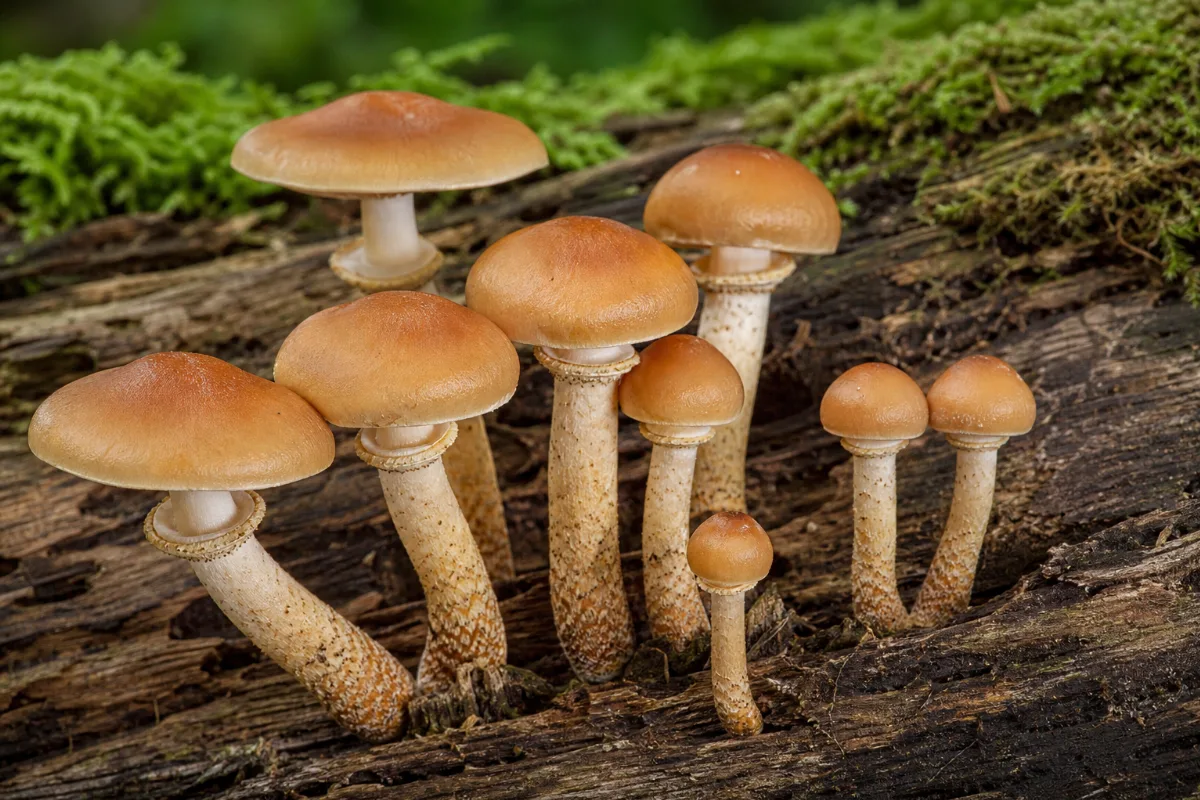
Mushrooms · Wild mushroom
Sheathed woodtuft
Kuehneromyces mutabilis · also called Velvet toughshank; Stockschwämmchen (German)
Sheathed woodtuft is a wild mushroom that grows on dead wood and is described in studies as edible. It has a deadly look-alike, the funeral bell, which holds the same kind of liver-destroying poison as the death cap, and a 2020 paper warns the two can be confused. Almost no health research exists on sheathed woodtuft itself, only a few lab tests. If anyone may have eaten a wild mushroom, call a poison centre now.
General information, not medical advice. Last substantive update · Not medically reviewed. A named clinician has not signed off on this page. How this page is made
About Sheathed woodtuft
Sheathed woodtuft (Kuehneromyces mutabilis) is a wood-growing fungus that studies describe as edible. Its danger is a deadly look-alike, the funeral bell (Galerina marginata), which holds amatoxins. This page gives no identification help, no preparation and no amount, because a wild mushroom cannot be safely chosen from words, photos or an app.
What it is
Sheathed woodtuft is a fungus in the family Strophariaceae. GBIF accepts the name Kuehneromyces mutabilis and lists Pholiota mutabilis as an older name, which is why you may see both. It is not a plant. A 2019 study calls it edible and cultivable, but we found no supplement product of it and no traditional medicinal use. This page does not help anyone identify or gather mushrooms.
What the research shows
There is no human study of sheathed woodtuft. The lab work is small. In a Hungarian screen, its extracts were among the three most active of 17 mushrooms at slowing cancer cell growth in dishes. In a Himalayan screen it scored lower than most on test-tube antioxidant readings. A Chinese study measured minerals in five mushrooms, including this one, and gave mice extracts of the group. A chemistry study profiled its sugars and acids, and a 2025 study purified an enzyme from lab cultures for possible industrial use. None of this shows a benefit in people.
At a glance
Traditional uses history, not proof
- No traditional medicinal use was found in the sources read. A 2019 study calls it an edible, cultivable mushroom.
Studied for research
- Cancer cells in dishes, insufficient (lab only)
- Antioxidant test-tube screens, insufficient (lab only)
- Influenza virus and mineral measurements, insufficient (lab and mouse blood minerals)
- Food chemistry profile, insufficient (no nutrient table)
Main compounds
- Trehalose (a sugar)
- Amino acids and organic acids
- Laccase, an enzyme made in lab cultures
Common forms
- Not recommended as a wild food. Cooking does not make a poisonous look-alike safe. No supplement product was found.
Research links: Poison Help (US) · Poison-centre guidance on poisonous mushrooms · Funeral bell and Galerina in Ukraine (2020) · Amatoxin poisoning: an update (2024) · Research Library · Genes & Biomarkers Library
What it is and its history
- Accepted scientific name
- Kuehneromyces mutabilis
- Naming authority
- (Schaeff.) Singer & A.H.Sm. (GBIF)
- Synonyms
- Pholiota mutabilis (Schaeff.) P.Kumm. (older name); Galerina mutabilis (Schaeff.) P.D.Orton
- Common names
- Sheathed woodtuft (English); Velvet toughshank (English (GBIF)); Stockschwammerl / Stockschwämmchen (German (GBIF))
- Family or group
- Strophariaceae (a fungus family), not a plant
- Classification
- Fungi > Basidiomycota > Agaricomycetes > Agaricales > Strophariaceae > Kuehneromyces > Kuehneromyces mutabilis
- Native range
- Not checked beyond the papers read, which come from Europe and the Himalaya.
- Habitat
- A wood-growing fungus per the 2019 paper's setting; details not given here.
- What it looks like
- Fruiting body: Not described here on purpose: this page gives no identification help.
- Cultivation
- Described as cultivable in a 2019 abstract. No cultivation advice is given.
- Look-alikes and adulterants
- Name: Funeral bell (Galerina marginata); Note: Deadly poisonous; contains amatoxins. A 2020 paper says it can be confused with sheathed woodtuft. GBIF accepts Galerina marginata (Batsch) Kuhner in family Hymenogastraceae (key 8118872). No identification detail is given.
- Sustainability and conservation
- Not checked.
Traditional use and history history, not clinical proof
| Tradition or era | Documented use | Source |
|---|---|---|
| Modern research | Described as an edible, cultivable mushroom in a 2019 study. No traditional medicinal use was found in the sources read. | p31199781 |
Traditional use shows how it was used. It does not show that it works or is safe today.
What is inside, and how it may work
What it contains and how those compounds act in cells and animals. Laboratory and animal mechanisms are not proven effects in people.
Main compounds
| Compound | Family | Where it is concentrated | Activity studied | Level of evidence |
|---|---|---|---|---|
| Trehalose | sugar | Stipe | Clearly higher in stipes than caps in an NMR study. 2 | Lab |
| Amino acids and organic acids | small molecules | Cap | A larger share in caps than stipes in the same study. 2 | Lab |
| Laccase (Kmlac) | enzyme, about 70 kDa | Culture filtrate (not the mushroom) | Broke down dyes in the lab; of potential industrial interest. 6 | Laboratory research |
| Selenium, iron, manganese | trace elements | Fruiting body Selenium printed as 203 mg/kg in one abstract (unusually high; not confirmed) | Measured only; no health effect shown. 13 | Lab |
Mechanisms, receptors and pathways
| Target or pathway | Gene or receptor | What was found | Level |
|---|---|---|---|
| Cancer cell growth in dishes | Not identified | Extracts slowed growth of four human cancer cell lines; the compound responsible is unknown. 12 | Laboratory research |
Absorption, metabolism and elimination
- Absorption
- Not found.
- Distribution
- Not found.
- Metabolism
- Not found.
- Elimination
- Not found.
- Bioavailability
- Not established.
Isolated compounds versus whole extracts
The lab findings use solvent extracts, a culture-filtrate enzyme or chemistry profiles. None used the whole mushroom as a person might meet it.
Nutritional composition
No USDA entry or open nutrient table was found, so none is given.
4 not enough evidence
What was looked at
The 4 benefits and uses checked for Sheathed woodtuft, each with how strong the evidence is. Tap one to open it.
- Cancer cells in the lab (cell dishes only)Not enough evidence
- Antioxidant tests (test tubes only)Not enough evidence
- Influenza virus (lab and mouse mineral work)Not enough evidence
- What it holds as a food (chemistry only)Not enough evidence
Lab markers tracked in the studies
Cancer cell growth inhibition (lab test)Antioxidant capacity (test-tube readings)Serum selenium, zinc and magnesium (in mice)
What is Sheathed woodtuft good for?
The uses researchers have looked at, and how strong the evidence is. All of it is lab work; none is a reason to eat a wild mushroom.
Benefits, one by one
Each card is a research question, not a promise. Tap a goal to filter. Open a card to see the studies, doses and limits.
Cancer cells in the lab (cell dishes only)
Not enough evidenceIn a Hungarian screening study, extracts of sheathed woodtuft slowed the growth of human cancer cells in dishes more than most of the other mushrooms tested. That is all it shows. Nothing was tested in animals or people, and it is not a reason to eat any wild mushroom.
1 studiesLaboratory solvent extracts of the fruiting body; not a product. No a…
Studies, doses and limits
What the trials found
No human or animal study was found.
Results
Sheathed woodtuft extracts (n-hexane, chloroform, 50% methanol and water) were among the three most active of 17 mushroom species in slowing cancer cell growth in dishes. The authors call it a species worth further chemical study. 7 of the 17 species gave at least 50% inhibition in one or more cell lines.
Effect sizes as reported
No figures for this species in the abstract.
Why this rating
One dish study with solvent extracts, no numbers for this species in the abstract, and nothing in animals or people.
Form and dose studied
Laboratory solvent extracts of the fruiting body; not a product. No amounts are given or advised.
Who was studied
Four human cancer cell lines (HeLa, A431, A2780, MCF7) in dishes
Limits
Not tested in animals or people. A substance that harms cancer cells in a dish often harms healthy cells too, and most never become medicines.
Why researchers looked
Researchers screen many wild mushrooms in the lab for substances that harm cancer cells.
Traditional use
No traditional medicinal use was found in the sources read.
Proposed mechanism Laboratory research
Water and solvent extracts were tested on four human cancer cell lines. The abstract does not say which extract worked, which cell lines responded or what in the mushroom did it. This is a lab finding.
A proposed mechanism does not show that the effect happens in people.
Sheathed woodtuft has a deadly look-alike. See the Safety tab.
Antioxidant tests (test tubes only)
Not enough evidenceIn a test-tube screen of nine wild mushrooms from the Indian Himalaya, sheathed woodtuft showed some antioxidant activity but ranked below most of the others. A test-tube antioxidant score is not a health effect.
1 studiesMethanol extract of dried fruiting body; not a product. No amounts ar…
Studies, doses and limits
What the trials found
No human or animal study was found.
Results
The puffball Clavatia craniiformis scored highest. The abstract lists sheathed woodtuft last among the species with the next highest antioxidant potential, and gives no figure for it.
Effect sizes as reported
No figure for this species in the abstract.
Why this rating
Test-tube screen, no numbers for this species in the abstract, no animal or human data.
Form and dose studied
Methanol extract of dried fruiting body; not a product. No amounts are given or advised.
Who was studied
Chemical tests, no living subjects
Limits
Antioxidant readings in a tube do not show that eating the mushroom does anything in the body.
Why researchers looked
Antioxidant tests are a cheap first look at the chemistry of food mushrooms.
Traditional use
No traditional medicinal use was found in the sources read.
Proposed mechanism Laboratory research
Methanol extracts were measured for total phenolics, flavonoids and tannins and tested in two radical-scavenging tests (ABTS and DPPH). These are chemistry tests in a tube.
A proposed mechanism does not show that the effect happens in people.
Sheathed woodtuft has a deadly look-alike. See the Safety tab.
Influenza virus (lab and mouse mineral work)
Not enough evidenceA Chinese study grouped sheathed woodtuft with four other mushrooms it calls 'anti-influenza virus mushrooms' and measured their minerals. Mice given mushroom extracts had higher blood selenium, zinc and magnesium. The abstract does not show that sheathed woodtuft protects against flu.
1 studiesMushroom extracts given to mice; not a product. No amounts are given …
Studies, doses and limits
What the trials found
No human study was found.
Results
Trace elements were measured in five mushrooms. In sheathed woodtuft the most plentiful were selenium, iron and manganese. Mice given extracts of the group for 8 weeks and then exposed to the virus had significantly higher serum selenium, zinc and magnesium. The abstract does not report infection outcomes or say which mushroom did what.
Effect sizes as reported
Selenium in sheathed woodtuft is printed as 203 mg/kg, an unusually high figure not confirmed elsewhere.
Why this rating
Mineral measurements and a mouse blood-level result, with no infection outcome for this species in the abstract.
Form and dose studied
Mushroom extracts given to mice; not a product. No amounts are given or advised.
Who was studied
Mice; mushroom samples
Limits
Not tested for flu protection in people. Mineral levels in mouse blood are not infection results. The abstract does not separate the five mushrooms.
Why researchers looked
Some mushroom extracts have slowed influenza viruses in the lab, and minerals such as selenium are linked to immune function.
Traditional use
No traditional medicinal use was found in the sources read.
Proposed mechanism Laboratory research
The authors suggest selenium, zinc and magnesium may help the host's innate immune response. That is a proposal, not something shown for this mushroom. A separate 1994 paper has a title about extracts of this mushroom and influenza virus in a dish, but PubMed carries no abstract for it, so we could not read what it found.
A proposed mechanism does not show that the effect happens in people.
Sheathed woodtuft has a deadly look-alike. See the Safety tab.
What it holds as a food (chemistry only)
Not enough evidenceResearchers have profiled the small molecules in sheathed woodtuft by NMR, including its sugar trehalose, amino acids and organic acids. No nutrient table (calories, protein, vitamins) was found, and no health effect has been shown.
1 studiesFruiting body samples; no amounts are given or advised.
Studies, doses and limits
What the trials found
No human study was found.
Results
Sheathed woodtuft samples from different places looked more alike than conifer tuft samples. No amounts per 100 g appear in the abstract.
Why this rating
A chemistry profile, not a nutrition or health study.
Form and dose studied
Fruiting body samples; no amounts are given or advised.
Who was studied
Mushroom samples
Limits
Mushroom chemistry changes with place, wood and season. Nothing here shows a benefit to people, and a wild mushroom must never be eaten on the strength of a lab profile.
Why researchers looked
Cultivated food mushrooms are profiled to compare species and parts.
Traditional use
The 2019 abstract calls it an edible, cultivable mushroom.
Proposed mechanism Lab
Nuclear magnetic resonance (NMR) reads which small molecules are in a sample. In 169 cap and stipe samples of sheathed woodtuft and conifer tuft, trehalose was clearly higher in stipes and caps held more amino acids and organic acids.
A proposed mechanism does not show that the effect happens in people.
Sheathed woodtuft has a deadly look-alike. See the Safety tab.
Connections to the rest of health
How Sheathed woodtuft connects to the rest of our health knowledge graph. Every link says what kind of connection it is. A safety link (for example to the liver) is a warning, not a benefit. A study that merely mentions a topic never creates a benefit link.
Explore every connection: goals, body systems, organs, symptoms, genes
E. Health conditions
| Connected to | Kind of connection | Evidence status | Context | Studies |
|---|---|---|---|---|
| Acute Toxic Hepatitis | High certainty | Amatoxin poisoning causes severe hepatitis; reported mix-up with this mushroom. Preparation or compound: Funeral bell (look-alike), not sheathed woodtuft |
4 5 | |
| Liver Failure, Acute | High certainty | Liver failure and transplant are described in amatoxin poisoning. Preparation or compound: Funeral bell (look-alike), not sheathed woodtuft |
5 4 |
I. Biomarkers
| Connected to | Kind of connection | Evidence status | Context | Studies |
|---|---|---|---|---|
| Cancer cell growth inhibition (lab test) | Biological association | Not enough evidence | Measured in trials: raised. A lab change is not the same as a health benefit. | 12 |
| Antioxidant capacity (test-tube readings) | Biological association | Not enough evidence | Measured in trials: raised. A lab change is not the same as a health benefit. | 3 |
| Serum selenium, zinc and magnesium (in mice) | Biological association | Not enough evidence | Measured in trials: raised. A lab change is not the same as a health benefit. | 13 |
L. Active compounds
| Connected to | Kind of connection | Evidence status | Context | Studies |
|---|---|---|---|---|
| Trehalose | Biological association | Lab | Clearly higher in stipes than caps in an NMR study. Preparation or compound: Stipe |
2 |
| Amino acids and organic acids | Biological association | Lab | A larger share in caps than stipes in the same study. Preparation or compound: Cap |
2 |
| Laccase (Kmlac) | Biological association | In vitro | Broke down dyes in the lab; of potential industrial interest. Preparation or compound: Culture filtrate (not the mushroom) |
6 |
| Selenium, iron, manganese | Biological association | Lab | Measured only; no health effect shown. Preparation or compound: Fruiting body |
13 |
Each connection is stored with the ingredient, the connected record, the kind of connection, the evidence status, the supporting studies, the preparation or compound involved, and a review date (last reviewed October 25, 2026).
Evidence at a glance: what changed in 3 lab markers
Tap a number to show only those markers. Counts are markers, not people.
The evidence
The research centre for Sheathed woodtuft. Every record here was checked against PubMed or the publisher's page; we never list a study we have not verified.
Evidence by outcome
Bars show how many studies we found for each outcome, not how well it works. People are added up across trials only (reviews are not added, to avoid double counting).
How we rate evidence
High certainty
Several well-run trials or reviews agree; further research is unlikely to change the picture much.
Moderate certainty
Good trials point the same way, but some doubt remains.
Low certainty
Small, short or inconsistent trials. The finding could change with better research.
Very low certainty
Very little or very weak human data. Treat as a possibility only.
Mixed findings
Trials or reviews disagree with each other.
Not enough evidence
Not enough human research to say either way.
Evidence against
Good research found no benefit, or found harm.
We take the reviewers' own risk-of-bias and GRADE statements where they exist, and otherwise judge from study size, design, consistency, directness and whether a product matches what is sold. Many publications do not make evidence high. Method note: We read PubMed records and abstracts for 12 papers (5 reviews or case compilations and toxin studies, 4 laboratory studies on the mushroom itself, 1 enzyme paper, 1 mineral and mouse study, and 1 chemistry profile), the abstract of a 2020 Ukrainian botanical paper, two poison-centre pages, and checked names in GBIF. Index Fungorum and regulators were not searched in depth. Certainty ratings are the compiler's own reading.
Study library: every study we checked 15
| Study | Design | People | Product, dose, length | Result |
|---|---|---|---|---|
| Akata 2020 Toxin components and toxicological importance of Galerina marginata from Turkey. Toxicon · PMID 32866473 · DOI |
Laboratory analysis lab |
Galerina marginata collected from three regions of Turkey | Funeral bell (Galerina marginata) fruiting bodies fruiting body Not shown here |
The authors measured alpha-, beta- and gamma-amanitin, phalloidin and phallacidin. Beta-amanitin was higher than alpha-amanitin in samples from all three regions, gamma-amanitin was below the detection limit and no phallotoxins were detected. They note that Galerina in this group is rare but can poison people and animals worldwide. Amanitins present in all three regions Methods, limits and fundingOutcomes: Amatoxin and phallotoxin content (HPLC and mass spectrometry) Limitations: Toxin chemistry from one country. Funding and conflicts: Not stated in the abstract Read: abstract |
| Alanne 2019 Metabolomic discrimination of the edible mushrooms Kuehneromyces mutabilis and Hypholoma capnoides (Strophariaceae, Agaricales) by NMR spectroscopy. Zeitschrift fur Naturforschung C · PMID 31199781 · DOI |
Laboratory analysis lab |
169 cap and stipe samples of two mushroom species from different collection sites | Sheathed woodtuft (Kuehneromyces mutabilis) fruiting bodies fruiting body (cap and stipe) Not shown here |
The abstract calls both species edible and cultivable. The clearest difference between the two species was in sugar composition, more diverse in the conifer tuft. Samples of sheathed woodtuft from different places looked more alike than those of the other species. In both species the sugar trehalose was clearly higher in stipes, and caps held a larger share of amino acids and organic acids. Chemical profile only Methods, limits and fundingOutcomes: Metabolite profile by proton NMR Limitations: A chemistry study. The abstract gives no nutrient amounts and no health outcome. Calling a mushroom edible in an abstract is not a safety guarantee for wild-collected mushrooms. Funding and conflicts: Not stated in the abstract Read: abstract |
| Bisht 2024 Exploring the Antioxidant Potential of Methanolic Extracts of Wild Medicinal and Edible Mushrooms from Darma Valley, Pithoragarh, Kumaun (Himalaya, India). International Journal of Medicinal Mushrooms · PMID 38305263 · DOI |
Laboratory research in-vitro |
Methanol extracts of nine wild mushroom species from the Kumaun Himalaya | Sheathed woodtuft (Kuehneromyces mutabilis) methanol extract fruiting body extract Not shown here |
Puffball Clavatia craniiformis had the highest antioxidant readings. The abstract lists Kuehneromyces mutabilis last in a list of species with the next highest antioxidant potential (after Ramaria species, Gomphus clavatus, Clavaria zollingeri and Pleurotus ostreatus). It gives no figure for sheathed woodtuft. Ranked lower than the top species; no figure given Methods, limits and fundingOutcomes: Total phenolics, flavonoids, tannins; ABTS and DPPH radical tests Limitations: Test-tube chemistry on solvent extracts. The abstract gives no numbers for this species, and test-tube antioxidant scores do not show an effect in people. Funding and conflicts: Not stated in the abstract Read: abstract |
| Care 2024 [Amatoxin-containing mushroom poisoning: An update]. La Revue de medecine interne · PMID 37949692 · DOI |
Narrative review review |
French update on amatoxin poisoning (English abstract) | Amatoxin-containing mushrooms (Amanita, Lepiota, Galerina) fruiting body Not shown here |
Symptoms are severe gastrointestinal disorders that start late, more than six hours after eating. The liver is the main target and severe hepatitis can lead to liver failure and liver transplantation; acute kidney failure is common. There is no antidote and early hospital care is essential. Mortality is now below 10%. In a suspected case a Poison Control Center should be contacted. Mortality now under 10% with modern hospital care Methods, limits and fundingOutcomes: Symptoms, organ damage, treatment, outcome Limitations: Short update; the English abstract was read, not the full text. Funding and conflicts: Not stated in the abstract Read: abstract |
| Diaz 2018 Amatoxin-Containing Mushroom Poisonings: Species, Toxidromes, Treatments, and Outcomes. Wilderness & Environmental Medicine · PMID 29325729 · DOI |
Narrative review review |
Review of published amatoxin poisonings from Amanita, Lepiota and Galerina mushrooms | Amatoxin-containing mushrooms (the funeral bell, Galerina marginata, is the look-alike named for sheathed woodtuft) fruiting body Not shown here |
Most mushroom poisonings are caused by unknown mushrooms and most fatal ones by amatoxin-containing mushrooms. The most frequently reported fatal Galerina ingestions are due to Galerina marginata. Apart from liver transplant, treatments are supportive and have not been tested in randomised trials. Patients with late-appearing gastrointestinal symptoms, with or without a 'false recovery' period before acute liver insufficiency, should be referred to centres that provide liver transplantation. About half of those with amatoxin-induced acute liver failure will need a transplant. Describes severe poisoning and deaths Methods, limits and fundingOutcomes: Species, symptoms, treatment and outcomes Limitations: Search-engine based narrative review, not a systematic one. It does not mention sheathed woodtuft. Funding and conflicts: Not stated in the abstract Read: abstract |
| Dou 2025 Purification and biochemical characterization of laccase from Kuehneromyces mutabilis. 3 Biotech · PMID 40951877 · DOI |
Laboratory research in-vitro |
An enzyme purified from the culture liquid of the fungus grown in the lab | Sheathed woodtuft (Kuehneromyces mutabilis) laboratory culture filtrate culture (not the mushroom) Not shown here |
The authors purified a laccase (Kmlac) of about 70 kDa from the culture filtrate. It worked best at 60 degrees C and pH 4.0, was stable below 40 degrees C, and broke down various dyes. They judge it of potential interest for industry. Industrial enzyme, not a health study Methods, limits and fundingOutcomes: Enzyme properties; dye breakdown Limitations: Concerns an enzyme from lab cultures. It says nothing about eating the mushroom. Funding and conflicts: Not stated in the abstract Read: abstract |
| Enjalbert 2002 Treatment of amatoxin poisoning: 20-year retrospective analysis. Journal of Toxicology. Clinical Toxicology · PMID 12475187 |
Review of case reports review |
2108 hospitalised amatoxin poisoning exposures reported in North America and Europe over 20 years | Amatoxin-containing mushrooms (Amanita, Galerina, Lepiota) fruiting body Not shown here |
The authors call amatoxin poisoning a medical emergency with a long delay before symptoms, a gastrointestinal phase and a liver-damaging phase, then coma and death. Amatoxins damage the liver and kidney by binding irreversibly to RNA polymerase II, and 35 amatoxin-containing species in three genera are named. Supportive care and 10 specific treatment regimens were compared by death rates; silybin and N-acetylcysteine looked the most effective, penicillin showed little benefit and thioctic acid and steroids showed none. 2108 hospitalised exposures compiled Methods, limits and fundingOutcomes: Treatment and mortality Limitations: Retrospective comparison of published reports, not a trial. Treatment findings are for hospital doctors and are not advice for anyone at home. Funding and conflicts: Not stated in the abstract Read: abstract |
| Enjalbert 2004 Amatoxins in wood-rotting Galerina marginata. Mycologia · PMID 21148893 |
Laboratory analysis lab |
27 Galerina marginata and 17 death cap specimens from French sites | Funeral bell (Galerina marginata) fruiting bodies fruiting body Not shown here |
Amanitins were found in all G. marginata specimens, from wood of broadleaf and conifer hosts. The amount varied from 78.17 to 243.61 ug per mg of fresh weight as printed, and some Galerina specimens held more amanitin than some death cap specimens. Toxin in every specimen tested Methods, limits and fundingOutcomes: Amatoxin and phallotoxin content (HPLC) Limitations: Chemistry on mushrooms from France. The units are as printed in the abstract. It says nothing about any other mushroom. Funding and conflicts: Not stated in the abstract Read: abstract |
| GBIF Secretariat 2026 GBIF Backbone Taxonomy: Kuehneromyces mutabilis (key 2533962) GBIF API · Source |
Database record n/a |
n/a | Sheathed woodtuft (Kuehneromyces mutabilis) Not shown here |
GBIF accepts Kuehneromyces mutabilis (Schaeff.) Singer & A.H.Sm., family Strophariaceae, order Agaricales. Synonyms include Pholiota mutabilis (Schaeff.) P.Kumm. and Galerina mutabilis (Schaeff.) P.D.Orton. English names listed include Sheathed Woodtuft and Velvet Toughshank. Methods, limits and fundingOutcomes: Accepted name and synonyms Limitations: Index Fungorum was not checked. Funding and conflicts: Not applicable Read: record read 2026-10-25 |
| Landry 2021 Phylogenetic analysis of the distribution of deadly amatoxins among the little brown mushrooms of the genus Galerina. PLoS One · PMID 33566818 · DOI |
Laboratory analysis lab |
70 Galerina and close-relative samples from western British Columbia, Canada, analysed by mass spectrometry and DNA | Galerina mushrooms including the Galerina marginata complex fruiting body Not shown here |
Some, but not all, Galerina contain deadly amatoxins at concentrations equal to those in the death cap. The authors say Galerina species are notoriously difficult to identify by their form. Amatoxins were found only in the 24 samples of the Galerina marginata complex and not in 46 other samples. They say careful identification of an ingested G. marginata could speed the right treatment. Amatoxin in 24 of 70 samples (all in one group) Methods, limits and fundingOutcomes: Amatoxin content by species group Limitations: Samples from one region. It does not mention sheathed woodtuft in the abstract. Funding and conflicts: PubMed lists non-US government research support; no conflict is stated in the abstract Read: abstract |
| Prydiuk 2020 Representatives of the genus Galerina (Hymenogastraceae) with pleurocystidia in Ukraine. Ukrainian Botanical Journal · Source · DOI |
Taxonomic survey taxonomy |
Records of Galerina species in Ukraine | Funeral bell (Galerina marginata) fruiting body Not shown here |
The abstract describes Galerina marginata as a deadly poisonous species containing amatoxins. It says that because G. marginata is fairly widely spread in Ukraine and looks similar, it can be confused with the edible species Kuehneromyces mutabilis. The paper stresses the characters that separate the two. This page does not repeat them. Reports possible confusion Methods, limits and fundingOutcomes: Records and distribution of Galerina species Limitations: A mushroom-mapping paper, not a poisoning study. The abstract was read on the journal's website; the Ukrainian-language PDF was not opened. No poisoning case is described in the abstract. Funding and conflicts: Not stated Read: abstract (journal website) |
| Vanyolos 2015 Antiproliferative Activity of Some Higher Mushrooms from Hungary against Human Cancer Cell Lines. International Journal of Medicinal Mushrooms · PMID 26854101 |
Laboratory research in-vitro |
68 water and solvent extracts of 17 mushroom species tested on four human cancer cell lines (HeLa, A431, A2780, MCF7) | Sheathed woodtuft (Kuehneromyces mutabilis) extracts (n-hexane, chloroform, 50% methanol, water) fruiting body extracts Not shown here |
7 of 17 species gave at least 50% inhibition of cell growth in one or more cell lines. Kuehneromyces mutabilis, Lactarius quietus and Lentinellus cochleatus had the highest activity, and the authors call them valuable for further chemical study. Among the 3 most active of 17 species in the dish Methods, limits and fundingOutcomes: Inhibition of cancer cell growth (MTT assay) Limitations: Cancer cells in a dish, using solvent extracts. The abstract gives no figures for this species or which extract worked. Not tested in animals or people. Something that harms cells in a dish can also harm healthy cells. Funding and conflicts: Not stated in the abstract (PubMed lists non-US government research support) Read: abstract |
| Wang 2011 Determination of trace elements in anti-influenza virus mushrooms. Biological Trace Element Research · PMID 21301988 · DOI |
Lab analysis with mouse component animal-and-lab |
Five mushroom species measured for trace elements; mice given mushroom extracts by mouth for 8 weeks then infected intranasally with influenza virus | Sheathed woodtuft (Kuehneromyces mutabilis) and four other mushrooms called 'anti-influenza virus mushrooms' by the authors fruiting body Not shown here |
For Kuehneromyces mutabilis the elements present in greater concentration were selenium, iron and manganese, with selenium highest at 203 +/- 9.8 mg/kg as printed. In mice given the mushroom extracts (the abstract does not say which mushroom did what), serum selenium, zinc and magnesium rose significantly. The authors suggest these minerals may play a part in the mushrooms' anti-influenza effect. Selenium 203 mg/kg as printed in the abstract Methods, limits and fundingOutcomes: Trace-element content of mushrooms; serum element levels in mice Limitations: The abstract does not say that sheathed woodtuft itself was tested in mice or how it did on infection. The selenium figure is unusually high for a mushroom and was not confirmed elsewhere, so it should not be read as a nutrition fact. Mouse minerals in blood are not infection outcomes. Funding and conflicts: Not stated in the abstract (PubMed lists non-US government research support) Read: abstract |
| n/a 2026 Poisonous Mushrooms (Poison Control Center) University of Kansas Health System Poison Control Center · Source |
Guide n/a |
n/a | Poisonous wild mushrooms in general fruiting body Not shown here |
The poison centre says even very experienced mushroom gatherers can have a hard time telling whether a mushroom is safe, and that symptoms may not develop for a couple of days, by which time serious damage may have occurred. It says amanitas are very poisonous and look much like safe mushrooms, that cooking, canning, pickling, freezing and drying do not remove toxins, and that people and animals should only eat mushrooms bought at a shop. Effects it lists include vomiting, diarrhea, stomach pain, confusion, drowsiness, seizures, and heart, liver and kidney damage. Some people are allergic to mushrooms not considered poisonous. Methods, limits and fundingOutcomes: n/a Limitations: A general poison-centre page about poisonous mushrooms. It does not name sheathed woodtuft or the funeral bell. Funding and conflicts: Not a funded study; hospital poison centre Read: full text |
| n/a 2026 Poison Help (America's Poison Centers) poisonhelp.org · Source |
Guide n/a |
n/a | Poisons in general Not shown here |
The official site of America's Poison Centers gives the free line 1-800-222-1222 for poison help, with live experts. It says: if a person has collapsed, had a seizure, has trouble breathing or cannot be woken, call 911 immediately. Methods, limits and fundingOutcomes: n/a Limitations: A general poison page, not specific to mushrooms. US numbers; use the local poison centre or emergency number elsewhere. Funding and conflicts: Not a funded study; non-profit poison-centre network Read: full text |
What we do not know yet
- No human study of sheathed woodtuft for any health use was found.
- No case report of poisoning from a sheathed woodtuft and funeral bell mix-up was read.
- No nutrient table, toxin, allergy, pregnancy, children or interaction data for sheathed woodtuft itself.
- A 1994 paper on extracts of this mushroom and influenza virus has no abstract on PubMed and was not read.
- No regulator statement was found.
How new research is added
New studies are found by a saved PubMed search and placed in a review queue. A person reads each one before it changes any evidence rating or safety wording.
Lab markers
What changed in blood or saliva tests during trials. A changed number is not the same as feeling or being healthier, and we give no "normal ranges".
Other 3
Cancer cell growth inhibition (lab test)
Raised in trials
A lab measure of how much an extract slows the growth of cancer cells grown in a dish.
Not enough evidenceResults and what it means
Why it was measured
A first screen for substances that might be studied as cancer drugs.
Statistical vs. clinical meaning
A dish measurement.
Safety implication
Does not show an anticancer effect in a person.
| Study | Result | People | Product |
|---|---|---|---|
| 12 | Sheathed woodtuft extracts were among the three most active of 17 species; at least 50% inhibition of growth in one or more cell lines was the cut-off for 'notable' activity. | Four human cancer cell lines in dishes | Solvent and water extracts of the fruiting body |
Antioxidant capacity (test-tube readings)
Raised in trials
Test-tube readings (phenolics, ABTS, DPPH) of how well an extract mops up reactive molecules.
Not enough evidenceResults and what it means
Why it was measured
A cheap chemistry screen.
Statistical vs. clinical meaning
Not a health marker.
Safety implication
None for a person; not a clinical outcome.
| Study | Result | People | Product |
|---|---|---|---|
| 3 | Sheathed woodtuft ranked among the lower of the nine species tested; no figure is given for it in the abstract. | Chemical tests | Methanol extract of dried fruiting body |
Serum selenium, zinc and magnesium (in mice)
Raised in trials
Blood levels of three minerals measured in mice.
Not enough evidenceResults and what it means
Why it was measured
The authors proposed the minerals may help the immune response.
Statistical vs. clinical meaning
Shows minerals in the extracts reached the blood in mice; not an infection result.
Safety implication
Does not apply to people.
| Study | Result | People | Product |
|---|---|---|---|
| 13 | Significantly higher serum selenium, zinc and magnesium in mice given extracts of the group of five mushrooms; the abstract does not separate sheathed woodtuft. | Mice infected intranasally with influenza virus | Oral mushroom extracts for 8 weeks |
Safety
What studies and official sources say about side effects, medicines and who should check first. Each point shows what kind of evidence it comes from.
Main points to know 5
- A deadly look-alike exists: the funeral bell. A 2020 botanical paper says the deadly poisonous funeral bell (Galerina marginata), which contains amatoxins, is widely spread and can be confused with sheathed woodtuft, which the paper calls edible. This is the main safety fact for this mushroom. We read no case report of this exact mix-up, so we cannot say how often it has happened. This page gives no identification help on purpose: you cannot make a safe choice from words, photos or an app. Taxonomic paper 11
- Amatoxin poisoning is a medical emergency. Reviews describe a long delay before symptoms, then severe gut illness, then liver damage, and often kidney failure. Amatoxins damage the liver and kidney by binding irreversibly to an enzyme called RNA polymerase II. A review of 2108 hospitalised cases covers North America and Europe; a recent French update says symptoms start more than six hours after eating and that, with modern hospital care, mortality is now under 10%. Some patients need a liver transplant. There is no antidote. Narrative review 7 4 5
- The funeral bell holds the same kind of poison as the death cap. A Canadian study found amatoxins at concentrations equal to those in the death cap in the Galerina marginata group. A French study found amanitins in every funeral bell it tested, and some had more than some death caps. The most frequently reported deadly Galerina poisonings are from Galerina marginata. The Canadian authors also say Galerina species are notoriously hard to identify by their form. Laboratory analysis 10 8 5
- Cooking does not make a poisonous mushroom safe. A poison centre says cooking, canning, pickling, freezing and drying do not remove the toxins of poisonous mushrooms, and that even very experienced gatherers can have a hard time telling whether a mushroom is safe. It advises only eating mushrooms bought at a shop. Poison centre guidance 14
- If anyone may have eaten a wild mushroom, call a poison centre now. Do not wait for symptoms. A poison centre says they may not develop for a couple of days, by which time serious damage may have occurred. In the US call 1-800-222-1222; elsewhere call your local poison centre or emergency number. Keep a piece of the mushroom if you can. Poison centre guidance 15 14 4
Side effects 5
| Effect | How often | Severity and recovery | Evidence |
|---|---|---|---|
| Delayed severe vomiting and diarrhoea (after amatoxin look-alike) This is the funeral bell, not sheathed woodtuft. | Symptoms start more than six hours after eating, according to a French update. | severe Can be followed by liver damage; outcome depends on hospital care. | Narrative review 4 7 |
| Liver damage and liver failure (after amatoxin look-alike) A 'false recovery' period can come before liver insufficiency, so feeling better is not a sign of safety. | Not given as a rate in the abstracts. About half of those with amatoxin liver failure will need a transplant, according to one review. | severe Often needs intensive care or transplant. | Narrative review 5 4 |
| Kidney failure (after amatoxin look-alike) Amatoxins damage the liver and kidney. | Described as common in a French update. | severe Not described in the abstract. | Narrative review 4 |
| Death (after amatoxin look-alike) Rates depend on how fast the person gets to hospital. | Mortality is now below 10% with modern hospital care in a French update; most fatal mushroom poisonings overall are caused by amatoxin mushrooms. | life-threatening n/a | Narrative review 4 5 |
| Poisoning from sheathed woodtuft itself Silence is not proof of safety. Allergy to mushrooms in general exists. | No report found. | unknown n/a | Gap |
Liver
Sheathed woodtuft itself has no liver report in the sources read. The liver is the main target of the amatoxins in the funeral bell, its deadly look-alike. LiverTox was not searched for this species. 4 5
How often. No data for sheathed woodtuft.
Monitoring. Tests are decided by a poison centre or hospital doctor, not by readers.
This is a safety connection. It is not evidence that Sheathed woodtuft supports liver health.
Medicines and supplements 3
| With | Why it matters | Importance | Evidence | What to do |
|---|---|---|---|---|
| Medicines (any) prescription | Not studied for sheathed woodtuft | No interaction data. In a poisoning, vomiting and diarrhoea can stop medicines being absorbed and cause dehydration. | Gap Not enough evidence | Tell the poison centre and hospital every medicine the person takes. |
| Alcohol substance | Not known | No source on this mushroom and alcohol was found. | Gap Not enough evidence | Silence in the research is not a sign of safety. |
| Herbal and mushroom supplements supplement | Not studied | No supplement product of this mushroom was found, so no interaction data exist. | Gap Not enough evidence | Ask a doctor or pharmacist before combining any supplements. |
Who should check first 4
| Situation | Advice | Evidence |
|---|---|---|
| Anyone who cannot be certain what wild mushroom they have | Do not eat it. Words, photos and apps cannot confirm a mushroom, and a deadly look-alike exists. | Poison centre guidance 14 11 |
| Pregnancy and breastfeeding | No data on sheathed woodtuft were found. Amatoxin poisoning in a pregnant or breastfeeding person is an emergency for a poison centre; no home advice is given. | Gap |
| Children and pets | No data were found for this species. A poison centre warns that people and animals should only eat shop-bought mushrooms and that a mushroom being eaten by an animal does not make it safe for people. Call a poison centre or vet at once if a child or pet may have eaten a wild mushroom. | Poison centre guidance 14 |
| Mushroom allergy | A poison centre notes that some people are allergic to mushrooms not considered poisonous. No allergy report for this species was found. | Poison centre guidance 14 |
Overdose, product quality and regulators
Summary. No toxin has been named for sheathed woodtuft in the sources read. The danger is its look-alike, the funeral bell, which holds amatoxins (alpha-, beta- and gamma-amanitins) that damage the liver and kidney.
Animal. Not relevant to this page; no animal toxicity figures are given.
Human doses studied. No amounts are given or advised, and no amount of a poisonous look-alike can be called safe.
High dose or long term signals. Not studied for sheathed woodtuft.
Overdose response. Call a poison centre or emergency number now; treatment is decided by clinicians.
Genotoxicity. Not read.
Toxic or hazardous parts. Fungus: fruiting body. Cooking, drying, canning, pickling and freezing do not remove toxins from poisonous mushrooms.
The main hazard is a mix-up of wild mushrooms. Wild mushrooms can also take up metals from their surroundings, but no measured value for this species was read. No product or supplement of this mushroom was found.
Mix-ups with deadly mushrooms. A 2020 paper warns of confusion with the funeral bell; reviews say most mushroom poisonings are from unknown mushrooms. 11 5
Metals. No measured heavy-metal value for sheathed woodtuft was read. A 2011 study printed an unusually high selenium figure for it that was not confirmed elsewhere. 13
| Body | Action | Date |
|---|---|---|
| America's Poison Centers (Poison Help) (United States) | Gives the free emergency line 1-800-222-1222 for poisonings. A general page, not a statement about this mushroom. source | 2026-10-25 |
| University of Kansas Health System Poison Control Center (United States) | Advises that cooking does not remove toxins and that only shop-bought mushrooms should be eaten. It does not name sheathed woodtuft. source | 2026-10-25 |
When to get medical help
- Any wild mushroom that may have been eaten: call a poison centre now (US 1-800-222-1222) or your local poison centre or emergency number, even if the person feels fine
- Collapse, a seizure, trouble breathing, or cannot be woken: call 911 or your emergency number
- Vomiting or diarrhoea that starts hours later, or that does not stop
- Feeling better after a stomach illness from a wild mushroom: still call, because a 'false recovery' can come before liver damage
- Confusion, drowsiness or severe stomach pain
- Children and pets: treat any possible taste of a wild mushroom as an emergency call
If someone may be poisoned or in a crisis, contact a clinician or emergency service straight away. In the US, Poison Control is 1-800-222-1222.
General information only, not medical advice. Ask a clinician or pharmacist before use, especially with medicines, in pregnancy or with a health condition. See the Natural Remedy Safety guide.
Frequently asked questions
What is sheathed woodtuft?
Is sheathed woodtuft safe to eat?
What is the deadly look-alike?
How dangerous is funeral bell poisoning?
What are the symptoms of amatoxin poisoning?
What should I do if someone may have eaten a wild mushroom?
Call a poison centre now (1-800-222-1222 in the US) or your local poison centre or emergency number, even if the person feels fine, and keep a piece of the mushroom if you can. Call 911 or your emergency number for collapse, a seizure or trouble breathing. Do not try home remedies or make someone vomit unless a poison centre says so.
Can I tell the two apart with a photo, an app or this page?
Does cooking make a poisonous look-alike safe?
No. Poison-centre guidance says cooking, canning, pickling, freezing and drying do not remove the toxins of poisonous mushrooms.
Does sheathed woodtuft have health benefits?
Does it fight cancer or viruses?
Is it safe in pregnancy, for children or with medicines?
No data were found for sheathed woodtuft. Children and pets are at particular risk from wild mushrooms, so call a poison centre or vet at once if one may have been eaten. Ask a doctor or pharmacist about medicines.
Is there a sheathed woodtuft supplement?
We found no extract, capsule or mycelium product for it. Be careful with any product claiming to contain a wild mushroom you cannot verify.
Explore by health goal
Editorial transparency
- Written by
- AlternativeMed editorial team. Research compiled with AI assistance, then checked against PubMed records.
- Medical review
- None. This page has not been reviewed by a physician or pharmacist.
- First published
- 2026-10-25
- Last substantive update
- 2026-10-25
- How we research
- We read PubMed records and abstracts for 12 papers (5 reviews or case compilations and toxin studies, 4 laboratory studies on the mushroom itself, 1 enzyme paper, 1 mineral and mouse study, and 1 chemistry profile), the abstract of a 2020 Ukrainian botanical paper, two poison-centre pages, and checked names in GBIF. Index Fungorum and regulators were not searched in depth. Certainty ratings are the compiler's own reading.
- How we rate evidence
- See "How we rate evidence" in the Evidence tab.
- Independence
- No product is promoted on this page. No affiliate links are shown. This page is a warning, not a recommendation to eat any wild mushroom.
Sources 15
Each source was opened and checked. Where we read only the abstract, it says so. The small numbers in the text point here.
- Akata I, Yilmaz I, Kaya E, Coskun NC, Donmez M. Toxin components and toxicological importance of Galerina marginata from Turkey.. Toxicon. 2020. PMID 32866473. DOI 10.1016/j.toxicon.2020.08.017. (abstract)
- Alanne AL, Issakainen J, Pihlaja K, Jokioja J, Sinkkonen J. Metabolomic discrimination of the edible mushrooms Kuehneromyces mutabilis and Hypholoma capnoides (Strophariaceae, Agaricales) by NMR spectroscopy.. Zeitschrift fur Naturforschung C. 2019. PMID 31199781. DOI 10.1515/znc-2018-0214. (abstract)
- Bisht P, Singh B, Sharma PK, Lotani NS, Negi CS, Bhatt ID. Exploring the Antioxidant Potential of Methanolic Extracts of Wild Medicinal and Edible Mushrooms from Darma Valley, Pithoragarh, Kumaun (Himalaya, India).. International Journal of Medicinal Mushrooms. 2024. PMID 38305263. DOI 10.1615/IntJMedMushrooms.2023051350. (abstract)
- Care W, Bruneau C, Rapior S, Langrand J, Le Roux G, Vodovar D. [Amatoxin-containing mushroom poisoning: An update].. La Revue de medecine interne. 2024. PMID 37949692. DOI 10.1016/j.revmed.2023.10.459. (abstract)
- Diaz JH. Amatoxin-Containing Mushroom Poisonings: Species, Toxidromes, Treatments, and Outcomes.. Wilderness & Environmental Medicine. 2018. PMID 29325729. DOI 10.1016/j.wem.2017.10.002. (abstract)
- Dou Y, Yao Q, Li Z, Zhai X, Wang LA, Lv J, Zhang J. Purification and biochemical characterization of laccase from Kuehneromyces mutabilis.. 3 Biotech. 2025. PMID 40951877. DOI 10.1007/s13205-025-04512-1. (abstract)
- Enjalbert F, Rapior S, Nouguier-Soule J, Guillon S, Amouroux N, Cabot C. Treatment of amatoxin poisoning: 20-year retrospective analysis.. Journal of Toxicology. Clinical Toxicology. 2002. PMID 12475187. (abstract)
- Enjalbert F, Cassanas G, Rapior S, Renault C, Chaumont JP. Amatoxins in wood-rotting Galerina marginata.. Mycologia. 2004. PMID 21148893. (abstract)
- GBIF Secretariat. GBIF Backbone Taxonomy: Kuehneromyces mutabilis (key 2533962). GBIF API. 2026. (record read 2026-10-25)
- Landry B, Whitton J, Bazzicalupo AL, Ceska O, Berbee ML. Phylogenetic analysis of the distribution of deadly amatoxins among the little brown mushrooms of the genus Galerina.. PLoS One. 2021. PMID 33566818. DOI 10.1371/journal.pone.0246575. (abstract)
- Prydiuk MP. Representatives of the genus Galerina (Hymenogastraceae) with pleurocystidia in Ukraine.. Ukrainian Botanical Journal. 2020. DOI 10.15407/ukrbotj77.04.270. (abstract (journal website))
- Vanyolos A, Kovacs B, Bozsity N, Zupko I, Hohmann J. Antiproliferative Activity of Some Higher Mushrooms from Hungary against Human Cancer Cell Lines.. International Journal of Medicinal Mushrooms. 2015. PMID 26854101. (abstract)
- Wang L, Hou Y. Determination of trace elements in anti-influenza virus mushrooms.. Biological Trace Element Research. 2011. PMID 21301988. DOI 10.1007/s12011-011-8986-0. (abstract)
- n/a. Poisonous Mushrooms (Poison Control Center). University of Kansas Health System Poison Control Center. 2026. (full text)
- n/a. Poison Help (America's Poison Centers). poisonhelp.org. 2026. (full text)


