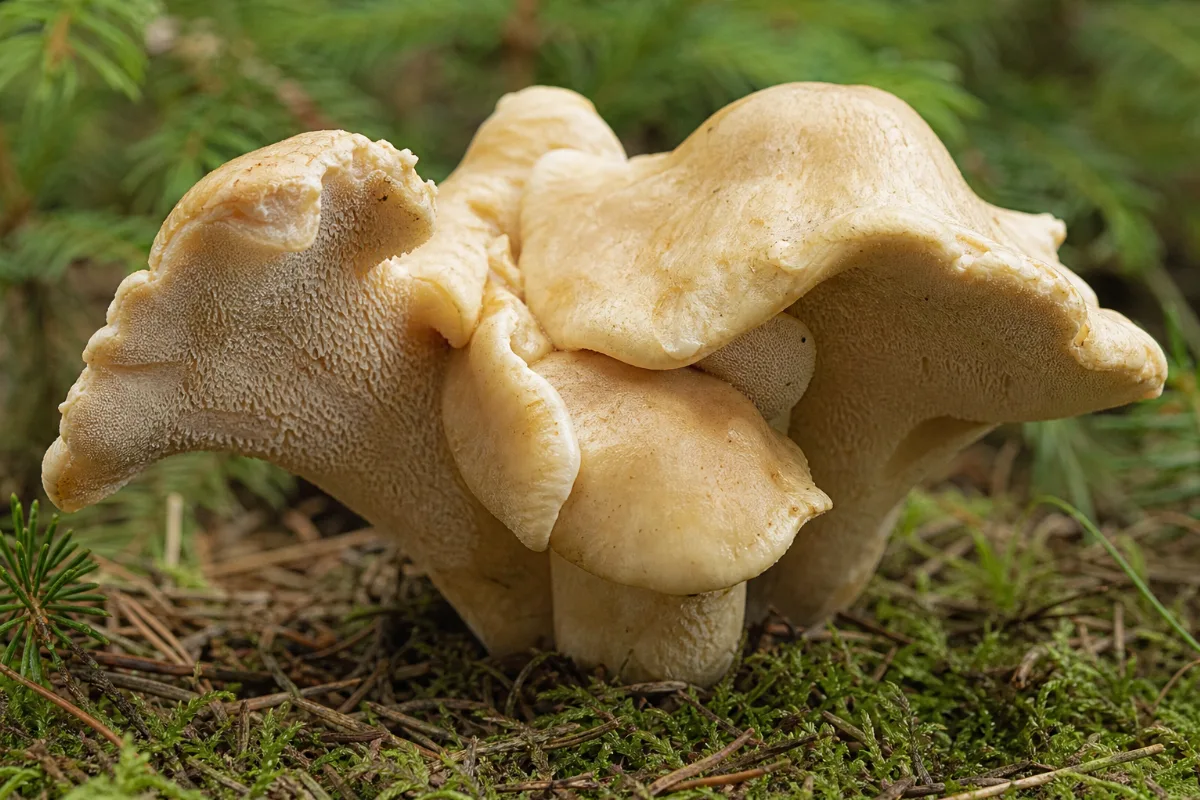
Mushrooms · Wild culinary mushroom
Sheep polypore
Albatrellus ovinus · also called Sheep polypore, Scutiger ovinus, fårticka (Swedish)
Sheep polypore is a wild mushroom eaten in parts of northern Europe. We found no human trial showing a health benefit from eating it or taking it as a supplement. Lab work has studied compounds from it, and one skin-cream study used an extract. Its close relative Albatrellus subrubescens is described by Wikipedia as mildly toxic and hard to tell apart, so never eat a wild mushroom unless an expert has identified it in person.
General information, not medical advice. Last substantive update · Not medically reviewed. A named clinician has not signed off on this page. How this page is made
About Sheep polypore
Sheep polypore is a wild, fleshy mushroom eaten in parts of northern Europe. Chemists have studied its compounds, but we found no human trial of eating it. The practical points are cooking it thoroughly, not eating a wild mushroom you cannot have identified in person, and the caesium and metals that wild mushrooms can carry.
Radioactive caesium and metals
A review quoting Finnish work (600 mushroom samples from 2000 to 2005, between 10 and 3,000 Bq per kg of caesium-137) placed sheep polypore, under its older name Scutiger ovinus, in the low group. That is relative to other mushrooms, quoted second-hand, and depends on where it grew. In an older report summarised in a 2022 paper, boiling it for 10 minutes removed about 46% of the caesium.
In ten species from unpolluted areas around Umea in Sweden, including sheep polypore, median cadmium ranged from 0.46 to 5.1 mg per kg dry weight and lead from 0.91 to 6.2; the abstract does not give the sheep polypore value alone. A 1995 survey found a mean of 0.72 mg nickel per kg fresh weight in sheep polypore, higher than in other species tested.
What it is
Sheep polypore is a fungus, Albatrellus ovinus, in the family Albatrellaceae. GBIF lists the name as accepted and Scutiger ovinus as an older name. A 2019 paper describes it as a large, dense mushroom rich in cell-wall material. It is wild-collected; we read no source on growing it.
Food use and traditional use
A Swedish survey lists it among mushrooms people collect, and one respondent recalled using it in wartime in a dish resembling pickled herring. Wikipedia cites a Finnish study for its commercial sale in Finland, which we did not open. We found no traditional medicine use in the sources we read.
What the research shows on benefits
The research is mostly chemistry. Two compounds beat vitamin E and the preservative BHA in a chemical antioxidant test. Grifolin-type compounds blocked a heat-and-pain receptor (TRPV1) in the lab, and a cream with 3% extract reduced irritation in volunteers; the abstract gives no group size and the authors work for a cosmetics-ingredient company. Beta-glucan particles bound an immune receptor in reporter cells. One pigment was weakly toxic to four tumour cell lines in a dish. None of this was tested in people eating the mushroom, and none shows a health benefit.
At a glance
Traditional uses history, not proof
- Eaten as a wild mushroom in Sweden and Finland (a 2019 Swedish survey lists it; Wikipedia cites a Finnish study for commercial sale).
- No traditional medicine use was confirmed in the sources we read.
Studied for research
- Test-tube antioxidant activity of two purified compounds, insufficient evidence
- Sensitive skin: a 3% extract cream in one industry-linked study, very low certainty
- Immune receptor binding of beta-glucan in cells, insufficient evidence
- Cancer cell toxicity of one pigment in a dish, insufficient evidence
Main compounds
- Grifolin and neogrifolin derivatives
- Scutigeral
- Meroterpenoid pigments such as confluentin
- Beta-glucans, alpha-glucan and a fucogalactan (cell-wall sugars)
Common forms
- Fresh, thoroughly cooked mushroom
- Skin-cream extract (one study only)
- Powder, extract or capsule (not assessed in the sources we read)
Research links: Skin receptor study with a 3% extract cream (abstract) · Antioxidant compounds from the mushroom (abstract) · Beta-glucan particles and the dectin-1a receptor (abstract) · Mouse feeding study of edible wild mushrooms (abstract) · Metals in mushrooms around Umea, Sweden (abstract) · Minerals and radionuclides in mushrooms, review · Research Library · Genes & Biomarkers Library
What it is and its history
- Accepted scientific name
- Albatrellus ovinus
- Naming authority
- (Schaeff.) Kotl. & Pouzar (GBIF)
- Synonyms
- Scutiger ovinus (Schaeff.) Murrill (GBIF homotypic synonym); Polyporus ovinus Schaeff.; Boletus ovinus Schaeff.; Caloporus ovinus (Schaeff.) Quel.
- Common names
- Sheep polypore (English); Fårticka (Swedish)
- Family or group
- Albatrellaceae (a fungus family), not a plant
- Classification
- Fungi > Basidiomycota > Agaricomycetes > Russulales > Albatrellaceae > Albatrellus > Albatrellus ovinus
- Native range
- Not checked. Studies we read come from Sweden, Finland and Japan.
- Habitat
- Not described in the papers read.
- What it looks like
- Fruiting body: Not described here. A 2019 paper calls it a large, dense mushroom rich in cell-wall material. Identification of wild mushrooms must be done in person by an expert.
- Cultivation
- Wild-collected in all sources read; no cultivation source was read.
- Harvest and processing
- Eaten cooked; boiling removed about 46% of radiocaesium in one old report (see Safety).
- Look-alikes and adulterants
- Name: Albatrellus subrubescens; Note: Wikipedia calls it mildly toxic (stomach and bowel illness, usually over within one to four hours) and says it is hard to separate from sheep polypore in the field. Another page calls it inedible and a Finnish guide cited there treats it as edible but rare, so sources disagree. Secondary sources only.; Name: Other similar polypores; Note: Wikipedia lists Albatrellus flettii, Jahnoporus hirtus, Scutiger ellisii and S. pes-caprae as similar. No poisoning is stated for them in the page read.
- Sustainability and conservation
- Not checked.
Traditional use and history history, not clinical proof
| Tradition or era | Documented use | Source |
|---|---|---|
| Food use in Sweden | A Swedish survey lists the mushroom among those people collect; one respondent recalled parents using it in wartime in a dish resembling pickled herring. | p31426821 |
| Commercial food use in Finland | Wikipedia cites a Finnish study for the species being sold commercially in Finland. We did not open that study. | s-wiki-albatrellus-ovinus |
Traditional use shows how it was used. It does not show that it works or is safe today.
What is inside, and how it may work
What it contains and how those compounds act in cells and animals. Laboratory and animal mechanisms are not proven effects in people.
Main compounds
| Compound | Family | Where it is concentrated | Activity studied | Level of evidence |
|---|---|---|---|---|
| Grifolin and neogrifolin derivatives | meroterpenoids (grifolin type) | Fruiting body Not given in the abstracts. | Two derivatives were stronger antioxidants than vitamin E or BHA in a chemical test; grifolin derivatives blocked the TRPV1 receptor in the lab and on skin. 12 5 | Laboratory research |
| Scutigeral | triprenyl phenol | Fruiting body Not given. | Bound vanilloid receptors in rat tissue; not pungent on the human tongue at a tiny amount. 15 | Laboratory research |
| Confluentin and albatrelins | meroterpenoid pigments | Fruiting body Not given. | Confluentin was weakly toxic to four human tumour cell lines. 8 | Laboratory research |
| Cell-wall polysaccharides (fucogalactan, alpha-glucan, beta-glucans) | polysaccharides | Fruiting body Not given in the abstract. | Beta-glucan particles bound the dectin-1a receptor in reporter cells like yeast glucan. 13 1 | Laboratory research |
Mechanisms, receptors and pathways
| Target or pathway | Gene or receptor | What was found | Level |
|---|---|---|---|
| TRPV1 (vanilloid, heat and burning-pain receptor) | TRPV1 | Grifolin derivatives inhibited TRPV1 in vitro and, in a cream, reduced capsaicin and heat irritation in volunteers (abstract). Scutigeral acted on vanilloid receptors in rat tissue. 5 15 | In vitro plus small human skin test |
| Dectin-1a (innate immune receptor) | CLEC7A (dectin-1) | Beta-glucan microparticles bound dectin-1a in reporter cells. 1 | Laboratory research |
Absorption, metabolism and elimination
- Absorption
- Not found for sheep polypore.
- Distribution
- Not found.
- Metabolism
- Not found.
- Elimination
- Not found.
- Bioavailability
- Not established.
Isolated compounds versus whole extracts
Most findings come from purified compounds or fractions, or from a 3% extract in a skin cream, not from the whole cooked mushroom that people eat. They should not be read as effects of eating it.
Nutritional composition
No open source with measured nutrient values for sheep polypore was found. A review notes another Albatrellus species is very high in selenium; no value is given for sheep polypore. Nickel was higher than in other species in one 1995 survey.
1 very low certainty4 not enough evidence
What was looked at
The 5 benefits and uses checked for Sheep polypore, each with how strong the evidence is. Tap one to open it.
What is Sheep polypore good for?
The uses people ask about and how strong the human evidence is for each. None is proven for sheep polypore. Read this together with the Safety tab.
Benefits, one by one
Each card is a research question, not a promise. Tap a goal to filter. Open a card to see the studies, doses and limits.
Food use and nutrition
Not enough evidenceSheep polypore is a wild mushroom eaten in northern Europe, for example in Sweden and Finland. We found no measured nutrient figures for it and no study of a health benefit from eating it. Its main chemistry papers describe its cell-wall sugars.
2 studiesEaten as a cooked wild mushroom. No supplement was assessed.
Studies, doses and limits
What the trials found
No human trial of eating sheep polypore was found.
Results
Chemistry papers identify the sugars in its cell wall. No open source with measured vitamin, mineral or protein values for the mushroom was found.
Why this rating
Food use is documented, but no study measured any health effect of eating it.
Form and dose studied
Eaten as a cooked wild mushroom. No supplement was assessed.
Who was studied
General food use
Limits
Wild samples vary by place. Our search was not exhaustive.
Why researchers looked
Mostly studied as a wild food and as a source of unusual compounds.
Traditional use
A Swedish survey lists it among mushrooms people collect, and one respondent recalled it being used in wartime in a dish resembling pickled herring.
Proposed mechanism Compositional analysis
Not applicable: this is a food-use fact. A 2019 paper describes a mushroom rich in cell-wall material with a fucogalactan, an alpha-glucan and two kinds of beta-glucan.
A proposed mechanism does not show that the effect happens in people.
Wild mushrooms cannot be told apart safely from text; see the Safety tab. Eaten raw or undercooked it is not advised.
Antioxidant activity in the test tube
Not enough evidenceTwo compounds purified from a Japanese sheep polypore were stronger antioxidants than vitamin E or the food preservative BHA in one chemical test. This is test-tube work on purified compounds. It does not show a benefit from eating the mushroom.
1 studiesPurified compounds in the lab. Not the mushroom as eaten.
Studies, doses and limits
Results
3-hydroxyneogrifolin and 1-formyl-3-hydroxyneogrifolin were more potent than alpha-tocopherol or BHA in the assay used.
Why this rating
Chemical test on isolated compounds only; no cell, animal or human outcome.
Form and dose studied
Purified compounds in the lab. Not the mushroom as eaten.
Limits
Abstract read only. Antioxidant assays are chemical tests and do not predict a benefit in the body.
Why researchers looked
Researchers screen mushroom compounds for antioxidant activity as a first look.
Proposed mechanism Laboratory research
Grifolin-type compounds (neogrifolin derivatives) were isolated and tested in a chemical antioxidant assay.
A proposed mechanism does not show that the effect happens in people.
None specific.
Sensitive skin (cream, skin receptor)
Very low certaintyGrifolin-type compounds from sheep polypore blocked the TRPV1 receptor, a sensor for heat and burning pain, in the lab. Creams with 3% extract reduced stinging, burning and redness in volunteers whose skin was irritated with capsaicin or heat. The study was written by people working for a cosmetics-ingredient company, and the abstract does not give the number of volunteers.
2 studiesCosmetic formulations containing 3% extract applied to the skin.
Studies, doses and limits
What the trials found
One skin-cream study with volunteers (labelled a randomised controlled trial in PubMed); group size and design not seen in the abstract. It says nothing about eating the mushroom.
Results
Reported reduction of stinging and burning sensations, reddening and microcirculation after irritation. No numbers are given in the abstract.
Effect sizes as reported
Not given in the abstract
Why this rating
One industry-linked study seen only as an abstract; numbers, size and controls unknown; applied to skin, not eaten.
Form and dose studied
Cosmetic formulations containing 3% extract applied to the skin.
Who was studied
Volunteers with skin irritated by capsaicin or heat (size unknown)
Limits
Industry-linked (RAHN AG). Abstract only. Not replicated in what we found.
Why researchers looked
Blocking TRPV1 is one idea for calming sensitive skin.
Proposed mechanism In vitro plus human skin test
Grifolin derivatives inhibited the TRPV1 receptor in cell assays and on skin irritated with capsaicin or heat. A 1999 paper on a related compound, scutigeral, found it bound vanilloid receptors in rat tissue and was not pungent on the human tongue at a tiny amount.
A proposed mechanism does not show that the effect happens in people.
No skin-reaction data were read. This is not advice to apply the mushroom to skin.
Immune receptor binding (beta-glucan)
Not enough evidenceParticles made from the mushroom's beta-glucan bound a human immune receptor, dectin-1a, in engineered reporter cells about as well as particles made from baker's yeast. That is a cell result. No animal or human immune test was found.
2 studiesA purified fraction in the lab, not the mushroom as eaten.
Studies, doses and limits
Results
Binding to dectin-1a equalled baker's-yeast beta-glucan particles.
Why this rating
Cell work with a chemically treated purified fraction; no animal or human outcome.
Form and dose studied
A purified fraction in the lab, not the mushroom as eaten.
Limits
Abstract read only. Receptor binding in cells does not show an immune benefit.
Why researchers looked
Fungal beta-glucans are studied for activating parts of the innate immune system.
Proposed mechanism Laboratory research
Beta-glucan was dissolved in sodium hydroxide, precipitated into 0.5 to 2 micrometre particles and tested on HEK-Blue reporter cells.
A proposed mechanism does not show that the effect happens in people.
People on immune-suppressing medicines should ask a pharmacist before taking mushroom products; see the Safety tab.
Cancer cell findings (lab only)
Not enough evidenceOne pigment from sheep polypore, confluentin, was weakly toxic to four types of human tumour cells in a dish. We read no animal or human study of this mushroom. This is lab work and says nothing about treating cancer.
1 studiesPurified compound in the lab.
Studies, doses and limits
Results
Confluentin showed weak cytotoxicity against HL-60, SMMC-7712, A-549 and MCF-7 cells.
Why this rating
Cell-line screen of one purified compound; no animal or human data.
Form and dose studied
Purified compound in the lab.
Limits
Abstract read only. Cell toxicity is not a treatment.
Why researchers looked
Researchers test purified fungal compounds on cancer cell lines as a first screen.
Proposed mechanism Laboratory research
Cell-line toxicity of an isolated compound.
A proposed mechanism does not show that the effect happens in people.
A cell-toxic compound can also be toxic to healthy cells; a water extract of the whole mushroom also tested toxic in one cell test (see Safety tab).
Connections to the rest of health
How Sheep polypore connects to the rest of our health knowledge graph. Every link says what kind of connection it is. A safety link (for example to the liver) is a warning, not a benefit. A study that merely mentions a topic never creates a benefit link.
Explore every connection: goals, body systems, organs, symptoms, genes
A. Wellness goals
| Connected to | Kind of connection | Evidence status | Context | Studies |
|---|---|---|---|---|
| Immune Support | Preliminary mechanism | Not enough evidence | Immune receptor binding (beta-glucan): Particles made from the mushroom's beta-glucan bound a human immune receptor, dectin-1a, in engineered reporter cells about as well as particles made from baker's yeast. That is a cell result. No animal or human immune test was found. | 1 13 |
B. Body systems
E. Health conditions
| Connected to | Kind of connection | Evidence status | Context | Studies |
|---|---|---|---|---|
| Mushroom poisoning | Adverse effect or risk | Not enough evidence | Secondary sources only; no peer-reviewed case found. Preparation or compound: Look-alike relative Albatrellus subrubescens |
16 |
F. Functional actions
| Connected to | Kind of connection | Evidence status | Context | Studies |
|---|---|---|---|---|
| Antioxidant | Biological association | Not enough evidence | Test-tube assay only. Preparation or compound: Purified neogrifolin derivatives |
12 |
G. Root causes and contributing factors
| Connected to | Kind of connection | Evidence status | Context | Studies |
|---|---|---|---|---|
| Environmental toxins | Low certainty | Low caesium group in Finnish samples; cadmium and nickel reported in Swedish surveys. Preparation or compound: Wild sheep polypore (caesium, metals) |
2 9 7 |
L. Active compounds
| Connected to | Kind of connection | Evidence status | Context | Studies |
|---|---|---|---|---|
| Grifolin and neogrifolin derivatives | Biological association | In vitro | Two derivatives were stronger antioxidants than vitamin E or BHA in a chemical test; grifolin derivatives blocked the TRPV1 receptor in the lab and on skin. Preparation or compound: Fruiting body |
12 5 |
| Scutigeral | Biological association | In vitro | Bound vanilloid receptors in rat tissue; not pungent on the human tongue at a tiny amount. Preparation or compound: Fruiting body |
15 |
| Confluentin and albatrelins | Biological association | In vitro | Confluentin was weakly toxic to four human tumour cell lines. Preparation or compound: Fruiting body |
8 |
| Cell-wall polysaccharides (fucogalactan, alpha-glucan, beta-glucans) | Biological association | In vitro | Beta-glucan particles bound the dectin-1a receptor in reporter cells like yeast glucan. Preparation or compound: Fruiting body |
13 1 |
Each connection is stored with the ingredient, the connected record, the kind of connection, the evidence status, the supporting studies, the preparation or compound involved, and a review date (last reviewed October 25, 2026).
Evidence at a glance: what the research found for 5 outcomes
Each outcome below is one thing researchers measured. Certainty is how far the evidence can be trusted, not how well it works. The full studies are on the next tab.
The evidence
The research centre for Sheep polypore. Every record here was checked against PubMed or the publisher's page; we never list a study we have not verified.
Evidence by outcome
Bars show how many studies we found for each outcome, not how well it works. People are added up across trials only (reviews are not added, to avoid double counting).
How we rate evidence
High certainty
Several well-run trials or reviews agree; further research is unlikely to change the picture much.
Moderate certainty
Good trials point the same way, but some doubt remains.
Low certainty
Small, short or inconsistent trials. The finding could change with better research.
Very low certainty
Very little or very weak human data. Treat as a possibility only.
Mixed findings
Trials or reviews disagree with each other.
Not enough evidence
Not enough human research to say either way.
Evidence against
Good research found no benefit, or found harm.
We take the reviewers' own risk-of-bias and GRADE statements where they exist, and otherwise judge from study size, design, consistency, directness and whether a product matches what is sold. Many publications do not make evidence high. Method note: We read PubMed records for 11 papers: abstracts for nine (compound chemistry, a skin study, a mouse study and two element surveys), and searched the open full text of five papers for the sheep polypore passages. We checked the name in GBIF and read two Wikipedia pages for edibility and relatives, which are secondary sources. Index Fungorum, EFSA, FDA and poison-centre statements were not read. Certainty ratings are the compiler's own reading.
Study library: every study we checked 17
| Study | Design | People | Product, dose, length | Result |
|---|---|---|---|---|
| Ellefsen 2023 Preparation of Albatrellus ovinus beta-Glucan Microparticles with Dectin-1a Binding Properties. ACS Applied Bio Materials · PMID 37075203 · DOI |
Laboratory chemistry fungus (purified fraction) |
HEK-Blue reporter cells | Microparticles made from alkali-soluble beta-glucan of the mushroom fruiting body Not shown here |
Precipitating the glucan from sodium hydroxide gave particles of 0.5 to 2 micrometres. They bound dectin-1a in reporter cells to the same extent as baker's-yeast beta-glucan particles. Receptor binding in engineered cells, equal to yeast glucan. Methods, limits and fundingOutcomes: Particle size; binding to the dectin-1a immune receptor Limitations: A purified, chemically treated fraction in cells. Nothing was given to animals or people. Abstract read only. Funding and conflicts: Authors declare no competing financial interest Read: abstract |
| Falandysz 2013 Macro and trace mineral constituents and radionuclides in mushrooms: health benefits and risks. Applied Microbiology and Biotechnology · PMID 23179616 · DOI |
Narrative review n/a |
Literature review | n/a Not shown here |
The review quotes Finnish work (Kostiainen 2007): 600 mushroom samples collected 2000 to 2005 held 10 to 3,000 Bq per kg of caesium-137, with low levels in Leccinum, Gyromitra and Scutiger ovinus (the older name of the sheep polypore), medium in king bolete, chanterelle and Russula, and high in some others. Sheep polypore placed in the low caesium-137 group in Finland. Methods, limits and fundingOutcomes: Radiocaesium and minerals in mushrooms Limitations: Second-hand: the finding is quoted from another paper, which was not opened. Applies to Finnish samples of 2000 to 2005; 'low' is relative to other species. Funding and conflicts: Not checked Read: full text (searched for Albatrellus and Scutiger) |
| Falandysz 2022 Effect of drying, blanching, pickling and maceration on the fate of 40K, total K and 137Cs in bolete mushrooms and dietary intake. Environmental Science and Pollution Research · PMID 34338984 · DOI |
Narrative review section n/a |
Literature summary inside a bolete study | n/a Not shown here |
The paper summarises an older report (Stijve 1994): a batch blanched for 10 minutes lost 51% of radiocaesium, while Albatrellus ovinus under the same conditions lost 46%. Frozen and dried mushrooms and salted water extracted more caesium. About 46% of radiocaesium lost from A. ovinus in one blanching test in an older report. Methods, limits and fundingOutcomes: Caesium-137 lost when blanching Limitations: Second-hand: the 1994 report was not opened. One test; not a safety guarantee. The paper is mainly about boletes. Funding and conflicts: Not checked Read: full text (searched for Albatrellus) |
| GBIF 2026 GBIF Backbone Taxonomy: Albatrellus ovinus (Schaeff.) Kotl. & Pouzar (key 2551823), checked 2026-10-25 GBIF API · Source |
Taxonomy record n/a |
n/a | n/a Not shown here |
GBIF returns Albatrellus ovinus (Schaeff.) Kotl. & Pouzar as ACCEPTED, kingdom Fungi, phylum Basidiomycota, class Agaricomycetes, order Russulales, family Albatrellaceae. Synonyms include Scutiger ovinus (Schaeff.) Murrill, Polyporus ovinus, Boletus ovinus and Caloporus ovinus. Methods, limits and fundingOutcomes: Accepted name and synonyms Limitations: A database record; Index Fungorum was not checked. Funding and conflicts: Public database Read: record |
| Hettwer 2017 Grifolin derivatives from Albatrellus ovinus as TRPV1 receptor blockers for cosmetic applications. International Journal of Cosmetic Science · PMID 27883196 · DOI |
Lab plus human skin test (labelled randomized controlled trial in PubMed) fungus extract (skin) |
In vitro assays, then volunteers with skin irritated by capsaicin or heat (group size not shown in the abstract) | Cosmetic formulations containing 3% Albatrellus ovinus extract applied to the skin fruiting body extract (applied to skin) 3% extract in the formulation (as stated in the abstract) |
Grifolin derivatives inhibited the TRPV1 receptor in vitro and in vivo. Creams with 3% extract reduced stinging and burning sensations, reddening and microcirculation after irritation with capsaicin or heat. Reported as reduced; no numbers in the abstract. Methods, limits and fundingOutcomes: TRPV1 receptor inhibition; skin reddening, microcirculation, stinging and burning sensations, heat pain threshold Limitations: Abstract only: number of volunteers, design details and statistics not seen. Skin cream, not food. The authors work at RAHN AG, a company that makes cosmetic ingredients, so this is industry-linked. Funding and conflicts: Industry-linked: authors are employed by RAHN AG (Zurich) Read: abstract |
| Hintikka 2024 Toxicity Screening of Fungal Extracts and Metabolites, Xenobiotic Chemicals, and Indoor Dusts with In Vitro and Ex Vivo Bioassay Methods. Pathogens · PMID 38535560 · DOI |
Laboratory survey fungus (water extract in cell tests) |
46 46 forest mushroom species, tested with two cell-based assays |
Water extracts of thawed fruiting bodies, boar sperm motility test (BSMI) and cell-proliferation test (ICP) fruiting body Not shown here |
Of 22 edible-classified mushrooms, Albatrellus ovinus, Leccinum scabrum and Leccinum versipelle were toxic in the cell tests. For A. ovinus the result was toxic in the ICP (cell proliferation) assay only; it was not toxic in the sperm-motility assay. Overall 18% of edible-classified species were toxic against 100% of poisonous-classified species. Toxic in one of two cell tests. Methods, limits and fundingOutcomes: Toxicity in the two bioassays Limitations: Cell and sperm tests do not show harm from cooking and eating a mushroom. Full text read only for the A. ovinus lines and the summary. Funding and conflicts: Not checked Read: full text (searched for Albatrellus) |
| Jorhem 1995 Levels of some trace elements in edible fungi. Zeitschrift fur Lebensmittel-Untersuchung und -Forschung · PMID 8525697 · DOI |
Laboratory survey fungus (wild survey) |
Edible fungi from Sweden (a number of species) | Wild fruiting bodies analysed for several trace elements fruiting body Not shown here |
Nickel was at or below 0.1 mg per kg fresh weight in all species except Albatrellus ovinus, which had a mean of 0.72 mg per kg. The authors note large differences in the same metal in the same species between surveys. Nickel higher in A. ovinus than other species in this survey. Methods, limits and fundingOutcomes: Lead, cadmium, nickel and other elements Limitations: Old survey (1995); abstract read only; no health outcome. Place of collection is not stated in the abstract. Funding and conflicts: Not stated in the abstract Read: abstract |
| Liu 2013 Meroterpenoid pigments from the basidiomycete Albatrellus ovinus. Journal of Natural Products · PMID 23305465 · DOI |
Laboratory chemistry fungus (isolated compounds) |
Compounds isolated from Albatrellus ovinus | Isolated grifolin derivatives fruiting body Not shown here |
Eight grifolin derivatives were isolated, including six new ones (albatrelins A to F) and confluentin. Confluentin showed weak cytotoxicity against four human tumour cell lines (HL-60, SMMC-7712, A-549, MCF-7) in vitro. Weak cell toxicity of one pigment; no animal or human data. Methods, limits and fundingOutcomes: Structures of new compounds; cytotoxicity Limitations: Lab work on purified compounds. Abstract read only; no figures given in the abstract. Funding and conflicts: Not stated in the abstract Read: abstract |
| Medyk 2017 Bio- and toxic elements in mushrooms from the city of Umea and outskirts, Sweden. Journal of Environmental Science and Health B · PMID 28494204 · DOI |
Laboratory survey fungus (wild survey) |
10 edible mushroom species including Albatrellus ovinus from unpolluted areas around Umea, northern Sweden | Wild fruiting bodies, atomic absorption spectroscopy fruiting body Not shown here |
Across the ten species, median cadmium was 0.46 to 5.1, lead 0.91 to 6.2 and silver 0.12 to 3.9 mg per kg dry weight. The authors say the species mattered most. Their estimated cadmium intake from a single mushroom meal was only slightly below a revised tolerable weekly intake. Species-by-species values for A. ovinus are not given in the abstract. Methods, limits and fundingOutcomes: Cadmium, lead, silver and essential minerals Limitations: The abstract gives ranges across ten species, not the sheep polypore alone. Abstract read only. Funding and conflicts: Not stated in the abstract Read: abstract |
| Nieminen 2006 Suspected myotoxicity of edible wild mushrooms. Experimental Biology and Medicine · PMID 16446499 · DOI |
Animal study Mus musculus (mice) |
86 86 mice, fed for 5 days |
Dried edible mushrooms (Russula spp., Cantharellus cibarius, Albatrellus ovinus, Leccinum versipelle) mixed into the diet fruiting body 3, 6 or 9 g per kg body mass per day (mice) |
Plasma creatine kinase rose with every mushroom species studied at 9 g per kg body mass per day. The microscope appearance of muscle and liver was unaffected. Muscle-enzyme rise at the highest amount only. Methods, limits and fundingOutcomes: Plasma creatine kinase (a muscle enzyme); muscle and liver appearance under the microscope Limitations: Mouse study at very large feeding amounts; the authors say it probably needs individual sensitivity and a significant amount of mushroom. Not shown to apply to normal human eating. Abstract read only. Funding and conflicts: Not stated in the abstract Read: abstract |
| Nieminen 2020 Toxic Potential of Traditionally Consumed Mushroom Species - A Controversial Continuum with Many Unanswered Questions. Toxins · PMID 33023182 · DOI |
Narrative review n/a |
Literature review | n/a Not shown here |
The open full text repeats the mouse finding: dried Albatrellus ovinus among several species fed to mice raised plasma creatine kinase at 9 g per kg body mass per day, while muscle and liver looked unchanged under the microscope. Narrative summary of the 2006 mouse study. Methods, limits and fundingOutcomes: Toxic potential of traditionally eaten mushrooms Limitations: A narrative review, not a new study. Full text read only for the A. ovinus passage. Funding and conflicts: Not checked Read: full text (searched for Albatrellus) |
| Nukata 2002 Neogrifolin derivatives possessing anti-oxidative activity from the mushroom Albatrellus ovinus. Phytochemistry · PMID 11909630 · DOI |
Laboratory chemistry fungus (isolated compounds) |
Compounds isolated from a Japanese Albatrellus ovinus | Isolated grifolin-type compounds fruiting body Not shown here |
Three neogrifolin derivatives plus grifolin and neogrifolin were isolated. Two of them, 3-hydroxyneogrifolin and 1-formyl-3-hydroxyneogrifolin, were more potent antioxidants than alpha-tocopherol (a form of vitamin E) or BHA (a food preservative) in the assay used. Two isolated compounds beat vitamin E and BHA in a chemical test; not tested in cells, animals or people. Methods, limits and fundingOutcomes: Antioxidant activity of isolated compounds Limitations: Test-tube chemistry on purified compounds, not the whole mushroom. Abstract read only; assay details not seen. Funding and conflicts: Not stated in the abstract Read: abstract |
| Samuelsen 2019 The edible mushroom Albatrellus ovinus contains a alpha-L-fuco-alpha-D-galactan, alpha-D-glucan, a branched (1-6)-beta-D-glucan and a branched (1-3)-beta-D-glucan. Carbohydrate Research · PMID 30412830 · DOI |
Laboratory chemistry fungus |
Polysaccharides extracted from the mushroom | Hot-water and hot-alkali extracts fruiting body Not shown here |
The abstract describes the sheep polypore as a large, dense mushroom rich in cell-wall material and identifies a fucogalactan, an alpha-glucan and two kinds of beta-glucan. Structure only; no activity tested in the abstract. Methods, limits and fundingOutcomes: Structure of the sugars in the cell wall Limitations: Describes chemistry only. Abstract read only. Funding and conflicts: Not stated in the abstract Read: abstract |
| Svanberg 2019 Mushroom hunting and consumption in twenty-first century post-industrial Sweden. Journal of Ethnobiology and Ethnomedicine · PMID 31426821 · DOI |
Survey ethnobiology n/a |
Swedish survey of mushroom pickers | n/a Not shown here |
The sheep polypore (fårticka in Swedish) is on the list of species the respondents reported collecting. One respondent recalled that their parents, in the war years, used fårticka and Hydnum in a dish that looked like pickled herring. Shows food use in Sweden; says nothing about health effects. Methods, limits and fundingOutcomes: Which mushrooms people in Sweden pick and eat Limitations: Survey of habits; not a safety or health study. Full text read only for the A. ovinus lines. Funding and conflicts: Not checked Read: full text (searched for Albatrellus) |
| Szallasi 1999 A non-pungent triprenyl phenol of fungal origin, scutigeral, stimulates rat dorsal root ganglion neurons via interaction at vanilloid receptors. British Journal of Pharmacology · PMID 10217528 · DOI |
Laboratory animal tissue fungus (isolated compound) / rat tissue |
Rat spinal cord membranes and rat sensory neurons; human tongue test | Scutigeral, isolated from Albatrellus ovinus fruiting body (isolated compound) Not shown here |
Scutigeral bound vanilloid receptors (Ki 19 micromolar) and stimulated rat neurons. It was not pungent on the human tongue up to 100 nanomoles per tongue. It acted like capsaicin in the lab but did not burn the tongue at the amount tried. Methods, limits and fundingOutcomes: Binding to vanilloid (capsaicin) receptors; nerve cell responses; pungency Limitations: Isolated compound in rat tissue; the tongue test was a tiny amount, not eating the mushroom. Abstract read only. Funding and conflicts: Not stated in the abstract Read: abstract |
| Wikipedia contributors 2026 Wikipedia: Albatrellus subrubescens (read 2026-10-25) Wikipedia · Source |
Encyclopedia page n/a |
n/a | n/a Not shown here |
The page calls Albatrellus subrubescens mildly toxic, causing a stomach and bowel illness that usually clears within one to four hours (citing a 2009 source), and says the two species are hard to separate in the field and share the compound scutigeral. A Finnish field guide it cites treats A. subrubescens as edible but rare, so sources disagree. Methods, limits and fundingOutcomes: Toxicity and confusion with A. ovinus Limitations: A secondary, user-edited source; the cited books were not opened. Sources disagree on this relative's edibility. Funding and conflicts: n/a Read: page text |
| Wikipedia contributors 2026 Wikipedia: Albatrellus ovinus (read 2026-10-25) Wikipedia · Source |
Encyclopedia page n/a |
n/a | n/a Not shown here |
The page says the mushroom may be edible if cooked thoroughly, but is typically slimy and may have a laxative effect, and that some guides do not recommend eating it. It names Albatrellus subrubescens as a close relative called inedible, and lists A. flettii, Jahnoporus hirtus, Scutiger ellisii and S. pes-caprae as similar. It does not describe any Albatrellus species as poisonous. Methods, limits and fundingOutcomes: Edibility and similar species Limitations: A secondary, user-edited source, not a regulator or a peer-reviewed paper. Used only because no better source was found. Funding and conflicts: n/a Read: page text |
What we do not know yet
- No human trial of eating sheep polypore or taking it as a supplement was found.
- No peer-reviewed poisoning report was found for sheep polypore or its relative Albatrellus subrubescens; the look-alike statement rests on encyclopedia pages that disagree.
- No regulator or poison-centre statement was read.
- The Finnish caesium finding and the blanching result are quoted second-hand from older reports.
- No data on allergy, pregnancy, breastfeeding, children or medicine interactions.
How new research is added
New studies are found by a saved PubMed search and placed in a review queue. A person reads each one before it changes any evidence rating or safety wording. New publications never change ratings automatically.
Lab markers
What changed in blood or saliva tests during trials. A changed number is not the same as feeling or being healthier, and we give no "normal ranges".
Safety
What studies and official sources say about side effects, medicines and who should check first. Each point shows what kind of evidence it comes from.
Main points to know 3
- Never eat a wild mushroom you have not had identified in person by an expert. Sheep polypore has close relatives. One of them, Albatrellus subrubescens, is described in a Wikipedia article as mildly toxic, causing a stomach and bowel illness that usually clears within one to four hours, and as hard to separate from sheep polypore in the field. Another encyclopedia page calls that relative inedible, while a Finnish guide cited by Wikipedia treats it as edible but rare, so sources disagree. These are secondary sources; we found no peer-reviewed poisoning report. Text and apps cannot identify a wild mushroom. Secondary source 16 17
- Cook it thoroughly; it may loosen the bowels. Wikipedia says the mushroom may be edible if cooked thoroughly, but may have a laxative effect, and that some guides do not recommend it. We found no clinical report on this, so treat it as a caution from a secondary source. Secondary source 17
- Radioactive caesium: low for a wild mushroom in Finland, still place-dependent. A review quoting Finnish measurements from 2000 to 2005 placed sheep polypore (under its older name Scutiger ovinus) in the low caesium-137 group, among samples that ran from 10 to 3,000 Bq per kg overall. 'Low' is relative to other mushrooms and applies to those samples; levels depend on where it grew. In an older report quoted second-hand, boiling for 10 minutes removed about 46% of caesium from it. Review quoting survey 2 3
Side effects 3
| Effect | How often | Severity and recovery | Evidence |
|---|---|---|---|
| Loose bowels or stomach upset Only a secondary source mentions a possible laxative effect. No clinical report was found. | Not measured | Not stated in the sources Not stated | Secondary source 17 |
| Raised muscle enzyme in mice at very high feeding amounts The authors link this to individual sensitivity and a significant amount of mushroom, and found the same with several other edible species. Not shown to apply to normal human eating. | Seen in mice fed 9 g per kg body mass per day for 5 days | Muscle and liver looked unchanged under the microscope Not studied | Animal study 10 11 |
| Toxic result in a cell-growth test A water extract of the mushroom was toxic in the cell-proliferation assay only. Cell tests do not show harm from cooking and eating it. Two other edible mushrooms (Leccinum species) were also toxic in cell tests. | Toxic in 1 of 2 cell-based tests (cell growth, not the sperm test) | Not applicable Not applicable | Laboratory research 6 |
Liver
No liver injury from sheep polypore was found in the sources read. In the mouse study, liver tissue looked unchanged under the microscope. A mouse muscle-enzyme rise is not liver injury. LiverTox was not searched for this mushroom. 10
Monitoring. No routine monitoring is suggested by the sources read. Get medical care for severe symptoms after eating wild mushrooms.
This is a safety connection. It is not evidence that Sheep polypore supports liver health.
Medicines and supplements 2
| With | Why it matters | Importance | Evidence | What to do |
|---|---|---|---|---|
| Immune-suppressing medicines (for example after a transplant or for an autoimmune disease) prescription | Beta-glucans from this mushroom bound an immune receptor in reporter cells. | No interaction report exists. This is only a theoretical concern from a cell result; absence of reports is not proof of safety. | Theoretical from in vitro Not enough evidence 1 | Ask a pharmacist or doctor before taking mushroom supplements if you use these medicines. |
| Other prescription and over-the-counter medicines prescription | No interaction report for sheep polypore was found in the sources read. This is absence of evidence. | None found Not enough evidence | Ask a pharmacist if you take regular medicines and plan to eat large amounts of wild mushrooms or use any mushroom product. |
Who should check first 1
| Situation | Advice | Evidence |
|---|---|---|
| Anyone who cannot be sure of the mushroom's identity | Do not eat it. Cooking does not make an unidentified mushroom safe. | Authoritative guidance general 16 |
Overdose, product quality and regulators
Summary. Sheep polypore is a traditionally eaten wild mushroom. In the sources read, the concerns are a possible laxative effect, a mouse muscle-enzyme rise at very large feeding amounts, a toxic cell test, caesium and metals that depend on location, and confusion with relatives.
Animal. Mice fed dried sheep polypore, 3, 6 or 9 g per kg body mass per day for 5 days, had raised plasma creatine kinase at the highest amount, with normal-looking muscle and liver (86 mice across several mushroom species).
Human doses studied. No dose studies. No amounts are advised here.
Genotoxicity. Not read.
Toxic or hazardous parts. Fungus: the fruiting body is eaten.
It is wild-collected, so what it carries depends on soil and place.
Radioactive caesium-137. Finnish samples (2000 to 2005, quoted in a review) put it in the low group. In an old report quoted second-hand, a 10-minute blanch removed about 46% of the caesium; frozen or dried mushrooms and salted water gave better extraction in that report. Levels in contaminated regions were not read for this species. 2 3
Cadmium, lead and silver. In ten edible species, including sheep polypore, from unpolluted areas around Umea in northern Sweden, median cadmium was 0.46 to 5.1 mg per kg dry weight and lead 0.91 to 6.2. The authors estimated that a single mushroom meal could bring cadmium intake only slightly below a tolerable weekly intake. The sheep polypore value alone is not in the abstract. 9
Nickel. In a 1995 Swedish survey, sheep polypore had a mean of 0.72 mg nickel per kg fresh weight, while other species were at or below 0.1. 7
Selenium in the same genus. A review says another species, Albatrellus pes-caprae, is the richest wild mushroom in selenium (about 200 mg per kg dry mass on average) and that several other Albatrellus species are abundant in it. It does not state a value for sheep polypore. 2
When to get medical help
- Severe or repeated vomiting, diarrhoea or belly pain, dizziness, confusion, heavy sweating, dark urine or muscle pain after eating any wild mushroom: get medical help and contact a poison centre. Wheezing, face swelling or hives is an emergency.
If someone may be poisoned or in a crisis, contact a clinician or emergency service straight away. In the US, Poison Control is 1-800-222-1222.
General information only, not medical advice. Ask a clinician or pharmacist before use, especially with medicines, in pregnancy or with a health condition. See the Natural Remedy Safety guide.
Frequently asked questions
What is sheep polypore?
Sheep polypore is Albatrellus ovinus, a wild mushroom eaten in parts of northern Europe. Scutiger ovinus is an older name for it.
Is sheep polypore edible?
Wikipedia says it may be edible if cooked thoroughly, but may loosen the bowels, and some guides do not recommend it. We found no clinical report either way. Never eat a wild mushroom that an expert has not identified in person.
Does sheep polypore have health benefits?
Is there a poisonous look-alike?
Wikipedia describes the close relative Albatrellus subrubescens as mildly toxic, with a stomach and bowel illness usually over within one to four hours, and as hard to separate from sheep polypore. Another page calls it inedible and a Finnish guide it cites calls it edible, so sources disagree. These are encyclopedia sources, not a poison-centre report. Only an expert, in person, can identify a wild mushroom.
Is sheep polypore radioactive?
Wild mushrooms can hold radioactive caesium from old fallout. A review quoting Finnish samples from 2000 to 2005 placed sheep polypore in the low group for caesium-137. Levels depend on where it grew.
Does cooking remove caesium?
In one older report summarised in a 2022 paper, a 10-minute blanch removed about 46% of the caesium from sheep polypore. That is one test, quoted second-hand, and not a safety guarantee.
Does it contain heavy metals?
Is sheep polypore toxic?
Is the skin-cream research proof it works?
No. It is one study, written by people working for a cosmetics-ingredient company, and we read only the abstract, which gives no group size. It tested a cream, not the mushroom as food.
Is it safe in pregnancy, breastfeeding or for children?
No sheep-polypore-specific safety data were found. Ask a clinician about wild mushrooms in these groups.
Does sheep polypore interact with medicines?
No interaction report was found, which is not proof of safety. Its beta-glucans act on an immune receptor in cells, so people on immune-suppressing medicines should ask a pharmacist.
Explore by health goal
Editorial transparency
- Written by
- AlternativeMed editorial team. Research compiled with AI assistance, then checked against PubMed records.
- Medical review
- None. This page has not been reviewed by a physician or pharmacist.
- First published
- 2026-10-25
- Last substantive update
- 2026-10-25
- How we research
- We read PubMed records for 11 papers: abstracts for nine (compound chemistry, a skin study, a mouse study and two element surveys), and searched the open full text of five papers for the sheep polypore passages. We checked the name in GBIF and read two Wikipedia pages for edibility and relatives, which are secondary sources. Index Fungorum, EFSA, FDA and poison-centre statements were not read. Certainty ratings are the compiler's own reading.
- How we rate evidence
- See "How we rate evidence" in the Evidence tab.
- Independence
- No product is promoted on this page. No affiliate links are shown. This page is information, not a recommendation to eat wild mushrooms.
Sources 17
Each source was opened and checked. Where we read only the abstract, it says so. The small numbers in the text point here.
- Ellefsen CF, et al. Preparation of Albatrellus ovinus beta-Glucan Microparticles with Dectin-1a Binding Properties.. ACS Applied Bio Materials. 2023. PMID 37075203. DOI 10.1021/acsabm.3c00071. (abstract)
- Falandysz J, Borovicka J. Macro and trace mineral constituents and radionuclides in mushrooms: health benefits and risks.. Applied Microbiology and Biotechnology. 2013. PMID 23179616. DOI 10.1007/s00253-012-4552-8. (full text (searched for Albatrellus and Scutiger))
- Falandysz J, et al. Effect of drying, blanching, pickling and maceration on the fate of 40K, total K and 137Cs in bolete mushrooms and dietary intake.. Environmental Science and Pollution Research. 2022. PMID 34338984. DOI 10.1007/s11356-021-15523-9. (full text (searched for Albatrellus))
- GBIF. GBIF Backbone Taxonomy: Albatrellus ovinus (Schaeff.) Kotl. & Pouzar (key 2551823), checked 2026-10-25. GBIF API. 2026. (record)
- Hettwer S, et al. Grifolin derivatives from Albatrellus ovinus as TRPV1 receptor blockers for cosmetic applications.. International Journal of Cosmetic Science. 2017. PMID 27883196. DOI 10.1111/ics.12385. (abstract)
- Hintikka T, et al. Toxicity Screening of Fungal Extracts and Metabolites, Xenobiotic Chemicals, and Indoor Dusts with In Vitro and Ex Vivo Bioassay Methods.. Pathogens. 2024. PMID 38535560. DOI 10.3390/pathogens13030217. (full text (searched for Albatrellus))
- Jorhem L, Sundstrom B. Levels of some trace elements in edible fungi.. Zeitschrift fur Lebensmittel-Untersuchung und -Forschung. 1995. PMID 8525697. DOI 10.1007/BF01192723. (abstract)
- Liu LY, et al. Meroterpenoid pigments from the basidiomycete Albatrellus ovinus.. Journal of Natural Products. 2013. PMID 23305465. DOI 10.1021/np300751m. (abstract)
- Medyk M, et al. Bio- and toxic elements in mushrooms from the city of Umea and outskirts, Sweden.. Journal of Environmental Science and Health B. 2017. PMID 28494204. DOI 10.1080/03601234.2017.1318638. (abstract)
- Nieminen P, et al. Suspected myotoxicity of edible wild mushrooms.. Experimental Biology and Medicine. 2006. PMID 16446499. DOI 10.1177/153537020623100213. (abstract)
- Nieminen P, Mustonen AM. Toxic Potential of Traditionally Consumed Mushroom Species - A Controversial Continuum with Many Unanswered Questions.. Toxins. 2020. PMID 33023182. DOI 10.3390/toxins12100639. (full text (searched for Albatrellus))
- Nukata M, et al. Neogrifolin derivatives possessing anti-oxidative activity from the mushroom Albatrellus ovinus.. Phytochemistry. 2002. PMID 11909630. DOI 10.1016/s0031-9422(02)00050-x. (abstract)
- Samuelsen ABC, et al. The edible mushroom Albatrellus ovinus contains a alpha-L-fuco-alpha-D-galactan, alpha-D-glucan, a branched (1-6)-beta-D-glucan and a branched (1-3)-beta-D-glucan.. Carbohydrate Research. 2019. PMID 30412830. DOI 10.1016/j.carres.2018.10.012. (abstract)
- Svanberg I, Lindh H. Mushroom hunting and consumption in twenty-first century post-industrial Sweden.. Journal of Ethnobiology and Ethnomedicine. 2019. PMID 31426821. DOI 10.1186/s13002-019-0318-z. (full text (searched for Albatrellus))
- Szallasi A, et al. A non-pungent triprenyl phenol of fungal origin, scutigeral, stimulates rat dorsal root ganglion neurons via interaction at vanilloid receptors.. British Journal of Pharmacology. 1999. PMID 10217528. DOI 10.1038/sj.bjp.0702440. (abstract)
- Wikipedia contributors. Wikipedia: Albatrellus subrubescens (read 2026-10-25). Wikipedia. 2026. (page text)
- Wikipedia contributors. Wikipedia: Albatrellus ovinus (read 2026-10-25). Wikipedia. 2026. (page text)


