Nuts & Seeds · Nut
Acorns
Quercus spp. (oak) · also called Oak nuts, bellotas (Spanish)
Acorns are the nuts of oak trees. They are starchy and rich in fat, with notable manganese and copper. Raw acorns are high in tannins, which taste bitter and may upset digestion, so they are normally leached (processed) before eating. Research is mostly about food composition and baking, not health effects in people. The main cautions are tannins, allergy, danger to dogs and choking in small children.
General information, not medical advice. Last substantive update · Not medically reviewed. A named clinician has not signed off on this page. How this page is made
About Acorns
Acorns are the starchy, fatty nuts of oak trees. They are a traditional food in some places and a new subject for food scientists, but they are not a proven remedy. Raw acorns are high in tannins and are normally leached before eating.
What it is
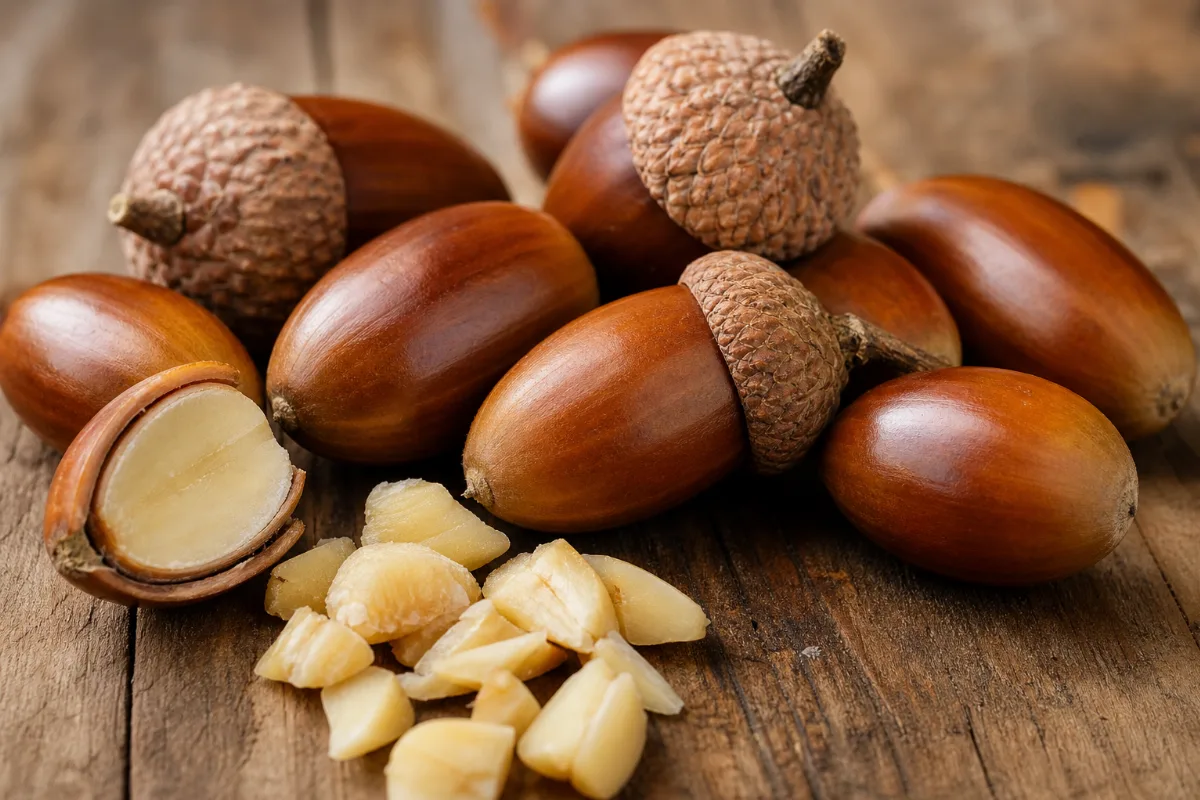
Acorns are the nuts of oak trees (genus Quercus, in the beech family). The part eaten is the kernel inside the cap and shell. Food-science reviews say acorns have a long history in human nutrition and that acorn flour is of interest because it lacks gluten.
USDA data for raw acorns: 387 kcal per 100 g, with 23.86 g fat, 40.75 g carbohydrate and 6.15 g protein. One ounce (28 g) has about 110 kcal, 0.38 mg manganese and 0.18 mg copper. Dried acorns have about 144 kcal per ounce because they hold less water. These figures were carried from our earlier reading and not re-opened today. They describe unprocessed acorns, not leached flour, and vary between species.
What the research shows
Almost all the research is food analysis, not health research. We found no trial of eating acorns for any health goal.
A 2026 study of three Portuguese oak species found that leaching, which reduces tannins, also lowered soluble sugars and cut minerals by about 90 percent. A 2026 review of acorn fats says they are mostly unsaturated but that no trial of acorn oil exists. Test-tube work finds many plant compounds, mostly tannins, but that does not show a benefit for people.
Food versus flour, oil and extracts
The studies we read are about acorn flour, oil and lab extracts. Results for a flour or an extract do not carry over to eating raw acorns, and leaching changes the food. No supplement trial was found.
Amounts
This page gives no amounts to eat and no instructions for finding or preparing wild acorns. Ask a doctor, pharmacist or dietitian what is right for you, especially if you have allergies or kidney or liver disease.
At a glance
Traditional uses history, not proof
- Eaten as a food in many places, according to food-science reviews
- Studied today as a gluten-free flour
- Long use as food is not proof that it treats any condition
Studied for research
- Everyday nutrients (manganese, copper, energy), moderate certainty for the composition facts, no trial
- Acorn fats and heart health, insufficient evidence
- Antioxidant activity of acorn compounds, very low certainty, lab only
- Blood sugar and starch digestion, insufficient evidence
- Acorn flour as a gluten-free ingredient, insufficient evidence (food technology)
Main compounds
- Hydrolyzable tannins
- Oleic acid
- Starch
- Manganese
- Copper
Common forms
- Raw and dried acorns (USDA items; raw ones are high in tannins)
- Leached acorn flour (studied for bread and pasta)
- Acorn oil (reviewed; not tested in people)
Research links: Merck Veterinary Manual: Oak toxicosis in animals · 2026 study: impact of leaching on acorn flour · NHS: Foods to avoid giving babies and young children · Research Library · Genes & Biomarkers Library
What it is and its history
- Accepted scientific name
- Quercus (oak genus)
- Naming authority
- L. (GBIF accepted)
- Common names
- Acorns (English); Oak nuts (English); Bellotas (Spanish)
- Family or group
- Fagaceae (the beech family), as given by GBIF.
- Classification
- Plantae > Tracheophyta > Magnoliopsida > Fagales > Fagaceae > Quercus > Quercus spp.
- Native range
- The Merck manual says oaks are naturally found in the Northern Hemisphere, in both the Old and New Worlds.
- Habitat
- Not verified from a source read.
- What it looks like
- Roots: Not verified.; Stems: Not verified.; Leaves: Not verified.; Flowers: Not verified.; Fruit: The acorn is the fruit of the oak. The Merck manual says acorns are partially enclosed by scaly caps at their base. The part eaten is the kernel (our earlier summary).; Seed: Not verified.
- Cultivation
- Not verified from a source read.
- Harvest and processing
- Raw and dried acorns are USDA items. Acorns are leached (processed to reduce tannins) and made into flour; 2026 studies describe acorn flour, bread, pasta, cookies, a drink and a pudding as foods in development. We give no preparation steps.
- Look-alikes and adulterants
- Name: Chestnuts; Note: Same plant family (Fagaceae) but a different nut.
- Sustainability and conservation
- Not assessed.
Photographs
What is inside, and how it may work
What it contains and how those compounds act in cells and animals. Laboratory and animal mechanisms are not proven effects in people.
Main compounds
| Compound | Family | Where it is concentrated | Activity studied | Level of evidence |
|---|---|---|---|---|
| Hydrolyzable tannins | polyphenol | Acorn Twelve of fourteen polyphenols identified in Quercus virginiana acorns were hydrolysable tannins (2026 study) | Cause bitterness and reduced nutrient absorption; in animals they injure the gut, kidney and liver (Merck manual). Show antioxidant activity in test tubes. 7 6 11 | In vitro and animal |
| Oleic acid and other unsaturated fats | fatty acid | Acorn kernel Up to about 70 percent of fatty acids (review); 65-70 percent in two Q. virginiana populations | Main fat in acorn oil. 4 7 | Composition |
| Starch | carbohydrate | Acorn kernel 57-58 percent in two Q. virginiana populations | Main energy source. 7 | Composition |
| Manganese and copper | mineral | Acorn kernel USDA raw: manganese 1.337 mg and copper 0.621 mg per 100 g | Essential minerals found in many plant foods. 13 | Composition |
Mechanisms, receptors and pathways
| Target or pathway | Gene or receptor | What was found | Level |
|---|---|---|---|
| Tannins binding proteins | Not applicable | Tannins bind and denature proteins lining the gut in animals and form complexes with nutrients, limiting how much the body absorbs (Merck manual). The 2026 leaching study says tannins reduce nutrient absorption. 11 6 | Animal research |
Absorption, metabolism and elimination
- Absorption
- Not found for people.
- Distribution
- Not found.
- Metabolism
- In animals, hydrolyzable tannins are broken down in the gut to simpler phenolics (Merck manual).
- Elimination
- Not found.
- Bioavailability
- Tannins limit how well nutrients are absorbed (Merck manual, 2026 leaching study).
Isolated compounds versus whole extracts
No supplement or extract trial was found. All human-relevant work is about the food, flour or oil, and most of it is composition or lab testing.
Nutritional composition
Nutrition from USDA FoodData Central items 170157 (acorns, raw) and 170565 (acorns, dried), SR Legacy. These figures were taken from our existing acorns page, which recorded them on 2026-10-23; the USDA data service was rate-limited on 2026-10-26 and they were NOT re-opened today. Household portion: 1 ounce = 28.35 g. Raw, per 100 g: 387 kcal, 6.15 g protein, 23.86 g fat (3.1 g saturated), 40.75 g carbohydrate, 62 mg magnesium, 539 mg potassium, 1.337 mg manganese, 0.621 mg copper, 0.528 mg vitamin B6, 87 micrograms folate (DFE), about 27.9 g water. Raw, per 1 ounce (28 g): about 110 kcal, 6.8 g fat, 1.7 g protein, 11.6 g carbohydrate, 0.38 mg manganese, 0.18 mg copper. Dried, per 100 g: 509 kcal, 8.1 g protein, 31.41 g fat, 53.66 g carbohydrate, 1.363 mg manganese, 0.818 mg copper, about 5.1 g water; dried per ounce: about 144 kcal. USDA lists no fiber value for either item. Values vary with species, place and processing, and leached flour has far fewer minerals (about 90 percent fewer in one study). Calories depend on water: dried acorns are about a third more energy dense than raw.
1 moderate certainty1 very low certainty3 not enough evidence
What was looked at
The 5 benefits and uses checked for Acorns, each with how strong the evidence is. Tap one to open it.
What is Acorns good for?
The studied uses and how strong the human evidence is for each. There are no human trials of acorns, so every item below is about food composition, lab tests or food technology.
Benefits, one by one
Each card is a research question, not a promise. Tap a goal to filter. Open a card to see the studies, doses and limits.
Everyday nutrients: manganese, copper and starchy energy
Moderate certaintyAcorns are a starchy, fatty nut. USDA lists raw acorns with a good amount of manganese and copper, and about 110 calories in one ounce (28 g). But processing changes this a lot: leaching, which is used to remove bitter tannins, cut minerals by about 90 percent in one study. These are food facts, not a health trial.
4 studiesRaw and dried acorns are USDA items. Leached acorn flour is the form …
Studies, doses and limits
What the trials found
No human trial of eating acorns was found. USDA lists raw acorns per 100 g at 387 kcal, 23.86 g fat, 6.15 g protein, 40.75 g carbohydrate, 1.337 mg manganese and 0.621 mg copper (figures from our earlier reading of USDA, not re-opened today). A 2026 study of Quercus virginiana acorns from Mexico found content varied between four populations.
Results
The nutrient figures are reliable as a database listing, but they describe unprocessed acorns. Leached acorn flour, which is how many acorn foods are made, has far fewer minerals.
Effect sizes as reported
One ounce (28 g) of raw acorns: about 110 kcal, 0.38 mg manganese and 0.18 mg copper. Leaching reduced minerals by about 90 percent in a study of three Portuguese oak species.
Why this rating
Moderate for the composition facts (USDA data plus a lab study) and not rated as a health effect. Values depend on species, place and processing. There is no trial of acorns for any health outcome.
Form and dose studied
Raw and dried acorns are USDA items. Leached acorn flour is the form studied for foods.
Who was studied
Not studied in a specific group.
Limits
USDA figures were carried from our earlier reading and not re-opened today. They do not describe leached flour. Species vary.
Why researchers looked
People ask what acorns add to a diet if they are eaten as food or flour.
Traditional use
Acorns have a long history as human food, according to food-science reviews. Long use is not proof that they treat any condition.
Proposed mechanism Reference database
Manganese and copper are minerals found in plant foods. Acorns are mostly starch, fat and water, as USDA lists.
A proposed mechanism does not show that the effect happens in people.
Raw acorns are high in tannins; see the Safety tab.
Acorn fats and heart health
Not enough evidenceAcorn fat is mostly unsaturated, mainly oleic acid (the main fat in olive oil), with some vitamin E-type compounds and plant sterols. Reviews note these compound groups are linked in general to heart-friendly effects. But nobody has tested acorn oil or acorns in people for heart health.
2 studiesAcorn oil and acorn flour were described in the review. Not tested in…
Studies, doses and limits
What the trials found
A 2026 review of acorn lipids found no intervention trials of acorn oil and says most evidence comes from whole acorn flour rather than isolated lipids.
Results
No human result. This is a composition finding only.
Effect sizes as reported
Oleic acid up to about 70 percent of fatty acids in acorn oil; lipids are 5-12 percent of dry weight (review).
Why this rating
No human trial of acorns or acorn oil was found. The heart-health link comes from the compound classes, not from acorn studies. Studies of other nuts do not carry over to acorns.
Form and dose studied
Acorn oil and acorn flour were described in the review. Not tested in people.
Limits
Narrative review of composition studies, with inconsistent reporting units.
Why researchers looked
Nuts are often studied for cholesterol and heart health, so people ask about acorns.
Traditional use
Acorns are eaten as food in several traditions. This is not evidence of a heart benefit.
Proposed mechanism Narrative review
A 2026 review says acorn lipids are dominated by unsaturated fatty acids, with tocopherols, phytosterols and carotenoids that are associated with antioxidant, anti-inflammatory, cholesterol-lowering and heart-protective effects in general.
A proposed mechanism does not show that the effect happens in people.
See the Safety tab for tannins and allergy.
Plant compounds and antioxidant tests (lab only)
Very low certaintyAcorns contain many plant compounds, mostly hydrolysable tannins. In test-tube measurements they show antioxidant activity. This has not been tested in people, so it does not show that eating acorns helps any condition.
1 studiesAcorn extracts tested in the laboratory.
Studies, doses and limits
Results
Antioxidant activity of 278-282 micromoles Trolox equivalents per gram was reported for two populations (test-tube measure).
Effect sizes as reported
Phenolic compounds 78-176 mg GAE/g and flavonoids 29-37 mg CE/g in two southern populations (lab measures).
Why this rating
Lab measurement of extracts only, no animal or human outcome. Tannins that show antioxidant activity in a test tube are also the compounds behind the safety concern in raw acorns.
Form and dose studied
Acorn extracts tested in the laboratory.
Limits
One species from one region.
Why researchers looked
Food scientists measure plant compounds in underused foods to see whether they could be new ingredients.
Proposed mechanism Laboratory research
A 2026 study identified fourteen polyphenols in Quercus virginiana acorns, twelve of them hydrolysable tannins, and measured antioxidant activity in the laboratory.
A proposed mechanism does not show that the effect happens in people.
The same tannins make raw acorns bitter and are the reason acorns are leached; see the Safety tab.
Blood sugar and starch digestion
Not enough evidenceA review says fats in acorn flour interact with starch in ways that can change how starch is digested. This was looked at in food products, not in people with diabetes or in blood sugar trials.
1 studiesAcorn flour products.
Studies, doses and limits
What the trials found
No human trial of acorn foods and blood sugar was found.
Results
No human result.
Why this rating
Food-science statement in a review. No trial in people.
Form and dose studied
Acorn flour products.
Limits
Narrative review; no data on blood sugar after eating acorns.
Why researchers looked
Acorn flour is starchy, so food scientists look at how it behaves in bread and pasta.
Proposed mechanism Narrative review
The 2026 lipids review says acorn lipids take part in starch-lipid interactions that influence starch digestibility, glycemic response and the properties of acorn-based foods.
A proposed mechanism does not show that the effect happens in people.
People with diabetes should ask their clinician about any new food that changes their carbohydrate intake.
Acorn flour as a gluten-free ingredient
Not enough evidenceFood scientists are studying acorn flour as a gluten-free baking ingredient. These reviews are about baking quality and sustainability, not health. They do not say whether a given acorn product is safe for people with celiac disease.
2 studiesAcorn flour, bread, pasta and other foods in development.
Studies, doses and limits
Results
The bread review says acorns have potential for food security and sustainability but need more standardisation and consumer awareness. A compilation of over 2,800 Mediterranean traditional-use reports (for five wild plants including oak) found 54 distinct food uses and also recorded harmful effects and ways to reduce them. Details for oak were not in the abstract.
Why this rating
Food-technology and ethnobotanical work; no health outcomes. Traditional use is not evidence of safety or benefit.
Form and dose studied
Acorn flour, bread, pasta and other foods in development.
Limits
Abstracts only. Cross-contact with gluten in a product is not covered.
Why researchers looked
Acorns are an underused plant resource, and acorn flour has no gluten.
Traditional use
Acorns have a long history in human nutrition, according to the 2026 bread review; traditional-use reports for oak were compiled in a 2026 Mediterranean study.
Proposed mechanism Narrative review
Acorn flour lacks gluten, so bread needs different techniques (2026 review).
A proposed mechanism does not show that the effect happens in people.
Check labels if you need to avoid gluten; ask a clinician if you have celiac disease.
Connections to the rest of health
How Acorns connects to the rest of our health knowledge graph. Every link says what kind of connection it is. A safety link (for example to the liver) is a warning, not a benefit. A study that merely mentions a topic never creates a benefit link.
Explore every connection: goals, body systems, organs, symptoms, genes
B. Body systems
| Connected to | Kind of connection | Evidence status | Context | Studies |
|---|---|---|---|---|
| Digestive System | Biological association | Moderate certainty | Studied for: Everyday nutrients: manganese, copper and starchy energy Studied for: Acorn flour as a gluten-free ingredient | 13 14 6 7 5 1 |
| Cardiovascular System | Biological association | Not enough evidence | Studied for: Acorn fats and heart health | 4 7 |
| Endocrine System | Biological association | Not enough evidence | Studied for: Blood sugar and starch digestion | 4 |
C. Body parts and organs
| Connected to | Kind of connection | Evidence status | Context | Studies |
|---|---|---|---|---|
| Liver | Adverse effect or risk | Documented risk | A 2026 study says raw acorn tannins may cause liver toxicity; animal data describe liver injury at higher doses. No human cases were read. Raw acorn tannins may cause liver toxicity (2026 study); animal data describe liver injury. No human cases were read. Preparation or compound: Raw acorn tannins |
6 11 |
| Gut | Adverse effect or risk | Documented risk | Raw acorn tannins may impair digestion; animal sources describe gut injury. Preparation or compound: Raw acorn tannins |
6 11 |
L. Active compounds
| Connected to | Kind of connection | Evidence status | Context | Studies |
|---|---|---|---|---|
| Hydrolyzable tannins | Biological association | In vitro and animal | Cause bitterness and reduced nutrient absorption; in animals they injure the gut, kidney and liver (Merck manual). Show antioxidant activity in test tubes. Preparation or compound: Acorn |
7 6 11 |
| Oleic acid and other unsaturated fats | Biological association | Composition | Main fat in acorn oil. Preparation or compound: Acorn kernel |
4 7 |
| Starch | Biological association | Composition | Main energy source. Preparation or compound: Acorn kernel |
7 |
| Manganese and copper | Biological association | Composition | Essential minerals found in many plant foods. Preparation or compound: Acorn kernel |
13 |
Each connection is stored with the ingredient, the connected record, the kind of connection, the evidence status, the supporting studies, the preparation or compound involved, and a review date (last reviewed October 26, 2026).
Evidence at a glance: what the research found for 5 outcomes
Each outcome below is one thing researchers measured. Certainty is how far the evidence can be trusted, not how well it works. The full studies are on the next tab.
The evidence
The research centre for Acorns. Every record here was checked against PubMed or the publisher's page; we never list a study we have not verified.
Evidence by outcome
Bars show how many studies we found for each outcome, not how well it works. People are added up across trials only (reviews are not added, to avoid double counting).
How we rate evidence
High certainty
Several well-run trials or reviews agree; further research is unlikely to change the picture much.
Moderate certainty
Good trials point the same way, but some doubt remains.
Low certainty
Small, short or inconsistent trials. The finding could change with better research.
Very low certainty
Very little or very weak human data. Treat as a possibility only.
Mixed findings
Trials or reviews disagree with each other.
Not enough evidence
Not enough human research to say either way.
Evidence against
Good research found no benefit, or found harm.
We take the reviewers' own risk-of-bias and GRADE statements where they exist, and otherwise judge from study size, design, consistency, directness and whether a product matches what is sold. Many publications do not make evidence high. Method note: We started from our existing acorns summary, re-read the PubMed or Europe PMC abstracts, the Merck Veterinary Manual, NHS and FDA pages, and matched the oak genus at GBIF. The USDA nutrient figures were carried over from our earlier reading because the USDA service was not available. Little research exists on acorns, so this page is shorter than most. Items we could not verify are flagged in the research gaps.
Study library: every study we checked 14
| Study | Design | People | Product, dose, length | Result |
|---|---|---|---|---|
| Balant 2026 Reviving Forgotten Foods: From Traditional Knowledge to Innovative and Safe Mediterranean Food Design. Foods · PMID 41517217 · DOI |
Ethnobotanical review n/a (ethnobotany) |
More than 2,800 traditional-use reports for the fruits and cones of five wild plants (Arbutus unedo, Prunus spinosa, Quercus spp., Pinus spp., Rosa spp.) | Traditional foods from wild fruits and cones, including oak Fruit/acorn |
Analysis of over 2,800 reports found 54 distinct food uses in 16 categories. The authors also collected information on processing methods that preserve nutrients and on potential harmful effects and the methods used to reduce them. Not applicable (Not applicable) Methods, limits and fundingOutcomes: Alimentary uses, preparation and conservation methods, potential harmful effects and ways to reduce them Limitations: Only the abstract was read, so the harmful effects and methods for oak specifically are not known to us. Traditional use is not evidence of safety or benefit. Results are not split by plant in the abstract. Funding and conflicts: Authors declare no conflicts of interest. Read: abstract |
| Jeong 2022 Oak Pollen Allergy in Korea. Current Protein and Peptide Science · PMID 35748545 · DOI |
Narrative review n/a (review) |
Published work on oak pollen allergy | Oak pollen and oak allergens Pollen; acorn; wood dust |
The review says oak pollen allergy is common worldwide, that sensitisation to oak along with birch often causes pollen food allergy syndrome to fruits and vegetables, and that acorn and wood dust from oak can cause allergic disease. Not applicable (Not applicable) Methods, limits and fundingOutcomes: Oak allergens, cross-reactivity with birch, diagnosis and immunotherapy Limitations: Abstract only. It does not say how often acorns cause reactions. Funding and conflicts: Not stated in the abstract. Read: abstract |
| Jeong 2025 Update on Tree Nut and Seed Allergies: Prevalence, Clinical Characteristics, Diagnosis, and Management. Allergy, Asthma and Immunology Research · PMID 41330701 · DOI |
Narrative review n/a (review) |
Published work on tree nut and seed allergy | Tree nuts and seeds (acorns are not named in the abstract) Nut/seed |
Tree nut and seed allergies are often severe, typically begin in childhood and may last for life. Prompt intramuscular epinephrine is first-line treatment for anaphylaxis. The highest clinical overlap between nuts is reported for cashew-pistachio and walnut-pecan. Not applicable (Not applicable) Methods, limits and fundingOutcomes: Prevalence, severity, diagnosis, management Limitations: Acorns are not mentioned in the abstract, so it is general background on nuts. Funding and conflicts: No conflict of interest reported in the abstract record. Read: abstract |
| Loncaric 2026 Lipids of Quercus Acorns: Health Implications, Oxidative Stability, and Food Applications. Foods · PMID 42588005 · DOI |
Narrative review n/a (review) |
Published studies of acorn lipids (literature search of Web of Science through June 2026) | Acorn lipids and acorn oil Acorn Up to 180 days of storage in the studies covered |
Acorn lipids are 5-12 percent of dry weight and mostly unsaturated fat, mainly oleic acid (up to about 70 percent of fatty acids), with tocopherols, phytosterols and carotenoids that are associated with antioxidant, anti-inflammatory, cholesterol-lowering and heart-protective effects. Oils kept good oxidative stability up to 180 days stored in the dark at room temperature. The review says most evidence comes from whole acorn flour rather than isolated lipids and that dedicated intervention trials of acorn oil are lacking. Oleic acid up to about 70 percent of total fatty acids; lipids 5-12 percent of dry weight (Not applicable) Methods, limits and fundingOutcomes: Fatty acid composition, minor bioactive compounds, oxidative stability, starch-lipid interaction Limitations: A narrative review of composition studies. 'Associated with' effects refer to compound classes in general, not to trials of acorns. No human trial of acorn oil. Funding and conflicts: Authors declare no conflicts of interest. Read: abstract |
| Loncaric 2026 Acorn Bread: The Synergy of Acorn Flour, Sustainability, and EU Organic Standards. Foods · PMID 42195829 · DOI |
Narrative review n/a (review) |
Published work on bread made with acorn flour | Acorn flour in bread Acorn |
The review says acorn flour has attracted interest as an ingredient because it lacks gluten and has a favourable nutritional profile and useful baking properties. It concludes that more standardisation and consumer awareness are needed for market integration. Not applicable (Not applicable) Methods, limits and fundingOutcomes: Technological properties, sensory attributes, nutritional profile, EU organic rules Limitations: Food-technology review; no health outcomes. It does not say whether a given product is suitable for people with celiac disease or how tannins were handled. Funding and conflicts: Authors declare no conflicts of interest. Read: abstract |
| Rodrigues 2026 Impact of leaching on the nutritional composition of acorn species. Journal of Food Composition and Analysis · Source |
Laboratory food analysis n/a (food analysis) |
Flours from three Portuguese oak species (Quercus pyrenaica, Quercus rotundifolia, Quercus robur) | Acorn flour before and after leaching Acorn kernel · vs Unleached flour |
The abstract says high tannin content is one barrier to acorn use: it leads to bitterness, reduced nutrient absorption, and may prevent digestion and liver toxicity. Leaching lowered pH, acidity, water activity and macronutrient values, lowered soluble sugars, reduced minerals by about 90 percent, and removed part of the fiber and fat. Key macronutrients and a favourable fatty acid profile were kept. Mineral content reduced by about 90 percent after leaching (abstract wording: approximately 90 %) (Not given in the abstract) Methods, limits and fundingOutcomes: pH, acidity, water activity, macronutrients, fiber, soluble sugars, minerals, fatty acids Limitations: The study measured nutrients, not toxicity or health effects. The abstract does not say how much leaching makes acorns safe. The tannin-harm statement is background in the abstract, not a result of this study. Found in the Europe PMC index (no PubMed record or DOI shown); only the abstract was read. Funding and conflicts: Not stated in the abstract. Read: abstract |
| Valero-Galvan 2026 Potential of North American Acorns as an Underutilized Food Source: Morphology, Nutritional Composition and Content of Bioactive Compounds in Quercus virginiana Acorns of Different Natural Populations. Molecules · PMID 42123804 · DOI |
Laboratory food analysis Quercus virginiana (food analysis) |
Acorns from four populations of Quercus virginiana in Chihuahua, Mexico | Whole acorns analysed in the laboratory Acorn · vs Four populations compared with each other |
Content differed between populations. Two southern populations had starch of 57-58 percent and oleic acid of 65-70 percent; one population had the highest protein (7.0 percent); another had the highest sugars (13.8 percent). Fourteen polyphenols were identified: twelve hydrolysable tannins, one hydroxycinnamic acid and one flavonol. Antioxidant activity was measured in test tubes. Starch 57-58 percent; protein up to 7.0 percent; oleic acid 65-70 percent (population-dependent) (Not applicable) Methods, limits and fundingOutcomes: Seed size, starch, protein, fatty acids, phenolic compounds, flavonoids, antioxidant activity (lab), polyphenol profile Limitations: Composition analysis of one species from one region. Antioxidant activity is a lab measure, not a health effect. Authors state composition is influenced by genetic and geographic factors. Funding and conflicts: Authors declare no conflicts of interest. Read: abstract |
| Vega 1998 Anaphylactic reaction to ingestion of Quercus ilex acorn nut. Clinical and Experimental Allergy · PMID 9677139 · DOI |
Case report |
1 One patient in Spain who had anaphylaxis after eating holm-oak acorns and hives after eating peanuts |
Holm oak (Quercus ilex) acorns eaten as food Acorn Not given Single reaction |
Skin-prick tests were strongly positive to acorn and peanut, and positive to olive, oak (Quercus alba, Quercus ilex) and grass pollens. Blood IgE was highest to acorn, peanut and grass pollen. One acorn protein of 17.9 kDa bound IgE and was partly blocked by a birch pollen allergen, suggesting a resemblance to tree pollen allergens. Not applicable (single case) (Not applicable) Methods, limits and fundingOutcomes: Skin-prick tests, specific IgE, IgE-binding protein bands Limitations: One patient; how common acorn allergy is cannot be learned from a single case. Funding and conflicts: Not stated in the abstract. Read: abstract |
| s-fda-allergens FDA: Food Allergies · Source |
Health agency n/a |
Methods, limits and fundingRead: full-text | ||
| s-gbif-quercus GBIF Backbone: Quercus L. (usageKey 2877951) · Source |
Reference database n/a |
Methods, limits and fundingRead: full-text | ||
| s-merck-oak Merck Veterinary Manual: Oak Toxicosis in Animals (Quercus spp toxicosis, acorn toxicosis) · Source |
Veterinary reference animals (cattle, sheep, horses, dogs and others) |
Methods, limits and fundingRead: full-text | ||
| s-nhs-foods-avoid NHS: Foods to avoid giving babies and young children · Source |
Health agency n/a |
Methods, limits and fundingRead: full-text | ||
| s-usda-fdc-170157 USDA FoodData Central: Nuts, acorns, raw (FDC 170157) · Source |
Reference database n/a |
Methods, limits and fundingRead: summary-only | ||
| s-usda-fdc-170565 USDA FoodData Central: Nuts, acorns, dried (FDC 170565) · Source |
Reference database n/a |
Methods, limits and fundingRead: summary-only |
What we do not know yet
- No trial of eating acorns, raw or leached, was found for any health outcome.
- No source we read says how much leaching makes acorns safe for people, and no human poisoning series was found.
- USDA figures were carried from our earlier reading and not re-opened on the review date.
- How common acorn allergy is, plus pregnancy, breastfeeding and medicine interactions, were not found.
- Mold, aflatoxin, heavy metals, pesticides and celiac cross-contact for acorn products were not researched.
How new research is added
New studies are found by a saved PubMed search and placed in a review queue before the page changes.
Lab markers
What changed in blood or saliva tests during trials. A changed number is not the same as feeling or being healthier, and we give no "normal ranges".
Safety
What studies and official sources say about side effects, medicines and who should check first. Each point shows what kind of evidence it comes from.
Main points to know 4
- Raw acorns are high in tannins and are normally leached before eating. A 2026 study says the high tannin content of acorns causes bitterness and reduced nutrient absorption, and may prevent digestion and cause liver toxicity. The word 'may' matters: we found no human poisoning report in the sources read. Leaching is the usual way to reduce tannins, but no source we read says how much leaching makes acorns safe. We give no preparation steps. Food science abstract 6
- Animals: all oaks are potentially toxic and dogs can be seriously hurt. The Merck Veterinary Manual says hydrolyzable tannins cause oak poisoning in animals, damaging the gut lining and then the kidneys, and the liver at higher doses. It says all oak species should be considered potentially toxic, no specific treatment exists, and dogs can develop kidney failure and liver disease after eating acorns (though signs may come from a blockage). Keep fallen acorns away from dogs. Animal research 11
- Acorn allergy has been reported. A 1998 case report describes anaphylaxis after eating holm-oak acorns in a patient who also had hives after peanuts and positive pollen tests. A 2022 review says acorn and oak wood dust can cause allergic disease. For trouble breathing or swelling of the face or throat, call emergency services. Case report 8 2
- Whole nuts can choke children under 5. The NHS says whole nuts should not be given to children under 5 because they can choke. Acorns are not named, so we apply this as a precaution. Authoritative guidance 12
Side effects 2
| Effect | How often | Severity and recovery | Evidence |
|---|---|---|---|
| Bitterness, poorer nutrient absorption, possible digestive upset from raw acorn tannins The study abstract says tannins may prevent digestion; it reports no human cases. Gut injury is described only for animals. | Not established | not stated Not stated | Food science abstract 6 |
| Anaphylaxis to acorn (one patient) The patient also had hives after peanuts and positive skin tests to oak and grass pollens. An acorn protein resembled a birch pollen allergen. | One case; how common it is is unknown | severe (anaphylaxis) Not stated in the abstract | Case report 8 |
Liver
The 2026 leaching study says raw acorn tannins may cause liver toxicity, and the Merck manual describes liver injury in animals at higher doses. No human liver cases were found in the sources read. LiverTox and similar sources were not searched. 6 11
How often. No frequency was found.
Monitoring. No agency monitoring advice was found.
This is a safety connection. It is not evidence that Acorns supports liver health.
Medicines and supplements 1
| With | Why it matters | Importance | Evidence | What to do |
|---|---|---|---|---|
| Prescription or over-the-counter medicines medicine | Tannins bind proteins and minerals in general (Merck manual, animals), but no source we read links acorns to a specific medicine. | No acorn-medicine interaction was found in the sources read. This is absence of evidence, not proof of safety. | None found Not enough evidence 11 | If you take medicines, especially for the kidneys or liver, ask a doctor or pharmacist before eating acorn foods. |
Who should check first 5
| Situation | Advice | Evidence |
|---|---|---|
| Kidney or liver disease | Tannin injury to the kidney and liver is described in animals, and the leaching study mentions possible liver toxicity. Ask your clinician before eating acorn foods. | Animal research 11 6 |
| Peanut, tree nut or oak/birch pollen allergy | Allergy to acorns has been reported and oak and birch pollen allergy can lead to food reactions. Ask an allergist. Tree nut allergies are often severe (2025 review). | Case report 8 2 3 |
| Children under 5 | The NHS says whole nuts should not be given to children under 5 because of choking. Acorns are not named by the NHS. | Authoritative guidance 12 |
| Pregnancy and breastfeeding | No source we read covers acorn foods in pregnancy or breastfeeding. Ask a clinician. | None found |
| Dogs and other pets | Acorns are a recognised cause of poisoning in animals. Contact a veterinarian if a pet has eaten acorns. | Animal research 11 |
Overdose, product quality and regulators
Summary. Raw acorns contain hydrolyzable tannins that poison animals. For people, the sources we read say only that the tannins may impair digestion and may cause liver toxicity, with no human case series. How much leaching is needed for safety is not stated.
Animal. Merck Veterinary Manual: gut erosions, then kidney and sometimes liver damage; risk rises with how much is eaten; animals usually need to eat a large share of their diet from oak, and there is no specific treatment.
High dose or long term signals. Not found for people.
Overdose response. Not found.
Genotoxicity. Not researched.
Toxic or hazardous parts. The Merck manual lists oak buds, leaves and acorns.
We found no acorn-specific source on mold, aflatoxin, heavy metals or pesticides.
General nut handling. No acorn-specific mold or aflatoxin source was read. General nut mold advice from the WHO was read earlier but not re-opened today, so we make no claim here.
| Body | Action | Date |
|---|---|---|
| NHS (UK) (United Kingdom) | Whole nuts should not be given to children under 5 years because they can choke; babies can have nuts crushed or ground from about 6 months. Acorns are not named. source | 2026-02-18 |
| FDA (US Food and Drug Administration) (United States) | Lists tree nuts among the nine major food allergens. Acorns are not mentioned on the page, so how acorn allergy is classified on labels is not known from this source. source | 2026-03-11 |
When to get medical help
- Trouble breathing, swelling of the lips, face or throat, widespread hives or fainting after eating acorns or any nut: call emergency services
- Persistent vomiting, severe stomach pain, very little urine or yellow skin or eyes after eating acorn foods: seek medical care
- A child under 5 choking on a nut: follow first-aid training and call emergency services
- A dog that has eaten acorns and is vomiting, not eating or lethargic: contact a veterinarian
Stop using the product and contact a clinician or emergency service. In the US, Poison Control is 1-800-222-1222.
General information only, not medical advice. Ask a clinician or pharmacist before use, especially with medicines, in pregnancy or with a health condition. See the Natural Remedy Safety guide.
Frequently asked questions
Can you eat acorns?
Acorns have a long history as food, and food scientists are studying acorn flour. But raw acorns are high in tannins, which cause bitterness and may harm digestion and the liver, so they are normally leached first. We do not give preparation steps, and no source we read says how much leaching makes them safe.
Why are raw acorns bitter and risky?
Does leaching remove the nutrients too?
Partly. In a study of three Portuguese oak species, leaching cut mineral content by about 90 percent and lowered soluble sugars and some fiber and fat, but kept the main macronutrients and a favourable fatty acid profile.
Are acorns safe for dogs?
No. The Merck Veterinary Manual says dogs can develop kidney failure and liver disease after eating acorns, although signs may sometimes come from a blockage. Contact a veterinarian if your dog has eaten acorns.
Can you be allergic to acorns?
Are acorns good for the heart?
Not shown. Acorn fat is mostly unsaturated, but a 2026 review says no intervention trial of acorn oil exists. Results for other nuts do not carry over.
What nutrients do acorns have?
Is acorn flour gluten-free?
A 2026 review describes acorn flour as lacking gluten. It does not say whether a particular product is safe for people with celiac disease, so check labels for cross-contact and ask a clinician.
Do acorns help with blood sugar?
Not shown. A review says acorn fats interact with starch in food products, but no human trial of blood sugar was found.
Are acorns safe in pregnancy or breastfeeding?
We found no source that covers acorn foods in pregnancy or breastfeeding. Ask your doctor.
Can young children eat acorns?
The NHS says whole nuts should not be given to children under 5 because they can choke. It does not name acorns, so we apply this as a precaution.
Do acorns interact with medicines?
No acorn-medicine interaction was found in the sources we read. That is absence of evidence, not proof of safety. Ask a pharmacist, especially if you have kidney or liver disease.
Explore by health goal
Editorial transparency
- Written by
- AlternativeMed editorial team. Research compiled with AI assistance, then checked against the sources listed.
- Medical review
- None. This page has not been reviewed by a physician or pharmacist.
- First published
- 2026-10-26
- Last substantive update
- 2026-10-26
- How we research
- We started from our existing acorns summary, re-read the PubMed or Europe PMC abstracts, the Merck Veterinary Manual, NHS and FDA pages, and matched the oak genus at GBIF. The USDA nutrient figures were carried over from our earlier reading because the USDA service was not available. Little research exists on acorns, so this page is shorter than most. Items we could not verify are flagged in the research gaps.
- How we rate evidence
- See "How we rate evidence" in the Evidence tab.
- Independence
- No product is promoted on this page. No affiliate links are shown.
Sources 14
Each source was opened and checked. Where we read only the abstract, it says so. The small numbers in the text point here.
- Balant M, Catala-Altes J, Garnatje T, et al.. Reviving Forgotten Foods: From Traditional Knowledge to Innovative and Safe Mediterranean Food Design.. Foods. 2026. PMID 41517217. DOI 10.3390/foods15010150. (abstract)
- Jeong KY, Park JW.. Oak Pollen Allergy in Korea.. Current Protein and Peptide Science. 2022. PMID 35748545. DOI 10.2174/1389203723666220624141550. (abstract)
- Jeong K, Lee S.. Update on Tree Nut and Seed Allergies: Prevalence, Clinical Characteristics, Diagnosis, and Management.. Allergy, Asthma and Immunology Research. 2025. PMID 41330701. DOI 10.4168/aair.2025.17.6.672. (abstract)
- Loncaric P, Jukic M, Moslavac T, Lukinac J.. Lipids of Quercus Acorns: Health Implications, Oxidative Stability, and Food Applications.. Foods. 2026. PMID 42588005. DOI 10.3390/foods15152747. (abstract)
- Loncaric P, Jukic M, Velic D, Lukinac J.. Acorn Bread: The Synergy of Acorn Flour, Sustainability, and EU Organic Standards.. Foods. 2026. PMID 42195829. DOI 10.3390/foods15101625. (abstract)
- Rodrigues CV, Maia ML, Babo P, Pintado MM.. Impact of leaching on the nutritional composition of acorn species.. Journal of Food Composition and Analysis. 2026. (abstract)
- Valero-Galvan J, Munoz-Bernal OA, Gonzalez-Fernandez R, et al.. Potential of North American Acorns as an Underutilized Food Source: Morphology, Nutritional Composition and Content of Bioactive Compounds in Quercus virginiana Acorns of Different Natural Populations.. Molecules. 2026. PMID 42123804. DOI 10.3390/molecules31091438. (abstract)
- Vega A, Dominguez C, Cosmes P, et al.. Anaphylactic reaction to ingestion of Quercus ilex acorn nut.. Clinical and Experimental Allergy. 1998. PMID 9677139. DOI 10.1046/j.1365-2222.1998.00318.x. (abstract)
- . FDA: Food Allergies. . . (full-text)
- . GBIF Backbone: Quercus L. (usageKey 2877951). . . (full-text)
- . Merck Veterinary Manual: Oak Toxicosis in Animals (Quercus spp toxicosis, acorn toxicosis). . . (full-text)
- . NHS: Foods to avoid giving babies and young children. . . (full-text)
- . USDA FoodData Central: Nuts, acorns, raw (FDC 170157). . . (summary-only)
- . USDA FoodData Central: Nuts, acorns, dried (FDC 170565). . . (summary-only)
Where to buy
Check the label first. Whatever you buy, look for these:
- Raw or roasted, and salted or unsalted
- A best-by date, since nuts and seeds turn rancid
- Tree nut and peanut allergy warnings
- A resealable bag, and cool storage once opened
Talk to a pharmacist or doctor before you start any supplement, especially if you take medicines. See the Safety tab for interactions.
Support our free guides: as an Amazon Associate we earn from qualifying purchases. Full disclosure.


