Nuts & Seeds · Seed
Cacao Nibs
Theobroma cacao · also called Cocoa nibs, crushed cocoa beans, nibs de cacao (Spanish)
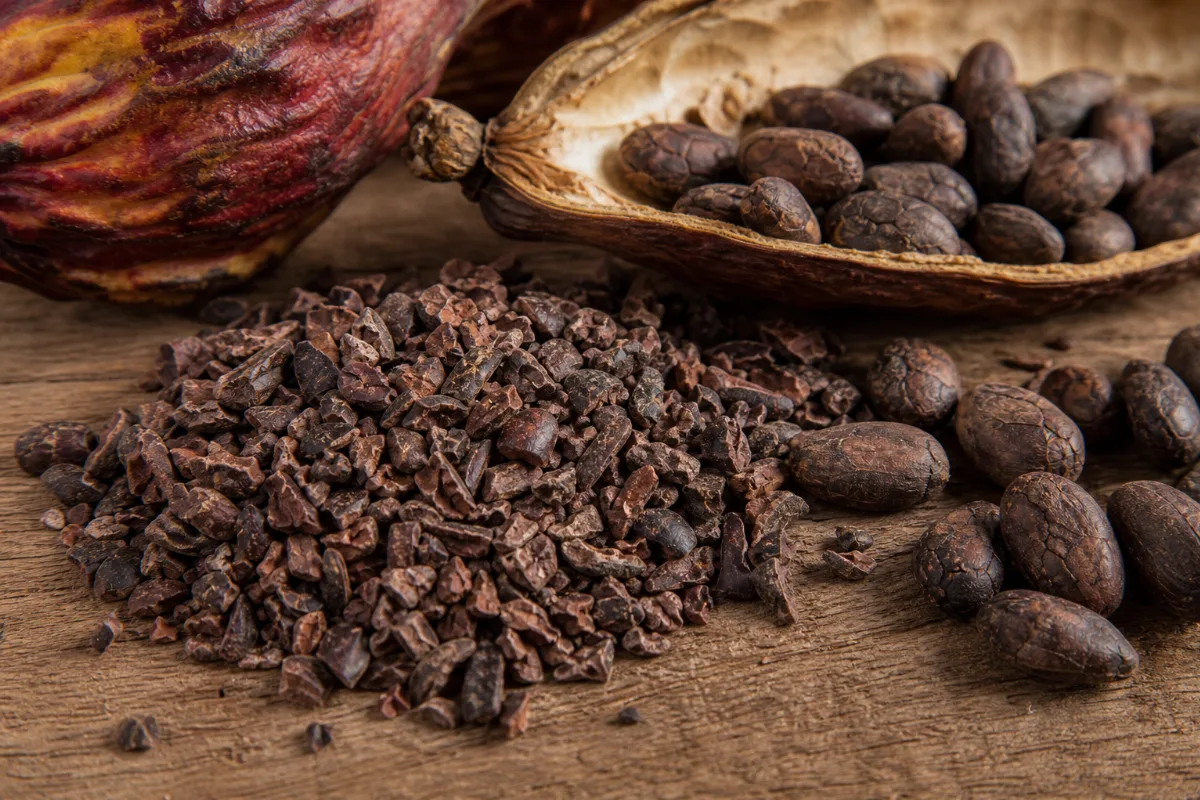
Cacao nibs are crushed pieces of the cocoa bean, the seed of the cacao tree that gives us chocolate. They are bitter, crunchy and rich in fat, magnesium and potassium. Trials of cocoa products show small drops in blood pressure and cholesterol, but no trial tested nibs. The main cautions are that cocoa foods can poison dogs and other pets, can carry cadmium and lead, and contain caffeine.
General information, not medical advice. Last substantive update · Not medically reviewed. A named clinician has not signed off on this page. How this page is made
About Cacao Nibs
Cacao nibs are a bitter, fat-rich food made from the cocoa bean. They are a food, not a proven remedy: the health findings come from studies of cocoa extract, cocoa products and dark chocolate. The most important cautions are for pets, heavy metals and caffeine.
What it is
Cacao nibs are crushed pieces of the seeds (beans) of Theobroma cacao, the tree that gives us chocolate. The beans are fermented and dried, the thin shell is removed, and the pieces left are the nibs, sold raw or roasted. Ground nibs are cocoa liquor, the base of chocolate.
USDA FoodData Central has no standard entry for nibs. One laboratory analysis of milled fermented Ghanaian beans, per 100 g: 18.8 g protein, 53.4 g fat, 21.0 g carbohydrate (by difference), 364 mg magnesium, 2,558 mg potassium and 10.6 mg zinc. One ounce (28 g, our arithmetic) has about 15 g fat, 5 g protein, 103 mg magnesium and 725 mg potassium, and about 180 kcal by our estimate. Fibre was not reported, and roasted or flavoured nibs differ.
What the research shows
No trial of nibs was found. Pooled trials of flavanol-rich cocoa products showed small falls in blood pressure (about 2 mmHg). A 2024 analysis of cocoa extract or dark chocolate with at least 70% cocoa also found lower LDL cholesterol and fasting glucose, and no change in weight, triglycerides, HDL or HbA1c.
The largest trial gave 21,442 older adults a cocoa extract capsule for 3.6 years. Total heart events did not fall significantly. These results are for products with set flavanol amounts. Nibs vary, and roasting lowers some compounds in lab tests.
A review of chocolate and migraine found the evidence that chocolate is a trigger insufficient.
Food versus extracts and chocolate
The strongest data are for cocoa extract capsules with set flavanol amounts and for dark chocolate. Results for a capsule, a drink or a bar do not carry over to a handful of nibs, and chocolate bars add sugar and milk.
Amounts
This page gives no amounts to eat. The Nutrition Facts label on the pack shows a serving. Ask a doctor, pharmacist or dietitian what is right for you, especially if you are pregnant, are sensitive to caffeine or take regular medicines.
At a glance
Traditional uses history, not proof
- Eaten as a crunchy, bitter snack, in baking and in smoothies
- Long use as food is not proof that it treats any condition
Studied for research
- Blood pressure (cocoa products, not nibs), low certainty
- LDL and total cholesterol (cocoa extract or dark chocolate), low certainty
- Fasting blood sugar (cocoa extract or dark chocolate), very low certainty
- Heart attacks and strokes (cocoa extract capsule), mixed
- Minerals in cocoa beans: magnesium, potassium, zinc, low certainty
- Migraine trigger (chocolate), insufficient evidence
Main compounds
- Theobromine
- Caffeine
- Epicatechin (a flavanol)
- Cocoa fat
- Magnesium
- Potassium
- Zinc
Common forms
- Raw (unroasted) nibs
- Roasted nibs
- Flavoured, coated or sweetened nibs
- Ground nibs (cocoa liquor)
- Cocoa extract capsules (a different product; used in the largest trial)
Research links: Cochrane review: Effect of cocoa on blood pressure (2017) · Meta-analysis: cocoa and cardiometabolic risk markers (2024) · Merck Veterinary Manual: Chocolate Toxicosis in Animals · Heavy metals in 72 dark chocolate and cocoa products (2024) · Research Library · Genes & Biomarkers Library
What it is and its history
- Accepted scientific name
- Theobroma cacao
- Naming authority
- L. (GBIF accepted)
- Common names
- Cacao nibs (English); Cocoa nibs (English); Crushed cocoa beans (English); Nibs de cacao (Spanish); Granos de cacao troceados (Spanish)
- Family or group
- Malvaceae, as given by GBIF.
- Classification
- Plantae > Tracheophyta > Magnoliopsida > Malvales > Malvaceae > Theobroma > Theobroma cacao
- Native range
- Not verified from a source read.
- Habitat
- Not verified from a source read.
- What it looks like
- Roots: Not verified.; Stems: Not verified.; Leaves: Not verified.; Flowers: Not verified.; Fruit: The nib is the part of the cocoa bean inside the shell (testa). The Ghana composition study reports the share of nib, shell and germ in the bean and found the nib share rose with fermentation and pod storage.
- Cultivation
- Not verified from a source read. The cadmium experiment fermented three cacao types (CCN 51, ICS 95, TCS 01).
- Harvest and processing
- Beans are fermented and dried, shelled and broken into nibs; nibs can be sold raw or roasted (Brazilian nib study). Ground nibs are cocoa liquor, used in chocolate making. Sold plain, flavoured or coated.
- Look-alikes and adulterants
- Name: Cocoa powder, dark chocolate and cocoa extract capsules; Note: Made from the same beans but different products; most health trials tested these, not nibs.; Name: Cocoa bean shells (hulls); Note: The shell removed to make nibs. It also contains methylxanthines (Merck lists 9 mg/g).
- Sustainability and conservation
- Not assessed.
Photographs
What is inside, and how it may work
What it contains and how those compounds act in cells and animals. Laboratory and animal mechanisms are not proven effects in people.
Main compounds
| Compound | Family | Where it is concentrated | Activity studied | Level of evidence |
|---|---|---|---|---|
| Theobromine | methylxanthine | Bean Merck: 3 to 10 times the caffeine in chocolate; no figure for nibs found | A stimulant related to caffeine; poisonous to dogs (Merck). 16 | Human and animal |
| Caffeine | methylxanthine | Bean Detected in nibs by LC/MS in a Brazilian study; abstract gives no amount | Counts toward daily caffeine limits (EFSA). Roasting lowered it in the lab test. 9 13 | Human data |
| Epicatechin (a cocoa flavanol) | flavanol | Bean No amount found; the COSMOS capsule had 80 mg epicatechin among 500 mg flavanols | Roasting lowered it in the lab test. Whether nibs give enough flavanols to matter was not found. 9 8 | Laboratory |
| Fat (cocoa butter) | fat | Bean 53.4 g per 100 g in fermented Ghanaian beans (range 50.4 to 55.2 g across samples) | Content only; this paper did not break the fat into types. 1 | Content only |
| Cadmium and lead | heavy metal contaminants | Nib and shell Not found for nibs on sale | Contaminants taken up from soil, not nutrients. Fermentation moved some cadmium from nib to shell in a lab experiment. 5 3 | Laboratory |
Mechanisms, receptors and pathways
| Target or pathway | Gene or receptor | What was found | Level |
|---|---|---|---|
| Blood vessel widening by cocoa flavanols | Endothelial nitric oxide (named in the Cochrane review background) | The Cochrane authors say flavanols in cocoa have been shown to increase the formation of endothelial nitric oxide, which promotes widening of blood vessels. This is background in the review, not a test in nibs. 7 | Authoritative review background |
| Adenosine receptors and heart muscle (methylxanthine poisoning) | Adenosine receptors | Merck says theobromine and caffeine block adenosine receptors, causing stimulation of the nervous system, increased urine output and a fast heart rate, and raise calcium in muscle cells. Described for animals. 16 | Animal research |
Absorption, metabolism and elimination
- Absorption
- Merck: theobromine and caffeine are readily absorbed from the gut in dogs.
- Distribution
- Widely distributed through the body in dogs.
- Metabolism
- Broken down in the liver and recycled between gut and liver in dogs.
- Elimination
- Passed in urine; half-lives in dogs are 17.5 hours for theobromine and 4.5 hours for caffeine (Merck). Human figures for nibs were not found.
- Bioavailability
- Not established for cocoa flavanols from nibs.
Isolated compounds versus whole extracts
The strongest human data are for cocoa extract capsules with set flavanol amounts (COSMOS) and for cocoa products or dark chocolate with at least 70% cocoa. Nibs are a food whose flavanols vary with variety and roasting. Results for a capsule, a drink or a chocolate bar do not carry over to a handful of nibs, and chocolate bars add sugar, milk and fat.
Nutritional composition
Source: a laboratory analysis of Ghanaian cocoa beans (Afoakwa and colleagues, J Food Sci Technol 2013; Tables 1 and 3 of the full text, read 2026-10-26). USDA FoodData Central has no standard entry for cacao nibs, so no USDA figures are used. The beans were fermented, dried and milled into liquor (ground cocoa), which is close to ground nibs but not the same as shop-bought nibs. Per 100 g of fermented beans with no pod storage: moisture 4.0 g, protein 18.8 g, fat 53.4 g, ash 2.8 g and carbohydrate 21.0 g (by difference), magnesium 364 mg, potassium 2,558 mg, zinc 10.6 mg, calcium 171 mg, phosphorus 196 mg, iron 2.2 mg and sodium 2.5 mg. Other samples in the same paper ranged from 17.6 to 21.6% protein, 50.4 to 55.2% fat and 262.7 to 364.2 mg magnesium per 100 g. One ounce (28 g) is our arithmetic (per 100 g x 0.2835): about 5.3 g protein, 15.1 g fat, 6.0 g carbohydrate, 103 mg magnesium, 725 mg potassium, 3.0 mg zinc, 48 mg calcium, 56 mg phosphorus, 0.6 mg iron. Energy is our estimate with standard 4-9-4 factors: about 640 kcal per 100 g, about 180 kcal per ounce; it was not measured. The paper does not state whether the figures are on a wet or dry basis. It reports copper at 8.8 mg per 100 g, which looks too high, so we leave it out. Fibre, vitamins and the amounts of caffeine and theobromine were not reported in the sources we read. Values vary with variety, fermentation, roasting and place of growing; roasted, flavoured and sweetened nibs differ, and the label on your pack is the guide.
1 mixed findings4 low certainty1 very low certainty2 not enough evidence
What was looked at
The 8 benefits and uses checked for Cacao Nibs, each with how strong the evidence is. Tap one to open it.
- Blood pressure (flavanol-rich cocoa products)Low certainty
- LDL and total cholesterol (cocoa extract or dark chocolate)Low certainty
- Fasting blood sugar (cocoa extract or dark chocolate)Very low certainty
- Heart attacks, strokes and deaths (cocoa extract capsule)Mixed findings
- Minerals in cacao nibs (magnesium, potassium, zinc)Low certainty
- Body weight and waist (cocoa extract or dark chocolate)Low certainty
- Migraine (is chocolate a trigger?)Not enough evidence
- Antioxidant compounds (laboratory measurements)Not enough evidence
Lab markers tracked in the studies
Blood pressureLDL cholesterolFasting blood glucoseWeight, waist, triglycerides, HDL cholesterol and HbA1c
What is Cacao Nibs good for?
The main studied uses and how strong the human evidence is for each. Most results are for cocoa products or extracts, not for cacao nibs themselves.
Benefits, one by one
Each card is a research question, not a promise. Tap a goal to filter. Open a card to see the studies, doses and limits.
Blood pressure (flavanol-rich cocoa products)
Low certaintyIn short trials, cocoa products rich in flavanols lowered blood pressure by a small amount, about 2 mmHg on average. Nibs were not tested, and their flavanol content is not known.
2 studiesCocoa powder, chocolate and extracts containing 30 to 1,218 mg flavan…
Studies, doses and limits
What the trials found
A 2017 Cochrane review pooled 35 randomised trials (40 comparisons, 1,804 mainly healthy adults) of flavanol-rich chocolate or cocoa products lasting 2 to 18 weeks (mean 9 weeks). Systolic pressure fell by 1.76 mmHg (95% CI 0.43 to 3.09) and diastolic pressure by 1.76 mmHg (0.94 to 2.57). The fall in systolic pressure was about 4 mmHg in people with high blood pressure and was not significant in people with normal pressure, though the test for that difference was borderline. Leaving out trials with authors employed by the sponsoring industry shrank the effect a little, which the authors read as some reporting bias. The 2024 meta-analysis of cocoa extract or dark chocolate (at least 70% cocoa) found a similar fall: systolic -2.52 mmHg and diastolic -1.58 mmHg.
Results
Flavanol-rich cocoa products lower blood pressure slightly in the short term. No trial of eating cacao nibs was found.
Effect sizes as reported
Cochrane 2017: systolic -1.76 mmHg (95% CI -3.09 to -0.43), diastolic -1.76 mmHg (-2.57 to -0.94). 2024 meta-analysis: systolic -2.52 (-4.17 to -0.88), diastolic -1.58 (-2.54 to -0.62).
Why this rating
Low for cacao nibs. Cochrane graded the evidence for flavanol-rich cocoa products as moderate quality, but trials used cocoa products with known flavanol amounts, were short, and showed some reporting bias. Nibs have unknown and variable flavanols, and roasting lowers them in lab tests, so the result cannot be assumed for nibs.
Form and dose studied
Cocoa powder, chocolate and extracts containing 30 to 1,218 mg flavanols a day in the trials. Not nibs.
Who was studied
Mainly healthy adults; larger fall in people with high blood pressure.
Limits
Small average effect on a number, not on heart attacks or strokes. Large differences between trials were not explained. Trial products are not nibs.
Why researchers looked
Cocoa contains flavanols, plant compounds that may help blood vessels relax. High blood pressure raises heart disease risk, so trials checked whether cocoa products lower it.
Traditional use
Cacao nibs are eaten as a crunchy, bitter snack, in baking and in smoothies. Long use as food is not proof that they treat any condition.
Proposed mechanism Authoritative guidance
The Cochrane authors say flavanols in cocoa have been shown to increase the formation of nitric oxide in the lining of blood vessels, which widens them. This is background from the review, not a test in nibs.
A proposed mechanism does not show that the effect happens in people.
Cocoa products were well tolerated: stomach complaints and nausea in 1% of cocoa groups versus 0.4% of controls (Cochrane). See the Safety tab for caffeine, heavy metals and pets.
LDL and total cholesterol (cocoa extract or dark chocolate)
Low certaintyTrials of cocoa extract or dark chocolate (at least 70% cocoa) lowered LDL cholesterol by about 9.5 mg/dL on average. The products were not nibs.
1 studiesCocoa extract or dark chocolate with at least 70% cocoa. Amounts are …
Studies, doses and limits
What the trials found
A 2024 meta-analysis pooled 31 randomised trials (1,986 adults) of cocoa extract or dark chocolate with at least 70% cocoa taken for 4 weeks or longer. Total cholesterol fell by 8.35 mg/dL (95% CI 2.69 to 14.01) and LDL cholesterol by 9.47 mg/dL (5.20 to 13.75). There was no change in triglycerides, HDL cholesterol or body weight.
Results
Cocoa extract or dark chocolate lowered LDL a little in trials of 4 weeks or more. No trial of eating cacao nibs was found.
Effect sizes as reported
Total cholesterol -8.35 mg/dL (95% CI -14.01 to -2.69); LDL -9.47 mg/dL (-13.75 to -5.20); triglycerides and HDL no change.
Why this rating
Low for nibs. A pooled analysis of 31 trials is a sound design, but the products were extract or dark chocolate, the abstract gives no certainty rating, and the result is a blood number, not a disease outcome.
Form and dose studied
Cocoa extract or dark chocolate with at least 70% cocoa. Amounts are not given in the abstract.
Who was studied
Adults, with and without health conditions.
Limits
Blood markers only. Not nibs. Dark chocolate adds sugar and fat that nibs alone do not.
Why researchers looked
Lowering LDL cholesterol is one way doctors try to lower heart disease risk, and cocoa polyphenols are thought to be one reason people ask about cocoa.
Traditional use
Cacao nibs are eaten as a crunchy, bitter snack, in baking and in smoothies. Long use as food is not proof that they treat any condition.
Proposed mechanism Unknown
Not shown in the abstract. The authors do not describe how cocoa would lower cholesterol.
A proposed mechanism does not show that the effect happens in people.
See the Safety tab: cocoa products can carry cadmium and lead.
Fasting blood sugar (cocoa extract or dark chocolate)
Very low certaintyThe same 2024 analysis found a small drop in fasting glucose (about 5 mg/dL) but no change in HbA1c, the long-term sugar measure. The products were not nibs.
1 studiesCocoa extract or dark chocolate with at least 70% cocoa.
Studies, doses and limits
What the trials found
In the 2024 meta-analysis of 31 trials (1,986 adults), fasting blood glucose fell by 4.91 mg/dL (95% CI 1.52 to 8.29). HbA1c, which reflects the last two to three months, did not change.
Results
Slightly lower fasting glucose but no change in HbA1c. No trial of eating cacao nibs was found.
Effect sizes as reported
Fasting glucose -4.91 mg/dL (95% CI -8.29 to -1.52); HbA1c no change.
Why this rating
Very low for nibs. A small fall in one blood number, with no change in the longer-term measure, for products that were not nibs. The abstract gives no certainty rating.
Form and dose studied
Cocoa extract or dark chocolate with at least 70% cocoa.
Who was studied
Adults, with and without health conditions.
Limits
Mixed signal across two glucose measures. Not a test of nibs or of diabetes outcomes.
Why researchers looked
People ask whether bitter, low-sugar cocoa foods help blood sugar. Trials measured fasting glucose and HbA1c.
Traditional use
Cacao nibs are eaten as a crunchy, bitter snack, in baking and in smoothies. Long use as food is not proof that they treat any condition.
Proposed mechanism Unknown
Not shown in the abstract.
A proposed mechanism does not show that the effect happens in people.
People with diabetes should ask a clinician before changing diet. Cocoa products can contain added sugar.
Heart attacks, strokes and deaths (cocoa extract capsule)
Mixed findingsThe largest trial gave older adults a cocoa extract capsule for 3.6 years. Total heart and blood vessel events did not fall significantly, though deaths from these causes were lower. A capsule is not nibs.
1 studiesCapsule with 500 mg cocoa flavanols a day. Not food.
Studies, doses and limits
What the trials found
COSMOS randomised 21,442 US adults (women 65 or older, men 60 or older) without major heart disease to a cocoa extract providing 500 mg flavanols a day (including 80 mg epicatechin) or placebo. Over a median 3.6 years, 410 people on cocoa extract and 456 on placebo had a confirmed cardiovascular event: HR 0.90 (95% CI 0.78 to 1.02, P = 0.11), not significant. Cardiovascular death HR 0.73 (0.54 to 0.98), a secondary result. Heart attack HR 0.87 (0.66 to 1.16); stroke HR 0.91 (0.70 to 1.17); all-cause death HR 0.89 (0.77 to 1.03). A per-protocol analysis, counting only time on treatment, gave HR 0.85 (0.72 to 0.99). The authors reported no safety concerns.
Results
Not significant for total events; lower cardiovascular death was a secondary result. A capsule of extract, not food.
Effect sizes as reported
Total events HR 0.90 (95% CI 0.78-1.02); CVD death HR 0.73 (0.54-0.98); per-protocol HR 0.85 (0.72-0.99).
Why this rating
Mixed. The planned main result was not significant. The lower death result was a secondary outcome and could be chance, while the per-protocol result leans the other way. An extract capsule with fixed flavanols does not tell us about nibs.
Form and dose studied
Capsule with 500 mg cocoa flavanols a day. Not food.
Who was studied
Older US adults without major heart disease.
Limits
One trial of one extract. Nibs have unknown and variable flavanol content.
Why researchers looked
Small changes in blood pressure and cholesterol numbers do not prove fewer heart attacks, so a large trial asked about real events.
Traditional use
Cacao nibs are eaten as a crunchy, bitter snack, in baking and in smoothies. Long use as food is not proof that they treat any condition.
Proposed mechanism Unknown
Not tested in the abstract.
A proposed mechanism does not show that the effect happens in people.
No safety concerns were reported in the trial. Supplements are not the food: see the Safety tab.
Minerals in cacao nibs (magnesium, potassium, zinc)
Low certaintyOne laboratory analysis of milled fermented Ghanaian cocoa beans found plenty of magnesium, potassium and zinc: about 364 mg, 2,558 mg and 10.6 mg per 100 g. This is a food-content fact from one sample, not a trial.
1 studiesRaw or roasted nibs as food. Roasted, flavoured and sweetened nibs di…
Studies, doses and limits
What the trials found
Afoakwa and colleagues analysed Ghanaian cocoa beans (fermented and dried, then milled). For fermented beans with no pod storage, per 100 g: magnesium 364.2 mg, potassium 2,557.9 mg, zinc 10.6 mg, calcium 170.8 mg, phosphorus 195.8 mg, iron 2.2 mg, sodium 2.5 mg. The abstract names potassium as the most plentiful mineral, then magnesium, phosphorus and calcium. Magnesium ranged from 262.7 to 364.2 mg per 100 g across the fermented samples.
Results
Cocoa beans from one study contain magnesium, potassium and zinc. No trial of nibs for mineral status was found.
Effect sizes as reported
Per 100 g (fermented, no pod storage): magnesium 364.2 mg; potassium 2,557.9 mg; zinc 10.6 mg; calcium 170.8 mg; phosphorus 195.8 mg; iron 2.2 mg. Per ounce (28 g), our arithmetic: about 103 mg magnesium, 725 mg potassium, 3.0 mg zinc.
Why this rating
Low. The numbers come from one study of one origin, milled whole beans rather than shop-bought nibs. USDA FoodData Central has no standard entry for cacao nibs. Values vary with variety, fermentation, roasting and place of growing.
Form and dose studied
Raw or roasted nibs as food. Roasted, flavoured and sweetened nibs differ.
Who was studied
General adult diet.
Limits
A food containing a mineral does not show it treats a shortage. The study did not state wet or dry basis. A copper figure in the study looks too high and is not used.
Why researchers looked
Cocoa beans are the seed of the cacao tree and contain minerals, so people ask what nibs supply.
Traditional use
Cacao nibs are eaten as a crunchy, bitter snack, in baking and in smoothies. Long use as food is not proof that they treat any condition.
Proposed mechanism Authoritative guidance
Minerals are nutrients the body needs. Nothing here shows nibs correct a shortage.
A proposed mechanism does not show that the effect happens in people.
Cocoa products can also carry cadmium and lead. See the Safety tab.
Body weight and waist (cocoa extract or dark chocolate)
Low certaintyIn the 2024 meta-analysis, cocoa extract or dark chocolate did not change body weight, BMI or waist size. Nibs are high in fat, and nobody has tested them for weight.
2 studiesCocoa extract or dark chocolate.
Studies, doses and limits
What the trials found
The 2024 meta-analysis of 31 trials (1,986 adults) found no effect of cocoa extract or dark chocolate with at least 70% cocoa on body weight, BMI, waist circumference, triglycerides, HDL cholesterol or HbA1c.
Results
No change in weight or waist in trials of other cocoa products. No trial of eating cacao nibs was found.
Effect sizes as reported
No effect on body weight, BMI, waist, triglycerides, HDL or HbA1c; effect sizes not given in the abstract.
Why this rating
Low for nibs. The pooled trials found no change, but they used extract or dark chocolate for at least 4 weeks, not nibs.
Form and dose studied
Cocoa extract or dark chocolate.
Who was studied
Adults, with and without health conditions.
Limits
No weight study of nibs. Calories come from our estimate (4-9-4 factors), not a measured value.
Why researchers looked
Nibs are energy-dense (about 640 kcal per 100 g by our estimate), so people ask whether they affect weight.
Traditional use
Cacao nibs are eaten as a crunchy, bitter snack, in baking and in smoothies. Long use as food is not proof that they treat any condition.
Proposed mechanism Unknown
Not shown in the abstract.
A proposed mechanism does not show that the effect happens in people.
None specific.
Migraine (is chocolate a trigger?)
Not enough evidenceSome people with migraine say chocolate sets off attacks. A 2020 review found that studies giving chocolate or placebo did not show a real difference, and called the evidence insufficient. The review was about chocolate, not nibs.
1 studiesChocolate. Not nibs.
Studies, doses and limits
What the trials found
The review found 25 studies of chocolate as a trigger: in 23 of them a small share of people (1.3% to 33%) named chocolate as a trigger. Three studies gave chocolate or placebo and none found a significant difference in attacks. The authors conclude there is insufficient evidence that chocolate is a migraine trigger and that doctors should not routinely tell migraine patients to avoid it.
Results
Evidence that chocolate triggers migraine is weak and mixed. Nibs were not studied.
Effect sizes as reported
Chocolate named as a trigger by 1.3% to 33% of participants (23 studies); no significant difference from placebo in 3 provocation studies.
Why this rating
Insufficient. A narrative review of surveys and three placebo tests, not a pooled analysis, and about chocolate rather than nibs. Nibs also contain caffeine, which some people with migraine notice.
Form and dose studied
Chocolate. Not nibs.
Who was studied
People with migraine.
Limits
Self-reports are not proof. A narrative review.
Why researchers looked
Chocolate is one of the foods people most often blame for migraine, so people ask about cocoa foods such as nibs.
Traditional use
Cacao nibs are eaten as a crunchy, bitter snack, in baking and in smoothies. Long use as food is not proof that they treat any condition.
Proposed mechanism Authoritative guidance
The review says the way chocolate might act is unclear and that eating chocolate before a headache may be a craving that comes with the start of an attack.
A proposed mechanism does not show that the effect happens in people.
If you notice a pattern, a headache diary and your clinician can help.
Antioxidant compounds (laboratory measurements)
Not enough evidenceIn a Brazilian lab study, unroasted nibs had more of some plant compounds than roasted nibs. This was a chemistry test, not a test in people, so it does not show a health benefit.
1 studiesRaw (unroasted) versus roasted nibs, and cereal bars made with nibs.
Studies, doses and limits
What the trials found
Souza and colleagues measured roasted and unroasted nibs from two Brazilian origins. Roasting reduced epicatechin, caffeine and caffeic acid, and the drop in total phenolics, flavonoids and antioxidant capacity was larger in beans from Bahia than from Espirito Santo. Cereal bars with 41% nibs and more unroasted Bahia nibs had more total phenolics (1,968.85 mg gallic acid per 100 g) and flavonoids (39.26 mg quercetin per 100 g).
Results
In the lab, roasting lowers some plant compounds in nibs. No human result.
Effect sizes as reported
Cereal bar F80 total phenolics 1,968.85 mg gallic acid/100 g; flavonoids 39.26 mg quercetin/100 g.
Why this rating
Insufficient for any health effect. A laboratory chemistry study. Antioxidant test scores do not show that the body absorbs the compounds or benefits.
Form and dose studied
Raw (unroasted) versus roasted nibs, and cereal bars made with nibs.
Who was studied
No people studied.
Limits
Test-tube antioxidant measures. The abstract does not give amounts of caffeine or theobromine.
Why researchers looked
Cocoa is known for flavanols, a group of plant compounds, so labs measure how roasting changes them.
Traditional use
Cacao nibs are eaten as a crunchy, bitter snack, in baking and in smoothies. Long use as food is not proof that they treat any condition.
Proposed mechanism Laboratory research
Roasting lowered epicatechin, caffeine and caffeic acid, and lowered total phenolics, flavonoids and antioxidant capacity in tests with DPPH, ABTS and FRAP chemicals. A review of cocoa processing has made similar points about roasting.
A proposed mechanism does not show that the effect happens in people.
Roasting also lowers caffeine in the lab test, so unroasted nibs may have more caffeine. This is an inference from one study.
Connections to the rest of health
How Cacao Nibs connects to the rest of our health knowledge graph. Every link says what kind of connection it is. A safety link (for example to the liver) is a warning, not a benefit. A study that merely mentions a topic never creates a benefit link.
Explore every connection: goals, body systems, organs, symptoms, genes
A. Wellness goals
| Connected to | Kind of connection | Evidence status | Context | Studies |
|---|---|---|---|---|
| Blood Pressure Support | Low certainty | Blood pressure (flavanol-rich cocoa products): In short trials, cocoa products rich in flavanols lowered blood pressure by a small amount, about 2 mmHg on average. Nibs were not tested, and their flavanol content is not known. | 7 2 | |
| Heart Health | Low certainty | Blood pressure (flavanol-rich cocoa products): In short trials, cocoa products rich in flavanols lowered blood pressure by a small amount, about 2 mmHg on average. Nibs were not tested, and their flavanol content is not known. LDL and total cholesterol (cocoa extract or dark chocolate): Trials of cocoa extract or dark chocolate (at least 70% cocoa) lowered LDL cholesterol by about 9.5 mg/dL on average. The products were not nibs. | 7 2 | |
| Cholesterol Balance | Low certainty | LDL and total cholesterol (cocoa extract or dark chocolate): Trials of cocoa extract or dark chocolate (at least 70% cocoa) lowered LDL cholesterol by about 9.5 mg/dL on average. The products were not nibs. | 2 | |
| Blood Sugar Balance | Very low certainty | Fasting blood sugar (cocoa extract or dark chocolate): The same 2024 analysis found a small drop in fasting glucose (about 5 mg/dL) but no change in HbA1c, the long-term sugar measure. The products were not nibs. | 2 | |
| Metabolic Health | Very low certainty | Fasting blood sugar (cocoa extract or dark chocolate): The same 2024 analysis found a small drop in fasting glucose (about 5 mg/dL) but no change in HbA1c, the long-term sugar measure. The products were not nibs. | 2 | |
| Heart Health | Mixed findings | Heart attacks, strokes and deaths (cocoa extract capsule): The largest trial gave older adults a cocoa extract capsule for 3.6 years. Total heart and blood vessel events did not fall significantly, though deaths from these causes were lower. A capsule is not nibs. | 8 | |
| Healthy Aging | Mixed findings | Heart attacks, strokes and deaths (cocoa extract capsule): The largest trial gave older adults a cocoa extract capsule for 3.6 years. Total heart and blood vessel events did not fall significantly, though deaths from these causes were lower. A capsule is not nibs. | 8 | |
| Weight Management | Low certainty | Body weight and waist (cocoa extract or dark chocolate): In the 2024 meta-analysis, cocoa extract or dark chocolate did not change body weight, BMI or waist size. Nibs are high in fat, and nobody has tested them for weight. | 2 1 |
B. Body systems
| Connected to | Kind of connection | Evidence status | Context | Studies |
|---|---|---|---|---|
| Cardiovascular System | Biological association | Low certainty | Studied for: Blood pressure (flavanol-rich cocoa products) Studied for: LDL and total cholesterol (cocoa extract or dark chocolate) | 7 2 8 |
| Metabolism Weight | Biological association | Very low certainty | Studied for: Fasting blood sugar (cocoa extract or dark chocolate) Studied for: Body weight and waist (cocoa extract or dark chocolate) | 2 1 |
| Nutrition | Biological association | Low certainty | Studied for: Minerals in cacao nibs (magnesium, potassium, zinc) | 1 |
| Nervous System | Biological association | Not enough evidence | Studied for: Migraine (is chocolate a trigger?) | 6 |
| Cellular | Biological association | Not enough evidence | Studied for: Antioxidant compounds (laboratory measurements) | 9 |
E. Health conditions
| Connected to | Kind of connection | Evidence status | Context | Studies |
|---|---|---|---|---|
| Pet chocolate poisoning | Adverse effect or risk | Documented risk | Theobromine and caffeine in cocoa poison dogs; nibs are not listed in the veterinary tables. Theobromine and caffeine in cocoa poison dogs and other pets. Preparation or compound: Cacao nibs (theobromine and caffeine) |
16 4 |
| Heavy metal exposure | Adverse effect or risk | Documented risk | Many cocoa products in a US analysis exceeded California limits for lead or cadmium at one serving; nibs were not tested. Many cocoa products exceeded California limits for lead or cadmium at one serving; nibs were not tested. Preparation or compound: Cocoa products |
5 |
I. Biomarkers
| Connected to | Kind of connection | Evidence status | Context | Studies |
|---|---|---|---|---|
| Blood pressure | Biological association | Low certainty | Measured in trials: lowered. A lab change is not the same as a health benefit. | 7 2 |
| LDL cholesterol | Biological association | Low certainty | Measured in trials: lowered. A lab change is not the same as a health benefit. | 2 |
| Fasting blood glucose | Biological association | Very low certainty | Measured in trials: lowered. A lab change is not the same as a health benefit. | 2 |
| Weight, waist, triglycerides, HDL cholesterol and HbA1c | Biological association | Low certainty | Measured in trials: no-change. A lab change is not the same as a health benefit. | 2 |
K. Biological pathways
| Connected to | Kind of connection | Evidence status | Context | Studies |
|---|---|---|---|---|
| Magnesium | Preliminary mechanism | Laboratory | Cocoa beans in one analysis held 364 mg per 100 g. | 1 |
| Theobromine | Preliminary mechanism | Animal | A methylxanthine in cocoa that is poisonous to dogs. | 16 |
| Cocoa flavanols | Preliminary mechanism | Human | Studied for blood pressure and heart disease in cocoa products and extract; not nibs. | 7 8 |
L. Active compounds
| Connected to | Kind of connection | Evidence status | Context | Studies |
|---|---|---|---|---|
| Theobromine | Biological association | Human and animal | A stimulant related to caffeine; poisonous to dogs (Merck). Preparation or compound: Bean |
16 |
| Caffeine | Biological association | Human | Counts toward daily caffeine limits (EFSA). Roasting lowered it in the lab test. Preparation or compound: Bean |
9 13 |
| Epicatechin (a cocoa flavanol) | Biological association | Laboratory | Roasting lowered it in the lab test. Whether nibs give enough flavanols to matter was not found. Preparation or compound: Bean |
9 8 |
| Fat (cocoa butter) | Biological association | Content only | Content only; this paper did not break the fat into types. Preparation or compound: Bean |
1 |
| Cadmium and lead | Biological association | Laboratory | Contaminants taken up from soil, not nutrients. Fermentation moved some cadmium from nib to shell in a lab experiment. Preparation or compound: Nib and shell |
5 3 |
Each connection is stored with the ingredient, the connected record, the kind of connection, the evidence status, the supporting studies, the preparation or compound involved, and a review date (last reviewed October 26, 2026).
The evidence
The research centre for Cacao Nibs. Every record here was checked against PubMed or the publisher's page; we never list a study we have not verified.
Evidence by outcome
Bars show how many studies we found for each outcome, not how well it works. People are added up across trials only (reviews are not added, to avoid double counting).
How we rate evidence
High certainty
Several well-run trials or reviews agree; further research is unlikely to change the picture much.
Moderate certainty
Good trials point the same way, but some doubt remains.
Low certainty
Small, short or inconsistent trials. The finding could change with better research.
Very low certainty
Very little or very weak human data. Treat as a possibility only.
Mixed findings
Trials or reviews disagree with each other.
Not enough evidence
Not enough human research to say either way.
Evidence against
Good research found no benefit, or found harm.
We take the reviewers' own risk-of-bias and GRADE statements where they exist, and otherwise judge from study size, design, consistency, directness and whether a product matches what is sold. Many publications do not make evidence high. Method note: We started from our existing cacao nibs summary, re-checked each PubMed study through its abstract, read the Ghana composition paper tables, and read the veterinary, EFSA, NHS, FDA and American Academy of Pediatrics pages. Items we could not re-verify are left out or flagged in the research gaps.
Study library: every study we checked 17
| Study | Design | People | Product, dose, length | Result |
|---|---|---|---|---|
| Afoakwa 2013 Chemical composition and physical quality characteristics of Ghanaian cocoa beans as affected by pulp pre-conditioning and fermentation. J Food Sci Technol · PMID 24426021 · DOI |
Laboratory analysis laboratory |
Ghanaian cocoa beans, unfermented and fermented, after 0, 7, 14 or 21 days of pod storage (fermented samples dried and milled into liquor for analysis) | Cocoa beans (fermented and unfermented), proximate and mineral composition; nibs reported as a share of the bean Cocoa beans · vs Unfermented versus fermented beans |
Fermentation and pod storage lowered ash, protein (21.63% to 17.62%) and fat (55.21% to 50.40%) and raised carbohydrate (15.47% to 24.93%). Potassium was the most plentiful mineral, followed by magnesium, phosphorus and calcium in fermented beans. The share of nibs in the bean rose with fermentation and pod storage. Fermented beans, no pod storage, per 100 g: protein 18.8 g, fat 53.4 g, ash 2.8 g, carbohydrate by difference 21.0 g, magnesium 364 mg, potassium 2,558 mg, zinc 10.6 mg, calcium 171 mg, phosphorus 196 mg, iron 2.2 mg. (Mean values of triplicate tests are given in the full text tables (read in full, not only the abstract).) Methods, limits and fundingOutcomes: Moisture, protein, fat, ash, carbohydrate, minerals, share of nibs, shell and germ Limitations: One variety group from Ghana, milled whole dried beans rather than shop-bought nibs. The full text does not state whether figures are on a wet or dry basis. It reports a copper value (8.8 mg per 100 g) that looks too high, so we do not use it. No fibre was reported. Funding and conflicts: Not stated. Read: full-text (tables) and abstract |
| Arisi 2024 Effects of Cocoa Consumption on Cardiometabolic Risk Markers: Meta-Analysis of Randomized Controlled Trials. Nutrients · PMID 38931273 · DOI |
Systematic review meta analysis |
1986 Adults in 31 randomised trials lasting at least 4 weeks |
Cocoa extract or dark chocolate with at least 70% cocoa; nibs not named in the abstract Cocoa extract or dark chocolate Not given in the abstract 4 weeks or longer |
Cocoa lowered total cholesterol, LDL cholesterol, fasting glucose and blood pressure by small amounts, and did not change body weight, BMI, waist, triglycerides, HDL or HbA1c. The authors conclude that cocoa showed protective effects on cardiometabolic markers. Total cholesterol -8.35 mg/dL; LDL -9.47 mg/dL; fasting glucose -4.91 mg/dL; systolic -2.52 mmHg; diastolic -1.58 mmHg. (Total cholesterol -8.35 (95% CI -14.01 to -2.69); LDL -9.47 (-13.75 to -5.20); glucose -4.91 (-8.29 to -1.52); systolic -2.52 (-4.17 to -0.88); diastolic -1.58 (-2.54 to -0.62).) Methods, limits and fundingOutcomes: Body weight, BMI, waist, total cholesterol, LDL, triglycerides, HDL, glucose, HbA1c, blood pressure Limitations: Results are for markers, not for heart attacks or deaths. The product tested was extract or dark chocolate, not nibs. The abstract gives no certainty rating and no measure of differences between trials. Funding and conflicts: Authors declared no conflicts of interest. Read: abstract |
| Camargo 2024 High temperature and nib acidification during cacao-controlled fermentation improve cadmium transfer from nibs to testa and the liquor's flavor. Sci Rep · PMID 38806593 · DOI |
Laboratory experiment laboratory |
Three cacao types (CCN 51, ICS 95, TCS 01) fermented under three controlled temperature treatments | Cacao beans during fermentation; cadmium measured in nibs and in the shell (testa) Cacao nibs and testa Fermentation up to 6 days · vs Different temperature treatments |
All treatments lowered the total cadmium in the nib. The warmest, most acid treatment (mean 44.25 C, pH 4.66) gave the largest drop, a factor of 1.37 in one type. The size of the drop depended on the cacao type, so no universal percentage can be expected. The authors say choosing types with a very absorbent shell and controlling temperature could help lower cadmium in the raw material. Nib cadmium reduced by up to a factor of 1.37 (TCS 01, warmest treatment). (Not given in the abstract.) Methods, limits and fundingOutcomes: Nib pH, cadmium moving from nib to testa, flavour Limitations: A controlled fermentation experiment, not a survey of nibs on sale. It does not tell shoppers how much cadmium their nibs contain. Funding and conflicts: Authors declared no competing interests. Read: abstract |
| Genareo 2025 Severe hypernatremia in a dog following activated charcoal treatment for chocolate ingestion. Can Vet J · PMID 41030422 |
Case report dog |
1 One 7-year-old spayed female Corgi that ate chocolate brownies |
Chocolate brownies (theobromine 88.3 mg/kg body weight) Chocolate 88.3 mg/kg theobromine (as reported) Hospital stay 57 hours |
The dog had a fast heart rate and high temperature, then tremors and seizures 4.5 hours after eating. After treatment with activated charcoal her blood sodium rose to a dangerous level (174 mmol/L) with brain signs and a near cardiac arrest. She went home after 57 hours and had mild balance problems that resolved 10 months later. The authors say the case shows the risk of high sodium after charcoal treatment, and that vets should monitor closely. Seizures at 4.5 hours; blood sodium 174 mmol/L; discharged after 57 hours; balance signs resolved at 10 months. (Not applicable (one case).) Methods, limits and fundingOutcomes: Clinical course after chocolate ingestion and treatment Limitations: A single dog with brownies, not nibs. The amount of theobromine is as reported by the authors. It shows chocolate poisoning can be life-threatening; it does not give a safe amount. Funding and conflicts: Not stated in the abstract. Read: abstract |
| Hands 2024 A multi-year heavy metal analysis of 72 dark chocolate and cocoa products in the USA. Front Nutr · PMID 39144282 · DOI |
Laboratory analysis laboratory |
72 72 consumer cocoa-containing products bought in the US in 2014, 2016, 2019 and 2022 |
Dark chocolate and cocoa products; the abstract does not mention nibs Cocoa-containing products One serving a day (assumed against Proposition 65 limits) 2014 to 2022 · vs California Proposition 65 limits and FDA interim reference levels |
43% of products were above the California Proposition 65 limit for lead (0.5 micrograms a day), 35% above the limit for cadmium (4.1 micrograms a day) and none above the limit for arsenic. 70 of 72 (97.2%) were under the FDA interim reference level for lead. Median levels were below the limits, so a few products with high levels drove the figures. Organic products were more likely to have higher cadmium and lead. The authors say a single serving of many products is unlikely to pose appreciable risk for an average person, but some products, or more than one serving a day combined with other sources, could pass the limits. Above limits: lead 43%, cadmium 35%, arsenic 0%. Under FDA lead reference level: 97.2%. (Not given in the abstract.) Methods, limits and fundingOutcomes: Lead, cadmium and arsenic Limitations: Chocolate and cocoa products, not nibs. Products were not a random sample of the market. Prop 65 limits are cautious California limits. Results do not give a health outcome. Funding and conflicts: Three of the authors were employed by ConsumerLab.com, the testing company that bought and analysed the products; the other authors declared no commercial relationships. Flagged as industry-linked. Read: abstract |
| Nowaczewska 2020 To Eat or Not to Eat: A Review of the Relationship between Chocolate and Migraines. Nutrients · PMID 32110888 · DOI |
Narrative review |
Studies of people with migraine, searched to January 2020 (25 surveys of chocolate as a trigger; 3 provocation studies against placebo) | Chocolate (not nibs) Chocolate Not given in the abstract · vs Placebo (in the 3 provocation studies) |
In 23 of 25 studies chocolate was named as a trigger by a small share of participants (1.3% to 33%). All three studies that gave chocolate or placebo found no significant difference in attacks. The authors conclude there is insufficient evidence that chocolate is a migraine trigger. Chocolate named as a trigger by 1.3% to 33% of participants in 23 studies; no significant difference from placebo in 3 provocation studies. (Not given in the abstract.) Methods, limits and fundingOutcomes: Whether chocolate triggers migraine attacks Limitations: A narrative review, not a pooled analysis. About chocolate, not nibs. People who report triggers may be craving chocolate before an attack. Funding and conflicts: Authors declared no conflict of interest. Read: abstract |
| Ried 2017 Effect of cocoa on blood pressure. Cochrane Database Syst Rev · PMID 28439881 · DOI |
Systematic review meta analysis |
1804 Mainly healthy adults in 35 randomised trials (40 treatment comparisons), cocoa taken for 2 to 18 weeks (mean 9 weeks) |
Flavanol-rich chocolate or cocoa products (30 to 1,218 mg flavanols a day, mean 670 mg, in 1.4 to 105 g of cocoa products); nibs not named in the abstract Cocoa products Varied (see substance) 2 to 18 weeks · vs Flavanol-free or low-flavanol products or placebo |
Flavanol-rich cocoa products lowered blood pressure by a small amount. The fall in systolic pressure was about 4 mmHg in people with high blood pressure and not significant in people with normal pressure (subgroup test borderline). Leaving out trials with authors employed by the sponsoring industry gave a slightly smaller effect, which the authors say points to some reporting bias. Stomach complaints and nausea were reported by 1% in the cocoa groups and 0.4% in control groups. The authors rate the evidence as moderate quality and call for long-term trials on heart events. Systolic -1.76 mmHg (40 comparisons, 1,804 people); diastolic -1.76 mmHg (39 comparisons, 1,772 people); systolic -4 mmHg in 9 comparisons in people with high blood pressure. (Systolic -1.76 (95% CI -3.09 to -0.43), P = 0.009; diastolic -1.76 (-2.57 to -0.94), P < 0.001. Subgroup difference by baseline pressure P = 0.08, I2 = 60%.) Methods, limits and fundingOutcomes: Systolic and diastolic blood pressure; adverse effects Limitations: Differences between trials were not explained by the planned subgroups. Short trials with cocoa products of known flavanol content, not nibs. Quality graded down from high to moderate. Funding and conflicts: Three authors; one of them was an investigator on two included trials and another on one; no other conflicts declared. Read: abstract |
| Sesso 2022 Effect of cocoa flavanol supplementation for the prevention of cardiovascular disease events: the COcoa Supplement and Multivitamin Outcomes Study (COSMOS) randomized clinical trial. Am J Clin Nutr · PMID 35294962 · DOI |
Randomised controlled trial |
21442 21,442 US adults (women 65 or older, men 60 or older) without major heart disease, median follow-up 3.6 years |
Cocoa extract supplement with 500 mg flavanols a day (including 80 mg epicatechin); a capsule, not food Cocoa extract capsule 500 mg flavanols a day Median 3.6 years · vs Placebo |
Total cardiovascular events were not significantly lower with cocoa extract (410 versus 456 people with events). Cardiovascular death was lower (a secondary result). A per-protocol analysis, which stops counting people when they stop taking the capsule, did show fewer total events. The authors reported no safety concerns and call for more research. Total events HR 0.90; CVD death HR 0.73 (27% lower); heart attack HR 0.87; stroke HR 0.91; all-cause death HR 0.89; per-protocol total events HR 0.85. (Total events 0.90 (95% CI 0.78-1.02), P = 0.11; CVD death 0.73 (0.54-0.98); heart attack 0.87 (0.66-1.16); stroke 0.91 (0.70-1.17); all-cause mortality 0.89 (0.77-1.03); per-protocol 0.85 (0.72-0.99).) Methods, limits and fundingOutcomes: Total cardiovascular events (heart attack, stroke, revascularisation, cardiovascular death, carotid artery disease, peripheral artery surgery, unstable angina) Limitations: A standardised extract capsule, not nibs. The main result was not significant, and the death result was secondary, so it may be chance. Older adults only. Funding and conflicts: Registered NCT02422745. PubMed lists US National Institutes of Health support; the abstract does not name other funders or supplies, so industry involvement was not checked. Read: abstract |
| Souza MSDS 2024 Roasted and Unroasted Cocoa Nibs: Bioactive Compounds Analysis and Application in Cereal Bars. Foods · PMID 39517294 · DOI |
Laboratory analysis laboratory |
Roasted and unroasted cocoa nibs from two Brazilian origins (Bahia and Espirito Santo), then cereal bars made with 41% nibs | Cocoa nibs, roasted and unroasted Cocoa nibs · vs Roasted versus unroasted |
Roasting lowered epicatechin, caffeine and caffeic acid. The fall in total phenolics, flavonoids and antioxidant capacity after roasting was larger in nibs from Bahia than from Espirito Santo. A cereal bar with a higher share of unroasted Bahia nibs had more total phenolics (1,968.85 mg gallic acid per 100 g) and flavonoids (39.26 mg quercetin per 100 g) than the others. The authors call this an initial study. Bar F80: total phenolics 1,968.85 mg gallic acid/100 g; total flavonoids 39.26 mg quercetin/100 g. (Not given in the abstract.) Methods, limits and fundingOutcomes: Total phenolics, flavonoids, antioxidant capacity (DPPH, ABTS, FRAP) and, by LC/MS, phenolic compounds and methylxanthines Limitations: Laboratory measurements of antioxidant tests, not a health outcome. Amounts of caffeine and theobromine in nibs were not stated in the abstract. Funding and conflicts: Authors declared no conflicts of interest. Read: abstract |
| de Lucena 2026 Survival of Salmonella enterica in chocolate formulated with contaminated coconut flakes, raisins, and cocoa nibs under varying temperature and humidity conditions. Int J Food Microbiol · PMID 41167104 · DOI |
Laboratory experiment laboratory |
Chocolate made with ingredients deliberately contaminated with Salmonella enterica, stored 120 days at 7, 14 and 25 C and 65%, 85% and 100% humidity | Chocolate containing contaminated cocoa nibs (also coconut flakes and raisins) Cocoa nibs in chocolate 120 days · vs Other contaminated ingredients |
Salmonella counts fell in chocolate with nibs. After 120 days at 7 C the level was below the detection limit in chocolate with nibs. At 14 C and 100% humidity counts fell below detection after 99 days with nibs. Temperature affected survival in the nib chocolate; humidity did not. The authors frame this as support for risk assessment of low-moisture chocolate products. Below detection (under 1.7 log CFU/g) after 120 days at 7 C, and after 99 days at 14 C and 100% humidity, in chocolate with nibs. (Model fit R2 = 0.84 for nibs.) Methods, limits and fundingOutcomes: Survival of Salmonella over time Limitations: Deliberately contaminated samples in a laboratory. It shows Salmonella can persist for weeks in low-moisture chocolate products, not how often nibs on sale are contaminated. No outbreak linked to nibs was searched for. Funding and conflicts: Authors declared no conflict of interest. Read: abstract |
| s-aap-choking American Academy of Pediatrics (HealthyChildren.org): Choking Prevention · Source |
Health agency n/a |
Methods, limits and fundingRead: full-text | ||
| s-aspca-foods ASPCA: People Foods to Avoid Feeding Your Pets (chocolate, coffee and caffeine) · Source |
Veterinary reference n/a |
Methods, limits and fundingRead: full-text | ||
| s-efsa-caffeine EFSA: Caffeine (topic page summarising the 2015 Scientific Opinion on the safety of caffeine) · Source |
Regulator n/a |
Methods, limits and fundingRead: full-text | ||
| s-fda-food-allergies FDA: Food Allergies · Source |
Regulator n/a |
Methods, limits and fundingRead: full-text | ||
| s-gbif-theobroma-cacao GBIF Backbone: Theobroma cacao L. (usageKey 3152205) · Source |
Reference database n/a |
Methods, limits and fundingRead: full-text | ||
| s-merck-chocolate-toxicosis Merck Veterinary Manual (professional version): Chocolate Toxicosis in Animals · Source |
Veterinary reference n/a |
Methods, limits and fundingRead: full-text | ||
| s-nhs-pregnancy-foods NHS: Foods to avoid in pregnancy (caffeine section) · Source |
Health agency n/a |
Methods, limits and fundingRead: full-text |
What we do not know yet
- No trial of eating cacao nibs was found for blood pressure, cholesterol, blood sugar, heart disease or any other outcome.
- Caffeine and theobromine per serving of nibs, and cadmium and lead levels in nibs on sale, were not found.
- Pregnancy statements are for caffeine in general; none was found for nibs, and breastfeeding was not covered.
- Drug interactions, liver safety, mould toxins, pesticides, rancidity, fibre content and cocoa allergy were not researched.
How new research is added
New studies are found by a saved PubMed search and placed in a review queue before the page changes.
Lab markers
What changed in blood or saliva tests during trials. A changed number is not the same as feeling or being healthier, and we give no "normal ranges".
Metabolic 2
LDL cholesterol
Lowered in trials
A blood measure of the cholesterol carried in LDL particles, often called bad cholesterol because high levels go with more heart disease.
Low certaintyResults and what it means
Why it was measured
Lowering LDL is one way doctors try to lower heart disease risk.
Statistical vs. clinical meaning
A modest fall in a blood number. Not tested with nibs.
Safety implication
None specific.
| Study | Result | People | Product |
|---|---|---|---|
| 2 | LDL -9.47 mg/dL (95% CI -13.75 to -5.20); total cholesterol -8.35 mg/dL (-14.01 to -2.69); no change in triglycerides or HDL | 1,986 adults in 31 trials of 4 weeks or longer | Cocoa extract or dark chocolate with at least 70% cocoa (not nibs) |
Fasting blood glucose
Lowered in trials
Blood sugar measured after not eating overnight.
Very low certaintyResults and what it means
Why it was measured
It shows how well the body handles sugar.
Statistical vs. clinical meaning
A small fall in one measure, with no change in HbA1c.
Safety implication
People on glucose-lowering medicines should ask a clinician before changing diet.
| Study | Result | People | Product |
|---|---|---|---|
| 2 | Fasting glucose -4.91 mg/dL (95% CI -8.29 to -1.52); HbA1c no change | 1,986 adults in 31 trials of 4 weeks or longer | Cocoa extract or dark chocolate with at least 70% cocoa (not nibs) |
Other 2
Blood pressure
Lowered in trials
The force of blood against artery walls, written as systolic over diastolic in mmHg.
Low certaintyResults and what it means
Why it was measured
High blood pressure raises the risk of heart disease and stroke.
Statistical vs. clinical meaning
A small fall, about 2 mmHg. Not tested with nibs.
Safety implication
None specific beyond the caffeine, heavy metal and pet cautions on the Safety tab.
| Study | Result | People | Product |
|---|---|---|---|
| 7 | Systolic -1.76 mmHg (95% CI -3.09 to -0.43) and diastolic -1.76 mmHg (-2.57 to -0.94); systolic about -4 mmHg in people with high blood pressure, not significant with normal pressure | 1,804 mainly healthy adults in 35 trials of 2 to 18 weeks | Flavanol-rich chocolate or cocoa products (not nibs) |
| 2 | Systolic -2.52 mmHg (95% CI -4.17 to -0.88); diastolic -1.58 mmHg (-2.54 to -0.62) | 1,986 adults in 31 trials of 4 weeks or longer | Cocoa extract or dark chocolate with at least 70% cocoa (not nibs) |
Weight, waist, triglycerides, HDL cholesterol and HbA1c
No clear change in trials
Common body and blood measures checked in the trials.
Low certaintyResults and what it means
Why it was measured
Trials of cocoa extract or dark chocolate checked these to see if cocoa has wider effects.
Statistical vs. clinical meaning
No clear effect on these measures.
Safety implication
None specific.
| Study | Result | People | Product |
|---|---|---|---|
| 2 | No effect on body weight, BMI, waist circumference, triglycerides, HDL cholesterol or HbA1c | 1,986 adults in 31 trials of 4 weeks or longer | Cocoa extract or dark chocolate with at least 70% cocoa (not nibs) |
Safety
What studies and official sources say about side effects, medicines and who should check first. Each point shows what kind of evidence it comes from.
Main points to know 6
- Pets: chocolate and cocoa foods can poison dogs. Cacao nibs come from the same bean as chocolate and contain theobromine and caffeine, which are poisonous to dogs. The Merck Veterinary Manual says chocolate poisoning is most common in dogs but many species are susceptible, and that death is generally due to heart rhythm problems, overheating or breathing failure. Signs usually start 6 to 12 hours after eating and include vomiting, restlessness, fast heart rate, tremors and seizures. For dogs, the manual lists mild signs at about 20 mg per kg of methylxanthines, heart effects at 40 to 50 mg per kg and seizures at 60 mg per kg or more. It does not list cacao nibs, but it gives 28.5 mg per gram for cocoa powder and 15.5 mg per gram for baker's chocolate, so nibs, which are unsweetened cocoa, should be treated as a risky food for pets (our inference, not a measured nib value). In one case report a dog that ate brownies with 88.3 mg per kg of theobromine had seizures within 5 hours, a near cardiac arrest, and a 57-hour hospital stay. The ASPCA says darker chocolate means higher risk. Keep nibs where pets cannot reach them, and call a vet or a poison line at once if a pet eats some. Authoritative guidance 16 12 4
- Cadmium and lead: cocoa products can contain both. A US analysis of 72 dark chocolate and cocoa products bought between 2014 and 2022 found 43% above California's lead limit (0.5 micrograms a day) and 35% above its cadmium limit (4.1 micrograms a day) at one serving, and none above its arsenic limit. 97.2% were under the FDA's interim reference level for lead. Median levels were under the limits, so a few high products drove the figures, and organic products tended to be higher in cadmium and lead. The authors say one serving of many products is unlikely to pose appreciable risk for an average person, but more than one serving a day, or some products, could pass the limits. The study was done by the testing company ConsumerLab.com. Cacao nibs were not mentioned, and we found no test of nibs on sale, so we cannot give a level for them. Laboratory analysis 5
- Caffeine and theobromine: they add to your daily caffeine. Nibs contain caffeine and other methylxanthines such as theobromine; a Brazilian lab study detected caffeine in nibs, though its abstract gives no amounts. EFSA says up to 400 mg of caffeine a day from all sources raises no safety concern for healthy adults except pregnant women, that 100 mg can affect sleep in some adults, and that up to 200 mg a day raises no concern in pregnancy. The NHS also says not more than 200 mg a day in pregnancy. We did not find a reliable caffeine figure per serving of nibs, so count them with your coffee, tea and cola. Authoritative guidance 13 17 9
- Allergy and cross-contact: cocoa is not a major allergen, but the pack may be. Cocoa is not on the FDA's list of major food allergens (milk, eggs, fish, shellfish, tree nuts, peanuts, wheat, soybeans, sesame). Nibs can be flavoured, coated or packed on lines that handle milk, nuts or sesame, so read the label. A rare cocoa allergy was not researched. Authoritative guidance 14
- Salmonella can survive in low-moisture foods that contain nibs. In a laboratory study, chocolate made with deliberately contaminated cocoa nibs still held Salmonella for weeks: at 14 C and 100% humidity the counts fell below detection after 99 days, and at 7 C they were below detection after 120 days. This shows nibs are a low-moisture ingredient where the germ can persist, not how often nibs on sale are contaminated. We did not search for recalls or outbreaks. Laboratory experiment 10
- Young children: hard small pieces. The American Academy of Pediatrics lists nuts and seeds among foods to avoid or modify for young children and says to keep high-risk foods from children until 4 or older, depending on development. Cacao nibs are not named, but they are hard small pieces (our inference). Caffeine limits also apply to children: EFSA says the 3 mg per kg single-dose level for adults may be applied to children. Authoritative guidance 11 13
Side effects 4
| Effect | How often | Severity and recovery | Evidence |
|---|---|---|---|
| Poisoning in dogs and other pets: vomiting, restlessness, fast heart rate, tremors, seizures, death Cacao nibs are not in the Merck table. Figures are for dogs eating chocolate, not for people. | Merck: signs usually 6 to 12 hours after eating; thresholds for dogs about 20 mg/kg (mild), 40 to 50 mg/kg (heart effects), 60 mg/kg or more (seizures). One dog case: 88.3 mg/kg theobromine, seizures at 4.5 hours | Mild to life-threatening The case dog recovered after 57 hours in hospital; balance signs took 10 months to resolve | Authoritative guidance 16 12 4 |
| Stomach complaints and nausea Trials used cocoa products, not nibs. | Cochrane review of cocoa products: 1% of cocoa groups versus 0.4% of control groups | Mild Not stated in the abstract | Clinical trial 7 |
| Sleep disturbance from caffeine We found no caffeine amount per serving of nibs. | EFSA: single doses of 100 mg of caffeine may affect sleep in some adults, especially near bedtime | Mild Not stated | Authoritative guidance 13 |
| Exposure to cadmium and lead from cocoa products Not a measured effect on health. No nibs were tested in that study. | 43% of 72 US products above California's lead limit and 35% above its cadmium limit at one serving | Not stated Not applicable | Laboratory analysis 5 |
Liver
No liver injury from eating cacao nibs was found. A liver-safety source such as LiverTox was not searched for this food page.
How often. No frequency was found.
Monitoring. No agency monitoring advice was found.
This is a safety connection. It is not evidence that Cacao Nibs supports liver health.
Medicines and supplements 3
| With | Why it matters | Importance | Evidence | What to do |
|---|---|---|---|---|
| Other caffeine sources (coffee, tea, cola, energy drinks, caffeine tablets) food | Caffeine from nibs adds to caffeine from other foods and drinks; EFSA's limits are for all sources together. | Matters if you are sensitive to caffeine, have trouble sleeping, or are pregnant (200 mg a day limit from EFSA and the NHS). | Authoritative guidance Moderate certainty 13 17 | Count nibs with your other caffeine. We found no figure for caffeine in nibs. |
| Pets (dogs and other animals) other | Dogs break down theobromine and caffeine slowly (half-lives of 17.5 and 4.5 hours in dogs, per Merck), so poisoning can build up and last. | A real risk in homes with pets. | Authoritative guidance High certainty 16 12 | Never give nibs to pets and keep packs out of reach. If a pet eats some, call a vet or a poison line (ASPCA Animal Poison Control lists (888) 426-4435). |
| Prescription medicines, including stimulants, heart rhythm medicines and antidepressants prescription | Not studied for cacao nibs. Caffeine and theobromine are stimulants, so a pharmacist may ask about caffeine intake. | No interaction study between eating nibs and a medicine was found in the sources read. | Unknown Not enough evidence | If you take regular medicines, ask a pharmacist before eating large amounts of any caffeine-containing food. |
Who should check first 5
| Situation | Advice | Evidence |
|---|---|---|
| Pets in the home | Do not feed nibs to dogs or other pets. Store them out of reach, and call a vet or poison line if a pet eats some. | Authoritative guidance 16 12 4 |
| Pregnancy and breastfeeding | EFSA says up to 200 mg of caffeine a day from all sources raises no concern for the foetus, and the NHS says not more than 200 mg a day in pregnancy. We found no caffeine amount for nibs and no breastfeeding statement for them, so ask your midwife or doctor, and count nibs with your other caffeine. | Authoritative guidance 13 17 |
| Young children | Hard small pieces are a choking concern (AAP lists nuts and seeds; nibs are not named). Caffeine limits also apply. Ask a paediatrician. | Authoritative guidance 11 13 |
| Sensitivity to caffeine, trouble sleeping, or a heart rhythm problem | Nibs contain caffeine and theobromine. Ask a clinician, especially if you take medicines for your heart or mood. | Authoritative guidance 13 |
| Milk, nut or sesame allergy | Cocoa is not a major allergen, but flavoured or shared-line products may contain them. Read the label. | Authoritative guidance 14 |
Overdose, product quality and regulators
Summary. The clear toxicity data are for pets: theobromine and caffeine poison dogs. No human toxicity from nibs as ordinary food was found in the sources read. The cautions for people are caffeine, cadmium and lead, and Salmonella in low-moisture foods.
Animal. Merck: oral LD50 of caffeine and theobromine in dogs is reported as 100 to 200 mg/kg, but severe signs and death may occur at much lower doses, and individual sensitivity varies. Deaths have also been reported in livestock fed cocoa byproducts and in animals eating cocoa bean hull mulch.
High dose or long term signals. A cumulative cadmium and lead load from frequent cocoa products was raised by the US analysis, with no health outcome measured.
Overdose response. For dogs, the signs and thresholds are in the first warning. No human overdose data for nibs were found.
Genotoxicity. Not researched.
Toxic or hazardous parts. Cocoa bean hulls (shells) also contain methylxanthines (Merck lists 9 mg/g) and have poisoned animals eating hull mulch.
Cocoa products can contain cadmium and lead. Nibs on sale were not tested in the studies we read. Mould toxins, pesticide residues and rancidity were not researched.
Lead and cadmium. 43% of 72 US cocoa products were above California's lead limit and 35% above its cadmium limit at one serving; organic products tended to be higher. Nibs not mentioned. 5
Cadmium moves during fermentation. In a controlled lab fermentation of three cacao types, nib cadmium fell, most with the warmest, most acid treatment (a factor of 1.37 in one type), and cadmium moved from the nib into the shell. The size of the effect depended on the cacao type. 3
Salmonella. Salmonella placed on cocoa nibs persisted for weeks in chocolate, falling below detection by 99 days at 14 C and 100% humidity. 10
| Body | Action | Date |
|---|---|---|
| Merck Veterinary Manual (ASPCA Animal Poison Control Center author) (United States) | Chocolate toxicosis in animals: theobromine and caffeine are the toxic parts; thresholds for dogs and clinical signs source | 2026-02 |
| EFSA (EU) (European Union) | Caffeine: up to 400 mg a day from all sources (200 mg in a single dose) raises no concern for healthy adults except pregnant women; up to 200 mg a day in pregnancy; 100 mg may affect sleep source | 2015 |
| NHS (UK) (United Kingdom) | Foods to avoid in pregnancy: no more than 200 mg of caffeine a day; less than 25 mg in a 50 g bar of plain dark chocolate source | 2026-06-15 |
| FDA (US) (United States) | Major food allergens are milk, eggs, fish, crustacean shellfish, tree nuts, peanuts, wheat, soybeans and sesame; cocoa is not on the list source | 2026-03-11 |
| American Academy of Pediatrics (US) (United States) | Choking prevention: nuts and seeds are foods to avoid or modify for young children; keep high-risk foods from children until 4 years or older, depending on development source | 2026-02-27 |
When to get medical help
- A pet that has eaten cacao nibs, chocolate or cocoa and is vomiting, restless, panting, trembling or having a seizure: call a vet or an animal poison line at once (ASPCA Animal Poison Control lists (888) 426-4435)
- Trouble breathing, swelling of the face or throat, or widespread hives after eating a nib product: call emergency services (911 in the US)
- A child choking on a nib or other hard piece: follow first-aid choking steps and call emergency services
- Racing or irregular heartbeat, severe shakiness or chest pain after caffeine-containing foods: seek urgent medical care
Stop using the product and contact a clinician or emergency service. In the US, Poison Control is 1-800-222-1222.
General information only, not medical advice. Ask a clinician or pharmacist before use, especially with medicines, in pregnancy or with a health condition. See the Natural Remedy Safety guide.
Frequently asked questions
Are cacao nibs healthy?
Can dogs eat cacao nibs?
Do cacao nibs contain caffeine?
Do cacao nibs contain lead and cadmium?
Cocoa products often do. A US analysis of 72 cocoa products found many above California limits at one serving. Nibs were not mentioned, and we found no test of nibs on sale.
Do cacao nibs lower blood pressure?
Do cacao nibs lower cholesterol?
Cocoa extract or dark chocolate with at least 70% cocoa lowered LDL by about 9.5 mg/dL in a 2024 analysis of 31 trials. It was not tested with nibs.
Are cacao nibs safe in pregnancy?
Can cacao nibs trigger migraines?
Some people say chocolate does. A 2020 review found no significant difference from placebo in three provocation studies and called the evidence insufficient. Nibs were not studied.
Is there a choking risk for young children?
The American Academy of Pediatrics lists nuts and seeds among foods to avoid or modify for young children. Nibs are not named, but they are hard small pieces.
Are raw cacao nibs safe from germs?
In a lab study, Salmonella placed on cocoa nibs survived for weeks in chocolate. That does not show how common contamination is. We did not search for recalls.
Are roasted or raw cacao nibs better?
In a Brazilian lab study roasting lowered epicatechin, caffeine and some plant compounds. That is a chemistry result, not a health result.
Is a cocoa extract capsule the same as eating nibs?
No. The largest heart trial used a capsule with set flavanol amounts and did not significantly cut total heart events. Its result does not tell us about nibs.
Explore by health goal
Heart HealthBlood Pressure SupportCholesterol BalanceBlood Sugar BalanceMetabolic HealthHealthy AgingWeight Management
Editorial transparency
- Written by
- AlternativeMed editorial team. Research compiled with AI assistance, then checked against the sources listed.
- Medical review
- None. This page has not been reviewed by a physician or pharmacist.
- First published
- 2026-10-26
- Last substantive update
- 2026-10-26
- How we research
- We started from our existing cacao nibs summary, re-checked each PubMed study through its abstract, read the Ghana composition paper tables, and read the veterinary, EFSA, NHS, FDA and American Academy of Pediatrics pages. Items we could not re-verify are left out or flagged in the research gaps.
- How we rate evidence
- See "How we rate evidence" in the Evidence tab.
- Independence
- No product is promoted on this page. No affiliate links are shown. The heavy metal analysis was done by a testing company, and the Cochrane review notes industry-employed authors in some included trials.
Sources 17
Each source was opened and checked. Where we read only the abstract, it says so. The small numbers in the text point here.
- Afoakwa EO, Quao J, Takrama J, et al.. Chemical composition and physical quality characteristics of Ghanaian cocoa beans as affected by pulp pre-conditioning and fermentation.. J Food Sci Technol. 2013. PMID 24426021. DOI 10.1007/s13197-011-0446-5. (full-text (tables) and abstract)
- Arisi TOP, da Silva DS, Stein E, et al.. Effects of Cocoa Consumption on Cardiometabolic Risk Markers: Meta-Analysis of Randomized Controlled Trials.. Nutrients. 2024. PMID 38931273. DOI 10.3390/nu16121919. (abstract)
- Camargo ID, Rodriguez-Silva LG, Carreño-Olejua R, et al.. High temperature and nib acidification during cacao-controlled fermentation improve cadmium transfer from nibs to testa and the liquor's flavor.. Sci Rep. 2024. PMID 38806593. DOI 10.1038/s41598-024-62609-8. (abstract)
- Genareo C, Durkan S. Severe hypernatremia in a dog following activated charcoal treatment for chocolate ingestion.. Can Vet J. 2025. PMID 41030422. (abstract)
- Hands JM, Anderson ML, Cooperman T, et al.. A multi-year heavy metal analysis of 72 dark chocolate and cocoa products in the USA.. Front Nutr. 2024. PMID 39144282. DOI 10.3389/fnut.2024.1366231. (abstract)
- Nowaczewska M, Wicinski M, Kazmierczak W, Kazmierczak H. To Eat or Not to Eat: A Review of the Relationship between Chocolate and Migraines.. Nutrients. 2020. PMID 32110888. DOI 10.3390/nu12030608. (abstract)
- Ried K, Fakler P, Stocks NP. Effect of cocoa on blood pressure.. Cochrane Database Syst Rev. 2017. PMID 28439881. DOI 10.1002/14651858.CD008893.pub3. (abstract)
- Sesso HD, Manson JE, Aragaki AK, et al.. Effect of cocoa flavanol supplementation for the prevention of cardiovascular disease events: the COcoa Supplement and Multivitamin Outcomes Study (COSMOS) randomized clinical trial.. Am J Clin Nutr. 2022. PMID 35294962. DOI 10.1093/ajcn/nqac055. (abstract)
- Souza MSDS, Borges LLR, Kobi HB, et al.. Roasted and Unroasted Cocoa Nibs: Bioactive Compounds Analysis and Application in Cereal Bars.. Foods. 2024. PMID 39517294. DOI 10.3390/foods13213510. (abstract)
- de Lucena FA, Schaffner DW, da Silva RT, et al.. Survival of Salmonella enterica in chocolate formulated with contaminated coconut flakes, raisins, and cocoa nibs under varying temperature and humidity conditions.. Int J Food Microbiol. 2026. PMID 41167104. DOI 10.1016/j.ijfoodmicro.2025.111505. (abstract)
- . American Academy of Pediatrics (HealthyChildren.org): Choking Prevention. . . (full-text)
- . ASPCA: People Foods to Avoid Feeding Your Pets (chocolate, coffee and caffeine). . . (full-text)
- . EFSA: Caffeine (topic page summarising the 2015 Scientific Opinion on the safety of caffeine). . . (full-text)
- . FDA: Food Allergies. . . (full-text)
- . GBIF Backbone: Theobroma cacao L. (usageKey 3152205). . . (full-text)
- . Merck Veterinary Manual (professional version): Chocolate Toxicosis in Animals. . . (full-text)
- . NHS: Foods to avoid in pregnancy (caffeine section). . . (full-text)
Where to buy
Check the label first. Whatever you buy, look for these:
- Raw or roasted, and salted or unsalted
- A best-by date, since nuts and seeds turn rancid
- Tree nut and peanut allergy warnings
- A resealable bag, and cool storage once opened
Talk to a pharmacist or doctor before you start any supplement, especially if you take medicines. See the Safety tab for interactions.
Support our free guides: as an Amazon Associate we earn from qualifying purchases. Full disclosure.


