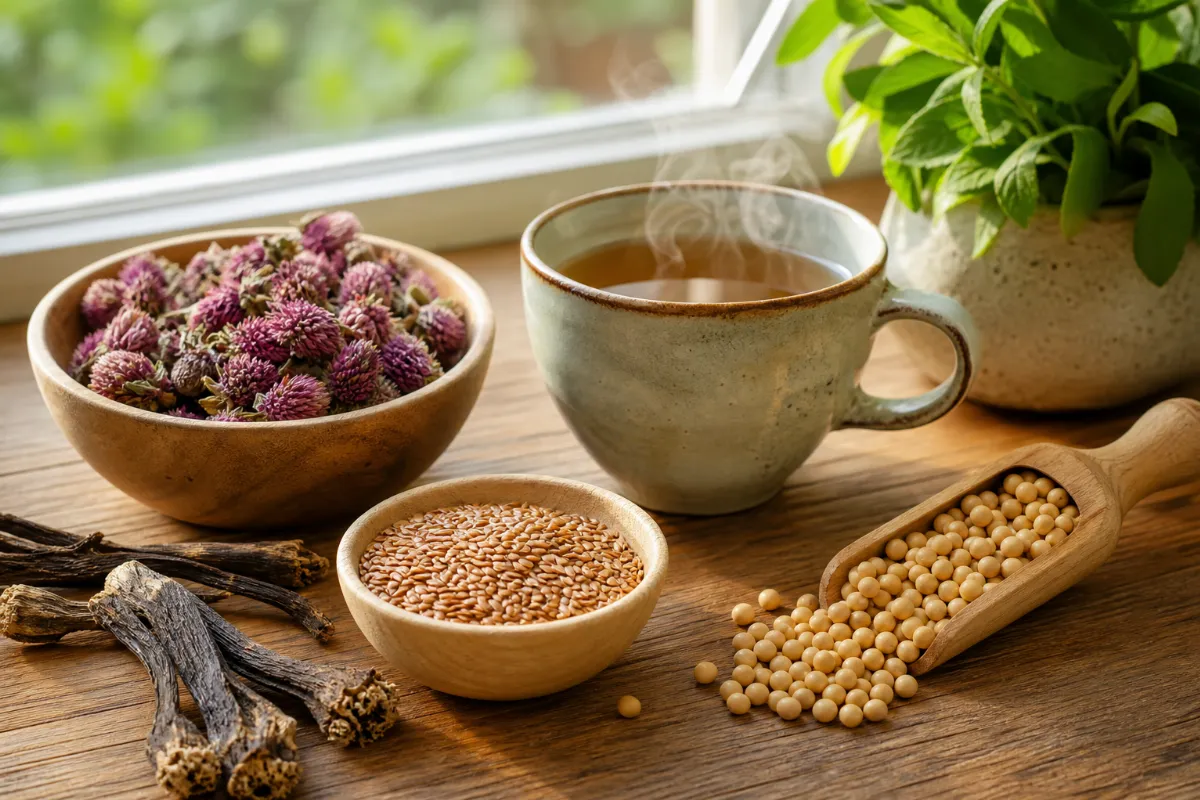
Wellness Goals · Women's Wellness · Claim check
Black Cohosh, Soy, Red Clover and "Hormone Balance" Claims
Plant products sold for menopause and "hormone balance" · also called Black cohosh, soy, red clover, evening primrose oil, maca, hormone balance, natural hormone replacement, bioidentical hormones, cohosh negro, trébol rojo
Many products promise "hormone balance" or "natural hormone replacement" for menopause, using black cohosh, soy, red clover, evening primrose oil or maca. Research gives mixed or weak results for hot flashes, and the trials that measured hormones found these products do not change hormone levels the way hormone therapy does. The North American Menopause Society lists supplements and herbal remedies as not recommended for hot flashes. Talk to a clinician before starting any, especially with other medicines, and see a doctor for any bleeding after menopause.
General information, not medical advice. Last substantive update · Not medically reviewed. A named clinician has not signed off on this page. How this page is made
About Black Cohosh, Soy, Red Clover and "Hormone Balance" Claims
Products sold to "balance hormones" or as "natural hormone replacement" usually contain black cohosh, soy isoflavones, red clover, evening primrose oil or maca. For hot flashes the evidence is mixed to weak, and the trials that measured hormones found no change in estradiol or FSH, so these are not hormone replacement. Hormone therapy is the most effective treatment, and the North American Menopause Society lists supplements and herbal remedies as not recommended for hot flashes. Some products carry rare liver, pregnancy and medicine-interaction cautions.
What the "hormone balance" and "natural hormone replacement" claims mean
"Hormone balance" is a marketing phrase. The NHS, FDA, NCCIH and the North American Menopause Society pages read for this page do not define hormone balancing as a treatment. Similar wording such as "natural hormone replacement" suggests a plant product can do what hormone therapy does.
The trials that measured hormones tested that idea directly. A 2025 pooled analysis of 40 trials, a 1-year trial of black cohosh and a small trial of maca found no change in estradiol or FSH, so these products do not act like hormone therapy. That is not the same as saying they do nothing for symptoms.
What research shows for black cohosh, soy, red clover and other herbs
For hot flashes, pooled results are small and inconsistent. Black cohosh: no difference from placebo in a 2012 Cochrane review, moderate certainty in a 2026 review. Soy isoflavone supplements: about 21 percent fewer hot flashes in a 2012 meta-analysis, no conclusive evidence in a 2013 Cochrane review. Red clover: about 1.7 fewer flushes a day in a 2021 meta-analysis but not significant in the Cochrane analysis.
Flaxseed did not beat a placebo bar in a 188-woman trial. Evening primrose oil and maca have limited evidence, and dong quai was no better than placebo in 71 women. Placebo effects were large in most trials.
What established care looks like
The North American Menopause Society says hormone therapy remains the most effective treatment for hot flashes. Its 2023 statement of non-hormone options recommends cognitive behavioural therapy and clinical hypnosis, and lists supplements and herbal remedies, soy foods, soy extracts and equol as not recommended for hot flashes.
The NHS advises talking to a doctor, nurse or pharmacist about hormone therapy and other options. See the perimenopause and menopause and hot flashes pages for more.
"Bioidentical" and compounded hormones
The FDA says it has no evidence that compounded "bioidentical hormones" are safe and effective, or safer or more effective than FDA-approved hormone therapy. ACOG's 2023 consensus statement says "bioidentical" is used as a marketing term and evidence for those claims is lacking.
FDA-approved products with hormones identical to those the body makes do exist, so "bioidentical" does not mean unapproved. This is information about claims, not advice for or against any prescription.
At a glance
Traditional uses history, not proof
Studied for research
- Black cohosh, mixed
- Soy isoflavones for hot flashes, mixed
- Red clover, mixed
- Flaxseed, low certainty and no benefit in one large trial
- Evening primrose oil, insufficient
- Maca, insufficient
- Soy and bone density, mixed
- Changing hormone levels (the "hormone balance" idea), evidence against
- Compounded "bioidentical" hormones, no evidence of extra safety
Main compounds
- Black cohosh extracts
- Soy isoflavones (genistein)
- Red clover isoflavones (biochanin A)
- Flax lignans
- Maca
- Dong quai
Common forms
- Standardised extracts and capsules
- Soy foods and isoflavone tablets
- Red clover extracts
- Flaxseed bars
- Evening primrose oil capsules
- Maca powder
- Compounded hormone creams and pellets
Research links: 2012 Cochrane review: black cohosh for menopausal symptoms · 2013 Cochrane review: phytoestrogens for hot flushes · 2025 pooled analysis: soy isoflavones and estrogenicity · 2023 NAMS nonhormone therapy statement · 2023 ACOG: compounded bioidentical hormones · NCCIH: Black cohosh · NHS: Treatment for menopause and perimenopause · FDA: Menopause · Research Library · Genes & Biomarkers Library
What it is and its history
- Accepted scientific name
- Botanical products sold for menopause and "hormone balance"
- Common names
- Black cohosh (English); Soy isoflavones (English); Red clover (English); Hormone balance supplements (English); Cohosh negro, soja, trébol rojo, equilibrio hormonal (Spanish)
- Family or group
- Plant products (herbs, seeds and soy extracts) rich in plant estrogens (phytoestrogens) or marketed as hormone-balancing. They are not hormones and not the same as prescription hormone therapy.
- Look-alikes and adulterants
- Name: Blue cohosh; Note: A different herb from black cohosh; NCCIH says it may cause high blood pressure and has been linked to complications in infants.; Name: Compounded 'bioidentical' hormones; Note: Custom-compounded prescription hormones, not plant supplements; see the Benefits tab.; Name: FDA-approved hormone therapy; Note: Prescription treatment with evidence from large trials; discussed with a clinician.
Traditional use and history history, not clinical proof
| Tradition or era | Documented use | Source |
|---|---|---|
| Andean tradition (maca) | A systematic review says maca has been used for centuries in the Andes as an adaptogenic plant to manage anemia, infertility and female hormone balance. | p21840656 |
| Chinese herbal tradition (dong quai) | A case report says dong quai is a Chinese herbal supplement touted for menstrual cramping, irregular menses and menopausal symptoms. | p10417036 |
| Modern guidance | Current agency pages treat these products as having little or inconsistent evidence. No history older than that was read for black cohosh, soy or red clover. | s-nhs-treatment |
Traditional use shows how it was used. It does not show that it works or is safe today.
What is inside, and how it may work
What it contains and how those compounds act in cells and animals. Laboratory and animal mechanisms are not proven effects in people.
Main compounds
| Compound | Family | Where it is concentrated | Activity studied | Level of evidence |
|---|---|---|---|---|
| Isoflavones (including genistein) | phytoestrogen | Found in soy and red clover. A meta-analysis found supplements giving more than 18.8 mg of genistein worked better than lower ones. | Weak estrogen-like binding proposed; trials found no change in blood hormone levels. 17 20 | Human data |
| Biochanin A | isoflavone | A red clover isoflavone; extracts with a higher share worked better in a 2021 meta-analysis. | Not established. 7 | Human data |
| Lignans | phytoestrogen | A flaxseed bar provided 410 mg in one trial. | Weak plant estrogens proposed; the trial did not show hot flash benefit. 15 | Human data |
| Black cohosh extracts | herbal extract | Content varies between products; NCCIH says some products have contained the wrong herb. | Not established; a 1-year trial found no change in reproductive hormones. 16 22 | Human data |
Mechanisms, receptors and pathways
| Target or pathway | Gene or receptor | What was found | Level |
|---|---|---|---|
| Estrogen receptors | Isoflavones and lignans are called plant estrogens, but a 2025 pooled analysis of 40 trials found no change in estradiol, FSH, womb lining or vaginal maturation, which the authors read as a selective effect unlike estrogen. This is an interpretation. 20 | Not established | |
| Black cohosh and maca | In the trials read, neither changed reproductive hormones; a lab test found no estrogen-like or androgen-like activity in maca extracts. How either might relieve symptoms is not established. 16 3 | Not established |
Isolated compounds versus whole extracts
Extracted soy isoflavone supplements, soy foods, black cohosh extracts and red clover products differ widely, and results for one product cannot be assumed for another. A 2012 meta-analysis found extracted or synthesised isoflavones worked better than placebo while a Cochrane review found no conclusive evidence for phytoestrogen foods and supplements together.
4 mixed findings3 low certainty4 not enough evidence1 evidence against
What was looked at
The 12 benefits and uses checked for Black Cohosh, Soy, Red Clover and "Hormone Balance" Claims, each with how strong the evidence is. Tap one to open it.
- Black cohoshMixed findings
- Soy isoflavones for hot flashesMixed findings
- Red cloverMixed findings
- Flaxseed (lignans)Low certainty
- Evening primrose oilNot enough evidence
- MacaNot enough evidence
- Plant-based products as a groupLow certainty
- Soy isoflavones and bone densityMixed findings
- Do plant products change hormone levels?Evidence against
- "Hormone balance" and "natural hormone replacement" claimsNot enough evidence
- Compounded "bioidentical" hormonesNot enough evidence
- Dong quaiLow certainty
Lab markers tracked in the studies
Hot flashes per day (frequency)Menopausal symptom scores (Kupperman Index, Greene Scale)Estradiol and FSH (reproductive hormones)Womb lining (endometrial) thicknessBone mineral density
What is Black Cohosh, Soy, Red Clover and "Hormone Balance" Claims good for?
Here are the claims made for black cohosh, soy, red clover, evening primrose oil, maca and "hormone balance" products, and how strong the human evidence is for each. They describe what trials found, not advice to try anything. Established medical care is described in the About tab.
Benefits, one by one
Each card is a research question, not a promise. Tap a goal to filter. Open a card to see the studies, doses and limits.
Black cohosh
Mixed findingsResults disagree. A 2012 Cochrane review of 16 trials found no difference from placebo for hot flushes, while a 2026 review rated black cohosh as moderate-certainty for hot flashes and overall menopausal symptoms and still called the overall evidence limited.
4 studiesCochrane trials used oral single-ingredient extracts, median 40 mg a …
Studies, doses and limits
What the trials found
A 2012 Cochrane review pooled 16 randomised trials (2,027 women) and found no significant difference from placebo in daily hot flushes or symptom scores, though hormone therapy beat black cohosh on symptom scores. A 2026 review for the International Menopause Society (158 studies) found moderate-certainty evidence for vasomotor and overall menopausal symptoms, while saying most complementary evidence is low or very low. NCCIH describes a 2023 review of 22 studies that found potential benefit for overall symptoms and hot flashes but not for anxiety or depression, and says it is uncertain whether black cohosh reduces hot flashes from breast cancer treatment. The 2023 review itself was not read.
Results
Cochrane: hot flushes per day mean difference 0.07 (95% CI -0.43 to 0.56); symptom score SMD -0.10 (-0.32 to 0.11).
Effect sizes as reported
Cochrane 2012: mean difference 0.07 flushes a day vs placebo (95% CI -0.43 to 0.56; 393 women, 3 trials). The 2026 review rates evidence for black cohosh as moderate certainty.
Why this rating
A Cochrane review found no difference from placebo, the 2026 review and NCCIH describe benefit, and the newer review gives no pooled number in its abstract.
Form and dose studied
Cochrane trials used oral single-ingredient extracts, median 40 mg a day for a mean of 23 weeks. NCCIH says it has been used safely in studies as long as a year. Amounts and durations are given only as what each study used. They are not advice.
Who was studied
Perimenopausal and postmenopausal women with hot flushes or other menopausal symptoms.
Limits
Heterogeneous extracts; poor reporting of trial quality and safety; the product used in each trial matters; the 2023 review was not read.
Why researchers looked
Black cohosh is one of the best known herbs sold for menopause, so it has the most trials of any botanical in this area.
Proposed mechanism Hypothesis
Proposed: acts on brain chemistry or on temperature control rather than as an estrogen. Not established in the sources read; a 1-year trial found it did not change reproductive hormones.
A proposed mechanism does not show that the effect happens in people.
Rare liver injury has been reported and the cause is uncertain. Some products have contained the wrong herb. See the Safety tab.
Soy isoflavones for hot flashes
Mixed findingsMixed. A meta-analysis of 17 trials found 20.6 percent fewer hot flashes with soy isoflavone supplements, but a Cochrane review found no conclusive evidence because of small trials and a strong placebo effect, and a 2-year trial of 248 women found no benefit.
6 studiesSupplements in the 2012 analysis gave a median 54 mg of isoflavones a…
Studies, doses and limits
What the trials found
A 2012 meta-analysis (17 trials) found isoflavone supplements cut hot flash frequency by 20.6 percent and severity by 26.2 percent versus placebo, with high variation. A 2013 Cochrane review of 43 trials (4,364 women) found no conclusive evidence of benefit, many small trials at high risk of bias, and placebo reductions of 1 to 59 percent. A 2016 JAMA meta-analysis of 62 studies found about 0.8 fewer hot flashes a day with soy isoflavones and no clear drop in night sweats. NCCIH says the effect may be small and results inconsistent. A 2-year trial of 248 women found more hot flashes in the soy group. The 2023 North American Menopause Society statement lists soy foods and soy extracts as not recommended for hot flashes (Level II evidence).
Results
Taku 2012: frequency -20.6 percent (95% CI -28.38 to -12.86); Franco 2016: -0.79 hot flashes a day (-1.35 to -0.23).
Effect sizes as reported
Frequency -20.6 percent and severity -26.2 percent (2012 meta-analysis); about 0.8 fewer hot flashes a day (2016); no conclusive evidence (2013 Cochrane).
Why this rating
Pooled analyses lean positive, the Cochrane review and a long trial are negative, and most trials are small with high variation and large placebo effects.
Form and dose studied
Supplements in the 2012 analysis gave a median 54 mg of isoflavones a day for 6 weeks to 12 months; extracts with more than 18.8 mg genistein worked better. The 2-year trial used 200 mg a day. Amounts and durations are given only as what each study used. They are not advice.
Who was studied
Perimenopausal and postmenopausal women with hot flashes.
Limits
High heterogeneity (I-squared 67 to 86 percent); many small trials; placebo effect; different products, doses and forms.
Why researchers looked
Soy foods contain isoflavones, plant compounds that are chemically similar to estrogen, and menopause symptoms are less often reported in some soy-eating populations, so researchers tested soy products.
Proposed mechanism Hypothesis
Proposed: isoflavones bind estrogen receptors weakly and act like a mild, selective estrogen. A 2025 pooled analysis found no change in estradiol, FSH or womb lining, which fits a selective rather than a hormone-like effect. This is the authors' interpretation.
A proposed mechanism does not show that the effect happens in people.
Soy is a common food allergen. See the Safety tab for pregnancy and medicine cautions.
Red clover
Mixed findingsMixed to weak. A 2021 meta-analysis of 8 trials found about 1.7 fewer hot flushes a day, but a Cochrane review found no significant difference from placebo for the Promensil extract and NCCIH calls results inconsistent.
4 studiesReviewed trials used red clover isoflavone extracts; the stronger res…
Studies, doses and limits
What the trials found
A 2021 meta-analysis of eight trials (ten comparisons) found 1.73 fewer hot flushes a day versus placebo, with a confidence interval close to no effect, and a clearer effect at 12 weeks, in women with 5 or more flushes a day, and at 80 mg or more of isoflavones a day. The 2013 Cochrane review pooled five Promensil trials and found no significant difference (mean difference -0.93 flushes a day, 95% CI -1.95 to 0.10). NCCIH says red clover studies for hot flashes have had inconsistent results and that research has not shown conclusive benefit for any health condition. NHS says red clover has very little evidence on how well it works or how safe it is.
Results
2021: -1.73 hot flushes per day (95% CI -3.28 to -0.18); Cochrane: -0.93 (-1.95 to 0.10).
Effect sizes as reported
About 1.7 fewer hot flushes a day (2021), not significant in the Cochrane pooled analysis.
Why this rating
Two reviews disagree and the positive one has a lower limit close to no effect.
Form and dose studied
Reviewed trials used red clover isoflavone extracts; the stronger results were at 80 mg or more of isoflavones a day over 12 weeks (as reported). Amounts and durations are given only as what each study used. They are not advice.
Who was studied
Perimenopausal and postmenopausal women with hot flushes.
Limits
Small number of trials; exploratory subgroups; brand-specific extracts.
Why researchers looked
Red clover is rich in isoflavones such as biochanin A and is sold as a natural source of plant estrogens for hot flushes.
Proposed mechanism Hypothesis
Proposed: isoflavones act as weak plant estrogens. Not tested for mechanism in the sources read.
A proposed mechanism does not show that the effect happens in people.
NCCIH says red clover supplements may be unsafe in pregnancy and breastfeeding. See the Safety tab.
Flaxseed (lignans)
Low certaintyOne large trial did not find a benefit. In 188 postmenopausal women a flaxseed bar did not reduce hot flashes more than a placebo bar over 6 weeks.
1 studies410 mg lignans a day in a bar for 6 weeks (as reported). Amounts and …
Studies, doses and limits
What the trials found
A phase III randomised trial of 188 postmenopausal women (with or without breast cancer) compared a flaxseed bar providing 410 mg of lignans a day with a placebo bar for 6 weeks. The hot flash score fell 4.9 with flaxseed and 3.5 with placebo (P=0.29), and just over a third in each group had a 50 percent drop. The authors say the results do not support this dose of lignans for hot flashes. Both groups reported bloating, wind, diarrhoea and nausea.
Results
Score reduction 4.9 vs 3.5 (P=0.29).
Effect sizes as reported
Hot flash score down 4.9 vs 3.5 on placebo; not significant.
Why this rating
One well-run placebo-controlled phase III trial, short, with a single product. Other flaxseed trials were not read.
Form and dose studied
410 mg lignans a day in a bar for 6 weeks (as reported). Amounts and durations are given only as what each study used. They are not advice.
Who was studied
Postmenopausal women with hot flashes, some with breast cancer history.
Limits
Only 6 weeks; one dose and form; other flaxseed products not tested.
Why researchers looked
Flaxseed is rich in lignans, plant compounds with mild estrogen-like activity, and early reports hinted at fewer hot flashes.
Proposed mechanism Hypothesis
Proposed: lignans act as weak plant estrogens. Not tested in the trial.
A proposed mechanism does not show that the effect happens in people.
Mild stomach effects were common in both groups.
Evening primrose oil
Not enough evidenceWeak and unclear. A 2024 review found lower hot flash severity than placebo in trials of under 6 months, but no change in frequency or duration, and says the evidence is insufficient.
1 studiesNot given in the abstract. Amounts and durations are given only as wh…
Studies, doses and limits
What the trials found
A 2024 systematic review of randomised and controlled trials found hot flash severity was lower with evening primrose oil than placebo when used for under 6 months, but frequency and duration did not differ. Nausea and headache were mild. Versus black cohosh, severity was similar at 4 weeks and worse at 8 weeks with evening primrose oil. The authors conclude evidence is insufficient for firm conclusions. The number of trials is not given in the abstract.
Results
Not given in the abstract.
Effect sizes as reported
Severity lower than placebo under 6 months; frequency and duration not different.
Why this rating
The review's own conclusion; trial numbers and sizes were not given in the abstract.
Form and dose studied
Not given in the abstract. Amounts and durations are given only as what each study used. They are not advice.
Who was studied
Menopausal women with hot flashes.
Limits
Only the abstract was read; trial sizes not given.
Why researchers looked
Evening primrose oil has been used as a natural alternative to hormone therapy for hot flashes.
Proposed mechanism Hypothesis
Not established in the sources read.
A proposed mechanism does not show that the effect happens in people.
Mild nausea and headache were reported.
Maca
Not enough evidenceLimited. A 2011 review of four small trials found better symptom scores with maca, but the authors say evidence is too limited to draw firm conclusions and safety has not been proven. A small trial found maca did not change hormone levels.
2 studiesMaca powder 3.5 g a day for 6 weeks in the crossover trial (as report…
Studies, doses and limits
What the trials found
A 2011 systematic review found four randomised trials of maca versus placebo; all reported favourable effects on the Kupperman Menopausal Index and Greene Climacteric Score, but the authors say trials were few, small and of limited quality. A 2008 crossover trial of 14 postmenopausal women found 3.5 g a day for 6 weeks lowered anxiety, depression and sexual dysfunction scores compared with placebo without changing hormone levels.
Results
2008: hormone levels unchanged (P > 0.05); symptom scores lower than placebo (P < 0.05).
Effect sizes as reported
Better symptom scores in all four trials; no change in hormones in the crossover trial.
Why this rating
Four small trials, high risk of bias in a field with very few rigorous trials, per the authors; safety not established.
Form and dose studied
Maca powder 3.5 g a day for 6 weeks in the crossover trial (as reported). Amounts and durations are given only as what each study used. They are not advice.
Who was studied
Healthy perimenopausal and postmenopausal women.
Limits
Very few trials; total sample size small; the 2008 trial had 14 women.
Why researchers looked
Maca, an Andean root vegetable, has been used for centuries in the Andes for female hormone balance, so researchers tested it in menopause.
Proposed mechanism Hypothesis
A crossover trial found no change in estradiol, FSH, LH or SHBG, and a lab test found no estrogen-like or androgen-like activity in maca extracts, so any effect on symptoms is not explained by hormones.
A proposed mechanism does not show that the effect happens in people.
The 2011 review says safety has not been proven.
Plant-based products as a group
Low certaintyModest and low quality. A 2016 JAMA meta-analysis of 62 studies found phytoestrogens linked to about 1.3 fewer hot flashes a day and less vaginal dryness, but no fewer night sweats, and three in four trials had high risk of bias.
3 studiesMixed products; see each herb above. Amounts and durations are given …
Studies, doses and limits
What the trials found
The 2016 JAMA review of 62 studies (6,653 women) found phytoestrogens linked to -1.31 hot flashes a day and a lower vaginal dryness score, but not to night sweats. Several herbal remedies, but not Chinese medicinal herbs, were linked to fewer vasomotor symptoms. NAMS 2023 lists supplements and herbal remedies as not recommended for hot flashes (Levels I-II). The NHS says there is very little evidence on how well red clover and black cohosh work or how safe they are.
Results
Hot flashes: -1.31 per day (95% CI -2.02 to -0.61); night sweats -2.14 (-5.57 to 1.29).
Effect sizes as reported
Modest reduction in hot flashes, none in night sweats.
Why this rating
Consistent small effects in a pool of weak trials, with 74 percent at high risk of bias.
Form and dose studied
Mixed products; see each herb above. Amounts and durations are given only as what each study used. They are not advice.
Who was studied
Women with menopausal symptoms in 62 studies.
Limits
Heterogeneous products and quality.
Why researchers looked
Women commonly use several plant products at once, so reviewers pooled phytoestrogens and herbal remedies together.
Proposed mechanism Hypothesis
Not established.
A proposed mechanism does not show that the effect happens in people.
Interaction and side-effect cautions apply to individual products.
Soy isoflavones and bone density
Mixed findingsMixed. A 2022 meta-analysis of 18 trials found a small gain in bone density, but a 2-year trial of 248 women found no difference from placebo. NCCIH says soy isoflavones probably have a beneficial effect on bone density after menopause.
3 studiesPooled trials gave a median 106 mg of isoflavones a day for 6 to 24 m…
Studies, doses and limits
What the trials found
A 2022 meta-analysis of 18 randomised trials found modest gains versus controls (lumbar spine +1.63 percent, femoral neck +1.87 percent, total hip +0.39 percent) with effects varying by trial length, ethnicity and product. A 2-year trial of 248 women within 5 years of menopause found no difference in spine, hip or femoral neck bone density between 200 mg a day of isoflavones and placebo. NCCIH says soy isoflavones probably have a beneficial effect on bone density in postmenopausal women. None of the sources read measured fractures. See the osteoporosis and bone health page.
Results
Lumbar spine +1.63 percent (95% CI 0.51 to 2.75); 2-year trial: spine -2.0 vs -2.3 percent.
Effect sizes as reported
Small gain in pooled trials; none in the largest single trial.
Why this rating
One pooled analysis and NCCIH lean positive; the large 2-year trial is negative; bone density is a stand-in for fractures.
Form and dose studied
Pooled trials gave a median 106 mg of isoflavones a day for 6 to 24 months (as reported). Amounts and durations are given only as what each study used. They are not advice.
Who was studied
Perimenopausal and postmenopausal women.
Limits
Mixed products and doses; bone density only; no fracture data in the abstracts.
Why researchers looked
Bone loss speeds up after menopause, and soy isoflavones have weak estrogen-like activity, so researchers tested them on bone.
Proposed mechanism Hypothesis
Proposed: weak estrogen-receptor effects on bone. Not tested in the sources read.
A proposed mechanism does not show that the effect happens in people.
See the Safety tab.
Do plant products change hormone levels?
Evidence againstEvidence says no. Pooled trials of soy isoflavones, a 1-year trial of black cohosh and a crossover trial of maca found no change in estradiol, FSH or other reproductive hormones. This is evidence against the idea that these products act like estrogen or 'balance' hormones.
4 studiesPooled trials gave a median 75 mg of soy isoflavones a day for a medi…
Studies, doses and limits
What the trials found
A 2025 meta-analysis of 40 trials (3,285 women) found soy isoflavones had no significant effect on endometrial thickness, vaginal maturation, FSH or estradiol, with moderate to high certainty. The HALT trial (351 women, 1 year) found black cohosh, a multibotanical and a multibotanical with soy counselling did not change vaginal cells, womb lining or reproductive hormones, while hormone therapy did. In 14 postmenopausal women, maca did not change estradiol, FSH, LH or SHBG. A 2013 Cochrane review found no oestrogenic stimulation of the womb lining or vagina up to two years. These tests do not say whether the products relieve symptoms, only that they do not behave like hormone therapy.
Results
Soy: endometrial thickness -0.22 mm (95% CI -0.45 to 0.01); estradiol +1.61 pmol/L (-1.17 to 4.38).
Effect sizes as reported
No significant change in estradiol, FSH, womb lining or vaginal cells with these products.
Why this rating
Several independent designs, including a large pooled analysis rated moderate to high certainty, measured hormones and found no change. This does not cover every product on the market.
Form and dose studied
Pooled trials gave a median 75 mg of soy isoflavones a day for a median 24 weeks (as reported). Amounts and durations are given only as what each study used. They are not advice.
Who was studied
Postmenopausal women (soy analysis, maca trial); women aged 45 to 55 (HALT).
Limits
Trials covered a limited set of products; trials of 6 months to 1 year; no evidence on every supplement sold as 'hormone balancing'.
Why researchers looked
Products are often sold as 'balancing hormones' or as 'natural hormone replacement', so trials measured hormones directly.
Proposed mechanism Hypothesis
The authors of the 2025 analysis read the results as soy isoflavones acting like a selective modulator rather than like estrogen. A maca lab test found no estrogen-like or androgen-like activity. These are interpretations, not proven mechanisms.
A proposed mechanism does not show that the effect happens in people.
The same finding is reassuring for womb-lining safety in the trials studied, but it is not proof of safety for every product.
"Hormone balance" and "natural hormone replacement" claims
Not enough evidenceNo medical or clinical test of 'hormone balancing' was found. Products sold with this wording are not shown by these sources to replace hormone therapy, and the NHS names only red clover and black cohosh as herbs sometimes sold for menopause with very little evidence.
3 studiesNot given. Amounts and durations are given only as what each study us…
Studies, doses and limits
Results
Not given.
Effect sizes as reported
No evidence found for a 'hormone balancing' effect.
Why this rating
Absence of evidence in the sources read; a claim with no defined test cannot be rated as effective.
Form and dose studied
Not given. Amounts and durations are given only as what each study used. They are not advice.
Who was studied
No studies of the claim as worded were found.
Limits
The search was limited to the sources named here.
Why researchers looked
The words 'hormone balance' appear on many labels and websites, so this page checks them against the research.
Proposed mechanism Hypothesis
Not established.
A proposed mechanism does not show that the effect happens in people.
Ask a clinician before relying on a product marketed this way, especially if you take other medicines.
Compounded "bioidentical" hormones
Not enough evidenceThe claim that they are safer or more effective is unsupported. The FDA has no evidence they are safer or more effective than FDA-approved hormone therapy, and the 2023 ACOG consensus says evidence for those marketing claims is lacking.
2 studiesNot given. Amounts and durations are given only as what each study us…
Studies, doses and limits
What the trials found
ACOG (2023) says many compounding pharmacies use 'bioidentical hormone' as a marketing term, that evidence for greater safety and effectiveness is lacking, and that compounded products should not be prescribed routinely when FDA-approved formulations exist. The FDA says most marketed 'bioidentical' products are compounded drugs that are not FDA-approved, that it has no evidence they are safe and effective, and that natural does not always mean safe. FDA-approved products with hormones identical to those made in the body exist. This entry is about marketing claims, not a recommendation for or against any prescription.
Results
Not given.
Effect sizes as reported
No evidence that compounded products are safer or more effective than approved ones.
Why this rating
Authoritative statements say evidence is lacking; high-quality long-term trials are called for.
Form and dose studied
Not given. Amounts and durations are given only as what each study used. They are not advice.
Who was studied
Women considering hormone therapy.
Limits
Only the ACOG abstract and an FDA page read; compounding practices vary.
Why researchers looked
'Bioidentical' sounds natural and safe, so people ask whether custom-compounded hormones are better.
Proposed mechanism Hypothesis
Not established.
A proposed mechanism does not show that the effect happens in people.
The FDA suggests asking a clinician about the risks and benefits of hormones, including 'bioidenticals'.
Dong quai
Low certaintyNot supported by the one trial read. In 71 postmenopausal women, dong quai alone did not differ from placebo for hot flushes, the Kupperman index, womb lining thickness or vaginal maturation.
2 studiesUsed alone for 24 weeks in the trial (as reported). Amounts and durat…
Studies, doses and limits
What the trials found
A 24-week double-blind trial of 71 postmenopausal women with hot flashes found no significant difference between dong quai and placebo in endometrial thickness, vaginal maturation, hot flush counts or the Kupperman index, so the authors conclude it does not produce estrogen-like responses and was no more helpful than placebo when used alone. A case report suggests it can raise warfarin effect; see the Safety tab.
Results
Not given.
Effect sizes as reported
No difference from placebo on any outcome.
Why this rating
One older randomised trial of moderate size, used alone; traditional combinations were not tested.
Form and dose studied
Used alone for 24 weeks in the trial (as reported). Amounts and durations are given only as what each study used. They are not advice.
Who was studied
Postmenopausal women with hot flashes.
Limits
One trial from 1997; combinations not tested.
Why researchers looked
Dong quai is a Chinese herb marketed for menopause and as 'estrogenic'.
Proposed mechanism Hypothesis
Not established; the trial found no estrogen-like response.
A proposed mechanism does not show that the effect happens in people.
A case report found a doubled INR in a woman taking warfarin with dong quai.
Connections to the rest of health
How Black Cohosh, Soy, Red Clover and "Hormone Balance" Claims connects to the rest of our health knowledge graph. Every link says what kind of connection it is. A safety link (for example to the liver) is a warning, not a benefit. A study that merely mentions a topic never creates a benefit link.
Explore every connection: goals, body systems, organs, symptoms, genes
A. Wellness goals
| Connected to | Kind of connection | Evidence status | Context | Studies |
|---|---|---|---|---|
| Menopause Support | Mixed findings | Black cohosh: Results disagree. A 2012 Cochrane review of 16 trials found no difference from placebo for hot flushes, while a 2026 review rated black cohosh as moderate-certainty for hot flashes and overall menopausal symptoms and still called the overall evidence limited. Soy isoflavones for hot flashes: Mixed. A meta-analysis of 17 trials found 20.6 percent fewer hot flashes with soy isoflavone supplements, but a Cochrane review found no conclusive evidence because of small trials and a strong placebo effect, and a 2-year trial of 248 women found no benefit. | 8 13 22 18 17 10 4 11 24 7 23 26 19 20 16 3 | |
| Womens Wellness | Mixed findings | Black cohosh: Results disagree. A 2012 Cochrane review of 16 trials found no difference from placebo for hot flushes, while a 2026 review rated black cohosh as moderate-certainty for hot flashes and overall menopausal symptoms and still called the overall evidence limited. Soy isoflavones for hot flashes: Mixed. A meta-analysis of 17 trials found 20.6 percent fewer hot flashes with soy isoflavone supplements, but a Cochrane review found no conclusive evidence because of small trials and a strong placebo effect, and a 2-year trial of 248 women found no benefit. | 8 13 22 18 17 10 4 11 24 7 23 26 19 2 | |
| Menopause Support | Low certainty | Flaxseed (lignans): One large trial did not find a benefit. In 188 postmenopausal women a flaxseed bar did not reduce hot flashes more than a placebo bar over 6 weeks. Maca: Limited. A 2011 review of four small trials found better symptom scores with maca, but the authors say evidence is too limited to draw firm conclusions and safety has not been proven. A small trial found maca did not change hormone levels. | 15 9 3 6 14 | |
| Womens Wellness | Low certainty | Flaxseed (lignans): One large trial did not find a benefit. In 188 postmenopausal women a flaxseed bar did not reduce hot flashes more than a placebo bar over 6 weeks. Maca: Limited. A 2011 review of four small trials found better symptom scores with maca, but the authors say evidence is too limited to draw firm conclusions and safety has not been proven. A small trial found maca did not change hormone levels. | 15 9 3 6 14 | |
| Bone Health | Mixed findings | Soy isoflavones and bone density: Mixed. A 2022 meta-analysis of 18 trials found a small gain in bone density, but a 2-year trial of 248 women found no difference from placebo. NCCIH says soy isoflavones probably have a beneficial effect on bone density after menopause. | 2 11 24 | |
| Hormone Balance | Evidence against | Do plant products change hormone levels?: Evidence says no. Pooled trials of soy isoflavones, a 1-year trial of black cohosh and a crossover trial of maca found no change in estradiol, FSH or other reproductive hormones. This is evidence against the idea that these products act like estrogen or 'balance' hormones. | 20 16 3 10 | |
| Hormone Balance | Not enough evidence | "Hormone balance" and "natural hormone replacement" claims: No medical or clinical test of 'hormone balancing' was found. Products sold with this wording are not shown by these sources to replace hormone therapy, and the NHS names only red clover and black cohosh as herbs sometimes sold for menopause with very little evidence. Compounded "bioidentical" hormones: The claim that they are safer or more effective is unsupported. The FDA has no evidence they are safer or more effective than FDA-approved hormone therapy, and the 2023 ACOG consensus says evidence for those marketing claims is lacking. | 26 21 18 1 | |
| Menopause Support | Not enough evidence | "Hormone balance" and "natural hormone replacement" claims: No medical or clinical test of 'hormone balancing' was found. Products sold with this wording are not shown by these sources to replace hormone therapy, and the NHS names only red clover and black cohosh as herbs sometimes sold for menopause with very little evidence. Compounded "bioidentical" hormones: The claim that they are safer or more effective is unsupported. The FDA has no evidence they are safer or more effective than FDA-approved hormone therapy, and the 2023 ACOG consensus says evidence for those marketing claims is lacking. | 26 21 18 1 |
B. Body systems
| Connected to | Kind of connection | Evidence status | Context | Studies |
|---|---|---|---|---|
| Reproductive System | Biological association | Mixed findings | Studied for: Black cohosh Studied for: Soy isoflavones for hot flashes | 8 13 22 18 17 10 4 11 24 7 23 26 15 19 9 3 6 14 |
| Musculoskeletal System | Biological association | Mixed findings | Studied for: Soy isoflavones and bone density | 2 11 24 |
| Endocrine System | Biological association | Evidence against | Studied for: Do plant products change hormone levels? Studied for: "Hormone balance" and "natural hormone replacement" claims | 20 16 3 10 26 21 18 1 |
E. Health conditions
| Connected to | Kind of connection | Evidence status | Context | Studies |
|---|---|---|---|---|
| Hot flashes | Mixed findings | The symptom most plant products are sold for. Preparation or compound: Black cohosh, soy, red clover |
8 17 | |
| Perimenopause and menopause | Health agency guidance | Established care options, covered there. Preparation or compound: Treatment overview |
26 |
I. Biomarkers
| Connected to | Kind of connection | Evidence status | Context | Studies |
|---|---|---|---|---|
| Hot flashes per day (frequency) | Biological association | Low certainty | Measured in trials: Lower is better. A lab change is not the same as a health benefit. | 8 7 4 |
| Menopausal symptom scores (Kupperman Index, Greene Scale) | Biological association | Low certainty | Measured in trials: Lower is better. A lab change is not the same as a health benefit. | 8 9 |
| Estradiol and FSH (reproductive hormones) | Biological association | Moderate certainty | Measured in trials: Hormone therapy raises estradiol and lowers FSH; no change means no hormone-like effect. A lab change is not the same as a health benefit. | 20 16 3 |
| Womb lining (endometrial) thickness | Biological association | Moderate certainty | Measured in trials: Thicker lining after estrogen-like exposure; no change is reassuring. A lab change is not the same as a health benefit. | 20 6 |
| Bone mineral density | Biological association | Low certainty | Measured in trials: Higher is better. A lab change is not the same as a health benefit. | 2 11 |
L. Active compounds
| Connected to | Kind of connection | Evidence status | Context | Studies |
|---|---|---|---|---|
| Isoflavones (including genistein) | Biological association | Human | Weak estrogen-like binding proposed; trials found no change in blood hormone levels. | 17 20 |
| Biochanin A | Biological association | Human | Not established. | 7 |
| Lignans | Biological association | Human | Weak plant estrogens proposed; the trial did not show hot flash benefit. | 15 |
| Black cohosh extracts | Biological association | Human | Not established; a 1-year trial found no change in reproductive hormones. | 16 22 |
Each connection is stored with the ingredient, the connected record, the kind of connection, the evidence status, the supporting studies, the preparation or compound involved, and a review date (last reviewed October 31, 2026).
Evidence at a glance: what the research found for 12 outcomes
Each outcome below is one thing researchers measured. Certainty is how far the evidence can be trusted, not how well it works. The full studies are on the next tab.
The evidence
The research centre for Black Cohosh, Soy, Red Clover and "Hormone Balance" Claims. Every record here was checked against PubMed or the publisher's page; we never list a study we have not verified.
Evidence by outcome
Bars show how many studies we found for each outcome, not how well it works. People are added up across trials only (reviews are not added, to avoid double counting).
How we rate evidence
High certainty
Several well-run trials or reviews agree; further research is unlikely to change the picture much.
Moderate certainty
Good trials point the same way, but some doubt remains.
Low certainty
Small, short or inconsistent trials. The finding could change with better research.
Very low certainty
Very little or very weak human data. Treat as a possibility only.
Mixed findings
Trials or reviews disagree with each other.
Not enough evidence
Not enough human research to say either way.
Evidence against
Good research found no benefit, or found harm.
We take the reviewers' own risk-of-bias and GRADE statements where they exist, and otherwise judge from study size, design, consistency, directness and whether a product matches what is sold. Many publications do not make evidence high. Method note: We searched PubMed, re-read the abstract of every review and trial cited, and read the NHS, FDA and NCCIH pages through a tool that summarises pages. Full texts were not read. Certainty ratings are the compiler's own reading, except where a guideline gives its own grade. Funding is not stated in most abstracts, and this is noted where relevant.
Study library: every study we checked 26
| Study | Design | People | Product, dose, length | Result |
|---|---|---|---|---|
| American College of Obstetricians and Gynecologists' Committee on Clinical Consensus-Gynecology 2023 Compounded Bioidentical Menopausal Hormone Therapy: ACOG Clinical Consensus No. 6. Obstet Gynecol · PMID 37856860 · DOI |
Clinical guideline |
Consensus statement for clinicians on compounded bioidentical menopausal hormone therapy | Compounded bioidentical menopausal hormone therapy compared with FDA-approved formulations Consensus statement · vs FDA-approved menopausal hormone therapy |
The statement says 'bioidentical' is a marketing term, evidence to support claims of greater safety and effectiveness is lacking, and compounded products should not be prescribed routinely when FDA-approved formulations exist. High-quality long-term trials comparing compounded and approved products are needed. Not a trial (Not a trial) Methods, limits and fundingOutcomes: Clinical guidance on use Limitations: Consensus statement; only the abstract was read. Funding and conflicts: Not stated in the abstract. Read: abstract |
| Barańska 2022 The Role of Soy Isoflavones in the Prevention of Bone Loss in Postmenopausal Women: A Systematic Review with Meta-Analysis of Randomized Controlled Trials. J Clin Med · PMID 36012916 · DOI |
Systematic review meta analysis |
18 randomised trials of soy isoflavones and bone mineral density in menopausal women (searched 1995 to 2019) | Soy isoflavones as genistein extracts, isoflavone extracts, soy protein or soy foods (median 106 mg a day, range 40 to 300, as reported) 6 to 24 months · vs Controls |
Isoflavones were linked to a modest gain in bone density compared with controls: lumbar spine +1.63 percent, femoral neck +1.87 percent, total hip +0.39 percent. Lumbar spine WMD 1.63 percent; femoral neck 1.87 percent; total hip 0.39 percent (95% CI 0.51 to 2.75; 0.14 to 3.60; 0.08 to 0.69) Methods, limits and fundingOutcomes: Bone mineral density at lumbar spine, femoral neck and total hip Limitations: Mixed products and doses; effects varied by duration, ethnicity and form; bone density is a stand-in for fractures, which were not reported in the abstract. Funding and conflicts: Not stated in the abstract. Read: abstract |
| Brooks 2008 Beneficial effects of Lepidium meyenii (Maca) on psychological symptoms and measures of sexual dysfunction in postmenopausal women are not related to estrogen or androgen content. Menopause · PMID 18784609 · DOI |
Randomised controlled trial |
14 14 postmenopausal women (crossover trial) |
Maca powder 3.5 g a day (as reported) 6 weeks on maca and 6 weeks on placebo · vs Placebo |
Hormone levels did not change with maca. Psychological symptom and sexual dysfunction scores were lower than on placebo and baseline. The lab test found no physiologically significant hormone-like activity. Hormone levels: no difference (P > 0.05) (Not given in the abstract) Methods, limits and fundingOutcomes: Estradiol, FSH, LH, SHBG; Greene Climacteric Scale; lab test of estrogen-like and androgen-like activity in maca extracts Limitations: Only 14 women; preliminary findings, per the authors. Funding and conflicts: Not stated in the abstract. Read: abstract |
| Franco 2016 Use of Plant-Based Therapies and Menopausal Symptoms: A Systematic Review and Meta-analysis. JAMA · PMID 27327802 · DOI |
Systematic review meta analysis |
6653 62 studies of plant-based therapies in women with menopausal symptoms (searched to March 2016) |
Phytoestrogens (soy isoflavones, red clover and others) and several herbal remedies Varied · vs Placebo or other comparators |
Phytoestrogens were linked to about 1.3 fewer hot flashes a day and a lower vaginal dryness score, but not fewer night sweats. Soy isoflavones were linked to about 0.8 fewer hot flashes a day. 74 percent of trials had high risk of bias in three or more areas. Hot flashes per day: -1.31 (phytoestrogens); -0.79 (soy isoflavones); night sweats -2.14 (95% CI -2.02 to -0.61; -1.35 to -0.23; -5.57 to 1.29) Methods, limits and fundingOutcomes: Daily hot flashes, night sweats, vaginal dryness Limitations: Heterogeneous and generally low-quality trials. Funding and conflicts: Not stated in the abstract. Read: abstract |
| Fritz 2014 Black cohosh and breast cancer: a systematic review. Integr Cancer Ther · PMID 23439657 · DOI |
Systematic review |
26 articles: 14 randomised trials, 7 uncontrolled trials and 5 observational studies in women with or at risk of breast cancer | Black cohosh Varied · vs Varied |
Current evidence does not support a link with higher breast cancer risk; 17 trials showed no effect on hormone levels or tissue growth. Evidence for hot flash relief in breast cancer patients is lacking. Observational: adjusted OR 0.47 (primary cancer risk); adjusted HR 0.75 (recurrence) (95% CI 0.27 to 0.82; 0.63 to 0.89) Methods, limits and fundingOutcomes: Safety in breast cancer; hot flashes; effects on estrogen-responsive tissues Limitations: Mixed study types; the authors call for further research. Funding and conflicts: Not stated in the abstract. Read: abstract |
| Hirata 1997 Does dong quai have estrogenic effects in postmenopausal women? A double-blind, placebo-controlled trial. Fertil Steril · PMID 9418683 · DOI |
Randomised controlled trial |
71 Postmenopausal women with hot flashes and FSH above 30 mIU/mL (mean age 52) |
Dong quai (Angelica sinensis) alone 24 weeks · vs Placebo |
No difference from placebo in womb lining thickness, vaginal maturation, hot flushes or symptom index. No significant differences (Not given in the abstract) Methods, limits and fundingOutcomes: Endometrial thickness, vaginal maturation, hot flush counts, Kupperman index Limitations: Dong quai used alone; traditional use is usually in combinations; 1997 trial. Funding and conflicts: Not stated in the abstract. Read: abstract |
| Kanadys 2021 Evaluation of Clinical Meaningfulness of Red Clover (Trifolium pratense L.) Extract to Relieve Hot Flushes and Menopausal Symptoms in Peri- and Post-Menopausal Women: A Systematic Review and Meta-Analysis of Randomized Controlled Trials. Nutrients · PMID 33920485 · DOI |
Systematic review meta analysis |
Eight randomised trials (ten comparisons) in perimenopausal and postmenopausal women | Red clover isoflavone extracts Follow-up varied; the largest effect was seen at 12 weeks · vs Placebo |
Red clover was linked to about 1.7 fewer hot flushes a day than placebo. The effect was clearer in women with 5 or more flushes a day, doses of 80 mg or more of isoflavones a day, and extracts with more biochanin A. The authors call for better studies. Weighted mean difference -1.73 hot flushes per day (95% CI -3.28 to -0.18) Methods, limits and fundingOutcomes: Daily hot flush frequency and menopausal symptoms Limitations: Small number of trials; subgroup findings are exploratory; the lower confidence limit is close to no effect. Funding and conflicts: Not stated in the abstract. Read: abstract |
| Leach 2012 Black cohosh (Cimicifuga spp.) for menopausal symptoms. Cochrane Database Syst Rev · PMID 22972105 · DOI |
Systematic review meta analysis |
2027 16 randomised trials in perimenopausal and postmenopausal women (searched to March 2012) |
Oral single-ingredient black cohosh (median 40 mg a day as reported) Mean 23 weeks per trial · vs Placebo, hormone therapy, red clover or fluoxetine |
No significant difference from placebo in hot flushes per day or symptom scores. Hormone therapy beat black cohosh on symptom scores. Safety evidence was inconclusive because of poor reporting. Hot flushes per day: mean difference 0.07 (3 trials, 393 women); symptom score SMD -0.10 (4 trials, 357 women); hormone therapy vs black cohosh SMD 0.32 (95% CI -0.43 to 0.56; -0.32 to 0.11; 0.13 to 0.51) Methods, limits and fundingOutcomes: Hot flush frequency, menopausal symptom scores, vulvovaginal symptoms, adverse effects Limitations: Trial quality unclear because of poor reporting; moderate to substantial heterogeneity; searched only to 2012. Funding and conflicts: Not stated in the abstract. Read: abstract |
| Lee 2011 Maca (Lepidium meyenii) for treatment of menopausal symptoms: A systematic review. Maturitas · PMID 21840656 · DOI |
Systematic review |
Four randomised trials of maca versus placebo in perimenopausal and postmenopausal women | Maca (Lepidium meyenii) Not given in the abstract · vs Placebo |
All four trials reported favourable effects on symptom scores, but the authors rate evidence as limited because trials were few, small and of limited quality, and safety has not been proven. Not given in the abstract (Not given in the abstract) Methods, limits and fundingOutcomes: Kupperman Menopausal Index and Greene Climacteric Score Limitations: Very few rigorous trials; total sample size small. Funding and conflicts: Not stated in the abstract. Read: abstract |
| Lethaby 2013 Phytoestrogens for menopausal vasomotor symptoms. Cochrane Database Syst Rev · PMID 24323914 · DOI |
Systematic review meta analysis |
4364 43 randomised trials in perimenopausal and postmenopausal women with hot flushes or night sweats |
Phytoestrogen foods and supplements: dietary soy, soy extracts, red clover extract (Promensil), genistein extracts and others At least 12 weeks per trial · vs Placebo or no treatment |
No conclusive evidence of benefit. Five Promensil trials pooled showed no significant difference from placebo; four trials of extracts with high genistein levels consistently reduced hot flushes. Placebo reduced frequency by 1 to 59 percent. No oestrogenic stimulation of the womb lining or vagina or other adverse effects up to two years. Promensil vs placebo, hot flushes per day: mean difference -0.93 (95% CI -1.95 to 0.10) Methods, limits and fundingOutcomes: Frequency and severity of hot flushes and night sweats; adverse effects Limitations: Many trials small and at high risk of bias; very few suitable for pooling; strong placebo effect. Funding and conflicts: Not stated in the abstract. Read: abstract |
| Levis 2011 Soy isoflavones in the prevention of menopausal bone loss and menopausal symptoms: a randomized, double-blind trial. Arch Intern Med · PMID 21824950 · DOI |
Randomised controlled trial |
248 Women aged 45 to 60 within 5 years of menopause (122 on soy, 126 on placebo) |
Soy isoflavone tablets, 200 mg a day 2 years · vs Placebo |
No difference in bone loss (spine -2.0 vs -2.3 percent; total hip -1.2 vs -1.4 percent). More women in the soy group had hot flashes and constipation than on placebo. Spine change -2.0 vs -2.3 percent (Not given in the abstract) Methods, limits and fundingOutcomes: Bone mineral density (spine, hip, femoral neck); menopausal symptoms Limitations: One centre; one product; women within 5 years of menopause. Funding and conflicts: Not stated in the abstract. Read: abstract |
| Mahady 2008 United States Pharmacopeia review of the black cohosh case reports of hepatotoxicity. Menopause · PMID 18340277 · DOI |
Systematic review |
30 30 non-duplicate case reports of liver damage in people using black cohosh products |
Black cohosh products Not given · vs Not given |
All reports were rated only 'possible' causality; none probable or certain. The US Pharmacopeia committee decided black cohosh products should carry a cautionary label. Not given (Not given) Methods, limits and fundingOutcomes: Causality of liver damage Limitations: Case reports cannot prove cause; product contents were often uncertain. Funding and conflicts: Not stated in the abstract. Read: abstract |
| Maunder 2026 Complementary therapies for management of menopausal symptoms: a systematic review to inform the update of the International Menopause Society recommendations on women's midlife health. Climacteric · PMID 41498229 · DOI |
Systematic review |
158 studies (one overview, 36 meta-analyses, seven systematic reviews, 114 randomised trials) of complementary therapies for menopause, searched January 2022 to December 2024 | Many complementary therapies, including black cohosh, Chinese herbal medicine, acupuncture and vitamin D Varied · vs Varied |
Most evidence was low or very-low certainty. Moderate-certainty evidence supported black cohosh for vasomotor and overall menopausal symptoms. The authors conclude overall evidence remains limited and most complementary therapies are safe. Not given as one number in the abstract (Not given in the abstract) Methods, limits and fundingOutcomes: Menopausal, vasomotor, genitourinary, sleep, bone and safety outcomes Limitations: Only the abstract was read; which black cohosh studies drove the moderate rating is not known; written to inform International Menopause Society recommendations. Funding and conflicts: Not stated in the abstract. Read: abstract |
| Page RL 2nd 1999 Potentiation of warfarin by dong quai. Pharmacotherapy · PMID 10417036 · DOI |
Case report |
1 46-year-old woman with atrial fibrillation stabilised on warfarin |
Dong quai taken together with warfarin 4 weeks |
More than 2-fold rise in prothrombin time and INR after 4 weeks of dong quai; values returned to acceptable levels 1 month after stopping it. INR more than doubled (Not given) Methods, limits and fundingOutcomes: Prothrombin time and INR Limitations: A single case report; mechanism unknown. Funding and conflicts: Not stated in the abstract. Read: abstract |
| Pruthi 2012 A phase III, randomized, placebo-controlled, double-blind trial of flaxseed for the treatment of hot flashes: North Central Cancer Treatment Group N08C7. Menopause · PMID 21900849 · DOI |
Randomised controlled trial |
188 Postmenopausal women with hot flashes, with or without breast cancer |
Flaxseed bar providing 410 mg of lignans, one a day 6 weeks · vs Placebo bar |
Hot flash score fell 4.9 with flaxseed and 3.5 with placebo, which was not a significant difference; just over a third in each group had a 50 percent reduction. Both groups reported bloating, wind, diarrhoea and nausea. Score reduction 4.9 vs 3.5; P=0.29 (Not given in the abstract) Methods, limits and fundingOutcomes: Change in hot flash score from baseline week to last treatment week Limitations: Only 6 weeks; one product; lignan content tested, not whole flaxseed in other forms. Funding and conflicts: Trial of the North Central Cancer Treatment Group; funding not stated in the abstract. Read: abstract |
| Reed 2008 Vaginal, endometrial, and reproductive hormone findings: randomized, placebo-controlled trial of black cohosh, multibotanical herbs, and dietary soy for vasomotor symptoms: the Herbal Alternatives for Menopause (HALT) Study. Menopause · PMID 18257142 |
Randomised controlled trial |
351 Women aged 45 to 55 with two or more vasomotor symptoms a day (the HALT study) |
Black cohosh; a multibotanical containing black cohosh; the multibotanical plus soy diet counselling 1 year · vs Placebo and hormone therapy |
None of the herbal groups differed from placebo in vaginal cells, womb lining, bleeding or reproductive hormones. Hormone therapy did change them (more abnormal bleeding, lower FSH, higher estradiol). No significant herbal effect on any outcome (Not given in the abstract) Methods, limits and fundingOutcomes: Vaginal cells, vaginal dryness, abnormal bleeding, estradiol, FSH, LH Limitations: Hormone blood tests only in 133 postmenopausal women. Funding and conflicts: Not stated in the abstract. Read: abstract |
| Taku 2012 Extracted or synthesized soybean isoflavones reduce menopausal hot flash frequency and severity: systematic review and meta-analysis of randomized controlled trials. Menopause · PMID 22433977 · DOI |
Systematic review meta analysis |
19 trials in the review; 17 in meta-analyses of hot flash frequency (13 trials) and severity (9 trials) | Extracted or synthesised soy isoflavone supplements (median 54 mg a day as aglycone equivalents as reported) 6 weeks to 12 months · vs Placebo |
Isoflavones reduced hot flash frequency by 20.6 percent and severity by 26.2 percent compared with placebo. Supplements providing more than 18.8 mg of genistein worked better than lower ones. Frequency -20.6 percent; severity -26.2 percent (95% CI -28.38 to -12.86; -42.23 to -10.15) Methods, limits and fundingOutcomes: Hot flash frequency and severity Limitations: High heterogeneity (I-squared 67 and 86 percent); the authors say further studies are needed on dose, form and duration. Funding and conflicts: Not stated in the abstract. Read: abstract |
| The 2023 Nonhormone Therapy Position Statement Advisory Panel 2023 The 2023 nonhormone therapy position statement of The North American Menopause Society. Menopause · PMID 37252752 · DOI |
Position statement evidence review |
Evidence review for bothersome menopause hot flashes and night sweats (vasomotor symptoms) | Nonhormone options, including supplements and herbal remedies, soy foods and extracts, and the soy metabolite equol Not given · vs Not given |
Hormone therapy remains the most effective treatment. Recommended nonhormone options include cognitive behavioural therapy and clinical hypnosis. Supplements and herbal remedies are listed as not recommended (Levels I-II), as are soy foods, soy extracts and equol (Level II). Not a trial (Not a trial) Methods, limits and fundingOutcomes: Recommended or not recommended for vasomotor symptoms, graded by level of evidence Limitations: The abstract was read, not the full statement or its product-by-product tables; 'not recommended' reflects limited or inconsistent evidence, not proven harm. Funding and conflicts: Not stated in the abstract. Read: abstract |
| Thevi 2024 Evening Primrose Oil for Menopause Hot Flashes: Systematic Review and Meta-Analysis. J Menopausal Med · PMID 39829189 · DOI |
Systematic review meta analysis |
Randomised and controlled trials in menopausal women with hot flashes (number of trials not given in the abstract) | Evening primrose oil Under 6 months in the trials with benefit · vs Placebo or black cohosh |
Severity was lower with evening primrose oil than placebo when used for less than 6 months, but frequency and duration did not differ. Mild nausea and headache were reported. The authors say evidence is insufficient for firm conclusions. Not given in the abstract (Not given in the abstract) Methods, limits and fundingOutcomes: Hot flash severity, frequency and duration; adverse effects Limitations: Number and size of trials not given in the abstract. Funding and conflicts: Not stated in the abstract. Read: abstract |
| Viscardi 2025 Effect of Soy Isoflavones on Measures of Estrogenicity: A Systematic Review and Meta-Analysis of Randomized Controlled Trials. Adv Nutr · PMID 39433088 · DOI |
Systematic review meta analysis |
3285 40 randomised trials (52 comparisons) of at least 3 months in postmenopausal women |
Soy isoflavones (median 75 mg a day over a median 24 weeks, as reported) Median 24 weeks · vs Non-isoflavone controls |
No significant effect on any of the four measures, with moderate to high certainty. The authors read this as soy isoflavones acting unlike the hormone estrogen. Endometrial thickness -0.22 mm; estradiol +1.61 pmol/L; FSH -0.02 IU/L (95% CI -0.45 to 0.01; -1.17 to 4.38; -2.39 to 2.35) Methods, limits and fundingOutcomes: Endometrial thickness, vaginal maturation index, FSH, estradiol Limitations: Median trial length 24 weeks; says nothing about longer use or about breast tissue. Funding and conflicts: Not stated in the abstract. Read: abstract |
| s-fda-menopause FDA: Menopause (content current as of 14 December 2023) · Source |
Health agency n/a |
Methods, limits and fundingRead: full-text | ||
| s-nccih-blackcohosh NCCIH: Black Cohosh (page updated November 2024) · Source |
Health agency n/a |
Methods, limits and fundingRead: full-text | ||
| s-nccih-redclover NCCIH: Red Clover (page updated April 2025) · Source |
Health agency n/a |
Methods, limits and fundingRead: full-text | ||
| s-nccih-soy NCCIH: Soy (page updated April 2025) · Source |
Health agency n/a |
Methods, limits and fundingRead: full-text | ||
| s-nhs-pmb NHS: Postmenopausal bleeding (last reviewed 24 September 2026) · Source |
Health agency n/a |
Methods, limits and fundingRead: full-text | ||
| s-nhs-treatment NHS: Treatment for menopause and perimenopause (last reviewed 19 May 2026) · Source |
Health agency n/a |
Methods, limits and fundingRead: full-text |
What we do not know yet
- The 2023 review of 22 black cohosh studies described by NCCIH was not read.
- Most trials last under a year; long-term safety was not found.
- No test or definition of "hormone balance" was found in the sources read.
- Product differences (extract, standardisation) mean one trial cannot be applied to another product.
- The LiverTox black cohosh record and the NIA hot flash page could not be opened.
- Fractures were not reported in the soy bone studies read.
How new research is added
New studies are found by a saved PubMed search and placed in a review queue before the page changes.
Lab markers
What changed in blood or saliva tests during trials. A changed number is not the same as feeling or being healthier, and we give no "normal ranges".
Other 5
Hot flashes per day (frequency)
Lower is better in trials
How many hot flashes a woman records each day in a diary.
Low certaintyResults and what it means
Why it was measured
To see whether a product reduces the symptom women most often want help with.
Statistical vs. clinical meaning
Diary counts are self-reported, with a large placebo response in most trials.
| Study | Result | People | Product |
|---|---|---|---|
| 8 | Black cohosh vs placebo: 0.07 more flushes a day, not significant. | 393 women in 3 trials | Oral black cohosh |
| 7 | Red clover vs placebo: 1.73 fewer flushes a day. | 8 trials, 10 comparisons | Red clover isoflavone extracts |
| 4 | Soy isoflavones: 0.79 fewer hot flashes a day. | 62 studies pooled | Soy isoflavones |
Menopausal symptom scores (Kupperman Index, Greene Scale)
Lower is better in trials
Questionnaires that add up symptoms such as flushes, mood and sleep trouble.
Low certaintyResults and what it means
Why it was measured
To capture overall menopausal symptoms, not just hot flashes.
Statistical vs. clinical meaning
Self-rated, and different tools in different trials.
Estradiol and FSH (reproductive hormones)
Hormone therapy raises estradiol and lowers FSH; no change means no hormone-like effect in trials
Blood levels of the main estrogen (estradiol) and the pituitary signal (FSH) that rises after menopause.
Moderate certaintyResults and what it means
Why it was measured
To check whether a plant product acts like hormone therapy in the body.
Statistical vs. clinical meaning
Shows these products do not behave like hormone therapy; it does not say whether they relieve symptoms.
| Study | Result | People | Product |
|---|---|---|---|
| 20 | Soy isoflavones: estradiol +1.61 pmol/L and FSH -0.02 IU/L, neither significant. | 3,285 postmenopausal women in 40 trials | Soy isoflavones |
| 16 | Herbal groups did not change FSH or estradiol; hormone therapy did. | 133 postmenopausal women (blood tests) | Black cohosh, multibotanical, soy counselling |
| 3 | No change in estradiol, FSH, LH or SHBG on maca. | 14 postmenopausal women | Maca 3.5 g a day |
Womb lining (endometrial) thickness
Thicker lining after estrogen-like exposure; no change is reassuring in trials
The thickness of the lining of the womb, measured by ultrasound. Estrogen alone can thicken it.
Moderate certaintyResults and what it means
Why it was measured
A safety check for estrogen-like stimulation.
Statistical vs. clinical meaning
No sign of thickening in the studied products; follow-up in the trials was months, not years.
Bone mineral density
Higher is better in trials
A scan measure of bone strength, used to estimate fracture risk.
Low certaintyResults and what it means
Why it was measured
Bone is lost quickly after menopause.
Statistical vs. clinical meaning
A stand-in measure; fractures were not reported.
Safety
What studies and official sources say about side effects, medicines and who should check first. Each point shows what kind of evidence it comes from.
Main points to know 4
- See a doctor first if you have symptoms or are thinking about stopping prescribed treatment. The NHS says to talk to a doctor, nurse or pharmacist about HRT and other options. It says red clover and black cohosh, sometimes sold for menopause, have very little evidence on how well they work or how safe they are, and may cause serious side effects with other medicines. Do not stop prescribed hormone therapy or any other medicine to try an herb without talking to the person who prescribed it. Health agency guidance 26
- Natural does not mean risk-free. The FDA says natural does not always mean safe and that it does not know if herbs or other 'natural' products are helpful or safe. It also says it has no evidence that compounded 'bioidentical' hormones are safer or more effective than FDA-approved hormone therapy. Health agency guidance 21 1
- Liver: stop and get help if you have dark urine and tiredness. NCCIH says liver damage, some of it very serious, has been reported with black cohosh. Cases are rare and it is uncertain whether black cohosh caused them. A review of 30 reports found every one only 'possible' and none probable or certain. If you take black cohosh and develop symptoms such as dark urine and fatigue, NCCIH advises consulting a health care provider. Health agency guidance and case report review 22 12
- This page does not replace care. The North American Menopause Society says hormone therapy remains the most effective treatment for hot flashes and lists supplements and herbal remedies, soy foods and soy extracts as not recommended for them. Treatment is a decision to make with a clinician. Guideline 18
Side effects 6
| Effect | How often | Severity and recovery | Evidence |
|---|---|---|---|
| Liver injury with black cohosh products NCCIH calls the reports rare, with an uncertain cause. A US Pharmacopeia review of 30 reports rated all as possible, none as probable, and recommended a cautionary label. | Rare | Can be severe Not stated | Health agency guidance and case reports 22 12 |
| Wrong or mixed herbs in black cohosh products NCCIH says some products have contained the wrong herb or unlisted herb mixtures. Blue cohosh is a different herb that may cause high blood pressure, high blood sugar and chest pain. | Not given | Not stated Not stated | Health agency guidance 22 |
| Bloating, constipation, diarrhoea or nausea with soy NCCIH lists these. In a 2-year isoflavone tablet trial more women had hot flashes and constipation than on placebo. | Not given | Mild Not stated | Health agency guidance 24 11 |
| Stomach upset with flaxseed bars Bloating, wind, diarrhoea and nausea were reported by women on flaxseed and on placebo. | Common in both groups | Mild Not stated | Randomised trial 15 |
| Nausea and headache with evening primrose oil Reported as mild in the 2024 review. | Not given | Mild Not stated | Systematic review 19 |
| Allergic reaction to soy Some people are allergic to soy. In the US, soy must be declared on packaged food and supplement labels. | Not given | Not stated Not stated | Health agency guidance 24 |
Medicines and supplements 4
| With | Why it matters | Importance | Evidence | What to do |
|---|---|---|---|---|
| Warfarin (a blood thinner) with dong quai prescription | Possible effect on clotting; mechanism unknown | A case report describes a more than doubled INR after 4 weeks; the INR returned to acceptable levels a month after the herb was stopped. | Case report Not enough evidence 14 | If you take warfarin or another blood thinner, ask a pharmacist or doctor before any herbal product. This rests on one case report. |
| MAO inhibitor antidepressants with high-tyramine soy foods prescription | Tyramine raises blood pressure | NCCIH says high-tyramine soy foods such as tofu and soy sauce have been reported to interact with monoamine oxidase inhibitors, causing dangerously high blood pressure. | Health agency statement Not enough evidence 24 | If you take this kind of antidepressant, ask your prescriber about soy foods and soy products. |
| Prescribed medicines with black cohosh or red clover prescription | Not described | NHS and NCCIH say herbs and medicines can interact in harmful ways. No product-specific interaction study was read. | Health agency statement Not enough evidence 26 22 23 | Tell your doctor or pharmacist about every herb or supplement you take, including those sold for menopause. |
| Hormone therapy or other menopause medicines with plant 'natural hormone' products prescription | Not studied in the sources read | No study read tested combining these products. The HALT trial compared them separately. | Absence of evidence Not enough evidence 16 | Do not stop or swap prescribed hormone therapy without talking to your prescriber. |
Who should check first 6
| Situation | Advice | Evidence |
|---|---|---|
| Pregnancy and breastfeeding | NCCIH says black cohosh may not be safe in pregnancy or breastfeeding, red clover supplements may be unsafe, and soy may be unsafe in pregnancy in amounts above those in foods. Blue cohosh, a different herb, has been linked to life-threatening complications in infants when used to induce labour. Menopause products are not for use in pregnancy. | Health agency guidance 22 23 24 |
| Breast or uterine cancer, or other hormone-sensitive conditions | NCCIH says it is uncertain whether black cohosh is safe for women with conditions such as breast or uterine cancer. A systematic review found no evidence linking black cohosh to higher breast cancer risk but called the evidence conflicting. Ask your oncology team before any herb or soy product. In the flaxseed trial, women with breast cancer were included. | Health agency guidance and systematic review 22 5 15 |
| Liver disease or a history of liver problems | Because of reported liver injury with black cohosh, people with liver disease should ask a clinician before using it. | Health agency guidance 22 12 |
| Soy allergy | People allergic to soy should avoid soy products. | Health agency guidance 24 |
| Children | The NCCIH soy page covers adult use only. No pediatric safety information was read for the products on this page, and menopause products are not intended for children. | Health agency guidance 24 |
| Anyone who takes prescribed medicines | NHS and NCCIH both advise talking with a pharmacist or doctor first, because herbs and medicines can interact. | Health agency guidance 26 24 |
Overdose, product quality and regulators
| Body | Action | Date |
|---|---|---|
| NHS (UK) (United Kingdom) | Says red clover and black cohosh are sometimes sold for menopause symptoms, that there is very little evidence on how well they work or how safe they are, and that they may cause serious side effects with other medicines. Advises talking to a doctor, nurse or pharmacist about HRT and other options. source | 2026-05 |
| US Food and Drug Administration (FDA) (United States) | Says it has no evidence that compounded 'bioidentical hormones' are safe and effective or safer than FDA-approved hormone therapy; natural does not always mean safe; suggests asking a clinician about hormones and any herbs or supplements you take. source | 2023-12 |
| National Center for Complementary and Integrative Health (NCCIH, US NIH) (United States) | Black cohosh: possible benefit for overall symptoms and hot flashes in a 2023 review, rare liver reports, may be unsafe in pregnancy. Soy: effect on hot flashes may be small and inconsistent, probably helps bone density. Red clover: inconsistent results, no conclusive benefit for any condition. source | 2024-11 |
| American College of Obstetricians and Gynecologists (ACOG) (United States) | Clinical Consensus No. 6 (2023): evidence for the marketing claims of compounded bioidentical hormones is lacking; FDA-approved therapies are recommended over compounded ones. source | 2023 |
| North American Menopause Society (NAMS) (United States) | 2023 nonhormone statement lists supplements and herbal remedies, soy foods, soy extracts and equol as not recommended for hot flashes. source | 2023 |
When to get medical help
- Any vaginal bleeding after menopause, even light or only once: see a doctor. The NHS says it is not usually serious but needs to be checked because it can be a sign of cancer, and a specialist should see you within two weeks.
- Dark urine, unusual tiredness, yellow skin or eyes or severe stomach pain after starting black cohosh or any herbal product: stop it and seek medical care promptly.
- A swollen face or lips, hives or trouble breathing after soy or any herb: seek emergency care.
- Your symptoms are severe, have lasted a long time, or low mood or anxiety is getting worse: book a doctor visit. If you ever feel unable to keep yourself safe, contact your local emergency number or crisis line now.
Stop using the product and contact a clinician or emergency service. In the US, Poison Control is 1-800-222-1222.
General information only, not medical advice. Ask a clinician or pharmacist before use, especially with medicines, in pregnancy or with a health condition. See the Natural Remedy Safety guide.
Frequently asked questions
Does black cohosh work for hot flashes?
Can supplements balance my hormones?
Are there natural hormone replacement products?
Plant products are not hormone replacement. Hormone therapy is the most effective treatment for hot flashes, according to the North American Menopause Society. Talk to a clinician.
Do soy and isoflavones ease hot flashes?
Does soy help bones?
Does red clover work?
Does evening primrose oil or maca help menopause?
Are bioidentical hormones safer?
Is black cohosh safe for the liver?
Can I take these herbs if I have breast cancer?
Can I take herbs with my medicines?
Explore by health goal
Editorial transparency
- Written by
- AlternativeMed editorial team. Research compiled with AI assistance, then checked against PubMed records.
- Medical review
- None. This page has not been reviewed by a physician or pharmacist.
- First published
- 2026-10-31
- Last substantive update
- 2026-10-31
- How we research
- We searched PubMed, re-read the abstract of every review and trial cited, and read the NHS, FDA and NCCIH pages through a tool that summarises pages. Full texts were not read. Certainty ratings are the compiler's own reading, except where a guideline gives its own grade. Funding is not stated in most abstracts, and this is noted where relevant.
- How we rate evidence
- See "How we rate evidence" in the Evidence tab.
- Independence
- No product is promoted on this page. No affiliate links are shown.
Sources 26
Each source was opened and checked. Where we read only the abstract, it says so. The small numbers in the text point here.
- American College of Obstetricians and Gynecologists' Committee on Clinical Consensus-Gynecology. Compounded Bioidentical Menopausal Hormone Therapy: ACOG Clinical Consensus No. 6.. Obstet Gynecol. 2023. PMID 37856860. DOI 10.1097/AOG.0000000000005395. (abstract)
- Barańska A, Kanadys W, Bogdan M et al.. The Role of Soy Isoflavones in the Prevention of Bone Loss in Postmenopausal Women: A Systematic Review with Meta-Analysis of Randomized Controlled Trials.. J Clin Med. 2022. PMID 36012916. DOI 10.3390/jcm11164676. (abstract)
- Brooks NA, Wilcox G, Walker KZ et al.. Beneficial effects of Lepidium meyenii (Maca) on psychological symptoms and measures of sexual dysfunction in postmenopausal women are not related to estrogen or androgen content.. Menopause. 2008. PMID 18784609. DOI 10.1097/gme.0b013e3181732953. (abstract)
- Franco OH, Chowdhury R, Troup J et al.. Use of Plant-Based Therapies and Menopausal Symptoms: A Systematic Review and Meta-analysis.. JAMA. 2016. PMID 27327802. DOI 10.1001/jama.2016.8012. (abstract)
- Fritz H, Seely D, McGowan J et al.. Black cohosh and breast cancer: a systematic review.. Integr Cancer Ther. 2014. PMID 23439657. DOI 10.1177/1534735413477191. (abstract)
- Hirata JD, Swiersz LM, Zell B et al.. Does dong quai have estrogenic effects in postmenopausal women? A double-blind, placebo-controlled trial.. Fertil Steril. 1997. PMID 9418683. DOI 10.1016/s0015-0282(97)00397-x. (abstract)
- Kanadys W, Barańska A, Błaszczuk A et al.. Evaluation of Clinical Meaningfulness of Red Clover (Trifolium pratense L.) Extract to Relieve Hot Flushes and Menopausal Symptoms in Peri- and Post-Menopausal Women: A Systematic Review and Meta-Analysis of Randomized Controlled Trials.. Nutrients. 2021. PMID 33920485. DOI 10.3390/nu13041258. (abstract)
- Leach MJ, Moore V. Black cohosh (Cimicifuga spp.) for menopausal symptoms.. Cochrane Database Syst Rev. 2012. PMID 22972105. DOI 10.1002/14651858.CD007244.pub2. (abstract)
- Lee MS, Shin BC, Yang EJ et al.. Maca (Lepidium meyenii) for treatment of menopausal symptoms: A systematic review.. Maturitas. 2011. PMID 21840656. DOI 10.1016/j.maturitas.2011.07.017. (abstract)
- Lethaby A, Marjoribanks J, Kronenberg F et al.. Phytoestrogens for menopausal vasomotor symptoms.. Cochrane Database Syst Rev. 2013. PMID 24323914. DOI 10.1002/14651858.CD001395.pub4. (abstract)
- Levis S, Strickman-Stein N, Ganjei-Azar P et al.. Soy isoflavones in the prevention of menopausal bone loss and menopausal symptoms: a randomized, double-blind trial.. Arch Intern Med. 2011. PMID 21824950. DOI 10.1001/archinternmed.2011.330. (abstract)
- Mahady GB, Low Dog T, Barrett ML et al.. United States Pharmacopeia review of the black cohosh case reports of hepatotoxicity.. Menopause. 2008. PMID 18340277. DOI 10.1097/gme.0b013e31816054bf. (abstract)
- Maunder A, Mardon AK, Rao V et al.. Complementary therapies for management of menopausal symptoms: a systematic review to inform the update of the International Menopause Society recommendations on women's midlife health.. Climacteric. 2026. PMID 41498229. DOI 10.1080/13697137.2025.2584061. (abstract)
- Page RL 2nd, Lawrence JD. Potentiation of warfarin by dong quai.. Pharmacotherapy. 1999. PMID 10417036. DOI 10.1592/phco.19.10.870.31558. (abstract)
- Pruthi S, Qin R, Terstreip SA et al.. A phase III, randomized, placebo-controlled, double-blind trial of flaxseed for the treatment of hot flashes: North Central Cancer Treatment Group N08C7.. Menopause. 2012. PMID 21900849. DOI 10.1097/gme.0b013e318223b021. (abstract)
- Reed SD, Newton KM, LaCroix AZ et al.. Vaginal, endometrial, and reproductive hormone findings: randomized, placebo-controlled trial of black cohosh, multibotanical herbs, and dietary soy for vasomotor symptoms: the Herbal Alternatives for Menopause (HALT) Study.. Menopause. 2008. PMID 18257142. (abstract)
- Taku K, Melby MK, Kronenberg F et al.. Extracted or synthesized soybean isoflavones reduce menopausal hot flash frequency and severity: systematic review and meta-analysis of randomized controlled trials.. Menopause. 2012. PMID 22433977. DOI 10.1097/gme.0b013e3182410159. (abstract)
- The 2023 Nonhormone Therapy Position Statement Advisory Panel, North American Menopause Society. The 2023 nonhormone therapy position statement of The North American Menopause Society.. Menopause. 2023. PMID 37252752. DOI 10.1097/GME.0000000000002200. (abstract)
- Thevi T, De S, Soe HHK. Evening Primrose Oil for Menopause Hot Flashes: Systematic Review and Meta-Analysis.. J Menopausal Med. 2024. PMID 39829189. DOI 10.6118/jmm.23038. (abstract)
- Viscardi G, Back S, Ahmed A et al.. Effect of Soy Isoflavones on Measures of Estrogenicity: A Systematic Review and Meta-Analysis of Randomized Controlled Trials.. Adv Nutr. 2025. PMID 39433088. DOI 10.1016/j.advnut.2024.100327. (abstract)
- . FDA: Menopause (content current as of 14 December 2023). . . (full-text)
- . NCCIH: Black Cohosh (page updated November 2024). . . (full-text)
- . NCCIH: Red Clover (page updated April 2025). . . (full-text)
- . NCCIH: Soy (page updated April 2025). . . (full-text)
- . NHS: Postmenopausal bleeding (last reviewed 24 September 2026). . . (full-text)
- . NHS: Treatment for menopause and perimenopause (last reviewed 19 May 2026). . . (full-text)


