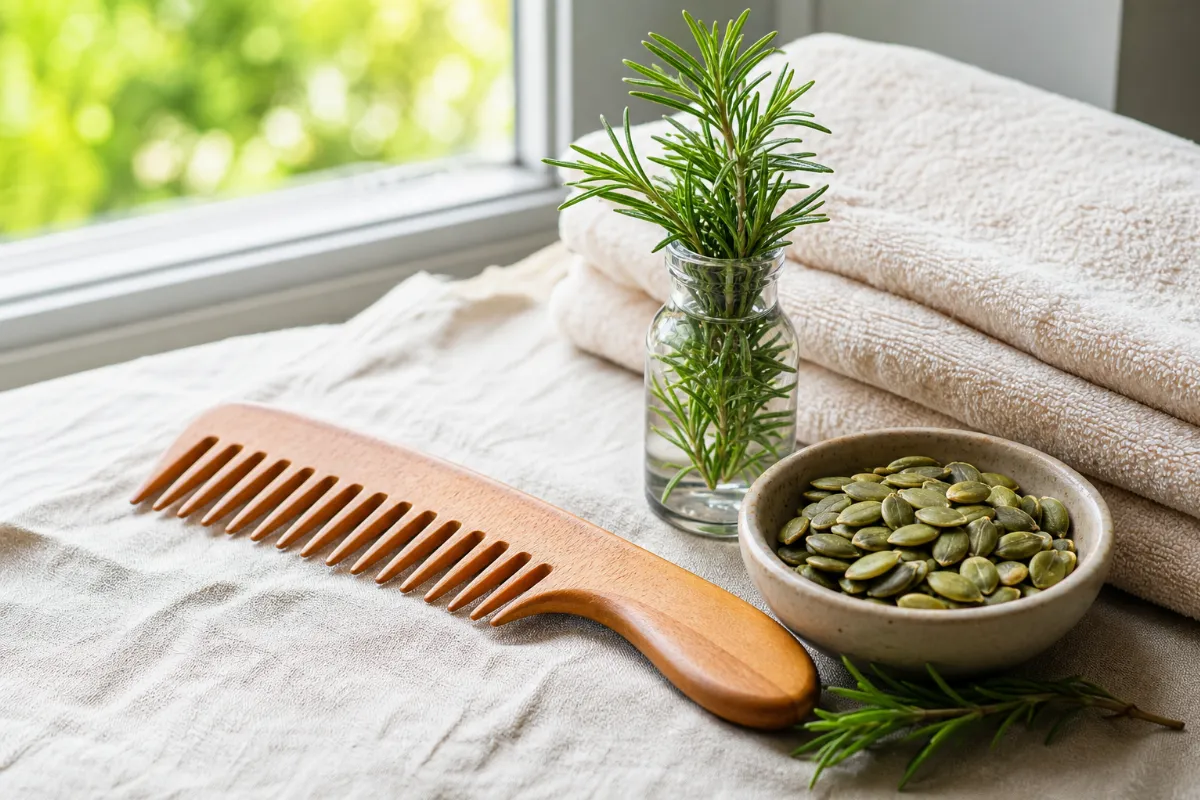
Support Healthy Hair, Scalp & Nails
Care for Thinning Hair
Hair can thin slowly over years or seem to thin after a difficult few months, and either way there are sensible ways to look after the hair and scalp you have and to find out what is behind the change. This page is about caring for thinning hair and judging the treatments on offer; sudden heavy shedding and breakage have their own pages.
General information, not medical advice. Last updated October 31, 2026. Written by the AlternativeMed editorial team. Not medically reviewed.
Start here
- Note when you first noticed thinning and where (all over, the part, the crown, the temples), and take a photo in the same light each month so you can see real change.
- See a doctor before buying treatments or visiting a commercial hair clinic, especially if the loss is sudden, patchy, painful or comes with other symptoms; some causes, such as low iron or a thyroid problem, are found by a test, not a product.
- Handle hair gently: avoid tight styles, brush or comb softly, and go easy on heat and harsh chemical treatments while hair is fragile.
Be careful with
- Be wary of products that promise to regrow hair quickly or 'reverse' thinning; the NHS says no treatment is 100% effective and the main medicines only work while they are used.
- More is not better with vitamins and minerals. Taking iron, zinc, selenium or vitamin A without a known need can cause harm, and excess selenium or vitamin A can itself be linked to hair loss.
- Biotin supplements can make some blood tests (including heart-attack and thyroid tests) read wrongly; tell your doctor and the lab if you take them.
- Medicines for hair loss are a clinician's or pharmacist's decision, and some are not suitable in pregnancy or breastfeeding. Never stop a prescribed medicine because of hair changes without speaking to your prescriber.
- Oils and herbal products can cause scalp irritation or allergy; patch test first.
Get help when
- Hair that comes out suddenly, in heavy amounts, or in patches (see the page on patchy and scarring hair loss).
- A scalp that is red, scaly, sore, itchy or has pustules or scarring, which can signal a condition needing treatment before more hair is lost.
- Hair loss with tiredness, weight change, heavy periods, feeling cold or other symptoms: these can point to low iron, a thyroid problem or another condition a clinician can test for.
- Hair loss that started after a new medicine, cancer treatment, childbirth, serious illness or crash dieting: tell your doctor.
- Hair loss in a child, or hair loss that is affecting your mood or confidence; a doctor can help and may arrange counselling or support.
About Care for Thinning Hair
What this goal means
This goal is about looking after hair that is becoming thinner or less dense, and knowing which options are worth your time. It is different from understanding sudden shedding after a stressful event, or from breakage along the hair shaft.
The NHS says losing 50 to 100 hairs a day is normal, and that hair loss is usually not a sign of anything dangerous, though it can be upsetting and occasionally signals a medical condition.
1What it can feel like
People describe a widening part, a smaller ponytail, more scalp showing under bright light, a receding hairline or temples, or a thinner crown. Some notice more hair in the brush or shower drain. Hair loss can affect confidence and mood, and that is a good reason to ask for support.
1,2What can contribute
Pattern thinning usually runs in families and, in men, is related to androgen hormones, especially dihydrotestosterone. Temporary thinning can follow illness, stress, cancer treatment, weight loss, childbirth or iron deficiency. MedlinePlus also lists thyroid problems, diabetes, lupus, certain medicines, chemotherapy, a low-protein diet and poor nutrition.
Hairstyling that pulls on the hair for long periods can cause traction alopecia, which can become permanent if the pulling continues.
1,3,2,4Conditions that can be behind it
Pattern hair loss is the most common cause of gradual thinning in both men and women. Patchy loss may be alopecia areata or a scarring condition and needs a clinician's assessment. Hormone conditions such as polycystic ovary syndrome, thyroid conditions and iron deficiency can also play a part, and a doctor can look for them.
1,3,5Realistic expectations
The NHS says most hair loss does not need treatment, and that no treatment is 100% effective. Medicines such as minoxidil and finasteride do not work for everyone and only work while they are used. In trials, effects were measured over months, so judge any approach over at least six months rather than weeks.
Hair that has thinned from a temporary cause (such as illness or low iron) often grows back after recovery, while pattern hair loss is permanent.
1,6,7Who this applies to
Adults noticing gradual thinning, a wider part or a receding hairline. If your main concern is heavy sudden shedding, see the shedding page; if hair is snapping, see the breakage page; if you take a medicine and notice thinning, your prescriber is the right person to ask. Pregnancy, breastfeeding, children and teenagers, and people having cancer treatment should ask a clinician before using any product.
1Related conditions and symptoms
Pattern hair loss → Alopecia areata and scarring hair loss → Anemia and iron deficiency → Thyroid problems and fatigue → PCOS →
A manageable starting plan
An educational starting point, not a personal prescription. Adjust it to your own situation and any advice from your clinician.
Your first actions
- Book a visit if the thinning is new, rapid, patchy or comes with other symptoms, and ask about iron, thyroid and medicine causes.
- Switch to gentle handling: looser styles, soft brushing, less heat and harsh chemicals.
- Take monthly photos of your part and crown in the same light.
- Ask a pharmacist or doctor about established options for pattern thinning if that is the likely cause.
Optional additions
- Add a gentle daily scalp massage with the fingertips if you enjoy it.
- Try a diluted rosemary oil scalp rub after patch testing, understanding the evidence is low.
- Consider a light therapy device or clinic option after talking to a clinician.
- Look into wigs, scalp camouflage or a support group if you want them.
What to track
- Monthly photos of the part, crown and temples.
- Any new medicine, supplement, illness, childbirth, diet change or stress event and when it happened.
- Scalp symptoms such as itch, pain or scale.
- Mood and confidence.
When to reassess
Review with a clinician after about six months of any approach. If thinning is increasing, patchy, painful, or you have other symptoms, do not wait.
When to seek professional support
- Ask your GP about counselling, wigs and support groups if hair loss is affecting you.
- Tell the clinician and lab about biotin or other supplements before blood tests.
- Ask about the other goal pages on shedding, breakage and scalp comfort for related concerns.
What helps
Ordered by how well the research supports each step. Evidence strength is shown on every card; precautions sit next to the advice.
Start here
Get the cause checked first
Moderate certaintyAddresses: Finds fixable causes and guides which care makes sense
Why it may help: The NHS advises seeing a GP to find the cause of hair loss before going to a commercial hair clinic, and says a GP can often tell the cause by looking at the hair and scalp. Temporary causes it lists include illness, stress, cancer treatment, weight loss and iron deficiency. A review of vitamins and minerals in hair loss notes that micronutrient deficiencies may be a modifiable factor, but that large placebo-controlled trials are still needed.
How to apply it: Book a visit if thinning is new, fast, patchy or comes with other symptoms. Bring a list of medicines and supplements, your photos, and notes on recent illness, childbirth, weight change or diet changes.
Who it may suit: Anyone with new or worrying thinning.
Precautions: A test result is only useful when read with your history; do not start iron or other supplements on your own because of a hair change.
1,5Hair shedding and thinning → Anemia and iron deficiency → Thyroid problems and fatigue →
Know the established medical options, and ask a clinician
High certaintyAddresses: The best-studied way to slow thinning or regrow some hair in pattern hair loss
Why it may help: A systematic review and meta-analysis of randomized trials found that minoxidil, finasteride and low-level laser light therapy were each better than placebo for hair growth in men with pattern hair loss, and that minoxidil was effective in women, though trials varied a lot. A Cochrane review of female pattern hair loss found moderate-quality evidence that topical minoxidil gives more regrowth than placebo. The NHS says these treatments do not work for everyone, only work while used, and that women should not use finasteride.
How to apply it: Ask a doctor or pharmacist whether a medicine from this general class is suitable for you, how long to try it, and what side effects to watch for. Treat the decision as a long-term one.
Who it may suit: Adults with gradual pattern thinning who want a treatment with trial support.
Precautions: These are medicines with possible side effects, and some are unsuitable in pregnancy or when trying to conceive. This page gives no drug names or doses; a clinician decides.
6,7,1Handle thinning hair gently and avoid pulling styles
Moderate certaintyAddresses: Protects the hair you have and prevents traction hair loss
Why it may help: A dermatology review of hairstyling practices notes that many styling practices are risk factors for traction alopecia, a type of hair loss that can become permanent if the pulling continues, and recommends safer styling alternatives and early recognition. Gentle handling does not regrow hair lost to pattern thinning, but it avoids adding avoidable loss.
How to apply it: Choose looser styles, rotate where hair is pulled, avoid tight braids, weaves, extensions or ponytails that hurt, comb with a wide-tooth comb from the ends upward, and pat hair dry rather than rubbing.
Who it may suit: Anyone who wears tight styles or has fragile thinning areas, particularly along the hairline.
Precautions: If the scalp becomes painful, bumpy or the hairline recedes, see a clinician early; loss can become permanent.
4Look after your general health: food, iron and stress
Moderate certaintyAddresses: Supports normal hair growth and avoids hair loss from poor intake
Why it may help: MedlinePlus lists a low-protein diet and poor nutrition among causes of hair loss, and the NHS names weight loss and iron deficiency as temporary causes. A review of nutrient studies says vitamins and minerals play an important but not entirely clear role in the hair cycle and that deficiency may be a modifiable risk factor. A review of telogen effluvium notes that sudden physical stress, such as childbirth or sudden weight loss, can trigger diffuse hair loss and that it often remits.
How to apply it: Eat regular meals with enough protein and varied foods, avoid crash diets, treat any diagnosed deficiency as your clinician advises, and give recovery time after illness or childbirth.
Who it may suit: Adults with restrictive eating, heavy periods, vegetarian or vegan diets, or recent illness or weight loss.
Precautions: Do not take high-dose supplements without a test and clinician advice; some nutrients cause harm in excess.
3,1,5,2Use cosmetic and practical options for confidence
Moderate certaintyAddresses: Helps you feel comfortable while you decide on treatment
Why it may help: The NHS notes that wigs (some available on the NHS), micropigmentation and counselling are options if hair loss is distressing, and that support groups and online forums can help. Most hair loss does not need treatment.
How to apply it: Ask your GP about wigs, scalp camouflage and counselling; try a haircut that suits your hair density; look for a patient support group.
Who it may suit: Anyone upset by thinning, whatever the cause.
Precautions: Synthetic wigs can feel hot and itchy; take breaks and keep the scalp clean.
1Additional options
Protect and monitor the scalp
Low certaintyAddresses: Keeps the skin under thinning hair comfortable and shows early problems
Why it may help: The NHS and MedlinePlus both stress finding the cause of hair loss. A red, scaly, sore or itchy scalp can mean a skin condition that is treatable and should be assessed rather than hidden.
How to apply it: Use a gentle shampoo suited to your scalp, rinse well, and check the scalp in good light when you take your monthly photo.
Who it may suit: Anyone with a flaky, itchy or tender scalp alongside thinning.
Precautions: Do not scratch hard or pick at sores; see a doctor for scalp sores that do not heal.
1,3Dandruff, dry scalp and seborrheic dermatitis → Improve Scalp Comfort →
Be patient and keep a photo record
Low certaintyAddresses: Shows whether anything is working and avoids wasted spending
Why it may help: Trials of pattern hair loss treatments measured hair outcomes over months (for example 24 weeks for pumpkin seed oil and 6 months for rosemary oil in two trials we read), so a fair test takes months. The trials also found large differences between studies, so personal photos beat guesswork.
How to apply it: Photograph the part and crown monthly in the same light and position, and judge any change after at least six months.
Who it may suit: Anyone trying a new approach.
Precautions: Photos are for you and your clinician; they are not a diagnosis.
8,9,6Still being studied
Low-level laser or LED light therapy
Moderate certaintyAddresses: Possibly modest improvement in hair density in pattern hair loss
Why it may help: A systematic review and meta-analysis of 38 studies (3,098 people, mostly with pattern hair loss) found hair density increased more with low-level laser or LED therapy than with placebo, but with very high differences between studies. The 2017 meta-analysis also found laser light therapy better than placebo in men.
How to apply it: Devices are used at home or in clinics for set sessions over months; ask a clinician before buying.
Who it may suit: Adults with early pattern thinning who want a non-drug option.
Precautions: Cost varies, devices differ in quality, and long-term results are less clear. Avoid on skin lesions or if you take light-sensitising medicines unless advised.
10,6Platelet-rich plasma (PRP) injections
Low certaintyAddresses: May increase hair density a little in pattern hair loss
Why it may help: A meta-analysis of 9 randomized trials (238 people) found PRP increased hair density at 3 and 6 months compared with placebo, but hair count and diameter did not differ from placebo. Two of 7 studies reported adverse reactions, and none were serious.
How to apply it: Given in a clinic as a series of scalp injections; ask about qualifications, cost and the number of sessions.
Who it may suit: Adults who want a clinic-based option and accept the cost.
Precautions: Small trials, variable methods, cost, and injection risks such as pain and infection; not suitable with some blood conditions. Choose a medical provider.
11Standardized scalp massage
Very low certaintyAddresses: Small possible increase in hair thickness
Why it may help: A small study of nine healthy men found that four minutes of daily standardized scalp massage with a device for 24 weeks was associated with increased hair thickness, and lab work suggested stretching forces change gene activity in hair-follicle cells. There was no control group, and no benefit in women or in other conditions was shown.
How to apply it: Gentle daily massage with the fingertips is low risk; the studied method used a specific device.
Who it may suit: People who like a relaxing, low-cost routine.
Precautions: Do not rub hard or massage over sore or broken scalp skin. Treat any benefit as unproven.
12Food & nutrition
Eating for hair
No food has been shown to reverse pattern thinning. MedlinePlus lists a low-protein diet and poor nutrition among causes of hair loss, and the NHS lists iron deficiency and weight loss as temporary causes, so regular meals with enough protein, iron-containing foods and variety are the sensible baseline.
A systematic review of 30 studies of dietary and nutritional interventions in people without known deficiency found no diet-based studies that met its criteria, so there is no tested 'hair diet'.
3,1,13Foods and food-based oils that have been studied
Small trials exist for pumpkin seed oil; see the remedies section. Whole pumpkin seeds as a food have not been tested for hair in the sources we read.
Pumpkin seeds and pumpkin seed oil as a food
Not enough evidenceAddresses: A source of nutrients, not a proven hair treatment
Why it may help: The oil used in trials was a capsule, not seeds eaten as a snack. The food itself adds protein, fat and minerals to a varied diet.
How to apply it: Add seeds to meals if you like them.
Who it may suit: Anyone wanting a nutritious snack.
Precautions: Seed allergy is possible; keep portions modest if you are watching calories.
13Iron-containing foods
If a clinician finds low iron, foods such as meat, beans and leafy greens can help along with any advice you are given. Do not self-treat with iron supplements: too much iron is harmful.
1,5Remedies & supplements
Traditional use, laboratory findings and human trials are kept apart. "Natural" does not mean safe.
Pumpkin seed oil (oral)
Low certaintyStudied form and route: Capsules or oil taken by mouth
Intended outcome: Possible increase in hair count in men with pattern hair loss
Human evidence: A randomized, double-blind, placebo-controlled trial of 76 men with mild to moderate pattern hair loss found that after 24 weeks, hair count rose about 40% with pumpkin seed oil versus about 10% with placebo, with similar side effects. A trial in 60 women with female pattern hair loss compared pumpkin seed oil with a topical minoxidil product over 3 months and found improved dermoscopy measures in both groups. A 2023 systematic review listed pumpkin seed oil among nutritional products with potential benefit.
Traditional use: Seed oils have been used as food and in folk practice; this page's evidence comes from the trials above.
Laboratory findings: Lab and animal work suggests it may block an enzyme (5-alpha reductase) involved in androgen activity; this is a possible explanation, not proof in people.
Limits: Few trials, short, small, one in men and one in women, and the women's trial had no placebo group.
Interactions and precautions: Can cause stomach upset; seed or squash allergy; talk to a pharmacist if you take any medicine. Not enough evidence for pregnancy or breastfeeding.
8,14,13Rosemary oil (applied to the scalp)
Low certaintyStudied form and route: Diluted rosemary oil massaged into the scalp
Intended outcome: Possible hair-count increase in pattern hair loss
Human evidence: A randomized comparative trial of 100 people with pattern hair loss found no significant change at 3 months, but hair counts rose at 6 months with rosemary oil, similar to topical minoxidil, with no significant difference between the two groups; scalp itching was more frequent with minoxidil. It had no placebo group.
Traditional use: Used in many hair-care traditions as a stimulating scalp rub.
Laboratory findings: Possible effects on scalp blood flow have been proposed in the paper; this is a proposal, not proof.
Limits: One trial, no placebo, no blinding mentioned in the abstract, and results at 6 months only.
Interactions and precautions: Essential oil can irritate or cause allergy; dilute in a carrier oil, patch test first, keep away from eyes, and ask a clinician before use in pregnancy, breastfeeding, epilepsy or with children.
9Saw palmetto
Not enough evidenceStudied form and route: Capsules or topical products
Intended outcome: Claimed to lower androgen activity and slow hair loss
Human evidence: We did not find a randomized trial in the sources we read that shows saw palmetto helps pattern hair loss.
Traditional use: Used traditionally for prostate and urinary complaints and marketed for hair.
Laboratory findings: It is claimed to block an androgen-related enzyme; lab findings do not show hair regrowth in people.
Limits: Evidence for hair is insufficient in the sources we read.
Interactions and precautions: May interact with blood thinners and hormone medicines; not recommended in pregnancy or breastfeeding; stomach upset is possible.
13Biotin (vitamin B7)
Very low certaintyStudied form and route: Tablets, gummies and hair formulas
Intended outcome: Claimed to thicken hair
Human evidence: A systematic review of case reports and trials found limited research on biotin for hair and nails in healthy people; cases that improved had an underlying cause such as biotin deficiency or rare conditions, and the authors proposed there is not enough evidence for supplementation in healthy individuals.
Traditional use: Not a traditional remedy; a modern supplement marketing claim.
Laboratory findings: Biotin is needed for normal body function, but extra has not been shown to help hair in people who are not deficient.
Limits: Mostly case reports.
Interactions and precautions: The FDA warns that biotin in supplements can significantly interfere with certain lab tests and cause incorrect results; it has received reports of falsely low troponin (a heart-attack marker) results. Tell your clinician and lab about any biotin you take.
15,16Multi-ingredient hair supplements
Low certaintyStudied form and route: Marine-protein, antioxidant and nutrient blends
Intended outcome: Some trials report improved hair measures
Human evidence: A systematic review of 30 studies in people with hair loss and no known deficiency (17 randomized) found potential benefit from several branded products and ingredients, including omega 3 and 6 with antioxidants, zinc, tocotrienol and pumpkin seed oil, with rare and mild side effects, and low-quality evidence for some others such as vitamin D3. The authors say larger trials with active comparators are needed.
Traditional use: Not a traditional remedy; these are modern commercial products.
Laboratory findings: Lab studies were not the basis for the human trials above.
Limits: Mixed products, many funded by manufacturers, and small trials; results do not transfer to every product.
Interactions and precautions: Check ingredients for vitamin A, selenium, iron and biotin; ask a pharmacist about medicines and pregnancy.
13Hair, skin and nails formulas claims checked → Omega-3 for skin, hair and nails →
Therapies & care
Established professional care for thinning hair starts with finding the cause. A doctor or dermatologist can examine the scalp, order tests when needed, and discuss prescription and over-the-counter treatments in the pattern-hair-loss class, light therapy, procedures and support. This page gives no drug names or doses, and you should not stop a prescribed medicine on your own.
Medical assessment (doctor or dermatologist)
High certaintyClinical care The NHS says a GP can often tell the cause by looking at the hair and scalp, and that you should see a GP to find the cause before using a commercial clinic. Further tests depend on your history and are a clinician's decision.
Who it may suit: Anyone with new, fast, patchy or worrying thinning.
Precautions: Bring a medicine and supplement list, including biotin.
1,3Pattern hair loss medicines (a clinician's decision)
High certaintyMedical treatment class Topical and, for men, tablet treatments are the main options the NHS names; they do not work for everyone and only work while used, and women should not use the tablet type. A review of oral low-dose minoxidil in 17 studies (634 patients) described it as effective and well tolerated for healthy people having difficulty with topical forms, but called for larger randomized trials.
Who it may suit: Adults with diagnosed pattern hair loss.
Precautions: Side effects, pregnancy and breastfeeding limits, and heart or blood-pressure issues need a clinician's judgement. Do not use leftover or borrowed medicines.
1,6,7,17Low-level light therapy
Moderate certaintyDevice Meta-analyses found improved hair density compared with placebo in pattern hair loss, with large differences between studies.
Who it may suit: Adults with early pattern thinning.
Precautions: Cost, device quality and long-term use are unclear; ask a clinician.
10,6Platelet-rich plasma injections
Low certaintyClinic procedure A meta-analysis of 9 randomized trials found increased hair density versus placebo but no clear difference in hair count or diameter.
Who it may suit: Adults who want a clinic option and understand the cost.
Precautions: Injection risks and variable methods; use a medical provider.
11Hair transplant and other procedures
Moderate certaintySurgical or specialist The NHS describes hair transplant as moving hair from the back of the head to thinning areas, and lists other options such as scalp reduction surgery and permanent make-up; not all are available on the NHS.
Who it may suit: Adults with stable pattern loss who want a lasting change.
Precautions: Choose a qualified surgeon; costs and results vary; no treatment is 100% effective.
1Counselling, wigs and support groups
Moderate certaintySupport The NHS says a GP may be able to arrange counselling, wigs are an option (some on the NHS), and support groups exist.
Who it may suit: Anyone whose hair loss affects mood or confidence.
Precautions: Seek help promptly if hair loss comes with persistent low mood.
1What to avoid
Habits, products and claims that can get in the way. Never stop a prescribed medicine without talking to the professional who prescribed it.
Risks that apply to most people
Tight or constant-tension hairstyles
Moderate certaintyWhy: A dermatology review lists many styling practices as risk factors for traction alopecia, which can become permanent if the pulling continues.
Who it applies to: Anyone who wears tight braids, weaves, extensions, buns or ponytails, especially along the hairline.
Try instead: Loosen styles, give hair rest days, and see a clinician if the scalp is sore or the hairline recedes.
4Treating before knowing the cause
Moderate certaintyWhy: The NHS advises seeing a GP to find the cause before using a commercial hair clinic. Some causes, such as iron deficiency or a medicine, need a different answer from a shampoo or lotion.
Who it applies to: Anyone with new thinning.
Try instead: Book a check and bring a medicines and supplements list.
1Starting high-dose supplements without a reason
Moderate certaintyWhy: A review of vitamins and minerals concluded that large placebo-controlled trials are still needed, and that the role of each nutrient is not entirely clear.
Who it applies to: People buying 'hair vitamins' without a known deficiency.
Try instead: Test first if your doctor suggests it; focus on a varied diet.
5Personal triggers to check
Crash dieting or sudden weight loss
Moderate certaintyWhy: The NHS lists weight loss as a temporary cause of hair loss, and a review notes sudden weight loss can trigger telogen effluvium.
Who it applies to: People dieting steeply or restricting food.
Try instead: Aim for gradual change with enough protein and variety; seek support if eating feels out of control or fearful.
1,2Pulling or picking at hair
Low certaintyWhy: Repeated pulling can thin the hair. This can be a compulsive habit (trichotillomania) or related to styling.
Who it applies to: Anyone who twists, pulls or picks at hair, often when stressed.
Try instead: Be kind to yourself; ask a doctor or therapist for support, which is available and can help.
4Starting a new medicine and ignoring a link
Low certaintyWhy: MedlinePlus lists certain medicines among causes of hair loss.
Who it applies to: People who notice thinning after starting a medicine.
Try instead: Tell your prescriber; do not stop the medicine yourself.
3Products that need caution
Biotin 'hair growth' supplements
Moderate certaintyWhy: A systematic review found limited research supporting biotin in healthy people, with benefit mainly in cases of true deficiency or rare conditions. The FDA warns that biotin can significantly interfere with certain lab tests.
Who it applies to: Anyone taking biotin or a hair-skin-nails formula.
Try instead: Check with a doctor; stop taking it for the period your doctor or lab advises before blood tests, and tell the lab you take it.
15,16Biotin and hair, skin and nails → Biotin lab test interference →
Collagen supplements for thinning
Low certaintyWhy: We did not find a trial of collagen on its own for hair growth in the sources we read; the trials that exist used multi-ingredient products.
Who it applies to: Anyone buying collagen for hair.
Try instead: Spend on a medical check or a proven option first.
13Taking more iron, zinc, selenium or vitamin A than needed
Moderate certaintyWhy: Excess selenium and vitamin A can themselves contribute to hair loss, and too much iron or zinc is harmful.
Who it applies to: People stacking several supplements.
Try instead: Use only what a clinician has recommended after a test.
5Unsupported claims
'Regrow hair overnight' or 'reverse baldness naturally'
High certaintyWhy: The NHS says no treatment is 100% effective and the main medicines only work while used; trials measured results over months.
Who it applies to: Social media and product labels.
Try instead: Prefer treatments with randomized trials and judge over at least six months.
1,6'Detox' to stop hair loss
Moderate certaintyWhy: We did not find trial evidence in the sources we read that detox products treat thinning; the causes found in the sources are illness, stress, nutrition, medicines, genetics and hormones.
Who it applies to: Detox teas and cleanses.
Try instead: Look for the actual cause with a clinician.
1,3Common mistakes
Expecting results in a few weeks
Moderate certaintyWhy: Trials ran for months: 24 weeks for pumpkin seed oil, 6 months for rosemary oil, and the rosemary oil trial showed no significant change at 3 months.
Who it applies to: Anyone starting a new treatment.
Try instead: Plan a six-month review with photos.
8,9Hiding scalp problems instead of getting them checked
Low certaintyWhy: A red, scaly or sore scalp can need treatment so that hair loss does not become permanent; the NHS says to see a GP if worried.
Who it applies to: Anyone using concealers over a sore scalp.
Try instead: See a GP or dermatologist.
1Evidence & safety
What the research shows
For pattern hair loss, minoxidil, finasteride (in men) and low-level light therapy beat placebo in a meta-analysis, and a Cochrane review found moderate-quality evidence for topical minoxidil in women, though trials varied. Gentle handling and finding treatable causes such as low iron are sensible first steps. For natural options, pumpkin seed oil and rosemary oil each have a small trial suggesting benefit (low certainty), while saw palmetto, collagen on its own and biotin in people who are not deficient lack good evidence.
Limits of the evidence
- Most trials of natural products were small, short and sometimes lacked a placebo group.
- Hair outcomes were measured in different ways, and results varied a lot between studies.
- Many supplement trials used branded multi-ingredient products and may be industry funded.
- Meta-analyses of devices and procedures had high heterogeneity.
- We did not read every trial on each topic; we cite systematic reviews and the trials named.
Precautions and interactions
- Check supplements and herbal products with a pharmacist if you take any medicine.
- Excess iron, zinc, selenium and vitamin A can cause harm; do not take them without a reason.
- Biotin can distort some blood tests, including troponin.
- Patch test oils; avoid essential oils unless advised in pregnancy, breastfeeding, epilepsy or for children.
- Never stop a prescribed medicine because of hair changes.
Life-stage considerations
- Pregnancy and breastfeeding: ask a clinician before any hair treatment; some medicines for hair loss are not suitable.
- Hair shedding after childbirth is common and often remits (see the shedding page).
- Children and teenagers: ask a doctor about any hair loss.
- Older adults: check medicines and nutrition, and review any supplement with a pharmacist.
- Cancer treatment: ask your care team about hair loss and scalp care.
Warning signs
- Sudden, patchy or very heavy hair loss.
- A red, scaly, painful, pustular or scarred scalp.
- Hair loss with tiredness, weight change, heavy periods, feeling cold or other new symptoms.
- Hair loss after a new medicine, cancer treatment or serious illness.
- Low mood that does not lift, or feeling that you cannot cope; seek help from a doctor or a local crisis service.
Claim checks
Hair vitamins and biotin will regrow thinning hair
Very low certaintyA systematic review found limited research for biotin in healthy people; benefit appears limited to deficiency or rare conditions. Biotin can also interfere with lab tests, per the FDA.
15,16Minoxidil, finasteride and laser light regrow hair in pattern loss
High certaintyA meta-analysis found each superior to placebo in men and minoxidil effective in women, with high heterogeneity. They do not work for everyone and only while used (NHS).
6,1Rosemary oil works as well as minoxidil
Low certaintyOne 6-month trial of 100 people found similar hair counts, but it had no placebo group and no change at 3 months.
9Scalp massage regrows hair
Very low certaintyA small study of nine men found increased hair thickness after 24 weeks with a device, without a control group.
12PRP injections cure thinning
Low certaintyA meta-analysis found improved density versus placebo but no clear difference in hair count or diameter.
11A natural detox stops hair loss
Evidence againstWe did not find evidence in the sources we read; the causes listed are illness, stress, nutrition, medicines, hormones and genes.
1,3Questions people ask
Is it normal to lose hair every day?
Yes. The NHS says losing 50 to 100 hairs a day is normal. Concern starts when you notice a clear change in density, a widening part, patches or a sudden increase.
Will my thinning hair grow back?
It depends on the cause. The NHS says hair loss caused by a medical condition usually stops or grows back after recovery, while male and female pattern baldness are permanent types that usually run in families.
Do I need a test?
Possibly. A doctor decides based on your history. Iron deficiency, thyroid problems and some medicines are among causes the sources mention, and a GP can often tell the likely cause by looking at the hair and scalp.
Can women use the same treatments as men?
Not all of them. The NHS says minoxidil can treat female pattern baldness but women should not use finasteride. A clinician advises, especially in pregnancy or when trying to conceive.
Do natural remedies work?
Some small trials of pumpkin seed oil and rosemary oil were positive, but evidence is low certainty. Saw palmetto, collagen on its own, and biotin in people without deficiency do not have good evidence in the sources we read.
Should I take biotin?
Evidence for hair in healthy people is limited. If you do, tell your doctor and the lab, because the FDA warns biotin can interfere with some blood tests.
Can tight hairstyles cause thinning?
Yes. A dermatology review lists many styling practices as risk factors for traction alopecia, which can become permanent if the pulling continues.
Does stress cause thinning?
Physical stress such as childbirth, illness or sudden weight loss can trigger diffuse shedding (telogen effluvium), which often remits. That differs from pattern thinning, which is mostly genetic and hormonal.
How long before I know if something works?
Trials ran for months. Plan a review at about six months, with monthly photos.
Can I get help with how I feel about it?
Yes. The NHS says a GP may be able to arrange counselling, and wigs and support groups are available.
References
- NHS. Hair loss. Read 2026-10-31. source
- Telogen effluvium: a review of the science and current obstacles. J Dermatol Sci 2021. PMID 33541773. source
- MedlinePlus. Hair Loss. Read 2026-10-31. source
- Haskin A, Aguh C. All hairstyles are not created equal: what the dermatologist needs to know about black hairstyling practices and the risk of traction alopecia. J Am Acad Dermatol 2016. PMID 27114262. source
- Almohanna HM, et al. The role of vitamins and minerals in hair loss: a review. Dermatol Ther (Heidelb) 2019. PMID 30547302. source
- Adil A, Godwin M. The effectiveness of treatments for androgenetic alopecia: a systematic review and meta-analysis. J Am Acad Dermatol 2017. PMID 28396101. source
- van Zuuren EJ, et al. Interventions for female pattern hair loss. Cochrane Database Syst Rev 2016. PMID 27225981. source
- Cho YH, et al. Effect of pumpkin seed oil on hair growth in men with androgenetic alopecia: a randomized, double-blind, placebo-controlled trial. Evid Based Complement Alternat Med 2014. PMID 24864154. source
- Panahi Y, et al. Rosemary oil vs minoxidil 2% for the treatment of androgenetic alopecia: a randomized comparative trial. Skinmed 2015. PMID 25842469. source
- Perez SM, et al. Low-level laser and LED therapy in alopecia: a systematic review and meta-analysis. Dermatol Surg 2025. PMID 39404126. source
- Zhang X, et al. Platelet-rich plasma for androgenetic alopecia: a systematic review and meta-analysis of randomized controlled trials. J Cutan Med Surg 2023. PMID 37533146. source
- Koyama T, et al. Standardized scalp massage results in increased hair thickness by inducing stretching forces to dermal papilla cells in the subcutaneous tissue. Eplasty 2016. PMID 26904154. source
- Drake L, et al. Evaluation of the safety and effectiveness of nutritional supplements for treating hair loss: a systematic review. JAMA Dermatol 2023. PMID 36449274. source
- Ibrahim IM, et al. Pumpkin seed oil vs. minoxidil 5% topical foam for the treatment of female pattern hair loss: a randomized comparative trial. J Cosmet Dermatol 2021. PMID 33544448. source
- Patel DP, et al. A review of the use of biotin for hair loss. Skin Appendage Disord 2017. PMID 28879195. source
- US Food and Drug Administration. Biotin interference with troponin lab tests: assays subject to biotin interference. Read 2026-10-31. source
- Randolph M, Tosti A. Oral minoxidil treatment for hair loss: a review of efficacy and safety. J Am Acad Dermatol 2021. PMID 32622136. source
Related on AlternativeMed
Related goals
Understand & Address Hair Shedding → Reduce Hair Breakage → Improve Scalp Comfort → Manage Scalp Flaking → Protect Hair From Styling Damage → Support Hair Through Nutrition → Build Healthier Hair & Nail-Care Habits →
Ingredients, foods and supplements
Pumpkin seed → Rosemary → Rosemary oil → Saw palmetto → Biotin → Iron → Zinc → Collagen →
Research, safety and claim-check resources
Collagen, biotin and beauty supplements → Skin and hair safety → Skin and hair research and evidence → Biotin lab test interference → Medication interactions →