Wellness Goals · Digestive symptom
Constipation: What Helps and When to Get Checked
Constipation (infrequent, hard or difficult bowel movements; a digestive symptom) · also called Constipation, hard stools, infrequent bowel movements, straining, trouble pooing, chronic constipation, functional constipation, estreñimiento, heces duras, evacuación difícil
Constipation can mean fewer than three bowel movements a week, hard, dry or lumpy stools, stools that are hard or painful to pass, or a feeling that not all stool has passed. It is common, is often a symptom rather than a disease, and can be linked to low fiber, too little activity, medicines and other conditions. Fiber supplements have the best research behind them; kiwifruit, prunes, magnesium, senna, massage and a few other options have smaller or lower-certainty trials. Blood in the stool, constant belly pain, vomiting, weight loss or a sudden change in bowel habits need a clinician.
General information, not medical advice. Last substantive update · Not medically reviewed. A named clinician has not signed off on this page. How this page is made
About Constipation: What Helps and When to Get Checked
Constipation is common and is usually treated at home. This page explains what constipation is, its common causes including medicines, what helps (fiber, fluids, routine, movement and, for a short time, laxatives), what research says about foods and natural options, and when to get checked. The best-supported natural option is a fiber supplement, especially psyllium; most other foods and remedies have small, low-certainty trials. Blood in the stool, constant belly pain, vomiting, weight loss or a sudden change in bowel habits needs a clinician.
What constipation is
NIDDK defines constipation as fewer than three bowel movements a week, stools that are hard, dry or lumpy, stools that are difficult or painful to pass, or a feeling that not all stool has passed. People have different patterns, and only you know what is normal for you. Constipation is not a disease, but it may be a symptom of another medical problem, and it can last a short or a long time.
NIDDK says about 16 out of 100 adults in the United States have symptoms of constipation, rising to about 33 out of 100 adults aged 60 and older. The NHS adds that you may also have a stomach ache and feel bloated or sick, and that constipation is common during pregnancy and after giving birth.
Common causes of constipation
NIDDK says there are many possible causes and more than one can be present: slow movement of stool through the colon, delayed emptying from pelvic floor disorders or colon surgery, and functional gut disorders such as irritable bowel syndrome. Health and nutrition problems include not eating enough fiber, not drinking enough liquids, too little physical activity, celiac disease, diabetes, an underactive thyroid, nervous system disorders and intestinal blockages.
Life changes such as pregnancy, getting older, travel, ignoring the urge to go or changing what you eat can also bring it on. The NHS lists stress, anxiety or depression and medicine side effects among the common causes. Medicines and supplements that can make it worse include antacids with aluminum or calcium, iron supplements, narcotic pain medicines, some antidepressants, diuretics and calcium channel blockers.
How a clinician finds the cause
NIDDK says doctors use your medical and family history, a physical exam and sometimes tests. They may ask about surgery on your digestive tract, recent weight change, anaemia, how often you go, what your stools look like, and your eating habits, activity and medicines, including supplements. Tracking your bowel movements for several days or weeks before the visit can help.
Depending on your symptoms, tests may include blood tests for anaemia, an underactive thyroid and celiac disease, stool tests, a colonoscopy or flexible sigmoidoscopy, colorectal transit studies, and tests of how the rectum and sphincter muscles work. NIDDK says a doctor may first try a treatment before using tests.
What established care looks like
NIDDK says most constipation can be treated at home with more high-fiber foods, plenty of liquids, regular physical activity and bowel training, and by reviewing medicines with a doctor. A doctor or pharmacist may recommend a laxative for a short time. NIDDK describes five kinds of over-the-counter laxative (fiber supplements, osmotic agents, stool softeners, lubricants and stimulants) and says stimulants are only for severe constipation or when other treatments have not worked.
If self-care does not work, NIDDK says a doctor may prescribe medicine, recommend biofeedback therapy to retrain the muscles used for bowel movements, or, rarely, surgery. The 2023 US guideline for chronic idiopathic constipation made strong recommendations for several medicines and conditional recommendations for fiber, senna, magnesium oxide and others. Those are named here only as what guidelines discuss, not as advice.
What helps constipation: food, fluids, movement and routine
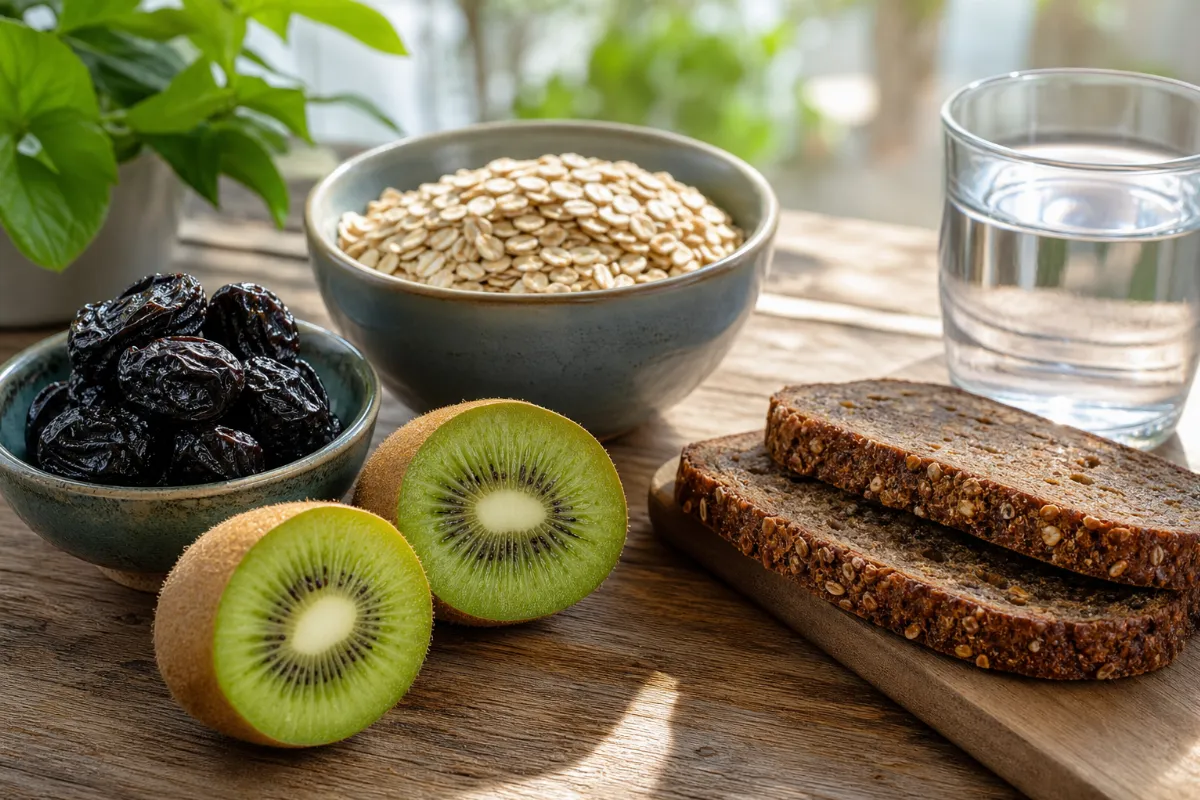
NIDDK says adults should get 22 to 34 grams of fiber a day depending on age and sex, add fiber a little at a time, and drink plenty of water and other liquids so the fiber works better. Good sources are whole grains, legumes, fruits, vegetables and nuts. The NHS suggests fruits that contain sorbitol such as apples, apricots, grapes, raspberries and strawberries, adding wheat bran, oats or linseed, and avoiding alcohol.
For routine, NIDDK suggests trying to have a bowel movement 15 to 45 minutes after breakfast, giving yourself enough time and using the bathroom as soon as you feel the need. The NHS suggests a regular time and place, not delaying the urge, resting your feet on a low stool with your knees above your hips if possible, and a daily walk or run. A small trial found a footstool did not change a simulated-defecation test in people with constipation, so posture tips are common advice rather than proven treatment.
What research says about foods and natural options
The best-supported option is fiber supplements, especially psyllium and pectin, which helped 66 percent of adults against 41 percent on control in a 2022 pooled analysis of 16 trials, with more gas. Kiwifruit, prunes and rye bread have small trials, mostly low or very low certainty, and a 2025 British guideline made statements about them and about high-mineral water. Probiotics are mixed: a pooled benefit, but a large 2024 trial of one strain found none.
Magnesium oxide and senna each helped about two-thirds of adults against 12 percent on placebo in one 28-day trial, and US guidance gives both a conditional recommendation. Abdominal massage, exercise and electroacupuncture each have some trial support but with low certainty. The British guideline made no statements on whole-diet approaches because evidence was lacking, and 51 of its 59 statements were rated low or very low in certainty.
At a glance
Traditional uses history, not proof
Studied for research
- Fiber supplements, especially psyllium: more people responded than on control, moderate confidence, with more gas
- Green kiwifruit: more bowel movements, low certainty
- Prunes and prune juice: softer stool in small trials, low certainty
- Rye bread: slightly more bowel movements, very low certainty
- High-mineral water: better response than low-mineral water, low certainty
- Probiotics: mixed
- Magnesium oxide and senna: improved overall symptoms against placebo in one 28-day trial each, moderate confidence
- Abdominal massage, exercise and electroacupuncture: low certainty
- Toilet posture and a regular routine: common advice, mixed evidence
Main compounds
- Dietary fiber
- Sorbitol in some fruits
- Magnesium
- Senna
Common forms
- Psyllium and other fiber supplements
- Green kiwifruit
- Prunes and prune juice
- Rye bread
- Magnesium-rich mineral water
- Probiotics
- Magnesium oxide
- Senna
- Abdominal massage
- Electroacupuncture
Research links: 2022 analysis: fiber supplements in chronic constipation (16 trials) · 2024 analysis: foods, drinks and diets in chronic constipation · 2025 British Dietetic Association guideline · 2023 AGA-ACG guideline on pharmacological management · 2022 analysis: probiotics and synbiotics (30 trials) · NIDDK: Treatment for constipation · NHS: Constipation · Research Library · Genes & Biomarkers Library
What it is and its history
- Accepted scientific name
- Constipation
- Synonyms
- infrequent bowel movements; hard stools; difficult or painful bowel movements; chronic constipation; functional constipation; chronic idiopathic constipation
- Common names
- Constipation (English); Trouble pooing (English (UK)); Estreñimiento (Spanish); Heces duras (Spanish)
- Family or group
- Digestive symptom; it can be a symptom of another medical problem, or functional when no other cause is found
- Look-alikes and adulterants
- Name: Irritable bowel syndrome with constipation; Note: A functional gut disorder; one kiwifruit trial included people with it.; Name: Faecal impaction; Note: Hard stool built up in the rectum, with leaking diarrhoea (NHS).; Name: Bowel obstruction; Note: NIDDK lists intestinal obstructions, including tumors, among causes.; Name: Pelvic floor disorders; Note: NIDDK says delayed emptying of the colon can come from pelvic floor disorders, especially in women.
Traditional use and history history, not clinical proof
| Tradition or era | Documented use | Source |
|---|---|---|
| Modern definitions | NIDDK defines constipation as fewer than three bowel movements a week, stools that are hard, dry or lumpy, stools that are difficult or painful to pass, or a feeling that not all stool has passed, and says only you know what is normal for you. | s-niddk-definition |
| Research definitions | Trials read for this page enrolled people with functional constipation by Rome III criteria or with 3 or fewer complete spontaneous bowel movements a week. | p24342746 |
| Guidelines 2023 and 2025 | The 2023 AGA-ACG guideline covers medicines for chronic idiopathic constipation, and the 2025 British Dietetic Association guideline gives the first comprehensive dietary statements for chronic constipation in adults. | p41081513 |
Traditional use shows how it was used. It does not show that it works or is safe today.
What is inside, and how it may work
What it contains and how those compounds act in cells and animals. Laboratory and animal mechanisms are not proven effects in people.
Main compounds
| Compound | Family | Where it is concentrated | Activity studied | Level of evidence |
|---|---|---|---|---|
| Dietary fiber | food component | Whole grains, legumes, fruits, vegetables, nuts (NIDDK) NIDDK: adults should get 22 to 34 grams of fiber a day depending on age and sex. | The most common dietary approach to constipation. 22 25 | Human data |
| Sorbitol (sugar alcohol in some fruits) | sugar alcohol | Fruit; the NHS names apples, apricots, grapes, raspberries and strawberries The prune juice trial studied a juice containing sorbitol, pectin and polyphenol. | The NHS suggests sorbitol-containing fruit to make poo softer and easier to pass. 18 11 | Human data |
| Magnesium (in mineral water and magnesium oxide) | mineral | The mineral water trial's response followed its magnesium sulfate content. | Used as an osmotic agent; see Evidence. 6 14 | Human data |
| Senna | plant-derived stimulant laxative | The NHS says senna works by triggering the bowel muscles to push stool out. 19 14 | Human data |
Mechanisms, receptors and pathways
| Target or pathway | Gene or receptor | What was found | Level |
|---|---|---|---|
| Slow movement of stool through the colon | NIDDK lists slow movement of stool through the colon as a cause of constipation. 23 | Human data | |
| Pelvic floor disorders and colon surgery | NIDDK says delayed emptying of the colon can come from pelvic floor disorders, especially in women, and from colon surgery. 23 | Human data | |
| Functional gut disorders | NIDDK lists functional gastrointestinal disorders such as irritable bowel syndrome among causes. 23 | Human data | |
| Medicines and supplements | NIDDK lists several medicines and dietary supplements that can make constipation worse. 23 | Human data |
Isolated compounds versus whole extracts
The options differ a lot by form. Fiber supplements, whole kiwifruit, kiwifruit capsule extracts, dried prunes, prune juice, rye bread, mineral water, magnesium oxide and senna are different products with different trials, so a result for one does not carry over to another.
Nutritional composition
NIDDK says good fiber sources are whole grains, legumes, fruits, vegetables and nuts, and that adding fiber a little at a time and drinking plenty of water and other liquids helps fiber work better. NIDDK suggests avoiding foods with little to no fiber, such as chips, fast food, meat, and prepared and processed foods. The NHS also suggests adding wheat bran, oats or linseed and avoiding alcohol.
3 moderate certainty2 mixed findings6 low certainty1 very low certainty
What was looked at
The 12 benefits and uses checked for Constipation: What Helps and When to Get Checked, each with how strong the evidence is. Tap one to open it.
- Fiber supplements, including psylliumModerate certainty
- Green kiwifruitLow certainty
- Prunes and prune juiceLow certainty
- Rye breadVery low certainty
- High-mineral (magnesium sulfate-rich) waterLow certainty
- ProbioticsMixed findings
- Magnesium oxide (magnesium supplement)Moderate certainty
- Senna (plant-derived stimulant laxative)Moderate certainty
- Abdominal massageLow certainty
- Exercise and physical activityLow certainty
- ElectroacupunctureLow certainty
- Toilet posture, footstool and a regular bowel routineMixed findings
Lab markers tracked in the studies
Complete spontaneous bowel movements per weekStool consistency (Bristol Stool Scale)Gut transit time
What is Constipation: What Helps and When to Get Checked good for?
The approaches that have been studied for constipation, and how strong the human evidence is for each. Most trials are small and short, and many are in adults with chronic or functional constipation. These describe what research found, not advice to use any remedy.
Benefits, one by one
Each card is a research question, not a promise. Tap a goal to filter. Open a card to see the studies, doses and limits.
Fiber supplements, including psyllium
Moderate certaintyFiber supplements are the best-studied option here. In a 2022 pooled analysis of 16 trials, 66 percent of adults with chronic constipation responded to fiber against 41 percent on control, and psyllium and pectin worked best. Gas was also higher with fiber. US guidance gives fiber a conditional recommendation.
7 studiesAs reported: psyllium and pectin had significant effects; improvement…
Studies, doses and limits
What the trials found
Van der Schoot 2022: 16 randomised trials, 1,251 adults with chronic constipation. Chey 2021 used psyllium as a comparison group. The 2023 AGA-ACG guideline and the 2021 over-the-counter review (Rao) rate fiber; the 2025 British Dietetic Association guideline made 15 statements on fiber supplements.
Results
Van der Schoot 2022: 66 percent (311 of 473) responded to fiber against 41 percent (134 of 329) on control; stool frequency and stool consistency improved; flatulence was higher with fiber. Rao 2021 graded psyllium as moderate evidence (grade B). AGA-ACG 2023 made a conditional recommendation for fiber.
Effect sizes as reported
Response RR 1.48 (95% CI 1.17 to 1.88); stool frequency SMD 0.72 (0.36 to 1.08); stool consistency SMD 0.32 (0.18 to 0.46); flatulence SMD 0.80 (0.47 to 1.13) (Van der Schoot 2022).
Why this rating
Moderate as the compiler's reading: several analyses and two guidelines agree on benefit, but heterogeneity is considerable (the authors urge caution), fiber types and doses vary, and gas rises. The review does not give its own GRADE rating in the abstract.
Form and dose studied
As reported: psyllium and pectin had significant effects; improvement was seen mainly in trials of more than 10 g a day and, for stool frequency, 4 weeks or more. In the kiwifruit comparison trials, psyllium was 7.5 g and 12 g a day. NIDDK says adults are advised to get 22 to 34 grams of fiber a day from all sources and to add it a little at a time.
Who was studied
Adults with chronic constipation, mostly in trial settings.
Limits
High heterogeneity; mixed fiber types; gas was higher; many trials are short.
Why researchers looked
Fiber is the oldest dietary advice for constipation, so researchers asked which kinds, how much and for how long.
Proposed mechanism Hypothesis
Proposed: some fibers hold water and add bulk, which softens stool and speeds its passage. NIDDK says fluids help fiber work better; the trials read measured bowel habits, not the mechanism.
A proposed mechanism does not show that the effect happens in people.
More gas and bloating is a known result (flatulence rose in the pooled analysis). NIDDK says to drink plenty of liquids with fiber and to add it gradually.
Green kiwifruit
Low certaintyEating about two green kiwifruit a day raised complete bowel movements by roughly 1.5 a week over baseline in an international trial of people with functional constipation or constipation with IBS, and was comparable to psyllium in other trials. The overall certainty is low because the trials are small.
5 studiesAs reported: 2 green kiwifruit a day for 4 weeks. Some trials used ca…
Studies, doses and limits
What the trials found
Gearry 2023: 184 people (60 with functional constipation, 61 with constipation-predominant IBS, 63 healthy), crossover against psyllium. Chey 2021: 79 US adults with chronic constipation, kiwifruit, prunes or psyllium. Eltorki 2022: 7 randomised trials, 399 people. Van der Schoot 2024 pooled foods.
Results
Gearry 2023: complete spontaneous bowel movements rose by 1.53 a week (functional constipation) and 1.73 (IBS with constipation), with better gut comfort and no significant adverse events. Chey 2021: kiwifruit raised weekly bowel movements, improved stool consistency, straining and bloating, and had the fewest adverse events. Eltorki 2022 rated overall certainty low. Van der Schoot 2024: fruits gave 0.36 more bowel movements a week than psyllium, kiwifruit in particular.
Effect sizes as reported
Versus psyllium, weekly bowel movements MD 1.01 (95% CI -0.02 to 2.04, moderate certainty); stool softness MD 0.63 (0.01 to 1.25, low certainty) (Eltorki 2022). Kiwifruit vs psyllium MD +0.36 per week (0.24 to 0.48, 192 people; Van der Schoot 2024).
Why this rating
Low: the 2022 review rates overall certainty low, the trials are small and short, and the intervals for some results include no effect. The individual 2023 trial was positive.
Form and dose studied
As reported: 2 green kiwifruit a day for 4 weeks. Some trials used capsule extracts, which are a different product.
Who was studied
Adults with functional constipation, IBS with constipation or chronic constipation; mostly women.
Limits
Small trials, 4 weeks, funding not stated in the abstracts; extract and whole-fruit trials are mixed.
Why researchers looked
Studies in Asia suggested kiwifruit may relieve constipation, so trials in the US and Europe tested it (Chey 2021).
Proposed mechanism Hypothesis
Not established. The trials read measured bowel habits, not the mechanism.
A proposed mechanism does not show that the effect happens in people.
The 2022 review found encapsulated extracts may cause more minor adverse events than placebo (not statistically certain). The sources read did not discuss kiwifruit allergy.
Prunes and prune juice
Low certaintyPrunes and prune juice softened stool and cut hard lumpy stools in trials, with few side effects reported. Prunes were similar to psyllium and to kiwifruit in a small US trial. Only a few small trials exist, so certainty is low.
5 studiesAs reported: prunes 100 g a day for 4 weeks (Chey 2021); prune juice …
Studies, doses and limits
What the trials found
Koyama 2022: double-blind placebo-controlled trial of prune juice in Japanese adults. Chey 2021: prunes in 24 of 75 analysed US adults. Van der Schoot 2024 included 2 trials of prunes.
Results
Koyama 2022: fewer hard and lumpy stools, more normal stool, no increase in loose stools, and no adverse events or liver or kidney test changes. Chey 2021: prunes raised weekly bowel movements, improved stool consistency and straining. Van der Schoot 2024: no difference between prunes and psyllium. Rao 2021 graded fruit-based laxatives including prunes as moderate evidence (grade B).
Effect sizes as reported
No effect sizes in the Koyama abstract. Responder share in Chey 2021 was similar across kiwifruit, prunes and psyllium.
Why this rating
Low: few and small trials, short follow-up, abstracts with limited numbers. The compiler's reading, not a published GRADE rating for this food.
Form and dose studied
As reported: prunes 100 g a day for 4 weeks (Chey 2021); prune juice in Koyama 2022 (amount not in the abstract).
Who was studied
Adults with chronic constipation in the US and Japan.
Limits
Small trials; the prune juice abstract gives no numbers; no long-term data.
Why researchers looked
The prune juice studied contained sorbitol, pectin and polyphenol (Koyama 2022), so researchers asked whether prunes ease constipation.
Proposed mechanism Hypothesis
Proposed: sorbitol, fiber (pectin) and plant polyphenols together soften stool; the trials read stool changes, not the mechanism.
A proposed mechanism does not show that the effect happens in people.
No adverse events were reported in the juice trial (Koyama 2022). NHS suggests fruits that contain sorbitol, such as apples, apricots, grapes, raspberries and strawberries.
Rye bread
Very low certaintyTwo small trials found that rye bread gave slightly more bowel movements than white bread. The gain was less than half a bowel movement a week, in 48 people, so it is a weak signal.
2 studiesRye bread eaten daily in the trials; amounts are not in the abstract.
Studies, doses and limits
What the trials found
Van der Schoot 2024: 2 randomised trials of rye bread, 48 people in the pooled comparison.
Results
Rye bread gave more bowel movements per week than white bread.
Effect sizes as reported
MD +0.43 bowel movements a week (95% CI 0.03 to 0.83) (Van der Schoot 2024).
Why this rating
Very low as the compiler's reading: two trials, 48 people, and the interval barely excludes no effect. The BDA guideline made two statements on rye bread; their strength was not read.
Form and dose studied
Rye bread eaten daily in the trials; amounts are not in the abstract.
Who was studied
Adults with chronic constipation.
Limits
Tiny numbers; short trials; one food among many.
Why researchers looked
Trials compared rye bread with white bread in constipated adults.
Proposed mechanism Hypothesis
Not established. The trials read bowel habits, not the mechanism.
A proposed mechanism does not show that the effect happens in people.
No adverse effects were noted in the abstract.
High-mineral (magnesium sulfate-rich) water
Low certaintyIn a trial of 244 women with functional constipation, drinking 1 litre a day of a magnesium sulfate-rich natural mineral water eased constipation in more women than low-mineral water at week 2 (37.5 versus 21.1 percent). Pooled results across four trials favour high-mineral water. It is one specific kind of water, not ordinary tap water.
3 studiesAs reported: 0.5 L or 1 L a day of the mineral water plus low-mineral…
Studies, doses and limits
What the trials found
Dupont 2014: 244 French women aged 18 to 60 with functional constipation, 4 weeks. Van der Schoot 2024: 4 randomised trials, 539 people for response.
Results
Dupont 2014: no effect at week 1; at week 2, constipation reduced in 21.1% (control), 30.9% (0.5 L, not significant) and 37.5% (1 L, significant); fewer hard or lumpy stools and less rescue medicine in the 1 L group; no serious adverse events. Van der Schoot 2024: response higher with high-mineral than low-mineral water.
Effect sizes as reported
Pooled response RR 1.47 (95% CI 1.20 to 1.81) (Van der Schoot 2024); Dupont 2014 week 2: 37.5% vs 21.1%, P = .013.
Why this rating
Low: few trials, mostly one design, women only in the main trial, and the effect depends on the water's mineral content. Compiler's reading.
Form and dose studied
As reported: 0.5 L or 1 L a day of the mineral water plus low-mineral water to a total of 1.5 L, for 4 weeks.
Who was studied
Women with functional constipation; pooled results across 539 people.
Limits
Mineral content differs between waters; labels vary; not tested in men in the main trial.
Why researchers looked
Some natural waters contain magnesium and sulfate, which can draw water into the bowel.
Proposed mechanism Hypothesis
Proposed: magnesium and sulfate in the water act as a mild osmotic agent. The Dupont trial found response followed magnesium sulfate content.
A proposed mechanism does not show that the effect happens in people.
Magnesium-containing waters can loosen stool; the trial reported very good safety. People with kidney problems should ask a clinician because of magnesium (see Safety).
Probiotics
Mixed findingsProbiotics show a mixed picture. A 2022 pooled analysis of 30 trials found more people responded (57 versus 44 percent), mainly with Bifidobacterium lactis, but a large 2024 trial of one B. lactis strain found no benefit over placebo. Only some products appear to work, and synbiotics did not help.
3 studiesStrains and doses differed. Cheng 2024 used B. lactis HN019, 7.0 x 10…
Studies, doses and limits
What the trials found
Van der Schoot 2022: 30 probiotic and 4 synbiotic randomised trials in adults. Cheng 2024: 229 adults in Shanghai, B. lactis HN019 vs placebo for 8 weeks. The BDA guideline made 20 statements on probiotics.
Results
Van der Schoot 2022: response 57% vs 44%; stool frequency rose; B. lactis helped but mixtures, Bacillus coagulans Unique IS2 and Lactobacillus casei Shirota did not; stool consistency did not change; synbiotics did not help. Cheng 2024: weekly change in complete spontaneous bowel movements 0.80 with probiotic vs 0.66 with placebo, no difference.
Effect sizes as reported
Response RR 1.28 (95% CI 1.07 to 1.52); stool frequency SMD 0.71 (0.37 to 1.04); symptom scores SMD -0.46 (-0.89 to -0.04) (Van der Schoot 2022). Cheng 2024: 0.80 (0.54 to 1.05) vs 0.66 (0.41 to 0.90).
Why this rating
Mixed: a pooled benefit with high heterogeneity and risk of bias, but a well-run 2024 trial of one strain was null, and results differ by strain.
Form and dose studied
Strains and doses differed. Cheng 2024 used B. lactis HN019, 7.0 x 10^9 CFU a day at the start and 4.69 x 10^9 at the end, as reported.
Who was studied
Adults with chronic constipation in trials in several countries.
Limits
High heterogeneity; many different products; few long trials.
Why researchers looked
Researchers have asked whether gut bacteria affect how the bowel moves, and tested live-bacteria supplements.
Proposed mechanism Hypothesis
Not established. The pooled analyses measured symptoms, not the mechanism.
A proposed mechanism does not show that the effect happens in people.
Probiotic safety depends on the person and product; see the Safety tab for who should be careful.
Magnesium oxide (magnesium supplement)
Moderate certaintyMagnesium oxide, a mineral supplement sold as an osmotic laxative, eased constipation in about 68 percent of adults in a 28-day trial, against 12 percent on placebo. US guidance gives it a conditional recommendation. The main caution is kidney disease and older age, where magnesium can build up.
5 studiesAs reported: magnesium oxide 1.5 g a day for 28 days. Not advice on a…
Studies, doses and limits
What the trials found
Morishita 2021: 90 adults, magnesium oxide vs senna vs placebo for 28 days. Mori 2021 review. AGA-ACG 2023 guideline and Rao 2021 over-the-counter review. BDA 2025 made 5 statements on magnesium oxide.
Results
Morishita 2021: overall improvement in 68.3% on magnesium oxide, 69.2% on senna, 11.7% on placebo; bowel movements and quality of life improved; no severe treatment-related events. AGA-ACG 2023: conditional recommendation. Rao 2021: moderate evidence (grade B) for magnesium salts, with diarrhoea, nausea, bloating and belly pain as common adverse events.
Effect sizes as reported
Overall improvement 68.3% vs 11.7% (P < 0.0001) (Morishita 2021).
Why this rating
Moderate as the compiler's reading: a clear placebo-controlled effect and two guideline-level reviews, but one small short trial of 90 mostly women, and long-term safety needs attention in kidney disease.
Form and dose studied
As reported: magnesium oxide 1.5 g a day for 28 days. Not advice on amounts.
Who was studied
Adults with chronic idiopathic constipation, mean age 42, 93 percent women.
Limits
One small trial; short; mostly women; one country.
Why researchers looked
Magnesium salts draw water into the bowel and have been used for constipation for many years, especially in East Asia.
Proposed mechanism Hypothesis
Proposed: an osmotic effect, drawing water into the gut and softening stool. The trial read symptoms, not the mechanism.
A proposed mechanism does not show that the effect happens in people.
Mori 2021 says dose, blood magnesium, drug interactions and side effects need attention, especially in older people and in kidney impairment. Common side effects are diarrhoea, nausea, bloating and belly pain (Rao 2021).
Senna (plant-derived stimulant laxative)
Moderate certaintySenna is a plant-derived stimulant laxative. In a 28-day placebo-controlled trial, about 69 percent of adults improved overall against 12 percent on placebo. An over-the-counter review graded the evidence for senna as good, and NHS says it is for short-term use only. NIDDK says stimulants are for severe constipation or when other treatments have not worked.
6 studiesAs reported: senna 1.0 g a day for 28 days in the trial. NHS says it …
Studies, doses and limits
What the trials found
Morishita 2021: 90 adults, 28 days, senna 1.0 g vs magnesium oxide vs placebo. Rao 2021 over-the-counter review (grade A). AGA-ACG 2023 (conditional recommendation). BDA 2025 made 2 statements on senna.
Results
Morishita 2021: overall improvement 69.2% on senna against 11.7% on placebo; bowel movements, complete bowel movements and quality of life improved more; no severe treatment-related events. Rao 2021: good evidence (grade A) for senna. AGA-ACG 2023: conditional recommendation.
Effect sizes as reported
Overall improvement 69.2% vs 11.7% (P < 0.0001) (Morishita 2021).
Why this rating
Moderate as the compiler's reading: a clear placebo-controlled effect and grade A in an over-the-counter review, but one 90-person trial and short-term use only.
Form and dose studied
As reported: senna 1.0 g a day for 28 days in the trial. NHS says it takes about 8 to 12 hours to work and not to take it for more than 7 days unless a doctor or pharmacist advises. Not advice on amounts.
Who was studied
Adults with chronic idiopathic constipation, mostly women.
Limits
Single small trial; short; long-term use is not supported by the sources read.
Why researchers looked
Senna is a plant-based stimulant laxative sold over the counter, and trials have tested it against placebo.
Proposed mechanism Hypothesis
NHS describes senna as a stimulant laxative that works by triggering the bowel muscles to push stool out.
A proposed mechanism does not show that the effect happens in people.
NHS lists stomach pain and cramps, diarrhoea and harmless coloured urine; rare serious effects include allergic reaction and low blood potassium with frequent diarrhoea over a long time. Several groups should check first (see Safety).
Abdominal massage
Low certaintyA 2025 pooled analysis of 23 studies found abdominal massage raised weekly bowel movements by about 1.6 and shortened gut transit time, but it did not reduce laxative use, and the studies varied a lot. It is low certainty.
1 studiesTechniques differed: circular massage, acupressure or aromatherapy ma…
Studies, doses and limits
What the trials found
Huang 2025: 23 randomised and quasi-experimental studies, 1,431 adults with chronic constipation.
Results
Weekly defecation frequency rose, transit time fell by about 21 hours and symptom scores fell; laxative use did not fall significantly; no adverse reactions were seen in people without neurological bowel problems.
Effect sizes as reported
Frequency MD 1.59 a week (95% CI 1.06 to 2.11); transit MD -21.53 hours (-35.94 to -7.12); symptoms SMD -1.06 (-1.33 to -0.80); laxative use OR 0.43 (0.14 to 1.34) (Huang 2025).
Why this rating
Low as the compiler's reading: high heterogeneity (I2 65 to 82 percent), quasi-experimental designs, and no change in laxative use.
Form and dose studied
Techniques differed: circular massage, acupressure or aromatherapy massage, and electric devices; time and frequency not given in the abstract.
Who was studied
Adults with chronic constipation, including functional, opioid-induced and neurological causes.
Limits
High heterogeneity; mixed designs; limited number of studies per technique.
Why researchers looked
Massaging the belly is a hands-on routine thought to stimulate the bowel.
Proposed mechanism Hypothesis
Proposed: massage stimulates bowel movement through the gut wall; the studies measured outcomes, not the mechanism.
A proposed mechanism does not show that the effect happens in people.
No adverse reactions were seen in people without neurological bowel problems (Huang 2025). Constant belly pain, a lump or blood need a clinician first (see Safety).
Exercise and physical activity
Low certaintyExercise is a standard part of advice for constipation. A 2019 pooled analysis of 9 trials found symptoms improved with exercise (mainly walking and Qigong), but the risk of bias was high. A 2024 review of cohort studies found being active went with a lower risk of constipation, which is an association, not proof.
4 studiesThe trials used aerobic exercise: Qigong, walking and physical moveme…
Studies, doses and limits
What the trials found
Gao 2019: 9 randomised trials, 680 people. Cui 2024: 13 cohort studies, 119,426 people, 63,713 cases of constipation.
Results
Gao 2019: symptoms improved with exercise, and with aerobic exercise (high risk of bias). Cui 2024: meeting international activity guidelines went with a lower risk of constipation.
Effect sizes as reported
Gao 2019: symptom improvement RR 1.97 (95% CI 1.19 to 3.27), aerobic RR 2.42 (1.34 to 4.36). Cui 2024: meeting activity guidelines RR 0.87 (0.81 to 0.93).
Why this rating
Low: the trials have very high heterogeneity and high risk of bias, and the cohort studies show association only.
Form and dose studied
The trials used aerobic exercise: Qigong, walking and physical movement. Amounts varied and are not given in the abstracts.
Who was studied
Adults with constipation (trials) and general populations (cohorts).
Limits
High risk of bias, high heterogeneity, observational links.
Why researchers looked
NIDDK lists not getting enough physical activity as a cause of constipation.
Proposed mechanism Hypothesis
Proposed: movement stimulates bowel activity; NIDDK says regular physical activity may help relieve symptoms.
A proposed mechanism does not show that the effect happens in people.
No harms were noted in the abstracts.
Electroacupuncture
Low certaintyIn a large Chinese trial of 1,075 people with chronic severe functional constipation, 8 weeks of electroacupuncture gave a bigger rise in weekly complete bowel movements than sham needling (1.76 versus 0.87), with mild, infrequent side effects. It is one big trial in one country, so certainty is low.
1 studies28 sessions of electroacupuncture over 8 weeks, as reported.
Studies, doses and limits
What the trials found
Liu 2016: 1,075 people at 15 hospitals in China, 28 sessions of electroacupuncture or sham electroacupuncture at non-acupoints over 8 weeks, followed to week 20.
Results
Weekly complete spontaneous bowel movements rose by 1.76 with electroacupuncture and 0.87 with sham in weeks 1 to 8, and 1.96 against 0.89 in weeks 9 to 20. The share reaching 3 or more a week was 31.3% against 12.1% during treatment. Adverse events were mild or short.
Effect sizes as reported
Between-group difference 0.90 (95% CI 0.74 to 1.10) in weeks 1 to 8 and 1.09 (0.94 to 1.31) in weeks 9 to 20 (Liu 2016).
Why this rating
Low as the compiler's reading: one large sham-controlled trial, but one country, acupuncturists could not be blinded, and long-term follow-up was not assessed.
Form and dose studied
28 sessions of electroacupuncture over 8 weeks, as reported.
Who was studied
People with chronic severe functional constipation and no serious underlying cause.
Limits
One trial; one country; follow-up only to week 20; acupuncturists not blinded.
Why researchers looked
Acupuncture, a traditional Chinese therapy, has been tried for constipation, and a large sham-controlled trial tested it.
Proposed mechanism Hypothesis
Proposed: not established. The trial measured bowel movements, not the mechanism.
A proposed mechanism does not show that the effect happens in people.
Acupuncture-related adverse events were infrequent and mild or short-lived (Liu 2016).
Toilet posture, footstool and a regular bowel routine
Mixed findingsNIDDK and the NHS suggest a regular time after breakfast, unhurried toilet time and resting the feet on a low stool. The one trial read found a footstool did not change a simulated-defecation test in 41 people with constipation, and no trial of bowel training was read. The advice is common, but the evidence is thin.
3 studiesNo amounts: timing after meals and a low stool at home, as the agenci…
Studies, doses and limits
What the trials found
Trieu 2023: 41 patients at a tertiary clinic, 93 percent female, mean age 52. NIDDK and NHS agency advice.
Results
Trieu 2023: a footstool changed posture but did not change balloon expulsion time or ease of evacuation. NIDDK: trying a bowel movement 15 to 45 minutes after breakfast may help because eating helps the colon move stool. NHS: keep a regular time and place, do not delay the urge, rest feet on a low stool.
Effect sizes as reported
No change in balloon expulsion time with a footstool (Trieu 2023).
Why this rating
Mixed: agency advice and a small null trial in a clinic setting; no trial of bowel training was read, so it is not rated on trial evidence.
Form and dose studied
No amounts: timing after meals and a low stool at home, as the agencies describe.
Who was studied
Adults with constipation.
Limits
The only trial is a single-visit simulation in a specialist clinic.
Why researchers looked
NIDDK and the NHS suggest timing and posture tips, and researchers have started to test them.
Proposed mechanism Hypothesis
Proposed: sitting with knees above hips straightens the anorectal angle; the footstool trial changed the body angle but not the test result.
A proposed mechanism does not show that the effect happens in people.
No harms were reported. A footstool or squat position is not a treatment for blood in the stool or severe pain.
Connections to the rest of health
How Constipation: What Helps and When to Get Checked connects to the rest of our health knowledge graph. Every link says what kind of connection it is. A safety link (for example to the liver) is a warning, not a benefit. A study that merely mentions a topic never creates a benefit link.
Explore every connection: goals, body systems, organs, symptoms, genes
A. Wellness goals
| Connected to | Kind of connection | Evidence status | Context | Studies |
|---|---|---|---|---|
| Digestive Support | Moderate certainty | Fiber supplements, including psyllium: Fiber supplements are the best-studied option here. In a 2022 pooled analysis of 16 trials, 66 percent of adults with chronic constipation responded to fiber against 41 percent on control, and psyllium and pectin worked best. Gas was also higher with fiber. US guidance gives fiber a conditional recommendation. Green kiwifruit: Eating about two green kiwifruit a day raised complete bowel movements by roughly 1.5 a week over baseline in an international trial of people with functional constipation or constipation with IBS, and was comparable to psyllium in other trials. The overall certainty is low because the trials are small. | 25 1 15 3 9 22 24 7 17 5 11 18 6 26 2 10 8 4 | |
| Gut Health | Moderate certainty | Fiber supplements, including psyllium: Fiber supplements are the best-studied option here. In a 2022 pooled analysis of 16 trials, 66 percent of adults with chronic constipation responded to fiber against 41 percent on control, and psyllium and pectin worked best. Gas was also higher with fiber. US guidance gives fiber a conditional recommendation. Green kiwifruit: Eating about two green kiwifruit a day raised complete bowel movements by roughly 1.5 a week over baseline in an international trial of people with functional constipation or constipation with IBS, and was comparable to psyllium in other trials. The overall certainty is low because the trials are small. | 25 1 15 3 9 22 24 7 17 5 11 18 6 26 2 10 8 4 | |
| Digestive Support | Moderate certainty | Magnesium oxide (magnesium supplement): Magnesium oxide, a mineral supplement sold as an osmotic laxative, eased constipation in about 68 percent of adults in a 28-day trial, against 12 percent on placebo. US guidance gives it a conditional recommendation. The main caution is kidney disease and older age, where magnesium can build up. Senna (plant-derived stimulant laxative): Senna is a plant-derived stimulant laxative. In a 28-day placebo-controlled trial, about 69 percent of adults improved overall against 12 percent on placebo. An over-the-counter review graded the evidence for senna as good, and NHS says it is for short-term use only. NIDDK says stimulants are for severe constipation or when other treatments have not worked. | 14 13 1 15 5 19 24 18 12 16 | |
| Gut Health | Moderate certainty | Magnesium oxide (magnesium supplement): Magnesium oxide, a mineral supplement sold as an osmotic laxative, eased constipation in about 68 percent of adults in a 28-day trial, against 12 percent on placebo. US guidance gives it a conditional recommendation. The main caution is kidney disease and older age, where magnesium can build up. Senna (plant-derived stimulant laxative): Senna is a plant-derived stimulant laxative. In a 28-day placebo-controlled trial, about 69 percent of adults improved overall against 12 percent on placebo. An over-the-counter review graded the evidence for senna as good, and NHS says it is for short-term use only. NIDDK says stimulants are for severe constipation or when other treatments have not worked. | 14 13 1 15 5 19 24 18 12 16 |
B. Body systems
E. Health conditions
| Connected to | Kind of connection | Evidence status | Context | Studies |
|---|---|---|---|---|
| Irritable bowel syndrome | Health agency guidance | NIDDK lists irritable bowel syndrome among causes of constipation, and one kiwifruit trial included people with constipation-predominant IBS. Preparation or compound: Functional gut disorder |
23 9 | |
| Bloating and gas | Health agency guidance | The NHS says you may also have a stomach ache and feel bloated or sick with constipation; fiber raised gas in a pooled analysis. Preparation or compound: Bloating |
18 25 | |
| Celiac disease | Health agency guidance | NIDDK lists celiac disease among health problems that can cause constipation. Preparation or compound: Digestive condition |
23 |
I. Biomarkers
| Connected to | Kind of connection | Evidence status | Context | Studies |
|---|---|---|---|---|
| Complete spontaneous bowel movements per week | Biological association | Low certainty | Measured in trials: an increase of 1 or more a week is generally treated as meaningful in the trials read. A lab change is not the same as a health benefit. | 9 12 2 |
| Stool consistency (Bristol Stool Scale) | Biological association | Low certainty | Measured in trials: softer stool, fewer hard or lumpy stools. A lab change is not the same as a health benefit. | 25 11 26 |
| Gut transit time | Biological association | Low certainty | Measured in trials: shorter transit time means faster movement. A lab change is not the same as a health benefit. | 10 |
L. Active compounds
| Connected to | Kind of connection | Evidence status | Context | Studies |
|---|---|---|---|---|
| Dietary fiber | Biological association | Human | The most common dietary approach to constipation. Preparation or compound: Whole grains, legumes, fruits, vegetables, nuts (NIDDK) |
22 25 |
| Sorbitol (sugar alcohol in some fruits) | Biological association | Human | The NHS suggests sorbitol-containing fruit to make poo softer and easier to pass. Preparation or compound: Fruit; the NHS names apples, apricots, grapes, raspberries and strawberries |
18 11 |
| Magnesium (in mineral water and magnesium oxide) | Biological association | Human | Used as an osmotic agent; see Evidence. | 6 14 |
| Senna | Biological association | Human | The NHS says senna works by triggering the bowel muscles to push stool out. | 19 14 |
Each connection is stored with the ingredient, the connected record, the kind of connection, the evidence status, the supporting studies, the preparation or compound involved, and a review date (last reviewed October 31, 2026).
Evidence at a glance: what the research found for 12 outcomes
Each outcome below is one thing researchers measured. Certainty is how far the evidence can be trusted, not how well it works. The full studies are on the next tab.
The evidence
The research centre for Constipation: What Helps and When to Get Checked. Every record here was checked against PubMed or the publisher's page; we never list a study we have not verified.
Evidence by outcome
Bars show how many studies we found for each outcome, not how well it works. People are added up across trials only (reviews are not added, to avoid double counting).
How we rate evidence
High certainty
Several well-run trials or reviews agree; further research is unlikely to change the picture much.
Moderate certainty
Good trials point the same way, but some doubt remains.
Low certainty
Small, short or inconsistent trials. The finding could change with better research.
Very low certainty
Very little or very weak human data. Treat as a possibility only.
Mixed findings
Trials or reviews disagree with each other.
Not enough evidence
Not enough human research to say either way.
Evidence against
Good research found no benefit, or found harm.
We take the reviewers' own risk-of-bias and GRADE statements where they exist, and otherwise judge from study size, design, consistency, directness and whether a product matches what is sold. Many publications do not make evidence high. Method note: We searched PubMed, re-read the abstract of every review and trial cited, and read the NIDDK and NHS pages directly. Certainty ratings are the compiler's own reading, except where a review gives its own rating (stated in the text). Funding is not stated in most abstracts, and this is noted where relevant.
Study library: every study we checked 26
| Study | Design | People | Product, dose, length | Result |
|---|---|---|---|---|
| Chang 2023 American Gastroenterological Association-American College of Gastroenterology Clinical Practice Guideline: Pharmacological Management of Chronic Idiopathic Constipation Am J Gastroenterol · PMID 37204227 · DOI |
Clinical practice guideline |
Adults with chronic idiopathic constipation | Fibre, osmotic laxatives, stimulant laxatives, secretagogues and a serotonin type 4 agonist Not given in the abstract |
The panel made 10 recommendations. Strong recommendations: polyethylene glycol, sodium picosulfate, linaclotide, plecanatide and prucalopride. Conditional recommendations: fibre, lactulose, senna, magnesium oxide and lubiprostone. Methods, limits and fundingOutcomes: Guideline recommendations for pharmacological treatment Limitations: Abstract only; the certainty rating behind each recommendation was not read. Funding and conflicts: Funding not stated in the record read. Read: abstract |
| Cheng 2024 Eight-Week Supplementation With Bifidobacterium lactis HN019 and Functional Constipation: A Randomized Clinical Trial JAMA Netw Open · PMID 39356506 · DOI |
Randomised triple blind placebo controlled trial |
229 Adults aged 18 to 70 with functional constipation (Rome III) and 3 or fewer complete spontaneous bowel movements a week, 5 hospitals in Shanghai; 84.7 percent female |
Bifidobacterium animalis subsp lactis HN019 Probiotic capsule 7.0 x 10^9 CFU a day at the start and 4.69 x 10^9 CFU a day at the end, as reported 8 weeks after a 2-week run-in · vs Maltodextrin placebo |
There was no difference between the probiotic and placebo in the weekly change in complete spontaneous bowel movements. Least-square mean change 0.80 (probiotic) vs 0.66 (placebo) (0.54 to 1.05 vs 0.41 to 0.90) Methods, limits and fundingOutcomes: Change in complete spontaneous bowel movements per week Limitations: One strain at one dose, in China; other strains were not tested. Funding and conflicts: Funding not stated in the record read. Read: abstract |
| Chey 2021 Exploratory Comparative Effectiveness Trial of Green Kiwifruit, Psyllium, or Prunes in US Patients With Chronic Constipation Am J Gastroenterol · PMID 34074830 · DOI |
Partially randomised comparative trial |
79 Adults with chronic constipation (3 or fewer complete spontaneous bowel movements a week) at a US medical center; mean age 42.7, 87 percent female |
Green kiwifruit, prunes or psyllium Whole fruit, dried fruit, supplement Kiwifruit 2 a day, prunes 100 g a day, psyllium 12 g a day, as reported 4 weeks · vs Each of the three was compared with baseline |
The share of responders was similar across the three. All three raised weekly bowel movements; stool consistency improved with kiwifruit and prunes; straining improved with all three; bloating scores improved with kiwifruit. Adverse events were most common with psyllium and least with kiwifruit. No difference in responder share between treatments. (Not reported in the abstract) Methods, limits and fundingOutcomes: Share with at least 1 more complete spontaneous bowel movement a week; stool frequency, consistency, straining; adverse events Limitations: Small, exploratory and only partly randomised; 75 of 79 had complete data; no placebo group. Funding and conflicts: Funding not stated in the record read. Read: abstract |
| Cui 2024 Physical activity and constipation: A systematic review of cohort studies J Glob Health · PMID 39575759 · DOI |
Systematic review of cohort studies |
119426 13 cohort studies (63,713 cases of constipation) |
Physical activity levels Observed activity levels Observation · vs Lower activity |
Higher physical activity was associated with lower constipation risk, and meeting international physical activity guidelines went with a lower risk. These are observational links, not proof of cause. Meeting activity guidelines: RR 0.87; moderate vs lower activity: RR 0.87 (0.81 to 0.93; 0.79 to 0.95) Methods, limits and fundingOutcomes: Risk of constipation Limitations: Cohort studies cannot prove cause. The abstract prints the headline high-versus-low number inconsistently (its interval does not contain the estimate), so that number is not quoted here. Funding and conflicts: Funding not stated in the record read. Read: abstract |
| Dimidi 2025 British Dietetic Association Guidelines for the Dietary Management of Chronic Constipation in Adults J Hum Nutr Diet · PMID 41081513 · DOI |
Clinical practice guideline |
Adults with chronic constipation; four systematic reviews covering 75 randomised trials | Dietary supplements, foods and drinks Not given in the abstract Not given in the abstract Not summarised in the abstract · vs Varied by statement |
Fifty-nine statements were agreed: 15 on fibre supplements, 20 on probiotics, 2 on synbiotics, 5 on magnesium oxide, 2 on senna, 3 on kiwifruit supplements, 3 on kiwifruits, 2 on prunes, 2 on rye bread and 5 on high-mineral water. No statements were made for whole-diet approaches because evidence was lacking. 12 statements had very low, 39 low and 8 moderate evidence; 27 were strong and 32 qualified recommendations. Not a single effect size: a set of graded statements. Methods, limits and fundingOutcomes: Treatment response, stool output, gut symptoms, adverse events, quality of life Limitations: Abstract only; the wording and strength of each individual statement were not read. Statements were based only on findings where at least 2 trials contributed. Funding and conflicts: Funding not stated in the record read. Read: abstract |
| Dupont 2014 Efficacy and safety of a magnesium sulfate-rich natural mineral water for patients with functional constipation Clin Gastroenterol Hepatol · PMID 24342746 · DOI |
Randomised double blind placebo controlled trial |
244 Women aged 18 to 60 with functional constipation (Rome III), recruited by 62 GPs in France |
Magnesium sulfate-rich natural mineral water Drinking water 0.5 L or 1 L a day of the mineral water with low-mineral water to make 1.5 L, as reported 4 weeks · vs 1.5 L low-mineral water a day |
No effect at week 1. At week 2 constipation was reduced in 21.1 percent on low-mineral water, 30.9 percent on 0.5 L (not significant) and 37.5 percent on 1 L of the mineral water (significant). The 1 L group also had fewer hard or lumpy stools and used less rescue medicine. No serious adverse events were seen. Reduction in constipation at week 2: 37.5% (1 L) vs 21.1% (control), P = .013 (Not reported in the abstract) Methods, limits and fundingOutcomes: Reduction in constipation, stool type, rescue medicine, abdominal pain, adverse events Limitations: Women only; a single named commercial water; the effect followed magnesium sulfate content, so it may not apply to other waters. Funding and conflicts: The abstract names the water's maker; study funding is not stated in the record read. Read: abstract |
| Eltorki 2022 Kiwifruit and Kiwifruit Extracts for Treatment of Constipation: A Systematic Review and Meta-Analysis Can J Gastroenterol Hepatol · PMID 36247043 · DOI |
Systematic review meta analysis |
399 7 randomised trials in people with constipation (82 percent female, mean age 42) |
Kiwifruit or kiwifruit extracts Fruit or encapsulated extract Not given in the abstract Varied · vs Placebo or psyllium |
Versus placebo, kiwifruit extracts might raise weekly bowel movements (low certainty, wide interval including no change) and kiwifruit or its extracts reduced abdominal pain (moderate certainty). Versus psyllium, kiwifruit may raise weekly bowel movements (moderate certainty) and give softer stools (low certainty). Encapsulated extracts may cause more minor adverse events than placebo. Versus placebo, weekly bowel movements MD 1.36; versus psyllium MD 1.01 and stool softness MD 0.63; minor adverse events RR 4.58 (extracts). (MD 1.36: -0.44 to 3.16; MD 1.01: -0.02 to 2.04; stool softness 0.01 to 1.25; RR 4.58: 0.79 to 26.4) Methods, limits and fundingOutcomes: Spontaneous bowel movements, abdominal pain, straining, Bristol Stool Scale Limitations: Overall low certainty; few small trials; intervals wide. The authors call for large rigorous trials. Funding and conflicts: Funding not stated in the record read. Read: abstract |
| Gao 2019 Exercise therapy in patients with constipation: a systematic review and meta-analysis of randomized controlled trials Scand J Gastroenterol · PMID 30843436 · DOI |
Systematic review meta analysis |
680 9 randomised trials in people with constipation; 8 used aerobic exercise (Qigong, walking, physical movement) |
Exercise Varied Varied · vs Control groups |
Exercise improved constipation symptoms, and aerobic exercise did too, but the results came with a high risk of bias. Symptom improvement RR 1.97; aerobic RR 2.42 (1.19 to 3.27; 1.34 to 4.36) Methods, limits and fundingOutcomes: Constipation symptom improvement Limitations: Heterogeneity was very high (I2 around 90 percent) and risk of bias was high, so the true effect cannot be fixed; only one trial used anaerobic exercise. Funding and conflicts: Funding not stated in the record read. Read: abstract |
| Gearry 2023 Consumption of 2 Green Kiwifruits Daily Improves Constipation and Abdominal Comfort - Results of an International Multicenter Randomized Controlled Trial Am J Gastroenterol · PMID 36537785 · DOI |
Randomised crossover trial |
184 63 healthy adults, 60 with functional constipation and 61 with constipation-predominant IBS |
Green kiwifruit Whole fruit 2 fruits a day, as reported 4 weeks, then 4-week washout, then the other treatment for 4 weeks · vs Psyllium 7.5 g a day |
Kiwifruit was associated with an increase of 1.5 or more complete spontaneous bowel movements a week in functional constipation and IBS with constipation, and improved gut comfort scores in the constipated groups. No significant adverse events were seen. Increase in complete spontaneous bowel movements per week: 1.53 (functional constipation), 1.73 (IBS with constipation) (P < 0.0001 and P = 0.0003 (confidence intervals not given in the abstract)) Methods, limits and fundingOutcomes: Complete spontaneous bowel movements per week; gut comfort score Limitations: Only 4 weeks per treatment; the comparison with psyllium is a within-person crossover; the abstract does not report who funded the trial. Funding and conflicts: Funding not stated in the record read. Read: abstract |
| Huang 2025 Effectiveness of abdominal massage on chronic constipation in adults: A systematic review and meta-analysis Int J Nurs Stud · PMID 39531948 · DOI |
Systematic review meta analysis |
1431 23 randomised and quasi-experimental studies in adults with chronic constipation |
Abdominal massage (circular, acupressure or aromatherapy, electric device) Techniques varied Varied · vs Control groups |
Massage increased weekly bowel movements, shortened gut transit time and lowered constipation symptom scores but did not reduce laxative use. No adverse reactions were seen in people without neurological bowel problems. Weekly frequency MD 1.59; transit MD -21.53 hours; symptoms SMD -1.06; laxative use OR 0.43 (Frequency 1.06 to 2.11; transit -35.94 to -7.12; symptoms -1.33 to -0.80; laxative use 0.14 to 1.34) Methods, limits and fundingOutcomes: Defecation frequency, stool consistency, transit time, symptoms, quality of life, laxative use, adverse events Limitations: Heterogeneity was high (I2 65 to 82 percent); studies included quasi-experimental designs; techniques differed. Funding and conflicts: Funding not stated in the record read. Read: abstract |
| Koyama 2022 Prune Juice Containing Sorbitol, Pectin, and Polyphenol Ameliorates Subjective Complaints and Hard Feces While Normalizing Stool in Chronic Constipation: A Randomized Placebo-Controlled Trial Am J Gastroenterol · PMID 35971232 · DOI |
Randomised double blind placebo controlled trial |
Japanese adults with chronic constipation (number not given in the abstract) | Prune juice Juice Not given in the abstract Not given in the abstract · vs Placebo drink |
Prune juice reduced hard and lumpy stools and increased normal stool without more loose stools, and eased the person's own complaints of constipation. No adverse events or liver or kidney test changes were seen. Not given as numbers in the abstract. (Not given in the abstract) Methods, limits and fundingOutcomes: Stool form, subjective constipation complaints, adverse events Limitations: The abstract is short and gives no participant numbers, doses or effect sizes; one country. Funding and conflicts: Funding not stated in the record read. Read: abstract |
| Liu 2016 Acupuncture for Chronic Severe Functional Constipation: A Randomized Trial Ann Intern Med · PMID 27618593 · DOI |
Randomised sham controlled trial |
1075 People with chronic severe functional constipation and no serious underlying cause, 15 hospitals in China |
Electroacupuncture at traditional acupoints 28 sessions 8 weeks, followed to week 20 · vs Sham electroacupuncture at non-acupoints |
The average rise in weekly complete spontaneous bowel movements was 1.76 with electroacupuncture and 0.87 with sham during weeks 1 to 8, and 1.96 against 0.89 during weeks 9 to 20. 31.3 percent of the treated group reached 3 or more a week, against 12.1 percent with sham. Acupuncture-related adverse events were infrequent, mild or short. Between-group difference in weekly complete spontaneous bowel movements: 0.90 (weeks 1 to 8); 1.09 (weeks 9 to 20) (0.74 to 1.10; 0.94 to 1.31) Methods, limits and fundingOutcomes: Mean weekly complete spontaneous bowel movements Limitations: Longer follow-up was not assessed; acupuncturists could not be blinded; done in China in people with severe functional constipation. Funding and conflicts: Ministry of Science and Technology of the People's Republic of China (stated in the abstract). Read: abstract |
| Mori 2021 Magnesium Oxide in Constipation Nutrients · PMID 33525523 · DOI |
Narrative review |
Review of the clinical use of magnesium oxide for constipation | Magnesium oxide Not given in the abstract · vs Efficacy, dose, serum concentration, drug interactions, side effects |
No numbers in the abstract. Methods, limits and fundingOutcomes: The review describes long use of magnesium oxide as a laxative in East Asia and says its use should take account of dose, blood magnesium concentration, drug interactions and side effects, especially in older people and those with kidney problems. Limitations: Funding not stated in the record read. Funding and conflicts: Funding not stated in the record read. Read: abstract |
| Morishita 2021 Senna Versus Magnesium Oxide for the Treatment of Chronic Constipation: A Randomized, Placebo-Controlled Trial Am J Gastroenterol · PMID 32969946 · DOI |
Randomised double blind placebo controlled trial |
90 Adults with chronic idiopathic constipation, mean age 42, 93 percent women, mean symptom duration 9.9 years |
Senna (stimulant) and magnesium oxide (osmotic) Senna: plant-derived; not given for magnesium oxide Senna 1.0 g and magnesium oxide 1.5 g, as reported 28 days · vs Placebo |
Overall improvement was reported by 11.7 percent on placebo, 69.2 percent on senna and 68.3 percent on magnesium oxide. Bowel movements and quality of life improved more with both than with placebo. No severe treatment-related adverse events occurred. Overall improvement: 69.2% senna, 68.3% magnesium oxide, 11.7% placebo (P < 0.0001) (Not reported in the abstract) Methods, limits and fundingOutcomes: Overall symptom improvement; spontaneous bowel movements; constipation quality of life Limitations: Only 90 people, 28 days, mostly women in one country; all completed the study. Funding and conflicts: Funding not stated in the record read. Read: abstract |
| Rao 2021 Efficacy and Safety of Over-the-Counter Therapies for Chronic Constipation: An Updated Systematic Review Am J Gastroenterol · PMID 33767108 · DOI |
Systematic review |
41 randomised trials of at least 4 weeks (2004 to 2020) of over-the-counter products for chronic constipation | Over-the-counter laxatives, fibre, magnesium salts, fruits and others Varied At least 4 weeks per trial · vs Varied |
Good evidence (grade A) was found for polyethylene glycol and senna; moderate evidence (grade B) for psyllium, SupraFiber, magnesium salts, bisacodyl and sodium picosulfate, fruit-based laxatives (kiwi, mango, prunes, ficus) and a yogurt with galacto-oligosaccharide, prunes and linseed oil; insufficient evidence (grade I) for polydextrose, inulin and fructo-oligosaccharide. Diarrhoea, nausea, bloating and belly pain were common adverse events, with no serious ones reported. Graded recommendations, not pooled numbers. Methods, limits and fundingOutcomes: Efficacy and safety, graded A to I Limitations: Variation in design, outcome measures, duration and small samples, as the authors note. Funding and conflicts: Funding not stated in the record read. Read: abstract |
| Trieu 2023 Using a footstool does not aid simulated defecation in undifferentiated constipation: A randomized trial Neurogastroenterol Motil · PMID 36989181 · DOI |
Randomised crossover trial |
41 Patients with constipation referred to a tertiary clinic; 93 percent female, mean age 52 |
Footstool (7-inch and 9-inch) during a simulated defecation test 7-inch and 9-inch footstools Single test sessions · vs No footstool |
A footstool changed the body angle, but it did not change balloon expulsion time or how easy the person found evacuation. The authors say a footstool recommendation cannot be applied to all people with constipation. No change in balloon expulsion time with a footstool. (Not reported in the abstract) Methods, limits and fundingOutcomes: Balloon expulsion time; ease of evacuation, urge and discomfort scores Limitations: Small, single-visit simulation in a specialist clinic, not everyday toilet use. Funding and conflicts: Funding not stated in the record read. Read: abstract |
| Van Der Schoot 2024 Systematic review and meta-analysis: Foods, drinks and diets and their effect on chronic constipation in adults Aliment Pharmacol Ther · PMID 37905980 · DOI |
Systematic review meta analysis |
1714 23 studies (17 randomised trials, 6 uncontrolled) in adults with chronic constipation |
Kiwifruit, high-mineral water, prunes, rye bread and other foods and drinks Whole foods and drinks Not given in the abstract Varied · vs Psyllium, white bread, low-mineral water or other controls |
Fruits gave more bowel movements than psyllium (+0.36 per week), kiwifruit in particular (+0.36 per week, 192 people), and prunes did not differ from psyllium. Rye bread gave more bowel movements than white bread (+0.43 per week, 48 people). High-mineral water gave a higher response than low-mineral water (539 people). Fruits vs psyllium MD +0.36 bowel movements per week; rye vs white bread MD +0.43; high- vs low-mineral water RR 1.47. (Fruits 0.25 to 0.48; kiwifruit 0.24 to 0.48; rye bread 0.03 to 0.83; mineral water RR 1.20 to 1.81) Methods, limits and fundingOutcomes: Response to treatment, stool output, transit time, symptoms, quality of life, adverse events Limitations: The authors say evidence on foods, drinks and diets is scarce; many food comparisons rest on one or two small trials. Funding and conflicts: Funding not stated in the record read. Read: abstract |
| s-nhs-constipation NHS: Constipation (page last reviewed 26 October 2023; next review due 26 October 2026) · Source |
Health agency n/a |
Methods, limits and fundingRead: full-text | ||
| s-nhs-senna NHS: Senna (page last reviewed 24 September 2026) · Source |
Health agency n/a |
Methods, limits and fundingRead: full-text | ||
| s-niddk-definition NIDDK: Definition & Facts for Constipation (Last Reviewed May 2018) · Source |
Health agency n/a |
Methods, limits and fundingRead: full-text | ||
| s-niddk-diagnosis NIDDK: Diagnosis of Constipation (Last Reviewed May 2018) · Source |
Health agency n/a |
Methods, limits and fundingRead: full-text | ||
| s-niddk-diet NIDDK: Eating, Diet, & Nutrition for Constipation (Last Reviewed May 2018) · Source |
Health agency n/a |
Methods, limits and fundingRead: full-text | ||
| s-niddk-symptoms NIDDK: Symptoms & Causes of Constipation (Last Reviewed May 2018) · Source |
Health agency n/a |
Methods, limits and fundingRead: full-text | ||
| s-niddk-treatment NIDDK: Treatment for Constipation (Last Reviewed May 2018) · Source |
Health agency n/a |
Methods, limits and fundingRead: full-text | ||
| van der Schoot 2022 The Effect of Fiber Supplementation on Chronic Constipation in Adults: An Updated Systematic Review and Meta-Analysis of Randomized Controlled Trials Am J Clin Nutr · PMID 35816465 · DOI |
Systematic review meta analysis |
1251 16 randomised trials in adults with chronic constipation |
Fibre supplements (psyllium and pectin had significant effects) Supplements Doses above 10 g a day seemed to work best, as reported Benefit on stool frequency seen with 4 weeks or longer · vs Control treatments (placebo or other) |
66 percent (311 of 473) responded to fibre against 41 percent (134 of 329) on control. Fibre increased stool frequency and improved stool consistency. Flatulence was higher in the fibre groups. Response RR 1.48; stool frequency SMD 0.72; stool consistency SMD 0.32; flatulence SMD 0.80 (Response 1.17 to 1.88; frequency 0.36 to 1.08; consistency 0.18 to 0.46; flatulence 0.47 to 1.13) Methods, limits and fundingOutcomes: Response to treatment, stool frequency, stool consistency, transit time, symptoms, quality of life Limitations: Considerable heterogeneity (I2 57 to 86 percent), so the authors urge caution; fibre types and doses differed. Funding and conflicts: Funding not stated in the record read. Read: abstract |
| van der Schoot 2022 Probiotics and synbiotics in chronic constipation in adults: A systematic review and meta-analysis of randomized controlled trials Clin Nutr · PMID 36372047 · DOI |
Systematic review meta analysis |
1214 30 trials of probiotics and 4 of synbiotics in adults with chronic constipation |
Probiotics and synbiotics Supplements Varied by product Varied · vs Placebo or control |
57 percent (369 of 647) responded to probiotics against 44 percent (252 of 567) to control. Probiotics raised stool frequency, with Bifidobacterium lactis helping but not mixtures, Bacillus coagulans Unique IS2 or Lactobacillus casei Shirota. Stool consistency did not change. Synbiotics did not help. Response RR 1.28; stool frequency SMD 0.71; symptom scores SMD -0.46 (Response 1.07 to 1.52; frequency 0.37 to 1.04; symptoms -0.89 to -0.04) Methods, limits and fundingOutcomes: Response to treatment, stool frequency, consistency, symptom scores Limitations: High heterogeneity and risk of bias, so the authors speak of cautious optimism; participants analysed for response total 1,214. Funding and conflicts: Funding not stated in the record read. Read: abstract |
What we do not know yet
- Most food and supplement trials are small and short, so long-term effects are unknown.
- Whole-diet approaches such as a high-fiber diet had too little trial evidence for the British guideline to make a statement.
- No trial of water or fluid intake alone, or of bowel training, was read.
- Magnesium oxide and senna rest on one small trial here, plus guideline-level reviews read by abstract only.
- Acupuncture evidence is one trial in China; the footstool trial was a single-visit test in a specialist clinic.
- Pregnancy, children and older adults were rarely the focus of the trials, and the guidance comes from NHS pages.
- The BDA and AGA-ACG guidelines were read by abstract only.
How new research is added
New studies are found by a saved PubMed search and placed in a review queue before the page changes.
Lab markers
What changed in blood or saliva tests during trials. A changed number is not the same as feeling or being healthier, and we give no "normal ranges".
Other 3
Complete spontaneous bowel movements per week
An increase of 1 or more a week is generally treated as meaningful in the trials read in trials
The number of bowel movements per week that happen without a laxative and leave the person feeling the bowel is empty.
Low certaintyResults and what it means
Why it was measured
It is the main outcome in many constipation trials, because constipation is defined partly by how often stool passes and whether it feels complete.
Statistical vs. clinical meaning
It shows whether a treatment changes how often the bowel empties, but not how comfortable it is.
Safety implication
None on its own.
| Study | Result | People | Product |
|---|---|---|---|
| 9 | Two green kiwifruit a day raised complete spontaneous bowel movements by 1.53 a week in functional constipation and 1.73 in IBS with constipation. | 60 people with functional constipation and 61 with IBS and constipation | Green kiwifruit |
| 12 | Electroacupuncture raised weekly complete bowel movements by 1.76 against 0.87 with sham (difference 0.90). | 1,075 people with chronic severe functional constipation | Electroacupuncture |
| 2 | Bifidobacterium lactis HN019 raised weekly complete bowel movements by 0.80 against 0.66 with placebo, no significant difference. | 229 adults with functional constipation | B. lactis HN019 |
Stool consistency (Bristol Stool Scale)
Softer stool, fewer hard or lumpy stools in trials
A seven-type picture scale that rates stool from hard lumps to watery, used to see whether stool becomes softer.
Low certaintyResults and what it means
Why it was measured
Hard, lumpy stool is a core feature of constipation, so softer stool is a sign of benefit.
Statistical vs. clinical meaning
A direct sign of softer stool; but it does not by itself show the bowel is moving more often.
Safety implication
Too loose stool means the dose or product may be too strong.
| Study | Result | People | Product |
|---|---|---|---|
| 25 | Fiber supplementation improved stool consistency (SMD 0.32, 95% CI 0.18 to 0.46). | 16 trials, 1,251 adults | Fiber supplements |
| 11 | Prune juice reduced hard and lumpy stools and increased normal stool. | Japanese adults with chronic constipation | Prune juice |
| 26 | Probiotics did not change stool consistency (SMD 0.26, 95% CI -0.03 to 0.54). | 30 probiotic trials in adults | Probiotics |
Gut transit time
Shorter transit time means faster movement in trials
How many hours food residue takes to travel through the large intestine, usually measured by marker capsules.
Low certaintyResults and what it means
Why it was measured
Slow movement of stool through the colon is a main cause of constipation (NIDDK).
Statistical vs. clinical meaning
An objective measure rather than a self-report, although only a few massage studies reported it.
Safety implication
None on its own.
| Study | Result | People | Product |
|---|---|---|---|
| 10 | Abdominal massage shortened gut transit time by about 21.5 hours (95% CI -35.94 to -7.12). | 23 studies, 1,431 adults | Abdominal massage |
Safety
What studies and official sources say about side effects, medicines and who should check first. Each point shows what kind of evidence it comes from.
Main points to know 8
- Signs that need a doctor right away. NIDDK says to see a doctor right away if constipation comes with bleeding from the rectum, blood in the stool, constant pain in the abdomen, inability to pass gas, vomiting, fever, lower back pain or weight loss you did not intend. The NHS lists blood in your poo, unintended weight loss, feeling tired all the time, regular bloating and tummy pain among reasons to see a GP. Health agency guidance 23 18
- A sudden change in bowel habits, or a family history of bowel cancer. The NHS says to see a GP if you notice sudden changes in how you poo. NIDDK says to see a doctor if symptoms do not go away with self-care or if you have a family history of colon or rectal cancer. The NHS says constipation can be caused by a medical condition such as diverticular disease or bowel cancer, but this is rare. Health agency guidance 23 18
- Do not stop or change a medicine on your own. NIDDK lists medicines and supplements that can make constipation worse, including iron supplements, antacids containing aluminum or calcium, narcotic pain medicines, some antidepressants, diuretics, calcium channel blockers and others. NIDDK says not to change or stop any medicine or supplement without talking with a health care professional, and the NHS says to speak to the GP before stopping any prescribed medicine. Health agency guidance 23 24 18
- Laxatives are for short-term use. NIDDK says a doctor may recommend a laxative for a short time and that stimulants should be used only if constipation is severe or other treatments have not worked. If you have taken laxatives for a long time and cannot go without them, NIDDK says to talk with your doctor about slowly stopping. The NHS says most laxatives work within 3 days and should only be used for a short time. Health agency guidance 24 18
- Long-term constipation can lead to a blockage of hard stool. The NHS says long-term constipation can lead to faecal impaction, where stool has built up in the last part of the large intestine. The main symptom is diarrhoea that leaks around the build-up. It is treated by a clinician, with stronger laxatives, a suppository or a mini enema, or by a health care professional removing some of the stool, which the NHS says is not something you should do yourself. Health agency guidance 18
- In older people and people who cannot say how they feel, constipation is easily missed. The NHS says that if you are caring for an older person, or someone with dementia or a learning disability, constipation may be easily missed, and a change in behaviour such as confusion might mean they are in pain or discomfort. Health agency guidance 18
- Magnesium products need care in older people and in kidney disease. A 2021 review says the use of magnesium oxide should take account of the dose, blood magnesium level, drug interactions and side effects, especially in older people and in people with kidney impairment. If you have kidney disease, ask a clinician before using any magnesium laxative or magnesium-rich water. Review 13
- Natural does not mean safe, and this page is not a replacement for care. The approaches here are described as studied, not recommended. Trial results are averages from groups of people, and many trials were short and small. This page does not diagnose or treat constipation; talk to a clinician or pharmacist before changing your care, especially if you take medicines, are pregnant, have another health condition or are caring for a baby or child. Editorial 24 18
Side effects 6
| Effect | How often | Severity and recovery | Evidence |
|---|---|---|---|
| More gas and bloating with fiber supplements NIDDK says to add fiber a little at a time and drink plenty of liquids with it. | Flatulence was higher in fiber groups than in control groups (SMD 0.80, 95% CI 0.47 to 1.13) in a pooled analysis of 16 trials. | Not graded in the abstract Not stated | Systematic review 25 |
| Stomach pain or cramps, diarrhoea and coloured urine with senna No severe treatment-related adverse events occurred in the 28-day trial of 90 people (Morishita 2021). | No frequency in the source read. | NHS lists these as possible side effects; the coloured urine is described as harmless The NHS says the urine colour stops once senna is stopped | Health agency drug information 19 |
| Low blood potassium, allergic reaction, muscle spasms or swollen joints with senna The NHS says low potassium can happen with frequent diarrhoea from taking senna for a long time; anaphylaxis needs emergency help. | The NHS says most serious side effects are rare. | Serious Not stated | Health agency drug information 19 |
| Diarrhoea, nausea, bloating and belly pain with over-the-counter laxatives and magnesium salts Older people and people with kidney impairment need extra care with magnesium oxide. | Common in the trials reviewed; no serious adverse events were reported (Rao 2021). | Mostly mild Not stated | Systematic review 15 13 |
| Minor adverse events with capsule extracts of kiwifruit Whole kiwifruit had the fewest adverse events in a US comparison trial (Chey 2021). | Relative risk 4.58 against placebo with a very wide interval (95% CI 0.79 to 26.4), so not statistically certain. | Minor Not stated | Systematic review 7 |
| Mild or short-lived effects with electroacupuncture The trial did not look beyond week 20. | Infrequent in both the treated and sham groups (1,075 people). | Mild or transient Transient | Randomised trial 12 |
Liver
No source read links the approaches on this page to liver problems, and liver safety was not searched for separately. The prune juice trial reported no liver or kidney test changes (Koyama 2022). 11
How often. No cases were looked for or found in the sources read.
This is a safety connection. It is not evidence that Constipation: What Helps and When to Get Checked supports liver health.
Medicines and supplements 4
| With | Why it matters | Importance | Evidence | What to do |
|---|---|---|---|---|
| Heart medicines, diuretics, steroids and liquorice root (with senna) prescription and over-the-counter | The NHS says some medicines, remedies and supplements may not mix well with senna, including some heart medicines for heart failure or heart rhythm problems, medicines to make you pee more (diuretics), steroids and anything made with liquorice root, such as supplements or liquorice tea. | Health agency drug information Not enough evidence 19 | Check the leaflet and ask a pharmacist or doctor before taking senna if you use any of these. | |
| Medicines and supplements that cause constipation prescription and over-the-counter | NIDDK lists antacids with aluminum or calcium, anticholinergics and antispasmodics, anticonvulsants, calcium channel blockers, diuretics, iron supplements, medicines for Parkinson's disease, narcotic pain medicines and some medicines for depression as able to make constipation worse. The NHS also names opioid painkillers. | Health agency guidance Not enough evidence 23 18 | Do not stop or change a medicine on your own; talk to your doctor or pharmacist. | |
| Other medicines (magnesium oxide) prescription and over-the-counter | A 2021 review says the use of magnesium oxide should take account of drug-drug interactions, without naming them in the abstract. | Review Not enough evidence 13 | Tell your pharmacist or doctor about all medicines and supplements you take before starting a magnesium product. | |
| Fiber supplements, probiotics, kiwifruit, prunes and the other options herb-drug | No source read addressed interactions for these. | No interaction data were found in the sources read; absence of a study is not proof of safety. | Absence of evidence Not enough evidence 24 | Tell your doctor or pharmacist about every supplement and herbal product you use. |
Who should check first 5
| Situation | Advice | Evidence |
|---|---|---|
| Pregnancy and after giving birth | The NHS says constipation is common during pregnancy and after giving birth, and that it is safe to try the simple diet and lifestyle measures when you are pregnant. For senna, the NHS says you can usually take it if pregnant but it is best to speak to a pharmacist or doctor first, who may suggest diet or lifestyle changes or a different laxative first. No pregnancy data were read for the other supplements. | Health agency guidance 18 19 |
| Breastfeeding | The NHS says you can take senna while breastfeeding if your baby is 1 month or older, and to speak to a healthcare professional if you have concerns. | Health agency drug information 19 |
| Babies and children | The NHS constipation page is about adults and says there is separate information for babies and children. The NHS says senna for children under 12 has to be prescribed. The evidence on this page is from adults, so ask a clinician about children. | Health agency guidance 18 19 |
| Bowel conditions, a blockage, or kidney or heart problems (senna) | The NHS says senna may not be suitable if you have a bowel condition such as irritable bowel syndrome, diverticular disease or Crohn's disease, a blockage in your bowel that is not from constipation, or kidney or heart problems, or if you have had an allergic reaction to senna or another laxative. Check the leaflet and ask a pharmacist or doctor. | Health agency drug information 19 |
| Kidney problems or older age (magnesium products) | A 2021 review says the use of magnesium oxide needs special care in older people and in people with kidney impairment. Ask a clinician first. | Review 13 |
Overdose, product quality and regulators
Summary. Constipation is a symptom, not a substance, so there is no toxic dose. The harms covered here come from the products studied: too much stimulant laxative, magnesium build-up in kidney impairment, and too little fluid with fiber.
Human doses studied. Amounts used in trials appear only in the Evidence tab as reported, not as advice.
High dose or long term signals. The NHS says an extra dose of senna is unlikely to cause problems but to get medical advice if you take too much and feel unwell, and not to take senna for more than 7 days without advice. Long-term use of laxatives was not studied in the trials read.
Overdose response. If you have taken more senna than the packet says and have vomiting, diarrhoea, stomach pain, dizziness or weakness, the NHS says to speak to a pharmacist as soon as possible; in the UK NHS 111 can advise.
The sources read did not look at product quality for the supplements and extracts on this page, so no findings are given.
| Body | Action | Date |
|---|---|---|
| National Institute of Diabetes and Digestive and Kidney Diseases (NIDDK, NIH) (United States) | Constipation: warning signs to see a doctor right away; treat at home with fiber, fluids, activity and bowel training; laxatives for a short time; stimulants only if severe or other treatments have not worked. source | 2018-05 |
| NHS (UK) (United Kingdom) | Constipation in adults: diet and lifestyle changes, regular toilet routine, pharmacist advice on short-term laxatives; see a GP if not improving, blood in poo, weight loss, sudden bowel changes or tummy pain. source | 2023-10 |
| NHS (UK) (United Kingdom) | Senna: short-term stimulant laxative; not for more than 7 days without advice; check suitability with heart, kidney or bowel conditions; usually acceptable in pregnancy after advice. source | 2026-09 |
| American Gastroenterological Association and American College of Gastroenterology (United States) | 2023 guideline on pharmacological management of chronic idiopathic constipation: 10 recommendations, strong for several prescription and over-the-counter medicines, conditional for fiber, senna, magnesium oxide and others. source | 2023 |
| British Dietetic Association (United Kingdom) | 2025 guideline on dietary management of chronic constipation in adults: 59 statements on fiber, probiotics, magnesium oxide, senna, kiwifruit, prunes, rye bread and high-mineral water; none on whole-diet approaches. source | 2025 |
When to get medical help
- Constipation with rectal bleeding, blood in the stool, constant belly pain, inability to pass gas, vomiting, fever, lower back pain or weight loss you did not intend: see a doctor right away (NIDDK). If it is severe or you feel very unwell, use your local emergency number.
- A sudden change in your bowel habits, or constipation that does not go away with self-care: see a doctor or GP (NIDDK, NHS).
- Blood in your poo, regular bloating, tummy pain, losing weight without trying, or feeling tired all the time with constipation: see a GP (NHS).
- A family history of colon or rectal cancer: see a doctor if you have constipation (NIDDK).
- Long-term constipation with diarrhoea that leaks out: this can mean a build-up of hard stool that needs a clinician (NHS).
- An older person or someone with dementia or a learning disability who becomes confused or changes behaviour: constipation may be the cause, so ask for a check (NHS).
- After taking senna: a swollen throat or tongue, a raised itchy rash or difficulty breathing could be an allergic reaction and needs emergency help (NHS: call 999 in the UK; elsewhere use your local emergency number).
Stop using the product and contact a clinician or emergency service. In the US, Poison Control is 1-800-222-1222.
General information only, not medical advice. Ask a clinician or pharmacist before use, especially with medicines, in pregnancy or with a health condition. See the Natural Remedy Safety guide.
Frequently asked questions
How often should I have a bowel movement?
Fewer than three bowel movements a week is a common definition of constipation, but NIDDK says people have different patterns and only you know what is normal for you.
What is the best fiber for constipation?
Does drinking more water cure constipation?
Do kiwifruit, prunes and rye bread help?
Do probiotics help constipation?
Is magnesium safe for constipation?
How long can I take senna?
Is it safe to use laxatives every day?
Can my medicines cause constipation?
Does a footstool or squatting help?
Is constipation common in pregnancy, and is it safe to treat?
When to get checked for constipation: when should I see a doctor?
Explore by health goal
Editorial transparency
- Written by
- AlternativeMed editorial team. Research compiled with AI assistance, then checked against PubMed records.
- Medical review
- None. This page has not been reviewed by a physician or pharmacist.
- First published
- 2026-10-31
- Last substantive update
- 2026-10-31
- How we research
- We searched PubMed, re-read the abstract of every review and trial cited, and read the NIDDK and NHS pages directly. Certainty ratings are the compiler's own reading, except where a review gives its own rating (stated in the text). Funding is not stated in most abstracts, and this is noted where relevant.
- How we rate evidence
- See "How we rate evidence" in the Evidence tab.
- Independence
- No product is promoted on this page. No affiliate links are shown.
Sources 26
Each source was opened and checked. Where we read only the abstract, it says so. The small numbers in the text point here.
- Chang L, Chey WD, Imdad A et al. American Gastroenterological Association-American College of Gastroenterology Clinical Practice Guideline: Pharmacological Management of Chronic Idiopathic Constipation. Am J Gastroenterol. 2023. PMID 37204227. DOI 10.14309/ajg.0000000000002227. (abstract)
- Cheng J, Gao C, Ala-Jaakkola R et al. Eight-Week Supplementation With Bifidobacterium lactis HN019 and Functional Constipation: A Randomized Clinical Trial. JAMA Netw Open. 2024. PMID 39356506. DOI 10.1001/jamanetworkopen.2024.36888. (abstract)
- Chey SW, Chey WD, Jackson K et al. Exploratory Comparative Effectiveness Trial of Green Kiwifruit, Psyllium, or Prunes in US Patients With Chronic Constipation. Am J Gastroenterol. 2021. PMID 34074830. DOI 10.14309/ajg.0000000000001149. (abstract)
- Cui J, Xie F, Yue H et al. Physical activity and constipation: A systematic review of cohort studies. J Glob Health. 2024. PMID 39575759. DOI 10.7189/jogh.14.04197. (abstract)
- Dimidi E, van der Schoot A, Barrett K et al. British Dietetic Association Guidelines for the Dietary Management of Chronic Constipation in Adults. J Hum Nutr Diet. 2025. PMID 41081513. DOI 10.1111/jhn.70133. (abstract)
- Dupont C, Campagne A, Constant F. Efficacy and safety of a magnesium sulfate-rich natural mineral water for patients with functional constipation. Clin Gastroenterol Hepatol. 2014. PMID 24342746. DOI 10.1016/j.cgh.2013.12.005. (abstract)
- Eltorki M, Leong R, Ratcliffe EM. Kiwifruit and Kiwifruit Extracts for Treatment of Constipation: A Systematic Review and Meta-Analysis. Can J Gastroenterol Hepatol. 2022. PMID 36247043. DOI 10.1155/2022/7596920. (abstract)
- Gao R, Tao Y, Zhou C et al. Exercise therapy in patients with constipation: a systematic review and meta-analysis of randomized controlled trials. Scand J Gastroenterol. 2019. PMID 30843436. DOI 10.1080/00365521.2019.1568544. (abstract)
- Gearry R, Fukudo S, Barbara G et al. Consumption of 2 Green Kiwifruits Daily Improves Constipation and Abdominal Comfort - Results of an International Multicenter Randomized Controlled Trial. Am J Gastroenterol. 2023. PMID 36537785. DOI 10.14309/ajg.0000000000002124. (abstract)
- Huang SY, Chiao CY, Chien LY. Effectiveness of abdominal massage on chronic constipation in adults: A systematic review and meta-analysis. Int J Nurs Stud. 2025. PMID 39531948. DOI 10.1016/j.ijnurstu.2024.104936. (abstract)
- Koyama T, Nagata N, Nishiura K et al. Prune Juice Containing Sorbitol, Pectin, and Polyphenol Ameliorates Subjective Complaints and Hard Feces While Normalizing Stool in Chronic Constipation: A Randomized Placebo-Controlled Trial. Am J Gastroenterol. 2022. PMID 35971232. DOI 10.14309/ajg.0000000000001931. (abstract)
- Liu Z, Yan S, Wu J et al. Acupuncture for Chronic Severe Functional Constipation: A Randomized Trial. Ann Intern Med. 2016. PMID 27618593. DOI 10.7326/M15-3118. (abstract)
- Mori H, Tack J, Suzuki H. Magnesium Oxide in Constipation. Nutrients. 2021. PMID 33525523. DOI 10.3390/nu13020421. (abstract)
- Morishita D, Tomita T, Mori S et al. Senna Versus Magnesium Oxide for the Treatment of Chronic Constipation: A Randomized, Placebo-Controlled Trial. Am J Gastroenterol. 2021. PMID 32969946. DOI 10.14309/ajg.0000000000000942. (abstract)
- Rao SSC, Brenner DM. Efficacy and Safety of Over-the-Counter Therapies for Chronic Constipation: An Updated Systematic Review. Am J Gastroenterol. 2021. PMID 33767108. DOI 10.14309/ajg.0000000000001222. (abstract)
- Trieu RQ, Prott G, Sequeira C et al. Using a footstool does not aid simulated defecation in undifferentiated constipation: A randomized trial. Neurogastroenterol Motil. 2023. PMID 36989181. DOI 10.1111/nmo.14580. (abstract)
- Van Der Schoot A, Katsirma Z, Whelan K et al. Systematic review and meta-analysis: Foods, drinks and diets and their effect on chronic constipation in adults. Aliment Pharmacol Ther. 2024. PMID 37905980. DOI 10.1111/apt.17782. (abstract)
- . NHS: Constipation (page last reviewed 26 October 2023; next review due 26 October 2026). . . (full-text)
- . NHS: Senna (page last reviewed 24 September 2026). . . (full-text)
- . NIDDK: Definition & Facts for Constipation (Last Reviewed May 2018). . . (full-text)
- . NIDDK: Diagnosis of Constipation (Last Reviewed May 2018). . . (full-text)
- . NIDDK: Eating, Diet, & Nutrition for Constipation (Last Reviewed May 2018). . . (full-text)
- . NIDDK: Symptoms & Causes of Constipation (Last Reviewed May 2018). . . (full-text)
- . NIDDK: Treatment for Constipation (Last Reviewed May 2018). . . (full-text)
- van der Schoot A, Drysdale C, Whelan K et al. The Effect of Fiber Supplementation on Chronic Constipation in Adults: An Updated Systematic Review and Meta-Analysis of Randomized Controlled Trials. Am J Clin Nutr. 2022. PMID 35816465. DOI 10.1093/ajcn/nqac184. (abstract)
- van der Schoot A, Helander C, Whelan K. Probiotics and synbiotics in chronic constipation in adults: A systematic review and meta-analysis of randomized controlled trials. Clin Nutr. 2022. PMID 36372047. DOI 10.1016/j.clnu.2022.10.015. (abstract)


