Fruits · Fruit
Kiwifruit
Actinidia deliciosa · also called Kiwi, green kiwifruit, gold kiwifruit
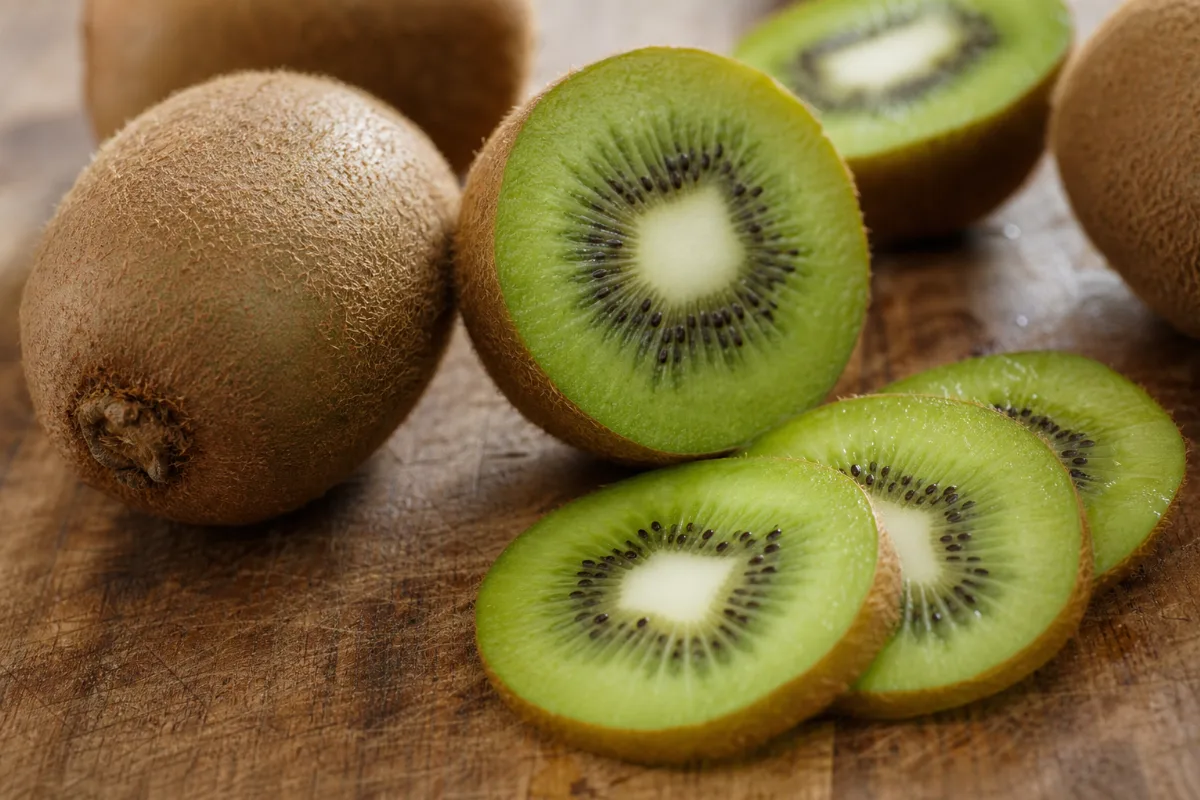
Kiwifruit is a fuzzy-skinned fruit with green or gold flesh, rich in vitamin C. Small trials suggest two to three a day may ease constipation, but the evidence is low certainty. Evidence for sleep, blood pressure and cholesterol is thin or mixed, and no trial has tested kiwifruit for colds. The main caution is allergy, which can be serious, including in people with a latex allergy.
General information, not medical advice. Last substantive update · Not medically reviewed. A named clinician has not signed off on this page. How this page is made
About Kiwifruit
Kiwifruit is a vitamin C-rich fruit with a useful amount of fibre and vitamin K. It is a nutritious food, not a proven remedy. The best-studied use is constipation, with low-certainty evidence from small trials.
What it is
Kiwifruit is the fruit of a woody vine in the family Actinidiaceae. The green type is usually named Actinidia deliciosa in studies; the gold type is usually Actinidia chinensis. The plant database GBIF lists the green name as a synonym of Actinidia chinensis var. deliciosa.
USDA data for green kiwifruit, raw: 61 kcal per 100 g. One fruit (69 g) has about 42 kcal, 2.1 g fibre, 6.2 g sugars, 64 mg vitamin C, 28 micrograms vitamin K and 215 mg potassium. One cup of slices (180 g) has about 110 kcal, 5.4 g fibre and 167 mg vitamin C.
What the research shows
The firmest fact is about vitamin C: too little causes scurvy, and vitamin C foods prevent it. That is a nutrient fact, not a kiwifruit trial. One small study in men with low vitamin C found gold kiwifruit raised their blood levels.
Constipation has the most trials. A 2022 review rated the evidence for more bowel movements as low certainty and for less abdominal pain as moderate certainty. Two small trials found whole kiwifruit similar to psyllium or prunes; neither had a placebo group. Some authors have links to a kiwifruit marketer.
Sleep studies were tiny. Blood pressure results are mixed, and pooled trials found no significant effect on cholesterol, blood sugar or weight. No kiwifruit trial for colds was found.
Fruit, extracts and vitamin C tablets
The cold trials used vitamin C tablets of at least 200 mg a day. One kiwifruit has about 64 mg. Some constipation trials used capsule extracts, and capsule extracts may cause more minor side effects than placebo (a small, uncertain result). Results for one form do not carry over to another, and gold and green kiwifruit are not identical.
At a glance
Traditional uses history, not proof
- Eaten fresh as a sweet-tart fruit
- Eaten for its vitamin C and fibre; long use is not proof that it treats any condition
Studied for research
- Preventing scurvy through vitamin C, high certainty for the nutrient, no kiwifruit trial
- Constipation, low certainty (small trials, some with no placebo)
- Raising blood vitamin C in people who are low, low certainty (one small study)
- Sleep, very low certainty (two tiny studies)
- Blood pressure, mixed; cholesterol, blood sugar and weight, no significant effect in pooled trials
Main compounds
- Vitamin C (ascorbic acid)
- Dietary fibre
- Actinidin (a protein-digesting enzyme)
- Vitamin K and potassium
- Kiwifruit allergens
Common forms
- Fresh whole fruit (flesh)
- Gold kiwifruit (SunGold) used in some trials
- Dried kiwifruit powder, used in one sleep study
- Capsule extracts, used in some constipation trials (not the same as the fruit)
- Vitamin C tablets, used in cold trials (not the same as kiwifruit)
Research links: NHS: Scurvy · Kiwifruit and constipation: systematic review (2022) · Kiwifruit allergy review (2019) · Research Library · Genes & Biomarkers Library
What it is and its history
- Accepted scientific name
- Actinidia chinensis var. deliciosa
- Naming authority
- (A.Chev.) A.Chev. (GBIF accepted, key 6550091). The name Actinidia deliciosa, used in the studies and food databases, is listed as a synonym.
- Synonyms
- Name: Actinidia deliciosa (A.Chev.) C.F.Liang & A.R.Ferguson; Status: synonym
- Common names
- Kiwifruit (English); Kiwi (English); Green kiwifruit (English); Gold kiwifruit (usually Actinidia chinensis) (English); Kiwi (Spanish)
- Family or group
- Actinidiaceae (the kiwifruit family).
- Classification
- Plantae > Tracheophyta > Magnoliopsida > Ericales > Actinidiaceae > Actinidia > Actinidia chinensis
- Native range
- Not verified from a source read. A 2018 review abstract describes kiwifruit as an ornamental curiosity from China in the 19th century.
- Habitat
- Not verified from a source read.
- What it looks like
- Roots: Not verified.; Stems: Not verified.; Leaves: Not verified.; Flowers: Not verified.; Fruit: The fruit is the food. USDA lists green kiwifruit portions of 69 g (one fruit), 148 g and 180 g (1 cup sliced).
- Cultivation
- Not verified from a source read.
- Harvest and processing
- Eaten raw (flesh), sliced, or as dried fruit powder in one study (with skin). Studies used whole fruit, dried fruit powder and capsule extracts.
- Look-alikes and adulterants
- Name: Gold kiwifruit (such as SunGold); Note: A related type with different vitamin C and fibre content. Some trials used gold, some green; results should not be assumed to transfer exactly.; Name: Hardy or baby kiwi (grape-sized kiwi); Note: Not covered by the studies read here.
- Sustainability and conservation
- Not assessed.
Photographs
Traditional use and history history, not clinical proof
| Tradition or era | Documented use | Source |
|---|---|---|
| From ornamental curiosity to crop | A 2018 review abstract says kiwifruit went from an ornamental curiosity from China in the 19th century to a crop of international economic importance in the 21st. The review has industry-linked authors (Zespri). | p29470689 |
| Culinary use | Eaten fresh as a sweet-tart fruit (general knowledge; no historical source was read). | Not verified |
Traditional use shows how it was used. It does not show that it works or is safe today.
What is inside, and how it may work
What it contains and how those compounds act in cells and animals. Laboratory and animal mechanisms are not proven effects in people.
Main compounds
| Compound | Family | Where it is concentrated | Activity studied | Level of evidence |
|---|---|---|---|---|
| Ascorbic acid (vitamin C) PubChem 54670067 | vitamin | Flesh USDA: 92.7 mg per 100 g green kiwifruit, raw (about 64 mg in one 69 g fruit) | Essential nutrient. Prevents scurvy. A small trial in men with low vitamin C raised blood levels with gold kiwifruit. 17 18 3 | Human data |
| Dietary fibre | fibre | Flesh and seeds USDA: 3.0 g per 100 g (about 2.1 g in one 69 g fruit) | A review proposes that kiwifruit fibre holds water and may change gut microbes; these are proposed explanations for softer stools. 18 10 | Review |
| Actinidin | protein-digesting enzyme | Flesh | A review says actinidin aids protein digestion in the stomach and small intestine. No trial read shows a benefit from actinidin as such. 10 | Review |
| Vitamin K (phylloquinone) | vitamin | Flesh USDA: 40.3 micrograms per 100 g (about 28 micrograms in one 69 g fruit) | Relevant to people who take warfarin; see Safety. 18 | Composition only |
| Potassium | mineral | Flesh USDA: 312 mg per 100 g (about 215 mg in one 69 g fruit) | A common mineral in fruit; relevant to some kidney conditions and medicines. 18 | Composition only |
| Lutein plus zeaxanthin and beta-carotene | carotenoid | Flesh USDA per 100 g: 122 micrograms lutein plus zeaxanthin, 52 micrograms beta-carotene | Present in small amounts; no kiwifruit trial of these was read. 18 | Composition only |
| Kiwifruit allergens (Act d 1, Act d 2, Act d 8, Act d 11, Act d 12 and others) | proteins | Fruit | Thirteen allergens have been identified in green kiwifruit; five are major. Act d 1 and Act d 2 are abundant in fully ripe fruit. 12 | Review |
Mechanisms, receptors and pathways
| Target or pathway | Gene or receptor | What was found | Level |
|---|---|---|---|
| Water-holding fibre and gut microbes | Not specified | A review proposes kiwifruit fibre holds water and shifts colonic microbes and metabolites, and that this softens stool and shortens transit time. These are proposed mechanisms from a narrative review with industry-linked authors. 10 | Review |
| Actinidin and protein digestion | Actinidin (protease) | The same review says actinidin aids protein digestion. No trial read shows a health benefit from the enzyme as such. 10 | Review |
| Vitamin C and neutrophil function | Not specified | In 14 men with low vitamin C, gold kiwifruit raised neutrophil vitamin C and chemotaxis by about 20%. This is a lab measure. 3 | Human data |
| Serotonin metabolism and sleep | Not specified | Urinary 5-HIAA rose after fresh and dried kiwifruit compared with water; the authors suggest a link to sleep and mood. This does not prove the fruit improves sleep. 7 | Human data |
| Platelets and ACE activity | Angiotensin-converting enzyme | Platelet aggregation fell 15% and ACE activity fell 11% with three kiwifruit a day in male smokers. 8 | Human data |
| Allergen cross-reaction with latex | Class I chitinases and hevein | Plant chitinases that cross-react with the latex allergen hevein are suspected panallergens in latex-fruit syndrome. 2 | Review |
Absorption, metabolism and elimination
- Absorption
- Not studied for kiwifruit as a whole. Plasma vitamin C rose after gold kiwifruit in one small study.
- Distribution
- Not found.
- Metabolism
- Not found.
- Elimination
- Not found.
- Bioavailability
- Not established for kiwifruit vitamin C.
Isolated compounds versus whole extracts
The cold trials used vitamin C tablets of 0.2 g a day or more, while one kiwifruit has about 64 mg. Some constipation trials used capsule extracts and some the whole fruit, and one sleep study used dried fruit powder. The vitamin C and constipation studies used gold kiwifruit in some trials and green in others. Results from one form or type do not carry over to another.
Nutritional composition
Nutrition from USDA FoodData Central (green kiwifruit, raw, FDC 168153, record last updated 4/1/2019, read 2026-10-25 from the FoodData Central website data feed). Per 100 g: 61 kcal, 3.0 g fibre, 9.0 g total sugars, 14.7 g carbohydrate, 1.1 g protein, 0.5 g fat, about 83 g water, 92.7 mg vitamin C, 40.3 micrograms vitamin K, 312 mg potassium, 0.13 mg copper, 1.46 mg vitamin E (alpha-tocopherol), 25 micrograms folate (DFE), 17 mg magnesium, 34 mg calcium, 0.31 mg iron. One whole fruit (69 g): about 42 kcal, 2.1 g fibre, 6.2 g sugars, 64 mg vitamin C, 28 micrograms vitamin K, 215 mg potassium, 17 micrograms folate. One cup of slices (180 g): about 110 kcal, 5.4 g fibre, 16.2 g sugars, 167 mg vitamin C, 72.5 micrograms vitamin K, 562 mg potassium. Per-fruit and per-cup figures are the USDA per-100 g values scaled by the USDA portion weight and rounded. NHS says adults 19 to 64 need 40 mg of vitamin C a day, so one kiwifruit has more than that. Kiwifruit is mainly a vitamin C fruit with a useful amount of vitamin K. Values vary with variety and ripeness, and gold kiwifruit differs from green.
1 high certainty1 mixed findings3 low certainty2 very low certainty2 not enough evidence
What was looked at
The 9 benefits and uses checked for Kiwifruit, each with how strong the evidence is. Tap one to open it.
- Preventing scurvy (severe vitamin C shortage)High certainty
- Raising blood vitamin C in people who are lowLow certainty
- Constipation and bowel movementsLow certainty
- Bloating and general digestive comfortVery low certainty
- Sleep qualityVery low certainty
- Immune cell functionNot enough evidence
- Common cold (vitamin C tablets, not kiwifruit)Not enough evidence
- Blood pressureMixed findings
- Cholesterol, blood sugar and body weightLow certainty
Lab markers tracked in the studies
Plasma vitamin CComplete spontaneous bowel movements a weekStool consistency and strainingSystolic blood pressureWhole-blood platelet aggregationNeutrophil chemotaxisSleep quality score and sleep onset timeUrinary 5-HIAALDL cholesterolFasting blood glucose
What is Kiwifruit good for?
The main studied uses and how strong the human evidence is for each. Several kiwifruit trials used gold kiwifruit or capsule extracts, and the cold evidence comes from vitamin C tablets, not the fruit.
Benefits, one by one
Each card is a research question, not a promise. Tap a goal to filter. Open a card to see the studies, doses and limits.
Preventing scurvy (severe vitamin C shortage)
High certaintyScurvy comes from going without enough vitamin C for a long time. Kiwifruit is a rich food source of vitamin C: USDA lists 92.7 mg per 100 g, so one fruit (69 g) has about 64 mg. The NHS says fruit and vegetables are the main source and that scurvy is rare. No trial has tested kiwifruit for scurvy.
2 studiesRaw fruit as food. Cooking and storage can reduce vitamin C in foods …
Studies, doses and limits
What the trials found
The NHS says scurvy is caused by not having enough vitamin C in the diet over a long period, that vitamin C is mainly found in fruit and vegetables, and that scurvy is rare because most people get enough. USDA FoodData Central lists green kiwifruit, raw, at 92.7 mg of vitamin C per 100 g. The NHS says adults 19 to 64 need 40 mg a day.
Results
The link between vitamin C foods and scurvy is well accepted. No trial of kiwifruit for scurvy was found.
Effect sizes as reported
USDA: 92.7 mg vitamin C per 100 g green kiwifruit; about 64 mg in one 69 g fruit (our calculation from the USDA figure).
Why this rating
High for the general point that a diet with vitamin C prevents scurvy (health-agency statement). No kiwifruit-specific scurvy trial exists, and an ordinary varied diet already prevents scurvy.
Form and dose studied
Raw fruit as food. Cooking and storage can reduce vitamin C in foods generally.
Who was studied
People with very limited diets: little or no fresh fruit and vegetables, smokers, people with eating problems or long-term alcohol or drug dependency (NHS).
Limits
Not a trial of kiwifruit. This is not a treatment for anyone with suspected scurvy.
Why researchers looked
Kiwifruit is best known as a vitamin C fruit, so people ask whether it protects against vitamin C shortage.
Traditional use
Kiwifruit is eaten as a fruit for its vitamin C and fibre. Everyday use is not proof that it treats any condition.
Proposed mechanism Preliminary mechanism
Kiwifruit is a rich food source of vitamin C (ascorbic acid), which the body needs for normal tissue repair and for immune cells. It also has fibre that holds water and an enzyme called actinidin that breaks down protein. These are proposed explanations, not proven ones.
A proposed mechanism does not show that the effect happens in people.
Swollen bleeding gums, easy bruising, tiredness and joint or muscle pain need a doctor, not food alone (NHS).
Raising blood vitamin C in people who are low
Low certaintyIn one small study, 14 young men with low blood vitamin C ate two gold (SunGold) kiwifruit a day for four weeks. Their blood vitamin C rose above 70 micromol/L within a week. There was no comparison group, and the study did not test infections.
2 studiesWhole SunGold (gold) kiwifruit, two fruit a day for 4 weeks (trial de…
Studies, doses and limits
What the trials found
Bozonet 2015 supplemented 14 men aged 18 to 30 with low plasma vitamin C (under 50 micromol/L) with two SunGold kiwifruit a day for 4 weeks. Plasma vitamin C rose to above 70 micromol/L within one week (p<0.001), and neutrophil (a white blood cell) vitamin C rose after 4 weeks (p=0.016).
Results
Eating gold kiwifruit raised vitamin C levels in men who started low. This is expected for a vitamin C food.
Effect sizes as reported
Plasma vitamin C from under 50 to over 70 micromol/L (p<0.001).
Why this rating
Only 14 young men, all starting low, no control group. The result is plausible and consistent with USDA vitamin C content, but it is one small before-and-after study of gold, not green, kiwifruit.
Form and dose studied
Whole SunGold (gold) kiwifruit, two fruit a day for 4 weeks (trial detail, not advice).
Who was studied
Young men with low blood vitamin C.
Limits
Small, no control group, gold variety, men only. Funding is not shown in the abstract.
Why researchers looked
Because kiwifruit is rich in vitamin C, researchers tested whether eating it lifts vitamin C in the blood.
Traditional use
Kiwifruit is eaten as a fruit for its vitamin C and fibre. Everyday use is not proof that it treats any condition.
Proposed mechanism Preliminary mechanism
Kiwifruit is a rich food source of vitamin C (ascorbic acid), which the body needs for normal tissue repair and for immune cells. It also has fibre that holds water and an enzyme called actinidin that breaks down protein. These are proposed explanations, not proven ones.
A proposed mechanism does not show that the effect happens in people.
None specific to the study.
Constipation and bowel movements
Low certaintyEating about two to three kiwifruit a day has been tried for constipation in several small trials. A 2022 review of 7 trials (399 people) rated the evidence low certainty for more bowel movements and moderate certainty for less abdominal pain. Some trials used capsule extracts, not fruit. Two small trials compared the whole fruit with psyllium or prunes and found similar results, with no placebo.
4 studiesWhole green or gold kiwifruit, usually two a day for 4 weeks, and cap…
Studies, doses and limits
What the trials found
Eltorki 2022 pooled 7 randomised trials (399 people, 82% female, mean age 42). Versus placebo, kiwifruit extracts might raise weekly spontaneous bowel movements by 1.36 (95% CI -0.44 to 3.16; low certainty), and kiwifruit or its extracts reduced abdominal pain (moderate certainty). Versus psyllium, kiwifruit may raise weekly bowel movements by 1.01 (-0.02 to 2.04; moderate certainty) and gave softer stools (low certainty). Chey 2021 (US, 75 adults, partially randomised, no placebo) found similar response rates for two green kiwifruit a day, prunes and psyllium; weekly complete spontaneous bowel movements rose with all three (P 0.003 or less). Bayer 2022 (24 adults with constipation or constipation-predominant IBS plus 32 healthy controls, crossover) found two gold kiwifruit a day lowered symptom scores and straining and were as effective as fibre-matched psyllium.
Results
Promising but limited. Small trials suggest more regular, easier bowel movements. The confidence intervals for the number of bowel movements include no effect.
Effect sizes as reported
Eltorki: MD 1.36 bowel movements a week vs placebo (extracts; CI -0.44 to 3.16); MD 1.01 vs psyllium (CI -0.02 to 2.04). Chey: responder rates similar across arms. Bayer: constipation score fell with both (p=0.004).
Why this rating
The review itself rated most bowel-movement findings as low certainty. Trials were small, many had no placebo, some used extract capsules, and some authors have links to a kiwifruit marketer.
Form and dose studied
Whole green or gold kiwifruit, usually two a day for 4 weeks, and capsule extracts in some trials (trial details, not advice). Extract results do not carry over to the fruit.
Who was studied
Mostly adult women with constipation or constipation-predominant IBS.
Limits
Small trials; no placebo in two fruit trials; short (4 weeks); funding links (Bayer 2022: Zespri grants and honoraria, funders had no role in design or publication).
Why researchers looked
Kiwifruit has fibre that holds water and an enzyme called actinidin, so researchers asked whether it helps people who are constipated.
Traditional use
Kiwifruit is eaten as a fruit for its vitamin C and fibre. Everyday use is not proof that it treats any condition.
Proposed mechanism Preliminary mechanism
The suggested explanations are water-holding fibre that softens stool, changes in gut microbes, and the protein-digesting enzyme actinidin. A narrative review describes these as proposed mechanisms; the review is not itself a trial and has industry-linked authors.
A proposed mechanism does not show that the effect happens in people.
Extract capsules may cause more minor side effects than placebo (Eltorki; small numbers, wide interval). Kiwifruit can cause allergy; see the Safety tab. Anyone with long-lasting constipation, blood in stool or weight loss needs a doctor.
Bloating and general digestive comfort
Very low certaintyIn one trial in people with constipation, the group eating two green kiwifruit a day reported better bloating scores. This was a side outcome in a small trial with no placebo. It does not show that kiwifruit helps bloating in people without constipation.
2 studiesTwo green kiwifruit a day for 4 weeks (trial detail, not advice).
Studies, doses and limits
What the trials found
In Chey 2021, patients with chronic constipation randomised to green kiwifruit reported significant improvement in bloating scores (P=0.02); the abstract does not report this for the prunes or psyllium groups. A narrative review (Richardson 2018) also describes less abdominal discomfort.
Results
A single small secondary result.
Effect sizes as reported
Bloating score improvement P=0.02 (kiwifruit group only).
Why this rating
A side outcome in a 29-person kiwifruit group, no placebo, partially randomised. The supporting review has industry-linked authors.
Form and dose studied
Two green kiwifruit a day for 4 weeks (trial detail, not advice).
Who was studied
Adults with chronic constipation.
Limits
Not designed for bloating; no placebo.
Why researchers looked
Because kiwifruit eases stool passage in some people, researchers also asked about bloating.
Traditional use
Kiwifruit is eaten as a fruit for its vitamin C and fibre. Everyday use is not proof that it treats any condition.
Proposed mechanism Preliminary mechanism
Kiwifruit is a rich food source of vitamin C (ascorbic acid), which the body needs for normal tissue repair and for immune cells. It also has fibre that holds water and an enzyme called actinidin that breaks down protein. These are proposed explanations, not proven ones.
A proposed mechanism does not show that the effect happens in people.
None specific.
Sleep quality
Very low certaintyTwo small studies looked at kiwifruit in the evening. One had 24 adults with sleep problems and no comparison group; people reported better sleep. The other had 24 young men for a single evening and found small changes in morning alertness. Neither can show that kiwifruit improves sleep.
2 studiesWhole fruit two at a time; dried green kiwifruit powder (with skin) i…
Studies, doses and limits
What the trials found
Lin 2011: 24 adults (22 women) with self-reported sleep problems ate two kiwifruit one hour before bed for 4 weeks. Sleep-quality scores, time awake after sleep onset and time to fall asleep fell by 42.4%, 28.9% and 35.4%; total sleep and efficiency rose by 13.4% and 5.41%. There was no control group. Kanon 2023: 24 young men (12 good and 12 poor sleepers) in a single-blind crossover had fresh kiwifruit, dried kiwifruit powder or water with an evening meal. Dried kiwifruit improved morning sleepiness, alertness on waking and vigour (p<0.05) versus water; both raised urinary 5-HIAA. Mood effects with fresh fruit were only trends (p<0.1).
Results
Suggestive but too weak to rely on. Self-reported results with no control group, and a single-evening crossover.
Effect sizes as reported
Lin: sleep score -42.4% (before and after, no control). Kanon: ease of waking +24% in poor sleepers after dried kiwifruit (p=0.005); urinary 5-HIAA +1.56 ng/g (fresh) vs 4.32 ng/g for water.
Why this rating
Two tiny studies. One has no control group; the other tested many outcomes after one evening, with several results only trends.
Form and dose studied
Whole fruit two at a time; dried green kiwifruit powder (with skin) in one study (trial details, not advice).
Who was studied
Adults with sleep problems (mostly women); young healthy men.
Limits
Tiny, short, self-reported and not placebo controlled.
Why researchers looked
Kiwifruit contains small amounts of serotonin-related compounds and antioxidants, and the authors of the first study suggested these might help sleep.
Traditional use
Kiwifruit is eaten as a fruit for its vitamin C and fibre. Everyday use is not proof that it treats any condition.
Proposed mechanism Human biomarker
Authors suggest changes in serotonin metabolism. In the 2023 crossover trial urinary 5-HIAA, a serotonin breakdown product, was higher after kiwifruit than water. This is a marker, not proof of a sleep effect.
A proposed mechanism does not show that the effect happens in people.
Anyone with long-lasting poor sleep should see a doctor. Do not eat kiwifruit if you are allergic.
Immune cell function
Not enough evidenceIn one small study of 14 young men with low vitamin C, four weeks of two gold kiwifruit a day raised the vitamin C inside white blood cells (neutrophils) and increased how strongly those cells moved toward a signal, by about 20%. This is a lab measure. It was not tested against infections.
1 studiesTwo SunGold (gold) kiwifruit a day for 4 weeks (trial detail, not adv…
Studies, doses and limits
What the trials found
Bozonet 2015 measured neutrophil functions before and after 4 weeks of two SunGold kiwifruit a day in 14 men with low vitamin C. Neutrophil vitamin C rose (p=0.016), neutrophil chemotaxis (movement toward a chemical signal) rose about 20% (p=0.041) and oxidant generation rose by a similar amount (p=0.031). Extracellular trap formation and spontaneous apoptosis did not change.
Results
Changes in lab measures of immune cells in men who started with low vitamin C. No infection outcome.
Effect sizes as reported
Chemotaxis +20% (p=0.041); oxidant generation up (p=0.031).
Why this rating
One 14-man before-and-after study, no control group, measures that do not by themselves mean better protection from illness.
Form and dose studied
Two SunGold (gold) kiwifruit a day for 4 weeks (trial detail, not advice).
Who was studied
Young men with low plasma vitamin C.
Limits
No control group; not tested in people with normal vitamin C; the authors' statement that this 'would be expected to translate into enhanced immunity' is an expectation, not a finding.
Why researchers looked
White blood cells hold a lot of vitamin C, so researchers asked whether a vitamin C-rich fruit changes how they work.
Traditional use
Kiwifruit is eaten as a fruit for its vitamin C and fibre. Everyday use is not proof that it treats any condition.
Proposed mechanism Preliminary mechanism
Kiwifruit is a rich food source of vitamin C (ascorbic acid), which the body needs for normal tissue repair and for immune cells. It also has fibre that holds water and an enzyme called actinidin that breaks down protein. These are proposed explanations, not proven ones.
A proposed mechanism does not show that the effect happens in people.
None specific.
Common cold (vitamin C tablets, not kiwifruit)
Not enough evidenceNo trial of kiwifruit for colds was found. The best nearby evidence is a Cochrane review of vitamin C tablets: they did not lower the chance of catching a cold in the general public, and daily use shortened colds a little (8% in adults, 14% in children). A kiwifruit holds much less vitamin C than the tablet trials used.
2 studiesVitamin C tablets of 0.2 g (200 mg) or more a day. One 69 g kiwifruit…
Studies, doses and limits
What the trials found
Cochrane (Hemila and Chalker 2013): 29 comparisons with 11,306 people. In general community trials (10,708 people) the risk ratio for catching a cold on regular vitamin C was 0.97 (95% CI 0.94 to 1.00). In 598 marathon runners, skiers and soldiers on subarctic exercises it was 0.48 (0.35 to 0.64). Regular vitamin C shortened colds by 8% in adults and 14% in children. Starting vitamin C at the onset of a cold showed no consistent effect. The review counted only trials with at least 0.2 g a day versus placebo; no kiwifruit trial was included.
Results
Tablet trials: no fewer colds in the general public; small shortening with daily use. Kiwifruit itself not tested.
Effect sizes as reported
General public RR 0.97 (0.94 to 1.00); extreme exercise or cold RR 0.48 (0.35 to 0.64); duration -8% adults, -14% children.
Why this rating
Insufficient for kiwifruit, because it was not tested. For vitamin C tablets, a large Cochrane review found no effect on catching colds in the general public.
Form and dose studied
Vitamin C tablets of 0.2 g (200 mg) or more a day. One 69 g kiwifruit has about 64 mg (USDA figure scaled).
Who was studied
General community adults and children; separate small group under severe short-term physical stress.
Limits
Supplement trials, not food. Review published 2013.
Why researchers looked
Kiwifruit is a vitamin C food, so readers ask whether it prevents or shortens colds.
Traditional use
Kiwifruit is eaten as a fruit for its vitamin C and fibre. Everyday use is not proof that it treats any condition.
Proposed mechanism Preliminary mechanism
Kiwifruit is a rich food source of vitamin C (ascorbic acid), which the body needs for normal tissue repair and for immune cells. It also has fibre that holds water and an enzyme called actinidin that breaks down protein. These are proposed explanations, not proven ones.
A proposed mechanism does not show that the effect happens in people.
Vitamin C supplements above 1,000 mg a day can cause stomach pain, diarrhoea and wind (NHS). See the Safety tab.
Blood pressure
Mixed findingsOne 8-week trial in 102 male smokers found blood pressure fell by about 10 over 9 mm Hg with three kiwifruit a day, compared with a control group. But a 2019 review that pooled 5 trials (489 people) found no significant effect. The result is mixed.
2 studiesThree whole kiwifruit a day for 8 weeks in the positive trial (trial …
Studies, doses and limits
What the trials found
Karlsen 2013 (102 male smokers aged 44 to 74, 8 weeks, control group): three kiwifruit a day lowered systolic blood pressure by about 10 mm Hg and diastolic by about 9 mm Hg (P=0.019 and P=0.016 versus control), lowered platelet aggregation by 15% (P=0.009) and ACE activity by 11% (P=0.034). Suksomboon 2019 pooled five randomised trials (489 people with high cholesterol, high blood pressure, type 2 diabetes or male smokers) and found no significant effect on systolic blood pressure (MD -1.72 mmHg, 95% CI -4.27 to 0.84) or diastolic (-2.35 mmHg, -5.10 to 0.41).
Results
One positive trial in male smokers; no significant effect in the pooled analysis.
Effect sizes as reported
Karlsen: SBP -10, DBP -9 mm Hg. Pooled: SBP -1.72 (CI -4.27 to 0.84); DBP -2.35 (CI -5.10 to 0.41).
Why this rating
The one clear positive trial was in male smokers only and could not be blinded. The pooled analysis found no significant effect, with wide intervals and few trials.
Form and dose studied
Three whole kiwifruit a day for 8 weeks in the positive trial (trial detail, not advice).
Who was studied
Male smokers; mixed groups with heart risk factors.
Limits
Few trials; different groups; the pooled trend favoured kiwifruit but did not reach significance.
Why researchers looked
Fruit and vegetables are linked with healthier blood pressure, and kiwifruit was tested in people with heart risk factors.
Traditional use
Kiwifruit is eaten as a fruit for its vitamin C and fibre. Everyday use is not proof that it treats any condition.
Proposed mechanism Human biomarker
The trial authors measured ACE activity, an enzyme involved in blood pressure control, which fell 11% in the kiwifruit group. This is a marker, not proof of the mechanism.
A proposed mechanism does not show that the effect happens in people.
Anyone on blood pressure medicine should not change medicine because of a fruit; ask a clinician.
Cholesterol, blood sugar and body weight
Low certaintyA 2019 review pooled 5 randomised trials (489 people with heart risk factors). It found no significant effect of kiwifruit on cholesterol, blood fats, fasting blood sugar, insulin resistance or body weight. Small benefits cannot be ruled out because there were few trials.
2 studiesWhole kiwifruit; amounts varied by trial.
Studies, doses and limits
What the trials found
Suksomboon 2019: no effect on total cholesterol (MD -0.14 mmol/L, 95% CI -0.71 to 0.43), triglycerides (-0.23, -0.66 to 0.20), LDL cholesterol (-0.41, -0.99 to 0.18), HDL cholesterol (+0.15, -0.18 to 0.48), fasting glucose (-0.08, -0.37 to 0.21), HOMA-IR (-0.29, -0.61 to 0.02) or body weight (-1.08 kg, -4.22 to 2.05). The authors say there seemed to be a trend of improvement.
Results
No significant effect on any of these measures.
Effect sizes as reported
LDL -0.41 mmol/L (CI -0.99 to 0.18); fasting glucose -0.08 mmol/L (CI -0.37 to 0.21); weight -1.08 kg (CI -4.22 to 2.05).
Why this rating
A meta-analysis of five trials found no effect, but with wide intervals so the result is imprecise. This is a null finding, not proof of no effect.
Form and dose studied
Whole kiwifruit; amounts varied by trial.
Who was studied
People with high cholesterol, high blood pressure, type 2 diabetes, or male smokers.
Limits
Few trials; mixed populations; trend toward benefit was not significant.
Why researchers looked
Kiwifruit has fibre and plant compounds, so it was tested for effects on heart and blood sugar markers.
Traditional use
Kiwifruit is eaten as a fruit for its vitamin C and fibre. Everyday use is not proof that it treats any condition.
Proposed mechanism Preliminary mechanism
Kiwifruit is a rich food source of vitamin C (ascorbic acid), which the body needs for normal tissue repair and for immune cells. It also has fibre that holds water and an enzyme called actinidin that breaks down protein. These are proposed explanations, not proven ones.
A proposed mechanism does not show that the effect happens in people.
Kiwifruit has about 9 g of sugars per 100 g (USDA); people managing diabetes should ask their clinician how it fits their eating plan.
Connections to the rest of health
How Kiwifruit connects to the rest of our health knowledge graph. Every link says what kind of connection it is. A safety link (for example to the liver) is a warning, not a benefit. A study that merely mentions a topic never creates a benefit link.
Explore every connection: goals, body systems, organs, symptoms, genes
A. Wellness goals
| Connected to | Kind of connection | Evidence status | Context | Studies |
|---|---|---|---|---|
| Digestive Support | Low certainty | Constipation and bowel movements: Eating about two to three kiwifruit a day has been tried for constipation in several small trials. A 2022 review of 7 trials (399 people) rated the evidence low certainty for more bowel movements and moderate certainty for less abdominal pain. Some trials used capsule extracts, not fruit. Two small trials compared the whole fruit with psyllium or prunes and found similar results, with no placebo. | 5 4 1 10 | |
| Gut Health | Low certainty | Constipation and bowel movements: Eating about two to three kiwifruit a day has been tried for constipation in several small trials. A 2022 review of 7 trials (399 people) rated the evidence low certainty for more bowel movements and moderate certainty for less abdominal pain. Some trials used capsule extracts, not fruit. Two small trials compared the whole fruit with psyllium or prunes and found similar results, with no placebo. | 5 4 1 10 | |
| Digestive Support | Very low certainty | Bloating and general digestive comfort: In one trial in people with constipation, the group eating two green kiwifruit a day reported better bloating scores. This was a side outcome in a small trial with no placebo. It does not show that kiwifruit helps bloating in people without constipation. | 4 10 | |
| Better Sleep | Very low certainty | Sleep quality: Two small studies looked at kiwifruit in the evening. One had 24 adults with sleep problems and no comparison group; people reported better sleep. The other had 24 young men for a single evening and found small changes in morning alertness. Neither can show that kiwifruit improves sleep. | 9 7 | |
| Immune Support | Not enough evidence | Common cold (vitamin C tablets, not kiwifruit): No trial of kiwifruit for colds was found. The best nearby evidence is a Cochrane review of vitamin C tablets: they did not lower the chance of catching a cold in the general public, and daily use shortened colds a little (8% in adults, 14% in children). A kiwifruit holds much less vitamin C than the tablet trials used. | 6 18 | |
| Blood Pressure Support | Mixed findings | Blood pressure: One 8-week trial in 102 male smokers found blood pressure fell by about 10 over 9 mm Hg with three kiwifruit a day, compared with a control group. But a 2019 review that pooled 5 trials (489 people) found no significant effect. The result is mixed. | 8 11 | |
| Cholesterol Balance | Low certainty | Cholesterol, blood sugar and body weight: A 2019 review pooled 5 randomised trials (489 people with heart risk factors). It found no significant effect of kiwifruit on cholesterol, blood fats, fasting blood sugar, insulin resistance or body weight. Small benefits cannot be ruled out because there were few trials. | 11 18 | |
| Blood Sugar Balance | Low certainty | Cholesterol, blood sugar and body weight: A 2019 review pooled 5 randomised trials (489 people with heart risk factors). It found no significant effect of kiwifruit on cholesterol, blood fats, fasting blood sugar, insulin resistance or body weight. Small benefits cannot be ruled out because there were few trials. | 11 18 |
B. Body systems
| Connected to | Kind of connection | Evidence status | Context | Studies |
|---|---|---|---|---|
| Immune system | Adverse effect or risk | Documented risk | Allergic reactions to kiwifruit. Preparation or compound: Kiwifruit allergens |
12 |
| Immune System | Biological association | High certainty | Studied for: Preventing scurvy (severe vitamin C shortage) Studied for: Raising blood vitamin C in people who are low | 15 18 3 6 |
| Integumentary System | Biological association | High certainty | Studied for: Preventing scurvy (severe vitamin C shortage) | 15 18 |
| Digestive System | Biological association | Low certainty | Studied for: Constipation and bowel movements Studied for: Bloating and general digestive comfort | 5 4 1 10 |
| Gut Health | Biological association | Low certainty | Studied for: Constipation and bowel movements | 5 4 1 10 |
| Nervous System | Biological association | Very low certainty | Studied for: Sleep quality | 9 7 |
| Sleep Recovery | Biological association | Very low certainty | Studied for: Sleep quality | 9 7 |
| Respiratory System | Biological association | Not enough evidence | Studied for: Common cold (vitamin C tablets, not kiwifruit) | 6 18 |
| Cardiovascular System | Biological association | Mixed findings | Studied for: Blood pressure Studied for: Cholesterol, blood sugar and body weight | 8 11 18 |
| Metabolism Weight | Biological association | Low certainty | Studied for: Cholesterol, blood sugar and body weight | 11 18 |
E. Health conditions
| Connected to | Kind of connection | Evidence status | Context | Studies |
|---|---|---|---|---|
| Food allergy | Adverse effect or risk | Documented risk | Kiwifruit allergy ranges from oral allergy symptoms to anaphylaxis. Kiwifruit allergy ranges from oral symptoms to anaphylaxis. Preparation or compound: Kiwifruit proteins (allergens) |
12 |
| Latex-fruit syndrome | Adverse effect or risk | Documented risk | People with a latex allergy may react to kiwifruit. People with a latex allergy may react to kiwi. Preparation or compound: Kiwi, banana, avocado, chestnut |
2 |
| Scurvy | Biological association | Deficiency link | Kiwifruit is a vitamin C food; scurvy comes from too little vitamin C. Preparation or compound: Raw kiwifruit as a vitamin C food |
15 18 |
| Constipation | Low certainty | Small trials and a 2022 review suggest kiwifruit may ease constipation. Preparation or compound: Whole kiwifruit; capsule extracts in some trials |
5 4 1 |
I. Biomarkers
| Connected to | Kind of connection | Evidence status | Context | Studies |
|---|---|---|---|---|
| Plasma vitamin C | Biological association | Low certainty | Measured in trials: up. A lab change is not the same as a health benefit. | 3 |
| Complete spontaneous bowel movements a week | Biological association | Low certainty | Measured in trials: up. A lab change is not the same as a health benefit. | 5 4 1 |
| Stool consistency and straining | Biological association | Low certainty | Measured in trials: improved. A lab change is not the same as a health benefit. | 5 4 1 |
| Systolic blood pressure | Biological association | Mixed findings | Measured in trials: mixed. A lab change is not the same as a health benefit. | 8 11 |
| Whole-blood platelet aggregation | Biological association | Very low certainty | Measured in trials: down. A lab change is not the same as a health benefit. | 8 |
| Neutrophil chemotaxis | Biological association | Not enough evidence | Measured in trials: up. A lab change is not the same as a health benefit. | 3 |
| Sleep quality score and sleep onset time | Biological association | Very low certainty | Measured in trials: improved. A lab change is not the same as a health benefit. | 9 7 |
| Urinary 5-HIAA | Biological association | Not enough evidence | Measured in trials: up. A lab change is not the same as a health benefit. | 7 |
| LDL cholesterol | Biological association | Low certainty | Measured in trials: no clear change. A lab change is not the same as a health benefit. | 11 |
| Fasting blood glucose | Biological association | Low certainty | Measured in trials: no clear change. A lab change is not the same as a health benefit. | 11 |
J. Genes, receptors and enzymes
| Connected to | Kind of connection | Evidence status | Context | Studies |
|---|---|---|---|---|
| Actinidin | Preliminary mechanism | Review | A protein-digesting enzyme in kiwifruit; no trial of the enzyme itself. | 10 |
K. Biological pathways
L. Active compounds
| Connected to | Kind of connection | Evidence status | Context | Studies |
|---|---|---|---|---|
| Ascorbic acid (vitamin C) | Biological association | Human | Essential nutrient. Prevents scurvy. A small trial in men with low vitamin C raised blood levels with gold kiwifruit. Preparation or compound: Flesh |
17 18 3 |
| Dietary fibre | Biological association | Review | A review proposes that kiwifruit fibre holds water and may change gut microbes; these are proposed explanations for softer stools. Preparation or compound: Flesh and seeds |
18 10 |
| Actinidin | Biological association | Review | A review says actinidin aids protein digestion in the stomach and small intestine. No trial read shows a benefit from actinidin as such. Preparation or compound: Flesh |
10 |
| Vitamin K (phylloquinone) | Biological association | Composition only | Relevant to people who take warfarin; see Safety. Preparation or compound: Flesh |
18 |
| Potassium | Biological association | Composition only | A common mineral in fruit; relevant to some kidney conditions and medicines. Preparation or compound: Flesh |
18 |
| Lutein plus zeaxanthin and beta-carotene | Biological association | Composition only | Present in small amounts; no kiwifruit trial of these was read. Preparation or compound: Flesh |
18 |
| Kiwifruit allergens (Act d 1, Act d 2, Act d 8, Act d 11, Act d 12 and others) | Biological association | Review | Thirteen allergens have been identified in green kiwifruit; five are major. Act d 1 and Act d 2 are abundant in fully ripe fruit. Preparation or compound: Fruit |
12 |
Each connection is stored with the ingredient, the connected record, the kind of connection, the evidence status, the supporting studies, the preparation or compound involved, and a review date (last reviewed October 25, 2026).
Evidence at a glance: what changed in 1 lab markers
Tap a number to show only those markers. Counts are markers, not people.
The evidence
The research centre for Kiwifruit. Every record here was checked against PubMed or the publisher's page; we never list a study we have not verified.
Evidence by outcome
Bars show how many studies we found for each outcome, not how well it works. People are added up across trials only (reviews are not added, to avoid double counting).
How we rate evidence
High certainty
Several well-run trials or reviews agree; further research is unlikely to change the picture much.
Moderate certainty
Good trials point the same way, but some doubt remains.
Low certainty
Small, short or inconsistent trials. The finding could change with better research.
Very low certainty
Very little or very weak human data. Treat as a possibility only.
Mixed findings
Trials or reviews disagree with each other.
Not enough evidence
Not enough human research to say either way.
Evidence against
Good research found no benefit, or found harm.
We take the reviewers' own risk-of-bias and GRADE statements where they exist, and otherwise judge from study size, design, consistency, directness and whether a product matches what is sold. Many publications do not make evidence high. Method note: We started from our existing kiwifruit summary, re-checked nutrition at USDA FoodData Central, and searched PubMed for human trials, reviews and allergy evidence. Only abstracts were read for studies. Items we could not verify are flagged in the research gaps.
Study library: every study we checked 18
| Study | Design | People | Product, dose, length | Result |
|---|---|---|---|---|
| Bayer 2022 Two Gold Kiwifruit Daily for Effective Treatment of Constipation in Adults-A Randomized Clinical Trial. Nutrients · PMID 36235798 · DOI |
Controlled trial |
56 Adults 18 to 65: 11 with functional constipation, 13 with constipation-predominant IBS, 32 healthy controls |
Whole gold kiwifruit compared with fibre-matched psyllium Fruit Two kiwifruit a day (psyllium 7.5 g) (trial detail, not advice) 4 weeks each, 4-week washout, crossover · vs Fibre-matched psyllium (no placebo) |
Both treatments lowered the constipation symptom score in all participants compared with baseline (p=0.004). All participants had more complete spontaneous bowel movements a week (p=0.014). Gold kiwifruit lowered straining (p=0.021). The authors conclude two gold kiwifruit a day were as effective as fibre-matched psyllium. Within-group improvements; kiwifruit similar to psyllium (Not given in the abstract) Methods, limits and fundingOutcomes: Gastrointestinal Symptom Rating Scale constipation score; weekly complete spontaneous bowel movements; straining Limitations: Only 24 people had constipation; most participants were healthy controls; no placebo; part of a larger study. Funding and conflicts: Industry-linked: authors report research grants, honoraria or advisory roles with Zespri International (a kiwifruit marketer); the funders had no role in design, analysis or the decision to publish. Read: abstract |
| Blanco C. 2003 Latex-fruit syndrome. Curr Allergy Asthma Rep · PMID 12542994 · DOI |
Narrative review |
Review of allergen cross-reaction between natural rubber latex and plant foods | Kiwi and other fruit Fruit |
Some latex allergens cross-react with plant food allergens (latex-fruit syndrome). The foods most often involved are banana, avocado, kiwi and chestnut, and several others are also implicated. Class I chitinases, which cross-react with the latex allergen hevein, are the panallergens suspected. Not applicable (review) Methods, limits and fundingOutcomes: Allergy and cross-reactivity Limitations: A 2003 review; the abstract gives no numbers. Funding and conflicts: Not shown in the abstract. Read: abstract |
| Bozonet 2015 Enhanced human neutrophil vitamin C status, chemotaxis and oxidant generation following dietary supplementation with vitamin C-rich SunGold kiwifruit. Nutrients · PMID 25912037 · DOI |
Other |
14 Young men aged 18 to 30 with low blood vitamin C (plasma under 50 micromol/L) |
Whole SunGold (gold) kiwifruit Fruit Two fruit a day (trial detail, not advice) 4 weeks |
Plasma vitamin C rose to above 70 micromol/L within one week (p<0.001). Neutrophil vitamin C rose (p=0.016). Neutrophil chemotaxis rose about 20% (p=0.041) and oxidant generation rose by a similar amount (p=0.031). Extracellular trap formation and spontaneous apoptosis did not change. Plasma vitamin C from under 50 to over 70 micromol/L; chemotaxis +20% (Not given in the abstract (p values only)) Methods, limits and fundingOutcomes: Plasma and neutrophil vitamin C; neutrophil chemotaxis, oxidant generation, extracellular traps, apoptosis Limitations: Only 14 young men, all with low vitamin C to begin with; no control group; results do not show fewer infections. Funding and conflicts: Funding and conflicts are not shown in the abstract; the authors are at the University of Otago, New Zealand. Read: abstract |
| Chey 2021 Exploratory Comparative Effectiveness Trial of Green Kiwifruit, Psyllium, or Prunes in US Patients With Chronic Constipation. Am J Gastroenterol · PMID 34074830 · DOI |
Controlled trial |
79 US adults with chronic constipation (3 or fewer complete spontaneous bowel movements a week); mean age 42.7, 87% female; 75 with complete data |
Whole green kiwifruit compared with prunes and psyllium Fruit Two kiwifruit a day (prunes 100 g; psyllium 12 g) (trial detail, not advice) 4 weeks · vs Prunes and psyllium (no placebo) |
The share of responders was similar for the three treatments. Weekly complete spontaneous bowel movements rose with all three (P 0.003 or less). Stool consistency improved with kiwifruit (P=0.01) and prunes (P=0.049). Straining improved with kiwifruit (P=0.003), prunes (P<0.001) and psyllium (P=0.04). The kiwifruit group reported better bloating scores (P=0.02). Side effects were most common with psyllium and least common with kiwifruit. Similar response rates across the three arms; within-group improvements (Not given in the abstract) Methods, limits and fundingOutcomes: Share with at least 1 more complete spontaneous bowel movement a week; stool frequency, consistency, straining; bloating; side effects; satisfaction Limitations: Partially randomised, small (29 on kiwifruit), no placebo group, exploratory. It cannot show kiwifruit works better than the other treatments. Funding and conflicts: Funding and conflicts are not shown in the abstract. Read: abstract |
| Eltorki 2022 Kiwifruit and Kiwifruit Extracts for Treatment of Constipation: A Systematic Review and Meta-Analysis. Can J Gastroenterol Hepatol · PMID 36247043 · DOI |
Meta-analysis |
399 People with constipation in 7 randomised trials (82% female, mean age 42) |
Kiwifruit or kiwifruit extracts (capsules) Fruit or extract Trial detail varied Varied · vs Placebo or psyllium |
Versus placebo, kiwifruit extracts might raise weekly spontaneous bowel movements by 1.36 (low certainty), with an uncertain effect on stool type (very low certainty). Kiwifruit or its extracts reduced abdominal pain (moderate certainty). Versus psyllium, kiwifruit may raise weekly bowel movements by 1.01 (moderate certainty) and gave softer stools (low certainty). Capsule extracts may cause more minor side effects than placebo. Weekly bowel movements: MD 1.36 vs placebo (extracts); MD 1.01 vs psyllium (95% CI -0.44 to 3.16 (vs placebo); -0.02 to 2.04 (vs psyllium); abdominal pain SMD -1.44 (interval printed in the abstract as -2.83 to -1.66, which does not contain the estimate, so quote with care)) Methods, limits and fundingOutcomes: Spontaneous bowel movements per week, abdominal pain, straining, stool type (Bristol Stool Scale) Limitations: Some trials used capsule extracts, not fruit. Confidence intervals for bowel movements cross zero. The review's own GRADE ratings range from very low to moderate. The authors say large, rigorous trials are needed. Funding and conflicts: The authors declare no conflicts of interest. Registration: PROSPERO CRD42021239397 Read: abstract |
| Hemila 2013 Vitamin C for preventing and treating the common cold. Cochrane Database Syst Rev · PMID 23440782 · DOI |
Meta-analysis |
11306 29 trial comparisons in the general community and in marathon runners, skiers and soldiers; 31 comparisons for duration |
Vitamin C tablets (not kiwifruit) At least 0.2 g a day (trial detail, not advice) Varied · vs Placebo |
General community (10,708 people): risk ratio for catching a cold 0.97. Five trials of 598 marathon runners, skiers and soldiers on subarctic exercises: 0.48. Regular vitamin C shortened colds by 8% in adults and 14% in children. Seven comparisons of vitamin C started at cold onset showed no consistent effect. RR 0.97 general community; RR 0.48 under extreme exercise or cold (95% CI 0.94 to 1.00; 0.35 to 0.64) Methods, limits and fundingOutcomes: Cold incidence, duration, severity Limitations: Supplement trials, not food. Trials under 0.2 g a day were excluded. Published 2013. A kiwifruit contains far less vitamin C than the trial amounts. Funding and conflicts: The record says none of the other review authors has a conflict of interest to declare. Read: abstract |
| Kanon 2023 Acute effects of fresh versus dried Hayward green kiwifruit on sleep quality, mood, and sleep-related urinary metabolites in healthy young men with good and poor sleep quality. Front Nutr · PMID 36998905 · DOI |
Controlled trial |
24 24 healthy young men (mean age 29), 12 good sleepers and 12 poor sleepers |
Fresh green kiwifruit flesh or dried green kiwifruit powder (with skin), with an evening meal Fruit or dried fruit powder Two fruit, or the dry matter of two, with the evening meal (trial detail, not advice) Single evening each, crossover · vs Water |
Compared with water, dried kiwifruit improved morning sleepiness, alertness on waking and vigour (p<0.05). Fresh and dried kiwifruit both raised urinary 5-HIAA (+1.56 and +1.30 ng/g versus 4.32 ng/g for water; p=0.001 and 0.004). In poor sleepers, ease of waking improved 24% after dried kiwifruit (p=0.005). Mood effects with fresh kiwifruit only 'tended' (p<0.1). 5-HIAA +1.56 ng/g (fresh), +1.30 ng/g (dried) vs water 4.32 ng/g (Not given in the abstract) Methods, limits and fundingOutcomes: Sleep quality, mood, urinary 5-HIAA (a serotonin breakdown product) and 6-sulfatoxymelatonin Limitations: A single evening, 24 young men, single-blind, many outcomes tested, some only trends. Not a test of long-term use. Funding and conflicts: The authors declare no commercial or financial relationships that could be a conflict of interest. Registered ACTRN12621000046808. Registration: ACTRN12621000046808 Read: abstract |
| Karlsen 2013 Kiwifruit decreases blood pressure and whole-blood platelet aggregation in male smokers. J Hum Hypertens · PMID 22258209 · DOI |
Controlled trial |
102 Male smokers aged 44 to 74 |
Whole kiwifruit (and, in a second arm, a mixed antioxidant-rich diet) Fruit Three kiwifruit a day (trial detail, not advice) 8 weeks · vs Control group (usual diet) |
In the kiwifruit group, systolic blood pressure fell about 10 mm Hg and diastolic about 9 mm Hg (P=0.019 and P=0.016 versus control). Platelet aggregation fell 15% (P=0.009) and ACE activity fell 11% (P=0.034). The antioxidant-diet group saw no change in platelets or ACE. Systolic -10 mm Hg, diastolic -9 mm Hg; platelet aggregation -15%; ACE -11% (Not given in the abstract) Methods, limits and fundingOutcomes: Blood pressure, whole-blood platelet aggregation, angiotensin-converting enzyme (ACE) activity Limitations: Male smokers only. The abstract does not say whether the trial was blinded, and people can usually see which fruit they eat. The 2019 meta-analysis that pooled five trials did not find the same effect. Funding and conflicts: Funding and conflicts are not shown in the abstract. Read: abstract |
| Lin 2011 Effect of kiwifruit consumption on sleep quality in adults with sleep problems. Asia Pac J Clin Nutr · PMID 21669584 |
Other |
24 24 adults (2 men, 22 women) aged 20 to 55 with self-reported sleep problems |
Whole kiwifruit Fruit Two kiwifruit one hour before bed (trial detail, not advice) 4 weeks |
After 4 weeks the sleep quality score, time awake after falling asleep and time to fall asleep fell by 42.4%, 28.9% and 35.4%. Total sleep time and sleep efficiency rose by 13.4% and 5.41%. Sleep score -42.4%; sleep onset time -35.4%; total sleep +13.4% (Not given in the abstract) Methods, limits and fundingOutcomes: Pittsburgh Sleep Quality Index (Chinese version), sleep diary, actigraph Limitations: Tiny, no control group or placebo, no blinding, self-reported symptoms; changes could come from expectation or from any evening routine. Funding and conflicts: Funding and conflicts are not shown in the abstract. Read: abstract |
| Richardson 2018 The nutritional and health attributes of kiwifruit: a review. Eur J Nutr · PMID 29470689 · DOI |
Narrative review |
Narrative review of human studies of green and gold kiwifruit | Kiwifruit (green and gold) Fruit |
The review describes kiwifruit as high in vitamin C. It links the gut effects (softer stools, shorter transit time, less abdominal discomfort) to the water-holding fibre, changes in the colon's microbes and the protein-digesting enzyme actinidin. These are described as proposed mechanisms. Not applicable (narrative review) (Not applicable) Methods, limits and fundingOutcomes: Nutrition, digestive, immune and metabolic health Limitations: A narrative review, not a systematic one. Selection of studies is not described in the abstract. Its conclusion is favourable. Funding and conflicts: Industry-linked: two authors have been paid by Zespri International for work and presentations, and one is a Zespri employee. Read: abstract |
| Suksomboon 2019 Effect of kiwifruit on metabolic health in patients with cardiovascular risk factors: a systematic review and meta-analysis of randomized controlled trials. Diabetes Metab Syndr Obes · PMID 30774402 · DOI |
Meta-analysis |
489 Five randomised trials in people with high cholesterol, high blood pressure, type 2 diabetes, or male smokers |
Whole kiwifruit Fruit Trial detail varied Varied · vs Control |
No significant effect on systolic blood pressure (MD -1.72 mmHg), diastolic (-2.35 mmHg), total cholesterol (-0.14 mmol/L), triglycerides (-0.23 mmol/L), LDL cholesterol (-0.41 mmol/L), HDL cholesterol (+0.15 mmol/L), fasting glucose (-0.08 mmol/L), HOMA-IR (-0.29) or body weight (-1.08 kg). The authors note a trend of improvement. All pooled differences not significant (SBP -4.27 to 0.84; DBP -5.10 to 0.41; LDL -0.99 to 0.18; fasting glucose -0.37 to 0.21; weight -4.22 to 2.05) Methods, limits and fundingOutcomes: Blood pressure, cholesterol, triglycerides, fasting glucose, HOMA-IR (insulin resistance), body weight Limitations: Only five trials with wide intervals, so small benefits cannot be ruled out. Mixed populations. Funding and conflicts: The authors report no conflicts of interest. Read: abstract |
| Wang 2019 A Comprehensive Review on Kiwifruit Allergy: Pathogenesis, Diagnosis, Management, and Potential Modification of Allergens Through Processing. Compr Rev Food Sci Food Saf · PMID 33336949 · DOI |
Narrative review |
Review of kiwifruit allergy | Green kiwifruit Fruit |
Kiwifruit is emerging as one of the most common elicitors of food allergy worldwide. Symptoms range from oral allergy syndrome to life-threatening anaphylaxis. Thirteen allergens have been identified in green kiwifruit; Act d 1, 2, 8, 11 and 12 are the major ones. Act d 1 and Act d 2 are ripening-related and are found in abundance in fully ripe kiwifruit. Some allergen structures may change under high temperatures or strong acid. Not applicable (review) Methods, limits and fundingOutcomes: Allergy and cross-reactivity Limitations: A narrative review; it does not give how common kiwifruit allergy is in the abstract. Funding and conflicts: No conflicts shown in the abstract. Read: abstract |
| s-fda-produce FDA: Selecting and Serving Produce Safely · Source |
Regulator n/a |
Methods, limits and fundingRead: full-text | ||
| s-gbif-actinidia-deliciosa GBIF Backbone: Actinidia deliciosa (A.Chev.) C.F.Liang & A.R.Ferguson (match key 7270761) and its accepted name Actinidia chinensis var. deliciosa (key 6550091) · Source |
Reference database n/a |
Methods, limits and fundingRead: full-text | ||
| s-nhs-scurvy NHS: Scurvy · Source |
Health agency n/a |
Methods, limits and fundingRead: full-text | ||
| s-nhs-vitc NHS: Vitamin C · Source |
Health agency n/a |
Methods, limits and fundingRead: full-text | ||
| s-pubchem-ascorbic-acid PubChem: L-Ascorbic acid (CID 54670067) · Source |
Reference database n/a |
Methods, limits and fundingRead: full-text | ||
| s-usda-fdc-168153 USDA FoodData Central: Kiwifruit, green, raw (FDC 168153) · Source |
Reference database n/a |
Methods, limits and fundingRead: full-text |
What we do not know yet
- No trial has tested kiwifruit for scurvy, colds or other infections.
- The constipation trials are small and short, and several have no placebo group; some authors have links to a kiwifruit marketer.
- Sleep and blood pressure findings come from tiny or single trials; the pooled review found no significant blood pressure effect.
- No kiwifruit-specific source was read on warfarin, potassium and kidney disease, pregnancy, children or choking risk.
- Green and gold kiwifruit were not compared directly in the sources read, and the skin was not researched.
How new research is added
New studies are found by a saved PubMed search and placed in a review queue before the page changes.
Lab markers
What changed in blood or saliva tests during trials. A changed number is not the same as feeling or being healthier, and we give no "normal ranges".
Metabolic 2
LDL cholesterol
No clear change in trials
The 'bad' cholesterol carried in the blood.
Low certaintyFasting blood glucose
No clear change in trials
Blood sugar after not eating overnight.
Low certaintyOther 8
Plasma vitamin C
Up in trials
The amount of vitamin C in the liquid part of the blood. It shows recent vitamin C intake.
Low certaintyResults and what it means
Why it was measured
A low level shows too little vitamin C in the diet.
Statistical vs. clinical meaning
A higher level is expected from a vitamin C food. It does not show that infections or other illness are reduced.
Safety implication
None specific.
| Study | Result | People | Product |
|---|---|---|---|
| 3 | Rose from below 50 to above 70 micromol/L within one week (p<0.001) | 14 young men with low vitamin C | Two SunGold kiwifruit a day for 4 weeks |
Complete spontaneous bowel movements a week
Up in trials
How many times a week a person passes stool without laxatives and feels the bowel has emptied.
Low certaintyResults and what it means
Why it was measured
It is the main measure of whether constipation is improving.
Statistical vs. clinical meaning
Increases are modest and the review's intervals include no effect.
Safety implication
None specific.
| Study | Result | People | Product |
|---|---|---|---|
| 5 | Extracts versus placebo: +1.36 a week (CI -0.44 to 3.16); fruit or extract versus psyllium: +1.01 a week (CI -0.02 to 2.04) | 7 trials, 399 people with constipation | Kiwifruit or kiwifruit extract |
| 4 | Rose with kiwifruit, prunes and psyllium (P 0.003 or less); response rates similar | 75 adults with chronic constipation | Two green kiwifruit a day for 4 weeks |
| 1 | More complete spontaneous bowel movements a week in all participants (p=0.014) | 56 adults (24 with constipation or IBS-C) | Two gold kiwifruit a day, crossover with psyllium |
Stool consistency and straining
Improved in trials
How soft the stool is (Bristol Stool Scale) and how much effort it takes to pass.
Low certaintyResults and what it means
Why it was measured
Hard stool and straining are core constipation symptoms.
Statistical vs. clinical meaning
Consistent direction across small trials, but low certainty.
Safety implication
None specific.
| Study | Result | People | Product |
|---|---|---|---|
| 5 | Softer stools than psyllium (MD 0.63 on the Bristol scale, CI 0.01 to 1.25; low certainty) | Constipated adults in the pooled trials | Kiwifruit vs psyllium |
| 4 | Consistency improved with kiwifruit (P=0.01) and prunes (P=0.049); straining improved with all three | 75 adults with chronic constipation | Two green kiwifruit a day |
| 1 | Straining decreased with gold kiwifruit (p=0.021) | 56 adults | Two gold kiwifruit a day |
Systolic blood pressure
Mixed results in trials
The top number in a blood pressure reading, the pressure when the heart beats.
Mixed findingsResults and what it means
Why it was measured
High blood pressure raises the risk of heart attack and stroke.
Statistical vs. clinical meaning
One positive trial and a null pooled result.
Safety implication
None specific.
Whole-blood platelet aggregation
Down in trials
How readily blood platelets clump together, which is part of how clots form.
Very low certaintyResults and what it means
Why it was measured
More clumping can raise the chance of clots.
Statistical vs. clinical meaning
One trial in male smokers. A lab marker, not a clinical outcome.
Safety implication
People who take blood-thinning medicine should ask a clinician or pharmacist about any food change; no kiwifruit-specific interaction source was read.
| Study | Result | People | Product |
|---|---|---|---|
| 8 | Fell 15% versus control (P=0.009); ACE activity fell 11% (P=0.034) | 102 male smokers | Three kiwifruit a day for 8 weeks |
Neutrophil chemotaxis
Up in trials
How well a type of white blood cell moves toward a signal of infection, measured in the lab.
Not enough evidenceResults and what it means
Why it was measured
It is one lab measure of how immune cells work.
Statistical vs. clinical meaning
A lab measure; not shown to mean fewer infections.
Safety implication
None specific.
| Study | Result | People | Product |
|---|---|---|---|
| 3 | Rose about 20% (p=0.041); oxidant generation also rose (p=0.031) | 14 young men with low vitamin C | Two SunGold kiwifruit a day for 4 weeks |
Sleep quality score and sleep onset time
Improved in trials
A questionnaire score (Pittsburgh Sleep Quality Index) and diary or watch measures of how fast and how well a person sleeps.
Very low certaintyResults and what it means
Why it was measured
These are the standard ways to measure sleep complaints.
Statistical vs. clinical meaning
Self-reported, tiny, and one study had no control group.
Safety implication
None specific.
| Study | Result | People | Product |
|---|---|---|---|
| 9 | Score -42.4%; time to fall asleep -35.4%; total sleep +13.4% | 24 adults with sleep problems | Two kiwifruit before bed for 4 weeks, no control group |
| 7 | Morning sleepiness, alertness and vigour better after dried kiwifruit (p<0.05); ease of waking +24% in poor sleepers | 24 young men | Single evening, crossover versus water |
Urinary 5-HIAA
Up in trials
A breakdown product of serotonin that appears in urine.
Not enough evidenceResults and what it means
Why it was measured
Used to explore whether kiwifruit changes serotonin handling.
Statistical vs. clinical meaning
A marker that moved; it does not show the fruit improves sleep.
Safety implication
None specific.
| Study | Result | People | Product |
|---|---|---|---|
| 7 | Rose after fresh (+1.56 ng/g, p=0.001) and dried (+1.30 ng/g, p=0.004) kiwifruit compared with water (4.32 ng/g) | 24 young men | Single evening with a meal |
Safety
What studies and official sources say about side effects, medicines and who should check first. Each point shows what kind of evidence it comes from.
Main points to know 3
- Kiwifruit allergy can be serious. A 2019 review says kiwifruit is emerging as one of the most common causes of food allergy worldwide. Symptoms range from an itchy mouth and throat (oral allergy syndrome) to life-threatening anaphylaxis. Swelling of the face or throat or trouble breathing needs emergency help. Narrative review 12
- People with a latex allergy may react to kiwifruit. A review of latex-fruit syndrome names banana, avocado, kiwi and chestnut as the foods most often involved. If you are allergic to natural rubber latex, ask an allergy specialist about kiwifruit. Narrative review 2
- Vitamin C tablets are not the same as the fruit. The NHS says more than 1,000 mg a day of vitamin C supplements can cause stomach pain, diarrhoea and wind. One kiwifruit has about 64 mg (USDA figure scaled), so food does not reach that range; this warning is for supplements. Authoritative guidance 16 18
Side effects 4
| Effect | How often | Severity and recovery | Evidence |
|---|---|---|---|
| Allergic reaction to kiwifruit: itchy or swollen mouth and throat, hives, and in some people anaphylaxis How common it is was not given in the abstract. Thirteen allergens have been identified in green kiwifruit. The review notes ripe fruit is rich in the allergens Act d 1 and Act d 2, and that some allergens may change with heat or strong acid; this does not make cooked kiwifruit safe for someone who is allergic. | Not established | mild to life-threatening Not stated in the abstract | Narrative review 12 |
| Cross-reaction in latex allergy (latex-fruit syndrome) Plant defence proteins that resemble a latex allergen are thought to be responsible. | Not established | not stated Not stated | Narrative review 2 |
| Minor side effects from kiwifruit extract capsules This was for capsule extracts, not the fruit, and the numbers were small. | Relative risk 4.58 (95% CI 0.79 to 26.4) versus placebo; very uncertain | mild (minor) Not stated | Systematic review 5 |
| Stomach pain, diarrhoea and wind with very large vitamin C supplement amounts Applies to supplements above 1,000 mg a day (NHS). The fruit trials did not report this. | Not established | mild The NHS says symptoms should disappear once the supplements are stopped | Authoritative guidance 16 |
Liver
No liver injury from eating kiwifruit was found in the sources read. LiverTox was not checked for kiwifruit.
How often. No frequency was found.
Monitoring. No agency monitoring advice was found.
This is a safety connection. It is not evidence that Kiwifruit supports liver health.
Medicines and supplements 4
| With | Why it matters | Importance | Evidence | What to do |
|---|---|---|---|---|
| Warfarin and other vitamin K-sensitive blood thinners prescription | Kiwifruit contains vitamin K (USDA: 40.3 micrograms per 100 g, about 28 micrograms in one 69 g fruit). Vitamin K can work against warfarin. | No source about kiwifruit and warfarin was read, so no claim is made about the size of any effect. | Composition database Not enough evidence 18 | If you take warfarin, ask your clinician or pharmacist before making large changes in how much vitamin K food you eat. |
| Blood-thinning or anti-platelet medicines prescription | In one trial in male smokers, three kiwifruit a day lowered whole-blood platelet aggregation by 15% over 8 weeks. This is a lab marker. | No interaction case or trial with medicines was read. Whether this matters for people on blood thinners is not known. | Human biomarker Very low certainty 8 | Ask a clinician or pharmacist if you take a blood thinner and plan to eat a lot of kiwifruit. |
| Medicines or kidney conditions affected by potassium prescription | Kiwifruit has potassium (USDA: 312 mg per 100 g; about 215 mg in one 69 g fruit). | No kiwifruit-specific source on potassium and medicines or kidney disease was read. | Composition database Not enough evidence 18 | If you have kidney disease or take a medicine that raises potassium, ask your clinician how potassium-rich foods fit your plan. |
| Medicines affected by grapefruit juice prescription | Not looked up for kiwifruit. | No source read links kiwifruit to the grapefruit-medicine effect. | Absence of evidence Not enough evidence | Follow the label or pharmacist advice for your own medicine. |
Who should check first 5
| Situation | Advice | Evidence |
|---|---|---|
| Known allergy to kiwifruit, with itching, swelling, hives or trouble breathing | Avoid kiwifruit and ask an allergist. Call emergency services for trouble breathing or swelling of the face or throat. | Narrative review 12 |
| Natural rubber latex allergy | Ask an allergy specialist about kiwifruit, banana, avocado and chestnut. | Narrative review 2 |
| Kidney disease with advice to limit potassium, or warfarin treatment | Ask your clinician or pharmacist; see the interaction notes. No kiwifruit-specific source was read. | Composition database 18 |
| Pregnancy and breastfeeding | No source read warns against eating kiwifruit as food in pregnancy or breastfeeding. The NHS says the body needs more vitamin C at these times and that a poor diet then raises the risk of scurvy. Ask a midwife or doctor about supplements or concentrated extracts. | Authoritative guidance 15 |
| Young children | No kiwifruit-specific source on children or choking risk was read. Allergy can occur at any age. | Absence of evidence |
Overdose, product quality and regulators
Summary. No toxicity from kiwifruit as ordinary food was found in the sources read. The documented concern is allergy.
Animal. Not reviewed.
Human doses studied. Trials gave two to three whole kiwifruit a day for 4 to 8 weeks, with no serious problems stated in the abstracts read. Safety was not the main aim of those trials.
Overdose response. Not found.
Genotoxicity. Not researched.
Toxic or hazardous parts. No toxic part was identified in the sources read.
Washing produce reduces dirt and germs. Pesticide residues and the safety of eating the fuzzy skin were not researched here.
Food safety handling. The FDA says to wash produce under running water, not to use soap or produce wash, to cut away damaged areas, to dry it afterwards, and to refrigerate cut produce. Washing reduces but does not eliminate bacteria. 13
| Body | Action | Date |
|---|---|---|
| NHS (UK) (United Kingdom) | Vitamin C page: adults 19 to 64 need 40 mg a day; more than 1,000 mg a day of supplements can cause stomach pain, diarrhoea and wind source | 2020-08-03 |
| NHS (UK) (United Kingdom) | Scurvy page: caused by too little vitamin C over a long time; mainly found in fruit and vegetables; rare; higher risk with a poor diet in pregnancy or breastfeeding source | |
| FDA (US Food and Drug Administration) (United States) | Produce safety guidance: wash under running water, no soap, refrigerate cut produce source |
When to get medical help
- Trouble breathing, wheezing, swelling of the lips, face or throat, or widespread hives after eating kiwifruit (call emergency services)
- Itching or swelling of the mouth and throat after kiwifruit, especially if you have a latex allergy (stop eating it and ask an allergist)
- Swollen bleeding gums, easy bruising, tiredness and joint pain in someone with a very limited diet (possible vitamin C shortage; NHS lists these symptoms)
- Constipation that lasts, with blood in the stool, severe pain or unexplained weight loss
Stop using the product and contact a clinician or emergency service. In the US, Poison Control is 1-800-222-1222.
General information only, not medical advice. Ask a clinician or pharmacist before use, especially with medicines, in pregnancy or with a health condition. See the Natural Remedy Safety guide.
Frequently asked questions
What is kiwifruit good for?
Does kiwifruit help constipation?
Does kiwifruit help you sleep?
Does kiwifruit lower blood pressure?
Does kiwifruit lower cholesterol or blood sugar?
A 2019 review of 5 trials found no significant effect on cholesterol, fasting blood sugar or weight, though the trials were few and the intervals wide.
Does kiwifruit prevent colds?
How much vitamin C is in a kiwifruit?
Can you be allergic to kiwifruit?
Yes. A 2019 review says kiwifruit is emerging as one of the most common causes of food allergy worldwide, with symptoms from an itchy mouth to anaphylaxis. Trouble breathing or swelling of the face or throat needs emergency help.
Is kiwifruit safe with a latex allergy?
Not necessarily. A review of latex-fruit syndrome names kiwi, banana, avocado and chestnut as the foods most often involved. Ask an allergy specialist.
Is kiwifruit safe with warfarin?
No kiwifruit-specific source was read. Kiwifruit contains vitamin K (about 28 micrograms in one fruit, USDA), which can work against warfarin. Ask your clinician or pharmacist.
Is kiwifruit safe in pregnancy?
No source read warns against eating it as food. The NHS says the body needs more vitamin C in pregnancy and breastfeeding. Ask a midwife or doctor about supplements or extracts.
Is the fruit different from kiwifruit capsules or vitamin C tablets?
Explore by health goal
Digestive SupportGut HealthBetter SleepImmune SupportBlood Pressure SupportCholesterol BalanceBlood Sugar Balance
Editorial transparency
- Written by
- AlternativeMed editorial team. Research compiled with AI assistance, then checked against the sources listed.
- Medical review
- None. This page has not been reviewed by a physician or pharmacist.
- First published
- 2026-10-25
- Last substantive update
- 2026-10-25
- How we research
- We started from our existing kiwifruit summary, re-checked nutrition at USDA FoodData Central, and searched PubMed for human trials, reviews and allergy evidence. Only abstracts were read for studies. Items we could not verify are flagged in the research gaps.
- How we rate evidence
- See "How we rate evidence" in the Evidence tab.
- Independence
- No product is promoted on this page. No affiliate links are shown.
Sources 18
Each source was opened and checked. Where we read only the abstract, it says so. The small numbers in the text point here.
- Bayer SB, Heenan P, Frampton C, Wall CL, Drummond LN, Roy NC, Gearry RB.. Two Gold Kiwifruit Daily for Effective Treatment of Constipation in Adults-A Randomized Clinical Trial.. Nutrients. 2022. PMID 36235798. DOI 10.3390/nu14194146. (abstract)
- Blanco C.. Latex-fruit syndrome.. Curr Allergy Asthma Rep. 2003. PMID 12542994. DOI 10.1007/s11882-003-0012-y. (abstract)
- Bozonet SM, Carr AC, Pullar JM, Vissers MC.. Enhanced human neutrophil vitamin C status, chemotaxis and oxidant generation following dietary supplementation with vitamin C-rich SunGold kiwifruit.. Nutrients. 2015. PMID 25912037. DOI 10.3390/nu7042574. (abstract)
- Chey SW, Chey WD, Jackson K, Eswaran S.. Exploratory Comparative Effectiveness Trial of Green Kiwifruit, Psyllium, or Prunes in US Patients With Chronic Constipation.. Am J Gastroenterol. 2021. PMID 34074830. DOI 10.14309/ajg.0000000000001149. (abstract)
- Eltorki M, Leong R, Ratcliffe EM.. Kiwifruit and Kiwifruit Extracts for Treatment of Constipation: A Systematic Review and Meta-Analysis.. Can J Gastroenterol Hepatol. 2022. PMID 36247043. DOI 10.1155/2022/7596920. (abstract)
- Hemila H, Chalker E.. Vitamin C for preventing and treating the common cold.. Cochrane Database Syst Rev. 2013. PMID 23440782. DOI 10.1002/14651858.CD000980.pub4. (abstract)
- Kanon AP, Giezenaar C, Roy NC, McNabb WC, Henare SJ.. Acute effects of fresh versus dried Hayward green kiwifruit on sleep quality, mood, and sleep-related urinary metabolites in healthy young men with good and poor sleep quality.. Front Nutr. 2023. PMID 36998905. DOI 10.3389/fnut.2023.1079609. (abstract)
- Karlsen A, Svendsen M, Seljeflot I, Laake P, Duttaroy AK, Drevon CA, Arnesen H, Tonstad S, Blomhoff R.. Kiwifruit decreases blood pressure and whole-blood platelet aggregation in male smokers.. J Hum Hypertens. 2013. PMID 22258209. DOI 10.1038/jhh.2011.116. (abstract)
- Lin HH, Tsai PS, Fang SC, Liu JF.. Effect of kiwifruit consumption on sleep quality in adults with sleep problems.. Asia Pac J Clin Nutr. 2011. PMID 21669584. (abstract)
- Richardson DP, Ansell J, Drummond LN.. The nutritional and health attributes of kiwifruit: a review.. Eur J Nutr. 2018. PMID 29470689. DOI 10.1007/s00394-018-1627-z. (abstract)
- Suksomboon N, Poolsup N, Lin W.. Effect of kiwifruit on metabolic health in patients with cardiovascular risk factors: a systematic review and meta-analysis of randomized controlled trials.. Diabetes Metab Syndr Obes. 2019. PMID 30774402. DOI 10.2147/DMSO.S193225. (abstract)
- Wang J, Vanga SK, McCusker C, Raghavan V.. A Comprehensive Review on Kiwifruit Allergy: Pathogenesis, Diagnosis, Management, and Potential Modification of Allergens Through Processing.. Compr Rev Food Sci Food Saf. 2019. PMID 33336949. DOI 10.1111/1541-4337.12426. (abstract)
- . FDA: Selecting and Serving Produce Safely. . . (full-text)
- . GBIF Backbone: Actinidia deliciosa (A.Chev.) C.F.Liang & A.R.Ferguson (match key 7270761) and its accepted name Actinidia chinensis var. deliciosa (key 6550091). . . (full-text)
- . NHS: Scurvy. . . (full-text)
- . NHS: Vitamin C. . . (full-text)
- . PubChem: L-Ascorbic acid (CID 54670067). . . (full-text)
- . USDA FoodData Central: Kiwifruit, green, raw (FDC 168153). . . (full-text)
Where to buy
Check the label first. Whatever you buy, look for these:
- Unsweetened with no added sugar, if you want the fruit alone
- Sulfur dioxide (sulfites) listed on the label: some people react
- A best-by date and a resealable bag
- Dried fruit is high in sugar and calories, so watch portions
Talk to a pharmacist or doctor before you start any supplement, especially if you take medicines. See the Safety tab for interactions.
Support our free guides: as an Amazon Associate we earn from qualifying purchases. Full disclosure.


