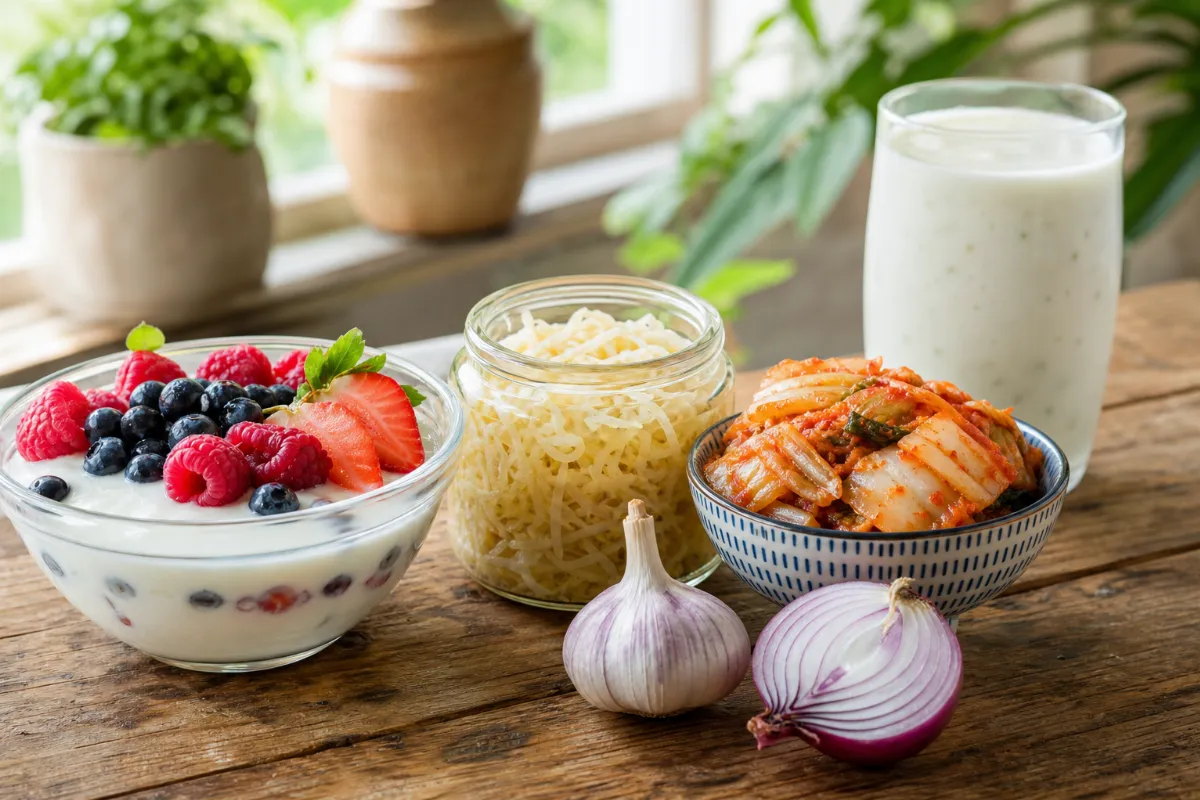
Gut & Digestive Health
Probiotics, Prebiotics and Fermented Foods for Gut Health
This page helps you work out what, if anything, probiotics, prebiotics and fermented foods can do for your gut, so you can make food and supplement choices based on what research actually found. The honest picture is mixed: some foods and some specific products show modest, uncertain benefits, and no single product is proven for everyone.
General information, not medical advice. Last updated October 31, 2026. Written by the AlternativeMed editorial team. Not medically reviewed.
Start here
- Start with food, not a capsule. Build up a varied, plant-rich plate, add fibre slowly, and try a fermented food you enjoy, such as plain yogurt, kefir, sauerkraut or kimchi, if it suits you.
- If you are thinking of a probiotic supplement, name the problem first (for example IBS symptoms, or diarrhoea while on antibiotics). Results belong to a specific strain and a specific condition, so ask a pharmacist or clinician.
- Change one thing at a time for two to four weeks and note how your belly feels. If you have blood in your stool, black stools, weight loss you cannot explain or symptoms that last more than a few weeks, see a doctor instead of trying products.
Be careful with
- Probiotic supplements are not right for everyone. Ask a clinician first if your immune system is weakened, you are seriously ill or have a central line, and never give one to a premature baby at home.
- 'Fermented' does not automatically mean 'probiotic', and one product's result does not carry over to another.
- Prebiotic fibres and some fermented foods can cause gas, bloating and cramps, especially if you add a lot quickly or have IBS.
- Fermented foods can be high in salt and can contain histamine and tyramine, which matters if you take an MAOI antidepressant or react to them.
- Never stop a prescribed medicine, or skip an antibiotic course, in favour of a probiotic.
Get help when
- Blood in the stool, or black, tarry stools.
- Unexplained weight loss, or anaemia found on a blood test.
- Persistent vomiting, severe or constant belly pain, or pain that wakes you at night.
- Trouble swallowing, or food getting stuck.
- Diarrhoea lasting more than two days, six or more loose stools a day, fever, or signs of dehydration, especially in babies, children, pregnant women and older adults.
- Any new bowel change or digestive symptom that lasts more than a few weeks, or any new symptom after the age of 50, or a family history of bowel cancer or inflammatory bowel disease.
- Fever, chills or feeling suddenly very unwell after starting a probiotic, particularly if your immune system is weakened. Get medical care promptly.
About Probiotics, Prebiotics and Fermented Foods for Gut Health
What this goal means
Your large intestine is home to a very large number of bacteria, along with some fungi and viruses. Together they are called the gut microbiome. They help break down carbohydrates that the stomach and small intestine cannot digest, and gas is made along the way.
This goal is about supporting that community with food and, where it makes sense, with carefully chosen products. It uses three words that are often mixed up. Probiotics are live microorganisms that give a health benefit when taken in adequate amounts. Prebiotics are substances that gut microbes use and that give a documented benefit. Fermented foods are foods made through microbial growth, and they may or may not still contain live microbes.
1,2,3,4Common experiences
People usually come to this goal because of bloating, loose or hard stools, irregular bowel habits, gut upsets after antibiotics, or simply because probiotic yogurt drinks and capsules are everywhere and they wonder whether they should be using one. Some also hope to 'rebalance' their gut after an illness or a stressful period.
5What shapes the gut microbiome
Researchers are still learning how food, medicines, illness and stress shape the microbiome. NIDDK notes that eating a variety of healthy foods can improve healthy bacteria in the gut, but that is general advice, not proof that any one food can fix a microbiome. Antibiotics can disturb the gut community, which is the reason probiotics have been tested for preventing antibiotic-linked diarrhoea. Many long-lasting digestive conditions, including IBS, involve how the brain and gut work together, so stress and sleep matter too.
6,7Conditions that can look like a 'microbiome problem'
Bloating, loose stools and cramps have many causes, and a probiotic will not sort out most of them. Irritable bowel syndrome, coeliac disease, lactose intolerance, inflammatory bowel disease, reflux and constipation each have their own page. Doctors diagnose these using your history, an exam and sometimes blood, stool or other tests, not from symptoms alone.
8Realistic expectations
Reviews of probiotic supplements find benefit in some conditions for some strains, usually with low to moderate certainty. The NHS says there is some evidence that probiotics help in certain cases, such as easing some IBS symptoms, but little evidence for many of the claims made, and likely a big difference between the products tested in trials and those sold in shops. For fermented foods, a 2025 review of randomised trials in healthy adults found modest gains in bowel movement frequency, stool consistency and belly symptoms, but the certainty was mostly low.
So the realistic aim is gentle: a diet that feeds a varied gut, perhaps a fermented food you like, and a trial of one product for a defined problem, stopped if it does not help. We found no source showing that routine daily probiotics improve health in healthy people.
9,10,5Who this applies to
Adults with ordinary digestive niggles who are curious about probiotics, prebiotics and fermented foods. Children, pregnant or breastfeeding women, older adults, people on antibiotics, and people with weakened immunity or long-term conditions should ask a clinician or pharmacist before using supplements. Anyone with warning signs should be seen by a doctor first.
9,5Related conditions and symptoms
Irritable bowel syndrome → Inflammatory bowel disease → Celiac disease → Lactose intolerance → Bloating and gas → Constipation → Diarrhea → Heartburn and reflux → Indigestion and nausea →
A manageable starting plan
An educational starting point, not a personal prescription. Adjust it to your own situation and any advice from your clinician.
Your first actions
- Week 1: note your symptoms, what you eat, and any probiotic or fibre products you already take. Change nothing yet.
- Weeks 2 to 3: widen your plant foods one item at a time and add a fermented food you enjoy a few times a week.
- If you want to try a probiotic, pick one product for one named problem, write down its strain names and the date you start.
- Keep fluids up and bowel habits and sleep regular.
Optional additions
- Try plain yogurt with a meal if milk bothers you but you are not allergic.
- Add small amounts of onion or garlic to cooked meals if you tolerate them.
- Ask a dietitian about a structured low-FODMAP trial if bloating or IBS-type symptoms persist.
What to track
- Stool frequency and form (a simple Bristol-style note).
- Bloating, wind, pain, 0 to 10, daily.
- What you ate and any new product.
- Any reaction such as headache, flushing or rash after fermented foods.
When to reassess
Give each change two to four weeks. If a probiotic has not clearly helped within the period you set, stop it rather than switching endlessly. If symptoms are getting worse, last more than a few weeks, or you have any warning sign, see a doctor.
When to seek professional support
- See a doctor for blood in the stool, black stools, unexplained weight loss, anaemia, persistent vomiting, severe or night pain, or trouble swallowing.
- Get medical care promptly for fever, chills or feeling very unwell after starting a probiotic, especially with weakened immunity.
- For diarrhoea lasting more than two days, or any diarrhoea with dehydration in a baby, child, pregnant woman or older adult, contact a clinician.
- Ask a pharmacist about any probiotic if you take regular medicines.
What helps
Ordered by how well the research supports each step. Evidence strength is shown on every card; precautions sit next to the advice.
Start here
Eat a varied, plant-rich diet and add fibre slowly
Low certaintyAddresses: Supports a varied gut community and avoids gas from sudden fibre jumps
Why it may help: NIDDK says eating a variety of healthy foods can improve healthy bacteria in the gut. MedlinePlus advises adding fibre slowly, because increasing it too quickly can lead to gas, bloating and cramps. Neither source claims a particular food repairs the microbiome, so treat this as sensible general advice rather than a proven treatment.
How to apply it: Add one extra plant food at a time, such as a different vegetable, beans, oats or fruit, and give each a week before adding another. Drink enough fluid as fibre goes up.
Who it may suit: Almost everyone, as a starting point.
Precautions: If you have IBS, inflammatory bowel disease, a narrowed bowel or swallowing problems, ask a clinician or dietitian before changing fibre a lot.
6,11Increase Fiber Comfortably → Fiber amounts and side effects →
Try a fermented food you enjoy and tolerate
Low certaintyAddresses: May modestly improve bowel regularity and belly comfort in healthy adults
Why it may help: A 2025 systematic review of 25 studies (19 randomised trials in the pooled analysis, 4,328 people) found more frequent bowel movements and better stool consistency with fermented foods, and the authors also reported benefits for belly symptoms. They rated the certainty of the evidence as highly variable and mostly low. The result is for fermented foods as a group, not for one product.
How to apply it: Pick one food, such as plain yogurt, kefir, sauerkraut or kimchi, and start with small portions a few times a week. Check labels for salt and added sugar.
Who it may suit: Healthy adults who like these foods and have no condition that rules them out.
Precautions: Fermented foods can be salty and can contain histamine and tyramine. They are a concern for people taking an MAOI antidepressant (ask the prescriber), people who flush or get headaches after them, and people with weakened immunity. In pregnancy avoid foods made from raw or unpasteurised milk.
10,3,12,13,14Fermented foods and gut health: what trials found → Histamine, tyramine and fermented foods → Yogurt → Kefir → Sauerkraut → Kimchi →
Name the problem before you buy a probiotic
Not enough evidenceAddresses: Avoids wasting money and tells you whether a trial is worth doing
Why it may help: NCCIH says that for most uses it is still unknown which probiotics help and who benefits most, and the AGA guideline judged each product separately because results varied so much between formulations. A 2023 meta-analysis of IBS trials also found that the effect differs between probiotics. So 'does it help?' only makes sense for a named strain and a named condition. We found no source showing a general benefit from daily probiotics in healthy people.
How to apply it: Write down the one symptom you want to change. Ask a pharmacist or clinician whether any product has been tested for it, and note the strain names on the label.
Who it may suit: Anyone considering a supplement.
Precautions: Ask first if you are pregnant or breastfeeding, have a weakened immune system or serious illness, or are choosing for a child. Do not use a probiotic as a reason to delay seeing a clinician.
5,15,16,9Do probiotics work? An honest overview → Reading supplement labels → Probiotic safety →
Additional options
Use plain yogurt if lactose is the issue
Moderate certaintyAddresses: Helps many people digest and tolerate lactose
Why it may help: A systematic review of 108 studies concluded there is a causal relationship between eating yogurt and lactose digestion and tolerance. Its other findings on health outcomes were mostly associations, and its authors argue that fermented milks should be encouraged, so read that as their view.
How to apply it: If milk upsets you, try a small amount of plain yogurt with a meal and see how you feel.
Who it may suit: People who feel gassy or loose after milk but are not allergic to it.
Precautions: Milk allergy is different from lactose intolerance; yogurt is not safe for a milk allergy. Check labels for added sugar.
17Include prebiotic foods in moderate amounts if you tolerate them
Not enough evidenceAddresses: Feeds helpful microbes; may cause gas in some people
Why it may help: Onions, garlic, shallots, leeks and artichokes are among the vegetables highest in fructans, a fibre type microbes ferment. Trials that raised helpful bifidobacteria mostly used purified inulin or inulin added to snack bars and shots, not whole vegetables, so the benefit of the foods themselves is unproven. Mild gas was common at higher amounts.
How to apply it: Add small amounts to cooked meals and increase slowly. If bloating rises, cut back.
Who it may suit: People without IBS who are comfortable with these foods.
Precautions: Fructans are one group within the low-FODMAP approach. If you have IBS, bloating or wind that gets worse, talk to a dietitian before adding more.
18,19,20,21,22Prebiotic foods: inulin, onions, garlic and more → The low-FODMAP diet → Manage Excess Gas →
Still being studied
Probiotic supplements for IBS symptoms
Mixed findingsAddresses: Possible modest relief of overall symptoms and pain; strain unclear
Why it may help: An NCCIH-summarised 2018 review of 53 studies found possible benefit for overall IBS symptoms and abdominal pain but could not say which strains help, and a 2023 meta-analysis of 52 trials reported benefit overall with variation between probiotics. Guidelines disagree: the AGA recommends probiotics for IBS only in clinical trials, the American College of Gastroenterology suggests against them for overall symptoms, and the British Society of Gastroenterology gives a weak recommendation that they can be tried. A 2026 umbrella review of 27 reviews rated quality low or critically low.
How to apply it: If you and your clinician decide to try one, choose a single product, note its strain names, and judge it over a set period. Stop it if there is no clear benefit.
Who it may suit: Adults with IBS who have been properly assessed.
Precautions: People with a weakened immune system or serious illness need a clinician's approval first. Do not swap a probiotic for prescribed IBS treatment.
5,16,15,23,24,25,26Irritable bowel syndrome → Probiotics for IBS: guidelines and trials →
Probiotics taken during antibiotics, to prevent diarrhoea and C. difficile
Low certaintyAddresses: May lower the chance of antibiotic-linked diarrhoea
Why it may help: A 2025 Cochrane review found C. difficile-associated diarrhoea in 1.6 percent of probiotic groups against 3.2 percent of comparison groups in 38 trials (13,179 people; relative risk 0.50), and antibiotic-associated diarrhoea in 23 percent against 27.4 percent in 40 trials (relative risk 0.67). Both findings were low certainty. The review noted that about 30 percent of studies lacked a registered protocol and that 28 had probiotic-company links. The AGA supports certain specific formulations for preventing C. difficile in people on antibiotics.
How to apply it: Ask the pharmacist or prescriber whether a product makes sense for your situation. Take the antibiotic exactly as prescribed.
Who it may suit: Adults and children being prescribed antibiotics who are not immunocompromised.
Precautions: Never skip or stop an antibiotic. Anyone with a weakened immune system, central line or serious illness must ask their care team first. Seek care promptly for diarrhoea with blood, fever or dehydration.
7,15,5Probiotics for antibiotic-associated diarrhea → Manage Loose Stools & Diarrhea → Diarrhea →
Prebiotic fibres, GOS and synbiotics for IBS
Not enough evidenceAddresses: Unclear; one prebiotic type improved overall symptoms in very few trials
Why it may help: A 2023 meta-analysis concluded that the benefit of prebiotics and synbiotics in IBS remained uncertain because too few trials exist, and a 2024 network meta-analysis found they did not show significant improvement. In a 2026 meta-analysis of 30 fibre trials, beta-galacto-oligosaccharides improved overall symptoms but this rests on two trials.
How to apply it: Discuss with a dietitian rather than self-treating; gas and bloating are common with these products.
Who it may suit: People with IBS working with a clinician.
Precautions: Can worsen gas, bloating and cramps. Avoid starting if you have a bowel obstruction or unexplained bowel changes until a clinician has checked you.
16,27,28Fermented foods for IBS
Mixed findingsAddresses: Possibly some symptom relief, with no clear change in pain or bloating scores
Why it may help: A 2024 meta-analysis of 16 randomised trials in 1,264 people with IBS found more people reporting symptom relief (relative risk 1.22) and a small improvement in global symptom scores, with fermented milk showing a benefit in a subgroup. There was no significant improvement in abdominal pain or bloating scores, and the authors said the conclusion should be interpreted with caution.
How to apply it: If you have IBS, talk to a clinician or dietitian before adding fermented foods; some people find them worse.
Who it may suit: People with IBS, with professional guidance.
Precautions: Fermented foods can contain fermentable carbohydrates, histamine and tyramine, so reactions vary.
29Probiotics for constipation
Low certaintyAddresses: Unclear; some low-certainty support
Why it may help: A 2025 British Dietetic Association guideline made 20 statements on probiotics for chronic constipation, and the guideline rated most statements low or very low certainty. NCCIH summarised an older adult review with some evidence of benefit, especially for Bifidobacterium lactis, while two reviews in children disagreed.
How to apply it: Fibre, fluids and movement come first; see the constipation goals.
Who it may suit: Adults with long-standing mild constipation, after basics are covered.
Precautions: Constipation with blood in the stool, belly pain, weight loss or a sudden change needs a doctor.
30,5Food & nutrition
A varied, plant-rich plate
NIDDK notes that eating a variety of healthy foods can improve healthy bacteria in the gut. It is general guidance, not proof that a particular food fixes the microbiome. The gentle step is to widen what you eat and add fibre gradually.
- Vegetables, fruit, beans and lentils, oats and whole grains, nuts and seeds, in as many different kinds as you can manage.
- Add one new plant food at a time and wait a week before the next.
- Drink enough fluid as fibre goes up.
- Cook or soften vegetables if raw ones bloat you.
Fermented foods
A 2025 review of randomised trials found fermented foods linked to modest improvements in bowel movement frequency, stool consistency and belly symptoms in healthy adults, with mostly low certainty. This applies to the group, not to one product. A 2025 sauerkraut trial in 87 healthy adults found the gut ecosystem was 'rather resilient' to four weeks of daily sauerkraut, and a separate 2026 randomised crossover trial in 87 healthy adults found that fresh and pasteurised sauerkraut were both linked to a small drop in systolic blood pressure, so live bacteria were not essential for that effect.
- Plain yogurt and kefir, if you digest dairy well.
- Sauerkraut and kimchi, mindful of salt.
- Check the label for added sugar and for live cultures, and remember 'live' is not the same as 'probiotic'.
- If you are pregnant, choose pasteurised dairy and avoid foods made from raw milk.
- If you take an MAOI antidepressant, ask your prescriber before eating fermented foods.
Prebiotic foods in moderation
The vegetables highest in fructans in one laboratory survey were garlic, artichoke, shallots, leek bulb and onions. Trials that raised bifidobacteria used purified inulin or inulin added to bars and shots, not these whole foods, so their effect on gut microbes is not proven. A meta-analysis of five inulin trials (252 people) found better stool frequency and consistency but no improvement in pain or bloating.
- Small amounts of onion, garlic or leeks in cooked meals.
- If gas or bloating gets worse, step back and see a dietitian.
When food triggers get in the way
If many of these foods upset you, you may be sensitive to fermentable carbohydrates, lactose or histamine. The American College of Gastroenterology recommends a limited trial of a low-FODMAP diet in IBS, guided by a clinician or dietitian. Avoid long-term restriction on your own.
- Keep a simple food and symptom note for two to four weeks.
- Ask for dietitian-guided testing rather than cutting out whole food groups.
Remedies & supplements
Traditional use, laboratory findings and human trials are kept apart. "Natural" does not mean safe.
Probiotic capsules, powders and drinks
Mixed findingsStudied form and route: Capsules, powders, sachets, drinks (live bacteria or yeast)
Intended outcome: Possible help with some IBS symptoms and with antibiotic-linked diarrhoea; benefit depends on the strain
Human evidence: Human trials are the main evidence. Reviews show possible benefit for IBS and for preventing antibiotic-associated and C. difficile diarrhoea, with low certainty, and guidelines differ on IBS. The AGA found insufficient evidence for Crohn's disease and ulcerative colitis, and recommends against probiotics for acute infectious gastroenteritis in children.
Traditional use: Fermented milks have long been used in many food cultures; that is traditional food use, not evidence for a capsule.
Laboratory findings: Laboratory and mucosal-sampling studies show gut colonisation varies by person and strain. This does not show a symptom benefit.
Limits: Results are strain and condition specific. Product contents may not match labels. Most evidence is low certainty, and some trials have industry links.
Interactions and precautions: Ask first if you are immunocompromised, seriously ill, have a central line, are pregnant or breastfeeding, or are choosing for a child. Never for premature infants at home. No dose is given here.
5,15,16,7,35,9Do probiotics work? → Probiotic safety → Probiotics and medicine interactions →
Prebiotic fibre powders (inulin, FOS, GOS)
Not enough evidenceStudied form and route: Powders, capsules, added to foods
Intended outcome: May raise bifidobacteria and loosen or regularise stools; effect on symptoms is unclear
Human evidence: A meta-analysis of five inulin trials found better stool frequency and consistency but no improvement in pain or bloating, and a systematic review of human inulin studies reported that the most consistent change was more bifidobacteria, with short-chain fatty acids not rising. In IBS, evidence is uncertain, with one prebiotic type (beta-GOS) improving overall symptoms in two trials.
Traditional use: The concentrated powders are modern products. The onions, garlic and other plant foods rich in these fibres have long been eaten as ordinary foods.
Laboratory findings: Fermentation by gut bacteria produces gas and short-chain fatty acids; these are mechanism findings, not proof of benefit.
Limits: A change in stool bacteria is not the same as feeling better. Trials differ in dose and product.
Interactions and precautions: Gas, bloating and cramps are common. Check with a clinician if you have IBS, inflammatory bowel disease, bowel narrowing or unexplained symptoms.
19,34,36,28,20,21Synbiotics (probiotic plus prebiotic together)
Not enough evidenceStudied form and route: Capsules or powders combining both
Intended outcome: Unclear for gut symptoms
Human evidence: A 2023 meta-analysis concluded the efficacy of synbiotics in IBS remains uncertain because too few trials exist, and a 2024 network meta-analysis found prebiotics and synbiotics did not show significant improvement.
Traditional use: No traditional use applies to this modern product type.
Laboratory findings: Laboratory findings are not the basis for the claims here.
Limits: Few trials, mixed products.
Interactions and precautions: The same cautions as probiotics and prebiotics separately.
16,27Kombucha
Not enough evidenceStudied form and route: Fermented sweet tea drink
Intended outcome: No proven gut benefit in people
Human evidence: A systematic review that screened 310 articles found only one study with empirical results in human subjects.
Traditional use: A long-consumed fermented tea in many regions; traditional use is not proof of a health effect.
Laboratory findings: Reviews describe benefits mostly from non-human studies.
Limits: Composition varies widely between bottles.
Interactions and precautions: Fermentation makes alcohol; in the US a kombucha at 0.5 percent alcohol by volume or more is regulated as alcohol. One review lists consumption as contraindicated in infants, pregnant women, young children, and people with kidney failure or HIV, so ask a clinician in those groups.
37,38,39Therapies & care
Persistent, worsening or unexplained digestive symptoms need an assessment before any product is tried. This page does not recommend or dose any medicine, and you should never stop a prescribed medicine without advice from the prescriber.
A check-up for persistent or worrying symptoms
High certaintyProfessional assessment A clinician takes a history, examines you and, when needed, arranges blood, stool or other tests, because symptoms alone cannot say what is wrong. Rectal bleeding, black stools, anaemia and weight loss may point to a problem other than IBS, and an NHS source says bowel cancer symptoms are common to other conditions but should be checked.
Who it may suit: Anyone with a red-flag symptom, or symptoms that last more than a few weeks or keep returning.
Precautions: Bring a list of what you take, including probiotics and supplements.
8,40,41,42,43Dietitian-guided low-FODMAP trial
Moderate certaintyDietary therapy The American College of Gastroenterology recommends a limited trial of a low-FODMAP diet for people with IBS. Fructans in garlic, onion and wheat are one of the FODMAP groups, which is why prebiotic foods can trigger symptoms.
Who it may suit: People with IBS-type symptoms.
Precautions: Should be guided by a clinician or dietitian, not a food list, and not continued indefinitely on your own.
22Gut-directed psychological therapies for IBS
Moderate certaintyPsychological therapy NIDDK says doctors may suggest mental health therapies for IBS, such as cognitive behavioural therapy, gut-directed hypnotherapy or relaxation training. A US guideline suggests gut-directed psychotherapy for overall IBS symptoms. This reflects how closely the gut and brain work together; symptoms are real, not 'in your head'.
Who it may suit: People with IBS whose symptoms flare with stress.
Precautions: Ask your clinician about access and suitability.
44,22Manage Stress-Related Digestive Discomfort → Manage Everyday Stress →
A pharmacist or doctor review before supplements
High certaintyMedicine review Few interactions between probiotics and medicines are well documented, but weakened immunity raises the risk of harm and product quality varies. A pharmacist can check your medicines, conditions and the product label.
Who it may suit: Anyone on regular medicines, on antibiotics, pregnant or breastfeeding, or with a long-term condition.
Precautions: Do not stop or change prescribed medicines because of anything on this page.
5,9What to avoid
Habits, products and claims that can get in the way. Never stop a prescribed medicine without talking to the professional who prescribed it.
Risks that apply to most people
Giving a probiotic to a premature baby at home
Moderate certaintyWhy: The US FDA warned that preterm infants given probiotic products are at risk of invasive, potentially fatal infection from the bacteria or yeast in them. Some hospital teams use specific products under supervision, and that is the baby's neonatal team's decision only.
Who it applies to: Parents and carers of premature babies.
Try instead: Ask the neonatal team. For a healthy older baby, speak to a paediatrician before any probiotic.
35,5Starting a probiotic without asking, if your immune system is weakened or you are seriously ill
Moderate certaintyWhy: NCCIH says the risk of harmful effects is greater in people with severe illnesses or compromised immune systems, and the NHS advises talking to a doctor first if you have an existing health condition or weakened immunity. Rare serious infections have been reported in high-risk patients.
Who it applies to: People on immune-suppressing treatment, with central lines, in intensive care, or with serious chronic illness.
Try instead: Ask your care team. Do not stop any prescribed medicine.
5,9,45Personal triggers to check
Adding lots of fibre, prebiotic supplements or fermented foods all at once
Moderate certaintyWhy: Undigested carbohydrates are broken down by gut bacteria, which makes gas. MedlinePlus advises adding fibre slowly to avoid gas, bloating and cramps, and a trial of inulin-type fructans found digestive symptoms tended to rise mildly with dose.
Who it applies to: Anyone, especially people with sensitive guts.
Try instead: Introduce one new item at a time and go up gradually.
11,20,21,4Fructan-rich foods when you have IBS or a FODMAP-sensitive gut
Moderate certaintyWhy: Fructans, found in garlic, onion, leeks, shallots, artichoke and wheat, are one group of FODMAPs. The American College of Gastroenterology recommends a limited trial of a low-FODMAP diet in IBS, which should be guided by a clinician or dietitian.
Who it applies to: People with IBS or recurrent bloating.
Try instead: Do not self-restrict for long; ask for dietitian-guided testing.
18,22Fermented foods when you take an MAOI antidepressant or react to histamine
Moderate certaintyWhy: The US label for one MAOI lists sauerkraut and yogurt among foods to avoid, and a 2022 prescriber review says tyramine levels vary widely within food categories, so the prescriber or pharmacist decides what applies to you. Histamine intolerance is poorly established and has no validated test.
Who it applies to: People taking MAOIs; people who get flushing, headache or hives after fermented foods.
Try instead: Ask your prescriber or pharmacist. Never change a prescribed medicine yourself.
13,46,12Products that need caution
Assuming any shop probiotic matches the one tested in a trial
Low certaintyWhy: Trials test specific strains. NCCIH says some products have been reported to contain organisms other than those on the label, one laboratory study of products sold in one market found almost none met their label claim, and the NHS says there is likely a huge difference between trial products and what is sold in shops.
Who it applies to: Anyone buying supplements.
Try instead: Choose by strain name and condition, and look for independent testing information.
5,47,9A probiotic label checklist → How supplements are regulated →
Colon cleanses and 'detox' products to reset your gut
Evidence againstWhy: A systematic review found no rigorous controlled trials supporting colonic cleansing for general health, found case reports of adverse effects, and concluded it cannot be recommended.
Who it applies to: Anyone tempted by cleanse products.
Try instead: Focus on food, fibre, fluids and movement, and see a clinician for persistent symptoms.
48Using a home microbiome test to pick supplements or diets
Not enough evidenceWhy: An international expert consensus statement says evidence for the clinical usefulness of microbiome testing is scarce and that direct-to-consumer tests have no proven value in practice.
Who it applies to: People considering mail-order stool tests.
Try instead: Do not base purchases on a test result; ask a clinician if you have symptoms.
49Unsupported claims
'A probiotic a day keeps your gut healthy'
Not enough evidenceWhy: We searched NCCIH, the NHS, the AGA reports and the reviews above for an overall benefit of daily probiotics in healthy people and found none stated. NCCIH says for most uses it is still unknown which probiotics help.
Who it applies to: Marketing aimed at everyone.
Try instead: Treat it as unproven, and judge any product against a specific problem.
5,9'Fermented food equals probiotic'
High certaintyWhy: An expert panel defines a probiotic as live microorganisms with a shown health benefit, and says some fermented foods have no live microbes left when sold. A fermented food should only be called probiotic when the benefit of its live microbes has been shown.
Who it applies to: Shoppers reading food labels.
Try instead: Read labels for live cultures, and treat benefits as food-level, not strain-level.
1,3Fermented foods vs probiotic supplements → Live cultures on labels →
Common mistakes
Using a probiotic as a reason to put off seeing a clinician
High certaintyWhy: NCCIH advises not using probiotics as a reason to postpone seeing a health care provider about any health problem. Persistent symptoms can have causes a supplement will not touch.
Who it applies to: Anyone with symptoms that do not settle.
Try instead: Book the appointment, and mention what you are taking.
5,50Stopping a medicine, or skipping an antibiotic, to take a probiotic
High certaintyWhy: Probiotics were tested alongside antibiotics, not instead of them. Stopping a prescribed medicine on your own can cause harm.
Who it applies to: Anyone on prescribed treatment.
Try instead: Keep taking prescribed medicines and ask the prescriber or pharmacist about any addition.
7,5Fermenting at home without safe methods
Low certaintyWhy: The expert panel that defined fermented foods says that, properly made, they have a long record of safe use, but some carry food-poisoning or biogenic amine concerns. This page gives no home-fermenting methods.
Who it applies to: Home fermenters.
Try instead: Use commercial products or follow tested, reliable guidance.
3,12Evidence & safety
What the research shows
For the gut microbiome, the evidence is encouraging in small pockets and weak almost everywhere else. Probiotic supplements show possible benefit for some IBS symptoms and for preventing antibiotic-linked diarrhoea, but results are strain-specific, certainty is low, and professional guidelines disagree on IBS. Fermented foods as a group show modest gains in bowel regularity in healthy adults, with mostly low-certainty evidence. Prebiotic evidence is uncertain, and yogurt's help with lactose digestion is the best established food finding. We found no source showing a general benefit from daily probiotics in healthy people.
Limits of the evidence
- Reviews usually pool many different products, so 'probiotics' as a group does not tell you about a single product.
- NCCIH's summary of reviews dates from 2014 to 2018 and may be outdated.
- Fermented-food reviews pool different foods and often measure lab markers rather than how people feel.
- Several trials have links to probiotic companies, and about 30 percent of Cochrane-included studies lacked a registered protocol.
- Evidence on prebiotics comes mainly from purified inulin, not whole foods.
- This page was built from health-agency pages and PubMed abstracts, and PubMed records were verified. Full texts of most trials were not reviewed.
Precautions and interactions
- Natural does not always mean safe. Check supplements with a pharmacist or doctor if you take any medicine.
- Immunocompromised, critically ill or central-line patients should not take probiotics without their care team's approval.
- Never give probiotics to premature babies at home.
- Never stop a prescribed medicine, or skip an antibiotic, in favour of a probiotic.
Life-stage considerations
- Pregnancy and breastfeeding: ask a midwife, obstetrician or pharmacist about probiotic supplements. Avoid foods made from raw or unpasteurised milk.
- Babies and children: probiotics for babies and children should be chosen with a paediatrician; diarrhoea can dehydrate them quickly.
- Older adults: more at risk of dehydration with diarrhoea and more likely to take interacting medicines; new bowel changes after 50 deserve a check.
- People with weakened immunity or serious illness: ask the care team first.
Warning signs
- Blood in stool, black or tarry stools, or vomiting blood.
- Unexplained weight loss, anaemia, or a new persistent change in bowel habit.
- Persistent vomiting, severe or night pain, or trouble swallowing.
- Diarrhoea lasting more than two days, with high fever or dehydration.
- Fever, chills or feeling seriously unwell after starting a probiotic.
Claim checks
Probiotics help everyone's gut
Insufficient evidence for healthy people; strain-specific benefit in some conditions
5,9Probiotics treat acute diarrhoea in children
Not recommended by the AGA
15,50Probiotics prevent antibiotic-linked diarrhoea
Possibly, low certainty
7Probiotics are proven for Crohn's disease or ulcerative colitis
Insufficient evidence
15,5Probiotic supplements fix everyday bloating
Proper evidence not found
4,5,15Fermented foods are probiotics
Not automatically
3,1Leaky gut is the hidden cause of many illnesses and supplements can repair it
Insufficient evidence
51Questions people ask
Which probiotic is best for IBS?
Reviews have not been able to say which species, strains or combinations are most likely to help in IBS. Guidelines also disagree about whether to use them at all. Ask your clinician, and do not assume one product equals another.
Should I take a probiotic every day for gut health?
For people without a specific condition, there is no established recommendation. Evidence for benefit depends on the strain and the condition.
Are probiotics safe?
Many people use them without problems, but severe infections have been reported in premature infants, and people with weakened immunity or serious underlying conditions should ask a clinician first.
Is yogurt a probiotic?
Not automatically. Yogurt is a fermented food, and a probiotic is defined as live microorganisms that give a shown health benefit. Plain yogurt can help many people digest lactose, which is a separate benefit.
Do fermented foods help gut health?
A 2025 review of randomised trials in healthy adults found modest improvements in bowel movement frequency, stool consistency and belly symptoms, but certainty was mostly low and it applies to fermented foods as a group.
Do probiotics help after antibiotics?
A 2025 Cochrane review found fewer cases of antibiotic-associated and C. difficile diarrhoea with probiotics, rated low certainty. Ask a pharmacist, and always finish antibiotics as prescribed.
Are prebiotic foods like onion and garlic good for me?
They contain fermentable fibres that gut microbes use, but trials showing benefits mostly used purified inulin. They can cause gas, especially in people with IBS.
Can probiotics help bloating?
We found no proper evidence from NIDDK, NHS, NCCIH or AGA sources that probiotic supplements are proven for everyday bloating.
Should I buy a gut microbiome test?
Experts say evidence for the clinical usefulness of consumer microbiome tests is scarce, so a result should not drive your diet or supplement choices.
Can I take a probiotic if I am pregnant?
Ask your midwife, obstetrician or pharmacist. The sources we read do not give a pregnancy-specific rule, and the NHS advises talking to a doctor first if you have an existing health condition. Avoid raw-milk foods in pregnancy.
When should I see a doctor instead?
For blood in the stool, black stools, weight loss, persistent vomiting, severe or night pain, trouble swallowing, symptoms lasting more than a few weeks, anaemia, or a family history of bowel cancer or IBD.
References
- Hill C et al. Expert consensus document. The ISAPP consensus statement on the scope and appropriate use of the term probiotic. Nat Rev Gastroenterol Hepatol 2014. PMID 24912386. Record verified 2026-10-31. source
- Gibson GR et al. Expert consensus document: The ISAPP consensus statement on the definition and scope of prebiotics. Nat Rev Gastroenterol Hepatol 2017. PMID 28611480. Record verified 2026-10-31. source
- Marco ML et al. The ISAPP consensus statement on fermented foods. Nat Rev Gastroenterol Hepatol 2021. PMID 33398112. Record verified 2026-10-31. source
- NIDDK (NIH). Eating, Diet, & Nutrition for Gas in the Digestive Tract. Read 2026-10-22. source
- National Center for Complementary and Integrative Health (NCCIH, NIH). Probiotics: Usefulness and Safety. Read 2026-10-22; page summarises reviews from 2014 to 2018. source
- NIDDK (NIH). Eating, Diet, & Nutrition for Crohn's Disease. Read 2026-10-22. source
- Esmaeilinezhad Z et al. Probiotics for the prevention of Clostridioides difficile-associated diarrhea in adults and children. Cochrane Database Syst Rev 2025. PMID 40931979. Abstract read 2026-10-31. source
- NIDDK (NIH). Diagnosis of Irritable Bowel Syndrome. Read 2026-10-22. source
- NHS (UK). Probiotics. Page last reviewed 24 November 2022. Read 2026-10-22. source
- Mukherjee A et al. Impact of fermented foods consumption on gastrointestinal wellbeing in healthy adults: a systematic review and meta-analysis. Front Nutr 2025. PMID 41141260. Abstract read 2026-10-31. source
- MedlinePlus (US National Library of Medicine). Dietary Fiber. Read 2026-10-23. source
- Saha Turna N et al. A review of biogenic amines in fermented foods: Occurrence and health effects. Heliyon 2024. PMID 38304783. Record verified 2026-10-31. source
- US National Library of Medicine, DailyMed. Prescribing information for phenelzine sulfate tablets (an MAOI antidepressant), section 'Warning to the Patient'. Read 2026-10-23. source
- Clemson Cooperative Extension. Food Safety for Pregnant Women and Their Babies. Extension fact sheet. Read 2026-10-22. source
- American Gastroenterological Association (via EurekAlert). AGA does not recommend the use of probiotics for most digestive conditions (news release, 9 June 2020). Read 2026-10-22. source
- Zhang WX et al. Efficacy of probiotics, prebiotics and synbiotics in irritable bowel syndrome: a systematic review and meta-analysis. J Med Microbiol 2023. PMID 37772692. Read 2026-10-22. source
- Savaiano DA, Hutkins RW. Yogurt, cultured fermented milk, and health: a systematic review. Nutr Rev 2021. PMID 32447398. Record verified 2026-10-31. source
- Muir JG et al. Fructan and free fructose content of common Australian vegetables and fruit. J Agric Food Chem 2007. PMID 17625872. Read 2026-10-23. source
- Hughes RL et al. The Prebiotic Potential of Inulin-Type Fructans: A Systematic Review. Adv Nutr 2022. PMID 34555168. Record verified 2026-10-31. source
- Bruhwyler J et al. Digestive tolerance of inulin-type fructans: a double-blind, placebo-controlled, cross-over, dose-ranging, randomized study in healthy volunteers. Int J Food Sci Nutr 2009. PMID 18608562. Read 2026-10-23. source
- Mysonhimer AR et al. Gastrointestinal Effects and Tolerance of Nondigestible Carbohydrate Consumption. Adv Nutr 2022. PMID 36041173. Record verified 2026-10-31. source
- Lacy BE et al. ACG Clinical Guideline: Management of Irritable Bowel Syndrome. Am J Gastroenterol 2021. PMID 33315591. Read 2026-10-22. source
- Su GL et al. AGA Clinical Practice Guidelines on the Role of Probiotics in the Management of Gastrointestinal Disorders. Gastroenterology 2020. PMID 32531291. Read 2026-10-22. source
- Preidis GA et al. AGA Technical Review on the Role of Probiotics in the Management of Gastrointestinal Disorders. Gastroenterology 2020. PMID 32531292. Read 2026-10-22. source
- Marlicz W et al. Probiotics in irritable bowel syndrome: is the quest for the right strain over? Rapid review of existing guidelines and recommendations. Prz Gastroenterol 2021. PMID 34976247. Read 2026-10-22. source
- Ballena-Caicedo J et al. Probiotics in Irritable Bowel Syndrome: An Umbrella Review of 27 Systematic Reviews. J Clin Med 2026. PMID 41827145. Read 2026-10-22. source
- Wu Y et al. The Efficacy of Probiotics, Prebiotics, Synbiotics, and Fecal Microbiota Transplantation in Irritable Bowel Syndrome: A Systematic Review and Network Meta-Analysis. Nutrients 2024. PMID 38999862. PubMed record verified 2026-10-31. source
- Staudacher HM et al. Fiber Supplementation in Irritable Bowel Syndrome: A Systematic Review and Meta-Analysis of Randomized Controlled Trials. Gastroenterology 2026. PMID 42600900. Abstract read 2026-10-31. source
- Ding L et al. Efficacy of fermented foods in irritable bowel syndrome: a systematic review and meta-analysis of randomized controlled trials. Front Nutr 2024. PMID 39839290. Abstract read 2026-10-31. source
- Dimidi E et al. British Dietetic Association Guidelines for the Dietary Management of Chronic Constipation in Adults. J Hum Nutr Diet 2025. PMID 41081513. Read 2026-10-22. source
- Schropp N et al. The impact of regular sauerkraut consumption on the human gut microbiota: a crossover intervention trial. Microbiome 2025. PMID 39940045. Record verified 2026-10-31. source
- Schropp N et al. Fermented foods and inflammation: a crossover intervention trial with fresh and pasteurized sauerkraut. Eur J Clin Nutr 2026. PMID 42321414. Record verified 2026-10-31. source
- US Department of Agriculture and US Department of Health and Human Services. Dietary Guidelines for Americans, 2020-2025. Read 2026-10-23. source
- Collado Yurrita L et al. Effectiveness of inulin intake on indicators of chronic constipation; a meta-analysis of controlled randomized clinical trials. Nutr Hosp 2014. PMID 25208775. Record verified 2026-10-31. source
- US Food and Drug Administration. FDA Raises Concerns About Probiotic Products Sold for Use in Hospitalized Preterm Infants. News release, 26 October 2023. Read 2026-10-22. source
- Le Bastard Q et al. The effects of inulin on gut microbial composition: a systematic review of evidence from human studies. Eur J Clin Microbiol Infect Dis 2020. PMID 31707507. Read 2026-10-23. source
- Kapp JM, Sumner W. Kombucha: a systematic review of the empirical evidence of human health benefit. Ann Epidemiol 2019. PMID 30527803. Read 2026-10-23. source
- de Miranda JF et al. Kombucha: A review of substrates, regulations, composition, and biological properties. J Food Sci 2022. PMID 35029317. Read 2026-10-23. source
- Alcohol and Tobacco Tax and Trade Bureau (TTB), US Department of the Treasury. Kombucha. Read 2026-10-23. source
- NHS (UK). Symptoms of bowel cancer. Read 2026-10-22. source
- NIDDK (NIH). Symptoms & Causes of Diarrhea. Read 2026-10-22. source
- NIDDK (NIH). Symptoms & Causes of Constipation. Read 2026-10-22. source
- NHS (UK). Bloating. Read 2026-10-22. source
- NIDDK (NIH). Treatment for Irritable Bowel Syndrome. Read 2026-10-22. source
- Doron S, Snydman DR. Risk and safety of probiotics. Clin Infect Dis 2015. PMID 25922398. Record verified 2026-10-31. source
- Van den Eynde V et al. The Prescriber's Guide to the MAOI Diet: Thinking Through Tyramine Troubles. Psychopharmacol Bull 2022. PMID 35721816. Read 2026-10-23. source
- Aziz G et al. Compositional Quality and Possible Gastrointestinal Performance of Marketed Probiotic Supplements. Probiotics Antimicrob Proteins 2022. PMID 35199309. Laboratory study of products sold in one market; abstract read 2026-10-22. source
- Acosta RD, Cash BD. Clinical effects of colonic cleansing for general health promotion: a systematic review. Am J Gastroenterol 2009. PMID 19724266. Read 2026-10-22. source
- International consensus statement on microbiome testing in clinical practice. Lancet Gastroenterol Hepatol 2025. PMID 39647502. Read 2026-10-22. source
- NIDDK (NIH). Treatment for Diarrhea. Read 2026-10-22. source
- Camilleri M. Leaky gut: mechanisms, measurement and clinical implications in humans. Gut 2019. PMID 31076401. Read 2026-10-22. source
Related on AlternativeMed
Related goals
Reduce Bloating → Manage Excess Gas → Feel More Comfortable After Meals → Improve Bowel Regularity → Ease Occasional Constipation → Manage Loose Stools & Diarrhea → Manage Occasional Heartburn → Manage Nausea & Stomach Discomfort → Understand Your Food Triggers → Increase Fiber Comfortably → Manage Stress-Related Digestive Discomfort →
Ingredients, foods and supplements
Probiotics, prebiotics and fermented foods → Yogurt → Kefir → Sauerkraut → Kimchi → Kombucha → Prebiotic foods → Prebiotic fibers → Psyllium, ginger and peppermint for digestion →
Research, safety and claim-check resources
How digestion and the microbiome work → Digestive symptoms: red flags → Leaky gut, cleanses and gut tests: claims checked → Gut health research and evidence → Probiotic safety → Do probiotics work? An honest overview → Fermented foods vs probiotic supplements → Medication interactions → Reading supplement labels →