Gut & Digestive Health
Ease Occasional Constipation
Hard, infrequent or difficult-to-pass stools happen to most people from time to time, and a few well-studied food and routine changes often ease them within days to a few weeks. This page is about relieving an occasional spell; overall regularity, fiber build-up, bloating and loose stools have their own goal pages.
General information, not medical advice. Last updated October 31, 2026. Written by the AlternativeMed editorial team. Not medically reviewed.
Start here
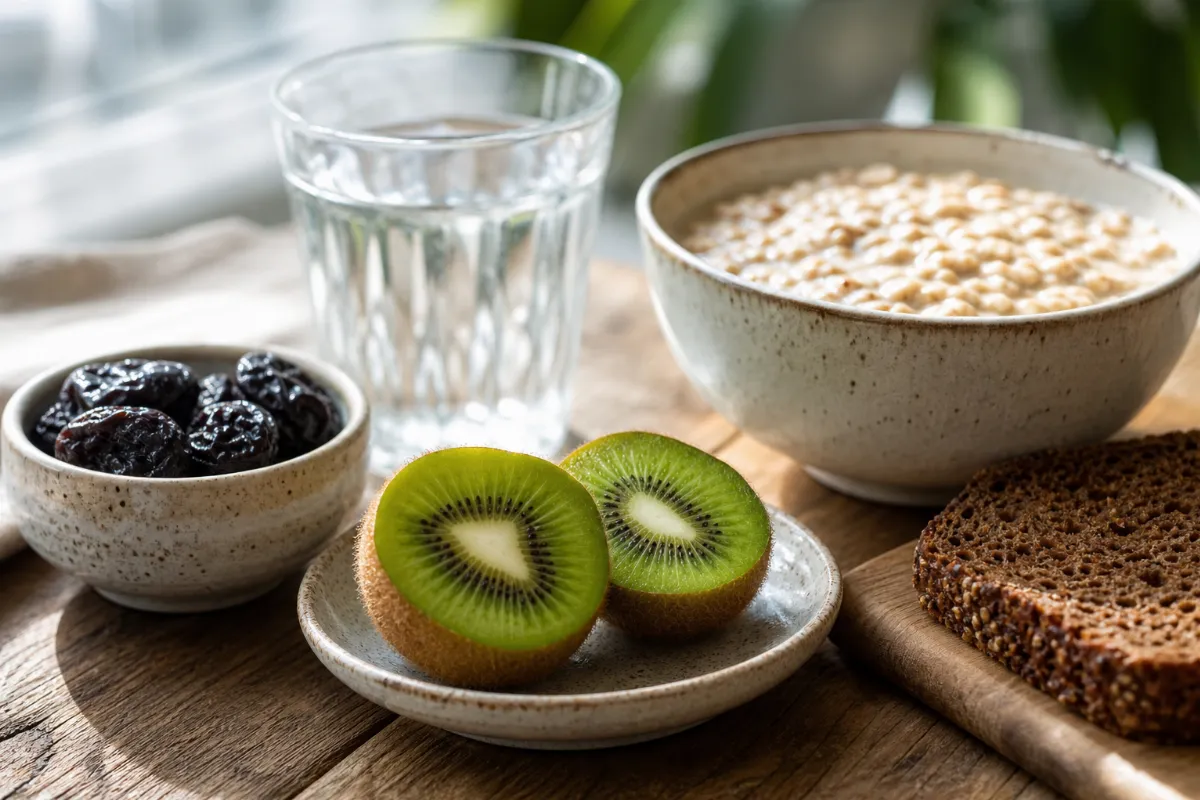
- Add fiber a little at a time from fruit, vegetables, oats, beans and whole grains, and drink fluids through the day. Two green kiwifruits or a small portion of prunes are the best-studied food options.
- Go for a walk most days and use the toilet at a regular time without rushing; do not put off the urge when it comes.
- If it is not improving after a few weeks, or you notice any warning sign listed below, speak to a pharmacist or doctor rather than adding more and more remedies.
Be careful with
- Laxatives are for short-term use. The NHS says most work within about 3 days; using them regularly without advice can make bowels depend on them, so ask a pharmacist which kind suits you.
- Natural does not mean safe: stimulant plant laxatives (such as senna) and magnesium products can cause cramps and diarrhea, and magnesium needs extra care with kidney problems. Check with a pharmacist if you take any medicine.
- Do not stop a prescribed medicine because you think it is causing constipation. Many medicines can do this, so talk to your prescriber.
Get help when
- Blood in the stool or bleeding from the back passage, black stools, unexplained weight loss, or constipation with constant tiredness.
- Constant tummy pain, vomiting, fever, lower back pain, or being unable to pass gas: these need medical attention right away (NIDDK lists them as reasons to see a doctor straight away).
- A sudden change in your usual bowel habit, regular bloating, constipation that keeps coming back, or constipation that is not improving after trying self-care for a few weeks.
- Constipation that began after starting a new medicine such as an opioid painkiller, or watery leaking around hard stool, which can signal a blockage of stool that needs a clinician.
- A family history of bowel cancer or bowel disease, or new bowel changes at age 50 or older: get these checked rather than waiting.
About Ease Occasional Constipation
What this goal means
Constipation means passing stool less often than usual, or finding it hard to do so. The NHS describes it as fewer than 3 poos in a week, or pooing less often than usual, with stools that are large, small, dry, hard or lumpy, straining or pain, and a feeling that the bowel has not fully emptied.
This page is about occasional constipation: a short spell you want to ease and avoid repeating. If it has gone on for months, it is called chronic constipation, which is a condition for a clinician to assess; see the constipation page.
1,2What it can feel like
Common experiences are a heavy or full belly, bloating, stomach ache, feeling sick, hard stools that are painful to pass, and the feeling that you have not finished. Some people also notice their appetite drops. In older people, or people with dementia or a learning disability, constipation can be missed and may show up as confusion or restlessness.
1What can make it more likely
NIDDK lists low fiber intake, low fluid intake or dehydration, low physical activity, ignoring the urge to go, travel, a change in routine or diet, pregnancy and aging. Several medicines and supplements can cause it, including iron supplements, calcium-containing antacids, opioid painkillers, some antidepressants, some blood pressure and water medicines and Parkinson's disease medicines.
2,1Conditions that can be behind it
Constipation that does not settle can be linked to irritable bowel syndrome, celiac disease, an underactive thyroid, diabetes, nerve conditions such as Parkinson's disease, pelvic floor problems, or a blockage in the bowel. That is why persistent or changing symptoms are worth checking rather than guessing. This page does not diagnose any of these.
2Realistic expectations
The NHS says diet and lifestyle changes may show within a few days but can take a few weeks. In a meta-analysis of 16 trials, 66% of people given fiber supplements responded versus 41% on control, so fiber helps many people but not everyone. The effects are measured in a bowel movement or two more per week, not an overnight change.
The goal is easier, softer, more comfortable stools, not a perfect daily clock; bowel habits vary a lot between healthy people.
1,3Who this applies to
Adults who have an occasional spell of hard or infrequent stools. Pregnancy, older age, children and people with bowel disease or on regular medicines have extra considerations: see the life-stage notes on the Evidence & Safety tab. Overall regularity, fiber build-up, bloating and loose stools are covered by their own goal pages.
1Related conditions and symptoms
Constipation: What Helps and When to Get Checked → Irritable Bowel Syndrome (IBS) → Celiac Disease and Gluten-Related Symptoms → Inflammatory Bowel Disease → Bloating and Gas →
A manageable starting plan
An educational starting point, not a personal prescription. Adjust it to your own situation and any advice from your clinician.
Your first actions
- Add one fiber-rich food at each meal for a week or two, such as oatmeal, beans, fruit with skin or whole-grain or rye bread, and keep drinking fluids.
- Eat two green kiwifruits a day or a small handful of prunes for 2 to 4 weeks, if you like them and are not allergic.
- Take a walk most days, at whatever length suits you.
- Sit on the toilet at the same time each day after a meal, with your feet on a low stool, and never ignore the urge.
Optional additions
- Try gentle clockwise belly massage if it feels comfortable.
- Swap white bread for dark rye or add wheat bran or oats if you tolerate gluten.
- If the basics are not enough after a couple of weeks, ask a pharmacist about a short-term laxative or a fiber supplement and how to take it safely with any medicines.
- Consider a probiotic with a named strain for a few weeks if you want to experiment.
What to track
- How often you go each week and what the stools look like (hard, lumpy, soft).
- Straining, pain, bloating or leaking.
- Any new medicine, supplement or travel at the time symptoms began.
- Any warning sign from the list at the top of this page.
When to reassess
Give food and routine changes a few days to a few weeks, as the NHS suggests. If there is no improvement after about 2 to 4 weeks, if it keeps coming back, or if you notice any warning sign, talk to a pharmacist or doctor.
When to seek professional support
- Ask a pharmacist for short-term help and to check your medicines for side effects.
- See a doctor for blood in the stool, weight loss, constant pain, vomiting, fever, sudden bowel changes or constipation that does not settle.
- Ask your doctor whether constipation could be linked to a medicine you take rather than stopping it yourself.
What helps
Ordered by how well the research supports each step. Evidence strength is shown on every card; precautions sit next to the advice.
Start here
Gradually eat more fiber from everyday foods
Moderate certaintyAddresses: Softer, bulkier stools and more frequent bowel movements
Why it may help: NIDDK advises adding fiber a little at a time from whole grains, beans and lentils, fruit, vegetables and nuts; adults need about 22 to 34 grams a day depending on age and sex. In a meta-analysis of 16 trials (1,251 people with chronic constipation), fiber supplements raised the response rate (RR 1.48) and stool frequency, mainly with higher doses over 4 or more weeks. Those were supplements, not whole foods.
How to apply it: Add one fiber-rich food at a time over a week or two, for example oatmeal at breakfast, a piece of fruit with skin, or beans in a soup. Drink fluids alongside. Gas and bloating are common while you build up.
Who it may suit: Most adults whose diet is low in fiber.
Precautions: Adding fiber too fast can cause gas, bloating and cramps, and in that meta-analysis flatulence was more common with fiber. If you have a bowel narrowing or blockage, or a bowel disease, ask your clinician first.
4,3,1Two green kiwifruits a day
Moderate certaintyAddresses: More complete bowel movements and better tummy comfort
Why it may help: In an international crossover trial of 184 people (healthy, functional constipation and constipation-predominant IBS), two green kiwifruits a day for 4 weeks raised complete spontaneous bowel movements by about 1.5 per week in people with constipation, and improved gut comfort scores. A US trial of 75 adults found kiwifruit, prunes and psyllium all raised weekly bowel movements, with kiwifruit having the fewest side effects and the best bloating results.
How to apply it: Eat two ripe green kiwifruits daily for a few weeks and see how your bowels respond. Keep the daily amount if it works.
Who it may suit: Adults who like kiwifruit and are not allergic.
Precautions: Avoid if you are allergic to kiwifruit; people with latex or related fruit allergies can react. Trials were mostly of people with ongoing constipation and some were funded by industry.
5,6,7Prunes (dried plums)
Moderate certaintyAddresses: More frequent and softer stools
Why it may help: In a crossover trial of 40 constipated adults, about 100 g of prunes a day for 3 weeks gave more complete spontaneous bowel movements and softer stools than psyllium. A systematic review of four trials concluded prunes appear promising but need more rigorous research. The 2021 US trial found prunes improved stool consistency and straining.
How to apply it: Start with a small portion of prunes a day and build toward more only if needed and tolerated; the trials used about 100 g a day, but start smaller if you are not used to them. Prune juice is also traditional; the evidence reviewed here was for the whole fruit.
Who it may suit: Adults with mild to moderate constipation who enjoy prunes.
Precautions: Prunes can cause gas and loose stools if you eat a lot at once. They are high in natural sugars and sorbitol, which can upset some people with IBS. The trials were small and short.
8,9,6Fluids through the day
Low certaintyAddresses: Helps fiber work and reduces hard, dry stools
Why it may help: NIDDK says to drink enough water and other liquids so fiber can work well, and the NHS advises plenty of fluids and avoiding alcohol. The right amount depends on your size, health, activity and climate. The evidence that simply drinking more water treats constipation in people who are already well hydrated is limited.
How to apply it: Keep a glass of water with meals and between them, and have clear soups or herbal teas if you like. Pale yellow urine is a rough sign you are drinking enough.
Who it may suit: Anyone who drinks little, travels, exercises or is in hot weather.
Precautions: If you have kidney, heart or liver disease or are told to limit fluids, follow your clinician's advice instead.
4,1,7Daily movement such as walking
Low certaintyAddresses: May help the bowel move things along
Why it may help: The NHS suggests a daily walk or run. A meta-analysis of 9 randomized trials (680 people) found exercise, mostly aerobic activity such as walking or qigong, improved constipation symptoms (RR 1.97), but with a high risk of bias and very different results between studies.
How to apply it: Aim for a daily walk of whatever length you can manage. A short walk after meals fits into a routine.
Who it may suit: Most adults, especially those who sit for long periods.
Precautions: Build up gradually if you are not active, and ask a clinician first if you have heart disease, recent surgery or other health limits.
1,10A regular toilet routine and a relaxed position
Not enough evidenceAddresses: Makes emptying easier and avoids straining
Why it may help: The NHS advises going to the toilet at a regular time and place, allowing enough time, not delaying when you feel the urge, and resting your feet on a low stool so your knees are above your hips. NIDDK lists ignoring the urge as a cause of constipation. We did not find a trial in the sources read for the footstool, so this is health-agency advice rather than proven treatment.
How to apply it: Sit on the toilet for a few unhurried minutes after a meal or when the urge comes, with feet on a low stool, and do not strain hard or hold your breath.
Who it may suit: Anyone with hard stools or incomplete-emptying feelings.
Precautions: Straining hard can aggravate hemorrhoids. If you feel you cannot empty at all, or you strain a lot every day, see a clinician.
1,2Additional options
Rye bread and oat or bran foods
Low certaintyAddresses: Slightly more frequent bowel movements
Why it may help: In a review of foods, drinks and diets for chronic constipation, rye bread gave about 0.4 more bowel movements per week than white bread in two small trials. The NHS also suggests wheat bran, oats or linseed as fiber sources.
How to apply it: Swap white bread for dark rye, or add oatmeal or a spoonful of wheat bran to meals, building up slowly.
Who it may suit: Adults without celiac disease or wheat or gluten problems.
Precautions: Wheat bran and rye contain gluten and fructans, which can cause gas in some people with IBS or celiac disease.
7,1Mineral-rich water
Low certaintyAddresses: A better chance of responding to treatment
Why it may help: In the foods and drinks meta-analysis, high-mineral (magnesium and sulfate-rich) water gave a higher response than low-mineral water (RR 1.47, 539 people from 4 trials).
How to apply it: Only if such water is available and you like it. Check the label for the mineral content.
Who it may suit: Adults who want to try a drink-based option.
Precautions: High-magnesium water behaves like a mild osmotic laxative and may cause loose stools; ask a clinician if you have kidney disease or are on a low-sodium plan.
7Sorbitol-containing fruits
Not enough evidenceAddresses: Can soften stool
Why it may help: The NHS names apples, apricots, grapes, raisins, raspberries and strawberries as fruits that contain sorbitol and can help. This is advice from a health agency, not a trial result.
How to apply it: Add one or two servings of these fruits a day, keeping the skin on where you can.
Who it may suit: Adults with mild constipation.
Precautions: Sorbitol can cause gas, bloating and diarrhea, especially in people with IBS or fructose problems.
1Gentle abdominal massage
Low certaintyAddresses: May increase bowel movements
Why it may help: A 2025 meta-analysis of 23 studies (1,431 adults) found abdominal massage raised weekly bowel movements by about 1.6 and shortened gut transit time, though results varied a lot and it did not reduce laxative use. Many included studies were of low quality.
How to apply it: Lying on your back, make slow clockwise circles with the flat of your hand around the belly button with light pressure; the studies used varied techniques, so keep it gentle and comfortable.
Who it may suit: Adults who like a hands-on, non-medicine option.
Precautions: Do not massage if you have severe belly pain, a hernia, recent abdominal surgery, a known bowel obstruction, or are pregnant, unless a clinician approves.
11Still being studied
Probiotics
Low certaintyAddresses: Possibly more frequent stools with certain strains
Why it may help: A meta-analysis of 30 trials found probiotics increased stool frequency and improved symptom scores, with Bifidobacterium lactis showing a significant effect but mixtures, Bacillus coagulans IS2 and Lactobacillus casei Shirota not. Probiotics did not clearly change stool consistency, and synbiotics showed no benefit. The authors called this cautious optimism, not firm proof.
How to apply it: If you try one, choose a product that names the strain and keep to the label for a few weeks, then stop if there is no change.
Who it may suit: Adults who want to experiment after the basics.
Precautions: Avoid or ask a clinician first if you are severely ill, have a weakened immune system, a central line or a very recent surgery. Gas is common at first.
12Prebiotic fibers such as inulin and fructo-oligosaccharides
Not enough evidenceAddresses: Unclear
Why it may help: A US systematic review of over-the-counter products rated the evidence for inulin, polydextrose and fructo-oligosaccharides as insufficient for chronic constipation.
How to apply it: Better to get fiber from varied whole foods; supplements of these fibers are not shown to be better.
Who it may suit: No one in particular.
Precautions: They ferment in the colon and commonly cause gas and bloating.
13Food & nutrition
Fiber and fluids first
NIDDK says adults need about 22 to 34 grams of fiber a day depending on age and sex, to be built up gradually with enough fluids. Good sources are whole grains (oatmeal, whole wheat bread, bran cereal), legumes (lentils, beans, chickpeas), fruit (berries, apples with skin, oranges, pears), vegetables (carrots, broccoli, peas, greens) and nuts.
The NHS also suggests wheat bran, oats or linseed, and fruits that contain sorbitol. Treat these as sensible habits; the strongest trial evidence is for specific foods below.
4,1Foods with the best trial evidence
A 2024 review of 23 studies found kiwifruit (7 studies), high-mineral water (4), prunes (2) and rye bread (2) had the most data. Fruits as a group gave slightly more bowel movements than psyllium, and kiwifruit in particular. A 2025 British Dietetic Association guideline built on this review and wrote recommendations on kiwifruit, prunes, rye bread and high-mineral water, noting that most of the evidence is low or very low certainty.
Everyday habit counts more than any single food. These foods work best alongside fluids, movement and a regular routine.
Green kiwifruit
Moderate certaintyAddresses: More bowel movements and better comfort
Why it may help: Two a day for 4 weeks raised complete spontaneous bowel movements by about 1.5 per week in constipated adults in one trial.
How to apply it: Two ripe fruits daily, at any time of day.
Who it may suit: Adults without kiwifruit or latex allergy.
Precautions: Allergy; may loosen stools in some.
5,6Prunes
Moderate certaintyAddresses: More frequent, softer stools
Why it may help: Prunes did better than psyllium for stool frequency and consistency in a small crossover trial of 40 adults.
How to apply it: A small portion daily, building up as tolerated.
Who it may suit: Mild to moderate constipation.
Precautions: Can cause gas and loose stools in larger amounts; high in sorbitol.
8,9Rye bread
Low certaintyAddresses: Slightly more frequent bowel movements
Why it may help: About 0.4 more bowel movements a week than white bread in two small trials.
How to apply it: Use dark whole-grain rye bread in place of white bread.
Who it may suit: Adults who tolerate gluten.
Precautions: Contains gluten; can cause gas in sensitive people.
7Mango, figs and other fruit
Very low certaintyAddresses: Possibly softer stool
Why it may help: Mango and fig each appeared in one small trial in the foods review; evidence is thin. A US systematic review also named mango and ficus (fig) among fruit-based options with moderate support.
How to apply it: Eat as part of a varied diet.
Who it may suit: Anyone who likes them.
Precautions: Fig and mango can cause loose stools or allergy in some people.
7,13Foods that may make it worse
NIDDK names low-fiber foods such as chips, fast food, prepared frozen meals, snack foods and processed foods. They are not forbidden, but a diet made mostly of them is a common reason for hard stools. If you suspect a food intolerance as the cause of your gut symptoms, see the food-triggers goal.
4Remedies & supplements
Traditional use, laboratory findings and human trials are kept apart. "Natural" does not mean safe.
Psyllium husk
Moderate certaintyStudied form and route: Bulk-forming fiber supplement taken with a full glass of water
Intended outcome: Softer, bulkier stools and more bowel movements
Human evidence: In the meta-analysis of fiber supplements, psyllium and pectin had significant effects on response and stool frequency, mostly at higher doses over 4 or more weeks. A US review rated psyllium moderate evidence (grade B). It was similar to kiwifruit and prunes in a US trial, with more side effects.
Traditional use: Seed husks have long been used in many traditions as a gentle bulking agent.
Limits: Needs several days to work. Flatulence and bloating were more common with fiber.
Interactions and precautions: Always take with plenty of fluid, as swallowing it dry can cause choking or blockage. Do not use if you have trouble swallowing or a bowel narrowing. It can slow absorption of some medicines, so ask a pharmacist how to space it; follow the product label.
3,13,6Magnesium oxide (osmotic laxative)
Moderate certaintyStudied form and route: Oral magnesium salt, used short term
Intended outcome: Softer stools and more bowel movements
Human evidence: In a 28-day randomized trial of 90 adults with chronic constipation, 68.3% improved on magnesium oxide versus 11.7% on placebo, with no severe side effects. A US review graded magnesium salts moderate evidence, and a 2025 dietetic guideline wrote statements on it.
Traditional use: Magnesium-containing mineral salts and waters have long been used as laxatives.
Limits: The trial was small, in people with long-standing constipation, and short; it does not show long-term safety.
Interactions and precautions: Can cause diarrhea and cramps. Magnesium builds up in people with kidney disease, so check with a pharmacist or doctor first; also check if you take other medicines, and avoid regular use in pregnancy or breastfeeding or for children unless advised. Magnesium for relaxation or sleep is a different topic.
15,13,14Senna
High certaintyStudied form and route: Plant-based stimulant laxative, short term
Intended outcome: Triggers bowel movements within hours to a day
Human evidence: In the same 28-day randomized trial, 69.2% improved with senna versus 11.7% with placebo. A US review gave senna a grade A recommendation as a first-line laxative.
Traditional use: Senna leaves and pods have a long history as a laxative in many herbal traditions.
Limits: Meant for short-term use; the trial lasted 28 days. This page does not give a dose; follow the product label and pharmacist advice.
Interactions and precautions: Can cause cramps and diarrhea, and low potassium or dependence with long, heavy use. Avoid in suspected obstruction, severe belly pain or unexplained bowel changes; ask a clinician first in pregnancy, breastfeeding, for children and with heart, kidney or potassium-lowering medicines.
15,13,1Probiotics
Low certaintyStudied form and route: Capsules, powders or fermented foods
Intended outcome: Possibly slightly more bowel movements
Human evidence: A meta-analysis of 30 trials found probiotics increased stool frequency, with Bifidobacterium lactis showing a significant effect; mixtures were not clearly helpful and stool consistency did not change significantly.
Traditional use: Fermented foods have been eaten for digestion for centuries.
Limits: Effects depend on the strain; the authors called their conclusion cautious optimism.
Interactions and precautions: Ask a clinician first if you are severely ill, have a weakened immune system or a central line. Can cause gas.
12Flaxseed (linseed)
Not enough evidenceStudied form and route: Whole or ground seeds with fluids
Intended outcome: Possibly softer stools
Human evidence: The NHS lists linseed as a fiber source to try. We did not review a trial for flaxseed alone in this research round, so we cannot rate benefit beyond general fiber advice.
Traditional use: Traditionally used as a gentle bulking and soothing food in many cuisines.
Limits: Not tested in the trials summarised here.
Interactions and precautions: Take with plenty of fluid. Ask a pharmacist if you take medicines, as fiber may affect absorption.
1Aloe latex and cascara sagrada
Not enough evidenceStudied form and route: Plant stimulant laxatives, often in 'cleanse' products
Intended outcome: Strong laxative action
Human evidence: We did not review human trials for these in this round, so we cannot rate benefit.
Traditional use: Both have a long traditional use as laxatives.
Limits: Not assessed in the sources read.
Interactions and precautions: They act as stimulant laxatives and can cause cramps and diarrhea. Ask a pharmacist before use, and avoid in pregnancy and breastfeeding and without advice if you take medicines. Aloe gel for skin is a different product.
13Therapies & care
A pharmacist can recommend a suitable short-term laxative, and a doctor can look for causes such as medicines, thyroid or bowel conditions when constipation persists or has warning signs. Persistent cases may be treated with stronger prescribed options or, for pelvic floor problems, physical therapy. This page does not recommend specific medicines or doses, and you should not stop a prescribed medicine on your own.
Pharmacist advice on a short-term laxative
High certaintyPrimary care The NHS says that if lifestyle changes do not help, speak to a pharmacist, who can recommend a suitable laxative; most work within about 3 days and should be used for a short time. A US systematic review found good evidence for polyethylene glycol and senna as first-line laxatives.
Who it may suit: Adults whose constipation has not eased with self-care.
Precautions: Tell the pharmacist about pregnancy, kidney disease and your medicines. See a doctor instead if you have any warning sign.
1,13Doctor's assessment
High certaintyMedical care A doctor can check for medicine-related causes, other conditions and warning signs, and can treat faecal impaction (hard stool stuck in the rectum) with stronger laxatives, suppositories or mini enemas, or manual removal by a professional.
Who it may suit: Anyone with warning signs, constipation lasting more than a few weeks or returning often.
Precautions: Do not try to remove impacted stool yourself.
1,2Abdominal massage
Low certaintySelf-care or therapist-guided A 2025 meta-analysis of 23 studies (1,431 adults) found more weekly bowel movements and shorter transit time, but high variability and no reduction in laxative use.
Who it may suit: Adults wanting a hands-on option.
Precautions: Avoid with severe pain, hernia, recent abdominal surgery, suspected obstruction or in pregnancy unless a clinician agrees.
11Exercise and walking programs
Low certaintyLifestyle A meta-analysis of 9 trials found exercise improved symptoms but with high risk of bias.
Who it may suit: Most adults, within their limits.
Precautions: Build up gradually.
10,1What to avoid
Habits, products and claims that can get in the way. Never stop a prescribed medicine without talking to the professional who prescribed it.
Risks that apply to most people
Ignoring or delaying the urge to go
Low certaintyWhy: NIDDK lists ignoring the urge to have a bowel movement among the causes of constipation, and the NHS advises not delaying.
Who it applies to: Busy people, travellers and anyone uncomfortable using shared toilets.
Try instead: Go when you feel the need, and set aside unhurried time at a regular point of the day.
2,1A sudden jump in fiber without enough fluid
Moderate certaintyWhy: NIDDK advises adding fiber gradually. Too much too quickly can cause gas, bloating and cramps and, without fluids, can make stools feel harder. Flatulence was higher with fiber supplements in the meta-analysis.
Who it applies to: Anyone starting bran, psyllium or a high-fiber diet at once.
Try instead: Increase over a week or two and keep fluids up.
4,3Alcohol
Low certaintyWhy: The NHS advises avoiding alcohol when constipated; it dehydrates.
Who it applies to: Regular and heavy drinkers.
Try instead: Choose water, herbal tea or soups.
1Long periods of sitting with little movement
Low certaintyWhy: NIDDK lists low physical activity as a contributor, and a meta-analysis suggested exercise may help symptoms.
Who it applies to: Desk workers, people recovering from illness or with limited mobility.
Try instead: Break up sitting with short walks, within your limits.
2,10Personal triggers to check
Low-fiber, highly processed foods as the main diet
Low certaintyWhy: NIDDK says low-fiber foods such as chips, fast food, prepared frozen meals, snack foods and processed foods may make constipation worse.
Who it applies to: People whose meals rarely include fruit, vegetables, beans or whole grains.
Try instead: Keep treats, but add a fiber-rich food to most meals.
4Medicines and supplements that can bind or slow the bowel
Moderate certaintyWhy: NIDDK lists iron supplements, calcium- or aluminum-containing antacids, opioid pain medicines, anticholinergics, some antidepressants, diuretics, calcium channel blockers and Parkinson's disease medicines.
Who it applies to: Anyone who started or changed a medicine around when constipation began.
Try instead: Do not stop it on your own. Tell your prescriber or pharmacist, who may have options such as timing, a different form or a short-term plan.
2,1Travel and changes in routine
Low certaintyWhy: NIDDK lists travel and changes in routine or diet as triggers.
Who it applies to: Holidays, shift changes, new jobs.
Try instead: Pack fiber-rich snacks, keep drinking water, and keep a regular time for the toilet where you can.
2Products that need caution
Regular use of stimulant or other laxatives without advice
Moderate certaintyWhy: The NHS says most laxatives work within about 3 days and should only be used for a short time, and to speak to a pharmacist first. Senna and magnesium oxide were effective over 28 days in one trial, but it is not evidence for open-ended use, and side effects such as cramps and diarrhea were common in laxative studies.
Who it applies to: Anyone who finds themselves reaching for a laxative every week.
Try instead: Use food and routine first, ask a pharmacist for a short-term choice, and see a doctor if you need it often.
1,15,13Detox teas, cleanses and colon flushes
Evidence againstWhy: Many contain stimulant plant laxatives and can cause cramps, dehydration and dependence; they are not a way to treat constipation. Our claim check explains these products.
Who it applies to: People searching for a quick reset.
Try instead: Use the steps on this page and ask a pharmacist if you need a laxative.
1,13Trying to remove hard stool yourself
Moderate certaintyWhy: The NHS advises against attempting to remove impacted stool yourself; a healthcare professional should treat it.
Who it applies to: Anyone with hard stool stuck in the rectum or watery leaking around it.
Try instead: Contact your doctor or pharmacist.
1Unsupported claims
"Cleanse your colon" or "flush out toxins" claims
Evidence againstWhy: No source we read shows that cleanses are needed for healthy bowels or that they treat constipation more safely than diet and routine.
Who it applies to: Marketing for teas, powders and kits.
Try instead: Stick to fiber, fluids, movement and routine, and ask a pharmacist about proven options.
13,1"You must go every day"
Moderate certaintyWhy: The NHS describes constipation as fewer than 3 poos in a week or less often than is usual for you, not as missing a day.
Who it applies to: Anyone worried about their own pattern.
Try instead: Judge by comfort and your own normal, not a fixed number.
1Common mistakes
Assuming a lasting change is just constipation
High certaintyWhy: NIDDK and the NHS list blood in the stool, unexplained weight loss, constant pain, vomiting and sudden bowel changes as reasons to see a doctor.
Who it applies to: Anyone with warning signs or symptoms lasting beyond a few weeks.
Try instead: Get it checked rather than self-treating for months.
1,2Stacking several remedies at once
Not enough evidenceWhy: Adding fiber, magnesium, senna, probiotics and teas together makes it hard to tell what works and can cause diarrhea, cramps and interactions.
Who it applies to: People who feel desperate for relief.
Try instead: Change one thing at a time and give it a fair trial of one to two weeks.
13Evidence & safety
What the research shows
Agencies agree that more fiber (built up slowly), fluids, regular movement and a good toilet routine are the first steps. Trial evidence is strongest for fiber supplements such as psyllium, for kiwifruit and prunes among foods, and for senna and magnesium oxide for short-term laxative use. Probiotics help some people depending on the strain. Overall certainty for foods and drinks is low to moderate, because trials are small and short.
Limits of the evidence
- Most trials were in adults with chronic constipation, not occasional constipation, so benefits may not carry over exactly.
- Food trials were small, short and sometimes industry-funded; kiwifruit was not blinded.
- Results of the exercise and massage reviews varied widely and had a high risk of bias.
- Senna and magnesium oxide were studied for 28 days; long-term safety was not tested.
- The reviews did not test whether fluids alone help people who are already hydrated.
Precautions and interactions
- Check supplements, laxatives and herbs with a pharmacist if you take any medicine, especially for the heart, kidneys or thyroid.
- Do not use laxatives regularly without advice.
- Magnesium needs care with kidney disease.
- Never stop a prescribed medicine because you think it causes constipation without speaking to your prescriber.
Life-stage considerations
- Pregnancy and breastfeeding: constipation is common. The NHS says fiber, fluids and exercise are safe to try in pregnancy. A Cochrane review found only limited, low-quality evidence on treatments (comparing stimulant and bulk-forming laxatives and fiber), so ask a midwife, doctor or pharmacist before any laxative, herb or magnesium product.
- Children: constipation in children has separate care and different doses; see a doctor or pharmacist rather than using adult remedies.
- Older adults: constipation is more common over 65 and may show up as confusion; medicines are a frequent cause, and fluids and dehydration matter. Ask a clinician before laxatives or magnesium.
- People with bowel disease, kidney disease, heart disease, a swallowing problem or a past bowel obstruction should get advice before fiber supplements or laxatives.
Warning signs
- Blood in the stool, black stools, or rectal bleeding.
- Unexplained weight loss or constant tiredness with constipation.
- Constant abdominal pain, vomiting, fever, lower back pain or being unable to pass gas.
- A sudden, lasting change in bowel habit, or symptoms continuing beyond a few weeks.
- A family history of colon or rectal cancer, or new bowel changes at 50 or older.
- Watery leaking around hard stool, which may mean impacted stool.
Claim checks
Kiwifruit relieves constipation.
Supported by moderate-quality trials in adults with constipation; not a cure and not tested in everyone.
5,6,7Prunes work better than fiber supplements.
Possibly in mild to moderate constipation, but based on small trials; one found prunes better, another found them similar.
8,9,6,7Drinking lots of water cures constipation.
Not proven. Fluids help fiber work and are advised, but we did not find strong trial evidence that extra water alone treats constipation.
1,4,7Natural laxatives such as senna are safer than other laxatives.
Misleading. Senna works and was well tolerated in a short trial, but stimulant laxatives are for short-term use and can cause cramps and diarrhea.
15,1,13Colon cleanses and detox teas are needed to clear the bowel.
Not supported. We found no evidence in the sources read that cleanses treat constipation safely.
1,13Constipation in pregnancy needs strong treatment.
Start with fiber, fluids and exercise, which the NHS calls safe to try; evidence for medicines in pregnancy is limited.
1,16Questions people ask
How many days without a bowel movement is too long?
The NHS describes constipation as fewer than 3 poos in a week or going less often than usual, but there is no single magic number. Contact a doctor if you also have blood in the stool, constant pain, vomiting, fever or cannot pass gas, or if it is not improving after a few weeks.
What is the fastest natural way to ease constipation?
No natural option works instantly. The NHS says changes may help within a few days but can take a few weeks. Fiber from varied foods, fluids, a daily walk and a regular toilet time are the usual starting points; two kiwifruits a day or prunes are the best-studied foods.
How much fiber do I need?
NIDDK says adults need about 22 to 34 grams a day, depending on age and sex. Build up gradually and drink enough fluids to avoid gas and bloating.
Do kiwifruit and prunes really work?
In trials of adults with constipation, both increased weekly bowel movements and softened stools. The trials were small and short, so they are promising rather than certain.
Is psyllium safe to take every day?
Psyllium is a studied bulk fiber, but it must be taken with plenty of fluid and may affect when you should take other medicines. Follow the label and ask a pharmacist, especially if you have swallowing problems or bowel disease.
Can I take magnesium for constipation?
Magnesium oxide helped in a 28-day trial, but magnesium can cause diarrhea and builds up in kidney disease. Ask a pharmacist or doctor first and use it for short periods.
How long can I use laxatives?
The NHS says laxatives should be used for a short time and most work within about 3 days. If you need one often, see a doctor to find the cause.
Is a footstool for the toilet useful?
The NHS suggests resting your feet on a low stool so your knees are above your hips. We did not find trial evidence in our sources, but it is a low-risk habit to try.
Could my medicine be causing constipation?
Possibly. NIDDK lists iron, certain antacids, opioid painkillers, some antidepressants, diuretics, calcium channel blockers and Parkinson's disease medicines. Do not stop them yourself; speak to your prescriber or pharmacist.
Is constipation in pregnancy different?
It is common. The NHS says fiber, fluids and exercise are safe to try in pregnancy. Check with a midwife, doctor or pharmacist before using laxatives, herbs or magnesium.
When is constipation a sign of something serious?
Blood in the stool, black stools, unexplained weight loss, constant tummy pain, vomiting, fever, being unable to pass gas, or a sudden change in your usual habit need prompt medical attention.
What is the difference between this and improving regularity?
This page is about easing a spell of constipation. Improve Bowel Regularity is about long-term routine and habits that keep things moving.
References
- NHS. Constipation. Read 2026-10-31. source
- NIDDK. Symptoms and Causes of Constipation. Read 2026-10-31. source
- van der Schoot A et al. The effect of fiber supplementation on chronic constipation in adults: an updated systematic review and meta-analysis of randomized controlled trials. Am J Clin Nutr. 2022. PMID 35816465. source
- NIDDK. Eating, Diet, and Nutrition for Constipation. Read 2026-10-31. source
- Gearry R et al. Consumption of 2 green kiwifruits daily improves constipation and abdominal comfort: results of an international multicenter randomized controlled trial. Am J Gastroenterol. 2023. PMID 36537785. source
- Chey SW et al. Exploratory comparative effectiveness trial of green kiwifruit, psyllium, or prunes in US patients with chronic constipation. Am J Gastroenterol. 2021. PMID 34074830. source
- van der Schoot A et al. Systematic review and meta-analysis: foods, drinks and diets and their effect on chronic constipation in adults. Aliment Pharmacol Ther. 2024. PMID 37905980. source
- Attaluri A et al. Randomised clinical trial: dried plums (prunes) vs. psyllium for constipation. Aliment Pharmacol Ther. 2011. PMID 21323688. source
- Lever E et al. Systematic review: the effect of prunes on gastrointestinal function. Aliment Pharmacol Ther. 2014. PMID 25109788. source
- Gao R et al. Exercise therapy in patients with constipation: a systematic review and meta-analysis of randomized controlled trials. Scand J Gastroenterol. 2019. PMID 30843436. source
- Huang SY et al. Effectiveness of abdominal massage on chronic constipation in adults: a systematic review and meta-analysis. Int J Nurs Stud. 2025. PMID 39531948. source
- van der Schoot A et al. Probiotics and synbiotics in chronic constipation in adults: a systematic review and meta-analysis of randomized controlled trials. Clin Nutr. 2022. PMID 36372047. source
- Rao SSC et al. Efficacy and safety of over-the-counter therapies for chronic constipation: an updated systematic review. Am J Gastroenterol. 2021. PMID 33767108. source
- Dimidi E et al. British Dietetic Association guidelines for the dietary management of chronic constipation in adults. J Hum Nutr Diet. 2025. PMID 41081513. source
- Morishita D et al. Senna versus magnesium oxide for the treatment of chronic constipation: a randomized, placebo-controlled trial. Am J Gastroenterol. 2021. PMID 32969946. source
- Rungsiprakarn P et al. Interventions for treating constipation in pregnancy. Cochrane Database Syst Rev. 2015. PMID 26342714. source
Related on AlternativeMed
Related goals
Improve Bowel Regularity → Increase Fiber Comfortably → Reduce Bloating → Manage Loose Stools & Diarrhea → Feel More Comfortable After Meals → Support a Healthy Gut Microbiome → Manage Stress-Related Digestive Discomfort → Stay Hydrated for Daily Wellbeing →
Ingredients, foods and supplements
Kiwifruit → Prunes → Figs → Mango → Psyllium → Flaxseed → Senna → Magnesium →
Research, safety and claim-check resources
Psyllium, Ginger and Peppermint for Digestion → Digestive Symptoms: Red Flags and When to Get Help → Gut and Digestive Health Research and Evidence → Leaky Gut, Cleanses and Gut Tests: Claim Check → Weight and Metabolism Safety (laxative misuse) →