Fruits · Fruit
Figs
Ficus carica · also called Fig, common fig, higo (Spanish)
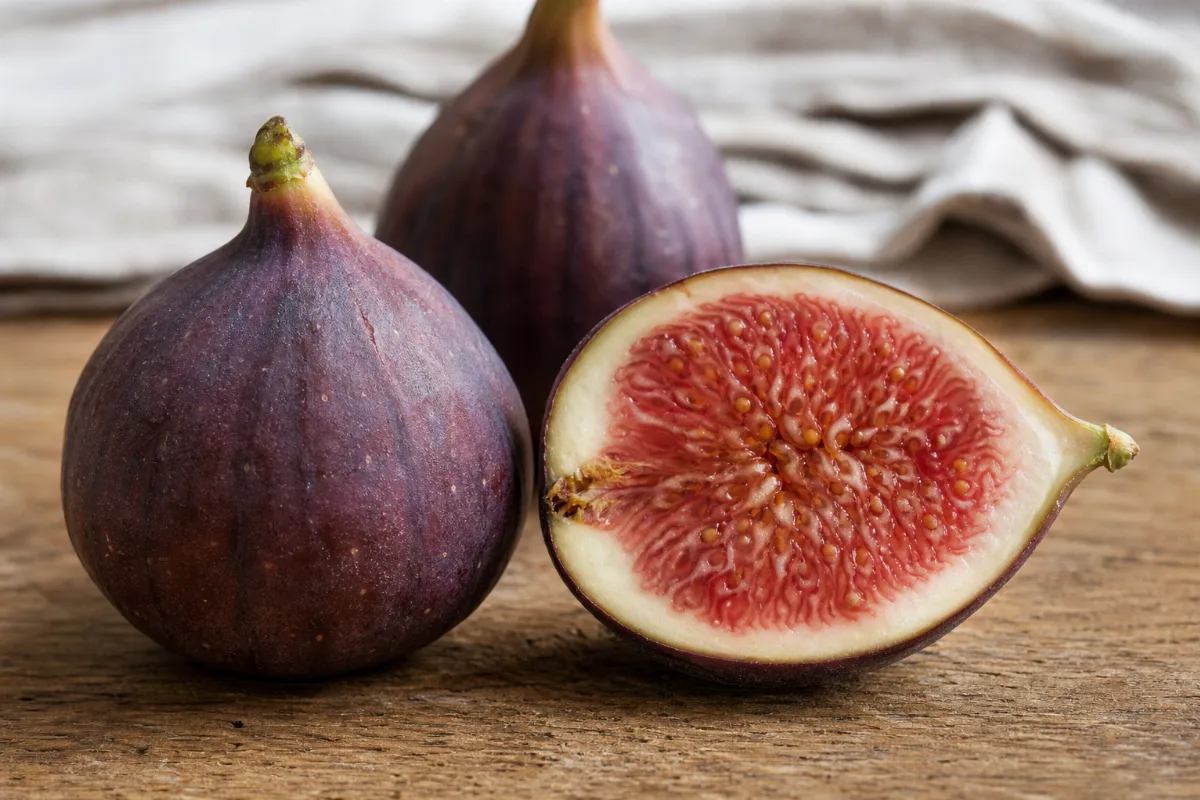
The fig is the soft, seedy fruit of a tree in the mulberry family, eaten fresh or dried. A large raw fig has about 47 calories and 1.9 g of fibre, and dried figs are far more concentrated. Small trials of fig paste and fig syrup found easier bowel movements in constipation, but those are not plain figs. The main cautions are fig allergy, sap that can burn skin in the sun, potassium for people with kidney disease, and mould toxins in some dried figs.
General information, not medical advice. Last substantive update · Not medically reviewed. A named clinician has not signed off on this page. How this page is made
About Figs
The fig is a sweet, fibre-containing fruit. Trials show small signs of easier bowel movements with fig paste and syrup, but plain figs have not been tested, so it is best seen as a food, not a remedy.
What it is
The fig (Ficus carica) is the fruit of a tree in the mulberry family. It is eaten fresh or dried, and also made into paste and syrup.
One large raw fig (64 g) has about 47 calories, 1.9 g of fibre, 10.4 g of natural sugars and 148 mg of potassium (USDA). Dried figs are far more concentrated: 100 g has about 249 calories, 9.8 g of fibre, 47.9 g of sugars and 680 mg of potassium, and one dried fig (8.4 g) has about 21 calories.
What the research shows
The best human data are on constipation. A fig paste trial and a fig syrup trial, both with placebo, found easier bowel movements. These were paste and syrup, not whole figs, and in a pooled analysis kiwifruit did better than fig paste.
A trial of mixed dried fruit including figs found no improvement in blood fats and slightly higher fasting glucose. One-off studies on period pain, mineral intake, eczema and after-meal sugar used different products and are small.
Claims about cancer and diabetes come mostly from cells, mice and leaf or twig extracts, and do not show a benefit from eating figs.
Fresh and dried figs versus paste, syrup, extracts and leaves
Most trials used fig paste, syrup, a fruit extract or leaf tea. Results from one form do not carry over to another.
Drying concentrates sugar, fibre and minerals, so dried figs pack more of each into a small portion. In a lab comparison, sun-drying raised phenolic content and minerals, while vitamin C and flavonoids fell. Leaf tea and extracts are different products and are not assessed here.
At a glance
Traditional uses history, not proof
- Eaten fresh or dried, and made into paste and syrup
- Long part of Mediterranean and Middle Eastern diets, and seen as a symbol of longevity, according to a 2019 review
Studied for research
- Constipation, in trials of fig paste and fig syrup, low certainty
- Irritable bowel syndrome with constipation, very low certainty
- Blood fats and sugar with mixed dried fruit including figs, low certainty (no benefit found)
- Mineral intake from dried figs, low certainty
- Period pain, very low certainty
- After-meal blood sugar (fruit extract, leaf tea), very low certainty
Main compounds
- Dietary fibre (about 1.9 g in a large raw fig)
- Polyphenols, mostly in the skin
- Potassium and small amounts of other minerals
- Ficin, an enzyme linked to fig allergy
- Furanocoumarins, mainly in leaves and twigs
Common forms
- Fresh figs (the form the main nutrition figures describe)
- Dried figs (more concentrated sugar, fibre and potassium)
- Fig paste and fig syrup (used in constipation trials)
- Fig leaf tea and fig extracts (not the fruit)
Research links: Fig-walnut syrup for constipation in pregnancy, randomised trial (Nutrition & Metabolism, 2025) · Fig paste for functional constipation, randomised trial (Asia Pacific J Clin Nutr, 2016) · Fruit and functional constipation, meta-analysis (Frontiers in Nutrition, 2022) · Fig allergy and the weeping fig (Clinical & Experimental Allergy, 2003) · USDA FoodData Central: raw figs · Research Library · Genes & Biomarkers Library
What it is and its history
- Accepted scientific name
- Ficus carica
- Naming authority
- L. (GBIF accepted, usageKey 5361909)
- Common names
- Fig (English); Common fig (English); Higo (Spanish)
- Family or group
- Moraceae (mulberry family), which also includes mulberry and the weeping fig houseplant (Ficus benjamina).
- Classification
- Plantae > Tracheophyta > Magnoliopsida > Rosales > Moraceae > Ficus > Ficus carica
- Native range
- Not verified from a source read.
- Habitat
- Not verified.
- What it looks like
- Roots: Not verified.; Stems: Not verified.; Leaves: Not verified.; Flowers: Not verified.; Fruit: A soft, seedy fruit eaten fresh or dried (existing site summary; not re-sourced). The tree, leaves and fruit skin carry a milky sap (case report, p37581161).
- Cultivation
- Not verified from a source read. Fig varieties differ in weight, sugar and fibre (Moroccan study).
- Harvest and processing
- Eaten fresh, or sun-dried; also made into paste or syrup (trials). A 2025 Moroccan study compared fresh and sun-dried figs.
- Look-alikes and adulterants
- Name: Weeping fig (Ficus benjamina); Note: A houseplant in the same genus. Its airborne allergens were linked to fig allergy in a 2003 study. It is not a food.
- Sustainability and conservation
- Not assessed.
Photographs
Traditional use and history history, not clinical proof
| Tradition or era | Documented use | Source |
|---|---|---|
| Mediterranean and Middle Eastern diet | A 2019 review says figs have been part of the diet in the Middle East and Mediterranean since ancient years and are seen as a symbol of longevity. | p30884655 |
Traditional use shows how it was used. It does not show that it works or is safe today.
What is inside, and how it may work
What it contains and how those compounds act in cells and animals. Laboratory and animal mechanisms are not proven effects in people.
Main compounds
| Compound | Family | Where it is concentrated | Activity studied | Level of evidence |
|---|---|---|---|---|
| Dietary fibre | carbohydrate | Flesh and skin 2.9 g per 100 g raw; 9.8 g per 100 g dried (USDA) | Provides fibre in the diet. Not tested here as a treatment. 29 30 | Composition data |
| Phenolic acids and flavonoids (polyphenols) | plant compounds | Skin more than pulp; dark figs more than light Varies by variety, ripeness and drying (laboratory studies) | Lab measures of antioxidant capacity; no human health outcome shown for these compounds in figs. 4 21 | Laboratory |
| Furanocoumarins | plant compounds | Leaves and twigs (major constituents); fruit level not stated in the abstract | Photo-sensitising compounds linked in the case reports to skin burns from sap and sunlight. 15 17 | Laboratory plus case reports |
| Ficin | cysteine protease (enzyme) | Fruit and latex (per a case report) | Called the major fig allergen in a case report; possible cross-reaction with a dust mite protein (Der p 1). 22 | Case report |
| Abscisic acid | plant hormone | Fruit (used to standardise a fruit extract) | Suggested to affect glucose handling through the receptor LANCL2 in mammals; tested only as part of an extract. 5 | Small human trial of an extract |
Mechanisms, receptors and pathways
| Target or pathway | Gene or receptor | What was found | Level |
|---|---|---|---|
| Fibre and bowel movement | A 2021 review says the fruit components behind faster gut transit (fibre, sorbitol, polyphenols) are not established. 14 | Review of lab, animal and human studies | |
| Antioxidant and anti-inflammatory activity of extracts | In mouse immune cells, leaf and twig extracts were stronger than fruit extract. 15 | Cell study | |
| Sugar handling by abscisic acid | LANCL2 receptor | The 2019 trial paper proposes this route for a fruit extract; not shown in people. 5 | Hypothesis |
Absorption, metabolism and elimination
- Absorption
- Not researched.
- Distribution
- Not found.
- Metabolism
- Not found.
- Elimination
- Not found.
- Bioavailability
- Not established.
Isolated compounds versus whole extracts
The constipation trials used fig paste or fig syrup, the sugar trial used a fruit extract, and the skin and diabetes studies used leaves. None of these is a fresh or dried fig. Drying concentrates sugar, fibre and minerals in the fruit. Results from one form do not carry over to another.
Nutritional composition
Per 100 g of raw figs (USDA FoodData Central, SR Legacy): 74 kcal, 79.1 g water, 0.75 g protein, 0.3 g fat, 19.2 g carbohydrate of which 16.3 g are sugars, and 2.9 g fibre. One large raw fig (64 g) gives about 47 kcal, 1.9 g fibre and 10.4 g sugars, with 148 mg potassium and 22 mg calcium. Per 100 g of dried figs: 249 kcal, 30.0 g water, 63.9 g carbohydrate of which 47.9 g are sugars, 9.8 g fibre, 680 mg potassium and 162 mg calcium. One dried fig (8.4 g) gives about 21 kcal, 0.8 g fibre and 4.0 g sugars. Drying concentrates sugar, fibre and minerals. Per-portion figures are calculated from the per-100 g values and vary with variety, ripeness and storage.
3 low certainty4 very low certainty2 not enough evidence
What was looked at
The 9 benefits and uses checked for Figs, each with how strong the evidence is. Tap one to open it.
- Constipation (fig paste and fig syrup trials)Low certainty
- Irritable bowel syndrome with constipation (IBS-C)Very low certainty
- Blood fats, blood sugar and weight (mixed dried fruit including figs)Low certainty
- Period pain and stress (dried figs)Very low certainty
- Mineral intake and blood mineral levels (dried figs)Low certainty
- After-meal blood sugar (fig fruit extract, fig leaf tea)Very low certainty
- Mild eczema (fig leaf tea)Very low certainty
- Gallstones (vinegar-soaked figs)Not enough evidence
- Cancer, blood sugar and antioxidant claims (lab and animal work)Not enough evidence
Lab markers tracked in the studies
Colon transit timeNumber of bowel movementsStool form (Bristol scale)Constipation-related quality of lifeFasting blood glucoseLDL cholesterolBlood sugar after a glucose drink or mealBlood mineral levelsEczema severity (EASI score)Menstrual pain severity and duration
What is Figs good for?
The main studied uses and how strong the human evidence is for each. Most results come from small trials of fig paste, syrup, extracts or leaf tea, not plain figs, so they are not proof that eating figs prevents or treats a condition.
Benefits, one by one
Each card is a research question, not a promise. Tap a goal to filter. Open a card to see the studies, doses and limits.
Constipation (fig paste and fig syrup trials)
Low certaintyIn two placebo-controlled trials, fig paste and fig syrup were linked with easier bowel movements in people with constipation. The products were paste and syrup, not whole fresh figs, and the trials were small. Another analysis found kiwifruit did better than fig paste.
3 studiesFig paste (Korean trial) and fig syrup with or without walnut (Irania…
Studies, doses and limits
What the trials found
An 8-week double-blind trial of fig paste in 80 adults with functional constipation (2016), a 2-week double-blind trial of fig syrup or fig-walnut syrup in 90 pregnant women (2025), and a 2022 meta-analysis of fruit trials that included fig paste as a comparator.
Results
Fig paste was linked with a shorter colon transit time and better stool type and abdominal discomfort than placebo. In pregnant women both syrups gave more bowel movements and better quality of life than placebo. Kiwifruit beat fig paste on stool form in three high-quality studies.
Effect sizes as reported
Quality of life vs placebo in pregnancy: fig syrup -5.8 (95% CI -3.1 to -8.6); fig-walnut syrup -3.4 (-0.7 to -6.1). Kiwifruit vs fig paste, Bristol scale: +0.39 (0.11 to 0.66). Transit-time and bowel-movement numbers are not in the abstracts.
Why this rating
Two small placebo-controlled trials, short, with products that are not ordinary fresh figs. Numbers were not in the abstracts, and the pregnancy trial's registration date was not checked.
Form and dose studied
Fig paste (Korean trial) and fig syrup with or without walnut (Iranian trial). Neither is a plain fresh or dried fig.
Who was studied
Adults with functional constipation; pregnant women with functional constipation.
Limits
Paste and syrup results do not carry over to fresh or dried figs. No head-to-head trial of dried figs for constipation is in the abstracts read.
Why researchers looked
Figs are eaten in many places as a gentle aid to regularity, and they contain fibre.
Traditional use
Figs have long been eaten for regularity in Mediterranean and Middle Eastern food traditions. This is custom, not evidence.
Proposed mechanism Preliminary mechanism
Fibre, plant sugars such as sorbitol and plant compounds are suggested routes. A 2021 review says it is not known which part of a fruit does the work.
A proposed mechanism does not show that the effect happens in people.
No serious problems were reported in the abstracts; the paste trial found blood tests and clinical findings in the normal range.
Irritable bowel syndrome with constipation (IBS-C)
Very low certaintyIn a four-month trial of 150 people with IBS-C, eating fig was linked with less bloating and pain episodes, more bowel movements and less hard stool than the control group. People knew what they ate, and the form of fig is not given in the abstract.
1 studiesFig (form not stated in the abstract).
Studies, doses and limits
What the trials found
A 2019 single-blind randomised trial of flixweed and fig in 150 people with IBS-C, over four months.
Results
Fig and flixweed, compared with the control group, were linked with fewer episodes of pain and bloating, more bowel movements, less hard stool and better quality of life. Abdominal pain severity and C-reactive protein did not change significantly.
Effect sizes as reported
Significant improvements vs control; no numbers in the abstract.
Why this rating
Single-blind with a non-matched control group, one trial, form and amount of fig not stated in the abstract, and no numbers given.
Form and dose studied
Fig (form not stated in the abstract).
Who was studied
Adults with IBS-C.
Limits
One trial only. Self-treating long-lasting bowel changes without a doctor can miss other causes.
Why researchers looked
Constipation-type IBS is hard to treat, and figs are a popular home remedy.
Traditional use
Figs are a traditional remedy for sluggish bowels. This is custom, not evidence.
Proposed mechanism Preliminary mechanism
Not studied in this trial.
A proposed mechanism does not show that the effect happens in people.
None reported in the abstract.
Blood fats, blood sugar and weight (mixed dried fruit including figs)
Low certaintyIn a four-week trial of 55 adults at higher heart risk, a large daily portion of mixed dried fruit (plums, figs, dates and raisins) did not improve blood fats or blood pressure compared with a matched snack. Fasting glucose was slightly higher, and LDL cholesterol rose a little from the start.
1 studiesMixed dried plums, figs, dates and raisins (a large daily portion).
Studies, doses and limits
What the trials found
A 2020 randomised crossover trial of mixed dried fruit versus an energy-matched snack for four weeks.
Results
Blood fat levels did not differ between conditions. LDL cholesterol was 0.10 mmol/L higher than at baseline. Fasting glucose was 0.08 mmol/L higher than with the snack. Insulin, C-reactive protein, blood pressure, vascular stiffness and weight did not differ.
Effect sizes as reported
Fasting glucose vs control +0.08 mmol/L (95% CI 0.005 to 0.16); LDL vs baseline +0.10 mmol/L (0.01 to 0.20).
Why this rating
One crossover trial of 55 people, short, and the product was a mix of four fruits so figs alone are not isolated.
Form and dose studied
Mixed dried plums, figs, dates and raisins (a large daily portion).
Who was studied
Adults with extra weight and at least one more heart-disease risk factor.
Limits
Not a trial of figs alone. A very large portion without diet guidance.
Why researchers looked
Dried fruit is concentrated in sugar but also in fibre and plant compounds, so researchers tested its effect on heart-risk markers.
Proposed mechanism Preliminary mechanism
Not studied here.
A proposed mechanism does not show that the effect happens in people.
No safety problems were reported in the abstract.
Period pain and stress (dried figs)
Very low certaintyIn one study of 99 midwifery students, those eating dried figs during their periods reported less pain, shorter pain and less stress than those given a placebo or cinnamon. It is one small, hard-to-blind study with a published erratum.
1 studiesDried figs eaten during periods.
Studies, doses and limits
What the trials found
A 2020 randomised placebo-controlled study (placebo, cinnamon, dried fig groups) over three menstrual cycles.
Results
The dried-fig group had lower pain severity and duration, less menstrual distress and less perceived stress, and a higher quality of life score, than the other groups.
Effect sizes as reported
Significant differences vs placebo; no numbers in the abstract.
Why this rating
One small study in students from one school, no numbers in the abstract, impossible to hide figs from the eater, and a 2021 erratum exists that was not read.
Form and dose studied
Dried figs eaten during periods.
Who was studied
Young women with painful periods.
Limits
Single study; the erratum could change details.
Why researchers looked
Figs are eaten in some traditions for women's health, and this was tested in one trial.
Proposed mechanism Preliminary mechanism
Not studied.
A proposed mechanism does not show that the effect happens in people.
None reported in the abstract.
Mineral intake and blood mineral levels (dried figs)
Low certaintyWhen 88 adults added dried figs to their usual diet for five weeks, diet records showed more calcium and potassium. Blood levels of minerals barely changed. The figs also pushed out some other foods and drinks.
1 studiesDried figs added to the usual diet.
Studies, doses and limits
What the trials found
A 2015 randomised crossover trial of dried California Mission figs added to the usual diet for five weeks.
Results
Higher calcium and potassium intake from the diet records in the fig period; blood mineral levels nearly the same as on the usual diet. Figs displaced about 4% of desserts, 5% of vegetables, 10% of dairy, 23% of grains and 168% of other drinks.
Effect sizes as reported
Intake higher (P<0.05); blood minerals not significantly changed.
Why this rating
One crossover trial of a large daily amount of dried figs.
Form and dose studied
Dried figs added to the usual diet.
Who was studied
Adults, average age about 56.
Limits
Food-replacement figures are rough estimates from 24-hour recalls.
Why researchers looked
Figs are a source of several minerals, so a trial checked whether eating them changes mineral status.
Proposed mechanism Preliminary mechanism
Not applicable.
A proposed mechanism does not show that the effect happens in people.
Potassium intake rises with dried figs; see the safety notes for kidney disease.
After-meal blood sugar (fig fruit extract, fig leaf tea)
Very low certaintyTwo small studies tested fig products on blood sugar after a meal. A fig fruit extract lowered the sugar response to a glucose drink in 10 healthy adults, and fig leaf tea lowered after-breakfast sugar in 10 people with type 1 diabetes. Neither tested fresh or dried figs, and the fruit-extract study was paid for by its maker.
2 studiesStandardised fig fruit extract; fig leaf decoction.
Studies, doses and limits
What the trials found
A 2019 randomised crossover trial of fig fruit extract (10 healthy adults, industry-linked) and a 1998 randomised crossover trial of fig leaf tea in 10 adults with type 1 diabetes.
Results
The two higher extract doses cut the blood sugar response to a glucose drink by about a quarter; the leaf tea gave lower after-breakfast glucose and a 12% lower average insulin dose than a comparison tea.
Effect sizes as reported
Fruit extract: glycaemic index about -25% and -24% (P<=0.002). Leaf tea: post-meal glucose 156.6 vs 293.7 mg/dL (P<0.001).
Why this rating
Ten people in each, short, an extract and a leaf tea rather than the fruit, and the fruit-extract study has industry authors.
Form and dose studied
Standardised fig fruit extract; fig leaf decoction.
Who was studied
Healthy adults; adults with type 1 diabetes.
Limits
Not fresh or dried figs. Do not change diabetes medicine because of this.
Why researchers looked
Fig leaves are used in some traditions for diabetes, and fruit extracts contain abscisic acid, which animal work suggests affects sugar handling.
Traditional use
Fig leaf tea has been used in folk medicine for diabetes. This is custom, not evidence.
Proposed mechanism Preliminary mechanism
Abscisic acid is suggested to act on a receptor called LANCL2 in mammals, per the 2019 paper. Not shown in people.
A proposed mechanism does not show that the effect happens in people.
Two dropouts for intolerance in the leaf tea study; the extract trial reported none in the abstract.
Mild eczema (fig leaf tea)
Very low certaintyIn one small preliminary trial, adults with mild atopic dermatitis who drank fig leaf tea had a lower eczema score than those on a placebo tea. The leaf tea is not the fruit, and the effect faded after stopping.
1 studiesFig leaf tea.
Studies, doses and limits
What the trials found
A 2022 double-blind, placebo-controlled preliminary trial of fig leaf tea.
Results
The EASI eczema score was significantly lower than with placebo, and the effect weakened 4 weeks after stopping. No health-hazard changes were reported.
Effect sizes as reported
Significant EASI difference vs placebo; no numbers in the abstract.
Why this rating
Small preliminary trial, leaf not fruit, number of participants and results not in the abstract.
Form and dose studied
Fig leaf tea.
Who was studied
Adults with mild atopic dermatitis.
Limits
Leaves contain furanocoumarins, which can make skin sensitive to sun (see safety).
Why researchers looked
Cell and animal work suggested fig leaf tea calmed allergy signals, so a first human trial was done.
Proposed mechanism Preliminary mechanism
The authors link it to lab findings on allergy signalling in cells and animals. Not shown in people.
A proposed mechanism does not show that the effect happens in people.
No safety problems found by the authors.
Gallstones (vinegar-soaked figs)
Not enough evidenceOne small single-blind trial from Pakistan compared vinegar-soaked figs with a gallstone medicine in 50 adults and reported stones getting smaller. This is a single unusual result, and gallstones need a doctor, not a food.
1 studiesFig soaked in vinegar.
Studies, doses and limits
What the trials found
A 2024 single-blind randomised trial against ursodiol in 50 adults with ultrasound-confirmed gallstones.
Results
Stones shrank from 15.5 to 7.3 mm with vinegar-soaked figs and from 16.1 to 10.8 mm with the medicine, according to the authors.
Effect sizes as reported
Mean stone size 15.5 to 7.3 mm (fig) vs 16.1 to 10.8 mm (medicine).
Why this rating
One small trial, no placebo, single-blind, a special preparation, and a large result needing independent repeat.
Form and dose studied
Fig soaked in vinegar.
Who was studied
Adults with gallstones.
Limits
Gallstones can cause serious complications. Do not treat them with food instead of medical care.
Why researchers looked
A traditional preparation was tested against a standard medicine.
Traditional use
Vinegar-soaked fig is a traditional preparation in some regions. This is custom, not evidence.
Proposed mechanism Preliminary mechanism
Not studied.
A proposed mechanism does not show that the effect happens in people.
Gallstone pain that is severe or comes with fever or yellow skin needs urgent care.
Cancer, blood sugar and antioxidant claims (lab and animal work)
Not enough evidenceMany headlines about figs and cancer or diabetes rest on cell studies and animal studies of fig leaves, fruit or extracts. A 2022 review gathered 27 studies and itself calls for well-designed clinical trials. None of this shows an effect from eating figs.
3 studiesLeaf, twig and fruit extracts in labs and animals.
Studies, doses and limits
What the trials found
A 2022 systematic review of 27 studies on cancer, a 2026 mouse study of fig leaf extract for diabetes, and a 2026 cell study comparing fruit, leaf and twig extracts.
Results
The mouse study found lower blood glucose with leaf extract but no lasting HbA1c fall. The cell study found leaf and twig extracts stronger than fruit extract. The cancer review describes no human outcomes in its abstract.
Why this rating
Lab, cell and animal work, mostly on leaves and twigs rather than the fruit.
Form and dose studied
Leaf, twig and fruit extracts in labs and animals.
Who was studied
Mice and cells.
Limits
Not evidence about eating figs.
Why researchers looked
Figs and fig leaves contain polyphenols and other compounds that show activity in test tubes and animals.
Traditional use
Fig and fig leaf are used in many folk traditions. This is custom, not evidence.
Proposed mechanism Animal research
Cell and animal studies of polyphenols and leaf compounds; not shown in people.
A proposed mechanism does not show that the effect happens in people.
None applicable.
Connections to the rest of health
How Figs connects to the rest of our health knowledge graph. Every link says what kind of connection it is. A safety link (for example to the liver) is a warning, not a benefit. A study that merely mentions a topic never creates a benefit link.
Explore every connection: goals, body systems, organs, symptoms, genes
A. Wellness goals
| Connected to | Kind of connection | Evidence status | Context | Studies |
|---|---|---|---|---|
| Digestive Support | Potential benefit | Low certainty | Constipation (fig paste and fig syrup trials): In two placebo-controlled trials, fig paste and fig syrup were linked with easier bowel movements in people with constipation. The products were paste and syrup, not whole fresh figs, and the trials were small. Another analysis found kiwifruit did better than fig paste. Irritable bowel syndrome with constipation (IBS-C): In a four-month trial of 150 people with IBS-C, eating fig was linked with less bloating and pain episodes, more bowel movements and less hard stool than the control group. People knew what they ate, and the form of fig is not given in the abstract. | 6 23 13 18 |
| Gut Health | Potential benefit | Low certainty | Constipation (fig paste and fig syrup trials): In two placebo-controlled trials, fig paste and fig syrup were linked with easier bowel movements in people with constipation. The products were paste and syrup, not whole fresh figs, and the trials were small. Another analysis found kiwifruit did better than fig paste. Irritable bowel syndrome with constipation (IBS-C): In a four-month trial of 150 people with IBS-C, eating fig was linked with less bloating and pain episodes, more bowel movements and less hard stool than the control group. People knew what they ate, and the form of fig is not given in the abstract. | 6 23 13 18 |
| Cholesterol Balance | Low certainty | Blood fats, blood sugar and weight (mixed dried fruit including figs): In a four-week trial of 55 adults at higher heart risk, a large daily portion of mixed dried fruit (plums, figs, dates and raisins) did not improve blood fats or blood pressure compared with a matched snack. Fasting glucose was slightly higher, and LDL cholesterol rose a little from the start. | 20 | |
| Blood Sugar Balance | Low certainty | Blood fats, blood sugar and weight (mixed dried fruit including figs): In a four-week trial of 55 adults at higher heart risk, a large daily portion of mixed dried fruit (plums, figs, dates and raisins) did not improve blood fats or blood pressure compared with a matched snack. Fasting glucose was slightly higher, and LDL cholesterol rose a little from the start. | 20 | |
| Womens Wellness | Potential benefit | Very low certainty | Period pain and stress (dried figs): In one study of 99 midwifery students, those eating dried figs during their periods reported less pain, shorter pain and less stress than those given a placebo or cinnamon. It is one small, hard-to-blind study with a published erratum. | 3 |
| Pain Relief | Potential benefit | Very low certainty | Period pain and stress (dried figs): In one study of 99 midwifery students, those eating dried figs during their periods reported less pain, shorter pain and less stress than those given a placebo or cinnamon. It is one small, hard-to-blind study with a published erratum. | 3 |
| Metabolic Health | Potential benefit | Low certainty | Mineral intake and blood mineral levels (dried figs): When 88 adults added dried figs to their usual diet for five weeks, diet records showed more calcium and potassium. Blood levels of minerals barely changed. The figs also pushed out some other foods and drinks. | 2 |
| Blood Sugar Balance | Potential benefit | Very low certainty | After-meal blood sugar (fig fruit extract, fig leaf tea): Two small studies tested fig products on blood sugar after a meal. A fig fruit extract lowered the sugar response to a glucose drink in 10 healthy adults, and fig leaf tea lowered after-breakfast sugar in 10 people with type 1 diabetes. Neither tested fresh or dried figs, and the fruit-extract study was paid for by its maker. | 5 19 |
| Healthy Skin | Potential benefit | Very low certainty | Mild eczema (fig leaf tea): In one small preliminary trial, adults with mild atopic dermatitis who drank fig leaf tea had a lower eczema score than those on a placebo tea. The leaf tea is not the fruit, and the effect faded after stopping. | 1 |
| Liver Support | Not enough evidence | Gallstones (vinegar-soaked figs): One small single-blind trial from Pakistan compared vinegar-soaked figs with a gallstone medicine in 50 adults and reported stones getting smaller. This is a single unusual result, and gallstones need a doctor, not a food. | 8 | |
| Cellular Protection | Not enough evidence | Cancer, blood sugar and antioxidant claims (lab and animal work): Many headlines about figs and cancer or diabetes rest on cell studies and animal studies of fig leaves, fruit or extracts. A 2022 review gathered 27 studies and itself calls for well-designed clinical trials. None of this shows an effect from eating figs. | 16 9 15 | |
| Blood Sugar Balance | Not enough evidence | Cancer, blood sugar and antioxidant claims (lab and animal work): Many headlines about figs and cancer or diabetes rest on cell studies and animal studies of fig leaves, fruit or extracts. A 2022 review gathered 27 studies and itself calls for well-designed clinical trials. None of this shows an effect from eating figs. | 16 9 15 |
B. Body systems
| Connected to | Kind of connection | Evidence status | Context | Studies |
|---|---|---|---|---|
| Digestive System | Biological association | Low certainty | Studied for: Constipation (fig paste and fig syrup trials) Studied for: Irritable bowel syndrome with constipation (IBS-C) | 6 23 13 18 8 |
| Cardiovascular System | Biological association | Low certainty | Studied for: Blood fats, blood sugar and weight (mixed dried fruit including figs) | 20 |
| Endocrine System | Biological association | Low certainty | Studied for: Blood fats, blood sugar and weight (mixed dried fruit including figs) Studied for: After-meal blood sugar (fig fruit extract, fig leaf tea) | 20 5 19 16 9 15 |
| Reproductive System | Biological association | Very low certainty | Studied for: Period pain and stress (dried figs) | 3 |
| Metabolism Weight | Biological association | Low certainty | Studied for: Mineral intake and blood mineral levels (dried figs) | 2 |
| Integumentary System | Biological association | Very low certainty | Studied for: Mild eczema (fig leaf tea) | 1 |
E. Health conditions
| Connected to | Kind of connection | Evidence status | Context | Studies |
|---|---|---|---|---|
| Food allergy | Adverse effect or risk | Documented risk | Fig allergy has been reported, linked in some people to weeping fig houseplant sensitisation. Fig allergy has been reported, from itchy mouth to anaphylaxis. Preparation or compound: Fresh or dried fig |
10 22 |
| Phytophotodermatitis | Adverse effect or risk | Documented risk | Sap on skin plus sunlight can cause blistering burns. Fig tree sap on skin plus sunlight can cause blistering burns. Preparation or compound: Fig tree sap |
7 17 24 |
I. Biomarkers
| Connected to | Kind of connection | Evidence status | Context | Studies |
|---|---|---|---|---|
| Colon transit time | Biological association | Low certainty | Measured in trials: shortened. A lab change is not the same as a health benefit. | 6 14 |
| Number of bowel movements | Biological association | Low certainty | Measured in trials: increased. A lab change is not the same as a health benefit. | 23 18 |
| Stool form (Bristol scale) | Biological association | Low certainty | Measured in trials: kiwifruit was better than fig paste. A lab change is not the same as a health benefit. | 13 6 |
| Constipation-related quality of life | Biological association | Low certainty | Measured in trials: improved. A lab change is not the same as a health benefit. | 23 |
| Fasting blood glucose | Biological association | Low certainty | Measured in trials: slightly higher. A lab change is not the same as a health benefit. | 20 |
| LDL cholesterol | Biological association | Low certainty | Measured in trials: no improvement. A lab change is not the same as a health benefit. | 20 |
| Blood sugar after a glucose drink or meal | Biological association | Very low certainty | Measured in trials: lowered. A lab change is not the same as a health benefit. | 5 19 |
| Blood mineral levels | Biological association | Low certainty | Measured in trials: no clear change. A lab change is not the same as a health benefit. | 2 |
| Eczema severity (EASI score) | Biological association | Very low certainty | Measured in trials: lowered. A lab change is not the same as a health benefit. | 1 |
| Menstrual pain severity and duration | Biological association | Very low certainty | Measured in trials: lowered. A lab change is not the same as a health benefit. | 3 |
L. Active compounds
| Connected to | Kind of connection | Evidence status | Context | Studies |
|---|---|---|---|---|
| Dietary fibre | Biological association | Composition data | Provides fibre in the diet. Not tested here as a treatment. Preparation or compound: Flesh and skin |
29 30 |
| Phenolic acids and flavonoids (polyphenols) | Biological association | Laboratory | Lab measures of antioxidant capacity; no human health outcome shown for these compounds in figs. Preparation or compound: Skin more than pulp; dark figs more than light |
4 21 |
| Furanocoumarins | Biological association | Laboratory plus case reports | Photo-sensitising compounds linked in the case reports to skin burns from sap and sunlight. Preparation or compound: Leaves and twigs (major constituents); fruit level not stated in the abstract |
15 17 |
| Ficin | Biological association | Case report | Called the major fig allergen in a case report; possible cross-reaction with a dust mite protein (Der p 1). Preparation or compound: Fruit and latex (per a case report) |
22 |
| Abscisic acid | Biological association | Small human trial of an extract | Suggested to affect glucose handling through the receptor LANCL2 in mammals; tested only as part of an extract. Preparation or compound: Fruit (used to standardise a fruit extract) |
5 |
Each connection is stored with the ingredient, the connected record, the kind of connection, the evidence status, the supporting studies, the preparation or compound involved, and a review date (last reviewed October 25, 2026).
Evidence at a glance: what changed in 3 lab markers
Tap a number to show only those markers. Counts are markers, not people.
The evidence
The research centre for Figs. Every record here was checked against PubMed or the publisher's page; we never list a study we have not verified.
Evidence by outcome
Bars show how many studies we found for each outcome, not how well it works. People are added up across trials only (reviews are not added, to avoid double counting).
How we rate evidence
High certainty
Several well-run trials or reviews agree; further research is unlikely to change the picture much.
Moderate certainty
Good trials point the same way, but some doubt remains.
Low certainty
Small, short or inconsistent trials. The finding could change with better research.
Very low certainty
Very little or very weak human data. Treat as a possibility only.
Mixed findings
Trials or reviews disagree with each other.
Not enough evidence
Not enough human research to say either way.
Evidence against
Good research found no benefit, or found harm.
We take the reviewers' own risk-of-bias and GRADE statements where they exist, and otherwise judge from study size, design, consistency, directness and whether a product matches what is sold. Many publications do not make evidence high. Method note: We started from our existing fig summary, re-read the USDA FoodData Central records for raw and dried figs, and read PubMed abstracts and the MedlinePlus and FDA pages. Only abstracts were read for studies. Items we could not verify are flagged in the research gaps.
Study library: every study we checked 30
| Study | Design | People | Product, dose, length | Result |
|---|---|---|---|---|
| Abe 2022 Efficacy and Safety of Fig (Ficus carica L.) Leaf Tea in Adults with Mild Atopic Dermatitis: A Double-Blind, Randomized, Placebo-Controlled Preliminary Trial. Nutrients · PMID 36364740 · DOI |
Randomised double blind placebo controlled preliminary trial |
Adults with mild atopic dermatitis (the abstract speaks of 15 participants in the tea group) | Fig leaf tea (leaves, not the fruit) leaf Prolonged daily tea; effect faded 4 weeks after stopping · vs Placebo tea |
The fig leaf tea group had a significantly lower EASI score than the placebo group, and the effect weakened 4 weeks after stopping. The authors found no variations that might be a health hazard. Lower EASI vs placebo (numbers not in abstract) Methods, limits and fundingOutcomes: Eczema Area and Severity Index (EASI); safety measures Limitations: Preliminary and small; leaf tea, not the fruit; total participant number not in the abstract. Funding and conflicts: No conflict of interest declared Read: abstract |
| Alshaeri 2015 Effect of dried California Mission figs on mineral status and food replacement. Public Health Nutr · PMID 25156424 · DOI |
Randomised crossover trial |
88 88 adults, mean age about 56 |
Dried California Mission figs added to the usual diet fruit (dried) 5 weeks per period · vs Usual diet |
Diet records showed higher calcium and potassium intake in the fig period, but blood mineral levels were nearly the same as on the usual diet. Eating the figs displaced some other foods, including desserts, vegetables, dairy, grains and drinks. Calcium and potassium intake higher in fig period (P<0.05); blood minerals not significantly changed Methods, limits and fundingOutcomes: Mineral intake from diet recalls; blood mineral levels; foods displaced Limitations: A follow-up analysis of data collected in 2008. The amount of figs was large. Industry funding is not stated in the abstract and was not checked. Funding and conflicts: Not stated in the abstract Read: abstract |
| Amanak 2020 Effects of Dry Figs on Primary Dysmenorrhea Symptoms, perceived Stress Levels and the Quality of Life. P R Health Sci J · PMID 33320461 |
Randomised placebo controlled study |
99 99 midwifery students with painful periods (placebo 32, cinnamon 34, dried fig 33) |
Dried figs fruit (dried) 3 menstrual cycles · vs Placebo, and cinnamon |
The dried-fig group had lower pain scores, shorter pain, less menstrual distress and less perceived stress, and higher quality of life, than the cinnamon and placebo groups. Significant differences vs placebo (numbers not in abstract) Methods, limits and fundingOutcomes: Pain severity and duration, menstrual distress, perceived stress, quality of life Limitations: Students from one school; a published erratum exists (P R Health Sci J 2021;40(1):59) and was not read; the abstract gives no numbers; it is hard to blind a fruit against a placebo. Funding and conflicts: Not stated in the abstract Read: abstract |
| Arvaniti 2019 Review on fresh and dried figs: Chemical analysis and occurrence of phytochemical compounds, antioxidant capacity and health effects. Food Res Int · PMID 30884655 · DOI |
Narrative review n/a |
Studies of the chemistry of fresh and dried figs | Fresh and dried figs fruit |
Phenolic acids and flavonoids are the main plant compounds in figs. Dark figs have more than light ones, and the skin has more than the pulp. Results on how drying changes them are contradictory. The review calls for clinical trials to confirm health benefits. Qualitative (n/a) Methods, limits and fundingOutcomes: Phytochemical content and antioxidant capacity Limitations: Chemistry review; antioxidant capacity in the lab does not show a benefit in people. Funding and conflicts: Not stated in the abstract Read: abstract |
| Atkinson 2019 Abscisic Acid Standardized Fig (Ficus carica) Extracts Ameliorate Postprandial Glycemic and Insulinemic Responses in Healthy Adults. Nutrients · PMID 31370154 · DOI |
Randomised double blind crossover trial |
10 10 healthy adults |
Fig fruit extracts standardised for abscisic acid, added to a glucose drink (not whole figs) fruit extract Single test drinks, blood tested over 2 hours · vs Plain glucose drink |
The two fig extracts, at higher doses, lowered the blood-sugar response to a glucose drink by about a quarter and lowered the insulin response at all doses. Glycaemic index about -25% and -24% (both P<=0.002) at the two higher extract doses; insulin response down 14% to 24% (n/a) Methods, limits and fundingOutcomes: Glycaemic index and insulinaemic index of the drink Limitations: Only 10 people, one drink at a time, an extract and not the fruit, and the sponsor's staff are among the authors. Funding and conflicts: Industry-linked: several authors are employed by Euromed S.A., which funded the study (the abstract says it had no role in design or analysis) Read: abstract |
| Baek 2016 Randomized, double-blind, placebo-controlled trial of Ficus carica paste for the management of functional constipation. Asia Pac J Clin Nutr · PMID 27440682 · DOI |
Randomised double blind placebo controlled trial |
80 Korean adults with functional constipation (40 fig paste, 40 placebo) |
Ficus carica (fig) paste fruit (paste) 8 weeks · vs Placebo |
Fig paste was linked with a significant drop in colon transit time and better stool type and abdominal discomfort than placebo. Blood tests and clinical findings for organ toxicity stayed in the normal range. Significant reduction in colon transit time vs placebo (numbers not in abstract) Methods, limits and fundingOutcomes: Colon transit time (primary); stool type and abdominal discomfort questionnaires; blood tests and clinical findings for safety Limitations: Paste, not fresh figs. The abstract gives no numbers. Funding is not stated in the abstract. Funding and conflicts: Not stated in the abstract (the record lists no conflict statement) Read: abstract |
| Barker 2024 Botanical Briefs: Fig Phytophotodermatitis (Ficus carica). Cutis · PMID 38820103 · DOI |
Clinical review |
People with sun-triggered skin blisters | Fig tree sap on skin followed by sunlight tree (sap, leaves) |
In warm climates, touching the common fig tree can cause a painful, linear, blistering rash that worsens after sun exposure. Doctors are urged to recognise it. Qualitative (n/a) Methods, limits and fundingOutcomes: Recognition of fig phytophotodermatitis Limitations: Short clinical review; about contact with the tree, not eating the fruit. Funding and conflicts: Not stated in the abstract Read: abstract |
| Bukhari 2024 Evaluation of the anti-cholelithiasis activity of vinegar-soaked Ficus carica fruit in adults: A randomized controlled trial. Pak J Pharm Sci · PMID 39799455 |
Randomised single blind trial against a medicine |
50 50 adults with gallstones on ultrasound |
Fig fruit soaked in vinegar fruit (vinegar-soaked) Dec 2023 to Feb 2024 · vs Ursodiol (a gallstone medicine) |
The authors report gallstones shrank from 15.5 to 7.3 mm with the vinegar-soaked figs and from 16.1 to 10.8 mm with the medicine. This is a single small trial of a special preparation. Mean stone size 15.5 to 7.3 mm (fig) vs 16.1 to 10.8 mm (ursodiol) Methods, limits and fundingOutcomes: Gallstone size, symptoms, liver markers Limitations: Small, single-blind, no placebo; compared with a medicine, not no treatment; one site; a special preparation that is not ordinary figs; the large result needs confirming by independent trials. Funding and conflicts: Not stated in the abstract Read: abstract |
| Calzada 2026 Characterizing the Antihyperglycemic Activity and Underlying Mechanisms of the Aqueous Extract of the Leaves from Ficus carica L. Molecules · PMID 42451577 · DOI |
Animal study animal |
Mice with induced type 2 diabetes | Aqueous leaf extract of Ficus carica (leaves, not fruit) leaf extract Acute and subchronic · vs Untreated mice and acarbose |
The leaf extract lowered blood glucose in the mice but did not lower HbA1c over the study and did not change glucose after a glucose load. This is mouse work on leaves. Qualitative in this summary Methods, limits and fundingOutcomes: Blood glucose, HbA1c, lipids, tolerance tests Limitations: Mice only; leaf extract; no human data. Funding and conflicts: No conflicts of interest declared Read: abstract |
| Focke 2003 Cross-reactivity between Ficus benjamina latex and fig fruit in patients with clinical fig allergy. Clin Exp Allergy · PMID 12859455 · DOI |
Laboratory immunology study in patients |
6 Five people with oral allergy syndrome or anaphylaxis after eating figs, and one with symptoms from a weeping fig tree |
Fresh and dried fig extracts, weeping fig (Ficus benjamina) latex, rubber latex fruit and latex |
Allergic reactions to fresh or dried figs can follow sensitisation to airborne weeping fig (Ficus benjamina) allergens, independent of rubber latex allergy. Heat or reducing treatment removed most allergenicity from the extracts. Skin tests were positive most often with kiwi, papaya and avocado. Qualitative; fig extract inhibited weeping-fig IgE binding 16-65% (mean 49%) (n/a) Methods, limits and fundingOutcomes: IgE cross-reactivity tests Limitations: Six patients; extracts, not eating tests. Funding and conflicts: Not stated in the abstract Read: abstract |
| González-Curbelo MÁ 2023 Occurrence of Mycotoxins in Dried Fruits Worldwide, with a Focus on Aflatoxins and Ochratoxin A: A Review. Toxins (Basel) · PMID 37756002 · DOI |
Review mixed |
Dried fruits worldwide, including figs | Dried fruits (vine fruits, figs, dates, apricots, prunes, mulberries) fruit (dried) |
Dried fruits can carry mould toxins, mainly aflatoxins and ochratoxin A, and the risk varies with fruit type, origin, climate, harvest and storage. Figs are among the fruits covered. Qualitative (n/a) Methods, limits and fundingOutcomes: Mould toxin (aflatoxin and ochratoxin A) occurrence Limitations: The abstract gives no figure for figs alone. Funding and conflicts: No conflict of interest declared Read: abstract |
| Gromek 2024 Revisiting Latex-Fruit Syndrome after 30 Years of Research: A Comprehensive Literature Review and Description of Two Cases. J Clin Med · PMID 39064262 · DOI |
Literature review plus two cases |
People with latex allergy | Fruits linked with latex-fruit syndrome fruit |
The abstract names banana, avocado, kiwifruit and papaya as the most common fruits in latex-fruit syndrome. It does not name figs. Prevalence of the syndrome in latex-allergic people varied from 4% to 88% (n/a) Methods, limits and fundingOutcomes: Which fruits cross-react with latex Limitations: Figs are simply not named in the abstract; this does not rule them out. Funding and conflicts: No conflicts of interest declared Read: abstract |
| Huo 2022 Effect of fruit intake on functional constipation: A systematic review and meta-analysis of randomized and crossover studies. Front Nutr · PMID 36276840 · DOI |
Systematic review and meta analysis of randomised and crossover trials |
11 trials of fruit in people with functional constipation | Several fruits; fig (Ficus carica) paste was one comparator fruit Varied · vs Varied |
Four trials found kiwifruit raised stool frequency more than palm date or orange juice. In three high-quality studies, kiwifruit did better than fig paste on the Bristol stool scale. The authors say fruit may ease constipation and call for larger studies. Kiwifruit vs fig paste, Bristol scale: mean difference 0.39 (95% CI 0.11 to 0.66) (0.11 to 0.66) Methods, limits and fundingOutcomes: Stool frequency, stool form (Bristol scale), gut bacteria Limitations: Only a few small trials; fig appears only as a comparator; this does not test whether fig works, only that kiwifruit did better than fig paste. Funding and conflicts: No competing interests declared Read: abstract |
| Katsirma 2021 Fruits and their impact on the gut microbiota, gut motility and constipation. Food Funct · PMID 34505614 · DOI |
Narrative review mixed |
Laboratory, animal and human studies of fruit and the gut | Various fruits, including fig paste fruit |
The review lists apple fibre isolate, kiwifruit, fig paste and orange extract among products shown to shorten gut transit time in humans, while prunes did not. It says there is limited evidence on which fruit component does the work. Qualitative (n/a) Methods, limits and fundingOutcomes: Gut bacteria, gut transit time, constipation Limitations: Narrative review, not a systematic search of fig trials; fig is one line in a long list. Funding and conflicts: Not stated in the abstract Read: abstract |
| Kim 2026 High-resolution LC-MS/MS-based phytochemical profiling and antioxidant and anti-inflammatory activities of fig (Ficus carica L.) fruits, leaves, and twigs. Food Chem · PMID 42731162 · DOI |
Laboratory analysis and cell study cell |
Fig fruit, leaf and twig extracts | Fig fruit, leaf and twig extracts fruit, leaf, twig |
Sixty-one compounds were identified, including furanocoumarins and rutin, which were major compounds in leaves and twigs. Leaf and twig extracts had stronger antioxidant and anti-inflammatory activity in cells than the fruit extract. Qualitative (n/a) Methods, limits and fundingOutcomes: Compounds; antioxidant strength; effect on mouse immune cells Limitations: Cell work; no human outcome; the fruit was the weakest of the three parts. Funding and conflicts: No competing interests declared Read: abstract |
| Morovati 2022 A systematic review on potential anticancer activities of Ficus carica L. with focus on cellular and molecular mechanisms. Phytomedicine · PMID 35952577 · DOI |
Systematic review mixed |
27 individual studies of Ficus carica and cancer | Ficus carica and its phytochemicals (parts and extracts differ) mixed |
The review reports anticancer activity of F. carica in the studies it gathered and says well-designed clinical trials are needed. The abstract describes no human cancer outcomes. Qualitative (n/a) Methods, limits and fundingOutcomes: Anticancer activity and mechanisms Limitations: The abstract does not say how many studies were in people, and describes none; treat as lab-level evidence. Funding and conflicts: Not stated in the abstract Read: abstract |
| Pinto 2023 Fig Tree-Induced Phytophotodermatitis: A Case Report on the Perils of a Hobby. Cureus · PMID 37581161 · DOI |
Case report |
1 A 55-year-old man who picked figs and pruned a fig tree in sunlight |
Fig tree sap tree (branches, leaves, fruit skin sap) |
He developed itchy red lesions that progressed to blisters and left darker skin. Photopatch tests supported the diagnosis. The authors say it is usually self-limited, and some cases need steroid creams or tablets. Qualitative (n/a) Methods, limits and fundingOutcomes: Skin reaction Limitations: One case. Funding and conflicts: No competing interests declared Read: abstract |
| Pourmasoumi 2019 Comparison and Assessment of Flixweed and Fig Effects on Irritable Bowel Syndrome with Predominant Constipation: A Single-Blind Randomized Clinical Trial. Explore (NY) · PMID 30318190 · DOI |
Randomised single blind controlled trial |
150 150 adults with irritable bowel syndrome with constipation (IBS-C), three groups |
Fig (the form is not stated in the abstract) or flixweed fruit 4 months · vs Control group (no fig or flixweed) |
Fig or flixweed, compared with the control group, was linked with fewer episodes of pain and bloating, more frequent bowel movements and less hard stool, and better quality of life and satisfaction with bowel habits. There was no clear effect on how severe the abdominal pain was or on C-reactive protein. Significant improvement in IBS symptoms vs control (numbers not in abstract) Methods, limits and fundingOutcomes: IBS severity, quality of life, stool frequency, hard stool, C-reactive protein Limitations: Single-blind, so people knew what they were eating. The control group was not a matched placebo. The form and amount of fig are not in the abstract. Only the abstract was read. Funding and conflicts: Not stated in the abstract (no conflict statement on the record) Read: abstract |
| Serraclara 1998 Hypoglycemic action of an oral fig-leaf decoction in type-I diabetic patients. Diabetes Res Clin Pract · PMID 9597370 · DOI |
Randomised crossover trial |
10 10 adults with type 1 diabetes on insulin |
Fig leaf decoction (a tea from leaves, not the fruit) leaf 1 month per period · vs Non-sweet commercial tea |
Blood glucose after breakfast was lower on the fig-leaf tea than on the comparison tea, and the average insulin dose was 12% lower. Two people dropped out because they could not tolerate it. Post-meal glucose 156.6 vs 293.7 mg/dL (P<0.001) Methods, limits and fundingOutcomes: After-meal blood glucose, HbA1c, insulin dose Limitations: Ten people, from 1998, leaf tea not the fruit; do not change diabetes treatment because of this. Funding and conflicts: Not stated in the abstract Read: abstract |
| Sullivan 2020 Dried fruit consumption and cardiometabolic health: a randomised crossover trial. Br J Nutr · PMID 32513313 · DOI |
Randomised crossover trial |
55 55 adults with a higher body mass index and at least one extra heart-disease risk factor |
Mixed dried fruit: plums, figs, dates and raisins (figs were one of four) fruit (dried) 4 weeks per period · vs Energy- and carbohydrate-matched snack |
Blood fats did not differ between the dried-fruit and snack periods. LDL cholesterol rose slightly compared with the start, and fasting glucose was a little higher than with the snack. Blood pressure, insulin, C-reactive protein and weight did not differ. Fasting glucose vs control +0.08 mmol/L (95% CI 0.005 to 0.16); LDL vs baseline +0.10 mmol/L (95% CI 0.01 to 0.20) (0.005 to 0.16 (glucose)) Methods, limits and fundingOutcomes: LDL cholesterol (primary), other blood fats, glucose, insulin, C-reactive protein, blood pressure, vascular stiffness, weight Limitations: A mix of four dried fruits, so figs alone are not isolated. A large portion without diet guidance. Short. Funding and conflicts: Conflicts of interest: none stated Read: abstract |
| Tikent 2025 Nutritional composition health benefits and quality of fresh and dried figs from Eastern Morocco. Sci Rep · PMID 40118970 · DOI |
Laboratory analysis n/a |
Five varieties of fresh figs and two sun-dried varieties from Eastern Morocco | Fresh and sun-dried figs fruit |
Fresh figs varied in weight, sugar, potassium and fibre between varieties. Sun-drying raised phenolic content, acid and minerals, while flavonoids, vitamin C and soluble solids fell. Dried Ghoudane had more polyphenols than dried Chetoui. Fresh Chetoui total sugar 15.04%, potassium 266.8 mg/100 g; fresh Onk Hmam fibre 2.60% (n/a) Methods, limits and fundingOutcomes: Sugar, fibre, minerals, polyphenols Limitations: One region and a few varieties; laboratory measurement, not health outcomes. Funding and conflicts: No competing interests declared Read: abstract |
| Urbani 2020 Adverse reaction to Ficus Carica: reported case of a possible cross-reactivity with Der p1. Clin Mol Allergy · PMID 32518529 · DOI |
Case report |
1 A 10-year-old girl with mild rhinitis who reacted at once after eating a fresh fig |
Fresh fig, raw and cooked fruit |
She had skin and blood tests positive for fig and for house dust mite, and negative for latex, pollen and common plant allergens. The authors suggest a cross-reaction between ficin, a fig protein, and a dust mite protein. Qualitative (n/a) Methods, limits and fundingOutcomes: Allergy tests Limitations: One child; the link is a suggestion, not proven. Funding and conflicts: Authors declare no competing interests Read: abstract |
| Valizadeh 2025 The effect of combined fig-Walnut syrup on functional constipation in pregnant women: a randomized controlled trial. Nutr Metab (Lond) · PMID 39825362 · DOI |
Randomised double blind placebo controlled trial |
90 90 pregnant women with functional constipation |
Fig syrup, or combined fig-walnut syrup (not fresh figs) fruit (syrup) 14 days of syrup, followed for 2 more weeks · vs Placebo |
Both the fig-walnut syrup and the fig syrup groups had more bowel movements than the placebo group, and the two syrups did not differ from each other. Quality of life was better than with placebo for both syrups. Quality of life, adjusted mean difference vs placebo: fig syrup -5.8 (95% CI -3.1 to -8.6), fig-walnut syrup -3.4 (95% CI -0.7 to -6.1) (-3.1 to -8.6 (fig syrup); -0.7 to -6.1 (fig-walnut)) Methods, limits and fundingOutcomes: Number of bowel movements; constipation-related quality of life Limitations: Syrups, not fresh figs; short; pregnant women only; the abstract gives the registration date as December 2023 and whether that was before enrolment was not checked; the abstract gives no bowel-movement numbers. Funding and conflicts: The authors declare no competing interests Registration: Iranian Registry of Clinical Trials IRCT2012071801032N79 (registration date 2023-12-07 per abstract) Read: abstract |
| Veraldi 2023 Ficus carica L photodermatitis: a report of five cases with histopathologic study and review of the literature. Dermatol Online J · PMID 38478649 · DOI |
Case series with review |
5 Five people with photodermatitis after contact with Ficus carica |
Fig plant contact followed by sunlight tree |
Five cases of acute photodermatitis after contact with the fig plant and sunlight are described with skin biopsy findings. Qualitative (n/a) Methods, limits and fundingOutcomes: Skin reaction and skin biopsy findings Limitations: Five cases; the abstract gives few details. Funding and conflicts: Not stated in the abstract Read: abstract |
| Yarali 2026 Aflatoxin levels in dried figs export from Turkey. Mycotoxin Res · PMID 41762336 · DOI |
Laboratory survey n/a |
1253 1253 export dried fig samples from Aydın, Turkey, in 2024 and 2025 |
Dried figs fruit (dried) 2024 and 2025 harvests · vs EU upper limits |
Aflatoxin was found in 253 of the 1253 samples, and 29 were above the EU upper limits. The share above the limit was 2.2% (2024) and 2.7% (2025). Detected in 253 of 1253; above EU limit in 29 samples (n/a) Methods, limits and fundingOutcomes: Aflatoxin in samples Limitations: Export samples from one province; the abstract gives a detection share for 2024 (50.2%) that does not match its own counts (172 of 838), so only the counts are used here. Funding and conflicts: No competing interests declared Read: abstract |
| s-fda-produce-safely FDA: Selecting and Serving Produce Safely · Source |
Official health guidance n/a |
Methods, limits and fundingRead: full-text | ||
| s-gbif-ficus-carica GBIF Backbone: Ficus carica L. (usageKey 5361909) · Source |
Reference database n/a |
Methods, limits and fundingRead: full-text | ||
| s-medlineplus-potassium MedlinePlus: Potassium in diet · Source |
Official health guidance n/a |
Methods, limits and fundingRead: full-text | ||
| s-usda-fdc-173021 USDA FoodData Central: Figs, raw (FDC 173021, SR Legacy) · Source |
Food composition database n/a |
Methods, limits and fundingRead: full-text | ||
| s-usda-fdc-174665 USDA FoodData Central: Figs, dried, uncooked (FDC 174665, SR Legacy) · Source |
Food composition database n/a |
Methods, limits and fundingRead: full-text |
What we do not know yet
- No trial has tested plain fresh or dried figs for constipation; the trials used paste or syrup.
- The only blood-fat and sugar trial used a mix of four dried fruits.
- Pregnancy and breastfeeding safety, choking risk for young children, dental effects, bloating, sulfites and oxalate were not researched.
- No source was found on whether people on warfarin should limit figs.
- Claims about cancer and diabetes rest on cell, animal and leaf studies.
How new research is added
New studies are found by a saved PubMed search and placed in a review queue before the page changes.
Lab markers
What changed in blood or saliva tests during trials. A changed number is not the same as feeling or being healthier, and we give no "normal ranges".
Metabolic 2
Fasting blood glucose
Slightly higher in trials
Blood sugar after not eating overnight.
Low certaintyResults and what it means
Why it was measured
A basic diabetes-risk marker.
Statistical vs. clinical meaning
A small rise; its meaning over longer periods is unknown.
Safety implication
None specific.
| Study | Result | People | Product |
|---|---|---|---|
| 20 | +0.08 mmol/L vs control snack (95% CI 0.005 to 0.16) | 55 adults at higher heart risk | Mixed dried fruit including figs, 4 weeks |
LDL cholesterol
No improvement in trials
The so-called bad cholesterol carried in the blood.
Low certaintyResults and what it means
Why it was measured
A common heart-risk marker.
Statistical vs. clinical meaning
No sign of benefit in this trial.
Safety implication
None specific.
| Study | Result | People | Product |
|---|---|---|---|
| 20 | No difference between conditions; +0.10 mmol/L (95% CI 0.01 to 0.20) vs baseline | 55 adults at higher heart risk | Mixed dried fruit including figs, 4 weeks |
Other 8
Colon transit time
Shortened in trials
How long food takes to pass through the large bowel.
Low certaintyResults and what it means
Why it was measured
A slow transit time is a sign of constipation.
Statistical vs. clinical meaning
A shorter transit time is what constipation treatment aims for, but fig paste is not fresh fig.
Safety implication
None specific.
| Study | Result | People | Product |
|---|---|---|---|
| 6 | Significant reduction vs placebo (numbers not in the abstract) | 80 adults with functional constipation | Fig paste, 8 weeks |
Number of bowel movements
Increased in trials
How often a person passes stool.
Low certaintyResults and what it means
Why it was measured
A basic measure of constipation.
Statistical vs. clinical meaning
Small gains reported; the size is unknown from the abstracts.
Safety implication
None specific.
Stool form (Bristol scale)
Kiwifruit was better than fig paste in trials
A seven-point picture scale for how hard or soft stool is.
Low certaintyResults and what it means
Why it was measured
Hard stool is a main complaint in constipation.
Statistical vs. clinical meaning
Shows fig paste helped less than kiwifruit, not that it did nothing.
Safety implication
None specific.
| Study | Result | People | Product |
|---|---|---|---|
| 13 | Kiwifruit beat fig paste: mean difference 0.39 (95% CI 0.11 to 0.66) | Adults in three high-quality trials | Kiwifruit vs fig paste |
Constipation-related quality of life
Improved in trials
A questionnaire on how much constipation affects daily life.
Low certaintyResults and what it means
Why it was measured
Shows how much the symptoms matter to the person.
Statistical vs. clinical meaning
One small trial in pregnancy.
Safety implication
None specific.
| Study | Result | People | Product |
|---|---|---|---|
| 23 | Better than placebo: fig syrup -5.8 (95% CI -3.1 to -8.6); fig-walnut syrup -3.4 (-0.7 to -6.1) | 90 pregnant women with constipation | Syrups, 14 days |
Blood sugar after a glucose drink or meal
Lowered in trials
How high blood sugar rises in the hours after a drink or meal.
Very low certaintyResults and what it means
Why it was measured
Large spikes matter in diabetes.
Statistical vs. clinical meaning
Small studies of an extract and a leaf tea; not fresh or dried figs.
Safety implication
In people on diabetes medicine, lower sugar could matter; ask a clinician.
Blood mineral levels
No clear change in trials
Levels of calcium, potassium and other minerals in the blood.
Low certaintyResults and what it means
Why it was measured
Shows whether extra dietary minerals reach the blood.
Statistical vs. clinical meaning
Diet intake rose but blood levels did not.
Safety implication
Extra potassium intake matters for people with kidney disease.
| Study | Result | People | Product |
|---|---|---|---|
| 2 | Blood mineral levels nearly the same on figs and usual diet | 88 adults | Dried figs added to the usual diet, 5 weeks |
Eczema severity (EASI score)
Lowered in trials
A clinician score of how widespread and severe eczema is.
Very low certaintyResults and what it means
Menstrual pain severity and duration
Lowered in trials
Self-rated pain score and days of pain during periods.
Very low certaintyResults and what it means
Safety
What studies and official sources say about side effects, medicines and who should check first. Each point shows what kind of evidence it comes from.
Main points to know 4
- Fig allergy can be serious. Allergic reactions to fresh or dried figs, including itchy mouth and anaphylaxis, have been reported. In one study of six patients, the reactions followed sensitisation to airborne allergens from the weeping fig houseplant (Ficus benjamina), not to rubber latex. A child with house dust mite allergy reacted straight away to a fresh fig. Swelling of the face or throat or trouble breathing is an emergency. Case series 10 22
- Fig tree sap can burn skin in the sun. Touching the milky sap of the fig tree and then going into sunlight can cause painful, blistering burns (phytophotodermatitis). Reports describe this in people picking figs or pruning the tree. This is about handling the tree, not eating the fruit. Wash sap off the skin and keep it out of the sun; a clinician should see a blistering rash. Case report 7 17 24
- Dried figs can carry mould toxins. Dried fruits, including figs, can carry mould toxins such as aflatoxin. A survey of 1253 export dried figs from Turkey found aflatoxin in 253, and 29 were above EU upper limits. Buy from sources that test, and throw out mouldy figs. Review 11 25
- Potassium: ask if you have kidney disease or take certain medicines. MedlinePlus says people with kidney problems should not eat too many potassium-rich foods, and that some blood pressure medicines (ACE inhibitors, ARBs, potassium-sparing diuretics) can raise blood potassium. Dried figs have about 680 mg per 100 g (USDA), nearly three times the raw figure. Authoritative guidance 28 30 29
Side effects 4
| Effect | How often | Severity and recovery | Evidence |
|---|---|---|---|
| Itchy mouth, hives or swelling after eating fig (allergy) Described as rare. No frequency was in the sources read. | Not established | mild to severe Mild reactions settle; severe ones need emergency treatment. | Case series 10 22 |
| Painful blistering skin reaction after touching fig sap and then sun (phytophotodermatitis) From handling the tree, not from eating the fruit. | Not established | mild to moderate Usually self-limited; some cases need steroid treatment; darker skin marks can remain. | Case report 7 17 24 |
| Foodborne illness from unwashed or poorly handled fresh figs FDA gives general produce advice; no fig-specific outbreak data were read. | Not established | mild to severe Varies | Authoritative guidance 26 |
| Intolerance with fig leaf tea (two dropouts in a small crossover study) Leaf tea, not the fruit. | 2 of 10 people | not stated Not stated | Clinical trial 19 |
Liver
No liver injury linked to eating figs was found in the sources read. LiverTox was not checked. A trial of fig paste reported organ-toxicity blood tests in the normal range. 6
How often. No frequency found.
This is a safety connection. It is not evidence that Figs supports liver health.
Medicines and supplements 4
| With | Why it matters | Importance | Evidence | What to do |
|---|---|---|---|---|
| ACE inhibitors, ARBs, potassium-sparing diuretics and other medicines that raise blood potassium prescription | These medicines can raise blood potassium; figs add potassium, much more concentrated in dried figs. | MedlinePlus lists these medicines as a cause of high blood potassium and says fruit and vegetables are rich potassium sources. No source read tests figs with these medicines. | Authoritative guidance Low certainty 28 30 | If you take one of these medicines or have kidney disease, ask a clinician or pharmacist about potassium-rich foods such as dried figs. |
| Warfarin and other blood thinners prescription | Vitamin K in food can affect warfarin. USDA lists 4.7 micrograms per 100 g raw figs and 15.6 micrograms per 100 g dried figs. | No source read tells people on warfarin what to do about figs, so no claim is made. | None found Not enough evidence 29 30 | Ask your anticoagulant clinic whether any change in your usual diet matters. |
| Diabetes medicines prescription | Fig leaf tea and fig fruit extract lowered after-meal sugar in two small studies, so a theoretical effect on medicine needs exists for those products. | Not tested with fruit or with diabetes medicine in the abstracts read. | Clinical trial Very low certainty 19 5 | Do not change diabetes treatment because of figs, leaf tea or extracts; ask your care team, especially about leaf tea and extracts. |
| Other medicines and supplements other | No other medicine interaction with eating figs was found in the sources read. Fig leaf teas and extracts were not checked for interactions. | None found Not enough evidence | A pharmacist can check your own medicines. |
Who should check first 3
| Situation | Advice | Evidence |
|---|---|---|
| Known allergy to figs, or a weeping fig (Ficus benjamina) allergy | Avoid figs and get an allergy assessment. Follow your own emergency plan. | Case series 10 22 |
| Advanced kidney disease or a doctor-advised low-potassium diet | Ask the care team about figs, especially dried figs. | Authoritative guidance 28 |
| Gallstone symptoms (severe pain, fever, yellow skin) | Seek medical care; the only trial of a fig preparation for gallstones is small and not a reason to delay care. | Clinical trial 8 |
Overdose, product quality and regulators
Summary. Eaten fig fruit is an ordinary food. The concerns in the sources read are allergy, mould toxins in dried figs and sun-triggered skin burns from the sap.
Animal. A 2026 mouse study of fig leaf extract reported low acute toxicity for leaf extract (not the fruit).
Human doses studied. Trials of fig paste, syrup, dried figs and leaf tea for weeks to months reported no safety problem in the abstracts read.
Overdose response. Not found.
Genotoxicity. Not reviewed.
Toxic or hazardous parts. The milky sap of the tree, leaves and green fruit is phototoxic on skin; leaves and twigs contain furanocoumarins (a 2026 analysis).
Dried figs can carry mould toxins (aflatoxin, ochratoxin A). Fresh figs, like any produce, can carry bacteria.
Mould toxins in dried fruit worldwide (2023 review). Dried fruits including figs can contain aflatoxins and ochratoxin A; risk varies with origin, climate and storage. 11
Aflatoxin in Turkish export dried figs (2024-2025). Aflatoxin was detected in 253 of 1253 samples, and 29 were above EU upper limits. 25
Bacteria on fresh produce. FDA says to wash produce under running water, without soap or produce wash, cut away bruised areas, and keep it at 40 F (about 4 C) or below. 26
| Body | Action | Date |
|---|---|---|
| FDA (US Food and Drug Administration) (United States) | Consumer advice on washing and storing fresh produce source | 2026-10-25 (page read) |
| MedlinePlus (US National Library of Medicine) (United States) | Says people with poor kidney function should not eat too many potassium-rich foods and lists ACE inhibitors, ARBs and potassium-sparing diuretics as causes of high blood potassium source | 2026-10-25 (page read) |
When to get medical help
- Swelling of the lips, face, tongue or throat
- Trouble breathing, wheezing or a tight throat
- Feeling faint, dizzy or collapsing after eating
- Spreading hives after eating fig
- Blistering skin rash after handling a fig tree and being in the sun
- Severe gallstone-type pain with fever or yellow skin
Stop using the product and contact a clinician or emergency service. In the US, Poison Control is 1-800-222-1222.
General information only, not medical advice. Ask a clinician or pharmacist before use, especially with medicines, in pregnancy or with a health condition. See the Natural Remedy Safety guide.
Frequently asked questions
What are figs good for?
Do figs help with constipation?
Do figs lower cholesterol or blood sugar?
Do figs help with period pain?
One study of 99 students reported less pain and stress with dried figs than with placebo. It is a single small study with a published erratum.
Can figs treat gallstones or cancer?
How many calories and how much fibre are in a fig?
Are dried figs different from fresh figs?
Can you be allergic to figs?
Are figs part of latex-fruit syndrome?
Can fig sap burn my skin?
Are figs safe if I have kidney disease or take blood pressure medicine?
Explore by health goal
Blood Sugar BalanceDigestive SupportGut HealthCholesterol BalanceWomens WellnessPain ReliefMetabolic HealthHealthy SkinLiver SupportCellular Protection
Editorial transparency
- Written by
- AlternativeMed editorial team. Research compiled with AI assistance, then checked against the sources listed.
- Medical review
- None. This page has not been reviewed by a physician or pharmacist.
- First published
- 2026-10-25
- Last substantive update
- 2026-10-25
- How we research
- We started from our existing fig summary, re-read the USDA FoodData Central records for raw and dried figs, and read PubMed abstracts and the MedlinePlus and FDA pages. Only abstracts were read for studies. Items we could not verify are flagged in the research gaps.
- How we rate evidence
- See "How we rate evidence" in the Evidence tab.
- Independence
- No product is promoted on this page. No affiliate links are shown.
Sources 30
Each source was opened and checked. Where we read only the abstract, it says so. The small numbers in the text point here.
- Abe T, Koyama Y, Nishimura K, et al.. Efficacy and Safety of Fig (Ficus carica L.) Leaf Tea in Adults with Mild Atopic Dermatitis: A Double-Blind, Randomized, Placebo-Controlled Preliminary Trial.. Nutrients. 2022. PMID 36364740. DOI 10.3390/nu14214470. (abstract)
- Alshaeri HK, Natto ZS, Tonstad S, et al.. Effect of dried California Mission figs on mineral status and food replacement.. Public Health Nutr. 2015. PMID 25156424. DOI 10.1017/S1368980014001566. (abstract)
- Amanak K. Effects of Dry Figs on Primary Dysmenorrhea Symptoms, perceived Stress Levels and the Quality of Life.. P R Health Sci J. 2020. PMID 33320461. (abstract)
- Arvaniti OS, Samaras Y, Gatidou G, et al.. Review on fresh and dried figs: Chemical analysis and occurrence of phytochemical compounds, antioxidant capacity and health effects.. Food Res Int. 2019. PMID 30884655. DOI 10.1016/j.foodres.2019.01.055. (abstract)
- Atkinson FS, Villar A, Mulà A, et al.. Abscisic Acid Standardized Fig (Ficus carica) Extracts Ameliorate Postprandial Glycemic and Insulinemic Responses in Healthy Adults.. Nutrients. 2019. PMID 31370154. DOI 10.3390/nu11081757. (abstract)
- Baek HI, Ha KC, Kim HM, et al.. Randomized, double-blind, placebo-controlled trial of Ficus carica paste for the management of functional constipation.. Asia Pac J Clin Nutr. 2016. PMID 27440682. DOI 10.6133/apjcn.092015.06. (abstract)
- Barker CS, McGovern TW, Elston DM. Botanical Briefs: Fig Phytophotodermatitis (Ficus carica).. Cutis. 2024. PMID 38820103. DOI 10.12788/cutis.0990. (abstract)
- Bukhari M, Gull I, Fatima M, et al.. Evaluation of the anti-cholelithiasis activity of vinegar-soaked Ficus carica fruit in adults: A randomized controlled trial.. Pak J Pharm Sci. 2024. PMID 39799455. (abstract)
- Calzada F, Ramírez-Santos J, Pérez-Álvarez H, et al.. Characterizing the Antihyperglycemic Activity and Underlying Mechanisms of the Aqueous Extract of the Leaves from Ficus carica L.. Molecules. 2026. PMID 42451577. DOI 10.3390/molecules31132207. (abstract)
- Focke M, Hemmer W, Wöhrl S, et al.. Cross-reactivity between Ficus benjamina latex and fig fruit in patients with clinical fig allergy.. Clin Exp Allergy. 2003. PMID 12859455. DOI 10.1046/j.1365-2222.2003.01704.x. (abstract)
- González-Curbelo MÁ, Kabak B. Occurrence of Mycotoxins in Dried Fruits Worldwide, with a Focus on Aflatoxins and Ochratoxin A: A Review.. Toxins (Basel). 2023. PMID 37756002. DOI 10.3390/toxins15090576. (abstract)
- Gromek W, Kołdej N, Świtała S, et al.. Revisiting Latex-Fruit Syndrome after 30 Years of Research: A Comprehensive Literature Review and Description of Two Cases.. J Clin Med. 2024. PMID 39064262. DOI 10.3390/jcm13144222. (abstract)
- Huo J, Wu L, Lv J, et al.. Effect of fruit intake on functional constipation: A systematic review and meta-analysis of randomized and crossover studies.. Front Nutr. 2022. PMID 36276840. DOI 10.3389/fnut.2022.1018502. (abstract)
- Katsirma Z, Dimidi E, Rodriguez-Mateos A, et al.. Fruits and their impact on the gut microbiota, gut motility and constipation.. Food Funct. 2021. PMID 34505614. DOI 10.1039/d1fo01125a. (abstract)
- Kim KJ, Kim DO. High-resolution LC-MS/MS-based phytochemical profiling and antioxidant and anti-inflammatory activities of fig (Ficus carica L.) fruits, leaves, and twigs.. Food Chem. 2026. PMID 42731162. DOI 10.1016/j.foodchem.2026.151015. (abstract)
- Morovati MR, Ghanbari-Movahed M, Barton EM, et al.. A systematic review on potential anticancer activities of Ficus carica L. with focus on cellular and molecular mechanisms.. Phytomedicine. 2022. PMID 35952577. DOI 10.1016/j.phymed.2022.154333. (abstract)
- Pinto AR, Machado Cunha I, Rebelo Gomes E. Fig Tree-Induced Phytophotodermatitis: A Case Report on the Perils of a Hobby.. Cureus. 2023. PMID 37581161. DOI 10.7759/cureus.41888. (abstract)
- Pourmasoumi M, Ghiasvand R, Darvishi L, et al.. Comparison and Assessment of Flixweed and Fig Effects on Irritable Bowel Syndrome with Predominant Constipation: A Single-Blind Randomized Clinical Trial.. Explore (NY). 2019. PMID 30318190. DOI 10.1016/j.explore.2018.09.003. (abstract)
- Serraclara A, Hawkins F, Pérez C, et al.. Hypoglycemic action of an oral fig-leaf decoction in type-I diabetic patients.. Diabetes Res Clin Pract. 1998. PMID 9597370. DOI 10.1016/s0168-8227(97)00112-5. (abstract)
- Sullivan VK, Petersen KS, Kris-Etherton PM. Dried fruit consumption and cardiometabolic health: a randomised crossover trial.. Br J Nutr. 2020. PMID 32513313. DOI 10.1017/S0007114520002007. (abstract)
- Tikent A, Laaraj S, Adiba A, et al.. Nutritional composition health benefits and quality of fresh and dried figs from Eastern Morocco.. Sci Rep. 2025. PMID 40118970. DOI 10.1038/s41598-025-92131-4. (abstract)
- Urbani S, Aruanno A, Nucera E. Adverse reaction to Ficus Carica: reported case of a possible cross-reactivity with Der p1.. Clin Mol Allergy. 2020. PMID 32518529. DOI 10.1186/s12948-020-00125-6. (abstract)
- Valizadeh R, Mohammad-Alizadeh-Charandabi S, Hajizadeh K, et al.. The effect of combined fig-Walnut syrup on functional constipation in pregnant women: a randomized controlled trial.. Nutr Metab (Lond). 2025. PMID 39825362. DOI 10.1186/s12986-025-00895-3. (abstract)
- Veraldi S, Rossi LC, Nazzaro G. Ficus carica L photodermatitis: a report of five cases with histopathologic study and review of the literature.. Dermatol Online J. 2023. PMID 38478649. DOI 10.5070/D329562413. (abstract)
- Yarali E, Ulken U, Pehlivan R. Aflatoxin levels in dried figs export from Turkey.. Mycotoxin Res. 2026. PMID 41762336. DOI 10.1007/s12550-026-00644-2. (abstract)
- . FDA: Selecting and Serving Produce Safely. . . (full-text)
- . GBIF Backbone: Ficus carica L. (usageKey 5361909). . . (full-text)
- . MedlinePlus: Potassium in diet. . . (full-text)
- . USDA FoodData Central: Figs, raw (FDC 173021, SR Legacy). . . (full-text)
- . USDA FoodData Central: Figs, dried, uncooked (FDC 174665, SR Legacy). . . (full-text)
Where to buy
Check the label first. Whatever you buy, look for these:
- Unsweetened with no added sugar, if you want the fruit alone
- Sulfur dioxide (sulfites) listed on the label: some people react
- A best-by date and a resealable bag
- Dried fruit is high in sugar and calories, so watch portions
Talk to a pharmacist or doctor before you start any supplement, especially if you take medicines. See the Safety tab for interactions.
Support our free guides: as an Amazon Associate we earn from qualifying purchases. Full disclosure.


