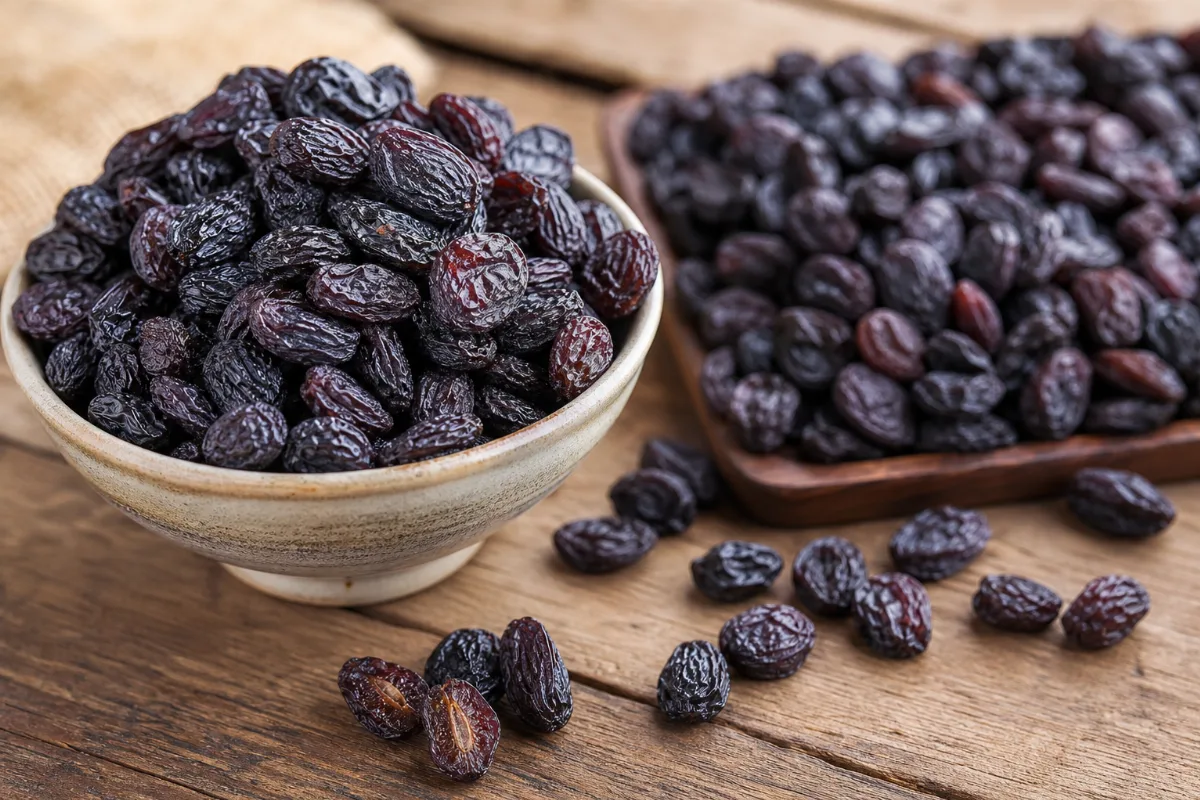
Fruits · Fruit
Raisins
Vitis vinifera (dried) · also called Dried grapes, sultanas, currants (dried Zante grapes), pasas (Spanish)
Raisins are dried grapes, eaten as a sweet snack and in baking. They give fiber, potassium and copper, but they are also very high in sugar. In small trials, swapping processed snacks for raisins lowered after-meal blood sugar and blood pressure, but the trials were few and came mostly from one research group. Main cautions: sulfites in some golden raisins, potassium for people with kidney disease, rare grape allergy, and raisins are poisonous to dogs.
General information, not medical advice. Last substantive update · Not medically reviewed. A named clinician has not signed off on this page. How this page is made
About Raisins
Raisins are dried grapes: a sweet, concentrated food with fiber, potassium and copper. They are a nutritious snack for most people, not a proven remedy, and they are high in sugar.
What it is
Raisins are grapes (Vitis vinifera) that have been dried. People eat them on their own, in cereal and in baking. Sultanas and currants (dried Zante grapes) are close relatives and some trials used them.
USDA data for dark seedless raisins: 299 kcal per 100 g, about 65 g of sugars and 4.5 g of fiber. A small 43 g box has about 129 kcal, 28 g of sugars, 1.9 g of fiber and 320 mg of potassium. They are about 15% water, which is why a small amount carries a lot of sugar and energy.
What the research shows
The firmest finding is about blood sugar speed: raisins raise blood sugar less than pure glucose, with a glycemic index of about 49 to 66 in three small studies.
In two 12-week trials from the same research group, people who ate raisins instead of processed snacks had lower after-meal blood sugar and systolic blood pressure. The trials were small and the funder is not stated in the abstracts. A large cohort linked grapes and raisins together to a lower chance of type 2 diabetes, but that shows a link, not cause.
Cholesterol results disagree. Findings for the bowel, appetite, teeth and fatty liver come from one small study each or from reviews. Cancer and Alzheimer's findings are cell and animal only. No trial tested heart attacks, strokes or death.
Raisins versus extracts and supplements
All the human trials used whole raisins or currants as food. Grape seed extract and other grape supplements are different products and were not covered. In one small study, cream of tartar (the same tartaric acid) did not match raisins for stool weight.
Amounts
This page gives no amounts to eat. Ask a doctor, pharmacist or dietitian what is right for you, especially if you have diabetes or kidney disease or take medicine.
At a glance
Traditional uses history, not proof
- Eaten as a sweet snack and added to cereal, baking and cooking
- Long use as a food is not proof that raisins treat any condition
Studied for research
- Blood sugar after eating (glycemic index), moderate certainty for a low-to-moderate index
- Blood sugar over 12 weeks in place of processed snacks, low certainty
- Type 2 diabetes risk (grapes and raisins together), low certainty
- Blood pressure, low certainty
- Cholesterol, mixed
- Bowel function, appetite, teeth, fatty liver, very low to low certainty
Main compounds
- Sugars (about 65 g per 100 g, USDA)
- Fiber (4.5 g per 100 g)
- Potassium (744 mg per 100 g)
- Tartaric acid
- Flavonols (quercetin, kaempferol) and phenolic acids (caftaric acid)
Common forms
- Dark seedless raisins (the form in the USDA data)
- Golden raisins (some sulfite-treated)
- Sultanas and currants (dried Zante grapes) used in some trials
- Raisins mixed into cereal, baking and snacks
Research links: Randomized study of raisins versus snacks in type 2 diabetes (2015) · Fruit consumption and type 2 diabetes risk, three cohorts (BMJ 2013) · Review: Is eating raisins healthy? (Nutrients 2019) · FDA recall notice: undeclared sulfites in golden raisins (2025) · Research Library · Genes & Biomarkers Library
What it is and its history
- Accepted scientific name
- Vitis vinifera
- Naming authority
- L. (GBIF accepted; usageKey 5372392)
- Common names
- Raisins (English); Dried grapes (English); Sultanas (English); Currants (dried Zante grapes) (English); Pasas (Spanish)
- Family or group
- Vitaceae (the grape family).
- Classification
- Plantae > Tracheophyta > Magnoliopsida > Vitales > Vitaceae > Vitis > Vitis vinifera
- Native range
- Not verified from a source read.
- Habitat
- Not verified from a source read.
- What it looks like
- Roots: Not verified.; Stems: Not verified.; Leaves: Not verified.; Flowers: Not verified.; Fruit: The food is the dried berry. USDA lists dark seedless raisins at about 15.5 g water per 100 g, and 1 oz (60 raisins) as 28.35 g.
- Cultivation
- Not verified from a source read.
- Harvest and processing
- Grapes are dried to make raisins. A 2007 study compared sun-dried raisins with golden raisins made from the same Thompson seedless grape; an FDA recall notice describes golden raisins with undeclared sulfites. Details of how drying is done were not verified.
- Look-alikes and adulterants
- Name: Fresh grapes; Note: The same species as a fresh fruit. A cohort study counts grapes and raisins together, so grape results do not always apply to raisins.; Name: Grape seed extract and other grape supplements; Note: Concentrated products made from seeds or skins. They are different from eating raisins and are not covered by these studies.; Name: Currants; Note: In the trials read, 'currants' or 'Corinthian raisins' are dried Zante grapes. They are not blackcurrants or redcurrants.
- Sustainability and conservation
- Not assessed.
Photographs
Traditional use and history history, not clinical proof
| Tradition or era | Documented use | Source |
|---|---|---|
| Research attention | A 2010 review says dried grapes (raisins, including sultanas and currants) have received comparatively little attention compared with grapes and wine. | p20851304 |
| Culinary use | Raisins are eaten as a sweet snack and used in cooking and baking (general knowledge; no historical source was read). | Not verified |
Traditional use shows how it was used. It does not show that it works or is safe today.
What is inside, and how it may work
What it contains and how those compounds act in cells and animals. Laboratory and animal mechanisms are not proven effects in people.
Main compounds
| Compound | Family | Where it is concentrated | Activity studied | Level of evidence |
|---|---|---|---|---|
| Sugars (fructose and glucose) | carbohydrate | Dried fruit USDA per 100 g: 65.2 g total sugars, of which 34.7 g fructose and 30.5 g glucose | Source of the sweetness and most of the energy. The authors of two studies propose that the fructose and fiber make the blood sugar rise more slowly than pure glucose. 35 11 9 | Human data |
| Dietary fiber | fiber | Dried fruit USDA: 4.5 g per 100 g | A 2011 review says raisins contain both soluble (viscous) and insoluble fiber. In one small crossover study, raisins raised stool weight, which cream of tartar did not. 35 3 19 | Human data |
| Tartaric acid PubChem 444305 | organic acid | Dried fruit A 2003 trial says 5 g of cream of tartar equals the tartaric acid in 120 g of sun-dried raisins | In people, cream of tartar softened stools and sped gut transit in a small crossover study. In dogs, tartaric acid has been proposed as the toxic part of grapes and raisins (hypothesis, not proven). 34 19 21 | Human data |
| Quercetin PubChem 5280343 | flavonol (polyphenol) | Dried fruit | A 2010 review names quercetin and kaempferol as the most abundant polyphenols in raisins. No amount per serving was read, and how much the body absorbs is not established. 33 22 | Composition only |
| Kaempferol PubChem 5280863 | flavonol (polyphenol) | Dried fruit | Named with quercetin in the 2010 review. No amount per serving was read. 32 22 | Composition only |
| Caftaric acid PubChem 6440397 | phenolic acid | Dried fruit | Named with coutaric acid as the most abundant phenolic acids in raisins in the 2010 review. No amount per serving was read. 31 22 | Composition only |
| Potassium | mineral | Dried fruit USDA: 744 mg per 100 g (about 320 mg in a small 43 g box) | Needed for nerves, muscles and heartbeat; a safety point for people with kidney disease. 35 | Human data |
Mechanisms, receptors and pathways
| Target or pathway | Gene or receptor | What was found | Level |
|---|---|---|---|
| Slower sugar absorption | Not specified | The authors of the glycemic-index studies suggest fructose, fiber and polyphenols may slow the rise in blood sugar. This was not tested. 11 9 22 | Hypothesis |
| Appetite hormones | Ghrelin, GIP | In 10 healthy adults, ghrelin and GIP were lower after raisins than after glucose. 7 | Human data |
| Colon function | Not specified | Raisins sped transit, softened stools, raised stool weight and short-chain fatty acids, and lowered stool bile acids in 13 healthy adults at a large daily amount. 19 | Human data |
| Mouth bacteria | Streptococcus mutans | Raisin compounds inhibited this cavity-linked bacterium in lab cultures. 23 | Laboratory research |
| Kidney injury in dogs | Not specified | Tartaric acid is proposed as the toxic part of grapes and raisins for dogs, from cases of dogs that ate cream of tartar or tamarinds. Proposed, not proven. 21 | Hypothesis |
Absorption, metabolism and elimination
- Absorption
- Not studied for raisins as a whole food.
- Distribution
- Not found.
- Metabolism
- Not found.
- Elimination
- Not found.
- Bioavailability
- A 2010 review says the bioavailability of raisin polyphenols and their effects on health markers still need to be established.
Isolated compounds versus whole extracts
All the human trials used whole raisins (or currants) as food. Cream of tartar, which supplies the tartaric acid of raisins, did not match raisins on stool weight or stool bile acids in one small crossover study. Grape seed extract and other grape supplements are different products and were not studied here.
Nutritional composition
Nutrition from USDA FoodData Central (raisins, dark, seedless, FDC 168165, SR Legacy, last updated 4/1/2019, read 2026-10-25). Per 100 g: 299 kcal, 79.3 g carbohydrate of which 65.2 g total sugars (34.7 g fructose, 30.5 g glucose), 4.5 g fiber, 3.3 g protein, 0.25 g fat, about 15.5 g water, 744 mg potassium, 62 mg calcium, 36 mg magnesium, 98 mg phosphorus, 1.79 mg iron, 0.27 mg copper, 0.28 mg manganese, 26 mg sodium, 2.3 mg vitamin C, 0.17 mg vitamin B6, 5 micrograms folate (DFE), 3.5 micrograms vitamin K and no vitamin A. One small box (1.5 oz, 43 g): about 129 kcal, 34 g carbohydrate, 28 g sugars, 1.9 g fiber, 1.4 g protein, 320 mg potassium, 27 mg calcium, 15 mg magnesium, 0.77 mg iron, 0.12 mg copper, 11 mg sodium and 1 mg vitamin C. One ounce (about 60 raisins, 28 g): about 84 kcal and 18 g sugars. One cup not packed (145 g): about 434 kcal. Per-portion figures are the USDA per-100-g values scaled by the USDA portion weights and rounded. Values vary with variety, ripeness and storage. Raisins are mainly a concentrated source of sugar and energy, with some potassium, copper and fiber.
1 moderate certainty2 mixed findings5 low certainty2 very low certainty1 not enough evidence
What was looked at
The 11 benefits and uses checked for Raisins, each with how strong the evidence is. Tap one to open it.
- Blood sugar after eating raisins (glycemic index)Moderate certainty
- Blood sugar over 12 weeks (raisins as a snack)Low certainty
- Risk of developing type 2 diabetes (grapes and raisins eaten together)Low certainty
- Blood pressureLow certainty
- Cholesterol and blood fatsMixed findings
- Bowel function and gut transitLow certainty
- Appetite and fullnessVery low certainty
- Teeth and mouth healthVery low certainty
- Fatty liver (NAFLD): a trial of currantsLow certainty
- Antioxidant, inflammation and artery markersMixed findings
- Cancer and Alzheimer's disease (cell and animal studies only)Not enough evidence
Lab markers tracked in the studies
Glycemic index of raisinsAfter-meal blood glucose (12-week trials)HbA1c (average blood sugar over about 3 months)Systolic blood pressureLDL cholesterolGut transit timeStool weightGhrelin and GIP (hunger and gut hormones)IL-6 and TNF-alpha (inflammation markers)
What is Raisins good for?
The main studied uses and how strong the human evidence is for each. Most results come from small trials of raisins used in place of other snacks.
Benefits, one by one
Each card is a research question, not a promise. Tap a goal to filter. Open a card to see the studies, doses and limits.
Blood sugar after eating raisins (glycemic index)
Moderate certaintyWhen people ate raisins on one occasion, their blood sugar rose less than after a glucose drink. The measured glycemic index was in the low-to-moderate range, roughly 49 to 66 across three small studies. This tells you how fast the sugar gets into the blood, not whether raisins are good for health.
3 studiesWhole raisins, a test portion eaten once (trial detail, not advice).
Studies, doses and limits
What the trials found
Kim 2008 tested raisins (50 g of available carbohydrate) against glucose in 31 people: 10 healthy sedentary adults, 11 trained adults and 10 adults with prediabetes. The glycemic index was 49.4, 49.6 and 62.3 in the three groups, with a low insulin index (47 to 54). Kanellos 2013 gave 74 g of Corinthian raisins (currants) or 50 g glucose to 15 healthy adults and 15 adults with type 2 diabetes. Blood sugar and insulin were lower after raisins than after glucose, with an estimated glycemic index of 66.3.
Results
Raisins raise blood sugar less than pure glucose. Their glycemic index is low to moderate in these small studies.
Effect sizes as reported
Glycemic index 49.4, 49.6, 62.3 (Kim 2008); about 66.3 (Kanellos 2013, Corinthian raisins).
Why this rating
Two independent groups got consistent results with the standard glycemic-index method, but the groups were small (10 to 15 each) and the abstracts do not say who paid. A glycemic index is not a health outcome.
Form and dose studied
Whole raisins, a test portion eaten once (trial detail, not advice).
Who was studied
Healthy adults, trained adults, adults with prediabetes, adults with type 2 diabetes.
Limits
Small groups, single test meals, finger-stick blood, values ranged from 49 to 66; one study used Corinthian raisins (currants).
Why researchers looked
Raisins are very sweet, so people ask how they affect blood sugar.
Traditional use
Raisins are dried grapes eaten as a sweet snack and in cooking and baking. Long use as food is not proof that they treat any condition.
Proposed mechanism Hypothesis
Raisins have about 65 g of sugars per 100 g, roughly half fructose (34.7 g) and half glucose (30.5 g) (USDA), plus 4.5 g of fiber. Fructose raises blood glucose less than glucose does, and fiber may slow absorption. The authors of these studies propose this; it was not tested directly.
A proposed mechanism does not show that the effect happens in people.
Raisins are about 65 g sugar per 100 g (USDA). People with diabetes should ask their care team before changing snacks. See the Safety tab.
Blood sugar over 12 weeks (raisins as a snack)
Low certaintyTwo 12-week trials from one research group compared raisin snacks with processed snacks. After-meal glucose was lower with raisins in both. HbA1c fell by 0.12 percentage points in one and did not reach statistical significance in the other. Both trials are small and the funder is not stated.
2 studiesDark raisins eaten as snacks several times a day in place of processe…
Studies, doses and limits
What the trials found
Bays 2015 randomised 51 people with type 2 diabetes to eat dark raisins or alternative processed snacks for 12 weeks. After-meal glucose was 23% lower with raisins (P=0.024). Fasting glucose (19% lower) and HbA1c (0.12% lower) did not reach significance. Anderson 2014, a 12-week trial of 46 people (31 raisins, 15 snacks), found after-meal glucose 13.1 mg/dL lower than with snacks (P=0.03) and HbA1c 0.12% lower than with snacks (P=0.036); fasting glucose did not change. Body weight did not change in either trial.
Results
Lower after-meal glucose with raisin snacks than with processed snacks in two small trials. Fasting glucose and HbA1c results were mixed between the two.
Effect sizes as reported
After-meal glucose -23% (Bays 2015) and -13.1 mg/dL (Anderson 2014); HbA1c -0.12% (significant in Anderson 2014 only).
Why this rating
Two small trials from the same group (Anderson is an author of both), 12 weeks, compared with processed snacks rather than no snack, with funding not stated and possible industry funding not ruled out.
Form and dose studied
Dark raisins eaten as snacks several times a day in place of processed snacks (trial detail, not advice).
Who was studied
Adults; one trial in people with type 2 diabetes (n=51).
Limits
Small, not independent of each other, short, and the comparison was processed snacks. They do not show that raisins prevent or treat diabetes.
Why researchers looked
Raisins are a common snack, so researchers tested whether swapping them for processed snacks changes blood sugar.
Traditional use
Raisins are dried grapes eaten as a sweet snack and in cooking and baking. Long use as food is not proof that they treat any condition.
Proposed mechanism Hypothesis
The authors suggest fiber, polyphenols and the way raisin sugars are absorbed may play a part. This was not tested in these trials.
A proposed mechanism does not show that the effect happens in people.
Raisins are about 65 g sugar per 100 g (USDA). People with diabetes should ask their care team before changing snacks. See the Safety tab.
Risk of developing type 2 diabetes (grapes and raisins eaten together)
Low certaintyIn three large US studies of health professionals, people who ate more grapes and raisins had a somewhat lower chance of developing type 2 diabetes. Raisins could not be separated from grapes. This kind of study shows a link, not cause.
1 studiesWhole grapes and raisins eaten as food, reported on questionnaires (n…
Studies, doses and limits
What the trials found
Muraki 2013 pooled three cohorts (66,105 and 85,104 women and 36,173 men; 12,198 developed type 2 diabetes over 3.46 million person-years). For every 3 servings a week, the hazard ratio was 0.88 (95% CI 0.83 to 0.93) for grapes and raisins together, 0.74 for blueberries, 0.93 for apples and pears, and 1.08 for fruit juice. Total whole fruit was 0.98.
Results
Grapes and raisins together were linked to about 12% lower diabetes risk per 3 servings a week.
Effect sizes as reported
HR 0.88 (0.83 to 0.93) per 3 servings a week of grapes and raisins; juice HR 1.08 (1.05 to 1.11).
Why this rating
A large, careful cohort analysis, but observational and the food questionnaire lumps grapes with raisins. People who eat more grapes may differ in other ways.
Form and dose studied
Whole grapes and raisins eaten as food, reported on questionnaires (not advice).
Who was studied
US health professionals (men and women).
Limits
Observational; cannot show cause; raisins not analysed alone.
Why researchers looked
People ask whether eating certain fruits, including grapes and raisins, changes the chance of getting diabetes.
Traditional use
Raisins are dried grapes eaten as a sweet snack and in cooking and baking. Long use as food is not proof that they treat any condition.
Proposed mechanism Not tested
Not tested. The authors note fruits differ, and that fruit juice showed the opposite link.
A proposed mechanism does not show that the effect happens in people.
None specific. See the Safety tab for sugar.
Blood pressure
Low certaintyIn two 12-week trials from one group, systolic blood pressure was lower with raisin snacks than with processed snacks (by 8.7 mmHg in one). A third small trial saw blood pressure fall in every group, so it cannot credit raisins. Overall the evidence is limited.
3 studiesDark raisins as snacks (trial detail, not advice).
Studies, doses and limits
What the trials found
Bays 2015 (51 people with type 2 diabetes): systolic pressure 8.7 mmHg lower with raisins than with processed snacks (P=0.035); diastolic not significantly different. Anderson 2014 (46 people): systolic pressure fell by 6.0 to 10.2 mmHg at weeks 4, 8 and 12 with raisins, and diastolic fell more than with snacks (P<0.05). Puglisi 2008 (34 people, 1 cup raisins a day, with or without extra walking): systolic pressure fell in all subjects (P=0.008), including groups that did not eat raisins, so the fall cannot be pinned on raisins.
Results
Lower systolic pressure with raisin snacks than processed snacks in two small trials by one group; a third trial could not separate raisins from walking.
Effect sizes as reported
Systolic -8.7 mmHg (Bays 2015); -6.0 to -10.2 mmHg (Anderson 2014).
Why this rating
Small trials, two from the same group, with possible industry funding not ruled out. Compared with processed snacks, not with nothing. No long-term or heart-event outcomes.
Form and dose studied
Dark raisins as snacks (trial detail, not advice).
Who was studied
Adults; one trial in type 2 diabetes.
Limits
Short, small, not independent; blood pressure was not the main aim of every trial.
Why researchers looked
Raisins are rich in potassium (744 mg per 100 g, USDA), and potassium is linked to blood pressure control.
Traditional use
Raisins are dried grapes eaten as a sweet snack and in cooking and baking. Long use as food is not proof that they treat any condition.
Proposed mechanism Authoritative guidance
Potassium helps offset some effects of sodium on blood pressure (MedlinePlus). Whether raisin potassium or other parts explain the trial results was not tested.
A proposed mechanism does not show that the effect happens in people.
People with kidney disease or taking medicines that raise potassium should ask their care team about raisins. See the Safety tab.
Cholesterol and blood fats
Mixed findingsRaisins did not clearly change cholesterol. The 12-week trial in type 2 diabetes found no difference. A smaller trial saw LDL fall 13.7%, but it fell in groups that did not eat raisins too. A trial in smokers found no overall effect.
3 studiesRaisins eaten daily (trial detail, not advice).
Studies, doses and limits
What the trials found
Bays 2015: no significant difference in total, LDL, HDL or non-HDL cholesterol or triglycerides compared with processed snacks. Puglisi 2008 (34 people, 6 weeks): total cholesterol fell 9.4% and LDL 13.7% in all subjects, including those not eating raisins; triglycerides fell 19.5% in the walking group only. Kanellos 2017 (36 smokers, 4 weeks, 90 g raisins a day, open-label): no effect on blood fats or other markers overall; tiny subgroups (5 women) showed lower total and LDL cholesterol, which the authors say do not allow safe conclusions.
Results
No clear effect of raisins on cholesterol or triglycerides.
Effect sizes as reported
No significant difference in Bays 2015; LDL -13.7% in all Puglisi 2008 subjects; no overall effect in Kanellos 2017.
Why this rating
Results disagree and the positive changes were not specific to raisins or came from tiny subgroups.
Form and dose studied
Raisins eaten daily (trial detail, not advice).
Who was studied
Adults with type 2 diabetes; mixed adults; smokers.
Limits
Small trials, different designs; one was open-label.
Why researchers looked
Raisins contain fiber and polyphenols, which are linked to blood fats in other foods.
Traditional use
Raisins are dried grapes eaten as a sweet snack and in cooking and baking. Long use as food is not proof that they treat any condition.
Proposed mechanism Not tested
Not tested in these trials. A review describes fiber and polyphenol content only.
A proposed mechanism does not show that the effect happens in people.
None specific.
Bowel function and gut transit
Low certaintyIn one small crossover study, healthy adults eating a large daily amount of raisins had softer, heavier stools and a faster trip through the gut. Reviews say raisin fiber and tartaric acid may help, and that more studies are needed. No trial in people with constipation was found.
3 studiesSun-dried raisins in a large daily amount (trial detail, not advice).
Studies, doses and limits
What the trials found
Spiller 2003 fed 13 healthy adults 120 g of sun-dried raisins a day or 5 g of cream of tartar a day in 3-week cycles. Transit time fell from 42 hours to 28 hours on raisins (P<0.05) and 31 hours on cream of tartar (P<0.1). Raisins raised stool weight (P<0.05), lowered stool bile acids and raised short-chain fatty acids. A 2019 review says raisin intake seems favorable for colon function but more studies are needed; a 2011 review describes the fiber in raisins.
Results
Faster transit and softer, heavier stools in 13 healthy adults at a very large daily amount.
Effect sizes as reported
Transit 42 h to 28 h on raisins (P<0.05).
Why this rating
One small crossover study in healthy people plus narrative reviews. It did not test people with constipation, and the amount was far above a typical serving.
Form and dose studied
Sun-dried raisins in a large daily amount (trial detail, not advice).
Who was studied
Healthy adults.
Limits
13 people, not constipated, no placebo-controlled treatment of a bowel condition.
Why researchers looked
Raisins contain fiber and tartaric acid, both thought to affect the bowel.
Traditional use
Raisins are dried grapes eaten as a sweet snack and in cooking and baking. Long use as food is not proof that they treat any condition.
Proposed mechanism Preliminary mechanism
The 2003 authors tested this by comparing raisins with cream of tartar (the same tartaric acid): both softened stools and sped transit, but only raisins raised stool weight, which the authors link to raisin fiber. Reviews describe raisins as containing both soluble and insoluble fiber.
A proposed mechanism does not show that the effect happens in people.
Large amounts of dried fruit can loosen stools in some people; raisins are also high in sugar. See the Safety tab.
Appetite and fullness
Very low certaintyA pilot study of 10 healthy adults found lower levels of two hunger-related hormones after raisins than after glucose. In 26 children, an after-school snack of raisins gave fewer calories and less food over the day than cookies or chips. Neither study measured lasting weight change.
3 studiesRaisins eaten once as a test snack (trial detail, not advice).
Studies, doses and limits
What the trials found
Kaliora 2017 gave 10 healthy adults 74 g of raisins or 50 g of glucose on separate days. Glucose and insulin responses were similar, but GIP was lower at 60 and 120 minutes and ghrelin lower at 120 and 180 minutes with raisins. Patel 2013 gave 26 children aged 8 to 11 raisins, grapes, potato chips or cookies after school on four days. Children took fewer calories from raisins and grapes than from cookies (P<0.001) and ate less in total across the day (P<0.001); the weight of raisins eaten was similar to chips.
Results
Lower hunger hormones in adults and fewer calories eaten in children, in single-meal tests.
Effect sizes as reported
Calories eaten: raisins and grapes lowest, cookies highest (P<0.001).
Why this rating
Two short single-meal studies (10 adults, 26 children) with no weight outcomes. Hormone changes and one snack day do not show effects on long-term appetite.
Form and dose studied
Raisins eaten once as a test snack (trial detail, not advice).
Who was studied
Healthy adults; normal-weight children.
Limits
Single-meal studies, tiny samples, no long-term data. Funding not stated.
Why researchers looked
Raisins are a sweet snack that is high in fiber for its size, so people ask if they curb appetite.
Traditional use
Raisins are dried grapes eaten as a sweet snack and in cooking and baking. Long use as food is not proof that they treat any condition.
Proposed mechanism Preliminary mechanism
The authors point to lower ghrelin and GIP (hormones that signal hunger and gut activity) after raisins than after glucose. This is a hormone measurement, not proof of less hunger in daily life.
A proposed mechanism does not show that the effect happens in people.
Raisins are energy-dense (299 kcal per 100 g, USDA). See the Safety tab.
Teeth and mouth health
Very low certaintyRaisins have a reputation for causing cavities because they are sweet and chewy. A review of mostly laboratory and short-term studies found they did not push mouth acid to enamel-dissolving levels, did not cling to teeth longer than other foods, and contain compounds that slowed cavity-causing bacteria in the lab. No tooth-decay trial was found, and the NHS still advises eating dried fruit with meals.
2 studiesRaisins as food (not advice).
Studies, doses and limits
What the trials found
Wong 2013 reviewed studies on low oral pH, adherence to teeth and bacterial behavior. It concluded that raisin consumption alone does not drop oral pH below the level that dissolves enamel, does not leave raisins on teeth longer than other foods, and that raisin compounds inhibit Streptococcus mutans, and said further research should be considered. The NHS advises that 30 g of dried fruit should be eaten at mealtimes, not as a between-meal snack, to reduce the risk of tooth decay.
Results
Lab and short-term findings do not point to extra decay risk from raisins alone. NHS advice is still to eat dried fruit with meals.
Effect sizes as reported
No numbers in the abstract.
Why this rating
A narrative review of mostly laboratory and short-term studies; no trial of tooth decay. The NHS advice points the other way.
Form and dose studied
Raisins as food (not advice).
Limits
No long-term human dental study was read. Funding not stated in the review's abstract.
Why researchers looked
Dried fruit is sticky and sugary, so dentists and parents ask about tooth decay.
Traditional use
Raisins are dried grapes eaten as a sweet snack and in cooking and baking. Long use as food is not proof that they treat any condition.
Proposed mechanism Laboratory research
A review proposes three reasons: mouth pH stays above the enamel threshold, raisins do not remain on teeth longer than other foods, and antioxidant compounds inhibit Streptococcus mutans in lab cultures. These are lab and short-term findings.
A proposed mechanism does not show that the effect happens in people.
Follow NHS advice to eat dried fruit with meals. Ask a dentist if you are prone to cavities.
Fatty liver (NAFLD): a trial of currants
Low certaintyIn one 24-week trial of 55 adults with fatty liver disease, swapping snacks for currants (dried Zante grapes) plus counselling improved fasting glucose, an inflammation marker, body fat and liver ultrasound more than counselling alone. Currants are one type of raisin, and this is a single trial.
1 studiesCurrants (dried Zante grapes), 36 g a day replacing snacks (trial det…
Studies, doses and limits
What the trials found
Kaliora 2016 randomised 55 adults with NAFLD and no significant scarring to nutrition counselling alone or counselling plus 36 g a day of currants replacing similar-calorie snacks for 24 weeks (50 finished). Fasting glucose and IL-6 fell only in the currant group. Weight, BMI, HbA1c and CRP fell in both groups equally. Total body fat, waist circumference and trunk fat fell more with currants, and liver ultrasound improved significantly. The abstract concludes that including dried grapes is beneficial.
Results
Better glucose, IL-6, body fat and ultrasound with currants than counselling alone, in one small trial.
Effect sizes as reported
Significant between-group differences in fasting glucose, IL-6, body fat and ultrasound; exact numbers not in the abstract.
Why this rating
One trial of 55 people, 24 weeks, with currants rather than other raisins and funding not stated.
Form and dose studied
Currants (dried Zante grapes), 36 g a day replacing snacks (trial detail, not advice).
Who was studied
Adults with NAFLD and no significant scarring.
Limits
Single trial; mostly counselling in both arms.
Why researchers looked
Fatty liver is common and linked to blood sugar and inflammation, and small snack changes may help.
Traditional use
Raisins are dried grapes eaten as a sweet snack and in cooking and baking. Long use as food is not proof that they treat any condition.
Proposed mechanism Authors hypothesis
The authors suggest fiber, polyphenols and swapping calorie-matched snacks may explain this. It was not tested.
A proposed mechanism does not show that the effect happens in people.
People with liver disease should follow their care team's advice.
Antioxidant, inflammation and artery markers
Mixed findingsRaisins contain plant polyphenols, and lab measures of antioxidant capacity rose in one small study. But other markers, including C-reactive protein and artery function in smokers, did not change. One trial saw lower TNF-alpha, an inflammation marker, with raisins. Overall the human results are mixed.
4 studiesRaisins or golden raisins eaten daily (trial detail, not advice).
Studies, doses and limits
What the trials found
Parker 2007 (15 healthy men, 4 weeks, crossover) found some lab antioxidant measures improved with grapes and golden raisins, but total phenolics and CRP did not change; some early after-meal changes were not positive. Kanellos 2017 (36 smokers, 90 g raisins a day, 4 weeks) found no effect on inflammation, oxidative stress or artery function markers overall. Puglisi 2008 saw TNF-alpha fall from 3.5 to 2.1 ng/L in the raisin group. A 2010 review says only limited numbers of human studies have been done.
Results
Some lab and inflammation markers improved in small studies; others did not, so the picture is mixed.
Effect sizes as reported
TNF-alpha 3.5 to 2.1 ng/L (Puglisi 2008, raisin group); no change in CRP or artery function (Parker 2007; Kanellos 2017).
Why this rating
Small studies, lab markers that are not health outcomes, and results that disagree.
Form and dose studied
Raisins or golden raisins eaten daily (trial detail, not advice).
Who was studied
Healthy men; smokers; mixed adults.
Limits
Biomarker studies only; no disease outcomes.
Why researchers looked
Grapes and wine are studied for polyphenols, and raisins keep some of them.
Traditional use
Raisins are dried grapes eaten as a sweet snack and in cooking and baking. Long use as food is not proof that they treat any condition.
Proposed mechanism Authoritative guidance
Raisins contain flavonols such as quercetin and kaempferol and phenolic acids such as caftaric and coutaric acid. A review says it is not clear how much these compounds explain any effect, and that their bioavailability needs study.
A proposed mechanism does not show that the effect happens in people.
None specific.
Cancer and Alzheimer's disease (cell and animal studies only)
Not enough evidenceA review lists effects of raisin compounds in cell lines and animals for cancer and Alzheimer's disease. No human trial was found. These findings are lab and animal only and are not evidence that raisins prevent or treat either disease.
1 studiesNot applicable.
Studies, doses and limits
What the trials found
Olmo-Cunillera 2019 compiled cell line and animal model studies and states that other potential benefits in specific diseases, such as cancer and Alzheimer's disease, exist in those models, but that human studies are needed. A protocol for a trial of raisins and thinking skills in older adults was found, but it has no results and is not used.
Results
No human evidence. Cell and animal findings only.
Why this rating
Lab and animal only; the review itself calls for human studies.
Who was studied
Cell lines and animals.
Limits
No human data. The review's abstract does not name the cell or animal models.
Why researchers looked
Raisin polyphenols are active in some lab tests, so researchers explore disease models.
Traditional use
Raisins are dried grapes eaten as a sweet snack and in cooking and baking. Long use as food is not proof that they treat any condition.
Proposed mechanism Lab and animal
Cell-line and animal model findings are described in a 2019 review. The review says deeper research and human intervention studies are needed.
A proposed mechanism does not show that the effect happens in people.
None specific.
Connections to the rest of health
How Raisins connects to the rest of our health knowledge graph. Every link says what kind of connection it is. A safety link (for example to the liver) is a warning, not a benefit. A study that merely mentions a topic never creates a benefit link.
Explore every connection: goals, body systems, organs, symptoms, genes
B. Body systems
| Connected to | Kind of connection | Evidence status | Context | Studies |
|---|---|---|---|---|
| Metabolism Weight | Biological association | Moderate certainty | Studied for: Blood sugar after eating raisins (glycemic index) Studied for: Blood sugar over 12 weeks (raisins as a snack) | 11 9 22 2 1 12 7 15 13 |
| Blood Sugar Support | Biological association | Moderate certainty | Studied for: Blood sugar after eating raisins (glycemic index) Studied for: Blood sugar over 12 weeks (raisins as a snack) | 11 9 22 2 1 12 |
| Cardiovascular System | Biological association | Low certainty | Studied for: Blood pressure Studied for: Cholesterol and blood fats | 2 1 16 10 14 22 |
| Heart Circulation | Biological association | Low certainty | Studied for: Blood pressure Studied for: Cholesterol and blood fats | 2 1 16 10 |
| Digestive System | Biological association | Low certainty | Studied for: Bowel function and gut transit Studied for: Appetite and fullness | 19 13 3 7 15 23 28 6 |
| Gut Health | Biological association | Low certainty | Studied for: Bowel function and gut transit | 19 13 3 |
| Hepatic System | Biological association | Low certainty | Studied for: Fatty liver (NAFLD): a trial of currants | 6 |
| Immune System | Biological association | Mixed findings | Studied for: Antioxidant, inflammation and artery markers | 14 10 16 22 |
| Cellular | Biological association | Not enough evidence | Studied for: Cancer and Alzheimer's disease (cell and animal studies only) | 13 |
| Nervous System | Biological association | Not enough evidence | Studied for: Cancer and Alzheimer's disease (cell and animal studies only) | 13 |
C. Body parts and organs
| Connected to | Kind of connection | Evidence status | Context | Studies |
|---|---|---|---|---|
| Kidneys | Documented risk | With chronic kidney disease the kidneys may not remove extra potassium (MedlinePlus); raisins are potassium-rich. Preparation or compound: Raisins as a potassium source |
27 35 | |
| Teeth | Adverse effect or risk | Advice | The NHS advises dried fruit at mealtimes to lower tooth decay risk. Preparation or compound: Dried fruit |
28 |
E. Health conditions
| Connected to | Kind of connection | Evidence status | Context | Studies |
|---|---|---|---|---|
| Sulfite sensitivity | Adverse effect or risk | Documented risk | FDA recall notice for undeclared sulfites in golden raisins. Preparation or compound: Sulfite-treated raisins |
25 |
| Type 2 diabetes | Observational link | Grapes and raisins together were linked to lower diabetes risk in three cohorts; raisins also lowered after-meal glucose in small trials. Raisins are high in sugar. Preparation or compound: Raisins (grapes and raisins together in the cohort) |
12 2 1 | |
| Hyperkalemia | Documented risk | With chronic kidney disease the kidneys may not clear extra potassium (MedlinePlus); raisins are potassium-rich. Preparation or compound: Raisins as a potassium source |
27 35 |
I. Biomarkers
| Connected to | Kind of connection | Evidence status | Context | Studies |
|---|---|---|---|---|
| Glycemic index of raisins | Biological association | Moderate certainty | Measured in trials: lowered. A lab change is not the same as a health benefit. | 11 9 |
| After-meal blood glucose (12-week trials) | Biological association | Low certainty | Measured in trials: lowered. A lab change is not the same as a health benefit. | 2 1 |
| HbA1c (average blood sugar over about 3 months) | Biological association | Low certainty | Measured in trials: mixed. A lab change is not the same as a health benefit. | 1 2 |
| Systolic blood pressure | Biological association | Low certainty | Measured in trials: lowered. A lab change is not the same as a health benefit. | 2 1 16 |
| LDL cholesterol | Biological association | Mixed findings | Measured in trials: mixed. A lab change is not the same as a health benefit. | 2 16 10 |
| Gut transit time | Biological association | Low certainty | Measured in trials: lowered. A lab change is not the same as a health benefit. | 19 |
| Stool weight | Biological association | Low certainty | Measured in trials: raised. A lab change is not the same as a health benefit. | 19 |
| Ghrelin and GIP (hunger and gut hormones) | Biological association | Very low certainty | Measured in trials: lowered. A lab change is not the same as a health benefit. | 7 |
| IL-6 and TNF-alpha (inflammation markers) | Biological association | Low certainty | Measured in trials: lowered. A lab change is not the same as a health benefit. | 6 16 |
K. Biological pathways
| Connected to | Kind of connection | Evidence status | Context | Studies |
|---|---|---|---|---|
| Potassium | Preliminary mechanism | Human | Raisins are a potassium-rich food; people with kidney disease may need to limit potassium. | 35 |
| Dietary fiber | Preliminary mechanism | Human | Raisins contain soluble and insoluble fiber. | 35 3 |
| Tartaric acid | Preliminary mechanism | Hypothesis | An organic acid in raisins that may affect gut transit in people and has been proposed as the toxic part of grapes and raisins for dogs. | 19 21 |
L. Active compounds
| Connected to | Kind of connection | Evidence status | Context | Studies |
|---|---|---|---|---|
| Sugars (fructose and glucose) | Biological association | Human | Source of the sweetness and most of the energy. The authors of two studies propose that the fructose and fiber make the blood sugar rise more slowly than pure glucose. Preparation or compound: Dried fruit |
35 11 9 |
| Dietary fiber | Biological association | Human | A 2011 review says raisins contain both soluble (viscous) and insoluble fiber. In one small crossover study, raisins raised stool weight, which cream of tartar did not. Preparation or compound: Dried fruit |
35 3 19 |
| Tartaric acid | Biological association | Human | In people, cream of tartar softened stools and sped gut transit in a small crossover study. In dogs, tartaric acid has been proposed as the toxic part of grapes and raisins (hypothesis, not proven). Preparation or compound: Dried fruit |
34 19 21 |
| Quercetin | Biological association | Composition only | A 2010 review names quercetin and kaempferol as the most abundant polyphenols in raisins. No amount per serving was read, and how much the body absorbs is not established. Preparation or compound: Dried fruit |
33 22 |
| Kaempferol | Biological association | Composition only | Named with quercetin in the 2010 review. No amount per serving was read. Preparation or compound: Dried fruit |
32 22 |
| Caftaric acid | Biological association | Composition only | Named with coutaric acid as the most abundant phenolic acids in raisins in the 2010 review. No amount per serving was read. Preparation or compound: Dried fruit |
31 22 |
| Potassium | Biological association | Human | Needed for nerves, muscles and heartbeat; a safety point for people with kidney disease. Preparation or compound: Dried fruit |
35 |
Each connection is stored with the ingredient, the connected record, the kind of connection, the evidence status, the supporting studies, the preparation or compound involved, and a review date (last reviewed October 25, 2026).
Evidence at a glance: what changed in 9 lab markers
Tap a number to show only those markers. Counts are markers, not people.
The evidence
The research centre for Raisins. Every record here was checked against PubMed or the publisher's page; we never list a study we have not verified.
Evidence by outcome
Bars show how many studies we found for each outcome, not how well it works. People are added up across trials only (reviews are not added, to avoid double counting).
How we rate evidence
High certainty
Several well-run trials or reviews agree; further research is unlikely to change the picture much.
Moderate certainty
Good trials point the same way, but some doubt remains.
Low certainty
Small, short or inconsistent trials. The finding could change with better research.
Very low certainty
Very little or very weak human data. Treat as a possibility only.
Mixed findings
Trials or reviews disagree with each other.
Not enough evidence
Not enough human research to say either way.
Evidence against
Good research found no benefit, or found harm.
We take the reviewers' own risk-of-bias and GRADE statements where they exist, and otherwise judge from study size, design, consistency, directness and whether a product matches what is sold. Many publications do not make evidence high. Method note: We started from our existing raisin summary, re-checked nutrition at USDA FoodData Central, and searched PubMed for human trials, reviews, cohort studies, safety and case-report evidence. Only abstracts were read for studies; regulator and health-agency pages were read in full. Items we could not verify are flagged in the research gaps.
Study library: every study we checked 35
| Study | Design | People | Product, dose, length | Result |
|---|---|---|---|---|
| Anderson 2014 Raisins compared with other snack effects on glycemia and blood pressure: a randomized, controlled trial. Postgrad Med · PMID 24393750 · DOI |
Controlled trial |
46 Adults (men and women) with raisins group n=31 and snack group n=15; the abstract does not say the group had diabetes |
Dark raisins eaten as a snack three times a day Whole dried fruit Three times a day; the amount is not given in the abstract (trial detail, not advice) 12 weeks · vs Processed snacks |
Fasting glucose was not significantly changed. After-meal glucose fell by 13.1 mg/dL with raisins (P=0.03 versus snacks). HbA1c fell by 0.12% (P=0.036 versus snacks). Systolic blood pressure fell by 6.0 to 10.2 mmHg at weeks 4, 8 and 12; diastolic pressure fell more than with snacks (P<0.05). Body weight did not change. After-meal glucose -13.1 mg/dL; HbA1c -0.12%; systolic -6.0 to -10.2 mmHg (P=0.03 (after-meal glucose vs snacks); P=0.036 (HbA1c vs snacks); P=0.015 to 0.001 (systolic within raisins group)) Methods, limits and fundingOutcomes: Fasting and after-meal glucose, HbA1c, blood pressure, body weight Limitations: Small (15 versus 31), compared with processed snacks rather than no snack, and the abstract does not say who the participants were. It also does not say who paid. Funding and conflicts: Not stated in the abstract. PubMed tags the paper 'Research Support, Non-U.S. Gov't'; the funder was not found, so industry funding cannot be ruled out. Read: abstract |
| Bays 2015 A randomized study of raisins versus alternative snacks on glycemic control and other cardiovascular risk factors in patients with type 2 diabetes mellitus. Phys Sportsmed · PMID 25609549 · DOI |
Controlled trial |
51 People with type 2 diabetes |
Dark raisins eaten as a snack Whole dried fruit Routine daily snacking; the amount is not given in the abstract (trial detail, not advice) 12 weeks · vs Alternative processed snacks |
After-meal glucose was 23% lower with raisins than with snacks (P=0.024). Fasting glucose was 19% lower and HbA1c 0.12% lower, but these two did not reach statistical significance. Systolic blood pressure was 8.7 mmHg lower (P=0.035); diastolic did not change significantly. Body weight, BMI, waist, fasting insulin, insulin resistance, total, LDL and HDL cholesterol, triglycerides and non-HDL cholesterol showed no significant difference. After-meal glucose -23% (P=0.024); systolic -8.7 mmHg (P=0.035) (P=0.024; P=0.035) Methods, limits and fundingOutcomes: After-meal and fasting glucose, HbA1c, blood pressure, weight, insulin, cholesterol Limitations: Small; compared with processed snacks, not with no snack; from the same research group as the 2014 trial, so the two are not independent confirmations; the abstract does not say who paid. Funding and conflicts: Not stated in the abstract. PubMed tags the paper 'Research Support, Non-U.S. Gov't'; the funder was not found, so industry funding cannot be ruled out. Read: abstract |
| Bell 2011 A review of dietary fiber and health: focus on raisins. J Med Food · PMID 21476884 · DOI |
Narrative review |
Review of fiber and health, with raisins as an example | Raisins Whole dried fruit |
The review says raisins contain both soluble (viscous) and insoluble fiber, and suggests a role for raisins in raising fiber intake. It describes general fiber effects, not raisin trials. Methods, limits and fundingOutcomes: Role of fiber Limitations: General fiber review; not a trial of raisins; funding not given in the abstract. Funding and conflicts: Not stated in the abstract. Read: abstract |
| Downs 2024 Scoping review exploring the evidence base on Vitis vinifera toxicity in dogs after ingestion: Clinical effects, treatments and types of V. vinifera. Vet Rec · PMID 39183495 · DOI |
Scoping review dog |
24 24 papers on dogs that ate unprocessed grape-family fruit |
Grapes, raisins and other Vitis vinifera fruit Fruit No clear toxic dose Review |
A wide range of types was eaten, a toxic dose was difficult to ascertain, and no clear toxicity was attributable to the type of fruit. Common signs were stomach and gut, kidney, nerve and blood changes. Treatment commonly included fluids, diuretics and anti-sickness drugs. Prognosis was varied. No clear toxic dose (n/a) Methods, limits and fundingOutcomes: Clinical signs and treatment Limitations: Scoping review of unprocessed fruit; the abstract says it did not explore processed fruit or lab findings. Dogs only. Funding and conflicts: Research Support, Non-U.S. Gov't (PubMed tag). Read: abstract |
| Gonzalez-Curbelo 2023 Occurrence of Mycotoxins in Dried Fruits Worldwide, with a Focus on Aflatoxins and Ochratoxin A: A Review. Toxins (Basel) · PMID 37756002 · DOI |
Narrative review |
Review of mycotoxins in dried fruits including vine fruits, figs, dates, apricots, prunes and mulberries | Dried fruits Dried fruit |
The main mycotoxins in dried fruits are aflatoxins and ochratoxin A. Contamination varies by fruit, origin, climate, harvest, drying and storage. The abstract gives no figures specific to raisins. Methods, limits and fundingOutcomes: Mycotoxin contamination Limitations: The abstract has no raisin-specific numbers. Funding and conflicts: Not stated in the abstract. Read: abstract |
| Kaliora 2016 The effect of minimal dietary changes with raisins in NAFLD patients with non-significant fibrosis: a randomized controlled intervention. Food Funct · PMID 27714002 · DOI |
Controlled trial |
55 Adults with non-alcoholic fatty liver disease (NAFLD) and no significant scarring; 50 finished |
Currants (dried Zante grapes) as a snack replacement, plus nutrition counselling Whole dried fruit Two fruit servings, 36 g a day (trial detail, not advice) 24 weeks · vs Nutrition counselling alone |
Fasting glucose and IL-6 fell only in the currant group. Body weight, BMI, HbA1c and CRP fell in both groups with no difference between them. Total body fat, waist and trunk fat fell more with currants, and liver ultrasound improved significantly. Lower fasting glucose, IL-6, body fat and better ultrasound than counselling alone (as reported) Methods, limits and fundingOutcomes: Liver ultrasound, glucose, inflammation markers, body fat Limitations: Currants, not other raisins; 50 completers; snacks swapped for similar-calorie currants; not blinded as far as the abstract shows. Funding and conflicts: Not stated in the abstract. PubMed tags the paper 'Research Support, Non-U.S. Gov't'; the funder was not found, so industry funding cannot be ruled out. Read: abstract |
| Kaliora 2017 Regulation of GIP and Ghrelin in Healthy Subjects Fed on Sun-Dried Raisins: A Pilot Study with a Crossover Trial Design. J Med Food · PMID 28170279 · DOI |
Controlled trial |
10 Healthy normal-weight adults |
Sun-dried raisins Whole dried fruit 74 g on one occasion (trial detail, not advice) Single test, 180 minutes · vs 50 g glucose |
Glucose and insulin peaked at 60 minutes in both trials with no difference. GIP was lower with raisins at 60 and 120 minutes, and ghrelin was lower at 120 and 180 minutes. GLP-1, apelin and obestatin did not differ. Lower GIP and ghrelin than glucose (as reported) Methods, limits and fundingOutcomes: Glucose, insulin and appetite hormones Limitations: Pilot, 10 people, one meal; hormone changes are not proof of less hunger in daily life. Funding and conflicts: Not stated in the abstract. Read: abstract |
| Kalogeromitros 2005 Grape anaphylaxis: a study of 11 adult onset cases. Allergy Asthma Proc · PMID 15813289 |
Case series |
11 11 unrelated Greek patients aged 16 to 44 with recurring reactions to grapes or grape products |
Grapes, wine, raisins and other grape products Whole fruit and products Case series |
The patients reported 35 grape-induced anaphylaxis episodes; 54.5% were severe. Triggers: wine 10, red grapes 9, stuffed vine leaves 8, raisins 3, white grapes 2, wine vinegar 2, grape juice 1. Many patients also reacted to apples, cherries, peaches and bananas. Raisins caused 3 of 35 episodes (n/a) Methods, limits and fundingOutcomes: Allergic reactions and testing Limitations: 11 patients from one clinic; says nothing about how common grape or raisin allergy is. Funding and conflicts: Not stated in the abstract. Read: abstract |
| Kanellos 2013 A study of glycemic response to Corinthian raisins in healthy subjects and in type 2 diabetes mellitus patients. Plant Foods Hum Nutr · PMID 23564595 · DOI |
Controlled trial |
30 15 healthy adults and 15 adults with type 2 diabetes |
Corinthian raisins (dried Zante grapes, also sold as currants) Whole dried fruit 74 g on one occasion (trial detail, not advice) Single test, 180 minutes · vs 50 g glucose (reference food) |
Glucose and insulin responses were lower after raisins than after glucose in both groups. The estimated glycemic index was 66.3 (SD 3.4). Estimated glycemic index 66.3 (as reported) Methods, limits and fundingOutcomes: Blood glucose and insulin response Limitations: Single meal; Corinthian raisins (currants) may differ from other raisins. Funding and conflicts: Not stated in the abstract. PubMed tags the paper 'Research Support, Non-U.S. Gov't'; the funder was not found, so industry funding cannot be ruled out. Read: abstract |
| Kanellos 2017 The effect of raisins on biomarkers of endothelial function and oxidant damage; an open-label and randomized controlled intervention. Food Res Int · PMID 29195999 · DOI |
Controlled trial |
36 Apparently healthy smokers eating fewer than 5 fruit and vegetable servings a day |
Raisins as five fruit servings Whole dried fruit 90 g a day (trial detail, not advice) 4 weeks · vs Control group (no raisins) |
No effect of raisins was seen on any of the markers measured in either group. In small subgroups, ICAM-1 fell in people over 30 (n=8), and diastolic pressure, total and LDL cholesterol fell in 5 women. The authors say the sample is too small for safe conclusions. No overall effect (subgroup P=0.004 (ICAM-1), P=0.043, P<0.001, P=0.012) Methods, limits and fundingOutcomes: Inflammation, oxidative stress, artery function, lipids, glucose, liver enzymes, blood pressure Limitations: Open-label; only 36 people; the subgroup results are tiny and unplanned. Funding and conflicts: Not stated in the abstract. PubMed tags the paper 'Research Support, Non-U.S. Gov't'; the funder was not found, so industry funding cannot be ruled out. A Greek grant is listed in Europe PMC. Read: abstract |
| Kim 2008 Raisins are a low to moderate glycemic index food with a correspondingly low insulin index. Nutr Res · PMID 19083424 · DOI |
Other |
31 10 healthy sedentary adults, 11 aerobically trained adults and 10 adults with prediabetes |
Raisins, 50 g of available carbohydrate Whole dried fruit 50 g of available carbohydrate on one occasion (trial detail, not advice) Single test, 2 to 3 hours of blood sampling · vs Glucose solution (reference food) |
The glycemic index of raisins was 49.4 (sedentary), 49.6 (prediabetes) and 62.3 (trained adults), with no significant difference between groups. The insulin index was 47.3 to 54.4. GI 49.4, 49.6 and 62.3; insulin index 47.3 to 54.4 (GI +/- 7.4, 4.8 and 10.5 (as reported)) Methods, limits and fundingOutcomes: Glycemic index and insulin index Limitations: Three small groups; single test meal; capillary finger-stick blood. Funding and conflicts: Not stated in the abstract. Read: abstract |
| Muraki 2013 Fruit consumption and risk of type 2 diabetes: results from three prospective longitudinal cohort studies. BMJ · PMID 23990623 · DOI |
Prospective cohort |
187382 66,105 women (Nurses' Health Study), 85,104 women (Nurses' Health Study II) and 36,173 men (Health Professionals Follow-up Study) free of major disease at the start; 12,198 developed type 2 diabetes |
Grapes and raisins eaten together, from food questionnaires Whole fruit Hazard ratio per 3 servings a week Followed 1984 to 2009 (3.46 million person-years) |
Per 3 servings a week, the pooled hazard ratio was 0.88 for grapes and raisins (95% CI 0.83 to 0.93), 0.74 for blueberries, 0.93 for apples and pears, and 1.08 for fruit juice (1.05 to 1.11). Total whole fruit was 0.98. HR 0.88 per 3 servings a week (grapes and raisins together) (95% CI 0.83 to 0.93) Methods, limits and fundingOutcomes: New cases of type 2 diabetes Limitations: Observational; raisins cannot be separated from grapes; food-questionnaire reporting; cannot show cause. Funding and conflicts: Research Support, N.I.H., Extramural (PubMed tag); no industry link stated in the abstract. Read: abstract |
| Olmo-Cunillera 2019 Is Eating Raisins Healthy? Nutrients · PMID 31878160 · DOI |
Narrative review |
Review of human, cell-line and animal studies | Raisins Whole dried fruit |
The review says raisins have a low-to-moderate glycemic index, may reduce appetite, and may help colon function (more studies needed). Oral-health findings are described as antibacterial activity, low adherence to teeth and an optimum oral pH. Cancer and Alzheimer's findings come from cell lines and animals; human studies are needed. Methods, limits and fundingOutcomes: Health effects of raisins Limitations: Narrative review; the abstract recommends an 80 to 90 g portion, which this page does not repeat as advice. Funding and conflicts: Not stated in the abstract. Read: abstract |
| Parker 2007 Antioxidant capacity and phenolic content of grapes, sun-dried raisins, and golden raisins and their effect on ex vivo serum antioxidant capacity. J Agric Food Chem · PMID 17880162 · DOI |
Controlled trial |
15 Healthy men |
Thompson seedless grapes, sun-dried raisins or golden raisins (all from the same grape) Whole fruit / dried fruit One serving a day (amount not given in the abstract; trial detail, not advice) 4 weeks, crossover · vs Each food compared with the others |
Antioxidant capacity rose after 2 weeks with grapes and after 3 weeks with golden raisins, and serum oxidation lag time was better with golden raisins at 4 weeks. Total phenolics and C-reactive protein did not change. Some changes right after eating were not positive; the authors suggest after-meal oxidation after carbohydrate. Some antioxidant measures improved; CRP and phenolics unchanged (as reported) Methods, limits and fundingOutcomes: Antioxidant capacity (ORAC), serum oxidation, total phenolics, CRP Limitations: Lab antioxidant measures are not health outcomes; 15 men. Funding and conflicts: Not stated in the abstract. PubMed tags the paper 'Research Support, Non-U.S. Gov't'; the funder was not found, so industry funding cannot be ruled out. Read: abstract |
| Patel 2013 An after-school snack of raisins lowers cumulative food intake in young children. J Food Sci · PMID 23789934 · DOI |
Controlled trial |
26 Normal-weight children aged 8 to 11 |
Raisins, grapes, potato chips or chocolate chip cookies as an eat-until-comfortably-full snack Whole dried fruit Eat until comfortably full (trial detail, not advice) Four separate weekdays, one week apart · vs Grapes, potato chips, cookies |
Children took in the fewest calories from raisins and grapes and the most from cookies (P<0.001). The weight of raisins eaten was similar to potato chips. Raisins and grapes led to lower total food intake over the day; cookies raised it (P<0.001). Fewer calories from raisins than cookies or chips (P<0.001) Methods, limits and fundingOutcomes: Snack calories, appetite, total food eaten that day Limitations: One snack session per food; 26 children; short-term only; not a weight-change study. Funding and conflicts: Not stated in the abstract. PubMed tags the paper 'Research Support, Non-U.S. Gov't'; the funder was not found, so industry funding cannot be ruled out. Read: abstract |
| Puglisi 2008 Raisins and additional walking have distinct effects on plasma lipids and inflammatory cytokines. Lipids Health Dis · PMID 18416823 · DOI |
Controlled trial |
34 Men and postmenopausal women |
Raisins (1 cup a day), more steps walked, or both Whole dried fruit 1 cup a day (trial detail, not advice) 6 weeks after a 2-week run-in · vs Groups compared with each other (raisins only, walking only, both) |
Systolic blood pressure fell in all subjects (P=0.008). Total cholesterol fell 9.4% and LDL cholesterol 13.7% in all subjects. Triglycerides fell 19.5% in the walking group only. TNF-alpha fell from 3.5 to 2.1 ng/L in the raisin group. sICAM-1 fell in all subjects. Systolic BP down in all groups; LDL -13.7% (all subjects); TNF-alpha 3.5 to 2.1 ng/L (raisins) (P=0.008; P<0.001; P<0.025) Methods, limits and fundingOutcomes: Blood pressure, blood fats, glucose, insulin, inflammation markers Limitations: Small; the blood pressure and cholesterol changes were seen in all groups, so they cannot be pinned on raisins alone; no no-intervention group is described in the abstract. Funding and conflicts: Not stated in the abstract. Read: abstract |
| Reich 2020 Retrospective evaluation of the clinical course and outcome following grape or raisin ingestion in dogs (2005-2014): 139 cases. J Vet Emerg Crit Care · PMID 31714003 · DOI |
Retrospective case series dog |
139 139 dogs with known grape or raisin ingestion at three veterinary teaching hospitals |
Grapes or raisins eaten by dogs Whole fruit / dried fruit Retrospective, 2005 to 2014 |
Among 120 dogs with blood tests, 6.7% (8) had acute kidney injury. 88% had stomach decontamination. 138 of 139 dogs survived. Vomiting was the most common sign. AKI in 6.7%; 138 of 139 survived (as reported) Methods, limits and fundingOutcomes: Acute kidney injury (AKI), outcome Limitations: Retrospective; 88% of the dogs had stomach decontamination, so it cannot show what happens without treatment. Dogs, not people. Funding and conflicts: Not stated in the abstract. Read: abstract |
| Schweighauser 2020 Toxicosis with grapes or raisins causing acute kidney injury and neurological signs in dogs. J Vet Intern Med · PMID 32893916 · DOI |
Retrospective case series dog |
89 15 dogs with grape or raisin toxicosis and 74 dogs with kidney injury from other causes |
Grapes or raisins eaten by dogs Whole fruit / dried fruit Retrospective, 17 months · vs Dogs with kidney injury from other causes |
All 15 dogs had severe acute kidney injury. Eleven (73%) had marked brain or balance signs. Eight dogs (53%) survived; 5 recovered fully from the nerve signs. 57% of the other-cause kidney injury dogs survived. 73% had nerve signs; 53% survived (as reported) Methods, limits and fundingOutcomes: Kidney injury, nerve signs, survival Limitations: Dogs, not people; 15 cases from referral hospitals, so severe cases are over-represented. Funding and conflicts: Not stated in the abstract. Read: abstract |
| Spiller 2003 Effect of tartaric acid and dietary fibre from sun-dried raisins on colonic function and on bile acid and volatile fatty acid excretion in healthy adults. Br J Nutr · PMID 13129449 · DOI |
Controlled trial |
13 Healthy adults |
Sun-dried raisins, or cream of tartar (matching tartaric acid) Whole dried fruit 120 g raisins a day, or 5 g cream of tartar a day (trial detail, not advice) 3-week cycles over 9 weeks, crossover · vs Baseline diet and cream of tartar |
Transit time fell from 42 hours at baseline to 28 hours on raisins (P<0.05) and 31 hours on cream of tartar (P<0.1). Stools were softer on both. Raisins increased stool weight (P<0.05); cream of tartar did not. Raisins lowered stool bile acids (1.42 to 1.09 mg/g, P<0.05) and raised short-chain fatty acids (5.6 to 7.6 g per 4 days, P<0.05). Transit 42 h to 28 h (P<0.05) Methods, limits and fundingOutcomes: Gut transit time, stool weight and softness, stool bile acids and short-chain fatty acids Limitations: 13 people; very large daily amount; healthy people, not people with constipation; effect on bile acids is a stand-in marker, not a disease outcome. Funding and conflicts: Not stated in the abstract. PubMed tags the paper 'Research Support, Non-U.S. Gov't'; the funder was not found, so industry funding cannot be ruled out. Read: abstract |
| Vassilopoulou 2007 Severe immediate allergic reactions to grapes: part of a lipid transfer protein-associated clinical syndrome. Int Arch Allergy Immunol · PMID 17228170 · DOI |
Case series |
37 37 patients with severe allergic reactions to grapes |
Grapes (allergen analysis) Whole fruit Case series |
Grape allergy is considered rare. All patients were sensitised to grape lipid transfer protein (LTP). All were allergic to several other foods and pollen, and the authors say cross-reactions with other LTP-containing plant foods are possible. All 37 sensitised to grape LTP (n/a) Methods, limits and fundingOutcomes: Allergens involved Limitations: Referral patients, mostly with other allergies; says nothing about how common raisin allergy is. Funding and conflicts: Research Support, Non-U.S. Gov't (PubMed tag). Read: abstract |
| Wegenast 2022 Acute kidney injury in dogs following ingestion of cream of tartar and tamarinds and the connection to tartaric acid as the proposed toxic principle in grapes and raisins. J Vet Emerg Crit Care · PMID 35869755 · DOI |
Case series dog |
6 4 dogs that ate tamarinds and 2 dogs that ate cream of tartar (ASPCA database) |
Cream of tartar and tamarinds (both contain tartaric acid) Case reports |
Dogs that ate cream of tartar or tamarinds developed kidney injury like that of grape and raisin poisoning. The authors conclude tartaric acid is the likely toxic component in grapes and tamarinds. Hypothesis: tartaric acid (n/a) Methods, limits and fundingOutcomes: Kidney injury Limitations: Six cases; a proposal, not proven; dogs only. Funding and conflicts: Not stated in the abstract. Read: abstract |
| Williamson 2010 Polyphenol content and health benefits of raisins. Nutr Res · PMID 20851304 · DOI |
Narrative review |
Review of raisin polyphenols and human intervention studies | Raisins (including sultanas and currants) Whole dried fruit |
The most abundant polyphenols are the flavonols quercetin and kaempferol and the phenolic acids caftaric and coutaric acid. In human studies raisins can lower the after-meal insulin response, modulate sugar absorption and affect certain oxidative markers. Few studies exist, and it is not clear how much the polyphenols are responsible. Methods, limits and fundingOutcomes: Polyphenol composition, bioavailability and human intervention findings Limitations: Few studies; bioavailability not established; author affiliations in the abstract are not shown. Funding and conflicts: Not stated in the abstract. PubMed tags the paper 'Research Support, Non-U.S. Gov't'; the funder was not found, so industry funding cannot be ruled out. Read: abstract |
| Wong 2013 Raisins and oral health. J Food Sci · PMID 23789933 · DOI |
Narrative review |
Review of studies on raisins, plaque acid, stickiness and mouth bacteria | Raisins Whole dried fruit |
The review says studies found that raisins alone do not drop mouth pH below the level that dissolves enamel, do not stay on teeth longer than other foods, and contain antioxidants that inhibit Streptococcus mutans in the lab. It says further research should be considered. Methods, limits and fundingOutcomes: Dental caries risk factors Limitations: Review of mostly laboratory and short-term studies, no tooth-decay trial; funding not given in the abstract; authors' links to the raisin industry were not checked. Funding and conflicts: Not stated in the abstract. PubMed tags the paper 'Research Support, Non-U.S. Gov't'; the funder was not found, so industry funding cannot be ruled out. Read: abstract |
| s-fda-produce FDA: Selecting and Serving Produce Safely · Source |
Regulator n/a |
Methods, limits and fundingRead: full-text | ||
| s-fda-sulfite-recall FDA: Apna Wholesale Issues Alert on Undeclared Sulfites in 'Paras Premium Golden Raisins' (2025) · Source |
Regulator n/a |
Methods, limits and fundingRead: full-text | ||
| s-gbif-vitis-vinifera GBIF Backbone: Vitis vinifera L. (usageKey 5372392) · Source |
Reference database n/a |
Methods, limits and fundingRead: full-text | ||
| s-medlineplus-potassium MedlinePlus: Potassium · Source |
Health agency n/a |
Methods, limits and fundingRead: full-text | ||
| s-nhs-5aday NHS: 5 A Day - what counts? · Source |
Health agency n/a |
Methods, limits and fundingRead: full-text | ||
| s-nhs-baby-first-foods NHS: Your baby's first solid foods · Source |
Health agency n/a |
Methods, limits and fundingRead: full-text | ||
| s-nhs-pregnancy-foods NHS: Foods to avoid in pregnancy · Source |
Health agency n/a |
Methods, limits and fundingRead: full-text | ||
| s-pubchem-caftaric-acid PubChem: Caftaric acid (CID 6440397) · Source |
Reference database n/a |
Methods, limits and fundingRead: full-text | ||
| s-pubchem-kaempferol PubChem: Kaempferol (CID 5280863) · Source |
Reference database n/a |
Methods, limits and fundingRead: full-text | ||
| s-pubchem-quercetin PubChem: Quercetin (CID 5280343) · Source |
Reference database n/a |
Methods, limits and fundingRead: full-text | ||
| s-pubchem-tartaric-acid PubChem: L-Tartaric acid (CID 444305) · Source |
Reference database n/a |
Methods, limits and fundingRead: full-text | ||
| s-usda-fdc-168165 USDA FoodData Central: Raisins, dark, seedless (FDC 168165) · Source |
Reference database n/a |
Methods, limits and fundingRead: full-text |
What we do not know yet
- No trial of raisins against heart attacks, strokes, diabetes complications or death was found.
- Both 12-week blood sugar trials came from one research group and compared raisins with processed snacks; funding is not stated in the abstracts.
- The diabetes cohort result covers grapes and raisins together.
- No raisin-specific mycotoxin, pesticide or heavy-metal figures, no data on how common raisin allergy is, and no study of raisins with named medicines were found.
- Pregnancy, breastfeeding and choking risk for small children were not covered by a raisin-specific source.
How new research is added
New studies are found by a saved PubMed search and placed in a review queue before the page changes.
Lab markers
What changed in blood or saliva tests during trials. A changed number is not the same as feeling or being healthier, and we give no "normal ranges".
Other 9
Glycemic index of raisins
Lowered in trials
A score from 0 to 100 for how quickly a food raises blood sugar compared with pure glucose.
Moderate certaintyResults and what it means
Why it was measured
Used to compare how fast foods raise blood sugar.
Statistical vs. clinical meaning
Raisins raise blood sugar less than glucose, in the low-to-moderate range. A glycemic index does not tell you the effect on health.
Safety implication
None specific; raisins are still a high-sugar food.
| Study | Result | People | Product |
|---|---|---|---|
| 11 | Glycemic index 49.4 (sedentary), 49.6 (prediabetes), 62.3 (trained adults); no significant difference between groups | 31 adults | Raisins, 50 g of available carbohydrate, versus glucose |
| 9 | Estimated glycemic index 66.3 (SD 3.4); glucose and insulin responses lower than glucose | 15 healthy adults and 15 adults with type 2 diabetes | 74 g Corinthian raisins versus 50 g glucose |
After-meal blood glucose (12-week trials)
Lowered in trials
Blood sugar measured after a meal.
Low certaintyResults and what it means
Why it was measured
A marker of how the body handles sugar after eating.
Statistical vs. clinical meaning
Lower after-meal glucose than with processed snacks, in two small trials from one group.
Safety implication
None specific.
HbA1c (average blood sugar over about 3 months)
Mixed results in trials
A blood test showing average blood sugar over roughly the past 2 to 3 months.
Low certaintyResults and what it means
Why it was measured
The standard long-term marker of blood sugar control in diabetes.
Statistical vs. clinical meaning
A very small change that was significant in one trial and not in the other.
Safety implication
None specific.
Systolic blood pressure
Lowered in trials
The top number of a blood pressure reading.
Low certaintyResults and what it means
Why it was measured
High blood pressure is a risk factor for heart disease and stroke.
Statistical vs. clinical meaning
Lower in the two raisin snack trials; the third trial could not tell raisins from walking.
Safety implication
None specific.
| Study | Result | People | Product |
|---|---|---|---|
| 2 | 8.7 mmHg lower than processed snacks (P=0.035) | 51 people with type 2 diabetes | Dark raisins as snacks for 12 weeks |
| 1 | Fell by 6.0 to 10.2 mmHg at weeks 4, 8 and 12 | 46 adults | Raisins three times a day |
| 16 | Fell in all subjects (P=0.008), including non-raisin groups | 34 adults | 1 cup raisins a day, extra walking, or both for 6 weeks |
LDL cholesterol
Mixed results in trials
The 'bad' cholesterol carried in the blood.
Mixed findingsResults and what it means
Why it was measured
A marker of heart disease risk.
Statistical vs. clinical meaning
Results disagree and no clear effect can be credited to raisins.
Safety implication
None specific.
| Study | Result | People | Product |
|---|---|---|---|
| 2 | No significant difference from processed snacks | 51 people with type 2 diabetes | Dark raisins as snacks for 12 weeks |
| 16 | Fell 13.7% in all subjects, including those not eating raisins | 34 adults | 1 cup raisins a day and/or extra walking for 6 weeks |
| 10 | No overall effect; fell in a subgroup of 5 women | 36 smokers | 90 g raisins a day for 4 weeks |
Gut transit time
Lowered in trials
How long food takes to pass through the digestive tract.
Low certaintyResults and what it means
Why it was measured
A simple marker of bowel speed.
Statistical vs. clinical meaning
Faster transit in healthy adults at a very large daily amount.
Safety implication
Softer stools were seen; this may be unwelcome for people prone to loose stools.
| Study | Result | People | Product |
|---|---|---|---|
| 19 | Fell from 42 hours at baseline to 28 hours on raisins (P<0.05) and 31 hours on cream of tartar (P<0.1) | 13 healthy adults | 120 g sun-dried raisins a day (trial detail, not advice) |
Stool weight
Raised in trials
The weight of stool passed, a marker of fiber bulk.
Low certaintyResults and what it means
Why it was measured
A marker of how much fiber reaches the colon.
Statistical vs. clinical meaning
Heavier stools with raisins; the tartaric acid alone did not do this.
Safety implication
None specific.
| Study | Result | People | Product |
|---|---|---|---|
| 19 | Raisins increased fecal wet weight (P<0.05); cream of tartar did not | 13 healthy adults | 120 g sun-dried raisins a day |
Ghrelin and GIP (hunger and gut hormones)
Lowered in trials
Hormones that rise before meals (ghrelin) or after eating (GIP) and take part in appetite signalling.
Very low certaintyResults and what it means
Why it was measured
Used as markers of appetite regulation.
Statistical vs. clinical meaning
A single-meal hormone change in 10 adults; it does not show less hunger in daily life.
Safety implication
None specific.
| Study | Result | People | Product |
|---|---|---|---|
| 7 | GIP lower at 60 and 120 minutes; ghrelin lower at 120 and 180 minutes than after glucose | 10 healthy normal-weight adults | 74 g raisins versus 50 g glucose |
IL-6 and TNF-alpha (inflammation markers)
Lowered in trials
Blood signals that rise during inflammation.
Low certaintyResults and what it means
Why it was measured
Used to track low-level inflammation.
Statistical vs. clinical meaning
Lower in two small trials, but not measured as a health outcome and not seen in smokers.
Safety implication
None specific.
Safety
What studies and official sources say about side effects, medicines and who should check first. Each point shows what kind of evidence it comes from.
Main points to know 6
- Sulfites: some dried grapes contain them, and a few people react badly. Some dried fruit is treated with sulfites. The FDA published a January 2025 recall of golden raisins sold without a sulfite warning; it says people with severe sulfite sensitivity risk serious or life-threatening reactions, and that 10 mg per serving has been reported to cause severe reactions in some people with asthma. The recalled product had 56.8 mg per serving. Check the label. How common sulfites are in dark raisins was not found. Authoritative guidance 25
- Allergy to grapes and grape products can be severe. In 11 patients with grape anaphylaxis, raisins caused 3 of 35 episodes (wine, red grapes and stuffed vine leaves caused more). A study of 37 patients with severe grape reactions found all were sensitised to a grape protein (lipid transfer protein) and often to other foods too. Grape allergy is described as rare. How common raisin allergy is was not found. Case report 8 20
- Raisins are rich in potassium: ask your care team if you have kidney disease. Raisins have 744 mg of potassium per 100 g (320 mg in a small 43 g box). MedlinePlus says people with chronic kidney disease may not clear extra potassium and that some medicines can raise potassium. Ask your kidney team or pharmacist what suits you. Authoritative guidance 35 27
- Raisins and grapes can poison dogs. Veterinary studies report that eating grapes or raisins can cause sudden kidney injury in dogs. In a series of 15 dogs, all had severe kidney injury and 53% survived. In a larger series of 139 dogs, 6.7% of those tested had kidney injury and 138 of 139 survived (88% had stomach decontamination). No clear toxic amount has been found. Keep raisins away from pets and call a veterinarian or animal poison line if a dog has eaten them. Case report 18 17 4
- Raisins are high in sugar and energy. Raisins have about 65 g of sugars and 299 kcal per 100 g (USDA); a small 43 g box has about 28 g of sugars. People who count carbohydrates for diabetes should treat raisins as a carbohydrate food. In the trials, raisins replaced processed snacks rather than being added on top. Authoritative guidance 35 2
- Dried fruit and teeth. The NHS advises eating dried fruit at mealtimes rather than as a snack between meals to reduce tooth decay risk. A review of mostly lab studies suggests raisins may be less harmful to teeth than expected, but it did not test cavities in people. Authoritative guidance 28 23
Side effects 4
| Effect | How often | Severity and recovery | Evidence |
|---|---|---|---|
| Reaction in people sensitive to sulfites (wheeze in some people with asthma, severe allergic-type reaction) Applies to sulfite-treated products such as some golden raisins. The recall notice describes the product; it does not give how many people react. | Not established | mild to life-threatening Not stated | Authoritative guidance 25 |
| Allergic reaction to grapes or grape products including raisins, up to anaphylaxis Case series of 11 and 37 patients; the number of people with raisin allergy is unknown. | Not established | moderate to severe Not stated | Case report 8 20 |
| Softer stools and faster gut transit at a very large daily amount Seen in 13 healthy adults; the authors describe it as a benefit. Some people may find looser stools unwelcome. | Not established | mild (not described as a complaint by the authors) Not stated | Controlled trial 19 |
| Higher blood potassium in people whose kidneys cannot clear it MedlinePlus states the general kidney-disease and medicine concern. It does not name raisins as a cause. | Not established | potentially serious Not stated | Authoritative guidance 27 35 |
Liver
No liver injury from eating raisins was found in the sources read. A trial in people with fatty liver disease used currants (dried Zante grapes) and reported improved ultrasound; it did not report harm in the abstract. LiverTox was not checked for raisins. 6
How often. No frequency was found.
Monitoring. No agency monitoring advice was found.
This is a safety connection. It is not evidence that Raisins supports liver health.
Medicines and supplements 3
| With | Why it matters | Importance | Evidence | What to do |
|---|---|---|---|---|
| Medicines that raise blood potassium prescription | MedlinePlus says some medicines can raise the potassium level, and raisins are a potassium-rich food (744 mg per 100 g, USDA). | MedlinePlus does not name particular medicines or raisins in this context. The overlap is our reading of two facts. | Authoritative guidance Low certainty 27 35 | Ask a pharmacist or your kidney team if you take medicines that affect potassium. |
| Diabetes medicines (insulin and tablets) prescription | Raisins are a carbohydrate food (about 65 g sugars per 100 g), so they can change blood sugar. | No study of raisins with diabetes medicines was read. The trials swapped raisins for processed snacks. | None found Not enough evidence 35 2 | People with diabetes should ask their care team before changing snacks. |
| Warfarin and other blood thinners prescription | USDA lists 3.5 micrograms of vitamin K per 100 g of raisins (1.5 micrograms in a small 43 g box). | No study of raisins and warfarin was read, so no claim is made either way. | None found Not enough evidence 35 | Ask your clinician before changing your diet if you take warfarin. |
Who should check first 4
| Situation | Advice | Evidence |
|---|---|---|
| Known allergy to grapes or grape products | Avoid the food that triggers symptoms and ask an allergist. Call emergency services for trouble breathing or face and throat swelling. | Case report 8 20 |
| Sulfite sensitivity or asthma triggered by sulfites | Read the label for sulfite warnings and avoid products that contain them. | Authoritative guidance 25 |
| Chronic kidney disease or medicines that raise potassium | Ask your care team how much potassium is right for you. | Authoritative guidance 27 |
| Dogs (and possibly other pets) | Do not feed raisins to dogs. Call a veterinarian or animal poison line if a dog has eaten any. | Case report 18 17 4 |
Overdose, product quality and regulators
Summary. No toxicity from raisins as ordinary human food was found in the sources read. In dogs, grapes and raisins are a recognised cause of sudden kidney injury.
Animal. Dogs: a series of 15 dogs had severe kidney injury, 73% had brain or balance signs and 53% survived; a larger series of 139 dogs had kidney injury in 6.7% of those tested and 138 survived, and 88% had stomach decontamination. A scoping review found no clear toxic dose. Tartaric acid has been proposed as the toxic part, from cases in dogs that ate cream of tartar or tamarinds; this is a hypothesis. Cats and other animals were not researched.
Human doses studied. Trials gave raisins as snacks for 4 to 12 weeks, up to 90 to 120 g a day in two studies, and currants for 24 weeks. The abstracts did not report serious harm; most did not report on safety at all.
Overdose response. Not found for people.
Genotoxicity. Not researched.
Toxic or hazardous parts. Not researched for people. Seeds, stems and the vine were not reviewed.
Dried fruit can be contaminated by moulds that make mycotoxins during growing, drying or storage. Sulfites are a labelling issue. Pesticide residues and heavy metals in raisins were not researched.
Mycotoxins (aflatoxins and ochratoxin A). A 2023 review names aflatoxins and ochratoxin A as the main mycotoxins in dried fruits (including vine fruits) and says levels vary by fruit, origin, climate, harvest, drying and storage. The abstract gives no raisin-specific figures. 5
Undeclared sulfites. A 2025 FDA recall notice describes golden raisins with undeclared sulfites (56.8 mg per serving). 25
Washing fresh produce. FDA advice to wash produce under running water covers fresh produce. No source read gave advice on rinsing packaged dried fruit. 24
| Body | Action | Date |
|---|---|---|
| FDA (US Food and Drug Administration) (United States) | Recall notice: golden raisins with undeclared sulfites (Apna Wholesale, 7 oz and 14 oz packs) source | 2025-01-22 |
| NHS (UK) (United Kingdom) | 5 A Day page: 30 g of dried fruit counts as one portion; eat dried fruit at mealtimes, not as a between-meal snack, to reduce the risk of tooth decay source | |
| MedlinePlus (US National Library of Medicine) (United States) | Potassium page: with chronic kidney disease the kidneys may not remove extra potassium; some medicines can raise potassium source | |
| NHS (UK) (United Kingdom) | Pregnancy foods-to-avoid page does not mention raisins or dried fruit; baby first-foods page advises cutting grapes into quarters and avoiding hard foods, and does not name raisins source |
When to get medical help
- Trouble breathing, wheeze, swelling of the lips, face or throat, or widespread hives after eating raisins or other grape products or sulfite-treated dried fruit
- A dog has eaten raisins or grapes: call a veterinarian or animal poison hotline right away, even if it seems well
Stop using the product and contact a clinician or emergency service. In the US, Poison Control is 1-800-222-1222.
General information only, not medical advice. Ask a clinician or pharmacist before use, especially with medicines, in pregnancy or with a health condition. See the Natural Remedy Safety guide.
Frequently asked questions
Are raisins good for you?
Do raisins raise blood sugar?
Can people with diabetes eat raisins?
In a 12-week trial of 51 people with type 2 diabetes, raisins replaced processed snacks and after-meal glucose was lower. That is not proof of benefit. Ask your care team before changing snacks.
Do raisins lower blood pressure?
Do raisins lower cholesterol?
Do raisins help with constipation?
Are raisins bad for your teeth?
Why are raisins dangerous to dogs?
Do raisins contain sulfites?
Some do, especially some golden raisins. An FDA recall in January 2025 involved golden raisins with undeclared sulfites. Read the label if you are sensitive.
Are raisins safe with kidney disease?
Can you be allergic to raisins?
Explore by health goal
Editorial transparency
- Written by
- AlternativeMed editorial team. Research compiled with AI assistance, then checked against the sources listed.
- Medical review
- None. This page has not been reviewed by a physician or pharmacist.
- First published
- 2026-10-25
- Last substantive update
- 2026-10-25
- How we research
- We started from our existing raisin summary, re-checked nutrition at USDA FoodData Central, and searched PubMed for human trials, reviews, cohort studies, safety and case-report evidence. Only abstracts were read for studies; regulator and health-agency pages were read in full. Items we could not verify are flagged in the research gaps.
- How we rate evidence
- See "How we rate evidence" in the Evidence tab.
- Independence
- No product is promoted on this page. No affiliate links are shown.
Sources 35
Each source was opened and checked. Where we read only the abstract, it says so. The small numbers in the text point here.
- Anderson JW, Weiter KM, Christian AL, et al.. Raisins compared with other snack effects on glycemia and blood pressure: a randomized, controlled trial.. Postgrad Med. 2014. PMID 24393750. DOI 10.3810/pgm.2014.01.2723. (abstract)
- Bays H, Weiter K, Anderson J. A randomized study of raisins versus alternative snacks on glycemic control and other cardiovascular risk factors in patients with type 2 diabetes mellitus.. Phys Sportsmed. 2015. PMID 25609549. DOI 10.1080/00913847.2015.998410. (abstract)
- Bell SJ. A review of dietary fiber and health: focus on raisins.. J Med Food. 2011. PMID 21476884. DOI 10.1089/jmf.2010.0215. (abstract)
- Downs J, Zoltowska A, Hackney T. Scoping review exploring the evidence base on Vitis vinifera toxicity in dogs after ingestion: Clinical effects, treatments and types of V. vinifera.. Vet Rec. 2024. PMID 39183495. DOI 10.1002/vetr.4536. (abstract)
- Gonzalez-Curbelo MA, Kabak B. Occurrence of Mycotoxins in Dried Fruits Worldwide, with a Focus on Aflatoxins and Ochratoxin A: A Review.. Toxins (Basel). 2023. PMID 37756002. DOI 10.3390/toxins15090576. (abstract)
- Kaliora AC, Kokkinos A, Diolintzi A, et al.. The effect of minimal dietary changes with raisins in NAFLD patients with non-significant fibrosis: a randomized controlled intervention.. Food Funct. 2016. PMID 27714002. DOI 10.1039/c6fo01040g. (abstract)
- Kaliora AC, Kanellos PT, Gioxari A, et al.. Regulation of GIP and Ghrelin in Healthy Subjects Fed on Sun-Dried Raisins: A Pilot Study with a Crossover Trial Design.. J Med Food. 2017. PMID 28170279. DOI 10.1089/jmf.2016.0123. (abstract)
- Kalogeromitros DC, Makris MP, Gregoriou SG, et al.. Grape anaphylaxis: a study of 11 adult onset cases.. Allergy Asthma Proc. 2005. PMID 15813289. (abstract)
- Kanellos PT, Kaliora AC, Liaskos C, et al.. A study of glycemic response to Corinthian raisins in healthy subjects and in type 2 diabetes mellitus patients.. Plant Foods Hum Nutr. 2013. PMID 23564595. DOI 10.1007/s11130-013-0348-y. (abstract)
- Kanellos PT, Kaliora AC, Protogerou AD, et al.. The effect of raisins on biomarkers of endothelial function and oxidant damage; an open-label and randomized controlled intervention.. Food Res Int. 2017. PMID 29195999. DOI 10.1016/j.foodres.2017.09.061. (abstract)
- Kim Y, Hertzler SR, Byrne HK, et al.. Raisins are a low to moderate glycemic index food with a correspondingly low insulin index.. Nutr Res. 2008. PMID 19083424. DOI 10.1016/j.nutres.2008.02.015. (abstract)
- Muraki I, Imamura F, Manson JE, et al.. Fruit consumption and risk of type 2 diabetes: results from three prospective longitudinal cohort studies.. BMJ. 2013. PMID 23990623. DOI 10.1136/bmj.f5001. (abstract)
- Olmo-Cunillera A, Escobar-Avello D, Perez AJ, et al.. Is Eating Raisins Healthy?. Nutrients. 2019. PMID 31878160. DOI 10.3390/nu12010054. (abstract)
- Parker TL, Wang XH, Pazmino J, Engeseth NJ. Antioxidant capacity and phenolic content of grapes, sun-dried raisins, and golden raisins and their effect on ex vivo serum antioxidant capacity.. J Agric Food Chem. 2007. PMID 17880162. DOI 10.1021/jf071468p. (abstract)
- Patel BP, Bellissimo N, Luhovyy B, et al.. An after-school snack of raisins lowers cumulative food intake in young children.. J Food Sci. 2013. PMID 23789934. DOI 10.1111/1750-3841.12070. (abstract)
- Puglisi MJ, Vaishnav U, Shrestha S, et al.. Raisins and additional walking have distinct effects on plasma lipids and inflammatory cytokines.. Lipids Health Dis. 2008. PMID 18416823. DOI 10.1186/1476-511X-7-14. (abstract)
- Reich CF, Salcedo MC, Koenigshof AM, et al.. Retrospective evaluation of the clinical course and outcome following grape or raisin ingestion in dogs (2005-2014): 139 cases.. J Vet Emerg Crit Care. 2020. PMID 31714003. DOI 10.1111/vec.12905. (abstract)
- Schweighauser A, Henke D, Oevermann A, et al.. Toxicosis with grapes or raisins causing acute kidney injury and neurological signs in dogs.. J Vet Intern Med. 2020. PMID 32893916. DOI 10.1111/jvim.15884. (abstract)
- Spiller GA, Story JA, Furumoto EJ, et al.. Effect of tartaric acid and dietary fibre from sun-dried raisins on colonic function and on bile acid and volatile fatty acid excretion in healthy adults.. Br J Nutr. 2003. PMID 13129449. DOI 10.1079/bjn2003966. (abstract)
- Vassilopoulou E, Zuidmeer L, Akkerdaas J, et al.. Severe immediate allergic reactions to grapes: part of a lipid transfer protein-associated clinical syndrome.. Int Arch Allergy Immunol. 2007. PMID 17228170. DOI 10.1159/000098657. (abstract)
- Wegenast CA, Meadows ID, Anderson RE, et al.. Acute kidney injury in dogs following ingestion of cream of tartar and tamarinds and the connection to tartaric acid as the proposed toxic principle in grapes and raisins.. J Vet Emerg Crit Care. 2022. PMID 35869755. DOI 10.1111/vec.13234. (abstract)
- Williamson G, Carughi A. Polyphenol content and health benefits of raisins.. Nutr Res. 2010. PMID 20851304. DOI 10.1016/j.nutres.2010.07.005. (abstract)
- Wong A, Young DA, Emmanouil DE, et al.. Raisins and oral health.. J Food Sci. 2013. PMID 23789933. DOI 10.1111/1750-3841.12152. (abstract)
- . FDA: Selecting and Serving Produce Safely. . . (full-text)
- . FDA: Apna Wholesale Issues Alert on Undeclared Sulfites in 'Paras Premium Golden Raisins' (2025). . . (full-text)
- . GBIF Backbone: Vitis vinifera L. (usageKey 5372392). . . (full-text)
- . MedlinePlus: Potassium. . . (full-text)
- . NHS: 5 A Day - what counts?. . . (full-text)
- . NHS: Your baby's first solid foods. . . (full-text)
- . NHS: Foods to avoid in pregnancy. . . (full-text)
- . PubChem: Caftaric acid (CID 6440397). . . (full-text)
- . PubChem: Kaempferol (CID 5280863). . . (full-text)
- . PubChem: Quercetin (CID 5280343). . . (full-text)
- . PubChem: L-Tartaric acid (CID 444305). . . (full-text)
- . USDA FoodData Central: Raisins, dark, seedless (FDC 168165). . . (full-text)
Where to buy
Check the label first. Whatever you buy, look for these:
- Unsweetened with no added sugar, if you want the fruit alone
- Sulfur dioxide (sulfites) listed on the label: some people react
- A best-by date and a resealable bag
- Dried fruit is high in sugar and calories, so watch portions
Talk to a pharmacist or doctor before you start any supplement, especially if you take medicines. See the Safety tab for interactions.
Support our free guides: as an Amazon Associate we earn from qualifying purchases. Full disclosure.


