Gut & Digestive Health
Improve Bowel Regularity
Being regular means passing soft, easy stools in a pattern that is normal for you, without straining or a feeling of not being finished. For most people this comes from a few steady habits: enough fibre-rich food, enough fluids, daily movement and an unhurried toilet routine.
General information, not medical advice. Last updated October 31, 2026. Written by the AlternativeMed editorial team. Not medically reviewed.
Start here
- Add fibre-rich foods a little at a time (wholegrains, oats, beans and lentils, fruit with the skin, vegetables, nuts and seeds) and drink water or other fluids through the day. Going slowly helps your body adjust.
- Pick a regular time and place for the toilet, such as 15 to 45 minutes after breakfast, give yourself time, and do not put it off when you feel the urge.
- Move every day: a walk is enough to start. Give changes a few days to a few weeks to show.
Be careful with
- Do not push a big jump in fibre or a fibre supplement without fluids. Too much too fast can cause gas and bloating, and fibre works better with enough fluid.
- Laxatives are for short-term use only. The NHS says over-the-counter laxatives should not be taken for longer than 7 days, and long-term use can cause problems. Ask a pharmacist if lifestyle changes are not enough.
- Never stop a prescribed medicine because you think it is the cause. Talk to your doctor or pharmacist first: several common medicines and supplements can make constipation worse.
Get help when
- Blood in your stool or bleeding from the rectum, black or tarry stools, or unexplained weight loss.
- Constant or severe tummy pain (especially pain that wakes you at night), being unable to pass gas, vomiting that does not stop, fever, or lower back pain along with constipation.
- A sudden change in your usual bowel habit, new symptoms after age 50, a family history of bowel cancer or inflammatory bowel disease, tiredness or signs of anaemia, trouble swallowing, or symptoms lasting more than a few weeks.
- Constipation that is not getting better with simple changes, keeps coming back, or comes with regular bloating. Also see someone sooner if you think a medicine is the cause (do not stop it yourself), or if diarrhoea leaks around hard stool, which the NHS says can happen with long-term constipation.
About Improve Bowel Regularity
What this goal means
This goal is about keeping your bowel pattern steady and comfortable over time: soft stools that pass without straining, at a rhythm that suits you. It is about the everyday basics of fibre, fluids, movement and routine, not about treating a bad bout of constipation (see Ease Occasional Constipation) or about fibre types and how to raise fibre gently (see Increase Fiber Comfortably).
There is no single number every person should hit. The NHS and the US NIDDK describe constipation as having fewer than three bowel movements a week, hard, dry or lumpy stools, straining or pain, or a feeling that you have not fully emptied. Anything comfortable and steady for you, without those problems, is a sensible aim.
1,2What people commonly experience
Irregularity can show up as going less often than usual, stools that are unusually large, small, hard or lumpy, straining, a feeling of incomplete emptying, a stomach ache and feeling bloated or sick. Some people alternate between harder and looser stools.
If you care for an older person or someone with dementia or a learning disability, the NHS notes that constipation can be missed; behaviour changes such as confusion may mean they are in pain or discomfort.
1What contributes to irregularity
The NHS lists the most common causes as not eating enough fibre, not drinking enough fluids, not moving enough, ignoring the urge to go, changing your diet or daily routine, a side effect of medicine, and stress, anxiety or depression. Sometimes there is no obvious reason.
NIDDK adds travel, pregnancy, getting older, and certain medicines and supplements, including iron supplements, antacids containing aluminium or calcium, and some medicines for pain, depression, seizures, blood pressure and Parkinson's disease. Many causes can be present at once.
1,2Related conditions
Constipation can also come from medical conditions such as an underactive thyroid, diabetes, celiac disease, Parkinson's disease, pelvic floor problems and bowel conditions. Irregularity that alternates with loose stools and pain may be irritable bowel syndrome, which has its own page. Rarely, constipation is linked to diverticular disease or bowel cancer, which is one reason red-flag symptoms should be checked.
This page does not diagnose. If your pattern is new, has changed suddenly, or comes with any warning sign in the Get Help section, talk to a doctor.
2,1Realistic expectations
The NHS says you may notice a difference within a few days, and sometimes it takes a few weeks. Fibre trials that showed benefit generally ran for several weeks, so give a change a fair try before judging it.
Most of the controlled trials behind the advice below were done in adults with constipation, not in people who are simply a little irregular. They tell us what moves the bowels in people who are sluggish, and are the best evidence available for staying regular.
1,3Who this applies to
Most healthy adults who want steadier bowels. Pregnancy, older age, travel, shift work and changes in routine make irregularity more likely; the NHS says constipation is common in pregnancy and after giving birth and in people over 65, and that simple diet and lifestyle measures are safe to try in pregnancy.
Children have different needs and should not simply follow adult advice; the NHS has separate information on constipation in babies and children.
1Related conditions and symptoms
Constipation: what helps and when to get checked → Irritable bowel syndrome (IBS) → Inflammatory bowel disease → Celiac disease → Bloating and gas → Diarrhea →
A manageable starting plan
An educational starting point, not a personal prescription. Adjust it to your own situation and any advice from your clinician.
Your first actions
- Pick a toilet time (such as after breakfast), allow 10 minutes without rushing, and answer the urge as it comes.
- Build fibre toward the range recommended for you by adding one fibre-rich food per week (oats, beans, fruit, vegetables, wholegrains).
- Drink fluids steadily through the day and keep alcohol modest.
- Walk or move for at least 20 to 30 minutes most days, broken up if needed.
Optional additions
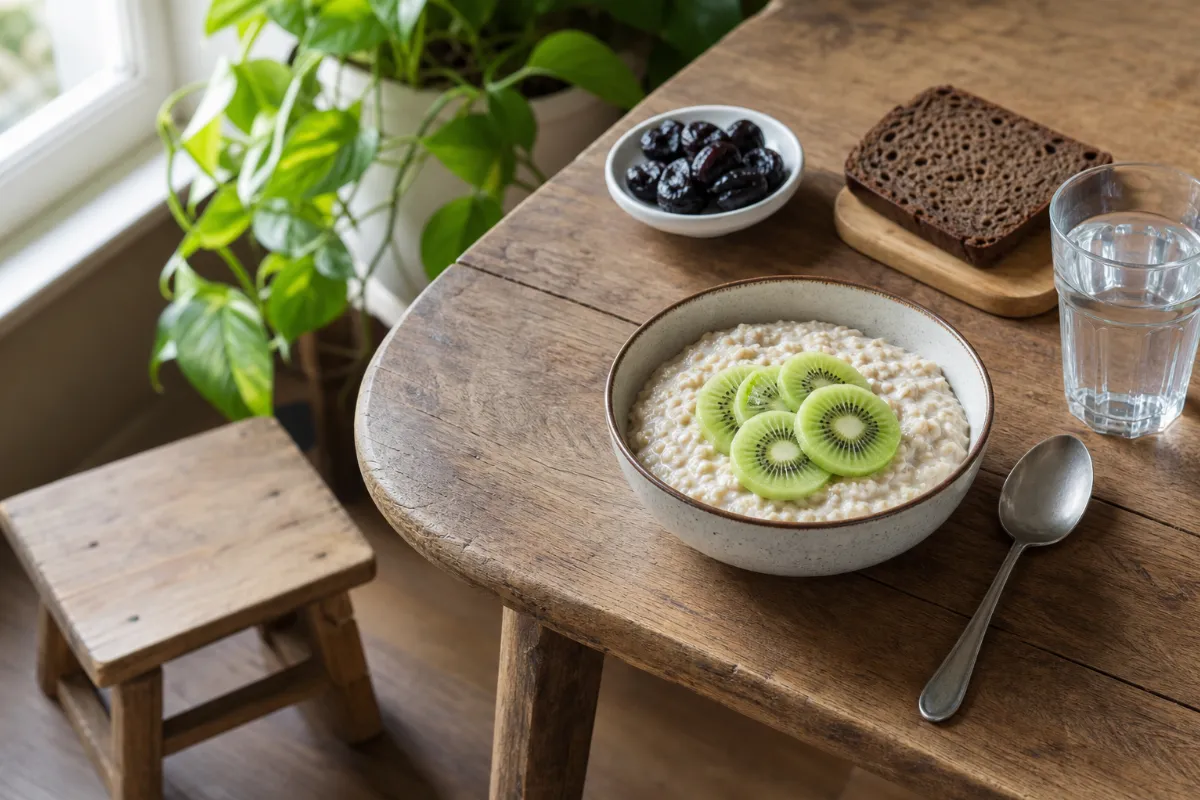
- Try 2 kiwifruit a day, prunes with a meal, or rye bread for a few weeks.
- Use a low footstool at the toilet.
- Try a psyllium supplement with water for about 4 weeks if food alone is not enough.
- Consider a strain-specific probiotic for several weeks, if suitable for you.
What to track
- Number of bowel movements each week and how easy they were.
- Stool form (a simple Bristol scale chart helps).
- Fibre foods and fluids on a typical day, plus any new medicine or supplement.
- Bloating, gas or pain after each change, so you can pace fibre.
When to reassess
Give habit changes a few days to a few weeks. If you are still constipated after about 3 to 4 weeks of consistent changes, or sooner if warning signs appear, see a pharmacist or doctor. Do not keep escalating laxatives.
When to seek professional support
- A pharmacist can advise on short-term options and check interactions with your medicines.
- A doctor can look for causes and arrange tests if red flags are present.
- A dietitian can help build a fibre plan, especially for IBS, older age or complex diets.
What helps
Ordered by how well the research supports each step. Evidence strength is shown on every card; precautions sit next to the advice.
Start here
Fibre-rich foods, increased gradually
Moderate certaintyAddresses: Softer, easier-to-pass stools and steadier habits
Why it may help: The NHS and NIDDK both advise a fibre-rich diet to treat and prevent constipation. The NHS says government guidelines recommend 30 g of fibre a day for adults and that most adults eat about 20 g; NIDDK says adults need about 22 to 34 g depending on age and sex. In a meta-analysis of 16 trials (1,251 adults with chronic constipation), 66% responded to fibre supplementation versus 41% on control, but trials of whole-food fibre alone are scarce.
How to apply it: Swap in wholemeal or granary bread, wholewheat pasta, brown rice, oats and porridge, and add beans, lentils or chickpeas to meals. Keep potato skins, eat fruit and vegetables with most meals, and snack on fruit, oatcakes, nuts and seeds. Add a little each week rather than all at once.
Who it may suit: Most adults. Older adults who eat less may need a dietitian's help with the plan.
Precautions: Raising fibre too fast can cause gas and bloating (flatulence was higher in the fibre groups). Drink fluids as you go. If you have a bowel condition such as IBS or IBD, ask your clinician how much and which types of fibre suit you.
4,5,3Drinking enough fluids through the day
Low certaintyAddresses: Helps fibre do its job and avoids dehydration, a recognised cause of hard stools
Why it may help: NIDDK says to drink plenty of water and other liquids to help fibre work better and to avoid dehydration, and lists not drinking enough as a cause of constipation. The NHS lists drinking plenty of fluids and avoiding alcohol among steps to soften stools. Controlled trials of simply adding extra plain water are limited (one study in a 2023 review), so the benefit is mainly for people who drink too little.
How to apply it: Keep water or other drinks (including soups and diluted fruit and vegetable juices) going through the day. Ask your clinician how much suits your size, health and activity.
Who it may suit: Most people, especially those raising their fibre or taking a fibre supplement.
Precautions: People advised by a clinician to limit fluids (for example with heart or kidney conditions) should follow that advice.
5,1,6A regular toilet routine, with time and no putting off
Low certaintyAddresses: Trains the bowel to a predictable rhythm
Why it may help: NHS and NIDDK both advise a regular time and place, plenty of time, and going as soon as you feel the urge. NIDDK suggests that trying 15 to 45 minutes after breakfast may help because eating helps the colon move stool. Ignoring the urge is listed as a cause of constipation. This advice rests on clinical guidance rather than trial results I could verify.
How to apply it: Choose the time you most often feel the urge, often after a meal. Sit for a few minutes, relax your muscles, and do not strain. Do not delay when the urge comes.
Who it may suit: Most adults; helpful when routine is disrupted by work, travel or shift patterns.
Precautions: If you need to strain a lot or cannot empty, do not keep pushing: speak to a clinician, as pelvic floor problems may be involved.
1,7,2Daily movement
Low certaintyAddresses: May improve constipation symptoms and keep the gut moving
Why it may help: The NHS says a daily walk or run can help you poo more regularly, and NIDDK says regular physical activity may help. A meta-analysis of nine randomized trials (680 people) found exercise improved constipation symptoms (relative risk 1.97), mostly walking, qigong and other aerobic activity, but the studies had a high risk of bias and very mixed results, so the true size of the effect is uncertain.
How to apply it: Aim for something you can keep up: a daily walk, cycling, swimming, gentle yoga or tai chi. Break up long periods of sitting or lying.
Who it may suit: Most adults, including older adults, adjusted to ability.
Precautions: If you have a heart condition, are recovering from surgery or have a medical condition, ask your clinician about suitable activity. Build up gradually.
1,7,8Additional options
Psyllium or other fibre supplements, with plenty of fluid
Moderate certaintyAddresses: Higher stool frequency and softer stools in people with constipation
Why it may help: In the 2022 meta-analysis of 16 trials, psyllium and pectin had significant effects on response and stool frequency. Improvement appeared mainly with higher doses (more than 10 g/day) and treatment of at least 4 weeks. NIDDK lists fibre supplements among options, and the NHS says that for non-prescription laxatives it is usually best to try a bulk-forming type first.
How to apply it: Used as directed on the product, taken with a full glass of water, and started low and built up. Judge it after about 4 weeks.
Who it may suit: Adults whose food fibre is hard to raise enough, or who prefer a supplement.
Precautions: Can increase gas and bloating. Bulk-forming products need enough fluid or they can make constipation worse. Swallowing difficulty, bowel narrowing or blockage mean they should not be used without medical advice. Take separately from other medicines if the leaflet says so.
3,7,9Psyllium → Fiber supplements compared → Psyllium, ginger and peppermint for digestion →
Green kiwifruit, a couple a day
Moderate certaintyAddresses: More complete spontaneous bowel movements and better abdominal comfort in constipated people
Why it may help: In a multicentre crossover trial (63 healthy adults, 60 with functional constipation and 61 with constipation-predominant IBS), eating 2 green kiwifruit a day for 4 weeks increased complete spontaneous bowel movements by about 1.5 to 1.7 per week in the constipated groups and improved gut comfort, with no significant adverse events. It was funded by a kiwifruit company. A 2022 review of 7 trials rated the certainty as low overall, and a 2024 review found kiwifruit gave about 0.36 more bowel movements per week than psyllium.
How to apply it: Eat 2 kiwifruit a day with the skin removed or scooped out, as used in the trial, for a few weeks and see how your pattern responds.
Who it may suit: Adults with sluggish bowels who like the fruit.
Precautions: Kiwifruit can cause mouth itching or allergic reactions in people with a kiwi, latex or birch pollen allergy; avoid if you are allergic. Fruit sugars can cause gas in some people.
10,11,6Prunes (dried plums)
Low certaintyAddresses: More complete spontaneous bowel movements and softer stools in mild to moderate constipation
Why it may help: In a single-blind crossover trial of 40 constipated people (37 women), 50 g of dried plums twice a day for 3 weeks improved weekly complete spontaneous bowel movements and stool consistency more than a psyllium comparison with matching fibre. A 2024 meta-analysis found no difference between prunes and psyllium. The NHS lists fruits containing sorbitol, such as apples, apricots, grapes and raisins, raspberries and strawberries, as a way to soften stools.
How to apply it: Include a small serving of prunes or other dried fruit as part of a meal. The NHS says dried fruit is better eaten with meals rather than as between-meal snacks because it is sticky and can raise the risk of tooth decay.
Who it may suit: Adults who like dried fruit.
Precautions: Prunes can cause gas, bloating and loose stools if you eat a lot. The trial was small and used a specific amount, so start small. Dried fruit is high in natural sugar, which matters for people with diabetes.
12,6,1,4Rye bread instead of white bread
Low certaintyAddresses: A little more stool frequency, softer stools and easier passing
Why it may help: In a randomized trial in 51 constipated adults, at least 240 g a day of whole-grain rye bread for 3 weeks shortened total gut transit time by 23%, increased weekly bowel movements by 1.4 and softened stools compared with white wheat bread, without more gut side effects. A 2024 meta-analysis of two trials found about 0.43 more bowel movements per week than with white bread.
How to apply it: Choose whole-grain rye bread in place of white bread at some meals.
Who it may suit: Adults who enjoy rye bread and tolerate wheat and gluten-containing grains.
Precautions: Rye contains gluten, so it is not suitable for people with celiac disease or gluten sensitivity. Trial amounts were large, so effects may be smaller with less.
13,6A low footstool to raise your knees
Very low certaintyAddresses: May reduce the effort of passing a stool
Why it may help: The NHS and NIDDK both suggest resting your feet on a low stool so your knees are above your hips. In a small study of 28 healthy volunteers, squatting reduced the time needed to feel emptied and the strain compared with sitting on a standard or low toilet seat. The study was small, in people with normal bowel function.
How to apply it: Place a small stool under your feet so your knees rise above your hips, lean forward slightly and relax.
Who it may suit: Anyone who strains or feels they cannot empty fully.
Precautions: Stability matters for older adults or anyone who is unsteady; use a stool that does not slip.
1,7,14Mineral-rich (high-magnesium, high-sulfate) drinking water
Low certaintyAddresses: Higher chance of a response in constipation
Why it may help: A 2024 meta-analysis of four trials (539 people) found that high-mineral water gave a higher response to treatment than low-mineral water (risk ratio 1.47). The British Dietetic Association guideline made recommendation statements on high-mineral water, graded low or very low evidence overall.
How to apply it: If you have easy access to such water, it can be one of your daily drinks. Check the label for magnesium and sulfate content.
Who it may suit: Adults with constipation who already drink bottled mineral water.
Precautions: Ask a clinician first if you have kidney problems or take regular medicines. It can loosen stools too much in some people.
6,15Still being studied
Probiotics, especially Bifidobacterium lactis
Low certaintyAddresses: Slightly more frequent bowel movements and softer stools in some trials
Why it may help: A 2014 meta-analysis of 14 trials (1,182 adults) found probiotics shortened gut transit time by about 12 hours and added about 1.3 bowel movements per week, with B. lactis showing the clearest effect and L. casei Shirota not. A 2022 meta-analysis of 30 trials found 57% responded to probiotics versus 44% to control, but results varied a lot between strains and studies, and synbiotics did not improve stool output.
How to apply it: If you try one, choose a product naming the specific strain, take it consistently for several weeks, and stop if there is no benefit. Fermented foods are discussed on the microbiome page.
Who it may suit: Adults with sluggish bowels who want a food-style option.
Precautions: NCCIH says the risk of harm is greater in people with severe illness or weakened immune systems, and that cases of severe infection have been reported in premature infants. Strain and dose differ between products. Ask a clinician first if you are immunocompromised.
16,17,18Abdominal massage
Low certaintyAddresses: May increase bowel frequency and ease symptoms
Why it may help: A 2024 meta-analysis of 23 studies (1,431 adults, including some non-randomized) found abdominal massage increased weekly bowel movements by about 1.6, shortened gut transit time and reduced constipation symptoms, but did not reduce laxative use. Results varied widely between studies and technique.
How to apply it: Gentle clockwise massage of the lower abdomen, learnt from a trained therapist or nurse, is the usual approach in studies.
Who it may suit: Adults who like a hands-on, low-risk option.
Precautions: Avoid massaging the abdomen if you are pregnant, have abdominal pain of unknown cause, a hernia, recent abdominal surgery, a bowel obstruction, or suspected inflammatory bowel disease, unless a clinician advises.
19Prebiotic fibres such as inulin and fructo-oligosaccharides
Not enough evidenceAddresses: Unclear for regularity
Why it may help: A 2021 systematic review of over-the-counter constipation therapies graded the evidence for polydextrose, inulin and fructo-oligosaccharide as insufficient, while psyllium and fruit-based products were graded moderate. These fibres can also ferment readily and cause gas.
How to apply it: If you want to try, start with very small amounts and compare with the fibre sources above.
Who it may suit: People who tolerate fermentable fibres well.
Precautions: Can worsen bloating, especially with IBS or when taken suddenly in larger amounts.
20Food & nutrition
Fibre in your daily food
The NHS says government guidelines recommend 30 g of fibre a day for adults and that most adults eat about 20 g. NIDDK gives a range of 22 to 34 g depending on age and sex. High-fibre foods have 6 g or more per 100 g.
Good sources named by the NHS and NIDDK include wholegrain cereals and breads, oats, bran flakes, wholewheat pasta, brown rice, potatoes with skins, beans, lentils, chickpeas, vegetables such as carrots, broccoli and peas, fruit such as berries, pears and apples with the skin, and nuts and seeds. The NHS suggests wheat bran, oats or linseed as additions.
Build up gradually. The NHS gives example days: wholemeal toast with peanut butter and an orange is about 8.3 g, wholemeal spaghetti with lentil sauce about 11 g, and a baked potato with skin, carrots and green beans with chicken about 11.2 g.
- Oats, porridge, plain wholewheat biscuit cereal
- Beans, lentils and chickpeas added to stews, curries and salads
- Fruit and vegetables with the skin, at most meals
- Nuts and seeds (unsalted), oatcakes, rye crackers
Fruit and bread with some evidence behind them
Green kiwifruit (about two a day), prunes and rye bread have each been tested in trials in constipated adults and showed more or softer bowel movements than comparison foods or psyllium in some studies. The 2024 review of foods concluded that fruits and rye bread may improve certain outcomes but that good trials are scarce. The NHS also lists fruit containing sorbitol, such as apples, apricots, grapes and raisins, raspberries and strawberries.
Pears, figs and other fruit also appear in our food pages; the trials above do not prove they work the same way.
10,12,13,6,1Fluids
NIDDK recommends water and other liquids such as naturally sweetened fruit and vegetable juices and clear soups, and says staying hydrated is good for health and can help avoid constipation. The NHS suggests drinking plenty of water and other fluids and avoiding alcohol. There is little trial evidence for extra plain water in people who are already well hydrated, but mineral-rich water was helpful in a pooled analysis.
5,1,6Meal timing and what to go easy on
Eating helps the colon move stool, which is why NIDDK suggests trying a bowel movement 15 to 45 minutes after breakfast. Regular meals help build a rhythm. NIDDK suggests avoiding foods with little to no fibre, such as chips, fast food and many processed foods.
Dried fruit is sticky and the NHS advises eating it with meals rather than as a between-meal snack to protect teeth.
7,5,4Remedies & supplements
Traditional use, laboratory findings and human trials are kept apart. "Natural" does not mean safe.
Psyllium
Moderate certaintyStudied form and route: Fibre supplement taken with water, often as husk powder or capsules
Intended outcome: Softer, more frequent stools
Human evidence: In a 2022 meta-analysis of 16 randomized trials (1,251 adults with chronic constipation), psyllium and pectin had significant effects; 66% responded to fibre overall versus 41% on control. Benefit appeared with more than 10 g/day and at least 4 weeks.
Traditional use: Psyllium is the type of fibre behind bulk-forming laxatives, which the NHS says are usually best to try first when buying without a prescription.
Laboratory findings: The NHS describes bulk-forming products as adding fibre to make stool bigger and softer, which triggers the bowel muscles to push it out.
Limits: Studies were heterogeneous; flatulence rose in fibre groups. Nutrition studies are rarely blinded well.
Interactions and precautions: Take with plenty of fluid. Do not use if you have difficulty swallowing, a narrowed bowel or blockage, or an unexplained change in bowel habit, without medical advice. Pregnant or breastfeeding women and people on regular medicines should ask a pharmacist.
Dose, only as reported in studies: Trials showing benefit generally used more than 10 g of fibre a day for at least 4 weeks; follow the product label.
3,9,7Probiotics (Bifidobacterium lactis and others)
Low certaintyStudied form and route: Capsules, powders or fermented foods
Intended outcome: Slightly higher stool frequency in some trials
Human evidence: Meta-analyses of 14 trials (1,182 adults, 2014) and 30 trials (2022) found modest benefit, strongest for B. lactis. Synbiotics did not help.
Traditional use: NCCIH notes probiotics are found in yogurt and other fermented foods as well as supplements; We did not review traditional-use sources.
Laboratory findings: NCCIH says probiotics might help maintain a healthy community of gut microorganisms; effects differ by type.
Limits: High heterogeneity and risk of bias; strains and doses vary and many products on sale were not the ones tested.
Interactions and precautions: Greater risk of harm in people with severe illness or weakened immunity; severe infections reported in premature infants. Ask a clinician first if this applies.
16,17,18Magnesium products taken by mouth
Moderate certaintyStudied form and route: Oral magnesium salts for constipation
Intended outcome: Softer stools through an osmotic effect
Human evidence: A 2021 systematic review of 41 randomized trials rated magnesium salts as moderate evidence for chronic constipation. The British Dietetic Association guideline made recommendation statements on magnesium oxide.
Traditional use: Not covered by the sources I read.
Laboratory findings: The NHS describes osmotic laxatives as bringing more water into the bowel so stool is softer; We did not review lab studies on magnesium itself.
Limits: These trials were short and varied by product. The review was part-funded by an industry sponsor. This is a short-term constipation tool, not a daily regularity habit.
Interactions and precautions: Diarrhoea, cramps and nausea are common. Anyone with kidney problems, heart conditions or on regular medicines should ask a doctor or pharmacist first. Not for long-term daily use without advice.
20,15Senna
Moderate certaintyStudied form and route: Stimulant herbal laxative (tea, tablets)
Intended outcome: Triggers a bowel movement within 6 to 12 hours
Human evidence: The 2021 systematic review graded senna as having good evidence for short-term chronic constipation. The NHS lists senna as a stimulant laxative that works in 6 to 12 hours.
Traditional use: The NHS lists senna as a stimulant laxative; We did not review traditional-use sources.
Laboratory findings: The NHS says stimulant laxatives trigger the bowel muscles to push stool out.
Limits: Trials were short; it is not a long-term regularity strategy. The review had industry funding.
Interactions and precautions: Short-term use only. The NHS says overuse can cause dehydration and low potassium. Do not use in suspected blockage or unexplained abdominal pain. Ask a clinician before using in pregnancy, breastfeeding, or alongside other medicines, and keep away from children unless advised.
20,9Kiwifruit extract or powder
Low certaintyStudied form and route: Whole fruit or encapsulated kiwifruit extract
Intended outcome: More bowel movements and abdominal comfort
Human evidence: A 2022 meta-analysis of 7 trials (399 people) found low-certainty evidence for more frequent bowel movements than placebo or psyllium, with moderate-certainty evidence for reduced abdominal pain. Extracts may cause more minor adverse events than placebo.
Traditional use: Not covered by the sources I read.
Laboratory findings: Not established; We did not review lab studies.
Limits: Trials were small and several were industry-funded.
Interactions and precautions: Avoid if allergic to kiwi or latex; extracts can cause minor gut upset.
11,10Therapies & care
For most adults, the NHS recommends trying diet and lifestyle changes first, then speaking to a pharmacist about a suitable laxative for short-term use if those are not enough. If constipation continues, a doctor can look for causes such as medicines or other conditions, may suggest a medicine for long-lasting constipation, or refer you for pelvic floor retraining. This page names options in general terms and gives no medicine recommendations or doses.
Bowel training (a timed daily routine)
Low certaintyBehavioural NIDDK says a doctor may suggest training yourself to have a bowel movement at the same time each day, for example 15 to 45 minutes after breakfast, giving enough time, using the bathroom as soon as you feel the need, and relaxing your muscles or using a footstool.
Who it may suit: Adults with irregular patterns or who tend to put off going.
Precautions: Do not strain for long periods; seek advice if you cannot empty.
7,1Review of medicines and supplements with a clinician
Moderate certaintyMedical review NIDDK says that if a medicine or supplement may be causing constipation your doctor may change the dose or suggest a different one. Do not change or stop anything yourself.
Who it may suit: Anyone whose constipation began after a new medicine or supplement.
Precautions: Never stop a prescribed medicine without talking to your doctor.
7,2,1Pelvic floor retraining (biofeedback)
Not enough evidenceSpecialist therapy NIDDK says that if problems with the muscles that control bowel movements are involved, a doctor may recommend biofeedback to retrain them.
Who it may suit: People who strain a lot, feel they cannot empty, or have pelvic floor problems, after assessment.
Precautions: Needs a clinician's assessment; We did not review trials on it.
7Dietitian support
Moderate certaintyNutrition care NIDDK suggests talking with a dietitian to plan meals with the right amount of fibre, especially for older adults. The British Dietetic Association has published dietary guidelines for chronic constipation in adults based on 75 trials.
Who it may suit: Older adults, people with chronic symptoms, and anyone who finds fibre hard to tolerate.
Precautions: Ask for a dietitian with experience in gut conditions if you have IBS or IBD.
5,15Abdominal massage
Low certaintyHands-on A 2025 meta-analysis found improved frequency and symptoms, with high variability between studies.
Who it may suit: Adults wanting a gentle non-dietary option.
Precautions: Avoid with pregnancy, hernia, recent surgery, suspected obstruction or undiagnosed abdominal pain.
19Pharmacist advice on short-term laxatives
High certaintyEstablished care The NHS says to speak to a pharmacist if diet and lifestyle changes are not helping; most laxatives work within 3 days, and non-prescription laxatives should not be taken for longer than 7 days.
Who it may suit: Adults when habits alone have not helped, after checking for other medicines.
Precautions: Overuse can cause dehydration, low potassium and bowel blockage. Speak to a doctor if 3 days of use does not help.
9,1What to avoid
Habits, products and claims that can get in the way. Never stop a prescribed medicine without talking to the professional who prescribed it.
Risks that apply to most people
Ignoring the urge to go
Low certaintyWhy: The NHS and NIDDK both list ignoring the urge as a cause of constipation, and advise going as soon as you feel it.
Who it applies to: Anyone busy, travelling or uncomfortable using public toilets.
Try instead: Build a regular time into your day and answer the urge when it comes.
1,2A sudden jump in fibre, or fibre without fluids
Moderate certaintyWhy: NIDDK says to add fibre a little at a time so your body gets used to the change, and to drink liquids so fibre works better. Meta-analysis data show more flatulence in fibre groups.
Who it applies to: Anyone starting a high-fibre diet or fibre supplement.
Try instead: Raise fibre slowly over weeks and drink fluids through the day.
5,3Diets built on low-fibre processed food
Low certaintyWhy: NIDDK suggests avoiding foods with little or no fibre when constipated, such as chips, fast food, meat-heavy prepared meals and processed foods like hot dogs and microwavable dinners.
Who it applies to: People who eat mostly convenience foods.
Try instead: Keep wholegrains, legumes, fruit, vegetables, nuts and seeds in most meals.
5,4Long periods of sitting or lying down
Low certaintyWhy: The NHS lists not moving enough and long periods sitting or lying as common causes of constipation.
Who it applies to: Desk workers, people recovering from illness, and anyone with limited mobility.
Try instead: Break up sitting with short walks and aim for regular daily activity.
1,8Personal triggers to check
Changes in routine: travel, shift work, new schedules
Low certaintyWhy: NIDDK and the NHS list travel and changes to daily routine or diet as common triggers.
Who it applies to: Travellers, shift workers, new parents, people starting a new job.
Try instead: Keep fluids and fibre steady while travelling, keep your usual meal and toilet timing as far as you can.
2,1Medicines and supplements that can slow the bowel
Moderate certaintyWhy: NIDDK lists iron supplements, antacids containing aluminium or calcium, medicines for pain, depression, seizures, blood pressure, Parkinson's disease and some others as possible causes. The NHS also names opioid painkillers.
Who it applies to: Anyone taking regular medicines or supplements, especially older adults.
Try instead: Do not stop a prescribed medicine. Speak to your doctor or pharmacist, who may adjust the dose or suggest an alternative.
2,7,1Alcohol
Low certaintyWhy: The NHS suggests avoiding alcohol when trying to soften stools, in the context of drinking enough fluids.
Who it applies to: Anyone with frequent hard stools.
Try instead: Choose water and other non-alcoholic drinks, and keep alcohol modest.
1Stress, anxiety and low mood
Low certaintyWhy: The NHS lists stress, anxiety or depression as possible causes of constipation.
Who it applies to: People under pressure or struggling emotionally.
Try instead: Work on the basics above and see the stress-related digestive page; seek help for ongoing low mood or anxiety.
1Products that need caution
Relying on laxatives for regularity
High certaintyWhy: The NHS says to try lifestyle changes first, use laxatives only for a short time, and not for longer than 7 days without advice. Using them too often can cause dehydration, low potassium in the blood and bowel blockage. NIDDK says that if you cannot pass stool without them, talk to your doctor about slowly stopping.
Who it applies to: Anyone using laxatives most weeks.
Try instead: Use food, fluids, movement and routine as the base. If these do not work, see a pharmacist or doctor rather than increasing laxative use.
9,7Senna tea, 'detox' teas and herbal laxative products used every day
Moderate certaintyWhy: Stimulant-type herbal products are not meant for daily long-term use. The NHS says stimulant laxatives work by triggering the bowel muscles, take 6 to 12 hours, and should be used briefly, and a systematic review graded senna as effective for short-term constipation but not as a routine habit.
Who it applies to: People using teas or capsules for weight loss, 'cleansing' or regularity.
Try instead: Keep stimulant products for occasional, short-term use after advice, and focus on diet and routine.
9,20Fibre supplements taken with little or no fluid
Moderate certaintyWhy: The NHS says people on bulk-forming laxatives should drink plenty of fluids to avoid dehydration, and NIDDK says liquids help fibre work.
Who it applies to: Anyone using psyllium or similar products.
Try instead: Take with a full glass of water and increase slowly.
9,5Colon cleanses and 'detox' programmes
Not enough evidenceWhy: The NHS and NIDDK pages I read point to fibre, fluids, movement and routine, not cleanses, for keeping regular. Repeated cleansing can cause dehydration and mineral imbalance.
Who it applies to: People drawn to cleanses for regularity.
Try instead: Stick to the basics, and see our claim-check page on cleanses.
1,7Unsupported claims
"You must have a bowel movement every day"
Moderate certaintyWhy: The NHS and NIDDK describe constipation as fewer than three bowel movements a week, with stool quality and ease also mattering. A daily movement is common but not required.
Who it applies to: Wellness marketing and social media.
Try instead: Judge your pattern by comfort, stool softness and how it compares with your usual.
1,2"Probiotics fix constipation"
Low certaintyWhy: Meta-analyses show modest improvements for some strains, notably B. lactis, but not for all strains, and heterogeneity is high. Synbiotics did not improve stool output.
Who it applies to: Probiotic product labels.
Try instead: Treat probiotics as a possible extra for some people, not a cure.
16,17"The more fibre the better"
Moderate certaintyWhy: Benefits in trials depended on fibre type, dose and duration, and flatulence rose. NIDDK advises building up gradually and drinking fluids; the NHS cautions to get fibre from a variety of sources.
Who it applies to: High-fibre diet trends.
Try instead: Aim for the recommended range and increase gradually.
3,5,4Common mistakes
Straining hard or sitting for long periods
Low certaintyWhy: Straining and a feeling of incomplete emptying are symptoms of constipation. The NHS advises giving yourself plenty of time but not forcing; use a footstool and relax.
Who it applies to: Anyone struggling to pass stool.
Try instead: Relax, lean forward with knees up, and stand up and try again later if nothing happens.
1,14Giving up too soon, or changing everything at once
Low certaintyWhy: The NHS says it may take a few days or a few weeks for simple changes to help. Changing many things at once makes it hard to see what is working.
Who it applies to: People who want fast results.
Try instead: Change one or two things, keep a simple diary, and allow at least a few weeks.
1,3Stopping a medicine on your own
High certaintyWhy: The NHS says to speak to the GP before you stop any prescribed medicine, even if you think it is causing constipation.
Who it applies to: Anyone on regular medicines.
Try instead: Book a medication review with your doctor or pharmacist.
1,7Evidence & safety
What the research shows
Health agencies agree on the basics for keeping regular: enough fibre, enough fluids, regular movement and an unhurried toilet routine, with changes made gradually. Controlled trials, almost all in people with chronic constipation, support fibre supplements (especially psyllium), kiwifruit and some probiotic strains, with smaller or less certain evidence for prunes, rye bread, mineral water, exercise and abdominal massage. Most studies are short, small and vary widely, so the evidence is moderate at best and the practical advice is still sensible to try.
Limits of the evidence
- Most trials enrolled adults with chronic constipation, so results may not map exactly onto people who are only mildly irregular.
- Fibre, probiotic and exercise meta-analyses showed high heterogeneity and, for exercise and probiotics, high risk of bias.
- Several fruit trials were funded by industry sponsors.
- Food and diet trials are scarce; a 2024 review found only 17 randomized trials across all foods and drinks, and the British Dietetic Association guideline graded most statements low or very low evidence.
- Basics like regular toilet timing and extra water rest more on clinical guidance than on trial results.
Precautions and interactions
- Check supplements, herbs and probiotics with a pharmacist if you take any medicine or have a long-term condition.
- Stop new foods or supplements that cause persistent pain, vomiting or diarrhoea.
- Do not use laxative products for long periods or give them to children without medical advice.
- This page is general information and does not replace care from your doctor.
Life-stage considerations
- Pregnancy and breastfeeding: constipation is common, and the NHS says simple diet and lifestyle measures are safe to try. Ask your midwife, doctor or pharmacist before using supplements, herbal laxatives or magnesium products.
- Older adults: constipation is more common after 65; fibre intake can fall with appetite. Fluids matter, and dementia or confusion may signal constipation. Check medicines with your clinician.
- Children: needs and advice differ. See the NHS information for children and ask a doctor before using products.
Warning signs
- Blood in the stool or rectal bleeding, black or tarry stools.
- Unexplained weight loss, tiredness or signs of anaemia.
- Constant, severe or night-waking abdominal pain, repeated vomiting, fever, back pain, or being unable to pass gas.
- A sudden change in your bowel habit, or new symptoms after 50; family history of bowel cancer or inflammatory bowel disease.
- Trouble swallowing, or symptoms lasting more than a few weeks without improving.
- Leaking of loose stool around hard stool, which can happen with long-term constipation.
Claim checks
You need a bowel movement every day to be healthy
Moderate certaintyNot supported. The NHS and NIDDK define constipation as fewer than three bowel movements a week, along with hard stools or straining. Comfort and consistency matter more than a daily count.
1,2Fibre supplements fix constipation
Moderate certaintyPartly supported. A meta-analysis of 16 trials found more responders with fibre, particularly psyllium at more than 10 g a day for 4 weeks or longer, but with heterogeneity and more gas.
3Kiwifruit works as well as laxatives
Moderate certaintyPromising but not proven. A large trial found about 1.5 more bowel movements a week with 2 kiwifruit a day compared with baseline, and reviews rate certainty low to moderate; it has not been compared head-to-head with most laxatives.
10,11Prunes work better than psyllium
Mixed findingsMixed. One small crossover trial favoured prunes, but a 2024 meta-analysis found no difference between them.
12,6Probiotics regulate the bowels for everyone
Low certaintyNot supported as a general claim. Benefit was seen for certain strains such as B. lactis, not for all, and synbiotics showed no improvement in stool output.
16,17Colon cleanses or detox teas keep you regular
Not enough evidenceNo support in the health agency pages I read, which recommend fibre, fluids, movement and routine. Stimulant products are for short-term use and overuse can cause harm.
1,9,7Squatting or a footstool makes passing stool easier
Very low certaintyPlausible but based on a very small study of healthy volunteers, plus NHS and NIDDK practical advice. Low risk to try.
14,1Questions people ask
How often should I have a bowel movement?
There is no single right number. The NHS and NIDDK describe constipation as fewer than three bowel movements a week, with hard, dry or lumpy stools, straining or a feeling of incomplete emptying. A steady comfortable pattern that is normal for you is the goal.
How much fibre do I need?
The NHS says government guidelines recommend 30 g a day for adults, and most adults eat about 20 g. NIDDK gives a range of 22 to 34 g depending on age and sex. Raise it gradually and drink fluids.
Why does extra fibre make me gassy or bloated?
A meta-analysis found more flatulence in fibre groups than in controls. Adding fibre a little at a time, spreading it through the day and drinking fluids usually helps. If bloating is a big problem, see the bloating page.
Do I really need to drink more water?
NIDDK and the NHS advise plenty of fluids, and not drinking enough is a recognised cause of constipation. Trials of extra plain water in people who are already hydrated are limited, so the benefit is mostly if you drink too little.
What is the best time to go to the toilet?
NIDDK suggests trying 15 to 45 minutes after breakfast, because eating helps the colon move stool. Choose a regular time and place, allow enough time, and go when you feel the urge.
Do kiwifruit or prunes really help?
Some trials suggest they do. Two green kiwifruit a day increased bowel movements in constipated adults in a multicentre trial, and prunes did in a small crossover trial. Evidence is encouraging but limited and some research was industry funded.
Are probiotics worth trying?
They may help a little, mainly certain strains such as Bifidobacterium lactis. Results vary, and people with weakened immune systems or serious illness should ask a clinician first.
Can I take a laxative every day to stay regular?
No. The NHS says non-prescription laxatives are for short-term use and should not be taken for longer than 7 days. Frequent use can cause dehydration, low potassium and bowel blockage. See a pharmacist or doctor if you need them often.
Can my medicines or supplements be causing irregularity?
Yes. NIDDK lists iron supplements, some antacids, and medicines for pain, depression, seizures, blood pressure and Parkinson's disease among possible causes. Do not stop anything yourself; talk to your doctor or pharmacist.
Is constipation in pregnancy normal?
It is common. The NHS says simple diet and lifestyle measures are safe to try during pregnancy. Check with your midwife or doctor before using supplements or herbal laxatives.
When should I see a doctor?
See a doctor if you have blood in your stool, black stools, unexplained weight loss, severe or constant pain, vomiting, fever, a sudden change in bowel habit, new symptoms after 50, a family history of bowel cancer or IBD, or if symptoms last more than a few weeks or do not improve.
What is the difference between this goal and easing occasional constipation?
This page is about everyday habits that keep you regular. Ease Occasional Constipation focuses on relieving a stubborn spell, and Increase Fibre Comfortably covers fibre types and how to raise them gently.
References
- NHS. Constipation. Page last reviewed 26 October 2023. Read 2026-10-31. source
- NIDDK. Symptoms & Causes of Constipation (last reviewed May 2018). Read 2026-10-31. source
- van der Schoot A, et al. The Effect of Fiber Supplementation on Chronic Constipation in Adults: An Updated Systematic Review and Meta-Analysis of Randomized Controlled Trials. Am J Clin Nutr. 2022. source
- NHS. How to get more fibre into your diet. Page last reviewed 2 March 2026. Read 2026-10-31. source
- NIDDK. Eating, Diet, & Nutrition for Constipation (last reviewed May 2018). Read 2026-10-31. source
- Van Der Schoot A, et al. Systematic review and meta-analysis: Foods, drinks and diets and their effect on chronic constipation in adults. Aliment Pharmacol Ther. 2024. source
- NIDDK. Treatment for Constipation (last reviewed May 2018). Read 2026-10-31. source
- Gao R, et al. Exercise therapy in patients with constipation: a systematic review and meta-analysis of randomized controlled trials. Scand J Gastroenterol. 2019. source
- NHS. Laxatives. Read 2026-10-31. source
- Gearry R, et al. Consumption of 2 Green Kiwifruits Daily Improves Constipation and Abdominal Comfort: Results of an International Multicenter Randomized Controlled Trial. Am J Gastroenterol. 2023. source
- Eltorki M, et al. Kiwifruit and Kiwifruit Extracts for Treatment of Constipation: A Systematic Review and Meta-Analysis. Can J Gastroenterol Hepatol. 2022. source
- Attaluri A, et al. Randomised clinical trial: dried plums (prunes) vs. psyllium for constipation. Aliment Pharmacol Ther. 2011. source
- Holma R, et al. Constipation is relieved more by rye bread than wheat bread or laxatives without increased adverse gastrointestinal effects. J Nutr. 2010. source
- Sikirov D. Comparison of straining during defecation in three positions: results and implications for human health. Dig Dis Sci. 2003. source
- Dimidi E, et al. British Dietetic Association Guidelines for the Dietary Management of Chronic Constipation in Adults. J Hum Nutr Diet. 2025. source
- Dimidi E, et al. The effect of probiotics on functional constipation in adults: a systematic review and meta-analysis of randomized controlled trials. Am J Clin Nutr. 2014. source
- van der Schoot A, et al. Probiotics and synbiotics in chronic constipation in adults: A systematic review and meta-analysis of randomized controlled trials. Clin Nutr. 2022. source
- NCCIH. Probiotics: Usefulness and Safety (last updated August 2019). Read 2026-10-31. source
- Huang SY, et al. Effectiveness of abdominal massage on chronic constipation in adults: A systematic review and meta-analysis. Int J Nurs Stud. 2025. source
- Rao SSC, Brenner DM. Efficacy and Safety of Over-the-Counter Therapies for Chronic Constipation: An Updated Systematic Review. Am J Gastroenterol. 2021. source
Related on AlternativeMed
Related goals
Ease Occasional Constipation → Increase Fiber Comfortably → Feel More Comfortable After Meals → Manage Loose Stools & Diarrhea → Reduce Bloating → Support a Healthy Gut Microbiome → Manage Stress-Related Digestive Discomfort → Stay Hydrated for Daily Wellbeing →
Ingredients, foods and supplements
Psyllium → Senna → Kiwifruit → Prunes → Oats → Magnesium → Fiber supplements compared →
Research, safety and claim-check resources
Digestive symptoms: red flags and when to get help → Psyllium, ginger and peppermint for digestion → How digestion and the gut microbiome work → Gut and digestive health: research and evidence → Leaky gut, cleanses and gut tests: claim check → Gut & Digestive Health → Medication interactions →