Women's Wellness
Understand Your Menstrual Cycle
A menstrual cycle is the pattern of hormone changes that repeats about every month, and knowing what is typical for you makes it easier to spot a real change. This page is about the normal cycle and simple tracking; period pain, premenstrual symptoms, heavy or irregular bleeding and menopause have their own pages.
General information, not medical advice. Last updated November 1, 2026. Written by the AlternativeMed editorial team. Not medically reviewed.
Start here
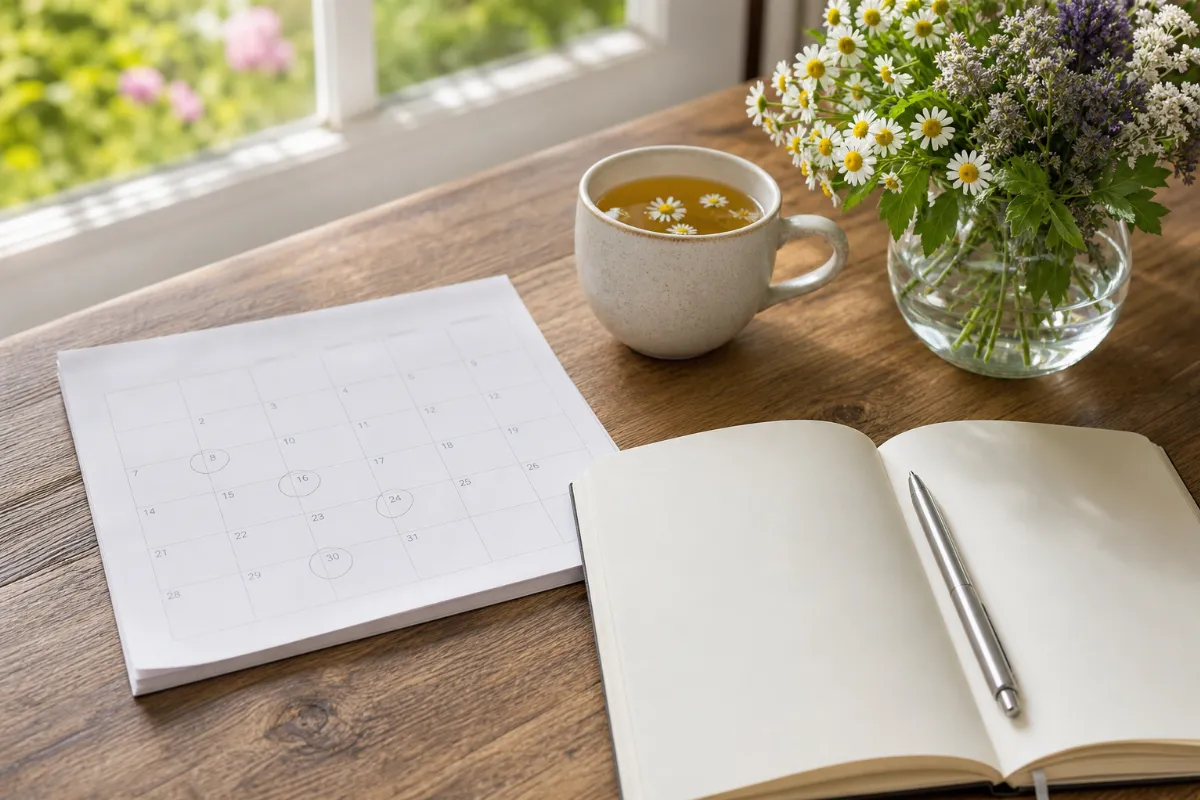
- Mark the first day of each period on a calendar or in a notebook. The cycle is counted from the first day of one period to the first day of the next.
- For two to three cycles also note how many days the bleeding lasts, how heavy it is, and any pain or premenstrual symptoms.
- Compare your pattern with the typical ranges on this page and take any change from your usual pattern, or any red flag below, to a clinician.
Be careful with
- Cycles vary from person to person and month to month, so a single early or late period is not usually a sign of a problem. A lasting change from your own pattern is worth checking.
- Period-tracking apps and calendar predictions are estimates. The NHS says none of the fertility-tracking apps and devices are officially recommended by it, so do not rely on one to avoid pregnancy.
- Do not start, stop or change any prescribed medicine, including hormonal contraception, because of what a tracker shows. Talk to the prescriber.
Get help when
- Periods that are irregular or change from your usual pattern, or that last longer than 7 days (NHS). Women's Health.gov also lists cycles shorter than 24 days or longer than 38 days.
- No period for 90 days when you are not pregnant or breastfeeding (Women's Health.gov), or three missed periods in a row after a negative pregnancy test (NHS).
- Bleeding between periods or after sex, or any bleeding after menopause (NHS).
- Soaking a pad or tampon every one to two hours, passing large clots, bleeding for more than 8 days, or feeling tired or breathless a lot with heavy periods.
- Severe pain that is worse than usual or stops you doing normal activities. The NHS says to contact a GP urgently or call NHS 111 if severe pain is not helped by painkillers.
- A girl who has not started periods by age 15, started before age 8, or has not started within three years of breast development (Women's Health.gov).
About Understand Your Menstrual Cycle
What this goal means
This goal is about understanding the normal menstrual cycle: what happens in it, what range is typical, and how to notice what is usual for you. MedlinePlus describes menstruation as the monthly bleeding that happens when pregnancy does not occur, when the uterus sheds its lining.
Women's Health.gov explains that hormones prepare the uterus for pregnancy each month; around ovulation the brain releases luteinizing hormone (LH), which triggers an ovary to release an egg. If pregnancy does not happen, estrogen and progesterone fall and the lining is shed as a period.
1,2What is typical
The NHS says a cycle of around 28 days is typical but anywhere from 21 to 35 days is common, and periods last 2 to 7 days, usually about 5, with the heaviest bleeding in the first 2 days. Women's Health.gov gives a wider normal range for adult cycles of 24 to 38 days. The two agencies draw the line slightly differently, which is a reminder that normal is a range.
The NHS gives normal blood loss as about 20 to 90 ml (roughly 1 to 5 tablespoons). Women's Health.gov gives an average of about two to three tablespoons. Colour can be red when heaviest and pink or brown on lighter days (NHS).
3,2How to count and what ovulation means
Count from the first day of one period to the first day of the next; that gap is one cycle (Women's Health.gov, MedlinePlus). Women's Health.gov says ovulation usually occurs roughly 7 to 19 days before the next period starts, and the NHS says about 12 to 16 days before. The sources differ, and ovulation can move from cycle to cycle.
Possible signs around ovulation listed by Women's Health.gov are clearer, more slippery vaginal discharge, mild one-sided pelvic cramping and a slight rise in basal body temperature. These are not reliable enough on their own to predict a fertile day.
2,3,1Life stages
Most people start periods between ages 9 and 15 (MedlinePlus); the NHS says usually around age 12, and that most girls have regular periods by 16 to 18. Cycles can take a few years to settle: Women's Health.gov says cycles longer than 38 days are common in teens for a few years and usually become regular within three years.
Cycles are usually regular in the 20s and 30s, and may become irregular in the 40s as menopause approaches (Women's Health.gov). The NHS says periods continue until menopause, typically in the mid-40s to mid-50s, with a UK average of 51, and they often become less frequent for months or years before stopping. See the perimenopause page for that stage.
1,3,2What can change a cycle
The NHS lists puberty, approaching menopause, pregnancy, hormonal contraception, significant weight loss or gain, stress and anxiety, excessive exercise, and conditions such as polycystic ovary syndrome (which the NHS now calls PMOS) or thyroid problems as common causes of irregular periods. Heavy periods can be normal at some life stages but can also be linked to conditions of the womb or ovaries, bleeding disorders, or some medicines (NHS).
Hormones also move your mood, energy and sleep through the month. Premenstrual symptoms such as bloating, breast tenderness, mood swings, irritability, spotty skin and headaches are common and usually ease once the period starts, though not everyone gets them (NHS).
4,5,3Realistic expectations
Tracking will not make your cycle more regular and does not diagnose anything. What it can do is give you and a clinician an accurate picture, which the NHS and Women's Health.gov both suggest when pattern changes need checking. Expect two or three cycles of notes before you can see a pattern, and expect some month-to-month variation even when everything is fine.
2,4Who this applies to
Anyone who has periods, from the first period through to menopause. If you are using a method to avoid pregnancy, see a contraception service rather than relying on this page. People who are pregnant, recently postpartum or breastfeeding, or using hormonal contraception may find their bleeding pattern differs from the typical cycle described here (NHS lists hormonal contraception among causes of irregular periods).
4,6Related conditions and symptoms
Period pain and menstrual cycle health → PMS and PMDD → Heavy and irregular periods → Perimenopause and menopause → Endometriosis and fibroids → Polycystic ovary syndrome (PCOS) → Thyroid problems and fatigue →
A manageable starting plan
An educational starting point, not a personal prescription. Adjust it to your own situation and any advice from your clinician.
Your first actions
- Record the first day of each period for the next 3 months.
- Note bleeding length and heaviness, plus pain and premenstrual symptoms, in a few words a day.
- Compare your results with the typical ranges and the red flags on this page.
Optional additions
- Look at how stress, training and weight changes line up with your cycle.
- Try an app or calendar for reminders, entering real dates.
- Read the pages on period pain, PMS or heavy periods if they fit.
What to track
- First day of each period and the cycle length.
- How many days you bleed and how heavy it is.
- Pain, mood and sleep around the period; any bleeding between periods or after sex.
When to reassess
After about three cycles, look back at your diary. If cycles fall outside the typical range, the pattern has changed, or anything on the warning-sign list applies, take the diary to a clinician. Sooner is better for red flags.
When to seek professional support
- Talk to a GP or a women's or contraceptive clinic about changes.
- Ask a pharmacist about interactions before trying any supplement.
- Share your diary with the clinician; it makes the visit more useful.
What helps
Ordered by how well the research supports each step. Evidence strength is shown on every card; precautions sit next to the advice.
Start here
Counting your cycle from day 1 to day 1
Moderate certaintyAddresses: Gives you a cycle length you can compare with the typical range
Why it may help: Women's Health.gov and MedlinePlus both define the cycle as the first day of one period to the first day of the next. Using the same starting point each time makes your numbers comparable with the 21 to 35 day (NHS) or 24 to 38 day (Women's Health.gov) ranges.
How to apply it: Write down the date bleeding starts. After a few cycles, subtract the dates to get your cycle lengths and see the shortest and longest.
Who it may suit: Anyone who has periods.
Precautions: A single length is not a diagnosis; look at several cycles.
2,1,3Keeping a short period diary
Moderate certaintyAddresses: Builds a clear picture of your own pattern and helps a clinician see it too
Why it may help: Women's Health.gov suggests marking the first day on a calendar and noting PMS symptoms, when bleeding starts, how heavy it is, how many pads or tampons you use, and how long the period lasts. The NHS heavy-periods page lists signs worth noticing, such as changing products every 1 to 2 hours, needing two products at once, periods over 7 days, large clots, leaking, or missing exercise or work.
How to apply it: Use a paper calendar or a notes page. Add pain, mood and sleep in a few words. Take the diary to appointments.
Who it may suit: People with changing, unpredictable or uncomfortable periods, and anyone curious about their cycle.
Precautions: Keep it light: if tracking makes you anxious, track fewer things or take a break.
2,5Knowing which changes need a check
Moderate certaintyAddresses: Helps you act early on the changes that matter
Why it may help: The NHS says changes such as longer or lighter periods do not necessarily mean a problem, but should be checked, and that bleeding between periods, after sex or after menopause needs assessment. Women's Health.gov lists cycles shorter than 24 or longer than 38 days, no period for 90 days, and severe pain or bleeding that makes you miss work or school.
How to apply it: Compare your diary with the red flags on this page. If anything fits, book an appointment instead of waiting for it to settle.
Who it may suit: Everyone, and particularly people who are tempted to put changes down to stress.
Precautions: This page cannot tell you the cause of a change; only an assessment can.
3,2,5Additional options
Noticing premenstrual patterns
Low certaintyAddresses: Shows whether symptoms follow the cycle
Why it may help: The NHS describes PMS as symptoms caused by hormone changes before a period that usually ease once bleeding starts. A diary that marks symptom days against cycle days shows whether yours follow that pattern or not.
How to apply it: Note mood, bloating, headaches and sleep each day for two to three cycles, and look at where they fall.
Who it may suit: People with mood, pain or energy changes that seem to come and go.
Precautions: If mood symptoms are severe or you have thoughts of harming yourself, seek help promptly; see the PMS and PMDD page.
3Noticing possible ovulation signs
Low certaintyAddresses: Adds context, but is not a reliable prediction
Why it may help: Women's Health.gov lists clearer, slippery discharge, mild one-sided cramping and a slight rise in basal body temperature as possible signs. It also says LH rises about 36 hours before ovulation and ovulation timing varies. The NHS says sperm can survive up to 7 days, so the fertile window starts before ovulation.
How to apply it: If you are curious, note discharge and any one-sided cramps in your diary. Treat them as clues, not proof.
Who it may suit: People curious about their cycle or trying to understand fertility timing.
Precautions: Do not use these signs on their own to avoid or to plan a pregnancy; ask a contraception or fertility service.
2,3Steady everyday habits when your cycle shifts
Low certaintyAddresses: May reduce lifestyle-related disruption
Why it may help: The NHS lists significant weight loss or gain, stress and anxiety, and excessive exercise among common causes of irregular periods. We did not find, in the pages read, a trial showing that changing these restores a regular cycle, so this is a sensible watch point rather than a proven fix.
How to apply it: If your cycle changed during a stressful or demanding period, note it in the diary and look for a return to your pattern. If it does not return, see a clinician.
Who it may suit: People whose periods changed during a big life, weight, training or stress change.
Precautions: Do not diet hard or train harder to try to fix a cycle. A pattern of restriction, bingeing, purging or fear of eating needs professional support.
4Eating disorders and disordered eating → Feel Calmer & Manage Stress →
Still being studied
Using a calendar or app to predict the next period
Not enough evidenceAddresses: Convenient, but only an estimate
Why it may help: The NHS period page says an online calendar can estimate when your next period will start and when peak ovulation is likely. Because normal cycles span a range of days, the estimate can be off, especially if your cycle is irregular, and the NHS fertility page says it does not officially recommend any fertility apps or devices. We did not read trials of tracking-app accuracy for this page.
How to apply it: Use an app or calendar for reminders and record-keeping, but enter real dates rather than relying on the app's prediction. Check the privacy settings if the app stores health data.
Who it may suit: People who want reminders or a record to share with a clinician.
Precautions: Apps may be wrong for irregular cycles. Not suitable as contraception.
3,6Fertility awareness (tracking temperature, discharge and cycle)
Mixed findingsAddresses: Effectiveness depends heavily on careful, correct use
Why it may help: The NHS says fertility awareness is 91% to 99% effective with perfect use but 76% effective with imperfect use (about 24 in 100 women pregnant within a year). The NHS says it may not suit people with irregular periods, or people who need to avoid pregnancy because of a health condition.
How to apply it: This is a contraception method, not a general wellness tool. If you are interested, ask a contraception service or a trained fertility awareness teacher.
Who it may suit: People choosing a non-hormonal method of avoiding pregnancy with regular cycles.
Precautions: Needs daily records and training; a health condition, irregular cycle, recent birth or perimenopause can make it unreliable.
6Food & nutrition
Food and the normal cycle
We did not find, in the agency pages read for this page, a specific diet that makes a normal cycle more regular. The NHS lists significant weight loss or gain among causes of irregular periods, so steady, adequate eating matters more than any single food.
Heavy periods can leave people short of iron (the NHS heavy-periods page lists feeling tired or short of breath a lot as a sign to get checked). Iron, folate, calcium and vitamin D are covered in the women's nutrition guide.
- Regular meals that provide enough energy
- A variety of foods rather than strict rules
- Ask a clinician about a blood test if heavy periods come with tiredness or breathlessness
Remedies & supplements
Traditional use, laboratory findings and human trials are kept apart. "Natural" does not mean safe.
Herbs and supplements marketed to 'regulate' the cycle
Not enough evidenceStudied form and route: Capsules, teas and tinctures
Intended outcome: Claimed to make cycles regular or to 'balance' hormones
Human evidence: We did not find, in the agency pages read for this page, evidence that a herb or supplement regulates a normal menstrual cycle. Individual herbs such as chasteberry are rated on their own pages.
Traditional use: Many herbs have traditional uses for periods; traditional use alone is not evidence that they work.
Limits: The pages read here did not review these products, so no rating can be given beyond what is missing.
Interactions and precautions: Herbs and supplements can interact with medicines, including hormonal contraception and thyroid medicines, and are mostly unstudied in pregnancy and breastfeeding. Irregular cycles need assessment first. Do not stop a prescribed medicine to try a supplement.
4Therapies & care
Established care for a changing cycle starts with a conversation and sometimes tests to find the cause; the treatment depends on that cause and is decided with a clinician. This page recommends no medicines or doses, and you should not start, stop or change a prescribed medicine on your own.
Assessment by a GP or women's health clinic
High certaintyMedical care The NHS says treatment for irregular periods is not always needed, that a GP may refer you to a specialist for tests to find the cause, and that treatment depends on that cause. You can also see a women's or contraceptive clinic about period changes.
Who it may suit: Anyone with a lasting change, a red flag, or periods that affect daily life.
Precautions: Bring your diary and a list of medicines and supplements.
4,3Clinician-led hormonal options
Moderate certaintyMedical treatment (class only) The NHS notes that hormonal contraception can change bleeding patterns and that the combined pill can be used to delay a period; a GP, pharmacist or sexual health clinic advises how, and it is not suitable for everyone. Whether any hormonal option suits you depends on your history.
Who it may suit: People who want to talk about changing or managing their periods.
Precautions: Decide with a clinician; do not start or stop on your own.
3,4Self-care for period pain
Low certaintySelf-care The NHS suggests a warm bath, a heat pad or hot water bottle on the tummy, massage, and gentle exercise such as yoga, swimming, walking or cycling; cutting down on alcohol and not smoking may also ease pain. Pain beyond this is covered on the period discomfort page.
Who it may suit: People with ordinary period cramps.
Precautions: Wrap hot water bottles in a cloth. See a GP if pain is worse than usual or not helped by self-care.
7What to avoid
Habits, products and claims that can get in the way. Never stop a prescribed medicine without talking to the professional who prescribed it.
Risks that apply to most people
Assuming a 28-day cycle is the only normal one
High certaintyWhy: The NHS says around 28 days is typical but 21 to 35 days is common, and Women's Health.gov gives 24 to 38 days. Many healthy cycles do not match 28.
Who it applies to: Anyone who compares themselves with an average.
Try instead: Judge your cycle against your own pattern and the ranges, not against the number 28.
3,2Ignoring a lasting change because periods are 'always a bit odd'
Moderate certaintyWhy: The NHS says changes in length or amount do not necessarily mean a problem but should be checked, and some causes (thyroid problems, polycystic ovary syndrome, pregnancy, womb conditions) are treatable or need care.
Who it applies to: People who have put up with changes for months.
Try instead: Book a visit and bring your diary.
3,4Personal triggers to check
Sudden large weight change or over-exercising
Low certaintyWhy: The NHS lists significant weight loss or gain, and excessive exercise, among common causes of irregular periods.
Who it applies to: People whose training load or weight has changed quickly.
Try instead: Make changes gradually and see a clinician if periods stop or change.
4Stress and anxiety
Low certaintyWhy: The NHS lists stress and anxiety among causes of irregular periods.
Who it applies to: People under long strain.
Try instead: Note stress in your diary and use the stress pages for coping skills.
4Hormonal contraception changes
Moderate certaintyWhy: The NHS lists some hormonal contraceptives, such as the progestogen-only pill, the injection and the intrauterine system, among the things that can make periods irregular.
Who it applies to: People who recently started, changed or stopped a contraceptive.
Try instead: Tell the clinician or pharmacist which contraceptive you use when you describe changes. Do not stop it on your own.
4Products that need caution
Treating a tracking app as a diagnosis or as contraception
Moderate certaintyWhy: The NHS says none of the apps and devices designed to track fertile days are officially recommended by it. Predictions assume your usual cycle length.
Who it applies to: People who rely on an app alone.
Try instead: Use apps as a diary. For contraception, ask a contraception service.
6Supplements or teas marketed to 'regulate' or 'reset' your cycle
Not enough evidenceWhy: We did not find, in the agency pages read for this page, evidence that a supplement or herb regulates a normal cycle. Irregular cycles can have medical causes that need assessment first, such as thyroid problems or polycystic ovary-related conditions.
Who it applies to: People tempted by cycle-regulating products.
Try instead: Get irregular cycles assessed before trying products; ask a pharmacist about interactions.
4Unsupported claims
'Your cycle must be 28 days or something is wrong'
Evidence againstWhy: Not supported by the NHS or Women's Health.gov, which both describe a range of normal cycle lengths.
Who it applies to: Anyone who reads this online.
Try instead: Use the typical ranges and your own pattern.
3,2'Detox your period' or 'cycle-sync everything'
Evidence againstWhy: We did not find these claims in the agency pages read, and this page found no evidence for them. The period is the shedding of the uterine lining (MedlinePlus), not a build-up of toxins.
Who it applies to: People following social-media cycle advice.
Try instead: If a claim sounds precise, look for a health-agency source before changing your food, training or supplements.
1,2Common mistakes
Counting from the last day of bleeding
High certaintyWhy: Both Women's Health.gov and MedlinePlus count from the first day of one period to the first day of the next, so counting from the end gives the wrong length.
Who it applies to: Anyone starting to track.
Try instead: Always record the first day of bleeding.
2,1Waiting too long to ask about severe pain or very heavy bleeding
Moderate certaintyWhy: The NHS says contact a GP urgently or call NHS 111 if period pain is severe or worse than usual and painkillers are not helping, and lists heavy-bleeding signs that need review.
Who it applies to: People who think painful or heavy periods are just normal.
Try instead: Take them to a clinician; they are common but not always 'just normal'.
7,5Evidence & safety
What the research shows
Agency sources agree on the broad picture: the cycle is counted from day 1 to day 1, a range of cycle lengths is normal, and lasting changes, bleeding between periods or after sex, very heavy bleeding, or severe pain should be checked. They differ a little on numbers (21 to 35 days in the NHS, 24 to 38 days from Women's Health.gov). We did not review trials; this page relies on health-agency guidance, so tracking advice is rated low to moderate, and we did not find evidence for cycle-regulating supplements or 'cycle detox' claims.
Limits of the evidence
- All sources are health-agency pages, not trial reviews, so no study counts are given.
- The pages read give different ovulation timing (12 to 16 days before the next period from the NHS; 7 to 19 days from Women's Health.gov).
- We did not read evidence on app accuracy. The ACOG adolescent guidance page could not be accessed, so adolescent-specific thresholds come from Women's Health.gov and the NHS.
- Normal ranges come from UK and US sources and can differ by age, ethnicity and individual.
Precautions and interactions
- Do not rely on a tracking app for contraception.
- Do not start, stop or change prescribed medicines, including hormonal contraception, on your own.
- Ask a clinician before using any herb or supplement, especially in pregnancy, while breastfeeding, or alongside medicines.
Life-stage considerations
- Teenagers: cycles longer than 38 days are common for a few years and usually settle within three years (Women's Health.gov); see a clinician if periods have not started by 15.
- 20s and 30s: cycles are usually regular; changes are worth noting.
- 40s and perimenopause: cycles may become irregular and less frequent; bleeding after menopause needs assessment (NHS).
- Pregnancy and breastfeeding: a missed period is often an early sign of pregnancy (NHS); bleeding patterns after birth and while breastfeeding differ, so ask a clinician.
Warning signs
- Periods irregular or changed from usual, or lasting over 7 days.
- No period for 90 days when not pregnant or breastfeeding.
- Bleeding between periods, after sex, or after menopause.
- Soaking a pad or tampon every one to two hours, large clots, or bleeding for more than 8 days.
- Severe or worsening pain; urgent help if severe and not eased by painkillers.
- Periods not started by age 15.
Claim checks
A normal cycle is exactly 28 days.
False: 28 days is an average, and a range is normal.
3,2Ovulation always happens on day 14.
Not reliable.
2,3A period-tracking app can tell you when you are safe from pregnancy.
Not supported.
6Supplements or teas can reset your cycle.
No evidence found in the sources read.
4Questions people ask
What is a normal menstrual cycle length?
The NHS says around 28 days is typical and 21 to 35 days is common. Women's Health.gov says 24 to 38 days is normal for adults.
How do I count my cycle?
From the first day of one period to the first day of the next (Women's Health.gov and MedlinePlus).
How long should a period last?
The NHS says 2 to 7 days, usually about 5; MedlinePlus says 3 to 7 days. Seeing a clinician is advised for periods longer than 7 days (NHS) or regularly more than 8 days (MedlinePlus).
How much blood is normal?
The NHS says about 20 to 90 ml, roughly 1 to 5 tablespoons. Signs of heavy bleeding include changing a pad or tampon every 1 to 2 hours, large clots, or leaking.
At what age do periods start and stop?
Most people start between ages 9 and 15 (MedlinePlus), usually around 12 (NHS). Periods continue until menopause, typically in the mid-40s to mid-50s, with a UK average of 51 (NHS).
When does ovulation happen?
It varies. Women's Health.gov says roughly 7 to 19 days before the next period; the NHS says about 12 to 16 days. Do not count on a fixed day.
What counts as an irregular period?
The NHS says periods are irregular if the gap is shorter than 21 days or longer than 35 days. Women's Health.gov suggests seeing a doctor for cycles shorter than 24 or longer than 38 days.
Why might my cycle change?
The NHS lists puberty, nearing menopause, pregnancy, hormonal contraception, major weight change, stress, excessive exercise, and conditions such as polycystic ovary syndrome or thyroid problems.
Is it worth using a period-tracking app?
It can be a handy diary. The NHS says none of the fertility-tracking apps or devices are officially recommended by it, so do not use one as contraception.
When should I see a doctor about my periods?
For changes from your usual pattern, no period for 90 days when not pregnant or breastfeeding, bleeding between periods or after sex, very heavy bleeding, severe pain, or periods that have not started by 15.
Do supplements regulate the cycle?
We did not find evidence in the agency pages read that supplements or herbs regulate a normal cycle. Irregular cycles need assessment first, and herbs can interact with medicines.
References
- MedlinePlus (National Library of Medicine). Menstruation. Read 2026-11-01. source
- Office on Women's Health, U.S. Department of Health and Human Services (Women's Health.gov). Your menstrual cycle. Read 2026-11-01. source
- NHS. Periods. Read 2026-11-01. source
- NHS. Irregular periods. Page last reviewed 26 June 2026. Read 2026-11-01. source
- NHS. Heavy periods. Read 2026-11-01. source
- NHS. Natural family planning (fertility awareness). Page last reviewed 9 February 2024. Read 2026-11-01. source
- NHS. Period pain. Read 2026-11-01. source
Related on AlternativeMed
Related goals
Manage Period Discomfort → Manage Premenstrual Symptoms → Navigate Heavy or Irregular Periods → Navigate Perimenopause → Understand Hormonal Changes → Understand Hormone Tests → Navigate Hormonal Changes During Puberty → Improve Pelvic Floor Function →
Ingredients, foods and supplements
Iron → Vitamin D → Calcium → Ginger → Chasteberry → Magnesium →
Research, safety and claim-check resources
Women's Wellness: A Starting Guide by Life Stage → Nutrition for Women: Iron, Folate, Calcium and Vitamin D → Women's Health: Abnormal Bleeding, Persistent Pain and When to Get Help → Women's Wellness Research and Evidence →