Whole Grains · Whole grain
Freekeh
Triticum durum · also called Freekeh, frikeh, farik, green wheat
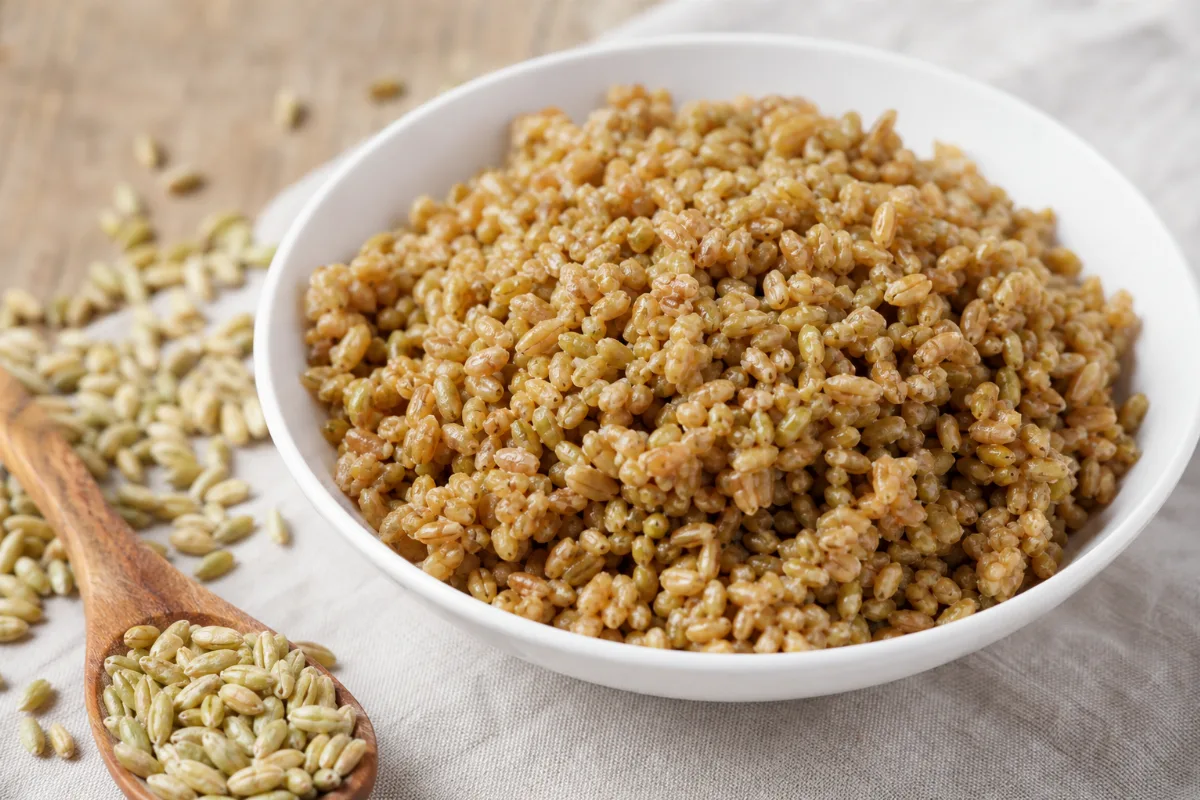
Freekeh is durum wheat that is picked while still green, then roasted or smoked and sold whole or cracked. A 2026 review reports it as high in fibre and protein, but we found no human trial of freekeh itself. Health findings come from studies of whole grains in general. The most important caution is that it is wheat: it contains gluten, so it is not safe for celiac disease, and wheat allergy can be serious.
General information, not medical advice. Last substantive update · Not medically reviewed. A named clinician has not signed off on this page. How this page is made
About Freekeh
Freekeh is wheat harvested green, then roasted or smoked. It is reported to be rich in fibre and protein. It is a nutritious grain food, not a proven remedy: the heart findings come from studies of whole grains in general. It contains gluten, so it is not for people with celiac disease.
What it is
Freekeh is made from durum wheat (Triticum durum) harvested while the grain is still green, then roasted or smoked and sold whole or cracked. A 2026 paper calls it smoked immature durum wheat with a toasted flavour, and it is eaten in pilafs, soups and stuffings in the Middle East and North Africa.
No USDA table for freekeh was found. A 2026 review reports ranges (it does not say if they are dry or cooked): protein 11% to 15%, fibre 12% to 19%, starch 45% to 68%, potassium 369 to 451 mg, magnesium 160 to 202 mg and phosphorus 412 mg per 100 g.
What the research shows
No human trial of freekeh was found. The review says freekeh has a low glycaemic index and cholesterol-lowering effects, but the abstract does not show the studies, so we treat those as unproven.
Whole grains in general: pooled trials found LDL cholesterol 0.09 mmol/L lower, with oats working best. Cohort studies link more whole grains to less heart disease and lower risk of death. Cohort studies cannot show cause, and none of this is specific to freekeh.
Food versus flour and extracts
Everything here is about freekeh as a cooked grain food. We did not read studies of freekeh flour, snacks or supplements and make no claim about them.
Portions
No USDA household portion or official serving for freekeh was found, and this page gives no amounts to eat. The NHS says starchy foods should make up just over a third of the food you eat and to choose wholegrain where you can. Ask a doctor, pharmacist or dietitian what is right for you, especially if you have celiac disease, a food allergy or kidney disease.
At a glance
Traditional uses history, not proof
- Eaten as a cooked grain in pilafs, soups and stuffings across the Middle East and North Africa
- Long use as food is not proof that it treats any condition
Studied for research
- Fibre, protein and minerals, low certainty (review ranges, no USDA table)
- Cholesterol, low certainty (whole grains as a group, not freekeh)
- Heart disease, low certainty (observational, whole grains)
- Death and cancer risk, low certainty (observational, whole grains)
- Blood sugar and glycaemic index, insufficient evidence (a claim in one review)
- Plant antioxidants, insufficient evidence
Main compounds
- Dietary fibre
- Protein and gluten
- Starch
- Potassium, magnesium and phosphorus
- Ferulic acid, lutein and zeaxanthin
- Phytate
Common forms
- Cooked whole or cracked freekeh as food
- Flour, snack or supplement forms were not studied or read
Research links: 2026 review: Green wheat freekeh · 2024 study: mould toxins in freekeh products · 2015 review: whole grains and blood lipids · Research Library · Genes & Biomarkers Library
What it is and its history
- Accepted scientific name
- Triticum durum
- Naming authority
- (durum wheat; freekeh is a food made from it, harvested green)
- Common names
- Freekeh (English); Frikeh, farik or green wheat (English (other spellings and names; from the existing page and the review title))
- Family or group
- Poaceae (the grass family), as given on the existing page; not re-checked.
- Classification
- Plantae > Poaceae (grass family) > Triticum > Triticum durum
- Native range
- Not verified from a source read.
- Habitat
- Not verified from a source read.
- What it looks like
- Roots: Not verified.; Stems: Not verified.; Leaves: Not verified.; Flowers: Not verified.; Fruit: The grain is wheat harvested while still green, then roasted or smoked and sold whole or cracked (2026 papers; existing page).
- Cultivation
- The 2026 review says freekeh cultivation needs less irrigation and fertilizer than conventional grains; no more detail was read.
- Harvest and processing
- Freekeh is produced from roasted, immature wheat grains (2024 study). A 2026 paper calls it smoked immature durum wheat, and says earlier harvest, variety and toasting intensity all shape its flavour.
- Look-alikes and adulterants
- Name: Bulgur; Note: Another cracked wheat product with its own page. Also wheat, so it also contains gluten.; Name: Farro, spelt and Khorasan wheat; Note: Other wheat grains with their own pages. All contain gluten.
- Sustainability and conservation
- Not assessed.
Photographs
What is inside, and how it may work
What it contains and how those compounds act in cells and animals. Laboratory and animal mechanisms are not proven effects in people.
Main compounds
| Compound | Family | Where it is concentrated | Activity studied | Level of evidence |
|---|---|---|---|---|
| Dietary fibre | carbohydrate | Grain Review: 12% to 19% (basis not stated) | Adds stool bulk; some types help lower cholesterol (general role of fibre). 2 | Human data |
| Protein (including gluten) | protein | Grain Review: 11% to 15% | Gluten is the protein fraction that triggers coeliac disease. 2 5 | Human data |
| Starch | carbohydrate | Grain Review: 45% to 68% | The main energy store of the grain. 2 | Human data |
| Ferulic acid, lutein and zeaxanthin | phenolic acid and carotenoids | Grain Amounts not given in the abstract | Named in the review as bioactive compounds. No human outcome data read. 2 | Lab |
| Flavour compounds (phenols, pyrazines, aldehydes) | volatile compounds | Grain More than 300 volatiles; 20 key odorants | Give the toasted, smoky smell and taste. A flavour finding, not a health finding. 6 | Lab |
| Phytate | mineral binder | Grain Not given | Can reduce mineral absorption at a meal; the review calls the effect for freekeh not yet studied. 2 9 | Human data |
Mechanisms, receptors and pathways
| Target or pathway | Gene or receptor | What was found | Level |
|---|---|---|---|
| Gluten and coeliac disease | Not specified in the sources read | NIDDK says gluten in wheat triggers an immune attack on the small intestine in people with coeliac disease. A 2022 review says gluten is in all wheat grains and ancient wheats are not safer for coeliac disease. 13 5 | Human data |
| Fibre and cholesterol | Not specified | Fibre is the usual explanation offered for small cholesterol falls with whole grains. Not tested for freekeh. 7 | Theoretical |
Absorption, metabolism and elimination
- Absorption
- Not found for freekeh.
- Distribution
- Not found.
- Metabolism
- Not found.
- Elimination
- Not found.
- Bioavailability
- The review says phytate effects on mineral absorption from freekeh need more research.
Isolated compounds versus whole extracts
All the information here is about freekeh as a food. No supplement, extract or flour product was studied in what we read.
Nutritional composition
No USDA FoodData Central entry for freekeh was found in the data held for this project (the live USDA site was not searched), so there is no per-portion table and no household portion. A 2026 review (abstract read) reports these ranges for freekeh, without saying if they are for dry or cooked grain: protein 11% to 15%, dietary fibre 12% to 19%, starch 45% to 68%, potassium 369 to 451 mg per 100 g, magnesium 160 to 202 mg per 100 g and phosphorus 412 mg per 100 g. It also mentions B vitamins, vitamins C and E, ferulic acid, lutein and zeaxanthin. Use these as approximate. Values vary with variety, harvest time and roasting, and whole and cracked forms are both sold.
4 low certainty2 not enough evidence
What was looked at
The 6 benefits and uses checked for Freekeh, each with how strong the evidence is. Tap one to open it.
- Fibre, protein and minerals (nutrient content)Low certainty
- Cholesterol (whole grains as a group)Low certainty
- Heart disease (whole grains, observational)Low certainty
- Blood sugar and glycaemic index (claimed for freekeh)Not enough evidence
- Death from any cause and cancer (whole grains, observational)Low certainty
- Plant antioxidants (ferulic acid, lutein, zeaxanthin)Not enough evidence
Lab markers tracked in the studies
LDL cholesterolTotal cholesterolDeath from any cause
What is Freekeh good for?
The main studied uses and how strong the human evidence is for each. No trial tested freekeh itself; most results are for whole grains as a group.
Benefits, one by one
Each card is a research question, not a promise. Tap a goal to filter. Open a card to see the studies, doses and limits.
Fibre, protein and minerals (nutrient content)
Low certaintyOne 2026 review reports freekeh as a grain high in fibre (12% to 19%) and protein (11% to 15%), with potassium, magnesium and phosphorus. These are ranges from a review, not results from a trial, and no USDA table was found.
2 studiesCooked whole or cracked freekeh as food.
Studies, doses and limits
What the trials found
The 2026 review (abstract read) reports protein 11% to 15%, dietary fibre 12% to 19%, starch 45% to 68%, potassium 369 to 451 mg per 100 g, magnesium 160 to 202 mg per 100 g and phosphorus 412 mg per 100 g, and describes freekeh as a nutrient-dense alternative to white rice and refined wheat. The NHS advises choosing wholegrain starchy foods where you can.
Results
The values describe what the grain contains. The abstract does not say whether they are per 100 g of dry grain, and no study showed that eating freekeh changes anything in the body.
Effect sizes as reported
Protein 11% to 15%; fibre 12% to 19%; starch 45% to 68%; potassium 369 to 451 mg, magnesium 160 to 202 mg, phosphorus 412 mg per 100 g (review ranges).
Why this rating
Composition reported by one review of reviews and data; no USDA entry was found and no trial measured freekeh. Dry or cooked basis is not stated.
Form and dose studied
Cooked whole or cracked freekeh as food.
Who was studied
General adult diet.
Limits
Review ranges, abstract only. An author lists an affiliation with a food company. Values vary by variety, harvest time and processing.
Why researchers looked
Freekeh is sold as a high-fibre, high-protein grain, so people ask how its nutrients compare with rice and refined wheat.
Traditional use
Freekeh is eaten cooked as a grain in pilafs, soups and stuffings across the Middle East and North Africa. Long use as food is not proof that it treats any condition.
Proposed mechanism Authoritative guidance
Fibre adds bulk to stool and some types help lower cholesterol (general role of fibre, not shown for freekeh).
A proposed mechanism does not show that the effect happens in people.
Freekeh is wheat and contains gluten; see the Safety tab.
Cholesterol (whole grains as a group)
Low certaintyPooled trials of whole-grain foods found small falls in LDL and total cholesterol compared with non-whole-grain foods. Oats worked best, and freekeh was not tested.
2 studiesWhole-grain foods (not specifically freekeh).
Studies, doses and limits
What the trials found
A 2015 meta-analysis of 24 randomised studies in apparently healthy adults found whole-grain foods lowered LDL cholesterol by 0.09 mmol/L and total cholesterol by 0.12 mmol/L compared with non-whole-grain controls. No change in HDL; triglycerides tended to fall but not clearly. Whole-grain oat had the biggest effect (total cholesterol -0.17 mmol/L).
Results
A small average change, mostly from mixed whole grains and oats. The 2026 freekeh review says freekeh has cholesterol-lowering effects, but its abstract does not say which studies show this.
Effect sizes as reported
LDL -0.09 mmol/L (95% CI -0.15 to -0.03); total cholesterol -0.12 mmol/L (-0.19 to -0.05).
Why this rating
Randomised trials, but of whole grains in general, with a small effect. The freekeh-specific claim is unchecked.
Form and dose studied
Whole-grain foods (not specifically freekeh).
Who was studied
Apparently healthy adults.
Limits
Not freekeh. Oats drove the biggest result. Small changes.
Why researchers looked
Whole grains are rich in fibre, so researchers ask whether eating them improves blood fats.
Traditional use
Freekeh is eaten cooked as a grain in pilafs, soups and stuffings across the Middle East and North Africa. Long use as food is not proof that it treats any condition.
Proposed mechanism Theoretical
Soluble fibre is thought to help lower cholesterol. Not shown for freekeh.
A proposed mechanism does not show that the effect happens in people.
None specific beyond the gluten and allergy cautions on the Safety tab.
Heart disease (whole grains, observational)
Low certaintyLarge groups of people who eat more whole grains have less heart disease. This is an association from cohort studies, about whole grains as a group, and freekeh is not named.
1 studiesWhole-grain foods such as whole-grain bread and cereals (study measur…
Studies, doses and limits
What the trials found
A 2016 meta-analysis of 45 prospective studies found that, per 90 g a day higher whole-grain intake, coronary heart disease was lower (RR 0.81) and cardiovascular disease was lower (RR 0.78). Stroke was not clearly lower (RR 0.88, CI 0.75 to 1.03). There was little sign of benefit for refined grains or white rice.
Results
Lower risk is linked with whole-grain intake, and cause was not shown.
Effect sizes as reported
Coronary heart disease RR 0.81 (0.75 to 0.87); cardiovascular disease RR 0.78 (0.73 to 0.85); stroke RR 0.88 (0.75 to 1.03), per 90 g a day.
Why this rating
Observational cohort data, whole grains as a group, freekeh not named.
Form and dose studied
Whole-grain foods such as whole-grain bread and cereals (study measure, not advice).
Who was studied
Adults followed over time in cohort studies.
Limits
Cannot prove cause. Mixed whole grains.
Why researchers looked
Heart disease is a main cause of death, and diets rich in whole grains are often linked to lower risk.
Traditional use
Freekeh is eaten cooked as a grain in pilafs, soups and stuffings across the Middle East and North Africa. Long use as food is not proof that it treats any condition.
Proposed mechanism Unknown
Not established. People who eat more whole grains may also differ in other habits.
A proposed mechanism does not show that the effect happens in people.
None specific.
Blood sugar and glycaemic index (claimed for freekeh)
Not enough evidenceA 2026 review says freekeh has a low glycaemic index. We could not see the studies behind that statement, so it stays unproven here.
1 studiesFreekeh as food.
Studies, doses and limits
What the trials found
The review abstract states that freekeh's low glycaemic index and cholesterol-lowering effects make it relevant to preventing long-term diseases. It gives no trial, numbers or method.
Results
Unchecked claim; no outcome data read.
Effect sizes as reported
Not given.
Why this rating
One review sentence, with no underlying studies visible in the abstract.
Form and dose studied
Freekeh as food.
Limits
Abstract only; the same review is linked to a food company by an author's affiliation.
Why researchers looked
Fibre-rich grains are often asked about for blood sugar.
Traditional use
Freekeh is eaten cooked as a grain in pilafs, soups and stuffings across the Middle East and North Africa. Long use as food is not proof that it treats any condition.
Proposed mechanism Unknown
Not stated in the abstract.
A proposed mechanism does not show that the effect happens in people.
People with diabetes should follow their care team's plan.
Death from any cause and cancer (whole grains, observational)
Low certaintyIn cohort studies, higher whole-grain intake went with lower risk of death. This is association, about whole grains as a group, and freekeh is not named.
1 studiesWhole-grain foods (study measure, not advice).
Studies, doses and limits
What the trials found
The 2016 meta-analysis of 45 cohort studies found that, per 90 g a day higher whole-grain intake, death from any cause was lower (RR 0.83), as was cancer death (RR 0.85). Diabetes death was not clearly lower (RR 0.49, CI 0.23 to 1.05).
Results
Lower risk is linked with whole-grain intake; cause is not shown.
Effect sizes as reported
All-cause mortality RR 0.83 (0.77 to 0.90); cancer mortality RR 0.85 (0.80 to 0.91); diabetes mortality RR 0.49 (0.23 to 1.05), per 90 g a day.
Why this rating
Observational and mixed whole grains; large differences between studies for all-cause death (I2 = 83%).
Form and dose studied
Whole-grain foods (study measure, not advice).
Who was studied
Adults in cohort studies.
Limits
Cannot prove cause.
Why researchers looked
Researchers ask whether whole-grain diets go with longer life.
Traditional use
Freekeh is eaten cooked as a grain in pilafs, soups and stuffings across the Middle East and North Africa. Long use as food is not proof that it treats any condition.
Proposed mechanism Unknown
Not established.
A proposed mechanism does not show that the effect happens in people.
None specific.
Plant antioxidants (ferulic acid, lutein, zeaxanthin)
Not enough evidenceThe review lists these plant compounds in freekeh. No study read tested whether they do anything in people who eat freekeh.
1 studiesFreekeh as food.
Studies, doses and limits
What the trials found
The review abstract says ferulic acid, lutein and zeaxanthin 'enhance its functional potential'. No amounts or health outcomes are given.
Results
Presence reported; no benefit shown.
Effect sizes as reported
Not given.
Why this rating
Named in an abstract, with no human outcome data.
Form and dose studied
Freekeh as food.
Limits
Abstract only.
Why researchers looked
Antioxidant compounds are often named when grains are marketed as healthy.
Traditional use
Freekeh is eaten cooked as a grain in pilafs, soups and stuffings across the Middle East and North Africa. Long use as food is not proof that it treats any condition.
Proposed mechanism Unknown
Not established for freekeh.
A proposed mechanism does not show that the effect happens in people.
None specific.
Connections to the rest of health
How Freekeh connects to the rest of our health knowledge graph. Every link says what kind of connection it is. A safety link (for example to the liver) is a warning, not a benefit. A study that merely mentions a topic never creates a benefit link.
Explore every connection: goals, body systems, organs, symptoms, genes
A. Wellness goals
| Connected to | Kind of connection | Evidence status | Context | Studies |
|---|---|---|---|---|
| Digestive Support | Demonstrated clinical effect | Low certainty | Fibre, protein and minerals (nutrient content): One 2026 review reports freekeh as a grain high in fibre (12% to 19%) and protein (11% to 15%), with potassium, magnesium and phosphorus. These are ranges from a review, not results from a trial, and no USDA table was found. | 2 12 |
| Balanced Nutrition | Demonstrated clinical effect | Low certainty | Fibre, protein and minerals (nutrient content): One 2026 review reports freekeh as a grain high in fibre (12% to 19%) and protein (11% to 15%), with potassium, magnesium and phosphorus. These are ranges from a review, not results from a trial, and no USDA table was found. | 2 12 |
| Cholesterol Balance | Low certainty | Cholesterol (whole grains as a group): Pooled trials of whole-grain foods found small falls in LDL and total cholesterol compared with non-whole-grain foods. Oats worked best, and freekeh was not tested. | 7 2 | |
| Heart Health | Low certainty | Cholesterol (whole grains as a group): Pooled trials of whole-grain foods found small falls in LDL and total cholesterol compared with non-whole-grain foods. Oats worked best, and freekeh was not tested. | 7 2 | |
| Heart Health | Low certainty | Heart disease (whole grains, observational): Large groups of people who eat more whole grains have less heart disease. This is an association from cohort studies, about whole grains as a group, and freekeh is not named. | 3 | |
| Blood Sugar Support | Not enough evidence | Blood sugar and glycaemic index (claimed for freekeh): A 2026 review says freekeh has a low glycaemic index. We could not see the studies behind that statement, so it stays unproven here. | 2 | |
| Healthy Aging | Low certainty | Death from any cause and cancer (whole grains, observational): In cohort studies, higher whole-grain intake went with lower risk of death. This is association, about whole grains as a group, and freekeh is not named. | 3 | |
| Healthy Aging | Not enough evidence | Plant antioxidants (ferulic acid, lutein, zeaxanthin): The review lists these plant compounds in freekeh. No study read tested whether they do anything in people who eat freekeh. | 2 |
B. Body systems
| Connected to | Kind of connection | Evidence status | Context | Studies |
|---|---|---|---|---|
| Digestive System | Biological association | Low certainty | Studied for: Fibre, protein and minerals (nutrient content) | 2 12 |
| Cardiovascular System | Biological association | Low certainty | Studied for: Cholesterol (whole grains as a group) Studied for: Heart disease (whole grains, observational) | 7 2 3 |
| Metabolic System | Biological association | Not enough evidence | Studied for: Blood sugar and glycaemic index (claimed for freekeh) | 2 |
| Whole Body | Biological association | Low certainty | Studied for: Death from any cause and cancer (whole grains, observational) Studied for: Plant antioxidants (ferulic acid, lutein, zeaxanthin) | 3 2 |
E. Health conditions
| Connected to | Kind of connection | Evidence status | Context | Studies |
|---|---|---|---|---|
| Celiac disease | Contraindication | Documented risk | Freekeh contains gluten and is not safe for people with coeliac disease. Freekeh contains gluten and is not safe for people with celiac disease. Preparation or compound: Gluten in freekeh (durum wheat) |
13 2 5 |
| Wheat allergy | Adverse effect or risk | Documented risk | Wheat is a named common food allergen; reactions can be severe. Preparation or compound: Wheat proteins in freekeh |
11 10 |
| Gluten sensitivity | Preliminary or mixed | In one trial of people who believed they were gluten sensitive, gluten had a specific effect in only 8%; fermentable carbohydrates may play a part. In one trial of people who believed they were gluten sensitive, gluten had a specific effect in only 8%. Preparation or compound: Wheat fructans and gluten |
4 5 |
I. Biomarkers
| Connected to | Kind of connection | Evidence status | Context | Studies |
|---|---|---|---|---|
| LDL cholesterol | Biological association | Low certainty | Measured in trials: lowered. A lab change is not the same as a health benefit. | 7 |
| Total cholesterol | Biological association | Low certainty | Measured in trials: lowered. A lab change is not the same as a health benefit. | 7 |
| Death from any cause | Biological association | Low certainty | Measured in trials: lowered. A lab change is not the same as a health benefit. | 3 |
K. Biological pathways
| Connected to | Kind of connection | Evidence status | Context | Studies |
|---|---|---|---|---|
| Fibre | Preliminary mechanism | Human | Freekeh is reported as a high-fibre grain. | 2 |
| Magnesium | Preliminary mechanism | Human | Review range 160 to 202 mg per 100 g. | 2 |
| Potassium | Preliminary mechanism | Human | Review range 369 to 451 mg per 100 g; relevant to kidney diets. | 2 |
L. Active compounds
| Connected to | Kind of connection | Evidence status | Context | Studies |
|---|---|---|---|---|
| Dietary fibre | Biological association | Human | Adds stool bulk; some types help lower cholesterol (general role of fibre). Preparation or compound: Grain |
2 |
| Protein (including gluten) | Biological association | Human | Gluten is the protein fraction that triggers coeliac disease. Preparation or compound: Grain |
2 5 |
| Starch | Biological association | Human | The main energy store of the grain. Preparation or compound: Grain |
2 |
| Ferulic acid, lutein and zeaxanthin | Biological association | Lab | Named in the review as bioactive compounds. No human outcome data read. Preparation or compound: Grain |
2 |
| Flavour compounds (phenols, pyrazines, aldehydes) | Biological association | Lab | Give the toasted, smoky smell and taste. A flavour finding, not a health finding. Preparation or compound: Grain |
6 |
| Phytate | Biological association | Human | Can reduce mineral absorption at a meal; the review calls the effect for freekeh not yet studied. Preparation or compound: Grain |
2 9 |
Each connection is stored with the ingredient, the connected record, the kind of connection, the evidence status, the supporting studies, the preparation or compound involved, and a review date (last reviewed October 26, 2026).
The evidence
The research centre for Freekeh. Every record here was checked against PubMed or the publisher's page; we never list a study we have not verified.
Evidence by outcome
Bars show how many studies we found for each outcome, not how well it works. People are added up across trials only (reviews are not added, to avoid double counting).
How we rate evidence
High certainty
Several well-run trials or reviews agree; further research is unlikely to change the picture much.
Moderate certainty
Good trials point the same way, but some doubt remains.
Low certainty
Small, short or inconsistent trials. The finding could change with better research.
Very low certainty
Very little or very weak human data. Treat as a possibility only.
Mixed findings
Trials or reviews disagree with each other.
Not enough evidence
Not enough human research to say either way.
Evidence against
Good research found no benefit, or found harm.
We take the reviewers' own risk-of-bias and GRADE statements where they exist, and otherwise judge from study size, design, consistency, directness and whether a product matches what is sold. Many publications do not make evidence high. Method note: We started from our earlier freekeh page, re-read PubMed abstracts and the NIDDK, WHO, MedlinePlus and NHS pages, and kept only what those sources say. Only abstracts were read for studies. Items we could not verify are flagged in the research gaps.
Study library: every study we checked 15
| Study | Design | People | Product, dose, length | Result |
|---|---|---|---|---|
| Al-Rashid 2013 Beware of what you eat: small bowel obstruction caused by freekeh bezoars. BMJ Case Rep · PMID 24068384 · DOI |
Case report |
One reported case (Saudi Arabia); no abstract is available | Freekeh Whole grain |
Only the title and publication details were read. The title says a small bowel obstruction was caused by freekeh bezoars (a bezoar is a lump of undigested food). One case report (Not applicable) Methods, limits and fundingOutcomes: Small bowel obstruction Limitations: No abstract or full text was read, so details such as how much was eaten, how it was prepared and the outcome are unknown. A single case report cannot show how often this happens. Funding and conflicts: Not stated. Read: title-only |
| Aluthge 2026 Green wheat Freekeh: evolution from traditional cereal to sustainable future food. Crit Rev Food Sci Nutr · PMID 40622358 · DOI |
Narrative review |
Review of freekeh history, production and composition (no patients) | Freekeh (smoked or roasted immature durum wheat) as a grain food Whole grain |
The review reports freekeh protein 11% to 15%, dietary fibre 12% to 19%, starch 45% to 68%, potassium 369 to 451 mg/100 g, magnesium 160 to 202 mg/100 g and phosphorus 412 mg/100 g, plus B vitamins, vitamins C and E, ferulic acid, lutein and zeaxanthin. It states that freekeh has a low glycaemic index and cholesterol-lowering effects, that it contains gluten, and that more research is needed on allergenic potential and phytate effects on mineral absorption. Ranges only; the abstract does not say if values are per 100 g of dry grain (Not applicable) Methods, limits and fundingOutcomes: Composition, nutrition and sustainability of freekeh Limitations: Abstract only. The abstract does not say which studies sit behind the low glycaemic index and cholesterol claims, and does not give the basis of the values (dry or cooked). An author is linked to a food company (Edlyn Foods Pty Ltd) by affiliation. Funding and conflicts: No funding or conflict statement in the abstract. One author lists an affiliation with Edlyn Foods Pty Ltd. Read: abstract |
| Aune 2016 Whole grain consumption and risk of cardiovascular disease, cancer, and all cause and cause specific mortality: systematic review and dose-response meta-analysis of prospective studies. BMJ · PMID 27301975 · DOI |
Systematic review meta analysis |
45 prospective (cohort) studies, 64 publications | Whole grains and whole grain foods such as whole grain bread and breakfast cereals; freekeh not named Whole grain Summary risks are per 90 g/day higher intake (about 3 servings), a study measure and not advice Follow-up varied by study · vs People with lower intake |
Per 90 g/day: coronary heart disease RR 0.81, stroke RR 0.88 (not clearly lower), cardiovascular disease RR 0.78. Mortality: total cancer 0.85, all causes 0.83, respiratory disease 0.78, diabetes 0.49 (not clearly lower), infectious diseases 0.74. Little evidence of benefit with refined grains, white rice or total grains. Cardiovascular disease RR 0.78; all-cause mortality RR 0.83 per 90 g/day (CVD 0.73 to 0.85; coronary heart disease 0.75 to 0.87; stroke 0.75 to 1.03; all-cause mortality 0.77 to 0.90; cancer mortality 0.80 to 0.91; diabetes mortality 0.23 to 1.05) Methods, limits and fundingOutcomes: Coronary heart disease, stroke, cardiovascular disease, cancer and death Limitations: Observational: people who eat whole grains may differ in other habits, so this shows association and not cause. Whole grains as a group, not freekeh. Some results varied a lot between studies (all-cause mortality I2 = 83%). Funding and conflicts: Funding is not stated in the abstract. Read: abstract |
| Biesiekierski 2013 No effects of gluten in patients with self-reported non-celiac gluten sensitivity after dietary reduction of fermentable, poorly absorbed, short-chain carbohydrates. Gastroenterology · PMID 23648697 · DOI |
Controlled trial |
37 37 adults with self-reported non-celiac gluten sensitivity and irritable bowel syndrome, no coeliac disease |
Gluten (16 g a day), low gluten with whey, or whey control, after a low-FODMAP diet Purified gluten, not freekeh 16 g gluten/day vs 16 g whey protein/day (trial detail, not advice) 1 week for each diet, then a 3-day rechallenge · vs Whey protein and control diets |
Gut symptoms improved on a low-FODMAP diet and worsened to a similar degree when diets included gluten or whey protein. A gluten-specific effect was seen in only 8% of participants. No biomarker changed with diet. Gluten-specific effects in 8% of participants (Not given in the abstract) Methods, limits and fundingOutcomes: Gut symptoms and markers of intestinal inflammation Limitations: Small trial of people who believed they were sensitive. It tells us nothing about coeliac disease. Not a trial of freekeh. Funding and conflicts: Funding is not stated in the abstract. Read: abstract |
| Brouns 2022 Do ancient wheats contain less gluten than modern bread wheat, in favour of better health? Nutr Bull · PMID 35915783 · DOI |
Narrative review |
Critical narrative review of gluten in wheat types and coeliac disease | Wheat types (ancient and modern); freekeh not named Whole grain |
The review says gluten is present in all wheat grains and all can induce coeliac disease in genetically susceptible people. Compared with bread wheat, ancient wheats contained more protein and gluten and more coeliac-active epitopes, so no single wheat type can be recommended for coeliac disease. Many people who think they are gluten sensitive are not confirmed in a medical test, and symptoms may come from gas made by fermentation of fructans in wheat or from non-gluten proteins. Not applicable (Not applicable) Methods, limits and fundingOutcomes: Gluten content, coeliac disease and tolerance Limitations: Narrative review, not a trial. Freekeh (a durum wheat product) is not named in the abstract. Funding and conflicts: No conflicts of interest relevant to the review are declared. Read: abstract |
| Cna'ani 2026 The first comprehensive analysis of the flavor of Freekeh: a toasted, smoked, green durum wheat product, by analytical and sensory approaches. Food Chem · PMID 42906477 · DOI |
Laboratory food analysis n/a |
Freekeh samples analysed in the laboratory and by sensory panels | Freekeh (smoked immature durum wheat) Whole grain |
Freekeh flavour is a mixture of grain compounds and processing products with more than 300 volatile compounds; 20 were key odorants (phenols, pyrazines, aldehydes). Earlier harvest gave a more aromatic, sweet and savoury-tasting freekeh. More than 300 volatiles; 20 key odorants (Not applicable) Methods, limits and fundingOutcomes: Flavour compounds and sensory properties Limitations: A flavour study, not a health study. No health outcome was measured. Funding and conflicts: The authors declare no competing interests. Read: abstract |
| Hollænder 2015 Whole-grain and blood lipid changes in apparently healthy adults: a systematic review and meta-analysis of randomized controlled studies. Am J Clin Nutr · PMID 26269373 · DOI |
Systematic review meta analysis |
24 randomised controlled studies in apparently healthy adults | Whole-grain foods compared with non-whole-grain foods; freekeh not named Whole grain Not given in the abstract (dose was not linked to the result) Varied; longer studies showed larger changes · vs Non-whole-grain control diets |
Whole-grain intake lowered LDL cholesterol (-0.09 mmol/L) and total cholesterol (-0.12 mmol/L) compared with control. HDL cholesterol was not changed and triglycerides tended to fall (not clearly). Whole-grain oat had the biggest effect on total cholesterol (-0.17 mmol/L). LDL -0.09 mmol/L; total cholesterol -0.12 mmol/L (LDL -0.15 to -0.03; total cholesterol -0.19 to -0.05) Methods, limits and fundingOutcomes: Total, LDL and HDL cholesterol and triglycerides Limitations: Small average changes. Mixed whole grains, with oats working best; freekeh not tested. Funding and conflicts: Funding is not stated in the abstract. Read: abstract |
| Mudalal 2024 Mycotoxin Prevalence and Microbiological Characteristics of Locally Produced Elected Freekeh Products. Toxins (Basel) · PMID 39591254 · DOI |
Laboratory food analysis |
Locally produced freekeh products in Palestine (number of samples not given in the abstract) | Freekeh products Whole grain |
Aflatoxin ranged 3.17 to 3.33 ppb and ochratoxin 4.63 to 8.17 ppb. More than 78% of samples had aflatoxin and ochratoxin above the limits of the European Commission (4 and 5 ppb). Deoxynivalenol and T2/HT2 were below the limit of detection. Some products had more than 2% straw and foreign grains. Bacterial counts varied from 1 to 4 logs and fungal counts from 1.39 to 4.3 logs. More than 78% of samples above the aflatoxin (4 ppb) and ochratoxin (5 ppb) limits (Not applicable) Methods, limits and fundingOutcomes: Mycotoxins, physical impurities and microbial counts Limitations: Screening (lateral flow) test, not a confirmatory laboratory method. Local products from one area, so it does not describe freekeh everywhere. Number of samples not in the abstract. Funding and conflicts: The author declares no conflicts of interest. Read: abstract |
| Nikolaou 2026 Effects of sourdough- or regular-bread fermentation, and phytate reduction on iron bioavailability, absorption, and iron status in humans: a systematic review of intervention studies. Front Nutr · PMID 42163962 · DOI |
Systematic review |
8 human intervention studies in healthy or iron-deficient people | Bread made with different phytate levels and fermentation; freekeh not named Bread Acute meals to 12 weeks · vs Various |
Results were inconclusive. Meals lower in phytate raised iron absorption after a single meal, but long-term trials did not improve iron stores and in one case ferritin fell. The review says no human study addressed the question with proper controls. Not applicable (Not applicable) Methods, limits and fundingOutcomes: Iron absorption and iron status Limitations: Bread studies, not freekeh. Only 8 studies, mixed designs. Funding and conflicts: Registered at OSF (osf.io/gzt8m). Funding is not stated in the abstract. Registration: osf.io/gzt8m Read: abstract |
| Santhosh 2026 Unusual Causes of Food-Induced Anaphylaxis - A Review. Indian Dermatol Online J · PMID 42377205 · DOI |
Narrative review |
Review of three unusual causes of food-induced anaphylaxis | Wheat (in wheat-dependent exercise-induced anaphylaxis) Wheat protein |
Wheat-dependent exercise-induced anaphylaxis happens when wheat is eaten together with exercise and extra triggers such as seafood, alcohol or anti-inflammatory pain medicines. The main allergen is omega-5 gliadin, in the gluten part of wheat. Symptoms range from hives or swelling to severe anaphylaxis. Not applicable (Not applicable) Methods, limits and fundingOutcomes: Anaphylaxis triggers and diagnosis Limitations: Narrative review. Freekeh is not named in the abstract; it is wheat. Funding and conflicts: One author was an assistant editor of the journal; the paper was reviewed independently. Read: abstract |
| s-medlineplus-foodallergy MedlinePlus: Food allergy · Source |
Official guidance n/a |
Methods, limits and fundingRead: full-text | ||
| s-nhs-starchy NHS: Starchy foods and carbohydrates · Source |
Official guidance n/a |
Methods, limits and fundingRead: full-text | ||
| s-niddk-diet NIDDK: Eating, Diet, & Nutrition for Celiac Disease · Source |
Official guidance n/a |
Methods, limits and fundingRead: full-text | ||
| s-niddk-facts NIDDK: Definition & Facts for Celiac Disease · Source |
Official guidance n/a |
Methods, limits and fundingRead: full-text | ||
| s-who-mycotoxins WHO: Mycotoxins fact sheet · Source |
Official guidance n/a |
Methods, limits and fundingRead: full-text |
What we do not know yet
- No human trial of freekeh was found for any outcome; the low glycaemic index and cholesterol claims in one review could not be traced to studies.
- No USDA nutrient table or household portion exists in the sources read; review ranges do not say if they are for dry or cooked grain.
- Whole-grain results are for whole grains in general, mostly from cohort studies that cannot show cause.
- Pregnancy, children, FODMAP content, heavy metals, pesticides and smoke compounds from roasting were not researched; the bowel-blockage case report was read by title only.
How new research is added
New studies are found by a saved PubMed search and placed in a review queue before the page changes.
Lab markers
What changed in blood or saliva tests during trials. A changed number is not the same as feeling or being healthier, and we give no "normal ranges".
Metabolic 2
LDL cholesterol
Lowered in trials
The 'bad' cholesterol carried in the blood. Higher levels are linked to more heart disease.
Low certaintyResults and what it means
Why it was measured
It is the usual blood marker used in diet trials for heart risk.
Statistical vs. clinical meaning
A small average fall with whole grains as a group; freekeh not tested.
Safety implication
None specific.
| Study | Result | People | Product |
|---|---|---|---|
| 7 | LDL mean difference -0.09 mmol/L (95% CI -0.15 to -0.03), P < 0.01 | 24 randomised studies in apparently healthy adults | Whole-grain foods compared with non-whole-grain controls |
Total cholesterol
Lowered in trials
All the cholesterol in the blood, including LDL and HDL.
Low certaintyResults and what it means
Why it was measured
A standard blood test used in diet trials.
Statistical vs. clinical meaning
A small average fall, largest with oats.
Safety implication
None specific.
| Study | Result | People | Product |
|---|---|---|---|
| 7 | Total cholesterol -0.12 mmol/L (95% CI -0.19 to -0.05), P < 0.001; whole-grain oat -0.17 mmol/L | 24 randomised studies in apparently healthy adults | Whole-grain foods compared with non-whole-grain controls |
Other 1
Death from any cause
Lowered in trials
Whether a person dies of any cause during follow-up in a cohort study.
Low certaintyResults and what it means
Why it was measured
The simplest overall outcome in diet cohort studies.
Statistical vs. clinical meaning
Association only, from cohorts, with large differences between studies.
Safety implication
None specific.
| Study | Result | People | Product |
|---|---|---|---|
| 3 | All-cause mortality RR 0.83 (95% CI 0.77 to 0.90) per 90 g/day whole grain; I2 = 83% | 11 prospective studies in the all-cause analysis | Higher versus lower whole-grain intake (observational) |
Safety
What studies and official sources say about side effects, medicines and who should check first. Each point shows what kind of evidence it comes from.
Main points to know 5
- Freekeh contains gluten: not safe for coeliac disease. Freekeh is made from durum wheat. NIDDK lists wheat and types of wheat such as durum as gluten sources, and says people with coeliac disease need a gluten-free diet for life. The 2026 freekeh review says directly that it contains gluten, and a 2022 review says all wheat grains can induce coeliac disease in genetically susceptible people. NIDDK says to see your doctor for testing before starting a gluten-free diet, because avoiding gluten first can make test results inaccurate. Authoritative guidance 13 2 5
- Wheat allergy can be serious. MedlinePlus lists wheat among the foods behind most food allergies, and says anaphylaxis is a medical emergency (call 911 in the US). A 2026 review describes a rarer wheat reaction that appears only when wheat is eaten with exercise, alcohol or anti-inflammatory pain medicines. The 2026 freekeh review says its allergenic potential still needs research. Anyone with wheat allergy should ask an allergist before eating freekeh. Authoritative guidance 11 10 2
- Mould toxins were high in one small study of local freekeh. A 2024 study of locally produced freekeh in Palestine found aflatoxin and ochratoxin above European Commission limits (4 and 5 ppb) in more than 78% of samples. It used a screening test and did not say how many samples were tested. Deoxynivalenol and T2/HT2 toxins were below detection. This is one study from one area, and it does not mean all freekeh is affected. WHO advises discarding grain that looks mouldy, discoloured or shrivelled. Laboratory food analysis 8 15
- Cooked grains left out can make toxins. The NHS says cooked rice and grains should be served soon after cooking, or cooled within 1 hour and kept refrigerated and eaten within 24 hours. It says grains left at room temperature overnight should be thrown away. This guidance is written for rice and grains in general, and no freekeh-specific source was read. Authoritative guidance 12
- Rare report of bowel blockage with freekeh. A 2013 case report is titled as a small bowel obstruction caused by freekeh bezoars (lumps of undigested food). Only the title was available to read, so we do not know the details. One case report cannot show how common this is. Case report 1
Side effects 4
| Effect | How often | Severity and recovery | Evidence |
|---|---|---|---|
| Coeliac disease reaction to gluten (gut damage, symptoms) Freekeh is a wheat product. No freekeh-specific data were read. | About 1% of people worldwide have coeliac disease, and many are undiagnosed (NIDDK). | can be serious over time Symptoms and gut damage can improve on a strict gluten-free diet (NIDDK). | Authoritative guidance 14 13 |
| Allergic reactions to wheat, from mild symptoms to anaphylaxis Wheat is a named common allergen. Freekeh-specific allergy data were not found. | Not found for freekeh. | can be severe (anaphylaxis) Not stated in the sources read | Authoritative guidance 11 10 |
| Gut symptoms (gas, bloating) in people sensitive to wheat fructans or FODMAPs Wheat in general; no freekeh-specific data. A dietitian can help with testing your own tolerance. | In a 37-person trial of people who believed they were gluten sensitive, symptoms improved on a low-FODMAP diet and gluten had a specific effect in only 8%. | mild to moderate Not studied | Controlled trial 4 5 |
| Small bowel obstruction from a bezoar (single case report) Only the title was read. | One case; frequency unknown. | serious if it occurs Not known (abstract not available) | Case report 1 |
Liver
No liver injury from eating freekeh was found. A liver-safety database was not searched for this food. Mould toxins such as aflatoxin are a recognised food-safety concern (WHO), which is why discarding mouldy grain matters. 15
How often. No frequency was found.
Monitoring. No agency monitoring advice was found.
This is a safety connection. It is not evidence that Freekeh supports liver health.
Medicines and supplements 3
| With | Why it matters | Importance | Evidence | What to do |
|---|---|---|---|---|
| Gluten-free diet for coeliac disease food-condition | Freekeh is wheat and contains gluten. | Documented: freekeh should not be part of a gluten-free diet. | Authoritative guidance High certainty 13 2 | If you have coeliac disease, leave freekeh out and ask your doctor or dietitian. |
| Medicines for diabetes or high cholesterol prescription | Whole grains lowered cholesterol a little in pooled trials; a large change in diet could in theory add to a medicine's effect. | No source read tied freekeh to a specific medicine interaction. This is a general caution, not a documented interaction. | Theoretical Not enough evidence 7 | Ask your clinician or pharmacist before making big diet changes if you take diabetes or cholesterol medicine. |
| Wheat reaction triggers (exercise, alcohol, anti-inflammatory pain medicines) co-factor | In wheat-dependent exercise-induced anaphylaxis, wheat is a trigger only when eaten with these co-factors. | Described in a 2026 review for wheat in general, not for freekeh. | Narrative review Low certainty 10 | If you have had a reaction after eating wheat and then exercising or drinking alcohol, ask an allergist. |
Who should check first 2
| Situation | Advice | Evidence |
|---|---|---|
| Coeliac disease | Avoid freekeh. It contains gluten. Ask your doctor or dietitian about your gluten-free diet, and see your doctor for testing before cutting gluten out. | Authoritative guidance 13 2 |
| Known or suspected wheat allergy | Avoid freekeh until an allergist has advised you. For trouble breathing or swelling of the face or throat, call emergency services. | Authoritative guidance 11 10 |
Overdose, product quality and regulators
Summary. No toxicity from freekeh as ordinary cooked food was found in the sources read. The safety concerns are gluten, wheat allergy, mould toxins and cooked-grain handling.
Animal. Not reviewed.
Human doses studied. No human trial of freekeh was found.
Overdose response. Not found.
Genotoxicity. Not researched.
One 2024 study found mould toxins above European limits in many local freekeh samples; WHO names deoxynivalenol and zearalenone as typical wheat toxins. Heavy metals, pesticides and smoke compounds from the roasting step were not researched.
Aflatoxin and ochratoxin in local freekeh products. More than 78% of samples had aflatoxin and ochratoxin above European Commission limits (4 and 5 ppb), by a screening test. Deoxynivalenol and T2/HT2 were below the limit of detection. Some products had more than 2% straw and foreign grains. 8
Mould and storage advice. WHO says deoxynivalenol and zearalenone are often associated with wheat, and advises inspecting whole grains for mould, discarding any that look mouldy, discoloured or shrivelled, buying grain as fresh as possible and storing it dry. 15
Phytates and mineral absorption. The freekeh review says phytate effects on mineral absorption need more research. A 2026 review of human bread studies was inconclusive on whether lowering phytate improves iron status over time. 2 9
| Body | Action | Date |
|---|---|---|
| NIDDK (US National Institutes of Health) (United States) | Coeliac disease diet page: durum and other wheat types contain gluten; a gluten-free label means under 20 parts per million; do not start a gluten-free diet before testing. source | 2020-10 |
| WHO (International) | Mycotoxins fact sheet: names aflatoxins, ochratoxin A, deoxynivalenol and zearalenone; advises discarding mouldy, discoloured or shrivelled grain. source | 2023-10-02 |
| NHS (UK) (United Kingdom) | Starchy foods page: choose wholegrain where you can; cool cooked grains within 1 hour and refrigerate; discard grains left at room temperature overnight. source | 2023-03-15 |
| MedlinePlus (US National Library of Medicine) (United States) | Food allergy page: wheat is among the foods behind most food allergies; anaphylaxis is an emergency. source |
When to get medical help
- Trouble breathing, swelling of the lips, face or throat, widespread hives, repeated vomiting or collapse after eating freekeh (possible anaphylaxis): call emergency services
- Severe belly pain with repeated vomiting after eating (possible bowel blockage): seek urgent medical care
- If you think you may have coeliac disease: see your doctor for testing before cutting out gluten
Stop using the product and contact a clinician or emergency service. In the US, Poison Control is 1-800-222-1222.
General information only, not medical advice. Ask a clinician or pharmacist before use, especially with medicines, in pregnancy or with a health condition. See the Natural Remedy Safety guide.
Frequently asked questions
What is freekeh?
Is freekeh gluten-free?
Can I eat freekeh with celiac disease?
Is freekeh healthier than rice?
A 2026 review reports more fibre, protein and minerals than white rice and refined wheat, but we found no trial comparing health outcomes.
Does freekeh have a low glycaemic index?
The review says so, but its abstract gives no studies or numbers. Treat it as unproven. People with diabetes should follow their care team's plan.
Does freekeh lower cholesterol?
Is freekeh good for the heart?
Cohort studies link whole grains in general to less heart disease (RR 0.78 for cardiovascular disease per 90 g a day). That shows association, not cause, and freekeh is not named.
Can freekeh cause an allergic reaction?
Is there a mould or contamination concern?
Does gluten cause stomach problems in people who are not celiac?
How should cooked freekeh be stored?
The NHS says to cool cooked grains within 1 hour, keep them refrigerated and eat them within 24 hours, and to throw away grains left at room temperature overnight.
Is freekeh safe in pregnancy, for children or with medicines?
No freekeh-specific advice was found in the sources read. Ask your doctor, midwife or pharmacist. Whole grains contain phosphorus and potassium, so people with kidney disease should ask their kidney team.
Explore by health goal
Heart HealthHealthy AgingDigestive SupportBalanced NutritionCholesterol BalanceBlood Sugar Support
Editorial transparency
- Written by
- AlternativeMed editorial team. Research compiled with AI assistance, then checked against the sources listed.
- Medical review
- None. This page has not been reviewed by a physician or pharmacist.
- First published
- 2026-10-26
- Last substantive update
- 2026-10-26
- How we research
- We started from our earlier freekeh page, re-read PubMed abstracts and the NIDDK, WHO, MedlinePlus and NHS pages, and kept only what those sources say. Only abstracts were read for studies. Items we could not verify are flagged in the research gaps.
- How we rate evidence
- See "How we rate evidence" in the Evidence tab.
- Independence
- No product is promoted on this page. No affiliate links are shown.
Sources 15
Each source was opened and checked. Where we read only the abstract, it says so. The small numbers in the text point here.
- Al-Rashid F, Al-Hariri A, Meshikhes AW. Beware of what you eat: small bowel obstruction caused by freekeh bezoars.. BMJ Case Rep. 2013. PMID 24068384. DOI 10.1136/bcr-2013-201444. (title-only)
- Aluthge S, Gunathilake S, Farahnaky A, et al.. Green wheat Freekeh: evolution from traditional cereal to sustainable future food.. Crit Rev Food Sci Nutr. 2026. PMID 40622358. DOI 10.1080/10408398.2025.2528741. (abstract)
- Aune D, Keum N, Giovannucci E, et al.. Whole grain consumption and risk of cardiovascular disease, cancer, and all cause and cause specific mortality: systematic review and dose-response meta-analysis of prospective studies.. BMJ. 2016. PMID 27301975. DOI 10.1136/bmj.i2716. (abstract)
- Biesiekierski JR, Peters SL, Newnham ED, et al.. No effects of gluten in patients with self-reported non-celiac gluten sensitivity after dietary reduction of fermentable, poorly absorbed, short-chain carbohydrates.. Gastroenterology. 2013. PMID 23648697. DOI 10.1053/j.gastro.2013.04.051. (abstract)
- Brouns F, Geisslitz S, Guzman C, et al.. Do ancient wheats contain less gluten than modern bread wheat, in favour of better health?. Nutr Bull. 2022. PMID 35915783. DOI 10.1111/nbu.12551. (abstract)
- Cna'ani A, Scharling EL, Hjerrild SK, et al.. The first comprehensive analysis of the flavor of Freekeh: a toasted, smoked, green durum wheat product, by analytical and sensory approaches.. Food Chem. 2026. PMID 42906477. DOI 10.1016/j.foodchem.2026.151571. (abstract)
- Hollænder PL, Ross AB, Kristensen M. Whole-grain and blood lipid changes in apparently healthy adults: a systematic review and meta-analysis of randomized controlled studies.. Am J Clin Nutr. 2015. PMID 26269373. DOI 10.3945/ajcn.115.109165. (abstract)
- Mudalal S. Mycotoxin Prevalence and Microbiological Characteristics of Locally Produced Elected Freekeh Products.. Toxins (Basel). 2024. PMID 39591254. DOI 10.3390/toxins16110499. (abstract)
- Nikolaou A, Assunção R, Cvetković B, et al.. Effects of sourdough- or regular-bread fermentation, and phytate reduction on iron bioavailability, absorption, and iron status in humans: a systematic review of intervention studies.. Front Nutr. 2026. PMID 42163962. DOI 10.3389/fnut.2026.1778997. (abstract)
- Santhosh P, Abraham A, Khan S. Unusual Causes of Food-Induced Anaphylaxis - A Review.. Indian Dermatol Online J. 2026. PMID 42377205. DOI 10.4103/idoj.idoj_160_25. (abstract)
- . MedlinePlus: Food allergy. . . (full-text)
- . NHS: Starchy foods and carbohydrates. . . (full-text)
- . NIDDK: Eating, Diet, & Nutrition for Celiac Disease. . . (full-text)
- . NIDDK: Definition & Facts for Celiac Disease. . . (full-text)
- . WHO: Mycotoxins fact sheet. . . (full-text)
Where to buy
Check the label first. Whatever you buy, look for these:
- Whole grain listed first, with no added sugar
- Gluten-free labeling if you need it, since cross-contact is common
- A best-by date and airtight storage
- Allergen statements
Talk to a pharmacist or doctor before you start any supplement, especially if you take medicines. See the Safety tab for interactions.
Support our free guides: as an Amazon Associate we earn from qualifying purchases. Full disclosure.


