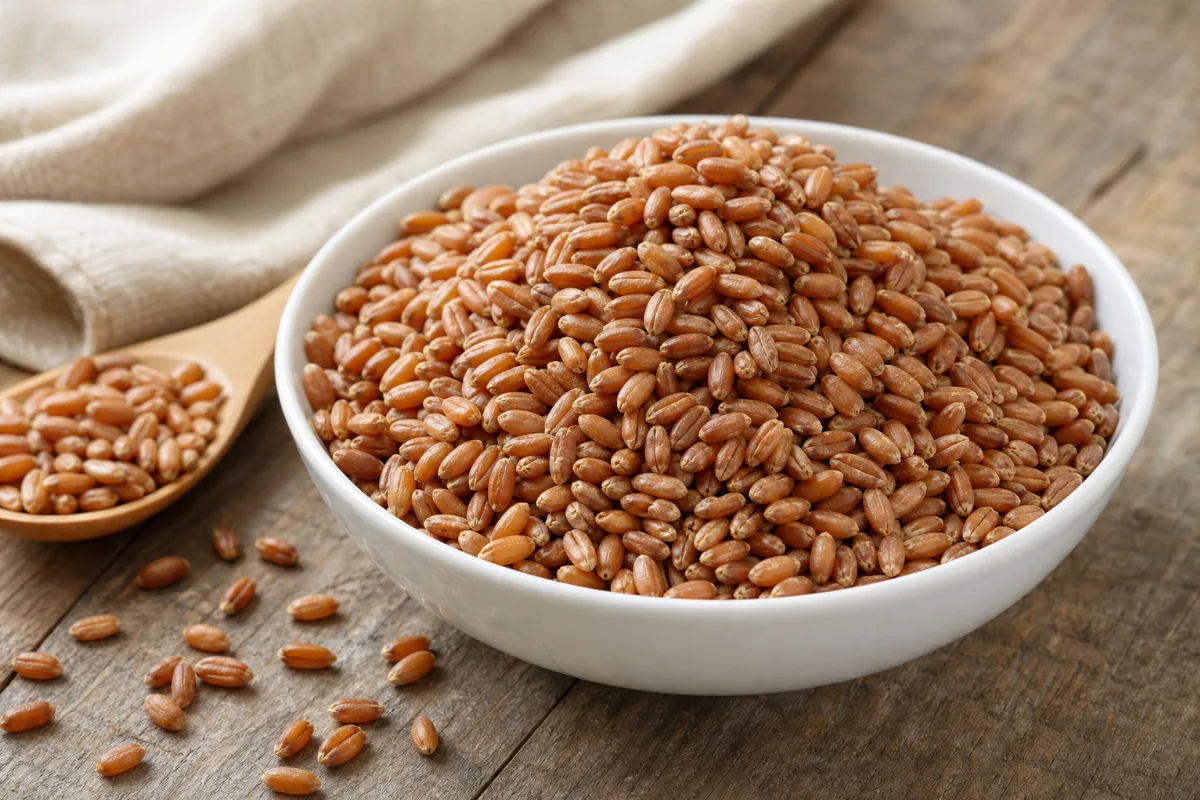
Whole Grains · Whole grain
Whole Wheat & Wheat Berries
Triticum aestivum · also called Wheat berries, whole wheat kernels, hard red winter wheat, trigo integral (Spanish)
Whole wheat here means the whole wheat kernel, often sold as wheat berries, with its bran and germ still on. It gives fibre, manganese, selenium and B vitamins. Studies of whole grains in general link them to slightly lower LDL cholesterol and, in large cohort studies, to less heart disease, but these are not trials of wheat berries. The main cautions are that wheat contains gluten (not safe for celiac disease), wheat allergy, and raw flour, which can carry germs.
General information, not medical advice. Last substantive update · Not medically reviewed. A named clinician has not signed off on this page. How this page is made
About Whole Wheat & Wheat Berries
Whole wheat here means the whole wheat kernel, often sold as wheat berries. It still has its bran, germ and starchy middle, so it has more fibre and minerals than white flour. It is a healthy food, not a proven remedy: the heart and diabetes findings come from studies of whole grains in general, and wheat contains gluten and is a common allergen.
What it is
Whole wheat (Triticum aestivum, in the grass family Poaceae) is the wheat kernel eaten whole. In shops it is often called wheat berries. GBIF lists Triticum aestivum L. as the accepted name. The kernel is boiled or soaked until chewy and eaten in salads, soups and side dishes.
USDA data for dry hard red winter wheat kernels, per 100 g: 327 kcal, 12.6 g protein, 12.2 g fibre, 126 mg magnesium, 363 mg potassium, 3.98 mg manganese, 70.7 micrograms selenium and 5.46 mg niacin. The USDA household portion is 1 cup dry (192 g), about 628 kcal and 23.4 g fibre. These are dry values; cooked wheat berries hold water, so compare dry with dry. Cooked values were not read.
What the research shows
The firmest facts are about nutrients and safety. Cereal fibre adds stool weight in trials, and the wheat kernel is a fibre food. USDA lists it as rich in manganese, selenium, magnesium and B vitamins.
Pooled trials of whole-grain foods found LDL cholesterol 0.09 mmol/L lower than with non-whole-grain foods, with oat the strongest. Cohort studies link more whole grain to less coronary heart disease (RR 0.81 per 90 g a day), less type 2 diabetes (RR 0.68 per 3 servings a day) and lower risk of death. Cohort studies cannot prove cause. One 8-week trial found lower body weight, IL-6 and C-reactive protein on a whole-grain diet, but did not change blood sugar control or gut bacteria.
Wheat berries on their own are not well studied. The trials and cohorts used whole-grain bread, cereals, pasta and other foods from several grains.
Food versus flour, bread, bran and supplements
The USDA values are for whole dry kernels. The trials used whole-grain foods such as bread, cereal and pasta from many grains. Whole wheat flour, bread, bran, germ, sprouted wheat and wheatgrass are different products with their own pages. The gluten trial used purified gluten, which is not the same as eating wheat. We make no claim about those products here.
Portions
The USDA household portion is 1 cup dry (192 g), which is information, not a prescription. The NHS says starchy foods should make up just over a third of what you eat, and to choose wholegrain varieties where you can. This page gives no amounts to eat. Ask a doctor, pharmacist or dietitian what is right for you, especially if you have celiac disease, a wheat allergy, kidney disease or take medicine for blood sugar or clotting.
At a glance
Traditional uses history, not proof
- Eaten whole, boiled or soaked, as a chewy grain in salads, soups and side dishes
- Ground into whole wheat flour (a separate product)
- Long use as food is not proof that it treats any condition
Studied for research
- Fibre for bowel regularity, moderate certainty for cereal fibre in general
- LDL cholesterol, low certainty (pooled whole-grain trials, oat strongest)
- Heart disease and early death, low certainty (observational, whole grains of all kinds)
- Type 2 diabetes risk, low certainty (observational)
- Minerals and B vitamins, high certainty for the nutrient content
- Body weight and inflammation markers, low certainty (one trial)
- Phytate and mineral absorption, insufficient evidence (bread studies)
- Gluten versus FODMAPs in people who feel gluten sensitive, mixed evidence
Main compounds
- Dietary fibre
- Gluten
- Fructans
- Phytate
- Manganese and selenium
- Thiamin and niacin
Common forms
- Whole wheat kernels (wheat berries), boiled or soaked, as food
- Cracked or ground whole wheat, bran and germ, bread and pasta (separate products, not covered here)
- Whole wheat flour (raw flour is not ready to eat)
- Sprouted wheat and wheatgrass (different products, not covered)
Research links: 2015 review: whole grains and cholesterol · 2016 review: whole grains and heart disease · NIDDK: celiac disease and diet · Research Library · Genes & Biomarkers Library
What it is and its history
- Accepted scientific name
- Triticum aestivum
- Naming authority
- L. (GBIF accepted name, exact match)
- Common names
- Whole wheat (English); Wheat berries (English); Whole wheat kernels (English); Hard red winter wheat (USDA variety) (English); Trigo integral (granos de trigo) (Spanish)
- Family or group
- Poaceae (the grass family), per GBIF.
- Classification
- Plantae > Tracheophyta > Liliopsida > Poales > Poaceae > Triticum > Triticum aestivum
- Native range
- Not verified from a source read.
- Habitat
- Not verified from a source read.
- What it looks like
- Roots: Not verified.; Stems: Not verified.; Leaves: Not verified.; Flowers: Not verified.; Fruit: The wheat kernel (grain) is eaten whole as 'wheat berries'. It holds the bran, the germ and the starchy middle (existing nutrient summary). USDA gives a household portion of 1 cup dry = 192 g.
- Cultivation
- Not verified from a source read.
- Harvest and processing
- Sold as whole kernels (wheat berries), cracked or ground (see the bulgur, bran and germ, bread and pasta pages), or milled into whole wheat flour. Only the dry hard red and soft red winter kernel values were read.
- Look-alikes and adulterants
- Name: Ancient wheats (einkorn, emmer, spelt, Khorasan); Note: Also contain gluten; a review found them to contain as much or more gluten than modern bread wheat.; Name: Wheat flour, bread, bran and germ; Note: Separate products with their own pages; not covered by the kernel values here.; Name: Wheatgrass; Note: The young plant, a different product.
- Sustainability and conservation
- Not assessed.
Photographs
What is inside, and how it may work
What it contains and how those compounds act in cells and animals. Laboratory and animal mechanisms are not proven effects in people.
Main compounds
| Compound | Family | Where it is concentrated | Activity studied | Level of evidence |
|---|---|---|---|---|
| Dietary fibre | carbohydrate | Kernel (bran) USDA: 12.2 g per 100 g dry hard red winter wheat; 12.5 g soft red | Cereal fibre adds stool weight (review of intervention trials). 9 18 19 | Human data |
| Gluten (gliadins and glutenins) | protein | Kernel (starchy middle) Not measured in the sources read; USDA lists 12.6 g total protein per 100 g dry | Triggers celiac disease in people with the genes; contains omega-5 gliadin, the main allergen in wheat-dependent exercise-induced anaphylaxis. 16 4 8 | Human data |
| Fructans | carbohydrate (FODMAP) | Kernel Not measured in the sources read | A review says gas from fermentation of fructans in wheat may explain symptoms in people who feel gluten sensitive. 4 | Human data |
| Phytate | mineral-binding compound | Kernel (bran) Not measured in the sources read | Can reduce mineral absorption from the same meal; the long-term effect is unclear. 6 | Human data |
| Manganese, selenium, magnesium, copper, zinc | minerals | Kernel (bran and germ) USDA per 100 g dry hard red winter: manganese 3.98 mg, selenium 70.7 micrograms, magnesium 126 mg, copper 0.434 mg, zinc 2.65 mg | Dietary minerals with well-known roles in the body. 18 | Human data |
| Thiamin (B1) and niacin (B3) | B vitamins | Kernel USDA per 100 g dry hard red winter: thiamin 0.383 mg, niacin 5.46 mg | Dietary B vitamins with well-known roles in the body. 18 | Human data |
Mechanisms, receptors and pathways
| Target or pathway | Gene or receptor | What was found | Level |
|---|---|---|---|
| Cereal fibre and bowel function | Not specified | Cereal fibre increased stool weight; fibres that ferment less added more. This is the general role of cereal fibre, not shown for wheat berries specifically. 9 | Human data |
| Gluten and the immune system in celiac disease | Not specified in the sources read (the Brouns review mentions celiac-active parts of gluten) | In celiac disease the immune system attacks the small intestine when gluten from wheat, barley or rye is eaten (NHS, NIDDK). 14 16 4 | Human data |
| Omega-5 gliadin and wheat allergy | Specific IgE to omega-5 gliadin | Omega-5 gliadin is the major allergen in wheat-dependent exercise-induced anaphylaxis. 8 | Human data |
| Phytate and iron | Not specified | The review calls the mechanism for lowering phytate to improve iron convincing, but human studies of bread were inconclusive. 6 | Human data |
Absorption, metabolism and elimination
- Absorption
- Not found for whole wheat. A 2026 review of bread studies describes lower non-haem iron absorption from high-phytate bread in single meals.
- Distribution
- Not found.
- Metabolism
- Not found.
- Elimination
- Not found.
- Bioavailability
- Not established for wheat nutrients in the sources read.
Isolated compounds versus whole extracts
The USDA values are for whole dry wheat kernels. The cholesterol trials and cohort studies used whole-grain foods such as bread, cereal and pasta from many grains, not boiled wheat berries alone. Wheat bran, germ and flour are separate products. The gluten trial used purified gluten, which is not the same as eating wheat.
Nutritional composition
Nutrition from USDA FoodData Central (SR Legacy, last updated 4/1/2019; values read 2026-10-26 from the public data feed). Dry hard red winter wheat kernels (FDC 168890), per 100 g: 327 kcal, 12.6 g protein, 1.54 g fat, 71.2 g carbohydrate, 12.2 g fibre, about 13.1 g water, 29 mg calcium, 3.19 mg iron, 126 mg magnesium, 288 mg phosphorus, 363 mg potassium, 2 mg sodium, 2.65 mg zinc, 0.434 mg copper, 3.98 mg manganese, 70.7 micrograms selenium, 0.383 mg thiamin, 5.46 mg niacin, 38 micrograms folate (DFE), 1.9 micrograms vitamin K. USDA's household portion is 1 cup dry (192 g): about 628 kcal, 24.2 g protein, 23.4 g fibre, 242 mg magnesium, 697 mg potassium and 7.6 mg manganese (per-100-g values multiplied by 1.92). Soft red winter wheat (FDC 168891), per 100 g: 331 kcal, 10.4 g protein, 12.5 g fibre, 3.21 mg iron, 493 mg phosphorus, 397 mg potassium. These are dry-kernel values; wheat berries absorb water when boiled, so a cooked portion weighs more and has fewer calories per 100 g. Cooked wheat berry values were not read. Values vary with variety, growing place and milling.
1 high certainty1 moderate certainty1 mixed findings5 low certainty1 not enough evidence
What was looked at
The 9 benefits and uses checked for Whole Wheat & Wheat Berries, each with how strong the evidence is. Tap one to open it.
- Fibre for bowel regularityModerate certainty
- Cholesterol (LDL)Low certainty
- Heart disease and early death (observational)Low certainty
- Type 2 diabetes risk (observational)Low certainty
- Minerals and B vitamins (nutrient content)High certainty
- Body weight and inflammation markersLow certainty
- Cancer deaths and other causes of death (observational)Low certainty
- Phytate and mineral absorptionNot enough evidence
- Gut symptoms: gluten versus FODMAPsMixed findings
Lab markers tracked in the studies
LDL cholesterolTotal cholesterolStool (fecal) weight and transit timeBody weightInflammation markers (IL-6 and C-reactive protein)
What is Whole Wheat & Wheat Berries good for?
The main studied uses and how strong the human evidence is for each. Most results are for whole grains in general, not wheat berries on their own.
Benefits, one by one
Each card is a research question, not a promise. Tap a goal to filter. Open a card to see the studies, doses and limits.
Fibre for bowel regularity
Moderate certaintyDry whole wheat kernels have 12.2 g of fibre per 100 g by USDA data. A review of trials found that cereal fibre in general adds to stool weight, and shortens slow gut transit. This is general cereal fibre evidence, not a trial of wheat berries. Wheat contains fructans that gas-prone people may notice (see Safety).
2 studiesWhole wheat kernels eaten as food; the review used fibre from cereals…
Studies, doses and limits
What the trials found
USDA lists 12.2 g of total fibre per 100 g of dry hard red winter wheat (23.4 g in the 1-cup dry household portion of 192 g). A review of intervention studies in healthy people found cereal and vegetable fibre had comparable effects on stool weight, both more than fruit fibre. Transit time did not change when it was already under 48 hours; when it was 48 hours or longer, it was shorter by about 30 minutes per gram of fibre.
Results
Cereal fibre in general adds stool weight and may speed slow transit. No trial of eating whole wheat berries for bowel function was read.
Effect sizes as reported
USDA: 12.2 g fibre per 100 g dry kernels. Review: about 30 minutes shorter transit per gram of fibre when starting transit was 48 hours or more.
Why this rating
Moderate for cereal fibre adding stool weight (a review of intervention trials, written by authors three of whom list Kellogg Company). Low for wheat berries themselves: no trial of them was read.
Form and dose studied
Whole wheat kernels eaten as food; the review used fibre from cereals in general (bran and others).
Who was studied
Healthy adults in the fibre trials.
Limits
Not a trial of wheat berries. Industry-linked authors. The review was of fibres, not cooked grains.
Why researchers looked
Wheat kernels keep the bran, which is where much of the fibre is, so people ask what that fibre does for the gut.
Traditional use
Whole wheat kernels are eaten boiled or soaked as a grain, or ground into flour. Long use as food is not proof that it treats any condition.
Proposed mechanism Authoritative guidance
Cereal fibre adds bulk to stool; fibres that ferment less added more stool weight in the review (de Vries 2016).
A proposed mechanism does not show that the effect happens in people.
Wheat fructans and gluten matter for some people; see the Safety tab.
Cholesterol (LDL)
Low certaintyPooled trials of whole-grain diets found a small fall in LDL ("bad") cholesterol of about 0.09 mmol/L compared with non-whole-grain diets. HDL did not change. Oat was the strongest grain. Wheat berries on their own were not separated out.
1 studiesWhole-grain foods such as bread, cereal and pasta (not wheat berries …
Studies, doses and limits
What the trials found
A 2015 meta-analysis of 24 randomised controlled studies in apparently healthy adults compared whole-grain foods with non-whole-grain controls. LDL cholesterol was 0.09 mmol/L lower (95% CI -0.15 to -0.03) and total cholesterol 0.12 mmol/L lower (-0.19 to -0.05). HDL did not change and triglycerides tended to fall (-0.04 mmol/L, P = 0.10, not significant). Whole-grain oat lowered total cholesterol the most.
Results
Eating whole grains instead of refined grains slightly lowered LDL cholesterol in short trials. The effect was driven partly by oat; wheat was not shown separately in the abstract.
Effect sizes as reported
LDL -0.09 mmol/L; total cholesterol -0.12 mmol/L; HDL no change; triglycerides -0.04 mmol/L (not significant).
Why this rating
The pooled trials are randomised, but they mix many whole-grain foods and oat looked strongest, so we rate whole wheat itself low. LDL is a marker, not a count of heart attacks.
Form and dose studied
Whole-grain foods such as bread, cereal and pasta (not wheat berries alone).
Who was studied
Apparently healthy adults.
Limits
Mixed whole grains. Small average change. A marker, not heart attacks or strokes.
Why researchers looked
Whole grains are rich in fibre, so researchers test whether swapping refined grain for whole grain changes blood fats.
Traditional use
Whole wheat kernels are eaten boiled or soaked as a grain, or ground into flour. Long use as food is not proof that it treats any condition.
Proposed mechanism Unknown
Not established in the abstract read. The authors note that grains differ in nutrients such as dietary fibre.
A proposed mechanism does not show that the effect happens in people.
None specific for cholesterol.
Heart disease and early death (observational)
Low certaintyIn large cohort studies, people who ate more whole grain had less coronary heart disease, less cardiovascular disease and a lower risk of death from any cause. The link for stroke was not clear. These studies show association, not proof, and cover whole grains of all kinds.
1 studiesWhole grain foods (bread, breakfast cereals, added bran and others).
Studies, doses and limits
What the trials found
A 2016 meta-analysis of 45 prospective studies found, for each 90 g a day more whole grain (about three servings), relative risks of 0.81 for coronary heart disease (95% CI 0.75 to 0.87), 0.78 for cardiovascular disease (0.73 to 0.85) and 0.83 for death from any cause (0.77 to 0.90). For stroke the result was 0.88 with a range that includes no effect (0.75 to 1.03). There was little sign of a link for refined grains or white rice.
Results
More whole grain went with lower heart disease and early death risk in cohorts. Cause is not shown.
Effect sizes as reported
Per 90 g/day more: coronary heart disease RR 0.81; cardiovascular disease 0.78; stroke 0.88 (0.75-1.03); death from any cause 0.83.
Why this rating
Cohort studies cannot prove cause, people who eat whole grains may have other healthy habits, and differences between studies were large for death from any cause (I2 = 83%). Whole grains of all kinds, not wheat berries alone.
Form and dose studied
Whole grain foods (bread, breakfast cereals, added bran and others).
Who was studied
Adults in prospective cohort studies.
Limits
Observational. Not specific to wheat. The 90 g a day figure describes the studies, not advice.
Why researchers looked
Public health bodies suggest whole grains, so researchers track whether people who eat them stay healthier.
Traditional use
Whole wheat kernels are eaten boiled or soaked as a grain, or ground into flour. Long use as food is not proof that it treats any condition.
Proposed mechanism Unknown
Not tested. Possible reasons include fibre and other kernel parts, but cohort studies cannot show why.
A proposed mechanism does not show that the effect happens in people.
None specific.
Type 2 diabetes risk (observational)
Low certaintyIn cohort studies, people who ate more whole grain were less likely to develop type 2 diabetes. Refined grain showed no clear link. This is association only, and about whole grains as a group.
1 studiesWhole grain foods (bread, cereal, wheat bran, brown rice and others).
Studies, doses and limits
What the trials found
A 2013 meta-analysis of 16 cohort studies found a relative risk of 0.68 per 3 servings a day of whole grains (95% CI 0.58 to 0.81; 10 studies; I2 = 82%) and 0.95 for refined grains (0.88 to 1.04; 6 studies). Links for whole grain bread, whole grain cereals and wheat bran were based on few studies. The authors suggest at least two servings of whole grain a day to lower risk.
Results
More whole grain, but not more refined grain, went with lower diabetes risk in cohorts. Cause is not shown.
Effect sizes as reported
Per 3 servings/day: whole grains RR 0.68 (0.58-0.81); refined grains RR 0.95 (0.88-1.04).
Why this rating
Observational, large differences between studies (I2 = 82%), and published in 2013. Whole grains of all kinds.
Form and dose studied
Whole grain foods (bread, cereal, wheat bran, brown rice and others).
Who was studied
Adults in cohort studies.
Limits
Observational. Not a treatment for diabetes. People with diabetes should follow their care team's plan.
Why researchers looked
Whole grains are digested more slowly than refined grains, so researchers ask whether they change diabetes risk.
Traditional use
Whole wheat kernels are eaten boiled or soaked as a grain, or ground into flour. Long use as food is not proof that it treats any condition.
Proposed mechanism Unknown
Not tested in the abstract read.
A proposed mechanism does not show that the effect happens in people.
None specific.
Minerals and B vitamins (nutrient content)
High certaintyDry hard red winter wheat kernels have 3.98 mg manganese, 71 micrograms selenium, 126 mg magnesium, 0.43 mg copper, 0.38 mg thiamin (B1) and 5.46 mg niacin (B3) per 100 g, by USDA data. This is nutrient content, not a trial of wheat berries.
2 studiesDry kernels as listed by USDA; cooked values were not read.
Studies, doses and limits
What the trials found
USDA FoodData Central lists, per 100 g of dry hard red winter wheat: 12.6 g protein, 3.19 mg iron, 2.65 mg zinc, 288 mg phosphorus, 363 mg potassium, 3.98 mg manganese, 70.7 micrograms selenium, 0.434 mg copper, 0.383 mg thiamin, 5.46 mg niacin and 38 micrograms folate (DFE). Soft red winter wheat is similar but has higher phosphorus (493 mg).
Results
Whole wheat is a food source of these minerals and B vitamins. No trial was read showing that eating wheat berries corrects a low level.
Effect sizes as reported
USDA: see composition tab and nutrition note for the full per-100 g and per-cup values.
Why this rating
High that the kernel contains these nutrients (USDA data). Not tested as a treatment for a low level.
Form and dose studied
Dry kernels as listed by USDA; cooked values were not read.
Who was studied
General adult diet.
Limits
Nutrient facts only. Amounts vary with variety, soil and milling. Phytate in whole grains can reduce mineral absorption from the same meal (see the other tab).
Why researchers looked
Grain kernels hold minerals and B vitamins in the bran and germ, so people ask what whole wheat adds to the diet.
Traditional use
Whole wheat kernels are eaten boiled or soaked as a grain, or ground into flour. Long use as food is not proof that it treats any condition.
Proposed mechanism Authoritative guidance
These nutrients have well-known roles in the body; this page makes no claim that eating wheat berries treats any lack of them.
A proposed mechanism does not show that the effect happens in people.
None specific.
Body weight and inflammation markers
Low certaintyIn one 8-week crossover trial of adults at risk of metabolic syndrome, a whole-grain diet lowered body weight and two inflammation markers (IL-6 and C-reactive protein) compared with a refined-grain diet. Blood sugar control and gut bacteria did not change. It was one trial with mixed whole grains, partly industry funded.
1 studiesWhole-grain foods (mixed), trial detail 179 g a day versus 13 g a day…
Studies, doses and limits
What the trials found
A randomised crossover trial in 60 Danish adults at risk of metabolic syndrome (50 completed both periods) compared two 8-week diets: whole grain (179 g a day) and refined grain (13 g a day). Whole grain lowered body weight (p < 0.0001), IL-6 (p = 0.009) and C-reactive protein (p = 0.003). It did not significantly change glucose control, the faecal microbiome, breath hydrogen, short-chain fatty acids, gut integrity or transit time.
Results
The whole-grain diet lowered weight and inflammation markers in one trial. Wheat alone was not tested.
Effect sizes as reported
Body weight p < 0.0001; IL-6 p = 0.009; C-reactive protein p = 0.003 (no confidence intervals in the abstract).
Why this rating
One 8-week trial of 50 completers, mixed whole grains (rye linked to the IL-6 result), and part industry support.
Form and dose studied
Whole-grain foods (mixed), trial detail 179 g a day versus 13 g a day (not advice).
Who was studied
Adults at risk of metabolic syndrome, in Denmark.
Limits
Small, short trial. Part funding from an unrestricted grant from Cereal Partners Worldwide; intervention products were sponsored by food companies; sponsors had no role in design or analysis.
Why researchers looked
Researchers test whether swapping refined grain for whole grain changes weight, inflammation and the gut microbiome.
Traditional use
Whole wheat kernels are eaten boiled or soaked as a grain, or ground into flour. Long use as food is not proof that it treats any condition.
Proposed mechanism Human clinical
The weight change matched a lower energy intake; the IL-6 change was linked to the amount of whole grain eaten, especially rye (Roager 2019).
A proposed mechanism does not show that the effect happens in people.
None specific.
Cancer deaths and other causes of death (observational)
Low certaintyThe same large review of cohort studies linked more whole grain to lower risk of dying from cancer, respiratory disease and infections, as well as from any cause. This is association only, for whole grains of all kinds.
1 studiesWhole grain foods of all kinds.
Studies, doses and limits
What the trials found
In the 2016 meta-analysis of 45 prospective studies, per 90 g a day more whole grain the relative risks of death were 0.85 for cancer (95% CI 0.80 to 0.91), 0.78 for respiratory disease (0.70 to 0.87), 0.74 for infectious diseases (0.56 to 0.96), 0.49 for diabetes (0.23 to 1.05, a range that includes no effect) and 1.15 for nervous system disease (0.66 to 2.02, no clear link).
Results
Lower risk of several causes of death in cohorts, but not for diabetes or nervous system disease deaths in this analysis. Cause is not shown.
Effect sizes as reported
Per 90 g/day: cancer deaths RR 0.85; respiratory 0.78; infectious diseases 0.74; diabetes deaths 0.49 (0.23-1.05); nervous system 1.15 (0.66-2.02).
Why this rating
Observational; may reflect other healthy habits; small numbers of studies for some causes; whole grains of all kinds.
Form and dose studied
Whole grain foods of all kinds.
Who was studied
Adults in prospective cohort studies.
Limits
Not specific to wheat. Not proof that any food prevents cancer.
Why researchers looked
Because whole grain is linked to lower overall death risk in cohorts, researchers also look at specific causes of death.
Traditional use
Whole wheat kernels are eaten boiled or soaked as a grain, or ground into flour. Long use as food is not proof that it treats any condition.
Proposed mechanism Unknown
Not tested.
A proposed mechanism does not show that the effect happens in people.
None specific.
Phytate and mineral absorption
Not enough evidenceWhole grains contain phytate, which can lower iron absorption from the same meal. A 2026 review of 8 human studies on bread was inconclusive: single-meal studies favoured low-phytate bread but long-term trials did not improve iron stores. It was about bread, not wheat berries.
1 studiesBread (sourdough, regular, low-phytate); not wheat berries.
Studies, doses and limits
What the trials found
A 2026 systematic review of 8 human intervention studies found that in single meals, low-phytate bread raised non-haem iron more (serum iron rise at 2 hours: 59 versus 30 ug Fe/100 mL for low-phytate white bread versus high-phytate wholemeal bread). In long-term trials, ferritin and total body iron did not improve; in a low-phytate sourdough rye bread group ferritin fell from 32 to 27 ug/L over 12 weeks.
Results
Phytate can reduce iron absorption at a meal, but the long-term effect on iron stores is not shown. Wheat berries were not studied.
Effect sizes as reported
Serum iron 2-hour rise 59 vs 30 ug Fe/100 mL (single meals); ferritin 32 to 27 ug/L (12 weeks, low-phytate sourdough rye).
Why this rating
The review calls its own results inconclusive and says no human study answers the question with proper control and quality. Bread, not wheat berries.
Form and dose studied
Bread (sourdough, regular, low-phytate); not wheat berries.
Who was studied
Healthy and iron-deficient people.
Limits
Bread rather than whole kernels. Mixed results.
Why researchers looked
The bran and germ of wheat hold phytate, so people ask whether whole wheat blocks iron and zinc.
Traditional use
Whole wheat kernels are eaten boiled or soaked as a grain, or ground into flour. Long use as food is not proof that it treats any condition.
Proposed mechanism Human clinical
Phytate binds minerals in the gut; the review says the sourdough mechanism for improving iron is convincing in the lab but not shown with proper human controls.
A proposed mechanism does not show that the effect happens in people.
People with low iron should ask a clinician about iron intake.
Gut symptoms: gluten versus FODMAPs
Mixed findingsSome people feel unwell after wheat and think gluten is the cause. In a double-blind crossover trial of 37 people with self-reported gluten sensitivity and IBS, symptoms improved on a low-FODMAP diet and gluten had a specific effect in only 8%. A review says the cause may be gas from fructans in wheat. Celiac disease is different and needs medical testing.
2 studiesPurified gluten in the trial; wheat food in daily life.
Studies, doses and limits
What the trials found
Biesiekierski 2013: 37 adults (aged 24-61) with self-reported non-celiac gluten sensitivity and irritable bowel syndrome, but not celiac disease, first ate a low-FODMAP diet for 2 weeks, then got high-gluten (16 g a day), low-gluten or whey-protein control diets for a week each. Symptoms improved on low FODMAP and worsened to a similar degree with gluten or whey. Gluten-specific effects were seen in 8%. A 3-day rechallenge in 22 people did not reproduce a gluten-specific effect. Brouns 2022 (narrative review): many people who think they are gluten sensitive are not confirmed in medical testing; gas from fermenting fructans in wheat may be the cause.
Results
In people who think they are gluten sensitive, FODMAPs explained more of the symptoms than gluten in one small trial. The trial does not apply to celiac disease or wheat allergy.
Effect sizes as reported
Gluten-specific effects in 8% of participants.
Why this rating
One small trial plus a narrative review, using purified gluten rather than wheat food. Results do not apply to celiac disease.
Form and dose studied
Purified gluten in the trial; wheat food in daily life.
Who was studied
Adults with self-reported gluten sensitivity and IBS.
Limits
Small trial. An order effect was noted. Do not stop eating gluten before celiac testing.
Why researchers looked
Many people avoid wheat for stomach symptoms, so researchers test whether gluten or other wheat carbohydrates are to blame.
Traditional use
Whole wheat kernels are eaten boiled or soaked as a grain, or ground into flour. Long use as food is not proof that it treats any condition.
Proposed mechanism Human clinical
FODMAPs, including wheat fructans, ferment in the gut and make gas (Brouns 2022). Not shown directly in the trial abstract.
A proposed mechanism does not show that the effect happens in people.
See the Safety tab for celiac disease and wheat allergy.
Connections to the rest of health
How Whole Wheat & Wheat Berries connects to the rest of our health knowledge graph. Every link says what kind of connection it is. A safety link (for example to the liver) is a warning, not a benefit. A study that merely mentions a topic never creates a benefit link.
Explore every connection: goals, body systems, organs, symptoms, genes
A. Wellness goals
| Connected to | Kind of connection | Evidence status | Context | Studies |
|---|---|---|---|---|
| Digestive Support | Moderate certainty | Fibre for bowel regularity: Dry whole wheat kernels have 12.2 g of fibre per 100 g by USDA data. A review of trials found that cereal fibre in general adds to stool weight, and shortens slow gut transit. This is general cereal fibre evidence, not a trial of wheat berries. Wheat contains fructans that gas-prone people may notice (see Safety). Gut symptoms: gluten versus FODMAPs: Some people feel unwell after wheat and think gluten is the cause. In a double-blind crossover trial of 37 people with self-reported gluten sensitivity and IBS, symptoms improved on a low-FODMAP diet and gluten had a specific effect in only 8%. A review says the cause may be gas from fructans in wheat. Celiac disease is different and needs medical testing. | 9 18 3 4 | |
| Cholesterol Balance | Low certainty | Cholesterol (LDL): Pooled trials of whole-grain diets found a small fall in LDL ("bad") cholesterol of about 0.09 mmol/L compared with non-whole-grain diets. HDL did not change. Oat was the strongest grain. Wheat berries on their own were not separated out. | 5 | |
| Heart Health | Low certainty | Cholesterol (LDL): Pooled trials of whole-grain diets found a small fall in LDL ("bad") cholesterol of about 0.09 mmol/L compared with non-whole-grain diets. HDL did not change. Oat was the strongest grain. Wheat berries on their own were not separated out. | 5 | |
| Heart Health | Low certainty | Heart disease and early death (observational): In large cohort studies, people who ate more whole grain had less coronary heart disease, less cardiovascular disease and a lower risk of death from any cause. The link for stroke was not clear. These studies show association, not proof, and cover whole grains of all kinds. | 2 | |
| Blood Sugar Balance | Low certainty | Type 2 diabetes risk (observational): In cohort studies, people who ate more whole grain were less likely to develop type 2 diabetes. Refined grain showed no clear link. This is association only, and about whole grains as a group. | 1 | |
| Balanced Nutrition | Demonstrated clinical effect | High certainty | Minerals and B vitamins (nutrient content): Dry hard red winter wheat kernels have 3.98 mg manganese, 71 micrograms selenium, 126 mg magnesium, 0.43 mg copper, 0.38 mg thiamin (B1) and 5.46 mg niacin (B3) per 100 g, by USDA data. This is nutrient content, not a trial of wheat berries. | 18 19 |
| Weight Management | Low certainty | Body weight and inflammation markers: In one 8-week crossover trial of adults at risk of metabolic syndrome, a whole-grain diet lowered body weight and two inflammation markers (IL-6 and C-reactive protein) compared with a refined-grain diet. Blood sugar control and gut bacteria did not change. It was one trial with mixed whole grains, partly industry funded. | 7 | |
| Healthy Aging | Low certainty | Cancer deaths and other causes of death (observational): The same large review of cohort studies linked more whole grain to lower risk of dying from cancer, respiratory disease and infections, as well as from any cause. This is association only, for whole grains of all kinds. | 2 | |
| Balanced Nutrition | Not enough evidence | Phytate and mineral absorption: Whole grains contain phytate, which can lower iron absorption from the same meal. A 2026 review of 8 human studies on bread was inconclusive: single-meal studies favoured low-phytate bread but long-term trials did not improve iron stores. It was about bread, not wheat berries. | 6 |
B. Body systems
| Connected to | Kind of connection | Evidence status | Context | Studies |
|---|---|---|---|---|
| Digestive System | Biological association | Moderate certainty | Studied for: Fibre for bowel regularity Studied for: Phytate and mineral absorption | 9 18 6 3 4 |
| Cardiovascular System | Biological association | Low certainty | Studied for: Cholesterol (LDL) Studied for: Heart disease and early death (observational) | 5 2 |
| Endocrine System | Biological association | Low certainty | Studied for: Type 2 diabetes risk (observational) | 1 |
| Metabolism Weight | Biological association | Low certainty | Studied for: Type 2 diabetes risk (observational) Studied for: Body weight and inflammation markers | 1 7 |
| Blood | Biological association | High certainty | Studied for: Minerals and B vitamins (nutrient content) Studied for: Phytate and mineral absorption | 18 19 6 |
| Musculoskeletal System | Biological association | High certainty | Studied for: Minerals and B vitamins (nutrient content) | 18 19 |
| Immune System | Biological association | Low certainty | Studied for: Body weight and inflammation markers Studied for: Cancer deaths and other causes of death (observational) | 7 2 |
E. Health conditions
| Connected to | Kind of connection | Evidence status | Context | Studies |
|---|---|---|---|---|
| Celiac disease | Contraindication | Documented risk | Gluten in wheat triggers celiac disease; a gluten-free diet is the treatment. Preparation or compound: Gluten in wheat |
17 16 14 |
| Wheat hypersensitivity | Adverse effect or risk | Documented risk | Wheat is a major food allergen; a form is triggered by wheat plus exercise or other co-factors. Preparation or compound: Wheat proteins including omega-5 gliadin |
13 8 |
| Gluten sensitivity | Adverse effect or risk | Preliminary or mixed | In one small trial, FODMAPs explained symptoms in people with self-reported gluten sensitivity better than gluten. Preparation or compound: Wheat gluten and fructans |
3 4 |
| Food poisoning | Adverse effect or risk | Documented risk | Raw flour can carry E. coli or Salmonella; cooked grains left at room temperature can make toxins. Raw flour can carry E. coli or Salmonella; cooked grains left out can make toxins. Preparation or compound: Raw flour; cooked grains left out |
10 15 |
I. Biomarkers
| Connected to | Kind of connection | Evidence status | Context | Studies |
|---|---|---|---|---|
| LDL cholesterol | Biological association | Low certainty | Measured in trials: lowered. A lab change is not the same as a health benefit. | 5 |
| Total cholesterol | Biological association | Low certainty | Measured in trials: lowered. A lab change is not the same as a health benefit. | 5 |
| Stool (fecal) weight and transit time | Biological association | Moderate certainty | Measured in trials: raised (weight) / shortened (slow transit). A lab change is not the same as a health benefit. | 9 |
| Body weight | Biological association | Low certainty | Measured in trials: lowered. A lab change is not the same as a health benefit. | 7 |
| Inflammation markers (IL-6 and C-reactive protein) | Biological association | Low certainty | Measured in trials: lowered. A lab change is not the same as a health benefit. | 7 |
K. Biological pathways
| Connected to | Kind of connection | Evidence status | Context | Studies |
|---|---|---|---|---|
| Fibre | Preliminary mechanism | Human | Whole wheat kernels are a fibre food; cereal fibre adds stool weight. | 9 18 |
| Gluten | Preliminary mechanism | Human | Gluten in wheat triggers celiac disease and may matter in wheat allergy. | 16 8 |
| Manganese and selenium | Preliminary mechanism | Human | Dry wheat kernels are rich in both by USDA data. | 18 |
L. Active compounds
| Connected to | Kind of connection | Evidence status | Context | Studies |
|---|---|---|---|---|
| Dietary fibre | Biological association | Human | Cereal fibre adds stool weight (review of intervention trials). Preparation or compound: Kernel (bran) |
9 18 19 |
| Gluten (gliadins and glutenins) | Biological association | Human | Triggers celiac disease in people with the genes; contains omega-5 gliadin, the main allergen in wheat-dependent exercise-induced anaphylaxis. Preparation or compound: Kernel (starchy middle) |
16 4 8 |
| Fructans | Biological association | Human | A review says gas from fermentation of fructans in wheat may explain symptoms in people who feel gluten sensitive. Preparation or compound: Kernel |
4 |
| Phytate | Biological association | Human | Can reduce mineral absorption from the same meal; the long-term effect is unclear. Preparation or compound: Kernel (bran) |
6 |
| Manganese, selenium, magnesium, copper, zinc | Biological association | Human | Dietary minerals with well-known roles in the body. Preparation or compound: Kernel (bran and germ) |
18 |
| Thiamin (B1) and niacin (B3) | Biological association | Human | Dietary B vitamins with well-known roles in the body. Preparation or compound: Kernel |
18 |
Each connection is stored with the ingredient, the connected record, the kind of connection, the evidence status, the supporting studies, the preparation or compound involved, and a review date (last reviewed October 26, 2026).
The evidence
The research centre for Whole Wheat & Wheat Berries. Every record here was checked against PubMed or the publisher's page; we never list a study we have not verified.
Evidence by outcome
Bars show how many studies we found for each outcome, not how well it works. People are added up across trials only (reviews are not added, to avoid double counting).
How we rate evidence
High certainty
Several well-run trials or reviews agree; further research is unlikely to change the picture much.
Moderate certainty
Good trials point the same way, but some doubt remains.
Low certainty
Small, short or inconsistent trials. The finding could change with better research.
Very low certainty
Very little or very weak human data. Treat as a possibility only.
Mixed findings
Trials or reviews disagree with each other.
Not enough evidence
Not enough human research to say either way.
Evidence against
Good research found no benefit, or found harm.
We take the reviewers' own risk-of-bias and GRADE statements where they exist, and otherwise judge from study size, design, consistency, directness and whether a product matches what is sold. Many publications do not make evidence high. Method note: We started from our existing whole wheat summary, re-checked nutrition against USDA FoodData Central data, read the health agency pages (NIDDK, NHS, MedlinePlus, FDA, WHO) and re-read PubMed abstracts for reviews and trials. Only abstracts were read for studies. Items we could not verify are flagged in the research gaps.
Study library: every study we checked 20
| Study | Design | People | Product, dose, length | Result |
|---|---|---|---|---|
| Aune 2013 Whole grain and refined grain consumption and the risk of type 2 diabetes: a systematic review and dose-response meta-analysis of cohort studies. European Journal of Epidemiology · PMID 24158434 · DOI |
Systematic review meta analysis |
16 cohort studies | Whole grain and refined grain intake Grain foods Results per 3 servings a day (an association, not a trial dose) Follow-up varied by study · vs Lower versus higher intake |
Higher whole grain intake was linked to lower type 2 diabetes risk. Refined grain showed no clear link. Inverse links for whole grain bread, whole grain cereals, wheat bran and brown rice were based on few studies. White rice was linked to higher risk. Per 3 servings/day: whole grains RR 0.68; refined grains RR 0.95 (Whole grains 0.58-0.81 (I2 = 82%, 10 studies); refined grains 0.88-1.04 (I2 = 53%, 6 studies)) Methods, limits and fundingOutcomes: Risk of developing type 2 diabetes Limitations: Observational: cannot prove cause. High differences between studies. Published in 2013. Whole grains of all kinds. Funding and conflicts: Funding is not stated in the abstract. Read: abstract |
| Aune 2016 Whole grain consumption and risk of cardiovascular disease, cancer, and all cause and cause specific mortality: systematic review and dose-response meta-analysis of prospective studies. BMJ · PMID 27301975 · DOI |
Systematic review meta analysis |
45 prospective (cohort) studies, 64 publications | Whole grain intake (all kinds: bread, breakfast cereals, added bran and others) Whole grain foods Results per 90 g a day increase (about three servings); an observed association, not a trial dose Follow-up varied by study · vs Lower versus higher whole grain intake |
Higher whole grain intake was linked to lower risk of coronary heart disease, cardiovascular disease, death from cancer and death from any cause. For stroke the range included no effect. There was little sign of a link for refined grains or white rice. Per 90 g/day: coronary heart disease RR 0.81; cardiovascular disease 0.78; stroke 0.88; cancer deaths 0.85; deaths from any cause 0.83 (CHD 0.75-0.87; CVD 0.73-0.85; stroke 0.75-1.03; cancer mortality 0.80-0.91; all-cause mortality 0.77-0.90) Methods, limits and fundingOutcomes: Coronary heart disease, stroke, cardiovascular disease, cancer and all-cause mortality Limitations: Observational: cannot prove cause, and people who eat more whole grains may differ in other healthy habits. Whole grains of all kinds, not wheat berries alone. Heterogeneity was high for all-cause mortality (I2 = 83%). Funding and conflicts: The authors declared no financial relationships with any organisation that might have an interest in the work. Read: abstract |
| Biesiekierski 2013 No effects of gluten in patients with self-reported non-celiac gluten sensitivity after dietary reduction of fermentable, poorly absorbed, short-chain carbohydrates. Gastroenterology · PMID 23648697 · DOI |
Controlled trial |
37 adults (aged 24-61) with self-reported non-celiac gluten sensitivity and irritable bowel syndrome, not celiac disease | Gluten (added as purified protein) versus whey protein or no added protein Gluten as an ingredient, not a whole food High-gluten 16 g/day; low-gluten 2 g/day; control 16 g whey/day 1 week per diet, then a 3-day rechallenge in 22 people · vs Whey protein or control diet |
After 2 weeks on a low-FODMAP diet, symptoms improved in everyone. They then got worse to a similar degree with gluten or whey protein. Gluten-specific effects were seen in only 8% of people. No marker changed with the diet. The 3-day rechallenge did not reproduce a gluten-specific effect. Gluten-specific effect in 8% of participants (Not given in the abstract) Methods, limits and fundingOutcomes: Gut symptoms, blood and stool markers Limitations: Small trial. Purified gluten given as supplement, not wheat food. An order effect was noted. Funding and conflicts: Funding is not stated in the abstract. Read: abstract |
| Brouns 2022 Do ancient wheats contain less gluten than modern bread wheat, in favour of better health? Nutrition Bulletin · PMID 35915783 · DOI |
Narrative review |
Narrative review (no study count in the abstract) | Ancient wheats (einkorn, emmer, spelt, Khorasan) versus modern bread wheat Wheat grain |
Gluten is in all wheat grains and all can trigger celiac disease in people with the genes. Ancient wheats had more protein and gluten and more celiac-active parts than bread wheat, so no single wheat type can be recommended as better for celiac disease. Many people who think they are gluten sensitive are not confirmed when tested; gas from fermenting fructans in wheat, or non-gluten proteins, may be the cause. n/a (n/a) Methods, limits and fundingOutcomes: Gluten and protein content, celiac disease, gluten sensitivity Limitations: Critical narrative review, not a systematic review. Funding and conflicts: The authors reported no conflicts relevant to the content. Read: abstract |
| Hollaender 2015 Whole-grain and blood lipid changes in apparently healthy adults: a systematic review and meta-analysis of randomized controlled studies. American Journal of Clinical Nutrition · PMID 26269373 · DOI |
Systematic review meta analysis |
24 randomised controlled studies in apparently healthy adults (6,069 articles screened) | Whole-grain foods (mixed grains; oat looked strongest) Whole grain foods Study length varied; longer studies showed larger changes · vs Non-whole-grain control foods |
Whole-grain diets lowered LDL cholesterol and total cholesterol compared with non-whole-grain controls. HDL cholesterol did not change and triglycerides tended to fall (not statistically significant). Whole-grain oat had the biggest effect on total cholesterol. LDL -0.09 mmol/L; total cholesterol -0.12 mmol/L; HDL no effect; triglycerides -0.04 mmol/L (P = 0.10) (LDL -0.09 (95% CI -0.15 to -0.03); total cholesterol -0.12 (-0.19 to -0.05); triglycerides -0.04 (-0.08 to 0.01)) Methods, limits and fundingOutcomes: Total, LDL and HDL cholesterol, triglycerides Limitations: Mixed whole-grain foods, not wheat berries on their own. Oat drove part of the result. Cholesterol is a marker, not heart attacks. Funding and conflicts: Funding is not stated in the abstract. Read: abstract |
| Nikolaou 2026 Effects of sourdough- or regular-bread fermentation, and phytate reduction on iron bioavailability, absorption, and iron status in humans: a systematic review of intervention studies. Frontiers in Nutrition · PMID 42163962 · DOI |
Systematic review |
8 human intervention studies (healthy or iron-deficient people) | Sourdough or regular bread, low- versus high-phytate; phytase Bread (not wheat berries) Acute meals up to 12-week trials · vs Higher-phytate breads or controls |
Results were inconclusive. In single meals, low-phytate bread raised non-haem iron more (serum iron rise at 2 hours: 59 for low-phytate white bread versus 30 ug Fe/100 mL for high-phytate wholemeal bread). Long-term trials did not improve ferritin or total body iron, and in one low-phytate sourdough rye bread trial both fell over 12 weeks. Serum iron 2-hour rise 59 vs 30 ug Fe/100 mL (acute); ferritin 32 to 27 ug/L in the low-phytate sourdough rye group over 12 weeks (Not given for these figures) Methods, limits and fundingOutcomes: Iron bioavailability, absorption and iron status Limitations: Bread, not wheat berries. The authors say no human study answers the question with proper controls and quality. Funding and conflicts: The authors declared no commercial or financial relationships that could be a conflict of interest. Registration: osf.io/gzt8m Read: abstract |
| Roager 2019 Whole grain-rich diet reduces body weight and systemic low-grade inflammation without inducing major changes of the gut microbiome: a randomised cross-over trial. Gut · PMID 29097438 · DOI |
Controlled trial |
60 Danish adults at risk of metabolic syndrome enrolled; 50 completed both periods | Whole grain diet (mixed whole grains; rye linked to the IL-6 change) versus refined grain diet Whole grain foods Whole grain intake 179 g/day versus 13 g/day (trial detail, not advice) Two 8-week periods with a washout of at least 6 weeks · vs Refined grain diet |
Compared with refined grain, whole grain did not significantly change glucose control or the gut bacteria, and did not change gut transit time or breath hydrogen. It lowered body weight, IL-6 and C-reactive protein. The weight change matched a lower energy intake. Body weight p < 0.0001; IL-6 p = 0.009; CRP p = 0.003 (Not given in the abstract) Methods, limits and fundingOutcomes: Gut microbiome, insulin sensitivity, body weight, inflammation markers Limitations: Mixed whole grains, not wheat berries alone. Adults at risk of metabolic syndrome. 8-week periods. Funding and conflicts: Part funding from an unrestricted grant from Cereal Partners Worldwide (Nestle and General Mills joint venture); products sponsored by food companies. Sponsors played no role in design or analysis. Registration: NCT01731366 Read: abstract |
| Santhosh 2026 Unusual Causes of Food-Induced Anaphylaxis - A Review. Indian Dermatology Online Journal · PMID 42377205 · DOI |
Narrative review |
Narrative review of three unusual causes of food-induced anaphylaxis | Wheat, with exercise and other triggers Wheat protein (omega-5 gliadin) |
WDEIA happens when wheat is eaten together with exercise and extra triggers such as seafood, alcohol or anti-inflammatory pain medicines (NSAIDs). The main allergen is omega-5 gliadin, a protein in wheat gluten. Symptoms range from hives or swelling to severe anaphylaxis. Diagnosis rests on history, skin prick tests and blood tests for specific IgE. n/a (n/a) Methods, limits and fundingOutcomes: Wheat-dependent exercise-induced anaphylaxis (WDEIA) Limitations: Narrative review; no frequency figures in the abstract. Funding and conflicts: One author was an assistant editor of the journal; peer review was independent. Read: abstract |
| de Vries 2016 Effects of Cereal, Fruit and Vegetable Fibers on Human Fecal Weight and Transit Time: A Comprehensive Review of Intervention Trials. Nutrients · PMID 26950143 · DOI |
Systematic review meta analysis |
Intervention studies of dietary fibre in healthy people (number not stated in the abstract) | Cereal, fruit and vegetable fibres Fibre from cereals, fruit and vegetables Varied by study · vs Control diets |
Cereal and vegetable fibre had comparable effects on stool weight, and both added more than fruit fibre. Less fermentable fibres added more stool weight than more fermentable ones. Fibre did not change transit time when it was already under 48 hours; when it was 48 hours or longer, transit time fell by about 30 minutes per gram of fibre. About 30 minutes shorter transit per gram of fibre when starting transit time was 48 hours or more (Not given in the abstract) Methods, limits and fundingOutcomes: Stool (fecal) weight and gut transit time Limitations: Cereal fibre in general, not wheat berries. Healthy people. Three of the five authors (Birkett, Hulshof, Gibes) list Kellogg Company as their affiliation. Funding and conflicts: Industry-linked: three authors list Kellogg Company affiliations. Read: abstract |
| s-fda-flour FDA: Flour Is a Raw Food and Other Safety Facts · Source |
Health agency n/a |
Methods, limits and fundingRead: full-text | ||
| s-fda-gf-rule US FDA: Food Labeling; Gluten-Free Labeling of Foods (final rule, Federal Register 5 August 2013) · Source |
Regulation n/a |
Methods, limits and fundingRead: full-text | ||
| s-gbif-triticum-aestivum GBIF species match: Triticum aestivum L. · Source |
Taxonomy database n/a |
Methods, limits and fundingRead: full-text | ||
| s-medlineplus-foodallergy MedlinePlus: Food allergy · Source |
Health agency n/a |
Methods, limits and fundingRead: full-text | ||
| s-nhs-coeliac NHS: Coeliac disease · Source |
Health agency n/a |
Methods, limits and fundingRead: full-text | ||
| s-nhs-starchy NHS: Starchy foods and carbohydrates · Source |
Health agency n/a |
Methods, limits and fundingRead: full-text | ||
| s-niddk-def NIDDK: Definition & Facts for Celiac Disease · Source |
Health agency n/a |
Methods, limits and fundingRead: full-text | ||
| s-niddk-diet NIDDK: Eating, Diet, & Nutrition for Celiac Disease · Source |
Health agency n/a |
Methods, limits and fundingRead: full-text | ||
| s-usda-fdc-168890 USDA FoodData Central: Wheat, hard red winter (SR Legacy, FDC 168890) · Source |
Reference database n/a |
Methods, limits and fundingRead: full-text | ||
| s-usda-fdc-168891 USDA FoodData Central: Wheat, soft red winter (SR Legacy, FDC 168891) · Source |
Reference database n/a |
Methods, limits and fundingRead: full-text | ||
| s-who-mycotoxins WHO: Mycotoxins fact sheet · Source |
Health agency n/a |
Methods, limits and fundingRead: full-text |
What we do not know yet
- No trial of boiled wheat berries on their own was found for cholesterol, blood sugar, weight or bowel function; the pooled trials and cohorts use whole-grain foods from many grains.
- Cooked wheat berry nutrient values, named plant compounds, fructan and phytate amounts were not read.
- How common wheat allergy is, and any FODMAP rating, pregnancy advice, choking advice for young children, heavy metals and pesticide residues were not researched.
- The CDC page on raw flour could not be read; the FDA page was used instead.
How new research is added
New studies are found by a saved PubMed search and placed in a review queue before the page changes.
Lab markers
What changed in blood or saliva tests during trials. A changed number is not the same as feeling or being healthier, and we give no "normal ranges".
Metabolic 3
LDL cholesterol
Lowered in trials
The 'bad' cholesterol carried in the blood. Higher levels are linked to more heart disease.
Low certaintyResults and what it means
Why it was measured
It is the usual blood marker used in diet trials for heart risk.
Statistical vs. clinical meaning
A small average fall in short trials of mixed whole-grain foods.
Safety implication
None specific.
| Study | Result | People | Product |
|---|---|---|---|
| 5 | LDL weighted difference -0.09 mmol/L (95% CI -0.15 to -0.03) | 24 randomised studies in apparently healthy adults | Whole-grain foods versus non-whole-grain controls |
Total cholesterol
Lowered in trials
All the cholesterol carried in the blood.
Low certaintyResults and what it means
Why it was measured
A broad blood-fat marker in diet trials.
Statistical vs. clinical meaning
A small average fall; oat gave the largest change.
Safety implication
None specific.
| Study | Result | People | Product |
|---|---|---|---|
| 5 | Total cholesterol -0.12 mmol/L (95% CI -0.19 to -0.05); oat -0.17 mmol/L | 24 randomised studies in apparently healthy adults | Whole-grain foods versus non-whole-grain controls |
Body weight
Lowered in trials
Total weight of the body.
Low certaintyResults and what it means
Why it was measured
A simple measure used in diet trials.
Statistical vs. clinical meaning
One short trial; mixed whole grains.
Safety implication
None specific.
| Study | Result | People | Product |
|---|---|---|---|
| 7 | Body weight lower on the whole-grain diet than on the refined-grain diet (p < 0.0001); consistent with lower energy intake | 50 adults who completed both periods | Whole grain diet 179 g/day versus refined grain 13 g/day, 8 weeks each |
Other 2
Stool (fecal) weight and transit time
Raised (weight) / shortened (slow transit) in trials
How much stool is made and how many hours food takes to pass through the gut.
Moderate certaintyResults and what it means
Why it was measured
Simple markers of bowel regularity.
Statistical vs. clinical meaning
Cereal fibre in general adds stool weight.
Safety implication
None specific.
| Study | Result | People | Product |
|---|---|---|---|
| 9 | Cereal and vegetable fibre both added more stool weight than fruit fibre; transit about 30 minutes shorter per gram of fibre when starting transit was 48 hours or more; no change when under 48 hours | Healthy people in intervention studies | Cereal, fruit and vegetable fibres |
Inflammation markers (IL-6 and C-reactive protein)
Lowered in trials
Blood proteins that rise with low-grade inflammation in the body.
Low certaintyResults and what it means
Why it was measured
They are used as markers of general inflammation.
Statistical vs. clinical meaning
One short trial; the IL-6 change was linked to the amount of whole grain eaten, especially rye.
Safety implication
None specific.
| Study | Result | People | Product |
|---|---|---|---|
| 7 | IL-6 lower (p = 0.009) and C-reactive protein lower (p = 0.003) on the whole-grain diet | 50 adults who completed both periods | Whole grain versus refined grain, 8 weeks each |
Safety
What studies and official sources say about side effects, medicines and who should check first. Each point shows what kind of evidence it comes from.
Main points to know 4
- Wheat contains gluten: not safe for celiac disease. Wheat, including whole wheat kernels, contains gluten. In celiac disease the immune system attacks the lining of the small intestine when gluten is eaten, and a gluten-free diet is the treatment. NIDDK lists wheat and its types (durum, emmer, semolina, spelt), barley and rye as gluten sources. Experts estimate about 1 percent of people worldwide have celiac disease, and many are not diagnosed. Do not stop eating gluten before you are tested: NIDDK warns the results may then be inaccurate. Ancient and old wheat types are not safer: a review found they contain as much or more gluten. Authoritative guidance 17 16 14 4
- Wheat is a common food allergen. MedlinePlus lists wheat among the foods that cause most food allergies. A rarer form, wheat-dependent exercise-induced anaphylaxis, happens when wheat is eaten together with exercise and other triggers such as alcohol, seafood or anti-inflammatory pain medicines; omega-5 gliadin, a protein in wheat gluten, is the main allergen. Trouble breathing or swelling of the face, lips or throat after eating wheat is an emergency: call 911 or your local emergency number. Authoritative guidance 13 8
- Raw flour is not a ready-to-eat food. The FDA says most flour is a raw food that has not been treated to kill germs, and outbreaks of Salmonella and E. coli have been linked to raw flour and dough. Cooking or baking kills them. Do not eat or taste raw flour, dough or batter, and do not let children play with raw dough. This applies to flour ground from whole wheat, not to boiled wheat berries. Authoritative guidance 10
- Cooked grains left out, and mould toxins. The NHS says spores of some food poisoning bacteria survive cooking, and if cooked grains stand at room temperature they can make toxins that reheating does not remove; cool within 1 hour and refrigerate. The WHO says deoxynivalenol and zearalenone are often found in wheat, and advises discarding grain that looks mouldy, discoloured or shrivelled. Authoritative guidance 15 20
Side effects 4
| Effect | How often | Severity and recovery | Evidence |
|---|---|---|---|
| Celiac disease flare in people with celiac disease (gut damage, diarrhoea, abdominal pain, bloating) A gluten-free diet is the treatment; there is no cure (NHS). | About 1 percent of people worldwide have celiac disease (NIDDK estimate). | can be serious Complications mainly affect people who keep eating gluten or are undiagnosed (NHS). | Authoritative guidance 16 14 |
| Wheat allergy, from hives and swelling to anaphylaxis Wheat-dependent exercise-induced anaphylaxis needs wheat plus a co-trigger such as exercise, alcohol or NSAIDs. | Not found in the sources read. | can be severe (anaphylaxis) Not found in the sources read. | Authoritative guidance 13 8 |
| Gas, bloating and stomach discomfort in some people (non-celiac gluten sensitivity or IBS) A review says gas from fermenting fructans in wheat may be the cause in many people. A purified gluten trial; not wheat food. | In one trial of 37 people with self-reported gluten sensitivity and IBS, gluten-specific effects were seen in 8%. | mild to moderate Symptoms improved on a low-FODMAP diet in that trial. | Controlled trial 3 4 |
| Food poisoning from raw flour or cooked grains left out Applies to raw flour or dough and to cooked grains stored badly. | Not found in the sources read. | can be serious Not found. | Authoritative guidance 10 15 |
Liver
No liver injury from eating whole wheat was found in the sources read. A liver-safety source (such as LiverTox) was not searched for food. The WHO fact sheet describes liver harm from aflatoxins in some grains, but names wheat only for other mould toxins. 20
How often. No frequency was found.
Monitoring. No agency monitoring advice was found.
This is a safety connection. It is not evidence that Whole Wheat & Wheat Berries supports liver health.
Medicines and supplements 3
| With | Why it matters | Importance | Evidence | What to do |
|---|---|---|---|---|
| Medicines for diabetes prescription | Cohort studies link more whole grain to lower diabetes risk, but no source read describes whole wheat changing the effect of diabetes medicine. | No interaction was documented in the sources read. This is a general caution, not a documented interaction. | None found Not enough evidence 1 | People with diabetes should follow their care team's plan. Ask your clinician about big diet changes. |
| Anti-inflammatory pain medicines (NSAIDs) and alcohol, in people with wheat-dependent exercise-induced anaphylaxis prescription | NSAIDs, alcohol and exercise can act as co-triggers when wheat is eaten in this rare form of wheat allergy. | Applies only to people with this allergy. | Narrative review Low certainty 8 | If you have had a reaction after wheat plus exercise, ask an allergist about triggers. |
| Warfarin (blood thinner) prescription | Vitamin K affects clotting. Dry hard red winter wheat has 1.9 micrograms of vitamin K per 100 g (USDA), a low amount. | No source read names whole wheat as a concern for warfarin. Steady diet matters with warfarin. | None found Not enough evidence 18 | Ask your warfarin clinic about any big change in diet. Do not change medicine on your own. |
Who should check first 3
| Situation | Advice | Evidence |
|---|---|---|
| Celiac disease | Avoid wheat. Ask your doctor or dietitian about a gluten-free diet. Do not stop gluten before testing if you think you may have celiac disease. | Authoritative guidance 17 14 |
| Wheat allergy, including wheat-dependent exercise-induced anaphylaxis | Avoid wheat until an allergist has advised you. For trouble breathing or swelling of the face or throat, call emergency services. | Authoritative guidance 13 8 |
| Kidney disease on a potassium or phosphorus limit | Whole wheat contains potassium (363 mg per 100 g dry) and phosphorus (288 mg per 100 g dry) by USDA. Ask your kidney team or dietitian how it fits your limits. | Reference database 18 |
Overdose, product quality and regulators
Summary. No toxicity from properly stored, cooked wheat as ordinary food was found in the sources read. The risks named are gluten (celiac disease), wheat allergy, raw flour germs, mould toxins and badly stored cooked grain.
Animal. Not reviewed.
Overdose response. Not found.
Genotoxicity. Not researched.
The WHO names deoxynivalenol (DON) and zearalenone as mycotoxins often found in wheat, formed by Fusarium moulds. Pesticide residues, heavy metals and cross-contact with other grains were not researched.
Mould toxins in wheat. WHO: DON and zearalenone are often associated with wheat. Mould can penetrate deep into food. Moulds do not usually grow in properly dried and stored food. Inspect whole grains and discard any that look mouldy, discoloured or shrivelled; buy grains as fresh as possible; store dry and free of insects. 20
Raw flour. FDA: flours are made directly from raw grain, bacteria can get in at the field or during milling, and milling does not kill them. Cooking and baking do. 10
Gluten-free labels and cross-contact. In the US, food labelled gluten-free must contain less than 20 parts per million of gluten. NIDDK says gluten can spread to gluten-free foods by cross-contact. Wheat berries are never gluten-free. 11 17
| Body | Action | Date |
|---|---|---|
| NIDDK (US National Institutes of Health) (United States) | Celiac disease diet page: wheat, its types, barley and rye contain gluten; a gluten-free diet is lifelong; test before starting one. source | 2020-10 |
| US Food and Drug Administration (United States) | Gluten-free labelling rule: foods labelled gluten-free must contain less than 20 ppm gluten. source | 2013-08-05 |
| US Food and Drug Administration (United States) | Consumer update: most flour is raw; do not eat raw flour, dough or batter. source | Not shown on the page text read |
| World Health Organization (International) | Mycotoxins fact sheet: DON and zearalenone often found in wheat; discard mouldy, discoloured or shrivelled grain. source | 2023-10-02 |
| NHS (UK) (United Kingdom) | Starchy foods page: cooked rice and grains left at room temperature can make toxins; cool within 1 hour, refrigerate. source | Not shown |
When to get medical help
- Trouble breathing, swelling of the lips, face or throat, widespread hives, repeated vomiting or collapse after eating wheat (possible anaphylaxis): call emergency services
- Hives, swelling or breathing trouble after wheat eaten together with exercise, alcohol or an anti-inflammatory pain medicine (possible wheat-dependent exercise-induced anaphylaxis): call emergency services
- Severe or bloody diarrhoea, or repeated vomiting after eating raw flour or dough, or cooked grains left out: seek medical advice
Stop using the product and contact a clinician or emergency service. In the US, Poison Control is 1-800-222-1222.
General information only, not medical advice. Ask a clinician or pharmacist before use, especially with medicines, in pregnancy or with a health condition. See the Natural Remedy Safety guide.
Frequently asked questions
Is whole wheat gluten-free?
Is whole wheat safe if I have celiac disease?
What if I think I am gluten sensitive?
Are wheat berries healthier than white flour?
Does whole wheat lower cholesterol?
A little, in pooled trials of whole-grain diets: LDL cholesterol was about 0.09 mmol/L lower, with oat strongest. No trial of wheat berries alone was read.
Does whole wheat help with heart disease?
Cohort studies link more whole grain to less coronary heart disease (RR 0.81 per 90 g a day). Cohort studies cannot show cause, and they cover whole grains of all kinds.
Does whole wheat help with constipation?
Cereal fibre adds stool weight in trials, and fibre shortened slow gut transit. That is general cereal fibre evidence, not a trial of wheat berries.
Is it safe to eat raw dough or flour?
No. The FDA says most flour is raw and has not been treated to kill germs such as E. coli and Salmonella. Cooking or baking kills them.
Can you be allergic to wheat?
Does the phytate in whole wheat block minerals?
Phytate can lower iron absorption from the same meal. A 2026 review of bread studies was inconclusive, and long-term trials did not improve iron stores. It is not known how much this matters in a mixed diet.
Are wheat berries safe with warfarin or other medicines?
No source read names a medicine interaction with whole wheat. Dry hard red winter wheat has very little vitamin K (1.9 micrograms per 100 g by USDA). Ask your clinic about big diet changes if you take warfarin or diabetes medicine.
Explore by health goal
Digestive SupportHeart HealthBalanced NutritionCholesterol BalanceBlood Sugar BalanceWeight ManagementHealthy Aging
Editorial transparency
- Written by
- AlternativeMed editorial team. Research compiled with AI assistance, then checked against the sources listed.
- Medical review
- None. This page has not been reviewed by a physician or pharmacist.
- First published
- 2026-10-26
- Last substantive update
- 2026-10-26
- How we research
- We started from our existing whole wheat summary, re-checked nutrition against USDA FoodData Central data, read the health agency pages (NIDDK, NHS, MedlinePlus, FDA, WHO) and re-read PubMed abstracts for reviews and trials. Only abstracts were read for studies. Items we could not verify are flagged in the research gaps.
- How we rate evidence
- See "How we rate evidence" in the Evidence tab.
- Independence
- No product is promoted on this page. No affiliate links are shown.
Sources 20
Each source was opened and checked. Where we read only the abstract, it says so. The small numbers in the text point here.
- Aune D, Norat T, Romundstad P, Vatten LJ.. Whole grain and refined grain consumption and the risk of type 2 diabetes: a systematic review and dose-response meta-analysis of cohort studies.. European Journal of Epidemiology. 2013. PMID 24158434. DOI 10.1007/s10654-013-9852-5. (abstract)
- Aune D, Keum N, Giovannucci E, Fadnes LT, et al.. Whole grain consumption and risk of cardiovascular disease, cancer, and all cause and cause specific mortality: systematic review and dose-response meta-analysis of prospective studies.. BMJ. 2016. PMID 27301975. DOI 10.1136/bmj.i2716. (abstract)
- Biesiekierski JR, Peters SL, Newnham ED, Rosella O, Muir JG, Gibson PR.. No effects of gluten in patients with self-reported non-celiac gluten sensitivity after dietary reduction of fermentable, poorly absorbed, short-chain carbohydrates.. Gastroenterology. 2013. PMID 23648697. DOI 10.1053/j.gastro.2013.04.051. (abstract)
- Brouns F, Geisslitz S, Guzman C, Ikeda TM, et al.. Do ancient wheats contain less gluten than modern bread wheat, in favour of better health?. Nutrition Bulletin. 2022. PMID 35915783. DOI 10.1111/nbu.12551. (abstract)
- Hollaender PL, Ross AB, Kristensen M.. Whole-grain and blood lipid changes in apparently healthy adults: a systematic review and meta-analysis of randomized controlled studies.. American Journal of Clinical Nutrition. 2015. PMID 26269373. DOI 10.3945/ajcn.115.109165. (abstract)
- Nikolaou A, Assuncao R, Cvetkovic B, Fardet A, et al.. Effects of sourdough- or regular-bread fermentation, and phytate reduction on iron bioavailability, absorption, and iron status in humans: a systematic review of intervention studies.. Frontiers in Nutrition. 2026. PMID 42163962. DOI 10.3389/fnut.2026.1778997. (abstract)
- Roager HM, Vogt JK, Kristensen M, Hansen LBS, et al.. Whole grain-rich diet reduces body weight and systemic low-grade inflammation without inducing major changes of the gut microbiome: a randomised cross-over trial.. Gut. 2019. PMID 29097438. DOI 10.1136/gutjnl-2017-314786. (abstract)
- Santhosh P, Abraham A, Khan S.. Unusual Causes of Food-Induced Anaphylaxis - A Review.. Indian Dermatology Online Journal. 2026. PMID 42377205. DOI 10.4103/idoj.idoj_160_25. (abstract)
- de Vries J, Birkett A, Hulshof T, Verbeke K, Gibes K.. Effects of Cereal, Fruit and Vegetable Fibers on Human Fecal Weight and Transit Time: A Comprehensive Review of Intervention Trials.. Nutrients. 2016. PMID 26950143. DOI 10.3390/nu8030130. (abstract)
- . FDA: Flour Is a Raw Food and Other Safety Facts. . . (full-text)
- . US FDA: Food Labeling; Gluten-Free Labeling of Foods (final rule, Federal Register 5 August 2013). . . (full-text)
- . GBIF species match: Triticum aestivum L.. . . (full-text)
- . MedlinePlus: Food allergy. . . (full-text)
- . NHS: Coeliac disease. . . (full-text)
- . NHS: Starchy foods and carbohydrates. . . (full-text)
- . NIDDK: Definition & Facts for Celiac Disease. . . (full-text)
- . NIDDK: Eating, Diet, & Nutrition for Celiac Disease. . . (full-text)
- . USDA FoodData Central: Wheat, hard red winter (SR Legacy, FDC 168890). . . (full-text)
- . USDA FoodData Central: Wheat, soft red winter (SR Legacy, FDC 168891). . . (full-text)
- . WHO: Mycotoxins fact sheet. . . (full-text)
Where to buy
Check the label first. Whatever you buy, look for these:
- Whole grain listed first, with no added sugar
- Gluten-free labeling if you need it, since cross-contact is common
- A best-by date and airtight storage
- Allergen statements
Talk to a pharmacist or doctor before you start any supplement, especially if you take medicines. See the Safety tab for interactions.
Support our free guides: as an Amazon Associate we earn from qualifying purchases. Full disclosure.


