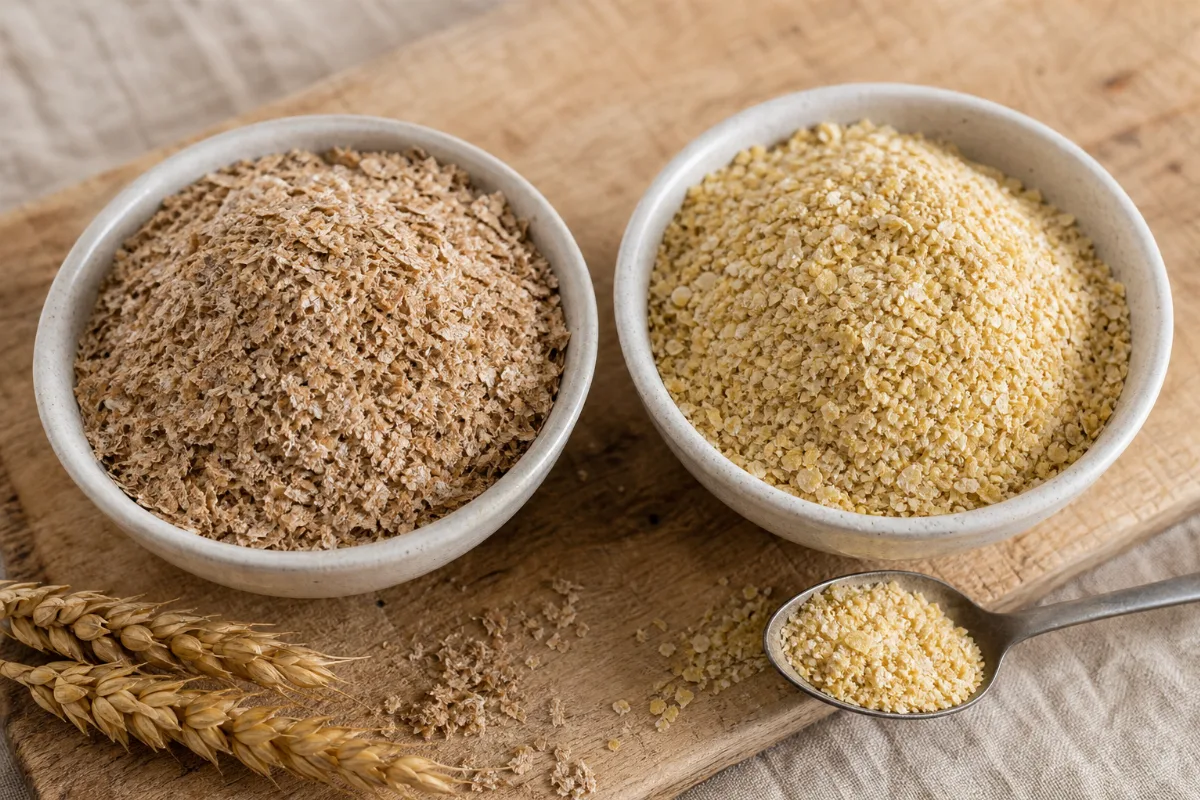
Whole Grains · Whole grain product
Wheat Bran & Wheat Germ
Triticum aestivum · also called Miller bran, toasted wheat germ, salvado de trigo, germen de trigo (Spanish)
Wheat bran is the outer layer of the wheat kernel and wheat germ is its small embryo. Both are taken off when white flour is made. Bran is one of the highest-fibre foods (42.8 g per 100 g by USDA), and germ is higher in protein, fat and several minerals. A small trial found bran helped bowel frequency in constipation, but the evidence is limited. Both come from wheat, so gluten and wheat allergy come first.
General information, not medical advice. Last substantive update · Not medically reviewed. A named clinician has not signed off on this page. How this page is made
About Wheat Bran & Wheat Germ
Wheat bran and wheat germ are two parts of the wheat kernel that white flour loses. Bran is the fibre-rich outer layer; germ is the small embryo, higher in protein and fat. They are foods, not proven remedies. Bran probably helps bowel frequency a little in constipation, but the evidence is small. Because they come from wheat, gluten and wheat allergy come first.
What they are
Wheat bran and wheat germ come from Triticum aestivum, the common wheat plant in the grass family Poaceae. GBIF lists Triticum aestivum L. as the accepted name. Bran is the outer layer of the kernel and germ is the embryo. Both are removed when white flour is made, and sold as flakes, meal or toasted germ.
USDA data for crude wheat bran, per 100 g: 216 kcal, 15.6 g protein, 4.25 g fat and 42.8 g fibre, with 611 mg magnesium, 11.5 mg manganese, 10.6 mg iron and 77.6 micrograms selenium. Per 1 ounce (28.35 g, a weight we computed): about 61 kcal and 12.1 g fibre.
USDA data for crude wheat germ, per 100 g: 360 kcal, 23.2 g protein, 9.72 g fat and 13.2 g fibre, with 239 mg magnesium, 13.3 mg manganese, 12.3 mg zinc, 79.2 micrograms selenium, 1.88 mg thiamin and 281 micrograms folate. Per 1 ounce (28.35 g, computed): about 102 kcal and 3.7 g fibre. Toasted germ is a different product and was not read.
What the research shows
The firmest facts are about nutrients and safety. The one trial of wheat bran itself was small: 24 people with chronic constipation, double-blind, crossover. Bran was better than placebo for bowel frequency and gut transit time, but symptoms did not differ and the placebo period also improved things. Pooled analyses of fibre in general found a response in 77% on fibre versus 44% on placebo, but the evidence was rated low quality and flatulence was higher.
A review of human studies of cereal fibre, including bran, reports changes in gut bacteria, but that is a marker and one author works for a cereal company. Population studies link high-fibre foods to less bowel cancer, but trials are inconclusive. In 16 healthy adults, a bread with wheat germ did not significantly change blood sugar. Antioxidant claims for wheat compounds come from cells and animals.
We found no good trial of wheat germ as a food for health outcomes.
Phytate and mineral absorption
Whole-grain parts such as bran contain phytate, which can bind minerals. In a 2026 review of 8 bread studies, a single meal with less phytate gave a bigger rise in blood iron (59 versus 30 micrograms per 100 mL in one comparison), but long-term trials did not improve iron stores. The review was inconclusive and was about breads, not bran or germ.
Food versus other wheat products and extracts
The USDA values are for plain crude bran and crude germ. The constipation trial gave bran; the pooled analyses mixed several fibre types; the blood sugar trial used a bread with carob pulp flour as well. Whole wheat kernels, bread, pasta, toasted germ, wheat germ oil and extracts are different products. We make no claim about them here.
Portions
USDA lists household portions of 58 g for crude bran and 115 g for crude germ, which is information, not a prescription, and much more than many people stir into a meal. This page gives no amounts to eat. Ask a doctor, pharmacist or dietitian what is right for you, especially if you have celiac disease, a wheat allergy, kidney disease or kidney stones.
At a glance
Traditional uses history, not proof
- Stirred into cereal, yogurt, smoothies and baking
- Sold as flakes or flour-like meal, or toasted (germ)
- Long use as food is not proof that it treats any condition
Studied for research
- Constipation, low certainty (one small bran trial; pooled fibre trials are low quality)
- Fibre content, high certainty for the nutrient fact
- Gut bacteria, low certainty (cereal fibre in general, industry-linked author)
- Minerals and B vitamins, high certainty for the nutrient content
- Bowel cancer and long-term health, insufficient evidence (fibre in general)
- Blood sugar and fullness with wheat germ, insufficient evidence
- Phytate and mineral absorption, insufficient evidence (bread studies)
- Antioxidant plant compounds, lab and animal evidence only
Main compounds
- Dietary fibre
- Gluten
- Fructans
- Phytate
- Phosphorus and potassium
- Unsaturated fats and tocopherols (germ)
Common forms
- Plain wheat bran (crude), as food
- Plain wheat germ (crude), as food
- Toasted wheat germ, bran cereals and muffins (different products, not covered)
- Wheat germ oil and extracts (not covered)
Research links: 1995 trial: wheat bran in constipation · 2016 review: fibre and constipation · NIDDK: celiac disease and diet · Research Library · Genes & Biomarkers Library
What it is and its history
- Accepted scientific name
- Triticum aestivum
- Naming authority
- L. (GBIF accepted name, exact match)
- Common names
- Wheat bran (English); Wheat germ (English); Miller bran (English); Toasted wheat germ (English); Salvado de trigo (Spanish); Germen de trigo (Spanish)
- Family or group
- Poaceae (the grass family), per GBIF.
- Classification
- Plantae > Tracheophyta > Liliopsida > Poales > Poaceae > Triticum > Triticum aestivum
- Native range
- Not verified from a source read.
- Habitat
- Not verified from a source read.
- What it looks like
- Roots: Not verified.; Stems: Not verified.; Leaves: Not verified.; Flowers: Not verified.; Fruit: Wheat bran is the outer layer of the wheat kernel; wheat germ is the small embryo. Both are taken off when white flour is made (our existing summary; not verified from a source read).
- Cultivation
- Not verified from a source read.
- Harvest and processing
- Sold as flakes, meal or toasted germ. How USDA defines 'crude' for these items was not read, and toasted wheat germ is a separate product not in the data read.
- Look-alikes and adulterants
- Name: Oat bran; Note: A different grain with its own page; the NHS says oats do not contain gluten but can cause a reaction if produced in the same place as wheat.; Name: Whole wheat (wheat berries), bread and pasta; Note: Separate products with their own pages.; Name: Wheat germ oil and wheat germ extracts; Note: Different products; not assessed here.
- Sustainability and conservation
- Not assessed.
Photographs
What is inside, and how it may work
What it contains and how those compounds act in cells and animals. Laboratory and animal mechanisms are not proven effects in people.
Main compounds
| Compound | Family | Where it is concentrated | Activity studied | Level of evidence |
|---|---|---|---|---|
| Dietary fibre | carbohydrate | Bran USDA: 42.8 g per 100 g in crude wheat bran; 13.2 g per 100 g in crude wheat germ. | Adds bulk to stool; small trials show more frequent bowel movements in constipation; gas and bloating can follow fast increases. 21 20 1 2 14 | Human data |
| Gluten (gliadins and glutenins) | protein | Kernel (mostly the starchy middle) Not measured in the sources read for bran or germ. | Triggers celiac disease in people with the condition (NIDDK, NHS). 17 16 | Human data |
| Fructans and amylase-trypsin inhibitors | carbohydrate (FODMAP) and proteins | Not stated Not measured in the sources read. | Named in a review as possible triggers in non-coeliac wheat sensitivity. 6 | Human data |
| Phytate (phytic acid) | mineral-binding compound | Whole-grain parts such as bran Not measured in the sources read. | Can lower iron absorption from the same meal in bread studies; long-term meaning inconclusive. 7 | Human data |
| Phosphorus and potassium | minerals | Bran and germ USDA per 100 g: bran phosphorus 1010 mg, potassium 1180 mg; germ phosphorus 842 mg, potassium 892 mg. | Matters for people whose kidneys cannot clear them (NIDDK). 21 20 18 | Human data |
| Unsaturated fats and tocopherols (vitamin E compounds) | lipids | Germ A lab study measured linoleic acid as 59.13% of the fatty acids in raw wheat germ and kept 96.42% of tocopherols after heat treatment. USDA lists 9.72 g fat per 100 g of crude germ and no vitamin E value for it. | These fats and the germ's own enzymes make germ spoil quickly. 5 20 | Lab |
| Phenolic acids, flavonoids, lignans | polyphenols | Bran and germ (per our existing summary) Not measured in the sources read. | Antioxidant and other activities in cell and animal models only. 9 | Lab |
Mechanisms, receptors and pathways
| Target or pathway | Gene or receptor | What was found | Level |
|---|---|---|---|
| Bulk and transit in the bowel | Not specified | In a crossover trial, wheat bran shortened oroanal transit time and raised bowel frequency compared with placebo; the abstract does not test a mechanism. 1 | Human data |
| Gut bacteria and fermentation | Not specified | A review reports that most human studies saw more diversity or abundance of gut bacteria after intact cereal fibre; short-chain fatty acids were among outcomes. 4 | Human data |
| Gluten and the immune system in celiac disease | Not specified in the sources read | In celiac disease the immune system reacts to gluten; a gluten-free diet is the treatment. 17 16 | Human data |
| Phytate and mineral binding | Not applicable | Lower phytate in breads raised blood iron after a single meal in some studies; long-term iron stores did not improve. 7 | Human data |
| Rancidity in germ (lipase and lipoxygenase enzymes) | Lipase and lipoxygenase (wheat germ enzymes) | These enzymes act on the germ's unsaturated fats; heat treatment reduced their activity in a lab study. 5 | Lab |
| Nrf2, NF-kB, AMPK and PI3K/AKT pathways | Nrf2, NF-kB, AMPK, PI3K/AKT | A review lists these pathways for wheat compounds in preclinical models only. 9 | Lab |
Absorption, metabolism and elimination
- Absorption
- Not found for bran or germ. Phytate may lower iron absorption in bread meals (inconclusive).
- Distribution
- Not found.
- Metabolism
- Not found.
- Elimination
- Not found.
- Bioavailability
- Not established for bran or germ minerals in the sources read.
Isolated compounds versus whole extracts
The USDA values are for plain crude bran and crude germ. The constipation trial used bran; the pooled analyses used fibre of several types. The blood sugar trial used a bread that also had carob pulp flour. Toasted germ, wheat germ oil, wheat germ extracts, bran cereals and muffins are different products and were not assessed.
Nutritional composition
Nutrition from USDA FoodData Central (SR Legacy, last updated 4/1/2019; values read 2026-10-26 from the public data feed). Wheat bran, crude (FDC 169722), per 100 g: 216 kcal, 15.6 g protein, 4.25 g fat, 42.8 g fibre, 611 mg magnesium, 1010 mg phosphorus, 1180 mg potassium, 10.6 mg iron, 7.27 mg zinc, 11.5 mg manganese, 77.6 micrograms selenium, 13.6 mg niacin, 1.3 mg vitamin B-6, 1.9 micrograms vitamin K. Per 1 ounce (28.35 g, a weight we picked and computed from the 100 g values): about 61 kcal, 4.4 g protein, 12.1 g fibre, 173 mg magnesium, 286 mg phosphorus, 335 mg potassium, 3.0 mg iron, 3.3 mg manganese and 22 micrograms selenium. USDA's own household portion is 58 g, which is more than most people stir into a meal. Wheat germ, crude (FDC 168892), per 100 g: 360 kcal, 23.2 g protein, 9.72 g fat, 13.2 g fibre, 239 mg magnesium, 842 mg phosphorus, 892 mg potassium, 6.26 mg iron, 12.3 mg zinc, 13.3 mg manganese, 79.2 micrograms selenium, 1.88 mg thiamin, 281 micrograms folate (DFE). Per 1 ounce (28.35 g, computed): about 102 kcal, 6.6 g protein, 2.8 g fat, 3.7 g fibre, 68 mg magnesium, 239 mg phosphorus, 253 mg potassium, 1.8 mg iron, 3.5 mg zinc, 3.8 mg manganese, 22.5 micrograms selenium, 0.53 mg thiamin and 80 micrograms folate. USDA's household portion is 115 g. USDA lists no vitamin E or vitamin K value for the germ item in the feed read. Values vary with the wheat variety, where it grew and how it was milled. This is information about the food, not advice on how much to eat.
2 high certainty2 low certainty4 not enough evidence
What was looked at
The 8 benefits and uses checked for Wheat Bran & Wheat Germ, each with how strong the evidence is. Tap one to open it.
- Constipation (wheat bran)Low certainty
- A very high-fibre food (nutrient content)High certainty
- Gut bacteria (cereal fibre including wheat bran)Low certainty
- Minerals and B vitamins (nutrient content)High certainty
- Phytate and mineral absorptionNot enough evidence
- Bowel cancer and long-term health (fibre in general)Not enough evidence
- Blood sugar and fullness (wheat germ in bread)Not enough evidence
- Antioxidant and other plant compounds (lab and animal evidence)Not enough evidence
Lab markers tracked in the studies
Bowel frequencyGut transit timeGut bacteria diversity or abundanceBlood glucose after eatingFullness (satiety score)Serum iron after a bread meal
What is Wheat Bran & Wheat Germ good for?
The main studied uses and how strong the human evidence is for each. Most results are for fibre in general, not for wheat bran or germ on their own.
Benefits, one by one
Each card is a research question, not a promise. Tap a goal to filter. Open a card to see the studies, doses and limits.
Constipation (wheat bran)
Low certaintyIn one small double-blind crossover trial of 24 people with long-standing constipation, 20 g a day of wheat bran for four weeks beat placebo for how often people went and how fast food moved through. Symptoms did not differ, and the placebo period also improved things. Pooled trials of fibre in general are low quality.
4 studiesWheat bran as a food or fibre supplement (the abstract does not say h…
Studies, doses and limits
What the trials found
Badiali 1995: 24 patients with chronic nonorganic constipation, 20 g a day of bran or placebo for two 4-week periods in a crossover design. Bowel frequency and stool weight rose and transit time fell during both bran and placebo versus the basal period. Bran was better than placebo for bowel frequency and oroanal transit time. Symptoms and their severity did not differ between bran and placebo. Pooled analyses of fibre in general: 7 trials found 77% responded on fibre versus 44% on placebo (low-quality evidence, more flatulence); 5 trials found more frequent stools but no change in stool consistency, treatment success or laxative use.
Results
Wheat bran probably helps stool frequency a little in people with constipation, but the evidence is small, old and low quality.
Effect sizes as reported
Bran trial: bowel frequency and transit time better than placebo; symptoms no different. Fibre pooled analyses: response RR 1.71 (95% CI 1.20-2.42); flatulence higher.
Why this rating
Only one small 1995 trial looked at wheat bran itself. The two pooled analyses mix fibre types and the larger one was rated low quality with high risk of bias.
Form and dose studied
Wheat bran as a food or fibre supplement (the abstract does not say how it was taken); the pooled analyses cover several fibre types.
Who was studied
Adults with chronic constipation.
Limits
Tiny trial (24 people). Placebo also improved. Pooled analyses are not about wheat bran alone.
Why researchers looked
Bran is the fibre-rich outer layer of wheat, so people ask whether it keeps the bowel regular.
Traditional use
Wheat bran and wheat germ are the outer layer and the embryo of the wheat kernel, taken off when white flour is made. They are stirred into cereal, yogurt and baking. Long use as food is not proof that they treat any condition.
Proposed mechanism Unknown
Insoluble fibre adds bulk to stool. The abstracts read do not test a mechanism.
A proposed mechanism does not show that the effect happens in people.
Fibre raised flatulence in the pooled analysis, and gas, bloating and cramps can follow a fast rise in fibre (MedlinePlus). Wheat contains gluten.
A very high-fibre food (nutrient content)
High certaintyBy USDA data, crude wheat bran has 42.8 g of fibre per 100 g, and wheat germ has 13.2 g. That is a fact about what is in the food, not a trial of a health result.
3 studiesPlain crude bran and germ. Toasted germ and flavoured products have d…
Studies, doses and limits
What the trials found
USDA FoodData Central (SR Legacy, last updated 4/1/2019), per 100 g: wheat bran, crude 42.8 g total fibre (about 12.1 g in 1 ounce, 28.35 g); wheat germ, crude 13.2 g (about 3.7 g in 1 ounce). USDA lists household portions of 58 g (bran) and 115 g (germ).
Results
Wheat bran is one of the most fibre-dense foods in our files; germ has fibre too but much less.
Effect sizes as reported
Fibre per 100 g: bran 42.8 g; germ 13.2 g.
Why this rating
High for the nutrient content (a measured reference value). It says nothing about a health benefit.
Form and dose studied
Plain crude bran and germ. Toasted germ and flavoured products have different values and were not read.
Limits
Values vary with wheat variety, growing place and milling.
Why researchers looked
Fibre is the main reason people add bran to meals.
Traditional use
Wheat bran and wheat germ are the outer layer and the embryo of the wheat kernel, taken off when white flour is made. They are stirred into cereal, yogurt and baking. Long use as food is not proof that they treat any condition.
Proposed mechanism Authoritative guidance
Not a mechanism claim. This is a nutrient measurement.
A proposed mechanism does not show that the effect happens in people.
A fast rise in fibre can cause gas, bloating and cramps (MedlinePlus).
Gut bacteria (cereal fibre including wheat bran)
Low certaintyA review of human studies of whole cereal fibres, with attention to wheat bran, reports that most studies saw more variety or more of some gut bacteria after the fibre. This is a change in a marker, not proof of a health benefit, and one author works for a cereal company.
1 studiesIntact cereal fibres including wheat bran; the abstract does not give…
Studies, doses and limits
What the trials found
Jefferson 2019, a systematic review of human intervention studies in healthy adults: 223 publications found and 40 included. The authors report that 39 of 42 studies showed an increase in microbiota diversity or abundance after intact cereal fibre, with effects from 24 hours to 52 weeks. They add that long-term stability is unknown.
Results
In healthy adults, most short studies of cereal fibre, including wheat bran, saw gut bacteria change. What that means for health is not shown.
Effect sizes as reported
39 of 42 studies showed an increase in diversity or abundance (as printed; counts in the abstract differ).
Why this rating
Low because the outcome is a marker, the studies mix cereal fibres, the counts in the abstract do not match, and one author works for the Kellogg Company.
Form and dose studied
Intact cereal fibres including wheat bran; the abstract does not give a per-food breakdown.
Who was studied
Healthy adults.
Limits
Marker only. Mixed fibres. Industry-linked author. Short studies.
Why researchers looked
Bran fibre reaches the large bowel, where gut bacteria feed on it, so researchers measure how the bacteria change.
Traditional use
Wheat bran and wheat germ are the outer layer and the embryo of the wheat kernel, taken off when white flour is made. They are stirred into cereal, yogurt and baking. Long use as food is not proof that they treat any condition.
Proposed mechanism Narrative review
Gut bacteria ferment cereal fibre and make short-chain fatty acids (named as outcomes in the review).
A proposed mechanism does not show that the effect happens in people.
Fibre can cause gas and bloating when raised quickly.
Minerals and B vitamins (nutrient content)
High certaintyBy USDA data, wheat bran and wheat germ are both rich in manganese, magnesium, selenium and zinc. Bran has more niacin and iron; germ has more thiamin (vitamin B1) and folate. This describes what is in the food, not a trial of a health result.
2 studiesPlain crude bran and germ; toasted germ was not in the data read.
Studies, doses and limits
What the trials found
USDA FoodData Central, per 100 g. Wheat bran, crude: manganese 11.5 mg, magnesium 611 mg, selenium 77.6 micrograms, zinc 7.27 mg, iron 10.6 mg, niacin 13.6 mg, vitamin B-6 1.3 mg. Wheat germ, crude: manganese 13.3 mg, magnesium 239 mg, selenium 79.2 micrograms, zinc 12.3 mg, iron 6.26 mg, thiamin 1.88 mg, folate 281 micrograms (DFE).
Results
Both are mineral-dense foods per 100 g. Per 1 ounce (28.35 g) the amounts are about a quarter to a third of these.
Effect sizes as reported
Per 100 g, bran: Mn 11.5 mg, Mg 611 mg, Se 77.6 micrograms. Germ: Mn 13.3 mg, Mg 239 mg, Se 79.2 micrograms, thiamin 1.88 mg.
Why this rating
High for the measured content (reference database). It does not show that eating them improves health, and minerals in bran may be less well absorbed (see phytate).
Form and dose studied
Plain crude bran and germ; toasted germ was not in the data read.
Limits
Values vary with variety, growing place and milling. Nutrient content is not the same as nutrient absorbed.
Why researchers looked
Bran and germ are the nutrient-dense parts of the kernel that white flour loses.
Traditional use
Wheat bran and wheat germ are the outer layer and the embryo of the wheat kernel, taken off when white flour is made. They are stirred into cereal, yogurt and baking. Long use as food is not proof that they treat any condition.
Proposed mechanism Authoritative guidance
Not a mechanism claim. This is a nutrient measurement.
A proposed mechanism does not show that the effect happens in people.
Bran and germ are also high in phosphorus and potassium, which matters in kidney disease (see Safety).
Phytate and mineral absorption
Not enough evidenceBran and germ come from whole grain, which contains phytate, a substance that can bind minerals such as iron in the gut. A 2026 review of bread studies was inconclusive and long-term trials did not improve iron stores. No study of wheat bran or germ alone was read.
1 studiesBreads in the review; nothing on bran or germ alone.
Studies, doses and limits
What the trials found
Nikolaou 2026, a systematic review of 8 human intervention studies of breads with different phytate levels. Results were inconclusive: single-meal studies found more iron absorbed from low-phytate breads (for example low-phytate white bread gave a bigger 2-hour rise in serum iron than high-phytate wholemeal bread, 59 versus 30 micrograms Fe/100 mL). Long-term trials did not improve iron stores, and in one case ferritin fell. The authors say no human study had the right controls and quality.
Results
Phytate may lower iron absorption from the same meal, but the long-term meaning is not known. It is about breads, not bran or germ.
Effect sizes as reported
Serum iron rise 59 versus 30 micrograms Fe/100 mL (low-phytate white bread versus high-phytate wholemeal bread).
Why this rating
Insufficient: the review is inconclusive, covers breads only, and has no study of wheat bran or germ.
Form and dose studied
Breads in the review; nothing on bran or germ alone.
Who was studied
Healthy or iron-deficient people.
Limits
Bread, not bran. Only 8 studies. Inconclusive.
Why researchers looked
People ask whether the minerals in bran are actually absorbed.
Traditional use
Wheat bran and wheat germ are the outer layer and the embryo of the wheat kernel, taken off when white flour is made. They are stirred into cereal, yogurt and baking. Long use as food is not proof that they treat any condition.
Proposed mechanism Narrative review
Phytate can bind minerals; breads with less phytate gave a bigger rise in blood iron after a meal in some studies.
A proposed mechanism does not show that the effect happens in people.
People who are low in iron should ask a clinician about diet.
Bowel cancer and long-term health (fibre in general)
Not enough evidenceA 2025 narrative review says population studies link high-fibre and whole-grain foods to lower colorectal cancer risk, but clinical trials are inconclusive. It is not about wheat bran alone and cannot show cause.
1 studiesFibre and whole-grain foods in general.
Studies, doses and limits
What the trials found
Hussain 2025, a narrative review: overall epidemiological evidence links foods rich in dietary fibre or whole grains to a reduced risk of colorectal cancer. Lab and animal studies support the idea. Findings of clinical trials are inconclusive, and the authors call for better-designed trials.
Results
Eating high-fibre foods is linked to lower bowel cancer risk in population studies, but trials have not settled it, and nothing is specific to wheat bran.
Effect sizes as reported
No numbers in the abstract.
Why this rating
Insufficient for wheat bran itself: the evidence is observational or lab-based fibre evidence, and the trials are inconclusive.
Form and dose studied
Fibre and whole-grain foods in general.
Who was studied
Mixed populations.
Limits
Narrative review. Observational data cannot prove cause. Not wheat bran specific.
Why researchers looked
Fibre reaches the colon undigested, so researchers study it for bowel health over the long term.
Traditional use
Wheat bran and wheat germ are the outer layer and the embryo of the wheat kernel, taken off when white flour is made. They are stirred into cereal, yogurt and baking. Long use as food is not proof that they treat any condition.
Proposed mechanism Narrative review
Fibres are fermented in the colon and have distinct effects in lab and animal studies (as the review summarises).
A proposed mechanism does not show that the effect happens in people.
None specific.
Blood sugar and fullness (wheat germ in bread)
Not enough evidenceIn 16 healthy adults, a week of bread with 20% wheat germ (plus 20% carob pulp flour) did not significantly change blood sugar after eating, but people felt fuller early on. Two added ingredients mean wheat germ's own effect cannot be separated.
2 studiesWheat germ baked into white bread with carob pulp flour.
Studies, doses and limits
What the trials found
Tuşat 2025, 16 healthy volunteers aged 19-35 ate a test bread (20% carob molasses pulp flour plus 20% wheat germ) or plain white bread, each for 1 week. The test bread had more fibre, polyphenols, antioxidants and resistant starch. Blood glucose, total antioxidant status and total oxidant status did not differ significantly. Satiety scores were higher after the test bread, especially at 0 and 30 minutes (p < 0.001).
Results
No change in blood sugar; more fullness early after the test bread, in a small short study with a mixed product.
Effect sizes as reported
Blood glucose: no significant difference (p > 0.05). Satiety: higher (p < 0.001).
Why this rating
Insufficient: one small short trial of a mixed bread, so wheat germ's own effect is unclear.
Form and dose studied
Wheat germ baked into white bread with carob pulp flour.
Who was studied
16 healthy adults.
Limits
Small. Mixed product. 1 week. Order of breads not described in the abstract.
Why researchers looked
Germ adds protein, fibre and fat to a meal, so researchers test whether it changes blood sugar and appetite.
Traditional use
Wheat bran and wheat germ are the outer layer and the embryo of the wheat kernel, taken off when white flour is made. They are stirred into cereal, yogurt and baking. Long use as food is not proof that they treat any condition.
Proposed mechanism Human clinical
Not established. The bread had more fibre and resistant starch than plain white bread.
A proposed mechanism does not show that the effect happens in people.
Contains wheat and gluten.
Antioxidant and other plant compounds (lab and animal evidence)
Not enough evidenceBran and germ hold plant compounds such as phenolic acids and lignans (and vitamin E compounds in germ oil). A 2026 review says benefits like antioxidant and anti-inflammatory effects were shown in lab and animal models and that human trials are still needed.
2 studiesCompounds from wheat in general; nothing is shown for bran or germ as…
Studies, doses and limits
What the trials found
Vinayagam 2026, a review of chemical, cell, animal and human studies of wheat compounds. It reports antioxidant, anti-diabetic, anti-obesity, anti-inflammatory and other activities in preclinical models and says clinical translation requires rigorous human studies. A lab study of wheat germ (Li 2016) measured linoleic acid as 59.13% of the fatty acids in raw germ.
Results
Evidence is lab and animal only for these compounds; no health result in people is shown.
Why this rating
Insufficient: cell and animal evidence only. Treat as lab evidence, not a health claim.
Form and dose studied
Compounds from wheat in general; nothing is shown for bran or germ as eaten.
Who was studied
Cells and animals.
Limits
Not human data. Not specific to bran or germ.
Why researchers looked
Bran and germ are rich in plant compounds, so researchers test them in cells and animals first.
Traditional use
Wheat bran and wheat germ are the outer layer and the embryo of the wheat kernel, taken off when white flour is made. They are stirred into cereal, yogurt and baking. Long use as food is not proof that they treat any condition.
Proposed mechanism Lab animal
Lab and animal studies point to antioxidant (Nrf2) and anti-inflammatory (NF-kB) pathways, as the review states.
A proposed mechanism does not show that the effect happens in people.
Contains wheat and gluten.
Connections to the rest of health
How Wheat Bran & Wheat Germ connects to the rest of our health knowledge graph. Every link says what kind of connection it is. A safety link (for example to the liver) is a warning, not a benefit. A study that merely mentions a topic never creates a benefit link.
Explore every connection: goals, body systems, organs, symptoms, genes
A. Wellness goals
| Connected to | Kind of connection | Evidence status | Context | Studies |
|---|---|---|---|---|
| Digestive Support | Low certainty | Constipation (wheat bran): In one small double-blind crossover trial of 24 people with long-standing constipation, 20 g a day of wheat bran for four weeks beat placebo for how often people went and how fast food moved through. Symptoms did not differ, and the placebo period also improved things. Pooled trials of fibre in general are low quality. Gut bacteria (cereal fibre including wheat bran): A review of human studies of whole cereal fibres, with attention to wheat bran, reports that most studies saw more variety or more of some gut bacteria after the fibre. This is a change in a marker, not proof of a health benefit, and one author works for a cereal company. | 1 2 10 21 4 | |
| Balanced Nutrition | Demonstrated clinical effect | High certainty | A very high-fibre food (nutrient content): By USDA data, crude wheat bran has 42.8 g of fibre per 100 g, and wheat germ has 13.2 g. That is a fact about what is in the food, not a trial of a health result. Minerals and B vitamins (nutrient content): By USDA data, wheat bran and wheat germ are both rich in manganese, magnesium, selenium and zinc. Bran has more niacin and iron; germ has more thiamin (vitamin B1) and folate. This describes what is in the food, not a trial of a health result. | 21 20 14 |
| Digestive Support | Demonstrated clinical effect | High certainty | A very high-fibre food (nutrient content): By USDA data, crude wheat bran has 42.8 g of fibre per 100 g, and wheat germ has 13.2 g. That is a fact about what is in the food, not a trial of a health result. | 21 20 14 |
| Balanced Nutrition | Not enough evidence | Phytate and mineral absorption: Bran and germ come from whole grain, which contains phytate, a substance that can bind minerals such as iron in the gut. A 2026 review of bread studies was inconclusive and long-term trials did not improve iron stores. No study of wheat bran or germ alone was read. | 7 | |
| Healthy Aging | Not enough evidence | Bowel cancer and long-term health (fibre in general): A 2025 narrative review says population studies link high-fibre and whole-grain foods to lower colorectal cancer risk, but clinical trials are inconclusive. It is not about wheat bran alone and cannot show cause. | 3 | |
| Blood Sugar Balance | Not enough evidence | Blood sugar and fullness (wheat germ in bread): In 16 healthy adults, a week of bread with 20% wheat germ (plus 20% carob pulp flour) did not significantly change blood sugar after eating, but people felt fuller early on. Two added ingredients mean wheat germ's own effect cannot be separated. | 8 20 | |
| Weight Management | Not enough evidence | Blood sugar and fullness (wheat germ in bread): In 16 healthy adults, a week of bread with 20% wheat germ (plus 20% carob pulp flour) did not significantly change blood sugar after eating, but people felt fuller early on. Two added ingredients mean wheat germ's own effect cannot be separated. | 8 20 | |
| Healthy Aging | Not enough evidence | Antioxidant and other plant compounds (lab and animal evidence): Bran and germ hold plant compounds such as phenolic acids and lignans (and vitamin E compounds in germ oil). A 2026 review says benefits like antioxidant and anti-inflammatory effects were shown in lab and animal models and that human trials are still needed. | 9 5 |
B. Body systems
| Connected to | Kind of connection | Evidence status | Context | Studies |
|---|---|---|---|---|
| Digestive System | Biological association | Low certainty | Studied for: Constipation (wheat bran) Studied for: A very high-fibre food (nutrient content) | 1 2 10 21 20 14 4 3 |
| Metabolism Weight | Biological association | High certainty | Studied for: Minerals and B vitamins (nutrient content) Studied for: Blood sugar and fullness (wheat germ in bread) | 21 20 8 |
| Blood | Biological association | Not enough evidence | Studied for: Phytate and mineral absorption | 7 |
| Endocrine System | Biological association | Not enough evidence | Studied for: Blood sugar and fullness (wheat germ in bread) | 8 20 |
| Immune System | Biological association | Not enough evidence | Studied for: Antioxidant and other plant compounds (lab and animal evidence) | 9 5 |
E. Health conditions
| Connected to | Kind of connection | Evidence status | Context | Studies |
|---|---|---|---|---|
| Celiac disease | Contraindication | Documented risk | Gluten in wheat triggers celiac disease; a gluten-free diet is the treatment. Preparation or compound: Gluten in wheat bran and germ |
17 16 |
| Wheat hypersensitivity | Adverse effect or risk | Documented risk | Wheat is a major food allergen; anaphylaxis is an emergency. Wheat is a major food allergen. Preparation or compound: Wheat proteins |
15 |
| Non-coeliac wheat sensitivity | Adverse effect or risk | Preliminary or mixed | Self-reported often above 10%, confirmed under 30% of the time by blinded challenge. Preparation or compound: Wheat fructans and other wheat components |
6 |
| Kidney stones | Adverse effect or risk | Documented risk | NIDDK lists wheat bran among foods to consider cutting back on after calcium oxalate stones. NIDDK lists wheat bran among foods people with calcium oxalate stones may want to avoid. Preparation or compound: Wheat bran (oxalate) |
19 |
| Constipation | Preliminary or mixed | A small crossover trial found bran better than placebo for bowel frequency; pooled fibre trials are low quality and show more flatulence. A small crossover trial found bran better than placebo for bowel frequency; pooled fibre trials are low quality. Preparation or compound: Wheat bran |
1 2 |
I. Biomarkers
| Connected to | Kind of connection | Evidence status | Context | Studies |
|---|---|---|---|---|
| Bowel frequency | Biological association | Low certainty | Measured in trials: raised. A lab change is not the same as a health benefit. | 1 2 10 |
| Gut transit time | Biological association | Low certainty | Measured in trials: shortened. A lab change is not the same as a health benefit. | 1 |
| Gut bacteria diversity or abundance | Biological association | Low certainty | Measured in trials: raised. A lab change is not the same as a health benefit. | 4 |
| Blood glucose after eating | Biological association | Not enough evidence | Measured in trials: no change. A lab change is not the same as a health benefit. | 8 |
| Fullness (satiety score) | Biological association | Not enough evidence | Measured in trials: raised. A lab change is not the same as a health benefit. | 8 |
| Serum iron after a bread meal | Biological association | Not enough evidence | Measured in trials: lower with high-phytate bread. A lab change is not the same as a health benefit. | 7 |
K. Biological pathways
| Connected to | Kind of connection | Evidence status | Context | Studies |
|---|---|---|---|---|
| Fibre | Preliminary mechanism | Human | Wheat bran is a very high-fibre food (42.8 g per 100 g, USDA). | 21 1 |
| Gluten | Preliminary mechanism | Human | Bran and germ come from wheat; gluten triggers celiac disease. | 17 16 |
| Manganese, magnesium and selenium | Preliminary mechanism | Human | Both bran and germ are rich in these by USDA data. | 21 20 |
| Phosphorus and potassium | Preliminary mechanism | Human | High in both; relevant to kidney disease. | 21 18 |
L. Active compounds
| Connected to | Kind of connection | Evidence status | Context | Studies |
|---|---|---|---|---|
| Dietary fibre | Biological association | Human | Adds bulk to stool; small trials show more frequent bowel movements in constipation; gas and bloating can follow fast increases. Preparation or compound: Bran |
21 20 1 2 14 |
| Gluten (gliadins and glutenins) | Biological association | Human | Triggers celiac disease in people with the condition (NIDDK, NHS). Preparation or compound: Kernel (mostly the starchy middle) |
17 16 |
| Fructans and amylase-trypsin inhibitors | Biological association | Human | Named in a review as possible triggers in non-coeliac wheat sensitivity. | 6 |
| Phytate (phytic acid) | Biological association | Human | Can lower iron absorption from the same meal in bread studies; long-term meaning inconclusive. Preparation or compound: Whole-grain parts such as bran |
7 |
| Phosphorus and potassium | Biological association | Human | Matters for people whose kidneys cannot clear them (NIDDK). Preparation or compound: Bran and germ |
21 20 18 |
| Unsaturated fats and tocopherols (vitamin E compounds) | Biological association | Lab | These fats and the germ's own enzymes make germ spoil quickly. Preparation or compound: Germ |
5 20 |
| Phenolic acids, flavonoids, lignans | Biological association | Lab | Antioxidant and other activities in cell and animal models only. Preparation or compound: Bran and germ (per our existing summary) |
9 |
Each connection is stored with the ingredient, the connected record, the kind of connection, the evidence status, the supporting studies, the preparation or compound involved, and a review date (last reviewed October 26, 2026).
Evidence at a glance: what changed in 3 lab markers
Tap a number to show only those markers. Counts are markers, not people.
The evidence
The research centre for Wheat Bran & Wheat Germ. Every record here was checked against PubMed or the publisher's page; we never list a study we have not verified.
Evidence by outcome
Bars show how many studies we found for each outcome, not how well it works. People are added up across trials only (reviews are not added, to avoid double counting).
How we rate evidence
High certainty
Several well-run trials or reviews agree; further research is unlikely to change the picture much.
Moderate certainty
Good trials point the same way, but some doubt remains.
Low certainty
Small, short or inconsistent trials. The finding could change with better research.
Very low certainty
Very little or very weak human data. Treat as a possibility only.
Mixed findings
Trials or reviews disagree with each other.
Not enough evidence
Not enough human research to say either way.
Evidence against
Good research found no benefit, or found harm.
We take the reviewers' own risk-of-bias and GRADE statements where they exist, and otherwise judge from study size, design, consistency, directness and whether a product matches what is sold. Many publications do not make evidence high. Method note: We started from our existing summary for wheat bran and wheat germ, re-checked nutrition against USDA FoodData Central data, read the health agency pages (NIDDK, MedlinePlus, FDA, WHO, NHS) and re-read PubMed abstracts for the reviews and trials. Items we could not verify are flagged in the research gaps.
Study library: every study we checked 22
| Study | Design | People | Product, dose, length | Result |
|---|---|---|---|---|
| Badiali 1995 Effect of wheat bran in treatment of chronic nonorganic constipation. A double-blind controlled trial. Digestive Diseases and Sciences · PMID 7851201 · DOI |
Controlled trial |
24 24 patients with chronic nonorganic constipation (Rome, Italy) |
Wheat bran versus placebo Wheat bran (the abstract does not say how it was taken) 20 g a day Two consecutive 4-week periods after a 2-week basal period (crossover) · vs Placebo |
Transit time fell and bowel frequency and stool weight rose during both bran and placebo periods compared with the basal period. Bran was more effective than placebo for bowel frequency and transit time. Transit became normal only in patients with slow colonic transit, not slow rectal transit. Symptoms and their severity did not differ between bran and placebo. Bran better than placebo for bowel frequency and oroanal transit; no difference in symptoms. (Not given in the abstract.) Methods, limits and fundingOutcomes: Symptoms, oroanal transit time, bowel frequency, stool weight Limitations: Small crossover trial from 1995. Placebo also improved things. Only 24 people. Funding and conflicts: Funding is not stated in the abstract. Read: abstract |
| Christodoulides 2016 Systematic review with meta-analysis: effect of fibre supplementation on chronic idiopathic constipation in adults. Alimentary Pharmacology & Therapeutics · PMID 27170558 · DOI |
Systematic review meta analysis |
7 randomised controlled trials, 147 patients on fibre and 140 on placebo, adults with chronic idiopathic constipation | Fibre supplements and prebiotics (several types, not wheat bran alone) Fibre supplements Varied · vs Placebo |
77% (113 of 147) of people on fibre responded versus 44% (61 of 140) on placebo. Fibre increased stool frequency and softened stool. Flatulence was higher with fibre. The authors rated the overall quality of evidence as low and the risk of bias as high. Response RR 1.71; stool frequency SMD 0.39; consistency SMD 0.35; flatulence SMD 0.56 (Response RR 1.71 (95% CI 1.20-2.42); stool frequency 0.39 (0.03-0.76); consistency 0.35 (0.04-0.65); flatulence 0.56 (0.12-1.00)) Methods, limits and fundingOutcomes: Response to treatment, stool frequency and consistency, flatulence Limitations: Several fibre types mixed, not wheat bran alone. Low-quality evidence with high risk of bias. Funding and conflicts: Funding is not stated in the abstract. Read: abstract |
| Hussain 2025 Anticancer potential of dietary fiber for colorectal carcinoma: a narrative review. Annals of Medicine · PMID 41249064 · DOI |
Narrative review |
Review of epidemiological, preclinical and clinical research on fibre and colorectal cancer | Dietary fibre and whole grains in general (not wheat bran alone) Fibre in foods |
Overall epidemiology links foods rich in fibre or whole grains to lower colorectal cancer risk. Lab and animal studies support fibre. The clinical trials are inconclusive. The authors call for more targeted trials. Observational link; clinical trials inconclusive (Not applicable) Methods, limits and fundingOutcomes: Colorectal cancer risk and treatment Limitations: Narrative review. Not a wheat-bran-specific result. Observational data cannot show cause. Funding and conflicts: The authors reported no conflict of interest. Read: abstract |
| Jefferson 2019 The Effects of Intact Cereal Grain Fibers, Including Wheat Bran on the Gut Microbiota Composition of Healthy Adults: A Systematic Review. Frontiers in Nutrition · PMID 30984765 · DOI |
Systematic review meta analysis |
Healthy adults in human intervention studies (223 publications found, 40 included) | Intact cereal fibres and their sub-fractions, with attention to wheat fibre, bran and arabinoxylans Cereal fibres including wheat bran Not summarised here 1 day to 12 weeks (one study over 1 year) · vs Usually crossover or control diets |
The authors report that 39 of 42 studies showed an increase in microbiota diversity or abundance after intact cereal fibre, with effects from 24 hours to 52 weeks. They say the stability of changes over long periods needs study. 39 of 42 studies showed an increase in diversity or abundance (as printed in the abstract) (Not given in the abstract.) Methods, limits and fundingOutcomes: Gut bacteria diversity and abundance, short-chain fatty acids Limitations: Counts in the abstract differ (40 included, 42 studies), so we repeat them as printed. Changes in gut bacteria are a marker, not a health result. Mixed fibre types. Funding and conflicts: One author works for the Kellogg Company (a cereal maker); treat as industry-linked. Funding is not stated in the abstract. Read: abstract |
| Li 2016 Inactivation of Lipase and Lipoxygenase of Wheat Germ with Temperature-Controlled Short Wave Infrared Radiation and Its Effect on Storage Stability and Quality of Wheat Germ Oil. PLoS ONE · PMID 27936025 · DOI |
Lab study lab |
Laboratory samples of wheat germ (100 g each) stored in sealed pouches | Wheat germ, raw and heat-stabilised with infrared radiation Wheat germ (crude and stabilised) 60 days at 40 C and 85% relative humidity · vs Raw germ versus heat-treated germ |
Wheat germ is quite susceptible to deterioration because it contains the enzymes lipase and lipoxygenase and a lot of unsaturated fat. In the full text, raw germ passed the 5% free-fatty-acid limit the authors chose in under 4 days at 40 C, while germ treated at 90 C for 20 minutes stayed within it for over 60 days. Linoleic acid was 59.13% of the fatty acids in raw germ. About 96.42% of tocopherols were kept in the treated germ. Raw germ: shelf life under 4 days at 40 C (hot, humid test). Treated germ: over 60 days. (Not applicable) Methods, limits and fundingOutcomes: Free fatty acids, peroxide value (signs of rancidity), tocopherols Limitations: Lab study with hot, humid storage and an industrial heat treatment. It did not test home storage or refrigeration, so no home storage time can be given. Not a human study. Funding and conflicts: One author is an executive manager of a company (Jiangsu Berkgen Bio-Pharmaceutical); the authors say this does not alter their adherence to PLOS ONE policies. Read: abstract+full-text |
| Maimaris 2025 Non-Coeliac Wheat Sensitivity: Symptoms in Search of a Mechanism, or a Distinct Well-Defined Clinical Entity? A Narrative Review. International Journal of Molecular Sciences · PMID 41303655 · DOI |
Narrative review |
Review of studies on non-coeliac wheat sensitivity | Wheat and gluten ingestion Wheat foods in general · vs Blinded challenges |
Self-reported rates are often above 10%, but blinded placebo-controlled challenges confirm it in typically fewer than 30% of cases. Fructans and amylase-trypsin inhibitors are implicated as possible triggers. A low-FODMAP diet has proved effective as an extra treatment. The authors say the condition lacks validated tests. Self-reported over 10%; confirmed in typically under 30% of challenged cases (Not applicable) Methods, limits and fundingOutcomes: Prevalence of self-reported versus confirmed non-coeliac wheat sensitivity, triggers Limitations: Narrative review. Not specific to bran or germ. Funding and conflicts: The authors declared no conflicts of interest. Read: abstract |
| Nikolaou 2026 Effects of sourdough- or regular-bread fermentation, and phytate reduction on iron bioavailability, absorption, and iron status in humans: a systematic review of intervention studies. Frontiers in Nutrition · PMID 42163962 · DOI |
Systematic review meta analysis |
8 human intervention studies in healthy or iron-deficient people | Bread made with different phytate levels (sourdough, regular, wholemeal, with added phytase) Breads (not bran or germ on their own) Short meal studies and trials up to 12 weeks · vs Low-phytate versus high-phytate breads |
Results were inconclusive. Single-meal studies found more iron absorbed from low-phytate bread (for example low-phytate white bread gave a bigger 2-hour rise in serum iron than high-phytate wholemeal bread, 59 versus 30 micrograms Fe/100 mL). Long-term trials did not improve iron stores, and in one case ferritin fell. The authors say no human study had the right controls and quality. Single-meal iron absorption higher with low-phytate bread; long-term iron status not improved (Not given in the abstract.) Methods, limits and fundingOutcomes: Iron absorption, iron status (ferritin, total body iron) Limitations: About breads, not bran or germ. Only 8 studies, inconclusive. Funding and conflicts: The authors declared no commercial or financial conflicts. Read: abstract |
| Tuşat 2025 Impact of White Bread Fortified With Carob Molasses Pulp Flour and Wheat Germ on Glycemic Response and Antioxidant Capacity in Healthy Subjects. Food Science & Nutrition · PMID 41356220 · DOI |
Controlled trial |
16 16 healthy volunteers aged 19-35 |
Test white bread with 20% carob molasses pulp flour and 20% wheat germ versus plain white bread Wheat germ in a bread (mixed with carob pulp flour) Each bread eaten for 1 week · vs Plain white bread |
The test bread had more fibre, polyphenols, antioxidants and resistant starch than the control bread. Blood glucose, total antioxidant status and total oxidant status did not differ significantly. Satiety scores were higher after the test bread, especially at 0 and 30 minutes. No significant difference in blood glucose (p > 0.05); higher satiety scores (p < 0.001) (Not given in the abstract.) Methods, limits and fundingOutcomes: Blood glucose, total antioxidant and oxidant status, satiety and appetite scores Limitations: Small trial. The bread had two added ingredients, so the effect of wheat germ alone cannot be separated. The abstract does not say how the order of breads was assigned. Short term. Funding and conflicts: The authors declared no conflicts of interest. Registered at ClinicalTrials.gov (NCT06200272). Read: abstract |
| Vinayagam 2026 Wheat Bioactive Compounds and Human Health: A Review of Nutraceutical Potential, Molecular Mechanisms and AI-Assisted Functional Food Innovation. International Journal of Molecular Sciences · PMID 42794717 · DOI |
Narrative review |
Review of chemical, cell, animal and human studies of wheat compounds | Wheat bioactive compounds (phenolic acids, flavonoids, lignans, alkylresorcinols, phytosterols, peptides) Compounds from wheat in general |
The review says the benefits were shown in preclinical models (cells and animals) and concludes that clinical translation requires rigorous human studies and that safety for gluten-sensitive people must be addressed. Preclinical activity reported; human proof lacking (Not applicable) Methods, limits and fundingOutcomes: Antioxidant, anti-diabetic, anti-obesity, anti-inflammatory and other activities Limitations: Narrative review, not specific to bran or germ. Mostly lab and animal evidence. Funding and conflicts: The authors declared no conflicts of interest. Read: abstract |
| Yang 2012 Effect of dietary fiber on constipation: a meta analysis. World Journal of Gastroenterology · PMID 23326148 · DOI |
Systematic review meta analysis |
5 randomised controlled trials in people with constipation | Dietary fibre (search terms included bran, cereals, psyllium; not wheat bran alone) Dietary fibre Varied · vs Placebo |
Fibre increased stool frequency compared with placebo. There was no significant difference in stool consistency, treatment success, laxative use or painful defecation. Stool frequency OR 1.19 (OR 1.19 (95% CI 0.58-1.80) as printed in the abstract) Methods, limits and fundingOutcomes: Stool frequency and consistency, treatment success, laxative use, painful defecation Limitations: Only 5 trials. Mixed fibre types. The reported interval for the odds ratio is as printed in the abstract. Funding and conflicts: Funding is not stated in the abstract. Read: abstract |
| s-cdc-choking CDC: Choking hazards (infant and toddler nutrition) · Source |
Health agency n/a |
Methods, limits and fundingRead: not-read | ||
| s-fda-flour FDA: Flour Is a Raw Food and Other Safety Facts · Source |
Health agency n/a |
Methods, limits and fundingRead: full-text | ||
| s-gbif-triticum-aestivum GBIF species match: Triticum aestivum · Source |
Reference database n/a |
Methods, limits and fundingRead: full-text | ||
| s-medlineplus-fiber MedlinePlus: Dietary Fiber · Source |
Health agency n/a |
Methods, limits and fundingRead: full-text | ||
| s-medlineplus-foodallergy MedlinePlus: Food Allergy · Source |
Health agency n/a |
Methods, limits and fundingRead: full-text | ||
| s-nhs-coeliac NHS: Coeliac disease · Source |
Health agency n/a |
Methods, limits and fundingRead: full-text | ||
| s-niddk-celiac NIDDK: Eating, Diet, & Nutrition for Celiac Disease · Source |
Health agency n/a |
Methods, limits and fundingRead: full-text | ||
| s-niddk-ckd NIDDK: Healthy Eating for Adults with Chronic Kidney Disease · Source |
Health agency n/a |
Methods, limits and fundingRead: full-text | ||
| s-niddk-stones NIDDK: Eating, Diet, & Nutrition for Kidney Stones · Source |
Health agency n/a |
Methods, limits and fundingRead: full-text | ||
| s-usda-fdc-168892 USDA FoodData Central: Wheat germ, crude (SR Legacy, FDC 168892) · Source |
Reference database n/a |
Methods, limits and fundingRead: full-text | ||
| s-usda-fdc-169722 USDA FoodData Central: Wheat bran, crude (SR Legacy, FDC 169722) · Source |
Reference database n/a |
Methods, limits and fundingRead: full-text | ||
| s-who-mycotoxins WHO: Mycotoxins fact sheet · Source |
Health agency n/a |
Methods, limits and fundingRead: full-text |
What we do not know yet
- Only one small trial (24 people, 1995) tested wheat bran itself for constipation; no trial of wheat germ as a food was found for any health outcome.
- Whether a plain bran or germ product is low in gluten, and its oxalate, fructan and phytate amounts, were not found in the sources read.
- The CDC page on choking could not be read (access error), so the wheat germ choking statement is unverified.
- Pregnancy and breastfeeding, heavy metals, pesticide residues and cross-contact with other grains were not researched. Toasted germ, wheat germ oil and extracts were not assessed.
How new research is added
New studies are found by a saved PubMed search and placed in a review queue before the page changes.
Lab markers
What changed in blood or saliva tests during trials. A changed number is not the same as feeling or being healthier, and we give no "normal ranges".
Metabolic 1
Blood glucose after eating
No change in trials
Sugar in the blood in the hours after a meal.
Not enough evidenceResults and what it means
Why it was measured
A short-term marker used in bread and meal trials.
Statistical vs. clinical meaning
No effect seen in a small trial.
Safety implication
None specific.
| Study | Result | People | Product |
|---|---|---|---|
| 8 | No significant difference in blood glucose between the wheat germ test bread and plain white bread (p > 0.05) | 16 healthy adults aged 19-35 | Bread with 20% wheat germ and 20% carob pulp flour versus white bread, 1 week each |
Other 5
Bowel frequency
Raised in trials
How often someone has a bowel movement.
Low certaintyResults and what it means
Why it was measured
The simplest marker of constipation.
Statistical vs. clinical meaning
A small 1995 trial found bran better than placebo; pooled fibre trials agree on direction but are low quality.
Safety implication
None specific beyond gas and bloating.
| Study | Result | People | Product |
|---|---|---|---|
| 1 | Bran better than placebo for bowel frequency; both improved versus the basal period | 24 patients with chronic nonorganic constipation | Wheat bran 20 g a day versus placebo, crossover |
Gut transit time
Shortened in trials
The hours food takes to pass from mouth to exit.
Low certaintyResults and what it means
Why it was measured
A measure of how slow the bowel is.
Statistical vs. clinical meaning
Helped one type of slow transit in a tiny trial.
Safety implication
None specific.
| Study | Result | People | Product |
|---|---|---|---|
| 1 | Bran shortened transit more than placebo; it became normal only in people with slow colonic transit, not slow rectal transit | 24 patients with chronic nonorganic constipation | Wheat bran 20 g a day versus placebo, crossover |
Gut bacteria diversity or abundance
Raised in trials
How varied the bacteria in the gut are and how much of each there is.
Low certaintyResults and what it means
Why it was measured
Used as a marker of how fibre changes the gut.
Statistical vs. clinical meaning
A marker change in a review with an industry-linked author.
Safety implication
None specific.
| Study | Result | People | Product |
|---|---|---|---|
| 4 | 39 of 42 studies reported an increase in diversity or abundance after intact cereal fibre (as printed) | Healthy adults across human intervention studies | Intact cereal fibres including wheat bran |
Fullness (satiety score)
Raised in trials
How full people say they feel, on a visual scale.
Not enough evidenceResults and what it means
Why it was measured
A simple measure of appetite.
Statistical vs. clinical meaning
Self-rated fullness in a small short trial of a mixed bread.
Safety implication
None specific.
| Study | Result | People | Product |
|---|---|---|---|
| 8 | Satiety higher after the test bread, especially at 0 and 30 minutes (p < 0.001) | 16 healthy adults aged 19-35 | Bread with 20% wheat germ and 20% carob pulp flour versus white bread, 1 week each |
Serum iron after a bread meal
Lower with high-phytate bread in trials
Iron in the blood a couple of hours after a meal.
Not enough evidenceResults and what it means
Why it was measured
Used to compare how much iron different breads let through.
Statistical vs. clinical meaning
Inconclusive and about breads, not bran or germ.
Safety implication
People low in iron should ask a clinician.
| Study | Result | People | Product |
|---|---|---|---|
| 7 | 2-hour rise 59 versus 30 micrograms Fe/100 mL for low-phytate white bread versus high-phytate wholemeal bread; long-term iron status not improved | 8 human intervention studies | Breads with different phytate levels |
Safety
What studies and official sources say about side effects, medicines and who should check first. Each point shows what kind of evidence it comes from.
Main points to know 5
- Wheat bran and germ contain gluten: not safe for celiac disease. Bran and germ are parts of the wheat kernel. NIDDK says gluten occurs naturally in wheat, barley and rye. We found no source saying a plain bran or germ product is low in gluten, so assume it contains gluten unless the package says gluten-free (in the US this means under 20 parts per million). In celiac disease a gluten-free diet is the treatment and there is no cure (NHS). Authoritative guidance 17 16
- Wheat is a common food allergen. MedlinePlus lists wheat among the foods that cause most food allergies. Signs can include hives, swelling of the lips, vomiting, cramps, wheezing and trouble breathing. Anaphylaxis is a medical emergency: call 911 or your local emergency number. Authoritative guidance 15
- Very high fibre: gas, bloating and cramps if raised too fast. Crude wheat bran has 42.8 g of fibre per 100 g (USDA). MedlinePlus says increasing fibre too quickly can lead to gas, bloating and cramps. In a pooled analysis of fibre trials in constipation, flatulence was higher with fibre than with placebo. Authoritative guidance 14 2 21
- Kidney stones and kidney disease. NIDDK lists wheat bran among foods that people who have had calcium oxalate kidney stones may want to avoid, and says to talk to a health care professional. Bran and germ are also high in phosphorus and potassium (USDA), and NIDDK says damaged kidneys cannot remove these minerals well. Ask your kidney team. Authoritative guidance 19 18 21 20
- Wheat germ goes rancid quickly. A lab study found wheat germ is quite susceptible to deterioration because of its unsaturated fats and its own enzymes. In hot, humid test storage (40 C, 85% humidity), raw germ passed the study's spoilage limit in under 4 days. The study did not test home storage, so no home storage time is given here. Germ that smells bitter or stale should be thrown away. Lab study 5
Side effects 6
| Effect | How often | Severity and recovery | Evidence |
|---|---|---|---|
| Celiac disease flare in people with celiac disease There is no cure for celiac disease (NHS). | Not found in the sources read for bran or germ. | can be serious A gluten-free diet is the treatment (NIDDK, NHS). | Authoritative guidance 17 16 |
| Wheat allergy, from hives and swelling to anaphylaxis Anaphylaxis is a medical emergency. | Not found in the sources read. | can be severe (anaphylaxis) Not found in the sources read. | Authoritative guidance 15 |
| Non-coeliac wheat sensitivity (gut and other symptoms after wheat without celiac disease or allergy) Fructans and amylase-trypsin inhibitors are implicated as possible triggers; a low-FODMAP diet has helped as an extra treatment. See a doctor, because celiac disease and allergy need to be ruled out. | Self-reported often above 10%; confirmed in typically under 30% of blinded challenges. | usually mild to moderate Not found in the sources read. | Narrative review 6 |
| Gas, bloating, cramps and flatulence from fibre Flatulence was significantly higher with fibre than placebo in the pooled analysis (SMD 0.56, 95% CI 0.12-1.00). | Not given as a rate in the sources read. | mild MedlinePlus advises adding fibre slowly. | Meta-analysis 14 2 |
| More calcium oxalate stones in people prone to them (bran is on NIDDK's food list) NIDDK says to talk with a health care professional about oxalate; the oxalate content of bran was not read. | Not given. | not rated Not found. | Authoritative guidance 19 |
| Spoiled (rancid) germ The study measured chemical signs of rancidity, not illness. No source read links rancid germ to a specific illness. | Raw germ passed a 5% free-fatty-acid limit in under 4 days at 40 C and 85% humidity (lab). | not rated Not applicable. | Lab study 5 |
Liver
No liver injury linked to eating wheat bran or germ was found in the sources read. LiverTox was not searched for these foods.
How often. No frequency was found.
Monitoring. No agency monitoring advice was found.
This is a safety connection. It is not evidence that Wheat Bran & Wheat Germ supports liver health.
Medicines and supplements 4
| With | Why it matters | Importance | Evidence | What to do |
|---|---|---|---|---|
| Warfarin (blood thinner) prescription | Vitamin K affects clotting. USDA lists 1.9 micrograms of vitamin K per 100 g of crude wheat bran, a low amount; it lists no vitamin K value for wheat germ. | No source read names wheat bran or germ as a concern for warfarin. A steady diet matters with warfarin. | None found Not enough evidence 21 20 | Ask your warfarin clinic before a big change in diet. Do not change medicine on your own. |
| Medicines for diabetes prescription | The only blood sugar trial read (wheat germ in bread) found no significant change in blood glucose. | No interaction was documented in the sources read. | None found Not enough evidence 8 | People with diabetes should follow their care team's plan and ask before large diet changes. |
| Iron supplements or iron-rich meals supplement | Whole-grain foods contain phytate, which can lower iron absorption from the same meal in single-meal studies of breads. | A 2026 review of bread studies was inconclusive; long-term trials did not improve iron stores. No bran or germ study was read. | Systematic review Not enough evidence 7 | If you are low in iron, ask a clinician or dietitian about your diet and supplements. |
| Other medicines (general) prescription | No medicine interaction with wheat bran or germ was found in the sources read. | Not studied in the sources read. | None found Not enough evidence | If you take several medicines, ask a pharmacist. |
Who should check first 4
| Situation | Advice | Evidence |
|---|---|---|
| Celiac disease | Avoid unless a clinician says otherwise; look for products labelled gluten-free and ask your doctor or dietitian. | Authoritative guidance 17 16 |
| Wheat allergy | Avoid until an allergist has advised you. For trouble breathing or swelling of the face or throat, call emergency services. | Authoritative guidance 15 |
| History of calcium oxalate kidney stones | NIDDK lists wheat bran among foods you may want to avoid. Talk with a health care professional. | Authoritative guidance 19 |
| Kidney disease | Bran and germ are high in phosphorus and potassium. Ask your kidney team or dietitian. | Authoritative guidance 18 21 20 |
Overdose, product quality and regulators
Summary. No toxicity from properly stored wheat bran or germ eaten as food was found in the sources read.
Animal. Not reviewed.
Overdose response. Not found.
Genotoxicity. Not researched.
WHO names deoxynivalenol (DON) and zearalenone as mould toxins often associated with wheat. Heavy metals and pesticide residues in bran were not researched.
Mould toxins in wheat. WHO: Fusarium toxins DON and zearalenone are often associated with wheat. Bran is the outer layer of the grain, but we found no measurements for bran or germ products. 22
Storage and spoiled grain. WHO advises discarding grain that looks mouldy, discoloured or shrivelled and storing it dry and not too warm. 22
Raw flour germs. FDA: most flour is raw and not treated to kill germs such as Salmonella and E. coli. The page is about flour and does not name bran or germ, so we do not know whether the same applies to bran or germ. 12
Rancidity of germ. Raw wheat germ spoils quickly in hot, humid lab storage (under 4 days to the study's limit). 5
| Body | Action | Date |
|---|---|---|
| NIDDK (US National Institutes of Health) (United States) | Celiac disease diet page: gluten occurs naturally in wheat, barley and rye; foods labelled gluten-free must contain under 20 parts per million. source | 2020-10 |
| NIDDK (United States) | Kidney stones diet page: lists wheat bran among foods people with calcium oxalate stones may want to avoid. source | 2017-05 |
| NIDDK (United States) | Chronic kidney disease eating page: damaged kidneys cannot remove phosphorus and potassium as well; work with a dietitian or clinician. source | Not shown on the page text read |
| MedlinePlus (US National Library of Medicine) (United States) | Food allergy page: wheat is among the foods that cause most allergies; anaphylaxis is an emergency. source | 2025-11-19 |
| MedlinePlus (United States) | Dietary fiber page: add fibre slowly because too fast can cause gas, bloating and cramps. source | 2023-04-25 |
| World Health Organization (International) | Mycotoxins fact sheet: DON and zearalenone often associated with wheat; discard mouldy, discoloured or shrivelled grain. source | 2023-10-02 |
| US Food and Drug Administration (United States) | Consumer update: most flour is raw; do not eat raw flour, dough or batter. source | Not shown on the page text read |
| NHS (UK) (United Kingdom) | Coeliac disease page: gluten is in wheat, barley and rye; no cure; a gluten-free diet controls symptoms. source | 2023-03-31 |
When to get medical help
- Trouble breathing, swelling of the lips, face or throat, widespread hives, repeated vomiting or collapse after eating wheat (possible anaphylaxis): call emergency services
- Severe or bloody diarrhoea or repeated vomiting after eating raw flour or dough, or grain that smelled or looked spoiled: seek medical advice
Stop using the product and contact a clinician or emergency service. In the US, Poison Control is 1-800-222-1222.
General information only, not medical advice. Ask a clinician or pharmacist before use, especially with medicines, in pregnancy or with a health condition. See the Natural Remedy Safety guide.
Frequently asked questions
Is wheat bran or wheat germ gluten-free?
Is it safe if I have celiac disease or a wheat allergy?
Does wheat bran help constipation?
Does wheat germ help with anything?
We found no good trial of wheat germ as a food for health outcomes. One small trial of a bread with wheat germ found no significant change in blood sugar but more fullness early on.
Why does wheat bran cause gas and bloating?
Does wheat germ go rancid?
Yes, quickly. A lab study found raw germ passed its spoilage limit in under 4 days in hot, humid storage. That was not home storage, so we give no storage time. Throw away germ that smells bitter or stale.
Is wheat bran bad for kidney stones?
NIDDK lists wheat bran among foods people with calcium oxalate stones may want to avoid. Talk with a health care professional about your stone type and oxalate.
Are bran and germ safe with kidney disease?
Do the phytates in bran block minerals?
Phytate can lower iron absorption from the same meal in bread studies. A 2026 review was inconclusive and long-term trials did not improve iron stores. No bran or germ study was read.
What if I feel sensitive to wheat but do not have celiac disease?
A review says self-reported wheat sensitivity is common (often over 10%) but confirmed in typically under 30% by blinded challenge, and fructans are possible triggers. See a doctor, because celiac disease and allergy need ruling out.
Are wheat bran and wheat germ the same thing?
Explore by health goal
Digestive SupportBalanced NutritionHealthy AgingBlood Sugar BalanceWeight Management
Editorial transparency
- Written by
- AlternativeMed editorial team. Research compiled with AI assistance, then checked against the sources listed.
- Medical review
- None. This page has not been reviewed by a physician or pharmacist.
- First published
- 2026-10-26
- Last substantive update
- 2026-10-26
- How we research
- We started from our existing summary for wheat bran and wheat germ, re-checked nutrition against USDA FoodData Central data, read the health agency pages (NIDDK, MedlinePlus, FDA, WHO, NHS) and re-read PubMed abstracts for the reviews and trials. Items we could not verify are flagged in the research gaps.
- How we rate evidence
- See "How we rate evidence" in the Evidence tab.
- Independence
- No product is promoted on this page. No affiliate links are shown.
Sources 22
Each source was opened and checked. Where we read only the abstract, it says so. The small numbers in the text point here.
- Badiali D, Corazziari E, Habib FI, Tomei E, Bausano G, Magrini P, Anzini F, Torsoli A.. Effect of wheat bran in treatment of chronic nonorganic constipation. A double-blind controlled trial.. Digestive Diseases and Sciences. 1995. PMID 7851201. DOI 10.1007/BF02065421. (abstract)
- Christodoulides S, Dimidi E, Fragkos KC, Farmer AD, Whelan K, Scott SM.. Systematic review with meta-analysis: effect of fibre supplementation on chronic idiopathic constipation in adults.. Alimentary Pharmacology & Therapeutics. 2016. PMID 27170558. DOI 10.1111/apt.13662. (abstract)
- Hussain MB, Albukhari AF, Rafeeq M, Imran M, Albagholi AH, Assedoodi MA.. Anticancer potential of dietary fiber for colorectal carcinoma: a narrative review.. Annals of Medicine. 2025. PMID 41249064. DOI 10.1080/07853890.2025.2583756. (abstract)
- Jefferson A, Adolphus K.. The Effects of Intact Cereal Grain Fibers, Including Wheat Bran on the Gut Microbiota Composition of Healthy Adults: A Systematic Review.. Frontiers in Nutrition. 2019. PMID 30984765. DOI 10.3389/fnut.2019.00033. (abstract)
- Li B, Zhao L, Chen H, Sun D, Deng B, Li J, Liu Y, Wang F.. Inactivation of Lipase and Lipoxygenase of Wheat Germ with Temperature-Controlled Short Wave Infrared Radiation and Its Effect on Storage Stability and Quality of Wheat Germ Oil.. PLoS ONE. 2016. PMID 27936025. DOI 10.1371/journal.pone.0167330. (abstract+full-text)
- Maimaris S, Scarcella C, Memoli GA, Crisciotti C, Schiepatti A, Biagi F.. Non-Coeliac Wheat Sensitivity: Symptoms in Search of a Mechanism, or a Distinct Well-Defined Clinical Entity? A Narrative Review.. International Journal of Molecular Sciences. 2025. PMID 41303655. DOI 10.3390/ijms262211174. (abstract)
- Nikolaou A, Assunção R, Cvetković B, Fardet A, Gamero A, Gandía M, Mojsova S, Yilmaz B, Kütt ML, Santa D, Chassard C, Praćer S, Vergères G, Karakaya S, Syrpas M.. Effects of sourdough- or regular-bread fermentation, and phytate reduction on iron bioavailability, absorption, and iron status in humans: a systematic review of intervention studies.. Frontiers in Nutrition. 2026. PMID 42163962. DOI 10.3389/fnut.2026.1778997. (abstract)
- Tuşat E, Parlak E, Yıldırım G, Öztop K, Gülşen B, Özdemir Y, Uysal Y.. Impact of White Bread Fortified With Carob Molasses Pulp Flour and Wheat Germ on Glycemic Response and Antioxidant Capacity in Healthy Subjects.. Food Science & Nutrition. 2025. PMID 41356220. DOI 10.1002/fsn3.71046. (abstract)
- Vinayagam R, Ganesan K, Sohn HB, Choi MG, Park YI, Mishra AK, Baek KH.. Wheat Bioactive Compounds and Human Health: A Review of Nutraceutical Potential, Molecular Mechanisms and AI-Assisted Functional Food Innovation.. International Journal of Molecular Sciences. 2026. PMID 42794717. DOI 10.3390/ijms27188290. (abstract)
- Yang J, Wang HP, Zhou L, Xu CF.. Effect of dietary fiber on constipation: a meta analysis.. World Journal of Gastroenterology. 2012. PMID 23326148. DOI 10.3748/wjg.v18.i48.7378. (abstract)
- . CDC: Choking hazards (infant and toddler nutrition). . . (not-read)
- . FDA: Flour Is a Raw Food and Other Safety Facts. . . (full-text)
- . GBIF species match: Triticum aestivum. . . (full-text)
- . MedlinePlus: Dietary Fiber. . . (full-text)
- . MedlinePlus: Food Allergy. . . (full-text)
- . NHS: Coeliac disease. . . (full-text)
- . NIDDK: Eating, Diet, & Nutrition for Celiac Disease. . . (full-text)
- . NIDDK: Healthy Eating for Adults with Chronic Kidney Disease. . . (full-text)
- . NIDDK: Eating, Diet, & Nutrition for Kidney Stones. . . (full-text)
- . USDA FoodData Central: Wheat germ, crude (SR Legacy, FDC 168892). . . (full-text)
- . USDA FoodData Central: Wheat bran, crude (SR Legacy, FDC 169722). . . (full-text)
- . WHO: Mycotoxins fact sheet. . . (full-text)
Where to buy
Check the label first. Whatever you buy, look for these:
- Whole grain listed first, with no added sugar
- Gluten-free labeling if you need it, since cross-contact is common
- A best-by date and airtight storage
- Allergen statements
Talk to a pharmacist or doctor before you start any supplement, especially if you take medicines. See the Safety tab for interactions.
Support our free guides: as an Amazon Associate we earn from qualifying purchases. Full disclosure.


