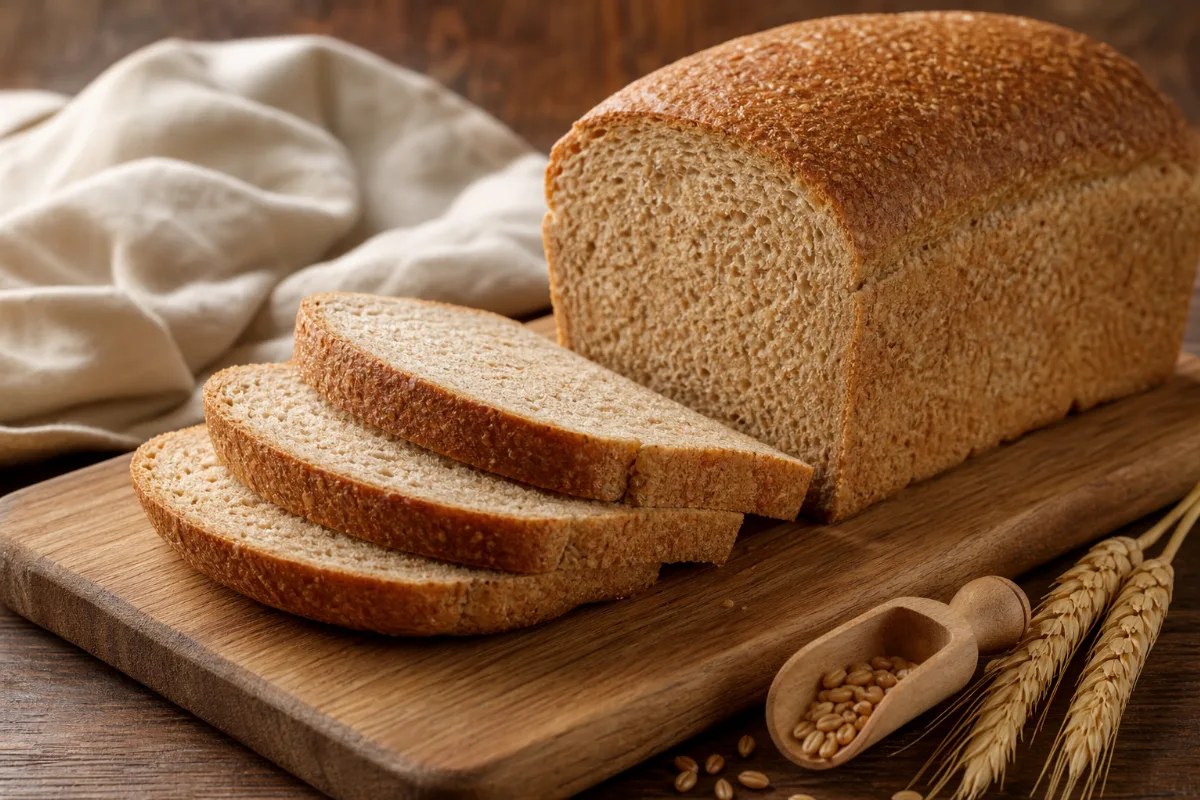
Whole Grains · Whole grain product
Whole-Wheat Bread
Triticum aestivum (bread) · also called Wholemeal bread, whole grain bread, brown bread, pan integral (Spanish)
Whole-wheat bread is baked from flour that keeps the bran and germ of the wheat kernel. A typical commercial loaf has about 6 g of fibre per 100 g, plus manganese, selenium and B vitamins. One small trial in adults with prediabetes found a smaller blood sugar rise after whole wheat bread than after white bread, but most heart and diabetes findings are for whole grains in general. The main cautions are that wheat contains gluten (not safe for celiac disease), wheat allergy, salt, and dark toast.
General information, not medical advice. Last substantive update · Not medically reviewed. A named clinician has not signed off on this page. How this page is made
About Whole-Wheat Bread
Whole-wheat bread is bread baked from flour that keeps the bran and germ. It is a useful everyday food with fibre, minerals and B vitamins, not a proven remedy. The one bread trial found a smaller blood sugar rise in adults with prediabetes; the heart and diabetes findings are about whole grains of all kinds. Wheat contains gluten and is a common allergen, and bread adds salt.
What it is
Whole-wheat bread is baked from wheat flour that includes the bran and germ of the kernel, so it has more fibre than white bread. Names vary: wholemeal, whole grain, brown. The word on the front of a loaf does not guarantee a high whole grain share, and a 2026 perspective says whole grain definitions differ even between large studies.
USDA data for generic commercial whole-wheat bread, per 100 g: 252 kcal, 12.4 g protein, 3.5 g fat, 42.7 g carbohydrate, 6.0 g fibre, 455 mg sodium, 2.17 mg manganese, 25.7 micrograms selenium, 0.394 mg thiamin and 4.44 mg niacin. One slice (32 g) has about 81 kcal, 1.9 g fibre and 146 mg sodium. Brands differ, so check the label.
What the research shows
The firmest facts are nutrients and safety. For benefits, the best bread-specific study is one 2-week crossover trial in 39 adults with prediabetes: whole wheat bread cut the glucose rise after a sugar drink by 27% compared with white bread. It is small, the result is close to the usual cutoff, and fasting glucose improved on either bread.
Pooled trials of whole-grain foods found LDL cholesterol 0.09 mmol/L lower, with oat strongest. Cohort studies link more whole grain to less heart disease (RR 0.81 per 90 g a day) and less type 2 diabetes (RR 0.68 per 3 servings a day). Cohorts cannot prove cause, and whole grain eaters often smoke less and exercise more.
Evidence for fullness, gut bacteria and mineral absorption is very low or insufficient.
Bread versus kernels, flour and other products
The USDA values are for a generic loaf. Wheat berries, flour, bran, pasta and sourdough are separate products. Supplements and extracts are not the food and are not covered here.
Portions
One USDA household slice is 32 g. Portion size is shown only to explain the nutrient values, not as advice. Ask your doctor or dietitian about amounts that suit you.
At a glance
Traditional uses history, not proof
- Eaten daily as sandwiches, toast and with meals
- Long use as food is not proof that it treats any condition
Studied for research
- Blood sugar after a sugar drink in prediabetes, low certainty (one small trial)
- LDL cholesterol, low certainty (pooled whole-grain trials, bread not tested alone)
- Heart disease and early death, low certainty (observational, whole grains of all kinds)
- Type 2 diabetes risk, low certainty (observational)
- Fibre for bowel regularity, moderate certainty for cereal fibre in general
- Minerals and B vitamins, high certainty for the nutrient content
- Fullness after a meal, very low certainty (one meal study)
- Gut bacteria and mineral absorption, insufficient evidence
Main compounds
- Dietary fibre
- Gluten
- Fructans
- Phytate
- Manganese and selenium
- Thiamin and niacin
- Sodium (salt)
Common forms
- Sliced commercial whole-wheat loaf (the USDA values used here)
- Toast (browning forms acrylamide)
- Bread with seeds or whole kernels (choking hazard for young children)
- Sourdough whole-wheat bread (separate product, not covered)
Research links: 2026 trial: whole wheat bread and blood sugar in prediabetes · 2016 review: whole grains and heart disease · NIDDK: celiac disease and diet · FDA: acrylamide and diet · Research Library · Genes & Biomarkers Library
What it is and its history
- Accepted scientific name
- Triticum aestivum (as bread)
- Naming authority
- L. (the wheat; GBIF accepted name per the whole wheat page, exact match)
- Common names
- Whole-wheat bread (English); Wholemeal bread (English); Whole grain bread (English); Brown bread (English); Pan integral (Spanish)
- Family or group
- Poaceae (the grass family), for the wheat it is made from.
- Classification
- Plantae > Poaceae > Triticum > Triticum aestivum
- Native range
- Not verified from a source read.
- What it looks like
- Fruit: Bread is baked dough made from ground wheat kernels, water, yeast or other leaven and salt. "Whole-wheat" means the flour keeps the bran and germ. Ingredient lists and the share of whole grain vary by brand and were not checked.
- Harvest and processing
- Milled flour, dough, baking. Not described in detail in any source read.
- Look-alikes and adulterants
- Name: "Wheat" or "brown" bread; Note: May be mostly refined flour; label wording was not checked against a rule here. A 2026 perspective says whole grain definitions are inconsistent across studies.; Name: Sourdough whole-wheat, rye and multigrain breads; Note: Separate products with their own research and pages.; Name: Whole wheat kernels (wheat berries) and wheat flour; Note: Whole wheat kernels have their own page.
- Sustainability and conservation
- Not assessed.
Photographs
What is inside, and how it may work
What it contains and how those compounds act in cells and animals. Laboratory and animal mechanisms are not proven effects in people.
Main compounds
| Compound | Family | Where it is concentrated | Activity studied | Level of evidence |
|---|---|---|---|---|
| Dietary fibre | carbohydrate | Bran in flour USDA: 6.0 g per 100 g (about 1.9 g per 32 g slice) | Cereal fibre adds stool weight (review of intervention trials). 13 23 | Human data |
| Gluten (gliadins and glutenins) | protein | Starchy middle of the kernel Not measured in the sources read; USDA lists 12.4 g total protein per 100 g | Triggers celiac disease in people with the genes; contains omega-5 gliadin, the main allergen in wheat-dependent exercise-induced anaphylaxis. 20 12 | Human data |
| Manganese | mineral | Whole grain USDA: 2.17 mg per 100 g | Nutrient content. 23 | Human data |
| Selenium | mineral | Whole grain USDA: 25.7 micrograms per 100 g | Nutrient content. 23 | Human data |
| Thiamin and niacin | B vitamins | Whole grain USDA: thiamin 0.394 mg, niacin 4.44 mg per 100 g | Nutrient content. 23 | Human data |
| Phytate | plant compound | Bran Not measured in the sources read | Binds minerals in the gut; effect on long-term iron levels is inconclusive. 8 | Human data |
| Fructans | carbohydrate | Wheat Not measured in the sources read | May be a trigger in non-coeliac wheat sensitivity. 7 | Human data |
| Acrylamide | process compound | Formed in toast crust Not measured in the sources read | Forms in high-heat cooking from sugars and asparagine; higher in dark toast. 15 | Human data |
Mechanisms, receptors and pathways
| Target or pathway | Gene or receptor | What was found | Level |
|---|---|---|---|
| Cereal fibre and bowel function | Not specified | Cereal fibre increased stool weight; fibres that ferment less added more. 13 | Human data |
| Gluten and the immune system in celiac disease | Not specified in the sources read | In celiac disease the immune system attacks the small intestine when gluten from wheat, barley or rye is eaten. 19 20 | Human data |
| Glucose handling after whole wheat bread | Not specified | The 27% smaller glucose rise was not explained by weight, inflammation or stool short-chain fatty acids; baseline levels of two bacteria groups predicted who responded more. 9 | Human data |
| Phytate and mineral binding | Not specified | High-phytate wholemeal bread raised serum iron less than low-phytate bread in single meals. 8 | Human data |
Absorption, metabolism and elimination
- Absorption
- Not found for bread nutrients; a 2026 review describes lower non-haem iron absorption from high-phytate bread in single meals.
- Distribution
- Not found.
- Metabolism
- Not found.
- Elimination
- Not found.
- Bioavailability
- Not established in the sources read.
Isolated compounds versus whole extracts
The USDA values are for one generic commercial loaf. The cholesterol trials and cohort studies used whole-grain foods of many kinds. The prediabetes trial used whole wheat bread in a controlled diet. Wheat berries, flour, bran, pasta and supplements are different products.
Nutritional composition
Nutrition from USDA FoodData Central, Bread, whole-wheat, commercially prepared (SR Legacy, FDC 172688, last updated 4/1/2019; values read 2026-10-26). Per 100 g: 252 kcal, 12.4 g protein, 3.5 g fat (0.72 g saturated), 42.7 g carbohydrate, 6.0 g fibre, 4.34 g sugars, 455 mg sodium, 254 mg potassium, 75 mg magnesium, 161 mg calcium, 2.47 mg iron, 1.77 mg zinc, 2.17 mg manganese, 25.7 micrograms selenium, 0.394 mg thiamin, 4.44 mg niacin, 42 micrograms folate. One slice is 32 g: about 81 kcal, 4.0 g protein, 1.9 g fibre, 146 mg sodium, 0.69 mg manganese. This is a generic product; real loaves differ, so check the label. The database lists no cholesterol.
1 high certainty1 moderate certainty5 low certainty1 very low certainty3 not enough evidence
What was looked at
The 11 benefits and uses checked for Whole-Wheat Bread, each with how strong the evidence is. Tap one to open it.
- Blood sugar after a sugar drink (prediabetes)Low certainty
- Cholesterol (LDL), from whole-grain foods in generalLow certainty
- Heart disease and early death (observational, whole grains in general)Low certainty
- Type 2 diabetes risk (observational, whole grains in general)Low certainty
- Fibre for bowel regularityModerate certainty
- Minerals and B vitamins (nutrient content)High certainty
- Fullness and appetite after a mealVery low certainty
- Body weight and inflammation markers (whole-grain diet)Low certainty
- Gut bacteria changesNot enough evidence
- Fermented (sourdough-style) bread and digestibilityNot enough evidence
- Mineral absorption from bread (phytate)Not enough evidence
Lab markers tracked in the studies
Glucose rise after a sugar drinkLDL cholesterolStool weightBody weightFullness after a mealInflammation markers (IL-6 and C-reactive protein)
What is Whole-Wheat Bread good for?
The main studied uses and how strong the human evidence is for each. Most results are for whole grains in general, not whole-wheat bread on its own.
Benefits, one by one
Each card is a research question, not a promise. Tap a goal to filter. Open a card to see the studies, doses and limits.
Blood sugar after a sugar drink (prediabetes)
Low certaintyIn one controlled-feeding trial of 39 adults with prediabetes, two weeks of whole wheat bread cut the glucose rise after a sugar drink by 27% compared with two weeks of white bread.
1 studiesCommercial-style whole wheat bread eaten as part of a controlled diet…
Studies, doses and limits
What the trials found
A randomised crossover trial (NCT05318183) fed 39 adults with prediabetes fully controlled diets that differed only in whole wheat or refined white bread, for 2 weeks each with a 2-week break. A 75 g glucose drink test was done after each period.
Results
Whole wheat bread lowered the glucose rise after the drink (p = 0.04). Fasting glucose and insulin improved over time on either bread. Inflammation markers and overall gut bacteria diversity did not differ.
Effect sizes as reported
Post-drink glucose rise 27% lower (p = 0.04); no confidence interval in the abstract.
Why this rating
One small, short trial with a result near the usual cutoff for significance, in a specific group (adults with prediabetes). It is a randomised trial with no industry conflict declared, but one trial is not enough for a firmer rating.
Form and dose studied
Commercial-style whole wheat bread eaten as part of a controlled diet (trial detail, not advice).
Who was studied
Adults with prediabetes in the United States.
Limits
Single trial, 39 people, 2 weeks. A drink test is not the same as blood sugar over a normal day. Not a trial in people with type 2 diabetes.
Why researchers looked
Whole-grain eating is linked to lower diabetes risk in cohorts, so researchers test whether swapping white bread for whole wheat bread changes blood sugar control.
Traditional use
Whole-wheat bread is eaten as a daily staple. Long use as food is not proof that it treats any condition.
Proposed mechanism Human clinical
The trial did not find a clear reason. Inflammation markers, stool fatty acids and body weight did not explain the result; the authors link the response to certain gut bacteria in some people.
A proposed mechanism does not show that the effect happens in people.
People with diabetes should follow their care team plan. Wheat contains gluten; see the Safety tab.
Cholesterol (LDL), from whole-grain foods in general
Low certaintyPooled trials of whole-grain foods found a small fall in LDL (bad) cholesterol of about 0.09 mmol/L compared with non-whole-grain foods. Oat looked strongest, and bread was not tested alone.
1 studiesWhole-grain foods such as bread, cereal and pasta (not bread alone).
Studies, doses and limits
What the trials found
A 2015 meta-analysis of 24 randomised studies in apparently healthy adults compared whole-grain foods with non-whole-grain controls.
Results
Whole-grain foods slightly lowered LDL and total cholesterol in short trials. HDL did not change. The result is for mixed whole-grain foods, not whole-wheat bread alone.
Effect sizes as reported
LDL -0.09 mmol/L; total cholesterol -0.12 mmol/L; HDL no change; triglycerides -0.04 mmol/L (not significant).
Why this rating
The trials are randomised but mix many grain foods, oat looked strongest, the average change is small, and cholesterol is a marker, not heart attacks.
Form and dose studied
Whole-grain foods such as bread, cereal and pasta (not bread alone).
Who was studied
Apparently healthy adults.
Limits
Mixed whole grains. Small average change. Marker, not outcome.
Why researchers looked
Whole grains carry fibre, so researchers test whether swapping refined grain foods for whole-grain ones changes blood fats.
Traditional use
Whole-wheat bread is eaten as a daily staple. Long use as food is not proof that it treats any condition.
Proposed mechanism Unknown
Not established in the abstract. The authors note that grains differ in nutrients such as fibre.
A proposed mechanism does not show that the effect happens in people.
None specific for cholesterol.
Heart disease and early death (observational, whole grains in general)
Low certaintyLarge cohort studies link more whole grain in the diet to less coronary heart disease and a lower risk of dying from any cause. This shows an association, not cause, and covers whole grains of all kinds.
2 studiesWhole grain foods of all kinds (results per 90 g a day, an associatio…
Studies, doses and limits
What the trials found
A 2016 meta-analysis pooled 45 prospective studies (64 publications) of whole grain intake, including bread, breakfast cereals and added bran.
Results
More whole grain went with less coronary heart disease, cardiovascular disease and death. The stroke range included no effect (0.75 to 1.03). A 2026 perspective points out that cohorts count whole grain foods differently and that whole grain eaters often smoke less and exercise more, so lifestyle may explain some of the benefit.
Effect sizes as reported
Per 90 g a day: coronary heart disease RR 0.81 (0.75-0.87); cardiovascular disease 0.78 (0.73-0.85); stroke 0.88 (0.75-1.03); all-cause mortality 0.83 (0.77-0.90).
Why this rating
Observational evidence only. People who choose whole grain differ in other healthy habits. The review is of whole grains of all kinds, not bread alone.
Form and dose studied
Whole grain foods of all kinds (results per 90 g a day, an association, not advice).
Who was studied
Adults in prospective cohorts.
Limits
Cannot prove cause. Not specific to whole-wheat bread. Definitions of whole grain differ between cohorts.
Why researchers looked
Because whole grain eaters often live longer in cohorts, researchers ask whether the grain itself plays a part.
Traditional use
Whole-wheat bread is eaten as a daily staple. Long use as food is not proof that it treats any condition.
Proposed mechanism Unknown
Not tested in these cohort studies.
A proposed mechanism does not show that the effect happens in people.
None specific.
Type 2 diabetes risk (observational, whole grains in general)
Low certaintyCohort studies link more whole grain, but not refined grain, to a lower risk of developing type 2 diabetes. This is an association across whole grains of all kinds.
1 studiesWhole grain foods of all kinds.
Studies, doses and limits
What the trials found
A 2013 meta-analysis of 16 cohort studies compared whole grain and refined grain intake and later type 2 diabetes.
Results
Whole grain intake went with lower diabetes risk; refined grain showed no clear link. Studies differed a lot from one another.
Effect sizes as reported
Per 3 servings a day: whole grains RR 0.68 (0.58-0.81, I2 82%); refined grains RR 0.95 (0.88-1.04).
Why this rating
Observational, high differences between studies, published 2013, whole grains of all kinds.
Form and dose studied
Whole grain foods of all kinds.
Who was studied
Adults in cohort studies.
Limits
Cannot prove cause; not bread alone.
Why researchers looked
Researchers ask whether the type of grain a person eats goes with later diabetes risk.
Traditional use
Whole-wheat bread is eaten as a daily staple. Long use as food is not proof that it treats any condition.
Proposed mechanism Unknown
Not tested in these cohort studies.
A proposed mechanism does not show that the effect happens in people.
None specific.
Fibre for bowel regularity
Moderate certaintyUSDA lists 6.0 g of fibre per 100 g of commercial whole-wheat bread, about 1.9 g per slice. Reviews of trials found that cereal fibre adds to stool weight.
2 studiesFibre from cereals in general (bran and others); bread as a food.
Studies, doses and limits
What the trials found
USDA lists 6.0 g total fibre per 100 g (1.92 g in a 32 g slice). A 2016 review of intervention trials found cereal and vegetable fibre had comparable effects on stool weight, and both beat fruit fibre. Transit time fell about 30 minutes per gram of fibre only when it started at 48 hours or more.
Results
Cereal fibre in general adds stool weight and may speed slow transit. No trial of whole-wheat bread alone for constipation was found. The review is of fibre, not of bread.
Effect sizes as reported
USDA: 6.0 g fibre per 100 g. Review: about 30 minutes shorter transit per gram of fibre when starting transit time was 48 hours or more.
Why this rating
Moderate for cereal fibre adding stool weight (a review of intervention trials), but this is not a bread trial and three of five authors list Kellogg Company as employer.
Form and dose studied
Fibre from cereals in general (bran and others); bread as a food.
Who was studied
Healthy adults in the fibre trials.
Limits
Not a bread trial. Industry-linked authors. Fibre content varies by brand.
Why researchers looked
Whole-wheat bread keeps wheat bran, where much of the fibre is, so people ask what that fibre does for the gut.
Traditional use
Whole-wheat bread is eaten as a daily staple. Long use as food is not proof that it treats any condition.
Proposed mechanism Authoritative guidance
Cereal fibre adds bulk to stool; fibres that ferment less added more stool weight in the review.
A proposed mechanism does not show that the effect happens in people.
Wheat fructans and gluten matter for some people; see the Safety tab.
Minerals and B vitamins (nutrient content)
High certaintyA typical commercial whole-wheat loaf has manganese, selenium, thiamin and niacin. Per 100 g USDA lists 2.17 mg manganese, 25.7 micrograms selenium, 0.394 mg thiamin and 4.44 mg niacin.
1 studiesWhole-wheat bread as food.
Studies, doses and limits
What the trials found
USDA FoodData Central lists these values for generic commercially prepared whole-wheat bread (last updated 4/1/2019). A 32 g slice has about 0.69 mg manganese, 8.2 micrograms selenium, 0.13 mg thiamin and 1.42 mg niacin.
Results
A reliable source of several nutrients as food. Brands differ, and some breads are fortified or made differently.
Effect sizes as reported
Per 100 g: manganese 2.17 mg; selenium 25.7 micrograms; thiamin 0.394 mg; niacin 4.44 mg; iron 2.47 mg; folate 42 micrograms.
Why this rating
High certainty only for what the database lists for a generic loaf; it does not show a health effect.
Form and dose studied
Whole-wheat bread as food.
Who was studied
General population.
Limits
Database values for one generic product; not a health outcome.
Why researchers looked
People ask what bread adds to the diet beyond calories.
Traditional use
Whole-wheat bread is eaten as a daily staple. Long use as food is not proof that it treats any condition.
Proposed mechanism Authoritative guidance
Nutrient content, not a mechanism.
A proposed mechanism does not show that the effect happens in people.
None specific.
Fullness and appetite after a meal
Very low certaintyIn a single-meal study of 16 young healthy adults, wholemeal wheat bread raised fullness and lowered hunger more than refined wheat bread. Blood sugar and later food intake did not differ.
1 studiesWholemeal wheat bread test meal.
Studies, doses and limits
What the trials found
A randomised crossover study in 16 young adults compared wholemeal and refined wheat bread and pasta test meals (50 g carbohydrate), measuring blood glucose and appetite for 180 minutes and then food eaten at lunch.
Results
Glucose responses were similar for wholemeal and refined breads. Wholemeal bread increased satiety and reduced hunger. Energy eaten at lunch did not differ.
Effect sizes as reported
No numbers in the abstract.
Why this rating
A single-meal study in 16 young healthy adults; effect on later eating was null.
Form and dose studied
Wholemeal wheat bread test meal.
Who was studied
Young healthy adults in Denmark.
Limits
Very small, single meal, no long-term data.
Why researchers looked
Researchers test whether fibre and structure in wholemeal bread change how full people feel.
Traditional use
Whole-wheat bread is eaten as a daily staple. Long use as food is not proof that it treats any condition.
Proposed mechanism Unknown
Not established in the abstract.
A proposed mechanism does not show that the effect happens in people.
None specific.
Body weight and inflammation markers (whole-grain diet)
Low certaintyOne 8-week trial of mixed whole grains in adults at risk of metabolic syndrome found lower body weight and lower inflammation markers than a refined-grain diet. Bread alone was not tested.
1 studiesMixed whole-grain foods (trial detail, not advice).
Studies, doses and limits
What the trials found
A randomised crossover trial (NCT01731366) in 60 Danish adults at risk of metabolic syndrome (50 completed both periods) compared a whole-grain diet (179 g a day) with a refined-grain diet (13 g a day) for 8 weeks each.
Results
Whole grain lowered body weight and the markers IL-6 and C-reactive protein, but did not significantly change glucose control or gut bacteria. This was a mix of whole grains, not wheat bread alone.
Effect sizes as reported
Body weight p < 0.0001; IL-6 p = 0.009; CRP p = 0.003 (no confidence intervals in the abstract).
Why this rating
One short trial of 50 completers, mixed grains, part industry funding.
Form and dose studied
Mixed whole-grain foods (trial detail, not advice).
Who was studied
Adults at risk of metabolic syndrome.
Limits
Mixed whole grains; part funded by an unrestricted grant from Cereal Partners Worldwide.
Why researchers looked
Researchers test whether swapping refined grain for whole grain changes weight and inflammation.
Traditional use
Whole-wheat bread is eaten as a daily staple. Long use as food is not proof that it treats any condition.
Proposed mechanism Human clinical
The weight change matched lower energy intake; the IL-6 change was linked to the amount of whole grain eaten, especially rye.
A proposed mechanism does not show that the effect happens in people.
None specific.
Gut bacteria changes
Not enough evidenceIn the prediabetes trial, overall diversity of gut bacteria did not change on whole wheat bread. A few bacteria groups shifted slightly, but these shifts were not corrected for chance.
1 studiesWhole wheat bread in a controlled diet.
Studies, doses and limits
What the trials found
The same 39-person crossover trial measured stool bacteria and short-chain fatty acids.
Results
Overall diversity unchanged; stool short-chain fatty acids did not differ between breads; a few groups moved (nominal p < 0.05).
Effect sizes as reported
Nominal p < 0.05 for a few groups; no overall change.
Why this rating
Small trial with nominal findings and no clear health outcome.
Form and dose studied
Whole wheat bread in a controlled diet.
Who was studied
Adults with prediabetes.
Limits
Not corrected for many comparisons.
Why researchers looked
Fibre feeds gut bacteria, so researchers look at whether bread changes the mix.
Traditional use
Whole-wheat bread is eaten as a daily staple. Long use as food is not proof that it treats any condition.
Proposed mechanism Unknown
Not established.
A proposed mechanism does not show that the effect happens in people.
None specific.
Fermented (sourdough-style) bread and digestibility
Not enough evidenceA 2026 review says yeast and lactic acid bacteria may raise mineral availability or lower gluten and FODMAP triggers in bread, but the clinical evidence is still insufficient.
1 studiesFermented bread, not ordinary whole-wheat bread.
Studies, doses and limits
What the trials found
A narrative review of fermentation in breadmaking and gut disorders such as non-coeliac wheat sensitivity and irritable bowel syndrome.
Results
Possible benefits from process changes; human studies are needed.
Effect sizes as reported
No numbers in the abstract.
Why this rating
Narrative review, mostly process and lab findings, with authors from a baking-yeast company.
Form and dose studied
Fermented bread, not ordinary whole-wheat bread.
Limits
Authors say strength of evidence is insufficient. Fermented bread is not made safe for celiac disease.
Why researchers looked
Some people who react to bread ask whether longer fermentation helps.
Traditional use
Whole-wheat bread is eaten as a daily staple. Long use as food is not proof that it treats any condition.
Proposed mechanism Laboratory research
Microbes break down some bread components during fermentation (lab and process findings).
A proposed mechanism does not show that the effect happens in people.
The review does not show fermented wheat bread to be safe for celiac disease.
Mineral absorption from bread (phytate)
Not enough evidenceWhole grain bread has more phytate, which can reduce iron absorption in single meals. A 2026 review of 8 human studies was inconclusive on whether lower-phytate or sourdough bread improves iron over time.
1 studiesBread, fermented or not.
Studies, doses and limits
What the trials found
A 2026 systematic review of 8 human intervention studies on sourdough or regular fermentation and phytate reduction for iron.
Results
In single meals, low-phytate white bread raised serum iron more than high-phytate wholemeal bread. Long-term trials did not improve ferritin or total iron.
Effect sizes as reported
Serum iron 2-hour rise 59 vs 30 ug Fe/100 mL (acute meals).
Why this rating
The authors say no human study answers the question with proper controls and quality.
Form and dose studied
Bread, fermented or not.
Who was studied
Healthy or iron-deficient people.
Limits
Small studies of mixed quality.
Why researchers looked
Phytate in bran can bind minerals, so people ask whether whole-wheat bread lowers iron or zinc uptake.
Traditional use
Whole-wheat bread is eaten as a daily staple. Long use as food is not proof that it treats any condition.
Proposed mechanism Human clinical
Phytate binds minerals in the gut.
A proposed mechanism does not show that the effect happens in people.
If you are iron-deficient, ask your clinician rather than changing bread.
Connections to the rest of health
How Whole-Wheat Bread connects to the rest of our health knowledge graph. Every link says what kind of connection it is. A safety link (for example to the liver) is a warning, not a benefit. A study that merely mentions a topic never creates a benefit link.
Explore every connection: goals, body systems, organs, symptoms, genes
A. Wellness goals
| Connected to | Kind of connection | Evidence status | Context | Studies |
|---|---|---|---|---|
| Blood Sugar Balance | Low certainty | Blood sugar after a sugar drink (prediabetes): In one controlled-feeding trial of 39 adults with prediabetes, two weeks of whole wheat bread cut the glucose rise after a sugar drink by 27% compared with two weeks of white bread. | 9 | |
| Metabolic Health | Low certainty | Blood sugar after a sugar drink (prediabetes): In one controlled-feeding trial of 39 adults with prediabetes, two weeks of whole wheat bread cut the glucose rise after a sugar drink by 27% compared with two weeks of white bread. | 9 | |
| Cholesterol Balance | Low certainty | Cholesterol (LDL), from whole-grain foods in general: Pooled trials of whole-grain foods found a small fall in LDL (bad) cholesterol of about 0.09 mmol/L compared with non-whole-grain foods. Oat looked strongest, and bread was not tested alone. | 4 | |
| Heart Health | Low certainty | Cholesterol (LDL), from whole-grain foods in general: Pooled trials of whole-grain foods found a small fall in LDL (bad) cholesterol of about 0.09 mmol/L compared with non-whole-grain foods. Oat looked strongest, and bread was not tested alone. | 4 | |
| Heart Health | Low certainty | Heart disease and early death (observational, whole grains in general): Large cohort studies link more whole grain in the diet to less coronary heart disease and a lower risk of dying from any cause. This shows an association, not cause, and covers whole grains of all kinds. | 2 5 | |
| Healthy Aging | Low certainty | Heart disease and early death (observational, whole grains in general): Large cohort studies link more whole grain in the diet to less coronary heart disease and a lower risk of dying from any cause. This shows an association, not cause, and covers whole grains of all kinds. | 2 5 | |
| Blood Sugar Balance | Low certainty | Type 2 diabetes risk (observational, whole grains in general): Cohort studies link more whole grain, but not refined grain, to a lower risk of developing type 2 diabetes. This is an association across whole grains of all kinds. | 1 | |
| Metabolic Health | Low certainty | Type 2 diabetes risk (observational, whole grains in general): Cohort studies link more whole grain, but not refined grain, to a lower risk of developing type 2 diabetes. This is an association across whole grains of all kinds. | 1 | |
| Digestive Support | Moderate certainty | Fibre for bowel regularity: USDA lists 6.0 g of fibre per 100 g of commercial whole-wheat bread, about 1.9 g per slice. Reviews of trials found that cereal fibre adds to stool weight. | 13 23 | |
| Preventive Wellness | High certainty | Minerals and B vitamins (nutrient content): A typical commercial whole-wheat loaf has manganese, selenium, thiamin and niacin. Per 100 g USDA lists 2.17 mg manganese, 25.7 micrograms selenium, 0.394 mg thiamin and 4.44 mg niacin. | 23 | |
| Weight Management | Very low certainty | Fullness and appetite after a meal: In a single-meal study of 16 young healthy adults, wholemeal wheat bread raised fullness and lowered hunger more than refined wheat bread. Blood sugar and later food intake did not differ. Body weight and inflammation markers (whole-grain diet): One 8-week trial of mixed whole grains in adults at risk of metabolic syndrome found lower body weight and lower inflammation markers than a refined-grain diet. Bread alone was not tested. | 6 11 | |
| Inflammation Balance | Low certainty | Body weight and inflammation markers (whole-grain diet): One 8-week trial of mixed whole grains in adults at risk of metabolic syndrome found lower body weight and lower inflammation markers than a refined-grain diet. Bread alone was not tested. | 11 | |
| Microbiome Balance | Not enough evidence | Gut bacteria changes: In the prediabetes trial, overall diversity of gut bacteria did not change on whole wheat bread. A few bacteria groups shifted slightly, but these shifts were not corrected for chance. | 9 | |
| Digestive Support | Not enough evidence | Fermented (sourdough-style) bread and digestibility: A 2026 review says yeast and lactic acid bacteria may raise mineral availability or lower gluten and FODMAP triggers in bread, but the clinical evidence is still insufficient. | 10 | |
| Preventive Wellness | Not enough evidence | Mineral absorption from bread (phytate): Whole grain bread has more phytate, which can reduce iron absorption in single meals. A 2026 review of 8 human studies was inconclusive on whether lower-phytate or sourdough bread improves iron over time. | 8 |
B. Body systems
| Connected to | Kind of connection | Evidence status | Context | Studies |
|---|---|---|---|---|
| Blood Sugar Support | Biological association | Low certainty | Studied for: Blood sugar after a sugar drink (prediabetes) Studied for: Type 2 diabetes risk (observational, whole grains in general) | 9 1 |
| Cardiovascular System | Biological association | Low certainty | Studied for: Cholesterol (LDL), from whole-grain foods in general Studied for: Heart disease and early death (observational, whole grains in general) | 4 2 5 |
| Digestive System | Biological association | Moderate certainty | Studied for: Fibre for bowel regularity Studied for: Gut bacteria changes | 13 23 9 10 |
| Whole Body Balance | Biological association | High certainty | Studied for: Minerals and B vitamins (nutrient content) Studied for: Mineral absorption from bread (phytate) | 23 8 |
| Metabolism Weight | Biological association | Very low certainty | Studied for: Fullness and appetite after a meal Studied for: Body weight and inflammation markers (whole-grain diet) | 6 11 |
| Immune System | Biological association | Low certainty | Studied for: Body weight and inflammation markers (whole-grain diet) | 11 |
E. Health conditions
| Connected to | Kind of connection | Evidence status | Context | Studies |
|---|---|---|---|---|
| Celiac disease | Contraindication | Documented risk | Gluten in wheat triggers celiac disease; a gluten-free diet is the treatment. Preparation or compound: Gluten in wheat bread |
21 20 19 |
| Wheat hypersensitivity | Adverse effect or risk | Documented risk | Wheat is a major food allergen; a form is triggered by wheat plus exercise or other co-factors. Preparation or compound: Wheat proteins including omega-5 gliadin |
18 12 |
| Gluten sensitivity | Adverse effect or risk | Documented risk | Self-reported often; confirmed by blinded challenge in a minority. Preparation or compound: Wheat fructans and gluten |
7 3 |
| Prediabetes | Preliminary human evidence | One small crossover trial found a smaller glucose rise after whole wheat bread than after white bread. Preparation or compound: Whole-wheat bread |
9 |
I. Biomarkers
| Connected to | Kind of connection | Evidence status | Context | Studies |
|---|---|---|---|---|
| Glucose rise after a sugar drink | Biological association | Low certainty | Measured in trials: lowered. A lab change is not the same as a health benefit. | 9 |
| LDL cholesterol | Biological association | Low certainty | Measured in trials: lowered. A lab change is not the same as a health benefit. | 4 |
| Stool weight | Biological association | Moderate certainty | Measured in trials: raised. A lab change is not the same as a health benefit. | 13 |
| Body weight | Biological association | Low certainty | Measured in trials: lowered. A lab change is not the same as a health benefit. | 11 |
| Fullness after a meal | Biological association | Very low certainty | Measured in trials: raised. A lab change is not the same as a health benefit. | 6 |
| Inflammation markers (IL-6 and C-reactive protein) | Biological association | Low certainty | Measured in trials: lowered. A lab change is not the same as a health benefit. | 11 9 |
K. Biological pathways
| Connected to | Kind of connection | Evidence status | Context | Studies |
|---|---|---|---|---|
| Fibre | Preliminary mechanism | Human | Whole-wheat bread is a fibre food; cereal fibre adds stool weight. | 13 23 |
| Gluten | Preliminary mechanism | Human | Gluten in wheat triggers celiac disease and may matter in wheat allergy. | 20 12 |
| Sodium | Preliminary mechanism | Human | Commercial bread carries salt; compare labels. | 23 22 |
L. Active compounds
| Connected to | Kind of connection | Evidence status | Context | Studies |
|---|---|---|---|---|
| Dietary fibre | Biological association | Human | Cereal fibre adds stool weight (review of intervention trials). Preparation or compound: Bran in flour |
13 23 |
| Gluten (gliadins and glutenins) | Biological association | Human | Triggers celiac disease in people with the genes; contains omega-5 gliadin, the main allergen in wheat-dependent exercise-induced anaphylaxis. Preparation or compound: Starchy middle of the kernel |
20 12 |
| Manganese | Biological association | Human | Nutrient content. Preparation or compound: Whole grain |
23 |
| Selenium | Biological association | Human | Nutrient content. Preparation or compound: Whole grain |
23 |
| Thiamin and niacin | Biological association | Human | Nutrient content. Preparation or compound: Whole grain |
23 |
| Phytate | Biological association | Human | Binds minerals in the gut; effect on long-term iron levels is inconclusive. Preparation or compound: Bran |
8 |
| Fructans | Biological association | Human | May be a trigger in non-coeliac wheat sensitivity. Preparation or compound: Wheat |
7 |
| Acrylamide | Biological association | Human | Forms in high-heat cooking from sugars and asparagine; higher in dark toast. Preparation or compound: Formed in toast crust |
15 |
Each connection is stored with the ingredient, the connected record, the kind of connection, the evidence status, the supporting studies, the preparation or compound involved, and a review date (last reviewed October 26, 2026).
The evidence
The research centre for Whole-Wheat Bread. Every record here was checked against PubMed or the publisher's page; we never list a study we have not verified.
Evidence by outcome
Bars show how many studies we found for each outcome, not how well it works. People are added up across trials only (reviews are not added, to avoid double counting).
How we rate evidence
High certainty
Several well-run trials or reviews agree; further research is unlikely to change the picture much.
Moderate certainty
Good trials point the same way, but some doubt remains.
Low certainty
Small, short or inconsistent trials. The finding could change with better research.
Very low certainty
Very little or very weak human data. Treat as a possibility only.
Mixed findings
Trials or reviews disagree with each other.
Not enough evidence
Not enough human research to say either way.
Evidence against
Good research found no benefit, or found harm.
We take the reviewers' own risk-of-bias and GRADE statements where they exist, and otherwise judge from study size, design, consistency, directness and whether a product matches what is sold. Many publications do not make evidence high. Method note: We started from our existing whole wheat summary, re-checked nutrition against USDA FoodData Central data, read the health agency pages (NIDDK, NHS, MedlinePlus, FDA, WHO) and re-read PubMed abstracts for reviews and trials. Only abstracts were read for studies. Items we could not verify are flagged in the research gaps.
Study library: every study we checked 24
| Study | Design | People | Product, dose, length | Result |
|---|---|---|---|---|
| Aune 2013 Whole grain and refined grain consumption and the risk of type 2 diabetes: a systematic review and dose-response meta-analysis of cohort studies. European Journal of Epidemiology · PMID 24158434 · DOI |
Systematic review meta analysis |
16 cohort studies | Whole grain and refined grain intake Grain foods Results per 3 servings a day (an association, not a trial dose) Follow-up varied by study · vs Lower versus higher intake |
Higher whole grain intake was linked to lower type 2 diabetes risk. Refined grain showed no clear link. Inverse links for whole grain bread, whole grain cereals, wheat bran and brown rice were based on few studies. White rice was linked to higher risk. Per 3 servings/day: whole grains RR 0.68; refined grains RR 0.95 (Whole grains 0.58-0.81 (I2 = 82%, 10 studies); refined grains 0.88-1.04 (I2 = 53%, 6 studies)) Methods, limits and fundingOutcomes: Risk of developing type 2 diabetes Limitations: Observational: cannot prove cause. High differences between studies. Published in 2013. Whole grains of all kinds. Funding and conflicts: Funding is not stated in the abstract. Read: abstract |
| Aune 2016 Whole grain consumption and risk of cardiovascular disease, cancer, and all cause and cause specific mortality: systematic review and dose-response meta-analysis of prospective studies. BMJ · PMID 27301975 · DOI |
Systematic review meta analysis |
45 prospective (cohort) studies, 64 publications | Whole grain intake (all kinds: bread, breakfast cereals, added bran and others) Whole grain foods Results per 90 g a day increase (about three servings); an observed association, not a trial dose Follow-up varied by study · vs Lower versus higher whole grain intake |
Higher whole grain intake was linked to lower risk of coronary heart disease, cardiovascular disease, death from cancer and death from any cause. For stroke the range included no effect. There was little sign of a link for refined grains or white rice. Per 90 g/day: coronary heart disease RR 0.81; cardiovascular disease 0.78; stroke 0.88; cancer deaths 0.85; deaths from any cause 0.83 (CHD 0.75-0.87; CVD 0.73-0.85; stroke 0.75-1.03; cancer mortality 0.80-0.91; all-cause mortality 0.77-0.90) Methods, limits and fundingOutcomes: Coronary heart disease, stroke, cardiovascular disease, cancer and all-cause mortality Limitations: Observational: cannot prove cause, and people who eat more whole grains may differ in other healthy habits. Whole grains of all kinds, not wheat berries alone. Heterogeneity was high for all-cause mortality (I2 = 83%). Funding and conflicts: The authors declared no financial relationships with any organisation that might have an interest in the work. Read: abstract |
| Biesiekierski 2013 No effects of gluten in patients with self-reported non-celiac gluten sensitivity after dietary reduction of fermentable, poorly absorbed, short-chain carbohydrates. Gastroenterology · PMID 23648697 · DOI |
Controlled trial |
37 adults (aged 24-61) with self-reported non-celiac gluten sensitivity and irritable bowel syndrome, not celiac disease | Gluten (added as purified protein) versus whey protein or no added protein Gluten as an ingredient, not a whole food High-gluten 16 g/day; low-gluten 2 g/day; control 16 g whey/day 1 week per diet, then a 3-day rechallenge in 22 people · vs Whey protein or control diet |
After 2 weeks on a low-FODMAP diet, symptoms improved in everyone. They then got worse to a similar degree with gluten or whey protein. Gluten-specific effects were seen in only 8% of people. No marker changed with the diet. The 3-day rechallenge did not reproduce a gluten-specific effect. Gluten-specific effect in 8% of participants (Not given in the abstract) Methods, limits and fundingOutcomes: Gut symptoms, blood and stool markers Limitations: Small trial. Purified gluten given as supplement, not wheat food. An order effect was noted. Funding and conflicts: Funding is not stated in the abstract. Read: abstract |
| Hollaender 2015 Whole-grain and blood lipid changes in apparently healthy adults: a systematic review and meta-analysis of randomized controlled studies. American Journal of Clinical Nutrition · PMID 26269373 · DOI |
Systematic review meta analysis |
24 randomised controlled studies in apparently healthy adults (6,069 articles screened) | Whole-grain foods (mixed grains; oat looked strongest) Whole grain foods Study length varied; longer studies showed larger changes · vs Non-whole-grain control foods |
Whole-grain diets lowered LDL cholesterol and total cholesterol compared with non-whole-grain controls. HDL cholesterol did not change and triglycerides tended to fall (not statistically significant). Whole-grain oat had the biggest effect on total cholesterol. LDL -0.09 mmol/L; total cholesterol -0.12 mmol/L; HDL no effect; triglycerides -0.04 mmol/L (P = 0.10) (LDL -0.09 (95% CI -0.15 to -0.03); total cholesterol -0.12 (-0.19 to -0.05); triglycerides -0.04 (-0.08 to 0.01)) Methods, limits and fundingOutcomes: Total, LDL and HDL cholesterol, triglycerides Limitations: Mixed whole-grain foods, not wheat berries on their own. Oat drove part of the result. Cholesterol is a marker, not heart attacks. Funding and conflicts: Funding is not stated in the abstract. Read: abstract |
| Jia 2026 Whole Grains Perspective: Porridge or Popcorn. Journal of Nutrition · PMID 42061716 · DOI |
Narrative review |
Perspective on 12 large prospective cohorts (over 100,000 participants) | Whole grain foods of all kinds Whole grain foods |
Ten of 12 big cohorts measured whole grain intake, but only 3 foods (popcorn, oatmeal, brown rice) were counted in 7 of them, and 17 of 54 whole grain foods were listed by a single cohort. Whole grain eaters tend to smoke less, exercise more and have more education, so part of the benefit seen in cohorts may be lifestyle. Intact barley gave a lower glucose response than milled barley flour used in breads, so processing matters. n/a (n/a) Methods, limits and fundingOutcomes: Which foods count as whole grains; lifestyle confounding; processing Limitations: Perspective article, not a systematic review. Not about bread alone. Funding and conflicts: One author reported that his wife had been a director of a clinical research company; others reported none. Read: abstract |
| Kristensen 2010 Wholegrain vs. refined wheat bread and pasta. Effect on postprandial glycemia, appetite, and subsequent ad libitum energy intake in young healthy adults. Appetite · PMID 19837118 · DOI |
Controlled trial |
16 young healthy adults | Wholemeal wheat bread (and wholegrain pasta) test meals Bread, pasta Meals with 50 g carbohydrate (2 MJ) Single meals; glucose and appetite for 180 minutes · vs Refined wheat bread and pasta |
Glucose responses over 180 minutes were similar for wholemeal and refined products. Wholemeal bread, but not wholegrain pasta, raised satiety and lowered hunger compared with refined bread. Energy eaten at the later meal did not differ. Glucose similar; satiety higher with wholemeal bread; later energy intake no different (Not given in the abstract) Methods, limits and fundingOutcomes: Blood glucose, appetite ratings, energy eaten at a later lunch Limitations: Single-meal study in 16 young healthy adults. Not a long-term trial. Funding and conflicts: Funding is not stated in the abstract. Read: abstract |
| Maimaris 2025 Non-Coeliac Wheat Sensitivity: Symptoms in Search of a Mechanism, or a Distinct Well-Defined Clinical Entity? A Narrative Review. International Journal of Molecular Sciences · PMID 41303655 · DOI |
Narrative review |
Narrative review of non-coeliac wheat sensitivity | Wheat and gluten as food Wheat foods |
Self-reported non-coeliac wheat sensitivity is high (often over 10%), but blinded challenge confirms it in only a minority (typically under 30%). Wheat parts other than gluten, notably fructans and amylase-trypsin inhibitors, may be triggers. Management is mainly removing wheat and gluten; a low-FODMAP diet has also helped as an add-on. There are no validated tests. Self-reported over 10%; confirmed in typically under 30% (n/a) Methods, limits and fundingOutcomes: Definition, prevalence, triggers, management Limitations: Narrative review; no pooled numbers. Not specific to bread. Funding and conflicts: The authors declare no conflicts of interest. Read: abstract |
| Nikolaou 2026 Effects of sourdough- or regular-bread fermentation, and phytate reduction on iron bioavailability, absorption, and iron status in humans: a systematic review of intervention studies. Frontiers in Nutrition · PMID 42163962 · DOI |
Systematic review |
8 human intervention studies (healthy or iron-deficient people) | Sourdough or regular bread, low- versus high-phytate; phytase Bread (not wheat berries) Acute meals up to 12-week trials · vs Higher-phytate breads or controls |
Results were inconclusive. In single meals, low-phytate bread raised non-haem iron more (serum iron rise at 2 hours: 59 for low-phytate white bread versus 30 ug Fe/100 mL for high-phytate wholemeal bread). Long-term trials did not improve ferritin or total body iron, and in one low-phytate sourdough rye bread trial both fell over 12 weeks. Serum iron 2-hour rise 59 vs 30 ug Fe/100 mL (acute); ferritin 32 to 27 ug/L in the low-phytate sourdough rye group over 12 weeks (Not given for these figures) Methods, limits and fundingOutcomes: Iron bioavailability, absorption and iron status Limitations: Bread, not wheat berries. The authors say no human study answers the question with proper controls and quality. Funding and conflicts: The authors declared no commercial or financial relationships that could be a conflict of interest. Registration: osf.io/gzt8m Read: abstract |
| Pierson 2026 Whole wheat bread improves postprandial glucose tolerance in adults with prediabetes: a controlled-feeding randomized crossover trial with microbiome-associated variation in response. Frontiers in Nutrition · PMID 42729417 · DOI |
Controlled trial |
39 adults with prediabetes (BMI about 34.7) | Whole wheat bread (all grain foods in fully controlled diets) Bread 2 weeks per diet, 2-week washout · vs Refined white bread |
Compared with white bread, whole wheat bread cut the glucose rise after the sugar drink by 27%. Fasting glucose and insulin improved over time with either bread. Inflammation markers, methylglyoxal and stool short-chain fatty acids did not differ between breads. Overall gut bacteria diversity did not change; a few groups shifted slightly (nominal p < 0.05). Post-drink glucose excursion reduced 27% (p = 0.04) (Not given in the abstract) Methods, limits and fundingOutcomes: Glucose rise during a 75 g oral glucose tolerance test, fasting glucose and insulin, inflammation markers, gut bacteria and fatty acids in stool Limitations: Small, short trial in adults with prediabetes. The p value is close to the usual cutoff. Gut bacteria shifts were not corrected for many comparisons (nominal). A drink test is not a measure of everyday meals. Funding and conflicts: The authors declared no commercial or financial relationships; one author was a Frontiers editorial board member, which the authors said had no effect on peer review. Registration: NCT05318183 Read: abstract |
| Ribet 2026 Fermentation in breadmaking: enhancing digestibility and nutritional value for gastrointestinal health. Frontiers in Nutrition · PMID 42253731 · DOI |
Narrative review |
Narrative review of fermentation in bread, with non-coeliac wheat or gluten sensitivity and irritable bowel syndrome discussed | Fermented bread (yeast and lactic acid bacteria) Bread |
Yeasts and lactic acid bacteria can raise mineral availability or lower triggers such as gluten and FODMAPs when well chosen. The authors say the strength of evidence for clinical benefit remains insufficient and that well-designed human studies are needed. n/a (n/a) Methods, limits and fundingOutcomes: Mineral availability, gluten and FODMAP reduction, metabolites Limitations: Narrative review, mostly lab and process findings. Authors say human evidence is insufficient. Funding and conflicts: Industry-linked: several authors worked for or consulted for Lesaffre, a yeast and baking-ingredients company. Read: abstract |
| Roager 2019 Whole grain-rich diet reduces body weight and systemic low-grade inflammation without inducing major changes of the gut microbiome: a randomised cross-over trial. Gut · PMID 29097438 · DOI |
Controlled trial |
60 Danish adults at risk of metabolic syndrome enrolled; 50 completed both periods | Whole grain diet (mixed whole grains; rye linked to the IL-6 change) versus refined grain diet Whole grain foods Whole grain intake 179 g/day versus 13 g/day (trial detail, not advice) Two 8-week periods with a washout of at least 6 weeks · vs Refined grain diet |
Compared with refined grain, whole grain did not significantly change glucose control or the gut bacteria, and did not change gut transit time or breath hydrogen. It lowered body weight, IL-6 and C-reactive protein. The weight change matched a lower energy intake. Body weight p < 0.0001; IL-6 p = 0.009; CRP p = 0.003 (Not given in the abstract) Methods, limits and fundingOutcomes: Gut microbiome, insulin sensitivity, body weight, inflammation markers Limitations: Mixed whole grains, not wheat berries alone. Adults at risk of metabolic syndrome. 8-week periods. Funding and conflicts: Part funding from an unrestricted grant from Cereal Partners Worldwide (Nestle and General Mills joint venture); products sponsored by food companies. Sponsors played no role in design or analysis. Registration: NCT01731366 Read: abstract |
| Santhosh 2026 Unusual Causes of Food-Induced Anaphylaxis - A Review. Indian Dermatology Online Journal · PMID 42377205 · DOI |
Narrative review |
Narrative review of three unusual causes of food-induced anaphylaxis | Wheat, with exercise and other triggers Wheat protein (omega-5 gliadin) |
WDEIA happens when wheat is eaten together with exercise and extra triggers such as seafood, alcohol or anti-inflammatory pain medicines (NSAIDs). The main allergen is omega-5 gliadin, a protein in wheat gluten. Symptoms range from hives or swelling to severe anaphylaxis. Diagnosis rests on history, skin prick tests and blood tests for specific IgE. n/a (n/a) Methods, limits and fundingOutcomes: Wheat-dependent exercise-induced anaphylaxis (WDEIA) Limitations: Narrative review; no frequency figures in the abstract. Funding and conflicts: One author was an assistant editor of the journal; peer review was independent. Read: abstract |
| de Vries 2016 Effects of Cereal, Fruit and Vegetable Fibers on Human Fecal Weight and Transit Time: A Comprehensive Review of Intervention Trials. Nutrients · PMID 26950143 · DOI |
Systematic review meta analysis |
Intervention studies of dietary fibre in healthy people (number not stated in the abstract) | Cereal, fruit and vegetable fibres Fibre from cereals, fruit and vegetables Varied by study · vs Control diets |
Cereal and vegetable fibre had comparable effects on stool weight, and both added more than fruit fibre. Less fermentable fibres added more stool weight than more fermentable ones. Fibre did not change transit time when it was already under 48 hours; when it was 48 hours or longer, transit time fell by about 30 minutes per gram of fibre. About 30 minutes shorter transit per gram of fibre when starting transit time was 48 hours or more (Not given in the abstract) Methods, limits and fundingOutcomes: Stool (fecal) weight and gut transit time Limitations: Cereal fibre in general, not wheat berries. Healthy people. Three of the five authors (Birkett, Hulshof, Gibes) list Kellogg Company as their affiliation. Funding and conflicts: Industry-linked: three authors list Kellogg Company affiliations. Read: abstract |
| s-cdc-choking CDC: Choking hazards (infant and toddler nutrition) · Source |
Health agency n/a |
Methods, limits and fundingRead: full-text | ||
| s-fda-acrylamide FDA: Acrylamide and Diet, Food Storage, and Food Preparation · Source |
Health agency n/a |
Methods, limits and fundingRead: full-text | ||
| s-fda-flour FDA: Flour Is a Raw Food and Other Safety Facts · Source |
Health agency n/a |
Methods, limits and fundingRead: full-text | ||
| s-fda-gf-rule US FDA: Food Labeling; Gluten-Free Labeling of Foods (final rule, Federal Register 5 August 2013) · Source |
Regulation n/a |
Methods, limits and fundingRead: full-text | ||
| s-medlineplus-foodallergy MedlinePlus: Food allergy · Source |
Health agency n/a |
Methods, limits and fundingRead: full-text | ||
| s-nhs-coeliac NHS: Coeliac disease · Source |
Health agency n/a |
Methods, limits and fundingRead: full-text | ||
| s-niddk-def NIDDK: Definition & Facts for Celiac Disease · Source |
Health agency n/a |
Methods, limits and fundingRead: full-text | ||
| s-niddk-diet NIDDK: Eating, Diet, & Nutrition for Celiac Disease · Source |
Health agency n/a |
Methods, limits and fundingRead: full-text | ||
| s-niddk-kidney NIDDK: Eating, Diet, & Nutrition for Kidney Stones · Source |
Health agency n/a |
Methods, limits and fundingRead: full-text | ||
| s-usda-fdc-172688 USDA FoodData Central: Bread, whole-wheat, commercially prepared (SR Legacy, FDC 172688) · Source |
Reference database n/a |
Methods, limits and fundingRead: full-text | ||
| s-who-mycotoxins WHO: Mycotoxins fact sheet · Source |
Health agency n/a |
Methods, limits and fundingRead: full-text |
What we do not know yet
- No long or large trial of whole-wheat bread was found; the prediabetes trial lasted 2 weeks in 39 people.
- The pooled trials and cohorts cover whole grains of all kinds, so bread cannot be separated out.
- Fructan and phytate amounts, a whole-grain labelling rule, bread-specific mould advice, pregnancy advice, heavy metals and pesticide residues were not researched.
- The CDC page was read through a page fetch because a direct download was refused.
How new research is added
New studies are found by a saved PubMed search and placed in a review queue before the page changes.
Lab markers
What changed in blood or saliva tests during trials. A changed number is not the same as feeling or being healthier, and we give no "normal ranges".
Metabolic 2
LDL cholesterol
Lowered in trials
The bad cholesterol carried in the blood.
Low certaintyResults and what it means
Why it was measured
It is the usual marker in diet trials for heart risk.
Statistical vs. clinical meaning
A small average fall from mixed whole-grain foods.
Safety implication
None specific.
| Study | Result | People | Product |
|---|---|---|---|
| 4 | LDL -0.09 mmol/L (95% CI -0.15 to -0.03); total cholesterol -0.12 mmol/L | 24 randomised studies in apparently healthy adults | Whole-grain foods versus non-whole-grain controls |
Body weight
Lowered in trials
Total weight of the body.
Low certaintyResults and what it means
Why it was measured
A simple measure used in diet trials.
Statistical vs. clinical meaning
One short trial; mixed whole grains.
Safety implication
None specific.
| Study | Result | People | Product |
|---|---|---|---|
| 11 | Body weight lower on the whole-grain diet (p < 0.0001) | 50 adults who completed both periods | Whole grain 179 g/day versus refined grain 13 g/day, 8 weeks each |
Other 4
Glucose rise after a sugar drink
Lowered in trials
How much blood sugar goes up in the hours after drinking a standard glucose drink.
Low certaintyResults and what it means
Why it was measured
It shows how well the body handles a sugar load.
Statistical vs. clinical meaning
One small crossover trial.
Safety implication
None specific.
| Study | Result | People | Product |
|---|---|---|---|
| 9 | Post-drink glucose rise 27% lower on whole wheat bread (p = 0.04) | 39 adults with prediabetes | Whole wheat bread versus refined white bread, 2 weeks each |
Stool weight
Raised in trials
How much stool the body makes each day.
Moderate certaintyResults and what it means
Why it was measured
It is a measure of bowel bulk.
Statistical vs. clinical meaning
Cereal fibre in general, not bread alone.
Safety implication
None specific.
| Study | Result | People | Product |
|---|---|---|---|
| 13 | Cereal fibre added stool weight, similar to vegetable fibre and more than fruit fibre | Intervention studies in healthy people | Cereal fibre in general |
Fullness after a meal
Raised in trials
How full people say they feel after eating.
Very low certaintyResults and what it means
Why it was measured
It guides appetite research.
Statistical vs. clinical meaning
A single meal.
Safety implication
None specific.
| Study | Result | People | Product |
|---|---|---|---|
| 6 | Wholemeal bread increased satiety and reduced hunger compared with refined bread; later energy intake did not differ | 16 young healthy adults | Wholemeal versus refined wheat bread, single meal |
Inflammation markers (IL-6 and C-reactive protein)
Lowered in trials
Blood proteins that rise with low-grade inflammation.
Low certaintyResults and what it means
Why it was measured
They are general inflammation markers.
Statistical vs. clinical meaning
One trial; mixed whole grains. The bread trial in prediabetes found no difference in inflammation markers.
Safety implication
None specific.
| Study | Result | People | Product |
|---|---|---|---|
| 11 | IL-6 lower (p = 0.009) and CRP lower (p = 0.003) on the whole-grain diet | 50 adults who completed both periods | Whole grain versus refined grain, 8 weeks each |
Safety
What studies and official sources say about side effects, medicines and who should check first. Each point shows what kind of evidence it comes from.
Main points to know 6
- Wheat bread contains gluten: not safe for celiac disease. Whole-wheat bread is made from wheat and contains gluten. In celiac disease the immune system attacks the small intestine when gluten is eaten. NIDDK says a gluten-free diet is lifelong. A gluten-free label means under 20 parts per million. Bread that is not labelled gluten-free is not safe for celiac disease. Authoritative guidance 21 20 19 17
- Wheat is a common food allergen. MedlinePlus lists wheat among the foods that cause most food allergies. A rarer form, wheat-dependent exercise-induced anaphylaxis, needs wheat plus a trigger such as exercise, alcohol or anti-inflammatory pain medicines. Anaphylaxis is an emergency. Authoritative guidance 18 12
- Non-coeliac wheat sensitivity is real for some, but often not gluten. Many people report problems with wheat, but blinded challenges confirm it in only a minority. Fructans and other wheat parts may be the triggers, not only gluten. Ask a doctor about celiac testing before you stop gluten, because stopping first can make tests inaccurate. Narrative review 7 3 21
- Salt (sodium) in bread adds up. USDA lists 455 mg sodium per 100 g (about 146 mg in a 32 g slice) for a typical commercial loaf. NIDDK says more sodium raises kidney stone risk in people prone to stones, and that 5% Daily Value or less per serving is low and 20% or more is high. Brands differ, so read the Nutrition Facts label. Authoritative guidance 23 22
- Toast: acrylamide forms when bread browns. FDA says acrylamide forms from natural sugars and asparagine during high-heat cooking and names toast among the larger grain sources. It caused cancer in animals at levels much higher than in foods; FDA is still researching if food levels pose a risk to people. Toasting to light brown rather than dark brown lowers it. FDA does not recommend cutting back on healthful whole grains. Authoritative guidance 15
- Choking risk for babies and young children with seeded breads. CDC lists breads with seeds, nut pieces or whole grain kernels among grain products to avoid for infants and young children. Authoritative guidance 14
Side effects 4
| Effect | How often | Severity and recovery | Evidence |
|---|---|---|---|
| Celiac disease flare in people with celiac disease (gut damage, diarrhoea, abdominal pain, bloating) A gluten-free diet is the treatment; there is no cure (NHS). | About 1 percent of people worldwide have celiac disease (NIDDK estimate). | can be serious Complications mainly affect people who keep eating gluten or are undiagnosed (NHS). | Authoritative guidance 20 19 |
| Wheat allergy, from hives and swelling to anaphylaxis Wheat-dependent exercise-induced anaphylaxis needs wheat plus a co-trigger such as exercise, alcohol or NSAIDs. | Not found in the sources read. | can be severe (anaphylaxis) Not found in the sources read. | Authoritative guidance 18 12 |
| Gut symptoms (bloating, pain) in people with non-coeliac wheat sensitivity or irritable bowel syndrome In one small trial of people who felt gluten sensitive, symptoms improved on a low-FODMAP diet, and added purified gluten caused a specific effect in only 8%. | Self-reported in over 10% of people; confirmed by blinded challenge in typically under 30% of those who report it. | usually mild to moderate Not found in the sources read. | Narrative review 7 3 |
| Extra sodium intake Compare Nutrition Facts labels. | USDA: 455 mg per 100 g for a typical loaf. | depends on total diet Not applicable. | Authoritative guidance 23 22 |
Liver
No liver injury from eating whole-wheat bread was found in the sources read. A liver-safety source such as LiverTox was not searched. 24
How often. No frequency was found.
Monitoring. No agency monitoring advice was found.
This is a safety connection. It is not evidence that Whole-Wheat Bread supports liver health.
Medicines and supplements 3
| With | Why it matters | Importance | Evidence | What to do |
|---|---|---|---|---|
| Medicines for diabetes prescription | The prediabetes trial lowered the glucose rise after a sugar drink, but no source read describes bread changing how a diabetes medicine works. | No interaction was documented in the sources read. This is a general caution, not a documented interaction. | None found Not enough evidence 9 | People with diabetes should follow their care team plan and ask before big diet changes. |
| Anti-inflammatory pain medicines (NSAIDs) and alcohol, in people with wheat-dependent exercise-induced anaphylaxis prescription | NSAIDs, alcohol and exercise can act as co-triggers when wheat is eaten in this rare form of wheat allergy. | Applies only to people with this allergy. | Narrative review Low certainty 12 | If you have reacted after wheat plus exercise, ask an allergist about triggers. |
| Iron supplements or iron-rich meals nutrient | Phytate in whole grain bread can lower iron absorption in single meals. | Long-term effect on iron levels is inconclusive in a 2026 review. | Systematic review Not enough evidence 8 | If you are iron-deficient, ask your clinician or pharmacist about timing. |
Who should check first 3
| Situation | Advice | Evidence |
|---|---|---|
| Celiac disease | Avoid wheat bread unless it is clearly labelled gluten-free and your doctor or dietitian agrees. Do not stop gluten before testing if you think you may have celiac disease. | Authoritative guidance 21 19 |
| Wheat allergy, including wheat-dependent exercise-induced anaphylaxis | Avoid wheat until an allergist has advised you. For trouble breathing or swelling of the face or throat, call emergency services. | Authoritative guidance 18 12 |
| Babies and young children with seeded or whole-kernel breads | CDC lists these breads among choking hazards for infants and young children. | Authoritative guidance 14 |
Overdose, product quality and regulators
Summary. No toxicity from fresh, properly stored bread eaten as food was found in the sources read. The risks named by agencies are gluten, allergy, salt, acrylamide in dark toast and mould toxins in spoiled grain.
Animal. Acrylamide caused cancer in animals at levels much higher than in foods (FDA).
High dose or long term signals. FDA is researching whether the low acrylamide levels in food pose a risk to people; no conclusion is stated on the page read.
Overdose response. Not found.
Genotoxicity. Not researched.
WHO names deoxynivalenol and zearalenone as mould toxins often found in wheat. FDA says flour is raw, so dough and batter should not be eaten raw.
Mould toxins in wheat. WHO: deoxynivalenol and zearalenone are often associated with wheat; discard mouldy, discoloured or shrivelled grain. 24
Raw flour and dough. FDA: most flour is not treated to kill bacteria; baking kills them; do not eat raw flour, dough or batter. Outbreaks involved Salmonella and E. coli. 16
Acrylamide. FDA: forms in high-heat cooking; very brown toast contains the most. 15
| Body | Action | Date |
|---|---|---|
| NIDDK (US National Institutes of Health) (United States) | Celiac disease diet page: wheat, its types, barley and rye contain gluten; a gluten-free diet is lifelong; test before starting one. source | 2020-10 |
| US Food and Drug Administration (United States) | Gluten-free labelling rule: foods labelled gluten-free must contain less than 20 ppm gluten. source | 2013-08-05 |
| US Food and Drug Administration (United States) | Acrylamide page: toast named among grain sources; toast to light brown; FDA does not recommend reducing healthful whole grains. source | 2024-03-05 |
| US Centers for Disease Control and Prevention (United States) | Choking hazards: breads with seeds, nut pieces or whole grain kernels are listed among grain products to avoid for infants and young children. source | 2026-03-11 |
| US Food and Drug Administration (United States) | Consumer update: most flour is raw; do not eat raw flour, dough or batter. source | Not shown on the page text read |
| World Health Organization (International) | Mycotoxins fact sheet: deoxynivalenol and zearalenone often found in wheat; discard mouldy, discoloured or shrivelled grain. source | 2023-10-02 |
When to get medical help
- Trouble breathing, swelling of the lips, face or throat, widespread hives, repeated vomiting or collapse after eating bread: call emergency services.
- Hives, swelling or breathing trouble after bread eaten together with exercise, alcohol or an anti-inflammatory pain medicine: seek urgent care and see an allergist.
- Severe or lasting diarrhoea, weight loss or abdominal pain: see a doctor, and ask about celiac testing before dropping gluten.
Stop using the product and contact a clinician or emergency service. In the US, Poison Control is 1-800-222-1222.
General information only, not medical advice. Ask a clinician or pharmacist before use, especially with medicines, in pregnancy or with a health condition. See the Natural Remedy Safety guide.
Frequently asked questions
Is whole-wheat bread gluten-free?
Is whole-wheat bread safe if I have celiac disease?
What if I think I am sensitive to wheat?
Is whole-wheat bread better for blood sugar than white bread?
Does whole-wheat bread lower cholesterol?
A little, in pooled trials of whole-grain foods: LDL was about 0.09 mmol/L lower, with oat strongest. Bread was not tested alone.
Does whole grain protect the heart?
Does whole-wheat bread help with constipation?
Does the word whole-wheat on the label guarantee whole grain?
Not necessarily. A 2026 perspective says whole grain definitions are inconsistent across large studies. Check the ingredient list and the fibre figure on the label.
Is there much salt in whole-wheat bread?
Is toast harmful because of acrylamide?
FDA says acrylamide forms in high-heat cooking and names toast among larger grain sources. It caused cancer in animals at much higher levels, and FDA is still researching risk at food levels. It advises toasting to light brown, and does not recommend cutting back on healthful whole grains.
Can young children eat bread with seeds?
CDC lists breads with seeds, nut pieces or whole grain kernels among grain products to avoid for infants and young children because of choking.
Does whole-wheat bread block iron absorption?
Phytate in whole grain bread lowered iron uptake in single meals, but a 2026 review found long-term results inconclusive. If you have low iron, ask your clinician.
Explore by health goal
Blood Sugar BalanceMetabolic HealthHeart HealthDigestive SupportPreventive WellnessWeight ManagementCholesterol BalanceHealthy AgingInflammation BalanceMicrobiome Balance
Editorial transparency
- Written by
- AlternativeMed editorial team. Research compiled with AI assistance, then checked against the sources listed.
- Medical review
- None. This page has not been reviewed by a physician or pharmacist.
- First published
- 2026-10-26
- Last substantive update
- 2026-10-26
- How we research
- We started from our existing whole wheat summary, re-checked nutrition against USDA FoodData Central data, read the health agency pages (NIDDK, NHS, MedlinePlus, FDA, WHO) and re-read PubMed abstracts for reviews and trials. Only abstracts were read for studies. Items we could not verify are flagged in the research gaps.
- How we rate evidence
- See "How we rate evidence" in the Evidence tab.
- Independence
- No product is promoted on this page. No affiliate links are shown.
Sources 24
Each source was opened and checked. Where we read only the abstract, it says so. The small numbers in the text point here.
- Aune D, Norat T, Romundstad P, Vatten LJ.. Whole grain and refined grain consumption and the risk of type 2 diabetes: a systematic review and dose-response meta-analysis of cohort studies.. European Journal of Epidemiology. 2013. PMID 24158434. DOI 10.1007/s10654-013-9852-5. (abstract)
- Aune D, Keum N, Giovannucci E, Fadnes LT, et al.. Whole grain consumption and risk of cardiovascular disease, cancer, and all cause and cause specific mortality: systematic review and dose-response meta-analysis of prospective studies.. BMJ. 2016. PMID 27301975. DOI 10.1136/bmj.i2716. (abstract)
- Biesiekierski JR, Peters SL, Newnham ED, Rosella O, Muir JG, Gibson PR.. No effects of gluten in patients with self-reported non-celiac gluten sensitivity after dietary reduction of fermentable, poorly absorbed, short-chain carbohydrates.. Gastroenterology. 2013. PMID 23648697. DOI 10.1053/j.gastro.2013.04.051. (abstract)
- Hollaender PL, Ross AB, Kristensen M.. Whole-grain and blood lipid changes in apparently healthy adults: a systematic review and meta-analysis of randomized controlled studies.. American Journal of Clinical Nutrition. 2015. PMID 26269373. DOI 10.3945/ajcn.115.109165. (abstract)
- Jia Y, Miller V, Jenkins DJ.. Whole Grains Perspective: Porridge or Popcorn.. Journal of Nutrition. 2026. PMID 42061716. DOI 10.1016/j.tjnut.2026.101560. (abstract)
- Kristensen M, Jensen MG, Riboldi G, Petronio M, et al.. Wholegrain vs. refined wheat bread and pasta. Effect on postprandial glycemia, appetite, and subsequent ad libitum energy intake in young healthy adults.. Appetite. 2010. PMID 19837118. DOI 10.1016/j.appet.2009.10.003. (abstract)
- Maimaris S, Scarcella C, Memoli GA, Crisciotti C, et al.. Non-Coeliac Wheat Sensitivity: Symptoms in Search of a Mechanism, or a Distinct Well-Defined Clinical Entity? A Narrative Review.. International Journal of Molecular Sciences. 2025. PMID 41303655. DOI 10.3390/ijms262211174. (abstract)
- Nikolaou A, Assuncao R, Cvetkovic B, Fardet A, et al.. Effects of sourdough- or regular-bread fermentation, and phytate reduction on iron bioavailability, absorption, and iron status in humans: a systematic review of intervention studies.. Frontiers in Nutrition. 2026. PMID 42163962. DOI 10.3389/fnut.2026.1778997. (abstract)
- Pierson JT, Bond AH, Cao S, Zhang S, et al.. Whole wheat bread improves postprandial glucose tolerance in adults with prediabetes: a controlled-feeding randomized crossover trial with microbiome-associated variation in response.. Frontiers in Nutrition. 2026. PMID 42729417. DOI 10.3389/fnut.2026.1907908. (abstract)
- Ribet L, Dessalles R, Clement H, Nyhan L, et al.. Fermentation in breadmaking: enhancing digestibility and nutritional value for gastrointestinal health.. Frontiers in Nutrition. 2026. PMID 42253731. DOI 10.3389/fnut.2026.1777596. (abstract)
- Roager HM, Vogt JK, Kristensen M, Hansen LBS, et al.. Whole grain-rich diet reduces body weight and systemic low-grade inflammation without inducing major changes of the gut microbiome: a randomised cross-over trial.. Gut. 2019. PMID 29097438. DOI 10.1136/gutjnl-2017-314786. (abstract)
- Santhosh P, Abraham A, Khan S.. Unusual Causes of Food-Induced Anaphylaxis - A Review.. Indian Dermatology Online Journal. 2026. PMID 42377205. DOI 10.4103/idoj.idoj_160_25. (abstract)
- de Vries J, Birkett A, Hulshof T, Verbeke K, Gibes K.. Effects of Cereal, Fruit and Vegetable Fibers on Human Fecal Weight and Transit Time: A Comprehensive Review of Intervention Trials.. Nutrients. 2016. PMID 26950143. DOI 10.3390/nu8030130. (abstract)
- . CDC: Choking hazards (infant and toddler nutrition). . . (full-text)
- . FDA: Acrylamide and Diet, Food Storage, and Food Preparation. . . (full-text)
- . FDA: Flour Is a Raw Food and Other Safety Facts. . . (full-text)
- . US FDA: Food Labeling; Gluten-Free Labeling of Foods (final rule, Federal Register 5 August 2013). . . (full-text)
- . MedlinePlus: Food allergy. . . (full-text)
- . NHS: Coeliac disease. . . (full-text)
- . NIDDK: Definition & Facts for Celiac Disease. . . (full-text)
- . NIDDK: Eating, Diet, & Nutrition for Celiac Disease. . . (full-text)
- . NIDDK: Eating, Diet, & Nutrition for Kidney Stones. . . (full-text)
- . USDA FoodData Central: Bread, whole-wheat, commercially prepared (SR Legacy, FDC 172688). . . (full-text)
- . WHO: Mycotoxins fact sheet. . . (full-text)
Where to buy
Check the label first. Whatever you buy, look for these:
- Whole grain listed first, with no added sugar
- Gluten-free labeling if you need it, since cross-contact is common
- A best-by date and airtight storage
- Allergen statements
Talk to a pharmacist or doctor before you start any supplement, especially if you take medicines. See the Safety tab for interactions.
Support our free guides: as an Amazon Associate we earn from qualifying purchases. Full disclosure.


