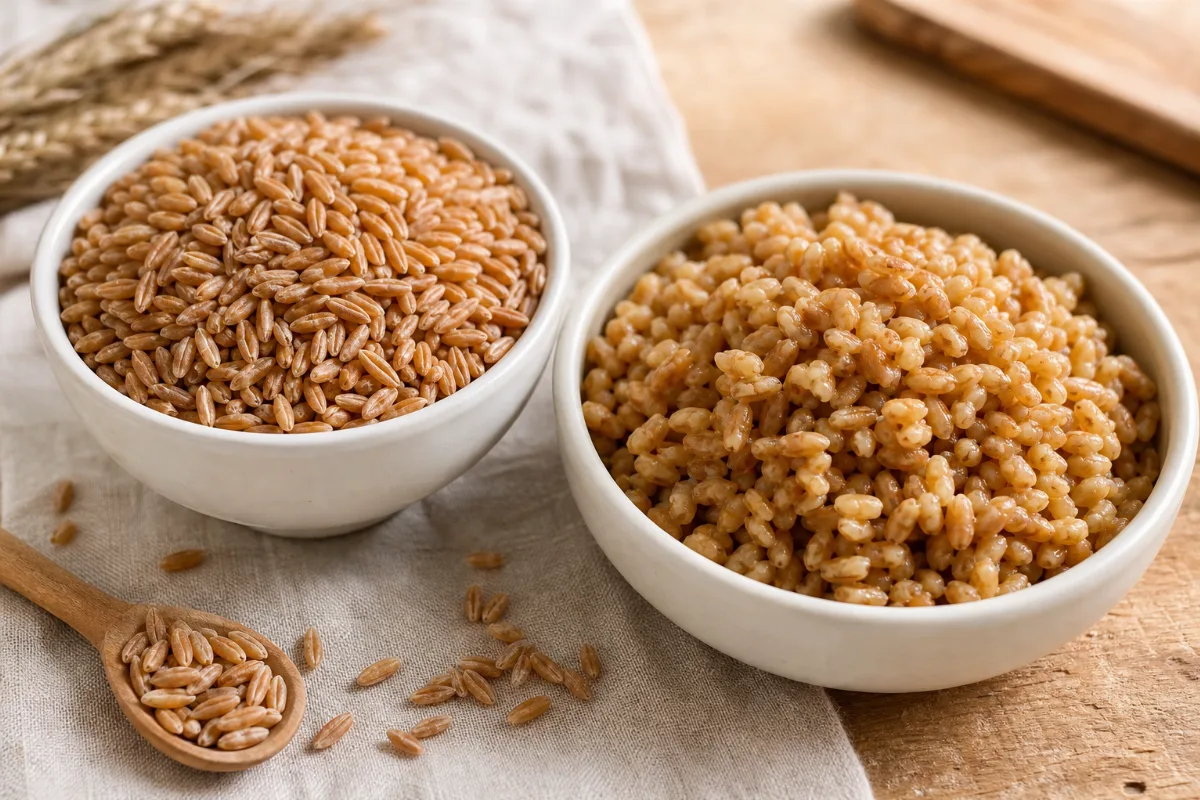
Whole Grains · Whole grain
Khorasan Wheat (Kamut)
Triticum turgidum subsp. turanicum (also written Triticum turanicum) · also called Kamut (a brand name), KAMUT khorasan, khorasan wheat, trigo khorasan (Spanish)
Khorasan wheat, often sold under the brand name Kamut, is an ancient wheat with large, amber kernels, eaten as cooked whole kernels, flour, pasta and flakes. It contains fibre, manganese and selenium. Several small trials found slightly lower cholesterol and blood sugar markers, but most were run by one research group with a grant from a Kamut company, so the evidence is weak. It contains gluten, so it is not safe for celiac disease, and wheat allergy is possible.
General information, not medical advice. Last substantive update · Not medically reviewed. A named clinician has not signed off on this page. How this page is made
About Khorasan Wheat (Kamut)
Khorasan wheat (Kamut) is an ancient wheat with large, amber kernels, eaten cooked, or as flour, pasta and bread. It has fibre, protein and minerals. It is a healthy-looking whole grain, not a proven remedy: the cholesterol and blood sugar findings come from a few small trials, most funded in part by a Kamut company. It has gluten, so it is not for celiac disease.
What it is
Khorasan wheat is an ancient wheat (Triticum turgidum subsp. turanicum; GBIF lists the older name Triticum turanicum as a synonym). A 2017 review says the KAMUT trademark marks one specific ancient variety of it. It is sold as whole kernels, flour, pasta, flakes and puffed cereal.
USDA data for cooked khorasan wheat: 132 kcal per 100 g. One cup (172 g) has about 227 kcal, 9.8 g protein, 7.4 g fibre, 1.77 mg manganese and 55 micrograms selenium. Dry kernels are denser (337 kcal and 14.5 g protein per 100 g) because they hold little water, so compare cooked with cooked.
What the research shows
The firmest facts are the nutrient values. Health findings come from a handful of small trials in which people ate khorasan bread, pasta, crackers and biscuits in place of other wheat foods. In four of them (21 to 40 people) total cholesterol was 3.7% to 6.8% lower and LDL cholesterol 3.4% to 8.1% lower; fasting blood sugar and insulin were also lower in several, and some inflammation and oxidative stress markers changed. Single trials looked at fatty liver, borderline high blood pressure, fibromyalgia and gut bacteria.
Be careful with these results. Most trials share authors, were short, measured blood markers rather than illness, and were supported in part by a grant from Kamut Enterprises of Europe, which supplied the wheat in the trials that say so. In some trials the control wheat improved symptoms or liver fat too. Reviews say there are too few human trials to say ancient wheat beats modern wheat, and ask for studies by more research groups.
Food versus flour, brands and extracts
The trials used khorasan bread, pasta, crackers and biscuits, usually from semi-whole flour, replacing other wheat foods. Whole kernels, whole-grain flour, flakes, powders and extracts were not tested, so no claim is made about them. "Kamut" is a brand; generic khorasan wheat may differ.
Portions
The NHS says starchy foods should make up just over a third of the food you eat, and to choose wholegrain varieties where you can. This page gives no amounts to eat. Ask a doctor, pharmacist or dietitian what is right for you, especially if you have celiac disease, a wheat allergy, kidney disease or take medicine for blood sugar or cholesterol.
At a glance
Traditional uses history, not proof
- Eaten as whole cooked kernels, and as flour, pasta, bread and flakes
- Long use as food is not proof that it treats any condition
Studied for research
- Cholesterol, low certainty (four small trials, markers only)
- Blood sugar and insulin, low certainty (small trials, markers only)
- Inflammation and oxidative stress markers, very-low certainty (patchy)
- Fatty liver markers, very-low certainty (one trial)
- Blood pressure and triglycerides, very-low certainty (one trial)
- Fibromyalgia symptoms, very-low certainty (one trial; control wheat also helped)
- Gut bacteria, insufficient evidence
- Better than modern wheat, insufficient evidence
Main compounds
- Dietary fibre
- Gluten proteins
- Selenium
- Manganese
- Protein (nsLTP2 is a hypothesis)
Common forms
- Cooked whole khorasan kernels as food (USDA values read)
- Semi-whole flour, pasta, bread, crackers and biscuits (used in the trials; not the same as whole-grain flour)
- Flakes and puffed cereal (not read)
- Supplements, powders and extracts are different products and are not covered
Research links: 2015 trial: heart patients, 8 weeks · 2018 review: ancient wheat and health · 2022 review: gluten in ancient wheats · Research Library · Genes & Biomarkers Library
What it is and its history
- Accepted scientific name
- Triticum turgidum subsp. turanicum
- Naming authority
- (Jakubz.) A.Love, per GBIF; the older name Triticum turanicum Jakubz. is a synonym but is still the name used in most food and nutrition sources
- Synonyms
- Name: Triticum turanicum Jakubz.; Note: Matched as a synonym by GBIF; used by USDA-related food sources and many papers.; Name: Triticum turgidum ssp. turanicum; Note: The name used in the trial papers and in the 2017 KAMUT review.
- Common names
- Khorasan wheat (English); Kamut (brand name) (English); KAMUT khorasan (English); Trigo khorasan (Spanish)
- Family or group
- Poaceae (the grass family), as given by GBIF.
- Classification
- Plantae > Tracheophyta > Liliopsida > Poales > Poaceae > Triticum > Triticum turgidum
- Native range
- Not verified from a source read.
- Habitat
- Not verified from a source read.
- What it looks like
- Roots: Not verified.; Stems: Not verified.; Leaves: Not verified.; Flowers: Not verified.; Fruit: The grain (kernel) is eaten whole after cooking, or milled into flour, pasta and flakes (existing food summary). USDA gives household portions of 1 cup cooked = 172 g and 1 cup dry = 186 g.
- Cultivation
- Trial papers state the KAMUT brand wheat they used was grown organically, in Saskatchewan, Canada (Whittaker 2015 full text). Other growing details were not read.
- Harvest and processing
- Sold as whole kernels, flour, pasta, flakes and puffed cereal (existing food summary). The trials used "semi-whole" flour products, which are not the same as whole-grain flour. Only cooked and uncooked kernel values were read from USDA.
- Look-alikes and adulterants
- Name: Durum wheat, bread wheat, emmer, einkorn and spelt; Note: Other wheats, all with gluten. A 2022 gluten review groups einkorn, emmer, spelt and khorasan as "ancient grains" but notes there is no clear definition of the term.; Name: Evoldur1 and other "ancient wheat" blends; Note: A durum blend used in a 2022 gut study; not khorasan wheat.
- Sustainability and conservation
- Not assessed.
Photographs
Traditional use and history history, not clinical proof
| Tradition or era | Documented use | Source |
|---|---|---|
| Modern crop breeding | A 2017 review says that after World War II industrial agriculture selected modern durum and common wheat for high yield and technical qualities, and that whole ancient grains are now considered nutritionally important. It says the KAMUT trademark indicates a specific ancient variety (Triticum turgidum ssp. turanicum, commonly khorasan wheat) and guarantees certain attributes. | p27790934 |
Traditional use shows how it was used. It does not show that it works or is safe today.
What is inside, and how it may work
What it contains and how those compounds act in cells and animals. Laboratory and animal mechanisms are not proven effects in people.
Main compounds
| Compound | Family | Where it is concentrated | Activity studied | Level of evidence |
|---|---|---|---|---|
| Dietary fibre | carbohydrate | Grain (more in whole and semi-whole grain than in refined flour) USDA: 4.3 g per 100 g cooked; 11.1 g per 100 g uncooked | Fibre adds stool bulk. The split between soluble and insoluble fibre was not read for khorasan wheat. 32 31 | Human data |
| Gluten proteins (gliadins and glutenins) | protein | Grain (endosperm) A 2022 review says ancient wheats, including khorasan, contain more protein and gluten than modern bread wheat; no khorasan percentage was read. | Trigger celiac disease in people at genetic risk; part of the allergy picture in wheat allergy. 4 11 14 | Human and lab |
| Selenium | mineral | Grain USDA: 31.9 micrograms per 100 g cooked (about 55 micrograms in a cup of 172 g); 81.5 micrograms per 100 g uncooked | An essential mineral; the grain content depends on soil. 32 31 | Human data |
| Manganese | mineral | Grain USDA: 1.03 mg per 100 g cooked (about 1.77 mg in a cup); 2.74 mg per 100 g uncooked | An essential mineral in food. 32 31 | Human data |
| Non-specific lipid transfer protein 2 (nsLTP2) | protein | Grain The 2018 blood pressure trial reports a higher nsLTP2 content in KAMUT khorasan than in the modern wheat it used (no figure read from the abstract). | The trial authors cite antioxidant and anti-inflammatory activity and suggest it may explain their results; they say other compounds cannot be excluded. 5 | Hypothesis |
Mechanisms, receptors and pathways
| Target or pathway | Gene or receptor | What was found | Level |
|---|---|---|---|
| Antioxidant and inflammation pathways | Not specified in the sources read | Trials measured lower reactive oxygen species and cytokines after khorasan foods, but did not test a mechanism. Lab studies of ancient wheats are mixed: some support a healthier profile and some do not (2018 review). 21 9 | Human markers; lab mixed |
| Gut bacteria and short-chain fatty acids | Not specified in the sources read | In 20 people with fibromyalgia, khorasan wheat was linked to different gut bacteria and a butyric acid change that did not reach significance (P = 0.054). Correlations with symptoms do not show cause. 1 | Human, small |
| Celiac T-cell response to gluten | HLA-linked T-cell responses to gluten peptides (general) | Gluten-specific gut T-cell lines from 13 celiac patients responded to all seven wheat types tested, including Kamut, with widely varying strength. 19 | Lab (human cells) |
Absorption, metabolism and elimination
- Absorption
- Not found for khorasan wheat.
- Distribution
- Not found.
- Metabolism
- Not found.
- Elimination
- Not found.
- Bioavailability
- Not established for khorasan nutrients in the sources read. A 2026 review found the effect of phytate on iron absorption from bread inconclusive.
Isolated compounds versus whole extracts
All the trials used khorasan foods (bread, pasta, crackers, biscuits, usually made from semi-whole flour) in place of other cereal foods. No supplement, powder or extract trial was read, and flour, pasta and whole kernels were not compared with each other.
Nutritional composition
Nutrition from USDA FoodData Central (SR Legacy, April 2018 release; record last updated 4/1/2019; values read 2026-10-26 from the FoodData Central portal data because the public API key was rate-limited). Cooked khorasan wheat, per 100 g (FDC 169744): 132 kcal, 5.71 g protein, 0.83 g fat, 27.6 g carbohydrate, 4.3 g fibre, 65.2 g water, 9 mg calcium, 1.76 mg iron, 48 mg magnesium, 147 mg phosphorus, 164 mg potassium, 8 mg sodium, 1.84 mg zinc, 0.207 mg copper, 1.03 mg manganese, 31.9 micrograms selenium, 0.095 mg thiamin, 2.3 mg niacin and 11 micrograms folate (DFE). One cup cooked (172 g), the per-100-g values multiplied by 1.72: about 227 kcal, 9.8 g protein, 7.4 g fibre, 83 mg magnesium, 253 mg phosphorus, 282 mg potassium, 3.0 mg iron, 3.2 mg zinc, 1.77 mg manganese and 55 micrograms selenium. Uncooked khorasan wheat (FDC 169743), per 100 g: 337 kcal, 14.5 g protein, 70.6 g carbohydrate, 11.1 g fibre, 81.5 micrograms selenium and 2.74 mg manganese. Dry kernels look very different from cooked ones because cooked kernels hold a lot of water, so compare like with like. Values vary with variety, growing place and cooking. Flour, pasta and bread values were not read.
1 high certainty2 low certainty5 very low certainty2 not enough evidence
What was looked at
The 10 benefits and uses checked for Khorasan Wheat (Kamut), each with how strong the evidence is. Tap one to open it.
- CholesterolLow certainty
- Blood sugar and insulinLow certainty
- Inflammation and oxidative stress markersVery low certainty
- Fibre, protein and minerals (as a food)High certainty
- Fatty liver (NAFLD) markersVery low certainty
- Blood pressure and triglyceridesVery low certainty
- Fibromyalgia symptomsVery low certainty
- Gut bacteria and short-chain fatty acidsNot enough evidence
- Body fat and fatty acids in healthy adultsVery low certainty
- Better than modern wheat?Not enough evidence
Lab markers tracked in the studies
LDL cholesterolTotal cholesterolBlood glucoseInsulinALT (alanine aminotransferase)Systolic blood pressureTriglycerides
What is Khorasan Wheat (Kamut) good for?
The studied uses and how strong the human evidence is for each. All results are from small trials of khorasan foods, mostly with Kamut brand wheat and a grant from a Kamut company, or from nutrient data.
Benefits, one by one
Each card is a research question, not a promise. Tap a goal to filter. Open a card to see the studies, doses and limits.
Cholesterol
Low certaintyIn four small trials (21 to 40 people) that swapped usual wheat foods for khorasan (Kamut) wheat foods for 8 weeks to 3 months, total cholesterol came out 3.7% to 6.8% lower, and LDL ("bad") cholesterol 3.4% to 8.1% lower in the three trials that report it. These are changes in blood markers in small groups, mostly from one research team and mostly with a grant from a Kamut company. It is not proof that the grain lowers cholesterol.
6 studiesKhorasan bread, pasta, crackers and biscuits made from semi-whole flo…
Studies, doses and limits
What the trials found
Whittaker 2015: 22 adults with acute coronary syndrome, 8 weeks of khorasan foods, total cholesterol -6.8% and LDL -8.1% from the start of that phase, nothing significant after modern wheat. Sofi 2013: 22 healthy adults, total cholesterol -8.46 mg/dl (-4%), LDL -9.82 mg/dl (-7.8%). Whittaker 2017: 21 adults with type 2 diabetes, total cholesterol -3.7%, LDL -3.4%, and the change differed significantly from modern wheat. Dinu 2018: 40 adults with fatty liver, 3 months, cholesterol -6% only in the khorasan group.
Results
All four small trials point the same way for cholesterol. Two further trials (Trozzi 2019 in healthy adults, Cicero 2018 in adults with borderline high blood pressure) did not report cholesterol in their abstracts. A 2024 review of ancient grains in diabetes included one khorasan trial but pooled only oats, brown rice and chia, so there is no pooled khorasan result.
Effect sizes as reported
Total cholesterol -3.7% to -6.8%; LDL cholesterol -3.4% to -8.1%.
Why this rating
Low: four small trials with consistent direction on a blood marker, but 21 to 40 people each, short, mostly the same research group, mostly industry-supported, no outcomes such as heart attacks, and no independent repeat or pooled analysis. The 2018 review by some of the same authors says too few human trials exist to say ancient wheat beats modern wheat.
Form and dose studied
Khorasan bread, pasta, crackers and biscuits made from semi-whole flour replacing other cereal foods (trial detail, not advice).
Who was studied
Adults with heart disease, type 2 diabetes, fatty liver, or healthy adults.
Limits
Changes are reported from the start of each phase; the control wheat was a different, modern wheat. Whole-grain khorasan and modern whole wheat were not always matched. Only abstracts were read.
Why researchers looked
Whole grains are linked to heart health, and researchers wanted to know whether this ancient wheat does better than modern wheat.
Traditional use
Khorasan wheat is eaten as whole kernels, flour, pasta, bread and flakes. Long use as a food is not proof that it treats any condition.
Proposed mechanism Hypothesis
Not established. One trial team suggests a wheat protein called nsLTP2, which is higher in KAMUT khorasan than in the modern wheat they used, may play a part (a hypothesis in a blood pressure trial, not shown for cholesterol).
A proposed mechanism does not show that the effect happens in people.
Khorasan wheat contains gluten and is not safe for celiac disease, and it can cause wheat allergy reactions; see the Safety tab.
Blood sugar and insulin
Low certaintyIn small trials of khorasan wheat foods, fasting blood sugar was 4% to 9% lower and insulin 16% to 25% lower in several groups. Again these are small studies with markers, not studies of diabetes control.
6 studiesKhorasan bread, pasta, crackers and biscuits replacing other cereal f…
Studies, doses and limits
What the trials found
Whittaker 2015 (22 adults with acute coronary syndrome): glucose -8% and insulin -24.6% from the start of the khorasan phase. Whittaker 2017 (21 adults with type 2 diabetes): glucose -9.1% and insulin -16.3%; the change in insulin and in the HOMA index differed significantly from modern wheat. Sofi 2013 (22 healthy adults): blood glucose reduced (size not given in the abstract). Trozzi 2019 (30 healthy adults, 16 weeks): insulin fell more with khorasan than with modern whole-grain durum (2.4 microunits/ml, CI 0.2 to 4.2). Cicero 2018 (63 adults with borderline high blood pressure): fasting glucose -4.3% from baseline.
Results
Direction is the same in all five trials, but blood sugar measures such as HbA1c are not reported in the abstracts, so the effect on long-term blood sugar control is unknown. The one khorasan trial in a 2024 diabetes review of ancient grains was not pooled.
Effect sizes as reported
Glucose -4.3% to -9.1% from baseline; insulin -16.3% and -24.6% from baseline.
Why this rating
Low: consistent direction in five small trials, but short, small, mostly one research group, mostly industry-supported, and measured on lab markers only.
Form and dose studied
Khorasan bread, pasta, crackers and biscuits replacing other cereal foods (trial detail, not advice).
Who was studied
Adults with heart disease, type 2 diabetes, borderline high blood pressure, or healthy adults.
Limits
No HbA1c result in the abstracts read. The "versus modern wheat" glucose figure in Cicero 2018 (-31.6%) is very large next to the change from baseline and should be treated with caution. Only abstracts were read.
Why researchers looked
Whole grains are linked to lower diabetes risk in general, so trials looked at blood sugar and insulin when people swapped to khorasan products.
Traditional use
Khorasan wheat is eaten as whole kernels, flour, pasta, bread and flakes. Long use as a food is not proof that it treats any condition.
Proposed mechanism Hypothesis
Not established. The trial authors point to fibre and other grain compounds; no mechanism was tested in these trials.
A proposed mechanism does not show that the effect happens in people.
If you take medicine for diabetes, follow your care team's plan; no source read ties khorasan wheat to a medicine interaction.
Inflammation and oxidative stress markers
Very low certaintySeveral small trials found lower levels of blood markers of inflammation and oxidative stress after khorasan foods. The markers that changed were different in each trial, so the picture is patchy.
6 studiesKhorasan bread, pasta, biscuits and crackers (trial detail, not advic…
Studies, doses and limits
What the trials found
Whittaker 2015: reactive oxygen species, lipid peroxidation of blood cells and TNF-alpha fell after khorasan, not after modern wheat. Sofi 2013: TBARS -21.5% and carbonyl -17.6%; IL-6, IL-12, TNF-alpha and VEGF lower. Whittaker 2017: reactive oxygen species, VEGF and interleukin-1ra lower, antioxidant capacity +6.3%. Dinu 2018: TNF-alpha -50%, IL-1ra -37%, IL-8 -24%, interferon gamma -24% only in the khorasan group. Spisni 2020: in 20 young male basketball players, MCP-1 -25.67% after 4 weeks; no difference in athletic performance.
Results
Markers moved in the favourable direction after khorasan in each trial, but a different set changed each time. Many markers were tested, so some may have changed by chance. None of the trials measured whether anyone became less ill.
Effect sizes as reported
Examples: TBARS -21.5%; TNF-alpha -50% (fatty liver trial); MCP-1 -25.67% (athletes).
Why this rating
Very low: surrogate markers, many tested, inconsistent across trials, small groups, and most trials had a grant from a Kamut company. A 2018 review says the human trials are too few to conclude ancient wheat beats modern wheat.
Form and dose studied
Khorasan bread, pasta, biscuits and crackers (trial detail, not advice).
Who was studied
Healthy adults, heart patients, people with type 2 diabetes or fatty liver, young male athletes.
Limits
No clinical outcomes. In the fatty liver trial improvements in liver fat and reactive oxygen species also happened with modern wheat. Only abstracts were read.
Why researchers looked
Inflammation and oxidative stress are linked to heart disease and diabetes, so trials measured these blood markers along with cholesterol.
Traditional use
Khorasan wheat is eaten as whole kernels, flour, pasta, bread and flakes. Long use as a food is not proof that it treats any condition.
Proposed mechanism Hypothesis
Not established. The authors suggest antioxidant compounds in the grain; one team measured a wheat protein called nsLTP2 and suggests it may matter.
A proposed mechanism does not show that the effect happens in people.
See the Safety tab: gluten, wheat allergy.
Fibre, protein and minerals (as a food)
High certaintyCooked khorasan wheat has 4.3 g of fibre and 5.7 g of protein per 100 g, and about 7.4 g of fibre and 9.8 g of protein in one cup (172 g), by USDA data. It also contains manganese, selenium, zinc and magnesium. These are nutrient facts, not trials of khorasan wheat.
3 studiesCooked whole khorasan wheat kernels as food.
Studies, doses and limits
What the trials found
USDA (SR Legacy) lists, for 100 g cooked: 132 kcal, 4.3 g fibre, 5.71 g protein, 1.76 mg iron, 48 mg magnesium, 147 mg phosphorus, 164 mg potassium, 1.84 mg zinc, 1.03 mg manganese and 31.9 micrograms selenium. Dry kernels are denser: 337 kcal, 11.1 g fibre and 14.5 g protein per 100 g. One of the trials (Sofi 2013) also found higher serum potassium and magnesium after 8 weeks of Kamut products.
Results
The nutrient values are measured values for the USDA sample. They vary with variety, growing place and cooking. A trial result that serum minerals rose is a lab finding in 22 people, not a sign of benefit.
Effect sizes as reported
Per 100 g cooked: fibre 4.3 g, protein 5.71 g, manganese 1.03 mg, selenium 31.9 micrograms. Per cup (172 g): fibre 7.4 g, protein 9.8 g.
Why this rating
High for the nutrient content (USDA measured data). This says nothing about health effects from eating khorasan wheat.
Form and dose studied
Cooked whole khorasan wheat kernels as food.
Who was studied
General adult diet.
Limits
One USDA sample; values for flour, pasta and bread products differ. Phytate and other grain compounds were not measured in the sources read.
Why researchers looked
People ask what a bowl of this chewy ancient wheat adds to a diet compared with other grains.
Traditional use
Khorasan wheat is eaten as whole kernels, flour, pasta, bread and flakes. Long use as a food is not proof that it treats any condition.
Proposed mechanism Authoritative guidance
Fibre adds bulk to stool; the minerals are used in many body processes. This is general nutrition, not tested for khorasan wheat.
A proposed mechanism does not show that the effect happens in people.
Contains gluten and wheat proteins; see the Safety tab. Whole grains contain phosphorus and potassium, relevant if a kidney team limits them.
Fatty liver (NAFLD) markers
Very low certaintyOne small trial of 40 people with fatty liver found liver enzymes (ALT, AST, ALP) lower after 3 months of khorasan foods but not after modern wheat foods. Liver fat on ultrasound improved with both wheats.
1 studiesKhorasan pasta, bread, crackers and biscuits (trial detail, not advic…
Studies, doses and limits
What the trials found
Dinu 2018: 40 adults with mild to moderate fatty liver were randomised to KAMUT khorasan or modern wheat products (pasta, bread, crackers, biscuits) for 3 months. ALT -12%, AST -14%, ALP -8% and cholesterol -6% only in the khorasan group. Liver steatosis grading, Doppler perfusion index and reactive oxygen species improved in both groups.
Results
Enzyme changes were seen only with khorasan; the ultrasound improvement was not specific to khorasan.
Effect sizes as reported
ALT -12%, AST -14%, ALP -8% (khorasan group).
Why this rating
Very low: one trial of 20 people per arm, enzymes only, a grant from a Kamut company, and the liver fat result was the same for both wheats.
Form and dose studied
Khorasan pasta, bread, crackers and biscuits (trial detail, not advice).
Who was studied
Adults with mild to moderate fatty liver.
Limits
Only the abstract was read. Not a treatment trial.
Why researchers looked
Fatty liver is linked to cholesterol and inflammation, which khorasan wheat trials were already tracking.
Traditional use
Khorasan wheat is eaten as whole kernels, flour, pasta, bread and flakes. Long use as a food is not proof that it treats any condition.
Proposed mechanism Unknown
Not established.
A proposed mechanism does not show that the effect happens in people.
Fatty liver needs medical follow-up; this is not a treatment.
Blood pressure and triglycerides
Very low certaintyIn one 4-week crossover trial of 63 adults with borderline high blood pressure, systolic blood pressure and triglycerides were slightly lower after khorasan foods than at baseline. The authors call the blood pressure change mild.
1 studiesOrganic KAMUT khorasan foods for 4 weeks (trial detail, not advice).
Studies, doses and limits
What the trials found
Cicero 2018: 63 healthy adults aged 40 to 70 with systolic pressure 130 to 139 and/or diastolic 85 to 90 mmHg ate KAMUT khorasan foods or modern wheat foods for 4 weeks each. Versus baseline: triglycerides -9.8%, fasting glucose -4.3%, daytime systolic pressure -3.1%, night-time systolic pressure -3.2%, pulse volume +4.2%.
Results
Small average changes. The paper reports much larger "versus modern wheat" percentages (for example systolic pressure -30.2%), which look too large to rely on.
Effect sizes as reported
Daytime systolic pressure -3.1% and night-time -3.2% from baseline; triglycerides -9.8%.
Why this rating
Very low: one short trial, borderline blood pressure only, unclear size of the comparison with modern wheat. It was funded by an EU research project, not a Kamut company.
Form and dose studied
Organic KAMUT khorasan foods for 4 weeks (trial detail, not advice).
Who was studied
Non-diabetic adults aged 40 to 70 with borderline high blood pressure.
Limits
Not a trial of people with diagnosed high blood pressure. Only the abstract was read.
Why researchers looked
Whole grains are linked to heart health; the researchers also looked for an effect on blood vessels.
Traditional use
Khorasan wheat is eaten as whole kernels, flour, pasta, bread and flakes. Long use as a food is not proof that it treats any condition.
Proposed mechanism Hypothesis
The authors suggest a wheat protein called nsLTP2, which they measured at a higher level in the KAMUT khorasan than in the modern wheat, may play a role. They say other compounds cannot be excluded and more studies are needed.
A proposed mechanism does not show that the effect happens in people.
If you take blood pressure medicine, follow your doctor's plan.
Fibromyalgia symptoms
Very low certaintyIn one crossover trial of 20 people with fibromyalgia, symptom scores improved after both khorasan and modern wheat periods, but more after khorasan.
1 studiesKhorasan pasta, bread, crackers and biscuits for 8 weeks (trial detai…
Studies, doses and limits
What the trials found
Pagliai 2020: 20 people with fibromyalgia (19 women) ate khorasan or control wheat products for 8 weeks each. Widespread Pain Index plus Symptom Severity fell 21.5% and sleep questionnaire score changed 11.7% only after khorasan; the Fibromyalgia Impact Questionnaire fell 22.5% after khorasan versus 0.3% after control (P = 0.037). The authors say scores improved in both periods, and improvement was greater in those with higher symptom severity.
Results
Self-reported scores improved more with khorasan in 20 people, though both diets helped.
Effect sizes as reported
FIQ -22.5% vs -0.3%; WPI + SS -21.5% (khorasan only).
Why this rating
Very low: one trial of 20 people, subjective questionnaires, improvement also with the control wheat (a placebo or study effect is possible), and a grant from a Kamut company.
Form and dose studied
Khorasan pasta, bread, crackers and biscuits for 8 weeks (trial detail, not advice).
Who was studied
Adults with fibromyalgia, nearly all women.
Limits
Only the abstract was read. Not a treatment recommendation.
Why researchers looked
Some people with fibromyalgia report diet changes help, so a team tested a khorasan replacement diet.
Traditional use
Khorasan wheat is eaten as whole kernels, flour, pasta, bread and flakes. Long use as a food is not proof that it treats any condition.
Proposed mechanism Unknown
Not established. The same team measured gut bacteria in these patients (see gut bacteria).
A proposed mechanism does not show that the effect happens in people.
Fibromyalgia needs medical care; this is not a treatment.
Gut bacteria and short-chain fatty acids
Not enough evidenceOne small trial in people with fibromyalgia saw more favourable gut bacteria and fecal markers after khorasan wheat than after modern wheat. The key butyrate change did not reach significance (P = 0.054). What this means for health is unclear.
2 studiesOrganic KAMUT khorasan wheat products for 8 weeks (trial detail, not …
Studies, doses and limits
What the trials found
Baldi 2022: 20 people with fibromyalgia, 8 weeks of khorasan or modern wheat products each, with stool analysis. Khorasan was linked to higher candidatus Saccharibacteria (P = 9.95e-06) and Actinobacteria and lower Enterococcaceae (P = 4.97e-04); butyric acid increased with P = 0.054. Some bacteria levels correlated with symptom scores.
Results
Favourable shifts in some bacteria groups, correlation with symptoms, but no proof of a health benefit. A separate 2022 trial in 20 healthy adults tested "ancient wheat pasta" and found genus-level changes with both ancient and modern wheat; that wheat was a durum blend, not khorasan, so it is not counted here.
Effect sizes as reported
Bacteria group changes with P-values as above; butyric acid P = 0.054.
Why this rating
Insufficient: one small trial, many bacteria groups tested, the main fatty acid result not significant, correlations only, and a grant from a Kamut company.
Form and dose studied
Organic KAMUT khorasan wheat products for 8 weeks (trial detail, not advice).
Who was studied
Adults with fibromyalgia.
Limits
Only the abstract was read. Effects in healthy people on khorasan were not found in the sources read.
Why researchers looked
Gut bacteria respond to diet, and the same team had seen symptom changes in fibromyalgia on khorasan wheat.
Traditional use
Khorasan wheat is eaten as whole kernels, flour, pasta, bread and flakes. Long use as a food is not proof that it treats any condition.
Proposed mechanism Preclinical or hypothesis
Short-chain fatty acids such as butyrate are made by gut bacteria from fibre and are thought to be anti-inflammatory; this was a lab measure in the trial, not shown to cause symptom change.
A proposed mechanism does not show that the effect happens in people.
None specific beyond gluten and wheat allergy.
Body fat and fatty acids in healthy adults
Very low certaintyOne 16-week trial in 30 healthy adults found a greater fall in body fat mass and insulin and a rise in DHA with khorasan products than with modern whole-grain durum. The effects were small and the trial was not blinded.
1 studiesWhole-grain KAMUT khorasan products as the only cereal foods for 16 w…
Studies, doses and limits
What the trials found
Trozzi 2019: 30 healthy volunteers were assigned to whole-grain KAMUT khorasan products or whole-grain modern durum products as their only cereal foods for 16 weeks. The khorasan group had a greater decrease in fat mass (b = 3.7%; CI 1.6 to 5.5; p = 0.042) and insulin and a significant increase in DHA (p = 0.021).
Results
A small difference in the khorasan group on a few of the outcomes tested.
Effect sizes as reported
Fat mass b = 3.7% (CI 1.6 to 5.5); insulin b = 2.4 microunits/ml (CI 0.2 to 4.2).
Why this rating
Very low: one small, non-blinded trial with several outcomes tested, and a grant from a Kamut company.
Form and dose studied
Whole-grain KAMUT khorasan products as the only cereal foods for 16 weeks (trial detail, not advice).
Who was studied
Healthy adult volunteers.
Limits
Only the abstract was read; body weight loss is not reported there.
Why researchers looked
Researchers looked at body fat and blood fats as markers linked to type 2 diabetes risk.
Traditional use
Khorasan wheat is eaten as whole kernels, flour, pasta, bread and flakes. Long use as a food is not proof that it treats any condition.
Proposed mechanism Unknown
Not established.
A proposed mechanism does not show that the effect happens in people.
None specific beyond gluten and wheat allergy.
Better than modern wheat?
Not enough evidenceReviews say the human trials are too few and too closely linked to one product and research group to say ancient wheats are better than modern wheat. Ancient wheats also have more gluten protein, not less.
4 studiesNot applicable.
Studies, doses and limits
What the trials found
Dinu 2018 (review): human trials showed convincing effects on lipid, blood sugar, inflammation and oxidative markers, but with few human trials it is not possible to say ancient wheats are better than all modern ones at reducing chronic disease risk. Shewry 2018 (review): studies mostly look at Kamut; mechanisms unclear; composition varies by genotype and growing conditions; more studies are needed, especially from a wider range of research groups. Bordoni 2017 (review of KAMUT khorasan): supports benefits but cannot say whether other ancient grains share them. Brouns 2022 (review): ancient wheats contain more protein and gluten and more coeliac-active parts than bread wheat.
Results
No review concluded that khorasan wheat is proven better than modern wheat. All the trials compared it only with other wheat products, not with other whole grains such as oats or brown rice.
Why this rating
Insufficient: a handful of small trials, mostly industry-supported, with reviewers calling for independent research.
Who was studied
General.
Limits
Only abstracts were read. Two of the reviews are by authors who also ran trials.
Why researchers looked
Marketing often presents ancient grains as healthier than modern wheat, so reviewers checked whether trials back this up.
Traditional use
Khorasan wheat is eaten as whole kernels, flour, pasta, bread and flakes. Long use as a food is not proof that it treats any condition.
Proposed mechanism Narrative review
Not established. Composition varies widely between wheat varieties and growing conditions.
A proposed mechanism does not show that the effect happens in people.
Ancient wheats are not gluten-free or lower in gluten.
Connections to the rest of health
How Khorasan Wheat (Kamut) connects to the rest of our health knowledge graph. Every link says what kind of connection it is. A safety link (for example to the liver) is a warning, not a benefit. A study that merely mentions a topic never creates a benefit link.
Explore every connection: goals, body systems, organs, symptoms, genes
A. Wellness goals
| Connected to | Kind of connection | Evidence status | Context | Studies |
|---|---|---|---|---|
| Cholesterol Balance | Low certainty | Cholesterol: In four small trials (21 to 40 people) that swapped usual wheat foods for khorasan (Kamut) wheat foods for 8 weeks to 3 months, total cholesterol came out 3.7% to 6.8% lower, and LDL ("bad") cholesterol 3.4% to 8.1% lower in the three trials that report it. These are changes in blood markers in small groups, mostly from one research team and mostly with a grant from a Kamut company. It is not proof that the grain lowers cholesterol. | 21 17 22 8 10 9 | |
| Heart Health | Low certainty | Cholesterol: In four small trials (21 to 40 people) that swapped usual wheat foods for khorasan (Kamut) wheat foods for 8 weeks to 3 months, total cholesterol came out 3.7% to 6.8% lower, and LDL ("bad") cholesterol 3.4% to 8.1% lower in the three trials that report it. These are changes in blood markers in small groups, mostly from one research team and mostly with a grant from a Kamut company. It is not proof that the grain lowers cholesterol. | 21 17 22 8 10 9 | |
| Blood Sugar Balance | Low certainty | Blood sugar and insulin: In small trials of khorasan wheat foods, fasting blood sugar was 4% to 9% lower and insulin 16% to 25% lower in several groups. Again these are small studies with markers, not studies of diabetes control. | 21 22 17 20 5 10 | |
| Metabolic Health | Low certainty | Blood sugar and insulin: In small trials of khorasan wheat foods, fasting blood sugar was 4% to 9% lower and insulin 16% to 25% lower in several groups. Again these are small studies with markers, not studies of diabetes control. | 21 22 17 20 5 10 | |
| Inflammation Balance | Very low certainty | Inflammation and oxidative stress markers: Several small trials found lower levels of blood markers of inflammation and oxidative stress after khorasan foods. The markers that changed were different in each trial, so the picture is patchy. | 21 17 22 8 18 9 | |
| Cellular Protection | Very low certainty | Inflammation and oxidative stress markers: Several small trials found lower levels of blood markers of inflammation and oxidative stress after khorasan foods. The markers that changed were different in each trial, so the picture is patchy. | 21 17 22 8 18 9 | |
| Balanced Nutrition | High certainty | Fibre, protein and minerals (as a food): Cooked khorasan wheat has 4.3 g of fibre and 5.7 g of protein per 100 g, and about 7.4 g of fibre and 9.8 g of protein in one cup (172 g), by USDA data. It also contains manganese, selenium, zinc and magnesium. These are nutrient facts, not trials of khorasan wheat. | 32 31 17 | |
| Digestive Support | High certainty | Fibre, protein and minerals (as a food): Cooked khorasan wheat has 4.3 g of fibre and 5.7 g of protein per 100 g, and about 7.4 g of fibre and 9.8 g of protein in one cup (172 g), by USDA data. It also contains manganese, selenium, zinc and magnesium. These are nutrient facts, not trials of khorasan wheat. | 32 31 17 | |
| Liver Support | Very low certainty | Fatty liver (NAFLD) markers: One small trial of 40 people with fatty liver found liver enzymes (ALT, AST, ALP) lower after 3 months of khorasan foods but not after modern wheat foods. Liver fat on ultrasound improved with both wheats. | 8 | |
| Metabolic Health | Very low certainty | Fatty liver (NAFLD) markers: One small trial of 40 people with fatty liver found liver enzymes (ALT, AST, ALP) lower after 3 months of khorasan foods but not after modern wheat foods. Liver fat on ultrasound improved with both wheats. Body fat and fatty acids in healthy adults: One 16-week trial in 30 healthy adults found a greater fall in body fat mass and insulin and a rise in DHA with khorasan products than with modern whole-grain durum. The effects were small and the trial was not blinded. | 8 20 | |
| Blood Pressure Support | Very low certainty | Blood pressure and triglycerides: In one 4-week crossover trial of 63 adults with borderline high blood pressure, systolic blood pressure and triglycerides were slightly lower after khorasan foods than at baseline. The authors call the blood pressure change mild. | 5 | |
| Heart Health | Very low certainty | Blood pressure and triglycerides: In one 4-week crossover trial of 63 adults with borderline high blood pressure, systolic blood pressure and triglycerides were slightly lower after khorasan foods than at baseline. The authors call the blood pressure change mild. | 5 | |
| Pain Relief | Very low certainty | Fibromyalgia symptoms: In one crossover trial of 20 people with fibromyalgia, symptom scores improved after both khorasan and modern wheat periods, but more after khorasan. | 13 | |
| Better Sleep | Very low certainty | Fibromyalgia symptoms: In one crossover trial of 20 people with fibromyalgia, symptom scores improved after both khorasan and modern wheat periods, but more after khorasan. | 13 | |
| Gut Health | Not enough evidence | Gut bacteria and short-chain fatty acids: One small trial in people with fibromyalgia saw more favourable gut bacteria and fecal markers after khorasan wheat than after modern wheat. The key butyrate change did not reach significance (P = 0.054). What this means for health is unclear. | 1 2 | |
| Digestive Support | Not enough evidence | Gut bacteria and short-chain fatty acids: One small trial in people with fibromyalgia saw more favourable gut bacteria and fecal markers after khorasan wheat than after modern wheat. The key butyrate change did not reach significance (P = 0.054). What this means for health is unclear. | 1 2 | |
| Weight Management | Very low certainty | Body fat and fatty acids in healthy adults: One 16-week trial in 30 healthy adults found a greater fall in body fat mass and insulin and a rise in DHA with khorasan products than with modern whole-grain durum. The effects were small and the trial was not blinded. | 20 | |
| Preventive Wellness | Not enough evidence | Better than modern wheat?: Reviews say the human trials are too few and too closely linked to one product and research group to say ancient wheats are better than modern wheat. Ancient wheats also have more gluten protein, not less. | 9 16 3 4 |
B. Body systems
| Connected to | Kind of connection | Evidence status | Context | Studies |
|---|---|---|---|---|
| Cardiovascular System | Biological association | Low certainty | Studied for: Cholesterol Studied for: Blood pressure and triglycerides | 21 17 22 8 10 9 5 |
| Endocrine System | Biological association | Low certainty | Studied for: Blood sugar and insulin | 21 22 17 20 5 10 |
| Metabolism Weight | Biological association | Low certainty | Studied for: Blood sugar and insulin Studied for: Fibre, protein and minerals (as a food) | 21 22 17 20 5 10 32 31 |
| Immune System | Biological association | Very low certainty | Studied for: Inflammation and oxidative stress markers Studied for: Gut bacteria and short-chain fatty acids | 21 17 22 8 18 9 1 2 |
| Digestive System | Biological association | High certainty | Studied for: Fibre, protein and minerals (as a food) Studied for: Gut bacteria and short-chain fatty acids | 32 31 17 1 2 |
| Hepatic System | Biological association | Very low certainty | Studied for: Fatty liver (NAFLD) markers | 8 |
| Pain Inflammation | Biological association | Very low certainty | Studied for: Fibromyalgia symptoms | 13 |
| Nervous System | Biological association | Very low certainty | Studied for: Fibromyalgia symptoms | 13 |
| Whole Body | Biological association | Not enough evidence | Studied for: Better than modern wheat? | 9 16 3 4 |
E. Health conditions
| Connected to | Kind of connection | Evidence status | Context | Studies |
|---|---|---|---|---|
| Celiac disease | Contraindication | Documented risk | Khorasan wheat contains gluten; lab studies found celiac-active parts and T-cell responses, and reviewers advise against it for celiac disease. Khorasan wheat contains gluten; lab studies found celiac-active parts and immune responses, and reviewers advise against it for celiac disease. Preparation or compound: Gluten in khorasan wheat |
30 4 19 6 |
| Wheat allergy | Adverse effect or risk | Documented risk | Wheat is a major food allergen; IgE-binding parts remain in Kamut pasta in a 2026 lab test. Preparation or compound: Wheat proteins in khorasan wheat |
25 23 14 |
| Food poisoning | Adverse effect or risk | Documented risk | Toxins from bacteria that survive cooking are not destroyed by reheating. Cooked grains left at room temperature can grow bacteria whose toxins survive reheating. Preparation or compound: Cooked khorasan kernels left at room temperature |
28 |
I. Biomarkers
| Connected to | Kind of connection | Evidence status | Context | Studies |
|---|---|---|---|---|
| LDL cholesterol | Biological association | Low certainty | Measured in trials: lowered. A lab change is not the same as a health benefit. | 21 17 22 |
| Total cholesterol | Biological association | Low certainty | Measured in trials: lowered. A lab change is not the same as a health benefit. | 21 17 22 8 |
| Blood glucose | Biological association | Low certainty | Measured in trials: lowered. A lab change is not the same as a health benefit. | 21 22 5 |
| Insulin | Biological association | Low certainty | Measured in trials: lowered. A lab change is not the same as a health benefit. | 21 22 20 |
| ALT (alanine aminotransferase) | Biological association | Very low certainty | Measured in trials: lowered. A lab change is not the same as a health benefit. | 8 |
| Systolic blood pressure | Biological association | Very low certainty | Measured in trials: lowered. A lab change is not the same as a health benefit. | 5 |
| Triglycerides | Biological association | Very low certainty | Measured in trials: lowered. A lab change is not the same as a health benefit. | 5 |
K. Biological pathways
| Connected to | Kind of connection | Evidence status | Context | Studies |
|---|---|---|---|---|
| Fibre | Preliminary mechanism | Human | Khorasan wheat contains fibre; cooked kernels have 4.3 g per 100 g by USDA. | 32 |
| Selenium | Preliminary mechanism | Human | Cooked kernels contain 31.9 micrograms per 100 g by USDA. | 32 |
| Gluten | Preliminary mechanism | Human | Wheat gluten triggers celiac disease; ancient wheats contain at least as much gluten as bread wheat. | 4 |
L. Active compounds
| Connected to | Kind of connection | Evidence status | Context | Studies |
|---|---|---|---|---|
| Dietary fibre | Biological association | Human | Fibre adds stool bulk. The split between soluble and insoluble fibre was not read for khorasan wheat. Preparation or compound: Grain (more in whole and semi-whole grain than in refined flour) |
32 31 |
| Gluten proteins (gliadins and glutenins) | Biological association | Human and lab | Trigger celiac disease in people at genetic risk; part of the allergy picture in wheat allergy. Preparation or compound: Grain (endosperm) |
4 11 14 |
| Selenium | Biological association | Human | An essential mineral; the grain content depends on soil. Preparation or compound: Grain |
32 31 |
| Manganese | Biological association | Human | An essential mineral in food. Preparation or compound: Grain |
32 31 |
| Non-specific lipid transfer protein 2 (nsLTP2) | Biological association | Hypothesis | The trial authors cite antioxidant and anti-inflammatory activity and suggest it may explain their results; they say other compounds cannot be excluded. Preparation or compound: Grain |
5 |
Each connection is stored with the ingredient, the connected record, the kind of connection, the evidence status, the supporting studies, the preparation or compound involved, and a review date (last reviewed October 26, 2026).
Evidence at a glance: what changed in 7 lab markers
Tap a number to show only those markers. Counts are markers, not people.
The evidence
The research centre for Khorasan Wheat (Kamut). Every record here was checked against PubMed or the publisher's page; we never list a study we have not verified.
Evidence by outcome
Bars show how many studies we found for each outcome, not how well it works. People are added up across trials only (reviews are not added, to avoid double counting).
How we rate evidence
High certainty
Several well-run trials or reviews agree; further research is unlikely to change the picture much.
Moderate certainty
Good trials point the same way, but some doubt remains.
Low certainty
Small, short or inconsistent trials. The finding could change with better research.
Very low certainty
Very little or very weak human data. Treat as a possibility only.
Mixed findings
Trials or reviews disagree with each other.
Not enough evidence
Not enough human research to say either way.
Evidence against
Good research found no benefit, or found harm.
We take the reviewers' own risk-of-bias and GRADE statements where they exist, and otherwise judge from study size, design, consistency, directness and whether a product matches what is sold. Many publications do not make evidence high. Method note: We started from our existing khorasan wheat summary, re-checked nutrition against USDA FoodData Central data, read the NIDDK, MedlinePlus, FDA, WHO and NHS pages and re-read PubMed abstracts for the trials, reviews and lab studies. Funding was checked in the full text or Europe PMC where open. Only abstracts were read for studies. Items we could not verify are flagged in the research gaps.
Study library: every study we checked 33
| Study | Design | People | Product, dose, length | Result |
|---|---|---|---|---|
| Baldi 2022 Effect of ancient Khorasan wheat on gut microbiota, inflammation, and short-chain fatty acid production in patients with fibromyalgia. World J Gastroenterol · PMID 35664958 · DOI |
Controlled trial |
20 20 people with fibromyalgia |
Organic KAMUT khorasan wheat products versus organic modern wheat ("palesio") products Khorasan wheat grain as food Not given in the abstract 8 weeks per phase, 8-week washout · vs Organic modern wheat products |
The khorasan diet had more favourable effects on gut bacteria and fecal markers than the control wheat. The butyric acid rise did not reach significance (P = 0.054). Some bacteria levels correlated with symptom scores. Butyric acid P = 0.054; candidatus Saccharibacteria P = 9.95e-06; Enterococcaceae lower, P = 4.97e-04; correlations with symptom scales (Not given in the abstract) Methods, limits and fundingOutcomes: Gut bacteria (16S sequencing), fecal immune markers, short-chain fatty acids, symptom scores Limitations: 20 people. Correlations with symptoms do not show cause. Many bacteria groups were tested. Funding and conflicts: The abstract says there are no competing interests, but the full text says the work was supported by a grant from Kamut Enterprises of Europe, which supplied the wheat. INDUSTRY-SUPPORTED. Read: abstract |
| Baldi 2022 Effect of ancient wheat pasta on gut microbiota composition and bacteria-derived metabolites: A randomized controlled trial. Front Nutr · PMID 35990344 · DOI |
Controlled trial |
20 20 healthy adults (mean age 43.1) |
Pasta from an organic "ancient" durum wheat mixture (Evoldur1, a cross of Sicilian durum varieties and two turanic wheat varieties) versus modern wheat pasta Ancient wheat mixture, NOT khorasan wheat Not given in the abstract 8 weeks per phase, 8-week washout · vs Modern wheat pasta |
Both diets changed gut bacteria only at genus level, in different ways. The ancient wheat pasta raised some fecal fatty acids. Genus-level changes (adjusted p < 0.05); fecal acetic acid +0.7%, isobutyric +30.1% with ancient wheat pasta (Not given in the abstract) Methods, limits and fundingOutcomes: Gut bacteria genera and short-chain fatty acids Limitations: The "ancient wheat" was a blend of durum wheats, not khorasan wheat (the full text names Evoldur1), so it is not khorasan evidence. Listed to avoid mixing it up with the khorasan trials. Funding and conflicts: The authors report no commercial or financial relationships. The full text says the study was funded by a Tuscany regional programme. Read: abstract |
| Bordoni 2017 Ancient wheat and health: a legend or the reality? A review on KAMUT khorasan wheat. Int J Food Sci Nutr · PMID 27790934 · DOI |
Narrative review n/a |
Review of studies on KAMUT khorasan wheat | KAMUT khorasan wheat Khorasan wheat grain as food |
The authors say the KAMUT trademark marks a specific ancient variety (Triticum turgidum ssp. turanicum), which makes studies comparable. They review the studies and say the evidence supports consumption of ancient grains, but add that it is not possible to say whether all ancient grains share these characteristics. Not applicable (Not applicable) Methods, limits and fundingOutcomes: Health-related findings on KAMUT khorasan wheat Limitations: The abstract gives no numbers and does not state how studies were picked, so it is a narrative summary, not a graded review. Its funding is not stated in the abstract. Funding and conflicts: Funding is not stated in the abstract. Read: abstract |
| Brouns 2022 Do ancient wheats contain less gluten than modern bread wheat, in favour of better health? Nutr Bull · PMID 35915783 · DOI |
Narrative review n/a |
Critical narrative review of ancient and modern wheat, gluten, coeliac disease and gluten sensitivity | Ancient wheats (einkorn, emmer, spelt, Khorasan wheat) versus modern bread wheat Wheat grain as food |
Gluten is present in all wheat grains and all can induce coeliac disease in people at genetic risk. Compared with bread wheat, ancient wheats contain more protein and gluten and more coeliac-active epitopes, so no single wheat type can be recommended as better for coeliac disease. Many people who think they are gluten sensitive are not confirmed on testing; fructan fermentation or non-gluten proteins may be the cause. Not applicable (Not applicable) Methods, limits and fundingOutcomes: Gluten content, coeliac disease risk, gluten sensitivity Limitations: A narrative review (abstract read, not the full text). Funding and conflicts: The authors report no conflicts of interest relevant to the content. Read: abstract |
| Cicero 2018 Short-Term Hemodynamic Effects of Modern Wheat Products Substitution in Diet with Ancient Wheat Products: A Cross-Over, Randomized Clinical Trial. Nutrients · PMID 30400372 · DOI |
Controlled trial |
63 63 non-diabetic adults aged 40 to 70 with borderline high blood pressure |
Organic KAMUT khorasan wheat foods versus organic modern wheat foods (a mix of durum and soft wheat) Khorasan wheat grain as food Not given in the abstract 4 weeks per phase · vs Organic modern wheat foods |
After khorasan foods triglycerides, fasting glucose and day and night systolic blood pressure were lower than at baseline and lower than after modern wheat. The authors call the blood pressure improvement mild. Versus baseline: triglycerides -9.8%, fasting glucose -4.3%, daytime systolic BP -3.1%, night-time systolic BP -3.2%. Versus modern wheat: triglycerides -14.5%, glucose -31.6%, daytime systolic BP -30.2%, night-time -36.8% (Not given in the abstract) Methods, limits and fundingOutcomes: Blood pressure, triglycerides, glucose, pulse volume Limitations: Short trial. The very large "versus modern wheat" percentages compare changes between phases and look much bigger than the change from baseline, so treat them with caution. Borderline-high blood pressure adults only. Funding and conflicts: The authors report no conflict of interest. The full text says the trial was supported by the EU 7th Framework Programme project BACCHUS. The khorasan wheat was KAMUT brand. Read: abstract |
| Colomba 2012 Are ancient durum wheats less toxic to celiac patients? A study of alpha-gliadin from Graziella Ra and Kamut. ScientificWorldJournal · PMID 22629212 · DOI |
Laboratory research in vitro |
Lab study of alpha-gliadin proteins from two ancient durum wheats (Graziella Ra and Kamut) and four modern durum wheats | Wheat gliadin protein, tested with antibodies Wheat grain protein in the lab · vs Modern durum accessions |
The lab results could not confirm that ancient durum wheats are less toxic for people with coeliac disease. The authors strongly advise celiac patients against consuming ancient wheats including Graziella Ra or Kamut. Antibodies still bound the coeliac-toxic peptides in all accessions (Not applicable) Methods, limits and fundingOutcomes: Whether coeliac-toxic gliadin parts are changed in ancient durum Limitations: Lab protein study, not people eating the wheat. Funding and conflicts: Funding is not stated in the abstract. Read: abstract |
| Colombo 2021 Ancient and Modern Cereals as Ingredients of the Gluten-Free Diet: Are They Safe Enough for Celiac Consumers? Foods · PMID 33924221 · DOI |
Narrative review n/a |
Review of lab and human studies on oats and ancient grains for people with celiac disease | Oats and ancient grains (einkorn, spelt, Kamut) Grains as food |
Some ancient wheats (einkorn, spelt and Kamut) showed reduced toxicity in lab tests, but to date these grains are still considered toxic for celiac patients. Not applicable (Not applicable) Methods, limits and fundingOutcomes: Toxicity for people with celiac disease Limitations: A narrative review. Funding and conflicts: The authors declare no conflict of interest. Read: abstract |
| Dinu 2018 A Khorasan Wheat-Based Replacement Diet Improves Risk Profile of Patients With Nonalcoholic Fatty Liver Disease (NAFLD): A Randomized Clinical Trial. J Am Coll Nutr · PMID 29652567 · DOI |
Controlled trial |
40 40 adults with mild to moderate fatty liver (12 men, 28 women, mean age 55.2) |
KAMUT khorasan pasta, bread, crackers and biscuits versus modern wheat products Khorasan wheat grain as food Not given in the abstract 3 months · vs Organic semi-whole-grain modern wheat products |
ALT, AST, ALP, cholesterol and several inflammatory markers fell only in the khorasan group. Liver fat grading, blood flow measures and reactive oxygen species improved in both groups. Khorasan group: ALT -12%, AST -14%, ALP -8%, cholesterol -6%, TNF-alpha -50%, IL-1ra -37%, IL-8 -24%, interferon gamma -24% (Not given in the abstract) Methods, limits and fundingOutcomes: Liver enzymes, cholesterol, inflammation markers, liver ultrasound Limitations: Small parallel trial (20 people per arm). The liver fat improvement was seen with both wheats, so it cannot be credited to khorasan. Markers, not liver outcomes. Funding and conflicts: Europe PMC lists a grant from Kamut Enterprises of Europe for this work; the abstract does not say so. INDUSTRY-SUPPORTED. Read: abstract |
| Dinu 2018 Ancient wheat species and human health: Biochemical and clinical implications. J Nutr Biochem · PMID 29065353 · DOI |
Narrative review n/a |
Review of lab, animal and human studies of emmer, einkorn, spelt, khorasan and Italian regional wheats | Ancient wheat varieties Wheat grain as food |
Lab studies are mixed. Human trials showed convincing beneficial effects on lipid and blood sugar profiles and on inflammatory and oxidative status, but because there are few human trials the authors say it is not possible to conclude that ancient wheats are better than all modern wheats at reducing chronic disease risk. Not applicable (Not applicable) Methods, limits and fundingOutcomes: Nutritional value and effects on cardio-metabolic markers Limitations: A narrative review by authors who also ran several of the khorasan trials. Funding is not stated in the abstract. Funding and conflicts: Funding is not stated in the abstract. Several authors also ran the khorasan trials above. Read: abstract |
| Magi 2024 Use of ancient grains for the management of diabetes mellitus: A systematic review and meta-analysis. Nutr Metab Cardiovasc Dis · PMID 38553358 · DOI |
Systematic review meta analysis |
29 randomised trials of ancient grains in people with diabetes (13 meta-analysed) | Ancient grains: oats, brown rice, buckwheat, chia, Job's tears, barley, khorasan wheat and millet Grains as food 1 day to 24 weeks · vs Control diets |
Only one included trial used khorasan wheat, and the pooled analyses covered oats, brown rice and chia, not khorasan. Oats lowered LDL cholesterol and total cholesterol; pooled chia and millet analyses did not show significant effects. Oats (4 studies, 717 people): LDL cholesterol about 0.30 mmol/L lower, total cholesterol about 0.44 mmol/L lower (LDL 95% CI as printed in the abstract: 0.42 to -0.17) Methods, limits and fundingOutcomes: Blood fats and blood sugar outcomes Limitations: Khorasan was not pooled, so this review gives no khorasan result. Included to show how little pooled evidence exists. Funding and conflicts: The authors report no conflict of interest. Registration: PROSPERO CRD42023422386 Read: abstract |
| Malalgoda 2019 Celiac Antigenicity of Ancient Wheat Species. Foods · PMID 31842464 · DOI |
Laboratory research n/a |
Lab analysis of ancient grains by mass spectrometry and HPLC | Einkorn, emmer and Kamut grain proteins Wheat grain protein in the lab |
Celiac epitopes were detected in einkorn, emmer and Kamut, so these grains have the potential to trigger the immune response linked to celiac disease. Epitopes detected in all three grains (Not applicable) Methods, limits and fundingOutcomes: Presence of coeliac-triggering protein pieces (epitopes) Limitations: Lab analysis only, not people. Funding and conflicts: The authors declare no conflict of interest. Read: abstract |
| Nikolaou 2026 Effects of sourdough- or regular-bread fermentation, and phytate reduction on iron bioavailability, absorption, and iron status in humans: a systematic review of intervention studies. Front Nutr · PMID 42163962 · DOI |
Systematic review |
8 human intervention studies of bread, sourdough and phytate | Bread made with regular or sourdough fermentation or reduced phytate Bread (not khorasan specifically) |
Results were inconclusive. Short meal studies found more iron absorbed from low-phytate bread (for example low-phytate white bread gave a greater 2-hour rise in serum iron than high-phytate wholemeal bread), but long-term trials did not improve iron stores, and in one case ferritin fell. Low-phytate white bread vs high-phytate wholemeal bread: 2-hour serum iron rise 59 vs 30 micrograms Fe/100 mL (Not applicable) Methods, limits and fundingOutcomes: Iron bioavailability, absorption and status Limitations: Not about khorasan wheat; it is about bread and phytate in general. No human study with proper controls answered the main question. Funding and conflicts: The authors declare no commercial or financial relationships. Read: abstract |
| Pagliai 2020 Effectiveness of a Khorasan Wheat-Based Replacement on Pain Symptoms and Quality of Life in Patients with Fibromyalgia. Pain Med · PMID 32488245 · DOI |
Controlled trial |
20 20 people with fibromyalgia (19 women, 1 man, mean age 48.9) |
Khorasan wheat pasta, bread, crackers and biscuits versus organic semi-whole-grain modern wheat products Khorasan wheat grain as food Not given in the abstract 8 weeks per phase, then crossed · vs Organic semi-whole-grain modern wheat products |
Questionnaire scores improved after both the khorasan and the control periods, but more after khorasan. Pain index plus severity fell 21.5% and the sleep questionnaire score changed 11.7% only after khorasan; the Fibromyalgia Impact Questionnaire fell 22.5% versus 0.3%. WPI + SS -21.5%; FOSQ -11.7% (khorasan only); FIQ -22.5% vs -0.3% (P = 0.037) (Not given in the abstract) Methods, limits and fundingOutcomes: Widespread Pain Index, symptom severity, sleep and quality-of-life questionnaires Limitations: Twenty people, almost all women, self-reported questionnaires. Both diets improved scores, which suggests a placebo or study effect. Not a treatment trial. Funding and conflicts: Europe PMC lists a grant from Kamut Enterprises of Europe for this work; the abstract does not say so. INDUSTRY-SUPPORTED. Read: abstract |
| Piasecka-Kwiatkowska 2026 Protein Quality and IgE-Binding in Ancient and Modern Wheat: An Analytical Study. Foods · PMID 42587865 · DOI |
Laboratory research in vitro (human serum) |
8 Lab test of flours and pasta from eight wheat materials, using blood serum from allergic individuals |
Flour and pasta from einkorn, emmer, Kamut, spelt, common wheat, durum and others Wheat flour and pasta in the lab · vs Common and durum wheat |
Spelt and Kamut had the highest protein contents. Processing into pasta lowered gliadin detectability but IgE-reactive components remained. Kamut pasta repeatedly showed one of the strongest IgE-binding responses across sera. The authors say the favourable protein features should not be read as lower IgE binding. Kamut pasta: among the strongest IgE binding across different sera (no numbers in the abstract) (Not applicable) Methods, limits and fundingOutcomes: Protein, amino acids, gliadin and IgE (allergy antibody) binding Limitations: Lab test with a small number of sera. It does not show how often people react when they eat the food. Funding and conflicts: The authors declare no commercial or financial relationships; one author works at an allergy clinic that supplied anonymised sera but did not fund the study. Read: abstract |
| Santhosh 2026 Unusual Causes of Food-Induced Anaphylaxis - A Review. Indian Dermatol Online J · PMID 42377205 · DOI |
Narrative review n/a |
Review of three unusual causes of food anaphylaxis, including wheat-dependent exercise-induced anaphylaxis | Wheat (omega-5 gliadin) eaten with exercise or other cofactors Wheat as food |
WDEIA develops when wheat is eaten along with exercise and other cofactors such as seafood, alcohol or anti-inflammatory pain medicines (NSAIDs). The major allergen is omega-5 gliadin, a protein in the gluten fraction of wheat. Symptoms range from hives or swelling to severe anaphylaxis. Not applicable (Not applicable) Methods, limits and fundingOutcomes: Description of wheat-dependent exercise-induced anaphylaxis (WDEIA) Limitations: A narrative review of a rare condition; not about khorasan wheat specifically. Funding and conflicts: The review states no funding in the abstract; an author was an assistant editor of the journal. Read: abstract |
| Shewry 2018 Do ancient types of wheat have health benefits compared with modern bread wheat? J Cereal Sci · PMID 29497244 · DOI |
Narrative review n/a |
Critical review of studies comparing ancient and modern wheats | Ancient wheats, mostly Kamut (khorasan wheat) Wheat grain as food |
The author says some studies suggest health benefits but the mechanisms are unclear, few genotypes were studied (mostly Kamut), composition varies widely between genotypes and growing conditions, and further studies are urgently needed, especially from a wider range of research groups. Not applicable (Not applicable) Methods, limits and fundingOutcomes: Health benefits and adverse effects (allergy, intolerance, sensitivity) Limitations: A critical narrative review. The abstract does not give numbers. Funding and conflicts: Funding is not stated in the abstract. Read: abstract |
| Sofi 2013 Characterization of Khorasan wheat (Kamut) and impact of a replacement diet on cardiovascular risk factors: cross-over dietary intervention study. Eur J Clin Nutr · PMID 23299714 · DOI |
Controlled trial |
22 22 healthy adults (14 women, 8 men) |
Kamut (khorasan) bread, pasta and crackers versus semi-whole-grain control wheat products Khorasan wheat grain as food Not given in the abstract 8 weeks per phase, 8-week washout · vs Semi-whole-grain control wheat products |
Kamut products were linked to lower total cholesterol, LDL cholesterol and blood glucose, lower oxidative stress markers, lower inflammatory cytokines and higher serum potassium and magnesium. Redox status improved only after the Kamut phase. Total cholesterol -8.46 mg/dl (-4%); LDL cholesterol -9.82 mg/dl (-7.8%); TBARS -0.17 nmol/ml (-21.5%); carbonyl -0.16 nmol/ml (-17.6%); IL-6, IL-12, TNF-alpha and VEGF lower (Not given in the abstract) Methods, limits and fundingOutcomes: Cholesterol, glucose, oxidative stress, inflammation markers, potassium and magnesium Limitations: Small, single-blinded trial in healthy adults. Blood glucose change is not quantified in the abstract. Markers only. Funding and conflicts: The full text says the work was supported in part by a grant from Kamut Enterprise of Europe. The abstract does not say so. INDUSTRY-SUPPORTED. Read: abstract |
| Spisni 2020 A Khorasan wheat-based diet improves systemic inflammatory profile in semi-professional basketball players: a randomized crossover pilot study. J Sci Food Agric · PMID 31347165 · DOI |
Controlled trial |
20 20 young male semi-professional basketball players |
KAMUT khorasan pasta, bread, biscuits and crackers versus modern semi-whole-grain wheat products Khorasan wheat grain as food Not given in the abstract 4 weeks per phase, 4-week washout · vs Modern semi-whole-grain wheat products |
Monocyte chemoattractant protein-1 (MCP-1) fell with khorasan products and self-rated health improved. No differences in athletic performance between the diets. MCP-1 -36.15 pg/mL (-25.67%) with khorasan; no significant performance differences (Not given in the abstract) Methods, limits and fundingOutcomes: Inflammation markers, self-rated health, fitness tests Limitations: Pilot study, single-blinded, 20 young men. Few markers changed. The abstract describes the modern wheat results unclearly. Funding and conflicts: Europe PMC lists a grant from Kamut Enterprises of Europe for this work; the abstract does not say so. INDUSTRY-SUPPORTED. Read: abstract |
| Suligoj 2013 Evaluation of the safety of ancient strains of wheat in coeliac disease reveals heterogeneous small intestinal T cell responses suggestive of coeliac toxicity. Clin Nutr · PMID 23465776 · DOI |
Laboratory research in vitro (human cells) |
13 Gut T-cell lines from 13 people with coeliac disease, tested in the lab against seven wheat types |
Seven wheat accessions including ancient Kamut and Graziella Ra durum, modern durum, einkorn and others Wheat grain protein (gluten) in the lab · vs Other wheat accessions |
All wheat strains, ancient or modern, triggered varied immune responses. The authors say their findings give more evidence for a strict gluten-free diet in coeliac disease, including avoiding ancient strains of wheat. Responses varied widely across accessions and patients (Not applicable) Methods, limits and fundingOutcomes: Immune (T-cell) responses of coeliac patients' gut cells Limitations: A lab study on cell lines, not people eating the wheat. The abstract does not give numbers. Funding and conflicts: Funding is not stated in the abstract. Read: abstract |
| Trozzi 2019 Evaluation of antioxidative and diabetes-preventive properties of an ancient grain, KAMUT(R) khorasan wheat, in healthy volunteers. Eur J Nutr · PMID 29143934 · DOI |
Controlled trial |
30 30 healthy volunteers |
Organic whole-grain KAMUT khorasan products as the only cereal foods versus organic whole-grain modern durum wheat products Khorasan wheat grain as food Not given in the abstract 16 weeks · vs Organic whole-grain modern durum wheat products |
The khorasan group had a greater fall in fat mass and insulin and a rise in DHA than the modern wheat group. Fat mass b = 3.7% (CI 1.6 to 5.5; p = 0.042); insulin b = 2.4 microunits/ml (CI 0.2 to 4.2; p = 0.036); DHA increase p = 0.021 (Fat mass 1.6 to 5.5; insulin 0.2 to 4.2 (as printed in the abstract)) Methods, limits and fundingOutcomes: Body fat mass, insulin, fatty acids and antioxidant markers Limitations: Randomised but not blinded, with parallel arms of about 15 people. Several outcomes were tested. Effects are small and the abstract text is hard to read exactly. Funding and conflicts: The abstract says no conflict of interest. The full text says the work was supported in part by a grant from Kamut Enterprises of Europe. INDUSTRY-SUPPORTED. Read: abstract |
| Whittaker 2015 An organic khorasan wheat-based replacement diet improves risk profile of patients with acute coronary syndrome: a randomized crossover trial. Nutrients · PMID 25970146 · DOI |
Controlled trial |
22 22 adults with acute coronary syndrome (9 women, 13 men) |
Organic semi-whole KAMUT-type khorasan wheat bread, pasta, biscuits and crackers replacing all other cereal foods Khorasan wheat grain as food Averaged 62.0 g dry semolina and 140.5 g dry flour a day (trial detail, not advice) 8 weeks per phase, 8-week washout · vs Organic semi-whole modern wheat products |
After the khorasan phase total cholesterol, LDL cholesterol, glucose and insulin were lower than at the start of that phase, as were reactive oxygen species, lipid peroxidation of blood cells and TNF-alpha. No significant changes from the start were seen after the modern wheat phase. From baseline in the khorasan phase: total cholesterol -6.8%, LDL cholesterol -8.1%, glucose -8%, insulin -24.6% (Not given in the abstract) Methods, limits and fundingOutcomes: Cholesterol, glucose, insulin, oxidative stress and inflammation markers Limitations: Small crossover trial. The abstract reports changes from the start of each phase; it does not give the size of the difference between the two wheats. Markers, not heart attacks. See funding. Funding and conflicts: The full text says the work was sponsored in part by a grant from Kamut Enterprise of Europe, and that company provided the khorasan wheat. The abstract does not say so. INDUSTRY-SUPPORTED. Read: abstract |
| Whittaker 2017 A khorasan wheat-based replacement diet improves risk profile of patients with type 2 diabetes mellitus (T2DM): a randomized crossover trial. Eur J Nutr · PMID 26853601 · DOI |
Controlled trial |
21 21 adults with type 2 diabetes (14 women, 7 men) |
Organic semi-whole khorasan wheat bread, pasta, crackers and biscuits versus modern organic wheat products Khorasan wheat grain as food Not given in the abstract 8 weeks per phase, 8-week washout · vs Organic semi-whole modern wheat products |
Total and LDL cholesterol, insulin and blood glucose were lower, reactive oxygen species, VEGF and interleukin-1ra were lower, and total antioxidant capacity was higher only after the khorasan phase. The change between the two phases differed significantly for total cholesterol, LDL cholesterol, insulin and the HOMA index. Total cholesterol -3.7%, LDL cholesterol -3.4%, insulin -16.3%, glucose -9.1%, antioxidant capacity +6.3% (khorasan phase) (Not given in the abstract) Methods, limits and fundingOutcomes: Cholesterol, insulin, glucose, oxidative stress and inflammation markers Limitations: Small crossover trial. Blood sugar control measures such as HbA1c are not reported in the abstract. Markers only. Funding and conflicts: The abstract says conflict of interest: none. The full text says the work was supported in part by a grant from Kamut Enterprises of Europe, which also provided the wheat. INDUSTRY-SUPPORTED. Read: abstract |
| s-fda-big9 FDA: Food Allergies, the "Big 9" · Source |
Regulator n/a |
Methods, limits and fundingRead: full-text | ||
| s-gbif-triticum-turanicum GBIF Backbone: Triticum turanicum Jakubz. (synonym of Triticum turgidum subsp. turanicum) · Source |
Reference database n/a |
Methods, limits and fundingRead: full-text | ||
| s-medlineplus-foodallergy MedlinePlus: Food Allergy · Source |
Health agency n/a |
Methods, limits and fundingRead: full-text | ||
| s-medlineplus-foodallergy-ency MedlinePlus Medical Encyclopedia: Food allergy · Source |
Health agency n/a |
Methods, limits and fundingRead: full-text | ||
| s-nhs-pregnancy-avoid NHS: Foods to avoid in pregnancy · Source |
Health agency n/a |
Methods, limits and fundingRead: full-text | ||
| s-nhs-starchy NHS: Starchy foods and carbohydrates · Source |
Health agency n/a |
Methods, limits and fundingRead: full-text | ||
| s-niddk-celiac-definition NIDDK: Definition & Facts for Celiac Disease · Source |
Health agency n/a |
Methods, limits and fundingRead: full-text | ||
| s-niddk-celiac-eating NIDDK: Eating, Diet, & Nutrition for Celiac Disease · Source |
Health agency n/a |
Methods, limits and fundingRead: full-text | ||
| s-usda-fdc-169743 USDA FoodData Central: Wheat, khorasan, uncooked (FDC 169743) · Source |
Reference database n/a |
Methods, limits and fundingRead: full-text | ||
| s-usda-fdc-169744 USDA FoodData Central: Wheat, khorasan, cooked (FDC 169744) · Source |
Reference database n/a |
Methods, limits and fundingRead: full-text | ||
| s-who-mycotoxins WHO: Mycotoxins fact sheet · Source |
Health agency n/a |
Methods, limits and fundingRead: full-text |
What we do not know yet
- No trial of khorasan wheat by a research group independent of the Kamut companies was found for the main uses, and none longer than 16 weeks.
- The trials measured blood markers; none measured heart attacks, diabetes control over time (HbA1c) or how people feel in daily life, apart from fibromyalgia and self-rated health scores.
- How often people react to khorasan wheat compared with other wheat was not found; the allergy and celiac evidence is lab-based or general to wheat.
- FODMAP and phytate content, heavy metals, pesticides, choking risk for young children and pregnancy-specific advice were not researched for khorasan wheat.
How new research is added
New studies are found by a saved PubMed search and placed in a review queue before the page changes.
Lab markers
What changed in blood or saliva tests during trials. A changed number is not the same as feeling or being healthier, and we give no "normal ranges".
Metabolic 5
LDL cholesterol
Lowered in trials
The 'bad' cholesterol carried in the blood. Higher levels are linked to more heart disease.
Low certaintyResults and what it means
Why it was measured
It is the usual blood marker used in diet trials for heart risk.
Statistical vs. clinical meaning
Small falls in LDL in three small trials by overlapping researchers; no pooled or independent result.
Safety implication
None specific. Not a substitute for cholesterol medicine.
| Study | Result | People | Product |
|---|---|---|---|
| 21 | LDL cholesterol -8.1% from the start of the khorasan phase; no significant change after modern wheat | 22 adults with acute coronary syndrome | Khorasan bread, pasta, biscuits and crackers for 8 weeks |
| 17 | LDL cholesterol -9.82 mg/dl (-7.8%) | 22 healthy adults | Kamut bread, pasta and crackers for 8 weeks versus semi-whole-grain control wheat |
| 22 | LDL cholesterol -3.4%; the change differed significantly from modern wheat | 21 adults with type 2 diabetes | Khorasan bread, pasta, crackers and biscuits for 8 weeks |
Total cholesterol
Lowered in trials
All the cholesterol carried in the blood, including LDL and HDL.
Low certaintyResults and what it means
Why it was measured
A standard blood test used in diet trials.
Statistical vs. clinical meaning
Consistent small falls, short trials.
Safety implication
None specific.
| Study | Result | People | Product |
|---|---|---|---|
| 21 | Total cholesterol -6.8% from the start of the khorasan phase | 22 adults with acute coronary syndrome | Khorasan products for 8 weeks |
| 17 | Total cholesterol -8.46 mg/dl (-4%) | 22 healthy adults | Kamut products for 8 weeks |
| 22 | Total cholesterol -3.7%; the change differed significantly from modern wheat | 21 adults with type 2 diabetes | Khorasan products for 8 weeks |
| 8 | Cholesterol -6% only in the khorasan group | 40 adults with fatty liver (20 per group) | KAMUT khorasan products for 3 months versus modern wheat products |
Blood glucose
Lowered in trials
The sugar level in the blood, usually measured fasting in diet trials.
Low certaintyResults and what it means
Why it was measured
Used to judge the effect of foods on blood sugar control.
Statistical vs. clinical meaning
Small falls in fasting glucose; HbA1c not reported in the abstracts.
Safety implication
People on diabetes medicine should follow their care team plan.
| Study | Result | People | Product |
|---|---|---|---|
| 21 | Glucose -8% from the start of the khorasan phase | 22 adults with acute coronary syndrome | Khorasan products for 8 weeks |
| 22 | Glucose -9.1% (khorasan phase only) | 21 adults with type 2 diabetes | Khorasan products for 8 weeks |
| 5 | Fasting glucose -4.3% versus baseline (the abstract also gives -31.6% versus modern wheat, which looks implausibly large and is not relied on) | 63 adults with borderline high blood pressure | KAMUT khorasan foods for 4 weeks |
Insulin
Lowered in trials
The hormone that moves sugar from the blood into cells. High fasting levels can point to insulin resistance.
Low certaintyResults and what it means
Why it was measured
Used with glucose to judge insulin resistance.
Statistical vs. clinical meaning
Falls in three small trials; the size varies.
Safety implication
None specific.
| Study | Result | People | Product |
|---|---|---|---|
| 21 | Insulin -24.6% from the start of the khorasan phase | 22 adults with acute coronary syndrome | Khorasan products for 8 weeks |
| 22 | Insulin -16.3%; insulin and HOMA index changes differed significantly from modern wheat | 21 adults with type 2 diabetes | Khorasan products for 8 weeks |
| 20 | Greater fall in insulin than with modern whole-grain durum: 2.4 microunits/ml (CI 0.2 to 4.2; p = 0.036) | 30 healthy adults | KAMUT khorasan whole-grain products for 16 weeks, not blinded |
Triglycerides
Lowered in trials
A type of fat carried in the blood. High levels are linked to heart disease risk.
Very low certaintyResults and what it means
Organ function 1
ALT (alanine aminotransferase)
Lowered in trials
A liver enzyme. Higher blood levels can point to liver irritation or damage.
Very low certaintyResults and what it means
Why it was measured
A standard blood test used to follow liver health.
Statistical vs. clinical meaning
One small trial; the change in liver fat was similar for both wheats.
Safety implication
None specific.
| Study | Result | People | Product |
|---|---|---|---|
| 8 | ALT -12% only in the khorasan group (AST -14%, ALP -8%) | 40 adults with fatty liver (20 per group) | KAMUT khorasan products for 3 months versus modern wheat products |
Other 1
Systolic blood pressure
Lowered in trials
The pressure in the arteries when the heart beats (the top number).
Very low certaintyResults and what it means
Why it was measured
High blood pressure is a main risk factor for heart attack and stroke.
Statistical vs. clinical meaning
A mild change in a short trial; the authors call it a mild improvement.
Safety implication
None specific. Not a replacement for blood pressure medicine.
| Study | Result | People | Product |
|---|---|---|---|
| 5 | Daytime systolic BP -3.1% and night-time -3.2% versus baseline after khorasan foods | 63 adults with borderline high blood pressure | KAMUT khorasan foods for 4 weeks versus modern wheat foods |
Safety
What studies and official sources say about side effects, medicines and who should check first. Each point shows what kind of evidence it comes from.
Main points to know 4
- Khorasan wheat (Kamut) contains gluten. It is not safe for celiac disease. Khorasan wheat is a wheat, and gluten is a protein found naturally in wheat, barley and rye (NIDDK). NIDDK lists wheat and types of wheat such as durum, emmer, semolina and spelt as gluten sources. A 2022 review says gluten is present in all wheat grains and that ancient wheats contain more protein and gluten and more celiac-active parts than bread wheat, so no single wheat type can be recommended for celiac disease. Lab studies on celiac patients' gut T cells found that all seven wheat types tested, including Kamut, triggered responses, and the authors advise celiac patients to avoid ancient wheats including Kamut. A 2021 review notes that some ancient wheats looked less toxic in lab tests but are still considered toxic for celiac patients. Do not stop eating gluten before you are tested, because the test may then be wrong. Authoritative guidance 29 30 4 19 6 11 7
- Wheat allergy: no source read shows khorasan is safe. Wheat is one of the foods that most often cause food allergy (MedlinePlus) and one of the nine major food allergens named by US law (FDA). A 2026 lab study tested flours and pasta from eight wheat materials with serum from allergic people: IgE-binding parts stayed in the pasta after processing, and Kamut pasta repeatedly showed one of the strongest binding responses. That is a lab finding, not a count of reactions in people. A rarer form, wheat-dependent exercise-induced anaphylaxis, appears when wheat is eaten with exercise, alcohol, seafood or anti-inflammatory pain medicines. For trouble breathing or swelling of the face or throat, call your local emergency number (911 in the US). Authoritative guidance 25 23 14 15
- Gluten or wheat sensitivity without celiac disease. About 10% of people in Western countries have gut symptoms with no clear cause, and many think they are gluten sensitive, but this is often not confirmed when tested. A 2022 review says the cause may be gas from fermentation of fructans in wheat or, in some people, effects of non-gluten proteins. No trial of khorasan wheat in people with gluten sensitivity or irritable bowel syndrome was found in the sources read, so it is not known whether it is better tolerated than other wheat. Narrative review 4 16
- Pregnancy, breastfeeding and children. No source read gives pregnancy or breastfeeding advice specific to khorasan wheat. The NHS list of foods to avoid in pregnancy (reviewed 15 June 2026) has no entry for wheat or cereal grains. Wheat allergy occurs at all ages (MedlinePlus). No source read gives choking or age advice for whole khorasan kernels. Ask your midwife, doctor or pediatrician if you or your child has celiac disease or wheat allergy. Authoritative guidance 27 26
Side effects 3
| Effect | How often | Severity and recovery | Evidence |
|---|---|---|---|
| Allergic reactions to wheat, from hives and itching to anaphylaxis Wheat allergy is described for people of all ages. No count of reactions to khorasan wheat was found. | Not established | can be severe (anaphylaxis) Not stated in the sources read | Authoritative guidance 25 26 15 |
| Gut damage and symptoms in people with celiac disease Applies to any wheat, including khorasan. | About 1 in 100 people worldwide have celiac disease; many have not been diagnosed (NIDDK). | ongoing and can be serious if untreated A strict gluten-free diet is the usual treatment (NIDDK) | Authoritative guidance 29 30 |
| Side effects in the trials The trial abstracts read do not mention side effects. That is not the same as showing there were none; only abstracts were read and the trials were small. | Not established | not reported Not applicable | Clinical trial 21 13 |
Liver
No liver injury from eating khorasan wheat was found in the sources read. One small trial in people with fatty liver found liver enzymes lower, not higher, after 3 months of khorasan foods. Liver safety of ordinary grains was not researched beyond that. 8
How often. No frequency was found.
Monitoring. No agency monitoring advice was found.
This is a safety connection. It is not evidence that Khorasan Wheat (Kamut) supports liver health.
Medicines and supplements 2
| With | Why it matters | Importance | Evidence | What to do |
|---|---|---|---|---|
| Medicines for diabetes or high cholesterol prescription | Trials found small falls in blood sugar and cholesterol markers after khorasan foods; a large change in eating could in theory add to a medicine effect. | No source read tied khorasan wheat to a specific medicine interaction. The heart patients in one trial were taking their usual medicines, and the authors say the changes were independent of medication. This is a general caution, not a documented interaction. | Theoretical Not enough evidence 21 22 | Ask your clinician or pharmacist before making big diet changes if you take diabetes or cholesterol medicine. |
| Iron from the same meal (whole-grain phytate) nutrient | Whole grains contain phytate, which can reduce iron absorption from a meal. A 2026 review of human bread studies found short meal studies showed more iron absorbed from low-phytate bread, but long-term trials did not improve iron stores; the authors call results inconclusive. | Not studied for khorasan wheat. The review is about bread in general. | Systematic review Low certainty 12 | If you have low iron, ask your clinician or dietitian about your whole-grain intake. |
Who should check first 2
| Situation | Advice | Evidence |
|---|---|---|
| Celiac disease, or any medically advised gluten-free diet | Avoid khorasan wheat and Kamut products. They contain gluten. Ask your doctor or dietitian. | Authoritative guidance 29 30 4 19 6 11 7 |
| Known or suspected wheat allergy | Avoid khorasan wheat until an allergist has advised you; no source read shows it is safe for wheat allergy. For trouble breathing or swelling of the face or throat, call your local emergency number. | Authoritative guidance 25 14 |
Overdose, product quality and regulators
Summary. No toxicity from khorasan wheat as ordinary cooked or baked food was found in the sources read. The risks are gluten and wheat allergy for sensitive people, and food safety problems with cooked grains and mouldy grain.
Animal. Not reviewed.
Human doses studied. Trial participants ate khorasan products in place of other cereal foods for 4 weeks to 3 months (trial detail, not advice).
Overdose response. Not found.
Genotoxicity. Not researched.
Toxic or hazardous parts. Moulds on stored grain can make toxins (see contamination). No toxic part of the grain was named in the sources read.
Cooked grains left at room temperature can grow bacteria that make toxins. Stored wheat can grow mould that makes mycotoxins. Heavy metals, pesticide residues and labelling accuracy were not researched.
Cooked grains left out. The NHS says spores of some food-poisoning bacteria survive cooking; if cooked rice or grains stand at room temperature the bacteria multiply and make toxins that reheating does not remove. Serve at once, or cool within 1 hour and refrigerate; throw away grains left at room temperature overnight. 28
Mould and mycotoxins in wheat. WHO says deoxynivalenol and zearalenone are often associated with wheat, that mould usually does not grow in properly dried and stored food, and advises inspecting whole grains for mould and discarding any that show it. 33
What "Kamut" on a label means. A 2017 review says the KAMUT trademark marks a specific ancient variety (Triticum turgidum ssp. turanicum). Generic "khorasan wheat" may not carry that guarantee. Some Kamut-brand studies were supported by Kamut Enterprises of Europe, which the trial papers name as a holder of the KAMUT trademark. 3 21
| Body | Action | Date |
|---|---|---|
| NIDDK (US National Institutes of Health) (United States) | Names wheat and types of wheat such as durum, emmer, semolina and spelt, plus barley and rye, as sources of gluten. A food labelled gluten-free under the FDA rule must contain less than 20 parts per million of gluten. Do not stop eating gluten before testing for celiac disease. source | 2020-10 |
| US Food and Drug Administration (United States) | Wheat is one of the nine major food allergens identified by law (milk, eggs, fish, crustacean shellfish, tree nuts, peanuts, wheat, soybeans, sesame). source | 2026-03-11 |
| World Health Organization (International) | Mycotoxins fact sheet: inspect whole grains including wheat for mould and discard any that show it; proper drying and storage prevent mould growth. source | 2023-10-02 |
| NHS (UK) (United Kingdom) | Starchy foods and carbohydrates: choose wholegrain where you can; cool cooked grains within 1 hour and refrigerate, because reheating does not remove bacterial toxins. The NHS foods-to-avoid-in-pregnancy page (reviewed 15 June 2026) has no entry for wheat or cereal grains. source | 2023-03-15 |
When to get medical help
- Trouble breathing, swelling of the lips, face or throat, widespread hives, repeated vomiting, severe dizziness or collapse after eating wheat (possible anaphylaxis): call your local emergency number (911 in the US)
- Hives, swelling or collapse that appears when you eat wheat and then exercise, drink alcohol or take anti-inflammatory pain medicine (possible wheat-dependent exercise-induced anaphylaxis): get urgent medical help
Stop using the product and contact a clinician or emergency service. In the US, Poison Control is 1-800-222-1222.
General information only, not medical advice. Ask a clinician or pharmacist before use, especially with medicines, in pregnancy or with a health condition. See the Natural Remedy Safety guide.
Frequently asked questions
Is Kamut the same as khorasan wheat?
Is khorasan wheat gluten-free?
Can people with celiac disease eat khorasan wheat?
Does khorasan wheat lower cholesterol?
Possibly a little. Four small trials (21 to 40 people) found total cholesterol 3.7% to 6.8% lower and LDL 3.4% to 8.1% lower after 8 weeks to 3 months of khorasan foods. They were short, mostly from one research team, and mostly had a grant from a Kamut company. Larger independent trials are needed.
Does khorasan wheat help with blood sugar or diabetes?
Small trials found slightly lower fasting glucose and insulin, including in 21 people with type 2 diabetes. Long-term blood sugar control (HbA1c) was not reported in the abstracts read, and a 2024 review of ancient grains in diabetes did not pool any khorasan result. It is not a treatment for diabetes.
Is khorasan wheat healthier than modern wheat?
Who paid for the khorasan wheat studies?
Most of the human trials were supported at least in part by a grant from Kamut Enterprises of Europe, a company linked to the Kamut brand, which in several of them also supplied the wheat. This is stated in the full texts, not always in the abstracts. One blood pressure trial was funded by an EU research project. Support from a company does not make a result wrong, but independent repeats would be more convincing.
Is khorasan wheat safe if I have a wheat allergy?
Is khorasan wheat easier to digest if I feel sensitive to gluten?
Does khorasan wheat help fibromyalgia or fatty liver?
What nutrients does cooked khorasan wheat have?
Per 100 g cooked, USDA lists 132 kcal, 5.7 g protein, 4.3 g fibre, 1.03 mg manganese, 31.9 micrograms selenium, 1.84 mg zinc and 48 mg magnesium. One cup (172 g) has about 227 kcal, 9.8 g protein and 7.4 g fibre. Values vary with variety and growing place.
Are there food safety risks with khorasan wheat?
Explore by health goal
Metabolic HealthHeart HealthDigestive SupportCholesterol BalanceBlood Sugar BalanceInflammation BalanceCellular ProtectionBalanced NutritionLiver SupportBlood Pressure SupportPain ReliefBetter SleepGut HealthWeight ManagementPreventive Wellness
Editorial transparency
- Written by
- AlternativeMed editorial team. Research compiled with AI assistance, then checked against the sources listed.
- Medical review
- None. This page has not been reviewed by a physician or pharmacist.
- First published
- 2026-10-26
- Last substantive update
- 2026-10-26
- How we research
- We started from our existing khorasan wheat summary, re-checked nutrition against USDA FoodData Central data, read the NIDDK, MedlinePlus, FDA, WHO and NHS pages and re-read PubMed abstracts for the trials, reviews and lab studies. Funding was checked in the full text or Europe PMC where open. Only abstracts were read for studies. Items we could not verify are flagged in the research gaps.
- How we rate evidence
- See "How we rate evidence" in the Evidence tab.
- Independence
- No product is promoted on this page. No affiliate links are shown. Several of the studies we describe were supported by a company that sells Kamut brand wheat; this is flagged where it applies.
Sources 33
Each source was opened and checked. Where we read only the abstract, it says so. The small numbers in the text point here.
- Baldi S, Pagliai G, Dinu M, et al.. Effect of ancient Khorasan wheat on gut microbiota, inflammation, and short-chain fatty acid production in patients with fibromyalgia.. World J Gastroenterol. 2022. PMID 35664958. DOI 10.3748/wjg.v28.i18.1965. (abstract)
- Baldi S, Dinu M, Pagliai G, et al.. Effect of ancient wheat pasta on gut microbiota composition and bacteria-derived metabolites: A randomized controlled trial.. Front Nutr. 2022. PMID 35990344. DOI 10.3389/fnut.2022.971666. (abstract)
- Bordoni A, Danesi F, Di Nunzio M, et al.. Ancient wheat and health: a legend or the reality? A review on KAMUT khorasan wheat.. Int J Food Sci Nutr. 2017. PMID 27790934. DOI 10.1080/09637486.2016.1247434. (abstract)
- Brouns F, Geisslitz S, Guzman C, et al.. Do ancient wheats contain less gluten than modern bread wheat, in favour of better health?. Nutr Bull. 2022. PMID 35915783. DOI 10.1111/nbu.12551. (abstract)
- Cicero AFG, Fogacci F, Veronesi M, et al.. Short-Term Hemodynamic Effects of Modern Wheat Products Substitution in Diet with Ancient Wheat Products: A Cross-Over, Randomized Clinical Trial.. Nutrients. 2018. PMID 30400372. DOI 10.3390/nu10111666. (abstract)
- Colomba MS, Gregorini A. Are ancient durum wheats less toxic to celiac patients? A study of alpha-gliadin from Graziella Ra and Kamut.. ScientificWorldJournal. 2012. PMID 22629212. DOI 10.1100/2012/837416. (abstract)
- Colombo F, Di Lorenzo C, Biella S, et al.. Ancient and Modern Cereals as Ingredients of the Gluten-Free Diet: Are They Safe Enough for Celiac Consumers?. Foods. 2021. PMID 33924221. DOI 10.3390/foods10040906. (abstract)
- Dinu M, Whittaker A, Pagliai G, et al.. A Khorasan Wheat-Based Replacement Diet Improves Risk Profile of Patients With Nonalcoholic Fatty Liver Disease (NAFLD): A Randomized Clinical Trial.. J Am Coll Nutr. 2018. PMID 29652567. DOI 10.1080/07315724.2018.1445047. (abstract)
- Dinu M, Whittaker A, Pagliai G, et al.. Ancient wheat species and human health: Biochemical and clinical implications.. J Nutr Biochem. 2018. PMID 29065353. DOI 10.1016/j.jnutbio.2017.09.001. (abstract)
- Magi CE, Rasero L, Mannucci E, et al.. Use of ancient grains for the management of diabetes mellitus: A systematic review and meta-analysis.. Nutr Metab Cardiovasc Dis. 2024. PMID 38553358. DOI 10.1016/j.numecd.2024.03.005. (abstract)
- Malalgoda M, Ohm JB, Simsek S. Celiac Antigenicity of Ancient Wheat Species.. Foods. 2019. PMID 31842464. DOI 10.3390/foods8120675. (abstract)
- Nikolaou A, Assuncao R, Cvetkovic B, et al.. Effects of sourdough- or regular-bread fermentation, and phytate reduction on iron bioavailability, absorption, and iron status in humans: a systematic review of intervention studies.. Front Nutr. 2026. PMID 42163962. DOI 10.3389/fnut.2026.1778997. (abstract)
- Pagliai G, Colombini B, Dinu M, et al.. Effectiveness of a Khorasan Wheat-Based Replacement on Pain Symptoms and Quality of Life in Patients with Fibromyalgia.. Pain Med. 2020. PMID 32488245. DOI 10.1093/pm/pnaa134. (abstract)
- Piasecka-Kwiatkowska D, Remesan A, Klimowicz P, et al.. Protein Quality and IgE-Binding in Ancient and Modern Wheat: An Analytical Study.. Foods. 2026. PMID 42587865. DOI 10.3390/foods15152605. (abstract)
- Santhosh P, Abraham A, Khan S. Unusual Causes of Food-Induced Anaphylaxis - A Review.. Indian Dermatol Online J. 2026. PMID 42377205. DOI 10.4103/idoj.idoj_160_25. (abstract)
- Shewry PR. Do ancient types of wheat have health benefits compared with modern bread wheat?. J Cereal Sci. 2018. PMID 29497244. DOI 10.1016/j.jcs.2017.11.010. (abstract)
- Sofi F, Whittaker A, Cesari F, et al.. Characterization of Khorasan wheat (Kamut) and impact of a replacement diet on cardiovascular risk factors: cross-over dietary intervention study.. Eur J Clin Nutr. 2013. PMID 23299714. DOI 10.1038/ejcn.2012.206. (abstract)
- Spisni E, Valerii MC, De Fazio L, et al.. A Khorasan wheat-based diet improves systemic inflammatory profile in semi-professional basketball players: a randomized crossover pilot study.. J Sci Food Agric. 2020. PMID 31347165. DOI 10.1002/jsfa.9947. (abstract)
- Suligoj T, Gregorini A, Colomba M, et al.. Evaluation of the safety of ancient strains of wheat in coeliac disease reveals heterogeneous small intestinal T cell responses suggestive of coeliac toxicity.. Clin Nutr. 2013. PMID 23465776. DOI 10.1016/j.clnu.2013.02.003. (abstract)
- Trozzi C, Raffaelli F, Vignini A, et al.. Evaluation of antioxidative and diabetes-preventive properties of an ancient grain, KAMUT(R) khorasan wheat, in healthy volunteers.. Eur J Nutr. 2019. PMID 29143934. DOI 10.1007/s00394-017-1579-8. (abstract)
- Whittaker A, Sofi F, Luisi ML, et al.. An organic khorasan wheat-based replacement diet improves risk profile of patients with acute coronary syndrome: a randomized crossover trial.. Nutrients. 2015. PMID 25970146. DOI 10.3390/nu7053401. (abstract)
- Whittaker A, Dinu M, Cesari F, et al.. A khorasan wheat-based replacement diet improves risk profile of patients with type 2 diabetes mellitus (T2DM): a randomized crossover trial.. Eur J Nutr. 2017. PMID 26853601. DOI 10.1007/s00394-016-1168-2. (abstract)
- . FDA: Food Allergies, the "Big 9". . . (full-text)
- . GBIF Backbone: Triticum turanicum Jakubz. (synonym of Triticum turgidum subsp. turanicum). . . (full-text)
- . MedlinePlus: Food Allergy. . . (full-text)
- . MedlinePlus Medical Encyclopedia: Food allergy. . . (full-text)
- . NHS: Foods to avoid in pregnancy. . . (full-text)
- . NHS: Starchy foods and carbohydrates. . . (full-text)
- . NIDDK: Definition & Facts for Celiac Disease. . . (full-text)
- . NIDDK: Eating, Diet, & Nutrition for Celiac Disease. . . (full-text)
- . USDA FoodData Central: Wheat, khorasan, uncooked (FDC 169743). . . (full-text)
- . USDA FoodData Central: Wheat, khorasan, cooked (FDC 169744). . . (full-text)
- . WHO: Mycotoxins fact sheet. . . (full-text)
Where to buy
Check the label first. Whatever you buy, look for these:
- Whole grain listed first, with no added sugar
- Gluten-free labeling if you need it, since cross-contact is common
- A best-by date and airtight storage
- Allergen statements
Talk to a pharmacist or doctor before you start any supplement, especially if you take medicines. See the Safety tab for interactions.
Support our free guides: as an Amazon Associate we earn from qualifying purchases. Full disclosure.


