Whole Grains · Whole grain
Wild Rice
Zizania palustris and Zizania aquatica · also called Northern wild rice, annual wild rice, manoomin, arroz salvaje (Spanish)
Wild rice is the seed of aquatic grasses in the genus Zizania, not the same plant as ordinary rice. It is eaten cooked as a grain, for its protein, minerals and nutty taste. There is very little human research on it: one small blood sugar test and mostly lab and mouse studies. The main cautions are gluten labels for people with coeliac disease, an old survey that found cadmium and lead, and storing cooked grain safely.
General information, not medical advice. Last substantive update · Not medically reviewed. A named clinician has not signed off on this page. How this page is made
About Wild Rice
Wild rice is the seed of aquatic grasses in the genus Zizania, eaten cooked like a grain. It has more protein and fibre than ordinary brown rice per 100 g cooked and fewer calories. It is a healthy-looking whole grain, not a proven remedy: there is almost no human research on wild rice itself.
What it is
Wild rice is the grain of aquatic grasses in the genus Zizania, in the grass family Poaceae. GBIF lists Zizania palustris and Zizania aquatica as accepted species. It is a different genus from ordinary rice (Oryza), although the dark grains look similar. A 2020 review calls it an aquatic cereal grain of North America and East Asia.
USDA data for cooked wild rice: 101 kcal per 100 g. One cup (164 g) has about 166 kcal, 6.5 g protein, 3.0 g fibre, 52 mg magnesium, 134 mg phosphorus, 2.2 mg zinc, 0.46 mg manganese and 43 micrograms folate. USDA lists cooked long-grain brown rice at 123 kcal, 2.74 g protein and 1.6 g fibre per 100 g. Dry (raw) wild rice is much denser (357 kcal and 14.73 g protein per 100 g) because it holds little water, so compare cooked with cooked.
What the research shows
The firmest facts are about nutrients, from USDA data and a 2026 laboratory comparison that found more protein, fibre and minerals in wild rice than in white or brown rice. These are not trials of eating wild rice.
Human research on wild rice itself is a single test: in 8 healthy adults the glycemic index was about 54, which the authors call low. Rats and mice fed wild rice had better insulin resistance, less liver fat and changed gut bacteria. Test-tube studies show antioxidant plant compounds, and cooking cut total phenolics by 17 to 23%. None of this shows a health effect in people.
Whole grains as a group are linked in large cohort studies to lower heart disease and earlier death, with wild rice not analysed on its own. Cohort studies cannot prove cause. We found no trial of wild rice on cholesterol, blood pressure or body weight.
At a glance
Traditional uses history, not proof
- Eaten cooked as a grain or in grain mixes
- Long use as food is not proof that it treats any condition
Studied for research
- Protein and minerals, high certainty for the nutrient content, no trial
- Blood sugar after a meal, insufficient evidence (one test in 8 healthy adults plus a rat study)
- Heart disease and early death, low certainty (whole grains as a group, observational)
- Antioxidant plant compounds, insufficient evidence (laboratory only)
- Fatty liver and gut bacteria, insufficient evidence (mouse study only)
Main compounds
- Protein
- Fibre
- Magnesium and phosphorus
- Zinc, manganese and copper
- Phenolic acids and flavonoids
- Phytosterols and GABA
Common forms
- Cooked wild rice as food
- Raw (dry) grain, much denser per 100 g than cooked
- Wild rice blends with other rices (check the ingredient list)
- Bran and extracts are laboratory materials and are not covered
Research links: USDA data: wild rice, cooked · 2015 test: glycemic index of wild rice · 1993 survey: cadmium, copper and lead in wild rice · Research Library · Genes & Biomarkers Library
What it is and its history
- Accepted scientific name
- Zizania palustris
- Naming authority
- L. (GBIF accepted)
- Common names
- Wild rice (English); Northern wild rice (English); Annual wild rice (English); Manoomin (Ojibwe)
- Family or group
- Poaceae (the grass family), per GBIF.
- Classification
- Plantae > Tracheophyta > Liliopsida > Poales > Poaceae > Zizania > Zizania palustris
- Native range
- Not verified from a source read, apart from the review statement that Zizania is an aquatic cereal grain of North America and East Asia (Yu 2020 abstract).
- Habitat
- Aquatic (the review calls it an aquatic cereal grain). Not otherwise verified.
- What it looks like
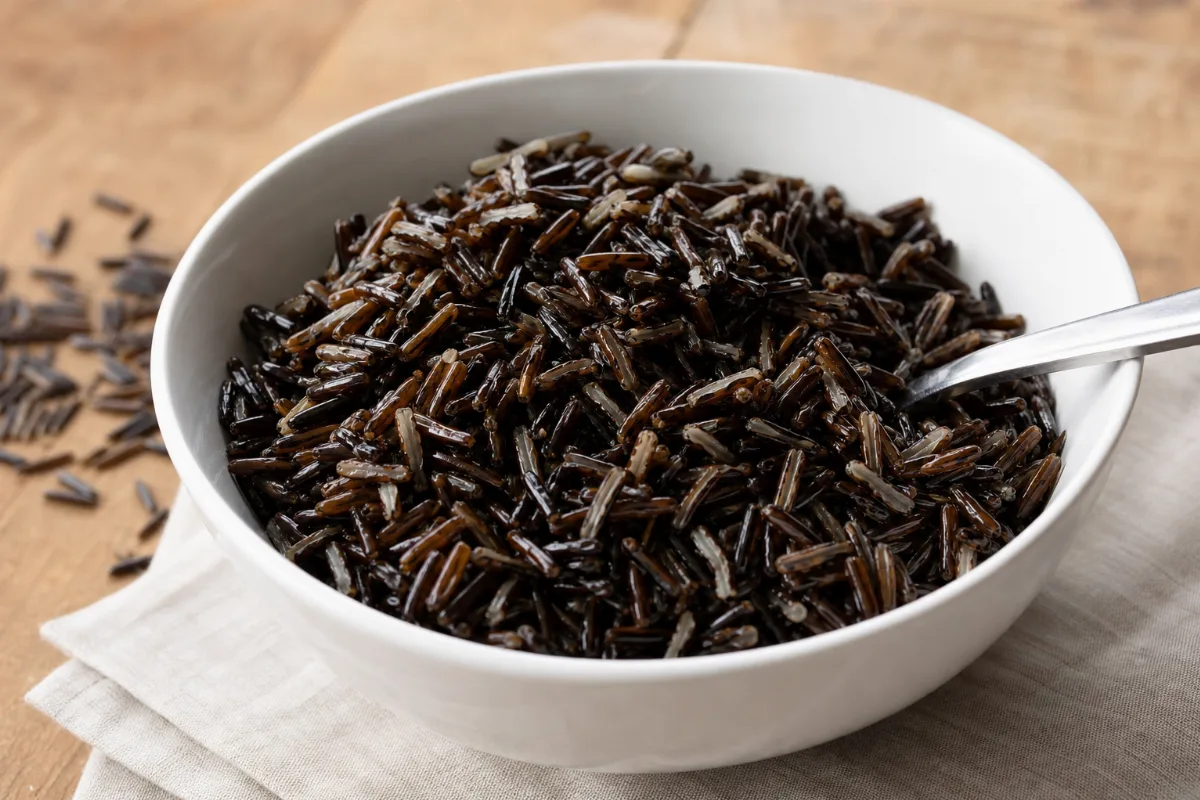
- Roots: Not verified.; Stems: Not verified.; Leaves: Not verified.; Flowers: Not verified.; Fruit: The grain is long and dark with a horseshoe-shaped look in cross-section under the microscope, with a dense endosperm (Li 2026 abstract: "elongated kernels with dense endosperm and horseshoe-shaped morphology").
- Cultivation
- Not verified from a source read.
- Harvest and processing
- Sold raw (dry) or cooked in the USDA record; bran and milled fractions were studied in the laboratory. Not otherwise verified.
- Look-alikes and adulterants
- Name: Ordinary rice (Oryza sativa); Note: A different genus. Both are grasses, but the dark grains of wild rice are from Zizania. Ordinary rice has a documented arsenic concern; wild rice has not been measured for arsenic in the sources read.; Name: Zizania latifolia; Note: An accepted Zizania species used in the mouse study. The species named in the existing nutrient summary are Zizania palustris and Zizania aquatica.; Name: Wild rice blends; Note: Packaged mixes with other rices. Read the ingredient list.
- Sustainability and conservation
- Not assessed.
Photographs
What is inside, and how it may work
What it contains and how those compounds act in cells and animals. Laboratory and animal mechanisms are not proven effects in people.
Main compounds
| Compound | Family | Where it is concentrated | Activity studied | Level of evidence |
|---|---|---|---|---|
| Protein | protein | Grain USDA: 3.99 g per 100 g cooked; 14.73 g per 100 g raw | Nutrient content. A 2026 lab comparison found more protein in wild rice than in white or brown rice and a nutritionally balanced amino acid profile. 15 17 3 | Composition data |
| Dietary fibre | carbohydrate | Grain, especially bran USDA: 1.8 g per 100 g cooked; 6.2 g per 100 g raw | Nutrient content. A 2026 lab comparison found more fibre in wild rice than in white or brown rice. 15 17 3 | Composition data |
| Magnesium, phosphorus, zinc, manganese and copper | minerals | Grain USDA per 100 g cooked: magnesium 32 mg, phosphorus 82 mg, zinc 1.34 mg, manganese 0.282 mg, copper 0.121 mg | Nutrient content only; absorption was not read. 15 | Composition data |
| Niacin, vitamin B6 and folate | B vitamins | Grain USDA per 100 g cooked: niacin 1.287 mg, vitamin B6 0.135 mg, folate 26 micrograms DFE | Nutrient content only. 15 | Composition data |
| Phenolic acids and flavonoids | plant compounds | Grain and bran Bran had 2 to 11 times more phenolics and flavonoids than white and brown rice controls; cooking lowered total phenolics by 17 to 23% | Antioxidant activity in test-tube assays. Caffeic acid and p-hydroxybenzoic acid were the most bioaccessible in a digestion model. No human effect shown. 4 3 6 | Lab |
| Phytosterols, gamma-oryzanol and gamma-aminobutyric acid (GABA) | plant compounds | Grain Not read | Listed by a 2020 review as phytochemicals in wild rice. Amounts and actions in people were not read. 6 | Review of cell and animal studies |
Mechanisms, receptors and pathways
| Target or pathway | Gene or receptor | What was found | Level |
|---|---|---|---|
| Antioxidant assays (DPPH, ABTS) | Not specified | Wild rice bran showed 2 to 7 times higher antioxidant activity in assays than rice controls; antioxidant activity fell by 5.53% (DPPH) and 9.34% (ABTS) after simulated digestion compared with cooked samples. These are test-tube measurements. 3 4 | Lab |
| Gut bacteria in mice on a high-fat diet | 16S rRNA sequencing | Wild rice (Zizania latifolia) changed gut bacteria composition and reversed 90 of 117 high-fat-diet changes in mice; the authors suggest this explains less fatty liver. A mouse finding. 2 | Lab and animal |
Absorption, metabolism and elimination
- Absorption
- Not found for wild rice. In a laboratory digestion model up to 22.61% of total phenolics were bioaccessible.
- Distribution
- Not found.
- Metabolism
- Not found.
- Elimination
- Not found.
- Bioavailability
- Not established for wild rice nutrients or phenolics in people.
Isolated compounds versus whole extracts
The only human data on wild rice (the glycemic index test) used the grain as food. The antioxidant numbers come from bran, milled fractions and laboratory assays, and the mouse study fed wild rice in a diet. Bran, powders and extracts are different from a bowl of cooked wild rice and are not covered by the findings here.
Nutritional composition
Nutrition from USDA FoodData Central (SR Legacy, April 2018 release; values read 2026-10-26 from the project's saved copy because the public API key was rate-limited). Wild rice, cooked (FDC 168897), per 100 g: 101 kcal, 3.99 g protein, 0.34 g fat, 21.34 g carbohydrate, 0.73 g sugars, 1.8 g fibre, about 74 g water, 3 mg calcium, 0.6 mg iron, 32 mg magnesium, 82 mg phosphorus, 101 mg potassium, 3 mg sodium, 1.34 mg zinc, 0.282 mg manganese, 0.121 mg copper, 1.287 mg niacin, 0.135 mg vitamin B6, 26 micrograms folate (DFE) and 0.5 micrograms vitamin K. One cup cooked (164 g): about 166 kcal, 6.5 g protein, 3.0 g fibre, 52 mg magnesium, 134 mg phosphorus, 166 mg potassium, 2.2 mg zinc, 0.46 mg manganese, 0.20 mg copper and 43 micrograms folate (per-100-g values times 1.64). Wild rice, raw (FDC 169726), per 100 g: 357 kcal, 14.73 g protein, 6.2 g fibre; dry grain is far denser because it holds little water, so compare cooked with cooked. For comparison, USDA lists cooked long-grain brown rice (FDC 169704) at 123 kcal, 2.74 g protein and 1.6 g fibre per 100 g. Values vary with species, growing place and cooking.
1 high certainty1 low certainty4 not enough evidence
What was looked at
The 6 benefits and uses checked for Wild Rice, each with how strong the evidence is. Tap one to open it.
- Protein, minerals and B vitamins (nutrient content)High certainty
- Blood sugar after a meal (glycemic index)Not enough evidence
- Whole grains and heart disease (whole grains as a group, observational)Low certainty
- Antioxidant plant compounds (laboratory findings)Not enough evidence
- Fatty liver, body weight and gut bacteria (mouse study)Not enough evidence
- Other health effects listed in reviews (blood pressure, inflammation, allergy)Not enough evidence
Lab markers tracked in the studies
Glycemic index (blood sugar rise after eating)Cardiovascular disease and death risk (whole grains)Liver fat and body weight (in mice)Insulin resistance (HOMA-IR, in rats)
What is Wild Rice good for?
The main studied uses and how strong the human evidence is for each. Very little is known about wild rice itself, and much of it comes from the laboratory or from animals.
Benefits, one by one
Each card is a research question, not a promise. Tap a goal to filter. Open a card to see the studies, doses and limits.
Protein, minerals and B vitamins (nutrient content)
High certaintyCooked wild rice has about 4 g of protein per 100 g and about 6.5 g in a cup (164 g), plus magnesium, phosphorus, zinc, manganese, copper, niacin, vitamin B6 and folate, by USDA data. This is food composition, not a trial.
4 studiesCooked wild rice as food. Raw (dry) wild rice is much denser per 100 …
Studies, doses and limits
What the trials found
USDA lists, per 100 g cooked: 101 kcal, 3.99 g protein, 1.8 g fibre, 32 mg magnesium, 82 mg phosphorus, 1.34 mg zinc, 0.282 mg manganese, 0.121 mg copper, 1.287 mg niacin, 0.135 mg vitamin B6 and 26 micrograms folate (DFE). A 2026 laboratory comparison found more protein, fibre and essential minerals in wild rice (Zizania palustris) than in white or brown rice. No study read shows that eating wild rice corrects a low level of any nutrient.
Results
Wild rice is a source of protein and several minerals. USDA lists cooked long-grain brown rice at 123 kcal, 2.74 g protein and 1.6 g fibre per 100 g, so wild rice has fewer calories and somewhat more protein per 100 g cooked. A cup of wild rice cooked holds 3.0 g of fibre.
Effect sizes as reported
Per 100 g cooked: protein 3.99 g; fibre 1.8 g; zinc 1.34 mg; manganese 0.282 mg (USDA).
Why this rating
High for the composition figures (USDA values, one lab comparison). It says nothing about health outcomes.
Form and dose studied
Cooked wild rice as food. Raw (dry) wild rice is much denser per 100 g because it holds little water, so compare cooked with cooked.
Who was studied
General adult diet.
Limits
A nutrient fact, not a trial. Values vary with species, growing place and cooking. The USDA record is from the 2018 SR Legacy release.
Why researchers looked
Wild rice is sold as a nutrient-rich whole grain, so people ask what it actually contains compared with other rice.
Traditional use
Wild rice is eaten cooked as a grain or in grain mixes. Long use as food is not proof that it treats any condition.
Proposed mechanism Unknown
Not a mechanism claim: these are the amounts of nutrients in the food.
A proposed mechanism does not show that the effect happens in people.
Potassium and phosphorus are covered on the Safety tab.
Blood sugar after a meal (glycemic index)
Not enough evidenceIn one small test, 8 healthy adults had a low glycemic index response to wild rice (about 54). Rats on a high-fat diet had better insulin resistance with wild rice. This is too little to say anything about people with diabetes.
1 studiesWild rice grain (species not stated) in the adult test; wild rice in …
Studies, doses and limits
What the trials found
A study in a Chinese-language journal measured blood glucose for 2 hours after 8 healthy adults ate 67 g of wild rice (against 50 g glucose as the reference). The glycemic index worked out at 53.72, which the authors call low. In 50 rats fed a high-fat diet for 8 weeks, fasting glucose, insulin, glucagon and insulin resistance (HOMA-IR) were lower with high-dose wild rice than with white rice flour or the model group.
Results
Only one tiny human test, in healthy people, plus a rat result. No trial of wild rice in people with diabetes or high blood sugar was found.
Effect sizes as reported
Glycemic index 53.72 (8 healthy adults). Rat results not given as numbers in the abstract.
Why this rating
One tiny, single test in 8 healthy adults, and the rest is animal data. The abstract is the only part read.
Form and dose studied
Wild rice grain (species not stated) in the adult test; wild rice in the rat diet. Not wild rice bran or extract.
Who was studied
8 healthy adults; rats on a high-fat diet.
Limits
Very small, one test. Cooking method and wild rice species are not clear from the abstract. Chinese-language paper, abstract read only. The rat paper abstract describes the low-dose group unclearly.
Why researchers looked
Whole grains are often asked about for blood sugar, and wild rice is a firm, high-fibre-for-a-grain food.
Traditional use
Wild rice is eaten cooked as a grain. Long use as food is not proof that it affects blood sugar.
Proposed mechanism Unknown
Not established. The abstract does not explain why.
A proposed mechanism does not show that the effect happens in people.
Ask your clinician before changing your diet if you take medicine for blood sugar.
Whole grains and heart disease (whole grains as a group, observational)
Low certaintyPeople who ate more whole grains had lower rates of heart disease and early death in large follow-up studies. Wild rice was not looked at on its own, and these studies cannot prove cause.
2 studiesWhole grain foods as a group. Not wild rice alone.
Studies, doses and limits
What the trials found
A 2016 meta-analysis of 45 prospective studies found, per 90 g a day more whole grain, a relative risk of 0.81 for coronary heart disease, 0.78 for cardiovascular disease and 0.83 for death from any cause. The result for stroke (0.88; 0.75 to 1.03) was not statistically clear. Harvard lists wild rice among unprocessed whole grains but gives no wild-rice-specific findings.
Results
A consistent link between more whole grains and lower risk, for whole grains as a group. Wild rice was not separated out. The same analysis found little evidence of an association with white rice or total rice.
Effect sizes as reported
Per 90 g/day: coronary heart disease RR 0.81 (0.75 to 0.87); cardiovascular disease RR 0.78 (0.73 to 0.85); all-cause death RR 0.83 (0.77 to 0.90).
Why this rating
Observational studies, so people who eat whole grains may differ in other ways. Whole grains as a group, not wild rice. Some results varied a lot between studies.
Form and dose studied
Whole grain foods as a group. Not wild rice alone.
Who was studied
Adult cohorts in prospective studies.
Limits
Cannot show that whole grains caused the lower risk. The amounts counted in the analysis are not advice.
Why researchers looked
Wild rice is listed by Harvard's Nutrition Source among unprocessed whole grains, so whole grain findings are often applied to it.
Traditional use
Whole grains are staple foods in many diets. Long use as food is not proof that a single grain protects the heart.
Proposed mechanism Unknown
Not established in the abstract. These are association studies.
A proposed mechanism does not show that the effect happens in people.
None specific.
Antioxidant plant compounds (laboratory findings)
Not enough evidenceWild rice contains phenolic acids and other plant compounds that show antioxidant activity in test-tube assays. Cooking lowered the amount of phenolics by about a fifth. None of this has been shown to protect people.
3 studiesCooked wild rice, raw grain and bran in laboratory tests. Bran and ex…
Studies, doses and limits
What the trials found
No human study of antioxidant effects was read. A 2026 laboratory study of commercial wild rice (Zizania palustris) found cooking reduced total phenolics by 17 to 23%, and only up to 22.61% of total phenolics were bioaccessible in a simulated digestion. A 2026 comparison found the bran had 2 to 11 times more phenolics and flavonoids than white or brown rice.
Results
Laboratory and test-tube findings only. Antioxidant activity in an assay does not mean an effect in the body.
Effect sizes as reported
Cooking: total phenolics -17 to -23%. Bran: phenolics and flavonoids 2 to 11 times higher than rice controls (assays).
Why this rating
Laboratory results only. No human outcome was measured.
Form and dose studied
Cooked wild rice, raw grain and bran in laboratory tests. Bran and extracts are not the cooked grain.
Limits
Test-tube studies; amounts that reach the body are small and unmeasured.
Why researchers looked
Dark whole grains and their bran are rich in plant compounds, so researchers measure them.
Traditional use
Wild rice is eaten cooked. Long use as food is not proof of any antioxidant benefit.
Proposed mechanism Preliminary mechanism
Phenolic acids and flavonoids neutralise certain chemicals in laboratory assays (DPPH and ABTS). That is a test-tube result.
A proposed mechanism does not show that the effect happens in people.
None specific.
Fatty liver, body weight and gut bacteria (mouse study)
Not enough evidenceIn mice fed a high-fat diet, wild rice reduced body weight and liver fat and changed gut bacteria. This was a mouse study, not a human one.
1 studiesWild rice mixed into mouse diet. Not tested in people.
Studies, doses and limits
What the trials found
No human study of wild rice and the liver, weight or gut bacteria was found.
Results
In mice on a high-fat diet, wild rice (Zizania latifolia) reduced body weight, liver steatosis and low-grade inflammation and improved insulin resistance. It changed the gut bacteria; richness and diversity were notably decreased, and 90 of 117 changes caused by the high-fat diet were reversed.
Effect sizes as reported
Not given as numbers in the abstract.
Why this rating
Animal study only. The species was Zizania latifolia.
Form and dose studied
Wild rice mixed into mouse diet. Not tested in people.
Who was studied
Mice.
Limits
Mouse results often do not carry over to people. Lower gut bacteria diversity is not clearly good. Funding not stated in the abstract.
Why researchers looked
Researchers wanted to know whether a whole grain could protect against fatty liver in an obesity model.
Proposed mechanism Preliminary mechanism
The authors suggest the effect works through changes in gut bacteria; this is a mouse finding.
A proposed mechanism does not show that the effect happens in people.
None specific.
Other health effects listed in reviews (blood pressure, inflammation, allergy)
Not enough evidenceA 2020 review lists anti-inflammatory, blood pressure, blood vessel and immune effects of Zizania plants. The abstract does not show which were seen in people, and we found no human trial.
1 studiesZizania plant parts and grain in studies the review covers.
Studies, doses and limits
Results
The review says the health-promoting effects include easing insulin resistance and lipotoxicity, preventing atherosclerosis, and anti-inflammatory, anti-allergic, anti-hypertensive and immunomodulatory effects. It does not say these were proven in people.
Effect sizes as reported
Not given.
Why this rating
A narrative review abstract only; no human evidence was identified.
Form and dose studied
Zizania plant parts and grain in studies the review covers.
Limits
Covers more than one species and more than the grain. We have not read the full review.
Why researchers looked
Reviews gather laboratory and animal findings on wild rice plants to suggest new research.
Proposed mechanism Unknown
Not specified in the abstract.
A proposed mechanism does not show that the effect happens in people.
None specific.
Connections to the rest of health
How Wild Rice connects to the rest of our health knowledge graph. Every link says what kind of connection it is. A safety link (for example to the liver) is a warning, not a benefit. A study that merely mentions a topic never creates a benefit link.
Explore every connection: goals, body systems, organs, symptoms, genes
A. Wellness goals
| Connected to | Kind of connection | Evidence status | Context | Studies |
|---|---|---|---|---|
| Energy Vitality | Demonstrated clinical effect | High certainty | Protein, minerals and B vitamins (nutrient content): Cooked wild rice has about 4 g of protein per 100 g and about 6.5 g in a cup (164 g), plus magnesium, phosphorus, zinc, manganese, copper, niacin, vitamin B6 and folate, by USDA data. This is food composition, not a trial. | 15 17 16 3 |
| Blood Sugar Balance | Not enough evidence | Blood sugar after a meal (glycemic index): In one small test, 8 healthy adults had a low glycemic index response to wild rice (about 54). Rats on a high-fat diet had better insulin resistance with wild rice. This is too little to say anything about people with diabetes. | 7 | |
| Heart Health | Low certainty | Whole grains and heart disease (whole grains as a group, observational): People who ate more whole grains had lower rates of heart disease and early death in large follow-up studies. Wild rice was not looked at on its own, and these studies cannot prove cause. | 1 11 | |
| Healthy Aging | Not enough evidence | Antioxidant plant compounds (laboratory findings): Wild rice contains phenolic acids and other plant compounds that show antioxidant activity in test-tube assays. Cooking lowered the amount of phenolics by about a fifth. None of this has been shown to protect people. | 4 3 6 | |
| Weight Management | Not enough evidence | Fatty liver, body weight and gut bacteria (mouse study): In mice fed a high-fat diet, wild rice reduced body weight and liver fat and changed gut bacteria. This was a mouse study, not a human one. | 2 | |
| Heart Health | Not enough evidence | Other health effects listed in reviews (blood pressure, inflammation, allergy): A 2020 review lists anti-inflammatory, blood pressure, blood vessel and immune effects of Zizania plants. The abstract does not show which were seen in people, and we found no human trial. | 6 |
B. Body systems
| Connected to | Kind of connection | Evidence status | Context | Studies |
|---|---|---|---|---|
| Metabolism Weight | Biological association | High certainty | Studied for: Protein, minerals and B vitamins (nutrient content) Studied for: Antioxidant plant compounds (laboratory findings) | 15 17 16 3 4 6 2 |
| Endocrine System | Biological association | Not enough evidence | Studied for: Blood sugar after a meal (glycemic index) | 7 |
| Cardiovascular System | Biological association | Low certainty | Studied for: Whole grains and heart disease (whole grains as a group, observational) Studied for: Other health effects listed in reviews (blood pressure, inflammation, allergy) | 1 11 6 |
| Digestive System | Biological association | Not enough evidence | Studied for: Fatty liver, body weight and gut bacteria (mouse study) | 2 |
| Immune System | Biological association | Not enough evidence | Studied for: Other health effects listed in reviews (blood pressure, inflammation, allergy) | 6 |
E. Health conditions
| Connected to | Kind of connection | Evidence status | Context | Studies |
|---|---|---|---|---|
| Coeliac disease | Documented risk | Wild rice is not wheat, barley or rye, but a label is the only guide to gluten cross-contact. Preparation or compound: Wild rice and wild rice blends |
13 9 | |
| Kidney disease | Documented risk | Contains potassium and phosphorus; dialysis patients are advised to limit potassium-rich foods. Preparation or compound: Cooked wild rice |
15 12 |
I. Biomarkers
| Connected to | Kind of connection | Evidence status | Context | Studies |
|---|---|---|---|---|
| Glycemic index (blood sugar rise after eating) | Biological association | Not enough evidence | Measured in trials: no clear change. A lab change is not the same as a health benefit. | 7 |
| Cardiovascular disease and death risk (whole grains) | Biological association | Low certainty | Measured in trials: lowered. A lab change is not the same as a health benefit. | 1 |
| Liver fat and body weight (in mice) | Biological association | Not enough evidence | Measured in trials: lowered. A lab change is not the same as a health benefit. | 2 |
| Insulin resistance (HOMA-IR, in rats) | Biological association | Not enough evidence | Measured in trials: lowered. A lab change is not the same as a health benefit. | 7 |
K. Biological pathways
| Connected to | Kind of connection | Evidence status | Context | Studies |
|---|---|---|---|---|
| Protein | Preliminary mechanism | Composition data | Wild rice is a source of plant protein per USDA data. | 15 |
| Zinc, manganese and copper | Preliminary mechanism | Composition data | Wild rice contains these minerals per USDA data. | 15 |
| Dietary fibre | Preliminary mechanism | Composition data | Wild rice has 1.8 g fibre per 100 g cooked per USDA. | 15 |
L. Active compounds
| Connected to | Kind of connection | Evidence status | Context | Studies |
|---|---|---|---|---|
| Protein | Biological association | Composition data | Nutrient content. A 2026 lab comparison found more protein in wild rice than in white or brown rice and a nutritionally balanced amino acid profile. Preparation or compound: Grain |
15 17 3 |
| Dietary fibre | Biological association | Composition data | Nutrient content. A 2026 lab comparison found more fibre in wild rice than in white or brown rice. Preparation or compound: Grain, especially bran |
15 17 3 |
| Magnesium, phosphorus, zinc, manganese and copper | Biological association | Composition data | Nutrient content only; absorption was not read. Preparation or compound: Grain |
15 |
| Niacin, vitamin B6 and folate | Biological association | Composition data | Nutrient content only. Preparation or compound: Grain |
15 |
| Phenolic acids and flavonoids | Biological association | Lab | Antioxidant activity in test-tube assays. Caffeic acid and p-hydroxybenzoic acid were the most bioaccessible in a digestion model. No human effect shown. Preparation or compound: Grain and bran |
4 3 6 |
| Phytosterols, gamma-oryzanol and gamma-aminobutyric acid (GABA) | Biological association | Review of cell and animal studies | Listed by a 2020 review as phytochemicals in wild rice. Amounts and actions in people were not read. Preparation or compound: Grain |
6 |
Each connection is stored with the ingredient, the connected record, the kind of connection, the evidence status, the supporting studies, the preparation or compound involved, and a review date (last reviewed October 26, 2026).
Evidence at a glance: what changed in 3 lab markers
Tap a number to show only those markers. Counts are markers, not people.
The evidence
The research centre for Wild Rice. Every record here was checked against PubMed or the publisher's page; we never list a study we have not verified.
Evidence by outcome
Bars show how many studies we found for each outcome, not how well it works. People are added up across trials only (reviews are not added, to avoid double counting).
How we rate evidence
High certainty
Several well-run trials or reviews agree; further research is unlikely to change the picture much.
Moderate certainty
Good trials point the same way, but some doubt remains.
Low certainty
Small, short or inconsistent trials. The finding could change with better research.
Very low certainty
Very little or very weak human data. Treat as a possibility only.
Mixed findings
Trials or reviews disagree with each other.
Not enough evidence
Not enough human research to say either way.
Evidence against
Good research found no benefit, or found harm.
We take the reviewers' own risk-of-bias and GRADE statements where they exist, and otherwise judge from study size, design, consistency, directness and whether a product matches what is sold. Many publications do not make evidence high. Method note: We started from our existing wild rice summary, re-checked nutrition against USDA FoodData Central data (saved copy), read the FDA, NHS, WHO and MedlinePlus pages and re-read PubMed abstracts. Only abstracts were read for studies. Items we could not verify are flagged in the research gaps.
Study library: every study we checked 18
| Study | Design | People | Product, dose, length | Result |
|---|---|---|---|---|
| Aune 2016 Whole grain consumption and risk of cardiovascular disease, cancer, and all cause and cause specific mortality: systematic review and dose-response meta-analysis of prospective studies. BMJ · PMID 27301975 · DOI |
Systematic review meta analysis |
45 prospective cohort studies (64 publications) of whole grain intake | Whole grains as a group (bread, breakfast cereals, added bran and others). Wild rice was not analysed on its own. Whole grains (food) as a group Per 90 g a day increase in intake (analysis unit, not advice) Cohort follow-up · vs Lower whole grain intake |
Per 90 g a day more whole grain: relative risk 0.81 for coronary heart disease, 0.88 (not statistically clear) for stroke, 0.78 for cardiovascular disease, 0.85 for death from cancer and 0.83 for death from any cause. There was little evidence of an association with refined grains, white rice or total rice. RR 0.81 (coronary heart disease), 0.78 (cardiovascular disease), 0.83 (all-cause death) per 90 g a day (Coronary heart disease 0.75 to 0.87; stroke 0.75 to 1.03; cardiovascular disease 0.73 to 0.85; cancer death 0.80 to 0.91; all-cause death 0.77 to 0.90) Methods, limits and fundingOutcomes: Coronary heart disease, stroke, cardiovascular disease, cancer, all-cause and cause-specific death Limitations: Observational cohorts cannot prove cause. Whole grains as a group, not wild rice. Some results had high heterogeneity (for example I2 = 83% for all-cause death). Funding and conflicts: Funding is not stated in the abstract. Read: abstract |
| Hou 2020 Consumption of Wild Rice (Zizania latifolia) Prevents Metabolic Associated Fatty Liver Disease through the Modulation of the Gut Microbiota in Mice Model. Int J Mol Sci · PMID 32751062 · DOI |
Animal study animal |
Mice fed a high-fat diet, with or without wild rice | Wild rice (Zizania latifolia) in the mouse diet Wild rice grain |
In mice on a high-fat diet, wild rice reduced body weight, liver steatosis and low-grade inflammation and improved insulin resistance. It changed the gut bacteria: richness and diversity were notably decreased, and 90 of 117 high-fat-diet changes were reversed toward the normal-diet pattern. Not given as numbers in the abstract (Not given in the abstract) Methods, limits and fundingOutcomes: Body weight, liver fat (steatosis), low-grade inflammation, insulin resistance, gut bacteria (16S rRNA sequencing) Limitations: Mouse study; it does not show these effects in people. The species is Zizania latifolia, not one of the two North American species named in the nutrient summary (Z. palustris and Z. aquatica). Decreased gut bacteria diversity is not clearly a benefit. Funding and conflicts: Funding is not stated in the abstract. Read: abstract |
| Li 2026 Exploring the functional food potential of wild rice (Zizania palustris): A comparative analysis of morphological, nutritional, bioactive compounds, and antioxidant activity in whole, milled, and bran fractions. Food Chem X · PMID 42179956 · DOI |
Lab study lab |
Wild rice (Z. palustris) whole grain, milled grain and bran compared with white and brown rice, in the laboratory | Wild rice (Z. palustris) fractions: whole, milled and bran Wild rice grain |
Wild rice had significantly higher protein, dietary fibre and essential minerals than white and brown rice in all fractions, especially the bran. The bran had 2 to 11 times more phenolics and flavonoids and 2 to 7 times higher antioxidant activity (in assays) than the rice controls. Unsaturated fats made up more than 87% of the fatty acids. Bran phenolics and flavonoids 2 to 11 times higher; antioxidant activity 2 to 7 times higher (assays) (Not given in the abstract) Methods, limits and fundingOutcomes: Protein, fibre, minerals, amino acids, fatty acids, phenolics, flavonoids and antioxidant tests Limitations: Laboratory analysis, not a health study. Bran is not the cooked whole grain that people usually eat. Abstract read only. Funding and conflicts: Funding is not stated in the abstract. Read: abstract |
| Panchbhaya 2026 Influence of Simulated Gastrointestinal Digestion on Phenolic Composition, Bioaccessibility, and Antioxidant Properties of Commercial Wild Rice. Molecules · PMID 42451700 · DOI |
Lab study lab |
Commercial wild rice samples (Zizania palustris), raw and cooked, in a laboratory digestion model | Wild rice (Z. palustris), cooked and in an in vitro (test-tube) digestion model Wild rice grain |
Free phenolics were more common than bound ones. Cooking reduced total phenolics by 17 to 23% across wild rice varieties. In simulated digestion, up to 22.61% of total phenolics became bioaccessible, and antioxidant activity by DPPH and ABTS fell by 5.53% and 9.34% compared with cooked samples. Cooking: total phenolics -17 to -23%; total phenolic bioaccessibility up to 22.61% (Not given in the abstract) Methods, limits and fundingOutcomes: Total and individual phenolics, bioaccessibility, antioxidant assays (DPPH and ABTS) Limitations: A test-tube study. It does not show what happens in the body or any health effect. Funding and conflicts: Funding is not stated in the abstract. Read: abstract |
| Pip E. 1993 Cadmium, copper and lead in wild rice from central Canada. Arch Environ Contam Toxicol · PMID 8466300 · DOI |
Contaminant survey n/a |
Wild rice grains sold in Manitoba, Canada, from different growing areas | Wild rice grain (market samples) Wild rice grain |
Samples contained under 0.01 to 6.2 micrograms per gram of cadmium, under 0.01 to 6.7 micrograms per gram of lead and 1.6 to 14.4 micrograms per gram of copper. Rice from Saskatchewan and northern Manitoba had higher copper. Larger, heavier grains held more lead per unit weight. Cd < 0.01 to 6.2; Pb < 0.01 to 6.7; Cu 1.6 to 14.4 micrograms per gram (Not given in the abstract) Methods, limits and fundingOutcomes: Cadmium, copper and lead in the grain Limitations: Published in 1993, from one region. It may not match wild rice sold today, and it does not say what these levels mean for health. Arsenic was not reported in the abstract. Funding and conflicts: Funding is not stated in the abstract. Read: abstract |
| Yu 2020 Wild rice (Zizania spp.): A review of its nutritional constituents, phytochemicals, antioxidant activities, and health-promoting effects. Food Chem · PMID 32554311 · DOI |
Narrative review mixed |
Review of Zizania research up to April 2020 (grain, plant parts, lab and animal studies) | Wild rice (Zizania spp.) grain and other plant parts Wild rice grain |
The review says wild rice is high in protein, minerals and vitamins and low in fat, and lists phytosterols, gamma-oryzanol, gamma-aminobutyric acid, phenolic acids and flavonoids. It reports antioxidant properties and lists health effects (easing insulin resistance and lipotoxicity, preventing atherosclerosis, and anti-inflammatory, anti-allergic, anti-hypertensive and immune effects). The abstract does not say which of these were shown in people. Not applicable (Not given in the abstract) Methods, limits and fundingOutcomes: Nutrients, plant compounds, antioxidant activity, reported health effects Limitations: A narrative review; the abstract gives no numbers, no study counts and no grading. It covers more than one Zizania species. The health effects listed are not shown to be proven in people. Funding and conflicts: Funding is not stated in the abstract. Read: abstract |
| Zhang 2015 Determination of the glycemic index of the wild rice and the effects of wild rice on insulin resistance in rats [Chinese-language journal]. Wei Sheng Yan Jiu · PMID 25997214 |
Human small test plus animal mixed |
8 8 healthy adults (glycemic index test) and 50 male rats on a high-fat diet (8 weeks) |
Wild rice (species not stated in the abstract): 67 g eaten by each adult; wild rice replacing part of the diet in rats Wild rice grain 2 hours (adults); 8 weeks (rats) |
The glycemic index of wild rice was 53.72 in the 8 adults, which the authors call low. In rats fed a high-fat diet, fasting glucose, insulin, glucagon and HOMA-IR were lower with high-dose wild rice than with the model group or white rice flour. The abstract wording about the low-dose group is unclear. Glycemic index 53.72 (8 healthy adults) (Not given in the abstract) Methods, limits and fundingOutcomes: Blood glucose for 2 hours after eating (to work out the glycemic index); in rats fasting glucose, insulin, HbA1c, glucagon and insulin resistance (HOMA-IR) Limitations: Only 8 healthy adults, one test. The rat results do not show the same happens in people. The species, cooking method and portion form are not clear from the abstract. Abstract read only; the paper is in Chinese. Funding and conflicts: Funding is not stated in the abstract. Read: abstract |
| s-fda-allergens FDA: Food allergies · Source |
Health agency n/a |
Methods, limits and fundingRead: full-text | ||
| s-fda-glutenfree FDA: Questions and answers on the gluten-free labeling of foods · Source |
Health agency n/a |
Methods, limits and fundingRead: full-text | ||
| s-gbif-zizania GBIF species match: Zizania palustris, Z. aquatica, Z. latifolia · Source |
Reference database n/a |
Methods, limits and fundingRead: full-text | ||
| s-harvard-whole-grains Harvard T.H. Chan School of Public Health, The Nutrition Source: Whole grains · Source |
Health agency n/a |
Methods, limits and fundingRead: full-text | ||
| s-medlineplus-potassium MedlinePlus: Potassium in diet · Source |
Health agency n/a |
Methods, limits and fundingRead: full-text | ||
| s-nhs-coeliac NHS: Coeliac disease · Source |
Health agency n/a |
Methods, limits and fundingRead: full-text | ||
| s-nhs-starchy NHS: Starchy foods and carbohydrates (storing and reheating rice and grains) · Source |
Health agency n/a |
Methods, limits and fundingRead: full-text | ||
| s-usda-fdc-168897 USDA FoodData Central: Wild rice, cooked (SR Legacy, FDC 168897) · Source |
Reference database n/a |
Methods, limits and fundingRead: full-text | ||
| s-usda-fdc-169704 USDA FoodData Central: Rice, brown, long-grain, cooked (SR Legacy, FDC 169704) · Source |
Reference database n/a |
Methods, limits and fundingRead: full-text | ||
| s-usda-fdc-169726 USDA FoodData Central: Wild rice, raw (SR Legacy, FDC 169726) · Source |
Reference database n/a |
Methods, limits and fundingRead: full-text | ||
| s-who-mycotoxins WHO: Mycotoxins fact sheet · Source |
Health agency n/a |
Methods, limits and fundingRead: full-text |
What we do not know yet
- No trial of wild rice on blood sugar in people with diabetes, cholesterol, blood pressure or weight was found; the only human data is a glycemic index test in 8 healthy adults.
- Whole grain cohort studies did not separate wild rice from other whole grains.
- No gluten test of wild rice and no recent contaminant survey were found, and arsenic in wild rice was not measured in any source read.
- Pregnancy, breastfeeding, children, choking risk, allergy, FODMAP, oxalate and histamine were not covered by any wild-rice-specific source read.
- Only abstracts were read for studies; the Journal of Cereal Science (2023) and Zizania latifolia (2024) reviews in our earlier summary were not re-opened.
How new research is added
New studies are found by a saved PubMed search and placed in a review queue before the page changes.
Lab markers
What changed in blood or saliva tests during trials. A changed number is not the same as feeling or being healthier, and we give no "normal ranges".
Other 4
Glycemic index (blood sugar rise after eating)
No clear change in trials
How much a food raises blood sugar over 2 hours compared with a reference such as glucose.
Not enough evidenceResults and what it means
Why it was measured
It is used to compare how foods affect blood sugar after a meal.
Statistical vs. clinical meaning
A single small test; it cannot show an effect on blood sugar control in people with diabetes.
Safety implication
Ask your clinician before diet changes if you take diabetes medicine.
| Study | Result | People | Product |
|---|---|---|---|
| 7 | Glycemic index 53.72, called low by the authors | 8 healthy adults | 67 g of wild rice, with 50 g glucose as the reference |
Cardiovascular disease and death risk (whole grains)
Lowered in trials
How often heart and blood vessel disease, or death, occurs in people followed over years.
Low certaintyResults and what it means
Why it was measured
These are the outcomes cohort studies of whole grains report.
Statistical vs. clinical meaning
A link between whole grains and lower risk, not shown for wild rice on its own and not proof of cause.
Safety implication
None specific.
| Study | Result | People | Product |
|---|---|---|---|
| 1 | Cardiovascular disease RR 0.78 (0.73 to 0.85); all-cause death RR 0.83 (0.77 to 0.90) per 90 g a day more whole grain | 45 prospective studies | Whole grains as a group, observational |
Liver fat and body weight (in mice)
Lowered in trials
The amount of fat stored in the liver and the weight of the animal.
Not enough evidenceResults and what it means
Why it was measured
They show whether a diet protects against fatty liver in an animal model.
Statistical vs. clinical meaning
Animal data only; not shown in people.
Safety implication
None specific.
| Study | Result | People | Product |
|---|---|---|---|
| 2 | Body weight and liver steatosis were reduced; numbers not in the abstract | Mice on a high-fat diet | Wild rice (Zizania latifolia) in the diet |
Insulin resistance (HOMA-IR, in rats)
Lowered in trials
A calculated score of how poorly the body responds to insulin.
Not enough evidenceResults and what it means
Why it was measured
A marker used in animal models of type 2 diabetes.
Statistical vs. clinical meaning
Rat data only; not shown in people.
Safety implication
None specific.
| Study | Result | People | Product |
|---|---|---|---|
| 7 | HOMA-IR, fasting glucose, insulin and glucagon were lower with high-dose wild rice than with the model group or white rice flour | 50 male rats on a high-fat diet, 8 weeks | Wild rice in the diet |
Safety
What studies and official sources say about side effects, medicines and who should check first. Each point shows what kind of evidence it comes from.
Main points to know 4
- Gluten: not one of the three gluten grains, but check the label. The NHS names wheat, barley and rye as the cereals that contain gluten. Wild rice is not one of them. We did not find a source that tested gluten in wild rice, so if you have coeliac disease, look for a gluten-free label. The FDA lets a grain other than wheat, rye or barley carry a gluten-free label if the food has less than 20 parts per million gluten, including cross-contact. Authoritative guidance 13 9
- Cadmium and lead in wild rice: old data, no recent survey found. A survey of wild rice sold in Manitoba, Canada (published 1993) found cadmium from under 0.01 to 6.2 micrograms per gram and lead from under 0.01 to 6.7 micrograms per gram. The data are old and regional and may not match products sold now. We found no recent survey and no source that measured arsenic in wild rice. Observational 5
- Cooked wild rice should be cooled and stored properly. The NHS says the spores of some food-poisoning bacteria survive cooking in rice and grains. Cool cooked rice and grains within 1 hour, keep them in the fridge, eat within 24 hours and reheat only once. Wild rice is not named, but it is a cooked grain stored the same way. Authoritative guidance 14
- Kidney disease: potassium and phosphorus. Cooked wild rice has 101 mg of potassium and 82 mg of phosphorus per 100 g (about 166 mg and 134 mg in a cup), by USDA data. MedlinePlus says people with kidney problems, particularly those on dialysis, should not eat too many potassium-rich foods. Wild rice is not named there. Ask your kidney team or dietitian. Authoritative guidance 15 12
Side effects 2
| Effect | How often | Severity and recovery | Evidence |
|---|---|---|---|
| Food poisoning from cooked grain stored badly NHS advice is for rice and grains in general. | No figure read for wild rice | mild to severe Not stated | Authoritative guidance 14 |
| Allergic reaction to wild rice Wild rice is not one of the nine major allergens the FDA lists, but any food can cause an allergy. | No case reports or surveys read | can be severe in any food allergy Not stated | None found 8 |
Liver
No liver injury from eating wild rice was found in the sources read. A liver-safety source such as LiverTox was not searched for this food.
How often. No frequency was found.
Monitoring. No agency monitoring advice was found.
This is a safety connection. It is not evidence that Wild Rice supports liver health.
Medicines and supplements 2
| With | Why it matters | Importance | Evidence | What to do |
|---|---|---|---|---|
| Medicines for diabetes prescription | Wild rice gave a low glycemic index in one small test; a large change in what you eat could in theory change how much medicine you need. | No source read tied wild rice to a medicine interaction. This is a general caution, not a documented interaction. | Theoretical Not enough evidence 7 | Ask your clinician or pharmacist before making big diet changes if you take diabetes medicine. |
| Warfarin (blood thinner) prescription | Vitamin K works against warfarin. USDA lists 0.5 micrograms of vitamin K per 100 g cooked wild rice, which is low. | No source read names wild rice as a concern for warfarin. Steady eating habits matter more than any single food. | None found Not enough evidence 15 | Ask your warfarin clinic about any big change in diet. Do not change medicine on your own. |
Who should check first 3
| Situation | Advice | Evidence |
|---|---|---|
| Coeliac disease or non-coeliac gluten sensitivity | Wild rice is not wheat, barley or rye, but only a label can tell you whether a product was tested for gluten. Blends and products made in shared plants may contain gluten. | Authoritative guidance 13 9 |
| Kidney disease, especially on dialysis | Ask your kidney team or dietitian how wild rice fits your potassium and phosphorus limits. | Authoritative guidance 12 15 |
| A known allergy to wild rice or other grasses | Avoid it until an allergist has advised you. No source read describes wild rice allergy, so we cannot say how common it is. | None found 8 |
Overdose, product quality and regulators
Summary. No toxicity from cooked wild rice eaten as ordinary food was found in the sources read. The safety questions that were found are metals in the grain, mould, and storage of cooked grain.
Animal. Not reviewed.
Human doses studied. No human safety trial of wild rice was found.
Overdose response. Not found.
Genotoxicity. Not researched.
One older survey found cadmium and lead in wild rice sold in Canada. WHO advises that grain which looks mouldy, discoloured or shrivelled should be discarded because of mycotoxins.
Cadmium, lead and copper in wild rice (1993, Manitoba). Cadmium under 0.01 to 6.2, lead under 0.01 to 6.7 and copper 1.6 to 14.4 micrograms per gram. Larger grains held more lead per unit weight. No health meaning was given in the abstract. 5
Arsenic. Arsenic in ordinary rice (Oryza) is a known concern, but no source read measured arsenic in wild rice, so no claim is made either way.
Mould and mycotoxins in stored grain. WHO says to check grain for mould, discard any that looks mouldy, discoloured or shrivelled, and to avoid damage to grains before and during drying and storage. Wild rice is not named. 18
| Body | Action | Date |
|---|---|---|
| FDA (US) (United States) | Gluten-free labeling: a grain other than wheat, rye, barley or their hybrids can be labelled gluten-free if the food has less than 20 parts per million gluten. Food allergies page: wild rice is not among the nine major allergens. source | 2026-03-11 |
| NHS (UK) (United Kingdom) | Gluten is in wheat, barley and rye. Rice and grains: cool within 1 hour, refrigerate, eat within 24 hours, reheat only once. source | 2023-03-31 |
| WHO (International) | Mycotoxins fact sheet: discard mouldy, discoloured or shrivelled grain; avoid damage to grains during drying and storage. source | 2023-10-02 |
| MedlinePlus (US National Library of Medicine) (United States) | Potassium page: people with kidney problems, particularly on dialysis, should not eat too many potassium-rich foods. source | 2026-04-30 |
When to get medical help
- Trouble breathing, swelling of the lips, face or throat, widespread hives, repeated vomiting or collapse after eating: call your local emergency number
- Severe or lasting vomiting or diarrhoea after eating cooked grain that was left out: seek medical advice
Stop using the product and contact a clinician or emergency service. In the US, Poison Control is 1-800-222-1222.
General information only, not medical advice. Ask a clinician or pharmacist before use, especially with medicines, in pregnancy or with a health condition. See the Natural Remedy Safety guide.
Frequently asked questions
Is wild rice really rice?
What is wild rice good for?
Is wild rice healthier than brown rice?
Is wild rice gluten-free?
Does wild rice lower blood sugar?
A small test in 8 healthy adults gave a glycemic index of about 54, which the authors call low, and rats improved. That is not enough to say it helps people with diabetes.
Does wild rice contain heavy metals?
An older survey (1993) of wild rice sold in Manitoba found cadmium and lead in some samples. We found no recent survey, so check the contaminant guide and buy from trusted sellers.
Does wild rice contain arsenic like other rice?
Arsenic is a known concern for ordinary rice. We found no source that measured arsenic in wild rice, so we make no claim either way.
Does wild rice help with weight loss or cholesterol?
We found no trial in people. Weight and liver fat fell in mice on a high-fat diet, which does not show the same in people.
Is wild rice an antioxidant superfood?
How should cooked wild rice be stored?
The NHS advice for rice and grains is to cool within 1 hour, refrigerate, eat within 24 hours and reheat only once. Wild rice is not named but is a cooked grain.
Is wild rice OK with kidney disease?
Is wild rice safe in pregnancy or for children?
We found no wild-rice-specific advice from an official body. Ask a doctor, midwife or pharmacist, especially if you have a food allergy or take medicine.
Explore by health goal
Heart HealthEnergy VitalityBlood Sugar BalanceHealthy AgingWeight Management
Editorial transparency
- Written by
- AlternativeMed editorial team. Research compiled with AI assistance, then checked against the sources listed.
- Medical review
- None. This page has not been reviewed by a physician or pharmacist.
- First published
- 2026-10-26
- Last substantive update
- 2026-10-26
- How we research
- We started from our existing wild rice summary, re-checked nutrition against USDA FoodData Central data (saved copy), read the FDA, NHS, WHO and MedlinePlus pages and re-read PubMed abstracts. Only abstracts were read for studies. Items we could not verify are flagged in the research gaps.
- How we rate evidence
- See "How we rate evidence" in the Evidence tab.
- Independence
- No product is promoted on this page. No affiliate links are shown.
Sources 18
Each source was opened and checked. Where we read only the abstract, it says so. The small numbers in the text point here.
- Aune D, Keum N, Giovannucci E, et al.. Whole grain consumption and risk of cardiovascular disease, cancer, and all cause and cause specific mortality: systematic review and dose-response meta-analysis of prospective studies.. BMJ. 2016. PMID 27301975. DOI 10.1136/bmj.i2716. (abstract)
- Hou XD, Yan N, Du YM, et al.. Consumption of Wild Rice (Zizania latifolia) Prevents Metabolic Associated Fatty Liver Disease through the Modulation of the Gut Microbiota in Mice Model.. Int J Mol Sci. 2020. PMID 32751062. DOI 10.3390/ijms21155375. (abstract)
- Li XY, Zhang YT, Wang YJ, et al.. Exploring the functional food potential of wild rice (Zizania palustris): A comparative analysis of morphological, nutritional, bioactive compounds, and antioxidant activity in whole, milled, and bran fractions.. Food Chem X. 2026. PMID 42179956. DOI 10.1016/j.fochx.2026.103961. (abstract)
- Panchbhaya AA, Herrera-Balandrano DD, Too B, et al.. Influence of Simulated Gastrointestinal Digestion on Phenolic Composition, Bioaccessibility, and Antioxidant Properties of Commercial Wild Rice.. Molecules. 2026. PMID 42451700. DOI 10.3390/molecules31132333. (abstract)
- Pip E.. Cadmium, copper and lead in wild rice from central Canada.. Arch Environ Contam Toxicol. 1993. PMID 8466300. DOI 10.1007/BF01141345. (abstract)
- Yu X, Chu M, Chu C, et al.. Wild rice (Zizania spp.): A review of its nutritional constituents, phytochemicals, antioxidant activities, and health-promoting effects.. Food Chem. 2020. PMID 32554311. DOI 10.1016/j.foodchem.2020.127293. (abstract)
- Zhang H, Liu Y, Zhao J, et al.. Determination of the glycemic index of the wild rice and the effects of wild rice on insulin resistance in rats [Chinese-language journal].. Wei Sheng Yan Jiu. 2015. PMID 25997214. (abstract)
- . FDA: Food allergies. . . (full-text)
- . FDA: Questions and answers on the gluten-free labeling of foods. . . (full-text)
- . GBIF species match: Zizania palustris, Z. aquatica, Z. latifolia. . . (full-text)
- . Harvard T.H. Chan School of Public Health, The Nutrition Source: Whole grains. . . (full-text)
- . MedlinePlus: Potassium in diet. . . (full-text)
- . NHS: Coeliac disease. . . (full-text)
- . NHS: Starchy foods and carbohydrates (storing and reheating rice and grains). . . (full-text)
- . USDA FoodData Central: Wild rice, cooked (SR Legacy, FDC 168897). . . (full-text)
- . USDA FoodData Central: Rice, brown, long-grain, cooked (SR Legacy, FDC 169704). . . (full-text)
- . USDA FoodData Central: Wild rice, raw (SR Legacy, FDC 169726). . . (full-text)
- . WHO: Mycotoxins fact sheet. . . (full-text)
Where to buy
Check the label first. Whatever you buy, look for these:
- Whole grain listed first, with no added sugar
- Gluten-free labeling if you need it, since cross-contact is common
- A best-by date and airtight storage
- Allergen statements
Talk to a pharmacist or doctor before you start any supplement, especially if you take medicines. See the Safety tab for interactions.
Support our free guides: as an Amazon Associate we earn from qualifying purchases. Full disclosure.


