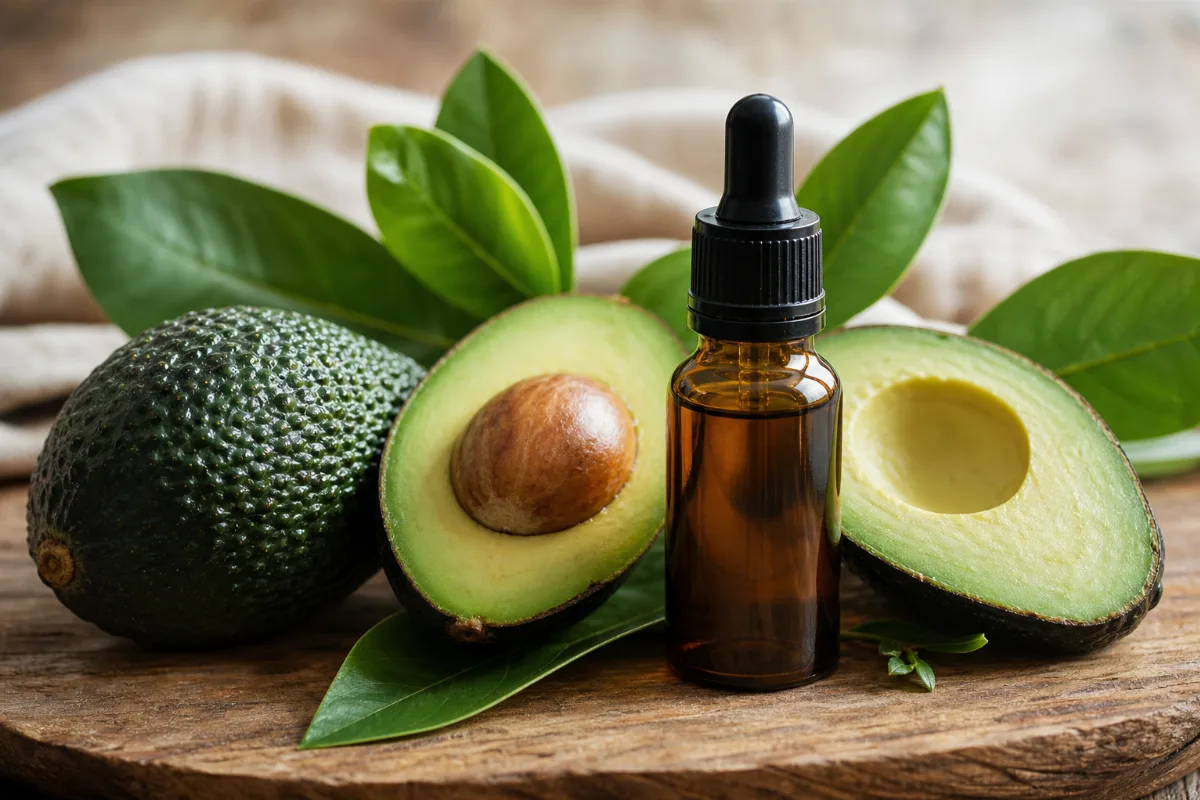
Essential Oils & Aromatherapy · Carrier oil
Avocado Oil
Persea americana (fruit oil) · also called Aceite de aguacate, avocado pear oil, Persea gratissima oil (older label name)
Avocado oil is a mild oil pressed from the pulp of the avocado. It is used on skin, to dilute essential oils, and in the kitchen. No human trial of the plain oil on skin or the heart was found, only small trials of mixed products, animal work and general fat advice. The main cautions are skin allergy, avocado and latex allergy, and bottles that are blended or gone off. Do a small patch test first.
General information, not medical advice. Last substantive update · Not medically reviewed. A named clinician has not signed off on this page. How this page is made
About Avocado Oil
Avocado oil is a pale-green to golden oil pressed from the pulp of Persea americana. People use it in cooking, on skin, and to dilute essential oils. The research on the plain oil is thin: no human trial of it alone on skin or cholesterol was found. The key cautions are allergy (including in people with latex allergy), bottles that are blended or not pure, and oil that has gone off.
What it is
It is a fixed (fatty) oil from the fruit pulp of Persea americana Mill. (GBIF accepts this name; family Lauraceae). It is not an essential oil and has no strong scent.
In one lab sample, the main fats were oleic acid (47.20%), palmitic acid (23.66%) and linoleic acid (13.46%). Make-up varies with variety, region, harvest, extraction and storage, and a 2025 review found the part of the fruit used matters most.
How it is used
Reviews describe use in food, cosmetics and as a base for creams. Extra virgin (cold-pressed) and refined oils are both sold. In one lab study extra virgin samples had higher fatty alcohol esters than refined ones.
A carrier oil dilutes an essential oil but does not make an unsuitable essential oil suitable. No avocado-specific dilution figure was found in the sources read.
What the research shows
On skin: one tiny psoriasis trial of a vitamin B12 cream containing avocado oil, one three-oil blend study from cosmetics companies, and rat wound studies. None tests the plain oil in people.
As a food: a 2021 review says effects on heart disease and diabetes have been shown in lab and animal studies, not in people. Small meal studies found that avocado fruit or oil helps the body absorb carotenoids from vegetables.
Not the same product
Avocado-soybean unsaponifiables (ASU) are a capsule extract of the part of avocado and soybean oils that does not turn to soap. A 2019 meta-analysis found less knee osteoarthritis pain than placebo, with very high differences between trials. That is not evidence for avocado oil from the kitchen or the cosmetic shelf.
Likewise, whole avocado fruit trials do not test the oil.
Rancidity and cooking
Oils rich in unsaturated fat oxidise. In a lab study, heating avocado oil to 100 C and 180 C sped oxidation and destroyed carotenoids, chlorophylls and sterols, and the authors advise against long or repeated heating. Throw away oil that smells off.
Will it clog pores?
No source we read rates avocado oil. Online ratings come from older lists. A small 2006 study of six people found finished products with such ingredients were not necessarily pore-clogging; it did not name avocado oil.
At a glance
Traditional uses history, not proof
- The sources read describe avocado oil as an ingredient in foods and cosmetics. They do not describe a traditional medicine use, so none is claimed here.
Studied for research
- Skin moisturising and carrier-oil use, insufficient (no human trial of the plain oil)
- Skin barrier (three-oil blend), very-low
- Plaque psoriasis (vitamin B12 cream with avocado oil), very-low
- Wound healing (rats), insufficient
- Cholesterol and heart health as a food oil, insufficient
- Blood sugar control, insufficient
- Helping carotenoid absorption from a meal, low
- Knee osteoarthritis (a capsule extract of avocado and soybean oils, a different product), low
Main compounds
- Oleic acid (omega-9), the main fat
- Palmitic acid
- Linoleic acid (omega-6)
- Palmitoleic acid
- Tocopherols (vitamin E types)
- Plant sterols such as beta-sitosterol
- Carotenoids and chlorophylls (give virgin oil its colour)
Common forms
- Cold-pressed (extra virgin) oil
- Refined oil
- Creams and body oils that contain it
- Blends sold as avocado oil
- A separate capsule extract of avocado and soybean oils (not the same as the oil)
Research links: Psoriasis trial of a vitamin B12 cream with avocado oil (abstract) · Authenticity of commercial avocado oil (abstract) · Latex-fruit syndrome review (abstract) · Review of avocado oil: production, composition, health (abstract) · Carotenoid absorption with avocado or avocado oil (abstract) · Avocado-soybean unsaponifiables for osteoarthritis (abstract) · Research Library · Genes & Biomarkers Library
What it is and its history
- Accepted scientific name
- Persea americana
- Naming authority
- Mill.
- Common names
- Avocado oil (English); Persea gratissima oil (label name (older)); Aceite de aguacate (Spanish)
- Family or group
- Lauraceae (the laurel family)
- Classification
- Plantae > Tracheophyta > Magnoliopsida > Laurales > Lauraceae > Persea > Persea americana
- Native range
- A 2025 review says avocado is originally from Mesoamerica.
- Habitat
- Not checked.
- What it looks like
- Roots: Not checked.; Stems: Not checked.; Leaves: Not checked.; Flowers: Not checked.; Fruit: The oil comes from the fruit pulp. A 2025 review of oils reports that the part of the fruit used (pulp, peel or seed) changes the fatty acid make-up more than other factors.
- Cultivation
- Several varieties are used for oil (Hass, Reed, Ettinger, Fuerte are named in a 2025 review), and their oil make-up differs.
- Harvest and processing
- A 2021 review lists solvent, centrifugation-assisted aqueous, cold-pressing, ultrasound-assisted and supercritical fluid extraction. Extra virgin (cold-pressed) and refined oils differ in some markers, such as fatty alcohol esters (higher in extra virgin in one lab study).
- Look-alikes and adulterants
- Name: Blended 'avocado oil'; Note: A 2025 lab study found some commercial bottles aligned with declared blends containing canola or safflower oil.; Name: Avocado-soybean unsaponifiables; Note: A capsule extract made from avocado and soybean oils, studied for osteoarthritis. A different product.; Name: Avocado seed or leaf products; Note: Different plant parts; not covered here.
- Sustainability and conservation
- Not checked.
Traditional use and history history, not clinical proof
| Tradition or era | Documented use | Source |
|---|---|---|
| Modern food and cosmetic industry, as described in reviews | A 2021 review says avocado oil continues to be of interest to the food, pharmaceutical and cosmetic industries. A 2025 review lists use in functional foods and cosmetics. | p34146454 |
| Origins of the fruit | A 2025 review says avocado is originally from Mesoamerica. The sources read do not describe the history of the oil. | p40807683 |
Traditional use shows how it was used. It does not show that it works or is safe today.
What is inside, and how it may work
What it contains and how those compounds act in cells and animals. Laboratory and animal mechanisms are not proven effects in people.
Main compounds
| Compound | Family | Where it is concentrated | Activity studied | Level of evidence |
|---|---|---|---|---|
| Oleic acid PubChem 445639 | omega-9 monounsaturated fatty acid | Fruit pulp oil 47.20% of one Brazilian-lab oil sample (rat wound paper); over two-thirds of the pulp's lipid in a review. | Main fat of the oil. 19 8 | Chemistry |
| Palmitic acid PubChem 985 | saturated fatty acid | Fruit pulp oil 23.66% in the same sample. | Second-largest fat in that sample. 19 | Chemistry |
| Linoleic acid PubChem 5280450 | omega-6 polyunsaturated fatty acid | Fruit pulp oil 13.46% in the same sample. | Essential fatty acid. 19 | Chemistry |
| Palmitoleic acid PubChem 445638 | omega-7 monounsaturated fatty acid | Fruit pulp oil 3.58% in the same sample. | Minor fat. 19 | Chemistry |
| Tocopherols (vitamin E types) PubChem 14985 | fat-soluble vitamin E compounds; alpha-tocopherol shown | Fruit pulp Amounts not read. | Listed by a review as present in the pulp. 8 | Chemistry |
| Phytosterols (beta-sitosterol) PubChem 222284 | plant sterols | Fruit pulp Amounts not read. Lost on heating in a lab study. | Listed by a review as present; lab study found loss when heated. 8 11 | Chemistry |
| Carotenoids and chlorophylls | pigments | Fruit pulp oil Amounts not read. | Degrade with heat in a lab study. 11 1 | Chemistry |
Mechanisms, receptors and pathways
| Target or pathway | Gene or receptor | What was found | Level |
|---|---|---|---|
| PPAR-alpha and PPAR-gamma skin barrier pathways | PPARA, PPARG; barrier genes FLG, LOR, DSG1, TGM1, CLDN1 | A three-oil blend containing avocado oil unsaponifiable switched on PPAR reporter activity and raised barrier genes in cells and a 3D skin model. Avocado oil unsaponifiable alone activated some PPAR pathway genes and lowered MMP1 in the lab. 15 | Laboratory research |
| Collagen and inflammation in wounds | Not specified | In rats, treated wounds had more collagen density, more tensile strength and fewer inflammatory cells (authors' report). 19 | Animal research |
| Carotenoid absorption with dietary fat | Not specified | Avocado fruit and avocado oil both raised carotenoid absorption in people; the authors attribute it mainly to the fat. 16 | Human data |
| Latex-avocado cross-reactivity | Class I endochitinase with a hevein domain (avocado); prohevein Hev b 6.01 (latex) | IgE from latex-allergic, avocado-sensitized people bound an avocado endochitinase that has a hevein domain. 10 | Human data |
Absorption, metabolism and elimination
- Absorption
- Carotenoids from a meal were absorbed better when avocado or avocado oil was added (small meal study).
- Distribution
- Not described.
- Metabolism
- Not described.
- Elimination
- Not described.
- Bioavailability
- Not described for skin use. Absorption through the skin was not found in the sources read.
Isolated compounds versus whole extracts
Whole oil, extra virgin or refined oil, the unsaponifiable fraction, the fruit, and the avocado-soybean capsule extract are all different things. The three-oil skin blend used only the unsaponifiable fraction. The osteoarthritis meta-analysis used a capsule extract of avocado and soybean oils. Results for one cannot be applied to another.
Nutritional composition
Avocado oil is a food fat that provides energy. A 2025 review says the pulp is rich in monounsaturated fat. Exact nutrient figures were not verified for this page.
2 low certainty2 very low certainty4 not enough evidence
What was looked at
The 8 benefits and uses checked for Avocado Oil, each with how strong the evidence is. Tap one to open it.
- Skin moisturising and carrier-oil useNot enough evidence
- Skin barrier (a three-oil blend with avocado oil unsaponifiable)Very low certainty
- Plaque psoriasis (a vitamin B12 cream that contains avocado oil)Very low certainty
- Wound healing (rat study)Not enough evidence
- Cholesterol and heart health (as a cooking or salad oil)Not enough evidence
- Blood sugar controlNot enough evidence
- Helping the body absorb carotenoids from vegetablesLow certainty
- Knee osteoarthritis (avocado-soybean unsaponifiables, a different product)Low certainty
Lab markers tracked in the studies
Water loss through the skin (TEWL)Skin surface hydrationPsoriasis severity score (PASI)Wound closing in ratsLDL cholesterolCarotenoids in blood after a mealOsteoarthritis pain (visual analog scale)
What is Avocado Oil good for?
What the research shows for each use, and how strong it is. For the plain oil most of it is missing or comes from mixed products and animals. Read the Safety tab too.
Benefits, one by one
Each card is a research question, not a promise. Tap a goal to filter. Open a card to see the studies, doses and limits.
Skin moisturising and carrier-oil use
Not enough evidenceAvocado oil is used on skin and to dilute essential oils. We found no human trial of the plain oil on skin, so its use rests on its make-up and on habit.
2 studiesCold-pressed (extra virgin) and refined oil; also used in creams. Amo…
Studies, doses and limits
Results
A 2025 review of the avocado pulp says its ingredients are used in functional foods and cosmetics. A 2021 review of the oil says its effects on cancer, diabetes and heart disease have been shown in lab and animal studies but not in people.
Why this rating
No human trial of the plain oil on skin. Use rests on composition and habit.
Form and dose studied
Cold-pressed (extra virgin) and refined oil; also used in creams. Amounts are not given here.
Who was studied
Not studied in people.
Limits
Being listed in a cosmetic or a review is not evidence of a skin benefit.
Why researchers looked
The pulp and its oil are rich in oleic acid, vitamin E types and plant sterols, which makes them an obvious skin and body oil.
Traditional use
Reviews list avocado oil as an ingredient in cosmetics and skin products. The sources read do not describe a traditional medicine use.
Proposed mechanism Composition only
Suggested by composition only: reviews describe an oil rich in oleic acid with tocopherols and phytosterols. No source we read tested whether this changes the skin barrier when the plain oil is used.
A proposed mechanism does not show that the effect happens in people.
Patch test first. A 1987 case report describes contact allergy to avocado oil in a sunscreen.
Skin barrier (a three-oil blend with avocado oil unsaponifiable)
Very low certaintyIn one 2026 study, a blend of three oils lowered water loss through the skin and raised skin hydration. Only the unsaponifiable part of avocado oil was in the blend, so it says little about the oil itself.
1 studiesBlend (AGX) at 2% and 4% in a product. Not plain avocado oil.
Studies, doses and limits
What the trials found
One clinical measurement of the blend at 2% and 4% in a skin product. The abstract does not give the number of people or a comparison group.
Results
Both 2% and 4% blend reduced transepidermal water loss (TEWL) and increased stratum corneum hydration (p < 0.05). The avocado oil unsaponifiable alone activated some PPAR pathway genes in the lab and lowered MMP1.
Effect sizes as reported
Only p-values in the abstract; no sizes.
Why this rating
A blend of three oils, a fraction of avocado oil, an industry-linked report, and few details in the abstract.
Form and dose studied
Blend (AGX) at 2% and 4% in a product. Not plain avocado oil.
Who was studied
Number and type of volunteers not given in the abstract.
Limits
The effect cannot be assigned to avocado oil. Industry-linked. Only the abstract was read.
Why researchers looked
To find natural substances that switch on PPAR pathways involved in the skin barrier.
Proposed mechanism Laboratory research
In cells and a 3D skin model the blend switched on PPAR-alpha and PPAR-gamma and raised barrier genes (FLG, LOR, DSG1, TGM1, CLDN1). This is lab work.
A proposed mechanism does not show that the effect happens in people.
The blend was made by cosmetics companies that own a related patent. Plain avocado oil was not tested on people.
Plaque psoriasis (a vitamin B12 cream that contains avocado oil)
Very low certaintyA tiny 2001 trial compared a vitamin B12 cream with avocado oil against calcipotriol in 13 people. After 12 weeks the two sides of the body did not differ significantly. The oil cannot be separated from the B12 in this test.
1 studiesA cream that contains vitamin B12 and avocado oil. Amounts are not gi…
Studies, doses and limits
What the trials found
One randomized trial, 13 adults, right/left comparison, 12 weeks.
Results
Calcipotriol worked faster early, with a significant difference only at week 8 (p < 0.05). At 12 weeks neither the PASI score nor skin ultrasound differed significantly. The B12-avocado oil cream was rated better tolerated by the investigator and patients.
Effect sizes as reported
No significant difference at 12 weeks; numbers are not in the abstract.
Why this rating
13 people, no placebo, a combination product, abstract only.
Form and dose studied
A cream that contains vitamin B12 and avocado oil. Amounts are not given here.
Who was studied
13 adults with chronic plaque psoriasis (10 men, 3 women).
Limits
Cannot tell what the avocado oil did. No placebo arm. Funding not stated in the abstract.
Why researchers looked
To find a gentler long-term skin treatment than the usual creams.
Proposed mechanism Not shown
Not shown in this trial.
A proposed mechanism does not show that the effect happens in people.
Psoriasis needs a doctor's care. A cream is not a replacement for prescribed treatment.
Wound healing (rat study)
Not enough evidenceIn rats, avocado oil or a 50% avocado oil formulation made skin wounds contract and re-close more than petroleum jelly. No human wound trial of the oil was found.
1 studiesPlain avocado oil or a 50% semisolid formulation on rat skin.
Studies, doses and limits
Results
On day 14, wound contraction and reepithelialization were significantly higher with the 50% formulation or plain oil than with petroleum jelly. The authors also report more collagen density and tensile strength.
Effect sizes as reported
No healing numbers in the abstract.
Why this rating
Animal study only; abstract only.
Form and dose studied
Plain avocado oil or a 50% semisolid formulation on rat skin.
Who was studied
Wistar rats.
Limits
Animal model. The abstract gives no numbers or funding.
Why researchers looked
Oleic-acid-rich plant oils are tested for wound care.
Proposed mechanism Animal research
The authors report less inflammation and more collagen in treated wounds. This is an animal observation, not shown in people.
A proposed mechanism does not show that the effect happens in people.
Do not put oil on a burn or open wound without asking a clinician. A rat result does not show it is safe or helpful on human wounds.
Cholesterol and heart health (as a cooking or salad oil)
Not enough evidenceGeneral advice is that swapping saturated fat for unsaturated fat helps the heart. Avocado oil is mostly monounsaturated fat, but we found no good human trial of avocado oil itself on cholesterol or heart disease.
5 studiesCulinary (food) avocado oil; the fruit trial used whole avocado. Amou…
Studies, doses and limits
What the trials found
No randomized trial of avocado oil on cholesterol or heart events was found. One 6-week trial of whole avocado fruit (not oil) found no change in blood fats.
Results
A 2021 review says the effect of avocado oil on heart disease has been shown in lab and animal studies, not in humans. A 2025 review says it 'may' improve fat metabolism and gives no pooled result. A 2024 umbrella review of 206 meta-analyses names canola, virgin olive and rice bran oil as lowering LDL cholesterol; avocado oil is not named in its abstract. In a 6-week trial in 61 overweight adults, 200 g/day of avocado fruit replacing other fats did not change lipids, blood pressure or arterial compliance significantly.
Why this rating
No human trial of the oil itself; reviews say the evidence is lab and animal. The one fruit trial found no change.
Form and dose studied
Culinary (food) avocado oil; the fruit trial used whole avocado. Amounts are not given here.
Who was studied
Not studied in people for the oil.
Limits
The fruit contains fibre and other parts that the oil does not. General fat advice is not evidence for one oil. The reviews were read as abstracts only.
Why researchers looked
It is rich in oleic acid, like olive oil.
Proposed mechanism Composition only
Suggested by the type of fat only. The American Heart Association links replacing saturated fat with unsaturated fat to lower LDL cholesterol. That is general fat advice, not a test of avocado oil.
A proposed mechanism does not show that the effect happens in people.
Avocado oil is a fat with energy. Heart advice applies to the overall pattern of fats in the diet.
Blood sugar control
Not enough evidenceA 2025 review says avocado oil may help blood sugar control, but the abstract gives no pooled result and asks for more research. We found no trial of the plain oil.
2 studiesNot given here.
Studies, doses and limits
What the trials found
No human trial of the plain oil on blood sugar was found.
Results
The review concludes the high monounsaturated fat content 'offers promising metabolic benefits' and says composition varies between cultivars. It gives no numbers in the abstract.
Why this rating
A narrative review without a pooled result; no plain-oil trial found.
Form and dose studied
Not given here.
Limits
Abstract only. The review itself says more research is needed.
Why researchers looked
Monounsaturated fats can change how the body handles sugar.
Proposed mechanism Hypothesis
Suggested only; the review links monounsaturated fat to insulin sensitivity.
A proposed mechanism does not show that the effect happens in people.
Diabetes needs medical care. Changes in food fats should be discussed with a clinician or dietitian.
Helping the body absorb carotenoids from vegetables
Low certaintyIn small meal studies of 11 healthy adults, adding avocado fruit or avocado oil to a salad or salsa raised the absorption of carotenoids such as beta-carotene and lutein several-fold.
1 studiesFruit or oil added to a meal. Amounts are in the paper; not given her…
Studies, doses and limits
What the trials found
Two crossover meal studies, 11 healthy adults each, blood sampled for 9.5 hours.
Results
Avocado added to salsa gave 4.4 times (lycopene) and 2.6 times (beta-carotene) the area under the curve. In the salad study, 150 g of avocado gave 7.2, 15.3 and 5.1 times for alpha-carotene, beta-carotene and lutein. Avocado oil gave a similar rise; the source (fruit or oil) and the amount did not change it.
Effect sizes as reported
2.6 to 15.3 times the carotenoid area under the curve, depending on the carotenoid.
Why this rating
Small crossover studies, one meal each, a blood marker rather than a health outcome. Compiler's rating.
Form and dose studied
Fruit or oil added to a meal. Amounts are in the paper; not given here.
Who was studied
Healthy adults.
Limits
Short, small and not a measure of health. Other oils may do the same; this study did not compare them.
Why researchers looked
Carotenoids dissolve in fat, and many vegetables contain little fat.
Proposed mechanism Human data
The authors attribute the effect mainly to the fat in avocado. The oil and the fruit worked similarly.
A proposed mechanism does not show that the effect happens in people.
Absorbing more carotenoids from a meal is a food-science result, not a treatment.
Knee osteoarthritis (avocado-soybean unsaponifiables, a different product)
Low certaintyA capsule extract of avocado and soybean oils (ASU) lowered knee osteoarthritis pain in pooled trials. It is a different product from avocado oil, and the trials differed a lot from each other.
1 studiesOral capsule extract (unsaponifiable fraction of avocado and soybean …
Studies, doses and limits
What the trials found
A 2019 meta-analysis of randomized placebo-controlled trials in hip or knee osteoarthritis, with oral ASU.
Results
Pain on the visual analog scale was 9.64 mm lower than placebo overall (95% CI -17.43 to -1.84; I2 = 92%). In knee osteoarthritis the pain scale was 17.36 mm lower and the Lequesne index 2.33 points lower; hip osteoarthritis showed no significant effect. Adverse events did not differ from placebo (relative risk 1.02, 95% CI 0.83 to 1.25).
Effect sizes as reported
Knee: pain scale -17.36 mm (95% CI -25.91 to -8.82); Lequesne -2.33 (95% CI -2.88 to -1.78).
Why this rating
Statistically significant in knee trials, but heterogeneity was very high (I2 87 to 92%). The abstract gives no certainty grade. Compiler's rating. It says nothing about plain avocado oil.
Form and dose studied
Oral capsule extract (unsaponifiable fraction of avocado and soybean oils). Amounts are not given here.
Who was studied
Adults with knee or hip osteoarthritis.
Limits
A different product. High heterogeneity. Abstract only.
Why researchers looked
Used as a supplement for joint pain.
Proposed mechanism Not shown
Not described in the abstract.
A proposed mechanism does not show that the effect happens in people.
This is a capsule extract. It is not avocado oil from the kitchen or from a skin product.
Connections to the rest of health
How Avocado Oil connects to the rest of our health knowledge graph. Every link says what kind of connection it is. A safety link (for example to the liver) is a warning, not a benefit. A study that merely mentions a topic never creates a benefit link.
Explore every connection: goals, body systems, organs, symptoms, genes
A. Wellness goals
| Connected to | Kind of connection | Evidence status | Context | Studies |
|---|---|---|---|---|
| Healthy Skin | Traditional use | Not enough evidence | Skin moisturising and carrier-oil use: Avocado oil is used on skin and to dilute essential oils. We found no human trial of the plain oil on skin, so its use rests on its make-up and on habit. | 8 1 |
| Healthy Skin | Preliminary mechanism | Very low certainty | Skin barrier (a three-oil blend with avocado oil unsaponifiable): In one 2026 study, a blend of three oils lowered water loss through the skin and raised skin hydration. Only the unsaponifiable part of avocado oil was in the blend, so it says little about the oil itself. Wound healing (rat study): In rats, avocado oil or a 50% avocado oil formulation made skin wounds contract and re-close more than petroleum jelly. No human wound trial of the oil was found. | 15 19 |
| Healthy Skin | Very low certainty | Plaque psoriasis (a vitamin B12 cream that contains avocado oil): A tiny 2001 trial compared a vitamin B12 cream with avocado oil against calcipotriol in 13 people. After 12 weeks the two sides of the body did not differ significantly. The oil cannot be separated from the B12 in this test. | 14 | |
| Heart Health | Preliminary mechanism | Not enough evidence | Cholesterol and heart health (as a cooking or salad oil): General advice is that swapping saturated fat for unsaturated fat helps the heart. Avocado oil is mostly monounsaturated fat, but we found no good human trial of avocado oil itself on cholesterol or heart disease. | 1 4 17 12 9 |
| Cholesterol Balance | Preliminary mechanism | Not enough evidence | Cholesterol and heart health (as a cooking or salad oil): General advice is that swapping saturated fat for unsaturated fat helps the heart. Avocado oil is mostly monounsaturated fat, but we found no good human trial of avocado oil itself on cholesterol or heart disease. | 1 4 17 12 9 |
| Blood Sugar Balance | Preliminary mechanism | Not enough evidence | Blood sugar control: A 2025 review says avocado oil may help blood sugar control, but the abstract gives no pooled result and asks for more research. We found no trial of the plain oil. | 4 1 |
| Preventive Wellness | Low certainty | Helping the body absorb carotenoids from vegetables: In small meal studies of 11 healthy adults, adding avocado fruit or avocado oil to a salad or salsa raised the absorption of carotenoids such as beta-carotene and lutein several-fold. | 16 | |
| Joint Support | Low certainty | Knee osteoarthritis (avocado-soybean unsaponifiables, a different product): A capsule extract of avocado and soybean oils (ASU) lowered knee osteoarthritis pain in pooled trials. It is a different product from avocado oil, and the trials differed a lot from each other. | 13 |
B. Body systems
| Connected to | Kind of connection | Evidence status | Context | Studies |
|---|---|---|---|---|
| Skin Hair Beauty | Biological association | Not enough evidence | Studied for: Skin moisturising and carrier-oil use Studied for: Skin barrier (a three-oil blend with avocado oil unsaponifiable) | 8 1 15 14 19 |
| Cardiovascular System | Biological association | Not enough evidence | Studied for: Cholesterol and heart health (as a cooking or salad oil) | 1 4 17 12 9 |
| Endocrine System | Biological association | Not enough evidence | Studied for: Blood sugar control | 4 1 |
| Digestive System | Biological association | Low certainty | Studied for: Helping the body absorb carotenoids from vegetables | 16 |
| Musculoskeletal System | Biological association | Low certainty | Studied for: Knee osteoarthritis (avocado-soybean unsaponifiables, a different product) | 13 |
C. Body parts and organs
| Connected to | Kind of connection | Evidence status | Context | Studies |
|---|---|---|---|---|
| Skin | Adverse effect or risk | Not enough evidence | One contact allergy case report (title only); frequency unknown. Preparation or compound: Avocado oil on skin |
18 |
| Skin | Biological association | Not enough evidence | Rat wound study; a three-oil blend and a B12 cream with avocado oil in small human tests. Preparation or compound: Avocado oil applied to skin |
19 15 14 |
E. Health conditions
| Connected to | Kind of connection | Evidence status | Context | Studies |
|---|---|---|---|---|
| Latex allergy | Adverse effect or risk | Moderate certainty | Avocado is among the most common cross-reacting fruits in latex-fruit syndrome. Preparation or compound: Avocado fruit (oil not studied) |
6 10 |
I. Biomarkers
| Connected to | Kind of connection | Evidence status | Context | Studies |
|---|---|---|---|---|
| Water loss through the skin (TEWL) | Biological association | Very low certainty | Measured in trials: lowered. A lab change is not the same as a health benefit. | 15 |
| Skin surface hydration | Biological association | Very low certainty | Measured in trials: raised. A lab change is not the same as a health benefit. | 15 |
| Psoriasis severity score (PASI) | Biological association | Very low certainty | Measured in trials: no significant difference between treatments at 12 weeks. A lab change is not the same as a health benefit. | 14 |
| Wound closing in rats | Biological association | Not enough evidence | Measured in trials: raised. A lab change is not the same as a health benefit. | 19 |
| LDL cholesterol | Biological association | Not enough evidence | Measured in trials: no significant change (whole avocado fruit trial). A lab change is not the same as a health benefit. | 9 17 |
| Carotenoids in blood after a meal | Biological association | Low certainty | Measured in trials: raised. A lab change is not the same as a health benefit. | 16 |
| Osteoarthritis pain (visual analog scale) | Biological association | Low certainty | Measured in trials: lowered. A lab change is not the same as a health benefit. | 13 |
J. Genes, receptors and enzymes
| Connected to | Kind of connection | Evidence status | Context | Studies |
|---|---|---|---|---|
| PPARA and PPARG (peroxisome proliferator-activated receptors alpha and gamma) | Preliminary mechanism | In vitro | Switched on in the lab by a three-oil blend containing avocado oil unsaponifiable. | 15 |
| MMP1 (matrix metalloproteinase 1) | Preliminary mechanism | In vitro | Lowered by avocado oil unsaponifiable in the lab. | 15 |
L. Active compounds
| Connected to | Kind of connection | Evidence status | Context | Studies |
|---|---|---|---|---|
| Oleic acid | Biological association | Chemistry | Main fat of the oil. Preparation or compound: Fruit pulp oil |
19 8 |
| Palmitic acid | Biological association | Chemistry | Second-largest fat in that sample. Preparation or compound: Fruit pulp oil |
19 |
| Linoleic acid | Biological association | Chemistry | Essential fatty acid. Preparation or compound: Fruit pulp oil |
19 |
| Palmitoleic acid | Biological association | Chemistry | Minor fat. Preparation or compound: Fruit pulp oil |
19 |
| Tocopherols (vitamin E types) | Biological association | Chemistry | Listed by a review as present in the pulp. Preparation or compound: Fruit pulp |
8 |
| Phytosterols (beta-sitosterol) | Biological association | Chemistry | Listed by a review as present; lab study found loss when heated. Preparation or compound: Fruit pulp |
8 11 |
| Carotenoids and chlorophylls | Biological association | Chemistry | Degrade with heat in a lab study. Preparation or compound: Fruit pulp oil |
11 1 |
Each connection is stored with the ingredient, the connected record, the kind of connection, the evidence status, the supporting studies, the preparation or compound involved, and a review date (last reviewed October 25, 2026).
Evidence at a glance: what changed in 5 lab markers
Tap a number to show only those markers. Counts are markers, not people.
The evidence
The research centre for Avocado Oil. Every record here was checked against PubMed or the publisher's page; we never list a study we have not verified.
Evidence by outcome
Bars show how many studies we found for each outcome, not how well it works. People are added up across trials only (reviews are not added, to avoid double counting).
How we rate evidence
High certainty
Several well-run trials or reviews agree; further research is unlikely to change the picture much.
Moderate certainty
Good trials point the same way, but some doubt remains.
Low certainty
Small, short or inconsistent trials. The finding could change with better research.
Very low certainty
Very little or very weak human data. Treat as a possibility only.
Mixed findings
Trials or reviews disagree with each other.
Not enough evidence
Not enough human research to say either way.
Evidence against
Good research found no benefit, or found harm.
We take the reviewers' own risk-of-bias and GRADE statements where they exist, and otherwise judge from study size, design, consistency, directness and whether a product matches what is sold. Many publications do not make evidence high. Method note: We read the PubMed abstracts of 18 papers and the title of one case report that has no abstract and checked the plant name in GBIF and NCBI Taxonomy and compounds in PubChem. Certainty ratings are the compiler's own reading. Funding is not stated in most abstracts; one study is industry-linked and one review is by authors from a palm oil body. No study is cited that we could not verify.
Study library: every study we checked 20
| Study | Design | People | Product, dose, length | Result |
|---|---|---|---|---|
| Cervantes-Paz 2021 Avocado oil: Production and market demand, bioactive components, implications in health, and tendencies and potential uses. Compr Rev Food Sci Food Saf · PMID 34146454 |
Narrative review review |
Review of avocado oil production, composition and health claims | Avocado oil (many extraction methods) fruit oil |
The abstract says the effect of avocado oil on cancer, diabetes and cardiovascular diseases has been demonstrated through in vitro and animal studies, but not in humans. It also says information on carotenoids and chlorophylls is limited and that content depends on many factors. Descriptive review. Methods, limits and fundingOutcomes: Production, extraction, phytochemicals, health effects Limitations: A narrative review; it does not pool results. Only the abstract was read. Funding and conflicts: Funding and conflicts of interest are not stated in the abstract. Read: abstract |
| Dash 2026 Cold pressed oils: a systematic review on physicochemical properties, nutritional composition and pharmacological activities. Front Nutr · PMID 42459801 |
Systematic review review |
Review of cold-pressed oils in general | Cold-pressed oils seed, kernel and fruit oils |
The abstract says oils rich in mono- and polyunsaturated fatty acids are particularly susceptible to oxidation, and that quality and shelf life depend on raw material, harvest, moisture, storage and extraction. It does not mention avocado oil. Descriptive. Methods, limits and fundingOutcomes: Stability, composition, activities Limitations: General review of cold-pressed oils; the abstract does not name avocado oil. Funding and conflicts: Funding and conflicts of interest are not stated in the abstract. Read: abstract |
| Draelos 2006 A re-evaluation of the comedogenicity concept. J Am Acad Dermatol · PMID 16488305 |
Small trial |
6 Six people able to form comedones on the upper back |
Finished cosmetic products (not named ingredients) Patches with 0.2 to 0.5 mL, three times a week 4 weeks |
The authors conclude that finished products using ingredients on 'comedogenic' lists are not necessarily comedogenic. The abstract does not name avocado oil. No numbers in the abstract. Methods, limits and fundingOutcomes: Follicles and microcomedones on skin samples Limitations: Six people; a limited number of finished products; avocado oil is not mentioned in the abstract. Funding and conflicts: Funding is not stated in the abstract. Read: abstract |
| Drakpa 2025 Avocado Oil: Recent Advances in Its Anti-diabetic Potential. Curr Med Sci · PMID 39998768 |
Narrative review review |
Review of experimental and clinical studies of avocado oil | Avocado oil fruit oil |
The abstract says avocado oil 'may' enhance blood sugar control and fat metabolism and that composition varies a lot between cultivars (Hass, Reed, Ettinger, Fuerte). It gives no pooled result and says more research is needed to standardise any use. No effect size in the abstract. Methods, limits and fundingOutcomes: Blood sugar control and fat metabolism Limitations: A narrative review; no numbers in the abstract and it does not say how many human trials of the oil it found. Only the abstract was read. Funding and conflicts: The authors declare no conflict of interest. Read: abstract |
| Fernando 2025 Distinguishing avocado oil quality based on fatty acid profile using PCA: A review of influencing factors and research gaps. J Food Drug Anal · PMID 41525194 |
Narrative review review |
23 articles, 143 data points on avocado oil fatty acid profiles | Avocado oil fruit oil |
The abstract lists cultivar, region, drying, harvest season, fruit maturity, extraction and storage as factors that influence quality. The part of the fruit used (pulp, peel or seed) was the most influential, and the authors say standards should be updated for oils from whole fruits, grades and newer extraction methods. Descriptive. Methods, limits and fundingOutcomes: What changes the fatty acid profile of avocado oil Limitations: A statistical pattern review of fatty acid data; not about safety or health outcomes. Funding and conflicts: Funding and conflicts of interest are not stated in the abstract. Read: abstract |
| Gromek 2024 Revisiting Latex-Fruit Syndrome after 30 Years of Research: A Comprehensive Literature Review and Description of Two Cases. J Clin Med · PMID 39064262 |
Systematic review |
People with latex allergy; review of original studies plus two cases | Fruits that cross-react with natural rubber latex (including avocado fruit) fruit |
The review found a wide range of prevalence (4 to 88%) depending on tests, region and study size. The most common allergenic fruits in these patients were banana, avocado, kiwifruit and papaya. Of the fruit reactions, 73% were systemic allergy symptoms and 27% local. Prevalence 4 to 88% across studies. Methods, limits and fundingOutcomes: Prevalence of latex-fruit syndrome, fruits involved, symptoms Limitations: About the fruit. The abstract does not say whether pressed or refined oil triggers reactions. Funding and conflicts: The authors declare no conflicts of interest. Read: abstract |
| Marin-Obispo 2025 Fatty acids and fatty alcohol esters as novel markers of authenticity and extraction method of commercial avocado oil. Food Chem X · PMID 40290469 |
Lab analysis lab |
Commercial avocado oil samples (number not given in the abstract) | Commercial 'avocado oil' bottles, extra virgin and refined fruit oil |
The abstract says lack of regulation let producers blend avocado oil with cheaper oils without saying so. Only 40% of samples met the fatty acid standards. Extra virgin samples had higher fatty alcohol esters (up to 2674 mg/kg) than refined samples (640 mg/kg). Samples with the most faults lined up with declared blends containing canola or safflower oil. Only 40% of samples met the fatty acid standards. Methods, limits and fundingOutcomes: Fatty acid profile and fatty alcohol esters as purity markers Limitations: Number and brands of samples are not in the abstract. Lab chemistry, not a health outcome. Funding and conflicts: The authors declare no competing financial interests. Read: abstract |
| Nascimento 2025 Bioactive Compounds, Technological Advances, and Sustainable Applications of Avocado (Persea americana Mill.): A Critical Review. Foods · PMID 40807683 |
Narrative review review |
Review of avocado pulp composition and uses | Avocado pulp and avocado-derived ingredients fruit pulp |
The abstract says the pulp is rich in monounsaturated fat, especially oleic acid, which can be over two-thirds of its lipid content, and in fibre, fat-soluble vitamins, carotenoids, tocopherols and phytosterols such as beta-sitosterol. It says avocado ingredients are used in functional foods and cosmetics and that future work should clarify long-term safety. Descriptive review. Methods, limits and fundingOutcomes: Composition, extraction, uses in foods and cosmetics Limitations: A narrative review about the pulp and the whole fruit, not about oil on skin. Only the abstract was read. Funding and conflicts: The authors declare no conflicts of interest. Read: abstract |
| Pieterse 2005 Substitution of high monounsaturated fatty acid avocado for mixed dietary fats during an energy-restricted diet: effects on weight loss, serum lipids, fibrinogen, and vascular function. Nutrition · PMID 15661480 |
Randomized trial |
61 61 overweight or obese adults (55 finished) |
Whole avocado fruit (not oil), replacing other fats fruit Amounts are in the paper; not given here 6 weeks · vs Same diet without avocado |
Weight fell in both groups to a similar degree. Serum lipids, fibrinogen, blood pressure and arterial compliance did not change significantly within or between groups. No significant difference between groups. Methods, limits and fundingOutcomes: Weight loss, LDL/HDL cholesterol, triglycerides, fibrinogen, blood pressure, arterial compliance Limitations: Whole avocado fruit, not the oil. Six weeks. All volunteers were on an energy-restricted diet. Funding and conflicts: Funding and conflicts of interest are not stated in the abstract. Read: abstract |
| Posch 1999 Class I endochitinase containing a hevein domain is the causative allergen in latex-associated avocado allergy. Clin Exp Allergy · PMID 10231327 |
Lab immunology human+lab |
15 Serum from 15 avocado-sensitized people with latex allergy |
Avocado fruit proteins (chitin-binding) tested against patient antibodies fruit proteins |
The abstract states that more than 50% of people with latex allergy are sensitized to avocado fruit on skin-prick or blood tests, and about 10 to 20% report reactions after eating it. In 80% of the 15 sensitized sera, IgE bound a 31-kDa avocado protein, a class I endochitinase with a hevein domain, which the authors identify as the main cause of latex-linked avocado allergy. More than 50% sensitized; 10 to 20% report reactions after eating. Methods, limits and fundingOutcomes: IgE binding to avocado proteins Limitations: A protein study in the lab with 15 serum samples. It tests avocado fruit proteins, not oil. Whether pressed oil carries the protein was not studied here. Funding and conflicts: Funding and conflicts of interest are not stated in the abstract. Read: abstract |
| Resende 2019 Changes in quality and phytochemical contents of avocado oil under different temperatures. J Food Sci Technol · PMID 30728583 |
Lab analysis lab |
Avocado oil samples in the lab | Avocado oil kept at room temperature, 100 C and 180 C fruit oil Short heating times in the lab · vs Room temperature |
Oxidation and loss of phytochemicals rose with temperature. At room temperature all oxidation measures rose steadily with time. The authors conclude the oil is not indicated for long or repeated heating. Oxidation rate constants increased with temperature. Methods, limits and fundingOutcomes: Oil oxidation (peroxide value, UV extinction) and loss of phytosterols, chlorophylls, carotenoids Limitations: Lab chemistry on oil samples; not a health outcome. Funding and conflicts: Funding and conflicts of interest are not stated in the abstract. Read: abstract |
| Sacks 2017 Dietary Fats and Cardiovascular Disease: A Presidential Advisory From the American Heart Association. Circulation · PMID 28620111 |
Guideline advisory n/a |
General population; review of trials and cohort studies | Dietary fats in general |
The advisory concludes that lowering saturated fat and replacing it with unsaturated fats, especially polyunsaturated fats, will lower cardiovascular disease. Trials that replaced saturated fat with polyunsaturated vegetable oil reduced cardiovascular disease by about 30%. Replacing saturated fat with mostly refined carbohydrates and sugars did not. About 30% fewer events in trials of polyunsaturated oil replacing saturated fat. Methods, limits and fundingOutcomes: Cardiovascular disease and LDL cholesterol Limitations: General advice about fats, not about avocado oil. The abstract does not name avocado oil. Funding and conflicts: The American Heart Association states that writing-group members complete disclosure forms. Read: abstract |
| Simental-Mendia 2019 Efficacy and safety of avocado-soybean unsaponifiables for the treatment of hip and knee osteoarthritis: A systematic review and meta-analysis of randomized placebo-controlled trials. Int J Rheum Dis · PMID 31328413 |
Meta-analysis |
Adults with hip or knee osteoarthritis (randomized placebo-controlled trials) | Avocado-soybean unsaponifiables (ASU), taken by mouth: a different product from avocado oil fruit and soybean unsaponifiable extract · vs Placebo |
Pooled pain on the visual analog scale fell by 9.64 mm more than placebo (95% CI -17.43 to -1.84; I2 = 92%). In knee osteoarthritis the pain scale fell 17.36 mm (95% CI -25.91 to -8.82; I2 = 87%) and the Lequesne index 2.33 points (95% CI -2.88 to -1.78; I2 = 18%), but not in hip osteoarthritis. Adverse events did not differ from placebo (relative risk 1.02, 95% CI 0.83 to 1.25). Pain lower by 9.64 mm (all joints) in pooled trials. Methods, limits and fundingOutcomes: Pain (visual analog scale), Lequesne index, joint space width, adverse events Limitations: A capsule extract of the part of avocado and soybean oils that does not turn to soap, not the culinary or skin oil. Very high heterogeneity (I2 up to 92%). Only the abstract was read; the abstract does not give a certainty grade or the funding of the trials. Funding and conflicts: Funding of the review and the included trials is not stated in the abstract. Read: abstract |
| Stucker 2001 Vitamin B(12) cream containing avocado oil in the therapy of plaque psoriasis. Dermatology · PMID 11586013 |
Randomized trial |
13 13 adults (10 men, 3 women) with chronic plaque psoriasis |
Vitamin B12 cream that contains avocado oil (a combination product) fruit oil (in a cream) Amounts are in the paper; not given here 12 weeks · vs Calcipotriol (a vitamin D3 analogue) on the other side of the body |
Calcipotriol worked faster in the first 8 weeks, with a significant difference only at week 8. After 12 weeks neither the PASI score nor the ultrasound showed a significant difference between the two sides. The B12-avocado oil cream was rated better tolerated. No significant difference at 12 weeks. Methods, limits and fundingOutcomes: Psoriasis severity score adapted to a right/left comparison (PASI), investigator and patient ratings, 20-MHz skin ultrasound Limitations: Very small trial (13 people). The product is a vitamin B12 cream with avocado oil, so the oil cannot be separated from the B12. No placebo arm. Funding not stated in the abstract. Funding and conflicts: Funding and conflicts of interest are not stated in the abstract. Read: abstract |
| Sun 2026 Plant oil complex: dual activation of peroxisome proliferator-activated receptors alpha and gamma to enhance skin barrier function. Open Life Sci · PMID 42415821 |
Mixed lab and clinical human+lab |
Cell lines, a 3D human skin model, and a clinical measurement on human skin (number of people not given in the abstract) | A blend (AGX) of avocado oil unsaponifiable, Ganoderma lucidum spore oil and Ximenia americana seed oil fruit oil (unsaponifiable part) in a three-oil blend 2% and 4% blend in the clinical part |
The three-oil blend switched on PPAR pathways in cells and raised barrier genes in a skin model. In the clinical part, both 2% and 4% blend reduced TEWL and increased hydration (p < 0.05). The avocado oil unsaponifiable on its own activated some PPAR pathway genes and lowered MMP1 in the lab. Blend result only; avocado oil on its own was not tested on people. Methods, limits and fundingOutcomes: Skin barrier genes, water loss through the skin (TEWL), skin hydration (stratum corneum hydration) Limitations: The blend contains two other oils and the avocado part is only the unsaponifiable fraction, not the whole oil. The abstract does not give the number of people or a comparison group. Funding and conflicts: Industry-linked: seven authors work for the cosmetics company that owns a patent related to the research, and two for a partner company. Read: abstract |
| Unlu 2005 Carotenoid absorption from salad and salsa by humans is enhanced by the addition of avocado or avocado oil. J Nutr · PMID 15735074 |
Crossover trial |
11 Healthy adults, 11 per study, two crossover studies |
Avocado fruit or avocado oil added to a salad or salsa meal fruit and fruit oil Amounts are in the paper; not given here One meal, blood sampled for 9.5 hours · vs The same meal without avocado |
Adding avocado to salsa raised lycopene and beta-carotene absorption (4.4 and 2.6 times the area under the curve of avocado-free salsa). In the salad study, avocado fruit or avocado oil similarly raised alpha-carotene, beta-carotene and lutein absorption (7.2, 15.3 and 5.1 times the avocado-free salad for 150 g avocado). Neither the avocado amount nor the source (fruit or oil) changed the effect. Several-fold higher carotenoid absorption with avocado or its oil. Methods, limits and fundingOutcomes: Carotenoids in the blood fat fraction after the meal (area under the curve) Limitations: Small, healthy volunteers, single meals, a blood marker rather than a health outcome. The abstract does not state funding; the authors attribute the effect mainly to the fat. Funding and conflicts: Funding is not stated in the abstract (the record lists US public health research support). Read: abstract |
| Voon 2024 Health Effects of Various Edible Vegetable Oil: An Umbrella Review. Adv Nutr · PMID 39053603 |
Umbrella review review |
Adults, 48 systematic reviews with 206 meta-analyses of vegetable oils | Edible vegetable oils (abstract names canola, virgin olive, rice bran, coconut, palm, sesame) oils Searched to July 2023 |
Moderate to very low certainty evidence showed that oils rich in monounsaturated and polyunsaturated fat (named in the abstract: canola, virgin olive, rice bran) lower total and LDL cholesterol. Oils high in saturated fat (coconut, palm) raise them. Avocado oil is not named in the abstract. Avocado oil is not named in the abstract, so no avocado-specific result can be taken from it. Methods, limits and fundingOutcomes: Cholesterol, blood sugar, cancer risk, body weight Limitations: An umbrella review; certainty ranged from moderate to very low. Authors include staff of the Malaysian Palm Oil Board (affiliation listed). Only the abstract was read, so whether the full text covers avocado oil was not checked. Funding and conflicts: One author group is the Malaysian Palm Oil Board (palm oil industry body), as listed in the author affiliations. Read: abstract |
| de Groot 1987 Contact allergy to avocado oil in a sunscreen. Contact Dermatitis · PMID 3568633 |
Case report |
1 A person with contact allergy (details not available: PubMed lists no abstract) |
Avocado oil in a sunscreen fruit oil Not given here |
Only the title was read; PubMed has no abstract. The title reports contact allergy to avocado oil in a sunscreen. Case report. Methods, limits and fundingOutcomes: Contact allergy Limitations: Title only. Number of people, how the allergy was shown and the outcome were not read. Funding and conflicts: Not stated. Read: title-only |
| de Oliveira 2013 Effect of semisolid formulation of persea americana mill (avocado) oil on wound healing in rats. Evid Based Complement Alternat Med · PMID 23573130 |
Animal research animal |
Wistar rats with cuts (incisional) and open skin wounds (excisional) | Avocado oil in natura, or a semisolid 50% avocado oil formulation, on the skin fruit oil Animal doses are in the paper; not given here 14 days · vs Petroleum jelly |
On day 14 the groups treated with the 50% formulation or the plain oil had significantly more wound contraction and reepithelialization than petroleum jelly. The authors also report less inflammation, more collagen and more tensile strength. The oil was mostly oleic acid (47.20%), then palmitic (23.66%) and linoleic (13.46%). Animal result only; the abstract gives no healing percentages. Methods, limits and fundingOutcomes: Wound contraction, reepithelialization, inflammation, collagen density, tensile strength; fatty acids of the oil Limitations: Rat study. Not a human wound. The abstract gives no numbers for healing and no information on funding. Funding and conflicts: Funding and conflicts of interest are not stated in the abstract. Read: abstract |
| n/a 2026 GBIF Backbone Taxonomy: Persea americana Mill. (species match) GBIF API · Source |
Database record n/a |
n/a | n/a Not given here |
Match 'Persea americana Mill.', status ACCEPTED, key 3034046; family Lauraceae, order Laurales, class Magnoliopsida. Retrieved 2026-10-25. Methods, limits and fundingOutcomes: Accepted name and classification Limitations: Name database; says nothing about oil safety or use. Read: database |
What we do not know yet
- What the evidence supports: insufficient for the plain oil on skin and for heart or blood-sugar use; very-low for the psoriasis cream and the three-oil blend; low for carotenoid absorption and for the capsule extract in knee osteoarthritis.
- No randomized trial of plain avocado oil on skin, wounds, eczema, cholesterol or blood sugar.
- No data on how often the oil causes skin allergy, or whether it triggers latex-fruit reactions.
- Pregnancy, babies, pets, asthma, sun sensitivity and drug interactions were not described in the sources read.
- No regulator statement (CIR, EFSA, FDA, EMA, LiverTox) on avocado oil was read. Only abstracts were read for the studies.
How new research is added
New studies are found by a saved PubMed search and placed in a review queue. A person reads each one before it changes any rating or safety wording.
Lab markers
What changed in blood or saliva tests during trials. A changed number is not the same as feeling or being healthier, and we give no "normal ranges".
Metabolic 1
LDL cholesterol
No significant change (whole avocado fruit trial) in trials
The 'bad' cholesterol carried in the blood; higher levels are linked to artery disease.
Not enough evidenceResults and what it means
Why it was measured
A standard marker of heart risk.
Statistical vs. clinical meaning
Fruit trial; the oil was not tested.
Safety implication
None reported in the abstract.
| Study | Result | People | Product |
|---|---|---|---|
| 9 | Serum lipids did not change significantly within or between groups. | 61 overweight or obese adults, 6 weeks | Whole avocado fruit in an energy-restricted diet (not oil) |
Other 6
Water loss through the skin (TEWL)
Lowered in trials
How much water escapes through the skin surface. Lower values usually mean a better barrier.
Very low certaintyResults and what it means
Why it was measured
A standard measure of the skin barrier.
Statistical vs. clinical meaning
Skin measurement; blend only.
Safety implication
None reported in the abstract.
| Study | Result | People | Product |
|---|---|---|---|
| 15 | Lower with 2% and 4% blend (p < 0.05); no size given in the abstract. | Human volunteers (number not stated in the abstract) | Three-oil blend containing avocado oil unsaponifiable |
Skin surface hydration
Raised in trials
How much water the outer skin layer holds.
Very low certaintyResults and what it means
Why it was measured
A standard measure of dry skin.
Statistical vs. clinical meaning
Skin measurement; blend only.
Safety implication
None reported in the abstract.
| Study | Result | People | Product |
|---|---|---|---|
| 15 | Higher with 2% and 4% blend (p < 0.05); no size given. | Human volunteers (number not stated) | Three-oil blend containing avocado oil unsaponifiable |
Psoriasis severity score (PASI)
No significant difference between treatments at 12 weeks in trials
A doctor's score of how large, red and scaly psoriasis patches are.
Very low certaintyResults and what it means
Why it was measured
The usual outcome in psoriasis trials.
Statistical vs. clinical meaning
Clinical score, but a very small trial with a combination product.
Safety implication
The cream was rated better tolerated than calcipotriol.
| Study | Result | People | Product |
|---|---|---|---|
| 14 | No significant difference at 12 weeks between the B12-avocado oil cream and calcipotriol; calcipotriol was faster, significant at week 8. | 13 adults with plaque psoriasis | Vitamin B12 cream with avocado oil versus calcipotriol |
Wound closing in rats
Raised in trials
How far a skin wound has shrunk and been re-covered with new skin.
Not enough evidenceResults and what it means
Why it was measured
A standard animal test of wound healing.
Statistical vs. clinical meaning
Animal result; not a human outcome.
Safety implication
None reported in the abstract.
| Study | Result | People | Product |
|---|---|---|---|
| 19 | Significantly greater contraction and reepithelialization on day 14 than petroleum jelly; no numbers in the abstract. | Wistar rats | Avocado oil or 50% avocado oil formulation on the skin |
Carotenoids in blood after a meal
Raised in trials
How much of a vegetable's carotenoids (such as beta-carotene) reach the blood after eating.
Low certaintyResults and what it means
Why it was measured
Shows how well fat helps absorb carotenoids.
Statistical vs. clinical meaning
Absorption marker, not a health outcome.
Safety implication
None reported in the abstract.
| Study | Result | People | Product |
|---|---|---|---|
| 16 | 2.6 to 15.3 times the area under the curve of the avocado-free meal; fruit and oil similar. | 11 healthy adults per study | Avocado fruit or avocado oil added to salad or salsa |
Osteoarthritis pain (visual analog scale)
Lowered in trials
A 100 mm line on which people mark their pain.
Low certaintyResults and what it means
Why it was measured
A standard osteoarthritis symptom measure.
Statistical vs. clinical meaning
Symptom score; high heterogeneity.
Safety implication
Adverse events were similar to placebo (relative risk 1.02).
| Study | Result | People | Product |
|---|---|---|---|
| 13 | Knee: 17.36 mm lower than placebo (95% CI -25.91 to -8.82; I2 = 87%); hip: no significant effect. | Adults with knee or hip osteoarthritis | Oral avocado-soybean unsaponifiables (a different product) |
Safety
What studies and official sources say about side effects, medicines and who should check first. Each point shows what kind of evidence it comes from.
Main points to know 6
- Patch test first: allergic reactions to avocado oil in skin products are reported. A 1987 case report is titled 'Contact allergy to avocado oil in a sunscreen' (only the title was read; there is no abstract). We found no study of how often avocado oil causes skin allergy. Testing a small patch of skin first is ordinary caution, not a result from these sources. Case report 18
- People with latex allergy may react to avocado fruit; the oil is not settled. A 2024 review lists avocado among the most common fruits to react in people with latex-fruit syndrome. A 1999 study says over half of people with latex allergy are sensitized to avocado fruit and about 10 to 20% report reactions after eating it. The sources we read do not say whether pressed or refined avocado oil causes this. If you have latex or avocado allergy, ask an allergist before using it. Systematic review 6 10
- Some bottles sold as avocado oil are not pure. A 2025 lab study of commercial avocado oils found only 40% met fatty acid standards, and the worst samples lined up with declared blends containing canola or safflower oil. The authors say there is a lack of regulation on authenticity. An undeclared blend can add oils you did not choose, which matters if you have allergies. Lab analysis 7 5
- Rancid or overheated oil. Oils rich in unsaturated fat oxidise, and heating speeds this up. A lab study found oxidation and loss of plant compounds rose when avocado oil was heated to 100 C and 180 C, and the authors advise against long or repeated heating. A cosmetic or old oil that smells off should be thrown away. Lab analysis 11 2
- Not for burns or open wounds without a clinician. The only wound evidence is in rats. It does not show that oil is safe or helpful on a human burn or open wound. Animal research 19
- Food oil and skin oil are not the same product. This page gives no advice on eating. Culinary avocado oil is a food. Oils sold for skin or for diluting essential oils may be made and checked under different rules; the sources read do not compare them. Expert opinion 7
Side effects 3
| Effect | How often | Severity and recovery | Evidence |
|---|---|---|---|
| Skin allergy (contact dermatitis) to avocado oil in a sunscreen Only the title was read. | Not known; one case report found | Not stated (title only) Not stated | Case report 18 |
| Allergic reactions to avocado fruit in people with latex allergy (itching, swelling; 73% of reported fruit reactions in a review were systemic) These are about the fruit. No source read reports reactions to the oil. | 10 to 20% of latex-allergic people report reactions after eating avocado (1999 abstract); latex-fruit syndrome prevalence 4 to 88% across studies | From mild to systemic reactions Not stated | Systematic review 6 10 |
| Adverse events with avocado-soybean unsaponifiable capsules were similar to placebo A different product from avocado oil. | Relative risk 1.02 (95% CI 0.83 to 1.25) | Not stated in the abstract Not stated | Meta-analysis 13 |
Liver
No liver injury linked to avocado oil was found in the sources read. LiverTox was not read.
How often. Not known.
This is a safety connection. It is not evidence that Avocado Oil supports liver health.
Medicines and supplements 3
| With | Why it matters | Importance | Evidence | What to do |
|---|---|---|---|---|
| Latex allergy (natural rubber latex) condition | Avocado fruit proteins with a hevein-like part can be recognised by antibodies made against latex. | Shown for avocado fruit. Not shown for the oil. | Systematic review Moderate certainty 6 10 | If you have latex allergy, ask an allergist before using avocado oil. |
| Prescribed medicines (including psoriasis treatments) drug | No drug interaction with avocado oil was found in the sources read. This is not proof there are none. | None found Not enough evidence 14 | Ask a doctor or pharmacist, especially before replacing a prescribed treatment with a cream or oil. | |
| Essential oils diluted in avocado oil other | Not studied for avocado oil. | No avocado-specific dilution figure was found in the sources read. A carrier oil does not make an unsuitable essential oil suitable. | None found Not enough evidence | Follow the safety advice for the essential oil itself. |
Who should check first 2
Overdose, product quality and regulators
Summary. No poisoning from avocado oil was found in the sources read. Toxicity of avocado oil, its leaves or its seed was not reviewed here.
Animal. Not reviewed.
Human doses studied. Meal studies of avocado oil in healthy adults and a psoriasis cream trial; none reported safety problems in the abstracts, and neither was designed to measure safety.
Genotoxicity. Not read.
Toxic or hazardous parts. Not covered. Only the oil from the fruit is the subject of this page.
Quality depends on the avocado variety, the part of the fruit used, extraction, storage and heat. A 2025 lab study found many bottles not meeting fatty-acid standards. Pesticide, heavy metal and solvent residues in avocado oil were not looked up.
Adulteration and mislabelling. Only 40% of commercial samples met fatty acid standards; the most faulty samples aligned with declared blends containing canola or safflower oil. Extra virgin samples had higher fatty alcohol esters than refined ones. 7
What changes the oil's make-up. Variety, region, harvest, extraction method, part of the fruit and storage all matter. Standards may not cover oils from whole fruits. 5
Heating and spoilage. Oxidation and loss of carotenoids, chlorophylls and sterols rose with temperature (room temperature, 100 C and 180 C). Oils rich in unsaturated fat are especially prone to oxidation. 11 2
| Body | Action | Date |
|---|
When to get medical help
- Hives, swelling of the lips or face, wheeze or trouble breathing after contact with or eating avocado or its oil: call emergency services.
- A child or pet has swallowed a large amount of skin oil or a product containing it: call a poison centre, doctor or vet.
- A burn or deep wound: see a clinician; do not rely on oil.
Stop using the product and contact a clinician or emergency service. In the US, Poison Control is 1-800-222-1222.
General information only, not medical advice. Ask a clinician or pharmacist before use, especially with medicines, in pregnancy or with a health condition. See the Natural Remedy Safety guide.
Frequently asked questions
Does avocado oil help skin?
Does it help psoriasis?
One 13-person trial of a B12 cream containing avocado oil found no significant difference from calcipotriol at 12 weeks. The oil cannot be separated from the B12, and psoriasis needs a doctor's care.
Is avocado oil good for the heart or cholesterol?
Is avocado oil better than olive oil?
No trial comparing the two was found. The 2024 umbrella review names virgin olive oil, canola and rice bran as lowering LDL cholesterol; it does not name avocado oil in its abstract.
Does it help with blood sugar?
A 2025 review says it may, gives no pooled result, and says more research is needed.
I have a latex allergy. Can I use avocado oil?
Can it cause a skin allergy?
Yes, it is possible. A 1987 case report describes contact allergy to avocado oil in a sunscreen. How often it happens is not known. Do a small patch test first.
Is the avocado oil I bought pure?
Is avocado soybean unsaponifiables the same thing?
No. That is a capsule extract tested for knee osteoarthritis. A 2019 meta-analysis found lower knee pain than placebo, with very different results between trials. It is not the oil.
Will it clog my pores?
Not shown either way for avocado oil in the sources read. A 2006 study of six people found that finished products are not necessarily pore-clogging because of an ingredient on a list.
How do I know if it has gone off?
Is it safe in pregnancy, for babies or pets?
The sources read do not cover the oil in pregnancy, breastfeeding, babies or pets, which is not the same as safe. Ask a doctor, pharmacist or vet.
Explore by health goal
Healthy SkinHeart HealthCholesterol BalanceBlood Sugar BalancePreventive WellnessJoint Support
Editorial transparency
- Written by
- AlternativeMed editorial team. Research compiled with AI assistance, then checked against PubMed records.
- Medical review
- None. This page has not been reviewed by a physician or pharmacist.
- First published
- 2026-10-25
- Last substantive update
- 2026-10-25
- How we research
- We read the PubMed abstracts of 18 papers and the title of one case report that has no abstract and checked the plant name in GBIF and NCBI Taxonomy and compounds in PubChem. Certainty ratings are the compiler's own reading. Funding is not stated in most abstracts; one study is industry-linked and one review is by authors from a palm oil body. No study is cited that we could not verify.
- How we rate evidence
- See "How we rate evidence" in the Evidence tab.
- Independence
- No product is promoted on this page. No affiliate links are shown.
Sources 20
Each source was opened and checked. Where we read only the abstract, it says so. The small numbers in the text point here.
- Cervantes-Paz B, Yahia EM. Avocado oil: Production and market demand, bioactive components, implications in health, and tendencies and potential uses.. Compr Rev Food Sci Food Saf. 2021. PMID 34146454. (abstract)
- Dash B, Sarangi A, Nayak A et al. Cold pressed oils: a systematic review on physicochemical properties, nutritional composition and pharmacological activities.. Front Nutr. 2026. PMID 42459801. (abstract)
- Draelos ZD, DiNardo JC. A re-evaluation of the comedogenicity concept.. J Am Acad Dermatol. 2006. PMID 16488305. (abstract)
- Drakpa D, Paul T, Chakrabarty S et al. Avocado Oil: Recent Advances in Its Anti-diabetic Potential.. Curr Med Sci. 2025. PMID 39998768. (abstract)
- Fernando D, Madja ARA, Azizah N et al. Distinguishing avocado oil quality based on fatty acid profile using PCA: A review of influencing factors and research gaps.. J Food Drug Anal. 2025. PMID 41525194. (abstract)
- Gromek W, Koldej N, Switala S et al. Revisiting Latex-Fruit Syndrome after 30 Years of Research: A Comprehensive Literature Review and Description of Two Cases.. J Clin Med. 2024. PMID 39064262. (abstract)
- Marin-Obispo LM, Mayorga-Martinez AA, Obispo-Fortunato DJ et al. Fatty acids and fatty alcohol esters as novel markers of authenticity and extraction method of commercial avocado oil.. Food Chem X. 2025. PMID 40290469. (abstract)
- Nascimento APS, Duarte MEM, Rocha APT, Barros AN. Bioactive Compounds, Technological Advances, and Sustainable Applications of Avocado (Persea americana Mill.): A Critical Review.. Foods. 2025. PMID 40807683. (abstract)
- Pieterse Z, Jerling JC, Oosthuizen W et al. Substitution of high monounsaturated fatty acid avocado for mixed dietary fats during an energy-restricted diet: effects on weight loss, serum lipids, fibrinogen, and vascular function.. Nutrition. 2005. PMID 15661480. (abstract)
- Posch A, Wheeler CH, Chen Z et al. Class I endochitinase containing a hevein domain is the causative allergen in latex-associated avocado allergy.. Clin Exp Allergy. 1999. PMID 10231327. (abstract)
- Resende LMB, de Souza VR, Ferreira GMD, Nunes CA. Changes in quality and phytochemical contents of avocado oil under different temperatures.. J Food Sci Technol. 2019. PMID 30728583. (abstract)
- Sacks FM, Lichtenstein AH, Wu JHY et al. Dietary Fats and Cardiovascular Disease: A Presidential Advisory From the American Heart Association.. Circulation. 2017. PMID 28620111. (abstract)
- Simental-Mendia M, Sanchez-Garcia A, Acosta-Olivo CA et al. Efficacy and safety of avocado-soybean unsaponifiables for the treatment of hip and knee osteoarthritis: A systematic review and meta-analysis of randomized placebo-controlled trials.. Int J Rheum Dis. 2019. PMID 31328413. (abstract)
- Stucker M, Memmel U, Hoffmann M et al. Vitamin B(12) cream containing avocado oil in the therapy of plaque psoriasis.. Dermatology. 2001. PMID 11586013. (abstract)
- Sun S, Yang Y, Wu H et al. Plant oil complex: dual activation of peroxisome proliferator-activated receptors alpha and gamma to enhance skin barrier function.. Open Life Sci. 2026. PMID 42415821. (abstract)
- Unlu NZ, Bohn T, Clinton SK, Schwartz SJ. Carotenoid absorption from salad and salsa by humans is enhanced by the addition of avocado or avocado oil.. J Nutr. 2005. PMID 15735074. (abstract)
- Voon PT, Ng CM, Ng YT et al. Health Effects of Various Edible Vegetable Oil: An Umbrella Review.. Adv Nutr. 2024. PMID 39053603. (abstract)
- de Groot AC, van der Meeren HL, Weyland JW. Contact allergy to avocado oil in a sunscreen.. Contact Dermatitis. 1987. PMID 3568633. (title-only)
- de Oliveira AP, Franco Ede S, Rodrigues Barreto R et al. Effect of semisolid formulation of persea americana mill (avocado) oil on wound healing in rats.. Evid Based Complement Alternat Med. 2013. PMID 23573130. (abstract)
- n/a. GBIF Backbone Taxonomy: Persea americana Mill. (species match). GBIF API. 2026. (database)
Where to buy
Check the label first. Whatever you buy, look for these:
- The botanical (Latin) name on the label and 100% pure oil
- A dark glass bottle and a batch number
- Essential oils are strong: dilute for skin, and do not swallow unless a qualified professional directs it
- Keep away from children and pets
Talk to a pharmacist or doctor before you start any supplement, especially if you take medicines. See the Safety tab for interactions.
Support our free guides: as an Amazon Associate we earn from qualifying purchases. Full disclosure.


