Fermented Foods · Fermented drink
Kvass
Rye bread fermented with yeast and lactic acid bacteria · also called Bread kvass, kvas, kwas chlebowy
Kvass is a sour, lightly fizzy drink made by fermenting rye bread with yeast and lactic acid bacteria. In one lab study it had about 0.34% alcohol and far less sugar than a malt-extract drink sold under the same name. No study in people was found, so claims about gut health or digestion are not proven. The main cautions are gluten (rye), a little alcohol and sugar that varies by product.
General information, not medical advice. Last substantive update · Not medically reviewed. A named clinician has not signed off on this page. How this page is made
About Kvass
Kvass is a traditional Eastern European drink made by fermenting rye bread. It is a drink, not a proven remedy. Its health claims are not backed by trials in people, and the practical points are what is in it: gluten, a little alcohol and a varying amount of sugar.
What it is
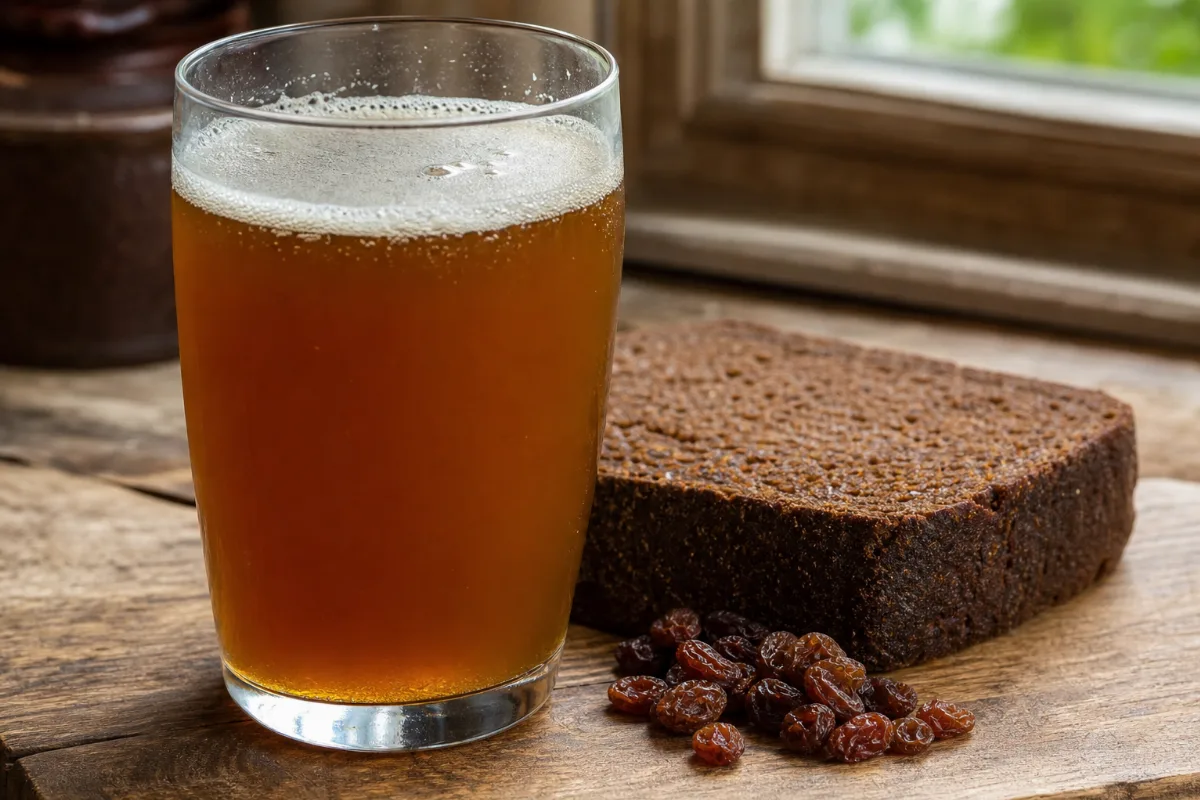
Kvass is made by steeping dried rye bread in hot water, then fermenting the liquid with yeast and lactic acid bacteria. The 2015 authors describe a combined lactic acid and alcohol fermentation. The drink is sour, lightly fizzy and brown.
The authors also say that many Polish drinks called kvass are made from malt concentrate and additives instead of fermenting bread. Read the ingredient list: bread, water, sugar and yeast point to a bread-fermented drink.
What is in it
No USDA entry with values was found, so all numbers come from one 2015 Polish lab study. Per 100 mL, three lab-made rye-bread kvass samples had 0.34% alcohol by volume, 4.1 to 4.6 g sugar, 0.3 to 0.5 g fibre and 0.12 to 0.13% protein (of dry matter). A commercial bread-extract drink had no alcohol, 4.2 g sugar and 0.2 g fibre. A malt-extract drink had no alcohol, 12.0 g sugar and 0.1 g fibre.
A 240 mL glass is therefore roughly 10 to 11 g of sugar for the lab-made kvass and about 29 g for the sweetest drink (our arithmetic). The lab-made samples had sugar, citric acid and caramel added, and the alcohol was measured after two weeks in the fridge. Home batches may differ and were not measured. Zinc and copper were too low to matter nutritionally.
What the research shows
No trial of kvass in people was found. The evidence is composition measurements, two lab studies of antioxidant tests, one rat study and general reviews of fermented foods. The antioxidant gain in the 2015 study came mostly from added caramel and citric acid.
Reviews say traditional Eastern European and European cereal ferments are under-studied and that few standardised human studies exist. Kvass is one of the foods they cover; none gives a kvass-specific result in its abstract.
At a glance
Traditional uses history, not proof
- Drunk cold as a refreshing drink in Eastern Europe
- Long use as a drink is not proof that it treats any condition
Studied for research
- Sugar and fibre compared with a malt-extract drink, high certainty for what was measured (composition, not a health effect)
- Antioxidant activity, very low certainty (lab test, mostly from added ingredients)
- Gut bacteria and probiotic claims, insufficient evidence
- Digestion, very low certainty (one rat study)
- Blood pressure, insufficient evidence (fermented foods in general)
Main compounds
- Alcohol (trace)
- Sugars
- Dietary fibre
- Lactic acid bacteria and yeast (live only if not pasteurised)
Common forms
- Lab-made kvass from wholemeal rye bread (measured in one 2015 study)
- Commercial bread-extract kvass (pasteurised; measured)
- Malt-extract drinks sold as kvass (measured)
- Home-made and unpasteurised kvass were not measured in the sources read
Research links: 2015 lab study: kvass from rye bread vs commercial drinks (journal PDF) · 2025 review: Eastern European fermented foods · 2026 survey: microplastics in kvass · Research Library · Genes & Biomarkers Library
What it is and its history
- Accepted scientific name
- Kvass (kvas, bread kvass)
- Common names
- Kvass (English); Bread kvass (English); Kvas (Russian transliteration); Kwas chlebowy (Polish)
- Family or group
- Fermented drink
- Native range
- Traditional in Eastern Europe (per the 2025 review of Eastern European fermented foods and the 2015 paper).
- Harvest and processing
- In the 2015 lab recipe, dried wholemeal rye bread was steeped in hot water, filtered, then fermented 24 hours at 28 C with pressed yeast, sugar and raisins, strained, sweetened, bottled and kept cold. The authors describe a combined lactic acid and alcohol fermentation by bacteria and yeast living together.
- Look-alikes and adulterants
- Name: Malt-extract drinks sold as kvass; Note: The 2015 authors say many Polish drinks called kvass are made from malt concentrate with additives, not from fermenting bread. Commercial Ilguciema in the study was made from rye-barley malt extract, was pasteurised and had added CO2.; Name: Kvass with added fruit or herbs; Note: Raisins, lemon, cranberries, black chokeberry, sea buckthorn or peppermint are added in some recipes (2015 and 2024 papers).
Photographs
What is inside, and how it may work
What it contains and how those compounds act in cells and animals. Laboratory and animal mechanisms are not proven effects in people.
Main compounds
| Compound | Family | Where it is concentrated | Activity studied | Level of evidence |
|---|---|---|---|---|
| Ethanol (alcohol) | alcohol | Made by yeast during fermentation 0.34% vol in three lab samples; 0.00% in two commercial drinks | Trace amount in the lab drink 3 | Measured |
| Reducing sugars | carbohydrate | From bread and added sugar 4.1 to 4.6 g per 100 mL (lab); 4.2 g (bread-extract commercial); 12.0 g (malt-extract commercial) | Energy 3 | Measured |
| Dietary fibre | carbohydrate | Rye bread 0.3 to 0.5 g per 100 mL (lab); 0.2 g and 0.1 g (commercial) | Small amounts only 3 | Measured |
| Zinc | mineral | Rye bread 0.042 to 0.21 mg per litre in lab samples | Too low to matter nutritionally, per the authors 3 | Measured |
| Caramel and citric acid (added) | additives | Added in the lab recipe Not a native compound | Raised antioxidant lab scores 3 | Measured |
| Phenolic compounds (from added fruit or leaves) | polyphenols | Chokeberry juice or peppermint infusion added 13 phenolic compounds, 1.68 to 1.73 mg per 100 mL with 10% chokeberry juice; 11 compounds, 6.86 to 7.65 mg per 100 mL with 10% peppermint infusion (as reported in the abstract) | Lab antioxidant activity 4 | Measured |
Mechanisms, receptors and pathways
| Target or pathway | Gene or receptor | What was found | Level |
|---|---|---|---|
| Combined lactic acid and alcohol fermentation | Not applicable | The 2015 authors describe lactic acid bacteria and yeast fermenting sugars together; this makes the drink sour, slightly fizzy and slightly alcoholic. 3 | Description by authors |
| ACE-inhibitory peptides | ACE | Experimental studies of fermented foods report blood-pressure-lowering peptides. Not shown for kvass. 7 | Lab or animal general |
| Stomach hormones and colon short-chain fatty acids | Not applicable | In rats, a kvass drink raised ghrelin, motilin and gastrin; authors suggest a colon fatty-acid link. 5 | Animal research |
Absorption, metabolism and elimination
- Absorption
- Not studied for kvass.
- Distribution
- Not studied.
- Metabolism
- Not studied.
- Elimination
- Not studied.
- Bioavailability
- Not studied.
Isolated compounds versus whole extracts
Kvass is a food drink. No kvass extract or supplement was studied in the sources read. Fermented food and probiotic capsules are different things.
Nutritional composition
No USDA FoodData Central entry with values for kvass was available. The only numbers are from the 2015 lab paper, per 100 mL: lab-made kvass sugars 4.1 to 4.6 g, fibre 0.3 to 0.5 g, protein 0.12 to 0.13% of dry matter, alcohol 0.34% vol; Eko-Natura sugars 4.2 g, fibre 0.2 g; Ilguciema sugars 12.0 g, fibre 0.1 g. For a 240 mL glass (our arithmetic): about 10 to 11 g sugar for the lab-made kvass, about 29 g for the sweetest commercial drink. The paper's introduction quotes about 32 kcal per 100 g and B vitamins from other authors; these were not measured and are not used.
1 high certainty2 very low certainty2 not enough evidence
What was looked at
The 5 benefits and uses checked for Kvass, each with how strong the evidence is. Tap one to open it.
- Sugar and fibre compared with a malt-extract drink (composition)High certainty
- Antioxidant activity (lab test)Very low certainty
- Gut bacteria and probiotic claimsNot enough evidence
- Digestive function (rat study only)Very low certainty
- Blood pressure (fermented foods in general)Not enough evidence
Lab markers tracked in the studies
Sugars in the drink (reducing sugars)Alcohol in the drink (ethanol)Antioxidant capacity (FRAP, lab test)Stomach hormones (ghrelin, motilin, gastrin, VIP) in rats
What is Kvass good for?
The main studied uses and how strong the evidence is. Nothing here comes from a trial of kvass in people.
Benefits, one by one
Each card is a research question, not a promise. Tap a goal to filter. Open a card to see the studies, doses and limits.
Sugar and fibre compared with a malt-extract drink (composition)
High certaintyIn one lab study, kvass made from rye bread had about 4.1 to 4.6 g of sugar and 0.3 to 0.5 g of fibre per 100 mL. A malt-extract drink sold as kvass had 12.0 g of sugar and 0.1 g of fibre. This describes what is in the drink. It is not a health result.
1 studiesLab-made rye-bread kvass and two Polish commercial drinks, 2015.
Studies, doses and limits
What the trials found
No study in people was found for kvass. The numbers come from one Polish food-science paper that made kvass from wholemeal rye bread and compared it with two commercial drinks.
Results
The bread-based drinks (lab-made and the one commercial bread-extract drink) had similar sugar, about 4.1 to 4.6 g per 100 mL. The malt-extract drink had about three times more. Fibre was small in all of them.
Effect sizes as reported
Per 100 mL, lab-made kvass: sugars 4.1 to 4.6 g, fibre 0.3 to 0.5 g. Eko-Natura bread-extract drink: sugars 4.2 g, fibre 0.2 g. Ilguciema malt-extract drink: sugars 12.0 g, fibre 0.1 g. A 240 mL glass is therefore roughly 10 to 11 g of sugar for the lab-made kvass and about 29 g for the sweetest drink (our arithmetic).
Why this rating
High that these amounts were measured in these drinks (one paper, three measurements each). It is one lab and two commercial products, so it does not describe every kvass. The lab-made samples also had sugar, citric acid and caramel added.
Form and dose studied
Lab-made rye-bread kvass and two Polish commercial drinks, 2015.
Who was studied
No people.
Limits
One lab, a few products, and added sugar in the lab recipe. Home batches and other brands will differ.
Why researchers looked
Many bottled drinks sold as kvass are made differently from bread kvass, so people ask what is actually in them.
Traditional use
Kvass is a traditional Eastern European drink. Long use as a drink is not proof that it treats any condition.
Proposed mechanism Composition measurement
These are measured amounts in the drinks tested. They are not an effect on the body.
A proposed mechanism does not show that the effect happens in people.
Sugar differs a lot between products, so read labels if you watch your sugar.
Antioxidant activity (lab test)
Very low certaintyLab-made kvass scored higher than a commercial bread-extract drink on a lab test of antioxidant chemistry. Most of the rise came from caramel and citric acid that were added, not from the fermentation. This is a test-tube result, not a benefit shown in people.
2 studiesLab-made kvass from wholemeal or mountain rye bread; some with chokeb…
Studies, doses and limits
What the trials found
No study in people. Two lab studies measured antioxidant activity in kvass.
Results
In the 2015 paper, a lab-made kvass with no additives (sample 0) scored 513.7 micromol/L on the FRAP test against 442.6 for the commercial Eko-Natura drink. The highest score, 2620.7, was in a sample with added malt wort, caramel and extra citric acid. The authors say the extra came from caramel and citric acid, not the malt wort. A 2024 lab study found the highest scores when 10% black chokeberry juice or a peppermint infusion was added to the kvass.
Effect sizes as reported
FRAP (micromol/L): lab-made no additives 513.7; commercial Eko-Natura 442.6; best lab sample with additives 2620.7; Ilguciema 1556.1. 2024 study: 0.734 micromol Trolox per g (ABTS) with 10% chokeberry juice.
Why this rating
Very low because it is a lab chemistry test, not a measure of anything in a person, and the biggest effects came from added ingredients.
Form and dose studied
Lab-made kvass from wholemeal or mountain rye bread; some with chokeberry, sea buckthorn or peppermint additions.
Who was studied
No people.
Limits
A test-tube measure. The result depends on what is added.
Why researchers looked
Fermented drinks are often described as antioxidant-rich, so researchers measured it.
Traditional use
Kvass is a traditional Eastern European drink. Long use as a drink is not proof that it treats any condition.
Proposed mechanism Lab assay
Lab assays (FRAP, ABTS, DPPH) measure how well a liquid can donate electrons in a test tube. Whether that matters in the body was not shown.
A proposed mechanism does not show that the effect happens in people.
None specific.
Gut bacteria and probiotic claims
Not enough evidenceKvass is often called a natural probiotic drink. No study in people tested whether drinking kvass changes gut bacteria or digestion. Reviews say research on traditional Eastern European ferments is thin.
4 studiesNaturally fermented kvass versus pasteurised or malt-concentrate drin…
Studies, doses and limits
What the trials found
No trial in people was found. Three reviews were read at abstract level: they describe fermented foods in general and say standardised human studies are few.
Results
Insufficient evidence either way.
Effect sizes as reported
No effect size exists.
Why this rating
No human study of kvass, gut bacteria or digestive symptoms was found.
Form and dose studied
Naturally fermented kvass versus pasteurised or malt-concentrate drinks.
Who was studied
No people.
Limits
Many kvass drinks on sale are pasteurised or made from malt concentrate, which changes the live microbes.
Why researchers looked
Kvass is fermented with yeast and lactic acid bacteria, so people assume it works like a probiotic.
Traditional use
Kvass is a traditional Eastern European drink. Long use as a drink is not proof that it treats any condition.
Proposed mechanism Author opinion
Lactic acid bacteria and yeast ferment the bread sugars. The 2015 authors say the drink could be called probiotic only if it is naturally fermented and not heat-treated. Pasteurised or malt-concentrate drinks would not qualify.
A proposed mechanism does not show that the effect happens in people.
Unpasteurised home-fermented drinks carry food safety questions; see the Safety tab.
Digestive function (rat study only)
Very low certaintyIn one rat study, a kvass drink improved eating, weight gain and some stomach hormones in rats with induced indigestion. No study in people was found.
1 studiesA kvass beverage (recipe not stated in the abstract).
Studies, doses and limits
What the trials found
No study in people. One animal study, read at abstract level only.
Results
Treated rats ate more, gained weight, had less food left in the stomach and higher pepsin than untreated model rats. The high dose raised ghrelin, motilin and gastrin and lowered VIP.
Effect sizes as reported
P < 0.05 for the listed measures; no numbers given in the abstract.
Why this rating
Very low: animals only, abstract only, kvass type and amounts not stated. It does not show that kvass helps digestion in people.
Form and dose studied
A kvass beverage (recipe not stated in the abstract).
Who was studied
Rats with induced functional dyspepsia.
Limits
Animal result. The abstract's statement of 'no side effects' was not shown in people.
Why researchers looked
Kvass is traditionally said to help digestion.
Traditional use
Kvass is a traditional Eastern European drink. Long use as a drink is not proof that it treats any condition.
Proposed mechanism Animal study
The authors suggest changes in colon short-chain fatty acids, which is a hypothesis they did not prove in people.
A proposed mechanism does not show that the effect happens in people.
None specific.
Blood pressure (fermented foods in general)
Not enough evidenceA 2025 review says experimental studies describe blood-pressure-lowering peptides (ACE-inhibitory peptides) in Eastern European fermented foods. This was not shown for kvass in people.
1 studiesEastern European fermented foods (dairy, cereal, vegetable) in genera…
Studies, doses and limits
What the trials found
No blood pressure trial of kvass was found. The review covers Eastern European ferments in general.
Results
Insufficient for kvass.
Effect sizes as reported
No effect size.
Why this rating
No human data on kvass and blood pressure.
Form and dose studied
Eastern European fermented foods (dairy, cereal, vegetable) in general.
Who was studied
No kvass trial.
Limits
A narrative review of mixed foods, abstract only read.
Why researchers looked
Fermentation can create small protein pieces that block an enzyme involved in blood pressure.
Traditional use
Kvass is a traditional Eastern European drink. Long use as a drink is not proof that it treats any condition.
Proposed mechanism Lab or animal
Experimental work describes ACE-inhibitory peptides made during fermentation. Not shown for kvass.
A proposed mechanism does not show that the effect happens in people.
None specific.
Connections to the rest of health
How Kvass connects to the rest of our health knowledge graph. Every link says what kind of connection it is. A safety link (for example to the liver) is a warning, not a benefit. A study that merely mentions a topic never creates a benefit link.
Explore every connection: goals, body systems, organs, symptoms, genes
A. Wellness goals
| Connected to | Kind of connection | Evidence status | Context | Studies |
|---|---|---|---|---|
| Blood sugar balance | Composition data | Sugar ranged from 4.1 to 12.0 g per 100 mL across drinks tested. Sugar ranged from 4.1 to 12.0 g per 100 mL across the drinks tested. Preparation or compound: Kvass as drink |
3 | |
| Blood Sugar Balance | High certainty | Sugar and fibre compared with a malt-extract drink (composition): In one lab study, kvass made from rye bread had about 4.1 to 4.6 g of sugar and 0.3 to 0.5 g of fibre per 100 mL. A malt-extract drink sold as kvass had 12.0 g of sugar and 0.1 g of fibre. This describes what is in the drink. It is not a health result. | 3 | |
| Cellular Protection | Very low certainty | Antioxidant activity (lab test): Lab-made kvass scored higher than a commercial bread-extract drink on a lab test of antioxidant chemistry. Most of the rise came from caramel and citric acid that were added, not from the fermentation. This is a test-tube result, not a benefit shown in people. | 3 4 | |
| Gut Health | Not enough evidence | Gut bacteria and probiotic claims: Kvass is often called a natural probiotic drink. No study in people tested whether drinking kvass changes gut bacteria or digestion. Reviews say research on traditional Eastern European ferments is thin. | 3 7 1 2 | |
| Microbiome Balance | Not enough evidence | Gut bacteria and probiotic claims: Kvass is often called a natural probiotic drink. No study in people tested whether drinking kvass changes gut bacteria or digestion. Reviews say research on traditional Eastern European ferments is thin. | 3 7 1 2 | |
| Digestive Support | Very low certainty | Digestive function (rat study only): In one rat study, a kvass drink improved eating, weight gain and some stomach hormones in rats with induced indigestion. No study in people was found. | 5 | |
| Blood Pressure Support | Not enough evidence | Blood pressure (fermented foods in general): A 2025 review says experimental studies describe blood-pressure-lowering peptides (ACE-inhibitory peptides) in Eastern European fermented foods. This was not shown for kvass in people. | 7 |
B. Body systems
| Connected to | Kind of connection | Evidence status | Context | Studies |
|---|---|---|---|---|
| Digestive System | Biological association | High certainty | Studied for: Sugar and fibre compared with a malt-extract drink (composition) Studied for: Gut bacteria and probiotic claims | 3 7 1 2 5 |
| Whole Body | Biological association | Very low certainty | Studied for: Antioxidant activity (lab test) | 3 4 |
| Cardiovascular System | Biological association | Not enough evidence | Studied for: Blood pressure (fermented foods in general) | 7 |
E. Health conditions
| Connected to | Kind of connection | Evidence status | Context | Studies |
|---|---|---|---|---|
| Celiac disease | Adverse effect or risk | Documented risk | Rye contains gluten, which triggers celiac disease. Preparation or compound: Rye bread kvass (gluten grain) |
10 |
I. Biomarkers
| Connected to | Kind of connection | Evidence status | Context | Studies |
|---|---|---|---|---|
| Sugars in the drink (reducing sugars) | Biological association | High certainty | Measured in trials: lower is better for sugar intake. A lab change is not the same as a health benefit. | 3 |
| Alcohol in the drink (ethanol) | Biological association | Moderate certainty | Measured in trials: lower is better if you avoid alcohol. A lab change is not the same as a health benefit. | 3 |
| Antioxidant capacity (FRAP, lab test) | Biological association | Very low certainty | Measured in trials: higher means more in the lab test. A lab change is not the same as a health benefit. | 3 |
| Stomach hormones (ghrelin, motilin, gastrin, VIP) in rats | Biological association | Very low certainty | Measured in trials: not applicable to people. A lab change is not the same as a health benefit. | 5 |
K. Biological pathways
| Connected to | Kind of connection | Evidence status | Context | Studies |
|---|---|---|---|---|
| Renin-angiotensin (ACE) | Preliminary mechanism | Lab or animal general | General fermented-food peptide research; not shown for kvass. | 7 |
| Digestive system | Preliminary mechanism | Animal | Rat study of stomach hormones. | 5 |
| Rye | Preliminary mechanism | Authoritative guidance | Main grain in bread kvass; a gluten grain. | 10 |
L. Active compounds
| Connected to | Kind of connection | Evidence status | Context | Studies |
|---|---|---|---|---|
| Ethanol (alcohol) | Biological association | Measured | Trace amount in the lab drink Preparation or compound: Made by yeast during fermentation |
3 |
| Reducing sugars | Biological association | Measured | Energy Preparation or compound: From bread and added sugar |
3 |
| Dietary fibre | Biological association | Measured | Small amounts only Preparation or compound: Rye bread |
3 |
| Zinc | Biological association | Measured | Too low to matter nutritionally, per the authors Preparation or compound: Rye bread |
3 |
| Caramel and citric acid (added) | Biological association | Measured | Raised antioxidant lab scores Preparation or compound: Added in the lab recipe |
3 |
| Phenolic compounds (from added fruit or leaves) | Biological association | Measured | Lab antioxidant activity Preparation or compound: Chokeberry juice or peppermint infusion added |
4 |
Each connection is stored with the ingredient, the connected record, the kind of connection, the evidence status, the supporting studies, the preparation or compound involved, and a review date (last reviewed October 26, 2026).
Evidence at a glance: what the research found for 5 outcomes
Each outcome below is one thing researchers measured. Certainty is how far the evidence can be trusted, not how well it works. The full studies are on the next tab.
The evidence
The research centre for Kvass. Every record here was checked against PubMed or the publisher's page; we never list a study we have not verified.
Evidence by outcome
Bars show how many studies we found for each outcome, not how well it works. People are added up across trials only (reviews are not added, to avoid double counting).
How we rate evidence
High certainty
Several well-run trials or reviews agree; further research is unlikely to change the picture much.
Moderate certainty
Good trials point the same way, but some doubt remains.
Low certainty
Small, short or inconsistent trials. The finding could change with better research.
Very low certainty
Very little or very weak human data. Treat as a possibility only.
Mixed findings
Trials or reviews disagree with each other.
Not enough evidence
Not enough human research to say either way.
Evidence against
Good research found no benefit, or found harm.
We take the reviewers' own risk-of-bias and GRADE statements where they exist, and otherwise judge from study size, design, consistency, directness and whether a product matches what is sold. Many publications do not make evidence high. Method note: We started from our existing kvass summary, re-read the full text of the 2015 lab paper, read PubMed abstracts for reviews and lab papers, and read the NIDDK, FDA and MedlinePlus pages. Only abstracts were read for the PubMed studies. Items we could not verify are flagged in the research gaps.
Study library: every study we checked 10
| Study | Design | People | Product, dose, length | Result |
|---|---|---|---|---|
| Ashaolu 2025 Nutritional and functional aspects of European cereal-based fermented foods and beverages Food Research International · PMID 40253130 · DOI |
Narrative review review |
European cereal-based fermented foods and beverages (breads, tarhana, boza, kvass, beers) | Cereal-based fermented foods in general Cereals Literature review |
Authors say some cereal ferments are rich in prebiotics and probiotics and can improve digestibility and mineral availability. Kvass is one of several foods covered. The abstract gives no kvass-specific result. No pooled effect (None) Methods, limits and fundingOutcomes: Nutrition, microbes, bioactive compounds, health-promoting properties Limitations: Narrative review; abstract only read; a general statement about a food group, not a test of kvass Funding and conflicts: Not read (abstract only) Read: abstract-only |
| Baschali 2017 Traditional low-alcoholic and non-alcoholic fermented beverages consumed in European countries: a neglected food group Nutrition Research Reviews · PMID 28115036 · DOI |
Narrative review review |
Traditional low-alcohol and non-alcohol fermented drinks in Europe, including kefir, kvass, kombucha and hardaliye | Traditional fermented drinks in general Mixed Literature review |
Authors say these drinks have received little attention and that future research should clarify their dietary role and nutritional value so they can be added to national food composition tables. No pooled effect (None) Methods, limits and fundingOutcomes: Dietary role, nutrient composition, health benefits Limitations: Narrative review; abstract only read; no kvass result in the abstract Funding and conflicts: Not read (abstract only) Read: abstract-only |
| Gambuś 2015 Health benefits of kvass manufactured from rye wholemeal bread Journal of Microbiology, Biotechnology and Food Sciences (special issue 3) · Source · DOI |
Laboratory composition study not applicable (food composition) |
Lab-made kvass from wholemeal rye bread and commercial Polish kvass drinks; no people | Kvass: rye bread extract fermented 24 hours at 28 C with baker's yeast, white sugar and raisins, then stored cold for two weeks and refined with sugar, citric acid, caramel and (in two samples) barley malt wort Wholemeal rye bread (dried cubes) Not a dose study Fermentation 24 h at 28 C; cold storage about 2 weeks · vs Two commercial drinks: Eko-Natura (rye bread extract, pasteurized) and Ilguciema (rye-barley malt extract, pasteurized) |
Per 100 mL, three lab-made samples: alcohol 0.34% vol in all three; sugars 4.1 to 4.6 g; fibre 0.3 to 0.5 g; protein 0.12 to 0.13% of dry matter. Eko-Natura: alcohol 0.00, sugars 4.2 g, fibre 0.2 g. Ilguciema: alcohol 0.00, sugars 12.0 g, fibre 0.1 g. Zinc and copper too low to matter. FRAP antioxidant activity rose with added caramel and citric acid, not with the malt wort. Lab-made kvass had about 0.34% alcohol, about a third of the sugar of the malt-extract drink and up to 0.5 g fibre per 100 mL (Not reported; each value is a mean of three measurements) Methods, limits and fundingOutcomes: Alcohol, protein, sugars, dietary fibre, acidity, zinc, copper, antioxidant activity (FRAP), taste panel of 15 Limitations: One lab, three lab samples that all had added sugar, citric acid and caramel; only two commercial drinks tested; flavoured with additives so not plain bread kvass; no people studied; the health statements in its introduction are cited to other authors and were not tested here. The statement that natural kvass is suitable for all ages is the authors' view. Funding and conflicts: Not stated in the text read Read: full-text |
| Kaszuba 2024 Comparison of the Antioxidant and Sensorial Properties of Kvass Produced from Mountain Rye Bread with the Addition of Selected Plant Raw Materials Foods · PMID 38338493 · DOI |
Laboratory composition study not applicable (food chemistry) |
Lab-made kvass from mountain rye bread; no people | Kvass from mountain rye bread with 3, 5 or 10% black chokeberry, sea buckthorn or peppermint additions Rye bread extract plus plant additives Additive shares 3, 5, 10% Fermented at 28 and 34 C · vs Kvass without additives |
Higher fermentation temperature improved taste and antioxidant measures. Highest antioxidant activity was in kvass with 10% black chokeberry juice or a peppermint infusion; the authors tie the benefit to the added plants. Antioxidant activity highest with 10% chokeberry juice (0.734 micromol Trolox per g by ABTS) (None) Methods, limits and fundingOutcomes: Antioxidant activity (ABTS, DPPH), phenolic compounds, taste Limitations: Lab assay of antioxidant chemistry, not a health effect in people; the plant additives, not plain kvass, drive the highest values Funding and conflicts: Not read (abstract only) Read: abstract-only |
| Shao 2022 Effect of Kvass on Improving Functional Dyspepsia in Rats Computational and Mathematical Methods in Medicine · PMID 35799630 · DOI |
Animal study rat |
Rats with induced functional dyspepsia | A kvass beverage (type and recipe not stated in the abstract) Low and high dose groups (amounts not given in the abstract) · vs Model group without kvass |
The treated rats ate more, gained weight, had less food left in the stomach and higher pepsin than the model group (P < 0.05). The high dose raised ghrelin, motilin and gastrin and lowered VIP in plasma. P < 0.05 for the listed measures (Not given in the abstract) Methods, limits and fundingOutcomes: Body weight, food intake, gastric emptying, pepsin, ghrelin, motilin, gastrin, VIP Limitations: Rats only; abstract only read; kvass type, amounts and group sizes not stated in the abstract; the abstract says kvass has no side effects, which was not shown in people Funding and conflicts: Not stated in the abstract Read: abstract-only |
| Xarpbay 2026 Microplastic contamination in fermented beverages: A case study of kvass Environmental Monitoring and Assessment · PMID 41535670 · DOI |
Laboratory contamination survey not applicable (product survey) |
Kvass beverages (number and brands not stated in the abstract) | Kvass beverages, as sold |
Average 81.53 +/- 43.24 microplastic items per litre, mostly fragments of 50 to 100 micrometres, six polymer types. The authors rate pollution as moderate on their own index and say health risks still need to be assessed. 81.53 +/- 43.24 items per litre (None) Methods, limits and fundingOutcomes: Microplastic abundance, size, shape and polymer type by micro-FTIR Limitations: Abstract only read; sample count and brands not stated; no health outcome measured Funding and conflicts: Not read (abstract only) Read: abstract-only |
| Zugravu 2025 Eastern European Fermented Foods: Nutritional Value, Functional Potential, and Cultural Heritage Foods · PMID 41517094 · DOI |
Narrative review review of mixed species, mostly experimental |
Eastern European fermented foods (dairy, cereal, vegetable) including kvass | Eastern European fermented foods in general Mixed Literature to 2025 |
Authors report experimental evidence for ACE-inhibitory peptides, polyphenol changes and prebiotic or postbiotic compounds with reported antioxidant, antihypertensive, immunomodulatory and metabolic effects. They say variable artisanal production and few standardised human studies prevent firm conclusions. No pooled effect (None) Methods, limits and fundingOutcomes: Composition, bioactive compounds and experimental or human health outcomes Limitations: Narrative review (no systematic search method or grading); abstract only read; kvass-specific findings are not given in the abstract Funding and conflicts: Not read (abstract only) Read: abstract-only |
| s-fda-allergens US FDA: Food Allergies · Source |
Health agency n/a |
Methods, limits and fundingRead: full-text | ||
| s-medlineplus-fasd MedlinePlus: Fetal Alcohol Spectrum Disorders · Source |
Health agency n/a |
Methods, limits and fundingRead: full-text | ||
| s-niddk-celiac NIDDK: Celiac Disease - Definition and Facts · Source |
Health agency n/a |
Methods, limits and fundingRead: full-text |
What we do not know yet
- No trial of kvass in people was found for any outcome.
- Composition comes from one 2015 lab study of three lab samples and two commercial drinks; home batches and other brands were not measured.
- No official statement on kvass, trace alcohol, pregnancy or children was found.
- No source on tyramine or medicine interactions with kvass was read.
- No gluten test of kvass was found.
How new research is added
New studies are found by a saved PubMed search and placed in a review queue before the page changes.
Lab markers
What changed in blood or saliva tests during trials. A changed number is not the same as feeling or being healthier, and we give no "normal ranges".
Other 4
Sugars in the drink (reducing sugars)
Lower is better for sugar intake in trials
Grams of sugar in 100 mL of the drink as measured in the lab.
High certaintyResults and what it means
Why it was measured
Sugar matters for people who watch blood sugar or calories.
Statistical vs. clinical meaning
Shows how much sugar a drink contains. It is not a blood-sugar test in people.
Safety implication
People with diabetes should read the label of each product.
| Study | Result | People | Product |
|---|---|---|---|
| 3 | Lab-made kvass 4.1 to 4.6 g per 100 mL; Eko-Natura bread-extract drink 4.2 g; Ilguciema malt-extract drink 12.0 g | Lab-made and two commercial drinks | Measured in the drink |
Alcohol in the drink (ethanol)
Lower is better if you avoid alcohol in trials
Percent of alcohol by volume measured in the drink.
Moderate certaintyResults and what it means
Why it was measured
Yeast makes alcohol during fermentation.
Statistical vs. clinical meaning
Moderate: measured in one lab on three samples. Home batches that ferment longer or warmer were not measured in the sources read, so they may differ.
Safety implication
If you avoid alcohol completely, see the Safety tab.
| Study | Result | People | Product |
|---|---|---|---|
| 3 | Lab-made kvass 0.34% by volume in all three samples; both commercial drinks 0.00% | Lab-made and two commercial drinks | Measured after the batch had been stored cold for about two weeks and refined |
Antioxidant capacity (FRAP, lab test)
Higher means more in the lab test in trials
A test-tube measure of how well a liquid reduces iron, used as a stand-in for antioxidant activity.
Very low certaintyResults and what it means
Why it was measured
Researchers use it to compare drinks.
Statistical vs. clinical meaning
A lab chemistry number, not a health outcome.
Safety implication
None.
| Study | Result | People | Product |
|---|---|---|---|
| 3 | Lab-made no-additive kvass 513.7 micromol/L; Eko-Natura 442.6; Ilguciema 1556.1; best lab sample with added caramel and citric acid 2620.7 | Lab-made and commercial drinks | FRAP assay |
Stomach hormones (ghrelin, motilin, gastrin, VIP) in rats
Not applicable to people in trials
Hormones that influence appetite, stomach movement and acid, measured in rat blood and stomach tissue.
Very low certaintyResults and what it means
Why it was measured
Used as markers of stomach function in a rat model.
Statistical vs. clinical meaning
Animal marker only.
Safety implication
None.
| Study | Result | People | Product |
|---|---|---|---|
| 5 | Raised ghrelin, motilin and gastrin and lowered VIP in plasma at the high dose compared with the model group (P < 0.05) | Rats with induced functional dyspepsia | Kvass beverage (recipe and amounts not stated in the abstract) |
Safety
What studies and official sources say about side effects, medicines and who should check first. Each point shows what kind of evidence it comes from.
Main points to know 4
- Rye bread kvass contains gluten. NIDDK says gluten is a protein found naturally in wheat, barley and rye, and that celiac disease is triggered by eating foods with gluten. Kvass made from rye bread, and malt-extract drinks made from rye and barley malt, are made from those grains. We did not read any gluten test of kvass. If you have celiac disease or must avoid gluten, do not assume kvass is safe. Authoritative guidance 10 3
- It can contain a little alcohol. Lab-made bread kvass had 0.34% alcohol by volume, and two commercial drinks had none. That was one lab and one recipe. Home batches left to ferment longer were not measured in the sources read. MedlinePlus says there is no known safe amount of alcohol during pregnancy. If you must avoid all alcohol, choose a product labelled alcohol-free and ask your doctor. Composition data and authoritative guidance 3 9
- Sugar varies a lot between products. In one study a malt-extract drink sold as kvass had 12.0 g of sugar per 100 mL, about three times the bread-based drinks (4.1 to 4.6 g). Read the label if you have diabetes or watch your sugar. Composition data 3
- Home fermentation and unpasteurised drinks. We found no official kvass guidance. The 2015 authors say a proven recipe can be made at home and kept in the fridge for several weeks. Their lab batch was stored in tightly capped jars; in general, a sealed bottle of actively fermenting drink can build pressure, which is a common-sense caution, not something the sources read measured. Throw away any batch that looks or smells spoiled. Author statement and general caution 3
Side effects 2
| Effect | How often | Severity and recovery | Evidence |
|---|---|---|---|
| Gluten reaction in celiac disease or gluten sensitivity Rye is a gluten grain. No gluten measurement of kvass was read. | Not established | can be serious in celiac disease not stated in the source read | Authoritative guidance 10 |
| Microplastic particles in bottled kvass The authors say health risk still needs to be assessed. Not a known harm. | 81.53 +/- 43.24 items per litre on average in one survey | health effect not established not applicable | Laboratory survey 6 |
Liver
No liver safety report on kvass was found. Kvass has only trace alcohol in the one lab study read.
This is a safety connection. It is not evidence that Kvass supports liver health.
Medicines and supplements 3
| With | Why it matters | Importance | Evidence | What to do |
|---|---|---|---|---|
| MAOI antidepressants (tyramine) prescription | Some fermented foods contain tyramine, which matters with MAOIs. | No source was read that names kvass, or measures tyramine in it. Not established either way. | No source found Not enough evidence | If you take an MAOI, ask your prescriber or pharmacist before drinking home-fermented or unpasteurised kvass. |
| Medicines that should not be mixed with alcohol prescription | Trace alcohol (0.34% by volume in one lab sample). | We did not read a source on whether trace alcohol in kvass matters for these medicines. | No source found Not enough evidence 3 | Check the medicine leaflet and ask a pharmacist. |
| Diabetes medicines and insulin prescription | Sugar in the drink: 4.1 to 12.0 g per 100 mL in the products tested. | The sugar load differs three-fold between products. No study of kvass and blood sugar in people was found. | Composition data Low certainty 3 | Read the label and ask your care team how a sweet drink fits your plan. |
Who should check first 2
| Situation | Advice | Evidence |
|---|---|---|
| Celiac disease or gluten avoidance | Rye kvass is made from a gluten grain; avoid unless a product is certified gluten-free. | Authoritative guidance 10 |
| Needing to avoid all alcohol (pregnancy, recovery, some medicines) | Choose an alcohol-free labelled product and ask your doctor. MedlinePlus says there is no known safe amount of alcohol in pregnancy; no official statement on kvass was found. | Authoritative guidance 9 3 |
Overdose, product quality and regulators
Summary. No toxicity data for kvass as a drink were found.
Animal. One rat study (abstract only) reported no side effects but did not describe a safety assessment.
Human doses studied. No human studies.
Overdose response. Not found.
Genotoxicity. Not found.
Quality varies by product.
Microplastics. One survey found an average of 81.53 +/- 43.24 microplastic items per litre in kvass beverages, mostly 50 to 100 micrometre fragments. Health meaning not established. 6
What is sold as kvass. The 2015 authors say traditional bread kvass had largely disappeared from the Polish market and been replaced by drinks made from malt concentrate with additives. This is about Poland in 2015. 3
| Body | Action | Date |
|---|---|---|
| NIDDK (United States) | Celiac disease: gluten is found in wheat, barley and rye and triggers celiac disease. source | 2020-10 |
| US FDA (United States) | Food Allergies: nine major allergens (milk, eggs, fish, crustacean shellfish, tree nuts, peanuts, wheat, soybeans, sesame). Rye is not one of them; a kvass may contain others as flavours or ingredients. source | 2026-03-11 |
| MedlinePlus (US National Library of Medicine) (United States) | No known safe amount of alcohol during pregnancy. source | 2024-08-19 |
When to get medical help
- Trouble breathing, wheezing or swelling of the lips, face, tongue or throat after drinking: call your local emergency number.
- Severe stomach pain, repeated vomiting or blood in vomit or stool after a home-fermented drink.
Stop using the product and contact a clinician or emergency service. In the US, Poison Control is 1-800-222-1222.
General information only, not medical advice. Ask a clinician or pharmacist before use, especially with medicines, in pregnancy or with a health condition. See the Natural Remedy Safety guide.
Frequently asked questions
What is kvass?
Is kvass alcoholic?
A little. Lab-made rye-bread kvass had 0.34% alcohol by volume in one study, and two commercial drinks had none. Longer home batches were not measured. If you must avoid all alcohol, choose a product labelled alcohol-free.
Is kvass gluten-free?
Is kvass a probiotic?
Is kvass healthier than soda?
In one lab study, bread kvass had about a third of the sugar of a malt-extract drink sold as kvass, and a little fibre. That is a comparison of contents, not proof of a health benefit. Some bottled kvass has a lot of sugar.
Is real kvass the same as bottled kvass?
Not always. The 2015 authors say many Polish drinks sold as kvass are made from malt concentrate with additives instead of fermenting bread. The ingredient list tells you which one you have.
Does kvass help digestion?
Not shown in people. One rat study reported better stomach measures, but it was in animals and the recipe was not stated in the abstract.
Can kvass lower blood pressure?
Not shown. A 2025 review describes blood-pressure-lowering peptides in Eastern European fermented foods in experiments, but kvass was not tested in people.
Is kvass safe in pregnancy or for children?
Can people with diabetes drink kvass?
Sugar varied from 4.1 to 12.0 g per 100 mL between products, and no study of kvass and blood sugar was found. Read the label and ask your care team.
Does kvass interact with medicines?
We found no source describing a kvass and medicine interaction, and none that measured tyramine in kvass. Ask a pharmacist if you take an MAOI antidepressant or any medicine that should not be mixed with alcohol.
Is home-made kvass safe?
We found no official kvass guidance. The 2015 authors say a proven recipe can be made at home and kept in the fridge for several weeks. Throw away a batch that looks or smells spoiled.
Explore by health goal
Blood Sugar BalanceCellular ProtectionGut HealthMicrobiome BalanceDigestive SupportBlood Pressure Support
Editorial transparency
- Written by
- AlternativeMed editorial team. Research compiled with AI assistance, then checked against the sources listed.
- Medical review
- None. This page has not been reviewed by a physician or pharmacist.
- First published
- 2026-10-26
- Last substantive update
- 2026-10-26
- How we research
- We started from our existing kvass summary, re-read the full text of the 2015 lab paper, read PubMed abstracts for reviews and lab papers, and read the NIDDK, FDA and MedlinePlus pages. Only abstracts were read for the PubMed studies. Items we could not verify are flagged in the research gaps.
- How we rate evidence
- See "How we rate evidence" in the Evidence tab.
- Independence
- No product is promoted on this page. No affiliate links are shown. Funding for the 2015 paper was not stated in the text read.
Sources 10
Each source was opened and checked. Where we read only the abstract, it says so. The small numbers in the text point here.
- Ashaolu TJ, Varga L, Greff B, et al.. Nutritional and functional aspects of European cereal-based fermented foods and beverages. Food Research International. 2025. PMID 40253130. DOI 10.1016/j.foodres.2025.116221. (abstract-only)
- Baschali A, Tsakalidou E, Kyriacou A. Traditional low-alcoholic and non-alcoholic fermented beverages consumed in European countries: a neglected food group. Nutrition Research Reviews. 2017. PMID 28115036. DOI 10.1017/S0954422416000202. (abstract-only)
- Gambuś H, Mickowska B, Bartoń H, Augustyn G, Zięć G, Litwinek D, Szary-Sworst K, Berski W. Health benefits of kvass manufactured from rye wholemeal bread. Journal of Microbiology, Biotechnology and Food Sciences (special issue 3). 2015. DOI 10.15414/jmbfs.2015.4.special3.34-39. (full-text)
- Kaszuba J, Jańczak-Pieniążek M, Migut D. Comparison of the Antioxidant and Sensorial Properties of Kvass Produced from Mountain Rye Bread with the Addition of Selected Plant Raw Materials. Foods. 2024. PMID 38338493. DOI 10.3390/foods13030357. (abstract-only)
- Shao Z, Zhong J, Fang Y. Effect of Kvass on Improving Functional Dyspepsia in Rats. Computational and Mathematical Methods in Medicine. 2022. PMID 35799630. DOI 10.1155/2022/5169892. (abstract-only)
- Xarpbay X, Tang J, Fu J. Microplastic contamination in fermented beverages: A case study of kvass. Environmental Monitoring and Assessment. 2026. PMID 41535670. DOI 10.1007/s10661-026-14976-0. (abstract-only)
- Zugravu CA, Constantin C. Eastern European Fermented Foods: Nutritional Value, Functional Potential, and Cultural Heritage. Foods. 2025. PMID 41517094. DOI 10.3390/foods15010028. (abstract-only)
- . US FDA: Food Allergies. . . (full-text)
- . MedlinePlus: Fetal Alcohol Spectrum Disorders. . . (full-text)
- . NIDDK: Celiac Disease - Definition and Facts. . . (full-text)
Where to buy
Check the label first. Whatever you buy, look for these:
- Live and active cultures on the label, if that is what you want
- Refrigerated or shelf-stable, since shelf-stable versions may be heat treated
- Added sugar and sodium
- A best-by date
Talk to a pharmacist or doctor before you start any supplement, especially if you take medicines. See the Safety tab for interactions.
Support our free guides: as an Amazon Associate we earn from qualifying purchases. Full disclosure.


