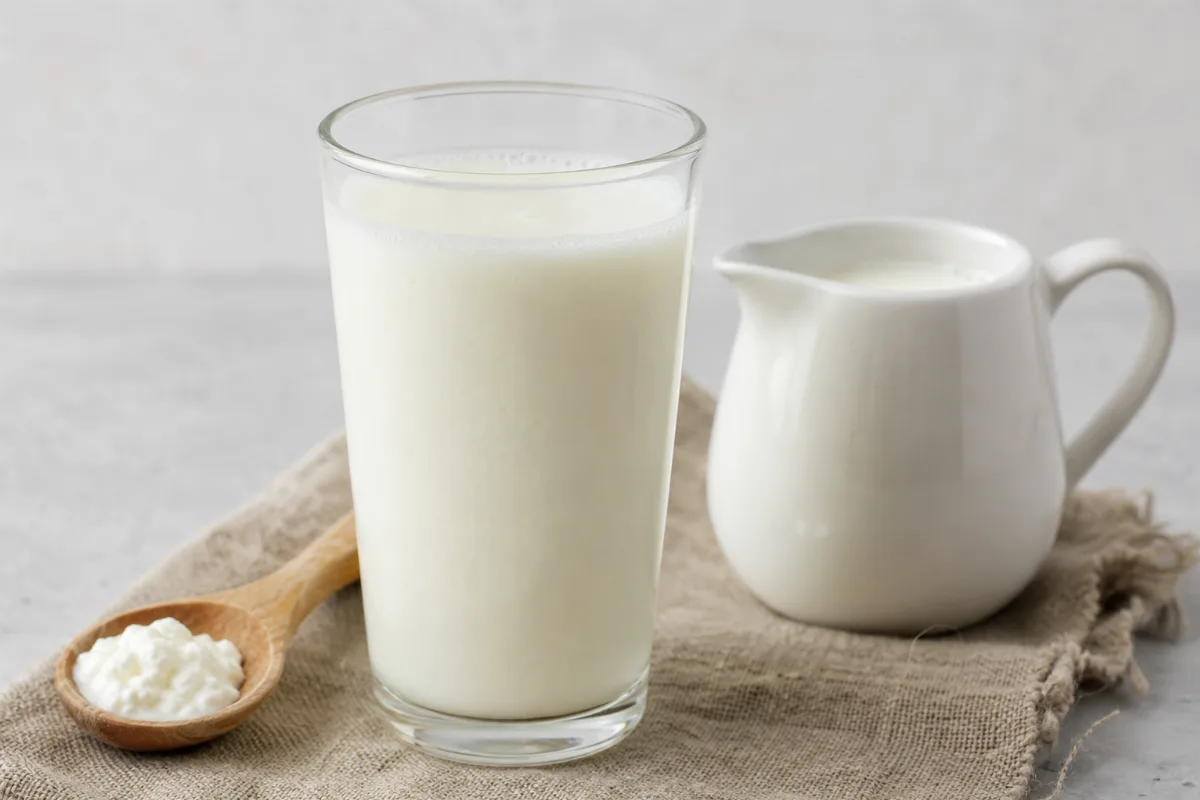
Fermented Foods · Fermented food
Cultured Buttermilk
Cultured cow's milk (fermented dairy drink) · also called Buttermilk, low-fat cultured buttermilk
Cultured buttermilk is a tangy drink made by fermenting cow's milk. By USDA data, a cup of the low-fat kind has about 8 g of protein and 284 mg of calcium, and 363 mg of sodium. Studies of buttermilk drinks for cholesterol and blood pressure are few, small and mixed, and no study shows it treats anything. The main cautions are milk allergy, lactose, sodium and, in pregnancy, choosing pasteurised dairy.
General information, not medical advice. Last substantive update · Not medically reviewed. A named clinician has not signed off on this page. How this page is made
About Cultured Buttermilk
Cultured buttermilk is a tangy fermented milk drink. It is a source of protein, calcium and riboflavin, and it contains lactose and sodium. It is a food, not a proven remedy: the research on buttermilk itself is small and mixed, and the one pooled result for cholesterol is about a milk fat ingredient.
What it is
Cultured buttermilk is a drink made from cow's milk that has been fermented. USDA lists two items: low-fat cultured buttermilk and reduced-fat cultured buttermilk, both fluid. Traditional sour buttermilk, the liquid left from butter-making, is a different product described in an earlier summary and not re-checked here.
Low-fat cultured buttermilk, per 100 g by USDA: 40 kcal, 3.31 g protein, 1.07 g fat, 5.36 g total sugars, 116 mg calcium and 148 mg sodium. How it is made, which cultures it contains and whether it is heated afterwards were not read from a source.
What is in a cup
One cup (245 g) of low-fat cultured buttermilk has about 98 kcal, 8.1 g of protein, 2.6 g of fat (1.6 g saturated), 13.1 g of sugars, 284 mg of calcium, 370 mg of potassium, 0.38 mg of riboflavin, 0.54 microgram of vitamin B12 and 363 mg of sodium.
The reduced-fat item has a little more fat and protein and more calcium, but less sodium: about 137 kcal, 10 g of protein, 350 mg of calcium and 257 mg of sodium a cup. Brands differ, so check the label. The numbers show what is in the food, not how much your body takes up.
What the research shows
Few studies look at buttermilk itself. In 61 perimenopausal women in Latvia, 250 mL a day of fermented buttermilk for 28 days did not clearly lower blood fats, and in the adjusted analysis the buttermilk group had higher total and LDL cholesterol than controls. This was a secondary analysis registered after the trial. In 25 young volunteers, a made-for-study buttermilk drink for 21 days did not significantly change blood chemistry or blood pressure.
A survey of 680 people in Nepal found lower systolic blood pressure and better blood fats in regular buttermilk drinkers. A survey cannot show that buttermilk is the cause, and the paper does not say what type of buttermilk was drunk.
A 2026 pooled analysis of 13 trials found that milk fat globule membrane (MFGM) and milk polar lipid foods or supplements lowered LDL by about 0.12 mmol/L with moderate certainty. Those were ingredients and supplements; the amount in a glass of buttermilk was not found.
Fermented, but not automatically a probiotic
Cultured buttermilk is made with bacteria. A 2026 review of fermented dairy (yoghurt, kefir and cheese; buttermilk is not named) says the bacteria make compounds that may help health, but that results vary a lot because strains, products and processing differ, and that better human trials are needed. No source read says which live cultures a carton of buttermilk contains or whether they survive to the shelf.
Food versus ingredients and supplements
The cholesterol pooled analysis is about MFGM and milk polar lipid ingredients and supplements, not about a glass of buttermilk. The buttermilk drink studies are small and mixed. Buttermilk powder, MFGM supplements and probiotic supplements are different products from the drink; ask a doctor or pharmacist before using supplements.
At a glance
Traditional uses history, not proof
- Drunk and used in cooking in many places
- Long use as food is not proof that it treats any condition
Studied for research
- Protein, calcium and riboflavin, high certainty for the nutrient content (USDA)
- Cholesterol and blood fats, very-low certainty for buttermilk, with one analysis pointing against a lowering effect
- Milk fat globule membrane (MFGM) ingredients and LDL, moderate certainty for the ingredient, not tested as buttermilk
- Blood pressure, very-low certainty (one survey, one null study)
- Lactose digestion and gut health, insufficient evidence for buttermilk
Main compounds
- Milk protein
- Calcium
- Riboflavin and vitamin B12
- Lactose (milk sugar)
- Milk fat globule membrane lipids
- Sodium
Common forms
- Low-fat and reduced-fat cultured buttermilk, fluid (both USDA items read)
- Fermented buttermilk drinks used in small studies
- Traditional sour buttermilk, powder and MFGM supplements are different products and are not covered
Research links: 2026 trial analysis: fermented buttermilk and blood fats (61 women) · 2026 review: MFGM ingredients and cholesterol (13 trials) · 2026 review: fermented dairy, mechanisms and safety · Research Library · Genes & Biomarkers Library
What it is and its history
- Accepted scientific name
- Cultured buttermilk (a fermented cow's milk drink)
- Common names
- Buttermilk (English); Low-fat cultured buttermilk (English); Cultured buttermilk (English)
- Family or group
- Fermented dairy. The base food is cow's milk.
- Harvest and processing
- USDA lists two cultured buttermilk items, 'lowfat' and 'reduced fat', fluid. Our earlier summary says traditional sour buttermilk is the thin liquid left from household butter-making and is not the USDA item; that was not re-checked against a source read today. How cultured buttermilk is made, which cultures are used and whether it is heat-treated afterwards were not read from a source.
- Look-alikes and adulterants
- Name: Traditional sour buttermilk; Note: The liquid from butter-making, described in the earlier summary; thinner, with different make-up. Not the USDA entries.; Name: Lassi and ayran; Note: Yogurt-based drinks, sometimes confused with buttermilk drinks.; Name: Buttermilk powder and MFGM supplements; Note: Ingredients and supplements; several MFGM trials used these, not the drink.
- Sustainability and conservation
- Not assessed.
Photographs
What is inside, and how it may work
What it contains and how those compounds act in cells and animals. Laboratory and animal mechanisms are not proven effects in people.
Main compounds
| Compound | Family | Where it is concentrated | Activity studied | Level of evidence |
|---|---|---|---|---|
| Protein | protein | Milk drink USDA: 3.31 g per 100 g (low-fat item); 4.1 g (reduced-fat item) | Milk protein is the source of milk allergy. 13 12 8 | Reference data |
| Calcium | mineral | Milk drink USDA: 116 mg per 100 g (low-fat); 143 mg (reduced-fat) | Nutrient content only; no absorption study was read. 13 12 | Reference data |
| Riboflavin (vitamin B2) and vitamin B12 | vitamin | Milk drink USDA per 100 g: riboflavin 0.154 mg and B12 0.22 microgram (low-fat); 0.21 mg and 0.37 microgram (reduced-fat) | Nutrient content only. 13 12 | Reference data |
| Lactose (milk sugar) | sugar | Milk drink USDA lists total sugars 5.36 g per 100 g (low-fat) and does not list lactose separately | The sugar that people with lactose intolerance react to. 13 11 | Reference data |
| Milk fat globule membrane (MFGM) and polar lipids | lipid | Milk drink Amount in buttermilk not found in the sources read | Tested as ingredients and supplements; pooled trials found a small LDL fall. 3 1 | Human data |
| Sodium | mineral | Milk drink USDA: 148 mg per 100 g (low-fat); 105 mg (reduced-fat) | Salt content varies with the product. 13 12 | Reference data |
Mechanisms, receptors and pathways
| Target or pathway | Gene or receptor | What was found | Level |
|---|---|---|---|
| Milk polar lipids and cholesterol absorption | Not specified in the sources read | The Latvian study's authors say dairy polar lipids have attracted interest for effects on cholesterol absorption, lipoprotein metabolism and blood lipids. This is background, not a tested result for buttermilk. 1 3 | Hypothesis |
| Fermentation by lactic acid bacteria | Not specified | A review of fermented dairy says lactic acid bacteria make bioactive peptides, organic acids and other compounds that may influence health, and may improve lactose digestion. It names yoghurt, kefir and cheese, not buttermilk, and says strains and processing make results vary. 2 | Review |
Absorption, metabolism and elimination
- Absorption
- Not found for buttermilk nutrients in people.
- Distribution
- Not found.
- Metabolism
- Not found.
- Elimination
- Not found.
- Bioavailability
- Not established.
Isolated compounds versus whole extracts
The cholesterol pooled analysis is about MFGM and milk polar lipid ingredients and supplements, not a glass of buttermilk. The trials of buttermilk drinks are small and mixed. Probiotic supplements and MFGM supplements are different products and are not covered by food results here.
Nutritional composition
Nutrition from USDA FoodData Central (SR Legacy, April 2018 release; values read 2026-10-26 from the project's saved copy of the data, not the public site). Low-fat cultured buttermilk (FDC 170874), per 100 g: 40 kcal, 3.31 g protein, 1.07 g fat (0.66 g saturated), 4.79 g carbohydrate, 5.36 g total sugars (lactose not listed separately), no fibre, 116 mg calcium, 148 mg sodium, 151 mg potassium, 89 mg phosphorus, 11 mg magnesium, 0.154 mg riboflavin, 0.22 microgram vitamin B12 and 4 mg cholesterol. One cup (245 g, the 100 g values multiplied by 2.45): about 98 kcal, 8.1 g protein, 2.6 g fat (1.6 g saturated), 11.7 g carbohydrate, 13.1 g sugars, 284 mg calcium, 363 mg sodium, 370 mg potassium, 218 mg phosphorus, 0.38 mg riboflavin and 0.54 microgram vitamin B12. Reduced-fat cultured buttermilk (FDC 167697), per 100 g: 56 kcal, 4.1 g protein, 2.0 g fat (1.24 g saturated), 5.3 g sugars, 143 mg calcium, 105 mg sodium, 180 mg potassium, 0.21 mg riboflavin and 0.37 microgram vitamin B12; per cup (245 g): about 137 kcal, 10.0 g protein, 350 mg calcium and 257 mg sodium. The two items differ because of fat level, brand and added ingredients, so check the label. Traditional sour buttermilk, buttermilk powder and flavoured products were not read.
1 high certainty1 moderate certainty2 very low certainty2 not enough evidence
What was looked at
The 6 benefits and uses checked for Cultured Buttermilk, each with how strong the evidence is. Tap one to open it.
- Protein, calcium and B vitamins (nutrient content)High certainty
- Cholesterol and blood fats (buttermilk drinks)Very low certainty
- Milk fat globule membrane (MFGM) ingredients and LDL cholesterol (ingredient, not buttermilk)Moderate certainty
- Blood pressureVery low certainty
- Lactose digestionNot enough evidence
- Gut health and live culturesNot enough evidence
Lab markers tracked in the studies
LDL cholesterolTotal cholesterolSystolic blood pressure
What is Cultured Buttermilk good for?
The studied uses and how strong the human evidence is for each. Only a few small studies look at buttermilk itself; the stronger results are for a milk fat ingredient, not the drink.
Benefits, one by one
Each card is a research question, not a promise. Tap a goal to filter. Open a card to see the studies, doses and limits.
Protein, calcium and B vitamins (nutrient content)
High certaintyBy USDA data, one cup (245 g) of low-fat cultured buttermilk has about 98 kcal, 8.1 g of protein, 284 mg of calcium, 0.38 mg of riboflavin and 0.54 microgram of vitamin B12. It also has 363 mg of sodium and about 13 g of sugars (milk sugar).
2 studiesUSDA low-fat and reduced-fat cultured buttermilk, fluid. Traditional …
Studies, doses and limits
What the trials found
No trial was read showing that drinking buttermilk corrects a low intake of any nutrient. The USDA gives amounts in the food, not how much your body takes up.
Results
Cultured buttermilk is a source of protein, calcium and riboflavin on paper. Reduced-fat cultured buttermilk (a second USDA item) has more calcium and protein per cup but less sodium, so the label matters.
Effect sizes as reported
USDA, low-fat cultured buttermilk per 100 g: 40 kcal, 3.31 g protein, 116 mg calcium, 148 mg sodium, 0.154 mg riboflavin. Per cup (245 g): 98 kcal, 8.1 g protein, 284 mg calcium, 363 mg sodium. Reduced-fat item per 100 g: 56 kcal, 4.1 g protein, 143 mg calcium, 105 mg sodium.
Why this rating
High that the food contains these nutrients (USDA data). Not tested as a treatment for any shortfall, and how much the body absorbs was not established in the sources read.
Form and dose studied
USDA low-fat and reduced-fat cultured buttermilk, fluid. Traditional sour buttermilk, powder and made-up drinks were not read.
Who was studied
General adult diet.
Limits
Nutrient facts, not trials. The values come from the April 2018 USDA release, and brands differ.
Why researchers looked
People drink it as a lower-fat dairy drink that gives protein and calcium.
Traditional use
Fermented milk drinks are eaten as food in many places. Long use as food is not proof that they treat any condition.
Proposed mechanism Nutrient database
These are nutrient amounts in the food, taken from USDA tables.
A proposed mechanism does not show that the effect happens in people.
Contains milk and lactose, and sodium; see the Safety tab.
Cholesterol and blood fats (buttermilk drinks)
Very low certaintyStudies of buttermilk drinks give mixed and weak results for cholesterol. A 28-day trial analysis found higher total and LDL cholesterol in the buttermilk group than in controls. A 21-day study found no significant change. One survey in Nepal linked regular buttermilk with better blood fats, but a survey cannot show cause.
3 studiesFermented buttermilk, 250 mL a day for 28 days (Latvia); a buttermilk…
Studies, doses and limits
What the trials found
In 61 perimenopausal women in Latvia, 250 mL a day of fermented buttermilk for 28 days did not clearly lower blood fats: in the adjusted analysis the buttermilk group had higher total cholesterol and LDL than controls, and the authors say the data do not support a lipid-lowering effect. In 25 young volunteers, 21 days of a made-for-study fermented buttermilk drink did not significantly change blood chemistry, although several cholesterol values fell slightly. In a survey of 680 people in Nepal, regular drinkers had lower total cholesterol and triglycerides and higher HDL than non-drinkers.
Results
No reliable benefit for cholesterol from buttermilk itself. The two intervention studies are small and do not show a lowering. The survey is the only favourable result and cannot show cause.
Effect sizes as reported
Latvia (secondary analysis): buttermilk group versus control, total cholesterol beta 0.485 (95% CI 0.023 to 0.948), LDL beta 0.330 (0.024 to 0.636), units not stated in the abstract. Lithuania: no significant change in 25 volunteers. Nepal: significant differences by p value only.
Why this rating
Very low: small studies, a secondary analysis, one drink made for the study and one cross-sectional survey. The best-controlled result points the wrong way for a benefit. Evidence against a lowering effect is stated plainly.
Form and dose studied
Fermented buttermilk, 250 mL a day for 28 days (Latvia); a buttermilk-based drink with milk protein concentrate for 21 days (Lithuania); habitual buttermilk, not defined (Nepal).
Who was studied
Perimenopausal women (Latvia), young volunteers (Lithuania), adults in one Nepalese district (Nepal).
Limits
Small groups, short trials, estimated rather than measured intake in the Latvian analysis, no stated control group in the Lithuanian page read, unknown buttermilk type in Nepal.
Why researchers looked
Buttermilk contains milk fat globule membrane (MFGM) lipids, which researchers have tested for effects on cholesterol.
Traditional use
Fermented milk drinks are eaten as food in many places. Long use as food is not proof that they treat any condition.
Proposed mechanism Hypothesis
Not shown for buttermilk. Researchers suggest milk polar lipids may affect cholesterol absorption in the gut; this is a hypothesis, not a result for buttermilk.
A proposed mechanism does not show that the effect happens in people.
Contains saturated fat (0.66 g per 100 g in the low-fat item) and sodium; see the Safety tab.
Milk fat globule membrane (MFGM) ingredients and LDL cholesterol (ingredient, not buttermilk)
Moderate certaintyA 2026 pooled analysis of 13 trials found that MFGM and milk polar lipid foods or supplements lowered LDL cholesterol by about 0.12 mmol/L. These were ingredients and supplements. The abstract does not say how much a glass of buttermilk provides.
1 studiesMFGM and milk polar lipid foods or supplements, 19.8 to 5,000 mg a da…
Studies, doses and limits
What the trials found
The pooled analysis covered 13 randomised trials in disease-free adults (2 to 16 weeks, 19.8 to 5,000 mg a day) against dairy comparators low in MFGM. Total cholesterol, LDL, apolipoprotein B and the total to HDL ratio fell a little with moderate certainty. HDL, triglycerides, glucose, insulin and blood pressure did not clearly change (low certainty). It did not test buttermilk as a drink.
Results
A small LDL fall for MFGM ingredients and supplements. It cannot be assumed for buttermilk.
Effect sizes as reported
Total cholesterol -0.18 mmol/L (95% CI -0.30 to -0.07); LDL -0.12 mmol/L (-0.22 to -0.03); apoB -0.05 g/L (-0.09 to -0.01).
Why this rating
Moderate for the ingredient, according to the review authors. Indirect for buttermilk, which was not tested, so this is not a promise about a glass of buttermilk. Funding was not stated in the abstract.
Form and dose studied
MFGM and milk polar lipid foods or supplements, 19.8 to 5,000 mg a day (trial detail, not advice).
Who was studied
Disease-free adults.
Limits
Ingredient and supplement trials. The amount in buttermilk was not reported in the sources read. Only the abstract was read.
Why researchers looked
Buttermilk is one source of milk fat globule membrane, so MFGM trials are sometimes quoted for it.
Traditional use
Fermented milk drinks are eaten as food in many places. Long use as food is not proof that they treat any condition.
Proposed mechanism Hypothesis
Not established. Milk polar lipids may affect cholesterol absorption; this is a proposed mechanism.
A proposed mechanism does not show that the effect happens in people.
Supplements are not the same as the food; ask a doctor or pharmacist before using any supplement.
Blood pressure
Very low certaintyOne survey in Nepal found lower systolic blood pressure in regular buttermilk drinkers. A 21-day study of a buttermilk-based drink found no significant change in blood pressure. Neither shows that buttermilk lowers blood pressure.
4 studiesHabitual buttermilk (Nepal); a made-for-study buttermilk drink (Lithu…
Studies, doses and limits
What the trials found
In 680 people in Nepal (340 regular drinkers, 340 not), systolic pressure (p=0.003) and mean arterial pressure (p=0.012) were lower in drinkers, and the diastolic difference was not significant (p=0.065). In 25 young volunteers, a fermented buttermilk-based drink for 21 days did not significantly change blood pressure or pulse. The MFGM pooled analysis found no clear effect on blood pressure.
Results
Not shown. One favourable survey and two null results.
Effect sizes as reported
Nepal: p values only in the abstract. Lithuania: no significant change. MFGM pooled analysis: no clear blood pressure effect (low certainty).
Why this rating
Very low: a cross-sectional survey cannot show cause, and the intervention results were null. The survey authors themselves call the blood pressure effect limited.
Form and dose studied
Habitual buttermilk (Nepal); a made-for-study buttermilk drink (Lithuania); MFGM ingredients (pooled analysis).
Who was studied
Adults.
Limits
Survey bias, small trials, unknown buttermilk type, sodium in the drink not considered in the abstracts.
Why researchers looked
Fermented dairy contains peptides that researchers have studied for blood pressure, and buttermilk is a common drink where the survey was done.
Traditional use
Fermented milk drinks are eaten as food in many places. Long use as food is not proof that they treat any condition.
Proposed mechanism Hypothesis
Not established for buttermilk. A review of fermented dairy says fermentation may create peptides with blood-pressure-lowering properties; no such effect was shown for buttermilk.
A proposed mechanism does not show that the effect happens in people.
Buttermilk contains sodium (363 mg a cup in the low-fat USDA item); see the Safety tab.
Lactose digestion
Not enough evidenceFermented dairy may be easier on lactose digestion for some people, but buttermilk was not tested. Buttermilk still contains milk sugar (about 13 g of sugars in a cup by USDA), so it is not lactose-free.
3 studiesCultured buttermilk as sold; home-made sour buttermilk may differ and…
Studies, doses and limits
What the trials found
NIDDK says people with lactose intolerance handle different amounts, and research suggests many could have 12 g of lactose (about 1 cup of milk) without symptoms or with mild ones. It suggests trying yogurt and hard cheeses. It does not name buttermilk in the part read. USDA lists total sugars (13.1 g a cup) and does not list lactose separately.
Results
No study of buttermilk and lactose symptoms was found. Tolerance differs from person to person.
Effect sizes as reported
USDA: total sugars 5.36 g per 100 g, 13.1 g per cup (245 g). NIDDK: about 12 g of lactose tolerated by many people with lactose intolerance (milk comparison).
Why this rating
Insufficient: general fermented-dairy and NIDDK statements only; no test of buttermilk.
Form and dose studied
Cultured buttermilk as sold; home-made sour buttermilk may differ and was not read.
Who was studied
People with lactose intolerance.
Limits
The lactose amount in buttermilk is not given by USDA. Fermented dairy results are general.
Why researchers looked
People with lactose intolerance ask whether cultured dairy drinks are easier to tolerate.
Traditional use
Fermented milk drinks are eaten as food in many places. Long use as food is not proof that they treat any condition.
Proposed mechanism Authoritative guidance
A review of fermented dairy says fermentation may improve lactose digestion in general; this was not shown for buttermilk.
A proposed mechanism does not show that the effect happens in people.
Milk allergy is different from lactose intolerance; buttermilk is not safe for milk allergy (see the Safety tab).
Gut health and live cultures
Not enough evidenceA fermented food is not automatically a probiotic. No study of buttermilk and gut health in people was found. Whether live cultures remain in a carton depends on the product and was not shown in the sources read.
2 studiesFermented dairy in general; a lab-made buttermilk with Lactobacillus …
Studies, doses and limits
What the trials found
A 2026 narrative review of fermented dairy (yoghurt, kefir, cheese) says results are inconsistent because strains, products and processing differ, and that better human trials are needed. Buttermilk is not named in its abstract. A 2026 lab study of a made-for-study fermented buttermilk found Listeria did not grow and the count fell, faster with an added probiotic strain; that is a food-safety lab test, not a health benefit.
Results
No human result for buttermilk and the gut.
Why this rating
Insufficient: reviews of other fermented dairy and a lab test only.
Form and dose studied
Fermented dairy in general; a lab-made buttermilk with Lactobacillus acidophilus LA-5.
Limits
Strains in commercial buttermilk are not given in the sources read. Heat treatment after fermentation and its effect on live cultures was not researched.
Why researchers looked
Cultured buttermilk is made with lactic acid bacteria, so people ask whether it supports the gut.
Traditional use
Fermented milk drinks are eaten as food in many places. Long use as food is not proof that they treat any condition.
Proposed mechanism Hypothesis
A review of fermented dairy proposes that fermentation bacteria and the compounds they make may influence gut microbes; this is a general proposal, not shown for buttermilk.
A proposed mechanism does not show that the effect happens in people.
Probiotic supplements are different products; ask a doctor or pharmacist.
Connections to the rest of health
How Cultured Buttermilk connects to the rest of our health knowledge graph. Every link says what kind of connection it is. A safety link (for example to the liver) is a warning, not a benefit. A study that merely mentions a topic never creates a benefit link.
Explore every connection: goals, body systems, organs, symptoms, genes
A. Wellness goals
| Connected to | Kind of connection | Evidence status | Context | Studies |
|---|---|---|---|---|
| Preventive Wellness | High certainty | Protein, calcium and B vitamins (nutrient content): By USDA data, one cup (245 g) of low-fat cultured buttermilk has about 98 kcal, 8.1 g of protein, 284 mg of calcium, 0.38 mg of riboflavin and 0.54 microgram of vitamin B12. It also has 363 mg of sodium and about 13 g of sugars (milk sugar). | 13 12 | |
| Bone Health | High certainty | Protein, calcium and B vitamins (nutrient content): By USDA data, one cup (245 g) of low-fat cultured buttermilk has about 98 kcal, 8.1 g of protein, 284 mg of calcium, 0.38 mg of riboflavin and 0.54 microgram of vitamin B12. It also has 363 mg of sodium and about 13 g of sugars (milk sugar). | 13 12 | |
| Cholesterol Balance | Very low certainty | Cholesterol and blood fats (buttermilk drinks): Studies of buttermilk drinks give mixed and weak results for cholesterol. A 28-day trial analysis found higher total and LDL cholesterol in the buttermilk group than in controls. A 21-day study found no significant change. One survey in Nepal linked regular buttermilk with better blood fats, but a survey cannot show cause. | 1 5 4 | |
| Heart Health | Very low certainty | Cholesterol and blood fats (buttermilk drinks): Studies of buttermilk drinks give mixed and weak results for cholesterol. A 28-day trial analysis found higher total and LDL cholesterol in the buttermilk group than in controls. A 21-day study found no significant change. One survey in Nepal linked regular buttermilk with better blood fats, but a survey cannot show cause. Blood pressure: One survey in Nepal found lower systolic blood pressure in regular buttermilk drinkers. A 21-day study of a buttermilk-based drink found no significant change in blood pressure. Neither shows that buttermilk lowers blood pressure. | 1 5 4 3 2 | |
| Cholesterol Balance | Moderate certainty | Milk fat globule membrane (MFGM) ingredients and LDL cholesterol (ingredient, not buttermilk): A 2026 pooled analysis of 13 trials found that MFGM and milk polar lipid foods or supplements lowered LDL cholesterol by about 0.12 mmol/L. These were ingredients and supplements. The abstract does not say how much a glass of buttermilk provides. | 3 | |
| Blood Pressure Support | Very low certainty | Blood pressure: One survey in Nepal found lower systolic blood pressure in regular buttermilk drinkers. A 21-day study of a buttermilk-based drink found no significant change in blood pressure. Neither shows that buttermilk lowers blood pressure. | 4 5 3 2 | |
| Digestive Support | Not enough evidence | Lactose digestion: Fermented dairy may be easier on lactose digestion for some people, but buttermilk was not tested. Buttermilk still contains milk sugar (about 13 g of sugars in a cup by USDA), so it is not lactose-free. | 11 13 2 | |
| Gut Health | Not enough evidence | Lactose digestion: Fermented dairy may be easier on lactose digestion for some people, but buttermilk was not tested. Buttermilk still contains milk sugar (about 13 g of sugars in a cup by USDA), so it is not lactose-free. Gut health and live cultures: A fermented food is not automatically a probiotic. No study of buttermilk and gut health in people was found. Whether live cultures remain in a carton depends on the product and was not shown in the sources read. | 11 13 2 6 | |
| Microbiome Balance | Not enough evidence | Gut health and live cultures: A fermented food is not automatically a probiotic. No study of buttermilk and gut health in people was found. Whether live cultures remain in a carton depends on the product and was not shown in the sources read. | 2 6 |
B. Body systems
| Connected to | Kind of connection | Evidence status | Context | Studies |
|---|---|---|---|---|
| Musculoskeletal System | Biological association | High certainty | Studied for: Protein, calcium and B vitamins (nutrient content) | 13 12 |
| Cardiovascular System | Biological association | Very low certainty | Studied for: Cholesterol and blood fats (buttermilk drinks) Studied for: Milk fat globule membrane (MFGM) ingredients and LDL cholesterol (ingredient, not buttermilk) | 1 5 4 3 2 |
| Digestive System | Biological association | Not enough evidence | Studied for: Lactose digestion Studied for: Gut health and live cultures | 11 13 2 6 |
E. Health conditions
| Connected to | Kind of connection | Evidence status | Context | Studies |
|---|---|---|---|---|
| Cow's milk allergy | Adverse effect or risk | Documented risk | Milk is a major food allergen; buttermilk is a milk food. Preparation or compound: Milk proteins in buttermilk |
8 9 |
| Lactose intolerance | Drug or supplement interaction | Documented risk | Buttermilk contains milk sugar; amounts tolerated differ by person. Buttermilk has milk sugar; tolerance differs by person. Preparation or compound: Milk sugar in buttermilk |
11 13 |
| Listeriosis | Adverse effect or risk | Documented risk | The NHS advises avoiding unpasteurised dairy in pregnancy because of listeria. Preparation or compound: Unpasteurised dairy |
10 |
| High cholesterol | Not enough evidence | Mixed and weak for buttermilk drinks; a small LDL fall for MFGM ingredients. Preparation or compound: Buttermilk drinks and MFGM ingredients |
1 3 |
I. Biomarkers
| Connected to | Kind of connection | Evidence status | Context | Studies |
|---|---|---|---|---|
| LDL cholesterol | Biological association | Measured in trials: mixed. A lab change is not the same as a health benefit. | ||
| Total cholesterol | Biological association | Measured in trials: mixed. A lab change is not the same as a health benefit. | ||
| Systolic blood pressure | Biological association | Measured in trials: mixed. A lab change is not the same as a health benefit. |
K. Biological pathways
| Connected to | Kind of connection | Evidence status | Context | Studies |
|---|---|---|---|---|
| Calcium | Preliminary mechanism | Reference data | Cultured buttermilk is a calcium source on paper (284 mg a cup, low-fat item). | 13 |
| Milk fat globule membrane (MFGM) | Preliminary mechanism | Human | An ingredient tested for a small LDL fall in trials; the amount in buttermilk was not found. | 3 |
| LDL cholesterol | Preliminary mechanism | Human | Mixed and weak for buttermilk drinks; small fall for MFGM ingredients. | 1 3 |
L. Active compounds
| Connected to | Kind of connection | Evidence status | Context | Studies |
|---|---|---|---|---|
| Protein | Biological association | Reference data | Milk protein is the source of milk allergy. Preparation or compound: Milk drink |
13 12 8 |
| Calcium | Biological association | Reference data | Nutrient content only; no absorption study was read. Preparation or compound: Milk drink |
13 12 |
| Riboflavin (vitamin B2) and vitamin B12 | Biological association | Reference data | Nutrient content only. Preparation or compound: Milk drink |
13 12 |
| Lactose (milk sugar) | Biological association | Reference data | The sugar that people with lactose intolerance react to. Preparation or compound: Milk drink |
13 11 |
| Milk fat globule membrane (MFGM) and polar lipids | Biological association | Human | Tested as ingredients and supplements; pooled trials found a small LDL fall. Preparation or compound: Milk drink |
3 1 |
| Sodium | Biological association | Reference data | Salt content varies with the product. Preparation or compound: Milk drink |
13 12 |
Each connection is stored with the ingredient, the connected record, the kind of connection, the evidence status, the supporting studies, the preparation or compound involved, and a review date (last reviewed October 26, 2026).
The evidence
The research centre for Cultured Buttermilk. Every record here was checked against PubMed or the publisher's page; we never list a study we have not verified.
Evidence by outcome
Bars show how many studies we found for each outcome, not how well it works. People are added up across trials only (reviews are not added, to avoid double counting).
How we rate evidence
High certainty
Several well-run trials or reviews agree; further research is unlikely to change the picture much.
Moderate certainty
Good trials point the same way, but some doubt remains.
Low certainty
Small, short or inconsistent trials. The finding could change with better research.
Very low certainty
Very little or very weak human data. Treat as a possibility only.
Mixed findings
Trials or reviews disagree with each other.
Not enough evidence
Not enough human research to say either way.
Evidence against
Good research found no benefit, or found harm.
We take the reviewers' own risk-of-bias and GRADE statements where they exist, and otherwise judge from study size, design, consistency, directness and whether a product matches what is sold. Many publications do not make evidence high. Method note: We started from our existing buttermilk summary, re-checked nutrition against saved USDA FoodData Central data, read the health agency pages (NHS, NIDDK, FDA, MedlinePlus) and re-read PubMed abstracts and two journal abstract pages. Only abstracts were read for studies. Items we could not verify are flagged in the research gaps.
Study library: every study we checked 13
| Study | Design | People | Product, dose, length | Result |
|---|---|---|---|---|
| Aleksejeva 2026 Estimated Habitual Dairy Polar Lipid Exposure and Post-Intervention Plasma Lipid Outcomes in Perimenopausal Women in Latvia: A Secondary Exposure-Based Analysis of a 28-Day Fermented Buttermilk Randomised Trial. Nutrients · PMID 42451194 · DOI |
Randomised trial secondary analysis |
61 61 perimenopausal women in Latvia: 31 in the buttermilk group, 30 in the control group, split into winter and spring groups |
Fermented buttermilk (the strains and product details are not given in the abstract) Drink 250 mL a day (trial detail, not advice) 28 days · vs Control group (no buttermilk) |
Estimated total dairy polar lipid intake was linked to higher HDL after the trial. It was not linked to total cholesterol, LDL or triglycerides. After adjustment, being in the buttermilk group went with higher total cholesterol and higher LDL than the control group. The authors say this does not support a clear lipid-lowering effect of 28 days of fermented buttermilk. HDL beta 0.059 per estimated polar lipid intake; buttermilk group versus control: total cholesterol beta 0.485, LDL beta 0.330 (units not stated in the abstract) (HDL 0.020 to 0.099; total cholesterol 0.023 to 0.948; LDL 0.024 to 0.636) Methods, limits and fundingOutcomes: Plasma total cholesterol, LDL, HDL and triglycerides; estimated dairy polar lipid intake from a food questionnaire Limitations: A secondary analysis, not the main trial result. Dairy polar lipid intake was estimated from a food questionnaire and average product composition, not measured. Small group. Registered after the trial was done. Authors urge caution. Funding and conflicts: Funding listed in the PubMed record: Latvia University of Life Sciences and Technologies. Not an industry body. Registration: ISRCTN11974930 (registered retrospectively, 25 June 2026) Read: abstract |
| Arslan 2026 Functional fermented dairy products: a review of mechanisms, health potential, and technological challenges. Front Nutr · PMID 42221754 · DOI |
Narrative review |
Review of fermented dairy products such as yoghurt, kefir and cheese (buttermilk is not named in the abstract) | Fermented dairy foods in general Fermented dairy |
Fermented dairy shows promise because of bioactive compounds made during fermentation, and fermentation may improve lactose digestion. But results are inconsistent because strains, products and processing differ. Safety points to watch: biogenic amines, sodium, allergenicity and antimicrobial resistance. The authors call for better human trials. No numbers in the abstract (Not applicable) Methods, limits and fundingOutcomes: Gut, immune, metabolic and heart-risk effects; safety (biogenic amines, sodium, allergenicity, antimicrobial resistance) Limitations: A narrative review of fermented dairy in general, not of buttermilk. Review authors describe emerging, not firm, evidence. Funding and conflicts: Funding is not stated in the abstract. Read: abstract |
| Borkar 2026 Impact of Milk Fat Globule Membrane and Its Associated Polar Lipids on Markers of Cardiometabolic Disease and Cognitive Function: A Systematic Review and Meta-Analysis of Randomized Controlled Trials in Adults. Adv Nutr · PMID 42398769 · DOI |
Systematic review meta analysis |
13 randomised trials (14 articles) in disease-free adults; risk of bias low to some concerns | Cow-derived milk fat globule membrane (MFGM) and milk polar lipid foods or supplements (ingredients, not a glass of buttermilk) Milk fat component 19.8 to 5,000 mg a day (trial detail, not advice) 2 to 16 weeks · vs Dairy products or supplements with the same energy but low in these components |
MFGM and milk polar lipids lowered total cholesterol, LDL, apolipoprotein B and the total to HDL cholesterol ratio, with moderate certainty and little difference between trials. No clear effect on HDL, triglycerides, glucose, insulin or blood pressure (low certainty). Evidence on newer markers, after-meal responses and thinking skills was limited. Total cholesterol -0.18 mmol/L; LDL -0.12 mmol/L; apoB -0.05 g/L; TC:HDL ratio -0.17 (Total cholesterol -0.30 to -0.07; LDL -0.22 to -0.03; apoB -0.09 to -0.01; ratio -0.33 to -0.01) Methods, limits and fundingOutcomes: Fasting total cholesterol, LDL, apolipoprotein B, TC:HDL ratio, HDL, triglycerides, glucose, insulin, blood pressure, cognition Limitations: These are MFGM ingredients and supplements. The abstract does not say how much MFGM is in a cup of buttermilk or whether buttermilk was tested. Funding and conflicts: Funding and conflicts of interest are not stated in the abstract. Registration: PROSPERO CRD42025636269 Read: abstract |
| Magar 2025 Effect of Buttermilk Consumption on Blood Pressure and Cholesterol: A Cross-Sectional Study Crimson Journal of Science and Technology 1(1):71-81 · Source · DOI |
Cross sectional |
680 680 people in Gulmi District, Nepal: 340 regular buttermilk drinkers and 340 non-drinkers |
Habitual buttermilk (not defined in the abstract) Drink Habitual intake, not measured as a dose · vs Non-consumers |
Regular drinkers had lower systolic blood pressure (p=0.003) and mean arterial pressure (p=0.012); the diastolic difference was not significant (p=0.065). Total cholesterol and triglycerides were lower and HDL higher. LDL was lower only in people with high baseline levels, not in the whole group. P values only in the abstract (Not applicable) Methods, limits and fundingOutcomes: Systolic, diastolic and mean blood pressure; total cholesterol, triglycerides, LDL, HDL Limitations: Cross-sectional: it compares people at one point in time and cannot show that buttermilk caused the difference. Diet, income and other habits can differ between groups. The abstract does not define the buttermilk (home-made, sour or cultured). A small new journal; treated as preliminary. Funding and conflicts: Funding is not stated in the abstract. Read: abstract |
| Narkevičius 2016 Fermented buttermilk-based beverage: impact on young volunteers' health parameters Czech J Food Sci 34(2):143-148 · Source · DOI |
Human intervention study |
25 25 young volunteers, 21 days |
A fermented drink made from buttermilk, skimmed milk and milk protein concentrate (0.3%), made for the study Drink Not given on the page read 21 days |
No statistically significant effect on blood chemistry after 21 days. Total, LDL and HDL cholesterol and triglycerides fell slightly but not significantly. Body composition, blood pressure and pulse did not change significantly. No numbers on the page read (Not applicable) Methods, limits and fundingOutcomes: Blood biochemistry, cholesterol, triglycerides, body composition, blood pressure, pulse Limitations: A made-for-study drink with added milk protein concentrate, not plain cultured buttermilk. Small. Whether it had a control group or randomisation is not stated on the page read. Funding and conflicts: Funding is not stated on the page read. Read: abstract |
| Smigiel 2026 Biological Control of Listeria monocytogenes Growth in Fermented Buttermilk Enriched with Microfiltration Retentate. Foods · PMID 42195947 · DOI |
Laboratory analysis n/a |
Lab-made fermented buttermilk with added microfiltration retentate, with Listeria added on purpose | Fermented buttermilk (lab-made, with Lactobacillus acidophilus LA-5 in some samples) Drink Storage at different temperatures · vs Buttermilk without the probiotic strain |
In this lab setting, the fermented buttermilk did not support Listeria growth and the count fell gradually. It fell faster with the probiotic strain. A prediction model suggested Listeria could grow in similar conditions, so the authors warn about relying on models. The reasons for the fall were not studied. No numbers in the abstract (Not applicable) Methods, limits and fundingOutcomes: Survival of Listeria monocytogenes during storage Limitations: A lab test on one study recipe, not on products on shop shelves. It does not show that unpasteurised or home-made buttermilk is safe, and it is not a human study. Funding and conflicts: Funding is not stated in the abstract. Read: abstract |
| Zarei Ahmady 2023 Occurrence of diarrheagenic Escherichia coli pathotypes from raw milk and unpasteurized buttermilk by culture and multiplex polymerase chain reaction in southwest Iran. Mol Biol Rep · PMID 36808583 · DOI |
Laboratory survey n/a |
197 197 samples bought from dairy stores in Ahvaz, Iran in 2021: 87 unpasteurised buttermilk and 110 raw cow milk |
Unpasteurised buttermilk and raw milk (tested in the lab) Dairy sample |
Of 76 presumed E. coli isolates, 50 were confirmed as E. coli, and 27 of those 50 carried diarrhoea-causing types. 7 of those 27 came from unpasteurised buttermilk and 20 from raw milk. The authors say this is a possible health risk and call for control efforts. 27 of 50 confirmed E. coli isolates carried diarrhoea-causing types (7 from buttermilk, 20 from raw milk) (Not applicable) Methods, limits and fundingOutcomes: Diarrhoea-causing E. coli types in the samples Limitations: A lab survey of products in one city, not a report of illness. The abstract does not give a rate of contaminated buttermilk samples. It says nothing about pasteurised buttermilk. Funding and conflicts: Funding is not stated in the abstract. Read: abstract |
| s-fda-allergens US FDA: Food Allergies · Source |
Health agency n/a |
Methods, limits and fundingRead: full-text | ||
| s-medlineplus-foodallergy MedlinePlus (US National Library of Medicine): Food allergy · Source |
Health agency n/a |
Methods, limits and fundingRead: full-text | ||
| s-nhs-foods-to-avoid NHS: Foods to avoid in pregnancy · Source |
Health agency n/a |
Methods, limits and fundingRead: full-text | ||
| s-niddk-lactose NIDDK: Eating, diet, and nutrition for lactose intolerance · Source |
Health agency n/a |
Methods, limits and fundingRead: full-text | ||
| s-usda-fdc-167697 USDA FoodData Central, SR Legacy: Milk, buttermilk, fluid, cultured, reduced fat (FDC 167697) · Source |
Reference database n/a |
Methods, limits and fundingRead: saved-copy | ||
| s-usda-fdc-170874 USDA FoodData Central, SR Legacy: Milk, buttermilk, fluid, cultured, lowfat (FDC 170874) · Source |
Reference database n/a |
Methods, limits and fundingRead: saved-copy |
What we do not know yet
- Research on buttermilk itself is thin: no large or long human trial was found, and the best-controlled result is a secondary analysis registered after the trial.
- The amount of MFGM and lactose in cultured buttermilk, and the live cultures it contains, were not found.
- The Nepal survey does not define its buttermilk, and surveys cannot show cause.
- Tyramine and histamine levels, advice for children and breastfeeding, kidney disease and gout were not researched.
- The US CDC raw milk and Listeria pages and the FDA definition of cultured buttermilk could not be read, so they are not relied on.
- Traditional sour buttermilk was not researched for this page.
How new research is added
New studies are found by a saved PubMed search and placed in a review queue before the page changes.
Lab markers
What changed in blood or saliva tests during trials. A changed number is not the same as feeling or being healthier, and we give no "normal ranges".
Metabolic 2
LDL cholesterol
Mixed results in trials
The 'bad' cholesterol carried in the blood. Higher levels are linked to more heart disease.
Results and what it means
Why it was measured
It is the usual blood marker used in diet trials for heart risk.
| Study | Result | People | Product |
|---|---|---|---|
| 1 | Higher LDL in the buttermilk group than controls (beta 0.330, 95% CI 0.024 to 0.636; units not stated) | 61 perimenopausal women in Latvia | Fermented buttermilk, 250 mL a day, 28 days |
| 3 | LDL -0.12 mmol/L (95% CI -0.22 to -0.03) with MFGM and milk polar lipid ingredients | 13 trials in disease-free adults | MFGM or milk polar lipids, 19.8 to 5,000 mg a day, 2 to 16 weeks (ingredients, not buttermilk) |
Total cholesterol
Mixed results in trials
All the cholesterol carried in the blood.
Results and what it means
Why it was measured
A common blood marker in diet trials.
| Study | Result | People | Product |
|---|---|---|---|
| 1 | Higher total cholesterol in the buttermilk group than controls (beta 0.485, 95% CI 0.023 to 0.948; units not stated) | 61 perimenopausal women in Latvia | Fermented buttermilk, 250 mL a day, 28 days |
| 5 | No significant change; values fell slightly | 25 young volunteers | Fermented buttermilk-based drink, 21 days |
Other 1
Systolic blood pressure
Mixed results in trials
The top number in a blood pressure reading, when the heart beats.
Results and what it means
Why it was measured
Diet studies often track it as a marker of heart risk.
Safety
What studies and official sources say about side effects, medicines and who should check first. Each point shows what kind of evidence it comes from.
Main points to know 4
- Milk allergy: buttermilk is a milk food. Milk is one of the nine major food allergens listed by the US FDA, and MedlinePlus names milk among common triggers of food allergy. Reactions can be severe. If you have a cow's milk allergy, buttermilk is not safe for you. Milk allergy is an immune reaction; it is different from lactose intolerance. Authoritative guidance 8 9
- Pregnancy: choose pasteurised, and check the label. The NHS says pasteurised milk and yoghurt are safe to eat in pregnancy, and that unpasteurised milk, cream, yoghurt and butter should be avoided because unpasteurised dairy may contain listeria, which can cause listeriosis, miscarriage or stillbirth. The NHS page does not name buttermilk. A lab survey in Iran found diarrhoea-causing E. coli types in unpasteurised buttermilk. Check that your buttermilk says pasteurised on the pack, and ask your midwife or doctor. Authoritative guidance 10 7
- Lactose: not lactose-free. Buttermilk contains milk sugar. USDA lists about 13.1 g of total sugars in a cup of low-fat cultured buttermilk and does not list lactose separately. NIDDK says many people with lactose intolerance can handle about 12 g of lactose at a time, and that people differ. Buttermilk is not named by NIDDK in the part read. Reference data and guidance 13 11
- Sodium. The low-fat cultured buttermilk item has 363 mg of sodium per cup by USDA (148 mg per 100 g); the reduced-fat item has 257 mg per cup. Brands differ, so read the label. If your doctor has set a salt limit for you, ask how it fits. Reference data 13 12
Side effects 3
| Effect | How often | Severity and recovery | Evidence |
|---|---|---|---|
| Allergic reactions to cow's milk, from itching and hives to anaphylaxis General milk-allergy statements; no buttermilk-specific data were read. | Not established | can be severe (anaphylaxis) Not described in the sources read. | Authoritative guidance 8 9 |
| Digestive upset in people with lactose intolerance NIDDK describes lactose intolerance in general; MedlinePlus lists cow's milk and dairy products among foods that often cause intolerance. Buttermilk is not named in either. | Not given for buttermilk | mild to moderate Not described. | Authoritative guidance 11 9 |
| Foodborne infection from unpasteurised dairy A product-contamination finding, not a report of illness from buttermilk. | Not given as a rate for buttermilk. In an Iranian lab survey, 7 of 27 diarrhoea-causing E. coli isolates came from unpasteurised buttermilk. | can be serious in pregnancy (NHS links listeriosis to miscarriage and stillbirth) Not described. | Authoritative guidance and lab survey 10 7 |
Liver
No liver injury from drinking cultured buttermilk was found in the sources read. A liver-safety source (such as LiverTox) was not searched.
How often. No frequency was found.
Monitoring. No agency monitoring advice was found.
This is a safety connection. It is not evidence that Cultured Buttermilk supports liver health.
Medicines and supplements 2
| With | Why it matters | Importance | Evidence | What to do |
|---|---|---|---|---|
| MAOI antidepressants (monoamine oxidase inhibitors) and tyramine in fermented foods prescription | Some fermented foods contain biogenic amines such as tyramine. With an MAOI, tyramine can raise blood pressure. | A 2026 review of fermented dairy lists biogenic amines among its safety considerations. No source read gave a tyramine level for cultured buttermilk or reported a case with an MAOI. | Theoretical Not enough evidence 2 | If you take an MAOI, ask your prescriber or pharmacist about fermented dairy, including buttermilk, and how fresh it should be. |
| Medicines or diets that limit salt or fluids prescription | Buttermilk contains sodium and potassium (151 mg potassium per 100 g, USDA). | No interaction was reported. This is a general reminder drawn from USDA values, not a documented interaction. | Reference data Not enough evidence 13 | If you have kidney disease, heart failure or a salt limit, ask your care team how a cultured dairy drink fits. |
Who should check first 5
| Situation | Advice | Evidence |
|---|---|---|
| Cow's milk allergy | Avoid buttermilk and other milk foods and read labels. Ask an allergist about your own case. For trouble breathing or swelling of the face, lips or throat, call 911 or your local emergency number. | Authoritative guidance 8 9 |
| Pregnancy | Choose pasteurised dairy and check the pack. The NHS advises avoiding unpasteurised milk, cream, yoghurt and butter in pregnancy. Buttermilk is not named by the NHS, so ask your midwife or doctor about your own diet. | Authoritative guidance 10 |
| Breastfeeding | No source read gave buttermilk-specific advice for breastfeeding. Ask your midwife or doctor. | Not found |
| Lactose intolerance | Buttermilk is not lactose-free. Tolerance differs; NIDDK suggests small amounts with meals and adding dairy slowly. Ask your doctor or dietitian if symptoms continue. | Authoritative guidance 11 |
| Taking an MAOI antidepressant | Ask your prescriber or pharmacist about fermented dairy. | Theoretical 2 |
Overdose, product quality and regulators
Summary. No toxicity from pasteurised cultured buttermilk as ordinary food was found in the sources read. The safety points are milk allergy, lactose, sodium, and unpasteurised dairy.
Animal. Not reviewed.
High dose or long term signals. The longest trial read was 28 days. Long-term effects of daily use were not studied in the sources read.
Overdose response. Not found.
Genotoxicity. Not researched.
Unpasteurised dairy can carry disease-causing bacteria. A lab test found Listeria did not grow in one study recipe of fermented buttermilk, but that does not make unpasteurised or home-made buttermilk safe.
Unpasteurised buttermilk. In a 2021 survey in Ahvaz, Iran, diarrhoea-causing E. coli types were found in 27 of 50 confirmed E. coli isolates from 87 unpasteurised buttermilk and 110 raw milk samples; 7 of the 27 came from buttermilk. A lab survey, not a report of illness. 7
Listeria in lab-made fermented buttermilk. In a 2026 lab study, Listeria did not grow in fermented buttermilk made with microfiltration retentate, and counts fell during storage. A prediction model suggested growth was possible, so the authors warn against relying on models. The mechanism was not studied. 6
| Body | Action | Date |
|---|---|---|
| US FDA (United States) | Food Allergies: milk is one of the nine major food allergens. source | 2026-03-11 |
| NHS (UK) (United Kingdom) | Foods to avoid in pregnancy: pasteurised milk and yoghurt are safe; avoid unpasteurised milk, cream, yoghurt, butter and ice cream because of listeria. Buttermilk is not named. source | 2026-06-15 |
| MedlinePlus (US National Library of Medicine) (United States) | Food allergy: milk is among common triggers; call 911 or the local emergency number for serious or whole-body reactions after eating any food. source | 2024-10-29 |
| NIDDK (US National Institutes of Health) (United States) | Eating, diet and nutrition for lactose intolerance: many people can have about 12 g of lactose without symptoms or with mild ones; amounts differ by person. source | 2018-02 |
When to get medical help
- Trouble breathing, wheezing, swelling of the lips, face, tongue or throat, widespread hives, repeated vomiting, dizziness or collapse after drinking buttermilk or another milk food (possible anaphylaxis): use epinephrine if prescribed, then call 911 or your local emergency number
- If you are pregnant and feel unwell with a fever after eating unpasteurised dairy, contact your midwife or doctor promptly (the NHS links listeria infection to miscarriage and stillbirth)
Stop using the product and contact a clinician or emergency service. In the US, Poison Control is 1-800-222-1222.
General information only, not medical advice. Ask a clinician or pharmacist before use, especially with medicines, in pregnancy or with a health condition. See the Natural Remedy Safety guide.
Frequently asked questions
What is cultured buttermilk?
What is in a cup of cultured buttermilk?
By USDA data, a cup (245 g) of the low-fat kind has about 98 kcal, 8.1 g of protein, 284 mg of calcium, 0.38 mg of riboflavin, 13.1 g of sugars and 363 mg of sodium. Check the label, because brands differ.
Does buttermilk lower cholesterol?
Is buttermilk good for blood pressure?
What is MFGM?
Milk fat globule membrane, a part of milk fat that contains polar lipids. In 13 trials, MFGM foods or supplements lowered LDL by about 0.12 mmol/L. The amount in buttermilk was not found.
Is buttermilk safe with lactose intolerance?
Is buttermilk a probiotic?
Not automatically. A fermented food is not a probiotic unless a benefit is shown for its strains. No source read says which live cultures buttermilk contains.
Can I drink buttermilk in pregnancy?
The NHS says pasteurised milk and yoghurt are safe and advises avoiding unpasteurised dairy because of listeria. Buttermilk is not named by the NHS. Check the pack says pasteurised and ask your midwife or doctor.
Who should avoid buttermilk because of allergy?
Is buttermilk high in sodium?
Does buttermilk interact with medicines?
No interaction was documented in the sources read. A review of fermented dairy lists biogenic amines among its safety points, and no tyramine level for buttermilk was found. If you take an MAOI antidepressant, ask your prescriber or pharmacist.
Explore by health goal
Cholesterol BalanceHeart HealthGut HealthPreventive WellnessBone HealthBlood Pressure SupportDigestive SupportMicrobiome Balance
Editorial transparency
- Written by
- AlternativeMed editorial team. Research compiled with AI assistance, then checked against the sources listed.
- Medical review
- None. This page has not been reviewed by a physician or pharmacist.
- First published
- 2026-10-26
- Last substantive update
- 2026-10-26
- How we research
- We started from our existing buttermilk summary, re-checked nutrition against saved USDA FoodData Central data, read the health agency pages (NHS, NIDDK, FDA, MedlinePlus) and re-read PubMed abstracts and two journal abstract pages. Only abstracts were read for studies. Items we could not verify are flagged in the research gaps.
- How we rate evidence
- See "How we rate evidence" in the Evidence tab.
- Independence
- No product is promoted on this page. No affiliate links are shown. No industry funding was stated in the abstracts read; funding for most was not stated at all.
Sources 13
Each source was opened and checked. Where we read only the abstract, it says so. The small numbers in the text point here.
- Aleksejeva S, Radenkovs V, Zolovs M, et al.. Estimated Habitual Dairy Polar Lipid Exposure and Post-Intervention Plasma Lipid Outcomes in Perimenopausal Women in Latvia: A Secondary Exposure-Based Analysis of a 28-Day Fermented Buttermilk Randomised Trial.. Nutrients. 2026. PMID 42451194. DOI 10.3390/nu18132194. (abstract)
- Arslan BN, Döndaş NY, Koçhan S, et al.. Functional fermented dairy products: a review of mechanisms, health potential, and technological challenges.. Front Nutr. 2026. PMID 42221754. DOI 10.3389/fnut.2026.1779688. (abstract)
- Borkar AS, Todorova Y, Markey O, et al.. Impact of Milk Fat Globule Membrane and Its Associated Polar Lipids on Markers of Cardiometabolic Disease and Cognitive Function: A Systematic Review and Meta-Analysis of Randomized Controlled Trials in Adults.. Adv Nutr. 2026. PMID 42398769. DOI 10.1016/j.advnut.2026.100694. (abstract)
- Magar AP, Neupane M, Rana R, KC P, Karki K, Neupane B. Effect of Buttermilk Consumption on Blood Pressure and Cholesterol: A Cross-Sectional Study. Crimson Journal of Science and Technology 1(1):71-81. 2025. DOI 10.3126/cjost.v1i1.88570. (abstract)
- Narkevičius R, Kaminskas A, Abaravičius JA, Vitkus D, Jablonskienė V, Sekmokienė D. Fermented buttermilk-based beverage: impact on young volunteers' health parameters. Czech J Food Sci 34(2):143-148. 2016. DOI 10.17221/344/2015-CJFS. (abstract)
- Smigiel P, Kowalik J, Bielecka M. Biological Control of Listeria monocytogenes Growth in Fermented Buttermilk Enriched with Microfiltration Retentate.. Foods. 2026. PMID 42195947. DOI 10.3390/foods15101742. (abstract)
- Zarei Ahmady A, Aliyan Aliabadi R, Amin M, Ameri A. Occurrence of diarrheagenic Escherichia coli pathotypes from raw milk and unpasteurized buttermilk by culture and multiplex polymerase chain reaction in southwest Iran.. Mol Biol Rep. 2023. PMID 36808583. DOI 10.1007/s11033-023-08261-3. (abstract)
- . US FDA: Food Allergies. . . (full-text)
- . MedlinePlus (US National Library of Medicine): Food allergy. . . (full-text)
- . NHS: Foods to avoid in pregnancy. . . (full-text)
- . NIDDK: Eating, diet, and nutrition for lactose intolerance. . . (full-text)
- . USDA FoodData Central, SR Legacy: Milk, buttermilk, fluid, cultured, reduced fat (FDC 167697). . . (saved-copy)
- . USDA FoodData Central, SR Legacy: Milk, buttermilk, fluid, cultured, lowfat (FDC 170874). . . (saved-copy)
Where to buy
Check the label first. Whatever you buy, look for these:
- Live and active cultures on the label, if that is what you want
- Refrigerated or shelf-stable, since shelf-stable versions may be heat treated
- Added sugar and sodium
- A best-by date
Talk to a pharmacist or doctor before you start any supplement, especially if you take medicines. See the Safety tab for interactions.
Support our free guides: as an Amazon Associate we earn from qualifying purchases. Full disclosure.


