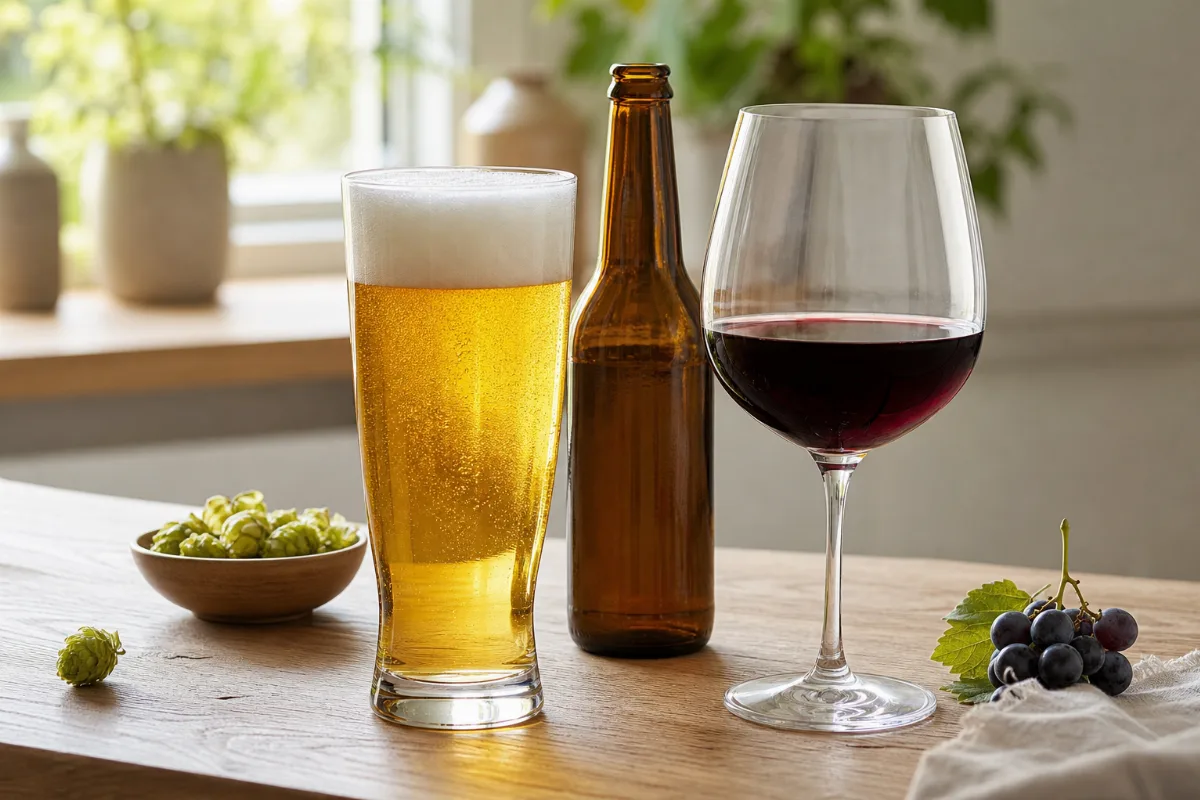
Beverages · Drink
Alcohol-Free Beer & Wine
Dealcoholized and non-alcoholic beer and wine (no single species) · also called Non-alcoholic beer, 0.0% beer, dealcoholized wine, alcohol-removed wine
Alcohol-free beer and wine are made like the regular drinks and then have most or all of the alcohol removed, or are brewed so little forms. The label matters: in the US, beer called non-alcoholic can hold under 0.5% alcohol, while only drinks with none may say alcohol free. The research is small: one 4-week trial found lower blood pressure with dealcoholized red wine, and beer trials gave mixed results. The main cautions are trace alcohol in pregnancy and in recovery from alcohol problems.
General information, not medical advice. Last substantive update · Not medically reviewed. A named clinician has not signed off on this page. How this page is made
About Alcohol-Free Beer & Wine
Alcohol-free beer and wine are drinks with the alcohol mostly or fully taken out. They are not a remedy. Research is limited to small short trials, so the clearest facts are what the label means and the safety cautions.
What it is
These drinks are made two ways: by limiting alcohol while brewing, or by removing it from the finished beer or wine with heat or membranes (reviews of beer and wine). Taking alcohol out also removes some flavour compounds.
In US rules for beer, 'non-alcoholic' means under 0.5% alcohol by volume, with that wording beside the term. '0.0%' may be shown only if the drink is also labelled 'alcohol free' and has none. The wine rules were not read.
No nutrition numbers are given here: USDA data could not be fetched and the papers read give no typical values. Calories and sugar differ by brand, so read the label.
What the research shows
Dealcoholized red wine lowered blood pressure in one crossover trial of 67 men at high heart risk. A 2025 review says most wine research is observational and the benefits of non-alcoholic wine need more study.
Beer trials were small and short. Some non-alcoholic beers worsened blood sugar and fat numbers in young men, probably because of calories and sugar. Gut bacteria diversity rose in 22 men. Seven soccer players kept their blood sodium steady.
Swapping may help some people drink less: a pub trial saw about 4% less alcoholic beer sold. But in a recovery study, users of non-alcoholic beer were less likely to stay abstinent.
In a lab check of 43 drinks, non-alcoholic beers made with membranes kept purines comparable to full-strength beer.
The drink versus its compounds
Studies here are about the drinks as drunk. Resveratrol and other polyphenol supplements are different products and were not covered.
At a glance
Traditional uses history, not proof
- Chosen as a taste-alike for people who want less or no alcohol
- Long use of beer and wine is not proof that the alcohol-free versions are healthy
Studied for research
- Blood pressure with dealcoholized red wine, low certainty (one small trial)
- Cutting down on alcohol, low certainty (pub sales and a survey)
- Blood sugar and blood fats with non-alcoholic beer, mixed
- Gut bacteria diversity, very low certainty
- Fluid and salt balance before exercise, very low certainty (seven people)
- Staying off alcohol in recovery, evidence against (observational)
Main compounds
- Trace ethanol (alcohol)
- Polyphenols from grain, hops or grapes
- Purines (in beer)
- Sugars and calories (differ by product)
Common forms
- Non-alcoholic beer made by limiting alcohol while brewing
- Non-alcoholic beer made by removing alcohol afterwards (heat or membranes)
- Dealcoholized wine (red, white and sparkling)
- Nutrition numbers were not verified and are not given
- Regular beer and wine, mocktails and sodas are different products
Research links: 2012 trial: dealcoholized red wine and blood pressure · 2025 trial: non-alcoholic beer and metabolism · 2026 follow-up: non-alcoholic beer and recovery · Research Library · Genes & Biomarkers Library
What it is and its history
- Accepted scientific name
- Dealcoholized and non-alcoholic beer and wine (no single species)
- Common names
- Alcohol-free beer (English); Non-alcoholic beer (English); 0.0% beer (English); Dealcoholized wine (English); Alcohol-removed wine (English); Non-alcoholic wine (English)
- Harvest and processing
- Two main routes: limit alcohol during brewing, or remove it afterwards by heat (vacuum distillation, spinning cone) or by membranes (reverse osmosis, osmotic distillation). Removing alcohol costs some flavour compounds and can change stability.
- Look-alikes and adulterants
- Name: Regular beer and wine, low-alcohol drinks, mocktails and soft drinks; Note: Different products. 'Low alcohol' beer is below 2.5% alcohol by volume under US rules; non-alcoholic is under 0.5%.
Photographs
What is inside, and how it may work
What it contains and how those compounds act in cells and animals. Laboratory and animal mechanisms are not proven effects in people.
Main compounds
| Compound | Family | Where it is concentrated | Activity studied | Level of evidence |
|---|---|---|---|---|
| Ethanol (trace) | alcohol | Drink Under 0.5% by volume for US 'non-alcoholic' beer; none for 'alcohol free' | The reason for the label rules and the pregnancy and recovery cautions. 16 1 | Human data |
| Polyphenols (resveratrol, quercetin in wine) | polyphenol | Drink Not given | A 2025 review says these are present in both alcoholic and non-alcoholic wine; health effects of the non-alcoholic form need more study. 2 | Review |
| Purines | purine | Beer 45.6 to 223.4 mg per litre in full-strength beers; membrane-dealcoholized non-alcoholic beers comparable; rice-based experimental ones 25 to 51% lower | Relevant to uric acid and gout; no gout study read. 14 | Lab |
Absorption, metabolism and elimination
- Absorption
- Not found.
- Distribution
- Trace ethanol reached breast milk in 2 of 15 women after 1.5 L of non-alcoholic beer.
- Metabolism
- Not found.
- Elimination
- Ethanol was not detected in breast milk samples taken 1 and 3 hours later (abstract).
- Bioavailability
- Not established.
Isolated compounds versus whole extracts
The studies read are about the drinks as drunk. Resveratrol or polyphenol supplements are different products and were not covered.
Nutritional composition
No nutrition numbers are given. USDA FoodData Central could not be queried on 2026-10-26 (the public API was rate-limited) and the peer-reviewed papers read do not list typical calories, sugar or carbohydrate for these drinks, which differ by brand. Read the Nutrition Facts panel. One 4-week trial linked unfavourable blood sugar and fat changes in some non-alcoholic beers to their calories and sugar.
1 mixed findings2 low certainty2 very low certainty1 evidence against
What was looked at
The 6 benefits and uses checked for Alcohol-Free Beer & Wine, each with how strong the evidence is. Tap one to open it.
- Blood pressure (dealcoholized red wine)Low certainty
- Cutting down on alcohol (swapping to an alcohol-free option)Low certainty
- Blood sugar and blood fats (non-alcoholic beer)Mixed findings
- Gut bacteria (non-alcoholic beer)Very low certainty
- Fluid and salt balance before exercise (non-alcoholic beer)Very low certainty
- Staying off alcohol after treatment (non-alcoholic beer)Evidence against
Lab markers tracked in the studies
Blood pressurePlasma nitric oxideFasting glucose and triglyceridesGut bacteria diversityBlood sodium during exercise
What is Alcohol-Free Beer & Wine good for?
The main studied uses and how strong the human evidence is for each. Almost all studies are small and short, so none is a reason to start drinking these.
Benefits, one by one
Each card is a research question, not a promise. Tap a goal to filter. Open a card to see the studies, doses and limits.
Blood pressure (dealcoholized red wine)
Low certaintyIn one small crossover trial of 67 men at high heart risk, 4 weeks of dealcoholized red wine lowered both blood pressure numbers and raised plasma nitric oxide.
2 studiesDealcoholized red wine, as studied. Other alcohol-free wines and beer…
Studies, doses and limits
What the trials found
One randomized crossover trial (67 men). A 2025 review says most wine research is observational and that benefits of non-alcoholic wine need more study.
Results
Blood pressure fell after the dealcoholized period compared with the start. The abstract gives no numbers.
Effect sizes as reported
Not given in the abstract.
Why this rating
One small, short trial in men at high risk, results reported without numbers in the abstract, and no repeat of the trial was read. Low, not high.
Form and dose studied
Dealcoholized red wine, as studied. Other alcohol-free wines and beers were not tested for blood pressure.
Who was studied
Men at high cardiovascular risk.
Limits
Measured blood pressure and nitric oxide, not heart attacks or strokes. Women were not included.
Why researchers looked
Red wine contains plant compounds called polyphenols. Researchers wanted to separate their effect from the effect of the alcohol.
Traditional use
Wine has been drunk for a very long time, but dealcoholized wine is a modern product.
Proposed mechanism Human trial proposed
The trial authors link the fall in blood pressure to nitric oxide, a gas that relaxes blood vessels. This is their reading of correlated changes, not proof.
A proposed mechanism does not show that the effect happens in people.
Alcohol-free wine can still contain trace alcohol. See the Safety tab.
Cutting down on alcohol (swapping to an alcohol-free option)
Low certaintyOffering a draught alcohol-free beer in 14 English pubs cut sales of draught alcoholic beer by about 4%. In a US survey, 59% of non-alcoholic beer drinkers who also drank alcohol felt they drank less when they chose it.
2 studiesDraught alcohol-free beer in pubs; self-reported non-alcoholic beer.
Studies, doses and limits
What the trials found
One randomized crossover field trial of venues and one national survey. Neither followed individual people's health.
Results
Pub sales of alcoholic draught beer were 4% lower (range 8% lower to 0.1% higher) when an alcohol-free draught beer was on offer. In the survey, 13% of non-alcoholic beer drinkers felt they drank more alcohol.
Effect sizes as reported
-20 L a week (4%); 5% after excluding venues that failed a fidelity check. Survey: 59% felt they drank less; 13% felt they drank more.
Why this rating
The trial counted venue sales, not people, and its main range included no change. The survey asks about feelings. Neither shows lasting reduction in a person's drinking or any health gain.
Form and dose studied
Draught alcohol-free beer in pubs; self-reported non-alcoholic beer.
Who was studied
Pub customers in England; US adults aged 21+ who drink weekly.
Limits
Short 8-week trial; survey cannot show cause. Some drinkers felt they drank more.
Why researchers looked
Many people use these drinks to reduce alcohol. Whether that really happens is the question.
Proposed mechanism Behavioural
Replacing an alcoholic drink with a drink without alcohol removes that alcohol from the occasion. It is not a biological effect of the drink.
A proposed mechanism does not show that the effect happens in people.
For people recovering from alcohol dependence, one study linked non-alcoholic beer with a higher chance of drinking again. See below and the Safety tab.
Blood sugar and blood fats (non-alcoholic beer)
Mixed findingsIn 44 healthy young men, 660 mL a day of non-alcoholic beer for 4 weeks had different effects by beer type: mixed beer and wheat beer made some numbers worse, pilsener and water lowered cholesterol.
1 studiesThree non-alcoholic beer types, as studied.
Studies, doses and limits
What the trials found
One randomized, investigator-blinded trial with a water group.
Results
Mixed beer raised fasting glucose and triglycerides. Wheat beer raised insulin, C-peptide and triglycerides. Pilsener and water lowered cholesterol and LDL without clearly changing glucose. Liver damage markers fell with water, pilsener (M30) and mixed beer (ALT and AST).
Effect sizes as reported
Direction of change only in the abstract.
Why this rating
Results go in opposite directions depending on the beer. One trial, young healthy men, 4 weeks.
Form and dose studied
Three non-alcoholic beer types, as studied.
Who was studied
Healthy young men.
Limits
Small groups, short, no women, no people with diabetes.
Why researchers looked
People wonder whether a drink without alcohol is neutral for sugar and fat metabolism.
Proposed mechanism Human trial proposed
The authors think the effects came from the calories and sugar in the beers, not from polyphenols.
A proposed mechanism does not show that the effect happens in people.
Sugar and calories differ by product; read the label. People with diabetes should ask their care team.
Gut bacteria (non-alcoholic beer)
Very low certaintyIn 22 healthy men, a daily non-alcoholic or alcoholic beer for 4 weeks raised gut bacteria diversity. Body weight and blood markers did not change.
1 studiesNon-alcoholic beer, 0.0%, as studied.
Studies, doses and limits
What the trials found
One randomized, double-blind trial with two beer groups and no water group.
Results
Gut diversity rose in both groups; a gut-barrier marker tended to rise. No change in weight, fat mass or blood markers.
Effect sizes as reported
No numbers in the abstract.
Why this rating
22 men, no no-beer group, and a bacteria marker rather than a health outcome.
Form and dose studied
Non-alcoholic beer, 0.0%, as studied.
Who was studied
Healthy men.
Limits
No comparison with water; health benefit not shown.
Why researchers looked
Beer contains polyphenols, which gut bacteria may use.
Proposed mechanism Human trial proposed
The authors suggest the effect is independent of alcohol and may come from beer polyphenols. This was not tested directly.
A proposed mechanism does not show that the effect happens in people.
None specific beyond trace alcohol.
Fluid and salt balance before exercise (non-alcoholic beer)
Very low certaintyIn seven male soccer players, 0.7 L of non-alcoholic beer before a 45-minute run kept blood sodium steady, while water and alcoholic beer did not.
1 studiesNon-alcoholic beer, as studied.
Studies, doses and limits
What the trials found
One small randomized, double-blind trial.
Results
Plasma sodium fell with water (-3.9%) and alcoholic beer (-3.7%) but not with non-alcoholic beer. Body mass fell about 1% in all groups.
Effect sizes as reported
Plasma sodium -3.9% (water), -3.7% (alcoholic beer).
Why this rating
Seven people, one session, and no performance outcome.
Form and dose studied
Non-alcoholic beer, as studied.
Who was studied
Seven male soccer players.
Limits
Tiny, single session.
Why researchers looked
Non-alcoholic beer contains some sodium, so researchers asked whether it helps hydration.
Proposed mechanism Human trial proposed
Not established; the authors suggest sodium in the drink helps.
A proposed mechanism does not show that the effect happens in people.
Not a replacement for medical advice about fluids.
Staying off alcohol after treatment (non-alcoholic beer)
Evidence againstIn a one-year follow-up of 198 Japanese men treated for alcohol dependence, those who used non-alcoholic beer were less likely to stay abstinent (15.3% versus 51.2%). This is a warning signal, not a benefit.
1 studiesSelf-reported non-alcoholic beer use.
Studies, doses and limits
What the trials found
One prospective cohort using mailed questionnaires.
Results
Non-alcoholic beer use was linked with a higher risk of a drinking lapse (HR 2.30, 95% CI 1.54 to 3.44), also after adjusting for self-help group and smoking.
Effect sizes as reported
Abstinence 51.2% non-users vs 15.3% users; lapse HR 2.30.
Why this rating
Evidence points against using it in recovery, but it is observational: it cannot show the drink caused relapse.
Form and dose studied
Self-reported non-alcoholic beer use.
Who was studied
Japanese men treated as inpatients for alcohol dependence.
Limits
Men only, one country, cause and effect unclear.
Why researchers looked
Some people in recovery drink these for the taste. Researchers asked whether that helps or hinders.
Proposed mechanism Hypothesis
Not tested. The authors raise the possibility that the drink may act as a trigger.
A proposed mechanism does not show that the effect happens in people.
Talk with your treatment team before using these drinks in recovery.
Connections to the rest of health
How Alcohol-Free Beer & Wine connects to the rest of our health knowledge graph. Every link says what kind of connection it is. A safety link (for example to the liver) is a warning, not a benefit. A study that merely mentions a topic never creates a benefit link.
Explore every connection: goals, body systems, organs, symptoms, genes
A. Wellness goals
| Connected to | Kind of connection | Evidence status | Context | Studies |
|---|---|---|---|---|
| Heart Health | Low certainty | Blood pressure (dealcoholized red wine): In one small crossover trial of 67 men at high heart risk, 4 weeks of dealcoholized red wine lowered both blood pressure numbers and raised plasma nitric oxide. | 5 2 | |
| Healthy Weight Metabolism | Low certainty | Cutting down on alcohol (swapping to an alcohol-free option): Offering a draught alcohol-free beer in 14 English pubs cut sales of draught alcoholic beer by about 4%. In a US survey, 59% of non-alcoholic beer drinkers who also drank alcohol felt they drank less when they chose it. | 7 12 | |
| Healthy Weight Metabolism | Mixed findings | Blood sugar and blood fats (non-alcoholic beer): In 44 healthy young men, 660 mL a day of non-alcoholic beer for 4 weeks had different effects by beer type: mixed beer and wheat beer made some numbers worse, pilsener and water lowered cholesterol. | 9 | |
| Gut Digestive Health | Very low certainty | Gut bacteria (non-alcoholic beer): In 22 healthy men, a daily non-alcoholic or alcoholic beer for 4 weeks raised gut bacteria diversity. Body weight and blood markers did not change. | 10 | |
| Energy Vitality | Very low certainty | Fluid and salt balance before exercise (non-alcoholic beer): In seven male soccer players, 0.7 L of non-alcoholic beer before a 45-minute run kept blood sodium steady, while water and alcoholic beer did not. | 4 | |
| Stress Relaxation | Evidence against | Staying off alcohol after treatment (non-alcoholic beer): In a one-year follow-up of 198 Japanese men treated for alcohol dependence, those who used non-alcoholic beer were less likely to stay abstinent (15.3% versus 51.2%). This is a warning signal, not a benefit. | 15 |
B. Body systems
| Connected to | Kind of connection | Evidence status | Context | Studies |
|---|---|---|---|---|
| Cardiovascular System | Biological association | Low certainty | Studied for: Blood pressure (dealcoholized red wine) | 5 2 |
| Reproductive System | Biological association | Low certainty | Studied for: Cutting down on alcohol (swapping to an alcohol-free option) | 7 12 |
| Metabolic System | Biological association | Mixed findings | Studied for: Blood sugar and blood fats (non-alcoholic beer) | 9 |
| Digestive System | Biological association | Very low certainty | Studied for: Gut bacteria (non-alcoholic beer) | 10 |
| Urinary System | Biological association | Very low certainty | Studied for: Fluid and salt balance before exercise (non-alcoholic beer) | 4 |
| Nervous System | Biological association | Evidence against | Studied for: Staying off alcohol after treatment (non-alcoholic beer) | 15 |
E. Health conditions
| Connected to | Kind of connection | Evidence status | Context | Studies |
|---|---|---|---|---|
| Alcohol use disorder | Preliminary | One observational study linked non-alcoholic beer use with lower one-year abstinence after treatment. Preparation or compound: Non-alcoholic beer |
15 | |
| Fetal alcohol spectrum disorders | Adverse effect or risk | Documented risk | Alcohol in pregnancy raises the risk; trace alcohol in alcohol-free drinks was not studied in pregnancy. Preparation or compound: Alcohol (and trace alcohol in labelled-'non-alcoholic' drinks) |
18 1 |
| Gout | Laboratory only | Membrane-dealcoholized beers kept purines comparable to full-strength beer in a lab analysis; no gout study was read. Purines in membrane-dealcoholized beers were comparable to full-strength beer in a lab analysis. Preparation or compound: Purines in non-alcoholic beer |
14 |
I. Biomarkers
| Connected to | Kind of connection | Evidence status | Context | Studies |
|---|---|---|---|---|
| Blood pressure | Biological association | Low certainty | Measured in trials: lower after 4 weeks of dealcoholized red wine (one small trial). A lab change is not the same as a health benefit. | 5 |
| Plasma nitric oxide | Biological association | Low certainty | Measured in trials: higher after dealcoholized red wine (one small trial). A lab change is not the same as a health benefit. | 5 |
| Fasting glucose and triglycerides | Biological association | Mixed findings | Measured in trials: rose with mixed non-alcoholic beer and wheat beer; fell (cholesterol) with pilsener and water. A lab change is not the same as a health benefit. | 9 |
| Gut bacteria diversity | Biological association | Very low certainty | Measured in trials: higher after 4 weeks of non-alcoholic or alcoholic beer. A lab change is not the same as a health benefit. | 10 |
| Blood sodium during exercise | Biological association | Very low certainty | Measured in trials: stayed steady with non-alcoholic beer; fell with water and alcoholic beer. A lab change is not the same as a health benefit. | 4 |
K. Biological pathways
| Connected to | Kind of connection | Evidence status | Context | Studies |
|---|---|---|---|---|
| Nitric oxide signalling | Preliminary mechanism | Human | Plasma nitric oxide rose with dealcoholized red wine in one trial. | 5 |
L. Active compounds
| Connected to | Kind of connection | Evidence status | Context | Studies |
|---|---|---|---|---|
| Ethanol (trace) | Biological association | Human | The reason for the label rules and the pregnancy and recovery cautions. Preparation or compound: Drink |
16 1 |
| Polyphenols (resveratrol, quercetin in wine) | Biological association | Review | A 2025 review says these are present in both alcoholic and non-alcoholic wine; health effects of the non-alcoholic form need more study. Preparation or compound: Drink |
2 |
| Purines | Biological association | Lab | Relevant to uric acid and gout; no gout study read. Preparation or compound: Beer |
14 |
Each connection is stored with the ingredient, the connected record, the kind of connection, the evidence status, the supporting studies, the preparation or compound involved, and a review date (last reviewed October 26, 2026).
Evidence at a glance: what the research found for 6 outcomes
Each outcome below is one thing researchers measured. Certainty is how far the evidence can be trusted, not how well it works. The full studies are on the next tab.
The evidence
The research centre for Alcohol-Free Beer & Wine. Every record here was checked against PubMed or the publisher's page; we never list a study we have not verified.
Evidence by outcome
Bars show how many studies we found for each outcome, not how well it works. People are added up across trials only (reviews are not added, to avoid double counting).
How we rate evidence
High certainty
Several well-run trials or reviews agree; further research is unlikely to change the picture much.
Moderate certainty
Good trials point the same way, but some doubt remains.
Low certainty
Small, short or inconsistent trials. The finding could change with better research.
Very low certainty
Very little or very weak human data. Treat as a possibility only.
Mixed findings
Trials or reviews disagree with each other.
Not enough evidence
Not enough human research to say either way.
Evidence against
Good research found no benefit, or found harm.
We take the reviewers' own risk-of-bias and GRADE statements where they exist, and otherwise judge from study size, design, consistency, directness and whether a product matches what is sold. Many publications do not make evidence high. Method note: We started from our existing page, then re-checked each study through PubMed (record and abstract) and re-read the eCFR, NHS and WHO pages. Only abstracts were read for studies. Items we could not verify are listed in the research gaps.
Study library: every study we checked 18
| Study | Design | People | Product, dose, length | Result |
|---|---|---|---|---|
| Adiong 2014 Consuming non-alcoholic beer and other beverages during pregnancy and breastfeeding. Can Fam Physician · PMID 25122816 |
Expert answer (Motherisk) |
Question from family doctors about pregnant and breastfeeding patients | Non-alcoholic beer and other alcohol-free versions of alcoholic drinks Drink |
Such drinks might contain more ethanol than their labels say. There is no known safe level of alcohol in pregnancy, so avoiding these drinks would remove any risk of fetal alcohol spectrum disorder. Moderate intake is likely harmless to breastfed infants, and briefly delaying breastfeeding after drinking one would avoid any alcohol exposure. Advice, no numbers (Not applicable) Methods, limits and fundingOutcomes: Safety advice in pregnancy and breastfeeding Limitations: A short expert answer, not a trial. It is from 2014. Funding and conflicts: Not stated in the abstract. Read: abstract |
| Afonso 2025 Non-Alcoholic Wines: Sensory Pleasantness and Health Benefits. Foods · PMID 40282758 · DOI |
Narrative review |
Review of non-alcoholic wine, taste and health | Non-alcoholic wine (and wine in general) Drink |
The review says phenolic compounds such as resveratrol and quercetin are present in both alcoholic and non-alcoholic wine. It says most wine research is observational and that the specific benefits of non-alcoholic wine need more study. No numbers in the abstract (Not applicable) Methods, limits and fundingOutcomes: Sensory qualities and possible health effects Limitations: A narrative review. The abstract gives no trial results for non-alcoholic wine. Funding and conflicts: The authors declare no conflicts of interest. Read: abstract |
| Akhtar 2025 Dealcoholized wine: Techniques, sensory impacts, stability, and perspectives of a growing industry. Compr Rev Food Sci Food Saf · PMID 40243128 · DOI |
Narrative review |
Review of dealcoholization methods for wine | Dealcoholized wine Drink |
Reviews reverse osmosis, osmotic distillation, vacuum distillation, spinning cone column, pervaporation and diafiltration, and how they affect flavour, aroma, mouthfeel, stability (chemical, microbial, oxidative, colour) and the market. No numbers (Not applicable) Methods, limits and fundingOutcomes: Methods, sensory effects, stability, market Limitations: A production and market review; it does not test health effects. Funding and conflicts: The authors declare no conflicts of interest. Read: abstract |
| Castro-Sepulveda 2016 Effects of Beer, Non-Alcoholic Beer and Water Consumption before Exercise on Fluid and Electrolyte Homeostasis in Athletes. Nutrients · PMID 27338452 · DOI |
Randomized double blind trial |
7 7 male soccer players |
Non-alcoholic beer Beer 0.7 L, 45 minutes before 45 minutes of treadmill running (as studied) Single session · vs Water and alcoholic beer |
Body mass fell about 1% in every group. Plasma sodium fell with water (-3.9%) and alcoholic beer (-3.7%) but not with non-alcoholic beer. Plasma potassium rose with alcoholic beer (8.5%). The authors say non-alcoholic beer before exercise could help keep electrolyte balance. Plasma sodium: -3.9% water, -3.7% alcoholic beer, no significant fall with non-alcoholic beer (Not given in the abstract) Methods, limits and fundingOutcomes: Body mass, plasma sodium and potassium, urine specific gravity Limitations: Seven people, one session, one drink amount. Sports performance was not measured. Funding and conflicts: Funding and conflicts are not stated in the abstract. Read: abstract |
| Chiva-Blanch 2012 Dealcoholized red wine decreases systolic and diastolic blood pressure and increases plasma nitric oxide: short communication. Circ Res · PMID 22955728 · DOI |
Randomized crossover trial |
67 67 men at high cardiovascular risk |
Dealcoholized red wine (the amount left after removing the alcohol from red wine that would give 30 g alcohol a day) Drink Daily, as set by the trial 4 weeks per period, after a 2-week run-in · vs Red wine and gin (30 g alcohol a day each) |
Systolic and diastolic blood pressure fell after the dealcoholized red wine period, and the falls tracked rises in plasma nitric oxide. Blood pressure fell; the abstract gives no numbers. (Not given in the abstract) Methods, limits and fundingOutcomes: Systolic and diastolic blood pressure, plasma nitric oxide Limitations: A short communication in men only, at high heart risk. Blood pressure and nitric oxide were measured, not heart attacks or strokes. The abstract does not say which wine, how much blood pressure fell, or who paid for the trial. Funding and conflicts: Funding and conflicts are not stated in the abstract. Registration: ISRCTN88720134 Read: abstract |
| D'Andrea 2026 Non-Alcoholic and Low-Alcohol Beer: Regulatory Complexity, Market Expansion and Technical Bottlenecks in Biological and Physical Dealcoholisation. Foods · PMID 42650516 · DOI |
Narrative review |
Review of how non-alcoholic and low-alcohol beers are made and regulated | Non-alcoholic and low-alcohol beer Beer |
Beer can be made with less alcohol either by limiting alcohol during brewing (for example controlled mashing, arrested or cold-contact fermentation, special yeasts) or by removing it afterwards (heat-based methods such as vacuum distillation, or membrane methods such as reverse osmosis). Rules differ: in the EU, national limits for ethanol classes diverge. Removing alcohol costs flavour compounds. Brewing-based methods can raise microbiological risk: E. coli O157:H7, Salmonella enterica and Listeria monocytogenes have been documented surviving for long periods in craft non-alcoholic beers with pH above 4.20 and under 0.5% alcohol, so heat or sterile filtration matters. No numbers other than pH 4.20 and 0.5% alcohol (Not applicable) Methods, limits and fundingOutcomes: Methods, rules and microbial safety Limitations: A narrative review of beer only; wine was not covered. Original studies were not read. Funding and conflicts: The authors declare no conflict of interest. Read: abstract |
| De-Loyde 2024 The impact of introducing alcohol-free beer options in bars and public houses on alcohol sales and revenue: A randomised crossover field trial. Addiction · PMID 38508212 · DOI |
Randomized crossover field trial |
14 14 bars and pubs in England that did not sell draught alcohol-free beer |
One draught alcohol-free beer replacing one draught alcoholic beer Beer Two intervention and two control periods over 8 weeks · vs Usual drinks list |
When a draught alcohol-free beer was offered, weekly sales of draught alcoholic beer were 4% lower (5% lower after excluding venues that failed a fidelity check). Takings did not change clearly. -20 L a week (4% less); -29 L a week (5% less) in the fidelity-checked group (95% CI -41 to +0.4 L (8% less to 0.1% more); fidelity-checked group -53 to -5 L) Methods, limits and fundingOutcomes: Weekly litres of draught alcoholic beer sold; weekly takings Limitations: It counted venue sales, not what any one person drank. The main result was borderline: the range included no change. Funding and conflicts: The abstract lists no funding or conflicts; an erratum was published in 2025. Read: abstract |
| Guazzo 2026 An In Vitro and In Vivo Assessment of Acidogenicity of Several Alcoholic and Non-Alcoholic Beverages. Clin Exp Dent Res · PMID 42830648 · DOI |
Lab plus small human test |
19 19 healthy adults (tooth-surface pH test) |
Sparkling wines, red and white wine, alcoholic and non-alcoholic soft drinks, pilsner beer, orange juice Drink 10 mL held in the mouth for 1 minute Up to 30 minutes · vs Water |
Every drink except water caused an immediate drop in tooth-surface pH, which recovered toward normal within 10 to 15 minutes. Traditional-method sparkling wine and orange juice gave the longest acid challenge. The lowest mean pH was 6.2. Lowest mean tooth-surface pH 6.2 (Not given in the abstract) Methods, limits and fundingOutcomes: Acidity of drinks and tooth-surface pH Limitations: No alcohol-free beer or wine was tested; the only non-alcoholic drink was a soft drink. It measured short-term acidity, not tooth damage. Funding and conflicts: The authors declare no conflicts of interest. Read: abstract |
| Kreimeyer 2025 Non-Alcoholic Beer Influences Glucose and Lipid Metabolism and Changes Body Composition in Healthy, Young, Male Adults. Nutrients · PMID 40431365 · DOI |
Randomized, investigator blinded trial |
44 44 healthy young men |
Non-alcoholic pilsener, mixed beer or wheat beer Beer 660 mL a day (as studied) 4 weeks · vs Water |
Mixed beer raised fasting glucose and triglycerides. Wheat beer raised insulin, C-peptide and triglycerides. Pilsener and water lowered cholesterol and LDL without clearly changing glucose. Liver damage markers such as M30 fell with water and pilsener; ALT and AST fell with mixed beer. Gut bacteria changed (pilsener lowered Firmicutes and raised Actinobacteria). The authors think the changes were probably due to calories and sugar, not polyphenols. Direction of change only; the abstract gives no numbers (Not given in the abstract) Methods, limits and fundingOutcomes: Glucose and fat metabolism, liver enzymes, body composition, gut bacteria Limitations: Young healthy men only, 4 weeks, small groups per drink. Results differ by beer type, so no single verdict fits all products. Funding and conflicts: Conflicts: one author reports consulting and institutional research support from drug companies and patents unrelated to beer; others none stated in the abstract. Read: abstract |
| Marques 2022 Impact of Beer and Nonalcoholic Beer Consumption on the Gut Microbiota: A Randomized, Double-Blind, Controlled Trial. J Agric Food Chem · PMID 35834180 · DOI |
Randomized double blind parallel trial |
22 22 healthy men |
Non-alcoholic beer (0.0%) or alcoholic beer (5.2%) Beer 330 mL a day (as studied) 4 weeks · vs The other beer (no water arm) |
Both beers raised gut bacteria diversity and tended to raise a gut-barrier marker. Neither raised body weight or body fat, and blood markers did not change significantly. Diversity rose in both groups; no numbers in the abstract (Not given in the abstract) Methods, limits and fundingOutcomes: Gut bacteria (16S sequencing), body weight, body fat, blood markers Limitations: Tiny trial with no water or no-drink group, so it cannot say beer caused the change versus time or season. Higher gut diversity is a marker, not proof of better health. Funding and conflicts: The authors declare no competing financial interest. Read: abstract |
| Oliffe 2025 The Commercial Determinants of Nonalcoholic Beer: Redemption, Revenue, or Men's Harm Reduction? Am J Mens Health · PMID 39921265 · DOI |
Commentary / review |
Policy discussion of the non-alcoholic beer market | Non-alcoholic beer Beer |
The authors say non-alcoholic beer is marketed as harm reduction but is mostly made by alcoholic beer companies, and raise concern about extending its presence to more places (supermarkets), situations (taking medication) and activities (driving). They argue for both regulating and encouraging it. No numbers (Not applicable) Methods, limits and fundingOutcomes: Public health concerns about non-alcoholic beer marketing Limitations: An opinion and policy paper. It is not a test of health effects. Funding and conflicts: The authors declare no conflicts of interest. Read: abstract |
| Ruggles 2026 Non-alcoholic beer consumption among alcohol consumers in the US. Addict Behav · PMID 42826540 · DOI |
Cross sectional survey |
1031 1,031 US adults aged 21+ who drank alcohol at least weekly (nationally representative, October 2024) |
Non-alcoholic beer (self-reported past-year use) Beer Past year |
25% had drunk non-alcoholic beer in the past year. Of those, 59% felt they drank less alcohol when they chose it and 13% felt they drank more. Reasons given: reduce alcohol (46%), better for health (39%), something new (37%). 59% felt they drank less; 13% felt they drank more (Not given in the abstract) Methods, limits and fundingOutcomes: How many used non-alcoholic beer and why; whether they felt they drank less or more alcohol Limitations: A survey of what people think they do. It cannot show that non-alcoholic beer changes how much alcohol people drink. Funding and conflicts: The authors declare no competing interests. Read: abstract |
| Schneider 2013 Ethanol concentration in breastmilk after the consumption of non-alcoholic beer. Breastfeed Med · PMID 23484672 · DOI |
Small drinking experiment |
15 15 healthy breastfeeding women |
Non-alcoholic beer Beer 1.5 L within 1 hour (as studied) Single session, milk sampled at 0, 1 and 3 hours · vs Own pre-drink sample |
In two women, trace ethanol (up to 0.0021 g/L) was found in milk collected right after drinking. It was not detected in the other samples. The authors call the mother's non-alcoholic beer intake likely innocuous for the breastfed infant. Trace ethanol in 2 of 15 women (Not applicable) Methods, limits and fundingOutcomes: Ethanol in breast milk Limitations: Small, one beer, one session. The abstract says US and most European rules allowed these drinks up to 1.2% by volume at the time; the beer's own strength is not given in the abstract. Funding and conflicts: Not stated in the abstract. Read: abstract |
| Sen 2026 Targeted analysis of purine derivatives in beer and fermented beverages using HPLC-QDA. Food Chem X · PMID 42898423 · DOI |
Laboratory analysis n/a (lab analysis) |
43 beverages measured in the lab | Beer, non-alcoholic beer, sake, spirits, hard seltzer and white wine Beer |
Full-strength beers had the most purines (45.6 to 223.4 mg per litre). Non-alcoholic beers made by membrane dealcoholization kept purines comparable to full-strength beer. Experimental non-alcoholic beers brewed with rice instead of barley malt had about 25 to 51% fewer. White wine, spirits and hard seltzers had no detectable purines. 45.6 to 223.4 mg/L in full-strength beer; 25 to 51% fewer with rice (Not applicable) Methods, limits and fundingOutcomes: Purine levels Limitations: A lab measurement. No study of gout or uric acid in people drinking non-alcoholic beer was read. Non-alcoholic wine was not measured. Funding and conflicts: One author reports US government (NIFA) funding; no other conflicts declared. Read: abstract |
| Yokoyama 2026 Self-help group participation, avoidance of nonalcoholic beer, and nonsmoking independently predict better drinking outcomes in Japanese alcohol-dependent men. Alcohol Clin Exp Res (Hoboken) · PMID 41620960 · DOI |
Prospective cohort (questionnaire follow up) |
198 198 Japanese men who finished a 3-month inpatient programme for alcohol dependence in 2014 |
Non-alcoholic beer use after discharge (self-reported) Beer 12 months · vs Men who did not use non-alcoholic beer |
One-year abstinence was 51.2% in non-users (n = 143) and 15.3% in users (n = 55) of non-alcoholic beer. Using non-alcoholic beer was linked with a higher risk of a drinking lapse. The authors call for caution about non-alcoholic beer as a possible threat to abstinence. Drinking lapse HR 2.30 for non-alcoholic beer use (95% CI 1.54 to 3.44) Methods, limits and fundingOutcomes: One-year abstinence, time to first drink, heavy-drinking lapse, sustained relapse Limitations: Men only, one country, mailed questionnaires. It shows a link, not cause: people at higher risk may have been the ones who chose these drinks. Funding and conflicts: Conflict of interest: none declared. Read: abstract |
| s-ecfr-7-65 US eCFR: 27 CFR 7.65, Alcohol content (malt beverages) · Source |
Regulation n/a |
Methods, limits and fundingRead: full-text | ||
| s-nhs-foods-avoid NHS: Foods to avoid in pregnancy · Source |
Health agency n/a |
Methods, limits and fundingRead: full-text | ||
| s-who-alcohol WHO: Alcohol fact sheet · Source |
Health agency n/a |
Methods, limits and fundingRead: full-text |
What we do not know yet
- No trial of alcohol-free wine on heart attacks, strokes or long-term health was read.
- The blood pressure trial is from 2012, in men only, with no numbers in the abstract.
- No beer trial lasted longer than 4 weeks, and all were in men.
- The old claim that 13 of 45 drinks had more alcohol than labelled could not be traced to an original paper, so it is not used.
- USDA nutrition values, wine labelling rules, gluten and sulfite content, medicine interactions, gout in people, and opened-bottle storage were not researched.
- The CDC pregnancy page could not be downloaded and is not relied on.
How new research is added
New studies are found by a saved PubMed search and placed in a review queue before the page changes.
Lab markers
What changed in blood or saliva tests during trials. A changed number is not the same as feeling or being healthier, and we give no "normal ranges".
Metabolic 1
Fasting glucose and triglycerides
Rose with mixed non-alcoholic beer and wheat beer; fell (cholesterol) with pilsener and water in trials
Sugar and fat levels in the blood after not eating.
Mixed findingsResults and what it means
Why it was measured
They show how the body handles sugar and fat.
Statistical vs. clinical meaning
Depends on the product; probably linked to calories and sugar.
Safety implication
Check labels, especially with diabetes.
| Study | Result | People | Product |
|---|---|---|---|
| 9 | Mixed beer raised fasting glucose and triglycerides; wheat beer raised insulin, C-peptide and triglycerides; pilsener and water lowered cholesterol and LDL. | 44 healthy young men | 660 mL a day of one of three non-alcoholic beers or water, 4 weeks |
Other 4
Blood pressure
Lower after 4 weeks of dealcoholized red wine (one small trial) in trials
The force of blood pushing on artery walls, written as a top (systolic) and bottom (diastolic) number.
Low certaintyResults and what it means
Why it was measured
High blood pressure raises the risk of heart disease and stroke.
Statistical vs. clinical meaning
A promising signal from one small trial. It is not enough to recommend the drink for blood pressure.
Safety implication
Trace alcohol may be present. Ask your doctor if you take blood pressure medicines.
| Study | Result | People | Product |
|---|---|---|---|
| 5 | Systolic and diastolic blood pressure decreased significantly after the dealcoholized red wine period; the abstract gives no numbers. | 67 men at high cardiovascular risk | Dealcoholized red wine daily for 4 weeks |
Plasma nitric oxide
Higher after dealcoholized red wine (one small trial) in trials
A gas in the blood that helps blood vessels relax and widen.
Low certaintyResults and what it means
Why it was measured
It was measured to test the idea that wine polyphenols lower blood pressure through nitric oxide.
Statistical vs. clinical meaning
A lab marker, not an outcome you feel. A link between two changes is not proof one caused the other.
Safety implication
None specific.
| Study | Result | People | Product |
|---|---|---|---|
| 5 | Plasma nitric oxide rose, and the rise correlated with the fall in blood pressure; the abstract gives no numbers. | 67 men at high cardiovascular risk | Dealcoholized red wine daily for 4 weeks |
Gut bacteria diversity
Higher after 4 weeks of non-alcoholic or alcoholic beer in trials
How many different kinds of bacteria live in the gut.
Very low certaintyResults and what it means
Why it was measured
Higher diversity is often linked to better gut health, but it is a marker, not a disease outcome.
Statistical vs. clinical meaning
No health benefit was shown.
Safety implication
None specific.
| Study | Result | People | Product |
|---|---|---|---|
| 10 | Both beers increased gut microbiota diversity. | 22 healthy men | 330 mL a day, 4 weeks |
Blood sodium during exercise
Stayed steady with non-alcoholic beer; fell with water and alcoholic beer in trials
The salt level in the blood, which can fall during exercise if fluids are low in salt.
Very low certaintyResults and what it means
Why it was measured
It shows fluid and salt balance.
Statistical vs. clinical meaning
Too small to guide anyone.
Safety implication
None specific.
| Study | Result | People | Product |
|---|---|---|---|
| 4 | Plasma sodium fell 3.9% (water) and 3.7% (alcoholic beer) but not significantly with non-alcoholic beer. | 7 male soccer players | 0.7 L before 45 minutes running |
Safety
What studies and official sources say about side effects, medicines and who should check first. Each point shows what kind of evidence it comes from.
Main points to know 5
- Not always zero alcohol. In US rules for beer (malt beverages), 'non-alcoholic' means under 0.5% alcohol by volume and the label must say so beside the words. 'Alcohol free' and '0.0%' are allowed only for drinks with no alcohol. The wine rules were not read. A 2014 Motherisk answer says such drinks might contain more ethanol than their labels say, and a 2013 study's abstract says rules in the US and most of Europe then allowed up to 1.2%. Rules differ by country and over time, so read the label. Authoritative guidance 16 1 13 6
- Pregnancy: avoid alcohol; no study of these drinks. The NHS says it is safest to avoid alcohol in pregnancy, and WHO says alcohol in pregnancy raises the risk of fetal alcohol spectrum disorders. Motherisk advises that abstaining from non-alcoholic drinks would remove any risk, because labels may understate alcohol. No trial of these drinks in pregnancy was read. Ask your midwife or doctor. Authoritative guidance 17 18 1
- Recovery from alcohol problems. In one follow-up of 198 men treated for alcohol dependence, those using non-alcoholic beer were less likely to stay abstinent for a year. It is observational, but the authors urge caution. Talk with your treatment team. Observational 15
- Purines (gout). In a lab analysis, non-alcoholic beers made by membrane dealcoholization kept purines comparable to full-strength beer. No study of gout in people drinking them was read. Ask your clinician if you have gout. Laboratory 14
- Germs in some craft versions. A 2026 review says E. coli O157:H7, Salmonella and Listeria have been documented surviving a long time in craft non-alcoholic beers with pH above 4.20 and under 0.5% alcohol, and stresses heat treatment or sterile filtration. This is a producer issue; it was not tied to any named product. Review of laboratory findings 6
Side effects 3
| Effect | How often | Severity and recovery | Evidence |
|---|---|---|---|
| Trace alcohol exposure (especially with 'non-alcoholic' labels) No measure of how many products exceed their label was verified. | Not established | matters most in pregnancy, recovery, or with medicines that react with alcohol Not described in the sources read. | Authoritative guidance 16 1 |
| Higher glucose, insulin or triglycerides with some non-alcoholic beers (4-week trial, young men) The authors link this to calories and sugar. | Not established | mild marker changes Not studied after stopping. | Human trial 9 |
| Brief acid challenge to teeth from acidic drinks Alcohol-free beer and wine were not tested; a non-alcoholic soft drink was. | Not established | short, recovered within 10 to 15 minutes in the test Saliva restored the pH. | Human test 8 |
Liver
No liver injury from alcohol-free beer or wine was found in the sources read. In one 4-week trial in healthy young men, liver markers did not worsen (M30 fell with water and pilsener; ALT and AST fell with mixed beer). 9
How often. No frequency was found.
Monitoring. No agency monitoring advice was found.
This is a safety connection. It is not evidence that Alcohol-Free Beer & Wine supports liver health.
Medicines and supplements 2
| With | Why it matters | Importance | Evidence | What to do |
|---|---|---|---|---|
| Medicines that carry an 'avoid alcohol' warning prescription | Not established in the sources read. | No source read names an interaction between alcohol-free drinks and a medicine. Because trace alcohol can be present, a medicine label that says to avoid all alcohol is worth checking with a pharmacist. A 2025 commentary raises concern about use of these drinks while taking medication. | None found Not enough evidence 11 | Ask your pharmacist before drinking these if your medicine says to avoid alcohol. |
| Driving activity | Not established. | The same commentary raises concern about extending these drinks to driving situations. No test of driving was read. | Opinion Not enough evidence 11 | If you must have no alcohol at all, check the label for 'alcohol free'. |
Who should check first 4
| Situation | Advice | Evidence |
|---|---|---|
| Pregnancy | Official bodies say avoid alcohol; a Motherisk answer advises abstaining from these drinks too. Ask your midwife or doctor. | Authoritative guidance 17 1 |
| Recovery from alcohol dependence | One study linked use with lower abstinence. Ask your treatment team. | Observational 15 |
| Anyone told to have no alcohol at all (medicine, medical or personal reasons) | Choose only products labelled 'alcohol free', and check the label. | Authoritative guidance 16 |
| Children | Not researched; alcohol-free drinks were not studied in children. | None found |
Overdose, product quality and regulators
Summary. No toxicity from alcohol-free beer or wine as drunk was found in the sources read, apart from the alcohol and germ points above.
Animal. Not reviewed.
High dose or long term signals. No trial longer than 4 weeks was read.
Overdose response. Not found.
Genotoxicity. Not researched.
Germs in some craft non-alcoholic beers are a documented concern in a review. Opened-bottle storage advice was not read.
Pathogen survival in craft non-alcoholic beer. E. coli O157:H7, Salmonella enterica and Listeria monocytogenes survived for extended periods in craft versions with pH above 4.20 and ABV under 0.5%. 6
| Body | Action | Date |
|---|---|---|
| US eCFR (27 CFR 7.65) (United States) | 'Non-alcoholic' malt beverages: under 0.5% alcohol by volume with that statement beside the term; 'alcohol free' only for no alcohol; 0.0% only with 'alcohol free'. Wine not covered. source | 2026-10-20 |
| NHS (United Kingdom) | It is safest to avoid alcohol in pregnancy. Alcohol-free drinks are not mentioned in the part read. source | 2026-06-15 |
| WHO (International) | Alcohol is an established carcinogen and alcohol in pregnancy raises the risk of fetal alcohol spectrum disorders. About alcohol, not alcohol-free drinks. source | 2024-06-28 |
When to get medical help
- Trouble breathing, swelling of the face, lips or throat, or a fast spreading rash after a drink: call 911 or your local emergency number (999 in the UK).
- Strong urges to drink, or relapse in recovery: contact your treatment team or a local helpline.
Stop using the product and contact a clinician or emergency service. In the US, Poison Control is 1-800-222-1222.
General information only, not medical advice. Ask a clinician or pharmacist before use, especially with medicines, in pregnancy or with a health condition. See the Natural Remedy Safety guide.
Frequently asked questions
What is alcohol-free beer and wine?
Is non-alcoholic beer really alcohol free?
Not always. In US rules for beer, 'non-alcoholic' means under 0.5% alcohol by volume with that wording on the label. Only drinks with no alcohol may say 'alcohol free' or 0.0%.
Can the label be wrong?
Is alcohol-free wine good for the heart?
Can I drink alcohol-free beer or wine in pregnancy?
What about breastfeeding?
Is it safe if I am recovering from alcohol problems?
One study of 198 men found those using non-alcoholic beer were less likely to stay abstinent over a year (15.3% against 51.2%). It cannot show cause, but the authors urge caution. Talk with your treatment team.
Does it help people drink less alcohol?
Is non-alcoholic beer good for blood sugar and cholesterol?
Results are mixed. In 44 young men some types raised glucose, insulin or triglycerides while pilsener lowered cholesterol. The authors blamed calories and sugar.
Does it have fewer purines for gout?
Not necessarily. In a lab analysis, non-alcoholic beers made with membranes had purines comparable to full-strength beer. No gout study was read.
Does it hydrate you before exercise?
In seven soccer players, non-alcoholic beer kept blood sodium steady compared with water. It is too small a study to draw conclusions.
Is it okay with medicines or driving?
No source read names an interaction, but a 2025 commentary raises concern about use with medicines and driving. Check the label and ask your pharmacist.
Explore by health goal
Healthy Weight MetabolismHeart HealthGut Digestive HealthEnergy VitalityStress Relaxation
Editorial transparency
- Written by
- AlternativeMed editorial team. Research compiled with AI assistance, then checked against the sources listed.
- Medical review
- None. This page has not been reviewed by a physician or pharmacist.
- First published
- 2026-10-26
- Last substantive update
- 2026-10-26
- How we research
- We started from our existing page, then re-checked each study through PubMed (record and abstract) and re-read the eCFR, NHS and WHO pages. Only abstracts were read for studies. Items we could not verify are listed in the research gaps.
- How we rate evidence
- See "How we rate evidence" in the Evidence tab.
- Independence
- No product is promoted on this page. No affiliate links are shown. The sources are listed with their conflicts of interest where stated.
Sources 18
Each source was opened and checked. Where we read only the abstract, it says so. The small numbers in the text point here.
- Adiong JP, Kim E, Koren G, Bozzo P. Consuming non-alcoholic beer and other beverages during pregnancy and breastfeeding.. Can Fam Physician. 2014. PMID 25122816. (abstract)
- Afonso S, Teixeira AL, Escobar E, Inês A, et al.. Non-Alcoholic Wines: Sensory Pleasantness and Health Benefits.. Foods. 2025. PMID 40282758. DOI 10.3390/foods14081356. (abstract)
- Akhtar W, Ceci AT, Longo E, Marconi MA, et al.. Dealcoholized wine: Techniques, sensory impacts, stability, and perspectives of a growing industry.. Compr Rev Food Sci Food Saf. 2025. PMID 40243128. DOI 10.1111/1541-4337.70171. (abstract)
- Castro-Sepulveda M, Johannsen N, Astudillo S, Jorquera C, et al.. Effects of Beer, Non-Alcoholic Beer and Water Consumption before Exercise on Fluid and Electrolyte Homeostasis in Athletes.. Nutrients. 2016. PMID 27338452. DOI 10.3390/nu8060345. (abstract)
- Chiva-Blanch G, Urpi-Sarda M, Ros E, Arranz S, et al.. Dealcoholized red wine decreases systolic and diastolic blood pressure and increases plasma nitric oxide: short communication.. Circ Res. 2012. PMID 22955728. DOI 10.1161/CIRCRESAHA.112.275636. (abstract)
- D'Andrea A, Licciardo F, Celi E, Carbone K. Non-Alcoholic and Low-Alcohol Beer: Regulatory Complexity, Market Expansion and Technical Bottlenecks in Biological and Physical Dealcoholisation.. Foods. 2026. PMID 42650516. DOI 10.3390/foods15162822. (abstract)
- De-Loyde K, Ferrar J, Pilling MA, Hollands GJ, et al.. The impact of introducing alcohol-free beer options in bars and public houses on alcohol sales and revenue: A randomised crossover field trial.. Addiction. 2024. PMID 38508212. DOI 10.1111/add.16449. (abstract)
- Guazzo R, Bressan E, Lehrkinder A, Campus G, et al.. An In Vitro and In Vivo Assessment of Acidogenicity of Several Alcoholic and Non-Alcoholic Beverages.. Clin Exp Dent Res. 2026. PMID 42830648. DOI 10.1002/cre2.70462. (abstract)
- Kreimeyer H, Sydor S, Buchholz L, Toskal C, et al.. Non-Alcoholic Beer Influences Glucose and Lipid Metabolism and Changes Body Composition in Healthy, Young, Male Adults.. Nutrients. 2025. PMID 40431365. DOI 10.3390/nu17101625. (abstract)
- Marques C, Dinis L, Barreiros Mota I, Morais J, et al.. Impact of Beer and Nonalcoholic Beer Consumption on the Gut Microbiota: A Randomized, Double-Blind, Controlled Trial.. J Agric Food Chem. 2022. PMID 35834180. DOI 10.1021/acs.jafc.2c00587. (abstract)
- Oliffe JL, Gao N, Kelly MT, Goodyear T, et al.. The Commercial Determinants of Nonalcoholic Beer: Redemption, Revenue, or Men's Harm Reduction?. Am J Mens Health. 2025. PMID 39921265. DOI 10.1177/15579883251317096. (abstract)
- Ruggles PR, Grummon AH, Lee CJY, Kowitt SD, et al.. Non-alcoholic beer consumption among alcohol consumers in the US.. Addict Behav. 2026. PMID 42826540. DOI 10.1016/j.addbeh.2026.108865. (abstract)
- Schneider C, Thierauf A, Kempf J, Auwärter V. Ethanol concentration in breastmilk after the consumption of non-alcoholic beer.. Breastfeed Med. 2013. PMID 23484672. DOI 10.1089/bfm.2012.0156. (abstract)
- Sen R, Schubert C, Rani H, Lafontaine S. Targeted analysis of purine derivatives in beer and fermented beverages using HPLC-QDA.. Food Chem X. 2026. PMID 42898423. DOI 10.1016/j.fochx.2026.104565. (abstract)
- Yokoyama A, Kimura M, Yoshimura A, Yoneda J, et al.. Self-help group participation, avoidance of nonalcoholic beer, and nonsmoking independently predict better drinking outcomes in Japanese alcohol-dependent men.. Alcohol Clin Exp Res (Hoboken). 2026. PMID 41620960. DOI 10.1111/acer.70227. (abstract)
- . US eCFR: 27 CFR 7.65, Alcohol content (malt beverages). . . (full-text)
- . NHS: Foods to avoid in pregnancy. . . (full-text)
- . WHO: Alcohol fact sheet. . . (full-text)


