Beverages · Drink
Water (Tap & Bottled)
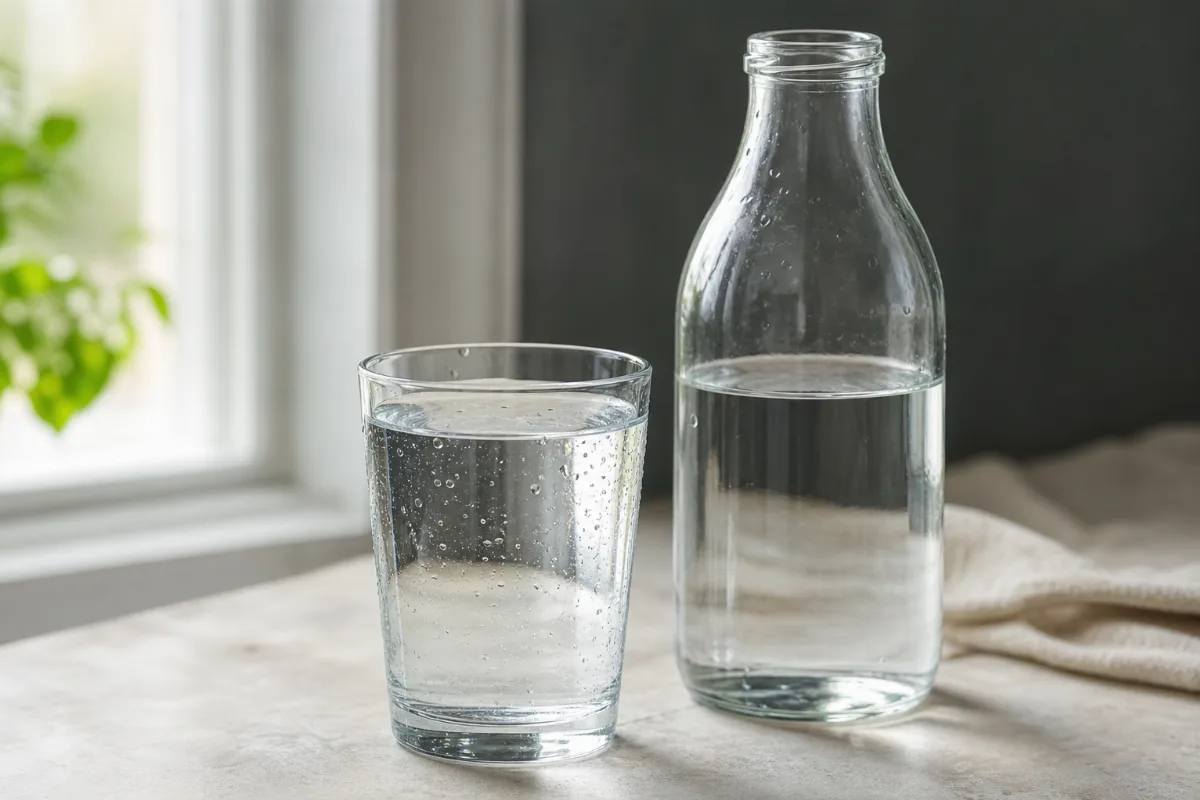
Drinking water (H2O) · also called Tap water, bottled water, still water
Water is the plain drink people use to replace the fluid the body loses each day. It has no calories, sugar or caffeine. Drinking enough prevents dehydration, and one 1996 trial found fewer kidney stone recurrences with more water. The main cautions are lead from old pipes, unsafe supplies, and drinking very large amounts too fast, which can lower blood sodium.
General information, not medical advice. Last substantive update · Not medically reviewed. A named clinician has not signed off on this page. How this page is made
About Water (Tap & Bottled)
Water is the plain drink people rely on to replace the fluid the body loses. It has no calories, sugar or caffeine. Drinking enough prevents dehydration; the other health claims are weaker. It is safe for most people, but the supply and plumbing matter, and very large amounts drunk fast can be dangerous.
What it is
This page covers plain tap water and bottled still water as drinks. It does not cover sparkling or mineral water, flavoured waters, "alkaline" or "detox" waters, or electrolyte drinks. Tap water is treated and supplied locally, so what is in it depends on your source and your pipes.
The National Academies set an Adequate Intake for total water, from drinks and food together, based on what healthy people in US surveys usually take in. They say normal hydration can be kept over a wide range of intakes. It is a survey-based figure, not a prescription, and this page gives no amount to aim for.
What is in it
USDA data for tap drinking water, taken from a saved USDA summary and not re-checked against USDA this time, per 100 g: 0 kcal, 99.9 g water, 4 mg sodium, 3 mg calcium and 1 mg magnesium, with no sugar and no caffeine. One 8 fl oz (237 g) glass has about 9.5 mg sodium, 7.1 mg calcium and 2.4 mg magnesium, each under 1% of the Daily Value.
A bottled still water in the same database shows no sodium, 3 mg calcium and 1 mg magnesium per 100 g. Tap water varies from place to place, so these figures are an example, not a promise for your tap. Water is not a meaningful source of vitamins or protein.
What the research shows
Water has less research behind its extra benefits than most foods, because it is a basic need. The clearest result is that drinking enough prevents dehydration; the NHS lists the signs and says to drink enough that urine is pale.
One randomised trial from 1996 followed 199 people for 5 years after a first calcium kidney stone. Stones came back in 12 of 99 who drank more water and 27 of 100 who did nothing extra. It is a single older trial, so it is promising but not settled.
A 2010 review found adults ate about 7.8% more energy at a meal after a sugary drink than after water, while sweetener drinks made no difference. The authors called the evidence sparse and said randomised trials are needed. It did not show lasting weight loss. Detox, skin and thinking claims were not supported in the sources we read.
At a glance
Traditional uses history, not proof
- Drunk for thirst by everyone, everywhere
- Long use as a drink is not proof that extra water treats any condition
Studied for research
- Staying hydrated, high certainty (established guidance, not a trial)
- Kidney stone recurrence, low certainty (one 1996 trial)
- Water instead of sugary drinks and energy eaten, low certainty
- Cavities with fluoridated tap water, moderate but unverified (CDC page not readable)
- Detox, skin and thinking claims, insufficient evidence
Main compounds
- Water
- Sodium (trace)
- Calcium (trace)
- Magnesium (trace)
- Fluoride (where added or natural)
Common forms
- Tap drinking water (USDA values summarised)
- Bottled non-carbonated water (USDA item summarised)
- Filtered tap water (a filter certified for lead is the EPA suggestion)
- Sparkling, mineral, flavoured and electrolyte waters are different products and are not covered
Research links: 1996 randomised trial: water and kidney stone recurrence · 2010 review: water, energy intake and weight · NHS: dehydration · Research Library · Genes & Biomarkers Library
What it is and its history
- Accepted scientific name
- Drinking water (H2O)
- Common names
- Water (English); Tap water (English); Bottled water (English); Still water (English)
- Harvest and processing
- Tap water is treated and piped by a local supplier; what is in it depends on the local source and pipes (WHO, EPA). In the US, bottled water comes in kinds such as spring, mineral and purified water, according to a saved summary; the rules for each were not read.
- Look-alikes and adulterants
- Name: Mineral and sparkling water; Note: Has its own page; carbonation and minerals differ.; Name: Flavoured, "alkaline" and electrolyte waters; Note: Different products; not covered by the results here.
Photographs
What is inside, and how it may work
What it contains and how those compounds act in cells and animals. Laboratory and animal mechanisms are not proven effects in people.
Main compounds
| Compound | Family | Where it is concentrated | Activity studied | Level of evidence |
|---|---|---|---|---|
| Water | water | USDA tap water: 99.9 g per 100 g (summary-only) | Replaces fluid lost by the body; prevents dehydration. 9 8 | Human data |
| Sodium | mineral | USDA tap water: 4 mg per 100 g; bottled item: none (summary-only) | A trace amount; blood sodium is what too much water can dilute. 9 10 6 | Human data |
| Calcium | mineral | USDA: 3 mg per 100 g in both tap and bottled items (summary-only) | A trace amount; under 1% of the Daily Value per glass. 9 10 | Human data |
| Magnesium | mineral | USDA: 1 mg per 100 g in both items (summary-only) | A trace amount. 9 10 | Human data |
| Lead (contaminant, not an ingredient) | metal | Varies by home and plumbing; not a USDA value | Harmful at any level in children (EPA and CDC: no known safe level in blood). 5 | Human data |
Mechanisms, receptors and pathways
| Target or pathway | Gene or receptor | What was found | Level |
|---|---|---|---|
| Dilution of blood sodium | Not applicable | MedlinePlus: when blood sodium falls, water moves into cells and brain cells swell. This is how very large amounts of water can cause symptoms. 6 | Human data |
| More urine, lower stone-risk measures | Not applicable | In the 1996 trial, urine stone-risk measures fell sharply only in the high-water group. The authors link stone risk to urine volume. 1 | Human data |
Absorption, metabolism and elimination
- Absorption
- Not found in the sources read.
- Distribution
- Not found.
- Elimination
- The National Academies give the kidneys' maximum excretion rate as about 0.7 to 1.0 litre an hour.
Isolated compounds versus whole extracts
This page is about plain water as a drink. Results for sugar-sweetened drinks, sweetener drinks, juice and milk are comparisons, not results for water.
Nutritional composition
Nutrition from USDA FoodData Central (SR Legacy), taken from a saved USDA summary; the USDA pages were NOT re-opened this time, so treat the numbers as unverified. Tap drinking water (FDC 173647), per 100 g: 0 kcal, 99.9 g water, 4 mg sodium, 3 mg calcium, 1 mg magnesium, 0.01 mg zinc, 0.01 mg copper, no sugar and no caffeine. One USDA household portion of 8 fl oz (237 g, the 100 g values multiplied by 2.37): 0 kcal, about 9.5 mg sodium, 7.1 mg calcium and 2.4 mg magnesium, each under 1% of the Daily Value. A bottled non-carbonated water in the same database (FDC 173655) shows no sodium, 3 mg calcium and 1 mg magnesium per 100 g. Tap water varies from place to place, so the numbers are an example, not a promise for your tap. Fluoride is not in the USDA record.
1 high certainty1 moderate certainty2 low certainty1 not enough evidence
What was looked at
The 5 benefits and uses checked for Water (Tap & Bottled), each with how strong the evidence is. Tap one to open it.
- Staying hydrated (preventing dehydration)High certainty
- Kidney stone recurrence (calcium stones)Low certainty
- Water instead of sugary drinks (energy eaten and weight)Low certainty
- Fluoridated tap water and cavitiesModerate certainty
- "Detox", glowing skin and sharper thinkingNot enough evidence
Lab markers tracked in the studies
Kidney stone recurrenceUrine stone-risk measures (supersaturation)Energy eaten at a test meal
What is Water (Tap & Bottled) good for?
The main studied uses and how strong the evidence is for each. Water is a basic need, so the first row is guidance rather than a trial result.
Benefits, one by one
Each card is a research question, not a promise. Tap a goal to filter. Open a card to see the studies, doses and limits.
Staying hydrated (preventing dehydration)
High certaintyDehydration means the body loses more fluid than it takes in. Drinking enough fluid prevents it. The US National Academies set an Adequate Intake for total water from drinks and food together based on what healthy people in US surveys take in, and say normal hydration can be kept over a wide range of intakes. The NHS lists thirst, headache, dizziness and dark yellow urine as signs, and says to drink enough that urine is a pale colour.
2 studiesPlain drinking water, tap or bottled, as a drink. The Adequate Intake…
Studies, doses and limits
What the trials found
No trial of drinking water against nothing was read. The support is guidance from the National Academies (2005) and the NHS (reviewed May 2026), which rest on physiology and survey data. The National Academies also say evidence linking low water intake to chronic disease was not enough to set intakes for that purpose.
Results
Drinking enough fluid prevents dehydration. The sources read do not tie any particular amount of plain water to better health outcomes in healthy people.
Why this rating
High that fluid prevents dehydration, which is established physiology. This is not a trial result, and it says nothing about extra water beyond what the body needs.
Form and dose studied
Plain drinking water, tap or bottled, as a drink. The Adequate Intake covers all drinks and food together; no amount is advised here.
Who was studied
General population. Babies, children under 5 and older adults are at higher risk of dehydration (NHS).
Limits
Guidance based on survey medians, not a prescription. Needs change with heat, exercise, illness and medicines.
Why researchers looked
Water is the main way people replace daily fluid losses.
Traditional use
Drinking water for thirst is universal. This is basic physiology, not a traditional remedy.
Proposed mechanism Authoritative guidance
Water replaces fluid lost in urine, sweat, breath and stools. Hydration was judged in the National Academies report mainly by blood osmolality (how concentrated the blood is).
A proposed mechanism does not show that the effect happens in people.
Too much water too fast can lower blood sodium; see the Safety tab.
Kidney stone recurrence (calcium stones)
Low certaintyIn one 5-year trial of 199 people after a first calcium kidney stone, stones came back in 12 of 99 people who drank more water and in 27 of 100 who did nothing extra. It is a single 1996 trial, so the result is promising but not settled.
1 studiesPlain water added to the usual diet. The amount is not given in the a…
Studies, doses and limits
What the trials found
One randomised trial (Borghi 1996): 199 people from their first idiopathic calcium stone, followed 5 years. Recurrence 12 of 99 with high water intake versus 27 of 100 untreated (p = 0.008). Average time to recurrence was 38.7 versus 25.1 months (p = 0.016).
Results
Fewer recurrences and a longer time to recurrence with more water in this group of people with a first calcium stone.
Effect sizes as reported
Recurrence within 5 years: 12/99 versus 27/100 (p = 0.008). Time to recurrence: 38.7 +/- 13.2 versus 25.1 +/- 16.4 months (p = 0.016).
Why this rating
Low: one trial from 1996, people knew their group, and nothing was found here to confirm it with other trials or other stone types.
Form and dose studied
Plain water added to the usual diet. The amount is not given in the abstract.
Who was studied
Adults after a first idiopathic calcium stone.
Limits
Single trial. No placebo or blinding. Applies to calcium stones only. People who have had stones should ask their own doctor about fluids.
Why researchers looked
Stones form when urine is concentrated; more water makes more urine.
Traditional use
Advice to drink more after a stone is long-standing clinical advice.
Proposed mechanism Human trial
In the trial, urine stone-risk measures (supersaturation of calcium oxalate, brushite and uric acid) fell sharply only in the high-water group. The authors link this to higher urine volume.
A proposed mechanism does not show that the effect happens in people.
People with kidney, heart or liver disease can be told to limit fluids; follow your own clinician.
Water instead of sugary drinks (energy eaten and weight)
Low certaintyA 2010 review found that adults who drank a sugar-sweetened drink before a meal ate about 7.8% more energy at that meal than those who drank water. Drinks with non-nutritive sweeteners made no difference. The review called the evidence sparse and somewhat inconclusive and asked for randomised trials.
1 studiesPlain water compared with sugar-sweetened drinks, sweetened drinks an…
Studies, doses and limits
What the trials found
One systematic review (Daniels and Popkin 2010) of clinical, population and intervention studies. The most consistent finding was from single-meal trials in adults. Weight itself was not shown to change.
Results
Water in place of a sugary drink went with less energy eaten at a meal. Nothing here shows lasting weight loss.
Effect sizes as reported
Energy eaten +7.8% with sugary drinks versus water (range -7.5 to 18.9). Sweetener drinks versus water -1.3 (range -9 to 13.8).
Why this rating
Low: a 2010 review of sparse, mostly one-meal studies that its authors call somewhat inconclusive. Mixed for weight outcomes.
Form and dose studied
Plain water compared with sugar-sweetened drinks, sweetened drinks and juice or milk.
Who was studied
Mostly adults.
Limits
Short studies. The result is about swapping a sweet drink for water, not about water adding to weight loss.
Why researchers looked
Water has no calories, so it is often suggested in place of sweet drinks.
Traditional use
Not a traditional use.
Proposed mechanism Hypothesis
Sweet drinks add calories that people do not fully make up for at the next meal; water adds none. This is the usual explanation, not something the review proved.
A proposed mechanism does not show that the effect happens in people.
None specific.
Fluoridated tap water and cavities
Moderate certaintyCDC is reported to say that community water fluoridation lowers cavities by about 25% in children and adults at a level of 0.7 mg of fluoride per litre. We could not open the CDC page, so this is shown as unverified.
1 studiesCommunity-fluoridated tap water at the level the agency recommends.
Studies, doses and limits
What the trials found
No study was read. The figure comes from a saved summary of the CDC page, which could not be re-opened (access refused). Whether your tap water is fluoridated depends on where you live.
Results
Reported as a reduction in cavities for fluoridated community supplies. Not checked here.
Effect sizes as reported
About 25% fewer cavities (CDC, per a saved summary; not re-verified).
Why this rating
Moderate and unverified: the claim is attributed to a public health agency, but we could not read the page or any underlying study this time.
Form and dose studied
Community-fluoridated tap water at the level the agency recommends.
Who was studied
Children and adults in places with fluoridated supplies.
Limits
Not re-verified. It applies to fluoridated supplies only, not to all tap or bottled water. High natural fluoride can be a problem too (WHO).
Why researchers looked
Fluoride in drinking water reaches the teeth.
Traditional use
Not a traditional use; a public health measure in some places.
Proposed mechanism Not read
Not read from a source.
A proposed mechanism does not show that the effect happens in people.
Fluoride mixed into infant formula: see the Safety tab.
"Detox", glowing skin and sharper thinking
Not enough evidenceClaims that plain water detoxes the body, improves skin or sharpens the mind were not supported by the sources we read. This is an absence of evidence in what we read, not proof that there is no effect.
1 studiesNot applicable.
Studies, doses and limits
What the trials found
The National Academies chapter says evidence linking low water intake to chronic disease was not enough to set intakes for that purpose. No trial on detox, skin or thinking was read.
Results
No evidence found in the sources read.
Why this rating
Insufficient: we did not search the literature for these claims.
Limits
Not researched in depth.
Why researchers looked
These are common popular claims about water.
Traditional use
Popular claims, not a documented tradition.
Proposed mechanism Not shown
None shown.
A proposed mechanism does not show that the effect happens in people.
Drinking far more than you need does not make it work better and has risks; see the Safety tab.
Connections to the rest of health
How Water (Tap & Bottled) connects to the rest of our health knowledge graph. Every link says what kind of connection it is. A safety link (for example to the liver) is a warning, not a benefit. A study that merely mentions a topic never creates a benefit link.
Explore every connection: goals, body systems, organs, symptoms, genes
A. Wellness goals
| Connected to | Kind of connection | Evidence status | Context | Studies |
|---|---|---|---|---|
| Preventive Wellness | High certainty | Staying hydrated (preventing dehydration): Dehydration means the body loses more fluid than it takes in. Drinking enough fluid prevents it. The US National Academies set an Adequate Intake for total water from drinks and food together based on what healthy people in US surveys take in, and say normal hydration can be kept over a wide range of intakes. The NHS lists thirst, headache, dizziness and dark yellow urine as signs, and says to drink enough that urine is a pale colour. | 7 8 | |
| Preventive Wellness | Low certainty | Kidney stone recurrence (calcium stones): In one 5-year trial of 199 people after a first calcium kidney stone, stones came back in 12 of 99 people who drank more water and in 27 of 100 who did nothing extra. It is a single 1996 trial, so the result is promising but not settled. | 1 | |
| Weight Management | Low certainty | Water instead of sugary drinks (energy eaten and weight): A 2010 review found that adults who drank a sugar-sweetened drink before a meal ate about 7.8% more energy at that meal than those who drank water. Drinks with non-nutritive sweeteners made no difference. The review called the evidence sparse and somewhat inconclusive and asked for randomised trials. | 2 | |
| Preventive Wellness | Moderate certainty | Fluoridated tap water and cavities: CDC is reported to say that community water fluoridation lowers cavities by about 25% in children and adults at a level of 0.7 mg of fluoride per litre. We could not open the CDC page, so this is shown as unverified. | 3 | |
| Detoxification Support | Not enough evidence | "Detox", glowing skin and sharper thinking: Claims that plain water detoxes the body, improves skin or sharpens the mind were not supported by the sources we read. This is an absence of evidence in what we read, not proof that there is no effect. | 7 |
B. Body systems
| Connected to | Kind of connection | Evidence status | Context | Studies |
|---|---|---|---|---|
| Kidney Urinary | Biological association | High certainty | Studied for: Staying hydrated (preventing dehydration) Studied for: Kidney stone recurrence (calcium stones) | 7 8 1 |
| Metabolism Weight | Biological association | Low certainty | Studied for: Water instead of sugary drinks (energy eaten and weight) | 2 |
| Integumentary System | Biological association | Moderate certainty | Studied for: Fluoridated tap water and cavities | 3 |
| Liver Detox | Biological association | Not enough evidence | Studied for: "Detox", glowing skin and sharper thinking | 7 |
E. Health conditions
| Connected to | Kind of connection | Evidence status | Context | Studies |
|---|---|---|---|---|
| Dehydration | Established | Drinking enough fluid prevents dehydration; the NHS lists signs and higher-risk groups. Preparation or compound: Drinking water and other fluids |
8 7 | |
| Low blood sodium (hyponatremia) | Adverse effect or risk | Documented risk | Water drunk faster than the kidneys can excrete it can lower blood sodium; this can be life-threatening. Very large amounts of water drunk quickly can lower blood sodium and be life-threatening. Preparation or compound: Very large amounts of water drunk quickly |
7 6 |
| Lead poisoning | Adverse effect or risk | Documented risk | Lead in tap water is one source of exposure, especially for infants on formula. Preparation or compound: Tap water carrying lead from plumbing |
5 |
I. Biomarkers
| Connected to | Kind of connection | Evidence status | Context | Studies |
|---|---|---|---|---|
| Kidney stone recurrence | Biological association | Low certainty | Measured in trials: lowered. A lab change is not the same as a health benefit. | 1 |
| Urine stone-risk measures (supersaturation) | Biological association | Low certainty | Measured in trials: lowered. A lab change is not the same as a health benefit. | 1 |
| Energy eaten at a test meal | Biological association | Low certainty | Measured in trials: lowered. A lab change is not the same as a health benefit. | 2 |
K. Biological pathways
| Connected to | Kind of connection | Evidence status | Context | Studies |
|---|---|---|---|---|
| Sodium | Preliminary mechanism | Human | Blood sodium is what too much water dilutes. | 6 |
| Kidneys | Preliminary mechanism | Human | Kidneys excrete extra water, at up to about 0.7 to 1.0 litre an hour, and urine volume was linked to stone risk in one trial. | 7 1 |
L. Active compounds
| Connected to | Kind of connection | Evidence status | Context | Studies |
|---|---|---|---|---|
| Water | Biological association | Human | Replaces fluid lost by the body; prevents dehydration. | 9 8 |
| Sodium | Biological association | Human | A trace amount; blood sodium is what too much water can dilute. | 9 10 6 |
| Calcium | Biological association | Human | A trace amount; under 1% of the Daily Value per glass. | 9 10 |
| Magnesium | Biological association | Human | A trace amount. | 9 10 |
| Lead (contaminant, not an ingredient) | Biological association | Human | Harmful at any level in children (EPA and CDC: no known safe level in blood). | 5 |
Each connection is stored with the ingredient, the connected record, the kind of connection, the evidence status, the supporting studies, the preparation or compound involved, and a review date (last reviewed October 26, 2026).
Evidence at a glance: what changed in 3 lab markers
Tap a number to show only those markers. Counts are markers, not people.
The evidence
The research centre for Water (Tap & Bottled). Every record here was checked against PubMed or the publisher's page; we never list a study we have not verified.
Evidence by outcome
Bars show how many studies we found for each outcome, not how well it works. People are added up across trials only (reviews are not added, to avoid double counting).
How we rate evidence
High certainty
Several well-run trials or reviews agree; further research is unlikely to change the picture much.
Moderate certainty
Good trials point the same way, but some doubt remains.
Low certainty
Small, short or inconsistent trials. The finding could change with better research.
Very low certainty
Very little or very weak human data. Treat as a possibility only.
Mixed findings
Trials or reviews disagree with each other.
Not enough evidence
Not enough human research to say either way.
Evidence against
Good research found no benefit, or found harm.
We take the reviewers' own risk-of-bias and GRADE statements where they exist, and otherwise judge from study size, design, consistency, directness and whether a product matches what is sold. Many publications do not make evidence high. Method note: We started from our existing water summary, read the National Academies water chapter, the NHS, MedlinePlus, EPA and WHO pages, and re-read PubMed abstracts for two studies. Only abstracts were read for studies. Little research was held for this item, so the page is smaller than most. Items we could not verify (USDA values and the CDC pages) are flagged.
Study library: every study we checked 11
| Study | Design | People | Product, dose, length | Result |
|---|---|---|---|---|
| Borghi 1996 Urinary volume, water and recurrences in idiopathic calcium nephrolithiasis: a 5-year randomized prospective study. J Urol · PMID 8583588 |
Randomized controlled trial |
199 199 people from their first idiopathic (cause not found) calcium kidney stone, plus 101 healthy controls; followed 5 years |
Plain water, increased intake, no change in diet 5 years · vs No treatment |
Stones came back in 12 of 99 people in the high-water group and 27 of 100 in the untreated group (p = 0.008). The average time to a recurrence was 38.7 months versus 25.1 months (p = 0.016). Urine stone-risk measures fell sharply only in the high-water group. Recurrence 12/99 versus 27/100 (Not given in the abstract (p = 0.008)) Methods, limits and fundingOutcomes: Stone recurrence within 5 years, time to recurrence, urine stone-risk measures Limitations: One trial from 1996 in people with a first calcium stone only. The amount of extra water is not in the abstract. The comparison group had no treatment, so people knew which group they were in. It does not apply to other stone types. Funding and conflicts: Funding is not stated in the abstract. Read: abstract |
| Daniels 2010 Impact of water intake on energy intake and weight status: a systematic review. Nutr Rev · PMID 20796216 · DOI |
Systematic review |
Clinical trials, population studies and intervention studies of water versus other drinks (number of studies not given in the abstract) | Plain drinking water compared with sugar-sweetened drinks, sweetener drinks, milk or juice Mostly a single test meal · vs Other drinks |
Adults who drank a sugar-sweetened drink before a meal ate 7.8% more energy in total than those who drank water (range -7.5 to 18.9). Drinks with non-nutritive sweeteners made no difference to energy eaten (-1.3, range -9 to 13.8). The authors called the evidence sparse and somewhat inconclusive, and said randomised trials are needed. Energy intake +7.8% with sugar-sweetened drinks versus water (Range -7.5 to 18.9 (a range of study results, not a confidence interval)) Methods, limits and fundingOutcomes: Energy eaten at a test meal, and weight status Limitations: A 2010 review of a sparse literature, mostly one-meal studies. Weight itself was not shown to change. The results compare water with a sweet drink, not water with nothing. Funding and conflicts: PubMed lists NIH extramural and non-US government research support; no industry funding is shown in the record. Read: abstract |
| s-cdc-fluoridation CDC: About community water fluoridation · Source |
Health agency n/a |
Methods, limits and fundingRead: summary-only | ||
| s-cdc-fluoride-formula CDC: Community water fluoridation frequently asked questions (infant formula) · Source |
Health agency n/a |
Methods, limits and fundingRead: summary-only | ||
| s-epa-lead US EPA: Basic Information about Lead in Drinking Water · Source |
Health agency n/a |
Methods, limits and fundingRead: full-text | ||
| s-medlineplus-hyponatremia MedlinePlus: Low blood sodium · Source |
Health agency n/a |
Methods, limits and fundingRead: full-text | ||
| s-nasem-water-2005 Institute of Medicine (National Academies): Dietary Reference Intakes for Water, Potassium, Sodium, Chloride, and Sulfate, chapter 4 Water (2005) · Source |
Health agency n/a |
Methods, limits and fundingRead: full-text | ||
| s-nhs-dehydration NHS: Dehydration · Source |
Health agency n/a |
Methods, limits and fundingRead: full-text | ||
| s-usda-fdc-173647 USDA FoodData Central: Beverages, water, tap, drinking (FDC 173647, SR Legacy) · Source |
Reference database n/a |
Methods, limits and fundingRead: summary-only | ||
| s-usda-fdc-173655 USDA FoodData Central: Beverages, water, bottled, non-carbonated (FDC 173655, SR Legacy) · Source |
Reference database n/a |
Methods, limits and fundingRead: summary-only | ||
| s-who-drinking-water WHO: Drinking-water (fact sheet) · Source |
Health agency n/a |
Methods, limits and fundingRead: full-text |
What we do not know yet
- No trial of plain water against no water was found for energy, mood, skin or thinking in healthy people.
- The kidney stone result rests on one 1996 trial in one kind of stone patient.
- The CDC pages (fluoridation and infant formula) could not be opened, so those statements are unverified.
- USDA values were taken from a saved summary and not re-opened.
- Bottled-water rules, storage, microplastics, pregnancy fluid advice and spring versus purified water were not researched.
How new research is added
New studies are found by a saved PubMed search and placed in a review queue before the page changes.
Lab markers
What changed in blood or saliva tests during trials. A changed number is not the same as feeling or being healthier, and we give no "normal ranges".
Other 3
Kidney stone recurrence
Lowered in trials
A new stone forming in someone who has already had one.
Low certaintyResults and what it means
Why it was measured
It is the outcome people care about after a first stone.
Statistical vs. clinical meaning
A meaningful drop in one trial; not confirmed by other trials in the sources read.
Safety implication
None specific.
| Study | Result | People | Product |
|---|---|---|---|
| 1 | 12 of 99 had a recurrence with high water intake versus 27 of 100 untreated within 5 years (p = 0.008) | Adults after a first idiopathic calcium stone | High water intake, no diet change, 5 years |
Urine stone-risk measures (supersaturation)
Lowered in trials
How close urine is to forming crystals of calcium oxalate, brushite or uric acid.
Low certaintyResults and what it means
Why it was measured
Higher supersaturation means a higher chance of crystals forming.
Statistical vs. clinical meaning
Supports the idea that more urine means less crystal risk, but the numbers were not read.
Safety implication
None specific.
| Study | Result | People | Product |
|---|---|---|---|
| 1 | Baseline values decreased sharply only in the high-water group (numbers not in the abstract) | Adults after a first idiopathic calcium stone | High water intake for 5 years |
Energy eaten at a test meal
Lowered in trials
The total calories a person eats at a single meal in a trial.
Low certaintyResults and what it means
Why it was measured
It is the quick measure used in these short trials; it is not a weight measure.
Statistical vs. clinical meaning
Suggests swapping a sweet drink for water may cut energy at that meal; lasting weight effects were not shown.
Safety implication
None specific.
| Study | Result | People | Product |
|---|---|---|---|
| 2 | +7.8% energy with a sugar-sweetened drink before the meal versus water (range -7.5 to 18.9) | Adults in single-meal trials | Sugar-sweetened drink versus water before a meal |
Safety
What studies and official sources say about side effects, medicines and who should check first. Each point shows what kind of evidence it comes from.
Main points to know 4
- Too much water, too fast, can be dangerous. The National Academies report acute water toxicity after people drank large amounts quickly, beyond the kidneys' maximum rate of about 0.7 to 1.0 litre an hour. MedlinePlus explains that when blood sodium falls, water moves into cells and brain cells swell, causing confusion, headache, nausea and, in severe cases, seizures, coma and death. It calls severe low blood sodium a life-threatening emergency. No upper limit was set for water. Authoritative guidance 7 6
- Lead in tap water. Lead can get into tap water from lead service lines, faucets and solder, especially in homes built before 1986. EPA and CDC agree there is no known safe level of lead in a child's blood. EPA estimates that infants who mostly drink mixed formula can get 40% to 60% of their lead exposure from water. EPA says boiling does not remove lead; it suggests a filter certified to remove lead, cold water for drinking, cooking and formula, and running the tap if water has sat in pipes. Authoritative guidance 5
- Unsafe supplies: germs, arsenic and fluoride. WHO reports that at least 1.7 billion people in 2022 used a drinking-water source contaminated with faeces, which it calls the greatest risk to drinking-water safety. It also says natural arsenic and fluoride in groundwater can matter for health. Where water is not known to be safe, follow local health advice. Authoritative guidance 11
- Dehydration in babies, young children and older adults. The NHS says babies, children under 5 and older adults are at higher risk of dehydration, as are people with vomiting, diarrhoea, fever, hot weather, heavy sweating, diabetes or diuretic medicines. Serious dehydration needs urgent care; see the urgent signs below. Authoritative guidance 8
Side effects 3
| Effect | How often | Severity and recovery | Evidence |
|---|---|---|---|
| Low blood sodium (hyponatremia) from drinking very large amounts quickly MedlinePlus lists many other causes of low blood sodium (illness, heart, kidney and liver disease, some tumours, diuretics). Drinking water is only one. | No frequency was found in the sources read. | can be life-threatening Not described in the sources read; MedlinePlus says treatment depends on the cause. | Authoritative guidance 7 6 |
| Lead poisoning from lead in tap water Depends on your pipes and your supply, not on water itself. | EPA estimates drinking water can be 20% or more of a person's total lead exposure. | can be serious, especially in children and pregnancy Not described for water in the source read. | Authoritative guidance 5 |
| Diarrhoea and other infections from contaminated water Global figure; risk depends on the local supply. | WHO estimates about 505,000 diarrhoeal deaths a year from microbiologically contaminated water. | can be severe, mostly where supplies are unsafe Not described. | Authoritative guidance 11 |
Liver
No liver problem from drinking water was found in the sources read. A liver-safety source such as LiverTox was not searched.
How often. No frequency was found.
Monitoring. No agency monitoring advice was found.
This is a safety connection. It is not evidence that Water (Tap & Bottled) supports liver health.
Medicines and supplements 2
| With | Why it matters | Importance | Evidence | What to do |
|---|---|---|---|---|
| Diuretic medicines (water pills) prescription | Diuretics make you pass more urine, so the NHS lists them as a cause of dehydration, and MedlinePlus lists them as a cause of low blood sodium. | Fluid needs can be different on a diuretic. The sources do not give amounts. | Authoritative guidance Moderate certainty 8 6 | Ask your prescriber or pharmacist how much fluid is right for you on a diuretic, and follow any fluid limit you have been given. |
| Other medicines, supplements and foods general | No interaction with plain drinking water was found in the sources read. | None found. | Not found Not enough evidence | Plain water is how most medicines are taken. If you have been told to limit fluids, follow that advice. |
Who should check first 4
| Situation | Advice | Evidence |
|---|---|---|
| A fluid limit set by your clinician (for example in heart failure, kidney disease or cirrhosis) | Follow your clinician's fluid limit. MedlinePlus lists heart failure, kidney disease and cirrhosis among causes of low blood sodium and says treatment may include limiting water intake. | Authoritative guidance 6 |
| Babies under 6 months | The NHS says that if a baby under 6 months is on formula and needs extra sips of water, the water should be boiled and cooled first. Do not water down formula. Ask a health visitor, pharmacist or doctor about your baby. Note that boiling does not remove lead (EPA). | Authoritative guidance 8 5 |
| Homes with lead pipes or fittings, especially with a baby or pregnancy | Ask your water supplier about your pipes and consider a lead test. EPA suggests a filter certified to remove lead and cold water for drinking and formula. | Authoritative guidance 5 |
| Pregnancy and breastfeeding | No source read gave water amounts for pregnancy or breastfeeding. EPA notes that lead stored in bones can be released in pregnancy and cross to the baby, and can pass in breast milk, so lead in tap water matters. Ask your midwife or doctor. | Authoritative guidance 5 |
Overdose, product quality and regulators
Summary. The National Academies set no Tolerable Upper Intake Level for water because healthy kidneys can excrete extra. Acute water toxicity has been reported after quickly drinking large amounts.
Animal. Not reviewed.
High dose or long term signals. Low blood sodium after rapid large intake (National Academies, MedlinePlus). The chapter cites reports of psychogenic polydipsia (compulsive drinking) causing water intoxication.
Overdose response. MedlinePlus: severe low blood sodium can be a life-threatening emergency; call your provider right away for symptoms.
What matters for safety is the supply and plumbing, not water itself. Germs, arsenic, fluoride and lead were found as concerns in the sources read.
Lead from pipes and fittings. Lead service lines, faucets and solder are the usual sources; boiling does not remove lead. 5
Germs from faecal contamination. At least 1.7 billion people used a faecally contaminated source in 2022 (WHO). 11
Natural arsenic and fluoride in groundwater. WHO says these can matter for health in some areas. No levels were read. 11
| Body | Action | Date |
|---|---|---|
| US EPA (United States) | Health goal for lead in drinking water is zero; no known safe level of lead in a child's blood (EPA and CDC); steps to cut lead in tap water. source | 2026-06-18 |
| WHO (International) | Drinking-water fact sheet: faecal contamination is the greatest drinking-water risk; arsenic, fluoride and lead can matter for health. source | 2023-09-13 |
| NHS (UK) (United Kingdom) | Dehydration: signs, higher-risk groups, urgent care advice, and drinking enough that urine is pale. source | 2026-05-01 |
When to get medical help
- Severe dehydration: blue, grey, pale or blotchy skin, lips or tongue, cold skin, trouble breathing or fast breathing, confusion, or being unusually sleepy or hard to wake. In the UK call 999; in the US call 911 or your local emergency number. The NHS says do not drive yourself.
- Low blood sodium after drinking a lot of water: confusion, severe headache, repeated vomiting, convulsions or fainting. Treat this as an emergency and get medical help right away.
Stop using the product and contact a clinician or emergency service. In the US, Poison Control is 1-800-222-1222.
General information only, not medical advice. Ask a clinician or pharmacist before use, especially with medicines, in pregnancy or with a health condition. See the Natural Remedy Safety guide.
Frequently asked questions
What does this page cover?
What is in tap water?
Does drinking water prevent dehydration?
What are the signs of dehydration?
The NHS lists thirst, headache, dizziness, tiredness, a dry mouth and dark yellow, strong-smelling urine, and peeing less. In babies: a sunken soft spot, sunken eyes, few tears and fewer wet nappies. Blue, grey or blotchy skin, cold skin, trouble breathing or confusion are emergencies: call 999 in the UK or 911 in the US.
Can water help prevent kidney stones?
One 5-year randomised trial in 199 people after a first calcium stone found fewer recurrences with more water: 12 of 99 versus 27 of 100. It is a single 1996 trial in one kind of stone, so ask your own doctor about your case.
Will drinking water help me lose weight?
The evidence is limited. A 2010 review found adults ate about 7.8% more energy at a meal after a sugar-sweetened drink than after water, so swapping a sweet drink for water may help. The authors said randomised trials are needed and weight change was not shown.
Can you drink too much water?
Yes. The National Academies report acute water toxicity after very large amounts drunk quickly, faster than the kidneys can clear it. MedlinePlus explains that low blood sodium makes brain cells swell, and severe cases can cause seizures, coma and death. It is rare in ordinary drinking; severe symptoms need emergency help.
Does boiling tap water remove lead?
No. EPA says boiling does not remove lead. It suggests a filter certified to remove lead, cold water for drinking, cooking and formula, and running the tap if water has sat in pipes. Ask your water supplier about your pipes.
Is bottled water safer than tap water?
Does fluoride in tap water prevent cavities?
Does water detox the body or clear the skin?
We found no evidence for this in the sources we read. That is an absence of evidence in what we read, not proof of no effect. Water replaces lost fluid; the body clears waste through the kidneys and liver.
Is tap water safe for babies?
Explore by health goal
Editorial transparency
- Written by
- AlternativeMed editorial team. Research compiled with AI assistance, then checked against the sources listed.
- Medical review
- None. This page has not been reviewed by a physician or pharmacist.
- First published
- 2026-10-26
- Last substantive update
- 2026-10-26
- How we research
- We started from our existing water summary, read the National Academies water chapter, the NHS, MedlinePlus, EPA and WHO pages, and re-read PubMed abstracts for two studies. Only abstracts were read for studies. Little research was held for this item, so the page is smaller than most. Items we could not verify (USDA values and the CDC pages) are flagged.
- How we rate evidence
- See "How we rate evidence" in the Evidence tab.
- Independence
- No product is promoted on this page. No affiliate links are shown. Funding of the two studies is not stated in their abstracts.
Sources 11
Each source was opened and checked. Where we read only the abstract, it says so. The small numbers in the text point here.
- Borghi L, Meschi T, Amato F, Briganti A, et al.. Urinary volume, water and recurrences in idiopathic calcium nephrolithiasis: a 5-year randomized prospective study.. J Urol. 1996. PMID 8583588. (abstract)
- Daniels MC, Popkin BM. Impact of water intake on energy intake and weight status: a systematic review.. Nutr Rev. 2010. PMID 20796216. DOI 10.1111/j.1753-4887.2010.00311.x. (abstract)
- . CDC: About community water fluoridation. . . (summary-only)
- . CDC: Community water fluoridation frequently asked questions (infant formula). . . (summary-only)
- . US EPA: Basic Information about Lead in Drinking Water. . . (full-text)
- . MedlinePlus: Low blood sodium. . . (full-text)
- . Institute of Medicine (National Academies): Dietary Reference Intakes for Water, Potassium, Sodium, Chloride, and Sulfate, chapter 4 Water (2005). . . (full-text)
- . NHS: Dehydration. . . (full-text)
- . USDA FoodData Central: Beverages, water, tap, drinking (FDC 173647, SR Legacy). . . (summary-only)
- . USDA FoodData Central: Beverages, water, bottled, non-carbonated (FDC 173655, SR Legacy). . . (summary-only)
- . WHO: Drinking-water (fact sheet). . . (full-text)


