Functional Foods · Drink
Black Tea
Camellia sinensis (black tea) · also called Tea, té negro
Black tea is a drink made from the leaves of the tea plant. In trials it changed LDL cholesterol and blood pressure only a little, and a larger review of short trials found no change. Large studies link tea drinking with lower risk of death, which cannot prove cause. The main cautions are caffeine, lower iron absorption from meals, and caffeine limits in pregnancy.
General information, not medical advice. Last substantive update · Not medically reviewed. A named clinician has not signed off on this page. How this page is made
About Black Tea
Black tea is a drink made from the leaves of the tea plant (Camellia sinensis). It is a drink, not a proven remedy. Trials show small and uneven changes in cholesterol and blood pressure, and large studies show lower death rates in people who drink tea, which cannot prove cause.
What it is
Black tea is made from the leaves of Camellia sinensis, the same plant that gives green and white tea (GBIF accepted name, species key 3189635). This page covers black tea as a drink. Green tea and its extracts are on other pages, and herbal 'teas' made from other plants are different drinks.
Nutrition values for brewed black tea (calories, minerals) were not read from a source for this page, so none are given. The caffeine facts are in the Safety section.
What the research shows
Black tea trials are small. A 2015 pooled analysis of 10 studies (411 people) found LDL cholesterol 4.64 mg/dL lower (95% CI -8.99 to -0.30), with no clear change in total or HDL cholesterol. A 2020 review of 14 trials (798 people, 4 to 24 weeks) of green and/or black tea found no significant effect on blood pressure or blood fats, and said the trials were too small to be sure.
For blood pressure, a pooled analysis of 5 trials (408 people with raised pressure) found falls of 4.81 mmHg systolic and 1.98 mmHg diastolic with green or black tea, and about 3.5 and 1 mmHg after removing the most inconsistent trials. Green tea looked stronger than black.
A 2024 pooled analysis of 38 cohort data sets (1,956,549 people) linked the highest tea intake with 10% lower all-cause death risk and 14% lower cardiovascular death risk, but not a significant change in cancer death (0.90, 95% CI 0.78 to 1.03). People who drink tea may differ in other ways, and black tea was not separated.
A 2025 review of 50 trials found small gains in thinking and mood for theanine with caffeine, not for tea drinks.
Tea and iron
In a 1999 trial, black tea cut iron absorption from a bread meal by 79 to 94%, and milk added to tea made little difference. The NHS lists tea among drinks to have less of if you have iron deficiency anaemia. A French survey of 2,593 healthy adults found no link between tea drinking and iron stores.
At a glance
Traditional uses history, not proof
- Drunk daily in many places as a hot or iced drink
- Long use as a drink is not proof that it treats any condition
Studied for research
- Cholesterol, low certainty (small trials, results differ)
- Blood pressure, mixed (green and black tea combined)
- Deaths and heart-related deaths, low certainty (observational)
- Alertness, thinking and mood, insufficient for black tea itself
- Iron absorption, a reduction to know about, low certainty
- Kidney stones, mixed
Main compounds
- Caffeine
- Polyphenols
- Theanine
- Oxalate
- Fluoride
Common forms
- Brewed black tea as a drink (the form studied)
- Tea bags and loose leaf (fluoride differed in a lab survey)
- Decaffeinated tea still has a little caffeine
- Milk, sugar, bottled and sweetened tea were not studied
- Green tea extracts and capsules are different products and are not covered
Research links: 2015 review: black tea and cholesterol (10 studies) · 2020 review: short green or black tea trials, blood fats and pressure · 2024 review: tea and death risk (38 cohort data sets) · Research Library · Genes & Biomarkers Library
What it is and its history
- Accepted scientific name
- Camellia sinensis (L.) Kuntze
- Naming authority
- (L.) Kuntze (GBIF accepted)
- Common names
- Black tea (English); Tea (English); Té negro (Spanish)
- Family or group
- Theaceae (the tea family), as given by GBIF. Black tea is a drink made from the leaves of this plant.
- Classification
- Plantae > Tracheophyta > Magnoliopsida > Ericales > Theaceae > Camellia > Camellia sinensis
- Native range
- Not verified from a source read.
- Habitat
- Not verified from a source read.
- What it looks like
- Roots: Not verified.; Stems: Not verified.; Leaves: Not verified.; Flowers: Not verified.; Fruit: Not verified.
- Cultivation
- Not verified from a source read.
- Harvest and processing
- The earlier page said reviews describe tea types as differing in how much the leaves are fermented (oxidized) after picking; that was not re-read here. The 1999 iron trial describes black tea as rich in complex polyphenol polymerization products. How black tea is made was otherwise not read from a source.
- Look-alikes and adulterants
- Name: Green tea, white tea and oolong; Note: Made from the same plant but not the same drink; most pooled analyses combine green and black tea.; Name: Herbal teas; Note: Made from other plants and have no caffeine in the lab survey read; they are different drinks.; Name: Chai, Earl Grey and iced or bottled tea; Note: Usually black tea with other ingredients such as spices, flavouring, milk or sugar; not what the studies measured.
- Sustainability and conservation
- Not assessed.
Photographs
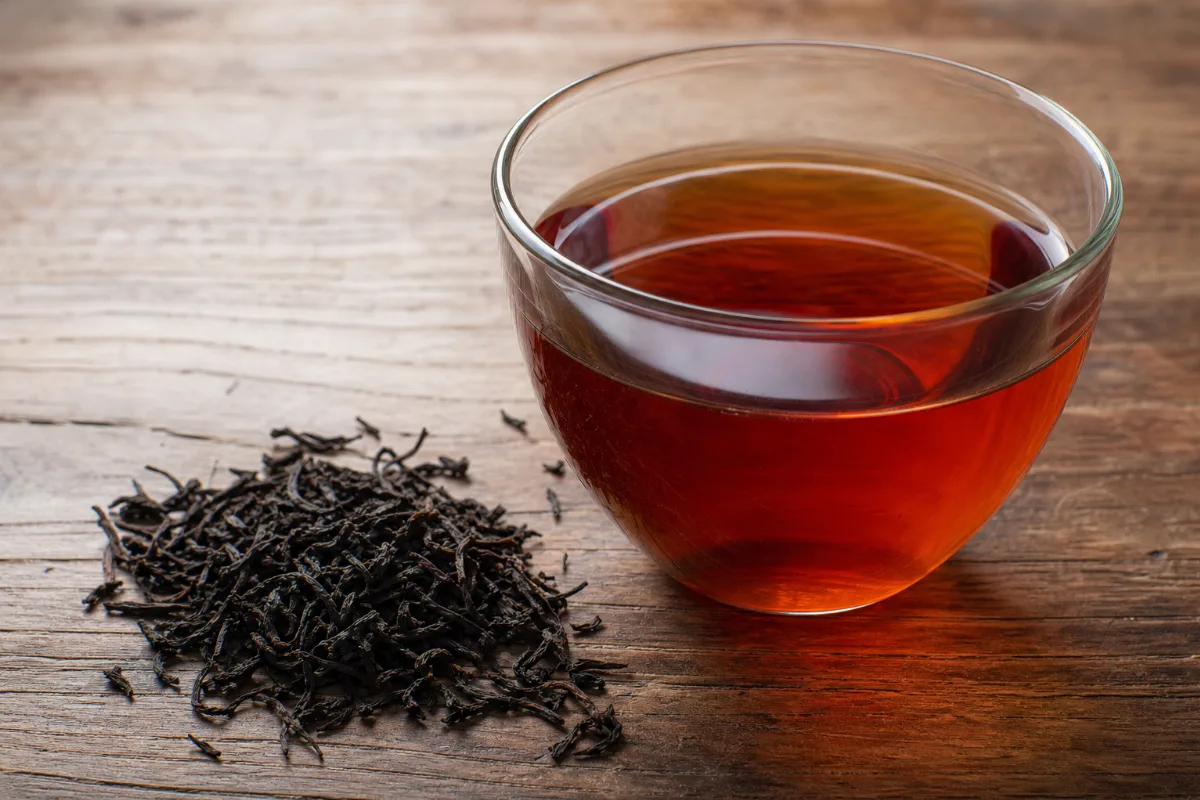
What is inside, and how it may work
What it contains and how those compounds act in cells and animals. Laboratory and animal mechanisms are not proven effects in people.
Main compounds
| Compound | Family | Where it is concentrated | Activity studied | Level of evidence |
|---|---|---|---|---|
| Caffeine | alkaloid (stimulant) | Leaf (in the brewed drink) FDA: about 71 mg per 12 fl oz of black tea. NHS: about 75 mg a cup. Lab survey of white, green and black teas: 14 to 61 mg per 6 or 8 oz serving. | A stimulant; the FDA and NHS give official limits for pregnancy and general use. 13 17 1 | Human data |
| Tea polyphenols (including complex polymerised forms) | polyphenol | Leaf (in the brewed drink) Not stated in the sources read. | Black tea is described by the 1999 authors as rich in complex polyphenol polymerization products, which inhibited iron absorption in proportion to the polyphenol content. 3 | Human data |
| Theanine | amino acid | Leaf Not stated in the sources read. | A tea amino acid that was studied alone and with caffeine for thinking and mood; those results are not for black tea as a drink. 9 | Human data |
| Oxalate | organic acid salt | Leaf (in the brewed drink) 86 mg a day in 1.5 L of black tea in one controlled study | A part of the most common kidney stones; black tea did not significantly change urine oxalate in healthy men. 10 | Human data |
| Fluoride | mineral | Leaf (in the brewed drink) Varies by tea form and origin (lab survey of 121 black teas); no single figure in the abstract. | Tea bag infusions and African-origin teas had the most in a Polish survey. 7 | Lab |
Mechanisms, receptors and pathways
| Target or pathway | Gene or receptor | What was found | Level |
|---|---|---|---|
| Iron binding in the gut | Not specified in the sources read | In a 1999 trial, drinks with more polyphenols cut iron absorption from a bread meal more, and black tea cut it by 79 to 94%. The authors link the effect to polyphenol content. 3 | Human data |
| Cholesterol and blood pressure | Not specified in the sources read | The sources read give no tested mechanism for the small cholesterol and blood pressure changes. Any explanation would be a hypothesis. 12 6 | Hypothesis |
Absorption, metabolism and elimination
- Absorption
- Not found for tea compounds. The FDA notes people differ in how fast they clear caffeine.
- Distribution
- Not found.
- Metabolism
- Not found.
- Elimination
- Not found.
- Bioavailability
- Not established in the sources read.
Isolated compounds versus whole extracts
The cholesterol, blood pressure and iron results are for tea as a drink; the thinking and mood results are mostly for isolated theanine and caffeine, which are not black tea. Green tea extracts and capsules are concentrated products with their own cautions and are not covered here.
Nutritional composition
Nutrition for brewed black tea (calories, minerals) was not read from a source for this page: the USDA FoodData Central service was rate-limited on 2026-10-26, so no table is given. The caffeine content read is from the FDA (about 71 mg per 12 fl oz), the NHS (about 75 mg a cup) and a lab survey (14 to 61 mg per 6 or 8 oz serving of white, green and black teas). Added milk, sugar and bottled sweetened tea were not studied in the sources read.
2 mixed findings3 low certainty1 not enough evidence
What was looked at
The 6 benefits and uses checked for Black Tea, each with how strong the evidence is. Tap one to open it.
- Cholesterol (LDL)Low certainty
- Blood pressureMixed findings
- Deaths and heart-related deaths (observational)Low certainty
- Alertness, thinking and moodNot enough evidence
- Effect on iron absorption (reduces it)Low certainty
- Kidney stonesMixed findings
Lab markers tracked in the studies
LDL cholesterolTotal and HDL cholesterolSystolic blood pressureDiastolic blood pressureSerum ferritin (iron stores)Urinary oxalate
What is Black Tea good for?
The main studied uses and how strong the human evidence is for each. Many results combine green and black tea or are observational, so read each line with its certainty.
Benefits, one by one
Each card is a research question, not a promise. Tap a goal to filter. Open a card to see the studies, doses and limits.
Cholesterol (LDL)
Low certaintyPooled small trials of black tea as a drink found LDL cholesterol about 4.6 mg/dL lower. Total and HDL cholesterol did not change clearly. A later review of short green and black tea trials found no significant change, so the result is small and not steady.
2 studiesBrewed black tea as a drink. The amount of tea, brewing time and cups…
Studies, doses and limits
What the trials found
A 2015 pooled analysis of 10 studies with 411 people found a small LDL fall with black tea. A 2020 review of 14 trials (798 people, 4 to 24 weeks) of green and/or black tea found no significant effect on LDL or other blood fats and said the trials were too small to be sure.
Results
A small average fall in LDL in one pooled analysis, not found in another.
Effect sizes as reported
LDL -4.64 mg/dL (95% CI -8.99 to -0.30) in 10 studies; no significant effect in the 14-trial review.
Why this rating
Two pooled analyses disagree, the trials are small, and the first LDL interval nearly reaches zero.
Form and dose studied
Brewed black tea as a drink. The amount of tea, brewing time and cups per day differ between studies and are not stated here.
Who was studied
Adults in trials; the fall was larger in people with higher cardiovascular risk.
Limits
Small trials; green and black tea combined in the later review; no trial measured heart attacks or strokes.
Why researchers looked
Tea contains plant compounds such as polyphenols, and cholesterol is a common blood marker in diet studies.
Traditional use
Black tea is drunk daily in many places. Long use as a drink is not proof that it treats any condition.
Proposed mechanism None found
The sources read give no tested mechanism.
A proposed mechanism does not show that the effect happens in people.
Black tea has caffeine; see the Safety tab.
Blood pressure
Mixed findingsPooled trials of green or black tea in people with raised blood pressure found small falls (about 3.5 to 4.8 mmHg systolic). A review of 14 short trials found no significant change. Green tea looked stronger than black tea.
2 studiesBrewed black tea as a drink. The amount of tea, brewing time and cups…
Studies, doses and limits
What the trials found
A 2020 pooled analysis of 5 trials (408 people with raised pressure) found systolic pressure 4.81 mmHg lower and diastolic 1.98 mmHg lower with green or black tea, and smaller falls (about 3.53 and 0.99) after removing the most inconsistent trials. In that analysis green tea had the bigger effect. A 2020 review of 14 trials of 4 to 24 weeks in healthy and at-risk adults found no significant effect on blood pressure.
Results
Small falls in one pooled analysis of people with raised pressure; none in a larger review of short trials.
Effect sizes as reported
Systolic -4.81 mmHg (95% CI -8.40 to -1.58); diastolic -1.98 mmHg (-3.77 to -0.20); no significant effect in the 14-trial review.
Why this rating
Green and black tea were combined, only 5 trials were pooled and the results are not consistent between reviews.
Form and dose studied
Brewed black tea as a drink. The amount of tea, brewing time and cups per day differ between studies and are not stated here.
Who was studied
Mostly adults with raised blood pressure (first analysis); healthy and at-risk adults (second).
Limits
Black tea alone was not separated in the first analysis. Trials were short.
Why researchers looked
Raised blood pressure is a major heart risk, and tea is a daily drink for many people.
Traditional use
Black tea is drunk daily in many places. Long use as a drink is not proof that it treats any condition.
Proposed mechanism None found
The sources read give no tested mechanism.
A proposed mechanism does not show that the effect happens in people.
Black tea has caffeine; see the Safety tab.
Deaths and heart-related deaths (observational)
Low certaintyIn a pooled analysis of 38 cohort data sets with almost 2 million people, those who drank the most tea had 10% lower risk of dying from any cause and 14% lower risk of dying from heart and blood vessel disease than those who drank the least. This is an association, not proof, and tea types were not separated.
1 studiesTea as a drink in cohort studies; black tea not separated in the abst…
Studies, doses and limits
What the trials found
A 2024 pooled analysis of 38 prospective cohort data sets (1,956,549 people) compared the highest with the lowest tea intake. Cancer deaths were lower by 10% but that result was not statistically significant. The authors say the lowest all-cause risk was around 2 cups a day with no further drop above that.
Results
Lower death risk in the highest tea group, which cannot show that tea is the cause.
Effect sizes as reported
All-cause mortality 0.90 (95% CI 0.86 to 0.95); cardiovascular mortality 0.86 (0.79 to 0.94); cancer mortality 0.90 (0.78 to 1.03, not significant).
Why this rating
Observational. Tea drinkers may differ from non-drinkers in diet, income or habits, and black tea was not separated from other teas.
Form and dose studied
Tea as a drink in cohort studies; black tea not separated in the abstract.
Who was studied
General adult cohorts.
Limits
Cannot show cause; food questionnaires; mixed tea types.
Why researchers looked
People who drink tea may live differently, so researchers compared groups over time.
Traditional use
Black tea is drunk daily in many places. Long use as a drink is not proof that it treats any condition.
Proposed mechanism None found
The sources read give no tested mechanism.
A proposed mechanism does not show that the effect happens in people.
Black tea has caffeine; see the Safety tab.
Alertness, thinking and mood
Not enough evidenceA 2025 review of 50 trials in healthy people found the clearest small gains for theanine plus caffeine and for theanine alone, not for tea drinks. The authors ask for trials that use real tea.
1 studiesIsolated theanine and caffeine in trials; not black tea.
Studies, doses and limits
What the trials found
In the 2025 review the benefits seen were for isolated theanine, with or without caffeine, in the first hours after a dose. The abstract does not give a result for black tea as a drink.
Results
Not shown for black tea itself.
Effect sizes as reported
Examples for theanine plus caffeine: attention switching accuracy SMD 0.33 (95% CI 0.13 to 0.54). Many intervals were wide.
Why this rating
The evidence is for isolated compounds, not black tea.
Form and dose studied
Isolated theanine and caffeine in trials; not black tea.
Who was studied
Healthy adults.
Limits
Short-term, mostly isolated compounds.
Why researchers looked
Black tea has caffeine and the amino acid theanine, and many people drink it to feel alert.
Traditional use
Black tea is drunk daily in many places. Long use as a drink is not proof that it treats any condition.
Proposed mechanism None found
Caffeine is a stimulant and theanine is a tea amino acid; the sources read do not test how either acts in black tea.
A proposed mechanism does not show that the effect happens in people.
Black tea has caffeine; see the Safety tab.
Effect on iron absorption (reduces it)
Low certaintyBlack tea reduces how much iron the body takes up from a meal. This is an effect to know about, not a benefit.
3 studiesBlack tea with a meal.
Studies, doses and limits
What the trials found
In a 1999 trial with a bread meal, black tea cut iron absorption by 79 to 94% compared with water, and milk added to tea made little or no difference. A French survey of 2,593 healthy adults found no link between tea drinking and iron stores (ferritin) or iron depletion. NHS advice for iron deficiency anaemia lists tea among drinks to have less of.
Results
A meal-time effect on iron absorption; no effect on iron stores in healthy adults was seen in the survey.
Effect sizes as reported
Black tea reduced iron absorption from a bread meal by 79 to 94%. No relation to ferritin or iron depletion in French adults.
Why this rating
One small old trial and one cross-sectional survey. The meal effect is clear in that trial, but its effect on long-term iron levels in healthy people looks small.
Form and dose studied
Black tea with a meal.
Who was studied
Healthy adults.
Limits
The trial number was not given in the abstract. The survey shows association only.
Why researchers looked
Tea polyphenols can bind iron from plant foods, so researchers measured absorption.
Traditional use
Black tea is drunk daily in many places. Long use as a drink is not proof that it treats any condition.
Proposed mechanism Preliminary mechanism
The 1999 authors tie the effect to the polyphenol content of the drink; this was measured, not just assumed.
A proposed mechanism does not show that the effect happens in people.
People with iron deficiency anaemia should follow their clinician's advice.
Kidney stones
Mixed findingsStudies disagree. A small controlled study found black tea did not raise urine oxalate; a case-control study linked 4 or more glasses of tea a day with more calcium oxalate stones; a Taiwan survey linked tea drinking with fewer stones in postmenopausal women.
3 studiesBlack tea (controlled study); tea of unstated type (observational stu…
Studies, doses and limits
What the trials found
In ten healthy men, 1.5 L a day of black tea for 5 days (86 mg oxalate a day) did not significantly change 24-hour urine oxalate, and urine citrate rose. In a case-control study of 215 patients and 215 controls, 4 or more glasses of tea a day versus fewer than 2 had OR 2.73. In 11,484 postmenopausal women in Taiwan, habitual tea drinkers had OR 0.78 for stone disease.
Results
No consistent effect; results point both ways.
Effect sizes as reported
Urine oxalate no significant change (10 men); OR 2.73 (95% CI 1.50 to 4.99) for 4 or more glasses a day in a case-control study; OR 0.78 (0.63 to 0.96) in the Taiwan survey.
Why this rating
Three small or observational studies that disagree; the two observational studies do not say which tea type was drunk.
Form and dose studied
Black tea (controlled study); tea of unstated type (observational studies).
Who was studied
Healthy men; people with calcium oxalate stones; postmenopausal women.
Limits
Small sample, recall bias and unknown tea types.
Why researchers looked
Black tea contains oxalate, which is part of the most common kidney stones.
Traditional use
Black tea is drunk daily in many places. Long use as a drink is not proof that it treats any condition.
Proposed mechanism Preliminary mechanism
The 2021 authors tested whether the oxalate in black tea shows up in urine; it did not significantly change.
A proposed mechanism does not show that the effect happens in people.
People with a history of kidney stones should ask their clinician about large amounts of tea.
Connections to the rest of health
How Black Tea connects to the rest of our health knowledge graph. Every link says what kind of connection it is. A safety link (for example to the liver) is a warning, not a benefit. A study that merely mentions a topic never creates a benefit link.
Explore every connection: goals, body systems, organs, symptoms, genes
A. Wellness goals
| Connected to | Kind of connection | Evidence status | Context | Studies |
|---|---|---|---|---|
| Heart Health | Low certainty | Cholesterol (LDL): Pooled small trials of black tea as a drink found LDL cholesterol about 4.6 mg/dL lower. Total and HDL cholesterol did not change clearly. A later review of short green and black tea trials found no significant change, so the result is small and not steady. | 12 4 | |
| Cholesterol Balance | Low certainty | Cholesterol (LDL): Pooled small trials of black tea as a drink found LDL cholesterol about 4.6 mg/dL lower. Total and HDL cholesterol did not change clearly. A later review of short green and black tea trials found no significant change, so the result is small and not steady. | 12 4 | |
| Blood Pressure Support | Mixed findings | Blood pressure: Pooled trials of green or black tea in people with raised blood pressure found small falls (about 3.5 to 4.8 mmHg systolic). A review of 14 short trials found no significant change. Green tea looked stronger than black tea. | 6 4 | |
| Healthy Aging | Low certainty | Deaths and heart-related deaths (observational): In a pooled analysis of 38 cohort data sets with almost 2 million people, those who drank the most tea had 10% lower risk of dying from any cause and 14% lower risk of dying from heart and blood vessel disease than those who drank the least. This is an association, not proof, and tea types were not separated. | 5 | |
| Heart Health | Low certainty | Deaths and heart-related deaths (observational): In a pooled analysis of 38 cohort data sets with almost 2 million people, those who drank the most tea had 10% lower risk of dying from any cause and 14% lower risk of dying from heart and blood vessel disease than those who drank the least. This is an association, not proof, and tea types were not separated. | 5 | |
| Focus Memory | Not enough evidence | Alertness, thinking and mood: A 2025 review of 50 trials in healthy people found the clearest small gains for theanine plus caffeine and for theanine alone, not for tea drinks. The authors ask for trials that use real tea. | 9 |
B. Body systems
| Connected to | Kind of connection | Evidence status | Context | Studies |
|---|---|---|---|---|
| Cardiovascular System | Biological association | Low certainty | Studied for: Cholesterol (LDL) Studied for: Blood pressure | 12 4 6 5 |
| Nervous System | Biological association | Not enough evidence | Studied for: Alertness, thinking and mood | 9 |
| Blood System | Biological association | Low certainty | Studied for: Effect on iron absorption (reduces it) | 3 8 16 |
| Urinary System | Biological association | Mixed findings | Studied for: Kidney stones | 10 2 11 |
E. Health conditions
| Connected to | Kind of connection | Evidence status | Context | Studies |
|---|---|---|---|---|
| Iron deficiency anaemia | Drug or supplement interaction | Trial and official guidance | Black tea cut iron absorption from a bread meal by 79 to 94% in a 1999 trial; the NHS lists tea among drinks to have less of. Preparation or compound: Black tea with meals |
3 16 |
| Pregnancy | Adverse effect or risk | Official guidance | The NHS limit is 200 mg of caffeine a day in pregnancy; tea counts. Preparation or compound: Caffeine in tea |
17 |
| Kidney stones | Mixed findings | A controlled study found no rise in urine oxalate; observational studies disagree. Preparation or compound: Black tea oxalate |
10 2 11 |
I. Biomarkers
| Connected to | Kind of connection | Evidence status | Context | Studies |
|---|---|---|---|---|
| LDL cholesterol | Biological association | Low certainty | Measured in trials: lowered slightly in one pooled analysis; no significant change in another. A lab change is not the same as a health benefit. | 12 4 |
| Total and HDL cholesterol | Biological association | Low certainty | Measured in trials: no clear change. A lab change is not the same as a health benefit. | 12 |
| Systolic blood pressure | Biological association | Mixed findings | Measured in trials: lowered slightly in one pooled analysis; no significant change in another. A lab change is not the same as a health benefit. | 6 4 |
| Diastolic blood pressure | Biological association | Mixed findings | Measured in trials: lowered slightly in one pooled analysis; no significant change in another. A lab change is not the same as a health benefit. | 6 4 |
| Serum ferritin (iron stores) | Biological association | Low certainty | Measured in trials: no relation found. A lab change is not the same as a health benefit. | 8 |
| Urinary oxalate | Biological association | Low certainty | Measured in trials: no significant change. A lab change is not the same as a health benefit. | 10 |
K. Biological pathways
L. Active compounds
| Connected to | Kind of connection | Evidence status | Context | Studies |
|---|---|---|---|---|
| Caffeine | Biological association | Human | A stimulant; the FDA and NHS give official limits for pregnancy and general use. Preparation or compound: Leaf (in the brewed drink) |
13 17 1 |
| Tea polyphenols (including complex polymerised forms) | Biological association | Human | Black tea is described by the 1999 authors as rich in complex polyphenol polymerization products, which inhibited iron absorption in proportion to the polyphenol content. Preparation or compound: Leaf (in the brewed drink) |
3 |
| Theanine | Biological association | Human | A tea amino acid that was studied alone and with caffeine for thinking and mood; those results are not for black tea as a drink. Preparation or compound: Leaf |
9 |
| Oxalate | Biological association | Human | A part of the most common kidney stones; black tea did not significantly change urine oxalate in healthy men. Preparation or compound: Leaf (in the brewed drink) |
10 |
| Fluoride | Biological association | Lab | Tea bag infusions and African-origin teas had the most in a Polish survey. Preparation or compound: Leaf (in the brewed drink) |
7 |
Each connection is stored with the ingredient, the connected record, the kind of connection, the evidence status, the supporting studies, the preparation or compound involved, and a review date (last reviewed October 26, 2026).
Evidence at a glance: what the research found for 6 outcomes
Each outcome below is one thing researchers measured. Certainty is how far the evidence can be trusted, not how well it works. The full studies are on the next tab.
The evidence
The research centre for Black Tea. Every record here was checked against PubMed or the publisher's page; we never list a study we have not verified.
Evidence by outcome
Bars show how many studies we found for each outcome, not how well it works. People are added up across trials only (reviews are not added, to avoid double counting).
How we rate evidence
High certainty
Several well-run trials or reviews agree; further research is unlikely to change the picture much.
Moderate certainty
Good trials point the same way, but some doubt remains.
Low certainty
Small, short or inconsistent trials. The finding could change with better research.
Very low certainty
Very little or very weak human data. Treat as a possibility only.
Mixed findings
Trials or reviews disagree with each other.
Not enough evidence
Not enough human research to say either way.
Evidence against
Good research found no benefit, or found harm.
We take the reviewers' own risk-of-bias and GRADE statements where they exist, and otherwise judge from study size, design, consistency, directness and whether a product matches what is sold. Many publications do not make evidence high. Method note: We started from our earlier Black Tea page and nutrient summary, re-opened each PubMed study and read its abstract, and re-read the FDA, NHS and IARC pages. Only abstracts were read for studies. Items we could not verify are flagged in the research gaps.
Study library: every study we checked 17
| Study | Design | People | Product, dose, length | Result |
|---|---|---|---|---|
| Chin 2008 Caffeine content of brewed teas. J Anal Toxicol · PMID 19007524 |
Laboratory analysis n/a |
20 20 commercial tea products brewed under different conditions |
Brewed white, green, black and herbal teas Brewed tea |
White, green and black teas held 14 to 61 mg of caffeine per 6 or 8 oz serving, with no clear pattern between tea types. Steeping time changed the caffeine. Decaffeinated teas had under 12 mg and no caffeine was found in herbal teas. Most brewed teas had less caffeine per serving than brewed coffee. 14 to 61 mg per serving (white, green and black teas) (Not applicable) Methods, limits and fundingOutcomes: Caffeine per serving Limitations: Twenty products; black tea is not reported separately in the abstract. Funding and conflicts: Funding is not stated in the abstract. Read: abstract |
| Haghighatdoost 2021 The Associations Between Tea and Coffee Drinking and Risk of Calcium-Oxalate Renal Stones. Plant Foods Hum Nutr · PMID 34735676 · DOI |
Case control |
430 215 people newly diagnosed with calcium oxalate stones and 215 matched controls |
Tea and coffee drinking by food questionnaire (tea type not given in the abstract) Tea as a drink Glasses a day Previous year of intake · vs Fewer than 2 glasses of tea a day |
People who drank 4 or more glasses of tea a day had higher odds of a calcium oxalate stone than those who drank fewer than 2. Coffee showed no clear link after adjustment. The authors say to read the coffee result with care because few people drank coffee. Tea, 4 or more glasses a day versus fewer than 2: OR 2.73 (1.50 to 4.99) Methods, limits and fundingOutcomes: Calcium oxalate kidney stone Limitations: Case-control with recall of food intake. It cannot show cause, and the abstract does not say which tea type was drunk. Funding and conflicts: Funding is not stated in the abstract. Read: abstract |
| Hurrell 1999 Inhibition of non-haem iron absorption in man by polyphenolic-containing beverages. Br J Nutr · PMID 10999016 |
Trial (radio iron absorption) |
Healthy adult volunteers (number not given in the abstract) | Black tea, coffee, cocoa and several herbal teas, each with a bread meal Brewed black tea Not given in the abstract Single test meals · vs Water with the same bread meal |
All the drinks cut iron absorption, more so with more polyphenols. Black tea cut it by 79 to 94%. Adding milk to tea or coffee made little or no difference. The authors say this should be considered in iron advice. Black tea reduced iron absorption by 79 to 94% versus water (Not given in the abstract) Methods, limits and fundingOutcomes: Iron absorption from the bread meal (radio-iron in red blood cells) Limitations: A single-meal study from 1999; it measured iron absorption from one meal, not iron levels over time. Funding and conflicts: Funding is not stated in the abstract. Read: abstract |
| Igho-Osagie 2020 Short-Term Tea Consumption Is Not Associated with a Reduction in Blood Lipids or Pressure: A Systematic Review and Meta-Analysis of Randomized Controlled Trials. J Nutr · PMID 33188386 · DOI |
Systematic review meta analysis |
798 14 randomised trials, 798 healthy adults and at-risk adults (obesity, prediabetes, borderline high cholesterol, metabolic syndrome); 4 to 24 weeks (average 7.4) |
Green and/or black tea as a drink Brewed tea Not given in the abstract 4 to 24 weeks (mean 7.4 weeks) · vs Placebo or control |
No significant effect of tea on any of these measures in healthy or at-risk adults. The authors say the trials were too small to detect changes. Strength of evidence was rated low to moderate. No significant change (Not given in the abstract) Methods, limits and fundingOutcomes: Systolic and diastolic blood pressure, total, LDL and HDL cholesterol, triglycerides Limitations: Short trials with small numbers; green and black tea combined. Registered as CRD42020134513. Funding and conflicts: Funding is not stated in the abstract. Read: abstract |
| Kim 2024 Tea consumption and risk of all-cause, cardiovascular disease, and cancer mortality: a meta-analysis of thirty-eight prospective cohort data sets. Epidemiol Health · PMID 38938012 · DOI |
Systematic review meta analysis |
1956549 38 prospective cohort data sets from 27 papers, 1,956,549 participants |
Tea drinking, highest versus lowest group (tea types are not separated in the abstract) Tea as a drink Highest versus lowest intake category Follow-up not given in the abstract · vs Lowest intake category |
The highest tea group had lower risk of death from any cause and from cardiovascular disease than the lowest group. The cancer-death result was not significant. The authors say the lowest risk for all-cause death was around 2 cups a day, with no further drop above that. They ask for further well-designed studies. All-cause mortality 0.90; cardiovascular mortality 0.86; cancer mortality 0.90 (not significant) (All-cause 0.86 to 0.95; cardiovascular 0.79 to 0.94; cancer 0.78 to 1.03) Methods, limits and fundingOutcomes: All-cause, cardiovascular and cancer mortality Limitations: Observational. People who drink tea may differ from people who do not in other ways. Black tea is not separated in the abstract. Funding and conflicts: Funding is not stated in the abstract. Read: abstract |
| Mahdavi-Roshan 2020 The effects of regular consumption of green or black tea beverage on blood pressure in those with elevated blood pressure or hypertension: A systematic review and meta-analysis. Complement Ther Med · PMID 32507441 · DOI |
Systematic review meta analysis |
408 5 randomised trials, 408 people with raised blood pressure; 3 of 5 trials at low risk of bias |
Green or black tea as a drink (the two combined) Brewed tea Not given in the abstract Not given in the abstract · vs Control groups (details not in the abstract) |
Regular tea lowered blood pressure. After removing the most inconsistent trials the fall was smaller. Longer tea drinking (3 months or more) went with bigger falls. The effect of green tea was more pronounced than that of black tea. No trial reported side effects. Systolic -4.81 mmHg; diastolic -1.98 mmHg (about -3.53 and -0.99 after removing the most inconsistent trials) (Systolic -8.40 to -1.58; diastolic -3.77 to -0.20) Methods, limits and fundingOutcomes: Systolic and diastolic blood pressure Limitations: Only 5 trials. Green and black tea were combined, and black tea alone was not separated in the abstract. Results varied a lot between trials. Funding and conflicts: Funding is not stated in the abstract. Read: abstract |
| Małyszek 2025 Fluoride Content in Infusions of Selected Teas Available on the Polish Market-An In Vitro Study. Foods · PMID 40724273 · DOI |
Laboratory analysis n/a |
121 121 black tea products (66 loose-leaf, 42 tea bags, 13 pyramid bags) sold in Poland |
Black tea infusions made by a standard method Brewed black tea |
Fluoride differed by tea form and origin. Tea bag infusions had the most fluoride and loose-leaf the least. Teas from Africa had about twice the fluoride of teas from Central or East Asia. The authors say heavy tea drinkers, or people in fluoridated areas, could pass recommended fluoride limits. Not given as a single number in the abstract (Not applicable) Methods, limits and fundingOutcomes: Fluoride and other properties of the infusion Limitations: A lab survey of one country's market. It does not measure harm in people and does not apply to every brand. Funding and conflicts: Funding is not stated in the abstract. Read: abstract |
| Mennen 2007 Consumption of black, green and herbal tea and iron status in French adults. Eur J Clin Nutr · PMID 17299492 |
Cross sectional |
2593 954 men (52 to 68) and 1,639 women (42 to 68) in the SU.VI.MAX study |
Tea drinking (black, green and herbal) by questionnaire Tea as a drink Self-reported amount, strength, infusion time and timing · vs Non-drinkers |
Average ferritin was not related to black, green or herbal tea drinking in men or in women before or after menopause. Iron depletion was not related to any tea type, strength, infusion time or time of day. The authors conclude healthy adults are not at risk of iron depletion from tea. No relation found (Not given in the abstract) Methods, limits and fundingOutcomes: Serum ferritin and iron depletion (ferritin under 16 micrograms per litre) Limitations: One-time questionnaire and blood test, so it shows association only. Healthy, mostly well-nourished French adults. Funding and conflicts: Funding is not stated in the abstract. Read: abstract |
| Payne 2025 Effects of Tea (Camellia sinensis) or its Bioactive Compounds l-Theanine or l-Theanine plus Caffeine on Cognition, Sleep, and Mood in Healthy Participants: A Systematic Review and Meta-Analysis of Randomized Controlled Trials. Nutr Rev · PMID 40314930 · DOI |
Systematic review meta analysis |
50 randomised trials in healthy people; 15 were eligible for at least one meta-analysis | Tea, l-theanine, or l-theanine plus caffeine Tea, or isolated compounds (the abstract does not separate black tea) Not given in the abstract Not given in the abstract · vs Placebo |
The clearest small-to-moderate differences were for theanine plus caffeine and for theanine alone, not for tea drinks. The confidence intervals often leave the direction and size uncertain. The authors call for more research using tea drinks or equivalent amounts. Examples for theanine plus caffeine: attention switching accuracy SMD 0.33; overall mood SMD 0.26 (not significant) (Attention switching 0.13 to 0.54; overall mood -0.10 to 0.63) Methods, limits and fundingOutcomes: Cognition, mood and sleep Limitations: The meta-analysis results are mostly for isolated theanine with or without caffeine, which are not black tea. Registered as CRD42022351601. Funding and conflicts: Funding is not stated in the abstract. Read: abstract |
| Siener 2021 Effect of Black Tea Consumption on Urinary Risk Factors for Kidney Stone Formation. Nutrients · PMID 34959987 · DOI |
Controlled dietary study (control phase then test phase) |
10 Ten healthy men on a standardised diet for ten days |
Black tea as a drink (86 mg of oxalate a day in the test phase) Brewed black tea 1.5 litres a day (as studied) 5-day control phase then 5-day test phase · vs Fruit tea with no oxalate in the control phase |
Black tea did not significantly change 24-hour urine oxalate. Urine citrate, which helps guard against calcium stones, went up. Supersaturation of calcium oxalate, uric acid and struvite did not change. The authors saw no raised stone risk in normal people and say people with a stone-prone condition need more research. Urinary oxalate: no significant change; urinary citrate: significant rise (Not given in the abstract) Methods, limits and fundingOutcomes: 24-hour urine oxalate and other kidney stone risk factors Limitations: Ten men, ten days. Not tested in people who form stones. Funding and conflicts: Funding is not stated in the abstract. Read: abstract |
| Wu 2024 Habitual tea consumption is associated with a lower prevalence of kidney stone disease in postmenopausal women. PeerJ · PMID 39677960 · DOI |
Cross sectional (Taiwan Biobank) |
11484 11,484 postmenopausal women (2,035 tea drinkers); mean age 61 |
Habitual tea drinking by questionnaire (tea type not given in the abstract) Tea as a drink Habitual drinkers; also 2 cups a day or more · vs Non-tea-drinkers |
Tea drinkers had less self-reported stone disease. Two cups a day or more went with a larger gap. The authors call for more studies. Habitual tea OR 0.78; 2 cups a day or more OR 0.71 (0.63 to 0.96; 0.56 to 0.90) Methods, limits and fundingOutcomes: Self-reported kidney stone disease Limitations: Questionnaire data from one population in Taiwan, so it shows association only. The abstract does not say which tea type was drunk. Funding and conflicts: Funding is not stated in the abstract. Read: abstract |
| Zhao 2015 Black tea consumption and serum cholesterol concentration: Systematic review and meta-analysis of randomized controlled trials. Clin Nutr · PMID 24972454 · DOI |
Systematic review meta analysis |
411 Ten eligible studies with 411 participants |
Black tea as a drink Brewed black tea Not given in the abstract Not given in the abstract · vs Control groups (details not in the abstract) |
Black tea lowered LDL cholesterol by a small amount. Total and HDL cholesterol did not change clearly. The LDL fall was larger in people with higher cardiovascular risk. The authors found no significant difference between studies. LDL -4.64 mg/dL; total cholesterol -2.04 mg/dL (not significant); HDL -1.15 mg/dL (not significant) (LDL -8.99 to -0.30; total -6.43 to 2.35; HDL -3.04 to 0.75) Methods, limits and fundingOutcomes: Total, LDL and HDL cholesterol Limitations: Small (10 studies, 411 people). The LDL interval comes close to zero. A later review of short green and black tea trials found no significant change in blood fats. Funding and conflicts: Funding is not stated in the abstract. Read: abstract |
| s-fda-caffeine US FDA: Spilling the Beans: How Much Caffeine Is Too Much? · Source |
Health agency n/a |
Methods, limits and fundingRead: full-text | ||
| s-gbif-camellia-sinensis GBIF Backbone Taxonomy: species match for Camellia sinensis · Source |
Reference database n/a |
Methods, limits and fundingRead: full-text | ||
| s-iarc-hot IARC (WHO): IARC Monographs evaluate drinking coffee, mate, and very hot beverages (press release 244) · Source |
Health agency n/a |
Methods, limits and fundingRead: partial text | ||
| s-nhs-iron NHS (UK): Iron deficiency anaemia · Source |
Health agency n/a |
Methods, limits and fundingRead: full-text | ||
| s-nhs-pregnancy NHS (UK): Foods to avoid in pregnancy · Source |
Health agency n/a |
Methods, limits and fundingRead: full-text |
What we do not know yet
- No long trial tested black tea on heart attack, stroke, diabetes or cancer; the death-risk results are observational.
- Many pooled analyses combine green and black tea, so black tea alone is often not shown.
- USDA nutrition values for brewed black tea could not be read, so none are given.
- Medicine interactions, allergy, pesticides, heavy metals and liver safety for black tea were not researched.
- Milk, sugar, iced, bottled and sweetened teas were not studied in the sources read.
- The Health Canada and EFSA caffeine pages in our earlier summary were not re-read.
How new research is added
New studies are found by a saved PubMed search and placed in a review queue before the page changes.
Lab markers
What changed in blood or saliva tests during trials. A changed number is not the same as feeling or being healthier, and we give no "normal ranges".
Metabolic 1
LDL cholesterol
Lowered slightly in one pooled analysis; no significant change in another in trials
The 'bad' cholesterol carried in the blood. Higher levels are linked to more heart disease.
Low certaintyResults and what it means
Why it was measured
It is the usual blood marker in diet trials for heart risk.
Statistical vs. clinical meaning
A small average change that the two reviews do not agree on.
Safety implication
None specific.
Other 5
Total and HDL cholesterol
No clear change in trials
Total cholesterol counts all cholesterol in the blood; HDL is the 'good' cholesterol that carries it away.
Low certaintyResults and what it means
Why it was measured
They are read together with LDL.
Statistical vs. clinical meaning
No clear effect on either measure.
Safety implication
None specific.
| Study | Result | People | Product |
|---|---|---|---|
| 12 | Total cholesterol -2.04 mg/dL (95% CI -6.43 to 2.35) and HDL -1.15 mg/dL (-3.04 to 0.75), neither significant | Adults in 10 studies (411 people) | Black tea as a drink |
Systolic blood pressure
Lowered slightly in one pooled analysis; no significant change in another in trials
The top number, the pressure when the heart beats.
Mixed findingsResults and what it means
Why it was measured
It is a main heart risk measure.
Statistical vs. clinical meaning
Results differ between reviews.
Safety implication
None specific.
| Study | Result | People | Product |
|---|---|---|---|
| 6 | Systolic -4.81 mmHg (95% CI -8.40 to -1.58); about -3.53 after removing the most inconsistent trials | 5 trials, 408 people with raised blood pressure | Green or black tea as a drink |
| 4 | No significant change | 14 trials, 798 healthy and at-risk adults | Green and/or black tea, 4 to 24 weeks |
Diastolic blood pressure
Lowered slightly in one pooled analysis; no significant change in another in trials
The bottom number, the pressure between beats.
Mixed findingsResults and what it means
Why it was measured
It is read with the top number.
Statistical vs. clinical meaning
Results differ between reviews.
Safety implication
None specific.
| Study | Result | People | Product |
|---|---|---|---|
| 6 | Diastolic -1.98 mmHg (95% CI -3.77 to -0.20); about -0.99 after removing the most inconsistent trials | 5 trials, 408 people with raised blood pressure | Green or black tea as a drink |
| 4 | No significant change | 14 trials, 798 healthy and at-risk adults | Green and/or black tea, 4 to 24 weeks |
Serum ferritin (iron stores)
No relation found in trials
A blood test that reflects the body's stored iron. Low levels point to iron depletion.
Low certaintyResults and what it means
Why it was measured
It shows whether tea drinking is linked to lower iron stores.
Statistical vs. clinical meaning
Healthy adults showed no link, but this is one cross-sectional study.
Safety implication
People who are already low in iron should follow their clinician's advice.
| Study | Result | People | Product |
|---|---|---|---|
| 8 | Mean ferritin not related to black, green or herbal tea drinking; iron depletion (ferritin under 16 micrograms per litre) not related to tea type, strength, infusion time or time of day | 954 men and 1,639 women, French adults | Tea drinking by questionnaire |
Urinary oxalate
No significant change in trials
The amount of oxalate passed in urine; high levels raise the chance of calcium oxalate kidney stones.
Low certaintyResults and what it means
Why it was measured
Black tea contains oxalate, so researchers asked if it raises urine oxalate.
Statistical vs. clinical meaning
No change in this small study of healthy men.
Safety implication
People with stones or high oxalate absorption were not tested.
| Study | Result | People | Product |
|---|---|---|---|
| 10 | 24-hour urinary oxalate did not change significantly; urinary citrate rose; calcium oxalate supersaturation unchanged | 10 healthy men | 1.5 L a day of black tea for 5 days versus fruit tea |
Safety
What studies and official sources say about side effects, medicines and who should check first. Each point shows what kind of evidence it comes from.
Main points to know 4
- Caffeine: black tea has less per cup than regular brewed coffee. The US FDA lists about 71 mg of caffeine in a 12-fluid-ounce cup of black tea, against 113 to 247 mg in regular brewed coffee. A lab survey of 20 teas found 14 to 61 mg per 6 or 8 oz serving of white, green and black tea, and steeping time changed it. People differ a lot in how they react to caffeine and how fast they clear it, and some conditions and some medicines make people more sensitive. Decaffeinated tea still has a little caffeine. Authoritative guidance 13 1
- Pregnancy: caffeine from tea counts toward the limit. The NHS says not to have more than 200 mg of caffeine a day in pregnancy, gives about 75 mg in a cup of black or green tea, and says too much caffeine is linked to a higher chance of miscarriage and stillbirth. The FDA says people who are pregnant, trying to become pregnant or breastfeeding should talk to their health care provider about whether to limit caffeine. Authoritative guidance 17 13
- Tea at mealtimes lowers iron absorption. In a 1999 trial black tea cut iron absorption from a bread meal by 79 to 94%. The NHS lists tea among drinks to have less of if you have iron deficiency anaemia. A French survey of healthy adults found no link between tea drinking and iron stores. If you are low in iron, ask your clinician or dietitian. Trial and authoritative guidance 3 16 8
- Very hot drinks and cancer of the food pipe. A 2016 IARC (WHO) group found that drinking very hot beverages probably causes cancer of the oesophagus (food pipe), and found no conclusive evidence for drinks at temperatures that are not very hot. This applies to any very hot drink, not black tea only. Authoritative guidance 15
Side effects 3
| Effect | How often | Severity and recovery | Evidence |
|---|---|---|---|
| Too much caffeine: the FDA says large amounts may pose a danger to health and to look out for signs of 'too much'. For children and teens it lists increased heart rate, palpitations, high blood pressure, anxiety, sleep problems, digestive problems and dehydration. The FDA list is about too much caffeine from any source, mainly stated for children and teens. | Not given | varies with the person and the amount Not described in the sources read. | Authoritative guidance 13 |
| Lower iron absorption from a meal eaten with tea Healthy French adults showed no link between tea drinking and low iron stores. | 79 to 94% less iron absorbed from one bread meal in a 1999 trial | mild for most healthy people; matters if iron is low Not studied. | Clinical trial 3 8 16 |
| Possible kidney stone risk with very large amounts: results disagree The tea type drunk was not stated in the two observational abstracts. | A case-control study: OR 2.73 for 4 or more glasses a day; a controlled study of 10 men and a Taiwan survey found no rise or a lower rate | Not described Not described | Observational 2 10 11 |
Liver
No liver injury from drinking black tea was found in the sources read. A liver-safety source such as LiverTox was not searched for black tea. Liver cautions on green tea extracts are about concentrated extracts, a different product.
How often. No frequency was found.
Monitoring. No agency monitoring advice was found.
This is a safety connection. It is not evidence that Black Tea supports liver health.
Medicines and supplements 3
| With | Why it matters | Importance | Evidence | What to do |
|---|---|---|---|---|
| Iron-rich food and iron tablets nutrient | Polyphenols in tea can bind iron and lower how much the gut takes up. A 1999 trial measured this for a bread meal. | The NHS says tea, among other foods and drinks, can stop the body absorbing iron from other foods and tablets. Healthy adults in a French survey showed no link with iron stores. | Trial and authoritative guidance Low certainty 3 16 8 | If you take iron or are treated for low iron, ask your clinician or pharmacist about when to have tea. |
| Medicines that make people more sensitive to caffeine prescription | Not described in the source read. | The FDA says some medications can make people more sensitive to caffeine's effects but, in the page read, names none. Tea contains caffeine. | Authoritative guidance Not enough evidence 13 | Ask your pharmacist whether any medicine you take affects how you handle caffeine. |
| Any specific named medicine prescription | No source read describes a documented interaction between black tea as a drink and a named medicine. This is a gap in what we read, not proof of safety. | None found Not enough evidence | Tell your pharmacist you drink tea regularly when they review your medicines. |
Who should check first 5
| Situation | Advice | Evidence |
|---|---|---|
| Pregnancy, trying to become pregnant or breastfeeding | Caffeine counts toward the NHS limit of 200 mg a day in pregnancy, and tea has about 75 mg a cup by the NHS figure. Ask your midwife or doctor about your own limit. | Authoritative guidance 17 13 |
| Iron deficiency anaemia or taking iron tablets | Tea can lower iron absorption. Follow your clinician's advice on drinks around meals and tablets. | Authoritative guidance 16 3 |
| Sensitivity to caffeine, or conditions or medicines that raise it | The FDA says some people are more sensitive and should talk to a health care provider. Decaffeinated tea still has a little caffeine. | Authoritative guidance 13 |
| Children | The FDA notes that the Dietary Guidelines for Americans say drinks containing caffeine should be avoided for children younger than age 2. For older children and teens, it advises talking to a health professional about caffeine. | Authoritative guidance 13 |
| History of kidney stones | Studies of tea and calcium oxalate stones disagree. Ask your clinician or dietitian about your own stones. | Observational 2 10 11 |
Overdose, product quality and regulators
Summary. No toxicity from black tea as an ordinary drink was found in the sources read. The points to know are caffeine, iron absorption, hot temperature and possibly fluoride.
Animal. Not reviewed.
High dose or long term signals. A lab survey of 121 black teas in Poland said that people who drink many cups a day, or who live where water is fluoridated, could pass recommended fluoride limits, especially with tea-bag infusions and African-origin tea. This is a lab survey, not a report of harm.
Overdose response. Not found.
Genotoxicity. Not researched.
Only fluoride was checked against a source read for this page. Pesticides, heavy metals and mould in black tea were not re-checked.
Fluoride. A 2025 Polish lab survey of 121 black teas found the most fluoride in tea-bag infusions and the least in loose-leaf, and about twice as much in African teas as in Central or East Asian teas. 7
| Body | Action | Date |
|---|---|---|
| US FDA (United States) | Caffeine: cites 400 mg a day for most adults as an amount not generally associated with negative effects; black tea about 71 mg per 12 fl oz; people who are pregnant, trying to become pregnant or breastfeeding should talk to a health care provider. source | 2024-08-28 |
| NHS (UK) (United Kingdom) | Foods to avoid in pregnancy: not more than 200 mg of caffeine a day; about 75 mg in a cup of tea; too much caffeine linked to higher chance of miscarriage and stillbirth. source | 2026-06-15 |
| NHS (UK) (United Kingdom) | Iron deficiency anaemia: tea listed among drinks to have less of because they can stop the body absorbing iron. source | 2024-01-26 |
| IARC (WHO) (International) | Very hot beverages probably cause oesophageal cancer; no conclusive evidence for drinks at temperatures that are not very hot. source | 2016-06-15 |
When to get medical help
- After a lot of caffeine: a racing or irregular heartbeat, palpitations or chest discomfort that does not settle, severe anxiety or trouble breathing: seek urgent medical help or call 911 or your local emergency number
- Pregnancy: if you are worried about caffeine or have bleeding or pain, call your midwife or doctor
Stop using the product and contact a clinician or emergency service. In the US, Poison Control is 1-800-222-1222.
General information only, not medical advice. Ask a clinician or pharmacist before use, especially with medicines, in pregnancy or with a health condition. See the Natural Remedy Safety guide.
Frequently asked questions
What is black tea?
Black tea is a drink made from the leaves of the tea plant, Camellia sinensis. Green and white tea come from the same plant.
Is black tea healthy?
Does black tea lower cholesterol?
Does black tea lower blood pressure?
Does black tea have more caffeine than coffee?
Is black tea or green tea better?
No clear winner is shown. In one blood pressure analysis green tea looked stronger, but only 5 trials were included and the two teas were combined.
Can I drink black tea in pregnancy?
Does tea affect iron?
Does black tea cause kidney stones?
Is it safe to drink black tea very hot?
A 2016 WHO (IARC) group found very hot beverages probably cause oesophageal cancer and no conclusive evidence for drinks that are not very hot. That applies to any very hot drink.
Is decaf black tea caffeine-free?
Does black tea help with focus or mood?
Not shown for black tea itself. A 2025 review found small gains for theanine plus caffeine as isolated compounds, not for tea drinks.
Explore by health goal
Heart HealthCholesterol BalanceBlood Pressure SupportHealthy AgingFocus Memory
Editorial transparency
- Written by
- AlternativeMed editorial team. Research compiled with AI assistance, then checked against the sources listed.
- Medical review
- None. This page has not been reviewed by a physician or pharmacist.
- First published
- 2026-10-26
- Last substantive update
- 2026-10-26
- How we research
- We started from our earlier Black Tea page and nutrient summary, re-opened each PubMed study and read its abstract, and re-read the FDA, NHS and IARC pages. Only abstracts were read for studies. Items we could not verify are flagged in the research gaps.
- How we rate evidence
- See "How we rate evidence" in the Evidence tab.
- Independence
- No product is promoted on this page. No affiliate links are shown. Funding is not stated in the abstracts read.
Sources 17
Each source was opened and checked. Where we read only the abstract, it says so. The small numbers in the text point here.
- Chin JM, Merves ML, Goldberger BA, et al.. Caffeine content of brewed teas.. J Anal Toxicol. 2008. PMID 19007524. (abstract)
- Haghighatdoost F, Sadeghian R, Abbasi B. The Associations Between Tea and Coffee Drinking and Risk of Calcium-Oxalate Renal Stones.. Plant Foods Hum Nutr. 2021. PMID 34735676. DOI 10.1007/s11130-021-00933-4. (abstract)
- Hurrell RF, Reddy M, Cook JD. Inhibition of non-haem iron absorption in man by polyphenolic-containing beverages.. Br J Nutr. 1999. PMID 10999016. (abstract)
- Igho-Osagie E, Cara K, Wang D, et al.. Short-Term Tea Consumption Is Not Associated with a Reduction in Blood Lipids or Pressure: A Systematic Review and Meta-Analysis of Randomized Controlled Trials.. J Nutr. 2020. PMID 33188386. DOI 10.1093/jn/nxaa295. (abstract)
- Kim Y, Je Y. Tea consumption and risk of all-cause, cardiovascular disease, and cancer mortality: a meta-analysis of thirty-eight prospective cohort data sets.. Epidemiol Health. 2024. PMID 38938012. DOI 10.4178/epih.e2024056. (abstract)
- Mahdavi-Roshan M, Salari A, Ghorbani Z, Ashouri A. The effects of regular consumption of green or black tea beverage on blood pressure in those with elevated blood pressure or hypertension: A systematic review and meta-analysis.. Complement Ther Med. 2020. PMID 32507441. DOI 10.1016/j.ctim.2020.102430. (abstract)
- Małyszek A, Zawiślak I, Kulus M, et al.. Fluoride Content in Infusions of Selected Teas Available on the Polish Market-An In Vitro Study.. Foods. 2025. PMID 40724273. DOI 10.3390/foods14142452. (abstract)
- Mennen L, Hirvonen T, Arnault N, et al.. Consumption of black, green and herbal tea and iron status in French adults.. Eur J Clin Nutr. 2007. PMID 17299492. (abstract)
- Payne ER, Aceves-Martins M, Dubost J, et al.. Effects of Tea (Camellia sinensis) or its Bioactive Compounds l-Theanine or l-Theanine plus Caffeine on Cognition, Sleep, and Mood in Healthy Participants: A Systematic Review and Meta-Analysis of Randomized Controlled Trials.. Nutr Rev. 2025. PMID 40314930. DOI 10.1093/nutrit/nuaf054. (abstract)
- Siener R, Hesse A. Effect of Black Tea Consumption on Urinary Risk Factors for Kidney Stone Formation.. Nutrients. 2021. PMID 34959987. DOI 10.3390/nu13124434. (abstract)
- Wu KH, Lee JI, Lee YC, et al.. Habitual tea consumption is associated with a lower prevalence of kidney stone disease in postmenopausal women.. PeerJ. 2024. PMID 39677960. DOI 10.7717/peerj.18639. (abstract)
- Zhao Y, Asimi S, Wu K, et al.. Black tea consumption and serum cholesterol concentration: Systematic review and meta-analysis of randomized controlled trials.. Clin Nutr. 2015. PMID 24972454. DOI 10.1016/j.clnu.2014.06.003. (abstract)
- . US FDA: Spilling the Beans: How Much Caffeine Is Too Much?. . . (full-text)
- . GBIF Backbone Taxonomy: species match for Camellia sinensis. . . (full-text)
- . IARC (WHO): IARC Monographs evaluate drinking coffee, mate, and very hot beverages (press release 244). . . (partial text)
- . NHS (UK): Iron deficiency anaemia. . . (full-text)
- . NHS (UK): Foods to avoid in pregnancy. . . (full-text)


