Herbs & Botanicals · Traditional women's herb
False unicorn root
Chamaelirium luteum · also called False unicorn, fairy wand, blazing star
False unicorn root is a North American root traditionally used for painful or irregular periods and fertility. We found no human trial of it, so its benefits are unproven. Avoid it in pregnancy, and be aware that it is an at-risk wild plant and that many products may not contain the real thing. Ask a doctor first if you take hormonal medicines.
General information, not medical advice. Last substantive update · Not medically reviewed. A named clinician has not signed off on this page. How this page is made
About False unicorn root
False unicorn root (Chamaelirium luteum) is the root of a slow-growing North American lily-like plant. It has been used for generations for painful or irregular periods, fertility and a tendency to miscarry. We found no human trial for any of these uses, and a 2026 review says clinical evidence is limited. Safety is also unproven: a consumer health reference advises against use in pregnancy, and an 1898 text says large amounts cause vomiting. The plant is on United Plant Savers' Critical at-risk list, and a 2026 analysis found most products it tested lacked the real plant's chemical profile. Ask a doctor or pharmacist before using it, especially if you are pregnant, hope to conceive, have a hormone-sensitive condition or take hormonal medicines.
What it is
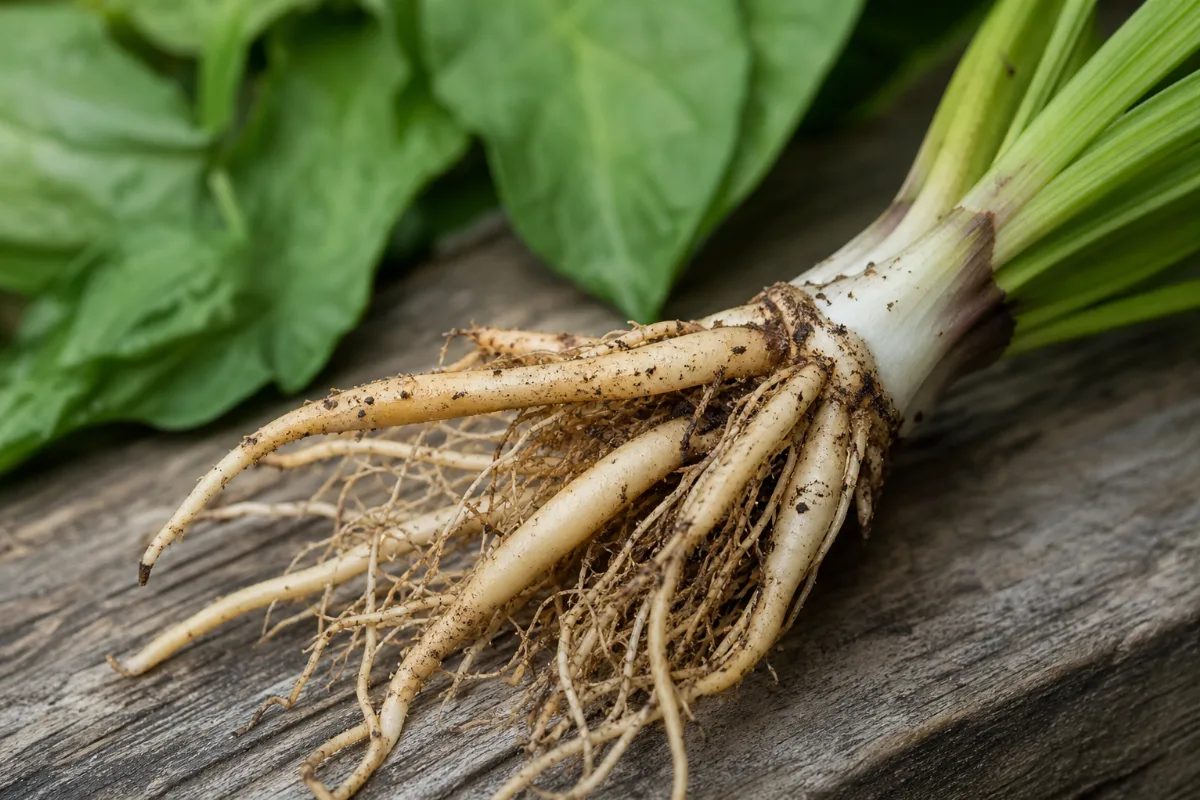
False unicorn root is the root and rhizome of Chamaelirium luteum, a plant native to eastern North America. It is also called fairy wand or blazing star.
Do not confuse it with true unicorn root (Aletris farinosa), a different plant. Herbal sources report the two are sometimes mixed up.
What makes it distinctive
The root holds unusual steroid-like saponins, many of them found only in this species. Chemists have described their structures, but no study shows they affect hormones or the body in people.
Historical and current uses
Native American traditions and 19th-century American herbals valued it for women's reproductive health: painful or irregular periods, a tendency to miscarry, and morning sickness. Today it is sold alone or in combination products for the female reproductive system.
What the research shows
There are no human trials. The research is a narrative review, a history review that does not name this herb in its abstract, and test-tube studies of the root's compounds.
In dishes, some compounds slowed the growth of tumour cells. This is early chemistry, not a treatment. We read abstracts only.
At a glance
Traditional uses history, not proof
- Native American and 19th-century herbal medicine: uterine tonic for painful, irregular or missing periods
- Also used traditionally for fertility, a tendency to miscarry, and nausea in pregnancy
Studied for research
- Menstrual complaints, fertility, pregnancy nausea: insufficient evidence (tradition only)
- Tumour cell growth and antioxidant activity: lab work only
Main compounds
- Open-chain steroidal saponins (many unique to this plant)
- Cholestane glycosides and sterols
- Diosgenin, phenolic acids and flavonoids (reported in a review)
Common forms
- Dried root or rhizome
- Tincture
- Capsules or powder
- Tea or decoction
- Combination women's-health products
Research links: Review of traditional uses and chemistry (2026) · Product authentication study (J Nat Prod 2026) · Enzyme study of women's herbal products (2011) · Saponin chemistry (J Nat Prod 2012) · Research Library · Genes & Biomarkers Library
The plant and its history
- Accepted scientific name
- Chamaelirium luteum (L.) A.Gray
- Naming authority
- (L.) A.Gray
- Synonyms
- Helonias dioica (name used in older texts; not checked in a taxonomic database)
- Common names
- False unicorn root (English); False unicorn (English); Fairy wand (English); Blazing star (English)
- Botanical family
- Melanthiaceae (a lily-like family; older papers say Liliaceae).
- Classification
- Plantae > Tracheophyta > Liliopsida > Liliales > Melanthiaceae > Chamaelirium > Chamaelirium luteum
- Native range
- Eastern North America. United Plant Savers gives Alabama to Virginia and West Virginia, rarely southern Ontario; an herbal-industry source says Florida to New York and west to the Mississippi. Sources differ.
- Habitat
- Not verified.
- What the plant looks like
- Roots: The root and rhizome is the part used.; Stems: Not verified.; Leaves: Not verified.; Flowers: Male and female flowers are on separate plants (a dioecious lily; titles of 1980-81 ecology papers).; Fruit: Not verified.
- Cultivation
- Slow-growing; supply is mostly wild-harvested (2026 J Nat Prod abstract). Cultivated sources exist but were not assessed.
- Harvest and processing
- Digging the root kills the plant (United Plant Savers, summary-only).
- Look-alikes and adulterants
- Name: Aletris farinosa (true unicorn root); Note: A different plant with a similar common name. Herbal sources report the two are mixed up; no testing survey was found.
- Sustainability and conservation
- United Plant Savers Critical tier (page content from our existing summary, not re-opened).
Traditional use and history history, not clinical proof
| Tradition or era | Documented use | Source |
|---|---|---|
| Native American traditions | Valued for women's reproductive health. | p41337655 |
| 19th-century American medicine (Eclectic) | Described as a uterine tonic; used for menstrual problems, a tendency to miscarry and nausea of pregnancy. Large amounts were said to cause vomiting. | s-kings-chamaelirium |
| Colonial to 1900 North America | Fertility remedies in general are reviewed; the abstract does not name this herb. NOT verified for false unicorn root. | p30023440 |
Traditional use shows how a plant was used. It does not show that a supplement works or is safe today.
What is inside, and how it may work
What the plant contains and how those compounds act in cells and animals. Laboratory and animal mechanisms are not proven effects in people.
Main compounds
| Compound | Family | Where it is concentrated | Activity studied | Level of evidence |
|---|---|---|---|---|
| Open-chain steroidal saponins (e.g. chamaelirosides A and B, chiograsterols) | steroidal saponin | root Not reported | Structures described; many appear unique to this species. Some slowed tumour cell growth in dishes. No effect in people shown. 8 2 1 | Laboratory research |
| Cholestane glycosides and sterols | steroidal glycoside | underground parts Not reported | Cytotoxic to HL-60 cells in dishes. 14 | Laboratory research |
| Diosgenin | steroidal sapogenin | root About 2.5% of dry weight, as stated in a review abstract (not checked against primary papers). | Not tested here. 13 | Laboratory research |
| Gallic acid, quercetin and lignans | phenolics | not stated About 1.2% and 0.8% of dry weight as stated in a review abstract (not checked). | Reported lab activity only. 13 | Laboratory research |
Mechanisms, receptors and pathways
| Target or pathway | Gene or receptor | What was found | Level |
|---|---|---|---|
| Cell growth (antiproliferation) in tumour cell lines | not established | Several root compounds, mostly the sugar-free parts, slowed growth of cell lines in dishes. 2 14 | Laboratory research |
| Drug-processing (CYP) enzymes | CYP1A2, 2C19, 2D6, 3A4 tested as a group | Commercial preparations (false unicorn among four) inhibited some enzymes in a test-tube assay. False unicorn's own results not in the abstract. 6 | Laboratory research |
Absorption, metabolism and elimination
- Absorption
- No data in people.
- Distribution
- No data.
- Metabolism
- No data apart from the test-tube enzyme study.
- Elimination
- No data.
- Bioavailability
- Not established.
Isolated compounds versus whole extracts
All the lab activity comes from isolated compounds in dishes. How the whole root or a store product behaves in people has not been studied. Product make-up is also uncertain because many products lack the real plant's profile.
Nutritional composition
A nutrient table is not meaningful for this medicinal root.
5 not enough evidence
What is False unicorn root good for?
The traditional uses and how strong the human evidence is for each. For false unicorn root, "insufficient" means we found no human trial at all. Nothing here is proven to work.
Benefits, one by one
Each card is a research question, not a promise. Tap a goal to filter. Open a card to see the studies, doses and limits.
Painful, irregular or missing periods (traditional use only)
Not enough evidenceFalse unicorn root has long been taken as a uterine tonic for painful, irregular or absent periods. We found no human trial. A consumer health reference rates this use as traditional, with minimal or no scientific evidence.
3 studiesDried root or rhizome, tincture, capsule and combination products are…
Studies, doses and limits
What the trials found
No human trial or case series for this use was found. The 2026 review says clinical evidence remains limited; the consumer reference rates the use as minimal or no scientific evidence.
Results
No human results exist.
Effect sizes as reported
None for people.
Why this rating
No human research; tradition and reviews only.
Form and dose studied
Dried root or rhizome, tincture, capsule and combination products are sold. No tested product or amount.
Who was studied
None studied.
Limits
Abstract and summary-only sources. Reviews describe tradition and are not tests of benefit.
Why researchers looked
It is the herb's best-known traditional use.
Traditional use
Described in historical herbal texts and by a 2026 review as a women's reproductive herb valued by Native American tribes.
Proposed mechanism Pharmacological theory
No mechanism has been shown in people. The root contains unusual steroid-like saponins, but no study links them to menstrual effects.
A proposed mechanism does not show that the effect happens in people.
Do not use it to treat missed periods without finding the cause: missed periods can signal pregnancy or illness. See the safety tab.
Fertility and preventing miscarriage (traditional use only)
Not enough evidenceHistorical texts describe it for fertility and for a tendency to miscarry. No trial shows it works, and the same sources advise against use in pregnancy.
3 studiesDried root or rhizome, tincture, capsule and combination products are…
Studies, doses and limits
What the trials found
A 2018 historical review covers North American fertility herbs. Its abstract does not name false unicorn root or show that it improves fertility. No human trial of this herb was found.
Results
None.
Effect sizes as reported
None for people.
Why this rating
History only; no human data.
Form and dose studied
Dried root or rhizome, tincture, capsule and combination products are sold. No tested product or amount.
Who was studied
None studied.
Limits
The 2018 review abstract does not mention this herb, so the entry for it was not read. The 19th-century sources are not evidence of benefit.
Why researchers looked
Old North American herbals list it for these uses.
Traditional use
19th-century dispensatory and herbal-industry texts.
Proposed mechanism Pharmacological theory
No mechanism shown.
A proposed mechanism does not show that the effect happens in people.
Conflicting message: used for miscarriage in old texts, yet advised against in pregnancy today. Avoid in pregnancy (see safety tab).
Nausea in pregnancy (traditional use only)
Not enough evidenceTraditionally used for morning sickness, yet a consumer health reference advises against any use in pregnancy.
2 studiesDried root or rhizome, tincture, capsule and combination products are…
Studies, doses and limits
What the trials found
No trial found.
Results
None.
Effect sizes as reported
None for people.
Why this rating
No human data, and a safety warning against use in pregnancy.
Form and dose studied
Dried root or rhizome, tincture, capsule and combination products are sold. No tested product or amount.
Who was studied
None studied.
Limits
Summary-only sources.
Why researchers looked
Listed in old herbals.
Traditional use
Historical use for nausea of pregnancy.
Proposed mechanism Pharmacological theory
No mechanism shown.
A proposed mechanism does not show that the effect happens in people.
Do not use for morning sickness. Ask a doctor or midwife about safe options.
Slowing the growth of cancer cells (test tube only)
Not enough evidenceCompounds from the root slowed the growth of human tumour cells in lab dishes. This does not show any benefit to a person, and the herb is not a cancer treatment.
2 studiesDried root or rhizome, tincture, capsule and combination products are…
Studies, doses and limits
What the trials found
No human study. Lab results only.
Results
Six human tumour cell lines in one study; compounds 6a, 10a, 12a, 13 and 13a were cytotoxic to HL-60 leukaemia cells in another, with IC50 6.2 to 15.3 micromolar.
Effect sizes as reported
IC50 6.2 to 15.3 micromolar in one cell line.
Why this rating
Cells in dishes only.
Form and dose studied
Dried root or rhizome, tincture, capsule and combination products are sold. No tested product or amount.
Who was studied
None.
Limits
Abstracts only. Isolated compounds, not the whole root or any product. Most cell-line hits never become medicines.
Why researchers looked
Chemists tested the root's unusual saponins in cell lines.
Traditional use
None.
Proposed mechanism Laboratory research
Steroid-like saponins and the sugar-free parts of them slowed growth of several human tumour cell lines in dishes.
A proposed mechanism does not show that the effect happens in people.
Do not use the herb for cancer. Tell your doctor about any herb you take.
Antioxidant and anti-inflammatory activity (lab and review only)
Not enough evidenceA 2026 review reports antioxidant and anti-inflammatory activity of the plant's compounds in lab research. Nothing in people.
1 studiesDried root or rhizome, tincture, capsule and combination products are…
Studies, doses and limits
What the trials found
No human study found.
Results
Review states activity; no numbers read.
Effect sizes as reported
None.
Why this rating
Narrative review of lab work.
Form and dose studied
Dried root or rhizome, tincture, capsule and combination products are sold. No tested product or amount.
Who was studied
None.
Limits
Abstract only; the review's primary sources were not checked.
Why researchers looked
Reviewed as part of the herb's pharmacology.
Traditional use
Anti-inflammatory use is mentioned in ethnobotanical records.
Proposed mechanism Laboratory research
Lab activity reported in the review, which also lists phenolic acids, flavonoids and lignans.
A proposed mechanism does not show that the effect happens in people.
None known beyond the general cautions on the safety tab.
Connections to the rest of health
How False unicorn root connects to the rest of our health knowledge graph. Every link says what kind of connection it is. A safety link (for example to the liver) is a warning, not a benefit. A study that merely mentions a topic never creates a benefit link.
Explore every connection: goals, body systems, organs, symptoms, genes
A. Wellness goals
| Connected to | Kind of connection | Evidence status | Context | Studies |
|---|---|---|---|---|
| Womens Wellness | Traditional use | Not enough evidence | Painful, irregular or missing periods (traditional use only): False unicorn root has long been taken as a uterine tonic for painful, irregular or absent periods. We found no human trial. A consumer health reference rates this use as traditional, with minimal or no scientific evidence. Fertility and preventing miscarriage (traditional use only): Historical texts describe it for fertility and for a tendency to miscarry. No trial shows it works, and the same sources advise against use in pregnancy. | 13 11 3 7 |
| Hormone Balance | Traditional use | Not enough evidence | Painful, irregular or missing periods (traditional use only): False unicorn root has long been taken as a uterine tonic for painful, irregular or absent periods. We found no human trial. A consumer health reference rates this use as traditional, with minimal or no scientific evidence. | 13 11 3 |
| Fertility Support | Traditional use | Not enough evidence | Fertility and preventing miscarriage (traditional use only): Historical texts describe it for fertility and for a tendency to miscarry. No trial shows it works, and the same sources advise against use in pregnancy. | 7 3 11 |
| Healthy Aging | Preliminary mechanism | Not enough evidence | Slowing the growth of cancer cells (test tube only): Compounds from the root slowed the growth of human tumour cells in lab dishes. This does not show any benefit to a person, and the herb is not a cancer treatment. | 2 14 |
| Inflammation Balance | Preliminary mechanism | Not enough evidence | Antioxidant and anti-inflammatory activity (lab and review only): A 2026 review reports antioxidant and anti-inflammatory activity of the plant's compounds in lab research. Nothing in people. | 13 |
B. Body systems
| Connected to | Kind of connection | Evidence status | Context | Studies |
|---|---|---|---|---|
| Reproductive System | Biological association | Not enough evidence | Studied for: Painful, irregular or missing periods (traditional use only) Studied for: Fertility and preventing miscarriage (traditional use only) | 13 11 3 7 |
| Digestive System | Biological association | Not enough evidence | Studied for: Nausea in pregnancy (traditional use only) | 11 3 |
| Immune System | Biological association | Not enough evidence | Studied for: Slowing the growth of cancer cells (test tube only) Studied for: Antioxidant and anti-inflammatory activity (lab and review only) | 2 14 13 |
E. Health conditions
L. Active compounds
| Connected to | Kind of connection | Evidence status | Context | Studies |
|---|---|---|---|---|
| Open-chain steroidal saponins (e.g. chamaelirosides A and B, chiograsterols) | Biological association | In vitro | Structures described; many appear unique to this species. Some slowed tumour cell growth in dishes. No effect in people shown. Preparation or compound: root |
8 2 1 |
| Cholestane glycosides and sterols | Biological association | In vitro | Cytotoxic to HL-60 cells in dishes. Preparation or compound: underground parts |
14 |
| Diosgenin | Biological association | In vitro | Not tested here. Preparation or compound: root |
13 |
| Gallic acid, quercetin and lignans | Biological association | In vitro | Reported lab activity only. Preparation or compound: not stated |
13 |
Each connection is stored with the ingredient, the connected record, the kind of connection, the evidence status, the supporting studies, the preparation or compound involved, and a review date (last reviewed October 25, 2026).
The evidence
The research centre for False unicorn root. Every record here was checked against PubMed or the publisher's page; we never list a study we have not verified.
Evidence by outcome
Bars show how many studies we found for each outcome, not how well it works. People are added up across trials only (reviews are not added, to avoid double counting).
How we rate evidence
High certainty
Several well-run trials or reviews agree; further research is unlikely to change the picture much.
Moderate certainty
Good trials point the same way, but some doubt remains.
Low certainty
Small, short or inconsistent trials. The finding could change with better research.
Very low certainty
Very little or very weak human data. Treat as a possibility only.
Mixed findings
Trials or reviews disagree with each other.
Not enough evidence
Not enough human research to say either way.
Evidence against
Good research found no benefit, or found harm.
We take the reviewers' own risk-of-bias and GRADE statements where they exist, and otherwise judge from study size, design, consistency, directness and whether a product matches what is sold. Many publications do not make evidence high. Method note: We started from our existing summary of this herb, then checked every cited paper in PubMed and the accepted name in GBIF. Several consumer and industry sources were taken from that summary and not re-opened. No study is cited that we could not verify.
Study library: every study we checked 14
| Study | Design | People | Product, dose, length | Result |
|---|---|---|---|---|
| Barr 2026 Complementary Orthogonal Approaches for Metabolite Profiling of Chamaelirium luteum (False Unicorn) Root Preparations and Commercial Products J Nat Prod · PMID 42924949 · DOI |
Chemistry not applicable (product chemistry) |
Authenticated root material and purchased commercial products | Root preparations and commercial false unicorn products root not extracted not extracted · vs see results |
The authors say the plant is slow-growing and mostly wild-harvested, with conservation concerns. They built a fingerprint method using authenticated material and applied it to purchased products. The majority of products lacked the characteristic false unicorn profile, which the authors describe as species substitution and adulteration. Most products tested lacked the false unicorn profile (the abstract gives no count). (not applicable) Methods, limits and fundingOutcomes: Chemical fingerprinting to authenticate products Limitations: Abstract only. Number and brands of products not given in the abstract. Not a safety study. Funding and conflicts: not read Read: abstract |
| Challinor 2012 Structure and bioactivity of steroidal saponins isolated from the roots of Chamaelirium luteum (false unicorn) J Nat Prod · PMID 22880631 · DOI |
Lab study in-vitro |
Six human tumour cell lines | Fifteen steroidal glycosides from the root root not extracted not extracted · vs see results |
Fifteen steroidal glycosides were isolated; twelve appear unique to this species. Some of the compounds (mostly the sugar-free parts) clearly slowed growth of the tumour cell lines. Cell-line findings only. (not applicable) Methods, limits and fundingOutcomes: Structures; growth-slowing (antiproliferative) activity in cell lines Limitations: Test tube only; says nothing about effects in people. Funding and conflicts: not read Read: abstract |
| Felter and Lloyd 1898 Chamaelirium (Helonias), Blazing Star - King's American Dispensatory Felter and Lloyd · Source |
Historical text not applicable |
False unicorn root root / rhizome not extracted not extracted · vs see results |
Historical uses and effects of large amounts See results (not applicable) Methods, limits and fundingOutcomes: Historical uses and effects of large amounts Limitations: Not a formal regulatory review or trial; reached through our existing summary, not re-opened for this page. Funding and conflicts: not read Read: summary-only | |
| GBIF 2026 GBIF species match: Chamaelirium luteum (L.) A.Gray GBIF · Source |
Database record not applicable |
False unicorn root root / rhizome not extracted not extracted · vs see results |
Accepted species, key 2741647, family Melanthiaceae, order Liliales (GBIF API, 2026-10-25). See results (not applicable) Methods, limits and fundingOutcomes: Accepted name, family Limitations: Not a formal regulatory review or trial; reached through our existing summary, not re-opened for this page. Funding and conflicts: not read Read: full-text | |
| Herbal Reality 2026 False Unicorn (herbal-industry monograph) Herbal Reality · Source |
Traditional use / reference not applicable |
False unicorn root root / rhizome not extracted not extracted · vs see results |
Traditional use, cautions, look-alike mix-ups See results (not applicable) Methods, limits and fundingOutcomes: Traditional use, cautions, look-alike mix-ups Limitations: Not a formal regulatory review or trial; reached through our existing summary, not re-opened for this page. Funding and conflicts: not read Read: summary-only | |
| Ho 2011 The effects of commercial preparations of herbal supplements commonly used by women on the biotransformation of fluorogenic substrates by human cytochromes P450 Phytother Res · PMID 21213356 · DOI |
Lab study in-vitro |
Enzymes made in the lab (no people) | Commercial preparations of black cohosh, chaste tree berry, crampbark and false unicorn commercial products, plant part not stated not extracted not extracted · vs see results |
All four preparations inhibited some of the enzymes tested, with potencies around 1 microgram per mL. None affected CYP1A1 or CYP2C9. The abstract does not give false unicorn's own results, so which enzymes it affected is not known. The authors say only studies in people can show whether this matters. Enzyme inhibition in the lab; false unicorn's own numbers not in the abstract. (not applicable) Methods, limits and fundingOutcomes: Effect on drug-processing (CYP) enzymes Limitations: Test tube assay on commercial products that interfered with the assay. False unicorn's own results were not read. Funding and conflicts: not read Read: abstract |
| Lans 2018 Herbal fertility treatments used in North America from colonial times to 1900, and their potential for improving the success rate of assisted reproductive technology Reprod Biomed Soc Online · PMID 30023440 · DOI |
Historical review |
Historical records of North American fertility remedies, 1492-1900 | Botanical remedies, including false unicorn root as covered by our summary various not extracted not extracted · vs see results |
The abstract describes historical use and says a few clinical trials of other medicinal plants have shown potential to help assisted reproduction. The abstract does not name false unicorn root or show that it improves fertility. History only; no effect for false unicorn root. (not applicable) Methods, limits and fundingOutcomes: Which plants were used for fertility, and their potential today Limitations: Abstract only; false unicorn root is not mentioned in the abstract, so its entry in the full paper was not read. Funding and conflicts: not read Read: abstract |
| Matovic 2011 The truth about false unicorn (Chamaelirium luteum): total synthesis of 23R,24S-chiograsterol B defines the structure and stereochemistry of the major saponins from this medicinal herb Chemistry · PMID 21598325 · DOI |
Chemistry in-vitro |
None (chemistry) | Steroidal saponins from the root root not extracted not extracted · vs see results |
Two new steroidal saponins with an unusual aglycone were isolated from the root and their 3D structure was settled by making the aglycone in 16 steps. The authors say only very limited chemical description of the herb existed before. Structure only; no health effect tested. (not applicable) Methods, limits and fundingOutcomes: Structure of two new saponins Limitations: Chemistry paper; says nothing about benefit or safety in people. Funding and conflicts: not read Read: abstract |
| NIH LiverTox 2026 LiverTox record for false unicorn NIH LiverTox · Source |
Regulator lookup not applicable |
False unicorn root root / rhizome not extracted not extracted · vs see results |
No false unicorn record found; the LiverTox site was blocked when checked, so absence is not confirmed. See results (not applicable) Methods, limits and fundingOutcomes: No record found Limitations: Not a formal regulatory review or trial; reached through our existing summary, not re-opened for this page. Funding and conflicts: not read Read: not found | |
| NIH NCCIH / MSKCC 2026 NCCIH and Memorial Sloan Kettering pages for false unicorn NIH NCCIH / MSKCC · Source |
Regulator lookup not applicable |
False unicorn root root / rhizome not extracted not extracted · vs see results |
No false unicorn page found (404) at NCCIH or MSKCC when checked for our existing summary. See results (not applicable) Methods, limits and fundingOutcomes: No page found Limitations: Not a formal regulatory review or trial; reached through our existing summary, not re-opened for this page. Funding and conflicts: not read Read: not found | |
| PeaceHealth 2015 False Unicorn (consumer health reference, reviewed 2015) PeaceHealth · Source |
Traditional use / reference not applicable |
False unicorn root root / rhizome not extracted not extracted · vs see results |
Traditional uses, evidence rating and safety advice See results (not applicable) Methods, limits and fundingOutcomes: Traditional uses, evidence rating and safety advice Limitations: Not a formal regulatory review or trial; reached through our existing summary, not re-opened for this page. Funding and conflicts: not read Read: summary-only | |
| United Plant Savers 2026 False Unicorn Root (Chamaelirium luteum), species at risk United Plant Savers · Source |
Traditional use / reference not applicable |
False unicorn root root / rhizome not extracted not extracted · vs see results |
Conservation status See results (not applicable) Methods, limits and fundingOutcomes: Conservation status Limitations: Not a formal regulatory review or trial; reached through our existing summary, not re-opened for this page. Funding and conflicts: not read Read: summary-only | |
| Wang 2026 Ethnopharmacological Insights Into Chamaelirium luteum (L.) Gray: Traditional Uses, Phytochemistry, and Pharmacological Potential Chem Biodivers · PMID 41337655 · DOI |
Narrative review in-vitro |
Review of botany, chemistry and lab pharmacology; no trial population | Chamaelirium luteum root and rhizome compounds root / rhizome not extracted not extracted · vs see results |
Review says the herb was valued by Native American tribes for women's reproductive health and reports anti-inflammatory, antioxidant and cytotoxic effects in the lab. It states that clinical evidence remains limited. Narrative review; no pooled effect. (not applicable) Methods, limits and fundingOutcomes: Traditional use, phytochemistry, lab pharmacology, toxicology Limitations: Abstract only. Narrative review, not a systematic review. Reports a diosgenin content of about 2.5% of dry weight, which we have not checked against primary papers. Funding and conflicts: not read Read: abstract |
| Yokosuka 2013 New cholestane glycosides and sterols from the underground parts of Chamaelirium luteum and their cytotoxic activity J Nat Med · PMID 23160794 · DOI |
Lab study in-vitro |
HL-60 human leukaemia cells | Cholestane glycosides and sterols from underground parts root / rhizome not extracted not extracted · vs see results |
Six new cholestane glycosides and two new sterols were identified. Five compounds were toxic to the leukaemia cells with IC50 values of 6.2 to 15.3 micromolar. IC50 6.2 to 15.3 micromolar in cells. (not applicable) Methods, limits and fundingOutcomes: Structures; cell-killing (cytotoxic) activity Limitations: Test tube only; one cell line. Funding and conflicts: not read Read: abstract |
What we do not know yet
- No human trial of false unicorn root for any use was found.
- Only abstracts were read; full papers were not.
- No safety study in people, and no pregnancy, breastfeeding or interaction study.
- False unicorn's own enzyme results from the 2011 study were not in the abstract.
- Whether it acts on hormones is unknown.
- The mix-up with true unicorn root rests on an herbal-industry source; no testing survey was found.
- NCCIH and LiverTox records were not found; EMA/HMPC, FDA, WHO and LactMed were not re-checked.
How new research is added
New studies are found by a saved PubMed search and are placed in a review queue. A person reads each one before it changes any evidence rating or safety wording.
Lab markers
What changed in blood or saliva tests during trials. A changed number is not the same as feeling or being healthier, and we give no "normal ranges".
Safety
What studies and official sources say about side effects, medicines and who should check first. Each point shows what kind of evidence it comes from.
Main points to know 4
- Avoid in pregnancy. A consumer health reference calls use in pregnancy potentially unsafe because of a possible effect on the uterus and advises against it. An herbal-industry source says to use it in pregnancy and breastfeeding only with a medical herbalist. Neither is a formal regulatory review, so treat this as a firm precaution. Authoritative guidance 11 5
- Large amounts can cause vomiting. A 19th-century dispensatory says large amounts of the root cause vomiting and that it was reported to poison cattle. This is an old text, not a modern safety study. Traditional use 3
- Products may not contain the real plant. A 2026 analysis of purchased products found that most lacked the characteristic false unicorn profile, which the authors describe as species substitution and adulteration. Herbal sources also report mix-ups with true unicorn root (Aletris farinosa). Authoritative guidance 1 5
- No human safety studies exist. We found no clinical trial, case report or regulator review of false unicorn root. Its safety in people has not been established. Authoritative guidance 10 9
Side effects 2
| Effect | How often | Severity and recovery | Evidence |
|---|---|---|---|
| Nausea and vomiting (with large amounts) From a 19th-century dispensatory; no modern report found. | Not established | unknown unknown | Traditional use 3 |
| Possible effect on the uterus Why use in pregnancy is advised against; mechanism not shown. | Not established | unknown unknown | Authoritative guidance 11 |
Liver
No liver injury case or LiverTox record for false unicorn root was found. The LiverTox site was blocked when checked, so this does not prove there is none. 9
How often. Unknown. No data.
Monitoring. No agency monitoring advice exists. Stop and see a doctor if you get yellow skin or eyes, dark urine or severe tiredness.
This is a safety connection. It is not evidence that False unicorn root supports liver health.
Medicines and supplements 3
| With | Why it matters | Importance | Evidence | What to do |
|---|---|---|---|---|
| Hormonal medicines (birth control, hormone therapy, fertility drugs) and hormone-sensitive conditions (breast, ovarian, uterine cancers, endometriosis, fibroids) prescription | The root holds steroid-like saponins and is sold for women's hormone health. No study shows it acts like a hormone, and none shows it does not. | Unknown. No interaction study. A precaution only. | Pharmacological theory Not enough evidence 2 13 | Ask your doctor or pharmacist before combining, especially with a hormone-sensitive condition. |
| Medicines cleared by liver (CYP) enzymes prescription | In a 2011 test-tube study, four commercial women's herbal products including false unicorn each inhibited some drug-processing enzymes. The abstract does not give false unicorn's own results. | Unknown. Lab signal only; the authors say studies in people are needed. | Laboratory research Not enough evidence 6 | Tell your pharmacist you use it, particularly with drugs that have a narrow safety margin. |
| Other women's-health herbs sold in the same products (black cohosh, chaste tree berry, others) herb | Combination products are common and ingredient lists vary. Combined effects are not studied. | Unknown. | Expert precaution Not enough evidence 6 | Read every ingredient and tell your clinician. |
Who should check first 4
| Situation | Advice | Evidence |
|---|---|---|
| Pregnancy, trying to conceive, breastfeeding | Avoid. Safety is not established and sources advise against use in pregnancy because of a possible uterine effect. No breastfeeding data (no LactMed record found). | Authoritative guidance 11 5 |
| Hormone-sensitive conditions or hormonal drugs | Ask a doctor first. No study checked; this is a precaution. | Pharmacological theory 13 |
| Abnormal, heavy or missed periods, pelvic pain or bleeding | See a doctor to find the cause first; do not self-treat with this herb. | Expert precaution 11 |
| Children | No data. Avoid. | Expert precaution 10 |
Overdose, product quality and regulators
Summary. No modern toxicity study in people was found. A 19th-century text says large amounts cause vomiting and that the root was reported to poison cattle.
Animal. Cattle poisoning was reported in the 1898 text only; not confirmed by any study we read.
Human doses studied. None. No safe amount has been established.
High dose or long term signals. Vomiting with large amounts (historical report).
Overdose response. Not described. Seek medical help for persistent vomiting.
Genotoxicity. Not found.
Toxic plant parts. The root and rhizome is the part used; the text does not single out other parts.
Quality is a real problem. Most wild-harvested supply is slow-growing, and a 2026 analysis found most purchased products lacked the false unicorn profile.
Species substitution and adulteration. The majority of commercial products tested lacked the characteristic profile (count not given in the abstract). 1
Mix-up with true unicorn root (Aletris farinosa). An herbal-industry monograph reports the two are confused and sometimes mixed. No testing survey of this was found; the 2026 analysis abstract does not name Aletris. 5 1
Wild harvest and conservation. United Plant Savers lists it on the Critical tier of its at-risk list, because harvesting the root kills the plant. The 2026 analysis also notes conservation concerns. 12 1
| Body | Action | Date |
|---|
When to get medical help
- Vaginal bleeding, cramping or pelvic pain in pregnancy or while trying to conceive.
- Repeated vomiting that does not stop.
- Yellow skin or eyes, or dark urine.
Stop the supplement and contact a clinician or emergency service. In the US, Poison Control is 1-800-222-1222.
General information only, not medical advice. Ask a clinician or pharmacist before use, especially with medicines, in pregnancy or with a health condition. See the Natural Remedy Safety guide.
Frequently asked questions
What is false unicorn root used for?
Does false unicorn root work?
We do not know. No human trial was found, and a 2026 review says clinical evidence remains limited.
Is false unicorn root safe in pregnancy?
Is it safe while breastfeeding?
Does it contain hormones or act like estrogen?
Can it interact with medicines?
Possibly. In a test-tube study, four women's herbal products including false unicorn slowed some drug-processing enzymes. False unicorn's own results were not in the abstract, and no study in people exists. Tell your pharmacist.
Does it cause nausea or vomiting?
An 1898 dispensatory says large amounts cause vomiting. No modern report was found.
Is false unicorn root harmful to the liver?
We found no case report and no LiverTox record, but the LiverTox site was blocked when checked, so this is not proof it is safe.
Is false unicorn root endangered?
What is the difference between false and true unicorn root?
They are different plants: false unicorn root is Chamaelirium luteum and true unicorn root is Aletris farinosa. Herbal sources report they are sometimes mixed up in products.
Do products contain the real plant?
Often not. A 2026 study found that most purchased products it tested lacked the characteristic false unicorn profile, which the authors describe as species substitution and adulteration. It did not give brand names in the abstract.
Explore by health goal
Womens WellnessHormone BalanceFertility SupportHealthy AgingInflammation Balance
Editorial transparency
- Written by
- AlternativeMed editorial team. Research compiled with AI assistance, then checked against PubMed records.
- Medical review
- None. This page has not been reviewed by a physician or pharmacist.
- First published
- 2026-10-25
- Last substantive update
- 2026-10-25
- How we research
- We started from our existing summary of this herb, then checked every cited paper in PubMed and the accepted name in GBIF. Several consumer and industry sources were taken from that summary and not re-opened. No study is cited that we could not verify.
- How we rate evidence
- See "How we rate evidence" in the Evidence tab.
- Independence
- No product is promoted on this page. No affiliate links are shown. If one is added later it will be labelled and kept apart from the evidence.
Sources 14
Each source was opened and checked. Where we read only the abstract, it says so. The small numbers in the text point here.
- Barr SA, Perera WH, Strangman WK. Complementary Orthogonal Approaches for Metabolite Profiling of Chamaelirium luteum (False Unicorn) Root Preparations and Commercial Products. J Nat Prod. 2026. PMID 42924949. DOI 10.1021/acs.jnatprod.6c00810. (abstract)
- Challinor VL, Stuthe JM, Parsons PG, et al.. Structure and bioactivity of steroidal saponins isolated from the roots of Chamaelirium luteum (false unicorn). J Nat Prod. 2012. PMID 22880631. DOI 10.1021/np300393y. (abstract)
- Felter and Lloyd. Chamaelirium (Helonias), Blazing Star - King's American Dispensatory. Felter and Lloyd. 1898. (summary-only)
- GBIF. GBIF species match: Chamaelirium luteum (L.) A.Gray. GBIF. 2026. (full-text)
- Herbal Reality. False Unicorn (herbal-industry monograph). Herbal Reality. 2026. (summary-only)
- Ho SH, Singh M, Holloway AC, et al.. The effects of commercial preparations of herbal supplements commonly used by women on the biotransformation of fluorogenic substrates by human cytochromes P450. Phytother Res. 2011. PMID 21213356. DOI 10.1002/ptr.3371. (abstract)
- Lans C, Taylor-Swanson L, Westfall R. Herbal fertility treatments used in North America from colonial times to 1900, and their potential for improving the success rate of assisted reproductive technology. Reprod Biomed Soc Online. 2018. PMID 30023440. DOI 10.1016/j.rbms.2018.03.001. (abstract)
- Matovic NJ, Stuthe JM, Challinor VL, et al.. The truth about false unicorn (Chamaelirium luteum): total synthesis of 23R,24S-chiograsterol B defines the structure and stereochemistry of the major saponins from this medicinal herb. Chemistry. 2011. PMID 21598325. DOI 10.1002/chem.201100503. (abstract)
- NIH LiverTox. LiverTox record for false unicorn. NIH LiverTox. 2026. (not found)
- NIH NCCIH / MSKCC. NCCIH and Memorial Sloan Kettering pages for false unicorn. NIH NCCIH / MSKCC. 2026. (not found)
- PeaceHealth. False Unicorn (consumer health reference, reviewed 2015). PeaceHealth. 2015. (summary-only)
- United Plant Savers. False Unicorn Root (Chamaelirium luteum), species at risk. United Plant Savers. 2026. (summary-only)
- Wang H, Yin R, Wang Y, et al.. Ethnopharmacological Insights Into Chamaelirium luteum (L.) Gray: Traditional Uses, Phytochemistry, and Pharmacological Potential. Chem Biodivers. 2026. PMID 41337655. DOI 10.1002/cbdv.202501941. (abstract)
- Yokosuka A, Takagi K, Mimaki Y. New cholestane glycosides and sterols from the underground parts of Chamaelirium luteum and their cytotoxic activity. J Nat Med. 2013. PMID 23160794. DOI 10.1007/s11418-012-0718-z. (abstract)