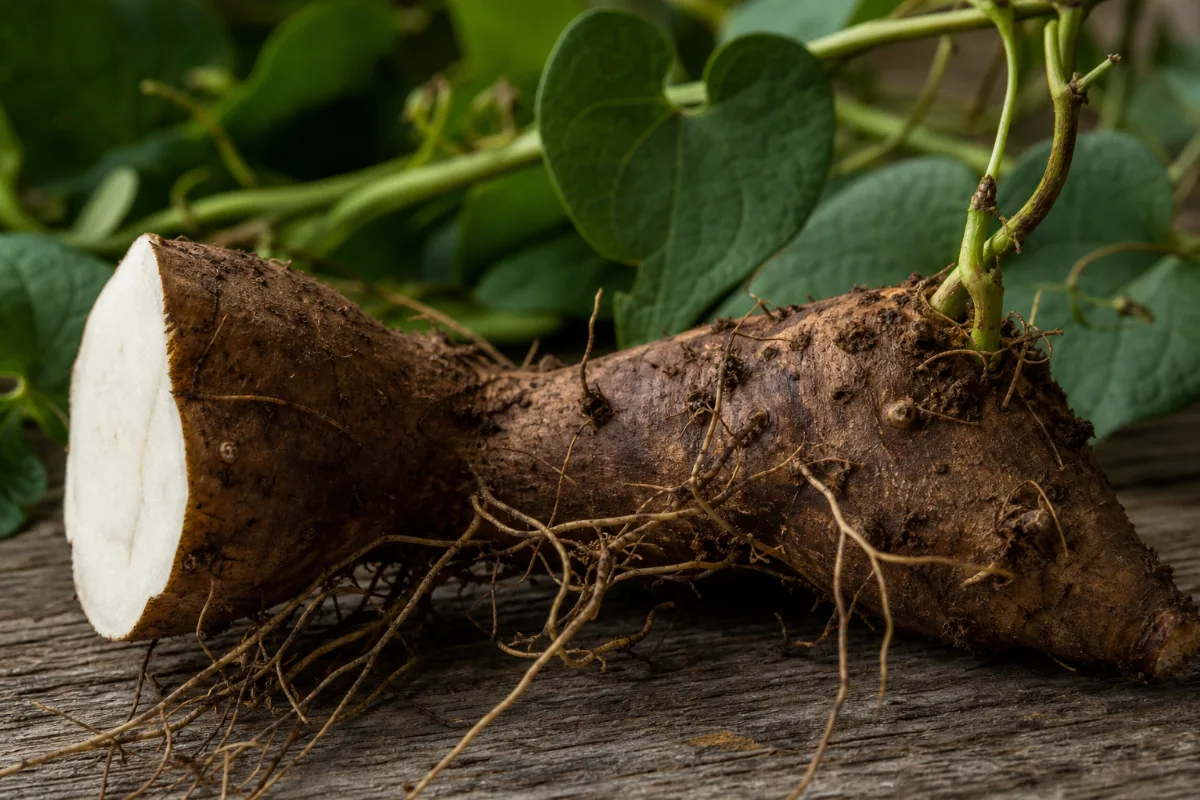
Herbs & Botanicals · Herbs · Root used for menopause symptoms, with low-certainty evidence and a popular myth about progesterone
Wild yam
Dioscorea villosa L. · also called Wild yam (not the same as food yams or other Dioscorea species)
Wild yam is a North American vine in the yam family. Its root (rhizome) is used in creams and supplements, mostly for menopause symptoms. It contains diosgenin, which drug makers use in the lab to make steroid hormones. The human body does not do this, and there is no evidence that it does.
General information, not medical advice. Last substantive update · Not medically reviewed. A named clinician has not signed off on this page. How this page is made
About Wild yam
Wild yam (Dioscorea villosa) is a North American vine whose root is used for menopause symptoms. The research is one small null trial of a cream, trials of other yam species, and lab and animal work. Nothing is rated moderate or high. The popular claim that the body turns it into progesterone is not supported.
What it is
Wild yam (Dioscorea villosa L.) is a vine in the yam family (Dioscoreaceae). Its accepted name was checked in GBIF and NCBI Taxonomy. The root (rhizome) is the part used.
It is not the same as the food yams eaten in many countries, such as Dioscorea alata, and it is not the same as steroid drugs made in factories from diosgenin. This page keeps these separate.
Traditional and current uses
Reviews describe wild yam being used for menopause symptoms, stomach and gut problems, muscle spasm, asthma, joint pain and rheumatoid arthritis. Today it is sold as creams, capsules and liquid extracts. Traditional use is not proof of benefit.
The progesterone myth
Wild yam products are often sold as 'natural progesterone'. The truth is smaller. Drug makers do use diosgenin from yams as a raw material, but they change it in a laboratory. Memorial Sloan Kettering states there is no evidence the human body can convert diosgenin into progesterone.
In the cream trial, blood and saliva progesterone did not change after 3 months. Lab studies show only weak estrogen-like effects in cells. A wild yam cream should not be used in place of prescribed progesterone.
What is in it and how it works
The root contains diosgenin and its sugar-bound form dioscin, plus other steroid-like saponins. In test tubes dioscin partly turns into diosgenin in gut fluid, and both slow a liver enzyme (CYP3A4). Saponins also act like detergents on cell membranes.
Purified diosgenin did not stimulate the rat uterus, while the whole extract acted as a weak phytoestrogen in breast cancer cells. These are lab and animal results and do not show what happens in people.
What the research shows
Nothing about wild yam is rated above low. A wild yam cream did no better than placebo for menopause symptoms in one small trial. A different species, Dioscorea alata, beat placebo in a 12-month trial, and a diosgenin-rich yam extract improved a thinking test in healthy adults. Period pain, cholesterol, blood sugar, joints, bone and cancer cells are very low, mixed or lab and animal only.
Species and product matter: results for other yams and for isolated diosgenin should not be treated as results for wild yam root. For amounts, ask a doctor or pharmacist.
At a glance
Traditional uses history, not proof
- Herbal medicine: menopause symptoms, stomach and gut problems, muscle spasm, asthma, joint pain and rheumatoid arthritis (as described by a clinical summary and a Brazilian study).
- The wider Dioscorea genus is used in Asia for breathing illness, rheumatism, diabetes and diarrhea, and in Africa for other conditions; North American traditional use is rarely recorded.
Studied for research
- Menopause symptoms, wild yam cream on the skin, low (one small trial, no better than placebo)
- Menopause symptoms, oral products of another yam species (Dioscorea alata), low
- Thinking skills, a diosgenin-rich yam extract (species not stated), low
- Cholesterol, mixed
- Period pain and PMS (another yam species), very low
- Blood sugar, joint pain, bone health and cancer cells, animal or lab work only, insufficient
- The claim that the body turns wild yam into progesterone, evidence is against it
Main compounds
- Diosgenin, a steroid-like plant compound
- Dioscin, a sugar-bound form that partly turns into diosgenin in the gut (lab test)
- Other steroidal saponins, some specific to D. villosa
- Saponins act like detergents on cell membranes (lab)
Common forms
- Creams and lotions with wild yam root extract
- Capsules and liquid extracts of the root
- Root powder and tea (traditional)
- Not the same: food yams, other Dioscorea species, or steroid drugs made from diosgenin
Research links: Memorial Sloan Kettering: Wild yam root · Wild yam cream for menopause symptoms, randomized trial (PubMed) · Kidney injury signals in rats fed Dioscorea villosa (PubMed) · Diosgenin and dioscin in the lab: gut stability and CYP3A4 (PubMed) · GBIF: Dioscorea villosa · Research Library · Genes & Biomarkers Library
The plant and its history
- Accepted scientific name
- Dioscorea villosa
- Naming authority
- L.
- Common names
- Wild yam (English)
- Botanical family
- Dioscoreaceae (yam family)
- Classification
- Plantae > Tracheophyta > Liliopsida > Dioscoreales > Dioscoreaceae > Dioscorea > Dioscorea villosa
- Native range
- North America (per the lab paper by Manda 2013 and MSK); finer range not verified.
- Habitat
- Not verified.
- What the plant looks like
- Roots: The rhizome (underground stem) is the medicinal part (cosmetic assessment, other papers). Detail not verified.; Stems: Described as a twining vine by MSK; detail not verified.; Leaves: Not verified.; Flowers: Not verified.; Fruit: Not verified.
- Cultivation
- Not verified.
- Harvest and processing
- For the cosmetic extract, ground rhizomes are extracted with a solvent and purified (CIR 2004). Other processing not verified.
- Look-alikes and adulterants
- Name: Dioscorea cayenensis (a yam also sold as 'wild' or 'Mexican' yam); Note: Can be told apart from D. villosa by its saponins: asperin and gracillin only in D. cayenensis; dioscoreavilloside A and B and parvifloside only in D. villosa (Avula 2014).; Name: Dioscorea alata (greater yam or water yam, a food yam); Note: Used in the Taiwan menopause trials. A different species; its results are not wild yam results.; Name: Dioscorea esculenta (lesser yam); Note: Used in the menstrual-pain trial. A different species.; Name: Steroid drugs made from diosgenin; Note: Made in factories from diosgenin. They are drugs, not the herb, and their safety and effects do not apply to wild yam.
- Sustainability and conservation
- Not assessed.
Traditional use and history history, not clinical proof
| Tradition or era | Documented use | Source |
|---|---|---|
| Herbal medicine (North America and elsewhere) | Menopausal symptoms, stomach and gut problems, muscle spasm, asthma, joint pain and rheumatoid arthritis | MSK clinical summary; Lima 2013 (use in Brazil) |
| Genus Dioscorea in Asia and Africa | Respiratory illness, rheumatism, diabetes, diarrhea, dysentery (Asia); HIV and ringworm (Africa). North American traditional use of the genus is rarely recorded. | Wang 2024 review (PMID 38552992) |
| Pharmaceutical industry | Diosgenin from yam roots used as a raw material for making steroid hormones in the laboratory | MSK summary; CIR 2004 (PMID 15513824) |
| Detailed history of when and where this started (for example 1940s Mexico) | Appears on reference sites but was not verified from a primary source here | NOT verified |
Traditional use shows how a plant was used. It does not show that a supplement works or is safe today.
What is inside, and how it may work
What the plant contains and how those compounds act in cells and animals. Laboratory and animal mechanisms are not proven effects in people.
Main compounds
| Compound | Family | Where it is concentrated | Activity studied | Level of evidence |
|---|---|---|---|---|
| Diosgenin PubChem 99474 | Steroidal sapogenin (spirostanol) | Rhizome Up to 3.5% in the specified cosmetic extract | Raw material for steroid drugs. Binds the estrogen receptor in a binding assay; no estrogen-like effect in a rat uterus test. 6 29 15 20 | In vitro; animal |
| Dioscin PubChem 119245 | Steroidal saponin (glycoside of diosgenin) | Rhizome | Partly converts to diosgenin in simulated stomach and gut fluid; inhibits CYP3A4 in test tubes. 13 21 | Laboratory research |
| Dioscoreavilloside A and B, parvifloside | Steroidal saponins | Rhizome | Found only in D. villosa among the two species tested; useful as identity markers. 4 | Lab analysis |
| Total steroidal saponins and diosgenin in products | Mixed | Rhizome 0.01 to 14.5% in dry plant material; 0.9 to 28.6 mg per daily intake in solid commercial products | Content differs widely between products. 3 | Lab analysis |
Mechanisms, receptors and pathways
| Target or pathway | Gene or receptor | What was found | Level |
|---|---|---|---|
| Estrogen receptors | Estrogen receptor | Diosgenin displaced estradiol from the receptor in a binding assay (IC50 10 nM) and acted through estrogen-receptor-related signals in mouse bone cells. The extract acted as a weak phytoestrogen in MCF-7 cells, switching on progesterone receptor and pS2 genes and lowering estrogen receptor alpha protein. 29 19 | Laboratory research |
| Whole-animal estrogen activity | Uterus (estrogen response) | Purified diosgenin at 20 to 200 mg/kg and a specified wild yam root extract at up to 500 mg/kg a day did not stimulate the rat uterus. 15 6 | Animal research |
| Cell membranes (detergent action) | Not specified | The extract's saponins reduce surface tension and can break up cell membranes, which complicates cancer-cell tests. At non-killing levels it changed 346 genes, raising inflammation and steroid-making signals and lowering cell-division genes. 14 | Laboratory research |
| DNA methylation in breast cancer cells | GATA3, DNMTs, TET enzymes | The extract changed methylation patterns differently in estrogen-receptor positive and negative cell lines. 2 | Laboratory research |
| Kidney scarring pathway | TGF-beta1, NF-kappaB, CTGF | Raised in rat kidney after 28 days of the extract. 27 | Animal research |
| Pain and inflammation | Not specified | The extract reduced pain behaviour and white-cell migration in mice. 12 | Animal research |
| Drug-metabolising enzymes and transporters | CYP3A4; P-glycoprotein | Diosgenin and dioscin inhibited CYP3A4; diosgenin was pumped out of gut-model cells by P-glycoprotein. 13 | Laboratory research |
Absorption, metabolism and elimination
- Absorption
- No human absorption data found. In a gut-cell model dioscin crossed the barrier better than diosgenin, which was pushed back out by P-glycoprotein. A diosgenin study in mice (cited by the cognition-trial authors) found an oil solvent gave the best blood and brain levels, which is why the trial extract was made in olive oil.
- Distribution
- Not found in people.
- Metabolism
- In lab tests dioscin partly turns into diosgenin in simulated stomach (24.2%) and gut (2.4%) fluid. Diosgenin was stable in human liver microsomes (no phase I metabolism) but disappeared in the S9 fraction with a half-life of 11.3 minutes, pointing to phase II metabolism. Nothing in these tests shows diosgenin turning into progesterone.
- Elimination
- Not found.
- Bioavailability
- Not found in people.
Isolated compounds versus whole extracts
Isolated diosgenin, the whole root extract and the cosmetic extract behave differently. Purified diosgenin did not stimulate the rat uterus, while the whole extract acted as a weak phytoestrogen in breast cancer cells, and the extract also carries detergent-like saponins that purified diosgenin does not. Results for one cannot be applied to another, and none of these lab results show what happens in people.
Nutritional composition
Wild yam root is used as a medicine, not a staple food. Studies of food yam (Dioscorea alata) as a large share of daily meals involve a different species and a very large food amount, so they say nothing about wild yam supplements.
1 mixed findings3 low certainty1 very low certainty4 not enough evidence1 evidence against
What was looked at
The 10 benefits and uses checked for Wild yam, each with how strong the evidence is. Tap one to open it.
- Menopause symptoms: wild yam cream on the skinLow certainty
- Menopause symptoms: oral yam products (a different species, Dioscorea alata)Low certainty
- The claim: the body turns wild yam into progesteroneEvidence against
- Thinking skills (a diosgenin-rich yam extract)Low certainty
- Menstrual pain and PMS (a different yam, Dioscorea esculenta)Very low certainty
- Cholesterol and blood fatsMixed findings
- Blood sugarNot enough evidence
- Pain and inflammation (joints, arthritis)Not enough evidence
- Bone health after menopauseNot enough evidence
- Cancer cells in the lab (not a treatment)Not enough evidence
Lab markers tracked in the studies
Estradiol and FSH (menopause hormone markers)Progesterone (blood and saliva)Greene Climacteric Scale (menopause symptom score)RBANS total score (thinking test)Total cholesterolProstaglandin E2 and COX-2 (inflammation chemicals)Urinary isoprostanes (oxidative stress marker)
What is Wild yam good for?
The main proposed uses and how strong the human evidence is for each. "Low" means small or limited studies. "Insufficient" means only lab or animal work. Other yam species are named where they were used.
Benefits, one by one
Each card is a research question, not a promise. Tap a goal to filter. Open a card to see the studies, doses and limits.
Menopause symptoms: wild yam cream on the skin
Low certaintyIn the one controlled trial of a wild yam cream, women with menopause symptoms did no better on the wild yam cream than on a matching placebo cream. Hot flushes eased a little with both, so the improvement looks like a placebo effect.
4 studiesCream applied to the skin; strength and diosgenin content not stated …
Studies, doses and limits
What the trials found
One double-blind, placebo-controlled crossover trial (Komesaroff 2001, 23 healthy women with troublesome menopause symptoms) gave active wild yam (D. villosa) cream and matching placebo for 3 months each, in random order. Both creams brought a minor improvement in flushing and other symptoms, with no statistical difference between them. Hormones, blood fats, glucose and blood pressure did not change. Two review articles that included wild yam (Kelley 2010; Depypere 2014) did not find consistent evidence for it. MSK's clinical summary calls the topical D. villosa formula ineffective.
Results
No difference from placebo on flushing, other symptoms, lipids, FSH, estradiol or progesterone after 3 months.
Effect sizes as reported
No effect sizes in the abstract; the reported finding is no statistical difference between active and placebo cream.
Why this rating
Only one small crossover trial (23 women) tested a wild yam cream. It was null, and a null result from a small trial cannot rule out a small effect.
Form and dose studied
Cream applied to the skin; strength and diosgenin content not stated in the abstract.
Who was studied
Healthy women about 4 years after their last period, average age 53.
Limits
Small, short, one cream, one site; no longer follow-up; funding not stated in the abstract.
Why researchers looked
Wild yam creams are sold as a gentle alternative to hormone therapy for hot flushes and night sweats. The trial's authors noted that no safety or efficacy study had been done before theirs.
Traditional use
Wild yam root is used in herbal medicine for menopause symptoms, stomach and gut problems, muscle spasm, asthma and joint pain (clinical summary, MSK).
Proposed mechanism Preliminary mechanism
The root contains diosgenin and related saponins that are claimed to influence the body's own hormone production. Lab work shows weak estrogen-like activity (see the hormones section), but the one human trial found no change in estradiol, FSH or progesterone.
A proposed mechanism does not show that the effect happens in people.
No significant side effects with either cream over 3 months.
Menopause symptoms: oral yam products (a different species, Dioscorea alata)
Low certaintyA 12-month trial of an oral extract of another yam species (Dioscorea alata) found fewer menopause symptoms than placebo, especially anxiety and sleep problems. This is not wild yam, so it cannot be taken as proof for wild yam.
3 studiesHsu 2011: extract in sachets, 12 mg per sachet, two a day for 12 mont…
Studies, doses and limits
What the trials found
Hsu 2011 was a two-centre, randomized, double-blind, placebo-controlled trial of 50 menopausal women given D. alata extract or placebo for 12 months. The total Greene Climacteric Scale score fell significantly with the extract (p < 0.01), with the clearest gains in feeling tense or nervous (p = 0.007), insomnia (p = 0.004), excitable (p = 0.047) and musculoskeletal pain (p = 0.019). Safety monitoring found no problems. A separate one-arm 30-day study (Wu 2005) had 22 postmenopausal women replace much of their rice with 390 g a day of D. alata food yam; blood estrone and SHBG rose and urinary markers changed, but there was no placebo group. MSK's summary calls the evidence on oral yam mixed and limited.
Results
Lower Greene scale scores than placebo after 12 months with a D. alata extract. Hormone markers shifted in the one-arm food study.
Effect sizes as reported
p < 0.01 for total Greene score; p-values for single items as above. No effect sizes or intervals in the abstracts.
Why this rating
One 50-woman placebo-controlled trial and one uncontrolled study, both with D. alata, not wild yam. Abstracts give no effect sizes.
Form and dose studied
Hsu 2011: extract in sachets, 12 mg per sachet, two a day for 12 months. Wu 2005: 390 g of cooked yam in 2 of 3 meals for 30 days.
Who was studied
Menopausal and postmenopausal women in Taiwan.
Limits
Different species; small; the food-yam study had no placebo; results may not apply to wild yam root products.
Why researchers looked
Researchers in Taiwan tested whether a yam used in folk medicine for menopause could ease symptoms and change hormone levels.
Traditional use
Yam (Dioscorea) has been used folklorically for menopausal symptoms (Wu 2005).
Proposed mechanism Preliminary mechanism
Not established. Steroid-like plant compounds could act weakly like hormones, but the trials did not test a mechanism.
A proposed mechanism does not show that the effect happens in people.
No safety signals were reported in either study, but they were small. Hormone changes seen in the food study mean the same caution applies to people with hormone-sensitive conditions.
The claim: the body turns wild yam into progesterone
Evidence againstNo. Wild yam creams and pills are often sold as 'natural progesterone'. Drug makers do use diosgenin from yams as a starting material, but only in a laboratory process. There is no evidence that the human body can make that change, and in the one trial that measured it, progesterone did not rise.
5 studiesNot applicable.
Studies, doses and limits
What the trials found
MSK's clinical summary says diosgenin from wild yam has been used as raw material for synthetic progesterone, but there is no evidence the human body can convert diosgenin into progesterone. In the wild yam cream trial (Komesaroff 2001) serum and salivary progesterone, estradiol and FSH did not change after 3 months. Zava 1998 tested saliva receptor-binding after people consumed soy milk, progesterone, medroxyprogesterone or 'wild Mexican yam products containing diosgenin', but the abstract does not report the yam result, so it cannot be used either way. Lab studies show wild yam extract has weak estrogen-like activity in breast cancer cells (Park 2009), which is a different thing from making progesterone.
Results
No rise in progesterone in the one trial that measured it; no source read shows conversion in the human body.
Why this rating
An authoritative clinical summary says there is no evidence of conversion in humans, and the one measuring trial showed no rise in progesterone. This is a rating on the claim, not on wild yam as a whole.
Who was studied
Menopausal women in the trial; lab studies.
Limits
Only one human trial measured progesterone, in 23 women with one cream; a different product could in theory differ, but no source read shows one that does.
Why researchers looked
Marketing for wild yam products says diosgenin is changed into progesterone or DHEA in the body, so a cream or pill acts as 'natural hormone replacement'. This is the claim readers most often ask about.
Traditional use
Not traditional. The claim comes from the history of the pharmaceutical industry using diosgenin from yams as a raw material for synthetic steroid hormones.
Proposed mechanism Pharmacological theory
The chemistry is done in factories, not in the body. MSK states there is no evidence the human body can convert diosgenin into progesterone. In lab tests, the dioscin in the root partly turns into diosgenin in simulated stomach and gut fluid, but nothing in that study shows diosgenin turning into a hormone.
A proposed mechanism does not show that the effect happens in people.
Because the claim is wrong, a wild yam cream should not be used in place of prescribed progesterone, for example to protect the womb lining during estrogen therapy. Ask a doctor.
Thinking skills (a diosgenin-rich yam extract)
Low certaintyOne small Japanese trial of healthy adults found better scores on a thinking test after 12 weeks of a diosgenin-rich yam extract. It is a single small trial with an unnamed yam species, so it is only a first signal.
2 studiesExtract in olive oil soft capsules; dose not stated in the abstract.
Studies, doses and limits
What the trials found
Tohda 2017 was a placebo-controlled, randomized, double-blind crossover trial of 28 healthy adults aged 20 to 81. A diosgenin-rich yam extract in olive-oil soft capsules for 12 weeks (with a 6-week washout) raised the total RBANS score; semantic fluency was the one subtest with a significant gain. No adverse effects were reported. The abstract does not name the yam species or the dose. A review article (Semwal 2022) mentions promising effects on cognitive function but says better trials are needed.
Results
Higher total RBANS score than placebo; better semantic fluency.
Effect sizes as reported
Numbers not in the abstract.
Why this rating
One small crossover trial in healthy people, species and dose unstated, no replication found.
Form and dose studied
Extract in olive oil soft capsules; dose not stated in the abstract.
Who was studied
Healthy adults, 20 to 81 years.
Limits
Small, short; healthy people so no information about memory loss; species not stated, so it cannot be assumed to be D. villosa.
Why researchers looked
In mice, diosgenin helped repair damaged nerve fibres and improved memory in an Alzheimer's model, so the researchers tested it in people.
Proposed mechanism Animal research
The authors report that in mice diosgenin repaired axon and synapse damage and improved memory. Animal evidence; not shown in people.
A proposed mechanism does not show that the effect happens in people.
No adverse effects reported in the trial.
Menstrual pain and PMS (a different yam, Dioscorea esculenta)
Very low certaintyA tiny trial in 10 young women found less period pain and PMS symptoms after a month of powder from another yam, Dioscorea esculenta. It is too small to rely on, and it is not wild yam.
1 studies300 mg a day of powder for 4 weeks.
Studies, doses and limits
What the trials found
Sato 2024 was a randomized, double-blind, placebo-controlled crossover trial in 10 healthy young women given D. esculenta powder (300 mg a day) or placebo for 4 weeks each, with a 4-week washout. PGE2 and COX-2 were lower after the yam (p = 0.038, p = 0.042) and pain and PMS scores were lower (p = 0.046, p = 0.035).
Results
Lower PGE2, COX-2, pain and PMS scores than placebo.
Effect sizes as reported
p-values only.
Why this rating
Ten participants, one trial, a different species, no replication.
Form and dose studied
300 mg a day of powder for 4 weeks.
Who was studied
Healthy young women in Japan.
Limits
Very small; short; different species; results may be chance.
Why researchers looked
Diosgenin lowered prostaglandin E2 (a pain and inflammation chemical) in rodents, so researchers tested a yam powder against period pain.
Proposed mechanism Preliminary mechanism
Lowering prostaglandin E2 and COX-2, the same pathway targeted by common period-pain tablets, was suggested by the trial's lab measurements.
A proposed mechanism does not show that the effect happens in people.
No safety findings in the abstract.
Cholesterol and blood fats
Mixed findingsResults are mixed. Eating a lot of food yam lowered cholesterol a little in a small uncontrolled study, but the wild yam cream trial saw no change in cholesterol, triglycerides or HDL.
2 studiesFood yam eaten in large amounts; or cream on the skin.
Studies, doses and limits
What the trials found
The 30-day one-arm food study (Wu 2005, D. alata, 390 g a day) found plasma cholesterol fell 5.9%. The wild yam cream trial (Komesaroff 2001) found no change in total cholesterol, triglycerides or HDL after 3 months.
Results
A 5.9% cholesterol fall with a large daily amount of D. alata food; no change with D. villosa cream.
Effect sizes as reported
Cholesterol -5.9% (Wu 2005); no change (Komesaroff 2001).
Why this rating
Two small studies pointing different ways, with different products and species.
Form and dose studied
Food yam eaten in large amounts; or cream on the skin.
Who was studied
Postmenopausal women.
Limits
No placebo in the food study; very different products.
Why researchers looked
Diosgenin and yam foods lowered cholesterol in animals, so lipids were measured in the menopause trials.
Proposed mechanism Animal research
Not shown in people. Animal work suggests diosgenin affects cholesterol uptake and handling.
A proposed mechanism does not show that the effect happens in people.
None.
Blood sugar
Not enough evidenceAll the evidence is from rodents and covers many yam species and compounds. No human trial was found, and nothing is specific to wild yam.
2 studiesNot applicable.
Studies, doses and limits
What the trials found
A systematic review (Alharazi 2022) found ten rodent studies and no human studies. All ten showed better blood sugar control with yam or extracts (dioscin, dioscorin, diosgenin and others). The authors say human trials are needed.
Results
Better glucose control in rodent diabetes models.
Effect sizes as reported
No pooled effect size.
Why this rating
Animal data only; no human trials; not specific to wild yam.
Who was studied
Rodent models.
Limits
Animal studies; many species and compounds mixed together.
Why researchers looked
Yam species are eaten in many countries and some have lowered blood sugar in animals.
Traditional use
Yams are used for diabetes in Asian traditional medicine (genus review).
Proposed mechanism Animal research
Not established; the review says the molecular mechanism remains largely unknown.
A proposed mechanism does not show that the effect happens in people.
Anyone taking diabetes medicines should ask a doctor first, since an effect on blood sugar is claimed, though not tested in people with wild yam.
Pain and inflammation (joints, arthritis)
Not enough evidenceWild yam is used traditionally for joint pain and rheumatoid arthritis. A rodent study found pain- and inflammation-lowering effects, but no human trial of this use was found.
2 studiesNot applicable.
Studies, doses and limits
Results
In mice, doses of 200 and 400 mg/kg reduced acetic-acid writhing and inflammatory pain, and 100 to 400 mg/kg reduced white-cell migration (Lima 2013).
Effect sizes as reported
p < 0.0001 for writhing and inflammatory pain at 200 and 400 mg/kg.
Why this rating
Mouse data only.
Who was studied
Mice.
Limits
Rodents; pain tests; no joint-disease model.
Why researchers looked
Folk use for joint pain and rheumatoid arthritis, including in Brazil.
Traditional use
Used for joint pain and rheumatoid arthritis (Lima 2013; MSK summary).
Proposed mechanism Animal research
The extract reduced white-cell movement to an inflamed area in mice; detail beyond that was not tested.
A proposed mechanism does not show that the effect happens in people.
See the kidney finding in rats on the safety tab before long-term use.
Bone health after menopause
Not enough evidenceA 2014 review says animal and human studies suggest wild yam may protect against osteoporosis, but that more evidence is needed. The abstract does not name any human bone trial, so this is not usable evidence for bone.
2 studiesNot applicable.
Studies, doses and limits
Results
Cell-culture signals only.
Why this rating
Lab data and a review statement; no human bone trial found.
Who was studied
Cells.
Limits
Purified diosgenin in mouse cells.
Why researchers looked
Diosgenin has estrogen-like activity in bone cells in the lab.
Proposed mechanism Laboratory research
In mouse bone-forming cells diosgenin raised VEGF-A through estrogen receptor signals and displaced estradiol from the receptor (IC50 10 nM).
A proposed mechanism does not show that the effect happens in people.
The estrogen-receptor binding means the same caution as for any estrogen-like product.
Cancer cells in the lab (not a treatment)
Not enough evidenceWild yam extract killed or slowed breast cancer cells in dishes. That is not evidence that it prevents or treats cancer, and the extract contains detergent-like saponins that break up cell membranes.
4 studiesNot applicable.
Studies, doses and limits
Results
Reduced cell viability; gene changes (GATA3, cell-division genes); weak estrogen-like gene activity in MCF-7 cells.
Effect sizes as reported
346 genes changed of 48,226 tested (Mazzio 2021).
Why this rating
Cell-culture work only.
Who was studied
Cell lines.
Limits
Dish studies; concentrations that kill cells are not reached by taking a supplement.
Why researchers looked
Steroid-like plant compounds can interact with hormone receptors on breast cancer cells.
Proposed mechanism Laboratory research
Extract lowered viability of breast cancer cell lines and changed methylation and gene activity; the detergent action of saponins is a confounding factor.
A proposed mechanism does not show that the effect happens in people.
Some of the same lab work shows estrogen-like activity, which is why people with hormone-sensitive cancers are told to talk to a doctor first.
Connections to the rest of health
How Wild yam connects to the rest of our health knowledge graph. Every link says what kind of connection it is. A safety link (for example to the liver) is a warning, not a benefit. A study that merely mentions a topic never creates a benefit link.
Explore every connection: goals, body systems, organs, symptoms, genes
A. Wellness goals
| Connected to | Kind of connection | Evidence status | Context | Studies |
|---|---|---|---|---|
| Menopause support | Potential benefit | Low certainty | The wild yam cream did no better than placebo; the better oral results used another species. Menopause symptoms: wild yam cream on the skin: In the one controlled trial of a wild yam cream, women with menopause symptoms did no better on the wild yam cream than on a matching placebo cream. Hot flushes eased a little with both, so the improvement looks like a placebo effect. Preparation or compound: Wild yam cream (no benefit over placebo); Dioscorea alata oral extract (benefit) |
11 9 10 7 16 28 |
| Memory support | Potential benefit | Low certainty | One small crossover trial in healthy adults. Thinking skills (a diosgenin-rich yam extract): One small Japanese trial of healthy adults found better scores on a thinking test after 12 weeks of a diosgenin-rich yam extract. It is a single small trial with an unnamed yam species, so it is only a first signal. Preparation or compound: Diosgenin-rich yam extract |
25 24 |
| Hormone balance | Biological association | Evidence against | No evidence the body converts diosgenin into progesterone. The claim: the body turns wild yam into progesterone: No. Wild yam creams and pills are often sold as 'natural progesterone'. Drug makers do use diosgenin from yams as a starting material, but only in a laboratory process. There is no evidence that the human body can make that change, and in the one trial that measured it, progesterone did not rise. Preparation or compound: Wild yam as a source of progesterone |
16 11 30 19 13 |
| Womens Wellness | Potential benefit | Low certainty | Menopause symptoms: wild yam cream on the skin: In the one controlled trial of a wild yam cream, women with menopause symptoms did no better on the wild yam cream than on a matching placebo cream. Hot flushes eased a little with both, so the improvement looks like a placebo effect. Menopause symptoms: oral yam products (a different species, Dioscorea alata): A 12-month trial of an oral extract of another yam species (Dioscorea alata) found fewer menopause symptoms than placebo, especially anxiety and sleep problems. This is not wild yam, so it cannot be taken as proof for wild yam. | 11 10 7 16 9 28 23 |
| Hormone Balance | Potential benefit | Low certainty | Menopause symptoms: wild yam cream on the skin: In the one controlled trial of a wild yam cream, women with menopause symptoms did no better on the wild yam cream than on a matching placebo cream. Hot flushes eased a little with both, so the improvement looks like a placebo effect. | 11 10 7 16 |
| Anxiety Support | Potential benefit | Low certainty | Menopause symptoms: oral yam products (a different species, Dioscorea alata): A 12-month trial of an oral extract of another yam species (Dioscorea alata) found fewer menopause symptoms than placebo, especially anxiety and sleep problems. This is not wild yam, so it cannot be taken as proof for wild yam. | 9 28 16 |
| Better Sleep | Potential benefit | Low certainty | Menopause symptoms: oral yam products (a different species, Dioscorea alata): A 12-month trial of an oral extract of another yam species (Dioscorea alata) found fewer menopause symptoms than placebo, especially anxiety and sleep problems. This is not wild yam, so it cannot be taken as proof for wild yam. | 9 28 16 |
| Menopause Support | Biological association | Evidence against | The claim: the body turns wild yam into progesterone: No. Wild yam creams and pills are often sold as 'natural progesterone'. Drug makers do use diosgenin from yams as a starting material, but only in a laboratory process. There is no evidence that the human body can make that change, and in the one trial that measured it, progesterone did not rise. | 16 11 30 19 13 |
| Womens Wellness | Biological association | Evidence against | The claim: the body turns wild yam into progesterone: No. Wild yam creams and pills are often sold as 'natural progesterone'. Drug makers do use diosgenin from yams as a starting material, but only in a laboratory process. There is no evidence that the human body can make that change, and in the one trial that measured it, progesterone did not rise. | 16 11 30 19 13 |
| Cognitive Performance | Potential benefit | Low certainty | Thinking skills (a diosgenin-rich yam extract): One small Japanese trial of healthy adults found better scores on a thinking test after 12 weeks of a diosgenin-rich yam extract. It is a single small trial with an unnamed yam species, so it is only a first signal. | 25 24 |
| Brain Health | Potential benefit | Low certainty | Thinking skills (a diosgenin-rich yam extract): One small Japanese trial of healthy adults found better scores on a thinking test after 12 weeks of a diosgenin-rich yam extract. It is a single small trial with an unnamed yam species, so it is only a first signal. | 25 24 |
| Inflammation Balance | Potential benefit | Very low certainty | Menstrual pain and PMS (a different yam, Dioscorea esculenta): A tiny trial in 10 young women found less period pain and PMS symptoms after a month of powder from another yam, Dioscorea esculenta. It is too small to rely on, and it is not wild yam. | 23 |
| Cholesterol Balance | Potential benefit | Mixed findings | Cholesterol and blood fats: Results are mixed. Eating a lot of food yam lowered cholesterol a little in a small uncontrolled study, but the wild yam cream trial saw no change in cholesterol, triglycerides or HDL. | 28 11 |
| Heart Health | Potential benefit | Mixed findings | Cholesterol and blood fats: Results are mixed. Eating a lot of food yam lowered cholesterol a little in a small uncontrolled study, but the wild yam cream trial saw no change in cholesterol, triglycerides or HDL. | 28 11 |
| Blood Sugar Balance | Preliminary mechanism | Not enough evidence | Blood sugar: All the evidence is from rodents and covers many yam species and compounds. No human trial was found, and nothing is specific to wild yam. | 1 26 |
| Metabolic Health | Preliminary mechanism | Not enough evidence | Blood sugar: All the evidence is from rodents and covers many yam species and compounds. No human trial was found, and nothing is specific to wild yam. | 1 26 |
| Joint Support | Traditional use | Not enough evidence | Pain and inflammation (joints, arthritis): Wild yam is used traditionally for joint pain and rheumatoid arthritis. A rodent study found pain- and inflammation-lowering effects, but no human trial of this use was found. | 12 16 |
| Inflammation Balance | Traditional use | Not enough evidence | Pain and inflammation (joints, arthritis): Wild yam is used traditionally for joint pain and rheumatoid arthritis. A rodent study found pain- and inflammation-lowering effects, but no human trial of this use was found. | 12 16 |
| Healthy Aging | Preliminary mechanism | Not enough evidence | Bone health after menopause: A 2014 review says animal and human studies suggest wild yam may protect against osteoporosis, but that more evidence is needed. The abstract does not name any human bone trial, so this is not usable evidence for bone. | 29 7 |
| Menopause Support | Preliminary mechanism | Not enough evidence | Bone health after menopause: A 2014 review says animal and human studies suggest wild yam may protect against osteoporosis, but that more evidence is needed. The abstract does not name any human bone trial, so this is not usable evidence for bone. | 29 7 |
B. Body systems
| Connected to | Kind of connection | Evidence status | Context | Studies |
|---|---|---|---|---|
| Reproductive System | Biological association | Low certainty | Studied for: Menopause symptoms: wild yam cream on the skin Studied for: Menopause symptoms: oral yam products (a different species, Dioscorea alata) | 11 10 7 16 9 28 30 19 13 23 2 14 |
| Endocrine System | Biological association | Low certainty | Studied for: Menopause symptoms: wild yam cream on the skin Studied for: The claim: the body turns wild yam into progesterone | 11 10 7 16 30 19 13 1 26 |
| Nervous System | Biological association | Low certainty | Studied for: Menopause symptoms: oral yam products (a different species, Dioscorea alata) Studied for: Thinking skills (a diosgenin-rich yam extract) | 9 28 16 25 24 |
| Cardiovascular System | Biological association | Mixed findings | Studied for: Cholesterol and blood fats | 28 11 |
| Metabolism Weight | Biological association | Not enough evidence | Studied for: Blood sugar | 1 26 |
| Musculoskeletal System | Biological association | Not enough evidence | Studied for: Pain and inflammation (joints, arthritis) Studied for: Bone health after menopause | 12 16 29 7 |
C. Body parts and organs
| Connected to | Kind of connection | Evidence status | Context | Studies |
|---|---|---|---|---|
| Reproductive organs | Contraindication | Not enough evidence | Weak estrogen-like activity in cells; people with hormone-sensitive cancers are advised to ask a doctor first. Weak estrogen-like activity in cells; caution with hormone-sensitive cancers. Preparation or compound: Wild yam extract and diosgenin |
19 29 16 |
| Kidneys | Adverse effect or risk | Very low certainty | Kidney scarring and inflammation markers rose in rats. Kidney scarring markers rose in rats. Preparation or compound: Dioscorea villosa rhizome extract (rats, 28 days) |
27 |
| Adrenal glands | Adverse effect or risk | Very low certainty | Smaller adrenal cortex and medulla in rats. Preparation or compound: Diosgenin delivered by implant (rats) |
5 |
| Liver | Drug or supplement interaction | Very low certainty | Inhibited CYP3A4 in human liver assays. Preparation or compound: Diosgenin and dioscin |
13 |
I. Biomarkers
| Connected to | Kind of connection | Evidence status | Context | Studies |
|---|---|---|---|---|
| Estradiol and FSH (menopause hormone markers) | Biological association | Low certainty | Measured in trials: no-change. A lab change is not the same as a health benefit. | 11 28 |
| Progesterone (blood and saliva) | Biological association | Low certainty | Measured in trials: no-change. A lab change is not the same as a health benefit. | 11 16 |
| Greene Climacteric Scale (menopause symptom score) | Biological association | Low certainty | Measured in trials: lowered. A lab change is not the same as a health benefit. | 9 |
| RBANS total score (thinking test) | Biological association | Low certainty | Measured in trials: raised. A lab change is not the same as a health benefit. | 25 |
| Total cholesterol | Biological association | Mixed findings | Measured in trials: mixed. A lab change is not the same as a health benefit. | 28 11 |
| Prostaglandin E2 and COX-2 (inflammation chemicals) | Biological association | Very low certainty | Measured in trials: lowered. A lab change is not the same as a health benefit. | 23 |
| Urinary isoprostanes (oxidative stress marker) | Biological association | Very low certainty | Measured in trials: lowered. A lab change is not the same as a health benefit. | 28 |
J. Genes, receptors and enzymes
| Connected to | Kind of connection | Evidence status | Context | Studies |
|---|---|---|---|---|
| Estrogen receptor alpha and beta | Preliminary mechanism | In vitro | Diosgenin binds in a lab assay; the extract lowers receptor alpha protein in MCF-7 cells | 29 19 |
| Progesterone receptor (PGR) and pS2 (TFF1) | Preliminary mechanism | In vitro | mRNA raised by the extract in MCF-7 cells | 19 |
| GATA3 and DNA methyltransferases | Preliminary mechanism | In vitro | Changed by the extract in breast cancer cell lines | 2 |
| CYP3A4 | Preliminary mechanism | In vitro | Inhibited by diosgenin and dioscin in human liver assays | 13 |
K. Biological pathways
L. Active compounds
| Connected to | Kind of connection | Evidence status | Context | Studies |
|---|---|---|---|---|
| Diosgenin | Biological association | In vitro; animal | Raw material for steroid drugs. Binds the estrogen receptor in a binding assay; no estrogen-like effect in a rat uterus test. Preparation or compound: Rhizome |
6 29 15 20 |
| Dioscin | Biological association | In vitro | Partly converts to diosgenin in simulated stomach and gut fluid; inhibits CYP3A4 in test tubes. Preparation or compound: Rhizome |
13 21 |
| Dioscoreavilloside A and B, parvifloside | Biological association | Lab analysis | Found only in D. villosa among the two species tested; useful as identity markers. Preparation or compound: Rhizome |
4 |
| Total steroidal saponins and diosgenin in products | Biological association | Lab analysis | Content differs widely between products. Preparation or compound: Rhizome |
3 |
Each connection is stored with the ingredient, the connected record, the kind of connection, the evidence status, the supporting studies, the preparation or compound involved, and a review date (last reviewed October 25, 2026).
The evidence
The research centre for Wild yam. Every record here was checked against PubMed or the publisher's page; we never list a study we have not verified.
Evidence by outcome
Bars show how many studies we found for each outcome, not how well it works. People are added up across trials only (reviews are not added, to avoid double counting).
How we rate evidence
High certainty
Several well-run trials or reviews agree; further research is unlikely to change the picture much.
Moderate certainty
Good trials point the same way, but some doubt remains.
Low certainty
Small, short or inconsistent trials. The finding could change with better research.
Very low certainty
Very little or very weak human data. Treat as a possibility only.
Mixed findings
Trials or reviews disagree with each other.
Not enough evidence
Not enough human research to say either way.
Evidence against
Good research found no benefit, or found harm.
We take the reviewers' own risk-of-bias and GRADE statements where they exist, and otherwise judge from study size, design, consistency, directness and whether a product matches what is sold. Many publications do not make evidence high. Method note: We searched PubMed, read the Memorial Sloan Kettering wild yam page, and checked the plant name in GBIF and NCBI Taxonomy and compounds in PubChem. Only abstracts were read for nearly all studies. Some sources were not verified: no EMA herbal monograph was found and the EMA site could not be checked; the NCCIH wild yam page returned 404; no LiverTox or LactMed entry was found; Commission E, WHO and FDA were not checked directly. Certainty ratings are the compiler's own reading, not formal grades. No study is cited that we could not verify.
Study library: every study we checked 30
| Study | Design | People | Product, dose, length | Result |
|---|---|---|---|---|
| Alharazi 2022 Could consumption of yam (Dioscorea) or its extract be beneficial in controlling glycaemia: a systematic review. Br J Nutr · PMID 34521490 · DOI |
Systematic review animal |
10 Ten rodent studies of diabetes (no human studies met the criteria) |
Yam (Dioscorea species) and extracts containing dioscin, dioscorin, diosgenin and other compounds unspecified · vs Control animals |
All 10 rodent studies showed better blood sugar control with yam or its extracts, often with changes in body weight and fat. The authors call for human trials. All 10 included studies favoured yam in rodents. Methods, limits and fundingOutcomes: Fasting blood glucose, glucose tolerance, insulin Limitations: Animal studies only; many Dioscorea species and compounds; none specific to wild yam. Funding and conflicts: No conflict stated in the abstract Read: abstract |
| Aumsuwan 2015 Evaluation of wild yam (Dioscorea villosa) root extract as a potential epigenetic agent in breast cancer cells. In Vitro Cell Dev Biol Anim · PMID 25148825 · DOI |
Laboratory research in-vitro |
MCF-7 (estrogen-receptor positive) and MDA-MB-231 (negative) breast cancer cells | Wild yam (Dioscorea villosa) root extract root 0 to 50 micrograms/mL 72 hours · vs Untreated cells |
The extract lowered the viability of both cell lines and raised GATA3 mRNA in a concentration-dependent way, with different DNA-methylation changes in the two cell types. Concentration-dependent lowering of viability; no numbers in the abstract. Methods, limits and fundingOutcomes: Cell viability, GATA3 gene, DNA methylation Limitations: Cell-line study only; says nothing about use in people or about cancer prevention or treatment. Funding and conflicts: No conflict stated in the abstract; some authors at a US NIH-funded centre Read: abstract |
| Avula 2014 Chemical fingerprint analysis and quantitative determination of steroidal compounds from Dioscorea villosa, Dioscorea species and dietary supplements using UHPLC-ELSD. Biomed Chromatogr · PMID 24019066 · DOI |
Laboratory research in-vitro |
Dioscorea rhizomes and tubers and commercial dietary supplements | Dioscorea villosa and other Dioscorea species; supplements rhizome |
Total standard compounds ranged from 0.01% to 14.5% in dry plant material and from 0.9 to 28.6 mg per daily intake in solid commercial products. Content varied about 30-fold between supplements (0.9 to 28.6 mg per daily intake). Methods, limits and fundingOutcomes: Amount of steroidal saponins and diosgenin Limitations: Quality-control method paper; does not say which products were wild yam only. Funding and conflicts: No conflict declared Read: abstract |
| Avula 2014 Characterization of steroidal saponins from Dioscorea villosa and D. cayenensis using ultrahigh performance liquid chromatography/electrospray ionization quadrupole time-of-flight mass spectrometry. Planta Med · PMID 24510365 · DOI |
Laboratory research in-vitro |
Dried rhizomes of two Dioscorea species and dietary supplements | Dioscorea villosa and Dioscorea cayenensis rhizomes rhizome |
21 saponins were detected. Some are found only in one species: asperin and gracillin only in D. cayenensis; dioscoreavilloside A and B and parvifloside only in D. villosa. The method can show whether D. villosa is present in a product and can help catch mislabelling or spiking. Species-specific saponin markers found. Methods, limits and fundingOutcomes: Identification of saponins; ability to tell the species apart in products Limitations: Lab method paper. The abstract does not say how many products were mislabelled. Funding and conflicts: No conflict declared Read: abstract |
| Benghuzzi 2003 The effects of sustained delivery of diosgenin on the adrenal gland of female rats. Biomed Sci Instrum · PMID 12724916 |
Animal research animal |
Adult female rats (ovariectomised and control) | Diosgenin from wild yam root, delivered continuously by an implant isolated compound 500 mg loaded in a slow-release implant 45 days · vs Control and ovariectomised rats without diosgenin |
Ovariectomised rats had bigger adrenal areas; diosgenin-treated rats had a significant decrease in cortical and medullary adrenal areas (p < 0.001). The authors say reduced adrenal mass could pose a risk of major endocrine problems. Adrenal areas significantly smaller with diosgenin (p < 0.001). Methods, limits and fundingOutcomes: Body, organ and adrenal gland weight and tissue changes Limitations: Rats; implanted purified diosgenin; not oral wild yam. Funding and conflicts: Not stated in the abstract Read: abstract |
| Cosmetic Ingredient Review Expert Panel (no authors listed) 2004 Final report of the amended safety assessment of Dioscorea Villosa (Wild Yam) root extract. Int J Toxicol · PMID 15513824 · DOI |
Systematic review animal |
Safety assessment of one specified cosmetic wild yam root extract (animal and lab tests) | Dioscorea villosa root extract, made with a specified process (saponins up to 0.4%, diosgenin up to 3.5%) rhizome Cosmetic use up to 15% of the extract (0.5% plant solids) |
One of ten rats died at 2 g/kg by mouth; none at 0.5 g/kg. No significant harm in a 28-day skin study at up to 10%. Undiluted extract irritated rabbit skin; 10% did not. No sensitization in guinea pigs. No estrogen-like effect in a juvenile rat uterus test at up to 500 mg/kg a day. Gene-damage tests were negative except one Ames test strain at one dose with one method. Panel concluded safe as used in cosmetics, only for extracts with a similar chemical profile; it flagged possible estrogen-like or progesterone-like activity as the main concern and urged limits on pesticide residues. Safe as used in cosmetics, for the extract described. Methods, limits and fundingOutcomes: Acute and short-term toxicity, skin and eye irritation, sensitization, uterotrophic assay, genotoxicity Limitations: Covers one specific extract and cosmetic use. Not a trial in people. The Cosmetic Ingredient Review is an industry-supported body. Funding and conflicts: Industry-supported review body (Cosmetic Ingredient Review) Read: abstract |
| Depypere 2014 Herbal preparations for the menopause: beyond isoflavones and black cohosh. Maturitas · PMID 24314619 · DOI |
Review |
Mini-review of herbal products for menopause | Herbal preparations including Dioscorea villosa unspecified |
The authors say animal and human studies suggest wild yam may protect against osteoporosis and breast and gynaecological cancers, but that further evidence is required. Narrative statement; no numbers. Methods, limits and fundingOutcomes: Efficacy and safety of herbs for menopause Limitations: Mini-review; the abstract does not say which human studies it used. Treated here as low-weight. Funding and conflicts: Not stated in the abstract Read: abstract |
| GBIF 2026 GBIF backbone match: Dioscorea villosa L. (ACCEPTED, key 2754553) GBIF API · Source |
Authoritative guidance |
Not applicable | Dioscorea villosa unspecified |
Accepted name Dioscorea villosa L., family Dioscoreaceae, order Dioscoreales, class Liliopsida (exact match). Methods, limits and fundingOutcomes: Reference record Limitations: Single database check. Read: summary-only |
| Hsu 2011 The assessment of efficacy of Diascorea alata for menopausal symptom treatment in Taiwanese women. Climacteric · PMID 20653397 · DOI |
Controlled trial |
50 Menopausal women in two centres in Taiwan |
Dioscorea alata (a different yam species, not wild yam) extract, oral unspecified Two sachets a day, 12 mg per sachet 12 months · vs Placebo |
Total Greene score fell significantly with the extract at 12 months (p < 0.01), more for anxiety than other items. Feeling tense or nervous (p = 0.007), insomnia (p = 0.004), excitable (p = 0.047) and musculoskeletal pain (p = 0.019) improved. Hormone profile changed in a positive direction according to the authors. Safety monitoring found no problems over 12 months. Greene score lower than placebo at 12 months (p < 0.01); no effect size or interval in the abstract. Methods, limits and fundingOutcomes: Greene Climacteric Scale; plasma hormone profile; safety monitoring Limitations: Different species (D. alata). Small. Extract details and funding not in the abstract. Hormone results not given as numbers in the abstract. Funding and conflicts: Not stated in the abstract Read: abstract |
| Kelley 2010 Evaluating the evidence for over-the-counter alternatives for relief of hot flashes in menopausal women. J Am Pharm Assoc · PMID 20833608 · DOI |
Systematic review |
Menopausal women; clinical trials of single-ingredient products including wild yam | Single-ingredient OTC products including wild yam unspecified Literature to June 2010 · vs Placebo or active treatment |
The authors found conflicting results and concluded the evidence does not support alternative OTC therapies for hot flashes, and that long-term safety data are lacking for all of them. Narrative review. Methods, limits and fundingOutcomes: Hot flash (vasomotor) symptoms Limitations: Search only to 2010; the abstract does not separate wild yam from the other products. Funding and conflicts: Not stated in the abstract Read: abstract |
| Komesaroff 2001 Effects of wild yam extract on menopausal symptoms, lipids and sex hormones in healthy menopausal women. Climacteric · PMID 11428178 |
Controlled trial |
23 Healthy women with troublesome menopausal symptoms, average age 53.3 |
Wild yam (Dioscorea villosa) extract, topical cream rhizome extract (cream) Cream applied to the skin (amount not stated in the abstract) 3 months of active cream and 3 months of matching placebo, in random order, after a 4-week baseline · vs Matching placebo cream |
No significant side effects. No change in weight, blood pressure, cholesterol, triglycerides, HDL, FSH, glucose, estradiol, or serum or salivary progesterone. Flushing and other symptoms improved a little with both placebo and active cream, with no statistical difference between them. No difference between wild yam cream and placebo on symptoms or hormones. Methods, limits and fundingOutcomes: Hot flush number and severity, other menopausal symptoms, lipids, FSH, glucose, estradiol, serum and salivary progesterone Limitations: Small (23 women); crossover; short; cream strength and diosgenin content not given in the abstract. Funding and conflicts: Not stated in the abstract Read: abstract |
| Lima 2013 Bioassay-guided evaluation of Dioscorea villosa - an acute and subchronic toxicity, antinociceptive and anti-inflammatory approach. BMC Complement Altern Med · PMID 23889998 · DOI |
Animal research animal |
Mice and rats | Dioscorea villosa dry extract (diosgenin the main compound), by mouth unspecified 100 to 400 mg/kg for pain and inflammation tests; 5 g/kg once and 1 g/kg a day for 30 days for toxicity Single dose, or 30 days · vs Vehicle |
At 200 and 400 mg/kg the extract reduced writhing and inflammatory pain, and at 100 to 400 mg/kg it reduced white-cell migration. Blood, chemistry and tissue results from the single and 30-day dosing showed only unremarkable changes. p < 0.0001 for writhing and inflammatory pain at 200 and 400 mg/kg. Methods, limits and fundingOutcomes: Pain (writhing, formalin), white-cell movement; blood tests and tissue exam Limitations: Rodents only. Short. Pain tests do not show benefit in joint disease in people. Funding and conflicts: Not stated in the abstract Read: abstract |
| Manda 2013 Characterization of in vitro ADME properties of diosgenin and dioscin from Dioscorea villosa. Planta Med · PMID 23970424 · DOI |
Laboratory research in-vitro |
Lab tests: simulated stomach and gut fluid, Caco-2 gut cell model, human liver fractions | Diosgenin and dioscin (compounds from Dioscorea villosa) isolated compounds Lab concentrations Lab |
Dioscin partly turned into diosgenin in simulated stomach fluid (24.2%) and gut fluid (2.4%). Diosgenin was stable in liver microsomes but disappeared in the S9 fraction (half-life 11.3 minutes), pointing to phase II metabolism. Diosgenin was pushed back out of cells by P-glycoprotein. Diosgenin and dioscin inhibited CYP3A4 (IC50 17 and 33 micromolar); the other enzymes were not affected. CYP3A4 IC50 17 micromolar (diosgenin), 33 micromolar (dioscin). Methods, limits and fundingOutcomes: Stability, gut-cell transport, liver metabolism, effects on drug-metabolising enzymes (CYP3A4, 2D6, 2C9, 1A2) Limitations: Test-tube study. Lab levels are not the same as levels in blood after a supplement. Funding and conflicts: No conflict declared Read: abstract |
| Mazzio 2021 Effects of Wild Yam Root (Dioscorea villosa) Extract on the Gene Expression Profile of Triple-negative Breast Cancer Cells. Cancer Genomics Proteomics · PMID 34697066 · DOI |
Laboratory research in-vitro |
MDA-MB-231 triple-negative breast cancer cells | Wild yam root (Dioscorea villosa) extract root Sub-lethal concentrations (not stated in the abstract) Cell culture · vs Untreated cells |
The authors note the extract contains detergent-like saponins that can break up cell membranes and kill cells, which confuses cancer-cell tests. At doses below killing, 346 genes changed: signals for inflammation, TNF and COX2 went up, as did cholesterol and steroid-making genes, while cell division genes went down. 346 of 48,226 transcripts changed. Methods, limits and fundingOutcomes: Gene expression changes Limitations: Cell-line study. Detergent-like cell damage is a key limit on reading these results as anti-cancer. Funding and conflicts: No conflict declared Read: abstract |
| Medigovic 2014 Diosgenin does not express estrogenic activity: a uterotrophic assay. Can J Physiol Pharmacol · PMID 24708211 · DOI |
Animal research animal |
Immature female rats | Diosgenin (purified), oral isolated compound 20, 100 or 200 mg/kg a day 3 days · vs Ethinylestradiol (positive control) and vehicle |
Diosgenin did not change uterine weight, womb lining or vaginal tissue, or the receptor staining. The estrogen control did. No estrogen-like effect at 20 to 200 mg/kg in this rat test. Methods, limits and fundingOutcomes: Uterine weight and tissue changes; ER-alpha, progesterone receptor and lactoferrin staining Limitations: Rats, 3 days, purified diosgenin only. Funding and conflicts: Not stated in the abstract Read: abstract |
| Memorial Sloan Kettering Cancer Center 2026 Wild yam root: patient and clinician summary (Memorial Sloan Kettering Cancer Center, About Herbs) MSK Integrative Medicine, About Herbs · Source |
Authoritative guidance |
Clinical summary of the evidence for wild yam | Wild yam (Dioscorea villosa, D. alata) root |
Limited, mixed evidence for menopausal symptoms. Diosgenin acts like estrogen and progesterone in animals and can be converted to steroid compounds in the laboratory, but there is no evidence that the human body can convert diosgenin into progesterone. Because wild yam has estrogenic effects, patients with hormone-sensitive cancers should talk to their physicians before use. A topical D. villosa formula was ineffective in one small trial; an oral D. alata formula beat placebo in another. D. villosa caused kidney injury via pro-fibrotic pathways in animal models. Methods, limits and fundingOutcomes: Evidence for menopause symptoms, mechanism and safety Limitations: Summary page, not original research. The dosage section is for OneMSK patients only and was not seen. Cites studies listed in this file. Funding and conflicts: Cancer centre; no product promoted Read: full-text |
| NCBI 2026 NCBI Taxonomy: Dioscorea villosa (taxid 330167) NCBI Taxonomy · Source |
Authoritative guidance |
Not applicable | Dioscorea villosa unspecified |
One matching record, taxid 330167. Methods, limits and fundingOutcomes: Reference record Limitations: Search by name only; lineage not read in full. Read: summary-only |
| NCCIH 2026 Regulator checks for wild yam: NCCIH page, LiverTox/LactMed Bookshelf search, EMA Web checks 2026-10-25 · Source |
Authoritative guidance |
Not applicable | Wild yam / Dioscorea unspecified |
https://www.nccih.nih.gov/health/wild-yam returned 404. A PubMed Bookshelf search for wild yam or Dioscorea in LiverTox and LactMed returned no records. The EMA site refused automated access (401), so an EMA/HMPC monograph could not be checked. Methods, limits and fundingOutcomes: Whether regulators or reference books have a wild yam entry Limitations: Absence of a hit is not proof there is no entry. Read: summary-only |
| Park 2009 Estrogen activities and the cellular effects of natural progesterone from wild yam extract in mcf-7 human breast cancer cells. Am J Chin Med · PMID 19222119 · DOI |
Laboratory research in-vitro |
MCF-7 human breast cancer cells | Wild yam extract (species not given in the abstract) unspecified Cell culture · vs 17beta-estradiol |
The extract raised progesterone receptor and pS2 mRNA, less than estradiol; lowered estrogen receptor alpha protein; and slowed MCF-7 proliferation. The authors call it a weak phytoestrogen. Weaker than estradiol; no numbers in the abstract. Methods, limits and fundingOutcomes: Progesterone receptor and pS2 gene activity, estrogen receptor alpha protein, cell proliferation Limitations: Cell-culture only. Does not show any effect in people. Funding and conflicts: Not stated in the abstract Read: abstract |
| PubChem 2026 PubChem: Diosgenin (CID 99474, C27H42O3, MW 414.6) PubChem PUG REST · Source |
Authoritative guidance |
Not applicable | Diosgenin isolated compound |
CID 99474, formula C27H42O3, molecular weight 414.6. Methods, limits and fundingOutcomes: Reference record Limitations: Property lookup only. Read: summary-only |
| PubChem 2026 PubChem: Dioscin (CID 119245, C45H72O16, MW 869.0) PubChem PUG REST · Source |
Authoritative guidance |
Not applicable | Dioscin isolated compound |
CID 119245, formula C45H72O16, molecular weight 869.0. Methods, limits and fundingOutcomes: Reference record Limitations: Property lookup only. Read: summary-only |
| Raj 2023 Dioscorea Villosa (Wild Yam) Root Extract. Int J Toxicol · PMID 37751575 · DOI |
Systematic review animal |
Review of new data since the 2004 assessment | Dioscorea villosa root extract (cosmetic ingredient) rhizome Cosmetic use |
The expert panel reviewed new information and reaffirmed its 2004 conclusion that the extract is safe as used in cosmetics at the concentrations described. Conclusion reaffirmed. Methods, limits and fundingOutcomes: Safety as a cosmetic ingredient Limitations: Short summary only. Covers cosmetic use, not supplements. Sponsored by the Cosmetic Ingredient Review. Funding and conflicts: Supplement sponsored by the Cosmetic Ingredient Review Read: abstract |
| Sato 2024 The effect of Dioscorea esculenta powder on prostaglandin E(2) and cytochrome c oxidase subunit 2 levels, menstrual pain, and premenstrual syndrome in young women: A randomized double-blind controlled trial. Nutr Health · PMID 36217795 · DOI |
Controlled trial |
10 Healthy young women in Japan |
Dioscorea esculenta powder (a different yam species) unspecified 300 mg a day 4 weeks, then 4-week washout and switch · vs Placebo |
PGE2 and COX-2 were lower after the yam than after placebo (p = 0.038, p = 0.042). VAS pain and DRSP scores were lower (p = 0.046, p = 0.035). p-values only in the abstract. Methods, limits and fundingOutcomes: Plasma PGE2 and COX-2; menstrual pain (VAS, McGill); PMS (DRSP) Limitations: Only 10 women; different species; very small crossover trial. Funding and conflicts: No conflicts declared Read: abstract |
| Semwal 2022 Diosgenin: An Updated Pharmacological Review and Therapeutic Perspectives. Oxid Med Cell Longev · PMID 35677108 · DOI |
Review |
Review of lab, animal and clinical studies of diosgenin | Diosgenin (purified compound from several plants) isolated compound |
Preclinical studies show promising effects on cancer, brain protection, artery disease, asthma and bone. The authors say clinical studies show diosgenin is non-toxic and has promising effects on cognitive function and menopause, but that better trials are needed. Narrative review; no pooled numbers. Methods, limits and fundingOutcomes: Pharmacological effects and safety of diosgenin Limitations: Narrative review, not a systematic review of trials; includes plants other than wild yam. Funding and conflicts: No conflict declared Read: abstract |
| Tohda 2017 Diosgenin-Rich Yam Extract Enhances Cognitive Function: A Placebo-Controlled, Randomized, Double-Blind, Crossover Study of Healthy Adults. Nutrients · PMID 29064406 · DOI |
Controlled trial |
28 Healthy adults in Toyama, Japan, aged 20 to 81 |
Diosgenin-rich yam (Dioscorea) extract in olive oil soft capsules (species not stated in the abstract) unspecified Dose not stated in the abstract 12 weeks per period, with a 6-week washout · vs Placebo capsules |
Total RBANS score rose significantly with the extract; of 12 subtests, semantic fluency improved significantly. No adverse effects were reported. Total RBANS score higher with extract; numbers not in the abstract. Methods, limits and fundingOutcomes: Japanese version of the RBANS cognitive test; adverse effects by blood tests Limitations: Small; healthy adults, so it says little about memory loss; species and dose not stated in the abstract; authors include a company-affiliated researcher (Resilio) although they declare no conflict. Funding and conflicts: Authors declare no conflict of interest; one author lists a company affiliation (Resilio Company Limited) Read: abstract |
| Wang 2024 The genus Dioscorea L. (Dioscoreaceae), a review of traditional uses, phytochemistry, pharmacology, and toxicity. J Ethnopharmacol · PMID 38552992 · DOI |
Review |
Review of about 600 Dioscorea species | Genus Dioscorea (many species) unspecified Literature 1950 to 2022 |
Over 1,000 compounds have been isolated. Traditional uses are mainly in Asia and Africa; North American traditional use is rarely recorded. Some studies point to possible toxicity at high doses, and the authors call for more work on acute and chronic toxicity. Narrative review. Methods, limits and fundingOutcomes: Traditional uses, compounds, pharmacology and toxicity Limitations: Covers the whole genus, so findings cannot be assumed for D. villosa. Funding and conflicts: No conflict declared Read: abstract |
| Wojcikowski 2008 Dioscorea villosa (wild yam) induces chronic kidney injury via pro-fibrotic pathways. Food Chem Toxicol · PMID 18662738 · DOI |
Animal research animal |
Sprague-Dawley rats, 4 per group per time point | Dioscorea villosa rhizome extract in food rhizome 0.79 g/kg a day 7, 14 and 28 days · vs Untreated rats |
By 28 days treated kidneys had more collagen, vimentin, TGF-beta1, NF-kappaB, ED-1, CTGF and alpha-SMA (signs of scarring and inflammation). Liver showed more ED-1 and TGF-beta1 at 28 days. No sudden kidney or liver toxicity. The authors say long-term use may best be avoided, especially with weak kidneys or with drugs that affect the kidneys. Significant increase in kidney scarring markers at 28 days. Methods, limits and fundingOutcomes: Kidney and liver tissue: scarring (collagen), inflammation and growth-factor markers Limitations: Rats; very small groups (4 per group); high dose; 28 days. Human relevance unknown. Funding and conflicts: Not stated in the abstract Read: abstract |
| Wu 2005 Estrogenic effect of yam ingestion in healthy postmenopausal women. J Am Coll Nutr · PMID 16093400 · DOI |
Non randomized trial |
22 Healthy postmenopausal women in Taiwan (24 enrolled, 22 finished) |
Whole food yam (Dioscorea alata, a different species), eaten in place of rice tuber (food) 390 g of yam in 2 of 3 daily meals, replacing staple food 30 days |
Serum estrone rose 26% and sex hormone binding globulin (SHBG) rose 9.5%; estradiol rose 27% (near significant). DHEA-S, androstenedione, testosterone, FSH and LH did not change. Urinary 16alpha-hydroxyestrone fell 37%. Plasma cholesterol fell 5.9%. LDL oxidation lag time lengthened 5.8% and urinary isoprostanes fell 42%. Sweet potato control: no change in estrone, estradiol, SHBG. Estrone +26%, SHBG +9.5%, cholesterol -5.9%, isoprostanes -42%. Methods, limits and fundingOutcomes: Blood lipids, sex hormones, urinary estrogen metabolites, oxidant stress Limitations: One-arm study with no placebo group; a historical sweet potato study as the control; very large daily food amount; D. alata food yam, not wild yam. Funding and conflicts: Not stated in the abstract Read: abstract |
| Yen 2005 Diosgenin induces hypoxia-inducible factor-1 activation and angiogenesis through estrogen receptor-related phosphatidylinositol 3-kinase/Akt and p38 mitogen-activated protein kinase pathways in osteoblasts. Mol Pharmacol · PMID 15998873 · DOI |
Laboratory research in-vitro |
Mouse bone-forming cells (MC3T3-E1) | Diosgenin from wild yam root (D. villosa) root Cell concentrations (not stated in the abstract) Cell culture · vs Estrogen receptor blockers (ICI 182,780, tamoxifen) |
Diosgenin displaced radio-labelled estradiol from the estrogen receptor (IC50 10 nM) and raised VEGF-A in the cells through estrogen-receptor-related signals that tamoxifen and ICI 182,780 blocked. IC50 10 nM for estrogen receptor binding in the assay. Methods, limits and fundingOutcomes: VEGF-A, HIF-1alpha, estrogen receptor binding Limitations: Mouse cells in a dish. Purified diosgenin, not the whole root. Funding and conflicts: Not stated in the abstract Read: abstract |
| Zava 1998 Estrogen and progestin bioactivity of foods, herbs, and spices. Proc Soc Exp Biol Med · PMID 9492350 · DOI |
Laboratory research in-vitro |
Over 150 herb extracts tested on human breast cancer cells, plus saliva tests after eating some foods and products | Plant extracts including (in saliva tests) wild Mexican yam products containing diosgenin unspecified · vs Soy milk, progesterone, medroxyprogesterone |
Many herbs bound the estrogen receptor (agonists) or progesterone receptor (neutral or antagonists). Saliva tests were done after soy milk, progesterone, medroxyprogesterone acetate or wild Mexican yam products containing diosgenin. The abstract does not report what the yam products did. Wild yam is not named among the top receptor-binding herbs in the abstract. No yam-specific numbers in the abstract. Methods, limits and fundingOutcomes: Binding to estrogen and progesterone receptors in cells; saliva receptor-binding after consumption Limitations: Abstract does not give the yam result. Saliva receptor binding is not the same as hormone levels in blood. Company-based authors (Aeron Biotechnology). Funding and conflicts: Authors from Aeron Biotechnology (a hormone-testing laboratory) Read: abstract |
What we do not know yet
- What the evidence supports: nothing about wild yam is above low certainty. Menopause symptoms with a cream and with other yam species, and thinking skills, are low; cholesterol is mixed; period pain is very low; blood sugar, joints, bone and cancer cells are lab or animal only; the progesterone-conversion claim is not supported.
- What is uncertain: the cream trial was small and null, the better oral results came from Dioscorea alata, and the yam species and dose in the cognition trial are unknown.
- What is not known: oral wild yam root has no menopause trial, there are no pregnancy, breastfeeding, child or drug-interaction studies, long-term safety is unstudied, and EMA, Commission E and WHO status could not be confirmed.
How new research is added
New studies are found by a saved PubMed search and are placed in a review queue. A person reads each one before it changes any evidence rating or safety wording. New publications never change ratings automatically.
Lab markers
What changed in blood or saliva tests during trials. A changed number is not the same as feeling or being healthier, and we give no "normal ranges".
Hormonal 2
Estradiol and FSH (menopause hormone markers)
No clear change in trials
Estradiol is the main estrogen. FSH is a pituitary hormone that rises after menopause. In the cream trial estradiol was undetectable in most women and FSH was high, as expected after menopause.
Low certaintyResults and what it means
Why it was measured
To see whether a wild yam product acts like a hormone treatment.
Statistical vs. clinical meaning
The cream did not shift these markers. The food-yam study did, but it had no placebo group and used another species. A shift in a lab marker is not the same as relief of symptoms.
Safety implication
Any real change in estrogen markers is a reason for caution in people with hormone-sensitive cancer or conditions.
| Study | Result | People | Product |
|---|---|---|---|
| 11 | No change in estradiol or FSH after 3 months of wild yam cream compared with placebo. | 23 menopausal women | Topical D. villosa cream, 3 months |
| 28 | Estrone rose 26%, estradiol rose 27% (near significant), SHBG rose 9.5%; FSH and LH did not change. | 22 postmenopausal women, one-arm study | 390 g a day of D. alata food yam, 30 days |
Progesterone (blood and saliva)
No clear change in trials
The hormone the claim says wild yam turns into. It was measured in blood and saliva in the cream trial.
Low certaintyResults and what it means
Why it was measured
To test directly whether a wild yam cream raises progesterone.
Statistical vs. clinical meaning
One small trial; consistent with the authoritative statement that there is no evidence of conversion in the body.
Safety implication
Do not use a wild yam product as a progesterone replacement.
| Study | Result | People | Product |
|---|---|---|---|
| 11 | No change in serum or salivary progesterone after 3 months of wild yam cream. | 23 menopausal women | Topical D. villosa cream, 3 months |
Metabolic 1
Total cholesterol
Mixed results in trials
Total cholesterol in blood plasma or serum.
Mixed findingsResults and what it means
Why it was measured
A common marker of heart risk.
Statistical vs. clinical meaning
A small change in a marker is not the same as fewer heart problems.
Safety implication
None.
Other 4
Greene Climacteric Scale (menopause symptom score)
Lowered in trials
A questionnaire where women score menopause symptoms such as anxiety, sleep and aches. A lower score means fewer symptoms.
Low certaintyResults and what it means
Why it was measured
The usual way to measure overall menopause symptoms in trials.
Statistical vs. clinical meaning
Statistically significant; the abstract gives no size of change, so clinical importance is unknown. Different yam species.
Safety implication
None reported.
| Study | Result | People | Product |
|---|---|---|---|
| 9 | Total score lower than placebo at 12 months (p < 0.01); anxiety and tension items improved most. | 50 menopausal women | Oral D. alata extract, 12 months |
RBANS total score (thinking test)
Raised in trials
A test battery that scores memory, attention, language and visual skills. A higher total means better scores.
Low certaintyResults and what it means
Why it was measured
To test whether a diosgenin-rich yam extract improves thinking.
Statistical vs. clinical meaning
Statistically significant in a small trial; practical importance unknown.
Safety implication
No adverse effects reported.
| Study | Result | People | Product |
|---|---|---|---|
| 25 | Total RBANS score rose after 12 weeks; semantic fluency was the one subtest with a significant gain. | 28 healthy adults | Diosgenin-rich yam extract in olive oil, 12 weeks, crossover |
Prostaglandin E2 and COX-2 (inflammation chemicals)
Lowered in trials
Chemicals involved in pain and inflammation, including period pain.
Very low certaintyResults and what it means
Why it was measured
To test whether a yam powder acts on the pathway of period pain.
Statistical vs. clinical meaning
Tiny trial, different species.
Safety implication
None reported.
| Study | Result | People | Product |
|---|---|---|---|
| 23 | Lower PGE2 (p = 0.038) and COX-2 (p = 0.042) than placebo after 4 weeks. | 10 young women | D. esculenta powder 300 mg a day |
Urinary isoprostanes (oxidative stress marker)
Lowered in trials
A lab marker of oxidative damage; lower means less measured damage.
Very low certaintyResults and what it means
Why it was measured
Used as a general marker of oxidant stress.
Statistical vs. clinical meaning
One-arm study without a placebo group, a different species and a very large food amount.
Safety implication
None.
| Study | Result | People | Product |
|---|---|---|---|
| 28 | Fell 42% and LDL oxidation lag time lengthened 5.8% after 30 days of D. alata food yam. | 22 postmenopausal women | 390 g a day of food yam |
Safety
What studies and official sources say about side effects, medicines and who should check first. Each point shows what kind of evidence it comes from.
Main points to know 6
- Hormone-sensitive conditions: talk to a doctor first. Lab studies show wild yam extract and diosgenin have weak estrogen-like activity in cells: the extract switched on estrogen-responsive genes in breast cancer cells (Park 2009), and diosgenin displaced estradiol from the estrogen receptor in a binding test (Yen 2005). Rat tests were reassuring: purified diosgenin did not stimulate the womb in a standard rat test (Medigovic 2014) and a specified cosmetic extract showed no estrogen-like effect in a juvenile rat test (CIR 2004). MSK advises people with hormone-sensitive cancers to talk to their doctors before use. This covers breast, womb and ovarian cancer; the same precaution is reasonable for other estrogen-sensitive conditions, but that wider list is the compiler's inference, not a finding. Laboratory research 19 29 15 6 16
- Not a replacement for progesterone. The idea that the body turns wild yam into progesterone is not supported (see the benefits tab). A wild yam cream does not protect the womb lining the way prescribed progesterone does during estrogen therapy. Never swap a prescribed hormone for a wild yam product. Authoritative guidance 16 11
- Kidney scarring signals in rats. Rats fed a Dioscorea villosa rhizome extract for 28 days showed more scarring and inflammation markers in the kidney and more inflammation markers in the liver, with no sudden toxicity. The authors suggest long-term use may best be avoided, especially with weak kidneys or with drugs that affect the kidneys. Human relevance is unknown. Animal research 27 16
- Short-term cream use: no side effects in the one trial. Women using a wild yam cream for 3 months reported no significant side effects compared with placebo (23 women). The cosmetic safety panel judged one specified wild yam root extract safe for cosmetic use at the concentrations described. Undiluted extract irritated rabbit skin; a 10% dilution did not. Controlled trial 11 6 22
- Pregnancy and breastfeeding: no safety data. No pregnancy or breastfeeding study of wild yam was found. Because of its possible hormone-like effects, avoiding it unless a doctor agrees is the careful choice. This is a precaution, not a proven harm. Pharmacological theory 19
- Products vary and may be mislabelled. Total steroid-like compounds in commercial Dioscorea products ranged from 0.9 to 28.6 mg per daily intake in one lab survey. Another lab study shows that wild yam can be confused with a related species, Dioscorea cayenensis, and gives markers to tell them apart. Authoritative guidance 3 4
Side effects 4
| Effect | How often | Severity and recovery | Evidence |
|---|---|---|---|
| Skin irritation (undiluted extract); no side effects at normal cream use in one trial Undiluted extract was irritating to rabbit skin and mildly to eyes; 10% was not irritating; no sensitization in guinea pigs. The 3-month cream trial found no significant side effects. | Not established | Mild Expected to settle when stopped (not studied) | Animal research 6 11 |
| Kidney scarring and inflammation markers (rats, 28 days) Dose was 0.79 g/kg a day in food. No sudden kidney or liver toxicity. | Not established | Not known in people Not studied | Animal research 27 |
| Possible hormone-like effects (estrogen-like in cells; smaller adrenal glands in rats given implanted diosgenin) The adrenal finding used a slow-release diosgenin implant, not oral wild yam; the authors flagged possible endocrine complications. | Not established | Unknown Unknown | Laboratory research 19 5 |
| Stomach and gut upset (nausea, loose stools) at higher oral amounts NOT verified. This effect is often listed on consumer sites for wild yam, but none of the trials read reported it, and no source read gives a frequency. A genus review only says high doses of some Dioscorea species may be toxic. The saponins are detergent-like (Mazzio 2021), so irritation of the gut lining is plausible but untested. | Not established | Not known Not known | Traditional use 26 |
Liver
No LiverTox chapter for wild yam was found (a Bookshelf search returned no record), and no human case of liver injury from Dioscorea villosa was found in the sources read. In rats fed the extract for 28 days there was more liver inflammation marker (ED-1, TGF-beta1) around the central veins without sudden toxicity, while a separate 30-day rodent study at 1 g/kg a day found only unremarkable blood chemistry and tissue changes. 27 12 18
How often. No frequency can be given: no human liver reports were found.
Monitoring. No monitoring protocol exists. Anyone with liver disease should ask a doctor or pharmacist before using it.
This is a safety connection. It is not evidence that Wild yam supports liver health.
Medicines and supplements 5
| With | Why it matters | Importance | Evidence | What to do |
|---|---|---|---|---|
| Estrogen, progesterone, hormone therapy, birth control pills, tamoxifen and aromatase inhibitors drug | Wild yam compounds bind or act weakly at estrogen receptors in the lab, so they could in theory add to or block the effect of hormone-active medicines. | Unknown. No human interaction study was found. | Pharmacological theory Not enough evidence 19 29 | If you take any hormone-related medicine, check with your doctor or pharmacist before using wild yam. |
| Medicines broken down by the liver enzyme CYP3A4 (many common drugs) drug | Diosgenin and dioscin inhibited CYP3A4 in human liver test-tube assays (IC50 17 and 33 micromolar). Other enzymes tested (CYP2D6, 2C9, 1A2) were not affected. Diosgenin is also moved out of gut cells by P-glycoprotein. | Unknown. Test-tube levels may not be reached in the body. | Laboratory research Very low certainty 13 | Ask a pharmacist if you take medicines with a narrow safety margin. |
| Medicines that affect the kidneys drug | The rat study suggests wild yam extract can increase kidney scarring markers; the authors advise avoiding long-term use with drugs that alter kidney function. | Unknown in people. | Animal research Very low certainty 27 | Ask your doctor, especially if you have kidney disease. |
| Diabetes medicines drug | Rodent studies of yam extracts show lower blood sugar. No human data for wild yam. | Theoretical add-on effect. | Animal research Not enough evidence 1 | If you take diabetes medicines, ask a doctor before using a yam extract. |
| Other herbs with estrogen-like activity (for example soy, red clover) herb | Additive hormone-like activity is possible in theory. | Unknown; not studied. | Pharmacological theory Not enough evidence 30 19 | Tell your clinician about every supplement you take. |
Who should check first 6
| Situation | Advice | Evidence |
|---|---|---|
| Breast, womb or ovarian cancer, or a past hormone-sensitive cancer | Talk to your cancer team before using. MSK specifically advises this for hormone-sensitive cancers. | Authoritative guidance 16 19 |
| Other estrogen-sensitive conditions (endometriosis, fibroids, estrogen-driven bleeding) | Precaution only: this is inferred from lab estrogen-like activity, not a documented harm. Ask your doctor. | Pharmacological theory 19 29 |
| Kidney disease | Avoid long-term use unless your doctor agrees. Based on a rat study. | Animal research 27 |
| Pregnancy and breastfeeding | No safety data. Avoid unless a doctor agrees. | Pharmacological theory 19 |
| Children | No studies found. Do not give wild yam supplements to children. | Pharmacological theory 18 |
| Replacing prescribed progesterone or estrogen | Do not stop or replace a prescribed hormone with wild yam without your doctor. | Authoritative guidance 16 |
Overdose, product quality and regulators
Summary. Wild yam appears to have low acute toxicity in animals, but the evidence in people is thin and long-term use has not been studied. Do not confuse it with the dangerous steroid drugs made from diosgenin, or with wild-harvested yams of other species.
Animal. CIR extract: one of ten rats died at 2 g/kg by mouth; no toxicity at 0.5 g/kg. A separate dry extract at 5 g/kg once and 1 g/kg a day for 30 days showed only unremarkable changes in rodents. 28 days of 0.79 g/kg a day in rats raised kidney scarring markers.
Human doses studied. A cream for 3 months (23 women). An oral diosgenin-rich yam extract for 12 weeks (28 adults). No trial of oral wild yam root for menopause was found.
High dose or long term signals. Kidney scarring markers in rats at 28 days; smaller adrenal glands in rats with implanted diosgenin; a genus review notes possible toxicity at high doses of some Dioscorea.
Overdose response. No human overdose reports found.
Genotoxicity. CIR: gene-damage tests were negative except one Ames strain at one dose by one method, for a specified extract.
Toxic plant parts. Rhizome (root) is the medicinal part. Other parts were not assessed.
Supplements are not standard: one lab survey found steroid-like compounds ranging from 0.9 to 28.6 mg per daily intake, and lab methods can show whether D. villosa is really present. The cosmetic panel urged a limit on pesticide residues.
Strength varies widely. 0.9 to 28.6 mg total steroid compounds per daily intake across commercial solid products. 3
Species mix-ups. D. villosa and D. cayenensis can be told apart by their saponins, which helps find mislabelled or spiked products. 4
Pesticide residues. The cosmetic safety panel urged manufacturers to keep pesticide residues to no more than 40 ppm (10 ppm for any single residue). 6
Creams that claim to contain progesterone. Not checked: whether any wild yam cream on the market has natural or synthetic progesterone added was not looked into. This is a gap, not a finding.
| Body | Action | Date |
|---|---|---|
| NCCIH (US National Center for Complementary and Integrative Health) (US) | No wild yam page: https://www.nccih.nih.gov/health/wild-yam returned 404. Not found. source | 2026-10-25 |
| Cosmetic Ingredient Review Expert Panel (US) | Concluded wild yam root extract is safe as used in cosmetics (2004) and reaffirmed it in 2023, for extracts with a similar chemical profile (diosgenin up to 3.5%). Industry-supported body. source | 2026-10-25 |
When to get medical help
- Hives, swelling of the face or lips, or trouble breathing after using a wild yam product: stop and seek emergency care.
- Much less urine than usual, new swelling of the legs, or blood in the urine while using a yam supplement: stop and see a doctor (kidney concern from rat data).
- Unexpected vaginal bleeding, a new breast lump, or breast pain while using a product with possible hormone-like effects: stop and see a doctor.
- Severe or lasting vomiting, diarrhea or stomach pain after taking a yam supplement: stop and see a doctor.
Stop the supplement and contact a clinician or emergency service. In the US, Poison Control is 1-800-222-1222.
General information only, not medical advice. Ask a clinician or pharmacist before use, especially with medicines, in pregnancy or with a health condition. See the Natural Remedy Safety guide.
Frequently asked questions
Does wild yam turn into progesterone in the body?
Does wild yam cream help menopause symptoms?
Is wild yam the same as the yam I eat or as other Dioscorea products?
Is wild yam safe for people with hormone-sensitive cancer?
Does wild yam have estrogen-like effects?
Is wild yam safe in pregnancy or when breastfeeding?
Does wild yam harm the kidneys or liver?
Does wild yam interact with medicines?
Does wild yam cause stomach upset?
Is wild yam approved by regulators?
Do supplements all contain the same amount?
Explore by health goal
Menopause SupportWomens WellnessHormone BalanceInflammation BalanceAnxiety SupportBetter SleepMemory SupportCognitive PerformanceBrain HealthCholesterol BalanceHeart HealthBlood Sugar BalanceMetabolic HealthJoint SupportHealthy Aging
Editorial transparency
- Written by
- AlternativeMed editorial team. Research compiled with AI assistance, then checked against PubMed records.
- Medical review
- None. This page has not been reviewed by a physician or pharmacist.
- First published
- 2026-10-25
- Last substantive update
- 2026-10-25
- How we research
- We searched PubMed, read the Memorial Sloan Kettering wild yam page, and checked the plant name in GBIF and NCBI Taxonomy and compounds in PubChem. Only abstracts were read for nearly all studies. Some sources were not verified: no EMA herbal monograph was found and the EMA site could not be checked; the NCCIH wild yam page returned 404; no LiverTox or LactMed entry was found; Commission E, WHO and FDA were not checked directly. Certainty ratings are the compiler's own reading, not formal grades. No study is cited that we could not verify.
- How we rate evidence
- See "How we rate evidence" in the Evidence tab.
- Independence
- No product is promoted on this page. No affiliate links are shown. If one is added later it will be labelled and kept apart from the evidence.
Sources 30
Each source was opened and checked. Where we read only the abstract, it says so. The small numbers in the text point here.
- Alharazi WZ, McGowen A, Rose P, et al.. Could consumption of yam (Dioscorea) or its extract be beneficial in controlling glycaemia: a systematic review.. Br J Nutr. 2022. PMID 34521490. DOI 10.1017/S0007114521003706. (abstract)
- Aumsuwan P, Khan SI, Khan IA, et al.. Evaluation of wild yam (Dioscorea villosa) root extract as a potential epigenetic agent in breast cancer cells.. In Vitro Cell Dev Biol Anim. 2015. PMID 25148825. DOI 10.1007/s11626-014-9807-5. (abstract)
- Avula B, Wang YH, Ali Z, et al.. Chemical fingerprint analysis and quantitative determination of steroidal compounds from Dioscorea villosa, Dioscorea species and dietary supplements using UHPLC-ELSD.. Biomed Chromatogr. 2014. PMID 24019066. DOI 10.1002/bmc.3019. (abstract)
- Avula B, Wang YH, Wang M, et al.. Characterization of steroidal saponins from Dioscorea villosa and D. cayenensis using ultrahigh performance liquid chromatography/electrospray ionization quadrupole time-of-flight mass spectrometry.. Planta Med. 2014. PMID 24510365. DOI 10.1055/s-0033-1360330. (abstract)
- Benghuzzi H, Tucci M, Eckie R, Hughes J. The effects of sustained delivery of diosgenin on the adrenal gland of female rats.. Biomed Sci Instrum. 2003. PMID 12724916. (abstract)
- Cosmetic Ingredient Review Expert Panel (no authors listed). Final report of the amended safety assessment of Dioscorea Villosa (Wild Yam) root extract.. Int J Toxicol. 2004. PMID 15513824. DOI 10.1080/10915810490499055. (abstract)
- Depypere HT, Comhaire FH. Herbal preparations for the menopause: beyond isoflavones and black cohosh.. Maturitas. 2014. PMID 24314619. DOI 10.1016/j.maturitas.2013.11.001. (abstract)
- GBIF. GBIF backbone match: Dioscorea villosa L. (ACCEPTED, key 2754553). GBIF API. 2026. (summary-only)
- Hsu CC, Kuo HC, Chang SY, et al.. The assessment of efficacy of Diascorea alata for menopausal symptom treatment in Taiwanese women.. Climacteric. 2011. PMID 20653397. DOI 10.3109/13697137.2010.498594. (abstract)
- Kelley KW, Carroll DG. Evaluating the evidence for over-the-counter alternatives for relief of hot flashes in menopausal women.. J Am Pharm Assoc. 2010. PMID 20833608. DOI 10.1331/JAPhA.2010.09243. (abstract)
- Komesaroff PA, Black CV, Cable V, et al.. Effects of wild yam extract on menopausal symptoms, lipids and sex hormones in healthy menopausal women.. Climacteric. 2001. PMID 11428178. (abstract)
- Lima CM, Lima AK, Melo MG, et al.. Bioassay-guided evaluation of Dioscorea villosa - an acute and subchronic toxicity, antinociceptive and anti-inflammatory approach.. BMC Complement Altern Med. 2013. PMID 23889998. DOI 10.1186/1472-6882-13-195. (abstract)
- Manda VK, Avula B, Ali Z, et al.. Characterization of in vitro ADME properties of diosgenin and dioscin from Dioscorea villosa.. Planta Med. 2013. PMID 23970424. DOI 10.1055/s-0033-1350699. (abstract)
- Mazzio E, Almalki A, Darling-Reed SF, et al.. Effects of Wild Yam Root (Dioscorea villosa) Extract on the Gene Expression Profile of Triple-negative Breast Cancer Cells.. Cancer Genomics Proteomics. 2021. PMID 34697066. DOI 10.21873/cgp.20294. (abstract)
- Medigovic I, Ristic N, Zivanovic J, et al.. Diosgenin does not express estrogenic activity: a uterotrophic assay.. Can J Physiol Pharmacol. 2014. PMID 24708211. DOI 10.1139/cjpp-2013-0419. (abstract)
- Memorial Sloan Kettering Cancer Center. Wild yam root: patient and clinician summary (Memorial Sloan Kettering Cancer Center, About Herbs). MSK Integrative Medicine, About Herbs. 2026. (full-text)
- NCBI. NCBI Taxonomy: Dioscorea villosa (taxid 330167). NCBI Taxonomy. 2026. (summary-only)
- NCCIH, NCBI Bookshelf, EMA. Regulator checks for wild yam: NCCIH page, LiverTox/LactMed Bookshelf search, EMA. Web checks 2026-10-25. 2026. (summary-only)
- Park MK, Kwon HY, Ahn WS, et al.. Estrogen activities and the cellular effects of natural progesterone from wild yam extract in mcf-7 human breast cancer cells.. Am J Chin Med. 2009. PMID 19222119. DOI 10.1142/S0192415X09006746. (abstract)
- PubChem. PubChem: Diosgenin (CID 99474, C27H42O3, MW 414.6). PubChem PUG REST. 2026. (summary-only)
- PubChem. PubChem: Dioscin (CID 119245, C45H72O16, MW 869.0). PubChem PUG REST. 2026. (summary-only)
- Raj PS, Bergfeld WF, Belsito DV, et al.. Dioscorea Villosa (Wild Yam) Root Extract.. Int J Toxicol. 2023. PMID 37751575. DOI 10.1177/10915818231204230. (abstract)
- Sato K, Seto K. The effect of Dioscorea esculenta powder on prostaglandin E(2) and cytochrome c oxidase subunit 2 levels, menstrual pain, and premenstrual syndrome in young women: A randomized double-blind controlled trial.. Nutr Health. 2024. PMID 36217795. DOI 10.1177/02601060221130889. (abstract)
- Semwal P, Painuli S, Abu-Izneid T, et al.. Diosgenin: An Updated Pharmacological Review and Therapeutic Perspectives.. Oxid Med Cell Longev. 2022. PMID 35677108. DOI 10.1155/2022/1035441. (abstract)
- Tohda C, Yang X, Matsui M, et al.. Diosgenin-Rich Yam Extract Enhances Cognitive Function: A Placebo-Controlled, Randomized, Double-Blind, Crossover Study of Healthy Adults.. Nutrients. 2017. PMID 29064406. DOI 10.3390/nu9101160. (abstract)
- Wang Y, Yu D, Zhu S, et al.. The genus Dioscorea L. (Dioscoreaceae), a review of traditional uses, phytochemistry, pharmacology, and toxicity.. J Ethnopharmacol. 2024. PMID 38552992. DOI 10.1016/j.jep.2024.118069. (abstract)
- Wojcikowski K, Wohlmuth H, Johnson DW, Gobe G. Dioscorea villosa (wild yam) induces chronic kidney injury via pro-fibrotic pathways.. Food Chem Toxicol. 2008. PMID 18662738. DOI 10.1016/j.fct.2008.06.090. (abstract)
- Wu WH, Liu LY, Chung CJ, et al.. Estrogenic effect of yam ingestion in healthy postmenopausal women.. J Am Coll Nutr. 2005. PMID 16093400. DOI 10.1080/07315724.2005.10719470. (abstract)
- Yen ML, Su JL, Chien CL, et al.. Diosgenin induces hypoxia-inducible factor-1 activation and angiogenesis through estrogen receptor-related phosphatidylinositol 3-kinase/Akt and p38 mitogen-activated protein kinase pathways in osteoblasts.. Mol Pharmacol. 2005. PMID 15998873. DOI 10.1124/mol.104.010082. (abstract)
- Zava DT, Dollbaum CM, Blen M. Estrogen and progestin bioactivity of foods, herbs, and spices.. Proc Soc Exp Biol Med. 1998. PMID 9492350. DOI 10.3181/00379727-217-44247. (abstract)
Where to buy
Check the label first. Whatever you buy, look for these:
- The plant part and the extract type or ratio on the label
- A standardized amount of the active compounds, where relevant
- A third-party testing mark (USP, NSF or ConsumerLab)
- Interactions: ask a pharmacist if you take medicines, are pregnant or have a medical condition
Talk to a pharmacist or doctor before you start any supplement, especially if you take medicines. See the Safety tab for interactions.
Support our free guides: as an Amazon Associate we earn from qualifying purchases. Full disclosure.


