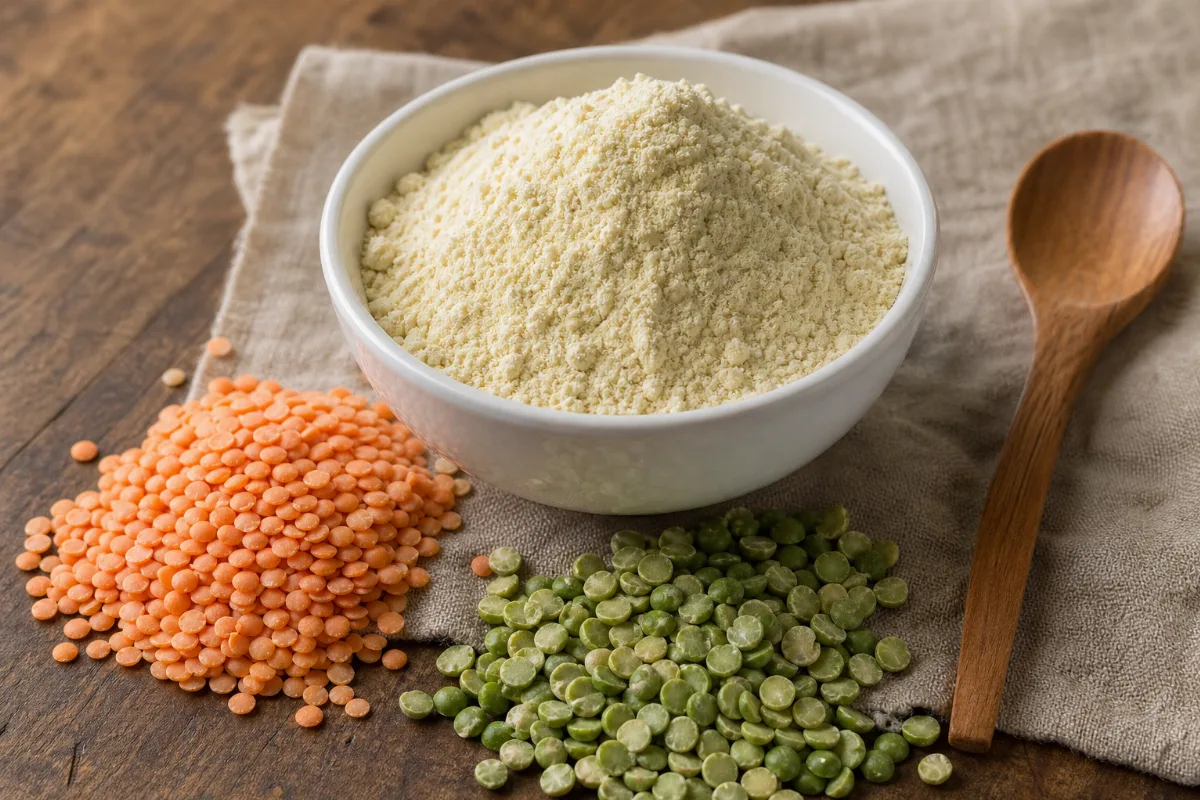
Legumes · Legume flour
Pulse Flours (Lentil, Pea and Fava)
Lens culinaris, Pisum sativum, Vicia faba · also called Lentil flour, pea flour, fava flour, faba bean flour, broad bean flour, harina de lentejas (Spanish)
Pulse flours are dried lentils, peas or fava (broad) beans ground to a powder. They are used in gluten-free baking, pasta and snacks for plant protein and fibre. The research is thin: one small test-meal study found flours raised blood sugar more than the same pulses eaten whole. The main cautions are fava flour for people with G6PD deficiency, legume allergy, and never eating the flour raw.
General information, not medical advice. Last substantive update · Not medically reviewed. A named clinician has not signed off on this page. How this page is made
About Pulse Flours (Lentil, Pea and Fava)
Pulse flours are ground dried lentils, peas or fava beans, used as a gluten-free and higher-protein baking ingredient. The seeds are rich in protein, fibre and folate, but the human research on the flours is very limited, and the biggest cautions are fava flour in G6PD deficiency, legume allergy and eating the flour raw.
What it is
Pulse flours are made by grinding dried lentils, peas or fava (broad) beans. They show up in gluten-free breads, pasta, pancakes, snack bars and high-protein baking mixes, and are sold alone or in blends. The plants are lentil (Lens culinaris), pea (Pisum sativum) and fava bean (Vicia faba). GBIF now lists lentil and pea under newer names, but food sources still use the older ones.
USDA FoodData Central has no entry for lentil, pea or fava flour, so the numbers come from the dry seeds. Per 100 g: raw lentils have 352 kcal, 24.63 g protein, 10.7 g fibre, 479 micrograms folate and 6.51 mg iron; raw fava beans have 341 kcal, 26.12 g protein, 25.0 g fibre, 423 micrograms folate and 6.7 mg iron. For a stated 30 g, lentil seed would give about 7.4 g protein and 3.2 g fibre, and fava seed about 7.8 g protein and 7.5 g fibre. Real flours differ with the seed part and milling. No pea values were available.
What the research shows
The human research on the flours is small. In a 2025 test-meal study of 19 adults with type 2 diabetes or metabolic syndrome, meals made with pea or lentil flour lowered the blood sugar rise compared with a glucose drink, but whole pulses lowered it more. A pulse industry body is among its funders. In a 2022 crossover trial of 24 healthy adults, bread with 20% pea flour did not change blood sugar or insulin, but people felt fuller and less hungry after one meal.
A review reports a lower glycemic index for legume-based baked goods, mostly about chickpea flour. Laboratory work says fermentation lowers antinutrients and raises mineral availability in digestion models. We found no trial of eating pulse flour for weeks or months, and no flour trial for cholesterol, blood pressure, weight or gut health.
Flour versus whole pulses and protein powders
Pulse flour is the whole seed ground up. Whole cooked pulses, protein concentrates and pea protein isolates are different products. In the one human study read, flour gave a higher blood sugar response than the same pulse eaten whole, so results for whole lentils or peas should not be assumed for flour.
Amounts
No official serving size for pulse flours was found, and USDA lists no flour portion. This page gives no amounts to eat. Ask a doctor, pharmacist or dietitian what is right for you, especially if you have a food allergy, G6PD deficiency, celiac disease, kidney disease or take medicine for diabetes or blood thinning.
At a glance
Traditional uses history, not proof
- Ground from dried pulses and used as a baking and cooking ingredient
- Long use as food is not proof that it treats any condition
Studied for research
- Blood sugar after a meal, very low certainty (one small study; flour higher than whole pulses)
- Glycemic index of baked goods, very low certainty (review and lab work)
- Fullness after pea flour bread, low certainty (one small crossover trial)
- Protein, fibre, folate and iron, moderate certainty for the dry seeds (not measured in flour)
- Gluten-free baking, insufficient evidence as a health benefit (baking study)
- Heart, weight and gut health, insufficient evidence (no flour trials)
Main compounds
- Plant protein
- Dietary fibre
- Resistant starch
- Folate and iron
- Phytates and tannins
- Lectins
Common forms
- Whole-seed flour (lentil, pea, fava)
- Protein-enriched fractions (different product)
- Heat-treated, germinated or fermented flours (not tested in people)
- Blends in gluten-free and high-protein mixes (check the label)
Research links: 2025 study: pea and lentil flours versus whole pulses · 2022 trial: pea flour bread and fullness · 2023 review: favism at different ages · Research Library · Genes & Biomarkers Library
What it is and its history
- Accepted scientific name
- Pulse flours (lentil, pea and fava flour)
- Naming authority
- A food category, not a single species. Flour milled from the dried seeds of three legume plants.
- Synonyms
- Name: Lens culinaris Medik.; Note: Lentil. GBIF treats it as a synonym of Vicia lens (accepted key 3973001); food sources still use the older name.; Name: Pisum sativum L.; Note: Pea. GBIF treats it as a synonym of Lathyrus oleraceus Lam. (accepted key 5347846); food sources still use the older name.; Name: Vicia faba L.; Note: Fava or broad bean. GBIF accepted name (key 2974832).
- Common names
- Lentil flour (English); Pea flour (English); Fava flour (English); Faba bean flour (English); Broad bean flour (English); Harina de lentejas (Spanish); Harina de guisantes (Spanish); Harina de habas (Spanish)
- Family or group
- Fabaceae (the legume or pea family), per GBIF.
- Classification
- Plantae > Tracheophyta > Magnoliopsida > Fabales > Fabaceae > Vicia (lentil, fava bean) and Lathyrus (pea) > Vicia lens, Lathyrus oleraceus, Vicia faba
- Native range
- Not verified from a source read.
- Habitat
- Not verified from a source read.
- What it looks like
- Roots: Not verified.; Stems: Not verified.; Leaves: Not verified.; Flowers: Not verified.; Fruit: The dried seeds are milled to flour (existing nutrient summary).
- Cultivation
- Not verified from a source read.
- Harvest and processing
- Pulse flours are made by grinding dried seeds. Forms named in the existing summary and the sources read: whole-seed flour; dehulled or fractionated flour (dry- or wet-fractionated protein-enriched fractions); heat-treated or germinated flour; and blends. A 2025 laboratory study separated fava bean, chickpea and red lentil flour into dry- and wet-fractionated protein fractions.
- Look-alikes and adulterants
- Name: Chickpea flour (besan); Note: Another pulse flour with its own page.; Name: Pea protein; Note: An isolate extracted from peas, much higher in protein than flour; a different product.; Name: Soy flour and wheat flour; Note: Soy flour is also from a legume; wheat flour contains gluten and pulse flours do not.
- Sustainability and conservation
- Not assessed.
Photographs
What is inside, and how it may work
What it contains and how those compounds act in cells and animals. Laboratory and animal mechanisms are not proven effects in people.
Main compounds
| Compound | Family | Where it is concentrated | Activity studied | Level of evidence |
|---|---|---|---|---|
| Plant protein | protein | Seed USDA dry seed per 100 g: 24.63 g (lentil), 26.12 g (fava) | Protein content of the dry seed; protein-enriched fractions reach 58 to 84 g per 100 g (laboratory). 21 23 5 | Human data |
| Dietary fibre | carbohydrate | Seed (more in the hull) USDA dry seed per 100 g: 10.7 g (lentil), 25.0 g (fava) | Fibre content of the dry seed. Dry-fractionated fractions kept more fibre than wet-fractionated ones (7.62 to 14.64 g per 100 g). 21 23 5 | Human data |
| Resistant starch and oligosaccharides | carbohydrate | Seed | Fermented by gut bacteria, which can cause gas and bloating (Harvard Nutrition Source). Amounts in flour were not read. 16 | Human data |
| Phytates, tannins and trypsin inhibitors (antinutrients) | antinutrient | Seed | Can bind minerals or block digestive enzymes; a 2026 laboratory scoping review says fermentation can degrade 90 to 100% of phytates and tannins. 9 5 | Laboratory research |
| Lectins | protein | Seed | Health Canada and the FSAI describe illness from raw or undercooked legumes because of lectins; wet heat reduces them. Neither mentions flour. 17 14 | Human data |
| Folate and iron | nutrient | Seed USDA dry seed per 100 g: folate 479 micrograms (lentil), 423 (fava); iron 6.51 mg (lentil), 6.7 mg (fava) | Nutrient content of the dry seed (USDA). 21 23 | Human data |
Mechanisms, receptors and pathways
| Target or pathway | Gene or receptor | What was found | Level |
|---|---|---|---|
| Starch digestion and particle size | Not specified | In a laboratory digestion test, starch digestion of fava bean flour rose as particle size increased; bread made with wheat and fava flour was about 84% digestible on average regardless of size. 10 | Laboratory research |
| Whole pulse versus flour and blood sugar | Not specified | In a small human test-meal study, whole pulses gave a lower glucose response than the flour equivalent. The abstract does not state why. 12 | Human data |
| Fermentation and antinutrients | Not specified | Laboratory work reviewed in 2026 says microbial acids and fungal enzymes break down phytates and tannins and raise mineral availability in digestion models. 9 | Laboratory research |
| Favism | G6PD enzyme | MedlinePlus Genetics says the G6PD enzyme protects red blood cells from reactive oxygen species; when it is deficient, fava beans can raise those levels and red blood cells break down faster than they are replaced. The compound in fava beans responsible was not named in the page read. 19 | Human data |
Absorption, metabolism and elimination
- Absorption
- Not found for pulse flours.
- Distribution
- Not found.
- Metabolism
- Not found.
- Elimination
- Not found.
- Bioavailability
- Not established for nutrients in pulse flour; laboratory models suggest fermentation raises mineral bioaccessibility.
Isolated compounds versus whole extracts
Pulse flour is the ground whole seed. Protein concentrates and isolates (such as pea protein) are extracted fractions with much more protein: wet-extracted fractions in one study had 58 to 84 g per 100 g. Whole cooked pulses are also different from flour: in the one human study read, flour gave a higher blood sugar response than the same pulse eaten whole. Results for one form should not be applied to another.
Nutritional composition
Nutrition from USDA FoodData Central (SR Legacy, April 2018), read from a saved copy. USDA has no entry for lentil, pea or fava flour, so these are the dry seeds the flours are milled from, per 100 g. Raw lentils (FDC 172420): 352 kcal, 24.63 g protein, 1.06 g fat, 63.35 g carbohydrate, 10.7 g fibre, 8.26 g water, 35 mg calcium, 6.51 mg iron, 47 mg magnesium, 281 mg phosphorus, 677 mg potassium, 6 mg sodium, 3.27 mg zinc, 479 micrograms folate (DFE). Raw pink or red lentils (FDC 174284): 358 kcal, 23.91 g protein, 10.8 g fibre, 204 micrograms folate, 7.39 mg iron, 668 mg potassium. Raw fava beans (FDC 175205): 341 kcal, 26.12 g protein, 1.53 g fat, 58.29 g carbohydrate, 25.0 g fibre, 103 mg calcium, 6.7 mg iron, 192 mg magnesium, 421 mg phosphorus, 1062 mg potassium, 13 mg sodium, 3.14 mg zinc, 423 micrograms folate. For a stated 30 g (a weight we chose; USDA gives no flour portion), lentil seed would supply about 106 kcal, 7.4 g protein, 3.2 g fibre, 144 micrograms folate, 2.0 mg iron and 203 mg potassium; fava seed about 102 kcal, 7.8 g protein, 7.5 g fibre, 127 micrograms folate, 2.0 mg iron and 319 mg potassium. Pea values were not available. Flour from hulled or fractionated seed differs from whole-seed values; protein-enriched fractions can reach 58 to 84 g protein per 100 g.
1 moderate certainty1 low certainty2 very low certainty4 not enough evidence
What was looked at
The 8 benefits and uses checked for Pulse Flours (Lentil, Pea and Fava), each with how strong the evidence is. Tap one to open it.
- Blood sugar after a meal (pea and lentil flours)Very low certainty
- Glycemic index of baked goods made with legume flourVery low certainty
- Feeling full after pea-flour breadLow certainty
- Protein, fibre, folate and iron (nutrient content of the dry seeds)Moderate certainty
- Gluten-free baking (lentil flour in cakes)Not enough evidence
- Antinutrients and mineral absorption (laboratory work)Not enough evidence
- Protein-enriched fractions are not the same as flourNot enough evidence
- Heart health, weight and gut health from eating pulse flourNot enough evidence
Lab markers tracked in the studies
Blood sugar after a meal (glucose response)Fullness and hunger ratings
What is Pulse Flours (Lentil, Pea and Fava) good for?
The studied uses and how strong the human evidence is for each. For pulse flours specifically, there are only a few small single-meal studies.
Benefits, one by one
Each card is a research question, not a promise. Tap a goal to filter. Open a card to see the studies, doses and limits.
Blood sugar after a meal (pea and lentil flours)
Very low certaintyIn one small study of 19 adults with type 2 diabetes or metabolic syndrome, meals made with pea or lentil flour gave a lower blood sugar rise than a glucose drink, but a higher rise than the same pulses eaten whole. A pulse industry council helped fund the work.
1 studiesPea and lentil flours versus whole pulses in single test meals (trial…
Studies, doses and limits
What the trials found
In a 2025 test-meal study, 11 adults with type 2 diabetes and 8 with metabolic syndrome ate four meals with 50 g of available carbohydrate from whole pulse or the dry-weight equivalent of pulse flour (pea and lentil), and a glucose drink as the control. All four pulse meals lowered the glucose response compared with the drink. Whole pulses gave a lower response than the flours in the early period for the diabetes group and across the whole test for the metabolic syndrome group.
Results
Pulse flour meals lowered the blood sugar rise compared with plain glucose, but less than whole pulses did. The study title says flours 'increase' the response; the abstract shows this is relative to whole pulses.
Effect sizes as reported
No numbers in the abstract.
Why this rating
One acute study with 19 people, single meals, only the abstract was read, and the PubMed record lists a pulse industry council among the funders (the authors say funders had no role).
Form and dose studied
Pea and lentil flours versus whole pulses in single test meals (trial detail, not advice).
Who was studied
Adults with type 2 diabetes or metabolic syndrome.
Limits
Not a long-term trial. Not a treatment for diabetes.
Why researchers looked
Grinding breaks the seed apart, so researchers asked whether flour affects blood sugar differently from whole pulses.
Traditional use
Pulse flours are made by grinding dried lentils, peas or fava beans. They are used in baking, pasta and snacks. Long use as an ingredient is not proof that it treats any condition.
Proposed mechanism Unknown
Not established in the abstract. The authors compared whole pulses with the flour equivalent.
A proposed mechanism does not show that the effect happens in people.
People who take diabetes medicine should ask their clinician before changing their diet.
Glycemic index of baked goods made with legume flour
Very low certaintyA review reports that legume-based baked goods have a glycemic index of about 40 to 50, against 55 to 80 for cereal-based ones. It is a review of bakery studies, mostly about chickpea flour, not a trial of lentil, pea or fava flour.
2 studiesLegume flour in baked goods.
Studies, doses and limits
What the trials found
A 2024 review says cereal-based bakery products typically have a glycemic index of 55 to 80 and legume-based ones 40 to 50, and that adding legumes can lower the glycemic index of baked goods by up to 25%. A 2024 laboratory study of fava bean flour found starch digestion in the lab rose as the flour particles got larger, while particle size had less effect on wheat-fava bread (about 84% digestibility on average).
Results
Lower glycemic index values for legume-based baked goods in a review. The fava study was a lab digestion test and says nothing about people.
Effect sizes as reported
GI 40 to 50 versus 55 to 80; up to 25% lower.
Why this rating
A narrative review, not trials in people; the abstract names chickpeas, not lentil, pea or fava flour. The fava work is a laboratory test.
Form and dose studied
Legume flour in baked goods.
Limits
The glycemic index is a lab-style measure, not a health outcome. The review calls for longer studies.
Why researchers looked
Wheat flour products raise blood sugar quickly, so researchers test whether swapping in legume flour changes that.
Traditional use
Pulse flours are made by grinding dried lentils, peas or fava beans. They are used in baking, pasta and snacks. Long use as an ingredient is not proof that it treats any condition.
Proposed mechanism Unknown
Not established in the abstract.
A proposed mechanism does not show that the effect happens in people.
None specific.
Feeling full after pea-flour bread
Low certaintyIn a crossover trial of 24 healthy adults, white bread with 20% pea flour did not change blood sugar or insulin compared with wheat bread, but people rated themselves about 18% fuller and 16 to 18% less hungry after the pea bread.
1 studiesBread with 20% pea flour (trial detail, not advice).
Studies, doses and limits
What the trials found
In a 2022 randomised crossover trial, 24 healthy adults ate white pan bread with 20% split yellow pea flour (untreated or heat processed) or 100% white wheat bread, each with 50 g available carbohydrate. Glucose and insulin responses did not differ. The pea breads gave 18% higher fullness and 16 to 18% lower hunger, desire to eat and prospective food consumption ratings. Taste and acceptability did not differ.
Results
Pea flour bread was rated more filling for a short time. There was no blood sugar effect. Nothing about weight was measured.
Effect sizes as reported
Fullness +18%; hunger and desire to eat -16 to -18% (self-rated).
Why this rating
A randomised crossover design, but only 24 healthy adults, one meal, and ratings people give themselves.
Form and dose studied
Bread with 20% pea flour (trial detail, not advice).
Who was studied
Healthy adults.
Limits
Only after a single meal. No weight or long-term eating outcome. The abstract names no funder.
Why researchers looked
Pulses are filling foods, so researchers test whether pea flour in bread changes appetite.
Traditional use
Pulse flours are made by grinding dried lentils, peas or fava beans. They are used in baking, pasta and snacks. Long use as an ingredient is not proof that it treats any condition.
Proposed mechanism Unknown
Not established in the abstract.
A proposed mechanism does not show that the effect happens in people.
None specific.
Protein, fibre, folate and iron (nutrient content of the dry seeds)
Moderate certaintyUSDA has no entry for lentil, pea or fava flour. The dry seeds they are milled from have about 24 to 26 g of protein per 100 g, and fibre from 10.7 g (lentil) to 25 g (fava). This is the seed, not a measured flour.
4 studiesDry seeds as stand-in for flour (not advice).
Studies, doses and limits
What the trials found
USDA FoodData Central (SR Legacy), dry seeds per 100 g: raw lentils 352 kcal, 24.63 g protein, 10.7 g fibre, 479 micrograms folate (DFE), 6.51 mg iron; raw fava beans 341 kcal, 26.12 g protein, 25.0 g fibre, 423 micrograms folate, 6.7 mg iron; raw pink or red lentils 358 kcal, 23.91 g protein, 10.8 g fibre, 204 micrograms folate, 7.39 mg iron. A laboratory study found protein-enriched fractions of fava, chickpea and red lentil contained 58.36 to 83.79 g protein per 100 g (wet-fractionated), and these concentrates are not the same as flour.
Results
The seeds are rich in protein, fibre, folate and iron. No source read measured a lentil, pea or fava flour, and the abstract of the fractionation study does not give whole-flour figures.
Effect sizes as reported
Per 100 g dry seed: protein 24.63 g (lentil), 26.12 g (fava); fibre 10.7 g, 25.0 g.
Why this rating
Moderate that the dry seeds contain these nutrients (USDA data). Flour values depend on the seed part and milling and were not found. No source read shows that flour corrects a low intake.
Form and dose studied
Dry seeds as stand-in for flour (not advice).
Who was studied
General adult diet.
Limits
Seed values, not flour values. Dry seed is far denser than cooked food. Pea values were not available.
Why researchers looked
People choose pulse flours for plant protein and fibre.
Traditional use
Pulse flours are made by grinding dried lentils, peas or fava beans. They are used in baking, pasta and snacks. Long use as an ingredient is not proof that it treats any condition.
Proposed mechanism Authoritative guidance
Nutrient facts; not a mechanism.
A proposed mechanism does not show that the effect happens in people.
Fava flour needs a special caution: see the Safety tab.
Gluten-free baking (lentil flour in cakes)
Not enough evidenceFlour from beans is listed by a US health institute as safe for people avoiding gluten. A baking study made gluten-free cakes with lentil flour and found them high in protein and fibre. This is food science, not a health trial, and cross-contact with gluten still matters.
2 studiesPulse flours as an ingredient in gluten-free baking.
Studies, doses and limits
What the trials found
NIDDK says flour made from gluten-free foods such as potatoes, rice, corn, soy, nuts, cassava, amaranth, quinoa, buckwheat or beans is safe to eat for people with celiac disease, and that cross-contact (gluten spreading to gluten-free food during growing, processing, storage or preparation) can make gluten-free foods unsafe. In a 2024 baking study of 11 gluten-free cake formulas, lentil flour improved volume and crumb structure, a cake from lentil flour alone could be labelled high in protein and fibre, and consumers preferred a lentil plus rice flour cake.
Results
Lentil and other pulse flours can be a gluten-free baking ingredient. No trial tested whether eating them helps people with celiac disease.
Why this rating
Insufficient as a health benefit: the baking study measured cakes, not people, and the NIDDK statement is general guidance for bean flours.
Form and dose studied
Pulse flours as an ingredient in gluten-free baking.
Who was studied
People who avoid gluten (celiac disease or gluten sensitivity).
Limits
Cross-contact with wheat during milling or packing is the key risk, so look for a gluten-free label. Pulse allergy is a separate issue (Safety tab).
Why researchers looked
People with celiac disease or gluten sensitivity look for flours that are not wheat, rye or barley.
Traditional use
Pulse flours are made by grinding dried lentils, peas or fava beans. They are used in baking, pasta and snacks. Long use as an ingredient is not proof that it treats any condition.
Proposed mechanism Authoritative guidance
Not a mechanism. Pulses do not contain the gluten of wheat, rye or barley (NIDDK lists bean flour among safe flours).
A proposed mechanism does not show that the effect happens in people.
Look for a gluten-free label; people with celiac disease should ask their doctor or dietitian.
Antinutrients and mineral absorption (laboratory work)
Not enough evidenceRaw pulses contain phytates, tannins and trypsin inhibitors, which can bind minerals or block enzymes. A 2026 review of laboratory studies says fermenting legumes can break down most of them and roughly double iron, zinc and calcium available in digestion models. It was not tested in people eating flour.
2 studiesFermented legume preparations (laboratory).
Studies, doses and limits
What the trials found
A 2026 scoping review of laboratory studies reports that fermentation can degrade 90 to 100% of phytates and condensed tannins, inactivate trypsin inhibitors, roughly double the bioaccessibility of iron, zinc and calcium in digestion models, and lower the predicted glycemic index. The review stresses the results depend on the seed, moisture, acidity and heat treatment. A 2025 laboratory study of fava, chickpea and red lentil flours and protein fractions found dry-fractionated fractions had higher antinutritional factor levels.
Results
Fermentation lowered antinutrients in the laboratory. Whether ordinary pulse flour affects mineral absorption in people was not found.
Effect sizes as reported
Phytates and tannins 90 to 100% degraded; iron, zinc and calcium bioaccessibility about doubled (laboratory digestion models).
Why this rating
Laboratory and food-science studies only; no human absorption trial of pulse flour was read.
Form and dose studied
Fermented legume preparations (laboratory).
Limits
Digestion models are not the human gut.
Why researchers looked
Researchers ask whether the way pulses are processed changes how much of their minerals the body can use.
Traditional use
Pulse flours are made by grinding dried lentils, peas or fava beans. They are used in baking, pasta and snacks. Long use as an ingredient is not proof that it treats any condition.
Proposed mechanism Laboratory research
Microbial acids and fungal enzymes break down phytates, tannins and trypsin inhibitors (laboratory work, per the review abstract).
A proposed mechanism does not show that the effect happens in people.
None specific.
Protein-enriched fractions are not the same as flour
Not enough evidencePulse flour is the ground whole seed. Protein concentrates made by air or wet processing are different products: in one laboratory study, wet-extracted fractions had 58 to 84 g protein per 100 g.
1 studiesProtein concentrates (laboratory).
Studies, doses and limits
What the trials found
A 2025 laboratory study compared fava bean, chickpea and red lentil flours with dry- and wet-fractionated protein-enriched fractions. Wet fractions had 58.36 to 83.79 g protein per 100 g; dry fractions kept more fibre (7.62 to 14.64 g per 100 g). In vitro protein digestibility was highest for wet-fractionated fava bean (84.12%) and red lentil (84.06%).
Results
The products are different. Findings about concentrates or isolates should not be applied to ordinary flour.
Effect sizes as reported
Protein 58.36 to 83.79 g per 100 g (wet fractions).
Why this rating
Laboratory comparison; no health outcome in people.
Form and dose studied
Protein concentrates (laboratory).
Limits
Whole-flour figures are not in the abstract.
Why researchers looked
Food makers extract protein from pulses, so it helps to know how those products differ from plain flour.
Traditional use
Pulse flours are made by grinding dried lentils, peas or fava beans. They are used in baking, pasta and snacks. Long use as an ingredient is not proof that it treats any condition.
Proposed mechanism Laboratory research
Not a health mechanism; a food-processing comparison.
A proposed mechanism does not show that the effect happens in people.
None specific.
Heart health, weight and gut health from eating pulse flour
Not enough evidenceNo trial of eating pulse flour for weeks or months was found for cholesterol, blood pressure, weight or gut health. Studies of whole cooked pulses exist, and they are covered on the lentil, chickpea and split pea pages, not on this page.
1 studiesNot applicable.
Studies, doses and limits
What the trials found
No long-term human study of lentil, pea or fava flour was found in the sources read.
Results
Unknown. Do not assume the results for whole pulses apply to flour: in the one flour study read, flour gave a higher blood sugar response than the same pulse eaten whole.
Why this rating
No human trials of pulse flour on these outcomes were found.
Limits
This is a gap, not a finding of no effect.
Why researchers looked
People ask whether the benefits seen for whole beans and lentils carry over to flour.
Traditional use
Pulse flours are made by grinding dried lentils, peas or fava beans. They are used in baking, pasta and snacks. Long use as an ingredient is not proof that it treats any condition.
Proposed mechanism Unknown
No mechanism was read for flour.
A proposed mechanism does not show that the effect happens in people.
None specific.
Connections to the rest of health
How Pulse Flours (Lentil, Pea and Fava) connects to the rest of our health knowledge graph. Every link says what kind of connection it is. A safety link (for example to the liver) is a warning, not a benefit. A study that merely mentions a topic never creates a benefit link.
Explore every connection: goals, body systems, organs, symptoms, genes
A. Wellness goals
| Connected to | Kind of connection | Evidence status | Context | Studies |
|---|---|---|---|---|
| Blood Sugar Balance | Very low certainty | Blood sugar after a meal (pea and lentil flours): In one small study of 19 adults with type 2 diabetes or metabolic syndrome, meals made with pea or lentil flour gave a lower blood sugar rise than a glucose drink, but a higher rise than the same pulses eaten whole. A pulse industry council helped fund the work. | 12 | |
| Blood Sugar Balance | Very low certainty | Glycemic index of baked goods made with legume flour: A review reports that legume-based baked goods have a glycemic index of about 40 to 50, against 55 to 80 for cereal-based ones. It is a review of bakery studies, mostly about chickpea flour, not a trial of lentil, pea or fava flour. | 7 10 | |
| Healthy Weight | Low certainty | Feeling full after pea-flour bread: In a crossover trial of 24 healthy adults, white bread with 20% pea flour did not change blood sugar or insulin compared with wheat bread, but people rated themselves about 18% fuller and 16 to 18% less hungry after the pea bread. | 4 | |
| Healthy Weight | Demonstrated clinical effect | Moderate certainty | Protein, fibre, folate and iron (nutrient content of the dry seeds): USDA has no entry for lentil, pea or fava flour. The dry seeds they are milled from have about 24 to 26 g of protein per 100 g, and fibre from 10.7 g (lentil) to 25 g (fava). This is the seed, not a measured flour. | 21 22 23 5 |
| Digestive Support | Not enough evidence | Gluten-free baking (lentil flour in cakes): Flour from beans is listed by a US health institute as safe for people avoiding gluten. A baking study made gluten-free cakes with lentil flour and found them high in protein and fibre. This is food science, not a health trial, and cross-contact with gluten still matters. Heart health, weight and gut health from eating pulse flour: No trial of eating pulse flour for weeks or months was found for cholesterol, blood pressure, weight or gut health. Studies of whole cooked pulses exist, and they are covered on the lentil, chickpea and split pea pages, not on this page. | 20 3 12 | |
| Healthy Weight | Not enough evidence | Antinutrients and mineral absorption (laboratory work): Raw pulses contain phytates, tannins and trypsin inhibitors, which can bind minerals or block enzymes. A 2026 review of laboratory studies says fermenting legumes can break down most of them and roughly double iron, zinc and calcium available in digestion models. It was not tested in people eating flour. Protein-enriched fractions are not the same as flour: Pulse flour is the ground whole seed. Protein concentrates made by air or wet processing are different products: in one laboratory study, wet-extracted fractions had 58 to 84 g protein per 100 g. | 9 5 | |
| Heart Health | Not enough evidence | Heart health, weight and gut health from eating pulse flour: No trial of eating pulse flour for weeks or months was found for cholesterol, blood pressure, weight or gut health. Studies of whole cooked pulses exist, and they are covered on the lentil, chickpea and split pea pages, not on this page. | 12 | |
| Healthy Weight | Not enough evidence | Heart health, weight and gut health from eating pulse flour: No trial of eating pulse flour for weeks or months was found for cholesterol, blood pressure, weight or gut health. Studies of whole cooked pulses exist, and they are covered on the lentil, chickpea and split pea pages, not on this page. | 12 |
B. Body systems
| Connected to | Kind of connection | Evidence status | Context | Studies |
|---|---|---|---|---|
| Endocrine System | Biological association | Very low certainty | Studied for: Blood sugar after a meal (pea and lentil flours) Studied for: Glycemic index of baked goods made with legume flour | 12 7 10 |
| Metabolism Weight | Biological association | Very low certainty | Studied for: Blood sugar after a meal (pea and lentil flours) Studied for: Feeling full after pea-flour bread | 12 4 21 22 23 5 |
| Digestive System | Biological association | Not enough evidence | Studied for: Gluten-free baking (lentil flour in cakes) Studied for: Antinutrients and mineral absorption (laboratory work) | 20 3 9 5 12 |
| Cardiovascular System | Biological association | Not enough evidence | Studied for: Heart health, weight and gut health from eating pulse flour | 12 |
E. Health conditions
| Connected to | Kind of connection | Evidence status | Context | Studies |
|---|---|---|---|---|
| Favism (G6PD deficiency) | Contraindication | Documented risk | Fava beans can trigger hemolytic anemia in people with G6PD deficiency; severity is highest in pregnant women and infants. Preparation or compound: Fava beans and fava flour |
19 2 |
| Food allergy | Adverse effect or risk | Documented risk | Pea and lentil were the most common legume allergies in a children's clinic study; most children reacted to several legumes. Preparation or compound: Pea, lentil and fava proteins |
11 1 |
| Food poisoning | Adverse effect or risk | Documented risk | Flour is usually not treated to kill germs; only baking or cooking does. Preparation or compound: Raw flour |
13 6 |
I. Biomarkers
| Connected to | Kind of connection | Evidence status | Context | Studies |
|---|---|---|---|---|
| Blood sugar after a meal (glucose response) | Biological association | Very low certainty | Measured in trials: lowered versus glucose drink; higher versus whole pulses. A lab change is not the same as a health benefit. | 12 4 |
| Fullness and hunger ratings | Biological association | Low certainty | Measured in trials: fullness higher, hunger lower. A lab change is not the same as a health benefit. | 4 |
J. Genes, receptors and enzymes
K. Biological pathways
L. Active compounds
| Connected to | Kind of connection | Evidence status | Context | Studies |
|---|---|---|---|---|
| Plant protein | Biological association | Human | Protein content of the dry seed; protein-enriched fractions reach 58 to 84 g per 100 g (laboratory). Preparation or compound: Seed |
21 23 5 |
| Dietary fibre | Biological association | Human | Fibre content of the dry seed. Dry-fractionated fractions kept more fibre than wet-fractionated ones (7.62 to 14.64 g per 100 g). Preparation or compound: Seed (more in the hull) |
21 23 5 |
| Resistant starch and oligosaccharides | Biological association | Human | Fermented by gut bacteria, which can cause gas and bloating (Harvard Nutrition Source). Amounts in flour were not read. Preparation or compound: Seed |
16 |
| Phytates, tannins and trypsin inhibitors (antinutrients) | Biological association | In vitro | Can bind minerals or block digestive enzymes; a 2026 laboratory scoping review says fermentation can degrade 90 to 100% of phytates and tannins. Preparation or compound: Seed |
9 5 |
| Lectins | Biological association | Human | Health Canada and the FSAI describe illness from raw or undercooked legumes because of lectins; wet heat reduces them. Neither mentions flour. Preparation or compound: Seed |
17 14 |
| Folate and iron | Biological association | Human | Nutrient content of the dry seed (USDA). Preparation or compound: Seed |
21 23 |
Each connection is stored with the ingredient, the connected record, the kind of connection, the evidence status, the supporting studies, the preparation or compound involved, and a review date (last reviewed October 26, 2026).
Evidence at a glance: what the research found for 8 outcomes
Each outcome below is one thing researchers measured. Certainty is how far the evidence can be trusted, not how well it works. The full studies are on the next tab.
The evidence
The research centre for Pulse Flours (Lentil, Pea and Fava). Every record here was checked against PubMed or the publisher's page; we never list a study we have not verified.
Evidence by outcome
Bars show how many studies we found for each outcome, not how well it works. People are added up across trials only (reviews are not added, to avoid double counting).
How we rate evidence
High certainty
Several well-run trials or reviews agree; further research is unlikely to change the picture much.
Moderate certainty
Good trials point the same way, but some doubt remains.
Low certainty
Small, short or inconsistent trials. The finding could change with better research.
Very low certainty
Very little or very weak human data. Treat as a possibility only.
Mixed findings
Trials or reviews disagree with each other.
Not enough evidence
Not enough human research to say either way.
Evidence against
Good research found no benefit, or found harm.
We take the reviewers' own risk-of-bias and GRADE statements where they exist, and otherwise judge from study size, design, consistency, directness and whether a product matches what is sold. Many publications do not make evidence high. Method note: We started from our existing pulse flours summary, re-read USDA values for the dry seeds from a saved copy, re-read agency pages (CDC, Health Canada, FSAI, MedlinePlus, NIDDK, Harvard) and re-read PubMed abstracts for the studies cited. Only abstracts were read for studies. Items we could not verify are flagged in the research gaps.
Study library: every study we checked 23
| Study | Design | People | Product, dose, length | Result |
|---|---|---|---|---|
| Abu Risha 2024 Legume Allergens Pea, Chickpea, Lentil, Lupine and Beyond. Curr Allergy Asthma Rep · PMID 38990406 · DOI |
Narrative review |
Review of reports on non-priority legume allergens | Legume allergens including pea and lentil Legumes as food |
The review says non-priority legumes (beans, pea, lentils, chickpea, lupine and others) cause mild to severe reactions, with severe reactions described particularly for peas and lupine. Exercise-linked anaphylaxis has been highlighted for soybean, lentils and chickpea. Most reactions come from cross-reacting proteins, for example between peanut and lupine. Most reports are case reports. Not applicable (Not applicable) Methods, limits and fundingOutcomes: Allergen sources, severity, cross-reactions Limitations: Mostly case reports. Funding and conflicts: The authors declare no conflict of interest. Read: abstract |
| Beretta 2023 Favism: Clinical Features at Different Ages. Nutrients · PMID 36678214 · DOI |
Narrative review |
Narrative review of case reports and case series of favism in four age groups | Fava beans eaten by people with G6PD deficiency Fava beans (the abstract does not mention flour) |
Favism is a hemolytic disease caused by eating fava beans in people with G6PD deficiency. Quantity, quality and ripeness of the beans, and age, all influence whether a crisis happens. Severity is highest in the youngest children and pregnant women. Symptoms include jaundice, pale skin, dark urine, fast heart rate, abdominal pain and anemia. In most cases the illness resolves without lasting effects, but hospital care and transfusion are often needed. Not applicable (Not applicable) Methods, limits and fundingOutcomes: Predisposing factors and clinical features of favism Limitations: Case reports and case series, so no rates. Not about flour or processed products. Funding and conflicts: The authors declare no conflict of interest. Read: abstract |
| Carboni 2024 Gluten-free lentil cakes with optimal technological and nutritional characteristics. J Sci Food Agric · PMID 38501745 · DOI |
Laboratory research n/a |
Laboratory baking study: 11 gluten-free cake formulas with lentil, corn and rice flours | Gluten-free cakes made with lentil flour Lentil flour · vs Corn and rice flour cakes |
Cakes made with lentil flour had better volume and crumb structure. The cake made from lentil flour alone could be labelled high in protein and fibre and had the lowest fat, carbohydrate and energy content. Consumers preferred the lentil plus rice flour cake. The authors conclude nutritive gluten-free cakes can be made with lentil flour. Not applicable (Not applicable) Methods, limits and fundingOutcomes: Cake texture, volume, composition and sensory scores Limitations: Baking and food-science study. No health outcome in people was tested. Funding and conflicts: No competing interests declared. Read: abstract |
| Fahmi 2022 Acute Effects of Split Pea-Enriched White Pan Bread on Postprandial Glycemic and Satiety Responses in Healthy Volunteers-A Randomized Crossover Trial. Foods · PMID 35407088 · DOI |
Randomized crossover trial |
24 24 healthy adults |
White pan bread with 20% split yellow pea flour (untreated, or heat processed at 140 C with or without steam) Pea flour in bread Bread with 50 g available carbohydrate (trial detail, not advice) Single test meals (crossover); blood sampled over 120 minutes · vs Bread made with 100% white wheat flour |
No significant difference in glucose or insulin responses between the breads. The pea breads gave 18% higher fullness and 16 to 18% lower hunger, desire to eat and prospective food consumption ratings than the wheat bread. Taste and acceptability did not differ. Fullness +18%; hunger, desire to eat and prospective consumption -16 to -18% (Not given in the abstract) Methods, limits and fundingOutcomes: Blood glucose and insulin over 120 minutes; hunger, fullness and desire to eat ratings Limitations: Healthy adults, single meals, self-rated appetite. No longer-term eating or weight outcomes. Funding and conflicts: The authors declare no conflict of interest. Read: abstract |
| Han 2025 Industrial-scale fractionation of fava bean, chickpea, and red lentil: A comparative analysis of composition, antinutrients, nutrition, structure, and functionality. Curr Res Food Sci · PMID 40792113 · DOI |
Laboratory research in vitro |
Laboratory comparison of fava bean, chickpea and red lentil flours and their protein-enriched fractions | Flours and dry- or wet-fractionated protein fractions Pulse flours and protein concentrates · vs Flour versus fractions |
Wet-fractionated fractions had 58.36 to 83.79 g protein per 100 g, while dry-fractionated ones kept more dietary fibre (7.62 to 14.64 g per 100 g). Wet-fractionated fava bean (84.12%) and red lentil (84.06%) had the highest in vitro protein digestibility. Dry-fractionated fractions had higher levels of antinutritional factors. Protein 58.36 to 83.79 g per 100 g (wet fractions); fibre 7.62 to 14.64 g per 100 g (dry fractions) (Not applicable) Methods, limits and fundingOutcomes: Composition, antinutrients, amino acids, in vitro protein digestibility, function Limitations: Food-science study of protein concentrates, which are not the same as flour. The abstract does not give whole-flour protein figures. Funding and conflicts: No competing interests declared. Read: abstract |
| Kesby 2024 The microbiological quality of flour products in the UK with respect to Salmonella and Shiga-toxin-producing Escherichia coli. J Appl Microbiol · PMID 39025805 · DOI |
Survey n/a |
882 882 raw flour and flour-based products sold in the UK, January to April 2020 |
Raw flours tested for Salmonella and Shiga-toxin-producing E. coli (STEC) Raw flour Four months of sampling |
Salmonella was found in 0.1% (one mixed-ingredient product), generic E. coli above 20 CFU/g in 7.7%, and STEC in 7 samples (0.8%). One Salmonella isolate was genetically linked to a human case. The authors conclude contamination is low but possible. Salmonella 0.1%; STEC 0.8%; generic E. coli 7.7% (Not applicable) Methods, limits and fundingOutcomes: Salmonella, generic E. coli and STEC in flour Limitations: Samples were flours in general; pulse flours are not named in the abstract. Funding and conflicts: No competing interests declared. Read: abstract |
| Naveed 2024 Glycemic impact of cereal and legume-based bakery products: Implications for chronic disease management. Food Chem X · PMID 39568514 · DOI |
Narrative review n/a |
Review of bakery products made from cereals and from legumes such as chickpeas | Legume-based bakery products Legume flours in baked goods |
The review reports cereal-based bakery products typically have a GI of 55 to 80 and legume-based ones 40 to 50, and that adding legumes can lower the GI of baked goods by up to 25%. It says longer-term studies are needed. GI 40 to 50 (legume-based) versus 55 to 80 (cereal-based); up to 25% lower with legumes (Not applicable) Methods, limits and fundingOutcomes: Glycemic index (GI) and glycemic load of bakery products; after-meal blood sugar Limitations: A review, not a trial. The abstract names chickpeas; it does not name lentil, pea or fava flours. Funding and conflicts: The authors declare no competing financial interests. Read: abstract |
| Nelson 2026 Assessment of Home-Scale Heat Treatment for Reducing Salmonella in Multiple Flours. J Food Prot · PMID 41780643 · DOI |
Laboratory research in vitro |
Laboratory test: all-purpose, whole-wheat and gluten-free flours spiked with Salmonella | Oven heat treatment of flour at 177 C for up to 10 minutes Raw flour Up to 10 minutes · vs Untreated flour |
After 10 minutes of oven heat, Salmonella fell by 3.28 (all-purpose), 4.09 (whole-wheat) and 4.13 (gluten-free) log units, all less than a 5-log reduction. None of the home methods tested was shown to reach a 5-log reduction. Reductions 3.28, 4.09 and 4.13 log (Not applicable) Methods, limits and fundingOutcomes: Salmonella reduction (log units) Limitations: Laboratory test. The abstract does not say which gluten-free flour was used. Funding and conflicts: No competing interests declared. Read: abstract |
| Noma 2026 Biotechnological Modulation of Legumes via Fermentation: Impacts on Nutrient Bioaccessibility, Glycemic Index, and Antinutrients-A Scoping Review. Foods · PMID 42511230 · DOI |
Narrative review in vitro |
Scoping review of laboratory studies of fermented legumes | Fermented legumes Legume seeds and flours, fermented · vs Unfermented legumes |
The review says fermentation can degrade 90 to 100% of phytates and condensed tannins, inactivate trypsin inhibitors, and roughly double the bioaccessibility of iron, zinc and calcium in digestion models. It also reports more resistant starch and a lower predicted glycemic index. It stresses results depend on the substrate and process. Phytates and tannins 90 to 100% degraded; iron, zinc and calcium bioaccessibility about doubled (laboratory models) (Not applicable) Methods, limits and fundingOutcomes: Phytates, tannins, trypsin inhibitors, mineral bioaccessibility, resistant starch, predicted glycemic index Limitations: Laboratory and food-science work on fermentation. Not tested in people eating pulse flour. Funding and conflicts: The authors declare no conflicts of interest; one author is employed by EMBRAPA Food and Territories. Read: abstract |
| Olakanmi 2024 Impact of Particle Size on the Physicochemical, Functional, and In Vitro Digestibility Properties of Fava Bean Flour and Bread. Foods · PMID 39335791 · DOI |
Laboratory research in vitro |
Laboratory study of fava bean flour milled to 0.14, 0.50 and 1.0 mm | Fava bean flour and wheat-fava composite bread Fava bean flour · vs Different particle sizes |
Finer flour had more starch damage and higher protein and fat. In the lab digestion test, starch digestion rose as particle size increased. Particle size had less effect on the digestibility of wheat-fava bread, which averaged 84%. Bread in vitro digestibility about 84% on average (Not applicable) Methods, limits and fundingOutcomes: Starch damage, functional properties, in vitro starch digestibility Limitations: Laboratory digestion test, not people. Funding and conflicts: The authors declare no conflicts of interest. Read: abstract |
| Serra 2026 IgE-Mediated Legume Allergy in Children: Insights from a Single-Center Experience in Italy. Nutrients · PMID 42280453 · DOI |
Case series |
55 55 children allergic to at least one of pea, lentil, chickpea, common bean or soy (retrospective clinic study, 2022 to 2024) |
Legume allergy (clinic record review) Legumes as food January 2022 to January 2024 |
Pea (70.9%) and lentil (69.1%) allergies were the most common. Anaphylaxis at the first reaction occurred in 12.7%, most often triggered by pea. Multi-legume allergy was most common (74.5%), and 25.5% had peanut allergy. Of 34 oral food challenges, 23.5% were positive. Pea 70.9%; lentil 69.1%; multi-legume 74.5%; peanut co-allergy 25.5% (Not given in the abstract) Methods, limits and fundingOutcomes: Which legumes caused allergy, severity, co-allergies, challenges Limitations: One clinic, retrospective, only children who were already allergic. It does not show how common legume allergy is, and it is about the foods, not flours. Funding and conflicts: Two authors report personal fees from Sanofi and Thermo Fisher Scientific; the others declare none. Read: abstract |
| Winham 2025 Pea and Lentil Flours Increase Postprandial Glycemic Response in Adults with Type 2 Diabetes and Metabolic Syndrome. Foods · PMID 40509460 · DOI |
Controlled trial |
19 19 adults who completed the study: 11 with type 2 diabetes and 8 with metabolic syndrome |
Four test meals of pea or lentil, as a half cup of whole pulse or the dry-weight equivalent in flour, each with 50 g of available carbohydrate (the abstract names pea and lentil; the exact form of each meal is not given) Whole pulses or pulse flours as food 50 g available carbohydrate per meal (trial detail, not advice) Single test meals, blood sampled for 3 hours · vs Glucola glucose drink |
All four pulse meals lowered the glucose response compared with the glucose drink (0 to 120 minutes in type 2 diabetes, 0 to 180 minutes in metabolic syndrome). Whole pulses gave a lower response than the pulse flours, in the early period for people with type 2 diabetes and over the whole test for people with metabolic syndrome. Numbers are not given in the abstract. (Not given in the abstract) Methods, limits and fundingOutcomes: Plasma glucose and incremental area under the curve (iAUC) over 3 hours Limitations: Very small study of single meals. Only abstract read. The PubMed record lists funding from the USDA and the USA Dry Pea & Lentil Council. Funding and conflicts: The authors declare no conflicts of interest and say the funders had no role in design, analysis, writing or publication. PubMed lists the USA Dry Pea & Lentil Council (a pulse industry body) among the funders. Read: abstract |
| s-cdc-raw-flour CDC: Raw flour and dough · Source |
Health agency n/a |
Methods, limits and fundingRead: full-text | ||
| s-fsai-beans Food Safety Authority of Ireland: precautionary advice on uncooked or raw bean consumption · Source |
Health agency n/a |
Methods, limits and fundingRead: full-text | ||
| s-gbif-pulse-plants GBIF Backbone species match: Lens culinaris, Pisum sativum, Vicia faba · Source |
Reference database n/a |
Methods, limits and fundingRead: full-text | ||
| s-harvard-legumes Harvard T.H. Chan School of Public Health: The Nutrition Source - Legumes · Source |
Health agency n/a |
Methods, limits and fundingRead: full-text | ||
| s-healthcanada-lectins Health Canada: Lectins in dry legumes · Source |
Health agency n/a |
Methods, limits and fundingRead: full-text | ||
| s-medlineplus-foodallergy MedlinePlus: Food allergy · Source |
Health agency n/a |
Methods, limits and fundingRead: full-text | ||
| s-medlineplus-g6pd MedlinePlus Genetics: Glucose-6-phosphate dehydrogenase deficiency · Source |
Health agency n/a |
Methods, limits and fundingRead: full-text | ||
| s-niddk-celiac-diet NIDDK: Eating, diet and nutrition for celiac disease · Source |
Health agency n/a |
Methods, limits and fundingRead: full-text | ||
| s-usda-fdc-172420 USDA FoodData Central: Lentils, raw (FDC 172420) · Source |
Reference database n/a |
Methods, limits and fundingRead: full-text | ||
| s-usda-fdc-174284 USDA FoodData Central: Lentils, pink or red, raw (FDC 174284) · Source |
Reference database n/a |
Methods, limits and fundingRead: full-text | ||
| s-usda-fdc-175205 USDA FoodData Central: Broadbeans (fava beans), mature seeds, raw (FDC 175205) · Source |
Reference database n/a |
Methods, limits and fundingRead: full-text |
What we do not know yet
- No trial of eating pulse flour for weeks or months was found for any health outcome.
- The only human flour studies were single-meal tests in small groups.
- No source read measured the nutrients of a lentil, pea or fava flour; USDA has no flour entry and no pea values were available.
- No official advice on raw pulse flour, and whether processing removes the favism risk from fava flour, was not found.
- Pregnancy, breastfeeding, young children, kidney limits, FODMAP, heavy metals and mycotoxins were not researched for pulse flours.
How new research is added
New studies are found by a saved PubMed search and placed in a review queue before the page changes.
Lab markers
What changed in blood or saliva tests during trials. A changed number is not the same as feeling or being healthier, and we give no "normal ranges".
Other 2
Blood sugar after a meal (glucose response)
Lowered versus glucose drink; higher versus whole pulses in trials
How much blood sugar rises in the hours after eating, often summed as an area under the curve (iAUC).
Very low certaintyResults and what it means
Why it was measured
A basic measure of how a food affects blood sugar.
Statistical vs. clinical meaning
Single test meals in small groups; results differ by group and bread.
Safety implication
Ask your clinician before diet changes if you take diabetes medicine.
| Study | Result | People | Product |
|---|---|---|---|
| 12 | All four pulse meals lowered the glucose response compared with a glucose drink; whole pulses lowered it more than pulse flours | 19 adults (11 with type 2 diabetes, 8 with metabolic syndrome) | Whole pea or lentil, or the dry-weight equivalent in flour, with 50 g available carbohydrate |
| 4 | No significant difference in glucose or insulin response between 20% pea flour bread and wheat bread | 24 healthy adults | Bread with 20% split pea flour versus white wheat bread |
Fullness and hunger ratings
Fullness higher, hunger lower in trials
Scores people give themselves for how full or hungry they feel.
Low certaintyResults and what it means
Why it was measured
Used to see whether a food might help people eat less later.
Statistical vs. clinical meaning
One crossover trial; self-rated after a single meal.
Safety implication
None specific.
| Study | Result | People | Product |
|---|---|---|---|
| 4 | Fullness 18% higher; hunger, desire to eat and prospective food consumption 16 to 18% lower with pea bread | 24 healthy adults | White bread with 20% split yellow pea flour versus 100% wheat bread, single meal |
Safety
What studies and official sources say about side effects, medicines and who should check first. Each point shows what kind of evidence it comes from.
Main points to know 5
- Fava flour and G6PD deficiency (favism). In people with G6PD deficiency, an inherited enzyme shortage, eating fava beans can make red blood cells break down (hemolytic anemia). MedlinePlus Genetics says an estimated 400 million people worldwide have G6PD deficiency and that many do not know it. A review of case reports found severity is highest in pregnant women and infants, most cases resolve without lasting effects, but hospital care and transfusion are often needed. Fava flour is milled from the same beans, but no source read says whether flour or processing changes the risk. If you may have G6PD deficiency, ask a doctor before using fava flour, and check blends for fava or broad bean. Case reports and regulator 19 2
- Do not eat flour raw. The CDC says most flour is raw, meaning it has not been treated to kill germs that cause food poisoning, and that germs are killed only when flour is baked or cooked. A UK survey of 882 flours found Salmonella in 0.1% and Shiga-toxin-producing E. coli in 0.8%. No survey of pulse flours was read. Health Canada and the FSAI describe lectin illness from raw or undercooked beans and do not mention flour; no official source read says raw pulse flour is safe. Authoritative guidance 13 6 17 14
- Lentil, pea and other legume allergy. In a clinic study of 55 children with legume allergy, pea (70.9%) and lentil (69.1%) were the most common, 74.5% were allergic to more than one legume, and 25.5% also had peanut allergy. Reviews describe reactions from mild to severe, with severe ones reported particularly for peas and lupine. These studies are about the foods, not flour, but flours contain the same proteins. For trouble breathing or swelling of the face, lips or throat, call emergency services. Observational 11 1 18
- Gas and bloating. Harvard's Nutrition Source says gut bacteria ferment the resistant starch and oligosaccharides in legumes, which can cause gas, bloating and cramping in some people. No source read measured this for flours. Authoritative guidance 16
- Gluten cross-contact for people with celiac disease. Pulses do not contain wheat gluten, but NIDDK explains that gluten can spread to gluten-free foods during growing, processing or storage. Check for a gluten-free label if you have celiac disease. Authoritative guidance 20
Side effects 4
| Effect | How often | Severity and recovery | Evidence |
|---|---|---|---|
| Hemolytic anemia (favism) after fava beans in people with G6PD deficiency: paleness, yellow skin or eyes, dark urine, fatigue, fast heart rate Studies are of fava beans. No source on fava flour specifically was read. | Not found. MedlinePlus Genetics says many people with G6PD deficiency never have symptoms. | can be serious; hospital care and transfusion are often needed In most reported cases the illness resolved without lasting effects | Case reports 19 2 |
| Allergic reactions to pea, lentil or fava proteins, from mild itching and hives to anaphylaxis Clinic studies of children already allergic. They do not show how common allergy is. | In 55 children with legume allergy: pea 70.9%, lentil 69.1%; anaphylaxis at first reaction 12.7%. | can be severe (anaphylaxis) Not found for flour | Observational 11 1 |
| Food poisoning from germs in raw flour (for example Salmonella or STEC) The survey did not report pulse flours separately. | UK survey of 882 flours: Salmonella 0.1%, STEC 0.8%. | varies Not stated | Survey 13 6 |
| Gas, bloating and cramps General statement about legumes. | Not found | mild Not studied | Authoritative guidance 16 |
Liver
No liver injury from eating pulse flours was found in the sources read. A liver-safety source (such as LiverTox) was not searched for food.
How often. No frequency was found.
Monitoring. No agency monitoring advice was found.
This is a safety connection. It is not evidence that Pulse Flours (Lentil, Pea and Fava) supports liver health.
Medicines and supplements 3
| With | Why it matters | Importance | Evidence | What to do |
|---|---|---|---|---|
| Medicines for diabetes prescription | Pulse meals lowered the blood sugar rise a little in one small study, so a large change in diet could in theory add to a medicine's effect. | No source read ties pulse flour to a specific medicine interaction. This is a general caution, not a documented interaction. | Theoretical Not enough evidence 12 | Ask your clinician or pharmacist before making big diet changes if you take diabetes medicine. |
| Medicines that can trigger hemolysis in G6PD deficiency (some antibiotics and malaria medicines) prescription | MedlinePlus Genetics lists certain drugs, infections and fava beans as separate triggers of hemolytic anemia in G6PD deficiency. It does not say they add together. | Not a documented interaction with fava flour; the point is that a person with G6PD deficiency has several triggers to avoid. | Authoritative guidance Not enough evidence 19 | If you have G6PD deficiency, ask your doctor or pharmacist about both medicines and fava products. |
| Warfarin (blood thinner) prescription | Vitamin K affects clotting and warfarin works against it. USDA lists 5 micrograms of vitamin K per 100 g of dry lentils and 9 per 100 g of dry fava beans, which are low values. | No source read names pulse flour as a concern for warfarin. A steady diet matters with warfarin. | None found Not enough evidence 21 23 | Ask your warfarin clinic about any big change in diet. Do not change medicine on your own. |
Who should check first 2
| Situation | Advice | Evidence |
|---|---|---|
| Known or suspected G6PD deficiency (fava flour and fava-containing blends) | Do not use fava flour or products made with fava or broad bean until a doctor has advised you. | Case reports 19 2 |
| Known or suspected pea, lentil, fava or other legume allergy (including peanut allergy) | Avoid pulse flours until an allergist has advised you. People allergic to one legume are often allergic to several. For trouble breathing or swelling of the face or throat, call emergency services. | Observational 11 1 18 |
Overdose, product quality and regulators
Summary. No toxicity from pulse flour in cooked foods was found in the sources read. The documented risks are favism (fava), allergy, germs in raw flour and lectins in raw or undercooked legumes.
Animal. Not reviewed.
Human doses studied. Single test meals with 50 g of available carbohydrate from pea or lentil flour were studied in a small trial; no safety problems are described in the abstract (trial detail, not advice).
Overdose response. Not found.
Genotoxicity. Not researched.
Toxic or hazardous parts. Raw or undercooked legume seeds contain lectins (Health Canada names lentils among lectin-containing legumes; the FSAI says lentils and peas have among the highest amounts). Neither page discusses flour, so cook all dishes made with it.
Flour in general is a raw farm product that can carry germs. A UK survey found Salmonella and STEC in a small share of flours; pulse flours were not reported separately. A laboratory test found oven heating at home did not reliably kill Salmonella in flour. Heavy metals, pesticides and mycotoxins in pulse flour were not researched.
Germs in raw flour. CDC: germs in flour are killed only when it is baked or cooked. UK survey of 882 flours: Salmonella in 0.1%, STEC in 0.8%, generic E. coli above 20 CFU/g in 7.7%. 13 6
Heating flour at home. In a laboratory test, 10 minutes in a 177 C oven cut Salmonella by 3.28 to 4.13 log units in all-purpose, whole-wheat and gluten-free flours, short of a 5-log reduction. The authors say none of the home methods tested was shown to be sufficient. 8
| Body | Action | Date |
|---|---|---|
| CDC (United States) | Raw flour and dough: most flour is not treated to kill germs; germs are killed only by baking or cooking; do not eat unbaked dough or batter. source | 2025-11-24 |
| Health Canada (Canada) | Lectins in dry legumes: names lentils among legumes with lectins; the main concern and the cooking steps are for red kidney beans. Flour is not mentioned. source | 2017-05-04 |
| Food Safety Authority of Ireland (Ireland) | Precautionary advice on raw or uncooked beans: lectins; legumes including lentils and peas have the highest amounts; avoid eating them raw or undercooked. Flour is not mentioned. source | 2024-07-23 |
| MedlinePlus Genetics (US National Library of Medicine) (United States) | G6PD deficiency: hemolytic anemia can follow eating fava beans. source | |
| NIDDK (US National Institutes of Health) (United States) | Celiac disease diet: bean flours listed as safe gluten-free flours; cross-contact warning; FDA gluten-free label means under 20 parts per million of gluten. source |
When to get medical help
- Trouble breathing, swelling of the lips, face or throat, widespread hives, repeated vomiting or collapse after eating pulse flour (possible anaphylaxis): call emergency services
- Paleness, yellow skin or eyes, dark urine, unusual tiredness or fast heartbeat within days of eating fava beans or fava flour, especially in a child or someone with G6PD deficiency: seek urgent medical care
- Severe vomiting or diarrhoea after eating undercooked legumes or raw flour: seek medical advice
Stop using the product and contact a clinician or emergency service. In the US, Poison Control is 1-800-222-1222.
General information only, not medical advice. Ask a clinician or pharmacist before use, especially with medicines, in pregnancy or with a health condition. See the Natural Remedy Safety guide.
Frequently asked questions
What are pulse flours?
Are pulse flours gluten-free?
Pulses do not contain wheat gluten, and NIDDK lists bean flours among safe flours for celiac disease. But gluten can spread to gluten-free foods during growing, processing or storage, so people with celiac disease should look for a gluten-free label.
Is pulse flour safe to eat raw?
Can people with G6PD deficiency eat fava flour?
Do pulse flours raise blood sugar less than wheat flour?
A review reports lower glycemic index values for legume-based baked goods, mostly with chickpea flour. In one small study, pea and lentil flour meals raised blood sugar less than a glucose drink but more than the same pulses eaten whole. In a bread trial, pea flour did not change blood sugar versus wheat bread.
Do pulse flours keep you full?
In one trial of 24 healthy adults, bread with 20% pea flour was rated about 18% more filling than wheat bread after a single meal. No long-term or weight results were found.
Are lentil, pea and fava flours healthy?
Is pulse flour the same as pea protein powder?
No. Flour is the whole ground seed. Protein concentrates are extracted fractions; in one lab study wet-extracted fractions had 58 to 84 g protein per 100 g.
Can I be allergic to pulse flours?
Do pulse flours cause gas?
They can. Harvard's Nutrition Source says gut bacteria ferment the resistant starch and oligosaccharides in legumes, which can cause gas, bloating and cramping in some people.
Does baking at home make raw flour safe?
Explore by health goal
Healthy WeightBlood Sugar BalanceDigestive SupportHeart Health
Editorial transparency
- Written by
- AlternativeMed editorial team. Research compiled with AI assistance, then checked against the sources listed.
- Medical review
- None. This page has not been reviewed by a physician or pharmacist.
- First published
- 2026-10-26
- Last substantive update
- 2026-10-26
- How we research
- We started from our existing pulse flours summary, re-read USDA values for the dry seeds from a saved copy, re-read agency pages (CDC, Health Canada, FSAI, MedlinePlus, NIDDK, Harvard) and re-read PubMed abstracts for the studies cited. Only abstracts were read for studies. Items we could not verify are flagged in the research gaps.
- How we rate evidence
- See "How we rate evidence" in the Evidence tab.
- Independence
- No product is promoted on this page. No affiliate links are shown.
Sources 23
Each source was opened and checked. Where we read only the abstract, it says so. The small numbers in the text point here.
- Abu Risha M, Rick EM, Plum M, Jappe U. Legume Allergens Pea, Chickpea, Lentil, Lupine and Beyond.. Curr Allergy Asthma Rep. 2024. PMID 38990406. DOI 10.1007/s11882-024-01165-7. (abstract)
- Beretta A, Manuelli M, Cena H. Favism: Clinical Features at Different Ages.. Nutrients. 2023. PMID 36678214. DOI 10.3390/nu15020343. (abstract)
- Carboni AD, Puppo MC, Ferrero C. Gluten-free lentil cakes with optimal technological and nutritional characteristics.. J Sci Food Agric. 2024. PMID 38501745. DOI 10.1002/jsfa.13459. (abstract)
- Fahmi R, Blewett H, Stebbing JA, et al.. Acute Effects of Split Pea-Enriched White Pan Bread on Postprandial Glycemic and Satiety Responses in Healthy Volunteers-A Randomized Crossover Trial.. Foods. 2022. PMID 35407088. DOI 10.3390/foods11071002. (abstract)
- Han R, Wang Y, Yang Z, et al.. Industrial-scale fractionation of fava bean, chickpea, and red lentil: A comparative analysis of composition, antinutrients, nutrition, structure, and functionality.. Curr Res Food Sci. 2025. PMID 40792113. DOI 10.1016/j.crfs.2025.101152. (abstract)
- Kesby M, Jorgensen F, Willis C, et al.. The microbiological quality of flour products in the UK with respect to Salmonella and Shiga-toxin-producing Escherichia coli.. J Appl Microbiol. 2024. PMID 39025805. DOI 10.1093/jambio/lxae183. (abstract)
- Naveed H, Sultan W, Awan KA, et al.. Glycemic impact of cereal and legume-based bakery products: Implications for chronic disease management.. Food Chem X. 2024. PMID 39568514. DOI 10.1016/j.fochx.2024.101959. (abstract)
- Nelson KL, Hildebrandt IM, James MK, Marks BP. Assessment of Home-Scale Heat Treatment for Reducing Salmonella in Multiple Flours.. J Food Prot. 2026. PMID 41780643. DOI 10.1016/j.jfp.2026.100742. (abstract)
- Noma C, Pagno CH, Briceno JCC, et al.. Biotechnological Modulation of Legumes via Fermentation: Impacts on Nutrient Bioaccessibility, Glycemic Index, and Antinutrients-A Scoping Review.. Foods. 2026. PMID 42511230. DOI 10.3390/foods15142483. (abstract)
- Olakanmi SJ, Jayas DS, Paliwal J, Aluko RE. Impact of Particle Size on the Physicochemical, Functional, and In Vitro Digestibility Properties of Fava Bean Flour and Bread.. Foods. 2024. PMID 39335791. DOI 10.3390/foods13182862. (abstract)
- Serra B, Barni S, Valleriani C, et al.. IgE-Mediated Legume Allergy in Children: Insights from a Single-Center Experience in Italy.. Nutrients. 2026. PMID 42280453. DOI 10.3390/nu18111810. (abstract)
- Winham DM, Camacho-Arriola M, Glick AA, et al.. Pea and Lentil Flours Increase Postprandial Glycemic Response in Adults with Type 2 Diabetes and Metabolic Syndrome.. Foods. 2025. PMID 40509460. DOI 10.3390/foods14111933. (abstract)
- . CDC: Raw flour and dough. . . (full-text)
- . Food Safety Authority of Ireland: precautionary advice on uncooked or raw bean consumption. . . (full-text)
- . GBIF Backbone species match: Lens culinaris, Pisum sativum, Vicia faba. . . (full-text)
- . Harvard T.H. Chan School of Public Health: The Nutrition Source - Legumes. . . (full-text)
- . Health Canada: Lectins in dry legumes. . . (full-text)
- . MedlinePlus: Food allergy. . . (full-text)
- . MedlinePlus Genetics: Glucose-6-phosphate dehydrogenase deficiency. . . (full-text)
- . NIDDK: Eating, diet and nutrition for celiac disease. . . (full-text)
- . USDA FoodData Central: Lentils, raw (FDC 172420). . . (full-text)
- . USDA FoodData Central: Lentils, pink or red, raw (FDC 174284). . . (full-text)
- . USDA FoodData Central: Broadbeans (fava beans), mature seeds, raw (FDC 175205). . . (full-text)
Where to buy
Check the label first. Whatever you buy, look for these:
- A recent packed-on date: very old dried beans cook unevenly
- Organic or not, and the country of origin
- Whether you want dried or canned
- Soak and cook thoroughly; some raw beans are unsafe
Talk to a pharmacist or doctor before you start any supplement, especially if you take medicines. See the Safety tab for interactions.
Support our free guides: as an Amazon Associate we earn from qualifying purchases. Full disclosure.


