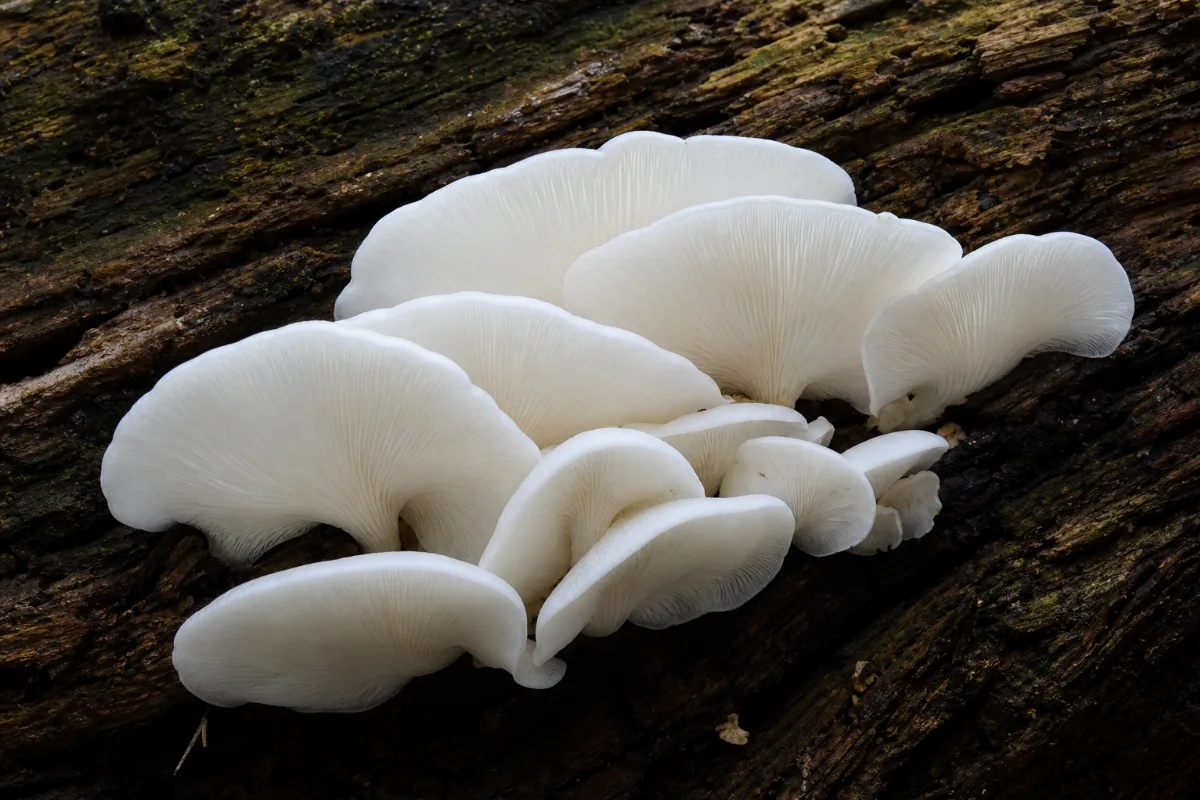
Mushrooms · Wild mushroom
Angel wing
Pleurocybella porrigens · also called Angel's wings, angel-wing mushroom, Sugihiratake (Japanese)
Angel wing is a wild mushroom that was a popular food in Japan. In autumn 2004, 59 people there fell ill with a sudden brain illness after eating it, and 17 died. The people in the clinical reports had kidney failure, most of them on dialysis. The cause has never been proven. People with kidney disease should not eat it, and anyone who may have eaten it should call poison help.
General information, not medical advice. Last substantive update · Not medically reviewed. A named clinician has not signed off on this page. How this page is made
About Angel wing
Angel wing is a wild mushroom eaten in Japan. In autumn 2004 it was linked to a sudden brain illness (acute encephalopathy) in 59 people, 17 of whom died. The clinical reports describe people with kidney failure, many on dialysis. The cause is unproven: the best-supported idea, from mouse and cell work, is that three compounds act together. This page gives no way to identify the mushroom and no safe amount, because none is known.
What happened in Japan in 2004
The cases were spread across many prefectures in September and October 2004. The lead researcher calls it the most severe food poisoning in post-war Japan. A society summary says nearly all the deaths involved people with weakened kidneys, the average age was about 70, and heavy rains had produced an unusually large harvest that many people ate in quantity. That last point is the summary author's explanation, not a measured fact.
Before 2004 the mushroom was widely eaten every year in several regions, and no food poisoning had been reported. One later death, in a 65-year-old man on hemodialysis, was also reported in 2009 by the society summary.
What the illness looked like
In the ten-patient Yamagata series, all ten had chronic kidney failure and seven were on hemodialysis. Each had eaten the mushroom within 2 to 3 weeks before nerve symptoms began. The first signs were tremor, trouble speaking and weak limbs, lasting 4.5 days on average. Then came severe loss of consciousness and seizures that would not stop (status epilepticus in 5 of the 10), and jerking muscle spasms in 4.
Brain scans were normal at first. Three to eight days after onset, lesions appeared in the insula and basal ganglia in 6 patients. Three patients died at 13, 14 and 29 days after onset, two still had disturbed consciousness at one month, one developed parkinsonism, and four recovered nearly completely. In three of those four, the kidney failure was not severe and dialysis was not needed. The authors suggest the degree of kidney failure is a key to the outcome.
In a Niigata series of six patients with varying kidney dysfunction, three were on dialysis. Four needed a ventilator to control seizures and two died. An autopsy of a 65-year-old man on dialysis found cyst-like dead tissue in both putamens, deep in the brain.
How long after the meal? The reports differ
The Yamagata series and a two-patient report say nerve symptoms began 2 to 3 weeks after the meal. A society summary says 13 to 18 days. One single-patient report says 7 days. A 2025 review says 12 to 24 hours, and cites the 2023 review for it. We cannot reconcile these, so we do not give one figure. The practical point is the same: do not wait for symptoms before calling for help.
Why kidney disease matters
Nearly all the serious cases were in people with kidney failure. A 2025 review says the illness can be fatal in kidney failure, but that deaths are rare in otherwise healthy people. A society summary suggests that people with weakened kidneys may have crossed a toxic threshold that others did not. That is the author's idea, not a measured fact. The sources do not say the mushroom damages the kidneys; kidney failure marks who was harmed.
We found no source that proves angel wing is safe in large amounts for anyone, and no known safe amount.
The cause is not proven
A health ministry research team looked for the cause, concluded it was unknown and was dissolved. The lead researcher, who was a member, kept going and in 2023 proposed that three compounds act together: a heat-stable protein (pleurocybelline), a lectin (a sugar-binding protein) and an unstable amino acid (pleurocybellaziridine).
In mice, the protein and the lectin together broke down proteins without preference and disrupted the blood-brain barrier. The amino acid was not isolated from the mushroom itself; its presence was shown by making it in the lab and matching it. It broke down in water and killed rat nerve-support cells in a dish. Only all three together raised brain cell death in mouse brains. This is injection work in animals and cells, not eating, and it has not been shown in people.
Other ideas were tried. One, 3-nitropropionic acid, was looked for in patients and the mushroom and was not found. A 2025 genome study says the usual gene for making the amino acid was not found in the fungus, only similar genes. Nobody has measured how much of any suspect compound a meal contains.
Does cooking help?
We found no evidence that it does. A mushroom fraction that was boiled for 30 minutes was still toxic to mice. The suspected amino acid breaks down in water in the lab, but no source shows that any cooking, soaking or drying makes angel wing safe for people with kidney disease. We make no such claim.
Treatment
We found no antidote and no treatment trial. A 2025 review says treatment is supportive. One dialysis patient, with a fever and many white cells in the spinal fluid, improved after steroids; that is one person and does not show steroids work. Anyone ill after eating it needs hospital care and contact with the poison centre. Do not try home remedies.
What it is, and what it is not
Angel wing is a fungus, Pleurocybella porrigens. GBIF lists the name as accepted, in the order Agaricales; the family is given as Marasmiaceae by GBIF and Tricholomataceae in the 2023 review. The Japanese name is Sugihiratake. The 2023 review says it has not been grown artificially, so it is not the cultivated oyster mushroom sold in shops. Do not assume anything here applies to those, or the reverse.
It is not a supplement and not a psychoactive mushroom. We do not describe how it looks, because that would invite identification from text.
How strong is the evidence?
The human evidence is small case series and single case reports, mostly written up quickly during the outbreak, with no comparison group. They agree on who was harmed (people with kidney failure) but not on the delay. The cause research is mouse, rat and cell work, mostly from one group. Two reviews list the illness as its own named syndrome. We found no study of any benefit.
At a glance
Traditional uses history, not proof
- Eaten as a wild food in parts of Japan, with no reported food poisoning before 2004 (2023 review).
- No traditional medicinal use was found in the sources we read.
Studied for research
- As a food by people with kidney failure, against (linked to a deadly brain illness in 2004)
Main compounds
- Three suspected compounds from mouse and cell studies: a protein (pleurocybelline), a lectin and an unstable amino acid (pleurocybellaziridine). None is proven to be the cause in people.
Common forms
- Wild mushroom, eaten fresh or cooked. It is not a supplement, and it has not been grown commercially.
Research links: Ten cases in Yamagata, 2004 (abstract) · Six cases in Niigata, 2005 (abstract) · Autopsy case report, 2008 (abstract) · Cause research review, 2023 (open access) · Mushroom poisoning review, 2025 (open access) · America's Poison Centers: need immediate assistance? · Research Library · Genes & Biomarkers Library
What it is and its history
- Accepted scientific name
- Pleurocybella porrigens
- Naming authority
- (Pers.) Singer (GBIF)
- Synonyms
- Pleurotus porrigens (Pers.) P.Kumm.; Nothopanus porrigens (Pers.) Singer; Agaricus porrigens Pers. (GBIF lists 14 synonym names in all)
- Common names
- Angel wing (English); Angel's wings (English); Angel-wing mushroom (English); Sugihiratake (Japanese)
- Family or group
- Marasmiaceae per GBIF (a fungus family, not a plant). The 2023 review says Tricholomataceae and calls it the only species in its genus; the classification of this group has been revised, so the family name varies by source.
- Classification
- Fungi > Basidiomycota > Agaricomycetes > Agaricales > Marasmiaceae (GBIF) > Pleurocybella > Pleurocybella porrigens
- Native range
- Eaten in the Hokuriku, Chubu and Tohoku regions of Japan (2023 review). Range elsewhere not checked.
- Habitat
- A wild, wood-decaying fungus. Not described further, on purpose.
- What it looks like
- Stems: Not described, on purpose.; Fruit: Not described, on purpose: this page gives no identification help.
- Cultivation
- The 2023 review says artificial cultivation has not been successful.
- Harvest and processing
- Wild-gathered. Not a commercial product we know of.
- Sustainability and conservation
- Not checked.
Traditional use and history history, not clinical proof
| Tradition or era | Documented use | Source |
|---|---|---|
| Food in Japan before 2004 | The 2023 review says the mushroom was widely consumed every year in several regions of Japan, with no reports of food poisoning before the 2004 incident. | p37518008 |
| Autumn 2004 outbreak | 59 people became ill and 17 died of acute encephalopathy, called by the lead researcher the most severe food poisoning in post-war Japan. A society summary says heavy rains gave an unusually large harvest. | p37518008 |
| Ministry investigation | A health ministry research team could not find the cause, concluded it was 'unknown' and was dissolved. The lead researcher kept working on it afterwards. | p37518008 |
| Medicine | No traditional medicinal use was found in the sources read. | p37518008 |
Traditional use shows how it was used. It does not show that it works or is safe today.
What is inside, and how it may work
What it contains and how those compounds act in cells and animals. Laboratory and animal mechanisms are not proven effects in people.
Main compounds
| Compound | Family | Where it is concentrated | Activity studied | Level of evidence |
|---|---|---|---|---|
| Pleurocybelline (PC) | Glycoprotein of about 10 kDa, heat-stable | Fruiting body (hot-water extract) Not given in the sources read. | Lethal to mice by injection (24 mg/kg for the purified protein). Caused no brain damage alone. 5 12 | Animal research |
| Pleurocybella porrigens lectin (PPL) | Sugar-binding protein (lectin) | Fruiting body Lectin activity was much stronger than in other mushrooms at the time of the incident (2023 review). | Lethally toxic to rats; no brain abnormality alone. With PC it formed a complex with protease activity. 5 12 | Animal research |
| Pleurocybellaziridine (PA) | Unstable amino acid with a three-atom ring | Fruiting body The society summary of the 2011 paper gives 5.75 mg per g, which we could not check: the 2011 paper has no abstract in PubMed and was not read. | Not isolated from the mushroom itself; its presence was shown by chemical synthesis and matching. Broke down in water. Killed rat oligodendrocyte cells in a dish. 5 2 | Laboratory research |
Mechanisms, receptors and pathways
| Target or pathway | Gene or receptor | What was found | Level |
|---|---|---|---|
| Blood-brain barrier | The PC and PPL complex broke down proteins without preference and, injected into mice, caused loss of a blood-brain-barrier marker (GLUT1). The authors hypothesise this lets other substances reach the brain. 12 5 | Animal research | |
| Myelin-producing brain cells (oligodendrocytes) | Pleurocybellaziridine reduced the survival of rat oligodendrocyte cells in a dish. This fits the loss of myelin that a pathologist (Arai) reported in the brains of patients who died, according to the 2023 review, but the link in people is not proven. 5 | Laboratory research | |
| Three together | Only the mixture of all three raised the number of apoptotic cells in the mouse hippocampus; each alone or in other combinations did not. 12 5 | Animal research | |
| 3-nitropropionic acid idea | Researchers looked for 3-nitropropionic acid (behind a moldy sugarcane encephalopathy in China) in patients and the mushroom and did not find it. 9 | Human specimens (negative) | |
| How the fungus makes pleurocybellaziridine | TqaL-like oxygenase genes | The gene for TqaL, an enzyme from Penicillium that makes this compound, was not found in the fungus; genes with similar activity were. How the fungus makes it is not known. 15 | Genome analysis |
| Clinical classification | A 2019 review gives the syndrome its own named subgroup (6D, encephalopathy syndrome). 16 | Review |
Absorption, metabolism and elimination
- Absorption
- Not found in the sources read.
- Distribution
- Not found.
- Metabolism
- Not found.
- Elimination
- Not found.
- Bioavailability
- Not established.
Isolated compounds versus whole extracts
The toxicity work used injected extracts and purified compounds in mice, rats and cells, not whole mushroom eaten by animals or people. The suspected ring compound is unstable in water in the lab, but no source shows that cooking or any preparation makes the mushroom safe for people with kidney disease.
Nutritional composition
Not a supplement. We found no nutrition data and make no nutrition claim.
1 evidence against
What was looked at
The 1 benefits and uses checked for Angel wing, each with how strong the evidence is. Tap one to open it.
What is Angel wing good for?
This is not a food to rely on and not a remedy. The card below shows what has been reported and how strong the evidence is. Read it with the Safety tab.
Benefits, one by one
Each card is a research question, not a promise. Tap a goal to filter. Open a card to see the studies, doses and limits.
As a food, by people with kidney failure
Evidence againstAngel wing is a wild mushroom that was a popular food in Japan. In autumn 2004 it was linked to a serious brain illness in people with kidney failure. The reports describe harm, so there is evidence against eating it if you have kidney disease.
6 studiesNot applicable. No amounts are given or advised, and none is known to…
Studies, doses and limits
What the trials found
Case series of 10 (Yamagata), 6 (Niigata) and two or one patient reports, all in people with kidney dysfunction. No trial and no comparison group.
Results
Tremor, trouble speaking or weak limbs, then loss of consciousness and long seizures. In the ten-patient Yamagata series, 3 died, 2 stayed unresponsive at one month, 1 developed parkinsonism and 4 recovered nearly completely; in 3 of those 4 kidney failure was not severe and dialysis was not needed. In the Niigata series 2 of 6 died.
Why this rating
Every human report describes harm and none describes benefit. The numbers are small and written up quickly, but they agree on the group at risk.
Who was studied
Mostly older adults with chronic kidney failure, many on hemodialysis (Japan, 2004)
Limits
No comparison group; amount eaten unknown; the toxin was not measured; reports differ on the delay between the meal and the illness.
Why researchers looked
Doctors in Japan wrote up the patients because the illness was new and the cause was unknown.
Traditional use
Eaten in the Hokuriku, Chubu and Tohoku regions of Japan, and widely eaten each year before 2004 with no reported food poisoning (2023 review).
Proposed mechanism Animal and in vitro
The cause is unproven in people. See the science tab for the three suspected compounds, which come from mouse and cell work.
A proposed mechanism does not show that the effect happens in people.
People with kidney disease should not eat it. If anyone may have eaten it or any wild mushroom, call poison help now (US 1-800-222-1222) or your local poison centre.
Connections to the rest of health
How Angel wing connects to the rest of our health knowledge graph. Every link says what kind of connection it is. A safety link (for example to the liver) is a warning, not a benefit. A study that merely mentions a topic never creates a benefit link.
Explore every connection: goals, body systems, organs, symptoms, genes
B. Body systems
| Connected to | Kind of connection | Evidence status | Context | Studies |
|---|---|---|---|---|
| Kidney Urinary | Biological association | Evidence against | Studied for: As a food, by people with kidney failure | 4 6 7 8 10 2 |
| Nervous System | Biological association | Evidence against | Studied for: As a food, by people with kidney failure | 4 6 7 8 10 2 |
C. Body parts and organs
| Connected to | Kind of connection | Evidence status | Context | Studies |
|---|---|---|---|---|
| Brain and nervous system | Adverse effect or risk | Low certainty | Acute encephalopathy with deep brain lesions in the 2004 outbreak; the cause is unproven. Preparation or compound: Eaten wild mushroom |
4 10 5 |
| Kidneys | Biological association | Low certainty | Kidney failure marks the group harmed; the sources do not say the mushroom damages the kidneys. Preparation or compound: Eaten wild mushroom |
4 2 |
L. Active compounds
| Connected to | Kind of connection | Evidence status | Context | Studies |
|---|---|---|---|---|
| Pleurocybelline (PC) | Biological association | Animal | Lethal to mice by injection (24 mg/kg for the purified protein). Caused no brain damage alone. Preparation or compound: Fruiting body (hot-water extract) |
5 12 |
| Pleurocybella porrigens lectin (PPL) | Biological association | Animal | Lethally toxic to rats; no brain abnormality alone. With PC it formed a complex with protease activity. Preparation or compound: Fruiting body |
5 12 |
| Pleurocybellaziridine (PA) | Biological association | In vitro | Not isolated from the mushroom itself; its presence was shown by chemical synthesis and matching. Broke down in water. Killed rat oligodendrocyte cells in a dish. Preparation or compound: Fruiting body |
5 2 |
Each connection is stored with the ingredient, the connected record, the kind of connection, the evidence status, the supporting studies, the preparation or compound involved, and a review date (last reviewed October 25, 2026).
Evidence at a glance: what the research found for 1 outcome
Each outcome below is one thing researchers measured. Certainty is how far the evidence can be trusted, not how well it works. The full studies are on the next tab.
The evidence
The research centre for Angel wing. Every record here was checked against PubMed or the publisher's page; we never list a study we have not verified.
Evidence by outcome
Bars show how many studies we found for each outcome, not how well it works. People are added up across trials only (reviews are not added, to avoid double counting).
How we rate evidence
High certainty
Several well-run trials or reviews agree; further research is unlikely to change the picture much.
Moderate certainty
Good trials point the same way, but some doubt remains.
Low certainty
Small, short or inconsistent trials. The finding could change with better research.
Very low certainty
Very little or very weak human data. Treat as a possibility only.
Mixed findings
Trials or reviews disagree with each other.
Not enough evidence
Not enough human research to say either way.
Evidence against
Good research found no benefit, or found harm.
We take the reviewers' own risk-of-bias and GRADE statements where they exist, and otherwise judge from study size, design, consistency, directness and whether a product matches what is sold. Many publications do not make evidence high. Method note: We read PubMed records and abstracts for 12 papers (five Japanese clinical reports, one lab investigation of a cause hypothesis, one mouse study, one genome study, and four reviews), read the 2023 cause-research review and a passage of a 2025 review in open-access full text, read a mycological-society page and two US poison-centre pages, and checked the name in GBIF. The 2011 pleurocybellaziridine paper has no abstract in PubMed and was not read. Certainty ratings are the compiler's own reading.
Study library: every study we checked 16
| Study | Design | People | Product, dose, length | Result |
|---|---|---|---|---|
| America's Poison Centers 2026 Poison Control (America's Poison Centers): Need immediate assistance? n/a · Source |
Authoritative guidance n/a |
n/a | n/a |
Call 911 if the person collapses, has a seizure, has trouble breathing or cannot be awakened; otherwise call Poison Help at 1-800-222-1222 (free, confidential). Methods, limits and fundingOutcomes: Call 911 if the person collapses, has a seizure, has trouble breathing or cannot be awakened; otherwise call Poison Help at 1-800-222-1222 (free, confidential). Limitations: Page text read 2026-10-25; no date shown. US numbers. Read: full-text |
| Beug MW (North American Mycological Association) Pleurocybella porrigens toxin unmasked? n/a · Source |
Society web article (not peer reviewed) human reports |
n/a | n/a |
Says 59 people in 9 prefectures were sickened and 17 died; all or nearly all of the deaths involved people with compromised kidneys and the average age was 70; heavy rains gave an unusually large harvest eaten in quantity; symptoms appeared 13 to 18 days after eating; one more death was reported in 2009 in a 65-year-old man on hemodialysis. It discusses the 2011 pleurocybellaziridine paper, quotes a reader who wants primate studies, and notes it is not known whether all collections contain the compound. Methods, limits and fundingOutcomes: Summary of the 2004 outbreak and the 2011 pleurocybellaziridine paper Limitations: Not peer reviewed; the author gives opinions (for example that a "toxic threshold" may have been crossed). Page read in text on 2026-10-25; no date shown in the text read. Read: full-text |
| GBIF Secretariat 2026 GBIF Backbone Taxonomy: Pleurocybella porrigens (Pers.) Singer n/a · Source |
Taxonomic database n/a |
n/a | n/a |
GBIF match API checked 2026-10-25: Pleurocybella porrigens (Pers.) Singer is ACCEPTED, species key 2538000, order Agaricales, family Marasmiaceae; 14 synonym names listed. Methods, limits and fundingOutcomes: Accepted name, family and synonyms Limitations: Index Fungorum not checked. The 2023 Kawagishi review places the genus in Tricholomataceae; classification of this group has been revised. Read: full-text |
| Kato 2004 [An outbreak of encephalopathy after eating autumn mushroom (Sugihiratake; Pleurocybella porrigens) in patients with renal failure: a clinical analysis of ten cases in Yamagata, Japan]. No To Shinkei · PMID 15729876 |
Case series human (Pleurocybella porrigens) |
10 Ten patients in Yamagata prefecture, all with chronic renal failure (seven on hemodialysis), who had eaten the mushroom within 2 to 3 weeks before nerve symptoms |
Wild Pleurocybella porrigens (Sugihiratake), eaten Fruiting body (eaten); amount unknown |
Initial symptoms were tremor, trouble speaking and/or weak limbs, lasting 4.5 days on average (2 to 11), followed by severe loss of consciousness and seizures that would not stop; status epilepticus in 5 patients, myoclonus in 4. CT and MRI were unremarkable early; 3 to 8 days after onset, lesions appeared in the insula and basal ganglia in 6 patients. All 6 patients tested had abnormal EEG. Three patients died (13, 14 and 29 days after onset), two still had disturbed consciousness at one month, one developed parkinsonism, and four recovered nearly completely. In 3 of the 4 who recovered, kidney failure was not severe and they did not need hemodialysis. The authors suggest the degree of kidney failure is a key to the outcome. 3 of 10 died; 4 of 10 recovered nearly completely Methods, limits and fundingOutcomes: Symptoms, brain scans, EEG and outcome Limitations: Ten patients, all with kidney failure, written up during the outbreak. No comparison group. Amount eaten unknown. The toxin was not identified. Abstract only (a Japanese-language paper). Funding and conflicts: Not stated in the abstract Read: abstract |
| Kawagishi 2023 Chemical elucidation of acute encephalopathy by ingestion of angel-wing mushroom (Pleurocybella porrigens) - involvement of three constituents in onset. Proceedings of the Japan Academy, Series B · PMID 37518008 · DOI |
Narrative review by the lead researcher mouse, rat, cell culture |
Outbreak background; mouse, rat and cell studies | Extracts and purified components of Pleurocybella porrigens Fruiting body |
In autumn 2004 the mushroom, widely eaten in Japan, was linked to acute encephalopathy; 59 patients and 17 deaths in what the author calls the most severe food poisoning in post-war Japan. The ministry research team concluded the cause was "unknown" and was dissolved. Room-temperature and boiling-water extracts were each lethal to mice at 3,000 mg/kg by injection; high-molecular-weight fractions at 1,000 mg/kg; a high-molecular-weight fraction boiled for 30 minutes was still toxic. Purified pleurocybelline (a glycoprotein of about 10 kDa) was lethal at 24 mg/kg. The lectin (PPL) was lethally toxic to rats but caused no brain abnormality alone. PC and PPL together broke down proteins without preference and, injected into mice, caused loss of a blood-brain-barrier marker (GLUT1). Pleurocybellaziridine was not isolated from the mushroom itself; its existence was shown by chemical synthesis and matching. It broke down in water and killed rat oligodendrocyte cells in a dish. Only the three together raised apoptosis in the mouse hippocampus. Artificial cultivation has not been successful. Three constituents proposed as jointly responsible; shown in mice and cells only Methods, limits and fundingOutcomes: History of the outbreak and of the cause research Limitations: Review by a researcher who led the work (not independent). Injection doses in mice, not eating. Open-access full text read for the first part (about two thirds); the remainder not read. Funding and conflicts: Not read; the author is a member of the former ministry research group Read: full-text (most of it) |
| Kurokawa 2005 [Clinical, neuroimaging and electroencephalographic findings of encephalopathy occuring after the ingestion of "sugihiratake" (Pleurocybella porrigens), an autumn mashroom: a report of two cases]. Rinsho Shinkeigaku · PMID 15782609 |
Case report human (Pleurocybella porrigens) |
2 A 54-year-old man and a 79-year-old woman, both on hemodialysis |
Wild Pleurocybella porrigens (Sugihiratake), eaten Fruiting body (eaten); amount unknown |
Both ate the mushroom 2 to 3 weeks before nerve symptoms. They began with weakness and involuntary movements of the limbs (the man also had trouble speaking), then seizures that would not stop, leading to status epilepticus or coma 6 days (man) or 3 days (woman) after onset. Scans were normal on the first day; days later, lesions were seen in deep brain and white matter on MRI (man, day 6) or low-density areas on CT (woman, day 4). EEG showed periodic synchronous discharge, which disappeared as consciousness improved. Seizures gradually improved in both. Blood and spinal-fluid tests, including viral antibodies, showed no cause. The authors call it a newly recognised disease entity. Seizures gradually improved in both; EEG pattern resolved with recovery of consciousness Methods, limits and fundingOutcomes: Symptoms, MRI/CT and EEG Limitations: Two patients. The abstract does not give long-term outcomes. Abstract only. Funding and conflicts: Not stated in the abstract Read: abstract |
| Kuwabara 2005 [Acute encephalopathy among patients with renal dysfunction after ingestion of "sugihiratake", angel's wing mushroom--study on the incipient cases in the northern area of Niigata Prefecture]. Rinsho Shinkeigaku · PMID 15835296 |
Case series human (Pleurocybella porrigens) |
6 Six patients with varying degrees of kidney dysfunction (three on dialysis) in northern Niigata Prefecture |
Wild Pleurocybella porrigens (Sugihiratake), eaten "in varying quantities and frequencies" Fruiting body (eaten) |
Patients first had shaking limbs and trouble walking, then several days later disturbed consciousness followed by status epilepticus. Four were put on mechanical ventilation to control seizures. Two of the six died. Spinal fluid showed raised protein without extra white cells; bacterial, rickettsial and viral screens were negative. CT and MRI showed swelling in the claustrum and external capsule and in white matter at the base of the frontal, parietal and temporal lobes. No common drug was found. The authors say the mushroom may have caused a toxic encephalopathy. 2 of 6 died; 4 of 6 needed a ventilator for seizure control Methods, limits and fundingOutcomes: Symptoms, spinal fluid, brain imaging and outcome Limitations: Six patients from early in the outbreak. Amount eaten varied and was not measured. Abstract only. Funding and conflicts: Not stated in the abstract Read: abstract |
| Obara 2005 [A case of encephalitis-type encephalopathy related to Pleurocybella porrigens (Sugihiratake)]. Rinsho Shinkeigaku · PMID 15835299 |
Case report human (Pleurocybella porrigens) |
1 A 65-year-old man on hemodialysis for chronic renal failure |
Wild Pleurocybella porrigens (Sugihiratake), eaten Fruiting body (eaten); amount unknown |
The man was well until 7 days after eating the mushroom, then lost consciousness and had generalised tonic-clonic status epilepticus. High fever and a high CRP followed; spinal fluid showed marked pleocytosis (many white cells). MRI showed diffuse lesions in the basal ganglia and multiple ring-shaped lesions in the cerebral cortex. Glucocorticoid (steroid) treatment was effective for clinical improvement. Clinical improvement with steroids (one patient) Methods, limits and fundingOutcomes: Symptoms, spinal fluid, MRI and response to treatment Limitations: One patient. An improvement after steroids in one person does not show that steroids work. Abstract only. Funding and conflicts: Not stated in the abstract Read: abstract |
| Obara 2006 [The research of the pathogen responsible for Pleurocybella porrigens related encephalopathy: investigation of 3-nitropropionic acid hypothesis]. No To Shinkei · PMID 16681260 |
Laboratory investigation of a cause hypothesis human specimens and mushroom |
Specimens from patients and from the mushroom | Test for 3-nitropropionic acid (the toxin behind the moldy sugarcane encephalopathy in China) Patient specimens and mushroom |
The authors compared the brain lesions in the patients with the moldy sugarcane encephalopathy epidemic in China, tried to detect 3-nitropropionic acid in various patient specimens and in the mushroom, and failed to detect it. They say further work is needed to find the cause. A proposed cause was not found Methods, limits and fundingOutcomes: Whether 3-nitropropionic acid could be detected Limitations: A negative result for one idea; it does not show what the cause is. Abstract only. Funding and conflicts: Not stated in the abstract Read: abstract |
| Obara 2008 Acute encephalopathy associated with ingestion of a mushroom, Pleurocybella porrigens (angel's wing), in a patient with chronic renal failure. Neuropathology · PMID 18366348 · DOI |
Autopsy case report human (Pleurocybella porrigens) |
1 A 65-year-old man who had been on hemodialysis for 3 months for chronic renal failure |
Wild Pleurocybella porrigens, eaten Fruiting body (eaten); amount unknown |
Generalised convulsion and coma followed eating the mushroom. The brain showed extensive cystic dead tissue, like that after a stroke, in both putamens, and multiple small patches of dead tissue in deep cerebral and cerebellar cortex. The authors note that similar encephalopathy was endemic in Japan in 2004 and that its cause remains unclear. Cystic necrosis in the putamens at autopsy (one patient) Methods, limits and fundingOutcomes: Brain pathology at autopsy Limitations: One patient. Shows what the brain looked like, not what caused it. Abstract only. Funding and conflicts: Not stated in the abstract Read: abstract |
| Saviuc 2006 New syndromes in mushroom poisoning. Toxicological Reviews · PMID 17192123 · DOI |
Narrative review human reports |
Newly described mushroom poisoning syndromes | n/a |
The review says that in the new syndromes onset is generally more than 6 hours after eating and treatment is mainly supportive. It notes that cases of encephalopathy were observed twice, after Hapalopilus rutilans in Germany in 1992 and after Pleurocybella porrigens in Japan in 2004, where a convulsive encephalopathy outbreak occurred in patients with a history of chronic renal failure. Lists the angel wing outbreak as a new syndrome Methods, limits and fundingOutcomes: Description of new syndromes Limitations: Review; abstract only. Funding and conflicts: Not stated in the abstract Read: abstract |
| Suzuki 2023 Possible molecular mechanism for acute encephalopathy by angel-wing mushroom ingestion - Involvement of three constituents in onset. Toxicon · PMID 36377137 · DOI |
Laboratory and mouse study mouse; purified components |
Mice; purified mushroom components | Pleurocybelline (PC), a lectin (PPL) and pleurocybellaziridine (PA) from Pleurocybella porrigens, given by injection Isolated components |
The authors purified a protein lethal to mice, pleurocybelline. It caused no brain damage on its own but formed a complex with a lectin (PPL) and showed exo-protease activity, breaking down substrates from both ends. The presence of an unstable toxic compound, pleurocybellaziridine, in the mushroom was shown. Apoptotic cells in the hippocampus were significantly increased by injecting the mixture of the three, and the authors say these substances might be involved in acute encephalopathy. More cell death in the mouse hippocampus with all three together Methods, limits and fundingOutcomes: Brain cell death (apoptosis) in the mouse hippocampus Limitations: Injected into mice, not eaten by people. A hypothesis, not proof of the cause in people. Abstract only. Funding and conflicts: Not stated in the abstract Read: abstract |
| Tugcan 2025 Mushroom poisoning: An updated review. Turkish Journal of Emergency Medicine · PMID 39882097 · DOI |
Narrative review human reports |
Mushroom poisoning syndromes | n/a |
A passage on delayed encephalopathy says it may develop 12 to 24 hours after eating some mushrooms (Pleurocybella porrigens and Hapalopilus rutilans); these can be fatal in people with kidney failure, but mortality is rare in otherwise healthy people; treatment is supportive. That timing differs from the clinical series (2 to 3 weeks). Delayed encephalopathy; deaths mainly with kidney failure Methods, limits and fundingOutcomes: Description of syndromes Limitations: Review; one passage read in the open-access full text. It cites the 2023 Kawagishi review for this statement. Funding and conflicts: Not stated Read: full-text passage |
| University of Kansas Health System Poison Control Center 2026 The University of Kansas Health System Poison Control Center: Poisonous Mushrooms n/a · Source |
Authoritative guidance n/a |
n/a | n/a |
Even very experienced mushroom gatherers can have a hard time telling whether a mushroom is safe to eat. If someone eats a wild mushroom, contact poison control immediately, save a piece if possible, and do not wait for symptoms, because symptoms may not develop for several days. Methods, limits and fundingOutcomes: Even very experienced mushroom gatherers can have a hard time telling whether a mushroom is safe to eat. If someone eats a wild mushroom, contact poison control immediately, save a piece if possible, and do not wait for symptoms, because symptoms may not develop for several days. Limitations: Page text read 2026-10-25; no date shown. General advice, not about this mushroom. Read: full-text |
| Watanabe 2025 A high-quality genome assembly of angel-wing mushroom Pleurocybella porrigens that causes acute encephalopathy. AMB Express · PMID 41385033 · DOI |
Genome sequencing study fungus (genome) |
The fungus (fruiting bodies and mycelium) | Genome and gene-expression analysis Fruiting body and mycelium |
The abstract restates 59 cases and 17 deaths in 2004 and that three components (a lectin, pleurocybelline and pleurocybellaziridine) are implicated in toxicity in mice. The gene for TqaL, an enzyme that makes pleurocybellaziridine in Penicillium, was not found in this fungus; genes with similar Fe/alpha-KG oxygenase activity were found. A new genome; how the fungus makes the suspected toxin is still unknown Methods, limits and fundingOutcomes: Genome assembly; search for genes that make pleurocybellaziridine Limitations: A genome paper; it does not test toxicity. Abstract only. Funding and conflicts: Not stated in the abstract Read: abstract |
| White 2019 Mushroom poisoning: A proposed new clinical classification. Toxicon · PMID 30439442 · DOI |
Literature review and classification human reports |
Mushroom poisoning syndromes | n/a |
The authors propose six groups of mushroom poisoning. Group 6 (miscellaneous adverse reactions) includes subgroup 6D, "encephalopathy syndrome (Pleurocybella porrigens)". Gives the angel wing syndrome its own named subgroup Methods, limits and fundingOutcomes: A six-group classification Limitations: Classification paper; abstract only. Funding and conflicts: Not stated in the abstract Read: abstract |
What we do not know yet
- The cause is not proven in people; the three-compound idea is mouse and cell work, mostly from one research group.
- Only small case series exist, with no comparison group.
- Reports differ on the delay between the meal and the illness.
- No measured amount of any suspected compound per gram of mushroom, and no known safe amount.
- No treatment trial and no antidote found.
- No data on pregnancy, breastfeeding, allergy or medicine interactions.
- We did not find a Japanese government advisory, and did not check EFSA or FDA.
How new research is added
New studies are found by a saved PubMed search and placed in a review queue. A person reads each one before it changes any evidence rating or safety wording. New publications never change ratings automatically.
Lab markers
What changed in blood or saliva tests during trials. A changed number is not the same as feeling or being healthier, and we give no "normal ranges".
Safety
What studies and official sources say about side effects, medicines and who should check first. Each point shows what kind of evidence it comes from.
Main points to know 5
- Linked to a serious brain illness in people with kidney failure (Japan, 2004). In autumn 2004, 59 people in Japan fell ill after eating angel wing and 17 died of acute encephalopathy, a sudden brain illness. Clinical reports describe patients with chronic kidney failure, most of them on hemodialysis. The illness began with tremor, trouble speaking or weak limbs, then loss of consciousness and long seizures. The cause is unproven. Case series and review 4 7 5
- People with kidney disease should not eat it. In the ten-patient Yamagata series every patient had chronic kidney failure, and the authors suggest the degree of kidney failure is a key to the outcome. A mycological-society summary says all or nearly all of the deaths involved people with weakened kidneys. A 2025 review says it can be fatal in kidney failure but that deaths are rare in otherwise healthy people. None of this proves it is safe for anyone, and no safe amount is known. Case series and review 4 2 13
- Do not wait for symptoms. In the clinical series, nerve symptoms began 2 to 3 weeks after the meal. A mycological-society page says 13 to 18 days, one case report says 7 days, and a 2025 review says 12 to 24 hours. The sources differ, but a poison centre says not to wait for symptoms because they may take days. If anyone may have eaten it or any wild or unknown mushroom, call Poison Help at 1-800-222-1222 (US) now. Call 911 if the person collapses, has a seizure, has trouble breathing or cannot be woken. Outside the US, call your local poison centre or emergency number. Case series and authoritative guidance 4 8 2 13 14 1
- The cause is not proven. The Japanese health ministry research group concluded the cause was unknown and was dissolved. The lead researcher later proposed three compounds acting together, based on mouse and cell work. One idea tested in patients and the mushroom, 3-nitropropionic acid, was not found. Nobody has measured how much of any suspected compound a meal contains. Review and animal study 5 12 9
- No identification help is given here, on purpose. Even very experienced gatherers can have a hard time telling whether a mushroom is safe to eat, according to a poison centre. Wild mushrooms must not be identified from text, photos or apps. Only a trained local expert looking at the mushroom in person can do that. Authoritative guidance 14
Side effects 6
| Effect | How often | Severity and recovery | Evidence |
|---|---|---|---|
| Tremor, trouble speaking and weak limbs (first nerve signs) Ten patients, all with kidney failure; not a rate for the public. | Initial symptoms in the ten-patient Yamagata series, lasting 4.5 days on average (2 to 11) | serious Progressed in most patients | Case series 4 6 7 |
| Loss of consciousness and long seizures (status epilepticus) Myoclonus (jerking) in 4 of 10 in Yamagata. | 5 of 10 in Yamagata; 4 of 6 in Niigata needed a ventilator for seizure control | life-threatening Seizures gradually improved in the two patients of one report; others died or stayed unresponsive | Case series 4 7 6 |
| Death The groups are overlapping reports of one outbreak, not independent counts. | 17 of 59 in the 2004 outbreak (2023 review); 3 of 10 in Yamagata; 2 of 6 in Niigata | fatal Not applicable | Case series and review 5 4 7 |
| Lasting problems after recovering consciousness Follow-up in the abstract ends at about one month. | Parkinsonism in 1 of 10; persistent disturbed consciousness at one month in 2 of 10 | serious Not described beyond one month | Case series 4 |
| Brain damage seen on scans and at autopsy One autopsy found cyst-like dead tissue in both putamens. A normal early scan does not rule it out. | Insula and basal ganglia lesions in 6 of 10 on MRI, 3 to 8 days after onset; scans were normal early | serious Not described | Case series and autopsy report 4 10 6 |
| Encephalitis-type illness with fever One person; does not show steroids work. | One patient, 7 days after the meal | serious Improved with steroid treatment in that patient | Case report 8 |
Liver
No liver injury was described in the abstracts read, and no LiverTox entry was looked for. This is not proof that the liver is unaffected.
How often. Not reported.
This is a safety connection. It is not evidence that Angel wing supports liver health.
Medicines and supplements 2
| With | Why it matters | Importance | Evidence | What to do |
|---|---|---|---|---|
| Existing kidney disease, kidney failure or dialysis condition | Not known. Every patient in the Yamagata series had chronic kidney failure, and the authors suggest the degree of kidney failure is a key to the outcome. | The group clearly harmed in 2004. A 2025 review says it can be fatal in kidney failure. | Case series and review Low certainty 4 13 2 | People with kidney disease should not eat it. Anyone with kidney disease who may have eaten it should call poison help at once. |
| Any medicine, supplement, food or alcohol general | Unknown. | None Not enough evidence 7 | Tell the poison centre and doctors everything the person has taken. |
Who should check first 4
| Situation | Advice | Evidence |
|---|---|---|
| Kidney disease, kidney failure or dialysis | Do not eat it. This is the group harmed in the 2004 outbreak. | Case series 4 7 2 |
| Anyone: eating wild mushrooms you or someone else picked | Do not eat a wild mushroom unless a trained local expert has identified it in person. No safe amount of angel wing is known. | Authoritative guidance 14 |
| Pregnancy and breastfeeding | No data. Do not eat it; ask a doctor or poison centre if exposed. | None |
| Children | No children's cases were described in the sources read; the patients were mostly older adults (average age about 70 per the society summary). Keep children away from wild mushrooms and call poison help if one may have eaten any. | None and society summary 2 |
Overdose, product quality and regulators
Summary. The toxin is not settled. Mouse studies injected extracts and purified compounds; these are not meals. Room-temperature and boiling-water extracts were each lethal to mice at 3,000 mg/kg by injection, and a boiled fraction was still toxic.
Animal. Mice: lethal at 3,000 mg/kg (crude water extracts), 1,000 mg/kg (high-molecular-weight fractions) and 24 mg/kg (purified pleurocybelline), all by injection (2023 review). Rats: the lectin was lethal. Cells: pleurocybellaziridine killed rat oligodendrocyte cells in a dish.
High dose or long term signals. Not studied. A society summary suggests an unusually large harvest and large meals in 2004 may have mattered; that is an opinion.
Overdose response. The sources describe supportive care; no antidote was found. Do not try to treat it at home.
Toxic parts. The fruiting body was the part eaten and tested.
Not a product: it is a wild mushroom that has not been grown commercially (2023 review). Whether boiling, drying, freezing or salting makes it safe was not tested in people, so do not assume it does.
Cooking. A fraction boiled for 30 minutes was still toxic to mice. The suspected ring compound breaks down in water in the laboratory, but no source shows that any preparation makes the mushroom safe for people with kidney disease. 5
Heavy metals, radioactivity, pesticides. Not checked in the sources read.
| Body | Action | Date |
|---|---|---|
| Japanese Ministry of Health, Labour and Welfare research group (Japan) | Established a research team after the outbreak; per the 2023 review it concluded the cause was 'unknown' and was dissolved. source | |
| The University of Kansas Health System Poison Control Center (United States) | Says to contact poison control immediately if someone eats a wild mushroom, to save a piece if possible, and not to wait for symptoms because they may take days. Says even very experienced gatherers can have a hard time telling whether a mushroom is safe. source | |
| America's Poison Centers (United States) | Call 911 if the person collapses, has a seizure, has trouble breathing or cannot be awakened; otherwise call 1-800-222-1222 (free, confidential). source |
When to get medical help
- Anyone who may have eaten angel wing or any wild or unknown mushroom: call Poison Help at 1-800-222-1222 (US) now, even with no symptoms; outside the US call your local poison centre.
- Collapse, a seizure, trouble breathing or cannot be woken: call 911 or your local emergency number now.
- Tremor, slurred speech, weak legs, confusion, jerking movements or unusual sleepiness in the days to weeks after eating a wild mushroom, especially in someone with kidney disease or on dialysis: get emergency care and say what was eaten.
- Fever with seizures after a mushroom meal: get emergency care.
If someone may be poisoned or in a crisis, contact a clinician or emergency service straight away. In the US, Poison Control is 1-800-222-1222.
General information only, not medical advice. Ask a clinician or pharmacist before use, especially with medicines, in pregnancy or with a health condition. See the Natural Remedy Safety guide.
Frequently asked questions
What should I do if someone ate angel wing or another wild mushroom?
What happened in Japan in 2004?
Is angel wing safe to eat?
Can it harm people with healthy kidneys?
What are the symptoms?
How long after eating does the illness start?
What is the toxin?
Does cooking remove the poison?
We found no source showing that it does. A boiled mushroom fraction was still toxic to mice.
Is there an antidote or treatment?
We found no antidote. A 2025 review says treatment is supportive. Do not try home remedies; get hospital care.
Is angel wing the same as the oyster mushroom in shops?
Does it have any health benefit?
Explore by health goal
Editorial transparency
- Written by
- AlternativeMed editorial team. Research compiled with AI assistance, then checked against PubMed records.
- Medical review
- None. This page has not been reviewed by a physician or pharmacist.
- First published
- 2026-10-25
- Last substantive update
- 2026-10-25
- How we research
- We read PubMed records and abstracts for 12 papers (five Japanese clinical reports, one lab investigation of a cause hypothesis, one mouse study, one genome study, and four reviews), read the 2023 cause-research review and a passage of a 2025 review in open-access full text, read a mycological-society page and two US poison-centre pages, and checked the name in GBIF. The 2011 pleurocybellaziridine paper has no abstract in PubMed and was not read. Certainty ratings are the compiler's own reading.
- How we rate evidence
- See "How we rate evidence" in the Evidence tab.
- Independence
- No product is promoted on this page. No affiliate links are shown. This page is information, not advice to eat a wild mushroom.
Sources 16
Each source was opened and checked. Where we read only the abstract, it says so. The small numbers in the text point here.
- America's Poison Centers. Poison Control (America's Poison Centers): Need immediate assistance?. n/a. 2026. (full-text)
- Beug MW (North American Mycological Association). Pleurocybella porrigens toxin unmasked?. n/a. . (full-text)
- GBIF Secretariat. GBIF Backbone Taxonomy: Pleurocybella porrigens (Pers.) Singer. n/a. 2026. (full-text)
- Kato T, Kawanami T, Shimizu H, Kurokawa K, Sato H, Nakajima K, et al.. [An outbreak of encephalopathy after eating autumn mushroom (Sugihiratake; Pleurocybella porrigens) in patients with renal failure: a clinical analysis of ten cases in Yamagata, Japan].. No To Shinkei. 2004. PMID 15729876. (abstract)
- Kawagishi H. Chemical elucidation of acute encephalopathy by ingestion of angel-wing mushroom (Pleurocybella porrigens) - involvement of three constituents in onset.. Proceedings of the Japan Academy, Series B. 2023. PMID 37518008. DOI 10.2183/pjab.99.012. (full-text (most of it))
- Kurokawa K, Sato H, Nakajima K, Kawanami T, Kato T. [Clinical, neuroimaging and electroencephalographic findings of encephalopathy occuring after the ingestion of "sugihiratake" (Pleurocybella porrigens), an autumn mashroom: a report of two cases].. Rinsho Shinkeigaku. 2005. PMID 15782609. (abstract)
- Kuwabara T, Arai A, Honma N, Nishizawa M. [Acute encephalopathy among patients with renal dysfunction after ingestion of "sugihiratake", angel's wing mushroom--study on the incipient cases in the northern area of Niigata Prefecture].. Rinsho Shinkeigaku. 2005. PMID 15835296. (abstract)
- Obara K, Okawa S, Kobayashi M, Takahashi S, Watanabe S, Toyoshima I. [A case of encephalitis-type encephalopathy related to Pleurocybella porrigens (Sugihiratake)].. Rinsho Shinkeigaku. 2005. PMID 15835299. (abstract)
- Obara K, Muto H, Itoh H, Satoh S, Gonmori K, Watanabe S, Toyoshima I. [The research of the pathogen responsible for Pleurocybella porrigens related encephalopathy: investigation of 3-nitropropionic acid hypothesis].. No To Shinkei. 2006. PMID 16681260. (abstract)
- Obara K, Wada C, Yoshioka T, Enomoto K, Yagishita S, Toyoshima I. Acute encephalopathy associated with ingestion of a mushroom, Pleurocybella porrigens (angel's wing), in a patient with chronic renal failure.. Neuropathology. 2008. PMID 18366348. DOI 10.1111/j.1440-1789.2007.00819.x. (abstract)
- Saviuc P, Danel V. New syndromes in mushroom poisoning.. Toxicological Reviews. 2006. PMID 17192123. DOI 10.2165/00139709-200625030-00004. (abstract)
- Suzuki T, Asakawa T, Maekawa F, Kimura E, Tezuka Y, Nakamura L, Sato T, Arai Y, Choi JH, Suzuki M, Dohra H, Hirai H, Kawagishi H. Possible molecular mechanism for acute encephalopathy by angel-wing mushroom ingestion - Involvement of three constituents in onset.. Toxicon. 2023. PMID 36377137. DOI 10.1016/j.toxicon.2022.106958. (abstract)
- Tugcan MO, Akpinar AA. Mushroom poisoning: An updated review.. Turkish Journal of Emergency Medicine. 2025. PMID 39882097. DOI 10.4103/tjem.tjem_129_24. (full-text passage)
- University of Kansas Health System Poison Control Center. The University of Kansas Health System Poison Control Center: Poisonous Mushrooms. n/a. 2026. (full-text)
- Watanabe N, Mitsukuni K, Sekimata K, Kimura M, Takada S, Zhang J, Sato T, Ono A. A high-quality genome assembly of angel-wing mushroom Pleurocybella porrigens that causes acute encephalopathy.. AMB Express. 2025. PMID 41385033. DOI 10.1186/s13568-025-01995-2. (abstract)
- White J, Weinstein SA, De Haro L, Bedry R, Schaper A, Rumack BH, Zilker T. Mushroom poisoning: A proposed new clinical classification.. Toxicon. 2019. PMID 30439442. DOI 10.1016/j.toxicon.2018.11.007. (abstract)


