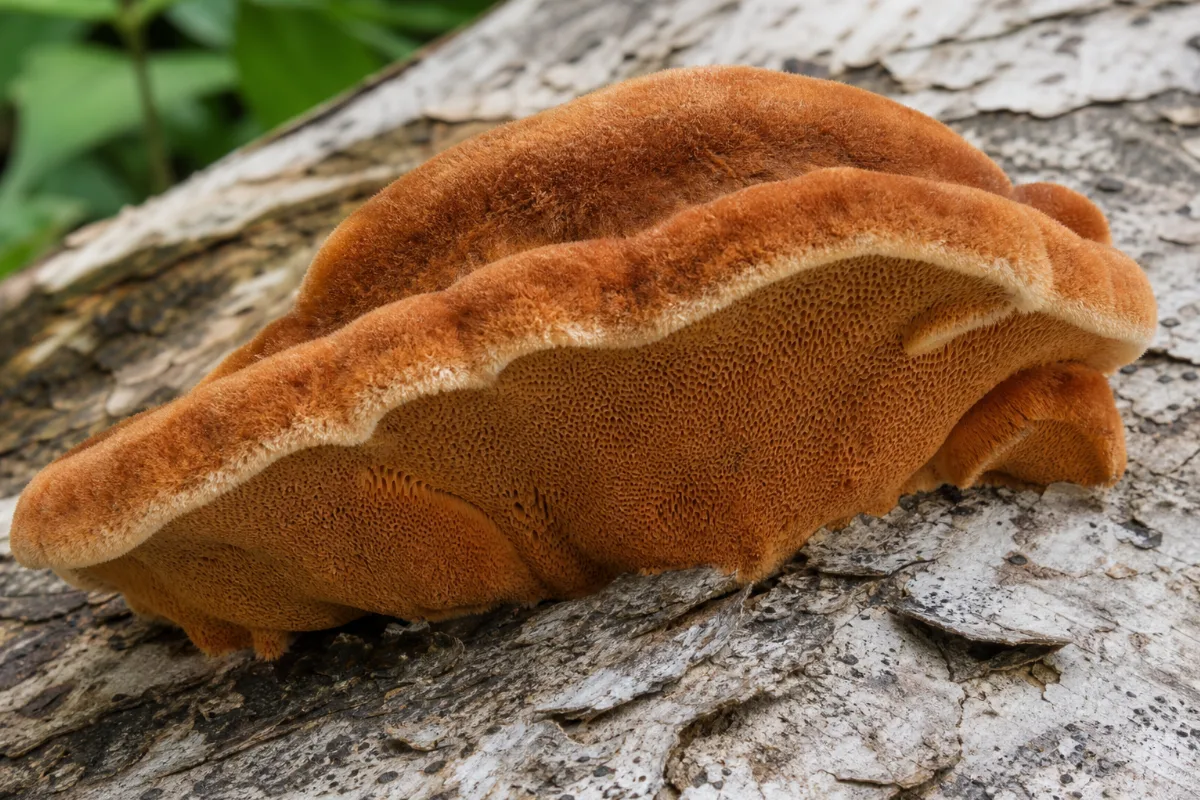
Mushrooms · Wild polypore
Tender nesting polypore
Hapalopilus rutilans (also written H. nidulans) · also called Hapalopilus nidulans (a name used in many papers for the same fungus)
The tender nesting polypore is a wild bracket fungus that has poisoned people who ate it by mistake. In the best-described report, two people had stomach pain, vision problems and purple urine, and both recovered within about a week. It is not a food, medicine or supplement, and no benefit has been shown. If anyone may have eaten a wild mushroom, call Poison Help now (1-800-222-1222 in the US).
General information, not medical advice. Last substantive update · Not medically reviewed. A named clinician has not signed off on this page. How this page is made
About Tender nesting polypore
The tender nesting polypore (Hapalopilus rutilans, also written H. nidulans) is a wild bracket fungus. Its pigment, polyporic acid, is the probable cause of the stomach, vision, nerve and kidney effects and purple urine seen in the few published poisonings. Only a handful of cases exist, so the full picture is unknown. This page explains the danger and gives no way to identify it.
What it is, and the naming
The tender nesting polypore is Hapalopilus rutilans. GBIF lists Hapalopilus nidulans as a synonym, and many papers use that name for the same fungus. It is a wood-rotting bracket fungus in the family Phanerochaetaceae. A 2024 DNA study confirms the genus Hapalopilus belongs in that family.
We do not describe how it looks, because that would invite identification from text. The people in the case report had taken it for the beefsteak fungus, an edible species. Even very experienced gatherers can find it hard to know whether a mushroom is poisonous, according to a poison centre. Only a trained local expert looking at the fungus in person can say. Do not make tea, tincture or powder from wild bracket fungi.
The probable toxin
Polyporic acid is an orange-to-purple pigment. The case-report authors say it is probably the active toxin. A 2023 paper shows that two enzymes of the fungus make it.
A 1998 study gave the pigment to rats at 100 to 800 mg/kg. They became much less active and developed liver and kidney failure and acid-base changes, which the authors say paralleled the poisoned people. The authors report that polyporic acid blocks an enzyme cells need to grow. A 2000 test-tube study found only a slight effect on the purified human enzyme at the amount tested, so how it harms people is not settled.
We found no source that tested whether cooking, drying or freezing removes polyporic acid. Do not assume it does. A 2019 review gives polyporic mushroom poisoning its own named group.
What was reported, hour by hour
About 12 hours after the meal: abdominal pain, nausea, vomiting, loss of appetite, weakness, double vision and blurred vision. The father also had visual hallucinations.
Day 2: involuntary eye movements in several directions in both, and purple urine in both. Blood tests showed raised creatinine and urea, protein and white cells in the urine. The father also had balance problems and mildly raised liver enzymes.
Recovery: urine colour was normal again on day 2 (daughter) and day 7 (father), and both recovered fully within a week. This is a report of two people, so timing and severity may differ for others. Purple urine was called highly suggestive by the authors, but that is a clue for doctors, not a test, and its absence proves nothing.
Treatment and how serious it is
We found no antidote and no treatment trial. The sources describe supportive care, given by clinicians. Do not try to treat it at home; follow the poison centre.
Reviews list the fungus among those linked to delayed brain effects (encephalopathy) 12 to 24 hours after eating. A 2025 review says these can be fatal in people with kidney failure, that death is rare in otherwise healthy people, and that treatment is supportive. A 2006 review says encephalopathy was seen twice after this fungus in Germany in 1992.
These are very small numbers. We found no case count, no death count and no long-term follow-up. The good recovery of two people does not show the fungus is mild.
How strong is the evidence?
The human evidence is one two-person case report and brief mentions in reviews. The toxin link rests on rat and cell work. A French poison-centre study of 275 cases of newer mushroom syndromes (2015 to 2022) recorded no Hapalopilus cases, which fits a rare event but does not show safety. No benefit has been studied in people.
At a glance
Traditional uses history, not proof
- No traditional food or medicinal use was found in the sources we read.
Studied for research
- As a food or home remedy, against (it has caused poisoning)
- Pigment as a drug lead, insufficient (cells and rats only)
Main compounds
- Polyporic acid, an orange-to-purple pigment and the probable toxin
Common forms
- None. It is not a product. Do not make tea, tincture or powder from wild fungi.
Research links: Case report of two poisonings, 2013 (abstract) · Rat and cell study of polyporic acid, 1998 (abstract) · Mushroom poisoning classification, 2019 (abstract) · Mushroom poisoning review, 2025 · French poison-centre study, 2025 (abstract) · America's Poison Centers: need immediate assistance? · Research Library · Genes & Biomarkers Library
What it is and its history
- Accepted scientific name
- Hapalopilus rutilans
- Naming authority
- (Pers.) Murrill (GBIF)
- Synonyms
- Hapalopilus nidulans (Fr.) P.Karst. (GBIF lists this as a synonym; the poisoning papers often use this name)
- Common names
- Tender nesting polypore (English)
- Family or group
- Phanerochaetaceae (a fungus family), not a plant
- Classification
- Fungi > Basidiomycota > Agaricomycetes > Polyporales > Phanerochaetaceae > Hapalopilus > Hapalopilus rutilans
- Native range
- Not checked in the sources read.
- Habitat
- A wood-rotting bracket fungus in the polypore group; no further description is given, on purpose.
- What it looks like
- Stems: Not described, on purpose.; Fruit: Not described, on purpose: this page gives no identification help.
- Cultivation
- Not checked.
- Look-alikes and adulterants
- Name: Fistulina hepatica (beefsteak fungus); Note: The people in the 2013 report had taken the fungus for this edible species. The authors say it can easily be confused with it. This records a mistake; it is not a way to tell them apart.
- Sustainability and conservation
- Not checked.
Traditional use and history history, not clinical proof
| Tradition or era | Documented use | Source |
|---|---|---|
| Poisoning reports | The authors of the 2013 report say only four cases had been published before theirs. A 2006 review says encephalopathy was seen twice after this fungus in Germany in 1992. | p23937526 |
| Food or medicine | No traditional food or medicinal use was found in the sources read. | p23937526 |
Traditional use shows how it was used. It does not show that it works or is safe today.
What is inside, and how it may work
What it contains and how those compounds act in cells and animals. Laboratory and animal mechanisms are not proven effects in people.
Main compounds
| Compound | Family | Where it is concentrated | Activity studied | Level of evidence |
|---|---|---|---|---|
| Polyporic acid | terphenylquinone (an orange-to-purple pigment) | Fungus Not given in the abstracts read. The 1998 authors call the content high. | Probable toxin per the 2013 case report. Reported to inhibit the enzyme dihydroorotate dehydrogenase (1998); a 2000 test-tube study found only a slight effect on the purified human enzyme at the amount tested. 12 6 5 9 | Human and animal |
Mechanisms, receptors and pathways
| Target or pathway | Gene or receptor | What was found | Level |
|---|---|---|---|
| Pyrimidine building-block enzyme (dihydroorotate dehydrogenase) | DHODH | Polyporic acid is reported to inhibit it, and rats given the pigment developed signs the authors say paralleled the human poisonings (1998). A 2000 test-tube study found only slight effect on the purified human enzyme at the amount tested, so the mechanism in people is not settled. 6 5 | Animal and in vitro |
| How the fungus makes polyporic acid | HapA1, HapA2 (fungal enzymes) | These enzymes make polyporic acid (2023). This explains where the pigment comes from, not how it harms. 9 | Laboratory research |
| Clinical classification | A 2019 review gives 'polyporic mushroom poisoning' its own subgroup (4C). 13 | Review |
Absorption, metabolism and elimination
- Absorption
- Not found in the sources read.
- Distribution
- Not found.
- Metabolism
- Not found.
- Elimination
- Not found. Urine was purple for 2 to 7 days in the 2013 report.
- Bioavailability
- Not established.
Isolated compounds versus whole extracts
The rat and cell studies used the isolated pigment, not the fungus. Whether cooking or drying changes the pigment was not tested in the sources read.
Nutritional composition
Not a food. We found no nutrition data and make no nutrition claim.
1 not enough evidence1 evidence against
What was looked at
The 2 benefits and uses checked for Tender nesting polypore, each with how strong the evidence is. Tap one to open it.
What is Tender nesting polypore good for?
This is not a food or a remedy. The cards below show what has been reported, and how strong the evidence is. Read them with the Safety tab.
Benefits, one by one
Each card is a research question, not a promise. Tap a goal to filter. Open a card to see the studies, doses and limits.
As a food or home remedy
Evidence againstIt is not a food, medicine or supplement. The only human reports are of poisoning, so there is evidence against eating it.
3 studiesNot applicable. No amounts are given or advised.
Studies, doses and limits
What the trials found
A 2013 case report of two people who ate it and became ill, and reviews that list it as a cause of delayed brain effects (encephalopathy). No trial of any benefit.
Results
About 12 hours after the meal, both people in the 2013 report had stomach upset, vision problems and eye-movement changes, and both passed purple urine with signs of kidney strain. Both recovered within about a week.
Why this rating
Reports describe harm and none describes benefit. Numbers are tiny (two people in the best report).
Who was studied
A father and a 13-year-old daughter (2013 report)
Limits
Few cases; the amount eaten is unknown; the toxin was not measured in the people.
Why researchers looked
Doctors have written up cases of people who ate it by mistake, believing it was an edible mushroom.
Traditional use
No traditional food or medicinal use was found in the sources we read.
Proposed mechanism None
Not applicable; see the Safety tab for the probable toxin.
A proposed mechanism does not show that the effect happens in people.
Do not eat it. If someone may have eaten a wild mushroom, call Poison Help (1-800-222-1222 in the US) now, even without symptoms.
Polyporic acid as a drug lead (cells in a dish)
Not enough evidencePolyporic acid, the fungus's pigment, slowed the growth of cultured cells, including tumour cells, in a 1998 study. That is also how it harms: it blocks an enzyme cells need to grow. It does not show a treatment.
2 studiesIsolated pigment in the lab. This is not the fungus and not a product.
Studies, doses and limits
Results
Cultured cells (rat brain neurons and glia, fibroblasts, tumour cells) grew less at 10 to the minus 4 to minus 3 mol/L. Rats given the pigment developed liver and kidney failure and movement problems (1998).
Effect sizes as reported
No effect size in the abstract
Why this rating
Lab and rat work with a toxic pigment; no human treatment data.
Form and dose studied
Isolated pigment in the lab. This is not the fungus and not a product.
Who was studied
Rats; cell cultures
Limits
Abstracts only; very high rat doses; the two papers about the enzyme do not fully agree.
Why researchers looked
Drugs that block the same enzyme (dihydroorotate dehydrogenase) have been tested against tumours and for immune effects, so researchers looked at the fungus's pigment.
Proposed mechanism Laboratory research
Authors report that polyporic acid inhibits dihydroorotate dehydrogenase. A separate test-tube study found only a slight effect on the purified human enzyme at the amount tested, so the mechanism in people is not settled.
A proposed mechanism does not show that the effect happens in people.
The same action is the probable reason the fungus is poisonous. Nothing here suggests it is safe or useful to eat.
Connections to the rest of health
How Tender nesting polypore connects to the rest of our health knowledge graph. Every link says what kind of connection it is. A safety link (for example to the liver) is a warning, not a benefit. A study that merely mentions a topic never creates a benefit link.
Explore every connection: goals, body systems, organs, symptoms, genes
B. Body systems
| Connected to | Kind of connection | Evidence status | Context | Studies |
|---|---|---|---|---|
| Kidney Urinary | Biological association | Evidence against | Studied for: As a food or home remedy | 12 10 3 |
| Digestive System | Biological association | Evidence against | Studied for: As a food or home remedy | 12 10 3 |
| Nervous System | Biological association | Evidence against | Studied for: As a food or home remedy | 12 10 3 |
| Cellular Protection | Biological association | Not enough evidence | Studied for: Polyporic acid as a drug lead (cells in a dish) | 6 5 |
C. Body parts and organs
| Connected to | Kind of connection | Evidence status | Context | Studies |
|---|---|---|---|---|
| Kidneys | Adverse effect or risk | Low certainty | Raised creatinine and urea in both people in the 2013 report. Preparation or compound: Eaten wild fungus |
12 |
| Brain and nervous system | Adverse effect or risk | Low certainty | Vision problems, nystagmus, balance problems, hallucinations; reviews list delayed encephalopathy. Preparation or compound: Eaten wild fungus |
12 10 |
| Liver | Adverse effect or risk | Not enough evidence | Mildly raised liver enzymes in one person; liver failure in rats at very high pigment doses. Preparation or compound: Eaten wild fungus; pigment in rats |
12 6 |
J. Genes, receptors and enzymes
L. Active compounds
| Connected to | Kind of connection | Evidence status | Context | Studies |
|---|---|---|---|---|
| Polyporic acid | Biological association | Human and animal | Probable toxin per the 2013 case report. Reported to inhibit the enzyme dihydroorotate dehydrogenase (1998); a 2000 test-tube study found only a slight effect on the purified human enzyme at the amount tested. Preparation or compound: Fungus |
12 6 5 9 |
Each connection is stored with the ingredient, the connected record, the kind of connection, the evidence status, the supporting studies, the preparation or compound involved, and a review date (last reviewed October 25, 2026).
Evidence at a glance: what the research found for 2 outcomes
Each outcome below is one thing researchers measured. Certainty is how far the evidence can be trusted, not how well it works. The full studies are on the next tab.
The evidence
The research centre for Tender nesting polypore. Every record here was checked against PubMed or the publisher's page; we never list a study we have not verified.
Evidence by outcome
Bars show how many studies we found for each outcome, not how well it works. People are added up across trials only (reviews are not added, to avoid double counting).
How we rate evidence
High certainty
Several well-run trials or reviews agree; further research is unlikely to change the picture much.
Moderate certainty
Good trials point the same way, but some doubt remains.
Low certainty
Small, short or inconsistent trials. The finding could change with better research.
Very low certainty
Very little or very weak human data. Treat as a possibility only.
Mixed findings
Trials or reviews disagree with each other.
Not enough evidence
Not enough human research to say either way.
Evidence against
Good research found no benefit, or found harm.
We take the reviewers' own risk-of-bias and GRADE statements where they exist, and otherwise judge from study size, design, consistency, directness and whether a product matches what is sold. Many publications do not make evidence high. Method note: We read PubMed records and abstracts for 10 papers (one case report, one rat and cell study, one test-tube enzyme study, one gene and enzyme study, one taxonomy paper and five reviews or surveys), read the open-access text of a 2025 review passage, read two US poison-centre pages and checked the names in GBIF. Abstracts give few numbers. Certainty ratings are the compiler's own reading.
Study library: every study we checked 14
| Study | Design | People | Product, dose, length | Result |
|---|---|---|---|---|
| America's Poison Centers 2026 Poison Control (America's Poison Centers): Need immediate assistance? n/a · Source |
Authoritative guidance n/a |
n/a | n/a |
Call 911 immediately if the person collapses, has a seizure, has trouble breathing or cannot be awakened; otherwise call Poison Help at 1-800-222-1222, free, confidential, 24/7. Methods, limits and fundingOutcomes: Call 911 immediately if the person collapses, has a seizure, has trouble breathing or cannot be awakened; otherwise call Poison Help at 1-800-222-1222, free, confidential, 24/7. Limitations: Page text read 2026-10-25; no date shown. US-only numbers. Read: full-text |
| Bruneau 2025 Emerging mycotoxic syndromes in France: Epidemiological trends and public health implications (2015-2022). Toxicon · PMID 41083025 · DOI |
Retrospective multicentre observational study |
275 Cases of seven "new" mushroom syndromes in the French poison-centre database, mainland France, 2015 to 2022 |
n/a |
There were 275 cases (1.7% of about 2,000 mushroom poisonings a year). Four syndromes were seen: neurotoxic morel syndrome (159), flagellate dermatitis (110), Amanita proxima/smithiana poisoning (4) and rhabdomyolysis (2). Most cases (78.2%) were mild. No cases of Hapalopilus nidulans encephalopathy were recorded in that period. No Hapalopilus cases in France 2015 to 2022 Methods, limits and fundingOutcomes: Case counts Limitations: Covers one country and eight years. It says the syndrome is rare there; it does not say the fungus is safe. Funding and conflicts: Not stated in the abstract Read: abstract |
| Diaz 2005 Syndromic diagnosis and management of confirmed mushroom poisonings. Critical Care Medicine · PMID 15699849 · DOI |
Narrative review human reports |
Confirmed mushroom ingestions in the literature | n/a |
The review lists "delayed neurotoxicity (Hapalopilus rutilans)" among four new syndromes, in a scheme sorted by timing and target organ. Names Hapalopilus rutilans as a cause of delayed neurotoxicity Methods, limits and fundingOutcomes: A classification of 14 syndromes Limitations: Review; abstract only. Funding and conflicts: Research support, non-US government (stated in record) Read: abstract |
| GBIF 2026 GBIF Backbone Taxonomy: Hapalopilus rutilans and H. nidulans n/a · Source |
Database record n/a |
n/a | n/a |
GBIF match API, checked 2026-10-25: Hapalopilus rutilans (Pers.) Murrill is ACCEPTED (key 8383534), family Phanerochaetaceae; Hapalopilus nidulans (Fr.) P.Karst. is a SYNONYM of it (key 2548633). Methods, limits and fundingOutcomes: GBIF match API, checked 2026-10-25: Hapalopilus rutilans (Pers.) Murrill is ACCEPTED (key 8383534), family Phanerochaetaceae; Hapalopilus nidulans (Fr.) P.Karst. is a SYNONYM of it (key 2548633). Limitations: Index Fungorum was not checked. Read: API record |
| Knecht 2000 Kinetics of inhibition of human and rat dihydroorotate dehydrogenase by atovaquone, lawsone derivatives, brequinar sodium and polyporic acid. Chemico-Biological Interactions · PMID 10658902 · DOI |
Laboratory enzyme study purified human and rat enzyme |
Purified recombinant human and rat enzyme in a test tube | Polyporic acid and nine other compounds Isolated compound |
In the purified enzyme test, polyporic acid (a natural quinone from fungi) acted as an alternative electron acceptor. At 1.5 mM it influenced the human enzyme only slightly and reduced the rat enzyme activity by 30%. Weak effect on the purified human enzyme at the amount tested Methods, limits and fundingOutcomes: Enzyme activity Limitations: Test tube only. It does not match the mechanism claimed in the rat paper, so how polyporic acid harms people is not settled. Funding and conflicts: Research support from a non-US government source (stated as "Research Support, Non-U.S. Gov't") Read: abstract |
| Kraft 1998 Biological effects of the dihydroorotate dehydrogenase inhibitor polyporic acid, a toxic constituent of the mushroom Hapalopilus rutilans, in rats and humans. Archives of Toxicology · PMID 9879809 · DOI |
Animal and cell culture study with reference to three human poisonings rat, cell culture |
Rats given polyporic acid by stomach tube; cultured cells (rat brain neurons and glia, fibroblasts, tumour cells) | Polyporic acid (isolated pigment) Pigment of the fungus |
Polyporic acid is an inhibitor of the enzyme dihydroorotate dehydrogenase (IC50 10 to the minus 4 to minus 3 mol/L). Three people had been poisoned after eating the fungus. Rats given 100 to 800 mg/kg by probang within 24 hours developed strongly reduced movement, a depressed visual placing response and impaired wire manoeuvre; blood tests showed liver and kidney failure, metabolic acidosis and low potassium and calcium. The authors say all of this closely paralleled the effects in the poisoned people. Growth of cultured cells was depressed at 10 to the minus 4 to minus 3 mol/L. The authors conclude that the poisoning is due to the high content of this enzyme inhibitor. Animal and cell-culture evidence that supports polyporic acid as the toxin; not a human measurement Methods, limits and fundingOutcomes: Behaviour, blood tests and cell growth Limitations: Rat doses were very high and given by stomach tube. Rats are not people. Human blood levels were not measured. Abstract only. Funding and conflicts: Not stated in the abstract Read: abstract |
| Saviuc 2003 [Acute higher funghi mushroom poisoning and its treatment]. La Presse Medicale · PMID 14534493 |
Narrative review (French) human reports |
Mushroom poisoning syndromes | n/a |
The abstract lists central nervous system failure (Hapalopilus rutilans) among the syndromes whose onset is more than six hours after eating. Late-onset central nervous system syndrome Methods, limits and fundingOutcomes: Description of syndromes Limitations: French-language review; abstract only. Funding and conflicts: Not stated in the abstract Read: abstract |
| Saviuc 2006 New syndromes in mushroom poisoning. Toxicological Reviews · PMID 17192123 · DOI |
Narrative review human reports |
Reports of newer mushroom poisoning syndromes | n/a |
Symptoms of these syndromes generally start more than 6 hours after eating and treatment is mainly supportive. The review says cases of encephalopathy were observed twice after ingestion of Hapalopilus rutilans in Germany in 1992. Late-onset syndrome; supportive treatment Methods, limits and fundingOutcomes: Description of syndromes Limitations: Review; abstract only. Funding and conflicts: Not stated in the abstract Read: abstract |
| Seibold 2023 Bifurcate evolution of quinone synthetases in basidiomycetes. Fungal Biology and Biotechnology · PMID 37400920 · DOI |
Laboratory genetics study fungal enzymes |
Fungal enzymes expressed in Aspergillus moulds | Hapalopilus rutilans enzymes HapA1 and HapA2 |
The Hapalopilus rutilans enzymes HapA1 and HapA2 were shown to make polyporic acid. The authors say the polyporic acid and atromentin enzymes evolved independently. Confirms the fungus makes polyporic acid by named enzymes Methods, limits and fundingOutcomes: Which compound the enzymes make Limitations: Enzyme study; says nothing about harm in people. Abstract only. Funding and conflicts: Not stated in the abstract Read: abstract |
| Tugcan 2025 Mushroom poisoning: An updated review (PMC11774429). Turkish Journal of Emergency Medicine · PMID 39882097 · DOI |
Narrative review human reports |
Mushroom poisoning syndromes | n/a |
A passage on delayed encephalopathy says it may develop 12 to 24 hours after eating some mushrooms (Pleurocybella porrigens and Hapalopilus rutilans); these can be fatal in patients with renal failure, but mortality is rare in otherwise healthy patients; treatment is supportive. Delayed encephalopathy; rare deaths, mainly with kidney failure Methods, limits and fundingOutcomes: Description of syndromes Limitations: Review; one passage read in the open-access full text. It does not give case numbers for this fungus. Funding and conflicts: Not stated Read: full-text passage |
| University of Kansas Health System Poison Control Center 2026 The University of Kansas Health System Poison Control Center: Poisonous Mushrooms n/a · Source |
Authoritative guidance n/a |
n/a | n/a |
Says even very experienced mushroom gatherers can find it hard to know whether a mushroom is poisonous. If someone eats a wild mushroom, contact poison control immediately, save a piece of the mushroom if you can, and do not wait for symptoms, because symptoms may not develop for several days. Poison Help line 1-800-222-1222. Methods, limits and fundingOutcomes: Says even very experienced mushroom gatherers can find it hard to know whether a mushroom is poisonous. If someone eats a wild mushroom, contact poison control immediately, save a piece of the mushroom if you can, and do not wait for symptoms, because symptoms may not develop for several days. Poison Help line 1-800-222-1222. Limitations: Page text read 2026-10-25; no publication date shown in the text read. General mushroom advice, not about this fungus. Read: full-text |
| Villa 2013 Tender Nesting Polypore (Hapalopilus rutilans) poisoning: report of two cases. Clinical Toxicology (Phila) · PMID 23937526 · DOI |
Case report human (Hapalopilus rutilans) |
2 A father and his 13-year-old daughter who ate an unknown amount of a wild fungus they had taken for Fistulina hepatica (beefsteak fungus) |
Wild Hapalopilus rutilans, eaten Fungus (eaten); amount unknown |
About 12 hours after the meal both had abdominal pain, nausea, vomiting, loss of appetite, weakness, double vision and blurred vision; the father also had visual hallucinations. On day 2 both had multidirectional nystagmus (involuntary eye movements) and purple urine; the father had balance problems. Blood and urine tests showed raised creatinine and urea, protein and white cells in the urine in both, and mildly raised liver enzymes in the father. Urine colour was normal again on day 2 (girl) and day 7 (father). Both recovered fully, clinically and biochemically, within a week. The authors say only four cases had been published before and that polyporic acid is probably the active toxin. Full recovery within about a week in both; purple urine, eye-movement and kidney-marker changes Methods, limits and fundingOutcomes: Symptoms, urine colour and blood tests after the meal Limitations: Two people from one meal. Amount eaten unknown. The toxin was not measured, so "probably" is the authors' own word. Abstract only; no treatment comparison. Funding and conflicts: Not stated in the abstract Read: abstract |
| White 2019 Mushroom poisoning: A proposed new clinical classification. Toxicon · PMID 30439442 · DOI |
Narrative review n/a |
Literature on mushroom poisoning syndromes | n/a |
The authors propose six groups of mushroom poisoning. Polyporic mushroom poisoning (polyporic acid) is listed as subgroup 4C, within Group 4 (metabolic, endocrine and related toxicity). Gives this poisoning its own named syndrome Methods, limits and fundingOutcomes: A classification of syndromes Limitations: A classification, not a risk estimate. Abstract only. Funding and conflicts: Not stated in the abstract Read: abstract |
| Zhang 2024 Molecular and morphological data reveal two new polypores (Polyporales, Basidiomycota) with reddish brown to orange basidiomata from China. MycoKeys · PMID 39045085 · DOI |
Taxonomy (DNA and form) study fungi (taxonomy) |
Polypore specimens, sequence data | n/a |
Hapalopilus is a monophyletic genus in the family Phanerochaetaceae. Two new species are described (one Hapalopilus, one Aurantiporus). The genera Aurantiporus and Hapalopilus are revised. Places the genus in Phanerochaetaceae Methods, limits and fundingOutcomes: Classification Limitations: Naming work; no health data. Abstract only. Funding and conflicts: Not stated in the abstract Read: abstract |
What we do not know yet
- Only a handful of poisoning cases are published, so outcomes and risk factors are not well known.
- The toxin was not measured in poisoned people in any abstract read.
- How polyporic acid harms people is not settled; two lab papers differ.
- No case count, death count or long-term follow-up was found.
- Whether cooking, drying or freezing removes the toxin was not tested in any source read.
- No benefit research in people exists.
How new research is added
New studies are found by a saved PubMed search and placed in a review queue. A person reads each one before it changes any evidence rating or safety wording. New publications never change ratings automatically.
Lab markers
What changed in blood or saliva tests during trials. A changed number is not the same as feeling or being healthier, and we give no "normal ranges".
Safety
What studies and official sources say about side effects, medicines and who should check first. Each point shows what kind of evidence it comes from.
Main points to know 5
- It has poisoned people who ate it by mistake. In the best-described report, a father and his 13-year-old daughter ate it thinking it was another mushroom. About 12 hours later both had stomach pain, vomiting, double or blurred vision and unsteady eye movements. Both passed purple urine and had blood and urine signs of kidney strain. Both recovered within about a week. Only a handful of cases have been published, so the full range of outcomes is not known. Case report 12
- If anyone may have eaten a wild mushroom, call for help now. Call Poison Help at 1-800-222-1222 (US) right away, even if there are no symptoms. A poison centre says not to wait for symptoms, because they may not appear for several days. Call 911 if the person collapses, has a seizure, has trouble breathing or cannot be woken. Outside the US, call your local poison centre or emergency number. Authoritative guidance 11 1
- Probable toxin: polyporic acid. The authors of the case report name polyporic acid, a pigment of the fungus, as the probable toxin. A 1998 study gave the pigment to rats and found liver and kidney failure, acid-base changes and movement problems that the authors say paralleled the poisoned people. That is animal evidence. The toxin was not measured in the patients. Case report and animal study 12 6
- Delayed effects on the brain, and extra risk with kidney failure. Reviews list this fungus among those linked to delayed encephalopathy (brain effects) 12 to 24 hours after eating. A 2025 review says these can be fatal in people with kidney failure, that death is rare in otherwise healthy people, and that treatment is supportive. Review 10 3 8
- No identification help is given here, on purpose. The people in the case report took it for another mushroom. Even very experienced gatherers can find it hard to know whether a mushroom is poisonous, according to a poison centre. Wild fungi must not be identified from text, photos or apps. Only a trained local expert looking at the fungus in person can do that. Do not make tea, tincture or powder from wild bracket fungi. Authoritative guidance 12 11
Side effects 6
| Effect | How often | Severity and recovery | Evidence |
|---|---|---|---|
| Abdominal pain, nausea, vomiting, loss of appetite and weakness Two people from one meal; not a rate. | Both people in the 2013 report; about 12 hours after the meal | moderate Recovered within about a week | Case report 12 |
| Double vision, blurred vision and involuntary eye movements (nystagmus) The father also had visual hallucinations and balance problems. | Both people; nystagmus seen on day 2 | moderate Recovered within about a week | Case report 12 |
| Purple urine The authors call purple urine after eating a polypore highly suggestive of this poisoning. It is a clue for doctors, not a test for the public. A lack of purple urine proves nothing. | Both people | mild (a sign) Urine colour normal on day 2 (girl) and day 7 (father) | Case report 12 |
| Raised creatinine and urea, protein and white cells in the urine (kidney strain) Kidney failure is described as a risk factor for worse outcomes in a 2025 review. | Both people | moderate Complete biochemical recovery within a week | Case report 12 |
| Mildly raised liver enzymes Rats given the pigment in large amounts developed liver failure (1998). | One person (the father) | mild Recovered within a week | Case report 12 |
| Delayed encephalopathy (brain effects) 12 to 24 hours after eating The 2006 review says encephalopathy was seen twice after this fungus in Germany in 1992. | Listed in reviews; no count | serious Not described in the abstracts read | Review 10 3 8 |
Liver
One of the two people in the 2013 report had mildly raised liver enzymes. In rats, large doses of the pigment polyporic acid caused liver and kidney failure. No LiverTox entry was looked for in this build. 12 6
How often. Too few cases for a rate.
Monitoring. Doctors decide. This is for clinicians managing a poisoning, not for home use.
- p23937526.
This is a safety connection. It is not evidence that Tender nesting polypore supports liver health.
Medicines and supplements 3
| With | Why it matters | Importance | Evidence | What to do |
|---|---|---|---|---|
| Existing kidney disease or kidney failure condition | A 2025 review says the delayed brain effects can be fatal in people with kidney failure. | Higher risk of a bad outcome if this fungus is eaten. | Review Low certainty 10 | Anyone with kidney disease who may have eaten it should call poison help at once. |
| Medicines that block the same enzyme (dihydroorotate dehydrogenase) prescription | Theory only: polyporic acid is reported to block this enzyme, which some medicines also target. | Unknown. No interaction study or report was found; this is the compiler's reading of the mechanism, not a finding. | Theoretical Not enough evidence 6 | Tell the poison centre and doctors every medicine the person takes. |
| Any other medicine, supplement, food or alcohol general | Unknown. Not a food, medicine or supplement. | None Not enough evidence | Tell the poison centre and doctors everything the person has taken. |
Who should check first 4
| Situation | Advice | Evidence |
|---|---|---|
| Anyone: eating it | Do not eat this fungus. It is not a food and it has caused poisoning. | Case report 12 |
| Kidney disease or kidney failure | Higher risk of a serious outcome if it is eaten (2025 review). Call poison help at once. | Review 10 |
| Pregnancy and breastfeeding | No data. It is not known what polyporic acid does in pregnancy. Do not eat it; ask a doctor if exposed. | None |
| Children | A 13-year-old was poisoned in the 2013 report. No other child data. Keep children away from wild fungi and call poison help if one may have eaten any. | Case report 12 |
Overdose, product quality and regulators
Summary. Polyporic acid is the probable toxin. Rats given 100 to 800 mg/kg by stomach tube developed reduced movement, liver and kidney failure and metabolic acidosis (1998). Human numbers are tiny.
Animal. Rats: strongly reduced movement, depressed visual placing response, liver and kidney failure, acid-base and mineral changes; cultured cells grew less (1998).
High dose or long term signals. Not studied. Delayed brain effects are described after a single meal.
Overdose response. Treatment in the sources read is supportive care; no antidote was found. Do not try to treat it at home.
Toxic parts. Not described in the sources read.
Not relevant as a product: there is no consumer product. Whether cooking, drying or freezing removes polyporic acid was not tested in any source we read, so do not assume it does.
Cooking, drying and freezing. No source read tested whether these remove the toxin.
| Body | Action | Date |
|---|---|---|
| The University of Kansas Health System Poison Control Center (United States) | Says to contact poison control immediately if someone eats a wild mushroom, to save a piece if possible, and not to wait for symptoms because they may take days to develop. Says even very experienced gatherers can have a hard time telling whether a mushroom is poisonous. source | |
| America's Poison Centers (United States) | Call 911 if the person collapses, has a seizure, has trouble breathing or cannot be awakened; otherwise call 1-800-222-1222 (free, 24/7). source |
When to get medical help
- Anyone who may have eaten a wild or unknown mushroom: call Poison Help at 1-800-222-1222 (US) now, even without symptoms; outside the US call your local poison centre.
- Collapse, a seizure, trouble breathing or cannot be woken: call 911 or your local emergency number now.
- Stomach pain, repeated vomiting, double or blurred vision, unsteady eyes or walking, confusion or hallucinations hours after a mushroom meal: get emergency care and say what was eaten.
- Dark purple or very dark urine, passing little urine, or swelling after a mushroom meal: get medical help now.
If someone may be poisoned or in a crisis, contact a clinician or emergency service straight away. In the US, Poison Control is 1-800-222-1222.
General information only, not medical advice. Ask a clinician or pharmacist before use, especially with medicines, in pregnancy or with a health condition. See the Natural Remedy Safety guide.
Frequently asked questions
What should I do if someone ate a wild mushroom?
What are the signs of tender nesting polypore poisoning?
In the case report: stomach upset, double or blurred vision, eye movements and balance problems, and purple urine with kidney-marker changes, starting about 12 hours after the meal. Reports are few.
Why does the urine turn purple?
The case authors say purple urine after eating a polypore is highly suggestive of this poisoning. The reason was not explained in the abstract. It is a clue for doctors, not a test, and its absence proves nothing.
What is the toxin?
Is it deadly?
A 2025 review says it can be fatal in people with kidney failure and that death is rare in otherwise healthy people. Only a few cases are published, so the full risk is unknown.
Does cooking make it safe?
We found no source that tested this. Do not assume cooking, drying or freezing removes the toxin.
Are Hapalopilus rutilans and Hapalopilus nidulans the same?
GBIF lists H. nidulans as a synonym of H. rutilans. Many poisoning papers use the older name.
Can I tell it from an edible mushroom myself?
Does it have any health benefit?
None has been shown. It is not a food, medicine or supplement. Its pigment slowed cultured cells in a 1998 study, but it also caused organ failure in rats.
Is it the same as turkey tail?
No. Turkey tail is a different polypore with its own research. One fungus's safety says nothing about another's.
Explore by health goal
Editorial transparency
- Written by
- AlternativeMed editorial team. Research compiled with AI assistance, then checked against PubMed records.
- Medical review
- None. This page has not been reviewed by a physician or pharmacist.
- First published
- 2026-10-25
- Last substantive update
- 2026-10-25
- How we research
- We read PubMed records and abstracts for 10 papers (one case report, one rat and cell study, one test-tube enzyme study, one gene and enzyme study, one taxonomy paper and five reviews or surveys), read the open-access text of a 2025 review passage, read two US poison-centre pages and checked the names in GBIF. Abstracts give few numbers. Certainty ratings are the compiler's own reading.
- How we rate evidence
- See "How we rate evidence" in the Evidence tab.
- Independence
- No product is promoted on this page. No affiliate links are shown. This page is information, not advice to eat or use this fungus.
Sources 14
Each source was opened and checked. Where we read only the abstract, it says so. The small numbers in the text point here.
- America's Poison Centers. Poison Control (America's Poison Centers): Need immediate assistance?. n/a. 2026. (full-text)
- Bruneau C, Poilane M, Lecot J, et al. Emerging mycotoxic syndromes in France: Epidemiological trends and public health implications (2015-2022).. Toxicon. 2025. PMID 41083025. DOI 10.1016/j.toxicon.2025.108623. (abstract)
- Diaz JH. Syndromic diagnosis and management of confirmed mushroom poisonings.. Critical Care Medicine. 2005. PMID 15699849. DOI 10.1097/01.ccm.0000153531.69448.49. (abstract)
- GBIF. GBIF Backbone Taxonomy: Hapalopilus rutilans and H. nidulans. n/a. 2026. (API record)
- Knecht W, Henseling J, Loffler M. Kinetics of inhibition of human and rat dihydroorotate dehydrogenase by atovaquone, lawsone derivatives, brequinar sodium and polyporic acid.. Chemico-Biological Interactions. 2000. PMID 10658902. DOI 10.1016/s0009-2797(99)00144-1. (abstract)
- Kraft J, Bauer S, Keilhoff G, Miersch J, Wend D, Riemann D, Hirschelmann R, Holzhausen HJ, Langner J. Biological effects of the dihydroorotate dehydrogenase inhibitor polyporic acid, a toxic constituent of the mushroom Hapalopilus rutilans, in rats and humans.. Archives of Toxicology. 1998. PMID 9879809. DOI 10.1007/s002040050565. (abstract)
- Saviuc P, Flesch F. [Acute higher funghi mushroom poisoning and its treatment].. La Presse Medicale. 2003. PMID 14534493. (abstract)
- Saviuc P, Danel V. New syndromes in mushroom poisoning.. Toxicological Reviews. 2006. PMID 17192123. DOI 10.2165/00139709-200625030-00004. (abstract)
- Seibold PS, Lawrinowitz S, Raztsou I, Gressler M. Bifurcate evolution of quinone synthetases in basidiomycetes.. Fungal Biology and Biotechnology. 2023. PMID 37400920. DOI 10.1186/s40694-023-00162-1. (abstract)
- Tugcan MO, Akpinar AA. Mushroom poisoning: An updated review (PMC11774429).. Turkish Journal of Emergency Medicine. 2025. PMID 39882097. DOI 10.4103/tjem.tjem_129_24. (full-text passage)
- University of Kansas Health System Poison Control Center. The University of Kansas Health System Poison Control Center: Poisonous Mushrooms. n/a. 2026. (full-text)
- Villa AF, Saviuc P, Langrand J, Favre G, Chataignerl D, Garnier R. Tender Nesting Polypore (Hapalopilus rutilans) poisoning: report of two cases.. Clinical Toxicology (Phila). 2013. PMID 23937526. DOI 10.3109/15563650.2013.827708. (abstract)
- White J, Weinstein SA, De Haro L, Bedry R, Schaper A, Rumack BH, Zilker T. Mushroom poisoning: A proposed new clinical classification.. Toxicon. 2019. PMID 30439442. DOI 10.1016/j.toxicon.2018.11.007. (abstract)
- Zhang X, Zhou HM, Ghobad-Nejhad M, Liu HG. Molecular and morphological data reveal two new polypores (Polyporales, Basidiomycota) with reddish brown to orange basidiomata from China.. MycoKeys. 2024. PMID 39045085. DOI 10.3897/mycokeys.107.126176. (abstract)


