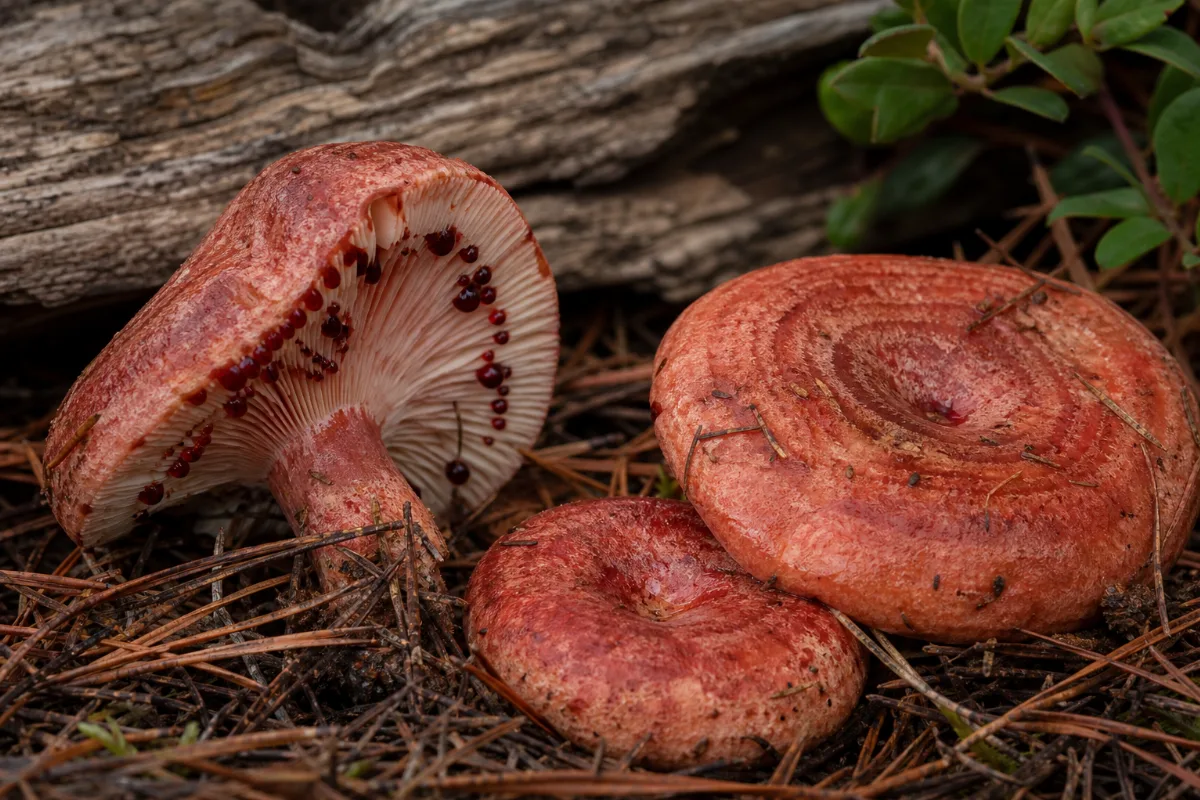
Mushrooms · Wild mushroom
Bloody milk cap
Lactarius sanguifluus · also called Bolet de sang, esclata-sang, rovello (Catalan); Blutreizker (German); lactaire sanguin (French)
The bloody milk cap is a wild pine-forest mushroom, a prized autumn food in Catalonia and sold in markets in several countries. Every source we read that rates it calls it edible, and we found no source calling it poisonous or any poisoning report. We also found no safety study and no study of a health benefit in people. Wild mushrooms can hold metals from the soil, and this page cannot help you identify one.
General information, not medical advice. Last substantive update · Not medically reviewed. A named clinician has not signed off on this page. How this page is made
About Bloody milk cap
The bloody milk cap (Lactarius sanguifluus) is a wild mushroom that grows with pine trees and is best known as a prized autumn food in Catalonia. The sources we read that rate it call it edible, and we found none calling it poisonous. The research is thin: some food chemistry and test-tube work, and no clinical study of any kind. Where it grew matters, because wild mushrooms can hold metals from the soil.
What the sources say about eating it
Edible: the English and Spanish Wikipedia articles call it edible (the English one says 'choice'), a Swedish field guide rates it edible with a top taste score, and several food-science papers call it a wild edible mushroom. A review of the Catalan-speaking area calls it one of the principal edible species. Unsafe: we looked in PubMed, GBIF, two encyclopedias, a field guide and a web search and found no source calling this species poisonous and no poisoning report.
That is not the same as proven safe. We found no safety study at all. The cautions that do appear are different ones: wild mushrooms can hold metals, and no wild mushroom should be eaten unless an expert has confirmed what it is.
A food of Catalonia and beyond
In the Catalan review it was the most cited species, with 115 reports and about 32 folk names, and its genus makes up more than half of the wild fungi sold in the Mercabarna market. It is also sold in markets in other countries, according to Wikipedia, and a Kashmir survey lists it among that region's major mushrooms.
This page gives no advice on preparation or amounts.
What two Spanish samples contained
A 2022 Spanish study measured minerals in 20 wild milk cap samples. Two were this species: one from Malaga (16 specimens) and one from Granada (21 specimens). In dry weight they held potassium of about 26,200 and 30,100 mg per kg, phosphorus of about 3,700 and 6,000 mg per kg and magnesium of about 1,040 and 1,575 mg per kg. Iron differed a lot between them (77 and 900 mg per kg).
Fresh mushrooms are mostly water, so a cooked portion holds far less per gram. These are examples from two places, not a food label. The authors say eating wild mushrooms should be moderated because of toxic metals, which that paper did not measure.
Metals and soil
Both encyclopedia articles advise against eating this mushroom from contaminated places such as busy roadsides, because fruit bodies can accumulate heavy metals. A survey of 139 wild mushrooms on the Greek island of Lesvos, including this species, found lead and cadmium within European Union limits on average, and the authors judged regular eating of those mushrooms quite safe. Levels differed with the soil type and species. We found no toxic-metal figure for this species alone and no measurement of radioactive caesium.
What research exists
There is no clinical trial, animal study or case series of this mushroom. The research is food chemistry and test-tube work. In Serbia a methanol extract had the highest phenolic content and best antibacterial results of five milk caps, and extracts lowered chromosome damage in a cell test. A 1989 German study of three compounds found in edible milk caps including this species found weak mutagenic action in a bacterial test and moderate action on tumour cells in dishes for two of them. These lab results point in different directions and none concerns eating the mushroom.
No supplement or extract product of this species was found, and none is recommended here.
Names and relatives
The accepted name is Lactarius sanguifluus (Paulet) Fr., checked in the GBIF database. A close relative, Lactarius vinosus, is listed as a separate species by GBIF and treated that way in the Spanish mineral study, while older sources treated it as a variety. The saffron milk cap (Lactarius deliciosus) is a different species with its own page, although the Catalan review says cooks often use the same names for the whole reddish-milk group.
At a glance
Traditional uses history, not proof
- A prized wild food in Catalonia and Spain; the most cited edible fungus in a review of the Catalan-speaking area (Alvarez-Puig 2025).
- Sold in rural markets in several countries, according to Wikipedia (not independently checked).
- A Kashmir survey lists it among major local mushrooms; no traditional medicinal use of this species was confirmed (Ullah 2022).
Studied for research
- Eating it as a food: described as edible, no health outcome studied
- Minerals in two Spanish samples: lab measurement, not a health effect
- Antioxidant and germ-killing tests on extracts: very low evidence, test tube only
- No clinical trial for any use
Main compounds
- Phenolic compounds (antioxidant in test tubes)
- Guaiane sesquiterpenoids such as lactaroviolin (weakly mutagenic in a 1989 bacterial test)
- Ergosterol and triterpenic acids
- Minerals, mainly potassium
Common forms
- Wild mushroom eaten as food
- No supplement or product based on this species was found
Research links: Wild Edible Fungi in the Catalan Linguistic Area (review, abstract) · Essential mineral content of five Lactarius species (abstract) · Trace metals in wild edible mushrooms, Lesvos (abstract) · Poison Control (US): get help online or call 1-800-222-1222 · NHS: what to do in poisoning · Research Library · Genes & Biomarkers Library
What it is and its history
- Accepted scientific name
- Lactarius sanguifluus
- Naming authority
- (Paulet) Fr.
- Synonyms
- Hypophyllum sanguifluum Paulet; Lactifluus sanguifluus (Paulet) Kuntze; Lactarius sanguifluus f. roseus Lalli & Pacioni; Lactarius sanguifluus f. vinosus (Quel.) Lalli & Pacioni; Lactarius sanguifluus var. vinosus Quel.
- Common names
- Bloody milk cap (English); Bolet de sang / esclata-sang / rovello (Catalan); Nicalo de sangre vinosa (Spanish); Lactaire sanguin (French); Blutreizker (German); Vinriska (Swedish)
- Family or group
- Russulaceae, a family of fungi (this is a mushroom, not a plant). Part concerned: the fruiting body, which is the mushroom.
- Classification
- Fungi > Basidiomycota > Agaricomycetes > Russulales > Russulaceae > Lactarius > Lactarius sanguifluus
- Native range
- GBIF holds about 3,244 occurrence records (25 October 2026). Wikipedia says it is found in Europe (widely in the south), Mediterranean Africa and Asia. Records are observations, not a map of native range.
- Habitat
- Wikipedia says it grows on the ground under pines and other conifers, usually on calcareous soil, fruiting from September to November in southern Europe; habitat details were not otherwise checked.
- What it looks like
- Part used: The fruiting body (the mushroom). This page does not describe how to recognise the mushroom, on purpose; a photo, a description or an app is never proof that a wild mushroom is safe.; Description note: Intentionally omitted.
- Look-alikes and adulterants
- Not described here, on purpose. The Catalan review says informants treat several reddish-milk caps (section Deliciosi) as one group with shared names. A Swedish field guide lists four similar species. Identification needs an expert holding the mushroom.
Traditional use and history history, not clinical proof
| Tradition or era | Documented use | Source |
|---|---|---|
| Taxonomy | First described by Paulet in 1811 and moved to the genus Lactarius by Fries in 1838 (Wikipedia, citing the original works; not independently checked). GBIF gives the 1838 combination. | Wikipedia; GBIF |
| Food, Catalonia and Spain | A prized autumn wild food in Catalonia, the most cited edible fungus in the Catalan review (115 reports), and part of the genus that makes up more than half of wild fungi sold at Mercabarna. | Alvarez-Puig 2025 |
| Food, elsewhere | Sold in rural markets in France, Spain, Turkey and Yunnan (China), eaten in India, and gathered in Cyprus where Wikipedia says it is held inferior to the saffron milk cap. A 2022 Kashmir survey lists it among major mushrooms of the area. Market claims other than Kashmir rest on Wikipedia and were not independently checked. | Wikipedia; Ullah 2022 |
| Traditional medicine | The Kashmir paper says wild edible mushrooms in general are used in traditional medicines; it does not name uses for this species in the abstract. No traditional medicinal use of this species was confirmed. | Ullah 2022 |
Traditional use shows how it was used. It does not show that it works or is safe today.
What is inside, and how it may work
What it contains and how those compounds act in cells and animals. Laboratory and animal mechanisms are not proven effects in people.
Main compounds
| Compound | Family | Where it is concentrated | Activity studied | Level of evidence |
|---|---|---|---|---|
| Phenolic compounds (total phenolics) | polyphenols | Fruiting body (methanol extract) 75.25 mg gallic acid equivalents per g dry extract (Serbian sample) | Free-radical scavenging in test tubes. Not shown to matter in the body. 7 4 | Laboratory research |
| Guaiane sesquiterpenoids (lactaroviolin, deterrol and a stearic acid ester) | sesquiterpenoids | Fruiting body | Weakly mutagenic in an Ames test; two moderately cytotoxic to tumour cell lines; one weakly antibacterial (1989 test-tube study). 3 | Laboratory research |
| Ergosterol and triterpenic acids (oleanolic, ursolic) | sterol and triterpenoids | Fruiting body Ergosterol 9.2 to 18.0 mg per 100 g fresh weight across five species | Composition data only. Figures for this species alone are not in the abstract. 4 | Laboratory research |
| Potassium, phosphorus, magnesium and other minerals | minerals | Fruiting body Potassium about 26,200 and 30,100 mg per kg dry weight in two samples | Nutrient content; see the Benefits tab. 6 | Product analysis |
Mechanisms, receptors and pathways
| Target or pathway | Gene or receptor | What was found | Level |
|---|---|---|---|
| Radical scavenging and chromosome-damage assay | n/a | Methanol extracts scavenged radicals in chemical tests and lowered micronuclei in a cell assay (test tube). 7 | Laboratory research |
| Bacterial mutation test | n/a | Three isolated sesquiterpenoids were weakly positive in the Ames test (1989 test-tube study). 3 | Laboratory research |
Absorption, metabolism and elimination
- Absorption
- Not established.
- Distribution
- Not established.
- Metabolism
- Not established.
- Elimination
- Not established.
- Bioavailability
- Not established.
Isolated compounds versus whole extracts
Lab findings come from solvent extracts and isolated compounds, not from the eaten mushroom. Nothing found about one can be assumed for the other.
Nutritional composition
The bloody milk cap is a food. Two Spanish samples held about 26,200 and 30,100 mg of potassium per kg dry weight. Fresh mushrooms are mostly water, so a portion holds much less per gram.
2 very low certainty2 not enough evidence
What was looked at
The 4 benefits and uses checked for Bloody milk cap, each with how strong the evidence is. Tap one to open it.
What is Bloody milk cap good for?
The uses people ask about and how strong the evidence is for each. None is shown to help health. Read every row together with the Safety tab: this is a wild mushroom.
Benefits, one by one
Each card is a research question, not a promise. Tap a goal to filter. Open a card to see the studies, doses and limits.
Eating it as a seasonal wild food
Not enough evidenceThe bloody milk cap is a long-standing wild food, best known in Catalonia and Spain, and is also sold in markets in France, Turkey and parts of Asia. The sources we read call it edible. None of them tests whether eating it does anything for health, and we found no study of harm or of benefit in people.
3 studiesNot covered. This page gives no amounts, no preparation and no ways o…
Studies, doses and limits
What the trials found
No clinical trial, cohort or case series on eating this species was found. The evidence is surveys and reviews of how it is used.
Results
Described as edible and widely eaten in the Catalan review, the Kashmir survey and the Turkish food-quality paper. No health outcome was measured.
Why this rating
Records of use show it is eaten, not that it is healthy or free of harm. No safety or benefit study was found.
Form and dose studied
Not covered. This page gives no amounts, no preparation and no ways of using the mushroom.
Who was studied
Communities that gather and sell wild mushrooms (Catalonia, Kashmir, Turkey). No clinical group has been studied.
Limits
Use surveys and citation counts do not show safety. The Catalan review text was read in part. Species names are shared among cooks: informants treat the reddish-milk caps (section Deliciosi) as one group.
Why researchers looked
Researchers who record local foods count how often it is mentioned, how many folk names it has and what it contains.
Traditional use
In a review of wild edible fungi in the Catalan-speaking area, it was the most cited species (115 reports), had about 32 folk names, and belongs to the genus that makes up more than half of the wild fungi sold in the Mercabarna market.
Proposed mechanism Traditional use
No mechanism applies. This is a food, and no study links eating it to a body effect.
A proposed mechanism does not show that the effect happens in people.
This is a wild mushroom. Do not use this page to identify or pick one. See the Safety tab, and if someone has eaten a wild mushroom and feels unwell, call a poison centre.
Minerals measured in the mushroom
Not enough evidenceTwo wild samples from Spain held a lot of potassium and some magnesium and phosphorus. These are lab measurements of dried mushrooms. They show what was in those samples, not that eating the mushroom improves anyone's health.
2 studiesNot covered.
Studies, doses and limits
Results
In two pooled wild samples (dry weight): potassium about 26,200 and 30,100 mg per kg, phosphorus about 3,700 and 6,000 mg per kg, magnesium about 1,040 and 1,575 mg per kg. Iron differed a lot between the two samples (77 and 900 mg per kg).
Why this rating
Lab measurement of two samples. Fresh mushrooms are mostly water, so a cooked portion holds far less per gram than these dry-weight figures. No health effect was tested.
Form and dose studied
Not covered.
Limits
Two pooled wild collections from two sites in 2018. Values vary between places and years. The authors say eating wild mushrooms should be moderated because of toxic metals, which that paper did not measure.
Why researchers looked
Food chemists measure minerals in wild mushrooms to see what they add to a diet.
Proposed mechanism Product analysis
Mushrooms take up minerals from the soil and from the wood or needles around their roots. Content varies with site and season.
A proposed mechanism does not show that the effect happens in people.
This is a wild mushroom. Do not use this page to identify or pick one. See the Safety tab, and if someone has eaten a wild mushroom and feels unwell, call a poison centre.
Laboratory antioxidant and germ-killing tests on extracts
Very low certaintyIn Serbia, an extract of the bloody milk cap did better than four other milk caps in antioxidant and antibacterial tests in dishes, and extracts lowered chromosome damage in a cell test. This is early test-tube work on solvent extracts. It does not show that eating the mushroom does anything.
3 studiesNot covered.
Studies, doses and limits
Results
Highest total phenolics (75.25 mg gallic acid equivalents per g dry extract) of five Lactarius species; best antibacterial results of the five; micronuclei lowered by 19 to 49 % at 3 micrograms per ml across the extracts. Greek and Turkish studies also report phenolic compounds and antioxidant activity in this and related species.
Why this rating
Test-tube and cell work on extracts, not on the eaten mushroom, with no animal or human test.
Form and dose studied
Not covered.
Limits
Abstracts only. Methanol extracts are not food. The abstract does not name the cell type or bacteria. Test-tube antioxidant tests often do not carry over to the body.
Why researchers looked
Researchers screen wild edible mushrooms for phenolic compounds that act as antioxidants in test tubes.
Proposed mechanism Laboratory research
Phenolic compounds in the extract scavenged free radicals in chemical tests, and extracts reduced micronuclei in a cell assay (laboratory). The abstract names no further mechanism.
A proposed mechanism does not show that the effect happens in people.
This is a wild mushroom. Do not use this page to identify or pick one. See the Safety tab, and if someone has eaten a wild mushroom and feels unwell, call a poison centre.
Laboratory work on compounds found in milk caps
Very low certaintyA 1989 German lab study tested three compounds found in edible milk caps, this species included. Two had moderate toxic action on tumour cells in dishes, one weakly killed bacteria, and all three were weakly mutagenic in a bacterial test. It is old, test-tube work on pure compounds, and it neither shows a benefit nor shows harm from eating the mushroom.
1 studiesNot covered.
Studies, doses and limits
Results
Weak mutagenic activity in all three compounds; moderate cytotoxicity in two; weak antibacterial activity in one; no antifungal or algicidal activity.
Effect sizes as reported
Not given in the abstract.
Why this rating
One 1989 test-tube study of isolated compounds.
Form and dose studied
Not covered.
Limits
Abstract only. The paper does not say how much of these compounds a mushroom holds, so it cannot be read as a statement about eating it.
Why researchers looked
Chemists look at coloured compounds of milk caps for biological activity.
Proposed mechanism Laboratory research
The abstract gives no mechanism. Activity was seen in bacteria (Ames test) and two tumour cell lines (laboratory).
A proposed mechanism does not show that the effect happens in people.
This is a wild mushroom. Do not use this page to identify or pick one. See the Safety tab, and if someone has eaten a wild mushroom and feels unwell, call a poison centre.
Connections to the rest of health
How Bloody milk cap connects to the rest of our health knowledge graph. Every link says what kind of connection it is. A safety link (for example to the liver) is a warning, not a benefit. A study that merely mentions a topic never creates a benefit link.
Explore every connection: goals, body systems, organs, symptoms, genes
B. Body systems
| Connected to | Kind of connection | Evidence status | Context | Studies |
|---|---|---|---|---|
| Digestive system | Not enough evidence | Eaten as a food; no study of digestive effects of this species was found. Preparation or compound: Wild mushroom as food |
2 | |
| Digestive System | Biological association | Not enough evidence | Studied for: Eating it as a seasonal wild food | 2 8 5 |
L. Active compounds
| Connected to | Kind of connection | Evidence status | Context | Studies |
|---|---|---|---|---|
| Phenolic compounds (total phenolics) | Biological association | In vitro | Free-radical scavenging in test tubes. Not shown to matter in the body. Preparation or compound: Fruiting body (methanol extract) |
7 4 |
| Guaiane sesquiterpenoids (lactaroviolin, deterrol and a stearic acid ester) | Biological association | In vitro | Weakly mutagenic in an Ames test; two moderately cytotoxic to tumour cell lines; one weakly antibacterial (1989 test-tube study). Preparation or compound: Fruiting body |
3 |
| Ergosterol and triterpenic acids (oleanolic, ursolic) | Biological association | In vitro | Composition data only. Figures for this species alone are not in the abstract. Preparation or compound: Fruiting body |
4 |
| Potassium, phosphorus, magnesium and other minerals | Biological association | Product analysis | Nutrient content; see the Benefits tab. Preparation or compound: Fruiting body |
6 |
Each connection is stored with the ingredient, the connected record, the kind of connection, the evidence status, the supporting studies, the preparation or compound involved, and a review date (last reviewed October 25, 2026).
Evidence at a glance: what the research found for 4 outcomes
Each outcome below is one thing researchers measured. Certainty is how far the evidence can be trusted, not how well it works. The full studies are on the next tab.
The evidence
The research centre for Bloody milk cap. Every record here was checked against PubMed or the publisher's page; we never list a study we have not verified.
Evidence by outcome
Bars show how many studies we found for each outcome, not how well it works. People are added up across trials only (reviews are not added, to avoid double counting).
How we rate evidence
High certainty
Several well-run trials or reviews agree; further research is unlikely to change the picture much.
Moderate certainty
Good trials point the same way, but some doubt remains.
Low certainty
Small, short or inconsistent trials. The finding could change with better research.
Very low certainty
Very little or very weak human data. Treat as a possibility only.
Mixed findings
Trials or reviews disagree with each other.
Not enough evidence
Not enough human research to say either way.
Evidence against
Good research found no benefit, or found harm.
We take the reviewers' own risk-of-bias and GRADE statements where they exist, and otherwise judge from study size, design, consistency, directness and whether a product matches what is sold. Many publications do not make evidence high. Method note: We read PubMed records and abstracts for 7 papers, read the free full text of the mineral paper and part of the Catalan review, read English and Spanish Wikipedia and a Swedish field guide, checked the poison-help pages, and checked the scientific name in GBIF. Where a statement could not be checked, it is marked as unverified in our notes.
Study library: every study we checked 15
| Study | Design | People | Product, dose, length | Result |
|---|---|---|---|---|
| Aloupi 2012 Trace metal contents in wild edible mushrooms growing on serpentine and volcanic soils on the island of Lesvos, Greece. Ecotoxicol Environ Saf · PMID 22172519 · DOI |
Laboratory lab |
139 139 wild mushroom samples (Russula delica, Lactarius sanguifluus, L. semisanguifluus, L. deliciosus, Suillus bellinii) from Lesvos, Greece |
Wild mushroom, dried fruiting body |
Median levels across all samples (mg per kg dry weight) were cadmium 0.14, lead 0.093, zinc 64.5 and nickel 0.34. Lead and cadmium did not exceed European Union limits. Mushrooms from serpentine soil held more cadmium, chromium and nickel than those from volcanic soil. None of the mushrooms was a metal 'bioaccumulator', although zinc was slightly above 1 in the three Lactarius species. The authors conclude that regular eating of wild edible mushrooms from Lesvos is quite safe, and note that one species (Russula delica) could supply 12 to 53 % of the daily tolerable cadmium intake. Methods, limits and fundingOutcomes: Cadmium, copper, chromium, iron, manganese, nickel, lead and zinc Limitations: Medians pool five species; L. sanguifluus figures alone are not in the abstract. One Greek island. An erratum was published (Ecotoxicol Environ Saf 2012;81:127) and was not opened. Other regions and soils differ. Funding and conflicts: Not stated in the abstract. Read: abstract |
| Alvarez-Puig 2025 Wild Edible Fungi in the Catalan Linguistic Area: A Scoping Review Linking Nutritional Value to Ethnomycology. Foods · PMID 40870809 · DOI |
Review |
643 Scoping review of 643 culinary fungi taxa used in the Catalan-speaking area, from books, experts and three academic databases |
Wild edible fungi (review) fruiting body |
In the full text, Lactarius sanguifluus (bolet de sang, esclata-sang) is the most cited taxon, with 115 bibliographic reports, and has about 32 Catalan folk names. The authors call it one of the principal edible species and say more than half of the wild fungi sold in the Mercabarna market (Catalonia) belong to the genus Lactarius. Nutritional data for it exist in 7 articles; the review gives no species-specific numbers in the passages we read. The review says Lactarius sect. Deliciosi is an ethnotaxon: informants do not tell its species apart and use the same names. No statement on toxicity or poisoning for this species was found in the first half of the full text. The abstract says nutritional values are still missing for most wild fungi. Methods, limits and fundingOutcomes: Which fungi are eaten, how often they are cited, and whether nutritional values exist Limitations: Part of the full text (the first 100,000 of about 209,000 characters) was read; the rest was not. It describes use and citation counts, not health effects or safety. Reports are books and papers, not a count of how many people eat it. Funding and conflicts: The authors declare no conflicts of interest. Funded by public bodies (Generalitat de Catalunya, Govern d'Andorra) and a University of Barcelona project. Read: full-text-part |
| Anke 1989 Assays of the biological activities of guaiane sesquiterpenoids isolated from the fruit bodies of edible lactarius species. Food Chem Toxicol · PMID 2792969 · DOI |
Laboratory lab |
Three sesquiterpenoids (a stearic acid ester, lactaroviolin and deterrol) found in Lactarius deliciosus, L. deterrimus and L. sanguifluus, tested in bacteria, microbes and cell lines | Isolated compounds from fruiting bodies fruiting body |
All three compounds showed weak mutagenic activity in the Ames bacterial test. Two (lactaroviolin and deterrol) had moderate cytotoxic activity against two tumour cell lines, and deterrol had weak antibacterial activity. None was phytotoxic, algicidal or antifungal. Methods, limits and fundingOutcomes: Mutagenicity (Ames test), antimicrobial activity, cytotoxicity, plant toxicity Limitations: Isolated pure compounds in test-tube systems, not the eaten mushroom. The abstract does not say how much of the compounds a mushroom holds. A weak result in a bacterial test does not show harm in people. Funding and conflicts: Not stated in the abstract. Read: abstract |
| Kalogeropoulos 2013 Bioactive microconstituents and antioxidant properties of wild edible mushrooms from the island of Lesvos, Greece. Food Chem Toxicol · PMID 23354393 · DOI |
Laboratory lab |
Five wild edible mushroom species from Lesvos, Greece, including L. sanguifluus | Wild mushroom and methanol extract fruiting body |
Ergosterol was the main sterol (9.2 to 18.0 mg per 100 g fresh weight across the five species). Total phenolics ranged from 6.0 to 20.8 mg gallic acid equivalents per 100 g fresh weight. Up to 19 simple phenolic compounds were found, and oleanolic and ursolic acids were reported in mushrooms for the first time. All species showed antioxidant activity in the lab. Figures for L. sanguifluus alone are not given in the abstract. Methods, limits and fundingOutcomes: Composition, sterols, phenolics, triterpenic acids, antioxidant tests Limitations: Five species pooled in the abstract. Antioxidant readings in test tubes do not show an effect in the body. A published comment on the paper exists (Food Chem Toxicol 2013;62:964) and was not opened. Funding and conflicts: Not stated in the abstract. Read: abstract |
| Kivrik 2022 A Research on Quality Evaluation of Eight Wild Edible Macrofungi Collected from East Mediterranean Region of Turkey. Chem Biodivers · PMID 35103384 · DOI |
Laboratory lab |
Eight wild edible macrofungi from Osmaniye, Turkey, including Lactarius sanguifluus, tested fresh and dried at 40 C | Fresh and dried wild mushroom fruiting body |
Across the eight species, protein in the dried samples ranged from 11.31 to 55.31 %, and phenolic content in fresh samples from 10,227 to 42,217 mg gallic acid equivalent per kg dry matter in methanol, falling with drying. The abstract does not give figures for L. sanguifluus alone. Methods, limits and fundingOutcomes: Colour, texture, protein, minerals, phenolic content, antioxidant tests Limitations: The abstract pools eight species. Per-species values were not read. Antioxidant test-tube readings are not health effects. Funding and conflicts: Not stated in the abstract. Read: abstract |
| Lopez 2022 Essential Mineral Content (Fe, Mg, P, Mn, K, Ca, and Na) in Five Wild Edible Species of Lactarius Mushrooms from Southern Spain and Northern Morocco: Reference to Daily Intake. J Fungi (Basel) · PMID 36547625 · DOI |
Laboratory lab |
20 Twenty pooled wild samples of five Lactarius species from southern Spain and northern Morocco; two samples were L. sanguifluus (#15, 16 specimens, Cortes de la Frontera, Malaga, 2018; #18, 21 specimens, Sierra de Huetor, Granada, 2018) |
Dried wild mushroom, acid-digested for analysis fruiting body |
For L. sanguifluus sample #15 (mg per kg dry weight): iron 77.4, magnesium 1042, manganese 38.2, phosphorus 3734, potassium 26,196, calcium 330, sodium 455. For sample #18: iron 900, magnesium 1575, manganese 23.1, phosphorus 5962, potassium 30,101, calcium 758, sodium 39.3. Potassium was the highest mineral in all mushrooms. The authors' daily-intake calculation assumed 300 g of fresh mushrooms and found it covers a high share of the reference intake of several minerals but not all (except iron). They conclude that consumption 'should be moderated due to the presence of toxic metals', although they measured only essential elements. Methods, limits and fundingOutcomes: Seven essential minerals per kg dry weight Limitations: Two pooled wild samples of this species, each measured in triplicate; values vary with site and season. A lab value is not a health effect. Toxic metals were not measured in this paper. Funding and conflicts: The authors declare no conflict of interest. Supported by a university collaboration grant. Read: full-text |
| Stankovic 2022 Selected fungi of the genus Lactarius - screening of antioxidant capacity, antimicrobial activity, and genotoxicity. J Toxicol Environ Health A · PMID 35591784 · DOI |
Laboratory lab |
Methanol extracts of five Lactarius species collected in Serbia, including L. sanguifluus, tested in dishes and cell cultures | Methanol extract of fruiting body fruiting body |
L. sanguifluus had the highest total phenol content (75.25 mg gallic acid equivalents per g dry extract) and the strongest results in three of the antioxidant tests, and its extract showed the best antibacterial results of the five. In a cell test of chromosome damage, extracts at 3 micrograms per ml lowered micronuclei by 19 to 49 %; the authors compare this with 16.3 % for amifostine. The authors say the mushrooms have 'potential' as antioxidant, antibacterial and antigenotoxic foods. Methods, limits and fundingOutcomes: Phenolic content, antioxidant tests, antibacterial tests, micronucleus test Limitations: Test-tube and cell work on solvent extracts, not on eaten mushrooms. The abstract does not name the bacteria or cell type. The abstract says 4 mushrooms in one place and lists 5 species. No animal or human test. Funding and conflicts: Not stated in the abstract. Read: abstract |
| Ullah 2022 Diversity and ethnomycological importance of mushrooms from Western Himalayas, Kashmir. J Ethnobiol Ethnomed · PMID 35418143 · DOI |
Survey |
923 923 informants and field surveys in Azad Jammu and Kashmir, 2015-2019 |
Wild mushrooms collected and sold fruiting body |
Of 131 mushroom species recorded, Lactarius sanguifluus was among the major species grouped by the statistical analysis. The paper says wild edible mushrooms are used as food and traditional medicine and are sold for income. The abstract does not describe uses of this species specifically. Methods, limits and fundingOutcomes: Mushroom diversity, uses and marketing Limitations: A survey of use. The abstract gives no health outcome for this species, and statements about 'potential' antibacterial or anticancer use are the authors' hope, not a finding. Funding and conflicts: The authors declare no competing interests. Read: abstract |
| n/a 2026 Wikipedia (English): Lactarius sanguifluus n/a · Source |
Encyclopedia n/a |
n/a | n/a |
The article calls the fruit bodies edible and 'choice', says they are sold in rural markets in France, Spain, Turkey and Yunnan (China), and that in Catalonia they are a prized ingredient. It says fruit bodies can accumulate heavy metals from polluted soil such as roadsides, and advises against eating them from possibly contaminated sites. It gives the authority (Paulet) Fr. 1838 and says L. vinosus was once treated as a variety and is now a separate species. It describes no acute toxin. Read 25 October 2026. Methods, limits and fundingOutcomes: n/a Limitations: A general encyclopedia, a secondary source. Its edibility statements rest on cited books and papers that we did not open. Read: full-text |
| n/a 2026 Wikipedia (Spanish): Lactarius sanguifluus n/a · Source |
Encyclopedia n/a |
n/a | n/a |
The article states the mushrooms are edible ('comestibles') and repeats the warning about heavy metals from contaminated soil. It says nothing about toxicity of the mushroom itself or digestive upset. Read 25 October 2026. Methods, limits and fundingOutcomes: n/a Limitations: A general encyclopedia, a secondary source. Read: full-text |
| n/a 2026 Svampguiden (Sweden): Lactarioid agarics, entry for Lactarius sanguifluus n/a · Source |
Field guide n/a |
n/a | n/a |
The page lists the species as edible with a top taste rating and says it suits soups, sauces and stews. It does not describe any toxic look-alike. Read 25 October 2026. Methods, limits and fundingOutcomes: n/a Limitations: A hobby mushroom guide, not a medical or regulatory source. It is cited only to show how field guides describe edibility; it is not a way to identify the mushroom. Read: full-text |
| n/a 2026 Poison Control (National Capital Poison Center): home page and call advice n/a · Source |
Authoritative guidance n/a |
n/a | n/a |
The home page gives the poison help number 1-800-222-1222 (free, expert and confidential) and says to call 911 if the person collapses, has a seizure, has trouble breathing or cannot be awakened. Page checked 25 October 2026 (the number was found on the page). Methods, limits and fundingOutcomes: n/a Limitations: A public help page, not a statement about this mushroom. Read: full-text |
| n/a 2026 NHS (UK): Poisoning n/a · Source |
Authoritative guidance n/a |
n/a | n/a |
The page says to call 999 or go to A&E if someone may have swallowed something harmful and has lost consciousness, stopped breathing, has severe breathing difficulty or a seizure, and to call NHS 111 if you are not sure. It advises not trying to make the person sick. Page reached with HTTP 200 on 25 October 2026; wording as read earlier the same day in this project. Methods, limits and fundingOutcomes: n/a Limitations: A public help page, not a statement about this mushroom. Read: full-text |
| n/a 2026 NSW Poisons Information Centre (Australia): home page n/a · Source |
Authoritative guidance n/a |
n/a | n/a |
The home page gives the 24/7 poisons line 13 11 26 (found on the page, 25 October 2026) and says to call Triple Zero (000) for an ambulance if someone is unconscious. Methods, limits and fundingOutcomes: n/a Limitations: A public help page for one Australian state service. Read: full-text |
| n/a 2026 GBIF Backbone Taxonomy: Lactarius sanguifluus (Paulet) Fr. n/a · Source |
Registry or database n/a |
n/a | n/a |
Accepted species, key 5248648, family Russulaceae, order Russulales, published in Epicrisis Systematis Mycologici 1838. GBIF lists synonyms including Hypophyllum sanguifluum Paulet and Lactifluus sanguifluus (Paulet) Kuntze, and holds about 3,244 occurrence records (25 October 2026). It lists L. vinosus Quel. as a separate accepted species while also listing a Lactarius vinosus name as a synonym of L. sanguifluus. Read through the GBIF API on 25 October 2026. Methods, limits and fundingOutcomes: n/a Limitations: Occurrence records are observations, not a map of native range. Index Fungorum was not checked. Read: full-text |
What we do not know yet
- No clinical trial, animal study or case series of this mushroom for any use.
- No safety, toxicity, allergy, pregnancy, children or interaction data for this species.
- No toxic-metal or radiocaesium figure for this species alone.
- Only two mineral samples were found; they differ a lot (for example in iron).
- No study of what cooking, drying or freezing does to its content.
How new research is added
New studies are found by a saved PubMed search and are placed in a review queue. A person reads each one before it changes this page.
Lab markers
What changed in blood or saliva tests during trials. A changed number is not the same as feeling or being healthier, and we give no "normal ranges".
Safety
What studies and official sources say about side effects, medicines and who should check first. Each point shows what kind of evidence it comes from.
Main points to know 4
- Sources disagree on nothing we could find, but this is not a green light. Every source we read that rates it calls it edible: two encyclopedia articles, a Swedish field guide and several food-science papers. We found no source calling it poisonous, and no poisoning report for this species. We also found no safety study of any kind. The sources' own cautions are about where a wild mushroom grew (metals) and about picking wild mushrooms without an expert. Traditional use 9 10 11 2
- This page cannot help you identify it. Cooks in Catalonia use the same names for several reddish-milk caps, and field guides describe look-alikes. Do not decide that a wild mushroom is safe from a photo, an app, a book or this page. Only a trained local expert holding the mushroom can do that; many countries have a mycological society or a poison centre that can advise. Authoritative guidance 2 11
- If someone has eaten a wild mushroom and feels unwell, call a poison centre. Do not wait. In the US call Poison Help at 1-800-222-1222 (free and confidential), or 911 if the person collapses, has a seizure, has trouble breathing or cannot be awakened. In the UK call NHS 111 if you are unsure and 999 in an emergency. In Australia the Poisons Information Centre line is 13 11 26, and Triple Zero (000) if someone is unconscious. Do not try to make the person sick. Keep the mushroom or a photo to show staff. Authoritative guidance 12 13 14
- Metals can build up in wild mushrooms. Both encyclopedia articles advise against eating them from contaminated sites such as busy roadsides, and the authors of a Spanish mineral paper say eating wild mushrooms should be moderated because of toxic metals. A Greek survey of 139 samples that included this species found lead and cadmium within European Union limits on average. We found no toxic-metal figure for this species alone. Product analysis 1 6 9
Side effects 3
| Effect | How often | Severity and recovery | Evidence |
|---|---|---|---|
| Poisoning or illness after eating this species No poisoning report for this species was found in the sources we read. That is not proof of safety, and it does not cover look-alikes, spoiled mushrooms or personal reactions. | No report found | unknown Not applicable | None 9 10 2 |
| Stomach upset after any wild mushroom A general risk with wild mushrooms. We found no data on rates for this species. | Not studied for this species | unknown Unknown | None |
| Weak mutagenic action of compounds from edible milk caps in a bacterial test 1989 test-tube study of isolated compounds. It does not show that eating the mushroom harms people, and a cell test in 2022 found extracts lowered chromosome damage (see the Benefits tab). Results conflict and neither covers eating it. | Three compounds tested; all weakly positive | unknown Not applicable | Laboratory research 3 |
Liver
No liver injury linked to this species was found in the sources we read. This is not an all-clear: LiverTox was not searched for it.
How often. Not studied.
This is a safety connection. It is not evidence that Bloody milk cap supports liver health.
Medicines and supplements 2
| With | Why it matters | Importance | Evidence | What to do |
|---|---|---|---|---|
| Medicines prescription and non-prescription | No interaction study was found. | Unknown. | None Not enough evidence | Ask a doctor or pharmacist if you take medicines and plan to eat wild mushrooms. |
| Alcohol substance | No interaction was described in the sources we read. | Unknown. | None Not enough evidence | No advice can be drawn from the sources we read. |
Who should check first 5
| Situation | Advice | Evidence |
|---|---|---|
| Anyone who cannot be sure what the mushroom is | Do not eat a wild mushroom you cannot confirm with an expert in person. This page does not teach identification. | Authoritative guidance 2 |
| Pregnancy and breastfeeding | No data were found for this species. Ask a doctor or midwife before eating wild mushrooms. | None |
| Children | No data were found for this species in children. Keep children away from wild mushrooms picked outdoors, and call a poison centre if one has put a wild mushroom in the mouth. | None |
| Allergy | No allergy report for this species was found. Mushroom allergy exists in general; stop and seek care if a reaction occurs. | None |
| Older adults and people with long-term illness | No data were found for these groups. Ask a doctor before eating wild mushrooms. | None |
Overdose, product quality and regulators
Summary. No toxin has been described for this species in the sources we read, and no poisoning case was found. The wider evidence is thin: one 1989 test-tube study found weak mutagenic activity from three sesquiterpenoid compounds found in edible milk caps including this species.
Amounts. No safe or unsafe amount has been established, because no toxicity study of this species was found.
Onset and course. Not described.
Repeated use. No data on repeated or long-term eating were found, although it has been eaten and sold for a long time in Catalonia and elsewhere.
Animal data. No animal study of this species was found.
Toxic parts. Not described.
Not read. Poison-centre statistics, any toxicology of the whole mushroom, genotoxicity of the eaten mushroom, reproductive toxicity, and the effect of cooking or drying were not found.
No supplement or processed product was looked for or recommended. The contamination findings are about wild-picked mushrooms.
Metals from soil. A Greek survey of 139 wild mushrooms (five species including this one) found median cadmium 0.14 and lead 0.093 mg per kg dry weight, within EU limits, with more cadmium, chromium and nickel in mushrooms from serpentine soil. The Spanish mineral paper's authors advise moderation because of toxic metals. Encyclopedia articles cite a Turkish study that found high zinc, manganese, nickel, cobalt, cadmium and lead in this species from lawns, roadsides and forests; we did not open that study. 1 6 9
Radioactive caesium. No measurement for this species was found.
Mix-ups between milk caps. The Catalan review says cooks and informants use the same names for several reddish-milk caps. This page does not help with telling them apart. 2
| Body | Action | Date |
|---|---|---|
| Poison Control, National Capital Poison Center (United States) | Public poison guidance, not a rule about this mushroom: call 1-800-222-1222 (free, expert, confidential), and 911 if the person collapses, has a seizure, has trouble breathing or cannot be awakened. source | 2026-10-25 |
| NHS (United Kingdom) | Public guidance, not a rule about this mushroom: call 999 or go to A&E if someone may have swallowed something harmful and is unconscious, not breathing, has severe breathing difficulty or a seizure; call NHS 111 if not sure. Do not try to make the person sick. source | 2026-10-25 |
| NSW Poisons Information Centre (Australia) | Public guidance, not a rule about this mushroom: call 13 11 26, and Triple Zero (000) if someone is unconscious or not breathing. source | 2026-10-25 |
When to get medical help
- If someone may have eaten a wild mushroom and is unwell, call a poison centre right away. In the US call Poison Help at 1-800-222-1222, or 911 if the person collapses, has a seizure, has trouble breathing or cannot be awakened. In the UK call NHS 111 if you are unsure and 999 in an emergency. In Australia call 13 11 26, and 000 if someone is unconscious or not breathing.
- Go to hospital or call emergency services for vomiting that will not stop, signs of dehydration (very dry mouth, no urine, dizziness when standing), confusion, fainting, a seizure, trouble breathing or severe belly pain.
- Also seek care if stomach symptoms start 6 or more hours after a wild-mushroom meal, if they improve and then return, or if several people ate the same meal. Some wild mushrooms cause late and life-threatening illness.
- Take the mushroom, a photo or any leftovers to the hospital. Do not try to make the person sick.
- Seek urgent care for swelling of the lips or throat, wheeze or hives after eating any mushroom.
If someone may be poisoned or in a crisis, contact a clinician or emergency service straight away. In the US, Poison Control is 1-800-222-1222.
General information only, not medical advice. Ask a clinician or pharmacist before use, especially with medicines, in pregnancy or with a health condition. See the Natural Remedy Safety guide.
Frequently asked questions
Is the bloody milk cap edible?
Every source we read that rates it calls it edible: English and Spanish Wikipedia, a Swedish field guide, a Catalan review and food-science papers. It is a prized food in Catalonia. That is a statement about the species. It is not a way to tell whether the mushroom in your hand is this species.
Do any sources say it is unsafe?
We found none. We searched PubMed, GBIF, two encyclopedias, a field guide and the web, and found no source calling it poisonous and no poisoning report for this species. We also found no safety study, so absence of reports is not proof of safety. The cautions that exist are about metals and about wild mushrooms in general.
Can this page help me identify it?
Is it the same as the saffron milk cap?
Does it have health benefits?
Can wild mushrooms contain metals?
Yes. Both encyclopedia articles warn about heavy metals from contaminated soil, and the authors of a Spanish mineral study advise moderation for this reason. A Greek survey of 139 wild mushrooms including this species found lead and cadmium within EU limits on average. No figure for this species alone was found.
Is there a supplement?
We found none and recommend none.
What if someone has eaten a wild mushroom and feels unwell?
Call a poison centre right away. In the US call Poison Help at 1-800-222-1222, or 911 if the person collapses, has a seizure, has trouble breathing or cannot be awakened. In the UK call NHS 111 if you are unsure, or 999 in an emergency. In Australia call 13 11 26. Do not try to make the person sick. Keep the mushroom or a photo to show staff.
Is it safe in pregnancy, breastfeeding or for children?
No data were found for this species in these groups. Ask a doctor or midwife before eating wild mushrooms, and keep children away from wild mushrooms picked outdoors.
Can it interact with medicines?
No interaction study was found. Ask a doctor or pharmacist if you take medicines and plan to eat wild mushrooms.
Can it cause allergy?
We found no allergy report for this species. Mushroom allergy exists in general. Seek urgent care for swelling of the lips or throat, wheeze or hives after eating any mushroom.
Why is it so popular in Catalonia?
A Catalan review calls it the most cited species of the region, with 115 reports and about 32 folk names, and says its genus makes up more than half of the wild fungi sold at Mercabarna, the big Barcelona market.
Explore by health goal
Editorial transparency
- Written by
- AlternativeMed editorial team. Research compiled with AI assistance, then checked against PubMed records.
- Medical review
- None. This page has not been reviewed by a physician or pharmacist.
- First published
- 2026-10-25
- Last substantive update
- 2026-10-25
- How we research
- We read PubMed records and abstracts for 7 papers, read the free full text of the mineral paper and part of the Catalan review, read English and Spanish Wikipedia and a Swedish field guide, checked the poison-help pages, and checked the scientific name in GBIF. Where a statement could not be checked, it is marked as unverified in our notes.
- How we rate evidence
- See "How we rate evidence" in the Evidence tab.
- Independence
- No product is promoted on this page. No affiliate links are shown. This page gives no dose, preparation, identification, picking, growing or sourcing advice.
Sources 15
Each source was opened and checked. Where we read only the abstract, it says so. The small numbers in the text point here.
- Aloupi M, Koutrotsios G, Koulousaris M, Kalogeropoulos N. Trace metal contents in wild edible mushrooms growing on serpentine and volcanic soils on the island of Lesvos, Greece.. Ecotoxicol Environ Saf. 2012. PMID 22172519. DOI 10.1016/j.ecoenv.2011.11.018. (abstract)
- Alvarez-Puig C, Casamartina J, Garnatje T, Niell M, Gras A, Valles J. Wild Edible Fungi in the Catalan Linguistic Area: A Scoping Review Linking Nutritional Value to Ethnomycology.. Foods. 2025. PMID 40870809. DOI 10.3390/foods14162897. (full-text-part)
- Anke H, Bergendorff O, Sterner O. Assays of the biological activities of guaiane sesquiterpenoids isolated from the fruit bodies of edible lactarius species.. Food Chem Toxicol. 1989. PMID 2792969. DOI 10.1016/0278-6915(89)90145-2. (abstract)
- Kalogeropoulos N, Yanni AE, Koutrotsios G, Aloupi M. Bioactive microconstituents and antioxidant properties of wild edible mushrooms from the island of Lesvos, Greece.. Food Chem Toxicol. 2013. PMID 23354393. DOI 10.1016/j.fct.2013.01.010. (abstract)
- Kivrik M, Sufer O, Bozok F. A Research on Quality Evaluation of Eight Wild Edible Macrofungi Collected from East Mediterranean Region of Turkey.. Chem Biodivers. 2022. PMID 35103384. DOI 10.1002/cbdv.202100967. (abstract)
- Lopez AR, Barea-Sepulveda M, Barbero GF, Ferreiro-Gonzalez M, Lopez-Castillo JG, Palma M, Espada-Bellido E. Essential Mineral Content (Fe, Mg, P, Mn, K, Ca, and Na) in Five Wild Edible Species of Lactarius Mushrooms from Southern Spain and Northern Morocco: Reference to Daily Intake.. J Fungi (Basel). 2022. PMID 36547625. DOI 10.3390/jof8121292. (full-text)
- Stankovic M, Mitic V, Stankov Jovanovic V, Dimitrijevic M, Nikolic J, Stojanovic G. Selected fungi of the genus Lactarius - screening of antioxidant capacity, antimicrobial activity, and genotoxicity.. J Toxicol Environ Health A. 2022. PMID 35591784. DOI 10.1080/15287394.2022.2075502. (abstract)
- Ullah TS, Firdous SS, Shier WT, Hussain J, Shaheen H, Usman M, Akram M, Khalid AN. Diversity and ethnomycological importance of mushrooms from Western Himalayas, Kashmir.. J Ethnobiol Ethnomed. 2022. PMID 35418143. DOI 10.1186/s13002-022-00527-7. (abstract)
- n/a. Wikipedia (English): Lactarius sanguifluus. n/a. 2026. (full-text)
- n/a. Wikipedia (Spanish): Lactarius sanguifluus. n/a. 2026. (full-text)
- n/a. Svampguiden (Sweden): Lactarioid agarics, entry for Lactarius sanguifluus. n/a. 2026. (full-text)
- n/a. Poison Control (National Capital Poison Center): home page and call advice. n/a. 2026. (full-text)
- n/a. NHS (UK): Poisoning. n/a. 2026. (full-text)
- n/a. NSW Poisons Information Centre (Australia): home page. n/a. 2026. (full-text)
- n/a. GBIF Backbone Taxonomy: Lactarius sanguifluus (Paulet) Fr.. n/a. 2026. (full-text)


