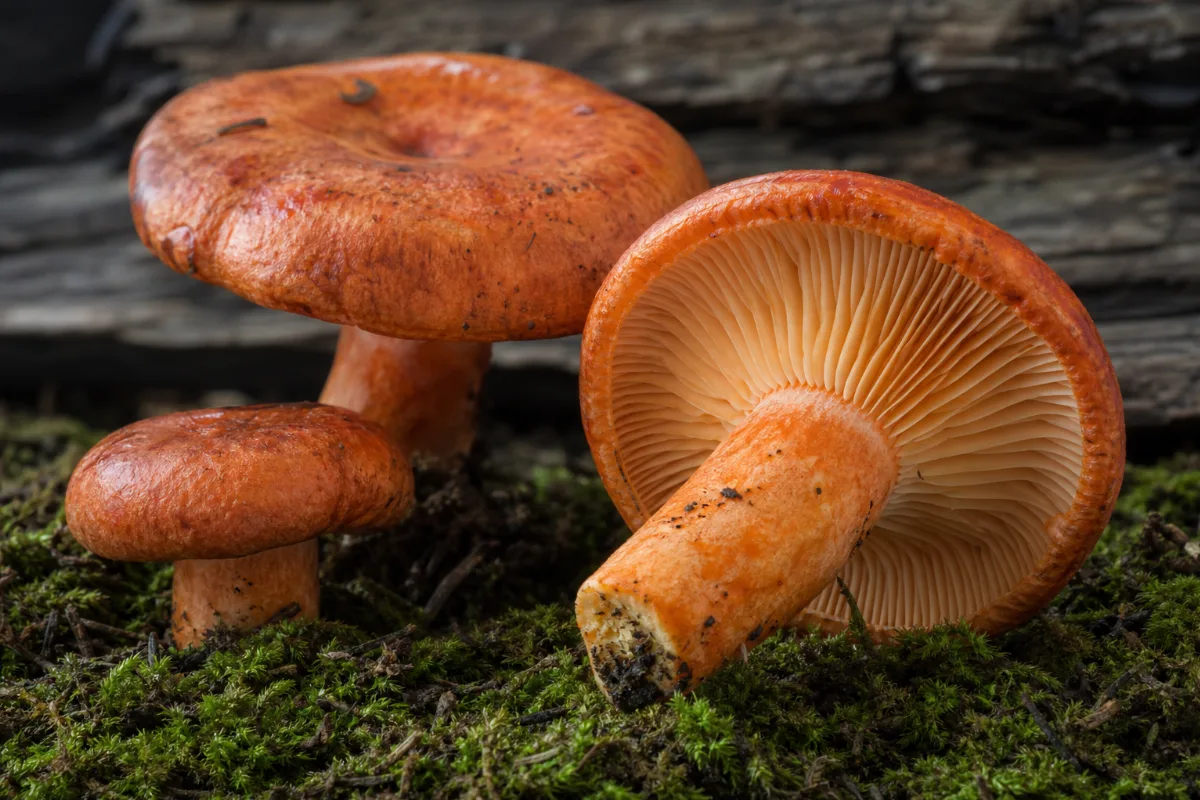
Mushrooms · Wild culinary mushroom
Candy Cap
Lactarius rubidus (older name Lactarius fragilis var. rubidus); Lactarius camphoratus is a related species also called candy cap · also called Curry milkcap (a name used for the related Lactarius camphoratus)
Candy cap is a small wild mushroom that smells strongly of maple syrup when dried. Cooks powder it or steep it in milk to flavour cookies and ice cream. It is a flavouring, not a remedy: we found no human study of any health effect and no nutrition table. The most important caution is mistaken identity, because poisonous look-alikes, including a deadly one that can grow in the same woods, are real.
General information, not medical advice. Last substantive update · Not medically reviewed. A named clinician has not signed off on this page. How this page is made
About Candy Cap
Candy cap is a small wild mushroom dried and used as a maple-syrup-scented flavouring. The name covers more than one species. We found no human or animal study of a health effect, only aroma and taste chemistry and one test-tube screen of a related European species. The main risk is mistaken identity: look-alikes can be acrid or toxic, and a deadly one, Galerina, can grow in the same woods.
What it is, and the name mix-up
Candy cap is a common name used for more than one milk-cap (Lactarius) species. Wikipedia names Lactarius camphoratus and Lactarius rubidus as the two closely related species and calls Lactarius rufulus the southern candy cap. GBIF accepts Lactarius rubidus as a species and lists the older name Lactarius fragilis var. rubidus as its synonym.
MushroomExpert says that for years the West Coast mushroom passed as Lactarius camphoratus, and calls the name rubidus provisional. MykoWeb and GBIF show it was published properly in 2013. A recipe, a paper or a label that says candy cap may therefore mean different species, so check the Latin name.
How it is used
Candy cap is not eaten like other mushrooms. It is used like vanilla or saffron: dried, then powdered or steeped in hot milk, mostly for sweets such as cookies and ice cream. Wikipedia adds that it is sometimes used in savoury dishes, and MykoWeb says one author thinks it suits savoury dishes better. We found no traditional medicinal use.
Fresh mushrooms smell only faintly sweet, while dried ones smell strongly of maple syrup and fenugreek (MykoWeb).
Why it smells like maple syrup
Wikipedia says a 2012 paper found the odour chemical quabalactone III in fresh tissue and latex, and that it turns into sotolon, a known maple-syrup and curry smell, as the mushroom dries. We could confirm the paper exists (Crossref) but could not open its abstract, so the findings are second-hand.
A web summary we saw earlier reported that sotolon itself was not detected in the dried mushroom, so treat the exact chemistry as unsettled. A separate Finnish study of cooked Lactarius camphoratus listed aldehydes and ketones among its odour compounds and did not name sotolon in its abstract.
What the research shows
No human trial, case series or review of a health effect was found, and searches of PubMed for Lactarius rubidus and for candy cap returned nothing. The research on the European relative, Lactarius camphoratus, is food science: taste amino acids, sensory descriptions and odour chemicals.
One Turkish screen of methanol extracts from 12 wild mushrooms found test-tube antioxidant and germ-killing activity in Lactarius camphoratus. Test-tube activity does not show that eating the mushroom helps anyone, and the extract is not the way it is eaten.
Forms and quality
The usual form is the dried whole mushroom. We found no capsule, extract or mycelium-on-grain candy cap evidence. Wild mushrooms in general can be high in heavy metals, as a review of nearly 400 species found, and we found no candy cap test. Check the Latin name and the supplier on any dried product.
Regulatory status
USDA FoodData Central has no reference entry for candy cap. We did not read statements from the FDA, EFSA or EMA on it, so none is stated here. Rules differ by country and change.
At a glance
Traditional uses history, not proof
- No traditional medicinal use was found in the sources we read.
- Used in cooking like vanilla or saffron: dried, then powdered or steeped in milk or cream for sweets and some savoury dishes (Wikipedia).
- Wikipedia says it is gathered and sold commercially in California (L. rubidus) and in the UK and Yunnan, China (L. camphoratus).
Studied for research
- Dessert flavouring (food use, not a health benefit), insufficient
- Maple-syrup aroma chemistry (food chemistry, second-hand), very low
- Taste: umami amino acids in the European relative (lab), low
- Nutrition: no table found, USDA has no entry, insufficient
- Antioxidant and germ-killing activity of a lab extract of the European relative (test tube only), insufficient
- Any health effect in people: none found, insufficient
Main compounds
- Quabalactone III, reported as the main odour chemical of the fresh mushroom (second-hand)
- Sotolon, a maple and curry smelling chemical reported to form on drying (second-hand, disputed)
- Free amino acids that give a savoury (umami) taste, measured in the European relative
Common forms
- Dried pieces or powder (the usual cooking form)
- Steeped in milk, cream or syrup for desserts
- Fresh mushroom (rarely sold; the smell is faint until dried)
Research links: Wikipedia: Candy cap · MykoWeb: Lactarius rubidus · The maple syrup odour of the candy cap (Wood 2012, record only) · Amatoxin-containing mushroom poisonings: review (abstract) · Accuracy of mushroom identification apps (abstract) · Poison Control (US) · Research Library · Genes & Biomarkers Library
What it is and its history
- Accepted scientific name
- Lactarius rubidus
- Naming authority
- (Hesler & A.H.Sm.) Methven (GBIF)
- Synonyms
- Lactarius fragilis var. rubidus Hesler & A.H.Sm. (GBIF synonym; the older name used in the 2012 odour paper); Lactarius camphoratus (Bull.) Fr. is a separate accepted species, also called candy cap or curry milkcap, long confused with L. rubidus (MykoWeb, MushroomExpert)
- Common names
- Candy cap (English); Curry milkcap (English)
- Family or group
- Russulaceae (milk-caps and brittlegills), a fungus family, not a plant
- Classification
- Fungi > Basidiomycota > Agaricomycetes > Russulales > Russulaceae > Lactarius > Lactarius rubidus
- Native range
- West Coast of North America for L. rubidus (MushroomExpert, MykoWeb); L. camphoratus is the species studied in Finland and sold in the UK (Wikipedia, Finnish papers).
- Habitat
- MykoWeb: mixed hardwood and conifer woods, fruiting mid to late winter. MushroomExpert: mycorrhizal with oaks and Douglas-fir. Details are given only to describe the fungus, not to help anyone find it.
- What it looks like
- Fruiting body: Small reddish-brown mushroom that bleeds a watery milk when cut (MykoWeb, Wikipedia). Not described further on purpose.
- Cultivation
- We found no source on cultivation; the mushroom is described as wild-gathered.
- Harvest and processing
- Dried; the scent grows much stronger on drying (MykoWeb, Wikipedia).
- Look-alikes and adulterants
- Name: Deadly Galerina (Galerina marginata and relatives); Note: Wikipedia says it can occur in the same habitat. It contains amatoxins that damage the liver. No identification tips are given here.; Name: Other small reddish Lactarius species; Note: MykoWeb names L. rufulus, L. rufus, L. xanthogalactus, L. luculentus and L. subviscidus as look-alikes that vary in how acrid they are. Wikipedia says some are distasteful to toxic.; Name: Fenugreek-scented milk-cap (Lactarius helvus); Note: Wikipedia says it is known to be mildly toxic.
- Sustainability and conservation
- Not checked.
Traditional use and history history, not clinical proof
| Tradition or era | Documented use | Source |
|---|---|---|
| Cooking, California, UK and Yunnan (China) | Dried and used like vanilla or saffron to flavour sweet and some savoury dishes. Wikipedia says L. rubidus is gathered and sold commercially in California and L. camphoratus in the UK and Yunnan. We found no traditional medicinal use. | s-wiki-candy-cap |
| Naming history | Once treated as a variety of L. fragilis; raised to species rank in 1997 but called provisional by MushroomExpert because no type collection was designated; validated as Lactarius rubidus in Mycotaxon in 2013 (MykoWeb, GBIF). | s-mykoweb-rubidus |
| Aroma chemistry, 2012 | Wikipedia says a chemist at Humboldt State University isolated the odour compound in 2012 after about 27 years of on-and-off investigation. The paper's abstract could not be read, so this is second-hand. | s-wiki-candy-cap |
Traditional use shows how it was used. It does not show that it works or is safe today.
What is inside, and how it may work
What it contains and how those compounds act in cells and animals. Laboratory and animal mechanisms are not proven effects in people.
Main compounds
| Compound | Family | Where it is concentrated | Activity studied | Level of evidence |
|---|---|---|---|---|
| Quabalactone III | aromatic lactone | Fruiting body and latex (fresh) | Reported (second-hand) as the main odour compound of fresh L. rubidus. No PubChem record was found under this name. 18 17 | Secondary source |
| Sotolon (sotolone) PubChem 62835 | furanone | Dried fruiting body (reported as forming on drying) | A known maple-syrup, curry and fenugreek aroma chemical. Wikipedia says it forms from quabalactone III on drying; another summary reported it was not detected in dried headspace. Unsettled. 18 13 | Secondary source |
| 12-hydroxycaryophyllene-4,5-oxide | sesquiterpenoid | L. camphoratus | Wikipedia says it was found in L. camphoratus but was not identified as an aroma component. 18 | Secondary source |
| Free amino acids (umami amino acids) | amino acids | Fruiting body of L. camphoratus | Highest umami amino acid concentration of four Nordic mushrooms tested; taste chemistry. 12 | Lab analysis |
| Aldehydes and ketones (volatile) | volatile compounds | Cooked fruiting body of L. camphoratus | Contribute to the odour of the wild mushrooms studied, including L. camphoratus. 2 | Lab analysis |
Mechanisms, receptors and pathways
| Target or pathway | Gene or receptor | What was found | Level |
|---|---|---|---|
| Aroma formation on drying | Not applicable | Proposed conversion of quabalactone III to sotolon as the mushroom dries (second-hand). 18 17 | Secondary source |
| Taste | Not applicable | Umami amino acids are highest in L. camphoratus among four mushrooms tested. 12 | Lab analysis |
| Antioxidant / antimicrobial screens | Not applicable | Test-tube activity of a methanol extract of L. camphoratus; no body mechanism shown. 14 | Laboratory research |
Absorption, metabolism and elimination
- Absorption
- Not found in the sources read.
- Distribution
- Not found.
- Metabolism
- Not found.
- Elimination
- Not found.
- Bioavailability
- Not established.
Isolated compounds versus whole extracts
Candy cap is eaten as the dried whole fruiting body (powder or infusion). The lab screens used methanol extracts. No supplement, capsule or mycelium-on-grain product evidence was found, so results from one form cannot be applied to another.
Nutritional composition
It is a flavouring used in tiny amounts, so it is not a meaningful source of any nutrient, and USDA has no entry for it.
1 low certainty1 very low certainty5 not enough evidence
What was looked at
The 7 benefits and uses checked for Candy Cap, each with how strong the evidence is. Tap one to open it.
- As a dessert flavouring (food use)Not enough evidence
- Maple-syrup aroma chemistryVery low certainty
- Taste: savoury (umami) amino acidsLow certainty
- Any health effect in peopleNot enough evidence
- NutritionNot enough evidence
- Antioxidant activity (test tube only)Not enough evidence
- Germ-killing activity (test dish only)Not enough evidence
What is Candy Cap good for?
The uses people ask about and how strong the evidence is for each. Candy cap is a flavouring: none of these is a proven health benefit. Read this together with the Safety tab.
Benefits, one by one
Each card is a research question, not a promise. Tap a goal to filter. Open a card to see the studies, doses and limits.
As a dessert flavouring (food use)
Not enough evidenceCandy cap is a small wild mushroom that is dried, then powdered or steeped in milk or cream to give desserts a maple-syrup scent. That is a cooking use. It is not a health benefit, and no study shows that eating it changes anyone's health.
2 studiesDried pieces or powder are the usual cooking form; infusions in milk,…
Studies, doses and limits
Results
Wikipedia and MykoWeb describe use in cookies, ice cream and breads, with the dried mushroom powdered or steeped in hot milk. MykoWeb calls it edible and good; one of its authors thinks it suits savoury dishes better. These are cooking descriptions, not study results.
Why this rating
There is no health claim to rate. The cooking description comes from a mushroom guide and an encyclopedia, not from a study.
Form and dose studied
Dried pieces or powder are the usual cooking form; infusions in milk, cream or syrup are described. Fresh mushrooms smell only faintly. We found no capsule, extract or mycelium product evidence. This page gives no amounts.
Limits
Edibility remarks come from guides written by mushroom enthusiasts. Two or more species are called candy cap, so a recipe may refer to a different one.
Why researchers looked
Chefs and mushroom guides write about it because the dried mushroom smells strongly of maple syrup, unusual for a mushroom.
Traditional use
We found no source describing a traditional medicinal use. Wikipedia says it is sold as a flavouring in California, in the UK and in Yunnan, China.
Proposed mechanism Food chemistry
Not a health mechanism. The scent comes from aroma chemicals that grow stronger when the mushroom is dried (see the aroma entry).
A proposed mechanism does not show that the effect happens in people.
The documented danger is picking the wrong mushroom. See the Safety tab first. The deadly Galerina can grow in the same habitat.
Maple-syrup aroma chemistry
Very low certaintyThe maple smell is real chemistry. Wikipedia reports that a 2012 paper found an aroma chemical, quabalactone III, in the fresh mushroom, and that it turns into sotolon, a maple-and-curry smelling chemical, when the mushroom dries. We could not read that paper's abstract, so this is second-hand.
5 studiesNot applicable. No amounts are given.
Studies, doses and limits
Results
Second-hand only: quabalactone III in fresh tissue; sotolon after drying (Wikipedia citing Wood 2012). MykoWeb independently says fresh specimens smell faintly sweet while dried ones smell strongly of fenugreek and maple syrup. A separate Finnish study of cooked Lactarius camphoratus (a related, European candy cap) found aldehydes and ketones among its odour compounds and did not name sotolon in its abstract.
Effect sizes as reported
No amounts were read
Why this rating
The primary paper's abstract could not be opened. Two different species and two cooking states are involved, and sources describe the exact compounds differently.
Limits
Primary paper not read. L. rubidus (California) and L. camphoratus (Europe) are different species. The scent changes with drying.
Why researchers looked
People wanted to know why a mushroom smells like maple syrup. The chemist who led the work spent years on the question, according to Wikipedia.
Proposed mechanism Food chemistry
Wikipedia (citing Wood 2012) says quabalactone III, an aromatic lactone in the fresh tissue and latex, is hydrolysed to sotolon on drying. Sotolon is a known maple-syrup and fenugreek aroma chemical (PubChem lists it as sotolone). The same Wikipedia article says sotolon was also reported in a different mushroom, Lactarius helvus, in 2000. An earlier note on our own pages said a web summary reported sotolon was not detected in the dried mushroom's headspace; we could not confirm that either way.
A proposed mechanism does not show that the effect happens in people.
A pleasant smell says nothing about safety or about whether a wild mushroom is the right one.
Taste: savoury (umami) amino acids
Low certaintyA Finnish lab study measured taste chemicals in cooked-down samples of Lactarius camphoratus, a European candy cap. It found the highest level of umami amino acids among the four mushrooms tested. This is about taste, not health.
2 studiesSamples were cooked wild mushrooms. Dried candy cap used as a flavour…
Studies, doses and limits
Results
Manninen and colleagues: the highest concentration of umami amino acids was in L. camphoratus; umami-enhancing nucleotides were low in all four species. Aisala and colleagues: the five mushrooms differed on all 18 sensory descriptors. The abstracts give no figures.
Effect sizes as reported
No figures in the abstracts
Why this rating
Measured in a lab with standard methods, but one study per question, one species (the European one), and the abstracts give no numbers. It is a taste finding, not a health finding.
Form and dose studied
Samples were cooked wild mushrooms. Dried candy cap used as a flavouring was not tested.
Limits
European L. camphoratus only; abstracts only; sample sizes not stated in the abstracts.
Why researchers looked
Researchers were describing what Nordic wild mushrooms taste like.
Proposed mechanism Food chemistry
Free amino acids such as glutamate give a savoury taste. This is taste chemistry only.
A proposed mechanism does not show that the effect happens in people.
None specific.
Any health effect in people
Not enough evidenceWe found no human study of candy cap for any health outcome. It is a flavouring, not a studied remedy.
2 studiesNot applicable
Studies, doses and limits
Results
No trial, cohort, case series or review of a health effect of candy cap was found.
Why this rating
Nothing to rate: no human research was found.
Limits
Absence of studies is not proof of safety or of no effect.
Why researchers looked
Not studied for health.
Traditional use
No traditional medicinal use found in the sources read.
Proposed mechanism None
None proposed in the sources read.
A proposed mechanism does not show that the effect happens in people.
See the Safety tab: the main risk is mistaken identity and no data exist on medicines, pregnancy or allergy.
Nutrition
Not enough evidenceNo measured table of protein, fibre, vitamins or minerals for candy cap was found, and USDA has no entry. It is used in tiny amounts for taste, so it would add little to the diet in any case.
2 studiesDried pieces or powder used as a flavouring. This page gives no amoun…
Studies, doses and limits
Results
USDA FoodData Central: no reference record for candy cap. The only nutrient-type measurement found was the free amino acids and nucleotides of European L. camphoratus (Manninen 2018), which the abstract describes without figures.
Effect sizes as reported
No numbers are given here rather than guess
Why this rating
No usable composition table; one taste-chemistry study of the European species.
Form and dose studied
Dried pieces or powder used as a flavouring. This page gives no amounts.
Limits
Composition depends on species, place and drying; no table found.
Why researchers looked
Nutrition tables exist for common mushrooms, so people ask.
Proposed mechanism Composition
Not a mechanism claim.
A proposed mechanism does not show that the effect happens in people.
Wild mushrooms can take up metals from soil (see the Safety tab).
Antioxidant activity (test tube only)
Not enough evidenceIn a Turkish lab study, a methanol extract of Lactarius camphoratus scored well in some antioxidant tests, including one where it beat two reference antioxidants. These were test-tube tests of a solvent extract, not studies in animals or people.
1 studiesMethanol extract of the fruiting body. Not how the mushroom is eaten.
Studies, doses and limits
Results
Ozen 2011 (12 wild mushrooms; L. camphoratus is the candy cap relative): L. camphoratus was among species that beat alpha-tocopherol and BHT on antioxidant activity. Lipid peroxidation result 58.05% (the abstract does not spell out the unit). DPPH scavenging at 500 micrograms/ml 61.55%.
Effect sizes as reported
DPPH 61.55% at 500 micrograms/ml; lipid peroxidation 58.05% (unit unclear in the abstract)
Why this rating
Laboratory only, one study, a methanol extract, a European species, and no link to any health result.
Form and dose studied
Methanol extract of the fruiting body. Not how the mushroom is eaten.
Limits
Abstract only. Antioxidant tests do not predict benefit in people.
Why researchers looked
Screening studies test many wild mushrooms for antioxidant activity.
Proposed mechanism Laboratory research
Free-radical scavenging and metal-binding in a test tube. Whether anything like this happens in the body after eating the mushroom is unknown.
A proposed mechanism does not show that the effect happens in people.
None specific.
Germ-killing activity (test dish only)
Not enough evidenceIn the same Turkish screen, extracts of Lactarius camphoratus and several other mushrooms slowed the growth of some bacteria in a dish, especially E. coli. This does not mean the mushroom treats or prevents any infection.
1 studiesMethanol extract of the fruiting body.
Studies, doses and limits
Results
Ozen 2011: L. piperatus, L. camphoratus, L. volemus, button mushroom, chanterelle, Laetiporus sulphureus and Hydnum repandum showed strong antimicrobial activity in disc diffusion tests, especially on E. coli.
Effect sizes as reported
No figures in the abstract
Why this rating
Laboratory dish test of solvent extracts only.
Form and dose studied
Methanol extract of the fruiting body.
Limits
Abstract only; no animal or human data; activity in a dish does not mean an infection can be treated.
Why researchers looked
The same screening paper tested extracts against bacteria and yeast.
Proposed mechanism Laboratory research
Not described in the abstract.
A proposed mechanism does not show that the effect happens in people.
Do not use a wild mushroom to try to treat an infection.
Connections to the rest of health
How Candy Cap connects to the rest of our health knowledge graph. Every link says what kind of connection it is. A safety link (for example to the liver) is a warning, not a benefit. A study that merely mentions a topic never creates a benefit link.
Explore every connection: goals, body systems, organs, symptoms, genes
B. Body systems
| Connected to | Kind of connection | Evidence status | Context | Studies |
|---|---|---|---|---|
| Digestive system | Adverse effect or risk | Not enough evidence | Stomach and bowel upset is the usual picture in wild mushroom poisoning. Preparation or compound: Wrongly identified or toxic milk-caps |
9 18 |
| Immune system (allergy) | Adverse effect or risk | Not enough evidence | Rare mushroom anaphylaxis; no candy cap case found. Preparation or compound: Edible mushrooms in general |
4 |
| Digestive System | Biological association | Not enough evidence | Studied for: As a dessert flavouring (food use) Studied for: Taste: savoury (umami) amino acids | 18 16 12 1 15 |
C. Body parts and organs
L. Active compounds
| Connected to | Kind of connection | Evidence status | Context | Studies |
|---|---|---|---|---|
| Sotolon | Preliminary mechanism | Very low certainty | Maple-syrup and curry smelling chemical reported to form on drying; second-hand and disputed. Preparation or compound: Dried fruiting body (reported) |
18 13 17 |
| Quabalactone III | Biological association | Secondary source | Reported (second-hand) as the main odour compound of fresh L. rubidus. No PubChem record was found under this name. Preparation or compound: Fruiting body and latex (fresh) |
18 17 |
| Sotolon (sotolone) | Biological association | Secondary source | A known maple-syrup, curry and fenugreek aroma chemical. Wikipedia says it forms from quabalactone III on drying; another summary reported it was not detected in dried headspace. Unsettled. Preparation or compound: Dried fruiting body (reported as forming on drying) |
18 13 |
| 12-hydroxycaryophyllene-4,5-oxide | Biological association | Secondary source | Wikipedia says it was found in L. camphoratus but was not identified as an aroma component. Preparation or compound: L. camphoratus |
18 |
| Free amino acids (umami amino acids) | Biological association | Lab analysis | Highest umami amino acid concentration of four Nordic mushrooms tested; taste chemistry. Preparation or compound: Fruiting body of L. camphoratus |
12 |
| Aldehydes and ketones (volatile) | Biological association | Lab analysis | Contribute to the odour of the wild mushrooms studied, including L. camphoratus. Preparation or compound: Cooked fruiting body of L. camphoratus |
2 |
Each connection is stored with the ingredient, the connected record, the kind of connection, the evidence status, the supporting studies, the preparation or compound involved, and a review date (last reviewed October 25, 2026).
Evidence at a glance: what the research found for 7 outcomes
Each outcome below is one thing researchers measured. Certainty is how far the evidence can be trusted, not how well it works. The full studies are on the next tab.
The evidence
The research centre for Candy Cap. Every record here was checked against PubMed or the publisher's page; we never list a study we have not verified.
Evidence by outcome
Bars show how many studies we found for each outcome, not how well it works. People are added up across trials only (reviews are not added, to avoid double counting).
How we rate evidence
High certainty
Several well-run trials or reviews agree; further research is unlikely to change the picture much.
Moderate certainty
Good trials point the same way, but some doubt remains.
Low certainty
Small, short or inconsistent trials. The finding could change with better research.
Very low certainty
Very little or very weak human data. Treat as a possibility only.
Mixed findings
Trials or reviews disagree with each other.
Not enough evidence
Not enough human research to say either way.
Evidence against
Good research found no benefit, or found harm.
We take the reviewers' own risk-of-bias and GRADE statements where they exist, and otherwise judge from study size, design, consistency, directness and whether a product matches what is sold. Many publications do not make evidence high. Method note: We read PubMed records and abstracts for 10 papers (three food-chemistry and sensory studies of the European relative, one lab screen, one toxin analysis of the deadly look-alike, two reviews of poisonings or metals, one comparison of identification apps, one emergency-department series and one allergy case report with literature review), the Wikipedia and MykoWeb articles in full, the MushroomExpert page, and checked names in GBIF, sotolon in PubChem, USDA FoodData Central and the Poison Control page. The 2012 odour paper could be confirmed only as a record; its abstract was not available, so what it found is second-hand. Only abstracts were read for papers, so numbers come from abstracts. Certainty ratings are the compiler's own reading.
Study library: every study we checked 18
| Study | Design | People | Product, dose, length | Result |
|---|---|---|---|---|
| Aisala 2018 Sensory properties of Nordic edible mushrooms. Food Research International · PMID 29803480 · DOI |
Sensory study fungus |
Trained panel; sous vide L. camphoratus, chanterelle, funnel chanterelle, porcini and cultivated button mushroom | Sensory profile (18 descriptors) Fruiting body Not shown here |
The five mushrooms, including L. camphoratus, differed from each other on all 18 descriptors. Only porcini and button mushroom were linked to a typical mushroom-like odour. Wild mushrooms had high odour intensity and low flavour intensity in the consumer test (L. camphoratus was in the panel test, not the consumer test). Methods, limits and fundingOutcomes: Odour and flavour descriptors Limitations: European L. camphoratus cooked sous vide; says nothing about dried candy cap in desserts. Abstract only. Funding and conflicts: Not stated in the abstract Read: abstract |
| Aisala 2019 Odor-contributing volatile compounds of wild edible Nordic mushrooms analyzed with HS-SPME-GC-MS and HS-SPME-GC-O/FID. Food Chemistry · PMID 30722913 · DOI |
Lab analysis fungus |
Four Finnish wild mushroom species, including Lactarius camphoratus (cooked sous vide) | Headspace odour compounds Fruiting body Not shown here |
Each species, including L. camphoratus, had its own pattern of volatile compounds. The authors say saturated and unsaturated aldehydes and ketones contribute especially to the odour of these wild mushrooms. The abstract does not name sotolon or a maple note. Methods, limits and fundingOutcomes: Odour-contributing compounds per species Limitations: Cooked European L. camphoratus, not the Californian L. rubidus. Abstract only; number of samples not stated there. Funding and conflicts: Not stated in the abstract Read: abstract |
| Akata 2020 Toxin components and toxicological importance of Galerina marginata from Turkey. Toxicon · PMID 32866473 · DOI |
Lab analysis fungus |
Galerina marginata collected from three regions of Turkey | Toxin analysis (HPLC, mass spectrometry) Fruiting body Not shown here |
Alpha- and beta-amanitin were found in G. marginata from all three regions, with beta-amanitin higher than alpha-amanitin. Gamma-amanitin was below the detection limit and no phallotoxins were detected. The authors note amatoxin-containing Galerina are rare but can poison humans and animals worldwide. Methods, limits and fundingOutcomes: Amatoxin and phallotoxin content Limitations: Toxin content of the look-alike, not of candy cap. Abstract only; no amounts quoted here. Funding and conflicts: Not stated in the abstract Read: abstract |
| Ali 2024 Agaricus bisporus mushroom anaphylaxis: A case report and review of the literature. Journal of Allergy and Clinical Immunology: Global · PMID 39282616 · DOI |
Case report and review |
28 One 77-year-old woman plus 27 other published cases |
Button/portobello mushroom (Agaricus bisporus) and other edible mushrooms Fruiting body Not shown here |
Anaphylaxis to edible mushrooms is uncommon. The patient had a serious low-blood-pressure reaction after a mushroom omelette and tested positive to several boiled mushrooms (button, portobello, Swiss brown, enoki, oyster, shiitake). The literature review found 27 other cases and cross-sensitisation between edible mushroom species in those tested. Methods, limits and fundingOutcomes: Allergic reaction Limitations: About button mushroom and other species, not candy cap; no candy cap allergy report was found. Funding and conflicts: Not stated in the abstract Read: abstract |
| American Association of Poison Control Centers 2026 Poison Control (poison.org): national poison help line poison.org · Source |
Authoritative guidance n/a |
n/a | n/a Not shown here |
The home page gives the free, expert help line as 1-800-222-1222 in the US and an online tool. Methods, limits and fundingOutcomes: Where to get poison help in the US Limitations: Contact page only; no candy cap content. Read 2026-10-25. Funding and conflicts: Non-profit association of US poison centres Read: page text |
| Diaz 2018 Amatoxin-Containing Mushroom Poisonings: Species, Toxidromes, Treatments, and Outcomes. Wilderness & Environmental Medicine · PMID 29325729 · DOI |
Narrative review fungus |
Published amatoxin mushroom poisonings | Amanita, Lepiota and Galerina species Fruiting body Not shown here |
Amatoxins come mainly from Amanita, Lepiota and Galerina. Most mushroom poisonings are caused by unknown mushrooms, and most fatal ones by amatoxin mushrooms. The most frequently reported fatal Galerina ingestions are due to Galerina marginata. Treatment is supportive and has not been tested in randomised trials, apart from liver transplantation. People with late-appearing stomach and bowel symptoms, with or without a false recovery before acute liver failure, should be referred to a liver transplant centre; about half of those with amatoxin-induced acute liver failure will need a transplant. Methods, limits and fundingOutcomes: Species, symptoms, treatments, outcomes Limitations: Narrative review using internet searches; not about candy cap. Funding and conflicts: Not stated in the abstract Read: abstract |
| GBIF 2026 GBIF Backbone Taxonomy: Lactarius rubidus, L. camphoratus and L. fragilis records (API, checked 2026-10-25) GBIF API · Source |
Taxonomy record fungus |
n/a | n/a Not shown here |
Lactarius rubidus (Hesler & A.H.Sm.) Methven is ACCEPTED (key 8293722; published Mycotaxon 124: 324, 2013; family Russulaceae). Lactarius fragilis var. rubidus is a SYNONYM of it. Lactarius camphoratus (Bull.) Fr. is ACCEPTED (key 8813286). Lactarius fragilis (Burl.) Hesler & A.H.Sm. is listed as a SYNONYM of L. camphoratus. Methods, limits and fundingOutcomes: Accepted names, synonyms, family Limitations: A names database; another authority could differ. Funding and conflicts: Public database Read: API record |
| Hodgson 2023 A comparison of the accuracy of mushroom identification applications using digital photographs. Clinical Toxicology · PMID 36794335 · DOI |
Comparison study |
78 78 mushroom specimens sent to a poisons information centre in Victoria, Australia, 2020 to 2021 |
Three phone mushroom identification apps (Picture Mushroom, Mushroom Identificator, iNaturalist) Photographs Not shown here |
Picture Mushroom correctly identified 49% of specimens, Mushroom Identificator 35% and iNaturalist 35%. For poisonous mushrooms the figures were 44%, 30% and 40%. Amanita phalloides was falsely identified three times in total. The authors conclude the apps are not reliable enough to exclude exposure to potentially poisonous mushrooms when used alone. Methods, limits and fundingOutcomes: Share of specimens correctly identified Limitations: Australian specimens from poisoning enquiries; very wide confidence intervals; apps change over time. Funding and conflicts: Not stated in the abstract Read: abstract |
| Keller 2019 Mushroom Poisoning-A 17 Year Retrospective Study at a Level I University Emergency Department in Switzerland. International Journal of Environmental Research and Public Health · PMID 30558129 · DOI |
Case series |
51 51 mushroom poisoning cases at one emergency department in Bern, 2001 to 2017 |
Wild mushrooms eaten (various) Fruiting body Not shown here |
Gastrointestinal upset was reported in 86% of the 51 cases. The mushroom type or family could be identified in 43%. Lactarius semisanguifluus (a different milk-cap) was among the most common identified mushrooms (5 cases, four of them part of one cluster). Poisonous species included Amanita phalloides (3 cases). There were no deaths and 80% of patients went home within 24 hours. The authors say most cases were minor and related to edible species, for example due to incorrect processing, and stress working with poison centres and mycologists. Methods, limits and fundingOutcomes: Symptoms, identity of mushrooms, outcomes Limitations: Small single-centre series from Switzerland; no candy cap case in the abstract. Funding and conflicts: Not stated in the abstract Read: abstract |
| Kuo MushroomExpert.com: Lactarius "rubidus" MushroomExpert.com · Source |
Secondary source fungus |
n/a | n/a Not shown here |
Says this West Coast species passed for years as Lactarius camphoratus and as a variety of L. fragilis, that the name rubidus was called provisional because no type collection was designated, and that the site contains no information about the edibility or toxicity of mushrooms. Methods, limits and fundingOutcomes: Name history and statement on edibility Limitations: Older page; MykoWeb and GBIF show the name was later validated (2013). Gives no edibility information. Funding and conflicts: Independent Read: full text |
| Liu 2022 Research Progress on Elements of Wild Edible Mushrooms. Journal of Fungi · PMID 36135689 · DOI |
Narrative review fungus |
Nearly 400 wild edible mushroom species from 10 countries | Metal analyses (iron, manganese, zinc, copper, cadmium, lead, mercury, arsenic) Fruiting body Not shown here |
Wild edible mushrooms contain essential trace elements and are highly enriched in heavy metals compared with green plants and cultivated edible mushrooms. Species differ in how much they take up, and pollution and soil geochemistry also matter. Consumers may face health risks from excessive heavy metals. Methods, limits and fundingOutcomes: Essential and harmful metals in wild mushrooms Limitations: General review; candy cap is not singled out in the abstract. Funding and conflicts: Not stated in the abstract Read: abstract |
| Manninen 2018 Free amino acids and 5'-nucleotides in Finnish forest mushrooms. Food Chemistry · PMID 29277224 · DOI |
Lab analysis fungus |
Four Nordic forest mushrooms including L. camphoratus | Free amino acids and 5-prime nucleotides Fruiting body Not shown here |
The authors say this was the first study of these taste components in L. camphoratus. The highest concentration of umami amino acids was in L. camphoratus. Umami-enhancing nucleotides were low in all four species. Methods, limits and fundingOutcomes: Umami and sweet amino acids, nucleotides Limitations: One European species (L. camphoratus); taste chemistry, not a health outcome. Abstract gives no figures. Funding and conflicts: Not stated in the abstract Read: abstract |
| NCBI 2026 PubChem: Sotolone (CID 62835) PubChem PUG REST · Source |
Compound record n/a |
n/a | n/a Not shown here |
PubChem CID 62835, formula C6H8O3, IUPAC name 4-hydroxy-2,3-dimethyl-2H-furan-5-one. No PubChem record was found for the name quabalactone III. Methods, limits and fundingOutcomes: Identity of sotolon Limitations: Identity only; says nothing about the mushroom or health. Funding and conflicts: Public database Read: API record |
| Ozen 2011 Screening of antioxidant, antimicrobial activities and chemical contents of edible mushrooms wildly grown in the black sea region of Turkey. Combinatorial Chemistry & High Throughput Screening · PMID 20958253 |
Lab study fungus |
Methanol extracts of twelve wild mushrooms, including L. camphoratus (tested in the lab, not in people) | Methanol extract Fruiting body Not shown here |
L. camphoratus was among species that beat alpha-tocopherol and BHT in some antioxidant tests. Its lipid peroxidation result is given as 58.05% (the abstract does not spell out the unit). DPPH radical scavenging at 500 micrograms/ml was 61.55%. L. camphoratus, with several other species, showed strong antimicrobial activity in disc tests, especially against E. coli. Methods, limits and fundingOutcomes: Antioxidant tests, antimicrobial disc tests Limitations: Lab tests of solvent extracts; no animal or human outcome. Methanol extract is not how the mushroom is eaten. Abstract only. Funding and conflicts: Not stated in the abstract Read: abstract |
| USDA 2026 USDA FoodData Central: search for Lactarius and candy cap (API, 2026-10-25) FoodData Central API · Source |
Food database search n/a |
n/a | n/a Not shown here |
A search for "Lactarius" returned one branded mixed wild-mushroom product and no reference entry for candy cap or any Lactarius species. No candy cap record was found. Methods, limits and fundingOutcomes: Whether USDA lists candy cap nutrient values Limitations: A search can miss records filed under another name; we do not guess nutrient numbers. Funding and conflicts: Public database Read: API record |
| Wood California Fungi (MykoWeb): Lactarius rubidus MykoWeb · Source |
Secondary source fungus |
n/a | n/a Not shown here |
Gives the accepted name as Lactarius rubidus (Hesler & Smith) Methven, Mycotaxon 124(1): 324, 2013, with Lactarius fragilis var. rubidus as the synonym and Lactarius camphoratus as a misapplied name. Says fresh specimens have a faint sweet odour and dried ones smell strongly of fenugreek and maple syrup. Calls it edible and good, and says several candy cap look-alikes, not all edible, occur in the area, so caution is advised. Methods, limits and fundingOutcomes: Name status, edibility comment, caution about look-alikes Limitations: A mushroom-club guide, not a toxicology source. Its edibility comment is an opinion of the authors. Funding and conflicts: Independent Read: full text |
| Wood 2012 The maple syrup odour of the "candy cap" mushroom, Lactarius fragilis var. rubidus Biochemical Systematics and Ecology 43:51-53 · Source · DOI |
Chemistry paper fungus |
Dried and fresh candy cap fruiting bodies (L. fragilis var. rubidus) | Aroma chemistry Fruiting body Not shown here |
The paper title and authors were confirmed through Crossref (DOI 10.1016/j.bse.2012.02.027). The abstract and full text could not be opened (publisher access closed; Crossref, OpenAlex and Semantic Scholar hold no abstract). What the paper found is therefore taken from Wikipedia, which cites it: quabalactone III in fresh tissue and latex, sotolon after drying. Methods, limits and fundingOutcomes: Compound responsible for the maple-syrup smell Limitations: Abstract NOT read. Any finding about this paper on this page is second-hand. Funding and conflicts: Not known Read: bibliographic record only |
| n/a 2026 Wikipedia: Candy cap (article text read through the Wikipedia API) Wikipedia · Source |
Secondary source fungus |
n/a | n/a Not shown here |
Says candy cap and curry milkcap are common names for two closely related species, Lactarius camphoratus and L. rubidus, and that L. rufulus is termed the southern candy cap. Says the odour compound in fresh tissue and latex of L. rubidus is quabalactone III, which is hydrolysed to sotolon when dried. Says candy caps are used mainly as a flavouring, dried and powdered or steeped in milk. Says they can be mistaken for other small brown mushrooms, including the deadly Galerina marginata, and that L. helvus is known to be mildly toxic and causes gastrointestinal upset. Methods, limits and fundingOutcomes: Names, uses, aroma chemistry summary, look-alike and toxic-relative notes Limitations: Encyclopedia article; used only for names, uses, the aroma-chemistry summary and safety notes, never for numbers. Its identification tips are deliberately not repeated on this page. Funding and conflicts: Independent public encyclopedia Read: full text |
What we do not know yet
- No human, animal or cell study of a health effect of candy cap was found.
- The 2012 odour paper's abstract could not be read, so the aroma compounds are second-hand and sources disagree on sotolon.
- No data on medicines, pregnancy, breastfeeding, children or allergy.
- No test of metals or contaminants in candy cap, and no composition table.
- FDA, EFSA and EMA statements were not read; all lab work found used the European relative, not the Californian species.
How new research is added
New studies are found by a saved PubMed search and placed in a review queue. A person reads each one before it changes any evidence rating or safety wording. New publications never change ratings automatically.
Lab markers
What changed in blood or saliva tests during trials. A changed number is not the same as feeling or being healthier, and we give no "normal ranges".
Safety
What studies and official sources say about side effects, medicines and who should check first. Each point shows what kind of evidence it comes from.
Main points to know 5
- The main risk is picking the wrong mushroom. Several small reddish-brown mushrooms grow in the same woods as candy cap, and not all are edible. MykoWeb warns that candy cap look-alikes occur in its area and that caution is advised. Wikipedia names the deadly Galerina marginata as one that can grow in the same habitat. This page does not teach identification. Do not identify a wild mushroom from text, a photo or an app. Authoritative guidance 16 18
- The deadly look-alike can destroy the liver. Galerina marginata contains amatoxins. A review says most fatal mushroom poisonings are caused by amatoxin mushrooms and that fatal Galerina cases are mostly due to G. marginata. Treatment is supportive and the worst cases need a liver transplant. A Turkish analysis found alpha- and beta-amanitin in G. marginata. Review 6 3
- Phone apps are not reliable enough. In a test on 78 specimens from poisoning enquiries, three popular apps named the right mushroom only 35% to 49% of the time, and some poisonous specimens were wrongly identified. Comparison study 8
- Other milk-caps can be bitter, acrid or toxic. Wikipedia says Lactarius helvus, a fenugreek-smelling relative, is known to be mildly toxic and causes stomach and bowel upset, and that some other Lactarius species may be distasteful to downright toxic. We could not confirm the L. helvus statement in a PubMed paper. Secondary source 18
- No data on medicines, pregnancy, allergy or children. None of the sources we read tested candy cap for interactions, pregnancy, breastfeeding, allergy or use in children. Ask a doctor or pharmacist if you take medicines or have a health condition. Gap 16 10
Side effects 4
| Effect | How often | Severity and recovery | Evidence |
|---|---|---|---|
| Stomach and bowel upset (from wrongly identified or toxic mushrooms) Shown to explain why correct identification matters. Not a candy cap finding. | In a Swiss emergency department series of 51 mushroom poisoning cases, gastrointestinal upset occurred in 86%. No case was linked to candy cap in the abstract. | mild to severe, depending on the mushroom 80% of patients in the series went home within 24 hours; no deaths there | Case series 9 |
| Liver failure (from the deadly look-alike Galerina) Applies to the look-alike, not to candy cap. | Not known for candy cap, which is not reported to cause it. | life-threatening Some need a liver transplant | Review 6 |
| Allergic reaction Cross-reactions between edible mushrooms were seen in some people. | Mushroom anaphylaxis is uncommon; a 2024 review found 27 other published cases, mostly with button mushroom. No candy cap case was found. | can be serious Not stated in the abstract | Case report 4 |
| Any side effect of correctly identified candy cap MykoWeb calls it edible and good; that is an opinion, not a safety study. | No report found. | unknown unknown | Gap 16 |
Liver
No liver injury linked to candy cap itself was found. The liver danger on this page comes from a deadly look-alike, Galerina marginata, which contains amatoxins. 6 3
How often. Not known for candy cap.
Monitoring. No agency monitoring advice for candy cap was found. Anyone who has eaten a wild mushroom they cannot name and feels unwell should call a poison centre or go to hospital.
- p29325729.
This is a safety connection. It is not evidence that Candy Cap supports liver health.
Medicines and supplements 2
| With | Why it matters | Importance | Evidence | What to do |
|---|---|---|---|---|
| Prescription medicines (any) prescription | No interaction data for candy cap were found. | Unknown. Absence of reports is not proof of no interaction. | Gap Not enough evidence 16 | Used as a tiny amount of flavouring it is unlikely to matter, but this is not tested. Tell your doctor or pharmacist about any mushroom products you use. |
| Blood thinners, immune-suppressing medicines, diabetes medicines prescription | No data. Some medicinal mushrooms such as reishi have cautions of this kind; nothing comparable was found for candy cap. | Unknown | Gap Not enough evidence 10 | Do not assume it is safe or unsafe. Ask your pharmacist. |
Who should check first 4
| Situation | Advice | Evidence |
|---|---|---|
| Any wild mushroom that has not been confirmed by a qualified local expert | Do not eat it. This page does not teach how to tell candy cap from look-alikes, and pictures or apps are not enough. | Case series 8 6 9 |
| Known mushroom allergy | Ask an allergy doctor first. Cross-reactions between edible mushrooms have been reported. | Case report 4 |
| Pregnancy and breastfeeding | No data on candy cap were found. Ask a doctor or midwife; wild-picked mushrooms add the risk of mistaken identity. | Gap 16 |
| Children | No data were found. Poisoning from wrongly identified wild mushrooms is a risk at any age; ask a doctor before giving a child wild mushrooms. | Gap 9 |
Overdose, product quality and regulators
Summary. No toxic constituent of correctly identified candy cap is described in the sources we read, and no poisoning by it was found. The dangers are look-alikes and other milk-caps.
Animal. Not found.
High dose or long term signals. Not studied.
Overdose response. If anyone has eaten a wild mushroom and you are unsure what it was, call Poison Control (1-800-222-1222 in the US) or go to emergency care.
Genotoxicity. Not found.
Toxic or hazardous parts. Fungus: only the fruiting body is used. Toxic look-alikes include Galerina marginata (amatoxins).
No candy cap test for metals or pesticides was found. Wild edible mushrooms in general can take up heavy metals, and the place they grew matters.
Heavy metals in wild edible mushrooms (general). A 2022 review of nearly 400 wild edible species from 10 countries found they are highly enriched in heavy metals compared with green plants and cultivated mushrooms, with large differences between species and sites. 11
Which species is in a recipe or product. The name candy cap is used for more than one species (L. rubidus in California, L. camphoratus in Europe), and L. rubidus was long mistaken for L. camphoratus. A label that says only candy cap may not say which one is inside. 16 7 10
Wild-harvested raw material. Wikipedia and MykoWeb describe candy cap as gathered from the wild and sold commercially in California and the UK. We found no source on quality rules or testing for dried candy cap. 18 16
| Body | Action | Date |
|---|---|---|
| USDA FoodData Central (United States) | No reference entry for candy cap or any Lactarius species; only a branded mixed wild-mushroom product turned up in a search. source | 2026-10-25 |
When to get medical help
- Vomiting, diarrhoea or belly pain after eating any wild mushroom, especially if it starts many hours later or comes back after seeming to settle.
- Yellow skin or eyes, dark urine, pale stools or severe tiredness after eating a wild mushroom.
- Swelling of the lips or face, wheezing, trouble breathing, fainting or a rash that spreads quickly after eating a mushroom: this can be an allergic emergency.
- In the US call Poison Control on 1-800-222-1222, or go to emergency care. Tell them what was eaten.
If someone may be poisoned or in a crisis, contact a clinician or emergency service straight away. In the US, Poison Control is 1-800-222-1222.
General information only, not medical advice. Ask a clinician or pharmacist before use, especially with medicines, in pregnancy or with a health condition. See the Natural Remedy Safety guide.
Frequently asked questions
What is candy cap?
Is Lactarius camphoratus the same as candy cap?
Why does it smell like maple syrup?
Is candy cap safe to eat?
Can I identify it from a photo or an app?
No. In a test on 78 specimens, three popular apps gave the right answer only 35% to 49% of the time, and some poisonous mushrooms were wrongly named. Do not eat any wild mushroom that a qualified local expert has not confirmed.
What is the deadly look-alike?
Does candy cap have health benefits?
Is candy cap sold as a supplement?
Is candy cap nutritious?
Does candy cap interact with medicines?
Is it safe in pregnancy, breastfeeding, allergy or for children?
Can wild mushrooms contain heavy metals?
Yes in general: a review of nearly 400 wild edible species found they are highly enriched in heavy metals compared with green plants. We found no test of candy cap itself, so we give no figures.
Explore by health goal
Editorial transparency
- Written by
- AlternativeMed editorial team. Research compiled with AI assistance, then checked against PubMed records.
- Medical review
- None. This page has not been reviewed by a physician or pharmacist.
- First published
- 2026-10-25
- Last substantive update
- 2026-10-25
- How we research
- We read PubMed records and abstracts for 10 papers (three food-chemistry and sensory studies of the European relative, one lab screen, one toxin analysis of the deadly look-alike, two reviews of poisonings or metals, one comparison of identification apps, one emergency-department series and one allergy case report with literature review), the Wikipedia and MykoWeb articles in full, the MushroomExpert page, and checked names in GBIF, sotolon in PubChem, USDA FoodData Central and the Poison Control page. The 2012 odour paper could be confirmed only as a record; its abstract was not available, so what it found is second-hand. Only abstracts were read for papers, so numbers come from abstracts. Certainty ratings are the compiler's own reading.
- How we rate evidence
- See "How we rate evidence" in the Evidence tab.
- Independence
- No product is promoted on this page. No affiliate links are shown. This page is information, not a recommendation to eat any wild mushroom.
Sources 18
Each source was opened and checked. Where we read only the abstract, it says so. The small numbers in the text point here.
- Aisala, Laaksonen, Manninen, Raittola, et al. Sensory properties of Nordic edible mushrooms.. Food Research International. 2018. PMID 29803480. DOI 10.1016/j.foodres.2018.04.059. (abstract)
- Aisala, Sola, Hopia, Linderborg, et al. Odor-contributing volatile compounds of wild edible Nordic mushrooms analyzed with HS-SPME-GC-MS and HS-SPME-GC-O/FID.. Food Chemistry. 2019. PMID 30722913. DOI 10.1016/j.foodchem.2019.01.053. (abstract)
- Akata, Yilmaz, Kaya. Toxin components and toxicological importance of Galerina marginata from Turkey.. Toxicon. 2020. PMID 32866473. DOI 10.1016/j.toxicon.2020.08.017. (abstract)
- Ali, Smith. Agaricus bisporus mushroom anaphylaxis: A case report and review of the literature.. Journal of Allergy and Clinical Immunology: Global. 2024. PMID 39282616. DOI 10.1016/j.jacig.2024.100324. (abstract)
- American Association of Poison Control Centers. Poison Control (poison.org): national poison help line. poison.org. 2026. (page text)
- Diaz JH. Amatoxin-Containing Mushroom Poisonings: Species, Toxidromes, Treatments, and Outcomes.. Wilderness & Environmental Medicine. 2018. PMID 29325729. DOI 10.1016/j.wem.2017.10.002. (abstract)
- GBIF. GBIF Backbone Taxonomy: Lactarius rubidus, L. camphoratus and L. fragilis records (API, checked 2026-10-25). GBIF API. 2026. (API record)
- Hodgson, McKenzie, May, et al. A comparison of the accuracy of mushroom identification applications using digital photographs.. Clinical Toxicology. 2023. PMID 36794335. DOI 10.1080/15563650.2022.2162917. (abstract)
- Keller, Klukowska-Rotzler, Schenk-Jaeger, et al. Mushroom Poisoning-A 17 Year Retrospective Study at a Level I University Emergency Department in Switzerland.. International Journal of Environmental Research and Public Health. 2019. PMID 30558129. DOI 10.3390/ijerph15122855. (abstract)
- Kuo M. MushroomExpert.com: Lactarius "rubidus". MushroomExpert.com. . (full text)
- Liu, Liu, Li, et al. Research Progress on Elements of Wild Edible Mushrooms.. Journal of Fungi. 2022. PMID 36135689. DOI 10.3390/jof8090964. (abstract)
- Manninen, Rotola-Pukkila, Aisala, Hopia, et al. Free amino acids and 5'-nucleotides in Finnish forest mushrooms.. Food Chemistry. 2018. PMID 29277224. DOI 10.1016/j.foodchem.2017.12.014. (abstract)
- NCBI. PubChem: Sotolone (CID 62835). PubChem PUG REST. 2026. (API record)
- Ozen, Darcan, Aktop, Turkekul. Screening of antioxidant, antimicrobial activities and chemical contents of edible mushrooms wildly grown in the black sea region of Turkey.. Combinatorial Chemistry & High Throughput Screening. 2011. PMID 20958253. (abstract)
- USDA. USDA FoodData Central: search for Lactarius and candy cap (API, 2026-10-25). FoodData Central API. 2026. (API record)
- Wood MG, Stevens F. California Fungi (MykoWeb): Lactarius rubidus. MykoWeb. . (full text)
- Wood WF, Brandes JA, Foy BD, Morgan CG, Mann TD, DeShazer DA. The maple syrup odour of the "candy cap" mushroom, Lactarius fragilis var. rubidus. Biochemical Systematics and Ecology 43:51-53. 2012. DOI 10.1016/j.bse.2012.02.027. (bibliographic record only)
- n/a. Wikipedia: Candy cap (article text read through the Wikipedia API). Wikipedia. 2026. (full text)


