Mushrooms · Medicinal wild polypore
Blushing Bracket
Daedaleopsis confragosa · also called Thin-maze polypore (older name)
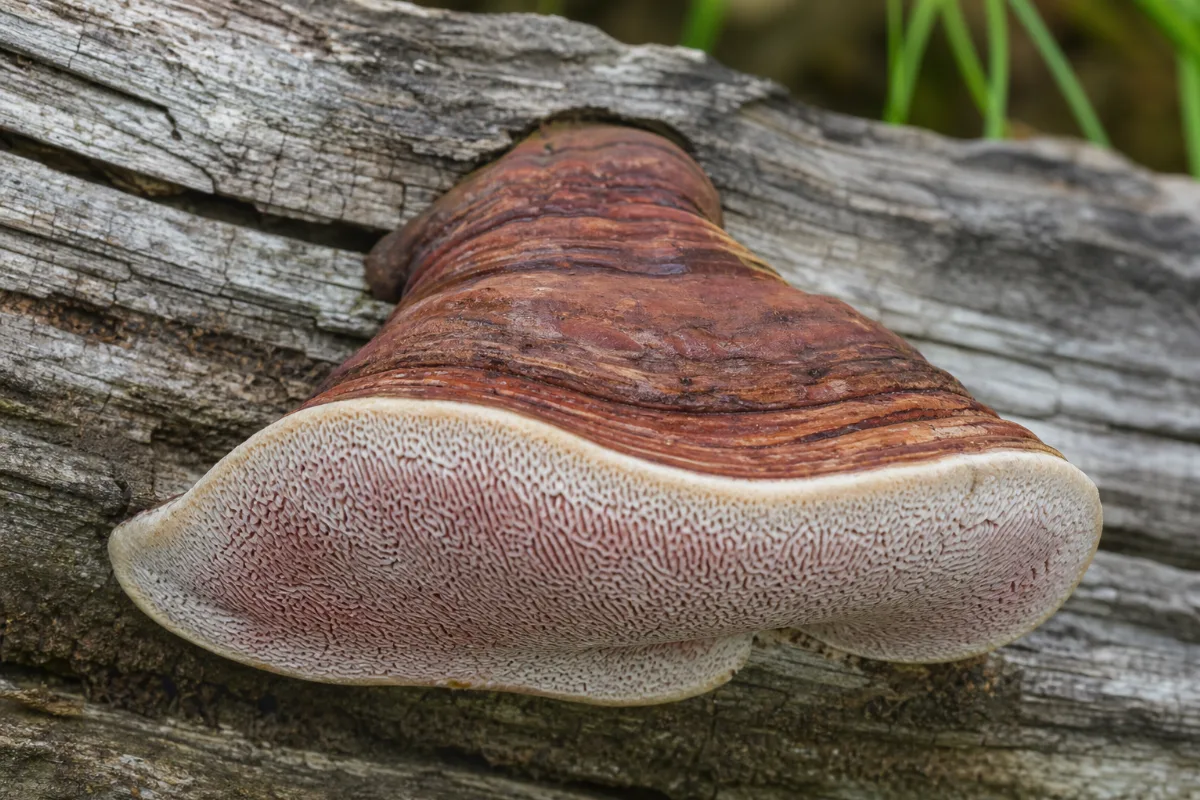
Blushing bracket (Daedaleopsis confragosa) is a tough shelf mushroom that grows in tiers on dead willow and other broadleaf trees. Its pores often bruise pink, which gives it its name. It is not eaten, and we found no supplement made from it. Research is limited to test-tube and cell studies of extracts. We found no human trial and no safety study in people. Ask a doctor or pharmacist before any product, and never eat a wild mushroom unless an expert has identified it.
General information, not medical advice. Last substantive update · Not medically reviewed. A named clinician has not signed off on this page. How this page is made
About Blushing Bracket
Blushing bracket (Daedaleopsis confragosa) is a tough, slow-growing shelf mushroom that rots dead wood, mostly willow. It is not a food, and we found no supplement made from it. Everything known about its health effects comes from test-tube and cell work on extracts and purified steroids. We found no human trial and no safety study in people, so any benefit is unproven and its safety is unknown.
What it is
Blushing bracket is a fungus, not a plant. GBIF accepts the name Daedaleopsis confragosa (Bolton) J.Schröt., in the order Polyporales. An older name is Daedalea confragosa. A field guide describes kidney-shaped caps 5 to 20 cm across with reddish-brown warts, pores that are mostly slits, and an underside that bruises pinkish-brown when handled.
A 2020 DNA study found that D. tricolor is not a separate species, so you may see either name. The family is Polyporaceae in GBIF, though the guide lists Fomitopsidaceae.
Traditional and current uses
We found no source on a traditional medicinal use of blushing bracket. Today it is studied in the lab, for the steroids and phenolic compounds in its fruiting body, and for how it breaks down wood. A field guide calls it inedible.
What the research shows
Everything is lab work. A 2024 Serbian study compared an ethanol and a hydrodistilled extract: the ethanol extract was the stronger antioxidant, while the hydrodistilled one was more toxic to cells and red blood cells and blocked a brain enzyme more. Two 2026 papers from one Korean group found that four endoperoxide steroids were toxic to cancer cell lines in dishes, with computer models pointing to the proteins Src and NOS2.
Earlier work found a sterol that held back H. pylori by 33.9% in a dish, weak antifungal action, a water-extract signal against influenza viruses, a crude animal pain screen, and protection of white blood cells from peroxide damage. None of it has been tested in a person, and a result in a dish rarely carries over to the body.
Fruiting body, mycelium and compounds are different
The studies used wild fruiting-body extracts from Serbia, Korea and Bangladesh, extracts of lab-grown mycelium, and purified steroids. These are different materials with different contents. Results from one cannot be applied to another, and none matches a mushroom product.
Legal and regulatory status
We did not find or read any statement on blushing bracket from EMA, FDA, NCCIH, LiverTox or LactMed, so none is stated here. We know of no authorised product. Rules differ by country and change.
At a glance
Traditional uses history, not proof
- We found no source on a traditional medicinal use of blushing bracket.
Studied for research
- Antioxidant chemistry in test tubes, insufficient (lab only)
- Cancer cells in dishes, insufficient (no animal or human data)
- Bacteria, fungi and viruses in dishes, insufficient
- Pain in a crude animal screen, insufficient
- Brain enzyme and DNA tests in the lab, insufficient
Main compounds
- Steroids with an endoperoxide bridge, such as ergosterol peroxide
- Other ergosterol-type sterols
- Phenolic compounds and flavonoids
Common forms
- Wild bracket (tough and inedible, not a food)
- Solvent and hydrodistilled extracts of the fruiting body, made in the lab
- Extracts of lab-grown mycelium, used in research
- Purified steroid compounds, used in research
Research links: 2024 lab study of extracts (abstract) · 2026 steroid and breast cancer cell study (abstract) · 2022 H. pylori sterol study (abstract) · 2017 antifungal and antioxidant study (abstract) · GBIF name record · Research Library · Genes & Biomarkers Library
What it is and its history
- Accepted scientific name
- Daedaleopsis confragosa
- Naming authority
- (Bolton) J.Schröt. (GBIF)
- Synonyms
- Daedalea confragosa (Bolton) Pers. (GBIF synonym); Boletus confragosus Bolton; Daedalea rubescens Alb. & Schwein.; Trametes rubescens (Alb. & Schwein.) Fr.; Trametes confragosa (Bolton) Rabenh.; Polyporus confragosus (Bolton) P.Kumm.; Daedalea intermedia Berk.
- Common names
- Blushing bracket (English); Thin-walled maze polypore (older name; First Nature gives 'Thin-maze Polypore') (English)
- Family or group
- Polyporaceae per GBIF (a fungus family, not a plant); First Nature lists Fomitopsidaceae
- Classification
- Fungi > Basidiomycota > Agaricomycetes > Polyporales > Polyporaceae > Daedaleopsis > Daedaleopsis confragosa
- Native range
- First Nature: common and widespread in Britain and Ireland and most of mainland Europe, also North America and other temperate regions.
- Habitat
- Mostly dead or dying willow trunks and branches, less often alder, hazel, birch, poplar and other broadleaf trees, often beside rivers and streams. It is a wood-rotting saprobe (First Nature).
- What it looks like
- Fruiting body: First Nature: usually kidney-shaped caps 5 to 20 cm across and 1 to 4 cm thick, tough and slow-growing, with reddish-brown warts and concentric zones, sometimes pink or mauve ('blushing'). Pores white, then beige and grey, mostly closed slits with some maze-like, bruising pinkish-brown when handled. Spore print white. Odour not distinctive; taste slightly bitter. Seen all year.
- Cultivation
- No cultivation source for the mushroom body was read. Lab-grown mycelium was used in two studies.
- Harvest and processing
- Not checked in the sources read.
- Look-alikes and adulterants
- Name: Oak mazegill (Daedalea quercina); Note: First Nature: similar shape and colour, but all its elongated pores form a maze.; Name: Birch mazegill (Lenzites betulinus); Note: First Nature: looks quite similar from above but has true gills.
- Sustainability and conservation
- Not checked in the sources read.
Traditional use and history history, not clinical proof
| Tradition or era | Documented use | Source |
|---|---|---|
| Britain, 1791 | First described by James Bolton as Boletus confragosus; moved to Daedaleopsis by Joseph Schröter in 1888 (as First Nature states). | s-first-nature |
| Asian Russia, 2020 | A DNA study found D. confragosa and D. tricolor are not different species and could be treated as two varieties. | p33389871 |
Traditional use shows how it was used. It does not show that it works or is safe today.
What is inside, and how it may work
What it contains and how those compounds act in cells and animals. Laboratory and animal mechanisms are not proven effects in people.
Main compounds
| Compound | Family | Where it is concentrated | Activity studied | Level of evidence |
|---|---|---|---|---|
| Ergosterol peroxide and related endoperoxide steroids | steroid | Fruiting body | Four of seven isolated steroids were toxic to cancer cell lines in dishes and raised ferroptosis markers. 6 4 | Laboratory research |
| Demethylincisterol A3 and other ergosterol derivatives | steroid | Fruiting body | Held back H. pylori in a dish (33.9% inhibition for the best compound). 10 | Laboratory research |
| Phenolic compounds and flavonoids (including protocatechuic acid) | phenolic | Fruiting body Total phenols 25.30 mg gallic acid equivalents per g dry weight in the ethanol extract (2024 study); the Polish study gave a five-species range of 6.80 to 21.88 mg per g. | Antioxidant activity in tubes. 5 11 7 | Laboratory research |
Mechanisms, receptors and pathways
| Target or pathway | Gene or receptor | What was found | Level |
|---|---|---|---|
| Src kinase and PI3K-Akt signalling in breast cancer cells | SRC | Isolated steroids lowered phosphorylated Src; computer docking suggested binding near the ATP site. 6 | Laboratory research |
| Ferroptosis markers and inducible nitric oxide synthase | NOS2, PTGS2, SLC7A11, CHAC1, HMOX1 | Endoperoxide steroids raised ferroptosis markers; computer target prediction pointed to NOS2. 4 | Laboratory research |
| Acetylcholinesterase | ACHE | Extracts blocked the enzyme in a tube. 5 | Laboratory research |
Absorption, metabolism and elimination
- Absorption
- Not studied.
- Distribution
- Not studied.
- Metabolism
- Not studied.
- Elimination
- Not studied.
- Bioavailability
- Not established for the mushroom or its extracts.
Isolated compounds versus whole extracts
The studies used very different materials: solvent extracts of wild fruiting bodies from three countries, purified steroids, and extracts of lab-grown mycelium. Their results cannot be combined, and none is the whole mushroom eaten as food.
Nutritional composition
We found no nutrient table or food-composition entry for blushing bracket. A field guide calls it tough and inedible.
6 not enough evidence
What was looked at
The 6 benefits and uses checked for Blushing Bracket, each with how strong the evidence is. Tap one to open it.
- Antioxidant chemistry in test tubesNot enough evidence
- Cancer cells in test dishesNot enough evidence
- Bacteria, fungi and viruses in test dishesNot enough evidence
- Pain in a crude animal screenNot enough evidence
- Brain enzyme (acetylcholinesterase) in a test tubeNot enough evidence
- DNA protection in blood cells in dishesNot enough evidence
Lab markers tracked in the studies
DPPH radical scavenging (antioxidant tube test)Cancer cell viability and IC50Germ growth inhibitionWrithing count after acetic acidAcetylcholinesterase (AChE) inhibitionDNA damage in white blood cells after hydrogen peroxide
What is Blushing Bracket good for?
The uses people ask about and how strong the human evidence is for each. For every one, there is no human evidence. Read this together with the Safety tab.
Benefits, one by one
Each card is a research question, not a promise. Tap a goal to filter. Open a card to see the studies, doses and limits.
Antioxidant chemistry in test tubes
Not enough evidenceExtracts of blushing bracket scored as antioxidants in test-tube chemistry. This does not show a benefit inside a body.
3 studiesEthanol, hydrodistilled, hot-water and other solvent extracts of frui…
Studies, doses and limits
What the trials found
No human or animal study of an antioxidant effect was found.
Results
In a 2024 Serbian study, an ethanol extract of the fruiting body scavenged the DPPH test radical better than a hydrodistilled extract and had higher phenol content. In a 2017 study, hot-water extract of lab-grown mycelium was the best radical scavenger and the 96% ethanol fruiting-body extract the weakest. A 2012 Polish study put blushing bracket among five polypores, with phenol content below the two highest species.
Effect sizes as reported
Test-tube figures only; no human or animal figures
Why this rating
Only test-tube chemistry on a few batches of mushroom. Nothing was measured in a living body.
Form and dose studied
Ethanol, hydrodistilled, hot-water and other solvent extracts of fruiting bodies, and extracts of lab-grown mycelium.
Who was studied
Chemicals in tubes
Limits
Scavenging a test radical in a tube does not mean the mushroom protects your cells. Results differ with solvent and with fruiting body versus mycelium.
Why researchers looked
Antioxidant tests are cheap, so many mushroom extracts are screened with them.
Traditional use
We found no source that describes a traditional medicinal use of blushing bracket.
Proposed mechanism Laboratory research
Phenol-type compounds in the extracts are thought to carry the activity. This is laboratory chemistry.
A proposed mechanism does not show that the effect happens in people.
Not a vitamin or a protective supplement. We found no safety study in people.
Cancer cells in test dishes
Not enough evidenceExtracts and purified steroids from blushing bracket were toxic to several cancer cell lines in dishes. No animal or human test exists, and the toxicity is not selective.
4 studiesIsolated steroid compounds and methanol, ethanol or hydrodistilled ex…
Studies, doses and limits
What the trials found
No human or animal study was found.
Results
In 2026 papers from one Korean group, four endoperoxide steroids from the fruiting body were toxic to four cancer cell lines (HCT116, A549, MDA-MB-231, A375SM) and lowered the Src signal in breast cancer cells, also in 3D spheroids. A 2024 Serbian study found the hydrodistilled extract toxic to cells in a dish (IC50 27.76 micrograms per mL after 72 hours). A brine shrimp test on methanol extracts of several mushrooms also showed toxicity (LC50 2.33 micrograms per mL).
Effect sizes as reported
Dish figures only; no human or animal figures
Why this rating
Dish and computer work from a few labs, two of the papers from the same group. Nothing was tested in an animal or a person.
Form and dose studied
Isolated steroid compounds and methanol, ethanol or hydrodistilled extracts of fruiting bodies.
Who was studied
Cancer cell lines in dishes; brine shrimp
Limits
Killing cells in a dish is not a cancer treatment. The same extract also broke open red blood cells in a test, so the toxicity is not selective. The abstracts do not say whether healthy cells were harmed.
Why researchers looked
Wood-rotting fungi make unusual steroids, and researchers screen them for cell-killing activity.
Traditional use
We found no source that describes a traditional medicinal use of blushing bracket.
Proposed mechanism Laboratory research
Four steroids with an endoperoxide bridge, including ergosterol peroxide, lowered phosphorylated Src in breast cancer cells and raised ferroptosis markers (a form of cell death). Computer models pointed to Src and NOS2 as targets. This is dish work and computer prediction.
A proposed mechanism does not show that the effect happens in people.
Not a cancer treatment. Do not use it in place of care. Tell your cancer team about any mushroom product.
Bacteria, fungi and viruses in test dishes
Not enough evidenceSome extracts held back a stomach bacterium (H. pylori), pathogenic fungi and influenza viruses in the lab, usually weakly. It is not an antibiotic.
3 studiesMethanol extract fractions and isolated sterols (fruiting body); wate…
Studies, doses and limits
What the trials found
No human or animal study of this was found.
Results
In 2022, a methanol extract of Korean fruiting bodies held back H. pylori strain 51; the best of five isolated sterols gave 33.9% inhibition, more than the comparison substance quercetin. In 2017, extracts of fruiting bodies and mycelium were weakly fungistatic and not fungicidal against seven fungal pathogens, weaker than the drug ketoconazole. In 2012, a mycelium water extract was named among seven fungus strains judged most promising against two influenza A strains; the abstract gives no figures.
Effect sizes as reported
Test-tube figures only; no human or animal figures
Why this rating
Only dish work, modest in size, on different materials (wild fruiting body, lab mycelium).
Form and dose studied
Methanol extract fractions and isolated sterols (fruiting body); water extracts of lab-grown mycelium.
Who was studied
Bacteria, fungi and viruses in dishes
Limits
Holding back germs in a dish is not treating an infection. Fruiting body and mycelium extracts are different materials.
Why researchers looked
Wood-rotting fungi make many chemicals, and researchers screen them for germ-fighting activity.
Traditional use
We found no source that describes a traditional medicinal use of blushing bracket.
Proposed mechanism Laboratory research
Ergosterol-type sterols were the active compounds in the H. pylori work. For the other tests the active part is unknown. This is laboratory chemistry.
A proposed mechanism does not show that the effect happens in people.
Blushing bracket is not an antibiotic or antiviral. See a doctor for an infection.
Pain in a crude animal screen
Not enough evidenceA methanol extract reduced the number of writhes in an acetic-acid pain test in animals, along with four other mushrooms. This is a screening test, not pain relief.
1 studiesMethanol extract of the fruiting body.
Studies, doses and limits
What the trials found
No human study was found.
Results
In a 2021 Bangladeshi study, the methanol extract of Daedaleopsis confragosa was one of four extracts that significantly lowered the number of writhes compared with control (p < 0.001); all but one of the five extracts gave 50% or more inhibition. The abstract does not name the animal species or give results for blushing bracket alone.
Effect sizes as reported
Writhing inhibition in the animal test; no figures for this species alone in the abstract
Why this rating
One crude screening test in animals. The abstract does not say how many animals or which species.
Form and dose studied
Methanol extract of the fruiting body.
Who was studied
Animals in an acetic-acid pain test
Limits
A writhing test is a rough screen. It does not show it would relieve real pain in people.
Why researchers looked
Screening wild mushrooms for pain-relieving activity.
Traditional use
We found no source that describes a traditional medicinal use of blushing bracket.
Proposed mechanism In silico
Computer docking suggested other mushroom compounds could bind COX enzymes. Nothing is known for blushing bracket compounds. This is computer prediction.
A proposed mechanism does not show that the effect happens in people.
Not a painkiller. Do not use it for pain; ask a doctor or pharmacist.
Brain enzyme (acetylcholinesterase) in a test tube
Not enough evidenceExtracts blocked the enzyme acetylcholinesterase in a tube. This is how some dementia medicines work, but no brain or memory effect was shown.
1 studiesHydrodistilled and ethanol extracts of the fruiting body.
Studies, doses and limits
What the trials found
No human or animal study was found.
Results
In the 2024 Serbian study, the hydrodistilled extract blocked the enzyme more strongly than the ethanol extract. We quote no number because the abstract and our earlier summary disagree on the unit.
Effect sizes as reported
Test-tube only; no figures quoted
Why this rating
Enzyme tests on one collection. No cell, animal or human test.
Form and dose studied
Hydrodistilled and ethanol extracts of the fruiting body.
Who was studied
Enzyme in a tube
Limits
An enzyme blocked in a tube does not show a memory or brain benefit. The same extract was also toxic to cells and red blood cells.
Why researchers looked
Blocking this enzyme is the action of some dementia medicines, so extracts are screened for it.
Traditional use
We found no source that describes a traditional medicinal use of blushing bracket.
Proposed mechanism Laboratory research
Terpenoids and steroids in the hydrodistilled extract may be responsible, say the authors. This is a guess from chemistry.
A proposed mechanism does not show that the effect happens in people.
Not a dementia treatment. If you take a dementia medicine, ask a pharmacist before adding any mushroom product.
DNA protection in blood cells in dishes
Not enough evidenceWater extracts did not damage DNA in white blood cells in a dish and reduced hydrogen-peroxide damage. This is cell work only.
2 studiesAqueous extracts of fruiting body and mycelium; ethanol and hydrodist…
Studies, doses and limits
What the trials found
No human or animal study was found.
Results
In the 2017 Serbian study, aqueous extracts of fruiting body and mycelium were not genotoxic and protected leukocytes against hydrogen-peroxide DNA damage. By contrast, in the 2024 study only the ethanol extract disintegrated DNA in a virus-based DNA-damage test at a 1 in 100 dilution.
Effect sizes as reported
Cell-level result; no figures quoted
Why this rating
Dish work on cells, two studies pointing in slightly different directions depending on the extract.
Form and dose studied
Aqueous extracts of fruiting body and mycelium; ethanol and hydrodistilled extracts.
Who was studied
White blood cells in dishes; a DNA-damage test
Limits
A cell test of DNA damage is a lab measure. It does not show a protective effect in people, and an ethanol extract showed DNA-damaging activity in another test.
Why researchers looked
Researchers test whether extracts are safe for DNA and whether they protect against oxidative damage.
Traditional use
We found no source that describes a traditional medicinal use of blushing bracket.
Proposed mechanism Laboratory research
Likely linked to the phenolic compounds, as a lab explanation. Not shown in a body.
A proposed mechanism does not show that the effect happens in people.
Not tested for safety in people.
Connections to the rest of health
How Blushing Bracket connects to the rest of our health knowledge graph. Every link says what kind of connection it is. A safety link (for example to the liver) is a warning, not a benefit. A study that merely mentions a topic never creates a benefit link.
Explore every connection: goals, body systems, organs, symptoms, genes
A. Wellness goals
| Connected to | Kind of connection | Evidence status | Context | Studies |
|---|---|---|---|---|
| Memory Support | Preliminary mechanism | Not enough evidence | Brain enzyme (acetylcholinesterase) in a test tube: Extracts blocked the enzyme acetylcholinesterase in a tube. This is how some dementia medicines work, but no brain or memory effect was shown. | 5 |
B. Body systems
| Connected to | Kind of connection | Evidence status | Context | Studies |
|---|---|---|---|---|
| Immune system | Drug or supplement interaction | Not enough evidence | Held back some germs in dishes; no immune study of blushing bracket was read. Held back some germs in dishes; no immune study was read. Preparation or compound: Extracts (germ tests in dishes) |
10 12 |
| Immune System | Biological association | Not enough evidence | Studied for: Bacteria, fungi and viruses in test dishes | 10 7 12 |
| Pain Inflammation | Biological association | Not enough evidence | Studied for: Pain in a crude animal screen | 8 |
| Brain Focus | Biological association | Not enough evidence | Studied for: Brain enzyme (acetylcholinesterase) in a test tube | 5 |
I. Biomarkers
| Connected to | Kind of connection | Evidence status | Context | Studies |
|---|---|---|---|---|
| DPPH radical scavenging (antioxidant tube test) | Biological association | Not enough evidence | Measured in trials: raised (scavenging in a tube). A lab change is not the same as a health benefit. | 5 7 |
| Cancer cell viability and IC50 | Biological association | Not enough evidence | Measured in trials: lowered (cell survival). A lab change is not the same as a health benefit. | 6 4 5 |
| Germ growth inhibition | Biological association | Not enough evidence | Measured in trials: lowered (germ growth). A lab change is not the same as a health benefit. | 10 7 |
| Writhing count after acetic acid | Biological association | Not enough evidence | Measured in trials: lowered (writhes). A lab change is not the same as a health benefit. | 8 |
| Acetylcholinesterase (AChE) inhibition | Biological association | Not enough evidence | Measured in trials: lowered (enzyme activity). A lab change is not the same as a health benefit. | 5 |
| DNA damage in white blood cells after hydrogen peroxide | Biological association | Not enough evidence | Measured in trials: lowered (DNA damage). A lab change is not the same as a health benefit. | 7 |
K. Biological pathways
L. Active compounds
| Connected to | Kind of connection | Evidence status | Context | Studies |
|---|---|---|---|---|
| Ergosterol peroxide and related endoperoxide steroids | Biological association | In vitro | Four of seven isolated steroids were toxic to cancer cell lines in dishes and raised ferroptosis markers. Preparation or compound: Fruiting body |
6 4 |
| Demethylincisterol A3 and other ergosterol derivatives | Biological association | In vitro | Held back H. pylori in a dish (33.9% inhibition for the best compound). Preparation or compound: Fruiting body |
10 |
| Phenolic compounds and flavonoids (including protocatechuic acid) | Biological association | In vitro | Antioxidant activity in tubes. Preparation or compound: Fruiting body |
5 11 7 |
Each connection is stored with the ingredient, the connected record, the kind of connection, the evidence status, the supporting studies, the preparation or compound involved, and a review date (last reviewed October 25, 2026).
Evidence at a glance: what the research found for 6 outcomes
Each outcome below is one thing researchers measured. Certainty is how far the evidence can be trusted, not how well it works. The full studies are on the next tab.
The evidence
The research centre for Blushing Bracket. Every record here was checked against PubMed or the publisher's page; we never list a study we have not verified.
Evidence by outcome
Bars show how many studies we found for each outcome, not how well it works. People are added up across trials only (reviews are not added, to avoid double counting).
How we rate evidence
High certainty
Several well-run trials or reviews agree; further research is unlikely to change the picture much.
Moderate certainty
Good trials point the same way, but some doubt remains.
Low certainty
Small, short or inconsistent trials. The finding could change with better research.
Very low certainty
Very little or very weak human data. Treat as a possibility only.
Mixed findings
Trials or reviews disagree with each other.
Not enough evidence
Not enough human research to say either way.
Evidence against
Good research found no benefit, or found harm.
We take the reviewers' own risk-of-bias and GRADE statements where they exist, and otherwise judge from study size, design, consistency, directness and whether a product matches what is sold. Many publications do not make evidence high. Method note: We searched PubMed for Daedaleopsis (29 records) and Daedaleopsis confragosa (14 records), screened the titles for human studies and found none, and read the PubMed records and abstracts of 10 papers (nine lab, animal or field studies and one DNA naming paper). We checked the name in GBIF and read one field guide. Only abstracts were read. EMA, FDA, NCCIH, LiverTox and LactMed were not read. Certainty ratings are the compiler's own reading.
Study library: every study we checked 13
| Study | Design | People | Product, dose, length | Result |
|---|---|---|---|---|
| First Nature (volunteer-run UK wildlife site) 2026 First Nature: Daedaleopsis confragosa (Bolton) J. Schröt. - Blushing Bracket (field guide page, read 2026-10-25) first-nature.com · Source |
Field guide n/a |
n/a | n/a |
Describes a tough, inedible polypore with a slightly bitter taste, usually on dead willow and sometimes alder, hazel, birch or poplar; kidney-shaped caps 5 to 20 cm across with reddish-brown warts and zoned colours; pores that are mostly closed slits, some maze-like; an underside that bruises pinkish-brown; white spore print. Lists Daedalea quercina (oak mazegill) and Lenzites betulinus (birch mazegill) as similar. Its taxonomy line gives the family as Fomitopsidaceae, whereas GBIF gives Polyporaceae. Methods, limits and fundingOutcomes: Names, synonyms, appearance, habitat, edibility and similar species of blushing bracket. Limitations: A hobbyist-run guide that cites books and Index Fungorum; not peer reviewed. It is not safe evidence for deciding what is edible. Index Fungorum itself was not opened. Funding and conflicts: Independent; volunteer-run, donation-funded Read: full text |
| GBIF 2026 GBIF Backbone Taxonomy: Daedaleopsis confragosa (Bolton) J.Schröt. (usage key 2545670), checked by API 2026-10-25 gbif.org · Source |
Database record n/a |
n/a | n/a |
GBIF accepts Daedaleopsis confragosa (Bolton) J.Schröt., kingdom Fungi, phylum Basidiomycota, class Agaricomycetes, order Polyporales, family Polyporaceae. The older name Daedalea confragosa (Bolton) Pers. is a listed synonym of it. Methods, limits and fundingOutcomes: Accepted name and synonym status. Limitations: A name database, not a health source. Funding and conflicts: Independent public database record Read: full text |
| Grodzinskaya 2022 Radioactive Contamination of Wild Mushrooms from Ukraine under Conditions of Contrasting Radiation Loads: 36 Years after the Chernobyl Nuclear Power Plant Catastrophe International Journal of Medicinal Mushrooms · PMID 36004707 · DOI |
Observational wild fungi, field samples |
Wild mushrooms collected in a heavily contaminated nature reserve in Ukraine | n/a Fruiting body (field samples) |
Daedaleopsis confragosa was one of the three species with the highest strontium-90 activity (145 Bq per kg dry mass) at that site. Caesium-137 was highest in other, soil-living species. The authors say eating wild mushrooms in this area is still dangerous. Methods, limits and fundingOutcomes: Caesium-137 and strontium-90 activity in wild mushrooms. Limitations: One heavily contaminated area in Ukraine. It says nothing about mushrooms from other places. Funding and conflicts: Funding not stated in the abstract Read: abstract |
| Heo 2025 Ferroptosis-mediated anticancer activity of endoperoxide-containing steroids derived from Daedaleopsis confragosa via targeting NOS2 Animal Cells and Systems (Seoul) · PMID 41357137 · DOI |
Laboratory research pure compounds in vitro and in silico |
Four human cancer cell lines (HCT116, A549, MDA-MB-231, A375SM) in dishes, plus computer modelling | Methanol extract of fruiting bodies; seven isolated steroids, four with an endoperoxide bridge Fruiting body (methanol extract, isolated compounds) |
The four endoperoxide steroids were strongly toxic to the four cancer cell lines and raised several markers of ferroptosis (a form of cell death) in a dose-dependent way. Computer prediction pointed to the NOS2 enzyme as a target. Methods, limits and fundingOutcomes: Cell toxicity, computer target prediction and docking, ferroptosis marker genes, NOS2 gene knock-down. Limitations: Dish and computer work on isolated compounds. Effects on healthy cells, animals or people were not reported in the abstract. Same research group as the Food Chemistry paper, so the two are not independent confirmations. Funding and conflicts: No competing interests declared Read: abstract |
| Ilić 2024 Bioactivity Profiling of Daedaleopsis confragosa (Bolton) J. Schröt. 1888: Implications for Its Possible Application in Enhancing Women's Reproductive Health Pharmaceuticals (Basel) · PMID 38794170 · DOI |
Laboratory research fungus extract in vitro |
Test-tube chemistry, red blood cells, a cell line and enzymes; fruiting bodies from Serbia | Ethanol extract (DC) and hydrodistilled extract (DCHD) of Daedaleopsis confragosa Fruiting body (extracts) |
The ethanol extract scavenged the DPPH radical more strongly and had higher phenol content (25.30 mg gallic acid equivalents per g dry weight) and flavonoid content (2.84 mg quercetin equivalents per g). The hydrodistilled extract was more toxic to cells (IC50 27.76 micrograms per mL after 72 hours), broke red blood cells more (339.39% as reported in the abstract) and blocked the AChE enzyme more strongly. Methods, limits and fundingOutcomes: Radical scavenging, reducing power, total phenols and flavonoids, protein phosphatase-1 activity, DNA damage by a virus (a DNA-damage test), red-blood-cell breakage (haemolysis), cell toxicity, acetylcholinesterase (AChE) inhibition. Limitations: Test-tube work on one collection from Serbia. The abstract does not name the cell line. The abstract gives the AChE figure in mg/mL, which looks like a unit slip, so no AChE number is quoted here. The title talks about women's reproductive health, but no reproductive outcome was measured. Funding and conflicts: Authors declare no conflicts of interest Read: abstract |
| Kim 2026 Steroidal compounds from Daedaleopsis confragosa suppress breast cancer via Src inhibition Food Chemistry · PMID 42143511 · DOI |
Laboratory research pure compounds in vitro and in silico |
Human breast cancer cells (MDA-MB-231) in dishes and 3D spheroids, plus computer modelling | Seven steroid compounds isolated from Daedaleopsis confragosa; four contained an endoperoxide bridge Fruiting body (isolated compounds) |
Four of seven isolated steroids (ergosterol peroxide and three related compounds) significantly reduced breast cancer cell viability and lowered phosphorylated Src. Similar effects were seen in 3D spheroids. Computer modelling suggested one compound and its metabolites bind to Src near the ATP site. Methods, limits and fundingOutcomes: Cancer-cell viability, cell death, phosphorylated Src protein, computer docking and dynamics. Limitations: Isolated pure compounds in dishes and computer models, not the mushroom or an extract. No animal or human data. The abstract does not say whether normal cells were harmed. Funding and conflicts: No competing interests declared Read: abstract |
| Knežević 2017 Antifungal, Antioxidative, and Genoprotective Properties of Extracts from the Blushing Bracket Mushroom, Daedaleopsis confragosa (Agaricomycetes) International Journal of Medicinal Mushrooms · PMID 29199561 · DOI |
Laboratory research fungus extract in vitro |
Seven animal and human fungal pathogens in dishes; DPPH chemistry; leukocytes (white blood cells) exposed to hydrogen peroxide | Various solvent extracts of fruiting bodies and mycelium of Daedaleopsis confragosa Fruiting body and mycelium (extracts) |
The extracts were weakly fungistatic and not fungicidal against seven pathogens, and weaker than the drug ketoconazole. They scavenged DPPH radicals to different degrees: the mycelial hot-water extract was best (half-maximal effective concentration 3.42 mg per mL) and the 96% ethanol extract of the fruiting body weakest (5.36 mg per mL). Aqueous fruiting-body and mycelial extracts were not genotoxic and protected leukocytes against hydrogen-peroxide DNA damage. Methods, limits and fundingOutcomes: Fungus growth (fungistatic and fungicidal activity), DPPH radical scavenging, total phenols, DNA damage in leukocytes. Limitations: Dish work only, on extracts of two different materials (fruiting body and lab-grown mycelium). Only the abstract was read. Funding and conflicts: Funding not stated in the abstract Read: abstract |
| Moazzem Hossen 2021 Wild mushrooms showed analgesic and cytotoxic properties along with phytoconstituent's binding affinity to COX-1, COX-2 and cytochrome P450 2C9 Heliyon · PMID 34585013 · DOI |
Animal research fungus extract in animals and brine shrimp |
Methanol extracts of five wild mushrooms from Bangladesh: an acetic-acid pain test in animals (species not named in the abstract), brine shrimp, and computer docking | Methanol extract of Daedaleopsis confragosa (among five mushrooms) Fruiting body (methanol extract) |
Extracts of four of the five mushrooms, including Daedaleopsis confragosa, significantly reduced the number of writhes compared with control (p < 0.001), and all except one extract gave 50% or more inhibition. In the brine shrimp test, Daedaleopsis confragosa had an LC50 of 2.33 micrograms per mL, which the authors called a decisive cytotoxic action. Methods, limits and fundingOutcomes: Number of writhes after acetic acid (a pain test); brine shrimp lethality (LC50); computer docking. Limitations: A crude animal pain screen and a brine shrimp toxicity test, plus computer docking. The abstract does not state which animal was used or give results for Daedaleopsis confragosa alone. The brine shrimp result is a toxicity signal, not a safety result. Funding and conflicts: No conflict of interest declared Read: abstract |
| Mukhin 2020 Notes on Medicinal Polypore Species from the Genus Daedaleopsis (Agaricomycetes), Distributed in the Asian Part of Russia International Journal of Medicinal Mushrooms · PMID 33389871 · DOI |
Database analysis fungus (DNA analysis) |
Daedaleopsis confragosa and D. tricolor from the Urals, Siberia and the Far East (DNA sequences) | n/a Fruiting body (DNA study) |
DNA analysis showed D. confragosa and D. tricolor do not differ taxonomically and should be considered one species, which the authors suggest could be treated as two morpho-ecological varieties (var. confragosa and var. tricolor). Methods, limits and fundingOutcomes: Taxonomy from DNA (ITS) sequences; ecology. Limitations: A naming and ecology paper. The abstract reports no health result. Funding and conflicts: Funding not stated in the abstract Read: abstract |
| Na 2022 Identification of Antibacterial Sterols from Korean Wild Mushroom Daedaleopsis confragosa via Bioactivity- and LC-MS/MS Profile-Guided Fractionation Molecules · PMID 35335230 · DOI |
Laboratory research fungus extract and compounds in vitro |
Helicobacter pylori (strain 51) bacteria in dishes; wild fruiting bodies from Korea | Methanol extract, its fractions, and five ergosterol-type compounds Fruiting body (extract fractions, isolated compounds) |
The methanol extract held back H. pylori; its n-hexane and dichloromethane fractions were moderate to weak. Of five sterols isolated, demethylincisterol A3 gave 33.9% inhibition, more than the comparison substance quercetin. Another sterol was comparable to quercetin. Methods, limits and fundingOutcomes: Growth of H. pylori; chemical identification of isolated compounds. Limitations: Dish work on bacteria. A 33.9% inhibition is modest. Not tested on an infection in animals or people. Funding and conflicts: No conflicts declared Read: abstract |
| Sulkowska-Ziaja 2012 Phenolic compounds and antioxidant activity in some species of polyporoid mushrooms from Poland International Journal of Medicinal Mushrooms · PMID 23510176 · DOI |
Laboratory research fungus extract in vitro |
Fruiting-body extracts of five polypore species from Poland, including Daedaleopsis confragosa | Extracts of fruiting bodies, measured by HPLC and the FRAP test Fruiting body (extract) |
Across the five species, protocatechuic acid was the main phenolic acid (17.7 to 90.0 micrograms per g dry weight) and total phenolics ranged from 6.80 to 21.88 mg per g. Fomitopsis pinicola and Gloeophyllum sepiarium had the highest phenolics and antioxidant activity; Daedaleopsis confragosa was not among the highest. Methods, limits and fundingOutcomes: Phenolic acids (protocatechuic, p-hydroxybenzoic, vanillic), total phenolics, antioxidant activity by FRAP. Limitations: The abstract gives ranges for all five species, not separate figures for Daedaleopsis confragosa. Test-tube chemistry. Funding and conflicts: Funding not stated in the abstract Read: abstract |
| Teplyakova 2012 Antiviral activity of polyporoid mushrooms (higher Basidiomycetes) from Altai Mountains (Russia) International Journal of Medicinal Mushrooms · PMID 22339706 · DOI |
Laboratory research fungus mycelium extract in vitro |
Influenza A viruses (H5N1 bird and H3N2 human strains) in the lab; mycelium of 11 fungi | Water extracts of mycelium of 11 fungus species, including Daedaleopsis confragosa Mycelium (water extract) |
The abstract names Daedaleopsis confragosa among seven strains it calls the most promising for producing antiviral medicines. It gives no figures for any single species. Methods, limits and fundingOutcomes: Antiviral activity against two influenza A strains. Limitations: Mycelium extract, not the mushroom. The abstract gives no numbers for Daedaleopsis confragosa. Lab virus tests only. Funding and conflicts: Funding not stated in the abstract Read: abstract |
| n/a 2026 Our PubMed searches for blushing bracket (run 2026-10-25): titles screened for human studies and safety reports n/a · Source |
Database record n/a |
n/a | n/a |
Almost all are laboratory studies of extracts or compounds, studies of wood decay enzymes, naming papers or field surveys. None was a clinical trial, a case report, an animal toxicity study or a safety study in people. The records read in full abstract are cited on this page. Methods, limits and fundingOutcomes: A search for the genus name Daedaleopsis returned 29 records and a search for the quoted species name returned 14. The records were screened by title and type. Limitations: A title screen can miss papers. Only English-language PubMed was searched; Chinese, Russian and other databases were not. Funding and conflicts: Independent public or database record Read: full text |
What we do not know yet
- No human trial, case report or safety study of blushing bracket was found.
- No animal toxicity test and only one crude animal pain screen.
- Metals, pesticides, allergy and look-alike questions for the mushroom body are not covered by any source read.
- Fruiting body, mycelium and compounds are not compared, and the studies were done on different collections.
- No regulator statement on the mushroom was read.
How new research is added
New studies are found by a saved PubMed search and placed in a review queue. A person reads each one before it changes any evidence rating or safety wording. New publications never change ratings automatically.
Lab markers
What changed in blood or saliva tests during trials. A changed number is not the same as feeling or being healthier, and we give no "normal ranges".
Other 6
DPPH radical scavenging (antioxidant tube test)
Raised (scavenging in a tube) in trials
A colour test in which an extract is mixed with a stable chemical radical. If the colour fades, the extract is said to scavenge radicals.
Not enough evidenceResults and what it means
Why it was measured
Used in the lab to rank antioxidant strength of extracts.
Statistical vs. clinical meaning
A tube result only. It is not a measure of antioxidant status in people.
Safety implication
It says nothing about safety or benefit in the body.
| Study | Result | People | Product |
|---|---|---|---|
| 5 | Ethanol extract scavenged DPPH better than the hydrodistilled extract; total phenols 25.30 mg gallic acid equivalents per g dry weight. | Chemistry in a tube | Fruiting-body extracts |
| 7 | Best scavenger: mycelial hot-water extract (half-maximal effective concentration 3.42 mg per mL); weakest: 96% ethanol fruiting-body extract (5.36 mg per mL). | Chemistry in a tube | Fruiting-body and mycelium extracts |
Cancer cell viability and IC50
Lowered (cell survival) in trials
The IC50 is the concentration that cuts cell survival or growth by half. A lower IC50 means the substance is more toxic to the cells.
Not enough evidenceResults and what it means
Why it was measured
Used in the lab to rank how toxic extracts or compounds are to cells.
Statistical vs. clinical meaning
Dish result. It shows toxicity to cells, not a treatment.
Safety implication
A toxic effect on cancer cells may also harm healthy cells; this was not tested in the abstracts read.
| Study | Result | People | Product |
|---|---|---|---|
| 6 | Four endoperoxide steroids significantly reduced MDA-MB-231 breast cancer cell viability; compound 2 was the most potent. | Breast cancer cells and spheroids in dishes | Isolated steroids |
| 5 | Hydrodistilled extract IC50 27.76 micrograms per mL after 72 hours; the abstract does not name the cell line. | A cell line in a dish | Hydrodistilled extract |
Germ growth inhibition
Lowered (germ growth) in trials
The share of germ growth held back by an extract or compound, or whether it only slows (fungistatic) or kills (fungicidal) the germ.
Not enough evidenceResults and what it means
Why it was measured
Used in the lab to rank germ-fighting activity.
Statistical vs. clinical meaning
A dish result only. It is not an antibiotic or antifungal measure for people.
Safety implication
A good result in a dish does not mean the extract is safe to swallow or works on an infection.
Writhing count after acetic acid
Lowered (writhes) in trials
The number of stretching movements an animal makes after an acetic-acid injection, used as a rough pain measure.
Not enough evidenceResults and what it means
Why it was measured
Used to screen for pain-relieving activity.
Statistical vs. clinical meaning
A crude animal screen, not a measure of pain in people.
Safety implication
Does not show safety or pain relief in people.
| Study | Result | People | Product |
|---|---|---|---|
| 8 | Daedaleopsis confragosa methanol extract significantly lowered writhes compared with control (p < 0.001) among four of five tested extracts. | Animals (species not stated in the abstract) | Methanol extract |
Acetylcholinesterase (AChE) inhibition
Lowered (enzyme activity) in trials
AChE is an enzyme that breaks down the brain messenger acetylcholine. Some dementia drugs block it.
Not enough evidenceResults and what it means
Why it was measured
Used to screen extracts for a possible memory-related effect.
Statistical vs. clinical meaning
Test tube only. It is not a measure of memory.
Safety implication
Not a sign of a brain benefit; the extract was also toxic to cells in a dish.
| Study | Result | People | Product |
|---|---|---|---|
| 5 | The hydrodistilled extract blocked AChE more strongly than the ethanol extract (no figure quoted). | Enzyme in a tube | Hydrodistilled and ethanol extracts |
DNA damage in white blood cells after hydrogen peroxide
Lowered (DNA damage) in trials
A lab test of how much DNA breakage occurs in white blood cells exposed to a damaging chemical, with or without an extract.
Not enough evidenceResults and what it means
Why it was measured
Used to see whether an extract protects cells or itself damages DNA.
Statistical vs. clinical meaning
Cell result only. Not a measure of cancer risk in people.
Safety implication
A dish result does not show protection in the body.
| Study | Result | People | Product |
|---|---|---|---|
| 7 | Aqueous extracts were not genotoxic and gave significant protection against hydrogen-peroxide DNA damage. | White blood cells in dishes | Aqueous extracts of fruiting body and mycelium |
Safety
What studies and official sources say about side effects, medicines and who should check first. Each point shows what kind of evidence it comes from.
Main points to know 4
- Nothing is known about safety in people. We found no clinical trial, case report, animal toxicity study or safety study of blushing bracket. Not knowing is not the same as safe. Absence of evidence 13
- It is a wild, tough, inedible bracket - do not pick it to use. A field guide calls blushing bracket tough, inedible and slightly bitter, growing mostly on dead willow. Several look-alike brackets exist, and a bracket with gills (birch mazegill) or maze-like pores (oak mazegill) can look similar from above. Never eat or use a wild mushroom unless an expert has identified it in person. Photos and apps are not reliable. Field guide 1
- Extracts were toxic in the lab. A hydrodistilled extract broke open red blood cells and was toxic to cells in a dish, and a methanol extract was toxic to brine shrimp. Purified steroids from the mushroom killed cancer cell lines. These dish results show the extracts can damage cells. They have not been tested for safety in people. Laboratory research 5 8 6
- A site-specific contamination signal. In one heavily contaminated Ukrainian reserve, blushing bracket was one of three species with the highest strontium-90 activity. This is a reminder that wild wood-rotting fungi can carry what is in their local environment. It does not describe mushrooms from other places. Observational 3
Side effects 3
| Effect | How often | Severity and recovery | Evidence |
|---|---|---|---|
| No adverse effects in people have been reported No human use was studied, so this is not a finding of safety. | Not established | unknown Not applicable | Absence of evidence 13 |
| Possible cell damage seen in the lab (red blood cells, cell lines, brine shrimp) Dish and shrimp results. Nobody knows what, if anything, this means for a person eating or taking an extract. | Not established | unknown Unknown | Laboratory research 5 8 |
| Allergy or stomach upset No report was found. Any mushroom can trigger allergy in some people, but this is a general caution, not a finding about blushing bracket. | Not established | unknown Unknown | Absence of evidence 13 |
Liver
We found no case report or trial linking blushing bracket to liver injury, and no liver safety test of it. 13
How often. No reports found; this is not proof of liver safety.
Monitoring. No agency monitoring advice was read. People with liver disease should ask a doctor before using any mushroom product.
This is a safety connection. It is not evidence that Blushing Bracket supports liver health.
Medicines and supplements 4
| With | Why it matters | Importance | Evidence | What to do |
|---|---|---|---|---|
| Any prescription medicine prescription | No interaction study of blushing bracket exists. | Unknown. Absence of reports is not proof of no interaction. | Absence of evidence Not enough evidence 13 | Ask a pharmacist before combining any mushroom product with medicines. |
| Cancer treatment prescription | Extracts and isolated steroids were toxic to cancer cells in dishes. Nothing is known about how they act with chemotherapy, radiotherapy or other cancer medicines. | Unknown. A theoretical concern from dish work only. | Laboratory research Not enough evidence 6 4 | Do not use it in place of cancer care. Tell your cancer team about any mushroom product. |
| Dementia medicines that block acetylcholinesterase prescription | Extracts blocked the acetylcholinesterase enzyme in a test tube. | A theoretical, tube-only concern. No effect in people is known. | Laboratory research Not enough evidence 5 | If you take a dementia medicine, ask a pharmacist before using any mushroom product. |
| Herbs and supplements herb-supplement | No interaction study of blushing bracket exists. | Unknown. | Absence of evidence Not enough evidence 13 | Ask a pharmacist before combining it with other herbs or supplements. |
Who should check first 5
| Situation | Advice | Evidence |
|---|---|---|
| Pregnancy and breastfeeding | No data. Avoid unless a doctor advises otherwise. | Absence of evidence 13 |
| Children | No data. Do not give to children. | Absence of evidence 13 |
| Liver or kidney disease | No data. Ask a doctor before use. | Absence of evidence 13 |
| Mushroom or mould allergy | No data on cross-reaction. Avoid unless a doctor advises otherwise. | Absence of evidence 13 |
| Planned surgery or a bleeding disorder | No data. Tell your care team about any mushroom product. | Absence of evidence 13 |
Overdose, product quality and regulators
Summary. No toxicity study of the mushroom in animals or people was found. In the lab, extracts damaged red blood cells and killed cancer cell lines and brine shrimp.
Animal. No animal toxicity study was found. The only animal work is one pain screen of a methanol extract (species not named in the abstract) and its abstract mentions no toxicity finding.
Human doses studied. No human use was studied.
High dose or long term signals. Not studied.
Overdose response. No overdose description was found.
Genotoxicity. Mixed in dishes: aqueous extracts were not genotoxic in white blood cells, but only the ethanol extract showed DNA damage in a virus-based DNA test. Not tested in animals or people.
Toxic or hazardous parts. Fungus. A field guide calls it inedible and tough, not poisonous.
No quality standard that we could verify applies to blushing bracket products, and we found no product made from it.
Wild-grown fungus and its surroundings. In one Ukrainian nature reserve with heavy radioactive fallout, blushing bracket had among the highest strontium-90 activity of the mushrooms measured (145 Bq per kg dry mass). This applies to that place only. 3
Look-alikes and mix-ups. Oak mazegill (Daedalea quercina) and birch mazegill (Lenzites betulinus) are named as similar brackets. The DNA paper treats D. tricolor as the same species, so a label may use either name. 1 9
Fruiting body versus mycelium. Research used wild fruiting bodies in most studies and lab-grown mycelium in two. These are different materials and results do not carry across. 7 12
Heavy metals and pesticides. Not studied for this mushroom in any source read. 13
| Body | Action | Date |
|---|
When to get medical help
- Swelling of the face or throat, wheeze or trouble breathing after taking any mushroom product: call emergency services.
- Vomiting, severe diarrhoea or stomach pain after eating a wild mushroom: get medical help or call a poison centre and keep a sample.
- Yellow skin or eyes, dark urine or pale stools after taking a mushroom product: stop it and get medical help.
- Dark or red urine, sudden weakness or yellowing after any mushroom extract: stop it and get medical help.
- A fever, cough or other sign of infection that is not improving: see a doctor. Do not rely on a mushroom extract.
If someone may be poisoned or in a crisis, contact a clinician or emergency service straight away. In the US, Poison Control is 1-800-222-1222.
General information only, not medical advice. Ask a clinician or pharmacist before use, especially with medicines, in pregnancy or with a health condition. See the Natural Remedy Safety guide.
Frequently asked questions
What is blushing bracket?
Is blushing bracket edible?
A field guide calls it tough, inedible and slightly bitter. We cannot advise wild picking. Photos and apps are not reliable, so never eat a wild mushroom unless an expert has identified it in person.
Is blushing bracket safe?
Does it help with cancer?
What look-alikes should I know about?
A field guide names oak mazegill, whose pores all form a maze, and birch mazegill, which has true gills but looks similar from above. Look-alike brackets are a reason not to rely on your own identification.
Is it an antibiotic?
Is it a strong antioxidant?
Does it relieve pain or help memory?
Does it interact with medicines?
Is it safe in pregnancy, breastfeeding or for children?
No data were found for any of these groups, so avoid it unless a doctor advises otherwise.
Can wild blushing bracket carry contamination?
Possibly. In one heavily contaminated Ukrainian reserve it had among the highest strontium-90 activity of the mushrooms measured. That applies to that place only, and metals and pesticides were not studied for this mushroom.
Is Daedaleopsis tricolor a different mushroom?
A 2020 DNA study of samples from Asian Russia found that D. confragosa and D. tricolor do not differ taxonomically and should be seen as one species, possibly two varieties. You may see either name.
Explore by health goal
Editorial transparency
- Written by
- AlternativeMed editorial team. Research compiled with AI assistance, then checked against PubMed records.
- Medical review
- None. This page has not been reviewed by a physician or pharmacist.
- First published
- 2026-10-25
- Last substantive update
- 2026-10-25
- How we research
- We searched PubMed for Daedaleopsis (29 records) and Daedaleopsis confragosa (14 records), screened the titles for human studies and found none, and read the PubMed records and abstracts of 10 papers (nine lab, animal or field studies and one DNA naming paper). We checked the name in GBIF and read one field guide. Only abstracts were read. EMA, FDA, NCCIH, LiverTox and LactMed were not read. Certainty ratings are the compiler's own reading.
- How we rate evidence
- See "How we rate evidence" in the Evidence tab.
- Independence
- No product is promoted on this page. No affiliate links are shown. This page is information, not a recommendation to use blushing bracket.
Sources 13
Each source was opened and checked. Where we read only the abstract, it says so. The small numbers in the text point here.
- First Nature (volunteer-run UK wildlife site). First Nature: Daedaleopsis confragosa (Bolton) J. Schröt. - Blushing Bracket (field guide page, read 2026-10-25). first-nature.com. 2026. (full text)
- GBIF. GBIF Backbone Taxonomy: Daedaleopsis confragosa (Bolton) J.Schröt. (usage key 2545670), checked by API 2026-10-25. gbif.org. 2026. (full text)
- Grodzinskaya AA, Nebesnyi VB, Landin VP, Gabriel J. Radioactive Contamination of Wild Mushrooms from Ukraine under Conditions of Contrasting Radiation Loads: 36 Years after the Chernobyl Nuclear Power Plant Catastrophe. International Journal of Medicinal Mushrooms. 2022. PMID 36004707. DOI 10.1615/IntJMedMushrooms.2022044725. (abstract)
- Heo EJ, Kim Y, Chang JW, Youn UJ, Oh SJ, Lee S. Ferroptosis-mediated anticancer activity of endoperoxide-containing steroids derived from Daedaleopsis confragosa via targeting NOS2. Animal Cells and Systems (Seoul). 2025. PMID 41357137. DOI 10.1080/19768354.2025.2589556. (abstract)
- Ilić D, Karaman M, Bogavac M, Mišković J, Rašeta M. Bioactivity Profiling of Daedaleopsis confragosa (Bolton) J. Schröt. 1888: Implications for Its Possible Application in Enhancing Women's Reproductive Health. Pharmaceuticals (Basel). 2024. PMID 38794170. DOI 10.3390/ph17050600. (abstract)
- Kim Y, Chang JW, Heo EJ, Kim S, Jeong D, Youn UJ, Lee S, Oh SJ. Steroidal compounds from Daedaleopsis confragosa suppress breast cancer via Src inhibition. Food Chemistry. 2026. PMID 42143511. DOI 10.1016/j.foodchem.2026.149579. (abstract)
- Knežević A, Stajić M, Živković L, Milovanović I, Spremo-Potparević B, Vukojević J. Antifungal, Antioxidative, and Genoprotective Properties of Extracts from the Blushing Bracket Mushroom, Daedaleopsis confragosa (Agaricomycetes). International Journal of Medicinal Mushrooms. 2017. PMID 29199561. DOI 10.1615/IntJMedMushrooms.v19.i6.30. (abstract)
- Moazzem Hossen SM, Hossain MS, Akbar S, Tahmida U, Mawa J, Uddin Emon N. Wild mushrooms showed analgesic and cytotoxic properties along with phytoconstituent's binding affinity to COX-1, COX-2 and cytochrome P450 2C9. Heliyon. 2021. PMID 34585013. DOI 10.1016/j.heliyon.2021.e07997. (abstract)
- Mukhin VA, Zhuykova EV, Vladykina VD, Badalyan SM. Notes on Medicinal Polypore Species from the Genus Daedaleopsis (Agaricomycetes), Distributed in the Asian Part of Russia. International Journal of Medicinal Mushrooms. 2020. PMID 33389871. DOI 10.1615/IntJMedMushrooms.2020035417. (abstract)
- Na MW, Lee E, Kang DM, Jeong SY, Ryoo R, Kim CY, Ahn MJ, Kang KB, Kim KH. Identification of Antibacterial Sterols from Korean Wild Mushroom Daedaleopsis confragosa via Bioactivity- and LC-MS/MS Profile-Guided Fractionation. Molecules. 2022. PMID 35335230. DOI 10.3390/molecules27061865. (abstract)
- Sulkowska-Ziaja K, Muszynska B, Motyl P, Pasko P, Ekiert H. Phenolic compounds and antioxidant activity in some species of polyporoid mushrooms from Poland. International Journal of Medicinal Mushrooms. 2012. PMID 23510176. DOI 10.1615/intjmedmushr.v14.i4.60. (abstract)
- Teplyakova TV, Psurtseva NV, Kosogova TA, Mazurkova NA, Khanin VA, Vlasenko VA. Antiviral activity of polyporoid mushrooms (higher Basidiomycetes) from Altai Mountains (Russia). International Journal of Medicinal Mushrooms. 2012. PMID 22339706. DOI 10.1615/intjmedmushr.v14.i1.40. (abstract)
- n/a. Our PubMed searches for blushing bracket (run 2026-10-25): titles screened for human studies and safety reports. n/a. 2026. (full text)


