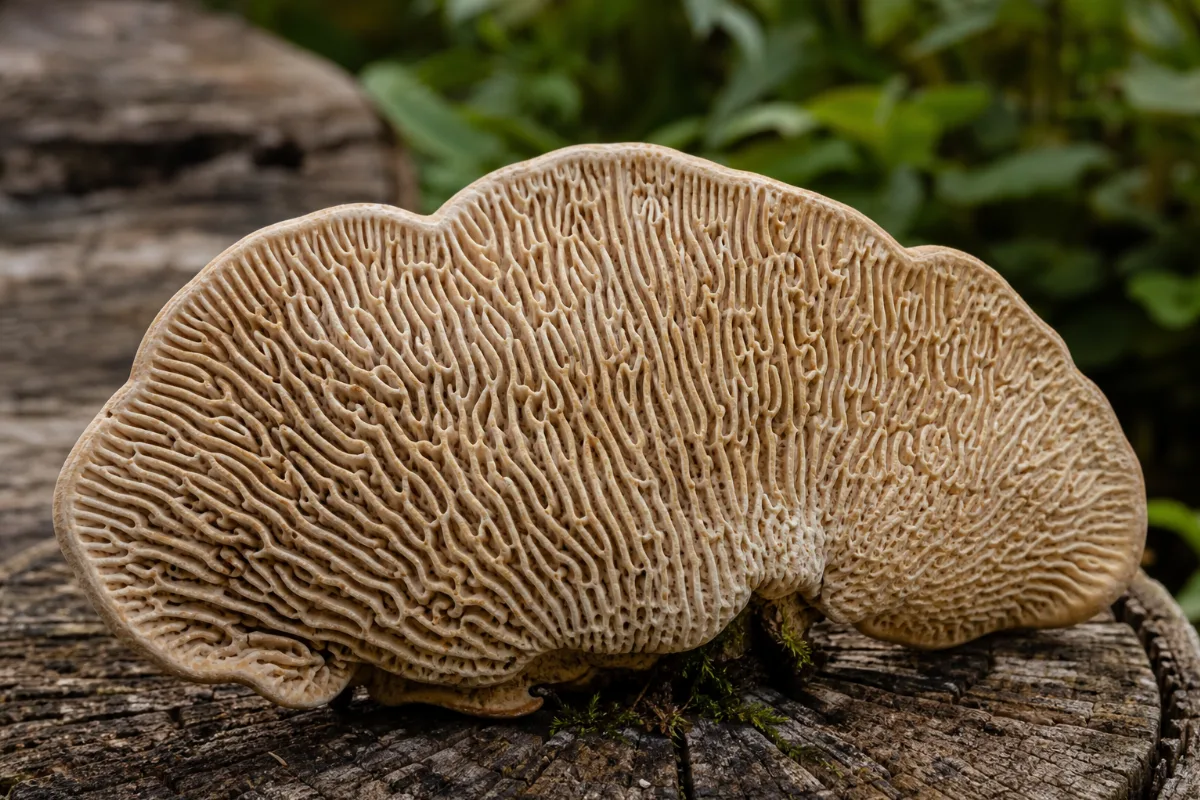
Mushrooms · Wild polypore
Oak mazegill
Daedalea quercina (L.) Pers. · also called Maze-gill
Oak mazegill is a hard, corky bracket fungus that grows on wood, with a maze-like pattern under the cap. Scientists have tested its extracts in test tubes, on bacteria plates and on cells in a dish, but no study has given it to animals or people. The evidence is thin and all from the lab. Wild fruiting bodies may carry heavy metals, and wild fungi should never be eaten unless a local expert has identified them.
General information, not medical advice. Last substantive update · Not medically reviewed. A named clinician has not signed off on this page. How this page is made
About Oak mazegill
Oak mazegill (Daedalea quercina) is a hard, corky bracket fungus that grows on wood. Researchers in Tunisia, Serbia, Turkey and Germany have tested its extracts and compounds in test tubes, on plates and on cells in a dish. The results are interesting lab findings, nothing more. No study in animals or people exists and its safety is unknown. The evidence is thin: only a handful of papers.
What it is
Oak mazegill is a bracket fungus. GBIF accepts the name Daedalea quercina (L.) Pers. and places it in the family Fomitopsidaceae. A mycology paper describes an underside that mixes pore-like and gill-like features. It is a wood-rotting fungus.
It is not a close relative of birch mazegill, which GBIF places in a different family.
What the research shows
Every study is from the lab. A hot-water extract neutralised a test chemical strongly in a Serbian test, while a Turkish comparison of five mushrooms did not rank it among the best. A Tunisian extract was active against HeLa cancer cells in a dish and slowed one soil bacterium. In Serbia, high amounts were needed to slow Salmonella and Listeria and they were not killed. A compound called quercinol, made from lab-grown mycelium, acted on inflammation-linked enzymes in test tubes. A methanol extract blocked a sugar-digesting enzyme in a tube.
A result in a dish or tube does not show a benefit in the body. We rate every use insufficient.
What the studies used
The studies used hot-water, hot-alkali, methanol, hexane and hydroalcoholic extracts of wild fruiting bodies, plus lab-grown mycelium for one compound. These are research materials, not products. Results change with the extract. No commercial product is recommended here.
How it differs from birch mazegill
Birch mazegill is another maze-patterned bracket with its own, separate lab papers and a reported eye-infection case. Nothing found in one applies to the other. See our birch mazegill page for that evidence.
What agencies say
We found no statement about oak mazegill from regulators. We did not open their pages for this page, so this is a gap, not a clean bill of health.
At a glance
Traditional uses history, not proof
- No source we read describes a traditional medicine or food use of this mushroom.
Studied for research
- Antioxidant tests in test tubes, insufficient
- Cancer cells in a dish, insufficient
- Germ-slowing on lab plates, insufficient
- Swelling-related enzymes in test tubes, insufficient
- Sugar-digesting enzyme in a test tube, insufficient
- Beta-glucan structure (no effect tested), insufficient
Main compounds
- Triterpene acids (polyporenic and quercinic acid types)
- Quercinol (a chromene, from lab-grown mycelium)
- A beta-glucan sugar chain
- Gallic acid (very small amounts)
Common forms
- Lab extracts (hot water, hot alkali, methanol, hydroalcoholic): research material, not products
- Lab-grown mycelium: research material
- Wild fruiting body: hard and corky, not shown to be a food
Research links: GBIF: Daedalea quercina · PubMed: Metal concentration of wild mushrooms from the Black Sea region of Turkey · PubMed: Quercinol from oak mazegill · PubMed: Five mushroom species from Turkey, enzyme and antioxidant tests · Research Library · Genes & Biomarkers Library
What it is and its history
- Accepted scientific name
- Daedalea quercina
- Naming authority
- (L.) Pers. (GBIF; published in Syn. Meth. Fung. 1801)
- Synonyms
- Agaricus quercinus L.; Daedalea inzengae Fr.; Antrodia hexagonoides (Fr.) P.Karst.; Agaricus labyrinthiformis Bull.
- Common names
- Oak mazegill (English); Maze-gill (English)
- Family or group
- Fomitopsidaceae (a fungus family; bracket fungi), not a plant
- Classification
- Fungi > Basidiomycota > Agaricomycetes > Polyporales > Fomitopsidaceae > Daedalea > Daedalea quercina
- Native range
- Not checked.
- Habitat
- The 2007 quercinol paper calls it a wood-rotting fungus, and the common name points to oak. Host trees and range were not checked.
- What it looks like
- Fruiting body: A 2023 Mycologia paper describes a unique and stable mix of pore-like and gill-like features on the underside. Do not identify it from this page.
- Cultivation
- Lab-grown mycelium was used in the quercinol work. Commercial cultivation was not checked.
- Harvest and processing
- Not checked.
- Look-alikes and adulterants
- Name: Other maze-patterned brackets; Note: We found no source that lists look-alikes. Birch mazegill (Lenzites betulinus, a different family) and blushing bracket (Daedaleopsis confragosa) also have maze-like or gill-like undersides. That is a naming note, not an identification guide.
- Sustainability and conservation
- Not checked.
Traditional use and history history, not clinical proof
| Tradition or era | Documented use | Source |
|---|---|---|
| Traditional or folk use | No source we read describes a traditional medicine or food use of this mushroom. | s-gbif-daedalea |
| 2000 chemistry | Five new triterpene derivatives were isolated from solvent extracts of Daedalea quercina. | p11014261 |
| 2007 chemistry | Quercinol was isolated from a lab-grown mycelium extract and tested on enzymes. | p17346963 |
Traditional use shows how it was used. It does not show that it works or is safe today.
What is inside, and how it may work
What it contains and how those compounds act in cells and animals. Laboratory and animal mechanisms are not proven effects in people.
Main compounds
| Compound | Family | Where it is concentrated | Activity studied | Level of evidence |
|---|---|---|---|---|
| Triterpene acids (polyporenic and quercinic acid types) | lanostane triterpenoids | Fruiting body Not stated | Listed as constituents; the 2000 paper gives no activity test. The 2025 Tunisian paper found 25 metabolites including daedaleanic acid A and carboxyacetylquercinic acid. 8 10 | Laboratory research |
| Quercinol | chromene (hydroquinone-type) | Lab-grown mycelium Not stated | Acted on COX-2, xanthine oxidase and horseradish peroxidase in test tubes. 5 | Laboratory research |
| Beta-glucan (about 16,000 Da) | polysaccharide | Fruiting body Not stated | Structure only; no activity tested. 1 | Laboratory research |
| Gallic acid | phenolic acid | Fruiting body (extract) Very small amounts reported across five mushrooms | Detected only; the abstract ties it to no effect. 2 | Laboratory research |
Mechanisms, receptors and pathways
| Target or pathway | Gene or receptor | What was found | Level |
|---|---|---|---|
| Free-radical scavenging | Hot-water and hydroalcoholic fruiting-body extracts neutralised test radicals in tubes. 3 10 | Laboratory research | |
| COX-2 and xanthine oxidase | Quercinol acted on these enzymes in test tubes. Not tested in cells, animals or people. 5 | Laboratory research | |
| Alpha-glucosidase | A methanol extract blocked this enzyme in a tube. 2 | Laboratory research |
Absorption, metabolism and elimination
- Absorption
- Not studied.
- Distribution
- Not studied.
- Metabolism
- Not studied.
- Elimination
- Not studied.
- Bioavailability
- Not established.
Isolated compounds versus whole extracts
Results depend on the extract. In the Serbian work the hot-water extract was a strong radical scavenger and the hot-alkali extract was weak. Quercinol came from lab-grown mycelium, not the wild fruiting body, so it may not be in the fruiting body in useful amounts.
Nutritional composition
No nutrition data were found for oak mazegill.
7 not enough evidence
What was looked at
The 7 benefits and uses checked for Oak mazegill, each with how strong the evidence is. Tap one to open it.
- Antioxidant activity in test tubes (laboratory only)Not enough evidence
- Effects on cancer cells in a dish (laboratory only)Not enough evidence
- Germ-slowing on lab plates (laboratory only)Not enough evidence
- Swelling-related enzymes in test tubes (laboratory only)Not enough evidence
- Sugar-digesting enzyme in a test tube (laboratory only)Not enough evidence
- Beta-glucan (fibre-like sugar) in the fruiting bodyNot enough evidence
- As a food (nutrition)Not enough evidence
Lab markers tracked in the studies
Free-radical scavenging (DPPH and ABTS test tube tests)Cancer cell and normal cell response (HeLa and HUVEC cells in a dish)Alpha-glucosidase blocking (test tube)COX-2 and xanthine oxidase enzyme activity (test tube)
What is Oak mazegill good for?
The uses researchers have looked at and how strong the evidence is for each. All of it is from the lab. Nothing is proven for people. Read this together with the Safety tab.
Benefits, one by one
Each card is a research question, not a promise. Tap a goal to filter. Open a card to see the studies, doses and limits.
Antioxidant activity in test tubes (laboratory only)
Not enough evidenceExtracts of the fruiting body neutralised test chemicals called free radicals in test tubes. The hot-water extract was very strong in one test. Nobody has given the mushroom to a person to see if it does anything in the body. A test-tube result is not a health benefit.
3 studiesEvery result here is from a laboratory extract or a test tube, not a …
Studies, doses and limits
What the trials found
No human trial or any study in people who took the mushroom was found.
Results
Serbian hot-water extract of fruiting bodies: very strong DPPH radical scavenging (EC50 below 0.1 mg/mL); the hot-alkali extract was much weaker and all extracts were poor in a copper test. Tunisian hydroalcoholic extract: the most active of the extracts they compared in the DPPH and ABTS tests. In a Turkish comparison of five mushrooms, Daedalea quercina was not among the best antioxidant extracts.
Effect sizes as reported
Lab effects only. No effect size in people.
Why this rating
Only test-tube chemistry from three labs using different extracts. No cell, animal or human evidence of benefit. Insufficient means there is nothing yet that says it does anything in the body.
Form and dose studied
Every result here is from a laboratory extract or a test tube, not a product you can buy. No amounts are given or advised on this page.
Who was studied
Test tubes
Limits
The results differ with the extract used. Test-tube radical tests do not show that eating the mushroom protects cells. Two of the three sources are abstracts only, one a conference record.
Why researchers looked
Wood-growing fungi make triterpenes and other compounds that react with free radicals in the lab, so they are often screened with these tests.
Traditional use
No source we read describes a traditional or folk use of this mushroom.
Proposed mechanism Laboratory research
Compounds in the extracts react with the test radical. This is a lab idea only; no one has shown it happens in the body.
A proposed mechanism does not show that the effect happens in people.
No safety data in people. See the Safety tab.
Effects on cancer cells in a dish (laboratory only)
Not enough evidenceIn one Tunisian study, extracts were active against HeLa cancer cells in a dish and protected another cell type. This is not a cancer treatment and nothing like it has been tested in animals or people.
1 studiesEvery result here is from a laboratory extract or a test tube, not a …
Studies, doses and limits
What the trials found
No animal or human study was found.
Results
A hydroalcoholic extract of fruiting bodies and its ethyl acetate fraction showed activity against HeLa cells and a protective effect on HUVEC cells, in a dose-dependent way. The hydroalcoholic extract was best at 25 to 200 micrograms per mL.
Effect sizes as reported
Lab effects only.
Why this rating
A single cell-dish study from one research group. Insufficient means there is nothing yet that says it does anything in the body.
Form and dose studied
Every result here is from a laboratory extract or a test tube, not a product you can buy. No amounts are given or advised on this page.
Who was studied
HeLa cells and HUVEC cells in a dish
Limits
One abstract. A dish is not a body. Concentrations used in a dish may not be reachable in the body.
Why researchers looked
Triterpenes from wood-rotting fungi are often tested on cell lines.
Traditional use
No source we read describes a traditional or folk use of this mushroom.
Proposed mechanism Laboratory research
Not worked out.
A proposed mechanism does not show that the effect happens in people.
Do not use a mushroom in place of cancer care. Tell your cancer team about anything you take.
Germ-slowing on lab plates (laboratory only)
Not enough evidenceExtracts slowed some bacteria on lab plates. The effect was strong against one harmless soil germ in the Tunisian work and weak against Salmonella and Listeria in the Serbian work. It is not an antibiotic.
2 studiesEvery result here is from a laboratory extract or a test tube, not a …
Studies, doses and limits
What the trials found
No animal or human infection study was found.
Results
Tunisia: Bacillus subtilis was the most sensitive bacterium (MIC 0.03 and 0.06 mg/mL). Serbia: 5 mg/mL stopped Salmonella Enteritidis growth; 10 to 20 mg/mL stopped Listeria monocytogenes; the level that kills them was not reached.
Effect sizes as reported
Lab MIC values only.
Why this rating
Plate tests only, two labs, different extracts and different bacteria.
Form and dose studied
Every result here is from a laboratory extract or a test tube, not a product you can buy. No amounts are given or advised on this page.
Who was studied
Bacteria on lab plates
Limits
Levels that worked on plates are not levels that can safely be reached in the body. Results differed a lot between labs.
Why researchers looked
Fungi make chemicals to fight germs, so they are screened on plates.
Traditional use
No source we read describes a traditional or folk use of this mushroom.
Proposed mechanism Laboratory research
Not worked out.
A proposed mechanism does not show that the effect happens in people.
Do not treat infections with a mushroom. See a doctor for infections.
Swelling-related enzymes in test tubes (laboratory only)
Not enough evidenceA pure compound called quercinol, made from lab-grown oak mazegill mycelium, blocked enzymes linked to inflammation in test tubes. Nobody has tested it in an animal or a person.
1 studiesEvery result here is from a laboratory extract or a test tube, not a …
Studies, doses and limits
What the trials found
No animal or human study was found.
Results
Quercinol showed broad anti-inflammatory-type activity in test-tube enzyme assays.
Effect sizes as reported
Lab effects only.
Why this rating
One 2007 paper, one compound, test tubes only.
Form and dose studied
Every result here is from a laboratory extract or a test tube, not a product you can buy. No amounts are given or advised on this page.
Who was studied
Test-tube enzymes
Limits
The compound came from lab-grown mycelium, not from the wild mushroom. Nobody knows whether it reaches the body from eating the mushroom.
Why researchers looked
Researchers looked for antioxidant and anti-inflammatory compounds in wood-rotting fungi.
Traditional use
No source we read describes a traditional or folk use of this mushroom.
Proposed mechanism Laboratory research
Quercinol acted on COX-2, xanthine oxidase and horseradish peroxidase at micromolar levels in tubes. This is enzyme chemistry, not a shown effect in the body.
A proposed mechanism does not show that the effect happens in people.
No safety data in people.
Sugar-digesting enzyme in a test tube (laboratory only)
Not enough evidenceA methanol extract blocked the sugar-digesting enzyme alpha-glucosidase in a test tube slightly more than the diabetes drug acarbose did. That says nothing about blood sugar in people.
1 studiesEvery result here is from a laboratory extract or a test tube, not a …
Studies, doses and limits
What the trials found
No animal or human study was found.
Results
Methanol extract of Daedalea quercina: 70.79% blocking of alpha-glucosidase against 67.01% for acarbose at the same test setting. Extract amount is not given in the abstract.
Effect sizes as reported
Lab effect only.
Why this rating
One test-tube study among five mushrooms.
Form and dose studied
Every result here is from a laboratory extract or a test tube, not a product you can buy. No amounts are given or advised on this page.
Who was studied
Test-tube enzyme
Limits
A tube is not a body. Do not use any mushroom in place of diabetes medicine.
Why researchers looked
Blocking this enzyme is how some diabetes medicines work, so extracts are screened for it.
Traditional use
No source we read describes a traditional or folk use of this mushroom.
Proposed mechanism Laboratory research
Enzyme inhibition in a tube. Not shown in cells, animals or people.
A proposed mechanism does not show that the effect happens in people.
If you take diabetes medicines, do not add a mushroom product without asking your doctor or pharmacist.
Beta-glucan (fibre-like sugar) in the fruiting body
Not enough evidenceChemists isolated a beta-glucan from the fruiting body and worked out its structure. Beta-glucans from some other mushrooms are studied for immune effects, but this paper tested no immune effect for this one.
1 studiesEvery result here is from a laboratory extract or a test tube, not a …
Studies, doses and limits
What the trials found
No immune test, animal study or human study was found.
Results
A beta-glucan of about 16,000 Da with a 1-3 glucose backbone and 1-6 branches.
Effect sizes as reported
Structure only.
Why this rating
Chemistry only. No sign yet of any effect.
Form and dose studied
Every result here is from a laboratory extract or a test tube, not a product you can buy. No amounts are given or advised on this page.
Who was studied
Isolated sugar in the lab
Limits
Nothing from beta-glucans of other mushrooms can be assumed for this one.
Why researchers looked
Beta-glucans are common in fungi and are a standard first thing to describe.
Traditional use
No source we read describes a traditional or folk use of this mushroom.
Proposed mechanism Laboratory research
None tested. Structure only.
A proposed mechanism does not show that the effect happens in people.
No safety data in people.
As a food (nutrition)
Not enough evidenceWe found no source that describes oak mazegill as a food or gives its nutrition. It is a hard, corky bracket on oak wood.
1 studiesNot applicable.
Studies, doses and limits
Results
No nutrition data found. Chemistry papers list triterpenes (for example from a 2000 isolation study), not nutrients.
Why this rating
No source found.
Limits
Not finding a source is not proof it is unsafe or safe to eat. Do not eat wild fungi you cannot identify.
Why researchers looked
Not studied as food.
Traditional use
No source we read describes a traditional or food use of this mushroom.
Proposed mechanism Gap
Not applicable.
A proposed mechanism does not show that the effect happens in people.
See the Safety tab.
Connections to the rest of health
How Oak mazegill connects to the rest of our health knowledge graph. Every link says what kind of connection it is. A safety link (for example to the liver) is a warning, not a benefit. A study that merely mentions a topic never creates a benefit link.
Explore every connection: goals, body systems, organs, symptoms, genes
G. Root causes and contributing factors
| Connected to | Kind of connection | Evidence status | Context | Studies |
|---|---|---|---|---|
| Heavy metal exposure | Observational | High risk-index values for cadmium, cobalt and lead in one regional study; per-species figures not in the abstract. Preparation or compound: Wild fruiting body |
9 |
I. Biomarkers
| Connected to | Kind of connection | Evidence status | Context | Studies |
|---|---|---|---|---|
| Free-radical scavenging (DPPH and ABTS test tube tests) | Biological association | Not enough evidence | Measured in trials: lowered. A lab change is not the same as a health benefit. | 3 10 |
| Cancer cell and normal cell response (HeLa and HUVEC cells in a dish) | Biological association | Not enough evidence | Measured in trials: lowered. A lab change is not the same as a health benefit. | 10 |
| Alpha-glucosidase blocking (test tube) | Biological association | Not enough evidence | Measured in trials: raised. A lab change is not the same as a health benefit. | 2 |
| COX-2 and xanthine oxidase enzyme activity (test tube) | Biological association | Not enough evidence | Measured in trials: lowered. A lab change is not the same as a health benefit. | 5 |
L. Active compounds
| Connected to | Kind of connection | Evidence status | Context | Studies |
|---|---|---|---|---|
| Triterpene acids (polyporenic and quercinic acid types) | Biological association | In vitro | Listed as constituents; the 2000 paper gives no activity test. The 2025 Tunisian paper found 25 metabolites including daedaleanic acid A and carboxyacetylquercinic acid. Preparation or compound: Fruiting body |
8 10 |
| Quercinol | Biological association | In vitro | Acted on COX-2, xanthine oxidase and horseradish peroxidase in test tubes. Preparation or compound: Lab-grown mycelium |
5 |
| Beta-glucan (about 16,000 Da) | Biological association | In vitro | Structure only; no activity tested. Preparation or compound: Fruiting body |
1 |
| Gallic acid | Biological association | In vitro | Detected only; the abstract ties it to no effect. Preparation or compound: Fruiting body (extract) |
2 |
Each connection is stored with the ingredient, the connected record, the kind of connection, the evidence status, the supporting studies, the preparation or compound involved, and a review date (last reviewed October 25, 2026).
Evidence at a glance: what changed in 4 lab markers
Tap a number to show only those markers. Counts are markers, not people.
The evidence
The research centre for Oak mazegill. Every record here was checked against PubMed or the publisher's page; we never list a study we have not verified.
Evidence by outcome
Bars show how many studies we found for each outcome, not how well it works. People are added up across trials only (reviews are not added, to avoid double counting).
How we rate evidence
High certainty
Several well-run trials or reviews agree; further research is unlikely to change the picture much.
Moderate certainty
Good trials point the same way, but some doubt remains.
Low certainty
Small, short or inconsistent trials. The finding could change with better research.
Very low certainty
Very little or very weak human data. Treat as a possibility only.
Mixed findings
Trials or reviews disagree with each other.
Not enough evidence
Not enough human research to say either way.
Evidence against
Good research found no benefit, or found harm.
We take the reviewers' own risk-of-bias and GRADE statements where they exist, and otherwise judge from study size, design, consistency, directness and whether a product matches what is sold. Many publications do not make evidence high. Method note: We read PubMed records and abstracts for 6 papers, plus the abstract records of a 2025 Tunisian paper and a 2018 Serbian conference paper, and checked the species name in GBIF. Only abstracts were read, so numbers come from abstracts. Regulators and Index Fungorum were not checked. The evidence is thin, and certainty ratings are the compiler's own reading.
Study library: every study we checked 10
| Study | Design | People | Product, dose, length | Result |
|---|---|---|---|---|
| Barrientos 2016 Extraction, isolation and MALDI-QTOF MS/MS analysis of beta-D-glucan from the fruiting bodies of Daedalea quercina. International Journal of Biological Macromolecules · PMID 27543344 · DOI |
Laboratory research fungus (lab work) |
Chemistry of an isolated sugar | Beta-glucan (a fibre-like sugar chain) isolated from Daedalea quercina fruiting bodies fruiting body Not shown here Lab test · vs See abstract |
The isolate was a beta-glucan of average weight about 16,000 Da, with a 1-3 linked glucose backbone and 1-6 linked branches. The abstract reports structure only. No immune test is reported. Structure only (n/a) Methods, limits and fundingOutcomes: Structure of the polysaccharide Limitations: Structure work. It says nothing about effects in cells, animals or people. Funding and conflicts: Not stated in abstract Read: abstract (PubMed) |
| Cayan 2021 HPLC-DAD characterization of phenolic profile and in vitro antioxidant, anticholinesterase, and antidiabetic activities of five mushroom species from Turkey. 3 Biotech · PMID 34055565 · DOI |
Laboratory research fungus (lab work) |
Test-tube enzyme and antioxidant assays | Hexane and methanol extracts of Daedalea quercina and four other mushrooms Not shown here Lab test · vs See abstract |
D. quercina was not named among the best performers in the antioxidant assays. Its methanol extract blocked alpha-glucosidase by 70.79% (plus or minus 0.34) against 67.01% (plus or minus 2.28) for the drug acarbose. Gallic acid was found in all five mushrooms, at very small amounts. Slightly more enzyme blocking than acarbose in a test tube (n/a) Methods, limits and fundingOutcomes: Antioxidant assays, enzyme inhibition (alpha-amylase, alpha-glucosidase, cholinesterases), phenolic compounds Limitations: Test tube only. The abstract does not give the amount of extract used. No animal or human data. Funding and conflicts: No competing interest (stated in abstract) Read: abstract (PubMed) |
| Dubljanin 2018 Antioxidant and antimicrobial activity of mushrooms Daedalea quercina and Fistulina hepatica IV International Congress Food Technology, Quality and Safety (AGRIS record) · Source |
Laboratory research fungus (lab work) |
Two bacteria on plates and test-tube chemistry | Hot-water and hot-alkali extracts of Daedalea quercina fruiting bodies fruiting body Not shown here Lab test · vs See abstract |
Both D. quercina extracts needed 5 mg/mL to stop Salmonella Enteritidis. Stopping Listeria monocytogenes took 20 mg/mL (hot water) or 10 mg/mL (hot alkali). The level that kills the bacteria (MBC) was not reached at the amounts tested. The hot-water extract neutralised the DPPH test radical very strongly (EC50 below 0.1 mg/mL); the alkali extract was much weaker (EC50 above 20 mg/mL). All extracts were poor at the copper test. Weak germ-slowing, strong test-tube radical scavenging by the hot-water extract (n/a) Methods, limits and fundingOutcomes: Bacterial growth (MIC, MBC), DPPH radical scavenging, copper reduction Limitations: Conference record, abstract only. Plate and tube tests only. High concentrations were needed. Funding and conflicts: No competing interest read (abstract only) Read: abstract (AGRIS record) |
| GBIF Secretariat 2026 GBIF Backbone Taxonomy: Daedalea quercina (L.) Pers. (key 8879395) GBIF API · Source |
Database record n/a |
n/a | n/a Not shown here |
Daedalea quercina (L.) Pers. is ACCEPTED (family Fomitopsidaceae, order Polyporales, phylum Basidiomycota; published in Syn. Meth. Fung. 1801). GBIF lists many synonyms, including Agaricus quercinus L., Daedalea inzengae Fr. and Antrodia hexagonoides (Fr.) P.Karst. n/a (n/a) Methods, limits and fundingOutcomes: Accepted name, family and synonyms Limitations: Index Fungorum could not be opened (access refused), so only GBIF was checked. Funding and conflicts: Not applicable Read: API record, checked 2026-10-25 |
| Gebhardt 2007 Quercinol, an anti-inflammatory chromene from the wood-rotting fungus Daedalea quercina (Oak Mazegill). Bioorganic and Medicinal Chemistry Letters · PMID 17346963 · DOI |
Laboratory research fungus (lab work) |
Test-tube enzyme assays | Quercinol, a compound isolated from an extract of lab-grown Daedalea quercina mycelium mycelial culture Not shown here Lab test · vs See abstract |
Quercinol, a chromene compound, showed broad anti-inflammatory-type activity against COX-2, xanthine oxidase and horseradish peroxidase at micromolar concentrations. Enzyme activity in test tubes (n/a) Methods, limits and fundingOutcomes: Activity against COX-2, xanthine oxidase and horseradish peroxidase Limitations: Test tubes only. Pure compound from lab-grown mycelium, not the wild mushroom. No animal or human test. Funding and conflicts: Not stated in abstract Read: abstract (PubMed) |
| Jensen 2020 Hymenophore configuration of the oak mazegill (Daedalea quercina). Mycologia · PMID 32716720 · DOI |
Observational fungus (lab work) |
Wild oak mazegill fruiting bodies from two sites | Not applicable (mycology) fruiting body Not shown here Lab test · vs See abstract |
The abstract describes the underside of the cap as a complex tube system and the species as comparatively complex among Polyporales. No health data. Identity only (n/a) Methods, limits and fundingOutcomes: Complexity of the maze-like underside Limitations: Mycology, not health. Funding and conflicts: Not stated in abstract Read: abstract (PubMed) |
| Jensen 2023 Patterns of basidiocarp growth in oak mazegill (Daedalea quercina, Polyporales) revealed by experimental and natural perturbations. Mycologia · PMID 37478014 · DOI |
Observational fungus (lab work) |
Wild oak mazegill fruiting bodies observed over two years | Not applicable (mycology) fruiting body Not shown here Lab test · vs See abstract |
The author says oak mazegill has a unique and stable mix of pore-like and gill-like features under the cap. Fruiting bodies grew at about 5 mm a year in 48 banded specimens. Identity and growth only (n/a) Methods, limits and fundingOutcomes: Growth pattern Limitations: Mycology, not health. Used here only for how the fungus looks and grows. Funding and conflicts: Not stated in abstract Read: abstract (PubMed) |
| Rosecke 2000 Constituents of the fungi Daedalea quercina and Daedaleopsis confragosa var. tricolor. Phytochemistry · PMID 11014261 · DOI |
Laboratory research fungus (lab work) |
Chemistry of solvent extracts | Solvent extracts of Daedalea quercina Not shown here Lab test · vs See abstract |
Five new triterpene derivatives were isolated from D. quercina (for example 16-O-acetylpolyporenic acid C) along with known fungal compounds. Compounds listed (n/a) Methods, limits and fundingOutcomes: Compounds found Limitations: Chemistry only. No activity test in the abstract. Funding and conflicts: Not stated in abstract Read: abstract (PubMed) |
| Sarikurkcu 2020 Metal concentration and health risk assessment of wild mushrooms collected from the Black Sea region of Turkey. Environmental Science and Pollution Research International · PMID 32363460 · DOI |
Observational lab analysis fungus (lab work) |
Wild mushrooms from hazelnut gardens in Arsin, Trabzon, Turkey | Wild fruiting bodies of many species including Daedalea quercina fruiting body Not shown here Lab test · vs See abstract |
Across all species, metal contents ranged widely (for example Cd 0.29-9.11 and Pb 14.9-752.0 mg/kg dry weight). Daedalea quercina was among species the authors found to have high risk-index values, especially for cadmium, cobalt and lead. The abstract gives no per-species figures. High risk index for Cd, Co, Pb (assumes eating) (n/a) Methods, limits and fundingOutcomes: Cd, Co, Cu, Fe, Mn, Ni, Pb and Zn contents, daily intake, health risk index Limitations: One region. Risk index assumes the mushroom is eaten. Per-species numbers are not in the abstract. Funding and conflicts: Not stated in abstract Read: abstract (PubMed) |
| Srih 2025 Molecular identification of Daedalea quercina (L.) Pers., a mushroom with antioxidant, antibacterial and anticancer functions South African Journal of Botany · Source |
Laboratory research fungus (lab work) |
Test tubes, bacteria on plates, HeLa cancer cells and HUVEC cells in a dish | Hydroalcoholic extract and ethyl acetate fraction of Tunisian Daedalea quercina fruiting bodies fruiting body Not shown here Lab test · vs See abstract |
25 secondary metabolites were found, including triterpenes (daedaleanic acid A, carboxyacetylquercinic acid). The hydroalcoholic extract was the most active in the DPPH and ABTS free-radical tests. Bacillus subtilis was the most sensitive bacterium (MIC 0.03 and 0.06 mg/mL). Both extracts showed activity against HeLa cells and protected HUVEC cells in a dish, in a dose-dependent way. Lab activity only (n/a) Methods, limits and fundingOutcomes: Chemical profile, radical scavenging, bacterial growth, cell-line activity Limitations: Lab work only. Read as the Europe PMC abstract; the record has no PubMed number. Nothing was given to an animal or person. Funding and conflicts: No competing interest read (abstract only) Read: abstract (Europe PMC record IND609360034) |
What we do not know yet
- No animal or human study of any kind, and no safety study.
- No edibility statement or look-alike list for this species was found.
- Allergy, pregnancy, breastfeeding, children and medicine interactions are unstudied.
- Only a handful of lab papers exist; the main one is a 2025 abstract with no PubMed record.
- Which part of the mushroom and which extract were used differs between papers.
- Regulator pages and Index Fungorum were not checked.
How new research is added
New studies are found by a saved PubMed search and placed in a review queue. A person reads each one before it changes any evidence rating or safety wording. New publications never change ratings automatically.
Lab markers
What changed in blood or saliva tests during trials. A changed number is not the same as feeling or being healthier, and we give no "normal ranges".
Other 4
Free-radical scavenging (DPPH and ABTS test tube tests)
Lowered in trials
How well an extract neutralises a coloured test radical in a tube. A lower EC50 means a stronger effect in the tube.
Not enough evidenceResults and what it means
Why it was measured
A common first screen for antioxidant claims.
Statistical vs. clinical meaning
Test-tube chemistry. It is not a measure of health in a person.
Safety implication
None known.
Cancer cell and normal cell response (HeLa and HUVEC cells in a dish)
Lowered in trials
How cells in a dish respond when an extract is added.
Not enough evidenceResults and what it means
Why it was measured
A first screen for anticancer claims.
Statistical vs. clinical meaning
A cell-dish marker only.
Safety implication
None known.
| Study | Result | People | Product |
|---|---|---|---|
| 10 | Activity against HeLa cells and a dose-dependent protective effect on HUVEC cells. | Cells in a dish | Hydroalcoholic extract and ethyl acetate fraction |
Alpha-glucosidase blocking (test tube)
Raised in trials
The share of a sugar-digesting enzyme that an extract switches off in a tube.
Not enough evidenceResults and what it means
Why it was measured
A screen for possible blood-sugar effects.
Statistical vs. clinical meaning
A tube result. It is not a measure of blood sugar in a person.
Safety implication
Theoretical overlap with diabetes medicines; see Safety.
| Study | Result | People | Product |
|---|---|---|---|
| 2 | Methanol extract 70.79% (plus or minus 0.34) against acarbose 67.01% (plus or minus 2.28). | Test tube | Methanol extract |
COX-2 and xanthine oxidase enzyme activity (test tube)
Lowered in trials
Activity of two enzymes linked to inflammation, measured in a tube.
Not enough evidenceResults and what it means
Why it was measured
A screen for anti-inflammatory-type compounds.
Statistical vs. clinical meaning
Tube chemistry only.
Safety implication
None known.
| Study | Result | People | Product |
|---|---|---|---|
| 5 | Quercinol acted against COX-2, xanthine oxidase and horseradish peroxidase at micromolar concentrations. | Test tube | Pure quercinol |
Safety
What studies and official sources say about side effects, medicines and who should check first. Each point shows what kind of evidence it comes from.
Main points to know 4
- No human safety data exist. We found no trial, no case report and no poisoning report for oak mazegill as a food or supplement. Everything known is from test tubes and cells. Not finding harm is not the same as safe. Gap 10 2
- Wild fruiting bodies may carry heavy metals. In one study of wild mushrooms from the Black Sea region of Turkey, oak mazegill was among the species with high risk-index values, especially for cadmium, cobalt and lead. The abstract gives no figures for this species and covers one area, but wild fungi can take up metals from wood and soil. Observational 9
- Wild collecting needs an expert. We found no source that lists look-alikes or says whether it is edible. Wild fungi cannot be safely identified from a description, a photo or an app. If you forage, go with a local expert. Never eat a wild mushroom you cannot identify. Gap 4
- Lab results are not proof of safety or benefit. Extracts that slowed bacteria or acted on cancer cells in a dish needed high amounts, and a dish is not a body. The evidence is thin. Expert note 3 10
Side effects 2
| Effect | How often | Severity and recovery | Evidence |
|---|---|---|---|
| Effects of eating or taking it No report of side effects from eating or taking oak mazegill was found in PubMed. That reflects a lack of study, not proof of safety. | Unknown | unknown Unknown | Gap |
| Heavy-metal intake from wild fruiting bodies High risk-index values for cadmium, cobalt and lead were reported for this species in one study. Per-species figures are not in the abstract. | No rate; one regional study | unknown Unknown | Observational 9 |
Liver
We found no case of liver injury linked to oak mazegill in our PubMed searches. LiverTox was not searched for this page, so this is a gap, not a clean bill of health.
How often. No rate can be given.
Monitoring. People with liver disease should ask a doctor before using any mushroom product.
This is a safety connection. It is not evidence that Oak mazegill supports liver health.
Medicines and supplements 3
| With | Why it matters | Importance | Evidence | What to do |
|---|---|---|---|---|
| Diabetes medicines prescription | A methanol extract blocked the sugar-digesting enzyme alpha-glucosidase in a test tube, as some diabetes drugs do. Nobody has tested whether eating the mushroom does this in the body. | Theoretical only. No interaction has been tested. | Pharmacological theory Very low certainty 2 | Ask your doctor or pharmacist before using any mushroom product if you take diabetes medicines. |
| Cancer treatment (chemotherapy, radiotherapy, targeted drugs) prescription | No data. Extracts affected cancer cells in a dish, which says nothing about how they would act next to treatment. | No study of any combination. | Gap Not enough evidence 10 | Tell your cancer team about any mushroom product before and during treatment. |
| All other medicines prescription | Unknown. No human study exists. | Gap Not enough evidence | Ask a pharmacist before taking any wild mushroom or extract with other medicines. |
Who should check first 5
| Situation | Advice | Evidence |
|---|---|---|
| Pregnancy | No safety data. It is not known to be safe, so do not treat it as safe. Ask your doctor. | Gap |
| Breastfeeding | No safety data. Ask your doctor. | Gap |
| Children | No safety data. Keep wild mushrooms away from children. | Gap |
| Mushroom or mould allergy | No allergy report was found, and none was searched for in depth. If you react to mushrooms or moulds, ask your doctor first. | Gap |
| Before surgery or with a weak immune system | No data. Ask your doctor or specialist before using any mushroom product. | Gap |
Overdose, product quality and regulators
Summary. No poisoning from oak mazegill was described in the sources read. No animal toxicity test was found either.
Animal. No animal toxicity study was found.
Human doses studied. No human use has been studied. This page gives no amounts, and none are advised.
Overdose response. No overdose description was found.
Genotoxicity. Not studied for this species.
Toxic or hazardous parts. Fungus. Fruiting body and lab-grown mycelium appear in the research. No source compared their safety.
The only quality finding is the Black Sea study of wild fruiting bodies: oak mazegill was among species with high risk-index values for cadmium, cobalt and lead. We found no test of pesticides, mould toxins or finished products.
Heavy metals in wild fruiting bodies. High risk-index values for cadmium, cobalt and lead in oak mazegill from one Turkish region, assuming it is eaten. The abstract gives no per-species numbers. 9
Which part and which extract. Lab papers used hot-water, hot-alkali, methanol, hexane and hydroalcoholic extracts of fruiting bodies, and lab-grown mycelium in one study. Results differ with the extract. None is a product. 3 2 5
| Body | Action | Date |
|---|
When to get medical help
- Anyone who has eaten a wild mushroom they cannot identify and feels unwell (vomiting, stomach pain, confusion, yellow skin): call poison control or emergency services at once and keep a sample.
- Swelling of the face or throat, wheeze or trouble breathing after any mushroom product: call emergency services.
- Eye pain or redness after mushroom or fungal material gets in the eye: see an eye doctor urgently.
If someone may be poisoned or in a crisis, contact a clinician or emergency service straight away. In the US, Poison Control is 1-800-222-1222.
General information only, not medical advice. Ask a clinician or pharmacist before use, especially with medicines, in pregnancy or with a health condition. See the Natural Remedy Safety guide.
Frequently asked questions
What is oak mazegill?
Is oak mazegill a medicine?
No. It is a wild fungus that scientists have tested in the lab. We found no trial in animals or people and no traditional medicine use in the sources we read.
Is oak mazegill edible?
We found no source that describes it as a food, and it is a hard, corky bracket. Do not eat wild fungi you cannot identify.
Is oak mazegill safe?
We do not know. No safety study in people exists. Pregnancy, breastfeeding, children, allergy and medicine interactions are all unstudied. One study also found high metal risk-index values in wild fruiting bodies.
Can wild oak mazegill contain heavy metals?
In one study of wild mushrooms from the Black Sea region of Turkey, oak mazegill was among the species with high risk-index values for cadmium, cobalt and lead. The abstract gives no per-species figures, and the study covers one region.
Does it fight cancer?
Not as far as anyone knows. A Tunisian extract was active against HeLa cancer cells in a dish, which says nothing about people. No animal or human study was found.
Is it an antioxidant?
Does it kill bacteria?
Can it help with blood sugar or diabetes?
No evidence in people. A methanol extract blocked a sugar-digesting enzyme in a test tube. If you take diabetes medicines, ask your doctor or pharmacist before using any mushroom product.
Does it interact with medicines?
Nothing has been tested. The sugar-enzyme result is a test-tube finding only. Ask a pharmacist about any medicine you take.
Is it the same as birch mazegill?
No. They are different fungi in different families, both with maze-like undersides. Each has its own, separate lab papers. See our birch mazegill page for that one.
Can I tell it from look-alikes in the woods?
We found no source listing its look-alikes, and wild fungi cannot be safely identified from text, photos or apps. If you want to forage, go with a local expert. If someone eats a wild mushroom they cannot identify and feels unwell, call poison control or emergency services.
Explore by health goal
Editorial transparency
- Written by
- AlternativeMed editorial team. Research compiled with AI assistance, then checked against PubMed records.
- Medical review
- None. This page has not been reviewed by a physician or pharmacist.
- First published
- 2026-10-25
- Last substantive update
- 2026-10-25
- How we research
- We read PubMed records and abstracts for 6 papers, plus the abstract records of a 2025 Tunisian paper and a 2018 Serbian conference paper, and checked the species name in GBIF. Only abstracts were read, so numbers come from abstracts. Regulators and Index Fungorum were not checked. The evidence is thin, and certainty ratings are the compiler's own reading.
- How we rate evidence
- See "How we rate evidence" in the Evidence tab.
- Independence
- No product is promoted on this page. No affiliate links are shown. This page is information, not a recommendation to use oak mazegill.
Sources 10
Each source was opened and checked. Where we read only the abstract, it says so. The small numbers in the text point here.
- Barrientos RC, Clerigo MM, Paano AM. Extraction, isolation and MALDI-QTOF MS/MS analysis of beta-D-glucan from the fruiting bodies of Daedalea quercina.. International Journal of Biological Macromolecules. 2016. PMID 27543344. DOI 10.1016/j.ijbiomac.2016.08.044. (abstract (PubMed))
- Cayan F, Tel-Cayan G, Deveci E, Duru ME. HPLC-DAD characterization of phenolic profile and in vitro antioxidant, anticholinesterase, and antidiabetic activities of five mushroom species from Turkey.. 3 Biotech. 2021. PMID 34055565. DOI 10.1007/s13205-021-02819-3. (abstract (PubMed))
- Dubljanin T, Petrovic M, Kozarski M, Vunduk J, Niksic M, Klaus A. Antioxidant and antimicrobial activity of mushrooms Daedalea quercina and Fistulina hepatica. IV International Congress Food Technology, Quality and Safety (AGRIS record). 2018. (abstract (AGRIS record))
- GBIF Secretariat. GBIF Backbone Taxonomy: Daedalea quercina (L.) Pers. (key 8879395). GBIF API. 2026. (API record, checked 2026-10-25)
- Gebhardt P, Dornberger K, Gollmick FA, Grafe U, Hartl A, Gorls H, Schlegel B, Hertweck C. Quercinol, an anti-inflammatory chromene from the wood-rotting fungus Daedalea quercina (Oak Mazegill).. Bioorganic and Medicinal Chemistry Letters. 2007. PMID 17346963. DOI 10.1016/j.bmcl.2007.02.008. (abstract (PubMed))
- Jensen B, Coolen BF, Smit TH. Hymenophore configuration of the oak mazegill (Daedalea quercina).. Mycologia. 2020. PMID 32716720. DOI 10.1080/00275514.2020.1785197. (abstract (PubMed))
- Jensen B. Patterns of basidiocarp growth in oak mazegill (Daedalea quercina, Polyporales) revealed by experimental and natural perturbations.. Mycologia. 2023. PMID 37478014. DOI 10.1080/00275514.2023.2227553. (abstract (PubMed))
- Rosecke J, Konig WA. Constituents of the fungi Daedalea quercina and Daedaleopsis confragosa var. tricolor.. Phytochemistry. 2000. PMID 11014261. DOI 10.1016/s0031-9422(00)00130-8. (abstract (PubMed))
- Sarikurkcu C, Akata I, Guven G, Tepe B. Metal concentration and health risk assessment of wild mushrooms collected from the Black Sea region of Turkey.. Environmental Science and Pollution Research International. 2020. PMID 32363460. DOI 10.1007/s11356-020-09025-3. (abstract (PubMed))
- Srih A, Hadiji-Abbes N, Hamrouni Zahmoul S, Ladhar-Chaabouni R, Peron G, Dogan HH, Kues U, Trigui M, Bouassida KZ. Molecular identification of Daedalea quercina (L.) Pers., a mushroom with antioxidant, antibacterial and anticancer functions. South African Journal of Botany. 2025. (abstract (Europe PMC record IND609360034))


