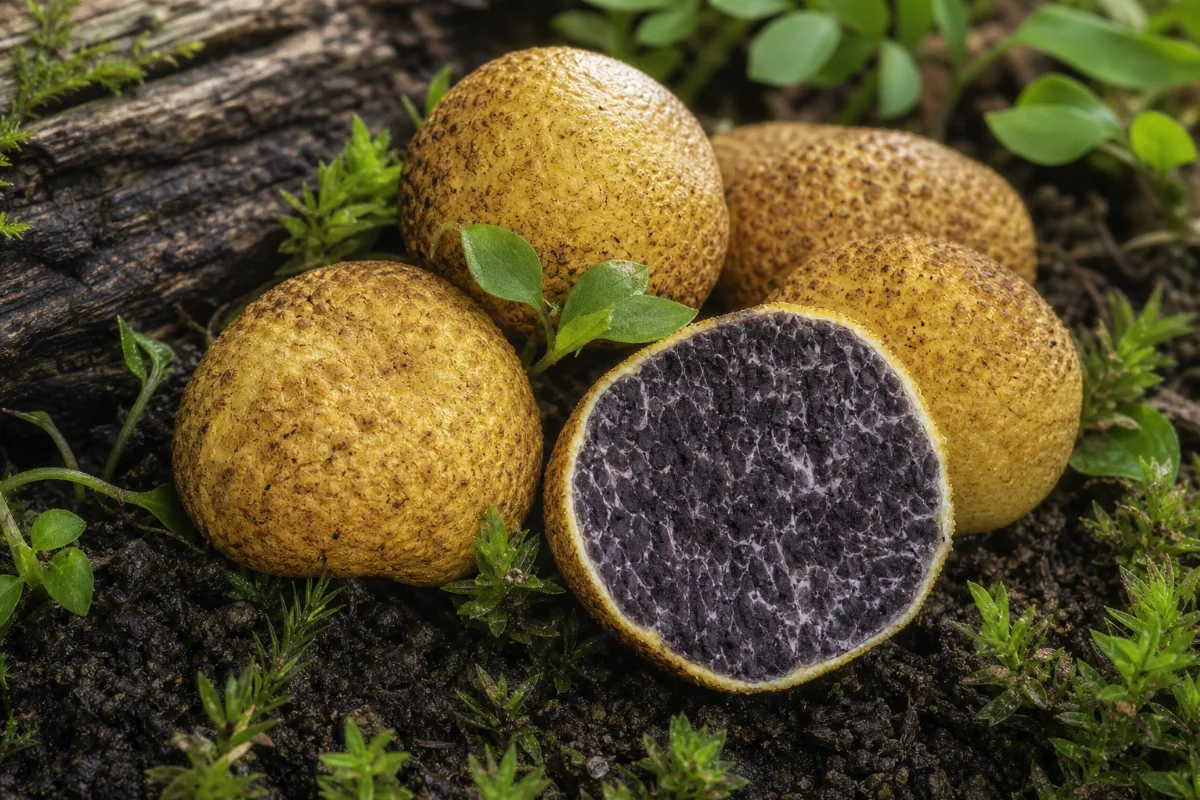
Mushrooms · Poisonous mushroom
Common earthball
Scleroderma citrinum · also called Pigskin poison puffball; earth ball
The common earthball is a poisonous wild fungus. Eaten by mistake it usually causes vomiting and stomach upset, and in a small share of French cases it also caused dizziness, fainting, muscle jerks and heart or blood-pressure changes. It is confused with edible puffballs and truffles. It is not a food or a supplement, and no trial shows it helps any condition. If someone has eaten it, call a poison centre right away.
General information, not medical advice. Last substantive update · Not medically reviewed. A named clinician has not signed off on this page. How this page is made
About Common earthball
The common earthball (Scleroderma citrinum) is a poisonous fungus, not a puffball and not a truffle. Eaten by mistake it usually causes vomiting and stomach upset. In a French poison-centre series of 134 earthball cases, most people had no symptoms or minor ones, but 7% were moderate or severe, with dizziness, fainting spells, muscle jerks, low blood pressure or an abnormal heartbeat. The poison is unknown and no antidote is described. No clinical trial supports any health use.
Danger first: what poisoning looks like
French poison centres logged 134 Scleroderma (earthball) cases between 2000 and 2022. The authors call it the largest national series so far. Most exposures were accidental. Most people had no symptoms or only minor stomach effects. Nine cases (7%) were moderate or severe. Besides vomiting and stomach pain, several people had vertigo, short disorders of consciousness or muscle jerks, and low blood pressure, a slow heartbeat or a fast irregular heartbeat. That series covers the Scleroderma group, so we cannot say how many cases were this exact species.
A US poison centre warned that eating it could leave people vomiting for quite a while. A US registry lists a man whose nausea and vomiting began after about 1.25 hours. If someone may have eaten it, or any wild fungus they cannot name for certain, call a poison centre right away. Do not wait for symptoms.
What happened in a serious case with a relative
A Japanese case report describes a 66-year-old man who ate a fried garden fungus later identified as a related earthball, Scleroderma albidum. He lost consciousness 10 minutes later. At hospital he had visual disturbance, light-headedness, a heart rate of 52 and a blood pressure of 53/42. He was treated by clinicians within an hour, stayed in shock for under 2 hours and went home 2 days later with no complications. His wife had eaten two or three slices and had no symptoms.
That is one man, with a past brain bleed and alcoholic hepatitis, and a different species. It shows how wide the range of reactions can be within this group. It is not a rule for what any one person will experience, and it says nothing about a safe amount.
Does cooking make it safe?
We found no study of whether cooking, drying or freezing changes its toxicity. People became ill after eating it fried or well cooked in the Japanese report and in a US registry case. A popular website says the toxins are not destroyed by cooking but gives no reference. Do not assume any preparation makes it safe.
Mix-ups with puffballs and truffles
Poison centres in France and the US report that it is eaten by mistake for edible puffballs and truffles. A US registry case involved a mushroom misidentified as a pear-shaped puffball. A popular website adds that it has been used as a truffle substitute, but it gives no references and we found no scientific study, so treat that as unconfirmed. If you buy truffles, buy from trusted sellers.
This page does not teach identification. A photo, a name, an app or a home test is never proof that a wild fungus is safe. Only a trained expert looking at the fungus in person can say, and the safest choice is to leave wild fungi you cannot name for certain alone.
Children and pets
A US registry lists an incident in which a child under 5 foraging a Scleroderma cepa group mushroom had three spells of vomiting. It also lists dogs and puppies that ate Scleroderma species and had vomiting, listlessness, chills, cramps, disorientation and drowsiness; the puppies survived. A 1990 report describes S. citrinum poisoning in a pot-bellied pig. Call a poison centre, vet or animal poison line at once.
What research exists
Almost all human research is about poisoning: a French series, case reports and registry entries. The poison has not been identified. Chemists have isolated compounds such as triterpenoids, pigments and ergosterol. In test tubes one triterpenoid was active against a herpes virus and a pigment-type acid and its derivatives against tuberculosis bacteria, and a 2026 paper used computer models to predict binding to some proteins. None of this involves people, and the fungus itself remains poisonous.
What it is
Scleroderma citrinum Pers. is the accepted name in the GBIF database (family Sclerodermataceae). Older names in use include Scleroderma aurantium and Scleroderma vulgare. It is a fungus, not a plant. Index Fungorum was not checked.
At a glance
Traditional uses history, not proof
- No traditional medicinal use is described in the sources we read.
- A popular website says slices were once used as a cheap truffle stand-in; it gives no references, so this is not verified (FungiAtlas).
Studied for research
- Eating it as food or as a truffle substitute: poison reports advise against it
- Germ and virus tests on isolated compounds: laboratory only, very low evidence
- Computer predictions for virus and brain-enzyme targets: not a finding about people
- Almost all human research is about poisoning, not benefit
Main compounds
- The poison has not been identified
- Pigments such as sclerocitrin (activity unclear, not shown to cause poisoning)
- Triterpenoids and ergosterol (laboratory and computer work only)
Common forms
- Wild fungus eaten by mistake (the only way people meet it)
- Not sold as a supplement; no preparation advice is given
Research links: Poison Control (US): get help online or call 1-800-222-1222 · French poison-centre series on earthball poisoning, 2000-2022 (abstract) · Case report: a related earthball (Scleroderma albidum) poisoning (abstract) · US poison centre notice on the pigskin poison puffball · NHS (UK): what to do in poisoning · NSW Poisons Information Centre (Australia) · Research Library · Genes & Biomarkers Library
What it is and its history
- Accepted scientific name
- Scleroderma citrinum
- Naming authority
- Pers. (GBIF; published 1801)
- Synonyms
- Scleroderma aurantium; Scleroderma vulgare; Lycoperdon aurantium (GBIF synonyms; the 2026 in-silico paper also names S. aurantium and S. vulgare as synonyms)
- Common names
- Common earthball (English); Pigskin poison puffball (English); Earth ball (English)
- Family or group
- Sclerodermataceae (a fungus family), not a plant and not a true puffball or truffle
- Classification
- Fungi > Basidiomycota > Agaricomycetes > Boletales > Sclerodermataceae > Scleroderma > Scleroderma citrinum
- Native range
- Not described in the sources we read; GBIF holds about 85,000 occurrence records.
- Habitat
- Not described in the sources we read.
- What it looks like
- Fruiting body: Not described. This page gives no identification help.
- Cultivation
- Not a cultivated or food mushroom; no cultivation source found.
- Look-alikes and adulterants
- Name: Edible puffballs; Note: French poison centres describe confusion with edible puffballs, and a US registry case involved a mushroom misidentified as a pear-shaped puffball. No way to tell them apart is given here.; Name: Truffles; Note: French poison centres and a US poison centre describe confusion with truffles.
- Sustainability and conservation
- Not checked.
Traditional use and history history, not clinical proof
| Tradition or era | Documented use | Source |
|---|---|---|
| Use as a truffle stand-in (claimed) | A popular website calls it a historical 'poor man's truffle' with slices added to dishes, and says it is sometimes fraudulently used as a truffle substitute. NOT verified: no references and no scientific study found. | s-fungiatlas |
| Traditional medicine | No traditional medicinal use described in the sources we read. |
Traditional use shows how it was used. It does not show that it works or is safe today.
What is inside, and how it may work
What it contains and how those compounds act in cells and animals. Laboratory and animal mechanisms are not proven effects in people.
Main compounds
| Compound | Family | Where it is concentrated | Activity studied | Level of evidence |
|---|---|---|---|---|
| Sclerocitrin (pigment) | pigment | Fruiting body | Reported from S. citrinum by the Japanese case-report authors, who say its biological activity is unclear. Not shown to cause poisoning. 9 | Unclear |
| Lanostane-type triterpenoids | triterpene | Fruiting body | A new lanostane triterpenoid (2003) showed antiviral activity against herpes simplex virus type 1 in the laboratory; a related one (2026) was modelled on a computer. 6 2 | In vitro / in silico |
| 4,4'-Dimethoxyvulpinic acid and methyl 4,4'-dimethoxyvulpinate (pigment-type) | vulpinic-acid type pigments | Fruiting body | The acid and two derivatives were active against Mycobacterium tuberculosis in the laboratory. 6 | Laboratory research |
| Pulvinic acid dimers (pigment-type) | pigment | Fruiting body | Named in a 2004 chemistry paper title; no abstract was read, so nothing about activity is stated. 10 | Unclear |
| Ergosterol | sterol | Fruiting body | Isolated in the 2026 paper and modelled on a computer; common in fungi generally. 2 | In silico |
Mechanisms, receptors and pathways
| Target or pathway | Gene or receptor | What was found | Level |
|---|---|---|---|
| Poisoning mechanism | unknown | The toxic compounds have not been identified. In a Japanese case with a relative, the authors thought the picture fitted muscarinic effects with some nervous-system toxicity. 3 9 | Case report |
| Antiviral and antibacterial screening | n/a | A triterpenoid was active against herpes simplex virus type 1, and a pigment-type acid and derivatives against M. tuberculosis, in laboratory tests. 6 | Laboratory research |
| Docking predictions | PARP1, CDC25B, PTGS2, acetylcholinesterase | Computer models predicted binding of two isolated compounds; the authors call for in vitro and in vivo validation. 2 | In silico |
Absorption, metabolism and elimination
- Absorption
- Not studied.
- Distribution
- Not studied.
- Metabolism
- Not studied.
- Elimination
- Not studied.
- Bioavailability
- Not established.
Isolated compounds versus whole extracts
All laboratory results are for isolated or modified compounds or computer models. None is for the whole mushroom, and the whole mushroom is poisonous.
Nutritional composition
Not a food mushroom. We found no nutrient table, so no nutrient figures are given.
2 very low certainty1 not enough evidence1 evidence against
What was looked at
The 4 benefits and uses checked for Common earthball, each with how strong the evidence is. Tap one to open it.
What is Common earthball good for?
The uses people ask about and how strong the human evidence is for each. None is proven. Read every row together with the Safety tab: this is a poisonous fungus.
Benefits, one by one
Each card is a research question, not a promise. Tap a goal to filter. Open a card to see the studies, doses and limits.
Eating it as food or as a truffle substitute
Evidence againstIt is not a food. Poison centres describe people eating it by mistake and becoming ill. A popular website says slices were once passed off as truffle; we found no scientific study of that.
4 studiesNot covered. This page gives no amounts, preparation or ways of using…
Studies, doses and limits
What the trials found
No trial. Reports are of poisoning: French poison centres logged 134 Scleroderma cases, most exposures accidental, often by confusion with edible puffballs or truffles. A US registry lists a man who became ill after eating half of a well-cooked one. A regional US poison centre warned the mushroom is sometimes taken for an edible puffball or mistaken for a truffle.
Results
Vomiting and stomach upset are the usual harm. No source we read shows any benefit of eating it.
Why this rating
Every human report is of poisoning, and poison centres advise against eating it. The truffle-substitute claim rests on a popular site with no references.
Form and dose studied
Not covered. This page gives no amounts, preparation or ways of using it.
Who was studied
People who ate it by mistake (adults, a child under 5, pets).
Limits
Poison-centre records and registry reports are incomplete and cannot show how much anyone ate or exactly which species it was.
Why researchers looked
People ask because it is sometimes confused with edible puffballs and truffles, and a popular site says it was used as a cheap truffle stand-in.
Traditional use
A popular website calls it a historical 'poor man's truffle'. It gives no reference, so this is NOT verified.
Proposed mechanism Unknown
The poisonous compound or compounds have not been identified (French poison-centre study; Japanese case report on a relative).
A proposed mechanism does not show that the effect happens in people.
This is a poisonous mushroom. Eaten by mistake it usually causes vomiting and stomach upset, and a minority of cases in France had dizziness, fainting spells, muscle jerks or heart and blood-pressure changes. See the Safety tab first. Call a poison centre if someone has eaten it.
Germ and virus tests on isolated compounds (laboratory only)
Very low certaintyIn test tubes, a compound from the mushroom was active against a herpes virus, and a related pigment-type compound was active against tuberculosis bacteria. This is chemistry-lab work on isolated and modified molecules, not a treatment.
1 studiesNot covered. Isolated compounds were tested, not the mushroom.
Studies, doses and limits
Results
A lanostane-type triterpenoid showed significant antiviral activity against herpes simplex virus type 1 in the laboratory. 4,4'-Dimethoxyvulpinic acid and two chemical derivatives were active against Mycobacterium tuberculosis in the laboratory. The abstract gives no potency figures.
Why this rating
A single test-tube study of isolated compounds, two of them chemically modified.
Form and dose studied
Not covered. Isolated compounds were tested, not the mushroom.
Limits
Activity in a dish rarely carries over to people. A poisonous mushroom is not a source for any of this.
Why researchers looked
Chemists screen compounds from fungi for activity against germs and viruses to find leads for new drugs.
Traditional use
No traditional medicinal use is described in the sources we read.
Proposed mechanism Laboratory research
Not worked out in the abstract.
A proposed mechanism does not show that the effect happens in people.
This is a poisonous mushroom. Eaten by mistake it usually causes vomiting and stomach upset, and a minority of cases in France had dizziness, fainting spells, muscle jerks or heart and blood-pressure changes. See the Safety tab first. Call a poison centre if someone has eaten it.
Computer predictions for virus and brain-enzyme targets
Not enough evidenceA 2026 paper isolated three compounds from the mushroom and used computer models to predict how they might bind some proteins. The authors say this needs real experiments. It is a prediction, not a finding about people.
1 studiesNot covered. Isolated compounds were modelled, not the mushroom.
Studies, doses and limits
Results
Three compounds were isolated (a lanostane-type triterpenoid, ergosterol and triacylglycerols). The computer models predicted stronger binding than the drugs Tamiflu and galantamine for two of them. The authors state that in vitro and in vivo validation is needed.
Why this rating
A computer model only: no cell, animal or human result.
Form and dose studied
Not covered. Isolated compounds were modelled, not the mushroom.
Limits
Predicted binding does not show an effect, and the same mushroom is poisonous when eaten.
Why researchers looked
Researchers use docking software to look for drug leads among natural compounds.
Proposed mechanism In silico
Predicted binding to PARP1, CDC25B, PTGS2 and acetylcholinesterase in computer models (docking and dynamics simulations).
A proposed mechanism does not show that the effect happens in people.
This is a poisonous mushroom. Eaten by mistake it usually causes vomiting and stomach upset, and a minority of cases in France had dizziness, fainting spells, muscle jerks or heart and blood-pressure changes. See the Safety tab first. Call a poison centre if someone has eaten it.
Toxicity to cancer cell lines (laboratory only)
Very low certaintyTwo chemically modified versions of a mushroom compound were toxic to one cancer cell line in a dish. That does not mean the mushroom or its compounds treat cancer.
1 studiesNot covered.
Studies, doses and limits
Results
In the 2003 isolation paper, two derivatives of 4,4'-dimethoxyvulpinic acid (a dibromo derivative and an acetate derivative) showed cytotoxicity against the NCI-H187 cell line. The abstract gives no figures.
Why this rating
One test-tube study with chemically modified compounds.
Form and dose studied
Not covered.
Limits
Killing cells in a dish is not a treatment. Healthy cells were not compared in the abstract.
Why researchers looked
Cell-line screens are a routine first step in looking for drug leads.
Proposed mechanism Laboratory research
Not described in the abstract.
A proposed mechanism does not show that the effect happens in people.
This is a poisonous mushroom. Eaten by mistake it usually causes vomiting and stomach upset, and a minority of cases in France had dizziness, fainting spells, muscle jerks or heart and blood-pressure changes. See the Safety tab first. Call a poison centre if someone has eaten it.
Connections to the rest of health
How Common earthball connects to the rest of our health knowledge graph. Every link says what kind of connection it is. A safety link (for example to the liver) is a warning, not a benefit. A study that merely mentions a topic never creates a benefit link.
Explore every connection: goals, body systems, organs, symptoms, genes
B. Body systems
| Connected to | Kind of connection | Evidence status | Context | Studies |
|---|---|---|---|---|
| Digestive system | Adverse effect or risk | Low certainty | Vomiting, stomach pain and diarrhoea after eating it. Preparation or compound: Fruiting body eaten by mistake |
3 1 7 |
| Nervous system | Adverse effect or risk | Low certainty | Vertigo, short disorders of consciousness and muscle jerks in a minority of French cases. Preparation or compound: Fruiting body eaten by mistake (genus-level reports) |
3 9 |
| Cardiovascular system | Adverse effect or risk | Low certainty | Low blood pressure and slow or irregular heartbeat in moderate or severe cases. Preparation or compound: Fruiting body eaten by mistake (genus-level reports) |
3 9 |
| Digestive System | Biological association | Evidence against | Studied for: Eating it as food or as a truffle substitute | 3 1 7 4 |
| Immune System | Biological association | Very low certainty | Studied for: Germ and virus tests on isolated compounds (laboratory only) Studied for: Computer predictions for virus and brain-enzyme targets | 6 2 |
| Nervous System | Biological association | Not enough evidence | Studied for: Computer predictions for virus and brain-enzyme targets | 2 |
E. Health conditions
| Connected to | Kind of connection | Evidence status | Context | Studies |
|---|---|---|---|---|
| Mushroom poisoning | Low certainty | A documented cause of accidental mushroom poisoning. Preparation or compound: Fruiting body |
3 7 |
J. Genes, receptors and enzymes
| Connected to | Kind of connection | Evidence status | Context | Studies |
|---|---|---|---|---|
| Acetylcholinesterase (computer model only) | Preliminary mechanism | In silico | Predicted binding by two isolated compounds in docking. | 2 |
L. Active compounds
| Connected to | Kind of connection | Evidence status | Context | Studies |
|---|---|---|---|---|
| Sclerocitrin (pigment) | Biological association | Unclear | Reported from S. citrinum by the Japanese case-report authors, who say its biological activity is unclear. Not shown to cause poisoning. Preparation or compound: Fruiting body |
9 |
| Lanostane-type triterpenoids | Biological association | In vitro / in silico | A new lanostane triterpenoid (2003) showed antiviral activity against herpes simplex virus type 1 in the laboratory; a related one (2026) was modelled on a computer. Preparation or compound: Fruiting body |
6 2 |
| 4,4'-Dimethoxyvulpinic acid and methyl 4,4'-dimethoxyvulpinate (pigment-type) | Biological association | In vitro | The acid and two derivatives were active against Mycobacterium tuberculosis in the laboratory. Preparation or compound: Fruiting body |
6 |
| Pulvinic acid dimers (pigment-type) | Biological association | Unclear | Named in a 2004 chemistry paper title; no abstract was read, so nothing about activity is stated. Preparation or compound: Fruiting body |
10 |
| Ergosterol | Biological association | In silico | Isolated in the 2026 paper and modelled on a computer; common in fungi generally. Preparation or compound: Fruiting body |
2 |
Each connection is stored with the ingredient, the connected record, the kind of connection, the evidence status, the supporting studies, the preparation or compound involved, and a review date (last reviewed October 25, 2026).
Evidence at a glance: what the research found for 4 outcomes
Each outcome below is one thing researchers measured. Certainty is how far the evidence can be trusted, not how well it works. The full studies are on the next tab.
The evidence
The research centre for Common earthball. Every record here was checked against PubMed or the publisher's page; we never list a study we have not verified.
Evidence by outcome
Bars show how many studies we found for each outcome, not how well it works. People are added up across trials only (reviews are not added, to avoid double counting).
How we rate evidence
High certainty
Several well-run trials or reviews agree; further research is unlikely to change the picture much.
Moderate certainty
Good trials point the same way, but some doubt remains.
Low certainty
Small, short or inconsistent trials. The finding could change with better research.
Very low certainty
Very little or very weak human data. Treat as a possibility only.
Mixed findings
Trials or reviews disagree with each other.
Not enough evidence
Not enough human research to say either way.
Evidence against
Good research found no benefit, or found harm.
We take the reviewers' own risk-of-bias and GRADE statements where they exist, and otherwise judge from study size, design, consistency, directness and whether a product matches what is sold. Many publications do not make evidence high. Method note: We searched PubMed and read the PubMed records of six papers (four with abstracts), read the abstract of the French poison-centre series via Crossref, the Japanese case report in full, the Scleroderma entries of a US poisoning registry, a US poison-centre notice and poison-help pages from the US, UK and Australia, and checked the scientific name in GBIF. Index Fungorum could not be checked. Where a statement could not be checked it is marked as unverified.
Study library: every study we checked 14
| Study | Design | People | Product, dose, length | Result |
|---|---|---|---|---|
| Beug 2021 Summary of the poisoning reports in the NAMA Mushroom Poisoning Case Registry, 2018-2020 McIlvainea 30 · Source |
Registry summary (voluntary reports) Scleroderma citrinum and other Scleroderma species |
Voluntary North American mushroom poisoning reports, 2018-2020 (humans and pets) | n/a |
A man ate half of one well-cooked mushroom misidentified as a pear-shaped puffball (reported as Scleroderma citrinum) and had nausea and vomiting, starting after 1.25 hours. A man who ate half a medium well-cooked mushroom reported as Scleroderma cf. areolatum had hallucinations, disorientation, vomiting, nausea, weakness and tiredness, with onset 3 to 4 hours; treatment was not reported. A man who ate one raw bite of a Scleroderma species had vision problems, weakness and dizziness and recovered fully in 3 to 4 hours without treatment. An infant foraging incident with a Scleroderma cepa group mushroom caused three spells of vomiting. Dogs and puppies eating Scleroderma species had vomiting, listlessness, chills, cramps, disorientation and drowsiness; the puppies survived. Methods, limits and fundingOutcomes: Scleroderma entries in the registry tables Limitations: Voluntary reports, so counts are incomplete. Species names are as given by the registry and are not all S. citrinum. Read from text extracted from the PDF. Read: full-text (Scleroderma entries) |
| Bolinget 2026 In Silico Evaluation of Bioactive Compounds Isolated from Scleroderma citrinum Against H1N1 and Acetylcholinesterase: A Post-COVID Perspective Current Pharmaceutical Design (online ahead of print) · PMID 42220128 · DOI |
Laboratory isolation plus computer modelling (docking) Scleroderma citrinum |
Compounds from freeze-dried fruiting bodies; computer models only | n/a |
Three compounds were isolated: 3,25-dihydroxy-22-acetoxylanosta-8,23-diene, ergosterol and triacylglycerols. Computer docking predicted that the first and ergosterol bind some proteins more strongly than the drugs Tamiflu and galantamine, and the authors call this suggestive of antiviral and neuroprotective potential. They state that it needs validation in vitro and in vivo. Methods, limits and fundingOutcomes: Predicted binding of isolated compounds to virus-related and brain-enzyme proteins Limitations: A computer prediction, not an experiment on cells, animals or people. Predicted binding does not mean an effect. Online ahead of print. Read: abstract |
| Bruneau 2026 Scleroderma mushroom poisoning in France (2000-2022): clinical patterns and early signals of a possible emerging mycotoxic syndrome Mycological Progress 25:6 · Source · DOI |
Retrospective case series (poison centre records) Scleroderma species (genus); S. citrinum share not stated |
134 134 Scleroderma-related cases reported to French poison control centres, 2000-2022 |
n/a |
Most exposures were accidental, often through confusion with edible puffballs or truffles. Most patients had no symptoms or only minor stomach effects. Nine cases (7%) were moderate or severe. Besides vomiting and stomach pain, several had vertigo, short disorders of consciousness or myoclonia (muscle jerks), and heart or blood-pressure problems (low blood pressure, slow heartbeat or fast irregular heartbeat). Similar cases have been described in Germany and Japan with no other toxic species eaten. The responsible compounds remain unidentified. The authors suggest it may be a new poisoning pattern worth studying. Methods, limits and fundingOutcomes: Pattern and severity of poisoning with Scleroderma species (earthballs) Limitations: Only the abstract (via Crossref) was read. How many cases were S. citrinum, the average time to symptoms and the exact share without symptoms are not in the abstract. Retrospective; species identification in poison-centre records can be uncertain. Read: abstract |
| FungiAtlas (popular website 2026 FungiAtlas: Scleroderma citrinum (Common Earthball) fungiatlas.com · Source |
Popular website Scleroderma citrinum |
General readers | n/a |
The page lists the mushroom as poisonous, says it is sometimes fraudulently used as a truffle substitute because of its smell, calls it a historical 'poor man's truffle' with slices once added to dishes, and says the toxins are not destroyed by cooking. It gives no references. Methods, limits and fundingOutcomes: Claims about edibility and truffle use Limitations: Popular site with no sources. The truffle-substitute and cooking statements are therefore unverified. Read 25 October 2026. Read: full-text |
| Galey 1990 A case of scleroderma citrinum poisoning in a miniature Chinese pot-pellied pig Veterinary and Human Toxicology 32(4):329-330 · PMID 2389545 |
Case report (animal) Scleroderma citrinum |
1 One miniature pot-bellied pig |
n/a |
PubMed lists this animal case report of S. citrinum poisoning in a pig. The record has no abstract, so we did not read what happened and do not state any detail from it. Methods, limits and fundingOutcomes: Poisoning after eating Scleroderma citrinum Limitations: Title and PubMed record only; no abstract. Animal case. Details not read. Read: title-only |
| Kanokmedhakul 2003 A bioactive triterpenoid and vulpinic acid derivatives from the mushroom Scleroderma citrinum Planta Medica 69(6):568-571 · PMID 12865983 · DOI |
Laboratory compound isolation and screening Scleroderma citrinum |
Isolated compounds tested in the laboratory (no people or animals) | n/a |
The authors isolated a new lanostane-type triterpenoid, methyl 4,4'-dimethoxyvulpinate and 4,4'-dimethoxyvulpinic acid from the mushroom. The triterpenoid showed significant antiviral activity against herpes simplex virus type 1 in the laboratory. The acid and two chemical derivatives were active against Mycobacterium tuberculosis in the laboratory, and two derivatives were also toxic to the NCI-H187 cancer cell line. Methods, limits and fundingOutcomes: Antiviral, antibacterial and cell-toxicity screening of compounds from the fruiting body Limitations: Test-tube work on isolated compounds, two of the active ones chemically modified. Says nothing about the mushroom as eaten or about any effect in people. The abstract gives no potency numbers. Read: abstract |
| Northern New England Poison Center (blog post) 2014 Don't trifle with a pigskin poison puffball NNEPC regional news, 27 August 2014 · Source |
Poison centre notice Scleroderma citrinum |
Callers to a regional poison centre in northern New England, USA | n/a |
The poison centre said it had seen a few cases in the previous week of people eating the mushroom. It said the mushroom will not agree with your stomach and eating some could leave you vomiting for quite a while. It said the mushroom is sometimes taken for an edible puffball or mistaken for a truffle, and advised eating wild mushrooms only if a trained mushroom expert has identified them. Methods, limits and fundingOutcomes: Warning about Scleroderma citrinum Limitations: A short public notice; no case numbers or outcomes. 2014. Read: full-text |
| Rasalanavho 2019 Elemental distribution including toxic elements in edible and inedible wild growing mushrooms from South Africa Environmental Science and Pollution Research 26(8):7913-7925 · PMID 30684184 · DOI |
Laboratory measurement of metals Scleroderma citrinum |
Wild mushrooms collected in South Africa, 30 species including Scleroderma citrinum | n/a |
Scleroderma citrinum is one of the 30 species measured. The abstract gives no figures for individual species. It says metal uptake depends on soil and environment, not on whether a mushroom is edible, and that the edible species it names had low toxic-metal levels. Methods, limits and fundingOutcomes: Metal and trace-element content of edible and inedible wild mushrooms Limitations: The abstract has no S. citrinum figures, so nothing species-specific is stated here. The full text was not read. Read: abstract |
| Sato 2019 Mushroom poisoning with Scleroderma albidum: a case report with review of the literature Acute Medicine & Surgery 7(1):e460 · PMID 31988772 · DOI |
Case report Scleroderma albidum (genus report; also mentions S. citrinum) |
1 One 66-year-old man in Japan with a history of brain bleed and alcoholic hepatitis |
n/a |
A man sliced and fried a garden mushroom, ate nearly all of it and lost consciousness 10 minutes later. At hospital he had visual disturbance, light-headedness, a heart rate of 52 beats per minute and a blood pressure of 53/42 mmHg. Stomach washing and activated charcoal were given within an hour; he stayed in shock for under 2 hours and was discharged 2 days later with no complications. His wife had eaten two or three slices and had no symptoms. The mushroom was identified as Scleroderma albidum. The authors concluded it caused muscarinic effects with signs of central nervous system toxicity, said the toxic substance could not be analysed, and noted that sclerocitrin is reported from S. citrinum but its biological activity is unclear. Methods, limits and fundingOutcomes: Symptoms, treatment and course after eating a Scleroderma mushroom Limitations: One patient and a different species (S. albidum, not S. citrinum). The man had other illnesses. The poison was not identified. A household of two cannot show a dose pattern. Read: abstract+full-text |
| Winner 2004 Unusual pulvinic acid dimers from the common fungi Scleroderma citrinum (common earthball) and Chalciporus piperatus (peppery bolete) Angewandte Chemie International Edition 43(14):1883-1886 · PMID 15054803 · DOI |
Laboratory chemistry Scleroderma citrinum |
Fungal chemistry (no people or animals) | n/a |
PubMed lists this paper on pulvinic acid dimers (pigment-type molecules) from the common earthball and the peppery bolete. The record has no abstract, so nothing beyond the title is stated here. Methods, limits and fundingOutcomes: Pigment structures in the fungus Limitations: Title and PubMed record only; no abstract. Read: title-only |
| n/a 2026 Poison Control (National Capital Poison Center): home page and call advice poison.org · Source |
Authoritative guidance n/a |
n/a | n/a |
The home page gives the poison help number 1-800-222-1222 (free, expert and confidential) and says to call 911 if the person collapses, has a seizure, has trouble breathing or cannot be awakened. Read 25 October 2026. Methods, limits and fundingOutcomes: What to do in a suspected poisoning in the US Limitations: A public help page; it does not mention this mushroom. Read: full-text |
| n/a 2026 NHS (UK): Poisoning nhs.uk · Source |
Authoritative guidance n/a |
n/a | n/a |
The page says to call 999 or go to A&E if someone may have swallowed something harmful, has lost consciousness, has stopped breathing or has a seizure, and to call NHS 111 if you are not sure whether something swallowed is harmful. Read 25 October 2026. Methods, limits and fundingOutcomes: What to do in suspected poisoning in the UK Limitations: A public help page; it does not mention this mushroom. Read: full-text |
| n/a 2026 NSW Poisons Information Centre (Australia): home page poisonsinfo.nsw.gov.au · Source |
Authoritative guidance n/a |
n/a | n/a |
The home page says the centre can be called 24/7 on 13 11 26, says not to wait for symptoms, and says to call Triple Zero (000) for an ambulance if someone is unconscious or not breathing. Read 25 October 2026. Methods, limits and fundingOutcomes: Poison advice line in Australia Limitations: A public help page for one Australian state service; it does not mention this mushroom. Read: full-text |
| n/a 2026 GBIF Backbone Taxonomy: Scleroderma citrinum Pers. (species key 5239982) gbif.org · Source |
Registry or database Scleroderma citrinum |
n/a | n/a |
Accepted species in the GBIF backbone: Scleroderma citrinum Pers. (1801, Syn. Meth. Fung. 1: 153), family Sclerodermataceae, order Boletales, class Agaricomycetes, phylum Basidiomycota, kingdom Fungi. Synonyms listed include Scleroderma aurantium, Scleroderma vulgare and Lycoperdon aurantium. English names listed include Common Earthball, Earth Ball and Pigskin Poison Puffball. About 85,000 occurrence records. Read through the GBIF API on 25 October 2026. Methods, limits and fundingOutcomes: Accepted name, authority, family, synonyms Limitations: A database record. Index Fungorum and MycoBank were not checked. Read: full-text |
What we do not know yet
- No clinical trial of the common earthball for any use.
- The poisonous compound has not been identified, and no measured toxin amount was found.
- The French series covers the Scleroderma group; the share caused by this species and the average time to symptoms are not known to us.
- No data on pregnancy, breastfeeding, long-term effects or medicine interactions.
- No scientific study of cooking and toxicity, or of earthball being used to adulterate truffles.
How new research is added
New studies are found by a saved PubMed search and are placed in a review queue. A person reads each one before it changes this page. Help-line pages are rechecked on a schedule.
Lab markers
What changed in blood or saliva tests during trials. A changed number is not the same as feeling or being healthier, and we give no "normal ranges".
Safety
What studies and official sources say about side effects, medicines and who should check first. Each point shows what kind of evidence it comes from.
Main points to know 4
- Poisonous: eaten by mistake it usually causes vomiting and stomach upset. French poison centres logged 134 earthball cases between 2000 and 2022. Most were accidental. Most people had no symptoms or only minor stomach effects, but nine cases (7%) were moderate or severe, with vertigo, short disorders of consciousness, muscle jerks, low blood pressure, slow heartbeat or fast irregular heartbeat. The poison has not been identified. Case series 3
- If someone has eaten it, call a poison centre now. Do not wait for symptoms. In the US call Poison Help at 1-800-222-1222 (free and confidential), or 911 if the person collapses, has a seizure, has trouble breathing or cannot be awakened. In the UK call NHS 111 if you are unsure and 999 in an emergency. In Australia the Poisons Information Centre line is 13 11 26. Keep the mushroom, a photo or the package to show staff. Authoritative guidance 11 12 13
- Cooking is not known to make it safe. People became ill after eating it fried or well cooked in a Japanese report on a relative and in a US registry case. A popular website says cooking does not destroy the toxins, but gives no reference. No study tested whether cooking, drying or freezing changes its toxicity. Case report 9 1 4
- A name, a photo or an app is never proof a wild mushroom is safe. It is eaten by mistake because it is confused with edible puffballs and truffles. This page does not teach identification. Only a trained expert looking at the mushroom in person can say what it is, and many people choose to leave wild mushrooms alone. Authoritative guidance 3 7
Side effects 4
| Effect | How often | Severity and recovery | Evidence |
|---|---|---|---|
| Nausea, vomiting, stomach pain and diarrhoea In a US registry case, symptoms began after about 1.25 hours. | The usual effect; most of 134 French Scleroderma cases had none or only minor stomach effects | mild to moderate Usually passes; a regional poison centre says vomiting can go on for quite a while | Case series 3 7 1 |
| Vertigo, short disorders of consciousness, muscle jerks (myoclonia) Hallucinations and disorientation were also reported in a US registry case with a related Scleroderma. | Part of the 9 of 134 (7%) moderate or severe French cases (genus-level) | moderate to severe Not stated in the abstract | Case series 3 |
| Low blood pressure, slow heartbeat or fast irregular heartbeat In that Japanese case the man lost consciousness 10 minutes after eating, with heart rate 52 and blood pressure 53/42. | Part of the 9 of 134 French cases | moderate to severe In the Japanese case (a relative, S. albidum) shock lasted under 2 hours with treatment | Case report 3 9 |
| Vision problems, weakness and dizziness Visual disturbance also occurred in the Japanese case. | One US registry report (one raw bite of a Scleroderma species) | moderate Full recovery in 3 to 4 hours without treatment in that report | Case report 1 9 |
Liver
No liver injury attributed to Scleroderma was found in the sources we read. In the US registry, blood chemistries and liver enzymes were normal in a dog that ate Scleroderma areolatum. 1 3
How often. Not studied in people. The abstracts read do not report liver injury.
Monitoring. Decided by the poison centre and hospital team.
- US registry, dog that ate Scleroderma areolatum. Vomiting and listlessness; blood chemistries and liver enzymes normal; sent home for monitoring. 1
This is a safety connection. It is not evidence that Common earthball supports liver health.
Medicines and supplements 2
| With | Why it matters | Importance | Evidence | What to do |
|---|---|---|---|---|
| Alcohol, medicines and other substances not studied | Unknown, because the poison has not been identified. | No data. The Japanese patient also had a past brain bleed and alcoholic hepatitis, and the authors could not say what part those played. | None Not enough evidence 9 | Tell the poison centre or emergency team about every medicine, drink and substance taken. |
| Heart-rate and blood-pressure medicines prescription | Theoretical only: poisoning cases had low blood pressure, slow or irregular heartbeat, so extra effects on the heart are a concern. | Not studied. This is a reasoning from the symptoms, not a reported interaction. | Theoretical Not enough evidence 3 | Tell the emergency team about heart and blood-pressure medicines. |
Who should check first 4
| Situation | Advice | Evidence |
|---|---|---|
| Anyone | Do not eat it. No source shows a benefit, and poison centres report illness after eating it. | Case series 3 7 |
| Pregnancy and breastfeeding | No data. Do not eat wild mushrooms you cannot name for certain. If it was eaten, call a poison centre. | None |
| Children | Reports of children eating it are rare in our sources, but a US registry lists an incident with a child under 5 and a Scleroderma cepa group mushroom (three spells of vomiting). Call a poison centre if a child puts any wild mushroom in the mouth. | Case report 1 |
| Pets | Dogs and puppies that ate Scleroderma species had vomiting, listlessness, chills, cramps, disorientation and drowsiness in US registry reports; the puppies survived. A 1990 report describes a pig. Call a vet or an animal poison line at once. | Case report 1 5 |
Overdose, product quality and regulators
Summary. The compound or compounds that make earthballs poisonous have not been identified. The Japanese authors thought the picture in their patient pointed to muscarinic-type effects with some nervous-system toxicity, but could not analyse the poison.
Animal. A 1990 report of S. citrinum poisoning in a pot-bellied pig exists (title only read). Dogs and puppies were poisoned in US registry reports.
Human doses studied. No amount or toxic level was measured in any source we read. In one Japanese household the man who ate nearly all of a fried mushroom was seriously ill while his wife, who ate two or three slices, had no symptoms. That is one household, not a rule, and a safe amount cannot be inferred.
High dose or long term signals. Long-term effects were not found in the sources read.
Overdose response. There is no antidote in any source we read. In the Japanese case, stomach washing and activated charcoal were given by clinicians within an hour. That is a medical treatment decided by hospital teams, not something to do at home. The poison centre decides what is needed.
Toxic parts. Not studied; treat the whole fungus as poisonous.
Not read. Measured toxin content, animal toxicity studies, and the share of French cases that were S. citrinum specifically.
A South African study measured metals in 30 wild mushrooms including Scleroderma citrinum, but its abstract gives no figure for this species. It says metal uptake depends on soil and environment, not on whether a mushroom is edible. It is not a food or a supplement, so no product testing exists.
Metals. S. citrinum was among 30 species measured for metals; the abstract gives no species-level numbers. 8
Truffle substitution claim. A popular website says earthball has been fraudulently used as a truffle substitute. It gives no reference and we found no scientific study. Poison centres do report confusion with truffles. 4 3 7
| Body | Action | Date |
|---|---|---|
| Northern New England Poison Center (United States) | Warned in August 2014 that eating the mushroom can leave people vomiting for quite a while, and said it is sometimes taken for an edible puffball or mistaken for a truffle. source | 2014-08-27 |
| Poison Control (National Capital Poison Center) (United States) | Poison help line 1-800-222-1222; call 911 if the person collapses, has a seizure, has trouble breathing or cannot be awakened. source | 2026-10-25 |
| NHS (United Kingdom) | Call 999 for collapse, no breathing or a seizure; call NHS 111 if unsure whether something swallowed is harmful. source | 2026-10-25 |
| NSW Poisons Information Centre (Australia) | 24/7 advice line 13 11 26; Triple Zero (000) for someone unconscious or not breathing. source | 2026-10-25 |
When to get medical help
- If someone may have eaten this mushroom, or any wild mushroom they cannot name for certain, call a poison centre right away, even if they seem fine. In the US call Poison Help at 1-800-222-1222 (free and confidential); call 911 now if the person collapses, has a seizure, has trouble breathing or cannot be awakened (Poison Control, poison.org).
- UK: call 999 if the person has lost consciousness, stopped breathing or has a seizure; call NHS 111 if you are not sure whether something swallowed is harmful (NHS). Australia: the Poisons Information Centre line is 13 11 26, and Triple Zero (000) for an unconscious person or one who is not breathing (NSW Poisons Information Centre). For other countries see the poison help by country page.
- Signs seen in reports: nausea, vomiting, stomach pain, diarrhoea; and in a minority dizziness or vertigo, fainting, muscle jerks, confusion or hallucinations, vision problems, weakness, a slow or irregular heartbeat and low blood pressure.
- Do not wait to see whether symptoms pass, and do not try to make the person vomit unless the poison centre tells you to. Keep the mushroom or a photo to show staff.
If someone may be poisoned or in a crisis, contact a clinician or emergency service straight away. In the US, Poison Control is 1-800-222-1222.
General information only, not medical advice. Ask a clinician or pharmacist before use, especially with medicines, in pregnancy or with a health condition. See the Natural Remedy Safety guide.
Frequently asked questions
Is the common earthball edible?
What should I do if someone has eaten it?
Call a poison centre right away, even if the person seems fine. In the US call Poison Help at 1-800-222-1222 (free, confidential). Call 911 now if the person collapses, has a seizure, has trouble breathing or cannot be awakened. In the UK call NHS 111 if unsure, or 999 in an emergency. In Australia the Poisons Information Centre line is 13 11 26. Do not wait for symptoms, and keep the fungus or a photo to show staff.
What are the symptoms of earthball poisoning?
Vomiting, stomach pain and diarrhoea are the usual signs. In nine of 134 French Scleroderma cases (7%) there was also vertigo, short disorders of consciousness, muscle jerks, low blood pressure, a slow heartbeat or a fast irregular heartbeat. Many people had no symptoms.
How fast do symptoms start?
Is there an antidote?
Does cooking make it safe?
Is it sold as a truffle?
Can I tell it from a puffball by myself?
Is there any proven health use?
Can children or pets be poisoned?
Is it safe in pregnancy or while breastfeeding?
We found no data. Do not eat wild fungi you cannot name for certain, and if it was eaten call a poison centre.
Can it interact with alcohol or medicines?
Explore by health goal
Editorial transparency
- Written by
- AlternativeMed editorial team. Research compiled with AI assistance, then checked against PubMed records and regulator pages.
- Medical review
- None. This page has not been reviewed by a physician or pharmacist.
- First published
- 2026-10-25
- Last substantive update
- 2026-10-25
- How we research
- We searched PubMed and read the PubMed records of six papers (four with abstracts), read the abstract of the French poison-centre series via Crossref, the Japanese case report in full, the Scleroderma entries of a US poisoning registry, a US poison-centre notice and poison-help pages from the US, UK and Australia, and checked the scientific name in GBIF. Index Fungorum could not be checked. Where a statement could not be checked it is marked as unverified.
- How we rate evidence
- See "How we rate evidence" in the Evidence tab.
- Independence
- No product is promoted on this page. No affiliate links are shown. This page gives no dose, preparation, identification, picking or sourcing advice.
Sources 14
Each source was opened and checked. Where we read only the abstract, it says so. The small numbers in the text point here.
- Beug MW. Summary of the poisoning reports in the NAMA Mushroom Poisoning Case Registry, 2018-2020. McIlvainea 30. 2021. (full-text (Scleroderma entries))
- Bolinget E, Hsieh CY, Sevilla UT, Tsai PW. In Silico Evaluation of Bioactive Compounds Isolated from Scleroderma citrinum Against H1N1 and Acetylcholinesterase: A Post-COVID Perspective. Current Pharmaceutical Design (online ahead of print). 2026. PMID 42220128. DOI 10.2174/0113816128437221260303075920. (abstract)
- Bruneau C, Arnaud E, Lecot J, Landreau A, Le Roux G and the French Poison Control Centers Research Group (and others). Scleroderma mushroom poisoning in France (2000-2022): clinical patterns and early signals of a possible emerging mycotoxic syndrome. Mycological Progress 25:6. 2026. DOI 10.1007/s11557-025-02116-w. (abstract)
- FungiAtlas (popular website, no references). FungiAtlas: Scleroderma citrinum (Common Earthball). fungiatlas.com. 2026. (full-text)
- Galey FD, Rutherford JJ 3rd, Wells K. A case of scleroderma citrinum poisoning in a miniature Chinese pot-pellied pig. Veterinary and Human Toxicology 32(4):329-330. 1990. PMID 2389545. (title-only)
- Kanokmedhakul S, Kanokmedhakul K, Prajuabsuk T, Soytong K, Kongsaeree P, Suksamrarn A. A bioactive triterpenoid and vulpinic acid derivatives from the mushroom Scleroderma citrinum. Planta Medica 69(6):568-571. 2003. PMID 12865983. DOI 10.1055/s-2003-40639. (abstract)
- Northern New England Poison Center (blog post). Don't trifle with a pigskin poison puffball. NNEPC regional news, 27 August 2014. 2014. (full-text)
- Rasalanavho M, Moodley R, Jonnalagadda SB. Elemental distribution including toxic elements in edible and inedible wild growing mushrooms from South Africa. Environmental Science and Pollution Research 26(8):7913-7925. 2019. PMID 30684184. DOI 10.1007/s11356-019-04223-0. (abstract)
- Sato Y, Tomonari H, Kaneko Y, Yo K. Mushroom poisoning with Scleroderma albidum: a case report with review of the literature. Acute Medicine & Surgery 7(1):e460. 2019. PMID 31988772. DOI 10.1002/ams2.460. (abstract+full-text)
- Winner M, Gimenez A, Schmidt H, Sontag B, Steffan B, Steglich W. Unusual pulvinic acid dimers from the common fungi Scleroderma citrinum (common earthball) and Chalciporus piperatus (peppery bolete). Angewandte Chemie International Edition 43(14):1883-1886. 2004. PMID 15054803. DOI 10.1002/anie.200352529. (title-only)
- n/a. Poison Control (National Capital Poison Center): home page and call advice. poison.org. 2026. (full-text)
- n/a. NHS (UK): Poisoning. nhs.uk. 2026. (full-text)
- n/a. NSW Poisons Information Centre (Australia): home page. poisonsinfo.nsw.gov.au. 2026. (full-text)
- n/a. GBIF Backbone Taxonomy: Scleroderma citrinum Pers. (species key 5239982). gbif.org. 2026. (full-text)


