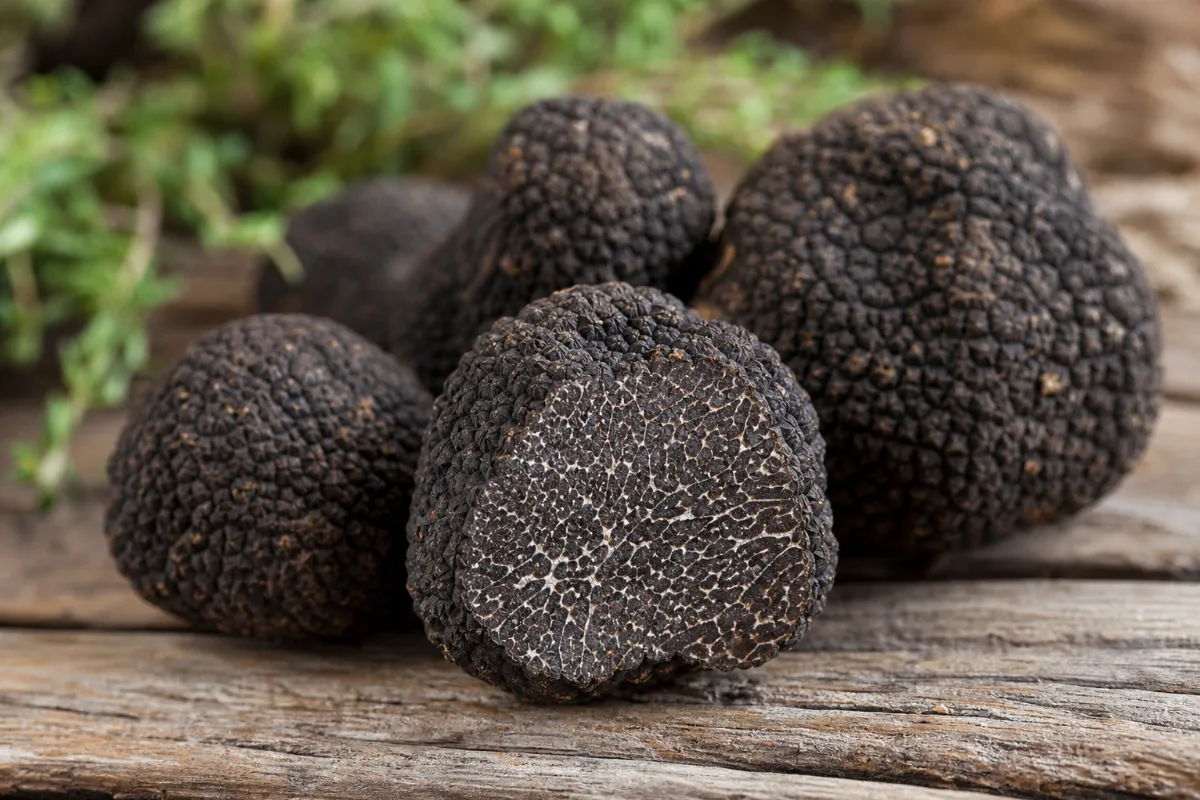
Mushrooms · Culinary fungus
Culinary truffles
Tuber melanosporum, Tuber magnatum, Tuber aestivum · also called Black Perigord truffle, white (Alba) truffle, summer truffle, Burgundy truffle
Truffles are underground fungi eaten in tiny amounts for their strong smell, grated or shaved over food. There are no human studies of health effects; the research is about aroma and test-tube work. Most truffle oil is flavoured with added aroma compounds, and these are not the psilocybin 'magic truffles'. The main caution is rare mushroom allergy and buying fake or spoiled product.
General information, not medical advice. Last substantive update · Not medically reviewed. A named clinician has not signed off on this page. How this page is made
About Culinary truffles
Truffles are underground fungi of the genus Tuber, eaten in tiny amounts for aroma. Chemistry explains their smell, but no human trial shows a health benefit; everything else is test-tube, cell-dish or rat work. Most truffle oil is flavoured with added aroma compounds. Mushroom allergy is rare but reported, and truffles are easy to fake or spoil.
What they are
Culinary truffles are the underground fruiting bodies of Tuber fungi that grow with tree roots. The three best known are the black Perigord truffle (Tuber melanosporum), the white truffle (Tuber magnatum) and the summer truffle (Tuber aestivum). The Burgundy truffle is often treated as a form of summer truffle, but its naming is unsettled.
Truffles are fungi, not plants. Desert truffles (Terfezia) are different fungi.
Not the same as magic truffles
'Magic truffles' are sclerotia of Psilocybe fungi, sold for the psychoactive substance psilocybin. They are unrelated to culinary truffles. See the separate page on psilocybin truffles for that subject.
Why they smell the way they do
Over 200 volatile compounds have been found across truffle species, but only about 30 to 60 in one species actively give smell. In white truffle, lab work found the strongest to be potato-like, malty, buttery and garlic-like compounds, and mixing them recreated the aroma. Aroma varies between species and even between single truffles.
Truffle oil
In 18 Italian truffle-flavoured olive oils, 19 of 63 volatile compounds came from truffles and 12 were foreign. The authors confirm the established practice of using bis(methylthio)methane (2,4-dithiapentane) in black-truffle flavourings, and a review says the exact synthetic mixture is unknown. The same compound also occurs in white truffle, so smell does not prove what is in the bottle. Check the label and seller.
As a food, and what the lab work shows
By dry weight, truffles are mostly carbohydrate, then protein, with little fat. A review says the price makes them unsuitable as a daily protein source. Test-tube and cell work reports antioxidant, anti-inflammatory and cancer-cell findings, but a 2025 review says human trials remain absent.
Quality: fake species and spoilage
Truffles are highly perishable. Because prices vary so much, papers describe lab methods to catch cheaper Chinese Tuber species passed off as black Perigord truffle. White truffles from Hungary tested clear of radioactive caesium-137, though only ten were checked.
At a glance
Traditional uses history, not proof
- Valued worldwide as a delicacy for aroma, with some species among the most expensive foods (reviews read).
- Older medicinal traditions were not read, so none is claimed here.
Studied for research
- Aroma chemistry, moderate (lab)
- Nutrients as a food, insufficient
- Antioxidant and anti-inflammatory activity, insufficient (test tube)
- Cancer-cell findings, insufficient (dishes only)
- Everything else, insufficient
Main compounds
- Sulfur aroma compounds such as bis(methylthio)methane (2,4-dithiapentane)
- Phenolics, ergosterol and polysaccharides
- Anandamide (in black truffle)
Common forms
- Fresh truffle, shaved or grated
- Preserved or frozen truffle
- Truffle oil, butter, salt, sauces and pastes (often flavoured)
- Laboratory extracts (research only)
Research links: Lee 2020 review: truffles in nutrition and medicine · Baldelli 2025 review: bioactive compounds in truffles · Pacioni 2014: composition of truffle-flavoured oils · Segelke 2020: telling truffle species apart · Research Library · Genes & Biomarkers Library
What it is and its history
- Accepted scientific name
- Tuber melanosporum, Tuber magnatum and Tuber aestivum (three separate species)
- Naming authority
- Vittad.; Picco; (Wulfen) Spreng. (GBIF)
- Synonyms
- Tuber uncinatum Chatin (Burgundy truffle) is listed by GBIF as a synonym of another entry; naming is unsettled
- Common names
- Black Perigord truffle (English); White truffle (Alba) (English); Summer truffle (English); Burgundy truffle (English)
- Family or group
- Tuberaceae (a fungus family, not a plant)
- Classification
- Fungi > Ascomycota > Pezizomycetes > Pezizales > Tuberaceae > Tuber > Tuber melanosporum; T. magnatum; T. aestivum
- Native range
- Not checked in the sources read, apart from regions named in lab studies (Italy, France, Spain, Croatia, Hungary, Serbia).
- Habitat
- Underground fungi growing with tree roots (reviews call them symbiotic hypogeous fungi).
- What it looks like
- Fruiting body: The edible part is the underground fruiting body. White and black truffles are hard to tell apart by sight within each group (Segelke 2020).
- Cultivation
- Reviews say truffles are difficult to culture and preserve. Details were not read.
- Harvest and processing
- Not checked in the sources read.
- Look-alikes and adulterants
- Name: Cheaper Tuber species such as Tuber indicum; Note: Sold as, or mixed with, black Perigord truffle in fraud cases described by test-method papers.; Name: Psilocybe 'magic truffles'; Note: A different fungus and a different product; see /mushrooms/psilocybin-truffles.
- Sustainability and conservation
- Not checked.
Traditional use and history history, not clinical proof
| Tradition or era | Documented use | Source |
|---|---|---|
| Modern gourmet cooking | Reviews describe truffles as a worldwide delicacy valued for aroma, and among the most expensive foods. | p32566240 |
| Earlier history | Older history and medicinal traditions were not read, so none is stated here. | p41300498 |
Traditional use shows how it was used. It does not show that it works or is safe today.
What is inside, and how it may work
What it contains and how those compounds act in cells and animals. Laboratory and animal mechanisms are not proven effects in people.
Main compounds
| Compound | Family | Where it is concentrated | Activity studied | Level of evidence |
|---|---|---|---|---|
| Bis(methylthio)methane (2,4-dithiapentane) | sulfur volatile | Fruiting body | Garlic-like odour; key in white truffle; also used in synthetic flavouring. 11 8 6 | Laboratory research |
| 3-(Methylthio)propanal, 2- and 3-methylbutanal, 2,3-butanedione, 1-pyrroline | aroma volatiles | Fruiting body | Potato-like, malty, buttery and amine-like notes in white and Burgundy truffle. 11 | Laboratory research |
| Phenolics (p-hydroxybenzoic acid, baicalein, kaempferol, epicatechin, catechin) | phenolic | Fruiting body Phenolic content 12 to 18 (T. aestivum) and 13 to 19 (T. magnatum) mg gallic acid equivalents per g dry weight, per Lee 2020 quoting Beara. | Moderate antioxidant activity in lab tests. 3 6 | Laboratory research |
| Ergosterol | sterol | Fruiting body About 1.3 to 1.9 mg per g dry matter in the reviews. | Vitamin D2 precursor under UV light. 6 2 | Laboratory research |
| Anandamide | endocannabinoid | Fruiting body (T. melanosporum) | Present; truffle lacks the main cannabinoid receptors. 9 | Laboratory research |
| Polysaccharides (sugar chains) | polysaccharide | Fruiting body | Cell-dish immune and anti-cancer findings reported in reviews; details not opened. 6 2 | Laboratory research |
Mechanisms, receptors and pathways
| Target or pathway | Gene or receptor | What was found | Level |
|---|---|---|---|
| COX-1 and 12-LOX products | COX-1, 12-LOX | T. magnatum extract inhibited their products in a test system; T. aestivum did not. 3 | Laboratory research |
| Antioxidant assays | Not applicable | Moderate radical scavenging linked to phenolics. 3 | Laboratory research |
| Endocannabinoid metabolism | Enzymes present; CB receptors not expressed | Anandamide made and broken down inside black truffle; no receptor. 9 | Laboratory research |
Absorption, metabolism and elimination
- Absorption
- Not found in the sources read.
- Distribution
- Not found.
- Metabolism
- Not found.
- Elimination
- Not found.
- Bioavailability
- Not established.
Isolated compounds versus whole extracts
Real truffle is a fresh food eaten in small amounts. Truffle oil, pastes and sauces may use real truffle, added aroma compounds or both. Lab extracts are not products people eat.
Nutritional composition
Dry-weight ranges in a 2025 review: carbohydrates 37 to 80%, protein 11 to 35%, fat 2 to 7%, fibre 4 to 13%; potassium, phosphorus and calcium make up about 80 to 90% of the minerals. These are ranges quoted from other papers.
1 moderate certainty8 not enough evidence
What was looked at
The 9 benefits and uses checked for Culinary truffles, each with how strong the evidence is. Tap one to open it.
- Aroma and flavour (the real use)Moderate certainty
- Antioxidant activity (laboratory only)Not enough evidence
- Anti-inflammatory markers (laboratory only)Not enough evidence
- Cancer-cell findings in laboratory dishes (not a treatment)Not enough evidence
- As a food: nutrientsNot enough evidence
- Ergosterol (a vitamin D2 building block)Not enough evidence
- Anandamide and the cannabinoid systemNot enough evidence
- Blood sugar (rat study, summary only)Not enough evidence
- Liver protection (desert truffles, not Tuber)Not enough evidence
What is Culinary truffles good for?
What truffles are used for and how strong the evidence is for each. None is proven to help health. Read this together with the Safety tab.
Benefits, one by one
Each card is a research question, not a promise. Tap a goal to filter. Open a card to see the studies, doses and limits.
Aroma and flavour (the real use)
Moderate certaintyTruffles are prized for a strong smell. Lab work has identified the sulfur-containing and other compounds behind it, and mixing those compounds back together recreated the aroma of white and Burgundy truffle. The mix differs by species and even between single truffles.
4 studiesEaten fresh in small amounts, shaved or grated over cooked food.
Studies, doses and limits
What the trials found
This is food chemistry, not a health effect. Smell tests with trained panels and chemical analysis show about 30 to 60 aroma-active compounds in one species out of 200-plus found across species. In white truffle from four countries, the main odour compounds were in all truffles but at different levels, and aroma varied more between single truffles than between regions.
Results
20 odour-active regions in white truffle and 25 in Burgundy truffle; recreating the aroma worked when compounds above their smell threshold were combined.
Effect sizes as reported
Aroma is chemically explained
Why this rating
Several independent lab studies agree on the main sulfur and malty compounds, but only a few species and samples were tested and aroma varies by truffle.
Form and dose studied
Eaten fresh in small amounts, shaved or grated over cooked food.
Who was studied
Tuber magnatum (white), Burgundy truffle; black truffle in reviews
Limits
Lab chemistry only. A smell is not a health benefit.
Why researchers looked
Aroma is why truffles are eaten and sold. Chemists study which of the 200-plus volatile compounds actually make the smell.
Traditional use
Eaten as a gourmet food; sources read describe them as a delicacy rather than a remedy.
Proposed mechanism Laboratory research
Odour-active compounds such as 3-(methylthio)propanal, 2- and 3-methylbutanal, 2,3-butanedione and bis(methylthio)methane (2,4-dithiapentane) drive white truffle aroma in lab measurements.
A proposed mechanism does not show that the effect happens in people.
Truffles are eaten in small amounts and no safety problem was found in the sources read, but allergy to mushrooms exists and truffle oil is often flavoured rather than made from truffle. See the Safety tab.
Antioxidant activity (laboratory only)
Not enough evidenceTruffle extracts mop up free radicals in test-tube tests. This has not been tested in people, so we cannot say eating truffle does anything for the body.
3 studiesExtracts made with methanol or water in the lab, which people do not …
Studies, doses and limits
What the trials found
No human trial of eating truffle was found in the reviews read (Baldelli 2025 says clinical trials in humans remain absent). Baldelli 2025 also says freezing and canning lowered antioxidant capacity in work it cites.
Results
Moderate antioxidant activity of methanol and water extracts in several assays.
Effect sizes as reported
Test-tube activity only
Why this rating
Laboratory assays only. No animal or human result shows a health effect from eating truffle.
Form and dose studied
Extracts made with methanol or water in the lab, which people do not eat.
Who was studied
T. aestivum and T. magnatum extracts
Limits
Antioxidant activity in a dish is not the same as a benefit in the body. Truffles are a luxury flavouring eaten in small amounts. Nothing here shows eating them improves health.
Why researchers looked
Truffles contain phenolic compounds (such as catechin and kaempferol), sterols and sugar-chain polysaccharides that are known to show antioxidant activity in tests.
Traditional use
No traditional use as medicine was found in the sources read.
Proposed mechanism Laboratory research
In test-tube assays, extracts of T. aestivum and T. magnatum showed moderate antioxidant activity linked to phenolic content (Beara 2014).
A proposed mechanism does not show that the effect happens in people.
Truffles are eaten in small amounts and no safety problem was found in the sources read, but allergy to mushrooms exists and truffle oil is often flavoured rather than made from truffle. See the Safety tab.
Anti-inflammatory markers (laboratory only)
Not enough evidenceAn extract of white truffle blocked some inflammation-related chemicals in test-tube work. The black summer truffle extract did not. No people were tested.
2 studiesLab extracts.
Studies, doses and limits
What the trials found
No human trial of eating truffle was found in the reviews read (Baldelli 2025 says clinical trials in humans remain absent).
Results
Inhibition of COX-1 and 12-LOX products by T. magnatum extract only.
Effect sizes as reported
Lab effect in one species
Why this rating
One lab study; no animal or human data in the sources read.
Form and dose studied
Lab extracts.
Who was studied
T. magnatum (white truffle) extract
Limits
A lab effect does not show a benefit when eating truffle.
Why researchers looked
Inflammation chemicals were checked as part of a lab screen of truffle extracts.
Proposed mechanism Laboratory research
T. magnatum extract inhibited synthesis of COX-1 and 12-LOX pathway products in a test system. Only T. magnatum showed this (Beara 2014).
A proposed mechanism does not show that the effect happens in people.
Truffles are eaten in small amounts and no safety problem was found in the sources read, but allergy to mushrooms exists and truffle oil is often flavoured rather than made from truffle. See the Safety tab.
Cancer-cell findings in laboratory dishes (not a treatment)
Not enough evidenceSome truffle extracts were toxic to cancer cells grown in dishes. This is a very early lab step. Truffle is not a cancer treatment and no person was tested.
3 studiesLab extracts made with solvents.
Studies, doses and limits
What the trials found
No human trial of eating truffle was found in the reviews read (Baldelli 2025 says clinical trials in humans remain absent).
Results
Cytotoxic effect on some tumour cell lines in dishes.
Effect sizes as reported
Lab finding only
Why this rating
Cell-dish work. Killing cells in a dish is far from treating people, and many substances do this.
Form and dose studied
Lab extracts made with solvents.
Who was studied
T. aestivum and T. magnatum extracts
Limits
Does not show truffle treats or prevents cancer. Anyone with cancer should talk to their care team before relying on any food or extract.
Why researchers looked
Plant and fungus extracts are often screened against cancer cell lines.
Proposed mechanism Laboratory research
Methanol extracts of T. aestivum and T. magnatum were toxic to HeLa, MCF7 and HT-29 cells; a water extract was notably active against MCF7 cells (Beara 2014). Reviews describe more such cell work.
A proposed mechanism does not show that the effect happens in people.
Truffles are eaten in small amounts and no safety problem was found in the sources read, but allergy to mushrooms exists and truffle oil is often flavoured rather than made from truffle. See the Safety tab.
As a food: nutrients
Not enough evidenceMeasured by weight after drying, truffles are mostly carbohydrate, then protein, with little fat, and potassium and phosphorus as main minerals. A truffle is a costly garnish eaten in small amounts, so it is not a meaningful nutrient source.
2 studiesFresh truffle contains much water, so fresh-weight values are lower t…
Studies, doses and limits
What the trials found
Composition only; no study measured what eating truffle does for health. Dry-weight ranges in a 2025 review: carbohydrates 37 to 80%, protein 11 to 35%, fat 2 to 7%, fibre 4 to 13%. A 2020 review says truffle is a source of protein but not suited to a daily diet because of the price.
Results
T. aestivum carbohydrate 60 to 79%, protein 14 to 24%, fat 1 to 5% of dry weight (review table ranges); T. melanosporum carbohydrate 74 to 75%, protein 12 to 18%, fat 2 to 4%.
Effect sizes as reported
Composition described, no health effect shown
Why this rating
Composition is measured, but there is no evidence of a health effect at the small amounts eaten. Values are ranges quoted in reviews, mostly on dry weight.
Form and dose studied
Fresh truffle contains much water, so fresh-weight values are lower than dry-weight values.
Who was studied
Tuber aestivum, Tuber melanosporum
Limits
Review-table ranges, not new measurements; they vary by species, place and ripeness.
Why researchers looked
Reviews list the composition of truffles to describe their food value.
Traditional use
Described in the reviews read as a delicacy.
Proposed mechanism Laboratory research
Not a mechanism; this is composition.
A proposed mechanism does not show that the effect happens in people.
Truffles are eaten in small amounts and no safety problem was found in the sources read, but allergy to mushrooms exists and truffle oil is often flavoured rather than made from truffle. See the Safety tab.
Ergosterol (a vitamin D2 building block)
Not enough evidenceTruffles contain ergosterol, which becomes vitamin D2 only after sunlight-type UV light. No measured vitamin D value or human result was found, so truffle should not be counted as a vitamin D source.
2 studiesNot applicable.
Studies, doses and limits
What the trials found
A 2020 review quotes total ergosterol of 1.90 mg per g dry matter in T. melanosporum and 1.86 in T. aestivum (from Villares et al.; original paper not opened). A 2025 review gives about 1.28 to 1.80 mg per g dry matter for some Tuber species. No vitamin D level or human result.
Results
Ergosterol about 1.3 to 1.9 mg/g dry matter in the reviews
Effect sizes as reported
Precursor present, no vitamin D result
Why this rating
Only review-quoted ergosterol values; a precursor is not vitamin D.
Who was studied
Tuber melanosporum, Tuber aestivum
Limits
Original ergosterol paper not read here. Values differ between reviews.
Why researchers looked
Ergosterol is a normal fungal sterol; reviews mention its nutritional interest.
Proposed mechanism Laboratory research
Ergosterol can turn into vitamin D2 under UV light in some fungi. This is chemistry, not a result in people.
A proposed mechanism does not show that the effect happens in people.
Truffles are eaten in small amounts and no safety problem was found in the sources read, but allergy to mushrooms exists and truffle oil is often flavoured rather than made from truffle. See the Safety tab.
Anandamide and the cannabinoid system
Not enough evidenceBlack truffle contains anandamide, a natural fat-like messenger that also exists in people. The truffle itself lacks the usual cannabinoid receptors. Whether eating truffle has any effect on mood or the body in people has not been studied.
2 studiesNot applicable.
Studies, doses and limits
What the trials found
No human study. This page does not claim any drug-like effect from eating truffle.
Results
Anandamide measured at several ripeness stages, rising with ripeness according to a 2025 review.
Effect sizes as reported
Compound present, effect untested
Why this rating
One lab study of one species; no animal feeding or human data in the sources read.
Who was studied
Tuber melanosporum fruiting body
Limits
The attractant idea is a hypothesis.
Why researchers looked
Researchers asked whether truffles have the endocannabinoid system and found it.
Proposed mechanism Laboratory research
Black truffle has the enzymes that make and break anandamide but not the main cannabinoid receptors. The authors suggest anandamide may attract animals that eat truffle, an idea they raise rather than prove (Pacioni 2015).
A proposed mechanism does not show that the effect happens in people.
Truffles are eaten in small amounts and no safety problem was found in the sources read, but allergy to mushrooms exists and truffle oil is often flavoured rather than made from truffle. See the Safety tab.
Blood sugar (rat study, summary only)
Not enough evidenceA review says a water extract of black Perigord truffle lowered blood sugar in rats given a diabetes-causing drug. We have not read the original rat study, and no person was tested.
2 studiesWater extract in rats.
Studies, doses and limits
What the trials found
No human trial. The rat finding is summary-only from reviews; the original (Zhang et al.) was not opened.
Results
Review says glucose fell as much as with the reference drug glibenclamide in rats.
Effect sizes as reported
Animal result only
Why this rating
Animal study seen only through reviews; no human data.
Form and dose studied
Water extract in rats.
Who was studied
Tuber melanosporum aqueous extract (rats)
Limits
Not verified from the original paper. Never a reason to change diabetes care.
Why researchers looked
Antioxidant extracts are sometimes tested in diabetic rats.
Proposed mechanism In vivo
Reviews link the rat result to antioxidant pathways (Nrf2, NF-kB). This is animal work.
A proposed mechanism does not show that the effect happens in people.
Truffles are eaten in small amounts and no safety problem was found in the sources read, but allergy to mushrooms exists and truffle oil is often flavoured rather than made from truffle. See the Safety tab.
Liver protection (desert truffles, not Tuber)
Not enough evidenceReviews mention liver-protection findings in rats, but they come from desert truffles (Terfezia), which are different fungi from the Tuber truffles on this page. They tell us nothing about Perigord, white or summer truffles.
1 studiesNot applicable.
Studies, doses and limits
What the trials found
No human trial and no Tuber result.
Results
Terfezia claveryi water extract protected rat liver against a chemical poison in the work reviewed.
Effect sizes as reported
Different fungus, animal work
Why this rating
Wrong species for this page; animal data only.
Who was studied
Desert truffle (Terfezia) extracts in rats
Limits
Do not apply to Tuber truffles.
Why researchers looked
Desert truffle extracts were tested against a liver poison in rats.
Traditional use
Desert truffles are a traditional food in some regions per reviews.
Proposed mechanism In vivo
Antioxidant and anti-inflammatory activity in animal work.
A proposed mechanism does not show that the effect happens in people.
Truffles are eaten in small amounts and no safety problem was found in the sources read, but allergy to mushrooms exists and truffle oil is often flavoured rather than made from truffle. See the Safety tab.
Connections to the rest of health
How Culinary truffles connects to the rest of our health knowledge graph. Every link says what kind of connection it is. A safety link (for example to the liver) is a warning, not a benefit. A study that merely mentions a topic never creates a benefit link.
Explore every connection: goals, body systems, organs, symptoms, genes
B. Body systems
| Connected to | Kind of connection | Evidence status | Context | Studies |
|---|---|---|---|---|
| Endocrine System | Biological association | Not enough evidence | Studied for: Blood sugar (rat study, summary only) | 6 2 |
| Hepatic System | Biological association | Not enough evidence | Studied for: Liver protection (desert truffles, not Tuber) | 2 |
E. Health conditions
| Connected to | Kind of connection | Evidence status | Context | Studies |
|---|---|---|---|---|
| Mushroom allergy | Adverse effect or risk | Very low certainty | Rare anaphylaxis to edible mushrooms is reported; no truffle case found. Preparation or compound: Edible fungi (truffle-specific data lacking) |
1 14 |
J. Genes, receptors and enzymes
L. Active compounds
| Connected to | Kind of connection | Evidence status | Context | Studies |
|---|---|---|---|---|
| Bis(methylthio)methane (2,4-dithiapentane) | Biological association | In vitro | Garlic-like odour; key in white truffle; also used in synthetic flavouring. Preparation or compound: Fruiting body |
11 8 6 |
| 3-(Methylthio)propanal, 2- and 3-methylbutanal, 2,3-butanedione, 1-pyrroline | Biological association | In vitro | Potato-like, malty, buttery and amine-like notes in white and Burgundy truffle. Preparation or compound: Fruiting body |
11 |
| Phenolics (p-hydroxybenzoic acid, baicalein, kaempferol, epicatechin, catechin) | Biological association | In vitro | Moderate antioxidant activity in lab tests. Preparation or compound: Fruiting body |
3 6 |
| Ergosterol | Biological association | In vitro | Vitamin D2 precursor under UV light. Preparation or compound: Fruiting body |
6 2 |
| Anandamide | Biological association | In vitro | Present; truffle lacks the main cannabinoid receptors. Preparation or compound: Fruiting body (T. melanosporum) |
9 |
| Polysaccharides (sugar chains) | Biological association | In vitro | Cell-dish immune and anti-cancer findings reported in reviews; details not opened. Preparation or compound: Fruiting body |
6 2 |
Each connection is stored with the ingredient, the connected record, the kind of connection, the evidence status, the supporting studies, the preparation or compound involved, and a review date (last reviewed October 25, 2026).
Evidence at a glance: what the research found for 9 outcomes
Each outcome below is one thing researchers measured. Certainty is how far the evidence can be trusted, not how well it works. The full studies are on the next tab.
The evidence
The research centre for Culinary truffles. Every record here was checked against PubMed or the publisher's page; we never list a study we have not verified.
Evidence by outcome
Bars show how many studies we found for each outcome, not how well it works. People are added up across trials only (reviews are not added, to avoid double counting).
How we rate evidence
High certainty
Several well-run trials or reviews agree; further research is unlikely to change the picture much.
Moderate certainty
Good trials point the same way, but some doubt remains.
Low certainty
Small, short or inconsistent trials. The finding could change with better research.
Very low certainty
Very little or very weak human data. Treat as a possibility only.
Mixed findings
Trials or reviews disagree with each other.
Not enough evidence
Not enough human research to say either way.
Evidence against
Good research found no benefit, or found harm.
We take the reviewers' own risk-of-bias and GRADE statements where they exist, and otherwise judge from study size, design, consistency, directness and whether a product matches what is sold. Many publications do not make evidence high. Method note: We read PubMed records and abstracts for 13 papers (nine laboratory studies, one case report, and three reviews), read the full text of two of the truffle reviews, and checked the species names in GBIF. EMA, FDA, EFSA, LiverTox and LactMed were not read. Numbers from papers come from abstracts or review text. Certainty ratings are the compiler's own reading.
Study library: every study we checked 14
| Study | Design | People | Product, dose, length | Result |
|---|---|---|---|---|
| Ali 2024 Agaricus bisporus mushroom anaphylaxis: A case report and review of the literature. Journal of Allergy and Clinical Immunology: Global · PMID 39282616 · DOI |
Case report |
1 A 77-year-old woman with anaphylaxis after a button-mushroom omelette, plus 27 other cases from the literature |
Agaricus bisporus (button, portobello) and other edible mushrooms fruiting body Not shown here |
Reactions were positive to several boiled edible mushrooms. The review found 27 other cases (average age 28.8). Cross-sensitisation between edible mushrooms was clear but followed no consistent pattern. Mushroom allergens named in some cases included alpha-mannosidase, alpha-trehalose, mannitol and a ribosomal protein. Mushroom anaphylaxis is uncommon but reported Methods, limits and fundingOutcomes: Anaphylaxis after eating mushrooms Limitations: About button mushrooms, not truffles. No truffle case was found. Whether truffles cross-react is not known. Funding and conflicts: No funding; authors report no conflict. Read: abstract |
| Baldelli 2025 Bioactive Compounds and Antioxidant Potential of Truffles: A Comprehensive Review. Antioxidants (Basel) · PMID 41300498 · DOI |
Narrative review fungus |
Review of truffle composition and bioactivity | Truffle fruiting bodies and extracts fruiting body Not shown here |
Full text read (Europe PMC). Dry weight: carbohydrates 37 to 80%, protein 11 to 35%, fat 2 to 7%, fibre 4 to 13%. Its Table 1 gives T. aestivum carbohydrates 60 to 79%, protein 14 to 24%, fat 1 to 5%, and T. melanosporum carbohydrates 74 to 75%, protein 12 to 18%, fat 2 to 4%. Potassium, phosphorus and calcium are about 80 to 90% of the minerals. More than 200 volatile compounds across species, only about 30 to 60 aroma-active in one species. Says most studies are test-tube or preclinical, and 'clinical trials in humans remain absent'. No human trial found by the authors Methods, limits and fundingOutcomes: Composition, aroma, antioxidant and anti-tumour work, storage Limitations: Narrative review; table values are ranges across studies, not measurements made by the authors. Freezing and canning lowered antioxidant capacity of processed truffles in the work it cites. Funding and conflicts: Authors declare no conflicts of interest. Read: full text |
| Beara 2014 Phenolic profile, antioxidant, anti-inflammatory and cytotoxic activities of black (Tuber aestivum Vittad.) and white (Tuber magnatum Pico) truffles. Food Chemistry · PMID 25038699 · DOI |
Laboratory study in vitro |
Methanol and water extracts of T. aestivum and T. magnatum fruiting bodies, tested in test tubes and cell lines | Methanol and water extracts of fruiting bodies fruiting body Not shown here |
14 of 45 phenolics checked were confirmed (main ones p-hydroxybenzoic acid, baicalein and kaempferol in T. aestivum; epicatechin and catechin in T. magnatum). Moderate antioxidant activity in both. Only T. magnatum inhibited COX-1 and 12-LOX products. Methanol extracts were toxic to some tumour cell lines; water extracts were notably active against MCF7 breast cells. Moderate antioxidant activity; anti-inflammatory activity only for T. magnatum; cell toxicity in dishes Methods, limits and fundingOutcomes: Phenolic profile, antioxidant assays, COX-1 and 12-LOX products, cytotoxicity in HeLa, MCF7 and HT-29 cells Limitations: Laboratory study: dishes and test tubes, no animals or people. Extracts are not the same as eating truffle. Funding and conflicts: Research support from non-US government sources per the record. Read: abstract |
| Buntgen 2019 No radioactive contamination from the Chernobyl disaster in Hungarian white truffles (Tuber magnatum). Environmental Pollution · PMID 31284206 · DOI |
Laboratory study fungus |
10 Ten white truffle fruiting bodies and soil from southern Hungary |
Fruiting bodies fruiting body Not shown here |
All ten white truffles had non-significant caesium-137 values, although some soil samples had slight levels. The authors call it an all clear for white truffle hunters in the species' northernmost habitats. No significant caesium-137 Methods, limits and fundingOutcomes: Radiocaesium-137 Limitations: Ten truffles from one region. Does not cover other species or regions. Funding and conflicts: Not stated in the abstract. Read: abstract |
| GBIF 2026 GBIF Backbone Taxonomy API: Tuber melanosporum, Tuber magnatum, Tuber aestivum, Tuber uncinatum GBIF · Source |
Taxonomy record n/a |
Name records | n/a Not shown here |
Checked 2026-10-25. Tuber melanosporum Vittad. (key 5258468), Tuber magnatum Picco (key 5258456) and Tuber aestivum (Wulfen) Spreng. (key 7364443) are ACCEPTED, family Tuberaceae, order Pezizales. Tuber uncinatum Chatin is listed as a SYNONYM pointing to another record (key 5258469, 'Tuber aestivum Vittad.', status DOUBTFUL). Names confirmed Methods, limits and fundingOutcomes: Accepted names and family Limitations: Database record. The Burgundy truffle naming is not settled. Funding and conflicts: Independent database Read: full text |
| Lee 2020 Potentials of truffles in nutritional and medicinal applications: a review. Fungal Biology and Biotechnology · PMID 32566240 · DOI |
Narrative review fungus |
Review of laboratory, animal and compositional work on truffles (Tuber and desert truffles) | Truffle fruiting bodies and extracts fruiting body Not shown here |
Reviews phenolics, terpenoids, polysaccharides, anandamide, fatty acids and ergosterols and lab antitumour, antioxidant, antibacterial, anti-inflammatory and liver-protection findings. Full text read (Europe PMC): says more than 200 volatile compounds have been found; says truffle-flavoured oils contain more than 60 volatiles, 2,4-dithiapentane the most common; says truffles are highly perishable; its conclusion mentions 'no known side effects'. No human trial summarised; lab and animal findings only Methods, limits and fundingOutcomes: Composition, aroma, lab and animal bioactivity, preservation Limitations: Narrative review, not systematic. Mixes Tuber and desert truffles (Terfezia, Tirmania), which are different fungi. 'No known side effects' is the authors' statement, not a safety study. Funding and conflicts: Authors declare no conflict of interest; one author affiliation is a company laboratory (Plamica Labs). Read: full text |
| Niimi 2021 Geographical-based variations in white truffle Tuber magnatum aroma is explained by quantitative differences in key volatile compounds. New Phytologist · PMID 33555031 · DOI |
Laboratory study fungus |
T. magnatum fruiting bodies from Italy, Croatia, Hungary and Serbia | Fruiting bodies fruiting body Not shown here |
The main odour compounds were present in all truffles but at different levels. Aroma of individual truffles varied more within sites than between regions, and maturity level did not explain it. Aroma varies truffle to truffle Methods, limits and fundingOutcomes: Headspace aroma, sensory profiles, maturity, bacteria Limitations: Single species; aroma only. Funding and conflicts: Research support from non-US government sources per the record. Read: abstract |
| Pacioni 2014 Composition of commercial truffle flavored oils with GC-MS analysis and discrimination with an electronic nose. Food Chemistry · PMID 24176309 · DOI |
Laboratory study n/a |
18 18 olive oil samples flavoured with white or black truffle, bought in Italy |
Commercial truffle-flavoured olive oils Not shown here |
63 volatile compounds detected: 32 attributed to olive oil, 19 to truffles, and 12 foreign compounds of dubious origin (synthesis and/or breakdown). The authors say the finding confirms the established malpractice of using bis(methylthio)methane in black-truffle flavourings. 19 of 63 volatiles attributed to truffle; 12 foreign Methods, limits and fundingOutcomes: Volatile compounds by GC-MS; electronic nose Limitations: Only 18 Italian samples; not a survey of all oils on sale. Bis(methylthio)methane (also called 2,4-dithiapentane) also occurs naturally in white truffle, so its presence alone does not prove a synthetic source. Funding and conflicts: Research support from non-US government sources per the record. Read: abstract |
| Pacioni 2015 Truffles contain endocannabinoid metabolic enzymes and anandamide. Phytochemistry · PMID 25433633 · DOI |
Laboratory study fungus |
Black truffle (Tuber melanosporum) fruiting bodies at maturation stages III to VI | Fruiting body tissue fruiting body Not shown here |
Truffles contain the main metabolic enzymes of the endocannabinoid system and anandamide, but did not express the main cannabinoid-binding receptors. 2-arachidonoylglycerol was below the detection limit. The authors suggest anandamide may be an ancient attractant to animals that eat truffles. Anandamide present; truffle itself has no cannabinoid receptors Methods, limits and fundingOutcomes: Endocannabinoid enzymes, receptors and anandamide Limitations: Lab measurement. The authors' attractant idea is a suggestion. It does not show eating truffle has any drug-like effect in people. Funding and conflicts: Research support from non-US government sources per the record. Read: abstract |
| Pellegrini 2013 Magic truffles or Philosopher's stones: a legal way to sell psilocybin? Drug Testing and Analysis · PMID 22887928 · DOI |
Laboratory study fungus |
Psilocybe sclerotia sold as 'magic truffles' | Psilocybe sclerotia sclerotium Not shown here |
'Magic truffles' are the sclerotia (hardened resting masses) of Psilocybe fungi and are a source of the psychoactive substance psilocybin. This is a different thing from the culinary truffles of the genus Tuber. Psilocybin found in the sclerotia tested Methods, limits and fundingOutcomes: Psilocybin content Limitations: Used here only to tell the two apart. No amounts are given on this page. Funding and conflicts: No funding statement in the abstract. Read: abstract |
| Schmidberger 2017 Characterization of the Key Aroma Compounds in White Alba Truffle (Tuber magnatum pico) and Burgundy Truffle (Tuber uncinatum) by Means of the Sensomics Approach. Journal of Agricultural and Food Chemistry · PMID 28965409 · DOI |
Laboratory study fungus |
White Alba truffle (T. magnatum) and Burgundy truffle (T. uncinatum) fruiting bodies | Aroma extracts of fruiting bodies fruiting body Not shown here |
20 odour-active regions in white truffle and 25 in Burgundy truffle. In white truffle the strongest were 3-(methylthio)propanal (potato-like), 2- and 3-methylbutanal (malty), 2,3-butanedione (buttery) and bis(methylthio)methane (garlic-like). Mixing the compounds back together mimicked the aroma of both. 1-pyrroline, described as amine-like and sperm-like, was a key odorant in both. Aroma recreated from identified compounds Methods, limits and fundingOutcomes: Odour-active compounds and their strength Limitations: Chemistry of smell only; says nothing about health. Funding and conflicts: No funding statement in the abstract. Read: abstract |
| Segelke 2020 Food Authentication: Species and Origin Determination of Truffles (Tuber spp.) by Inductively Coupled Plasma Mass Spectrometry and Chemometrics. Journal of Agricultural and Food Chemistry · PMID 32520544 · DOI |
Laboratory study fungus |
59 59 truffle samples of five commercially relevant species |
Fruiting bodies fruiting body Not shown here |
Prices differ widely between species and the authors say it is hard to tell white from white and black from black by sight, so food fraud is likely. Their method told the white truffle T. magnatum from all the others, and black truffles with 90.4% accuracy. Cheaper T. indicum passed off as T. melanosporum could be ruled out by the method. 90.4% overall accuracy for black truffles Methods, limits and fundingOutcomes: Element profiles to tell species and origin apart Limitations: A test method paper. It does not say how common fraud is. Funding and conflicts: Not stated in the abstract. Read: abstract |
| Sommer 2020 Differentiation of European and Chinese Truffle (Tuber sp.) Species by Means of Sterol Fingerprints. Journal of Agricultural and Food Chemistry · PMID 33138362 · DOI |
Laboratory study fungus |
Five Tuber species including T. magnatum, T. melanosporum, T. aestivum, T. albidum and T. indicum | Fruiting bodies fruiting body Not shown here |
Sterol patterns told the five species apart whatever the country of origin, using 27 sterols and eight marker compounds, to help prevent food fraud with 'valueless' Tuber species. Species told apart by sterol fingerprint Methods, limits and fundingOutcomes: Sterol patterns Limitations: A method paper; does not measure how much fraud exists. Funding and conflicts: Not stated in the abstract. Read: abstract |
| Xing 2022 Recent Advances in the Allergic Cross-Reactivity between Fungi and Foods. Journal of Immunology Research · PMID 36249419 · DOI |
Narrative review |
Review of allergy to fungi and fungus-related foods | Edible mushrooms, mycoprotein, foods fermented by fungi Not shown here |
Edible mushrooms and fungus-related foods can cause fungus food allergy syndrome through cross-reaction with airborne fungi. Symptoms range from oral allergy syndrome to severe anaphylaxis. Cross-reactions reported Methods, limits and fundingOutcomes: Fungus food allergy Limitations: Review; not truffle-specific. Funding and conflicts: Authors declare no conflict of interest. Read: abstract |
What we do not know yet
- No human trial of eating truffle was found.
- No truffle allergy, pregnancy or children data.
- No heavy-metal or germ testing of Tuber truffles was read.
- Original ergosterol and rat-diabetes papers were not opened.
- Regulator statements on truffles were not read.
How new research is added
New studies are found by a saved PubMed search and placed in a review queue. A person reads each one before it changes any evidence rating or safety wording. New publications never change ratings automatically.
Lab markers
What changed in blood or saliva tests during trials. A changed number is not the same as feeling or being healthier, and we give no "normal ranges".
Safety
What studies and official sources say about side effects, medicines and who should check first. Each point shows what kind of evidence it comes from.
Main points to know 5
- These are not 'magic truffles'. Culinary truffles (genus Tuber) are underground fruiting bodies eaten as food. 'Magic truffles' are Psilocybe sclerotia, a different fungus sold for the psychoactive substance psilocybin. The two share a name only. Nothing on this page applies to magic truffles. Taxonomy record 10 5
- Most truffle oil is flavoured, not made from truffle. In a blind analysis of 18 Italian truffle-flavoured olive oils, 63 volatile compounds were found: 32 came from the olive oil, 19 were attributed to truffles, and 12 were foreign compounds of dubious origin. The authors confirm the established malpractice of using bis(methylthio)methane (2,4-dithiapentane) in black-truffle flavourings. A 2020 review says truffle-flavoured oils contain more than 60 volatiles, with 2,4-dithiapentane the most common, and that the exact synthetic aroma mixture is unknown. The same compound also occurs naturally in white truffle, so the label and the seller matter more than the smell. Laboratory study 8 6 11
- Mushroom allergy exists; truffle-specific cases were not found. No allergy report for truffles was found. Anaphylaxis to edible mushrooms is uncommon but reported: one review found 27 other cases, with cross-reaction between edible mushrooms but no clear pattern. People allergic to moulds can react to fungus foods. Whether this extends to truffles is not known. Stop eating and seek urgent medical help for swelling, wheeze, faintness or widespread hives. Case report 1 14
- Truffles go off fast, and species can be faked. A review calls truffles highly perishable and very sensitive to germs and water loss. Because prices differ so much by species, and white or black truffles are hard to tell apart by sight, lab papers describe test methods to catch cheaper Chinese Tuber indicum sold as the black Perigord truffle. How often this happens was not found. Laboratory study 6 12 13
- No safety trial exists. The reviews we read describe composition and lab work only. One review says 'no known side effects', but that is not a safety study. Truffles are a food eaten in small amounts; nothing here is a reason to take them as a supplement. Narrative review 6 2
Side effects 2
| Effect | How often | Severity and recovery | Evidence |
|---|---|---|---|
| Allergic reaction to fungi (rare) Evidence is from other edible mushrooms. | No truffle-specific cases found; edible-mushroom anaphylaxis is described as uncommon (27 other cases in one review) | mild to severe Not described | Case report 1 14 |
| No other adverse effects reported in the sources read Absence of reports is not proof of safety. | Not measured; no human safety trial | unknown unknown | Narrative review 6 2 |
Liver
No liver injury from Tuber truffles was reported in the sources read. LiverTox was not searched. The only liver-related findings are rat studies of desert truffles, a different fungus. 2
This is a safety connection. It is not evidence that Culinary truffles supports liver health.
Medicines and supplements 3
| With | Why it matters | Importance | Evidence | What to do |
|---|---|---|---|---|
| Prescription medicines in general prescription | No interaction with any medicine was found in the sources read. | No report found Not enough evidence 6 2 | Eating truffle as a flavouring is not known to interact with medicines. Ask a doctor or pharmacist if you plan a truffle extract or supplement, which has no safety data. | |
| Cannabinoid medicines or cannabis theoretical | Black truffle contains anandamide, but the truffle itself lacks the main cannabinoid receptors (lab study). | No study tests whether eating truffle affects anyone taking cannabinoids. This is a laboratory fact only, not an established interaction. | Laboratory research Not enough evidence 9 | No action needed for ordinary food amounts; mention it if you take cannabinoid medicines and plan a concentrated truffle product. |
| Alcohol and other foods food | No interaction was found in the sources read. | No report found Not enough evidence 2 | None needed. |
Who should check first 2
| Situation | Advice | Evidence |
|---|---|---|
| Known mushroom or mould allergy | Ask an allergy doctor before eating truffles, because cross-reaction between fungi is reported and truffle-specific data are missing. | Narrative review 14 1 |
| Pregnancy, breastfeeding and young children | No truffle-specific safety data were found for pregnancy, breastfeeding or children. Truffle in ordinary meal amounts is a food, but ask a doctor or midwife if unsure, and avoid supplements or extracts. | No report found 2 |
Overdose, product quality and regulators
Summary. No poisoning from Tuber truffles was described in the sources read.
Animal. Not reviewed in depth. Reviews of desert truffles mention rat studies only for protection, not harm.
Human doses studied. No human feeding study found. This page gives no amounts.
High dose or long term signals. Not studied.
Overdose response. Not described. Seek medical help for any severe reaction after eating.
Genotoxicity. Not read.
Toxic or hazardous parts. Fungus fruiting body only. Toxic or false look-alike fungi were not examined in the sources read. Wild fungi should only be eaten when an expert has identified them.
Truffles are wild-harvested or farmed fungi with no special product standard in the sources we read. Quality problems found in papers are species fraud and fake truffle flavour.
Radioactivity. Ten white truffles and soil samples from southern Hungary had non-significant caesium-137, called an all clear for that region. Other regions and species were not tested. 4
Heavy metals. No Tuber heavy-metal result was read. One review notes low cadmium and mercury in a desert truffle, which is a different fungus. 6
Wrong species. Lab methods can tell white truffle from others and rule out cheap Tuber indicum sold as black Perigord truffle. 12 13
Flavoured products. Truffle oils are often flavoured with added aroma compounds rather than truffle. 8 6
Spoilage. Truffles are highly perishable. Freezing alters aroma. 6 2
When to get medical help
- Swelling of lips, tongue or throat, wheezing, faintness or widespread hives soon after eating: call emergency services.
- Vomiting, severe belly pain or confusion after eating any wild fungus: seek urgent medical care and keep a sample if possible.
- Itchy mouth or tummy upset that returns each time you eat truffle or other mushrooms: see a doctor.
If someone may be poisoned or in a crisis, contact a clinician or emergency service straight away. In the US, Poison Control is 1-800-222-1222.
General information only, not medical advice. Ask a clinician or pharmacist before use, especially with medicines, in pregnancy or with a health condition. See the Natural Remedy Safety guide.
Frequently asked questions
What are culinary truffles?
Are truffles the same as magic truffles?
No. Magic truffles are sclerotia of Psilocybe fungi sold for psilocybin. Culinary truffles are a different fungus eaten as food.
Is truffle oil made from real truffle?
Why does truffle oil smell like truffle if it is not?
Can you be allergic to truffles?
Do truffles have health benefits?
Do truffles contain a cannabis-like substance?
Black truffle contains anandamide, a natural messenger found in people too, but the truffle lacks the main cannabinoid receptors, and no study shows an effect from eating it.
Are truffles nutritious?
Are truffles safe in pregnancy or for children?
No truffle-specific data were found. Ask a doctor or midwife if you are unsure, and avoid truffle extracts or supplements, which have no safety data.
Does truffle interact with medicines?
How can I tell a real truffle from a fake one?
Are truffles radioactive?
Ten Hungarian white truffles tested clear of significant caesium-137. Other species and regions were not covered by that study.
Explore by health goal
Editorial transparency
- Written by
- AlternativeMed editorial team. Research compiled with AI assistance, then checked against PubMed records.
- Medical review
- None. This page has not been reviewed by a physician or pharmacist.
- First published
- 2026-10-25
- Last substantive update
- 2026-10-25
- How we research
- We read PubMed records and abstracts for 13 papers (nine laboratory studies, one case report, and three reviews), read the full text of two of the truffle reviews, and checked the species names in GBIF. EMA, FDA, EFSA, LiverTox and LactMed were not read. Numbers from papers come from abstracts or review text. Certainty ratings are the compiler's own reading.
- How we rate evidence
- See "How we rate evidence" in the Evidence tab.
- Independence
- No product is promoted on this page. No affiliate links are shown. This page is information, not a recommendation to eat or buy truffles.
Sources 14
Each source was opened and checked. Where we read only the abstract, it says so. The small numbers in the text point here.
- Ali SB, Smith W. Agaricus bisporus mushroom anaphylaxis: A case report and review of the literature.. Journal of Allergy and Clinical Immunology: Global. 2024. PMID 39282616. DOI 10.1016/j.jacig.2024.100324. (abstract)
- Baldelli S, Aiello G, De Bruno A, et al. Bioactive Compounds and Antioxidant Potential of Truffles: A Comprehensive Review.. Antioxidants (Basel). 2025. PMID 41300498. DOI 10.3390/antiox14111341. (full text)
- Beara IN, Lesjak MM, Cetojevic-Simin DD, et al. Phenolic profile, antioxidant, anti-inflammatory and cytotoxic activities of black (Tuber aestivum Vittad.) and white (Tuber magnatum Pico) truffles.. Food Chemistry. 2014. PMID 25038699. DOI 10.1016/j.foodchem.2014.05.116. (abstract)
- Buntgen U, Jaggi M, Egli S, et al. No radioactive contamination from the Chernobyl disaster in Hungarian white truffles (Tuber magnatum).. Environmental Pollution. 2019. PMID 31284206. DOI 10.1016/j.envpol.2019.06.108. (abstract)
- GBIF. GBIF Backbone Taxonomy API: Tuber melanosporum, Tuber magnatum, Tuber aestivum, Tuber uncinatum. GBIF. 2026. (full text)
- Lee H, Nam K, Zahra Z, et al. Potentials of truffles in nutritional and medicinal applications: a review.. Fungal Biology and Biotechnology. 2020. PMID 32566240. DOI 10.1186/s40694-020-00097-x. (full text)
- Niimi J, Deveau A, Splivallo R. Geographical-based variations in white truffle Tuber magnatum aroma is explained by quantitative differences in key volatile compounds.. New Phytologist. 2021. PMID 33555031. DOI 10.1111/nph.17259. (abstract)
- Pacioni G, Cerretani L, Procida G, et al. Composition of commercial truffle flavored oils with GC-MS analysis and discrimination with an electronic nose.. Food Chemistry. 2014. PMID 24176309. DOI 10.1016/j.foodchem.2013.09.016. (abstract)
- Pacioni G, Rapino C, Zarivi O, et al. Truffles contain endocannabinoid metabolic enzymes and anandamide.. Phytochemistry. 2015. PMID 25433633. DOI 10.1016/j.phytochem.2014.11.012. (abstract)
- Pellegrini M, Rotolo MC, Marchei E, et al. Magic truffles or Philosopher's stones: a legal way to sell psilocybin?. Drug Testing and Analysis. 2013. PMID 22887928. DOI 10.1002/dta.1400. (abstract)
- Schmidberger PC, Schieberle P. Characterization of the Key Aroma Compounds in White Alba Truffle (Tuber magnatum pico) and Burgundy Truffle (Tuber uncinatum) by Means of the Sensomics Approach.. Journal of Agricultural and Food Chemistry. 2017. PMID 28965409. DOI 10.1021/acs.jafc.7b04073. (abstract)
- Segelke T, von Wuthenau K, Neitzke G, et al. Food Authentication: Species and Origin Determination of Truffles (Tuber spp.) by Inductively Coupled Plasma Mass Spectrometry and Chemometrics.. Journal of Agricultural and Food Chemistry. 2020. PMID 32520544. DOI 10.1021/acs.jafc.0c02334. (abstract)
- Sommer K, Krauss S, Vetter W. Differentiation of European and Chinese Truffle (Tuber sp.) Species by Means of Sterol Fingerprints.. Journal of Agricultural and Food Chemistry. 2020. PMID 33138362. DOI 10.1021/acs.jafc.0c06011. (abstract)
- Xing H, Wang J, Sun Y, et al. Recent Advances in the Allergic Cross-Reactivity between Fungi and Foods.. Journal of Immunology Research. 2022. PMID 36249419. DOI 10.1155/2022/7583400. (abstract)
Where to buy
Check the label first. Whatever you buy, look for these:
- Fruiting body versus mycelium on grain: the label should say which
- The extract type and the beta-glucan amount, if stated
- A third-party testing mark
- Interactions: ask a pharmacist if you take medicines or blood thinners
Talk to a pharmacist or doctor before you start any supplement, especially if you take medicines. See the Safety tab for interactions.
Support our free guides: as an Amazon Associate we earn from qualifying purchases. Full disclosure.


