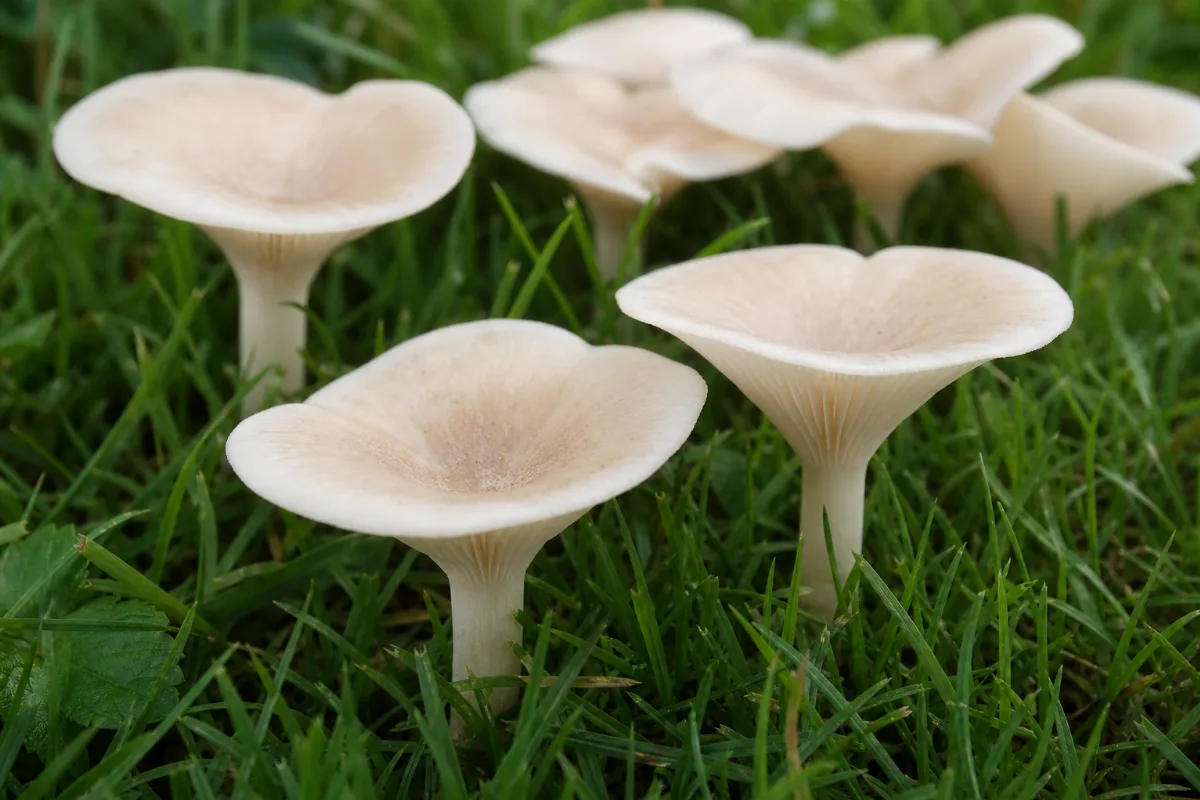
Mushrooms · Poisonous mushroom
Ivory Funnel
Clitocybe rivulosa (Pers.) P.Kumm. · also called Fool's funnel, sweating mushroom; also written Clitocybe dealbata
The ivory funnel is a poisonous mushroom. It contains muscarine, which can cause heavy sweating, tears, drooling, stomach cramps, vomiting, a slow heart rate and breathing trouble, usually within hours of eating it. Cooking, drying and freezing do not remove the poison. Most people recover with hospital care, but serious cases need intensive treatment, and no health benefit has been shown. If someone has eaten it, call a poison centre right away.
General information, not medical advice. Last substantive update · Not medically reviewed. A named clinician has not signed off on this page. How this page is made
About Ivory Funnel
The ivory funnel (Clitocybe rivulosa, also written Clitocybe dealbata) is a poisonous mushroom. Its poison, muscarine, causes heavy sweating, tears, drooling, cramps, a slow heart rate and breathing trouble, usually within a few hours, and cooking does not remove it. Most people recover with care, but serious cases need hospital treatment. No study shows any health benefit.
Danger first: what it is and why it poisons
The ivory funnel is a small fungus of the genus Clitocybe. Its poison is muscarine. Muscarine copies the body's own messenger acetylcholine and is not switched off quickly, so the glands and the gut work too hard and the heart slows down. The poison centre monograph says muscarine is present in all parts of these mushrooms.
Signs usually start 30 minutes to a few hours after eating (average 2 hours): sweating, tears, drooling, runny nose, nausea, vomiting, cramps, diarrhoea, small pupils and blurred vision. In severe cases the heart rate and blood pressure fall and the airways fill with fluid. If someone has eaten it, call a poison centre right away.
How serious is it?
In the monograph, signs are at their worst at the start, ease after a few hours and are gone before 24 hours (average 13 hours). In a southern France series of 483 patients who ate muscarine mushrooms (several species, not ivory funnel alone), sweating occurred in 96%, vomiting in 70% and a slow heart rate in 20%, and 58% were treated in hospital.
Some cases are severe. In one family in India, three of four people who ate a Clitocybe-type mushroom dish had severe signs. The report lists a slow heart rate, low blood pressure and wheeze among the signs seen. The three needed intensive care and all four recovered after about 48 hours of observation. The monograph says severe poisonings have been reported in people with stomach surgery or heart disease.
Sources differ on deaths. The monograph says fatalities appear in old literature and none in modern times. A 2025 review calls death rare. The Indian authors say fatal poisoning from Clitocybe and Inocybe has been described. No reliable count for ivory funnel itself was found.
Cooking, drying and freezing do not help
The monograph states that the muscarine molecules are not destroyed by heating during cooking, and that poisonings have followed fresh, dried and frozen mushrooms. A US poison centre says cooking, canning, pickling, freezing and drying do not remove toxins from poisonous mushrooms. This page gives no preparation advice.
Why people are poisoned: mistaken identity
Most muscarine poisonings follow a wrong identification. The monograph says the mushrooms are usually eaten by mistake for edible species, naming Tricholoma terreum, Tricholoma georgii and the fairy ring mushroom (Marasmius oreades). A Missouri field guide gives the same warning. More than a quarter of cases in published series involved unidentified mushrooms.
This page does not teach identification, on purpose. A 2025 review says poisonous species cannot always be told from edible ones by looks, and a photo, an app or a description is never proof that a mushroom is safe.
Treatment is in hospital
Doctors treat severe signs with atropine, a medicine that blocks the effects of muscarine, along with fluids and monitoring. Mild cases may need fluids only. The monograph says atropine relieves the signs but does not shorten the poisoning. Emptying the stomach or giving charcoal is a clinician's choice and helps only if done very early. Amounts are for doctors and are not given here. Do not make the person vomit and do not give food or drink; follow the poison centre's advice.
Names, chemistry and what research exists
Two Latin names are in use. GBIF lists Clitocybe rivulosa as the accepted name and Clitocybe dealbata as a synonym. Poison-centre sources still use both names, so you may meet either.
Almost all published human research is about poisoning: a poison-centre monograph, a few case reports and reviews. Many reports never identified the mushroom. The only laboratory work found on this fungus is a 2024 study of cultured mycelium that found a weakly active precursor which can release muscarine; it shows no benefit. No source gives a measured muscarine amount for ivory funnel itself; the monograph's 0.1 to 0.3% of dry weight is a figure for toxic species of the group.
Children, pets and pregnancy
Children are poisoned too: 41 of the 483 patients in the France series were aged 1 to 14. Dogs can be poisoned, and in a Norwegian study of 421 dogs that ate mushrooms, deaths followed several mushrooms including Clitocybe rivulosa (98.6% of dogs survived). No data were found on pregnancy or breastfeeding, so call a poison centre or a doctor at once if a wild mushroom may have been eaten.
At a glance
Traditional uses history, not proof
- No traditional food, medicine or ceremonial use is described in the sources we read.
- Poison-centre literature names it among the muscarine mushrooms that cause most exposures (IPCS monograph).
- Medical papers describe it only as a cause of accidental poisoning.
Studied for research
- Eating it as food: poisonous, evidence against
- Mood or mind-altering use: no study, not enough evidence
- Medicine or supplement use: no study, not enough evidence
- Laboratory chemistry of its toxin: very low evidence, early research only
- Almost all human research is about poisoning, not benefit
Main compounds
- Muscarine (copies the body's messenger acetylcholine; causes the poisoning)
- 4'-Phosphomuscarine (a weakly active precursor found in cultured mycelium; laboratory research only)
Common forms
- Wild mushroom, eaten by mistake in most reports (strength unknown)
- No supplement, extract or food product was found
Research links: Poison Control (US): get help online or call 1-800-222-1222 · NHS (UK): what to do if someone may be poisoned · Poison centre monograph on muscarine mushrooms (WHO/IPCS) · Muscarinic poisoning in a family after eating mushrooms (abstract) · Mushroom poisoning: an updated review (abstract) · Mushroom ingestions in 421 dogs in Norway (abstract) · Research Library · Genes & Biomarkers Library
What it is and its history
- Accepted scientific name
- Clitocybe rivulosa
- Naming authority
- (Pers.) P.Kumm.
- Synonyms
- Clitocybe dealbata (Sowerby) P.Kumm.; Agaricus dealbatus Sowerby; Agaricus rivulosus Pers.; Clitocybe dealbata var. rivulosa (Pers.) P.Kumm.; Clitocybe rivulosa var. dealbata (Sow. ex Fr.) Konr. & Maubl.; Omphalia dealbata (Sowerby) Quél.; Omphalia rivulosa (Pers.) Quél. (and other forms and varieties)
- Common names
- Ivory funnel (English); Fool's funnel (English (GBIF)); Cracking clitocybe (English (GBIF)); Sweating mushroom (English (used for Clitocybe dealbata by the Missouri Department of Conservation)); Rinnigbereifter Trichterling (German (GBIF)); Clitocybe du bord des routes (French (GBIF)); Giftige weidetrechterzwam (Dutch (GBIF))
- Family or group
- Tricholomataceae in GBIF, a family of fungi (this is a mushroom, not a plant). Other authorities, including the 2026 paper on Clitocybaceae, place Clitocybe in a different family; family placement was not settled here. Part concerned: the fruiting body, which is the mushroom.
- Classification
- Fungi > Basidiomycota > Agaricomycetes > Agaricales > Tricholomataceae (as filed by GBIF) > Clitocybe > Clitocybe rivulosa
- Native range
- GBIF holds about 11,600 occurrence records, about 10,800 in Europe and about 600 in North America, with a few in Asia, Oceania, Africa and South America. Occurrence records are observations, not a map of native range, and native versus introduced status was not checked.
- Habitat
- The monograph says Clitocybe species grow in grassland or open woods and that small white Clitocybe and Inocybe mushrooms are eaten by mistake. Habitat was not otherwise reviewed.
- What it looks like
- Part used: The fruiting body (the mushroom). This page does not describe how to recognise the mushroom, on purpose. A photo, an app or a description is never proof that a mushroom is safe, and reports say identification by eye is unreliable.
- Look-alikes and adulterants
- Name: Edible mushrooms it has been mistaken for; Note: The poison centre monograph says muscarine poisonings are mostly from small white mushrooms eaten in error for edible Tricholoma terreum, T. georgii and fairy ring mushroom (Marasmius oreades). The Missouri Department of Conservation warns that poisonous Clitocybe, including the sweating mushroom (C. dealbata), can be confused with the fairy ring mushroom. This is naming, not guidance for telling mushrooms apart.; Name: Inocybe and other muscarine mushrooms; Note: Small Inocybe (fibrecap) species also contain muscarine. The monograph's most severe cases were from Inocybe.; Name: Death cap and other amatoxin mushrooms; Note: A different poison that damages the liver, with signs starting many hours later. A review says amatoxin mushrooms cause more than 90% of mushroom-poisoning deaths.
- Sustainability and conservation
- Not checked.
Traditional use and history history, not clinical proof
| Tradition or era | Documented use | Source |
|---|---|---|
| Medical and poison-centre literature | The mushroom enters the sources we read only as a cause of accidental poisoning. The IPCS monograph lists Clitocybe dealbata and C. rivulosa among the muscarine-containing species that cause most exposures, and a 2025 review names C. dealbata as an uncommon cause of cholinergic syndrome. | de Haro (IPCS INCHEM G028); Tuğcan & Akpınar 2025 |
| Traditional or ceremonial use | None of the sources we read describes a traditional food, medicine or ceremonial use, so none is described here. A claim from a source we did not read would be marked as not verified. | n/a |
Traditional use shows how it was used. It does not show that it works or is safe today.
What is inside, and how it may work
What it contains and how those compounds act in cells and animals. Laboratory and animal mechanisms are not proven effects in people.
Main compounds
| Compound | Family | Where it is concentrated | Activity studied | Level of evidence |
|---|---|---|---|---|
| Muscarine PubChem 9308 | quaternary ammonium (choline-like) | All parts of muscarine mushrooms (monograph) 0.1 to 0.3% of dry weight for toxic species of the Clitocybe and Inocybe group (monograph figure; not ivory funnel alone; method and number of samples not stated), versus under 0.002% in fly agaric. | Copies acetylcholine at muscarinic receptors and is not quickly switched off, causing the cholinergic signs. The monograph says L-muscarine is the most toxic of four isomers found in toxic fungi. 9 14 3 | Monograph |
| 4'-Phosphomuscarine | phosphorylated muscarine | Mycelium of Clitocybe rivulosa (laboratory culture) | Only weak activity at the M3 muscarinic receptor in human cell tests, but the authors report it can release muscarine through unspecific enzyme action. 3 | Laboratory research |
Mechanisms, receptors and pathways
| Target or pathway | Gene or receptor | What was found | Level |
|---|---|---|---|
| Muscarinic acetylcholine receptors | Muscarinic receptors (M1 to M5; M3 tested in the 2024 cell study) | Muscarine binds muscarinic receptors on automatic (parasympathetic) nerve targets, causing contraction of smooth muscle in the pupil, airways and gut, over-activity of glands and a slower heart. The monograph says the poison is not broken down by the body's usual enzyme, so the stimulation continues. Human data are clinical signs from case reports and series. 14 5 11 | Review |
| Release of muscarine from a precursor | M3 muscarinic receptor (cells) | In cultured Clitocybe rivulosa mycelium the main product was a weakly active phosphorylated precursor that can release muscarine by enzyme action. This is laboratory work on mycelium and cells, not on people. 3 | Laboratory research |
Absorption, metabolism and elimination
- Absorption
- The monograph says only a very small part of ingested muscarine is absorbed from the gut (citing Lambert 2000), yet signs begin within 30 minutes to a few hours and in some cases patients had not finished their dish.
- Distribution
- The monograph says absorbed muscarine is distributed quickly through the body.
- Metabolism
- Not established in sources we read.
- Elimination
- No half-life data available (monograph). Muscarine was found in the urine of two patients by a laboratory method in a 2023 case report.
- Bioavailability
- Not established.
Isolated compounds versus whole extracts
Poisoning data are about eating the mushroom. Laboratory work is on cultured mycelium and cells. Muscarine alone is not the same as the whole mushroom, which may also contain a precursor and other compounds. Nothing about one can be assumed for another.
Nutritional composition
The ivory funnel is not a food or a nutrient source. It is poisonous.
1 very low certainty2 not enough evidence1 evidence against
What was looked at
The 4 benefits and uses checked for Ivory Funnel, each with how strong the evidence is. Tap one to open it.
What is Ivory Funnel good for?
The uses people ask about and how strong the human evidence is for each. None is proven. Read every row together with the Safety tab: this is a poisonous mushroom.
Benefits, one by one
Each card is a research question, not a promise. Tap a goal to filter. Open a card to see the studies, doses and limits.
Mood or mind-altering use
Not enough evidenceNo study has tested the ivory funnel for mood, anxiety, sleep or any mind-altering effect. It is not a psychoactive mushroom. The anxiety and strange behaviour sometimes seen in poisoning are signs of poisoning, not a benefit.
1 studiesNot covered. This page gives no amounts or ways of using the mushroom.
Studies, doses and limits
Results
Nothing measured as a benefit; the effects named are harms.
Why this rating
No trial. Only a poison-centre monograph and case reports, which can show harm but cannot show that the mushroom helps.
Form and dose studied
Not covered. This page gives no amounts or ways of using the mushroom.
Who was studied
People who were poisoned; no clinical group has been studied.
Limits
Poison reports cannot separate a benefit from an adverse effect. The mushroom in most reports was never identified or measured.
Why researchers looked
The poison centre monograph says muscarine mushrooms mainly act on the body's automatic (autonomic) nerves. Headache and behaviour changes such as anxiety, euphoria and fear of death can occur as part of the poisoning.
Traditional use
No traditional or ceremonial use is described in the sources we read.
Proposed mechanism Toxicology monograph
Muscarine stimulates muscarinic acetylcholine receptors, mostly in the automatic nervous system (poison monograph). It is a poisoning mechanism, not a treatment.
A proposed mechanism does not show that the effect happens in people.
This is a poisonous mushroom. Muscarine poisoning causes sweating, tears, saliva, cramps, vomiting, a slow heart rate and breathing trouble, usually within hours. See the Safety tab first. Call a poison centre right away if someone has eaten it.
Eating it as a food
Evidence againstIt is not a food. Eating it has caused poisoning, and cooking does not make it safe.
4 studiesNot covered. No safe amount or preparation is given.
Studies, doses and limits
What the trials found
Case reports and poison-centre series describe poisoning after eating muscarine mushrooms. One family of four in India had cramps and diarrhoea after a Clitocybe-type dish, and three of them had severe signs that needed intensive care. Fresh, dried and frozen muscarine mushrooms have all caused poisoning.
Results
Harm, not benefit. Signs usually start within hours and settle within about 24 hours with care; serious cases need hospital treatment.
Why this rating
Every source we read describes it as poisonous; none describes a safe food use.
Form and dose studied
Not covered. No safe amount or preparation is given.
Who was studied
Adults and children who ate it by mistake.
Limits
Most reports never identified the mushroom, so poisoning is shown for the group of muscarine mushrooms and for Clitocybe-type mushrooms, not proven for every ivory funnel.
Why researchers looked
People are poisoned when they eat it by mistake for an edible mushroom. That is why poison centres write about it.
Traditional use
No traditional food use is described in the sources we read.
Proposed mechanism Toxicology monograph
Muscarine is present in all parts of muscarine mushrooms and is not destroyed by heating during cooking (poison centre monograph). Poison centres also say cooking, canning, pickling, freezing and drying do not remove toxins from poisonous mushrooms.
A proposed mechanism does not show that the effect happens in people.
This is a poisonous mushroom. Muscarine poisoning causes sweating, tears, saliva, cramps, vomiting, a slow heart rate and breathing trouble, usually within hours. See the Safety tab first. Call a poison centre right away if someone has eaten it.
Use as a medicine or supplement
Not enough evidenceNo trial, product or health claim for the ivory funnel was found. It is not a supplement and should not be used as one.
1 studiesNot covered.
Studies, doses and limits
Why this rating
No human study of any health use.
Form and dose studied
Not covered.
Limits
Absence of studies does not make a use safe.
Why researchers looked
It was looked for here so readers do not mistake it for a medicinal mushroom.
Traditional use
No traditional medicinal use is described in the sources we read.
Proposed mechanism Toxicology monograph
None as a benefit. Muscarine is itself the cause of the poisoning.
A proposed mechanism does not show that the effect happens in people.
This is a poisonous mushroom. Muscarine poisoning causes sweating, tears, saliva, cramps, vomiting, a slow heart rate and breathing trouble, usually within hours. See the Safety tab first. Call a poison centre right away if someone has eaten it.
Laboratory chemistry of its toxin
Very low certaintyChemists have studied how this fungus makes and stores muscarine. This is early laboratory work and does not show any benefit.
1 studiesNot covered.
Studies, doses and limits
Results
A precursor of muscarine was identified in the fungus's mycelium. The authors say this matters for emergency medicine when judging how toxic these mushrooms are.
Why this rating
A single laboratory study on cultured mycelium and cells, not on people or on whole mushrooms.
Form and dose studied
Not covered.
Limits
Does not show how much muscarine a person receives from a mushroom.
Why researchers looked
Researchers want to understand how the poison is made and released, because that bears on how dangerous these mushrooms are.
Proposed mechanism Laboratory
In cultured mycelium of Clitocybe rivulosa the authors found 4'-phosphomuscarine as the main natural product. It was only weakly active at the M3 receptor in cell tests, but the authors report it can release muscarine through unspecific enzyme action.
A proposed mechanism does not show that the effect happens in people.
This is a poisonous mushroom. Muscarine poisoning causes sweating, tears, saliva, cramps, vomiting, a slow heart rate and breathing trouble, usually within hours. See the Safety tab first. Call a poison centre right away if someone has eaten it.
Connections to the rest of health
How Ivory Funnel connects to the rest of our health knowledge graph. Every link says what kind of connection it is. A safety link (for example to the liver) is a warning, not a benefit. A study that merely mentions a topic never creates a benefit link.
Explore every connection: goals, body systems, organs, symptoms, genes
B. Body systems
| Connected to | Kind of connection | Evidence status | Context | Studies |
|---|---|---|---|---|
| Digestive system | Adverse effect or risk | Low certainty | Nausea, vomiting, cramps and diarrhoea are among the earliest signs. Preparation or compound: Mushroom (muscarine) |
14 5 |
| Cardiovascular system | Adverse effect or risk | Low certainty | Slow heart rate and low blood pressure in severe cases. Preparation or compound: Mushroom (muscarine) |
14 5 |
| Respiratory system | Adverse effect or risk | Low certainty | Airway secretions, wheeze and, in the monograph, low oxygen. Preparation or compound: Mushroom (muscarine) |
14 5 |
| Nervous System | Biological association | Not enough evidence | Studied for: Mood or mind-altering use Studied for: Laboratory chemistry of its toxin | 14 3 |
| Digestive System | Biological association | Evidence against | Studied for: Eating it as a food | 14 5 11 12 |
C. Body parts and organs
| Connected to | Kind of connection | Evidence status | Context | Studies |
|---|---|---|---|---|
| Heart | Adverse effect or risk | Low certainty | Slow heart rate; cardio-respiratory arrest in one Inocybe case in the monograph. Preparation or compound: Mushroom (muscarine) |
14 5 |
| Gut | Adverse effect or risk | Low certainty | Cramps, vomiting and diarrhoea. Preparation or compound: Mushroom (muscarine) |
14 5 |
| Lungs | Adverse effect or risk | Low certainty | Excess airway secretions, cough and wheeze; breathing trouble means emergency help. Preparation or compound: Mushroom (muscarine) |
14 5 |
E. Health conditions
| Connected to | Kind of connection | Evidence status | Context | Studies |
|---|---|---|---|---|
| Bradycardia | Adverse effect or risk | Low certainty | A slow heart rate is a documented sign of muscarine poisoning, treated with atropine in hospital. Preparation or compound: Mushroom (muscarine) |
14 5 |
J. Genes, receptors and enzymes
L. Active compounds
| Connected to | Kind of connection | Evidence status | Context | Studies |
|---|---|---|---|---|
| Muscarine | Biological association | Monograph | Copies acetylcholine at muscarinic receptors and is not quickly switched off, causing the cholinergic signs. The monograph says L-muscarine is the most toxic of four isomers found in toxic fungi. Preparation or compound: All parts of muscarine mushrooms (monograph) |
9 14 3 |
| 4'-Phosphomuscarine | Biological association | In vitro | Only weak activity at the M3 muscarinic receptor in human cell tests, but the authors report it can release muscarine through unspecific enzyme action. Preparation or compound: Mycelium of Clitocybe rivulosa (laboratory culture) |
3 |
Each connection is stored with the ingredient, the connected record, the kind of connection, the evidence status, the supporting studies, the preparation or compound involved, and a review date (last reviewed October 25, 2026).
Evidence at a glance: what the research found for 4 outcomes
Each outcome below is one thing researchers measured. Certainty is how far the evidence can be trusted, not how well it works. The full studies are on the next tab.
The evidence
The research centre for Ivory Funnel. Every record here was checked against PubMed or the publisher's page; we never list a study we have not verified.
Evidence by outcome
Bars show how many studies we found for each outcome, not how well it works. People are added up across trials only (reviews are not added, to avoid double counting).
How we rate evidence
High certainty
Several well-run trials or reviews agree; further research is unlikely to change the picture much.
Moderate certainty
Good trials point the same way, but some doubt remains.
Low certainty
Small, short or inconsistent trials. The finding could change with better research.
Very low certainty
Very little or very weak human data. Treat as a possibility only.
Mixed findings
Trials or reviews disagree with each other.
Not enough evidence
Not enough human research to say either way.
Evidence against
Good research found no benefit, or found harm.
We take the reviewers' own risk-of-bias and GRADE statements where they exist, and otherwise judge from study size, design, consistency, directness and whether a product matches what is sold. Many publications do not make evidence high. Method note: We searched PubMed and read the abstracts of 7 papers, read the WHO/IPCS poison monograph on muscarine mushrooms, Poison Control (US), NHS (UK), a US hospital poison-centre page and a state field guide, and checked the scientific name in GBIF and the toxin identifier in PubChem. Index Fungorum and MycoBank were not opened. Where a statement could not be checked it is marked as unverified.
Study library: every study we checked 14
| Study | Design | People | Product, dose, length | Result |
|---|---|---|---|---|
| Alvarado 2015 Atractosporocybe, Leucocybe and Rhizocybe: three new clitocyboid genera in the Tricholomatoid clade (Agaricales) with notes on Clitocybe and Lepista. Mycologia · PMID 25344261 · DOI |
Laboratory fungi |
DNA analysis of clitocyboid fungi | n/a |
Whitish clitocyboid species including Clitocybe dealbata and C. rivulosa are shown to be genetically related to the core lineage of the genus Clitocybe (Clitocybeae). The abstract does not say whether the two names are one species. Methods, limits and fundingOutcomes: Family tree of Clitocybe-like fungi Limitations: Taxonomy paper; abstract read only. Funding and conflicts: Research support, non-US government (per PubMed). Read: abstract |
| Chan 2023 Cholinergic Mushroom Poisoning With a Detection of Muscarine Toxin in Urine. J Med Cases · PMID 37435104 · DOI |
Case report |
2 Two middle-aged patients in Hong Kong who ate cooked wild mushrooms from a country park |
Cooked wild mushrooms (species not stated in abstract) |
Stomach pain, vomiting and diarrhoea were followed by small pupils, palpitations and sweating, which fit a cholinergic picture. Muscarine was found in the urine of both patients by a laboratory method (liquid chromatography with tandem mass spectrometry). One woman had mildly raised liver enzymes. The abstract says muscarine is found in mushrooms such as Inocybe and Clitocybe and does not name the species they ate. Methods, limits and fundingOutcomes: Signs, tests, diagnosis Limitations: Two patients. Abstract read only; the species is not stated there, so this is not shown to be ivory funnel. Funding and conflicts: Not stated in the abstract. Read: abstract |
| Dörner 2024 The Fatal Mushroom Neurotoxin Muscarine is Released from a Harmless Phosphorylated Precursor upon Cellular Injury. Angew Chem Int Ed Engl · PMID 39432715 · DOI |
Laboratory in vitro |
Mycelium (cultured fungal threads) of Clitocybe rivulosa, called fool's funnel by the authors, plus two other muscarine-producing fungi | Clitocybe rivulosa mycelium |
The main natural product in C. rivulosa mycelium was 4'-phosphomuscarine, which the authors found only weakly active at the M3 muscarinic receptor in cell tests. The same compound was seen in two other fungi. The authors report that the harmless-looking precursor can release muscarine through unspecific enzyme action, which they say matters for estimating the true toxicity of these mushrooms. A related compound, muscaridine, did not activate the receptor. Methods, limits and fundingOutcomes: Chemical profile of the mycelium; effect of the precursor on a muscarinic receptor in human cells Limitations: Laboratory work on cultured mycelium and cells, not on mushrooms eaten by people; it does not show how much of the precursor turns into muscarine in a person. Funding and conflicts: Not stated in the abstract. Read: abstract |
| GBIF 2026 GBIF Backbone Taxonomy: Clitocybe rivulosa (Pers.) P.Kumm., species key 2531052 GBIF API · Source |
Registry or database n/a |
Name authority record | n/a |
Clitocybe rivulosa (Pers.) P.Kumm. is ACCEPTED. Clitocybe dealbata (Sowerby) P.Kumm. (key 2531056) is listed as a SYNONYM of it. GBIF family: Tricholomataceae. English vernacular names in the record include Fool's Funnel and Cracking Clitocybe. About 11,600 occurrence records, about 10,800 of them in Europe and about 600 in North America. Methods, limits and fundingOutcomes: Accepted name, synonyms, family, occurrence counts Limitations: GBIF follows one taxonomy; other authorities may differ, and Index Fungorum was not opened. Occurrence records are observations, not a map of native range. Funding and conflicts: n/a Read: API record |
| George 2013 Muscarinic toxicity among family members after consumption of mushrooms. Toxicol Int · PMID 23833447 · DOI |
Case report |
4 Four members of one family in India (three women, one man) who ate a wild mushroom dish picked on their farmland |
Wild mushroom dish (Clitocybe-type by description) |
Two to three hours after the meal all four were irritable, exhausted, and had cramps and diarrhoea. The report lists salivation, sweating, tears, blurred vision, small pupils, wheeze, slow heart rate and low blood pressure among the signs seen in the family. Three had severe signs and one was milder. They were given fluids and atropine and went to intensive care; signs were gone after 8 to 10 hours and they went home after 48 hours of observation. The man was mild and went home within 6 hours. The mushrooms could not be collected; the patients' description matched Clitocybe species. The authors say there is no specific antidote and that fatal muscarinic poisoning from Clitocybe and Inocybe has been described. Methods, limits and fundingOutcomes: Signs, treatment and recovery Limitations: One family. The mushrooms were never identified, so this is not proven to be ivory funnel. Funding and conflicts: Not stated in the abstract. Read: abstract and open-access full text |
| Missouri Department of Conservation 2026 Missouri Department of Conservation: Fairy Ring Mushroom (field guide) mdc.mo.gov · Source |
Authoritative guidance n/a |
General public | n/a |
The field guide warns that certain poisonous Clitocybe and Inocybe species can be confused with the fairy ring mushroom, and names the sweating mushroom (Clitocybe dealbata) as also poisonous. Methods, limits and fundingOutcomes: Look-alike warning for an edible mushroom Limitations: Used only for the confusion warning. This page gives no identification help. Funding and conflicts: State agency; no product promoted. Read: page text |
| NHS 2026 NHS (UK): Poisoning nhs.uk · Source |
Authoritative guidance n/a |
General public | n/a |
Call 999 or go to A&E if someone may have swallowed something harmful and has lost consciousness, stopped breathing, has severe breathing difficulty or has a seizure; call NHS 111 if unsure. While waiting: do not make the person sick and do not give food or drink; take the substance or packaging to show doctors. Certain plants and mushrooms are listed as causes of poisoning. Methods, limits and fundingOutcomes: What to do after a possible poisoning Limitations: General guidance, not mushroom specific. Funding and conflicts: Public health service; no product promoted. Read: full-text |
| Poison Control 2026 Poison Control (America's Poison Centers): Need immediate assistance? poison.org · Source |
Authoritative guidance n/a |
General public | n/a |
Free, confidential expert help 24 hours a day at 1-800-222-1222 (US) or online. Call 911 immediately if the person collapses, has a seizure, has trouble breathing or cannot be awakened. The online tool is not for pregnancy, children under 6 months, adults over 79 or pets; call a poison center instead. Methods, limits and fundingOutcomes: What to do after a possible poisoning Limitations: General poison guidance, not mushroom specific. Funding and conflicts: Non-profit; no product promoted. Read: full-text |
| PubChem 2026 PubChem: Muscarine (CID 9308) PubChem REST API · Source |
Registry or database n/a |
Chemical record | n/a |
PubChem CID 9308, title Muscarine, formula C9H20NO2+ (a charged quaternary ammonium compound). Methods, limits and fundingOutcomes: Identifier and formula Limitations: Identifier check only. Funding and conflicts: n/a Read: API record |
| Seljetun 2023 A retrospective evaluation of mushroom ingestions in 421 dogs in Norway (2011-2022). Vet Rec Open · PMID 37057032 · DOI |
Case series dog |
421 421 dogs reported to the Norwegian Poison Information Center, 2011 to 2022 |
n/a |
Muscarinic mushrooms were the second most common poisonous group after stomach-irritant mushrooms. About 64% of cases were managed at home and 33% were hospitalised. Survival was 98.6%; deaths followed ingestion of Amanita muscaria, Cortinarius rubellus, Amanita virosa, Clitocybe rivulosa and Inocybe species. The authors stress prompt, correct identification of the mushroom. Methods, limits and fundingOutcomes: Mushroom types, signs, treatment, survival Limitations: Dog study. Number of Clitocybe rivulosa cases and deaths is not in the abstract. Funding and conflicts: Not stated in the abstract. Read: abstract |
| Tuğcan 2025 Mushroom poisoning: An updated review. Turk J Emerg Med · PMID 39882097 · DOI |
Review |
Narrative review of poisonous mushroom syndromes | n/a |
Says it is not possible to tell poisonous species from some edible ones by looks, and that unintentional mushroom eating is an important public health problem. Names Clitocybe dealbata as an uncommon muscarine-containing mushroom that causes cholinergic syndrome. After muscarine mushrooms, signs start within 30 minutes to 2 hours, death is rare and signs usually settle within 12 hours; treatment is atropine and supportive care. Cyclopeptide (amatoxin) mushrooms cause more than 90% of mushroom-poisoning deaths. Methods, limits and fundingOutcomes: Clinical syndromes, toxin mechanisms, treatment Limitations: Narrative review; the full text was read for the muscarine passages only. Funding and conflicts: Not stated in the abstract. Read: abstract and open-access full text |
| University of Kansas Health System Poison Control Center 2026 University of Kansas Health System Poison Control Center: Poisonous Mushrooms kansashealthsystem.com · Source |
Authoritative guidance n/a |
General public | n/a |
Even very experienced gatherers can find it hard to tell whether a mushroom is safe. Cooking, canning, pickling, freezing and drying do not remove toxins. If someone eats a wild mushroom, call the poison centre immediately, save a piece if possible, and do not wait for symptoms. Do not pick and eat wild mushrooms. Methods, limits and fundingOutcomes: Poisonous mushroom risks and first steps Limitations: General page for all poisonous mushrooms. Funding and conflicts: Hospital poison centre; no product promoted. Read: full-text |
| Xu 2026 Phylogenetic and Phylogenomic Analyses Reveal New Taxa in Clitocybaceae, with Notes on Poisonous Species and Spore Evolution. J Fungi (Basel) · PMID 42646075 · DOI |
Laboratory human and fungi |
24 24 Chinese specimens of Clitocybaceae fungi, most collected at poisoning sites |
n/a |
The authors say the edibility and toxicity of many species in this family are unknown, which poses a poisoning risk. In their poisoning cases, several species of Clitocybe and Collybia led to muscarinic syndrome and one species to gastroenteritis. Ivory funnel is not among the named species in the abstract. Methods, limits and fundingOutcomes: Naming, DNA placement and the poisoning signs linked to each species Limitations: Specimens from China; not about ivory funnel. Funding and conflicts: Not stated in the abstract. Read: abstract |
| de Haro 2000 Inocybe, clitocybe, omphalotus and others (IPCS INCHEM Poisons Information Monograph G028; reviewed October 2000) IPCS INCHEM · Source |
Monograph |
Poison-centre monograph on muscarine-containing mushrooms (Inocybe, Clitocybe including C. dealbata and C. rivulosa, Omphalotus and others) | Muscarine-containing mushrooms (group) |
Lists Clitocybe dealbata and C. rivulosa among muscarine-containing species. Muscarine is in all parts of the mushrooms; toxic species hold 0.1 to 0.3% of dry weight (a group figure). Heating during cooking does not destroy the toxin, and fresh, dried and frozen mushrooms have caused poisoning. Signs start from 30 minutes to a few hours (average 2 hours): sweating, tears, saliva, runny nose, airway secretions, slow heart rate, small pupils, blurred vision, nausea, vomiting, diarrhoea, abdominal pain, low blood pressure. All signs disappear before 24 hours (average 13 hours). Fatalities are reported in old literature and none in modern times (Lambert 2000, as cited). Severe poisoning has been reported in people with stomach surgery or heart disease. Atropine counters the signs but does not shorten the poisoning. In a southern France series of 248 incidents (483 patients, 41 children aged 1 to 14) sweating occurred in 96%, vomiting 70%, diarrhoea 62%, low blood pressure 36%, slow heart rate 20%; 58% were treated in hospital. Most poisonings are from small white mushrooms eaten by mistake for edible ones such as Tricholoma terreum, T. georgii and Marasmius oreades; over a quarter of cases in published series involved unidentified mushrooms. Methods, limits and fundingOutcomes: Toxin, signs, course, treatment principles, confusion with edible species Limitations: A 2000 monograph with parts marked pending. Figures are for the whole group of muscarine mushrooms (mostly Inocybe in the severe cases quoted), not ivory funnel alone. Teratogenicity, mutagenicity and interactions are listed as "no data available". Funding and conflicts: Public-sector poison-information monograph; no industry funding apparent. Read: full-text |
What we do not know yet
- No human study of the ivory funnel for any use.
- No reliable count of poisonings, hospital admissions or deaths from ivory funnel itself; most reports cover the whole group of muscarine mushrooms or never identified the mushroom.
- No measured muscarine amount for ivory funnel specimens; the only figure is a group range from a poison-centre monograph.
- No studies in pregnancy, breastfeeding, older adults or people on prescription medicines.
- Food and drug regulators other than poison centres were not checked, and a 2014 veterinary letter on a fatal dog poisoning had no abstract and was not read.
How new research is added
New studies are found by a saved PubMed search and are placed in a review queue. A person reads each one before it changes this page. Poison-help pages are rechecked on a schedule.
Lab markers
What changed in blood or saliva tests during trials. A changed number is not the same as feeling or being healthier, and we give no "normal ranges".
Safety
What studies and official sources say about side effects, medicines and who should check first. Each point shows what kind of evidence it comes from.
Main points to know 6
- If someone has eaten it, or any wild mushroom, call a poison centre now. Do not wait for symptoms. In the US call Poison Help at 1-800-222-1222 (free and confidential), or 911 if the person collapses, has a seizure, has trouble breathing or cannot be awakened. In the UK call NHS 111 if you are unsure and 999 in an emergency. Keep the mushroom, a photo or the package to show staff. Authoritative guidance 8 7 12
- Muscarine poisoning is fast and can be serious. Signs usually start from 30 minutes to a few hours after eating: sweating, tears, saliva, cramps, vomiting, diarrhoea, small pupils and blurred vision. In severe cases the heart slows, blood pressure falls and the airways fill with secretions. In a family of four in India, three needed intensive care and 48 hours of observation. The mushroom could not be identified, so this is a Clitocybe-type poisoning, not proven ivory funnel. Case report 14 5
- Cooking, drying and freezing do not make it safe. The poison centre monograph states that the muscarine molecules are not destroyed by heating during cooking, and that fresh, dried and frozen mushrooms have all caused poisoning. A US poison centre says cooking, canning, pickling, freezing and drying do not remove toxins from poisonous mushrooms. Toxicology monograph 14 12
- It is eaten by mistake for edible mushrooms. Most muscarine poisonings come from small white mushrooms eaten in error. The monograph names edible Tricholoma and fairy ring mushrooms (Marasmius oreades) among those involved in confusion, and a state field guide warns about the same mix-up. More than a quarter of cases in published series involved unidentified mushrooms. This page does not teach identification, and a photo, app or description is never proof that a mushroom is safe. Toxicology monograph 14 6 11
- Treatment is in hospital, not at home. Doctors treat severe signs with a medicine called atropine, plus fluids and monitoring. The monograph says atropine relieves the signs but does not shorten the poisoning, and that emptying the stomach or giving charcoal helps only if done very early. Those are clinician decisions. Do not try to make the person vomit and do not give food or drink; follow the poison centre. Amounts are for doctors and are not given here. Toxicology monograph 14 5 7
- Dogs can die from it. In a Norwegian study of 421 dogs that ate mushrooms, 98.6% survived. The deaths followed several mushrooms, one of them Clitocybe rivulosa. Call a vet or animal poison service at once if a pet may have eaten a wild mushroom. Case series 10
Side effects 8
| Effect | How often | Severity and recovery | Evidence |
|---|---|---|---|
| Heavy sweating, tears, saliva and runny nose The monograph says the sweating can be so heavy that clothes and bed are wet. | Sweating in 96%, tears in 6%, runny nose in 6% of 483 patients with muscarine mushroom poisoning in southern France (group of species, not ivory funnel alone) | moderate Usually settles within 24 hours (average 13 hours) | Case series 14 |
| Nausea, vomiting, cramps and diarrhoea Often the first signs. | Vomiting 70%, diarrhoea 62%, abdominal pain 32% in the same French series | moderate Usually settles within a day with care; dehydration can need fluids in hospital | Case series 14 5 |
| Slow heart rate and low blood pressure The most dangerous part of the poisoning. Severe cases were reported in people with heart disease or stomach surgery. | Low blood pressure 36%, slow heart rate 20% in the French series; the Indian report lists both among the signs in a family where three of four had severe signs | severe Reversed with atropine and intensive care in the cases we read | Case series 14 5 |
| Wheeze, cough and airway secretions Breathing trouble is a reason to call 911 or the local emergency number. | The Indian report lists airway secretions, cough and wheeze among the signs in the family; the monograph says narrowing of the airways leading to low oxygen may occur | severe Settled with treatment in the cases we read | Case report 14 5 |
| Small pupils and blurred vision Double vision has also been reported. | Small pupils 25%, blurred vision 22% in the French series | mild Settles as the poisoning passes | Case series 14 |
| Headache, anxiety and behaviour changes Anxiety, euphoria and fear of death are named. | Listed as 'may occur' in the monograph; no frequency given | mild to moderate Settles with the poisoning | Toxicology monograph 14 |
| Bladder contraction and urgent need to pass urine | Listed as 'may occur'; no frequency given | mild Settles with the poisoning | Toxicology monograph 14 |
| Death No reliable count of poisonings or deaths from ivory funnel was found, so the true risk is not known. | Sources differ: the monograph says fatalities were reported in old literature and none in modern times (citing Lambert 2000); a 2025 review says death is rare; the Indian authors say fatal muscarinic poisoning from Clitocybe and Inocybe has been described; one dog study lists C. rivulosa among deaths in dogs. | life-threatening n/a | Review 14 11 5 10 |
Liver
The poison centre monograph lists liver effects as 'never reported' for muscarine mushrooms. In one report of two patients with muscarine in their urine, one woman had mildly raised liver enzymes; the species was not named. A different, delayed liver poisoning comes from amatoxin mushrooms such as the death cap, and reviews say those cause more than 90% of mushroom-poisoning deaths. A mixed meal could contain both kinds. 14 2 5 11
How often. Liver injury from muscarine itself is not described in the sources we read. Liver failure belongs to other mushrooms and starts many hours later.
- Hong Kong case report (2 patients). Mildly raised liver enzymes in one woman after a cholinergic mushroom poisoning; muscarine found in urine; species not stated in the abstract. 2
- Indian family report (4 patients). Liver blood tests were normal in the four family members. 5
This is a safety connection. It is not evidence that Ivory Funnel supports liver health.
Medicines and supplements 5
| With | Why it matters | Importance | Evidence | What to do |
|---|---|---|---|---|
| Medicines that slow the heart, such as digoxin (digitalis) prescription | Muscarine slows the heart; so do these medicines. The monograph describes a 70-year-old woman treated with digitalis who had severe slow heart rate and shock after eating an Inocybe mushroom; she recovered within a day in intensive care. | A single case in a monograph, for a different muscarine genus. It points to extra danger but cannot show how often. | Case report Not enough evidence 14 | Tell the emergency team about every medicine the person takes. |
| Beta-blockers and other heart-rate-lowering medicines prescription | In theory the slowing of the heart could add up with muscarine. | Not studied. This is a theory, not a finding from a source we read. | Pharmacological theory Not enough evidence | Tell the emergency team about every medicine the person takes. |
| Medicines that raise acetylcholine, such as some medicines for memory loss or myasthenia prescription | They act on the same nerve system as muscarine, so effects could add up in theory. | Not studied. This is a theory, not a finding from a source we read. | Pharmacological theory Not enough evidence | Tell the emergency team about every medicine the person takes. |
| Alcohol and liver disease other | The monograph describes a 58-year-old man with stomach surgery and alcoholic liver disease who had a cardio-respiratory arrest 1.5 hours after eating an Inocybe mushroom. He recovered by day three in intensive care. | One case for a different genus, with several health problems at once, so alcohol cannot be singled out. | Case report Not enough evidence 14 | Tell the emergency team about alcohol and every other substance taken. |
| Atropine given by doctors treatment | Atropine blocks muscarinic receptors and counters the signs; the monograph says it does not shorten the poisoning. | A hospital treatment, not an interaction to manage at home. Doses are for clinicians. | Toxicology monograph Moderate certainty 14 5 11 | Treatment is decided by doctors. Do not give any medicine at home unless a poison centre tells you to. |
Who should check first 6
| Situation | Advice | Evidence |
|---|---|---|
| Anyone | There is no proven benefit and the mushroom is poisonous. Do not eat it, in any form. | Toxicology monograph 14 12 |
| People with heart disease, a slow heart rate, or past stomach surgery | The monograph says severe poisonings were reported in people with stomach surgery or a history of heart disease. Treat any possible eating of a wild mushroom as an emergency. | Toxicology monograph 14 |
| Pregnancy and breastfeeding | No data were found. The monograph lists teratogenicity as 'no data available', and Poison Control's online tool says it does not cover pregnancy. Call a poison centre or a doctor at once if a wild mushroom may have been eaten. | Authoritative guidance 14 8 |
| Children | Children are poisoned too: 41 of 483 patients in the southern France muscarine-mushroom series were aged 1 to 14, and the monograph says accidental poisonings also occur with children. Call a poison centre immediately. | Case series 14 |
| Mushroom allergy | The monograph lists an allergic reaction as 'never reported' for muscarine poisoning. A US poison centre notes that some people are allergic to mushrooms that are not poisonous. Allergy is a separate question from poisoning. | Toxicology monograph 14 12 |
| Pets | Dogs can be poisoned. Call a vet or animal poison service immediately. | Case series 10 |
Overdose, product quality and regulators
Summary. The main poison is muscarine. It is a charged compound that copies the body's own messenger acetylcholine at muscarinic receptors, so sweating, saliva, tears, gut movement and airway secretions go into overdrive and the heart slows. The monograph says the body does not switch it off quickly. Some muscarine mushrooms also hold small amounts of other compounds (the monograph names acetylcholine, choline, histamine, muscimol, muscazone and ibotenic acid) in different proportions; this was not measured for ivory funnel.
Amounts. No safe amount has been established in any source we read, and the amount of muscarine in a given mushroom is unknown. The monograph gives a group figure: toxic species of the group contain 0.1 to 0.3% muscarine of dry weight, versus under 0.002% in fly agaric. That is not a measurement of ivory funnel and not a guide to how much is harmful.
Onset and course. Onset 30 minutes to a few hours (average 2 hours; in one case under 10 minutes). Signs are at their worst at the start, ease after a few hours and are gone before 24 hours (average 13 hours) in the monograph. A 2025 review says usually within 12 hours. Severe cases need intensive care.
Repeated use. No data on repeated or long-term exposure were found; the monograph lists chronic poisoning as 'no data available'.
Animal data. A 14-year-old dog in a monograph case recovered within 24 hours after eating a different muscarine mushroom. In the Norwegian dog study 98.6% of 421 dogs survived, and Clitocybe rivulosa is among the mushrooms followed by death.
Toxic parts. The monograph says muscarine is present in all parts of these mushrooms. Treat the whole mushroom as poisonous.
Not read. Muscarine content measured in ivory funnel specimens, blood levels linked to severity, long-term effects and the share of the toxin released from a precursor in people were not found in the sources we read.
No product made from the ivory funnel was found, and there is no legitimate supplement or food use. The main 'quality' problem is mistaken identity.
Mistaken identity. Muscarine poisonings usually follow a wrong identification. Over a quarter of cases in published series involved unidentified mushrooms. A 2026 paper adds that the edibility and toxicity of many species in this fungal family are unknown. 14 13
Dried and frozen mushrooms. Poisonings have also followed dried or frozen mushrooms, so a stored or processed form is not safer. 14
Heavy metals and other contaminants. Not reviewed.
| Body | Action | Date |
|---|---|---|
| Poison Control (America's Poison Centers) (United States) | Free, confidential help at 1-800-222-1222 or online, 24 hours a day. Call 911 immediately if the person collapses, has a seizure, has trouble breathing or cannot be awakened. source | n/a |
| NHS (United Kingdom) | Call 999 or go to A&E if someone may have swallowed something harmful and has lost consciousness, stopped breathing, has severe breathing difficulty or a seizure. Call NHS 111 if unsure. Do not make the person sick and do not give food or drink. source | n/a |
| WHO / IPCS INCHEM (International) | Poisons Information Monograph G028 lists Clitocybe dealbata and C. rivulosa among muscarine-containing species and gives management principles for clinicians. source | 2000-10 |
When to get medical help
- If someone may have eaten this mushroom, or any wild mushroom, call a poison centre right away, even if they seem fine. In the US call Poison Help at 1-800-222-1222 (free and confidential); call 911 now if the person collapses, has a seizure, has trouble breathing or cannot be awakened (poison.org).
- UK: call 999 if the person has lost consciousness, stopped breathing, has severe breathing difficulty or a seizure; call NHS 111 if you are not sure whether something swallowed is harmful (NHS). For other countries see the poison help by country page.
- Signs seen in reports: heavy sweating, tears, drooling, runny nose, stomach cramps, vomiting, diarrhoea, small pupils, blurred vision, wheeze or cough, a slow heartbeat, dizziness or fainting.
- Do not wait to see whether symptoms pass, do not try to make the person vomit, and do not give food or drink. Take the mushroom, a photo or the leftovers with you so staff can see what was eaten.
- If a wild mushroom of unknown type may have been eaten, go to hospital even if the first signs settle. Other poisonous mushrooms, such as the death cap, cause liver damage with signs that start many hours later and may seem to improve first.
- Pets: dogs and other animals can be poisoned. Call a vet or an animal poison service immediately.
If someone may be poisoned or in a crisis, contact a clinician or emergency service straight away. In the US, Poison Control is 1-800-222-1222.
General information only, not medical advice. Ask a clinician or pharmacist before use, especially with medicines, in pregnancy or with a health condition. See the Natural Remedy Safety guide.
Frequently asked questions
Is the ivory funnel poisonous?
What should I do if someone has eaten it or any wild mushroom?
Call a poison centre right away, even if the person seems fine. In the US call Poison Help at 1-800-222-1222 (free, confidential). Call 911 now if the person collapses, has a seizure, has trouble breathing or cannot be awakened. In the UK call NHS 111 if you are unsure, or 999 in an emergency. Do not make the person vomit, and keep the mushroom or a photo to show staff.
How fast do symptoms start?
Does cooking remove the poison?
Can people die from it?
Sources differ. The monograph says deaths appear in old literature and none in modern times. A 2025 review says death is rare, and authors of an Indian family report say fatal muscarinic poisoning from Clitocybe and Inocybe has been described. A Norwegian dog study lists Clitocybe rivulosa among mushrooms followed by death in dogs. No reliable count for ivory funnel exists, so treat every case as an emergency.
Is there an antidote?
Which edible mushrooms is it confused with?
The monograph names edible Tricholoma terreum, Tricholoma georgii and the fairy ring mushroom (Marasmius oreades) among mushrooms involved in confusion, and a Missouri field guide warns that poisonous Clitocybe can be mistaken for the fairy ring mushroom. Do not try to tell mushrooms apart from text, photos or apps.
Are ivory funnel and Clitocybe dealbata the same mushroom?
Is it psychoactive, or a supplement?
No. It is not a psychoactive mushroom and no supplement or food use was found. The anxiety or behaviour changes listed in the monograph are signs of poisoning.
Can children or pets be poisoned?
Is it safe in pregnancy or when breastfeeding?
Can it interact with medicines?
Interactions were not studied. The monograph describes severe slow heart rate and shock in a woman taking digitalis and a cardio-respiratory arrest in a man with stomach surgery and alcoholic liver disease, both after eating Inocybe, a different muscarine genus. Tell the emergency team about every medicine and substance taken.
Explore by health goal
Editorial transparency
- Written by
- AlternativeMed editorial team. Research compiled with AI assistance, then checked against PubMed records, a poison-centre monograph and public-health pages.
- Medical review
- None. This page has not been reviewed by a physician or pharmacist.
- First published
- 2026-10-25
- Last substantive update
- 2026-10-25
- How we research
- We searched PubMed and read the abstracts of 7 papers, read the WHO/IPCS poison monograph on muscarine mushrooms, Poison Control (US), NHS (UK), a US hospital poison-centre page and a state field guide, and checked the scientific name in GBIF and the toxin identifier in PubChem. Index Fungorum and MycoBank were not opened. Where a statement could not be checked it is marked as unverified.
- How we rate evidence
- See "How we rate evidence" in the Evidence tab.
- Independence
- No product is promoted on this page. No affiliate links are shown, and none will be added for this mushroom. This page gives no dose, preparation, identification, picking, growing or sourcing advice.
Sources 14
Each source was opened and checked. Where we read only the abstract, it says so. The small numbers in the text point here.
- Alvarado P, Moreno G, Vizzini A, Consiglio G, Manjón JL, Setti L. Atractosporocybe, Leucocybe and Rhizocybe: three new clitocyboid genera in the Tricholomatoid clade (Agaricales) with notes on Clitocybe and Lepista.. Mycologia. 2015. PMID 25344261. DOI 10.3852/13-369. (abstract)
- Chan TYC, Ng SW, Chan CK, Lee HHC, Mak TWL. Cholinergic Mushroom Poisoning With a Detection of Muscarine Toxin in Urine.. J Med Cases. 2023. PMID 37435104. DOI 10.14740/jmc4109. (abstract)
- Dörner S, Trottmann F, Jordan PM, Rogge K, Bartels B, Werz O, Hertweck C, Hoffmeister D. The Fatal Mushroom Neurotoxin Muscarine is Released from a Harmless Phosphorylated Precursor upon Cellular Injury.. Angew Chem Int Ed Engl. 2024. PMID 39432715. DOI 10.1002/anie.202417220. (abstract)
- GBIF. GBIF Backbone Taxonomy: Clitocybe rivulosa (Pers.) P.Kumm., species key 2531052. GBIF API. 2026. (API record)
- George P, Hegde N. Muscarinic toxicity among family members after consumption of mushrooms.. Toxicol Int. 2013. PMID 23833447. DOI 10.4103/0971-6580.111559. (abstract and open-access full text)
- Missouri Department of Conservation. Missouri Department of Conservation: Fairy Ring Mushroom (field guide). mdc.mo.gov. 2026. (page text)
- NHS. NHS (UK): Poisoning. nhs.uk. 2026. (full-text)
- Poison Control. Poison Control (America's Poison Centers): Need immediate assistance?. poison.org. 2026. (full-text)
- PubChem. PubChem: Muscarine (CID 9308). PubChem REST API. 2026. (API record)
- Seljetun KO, Kragstad HR. A retrospective evaluation of mushroom ingestions in 421 dogs in Norway (2011-2022).. Vet Rec Open. 2023. PMID 37057032. DOI 10.1002/vro2.60. (abstract)
- Tuğcan MO, Akpınar AA. Mushroom poisoning: An updated review.. Turk J Emerg Med. 2025. PMID 39882097. DOI 10.4103/tjem.tjem_129_24. (abstract and open-access full text)
- University of Kansas Health System Poison Control Center. University of Kansas Health System Poison Control Center: Poisonous Mushrooms. kansashealthsystem.com. 2026. (full-text)
- Xu YD, Li HJ, Sheng CG, Chen ZH, He ZM. Phylogenetic and Phylogenomic Analyses Reveal New Taxa in Clitocybaceae, with Notes on Poisonous Species and Spore Evolution.. J Fungi (Basel). 2026. PMID 42646075. DOI 10.3390/jof12080548. (abstract)
- de Haro L. Inocybe, clitocybe, omphalotus and others (IPCS INCHEM Poisons Information Monograph G028; reviewed October 2000). IPCS INCHEM. 2000. (full-text)


